EP4552513A1 - Ensemble de génération d'aérosol comprenant un élément chauffant capable de réaction exothermique - Google Patents
Ensemble de génération d'aérosol comprenant un élément chauffant capable de réaction exothermique Download PDFInfo
- Publication number
- EP4552513A1 EP4552513A1 EP23208977.1A EP23208977A EP4552513A1 EP 4552513 A1 EP4552513 A1 EP 4552513A1 EP 23208977 A EP23208977 A EP 23208977A EP 4552513 A1 EP4552513 A1 EP 4552513A1
- Authority
- EP
- European Patent Office
- Prior art keywords
- aerosol generating
- heating element
- aerosol
- heater
- fluid
- Prior art date
- Legal status (The legal status is an assumption and is not a legal conclusion. Google has not performed a legal analysis and makes no representation as to the accuracy of the status listed.)
- Pending
Links
Images

Classifications
-
- A—HUMAN NECESSITIES
- A24—TOBACCO; CIGARS; CIGARETTES; SIMULATED SMOKING DEVICES; SMOKERS' REQUISITES
- A24F—SMOKERS' REQUISITES; MATCH BOXES; SIMULATED SMOKING DEVICES
- A24F42/00—Simulated smoking devices other than electrically operated; Component parts thereof; Manufacture or testing thereof
- A24F42/10—Devices with chemical heating means
-
- A—HUMAN NECESSITIES
- A24—TOBACCO; CIGARS; CIGARETTES; SIMULATED SMOKING DEVICES; SMOKERS' REQUISITES
- A24D—CIGARS; CIGARETTES; TOBACCO SMOKE FILTERS; MOUTHPIECES OF CIGARS OR CIGARETTES; MANUFACTURE OF TOBACCO SMOKE FILTERS OR MOUTHPIECES
- A24D1/00—Cigars; Cigarettes
- A24D1/20—Cigarettes specially adapted for simulated smoking devices
-
- A—HUMAN NECESSITIES
- A24—TOBACCO; CIGARS; CIGARETTES; SIMULATED SMOKING DEVICES; SMOKERS' REQUISITES
- A24F—SMOKERS' REQUISITES; MATCH BOXES; SIMULATED SMOKING DEVICES
- A24F40/00—Electrically operated smoking devices; Component parts thereof; Manufacture thereof; Maintenance or testing thereof; Charging means specially adapted therefor
-
- A—HUMAN NECESSITIES
- A24—TOBACCO; CIGARS; CIGARETTES; SIMULATED SMOKING DEVICES; SMOKERS' REQUISITES
- A24F—SMOKERS' REQUISITES; MATCH BOXES; SIMULATED SMOKING DEVICES
- A24F40/00—Electrically operated smoking devices; Component parts thereof; Manufacture thereof; Maintenance or testing thereof; Charging means specially adapted therefor
- A24F40/40—Constructional details, e.g. connection of cartridges and battery parts
- A24F40/46—Shape or structure of electric heating means
-
- A—HUMAN NECESSITIES
- A24—TOBACCO; CIGARS; CIGARETTES; SIMULATED SMOKING DEVICES; SMOKERS' REQUISITES
- A24F—SMOKERS' REQUISITES; MATCH BOXES; SIMULATED SMOKING DEVICES
- A24F40/00—Electrically operated smoking devices; Component parts thereof; Manufacture thereof; Maintenance or testing thereof; Charging means specially adapted therefor
- A24F40/40—Constructional details, e.g. connection of cartridges and battery parts
- A24F40/48—Fluid transfer means, e.g. pumps
-
- A—HUMAN NECESSITIES
- A24—TOBACCO; CIGARS; CIGARETTES; SIMULATED SMOKING DEVICES; SMOKERS' REQUISITES
- A24D—CIGARS; CIGARETTES; TOBACCO SMOKE FILTERS; MOUTHPIECES OF CIGARS OR CIGARETTES; MANUFACTURE OF TOBACCO SMOKE FILTERS OR MOUTHPIECES
- A24D1/00—Cigars; Cigarettes
- A24D1/22—Cigarettes with integrated combustible heat sources, e.g. with carbonaceous heat sources
-
- A—HUMAN NECESSITIES
- A24—TOBACCO; CIGARS; CIGARETTES; SIMULATED SMOKING DEVICES; SMOKERS' REQUISITES
- A24F—SMOKERS' REQUISITES; MATCH BOXES; SIMULATED SMOKING DEVICES
- A24F40/00—Electrically operated smoking devices; Component parts thereof; Manufacture thereof; Maintenance or testing thereof; Charging means specially adapted therefor
- A24F40/30—Devices using two or more structurally separated inhalable precursors, e.g. using two liquid precursors in two cartridges
Definitions
- the present invention concerns an aerosol generating assembly.
- said aerosol generating assembly comprises an aerosol generating device and an aerosol generating article comprising an aerosol generating substrate able to form aerosol when being heated.
- the aerosol generating article is configured to operate with the aerosol generating device.
- Such type of aerosol generating device also known as heat-not-burn device, is adapted to heat, rather than burn, the aerosol generating substrate to generate aerosol for inhalation.
- such devices are heat-not-burn devices.
- Devices of this type generate aerosol or vapour by heating an aerosol generating substrate that typically comprises moist leaf tobacco or other suitable vaporizable material to a temperature typically in the range of 150°C to 350°C. Heating an aerosol generating substrate, but not combusting or burning it, releases aerosol that comprises the components sought by the user but not the toxic and carcinogenic by-products of combustion and burning.
- the aerosol produced by heating the tobacco or other vaporizable material does not typically comprise the burnt or bitter taste resulting from combustion and burning that can be unpleasant for the user and so the substrate does not therefore require the sugars and other additives that are typically added to such materials to make the smoke and/or vapour more palatable for the user.
- the aerosol generating article comprises an aerosol generating part and a mouthpiece portion.
- the aerosol generating part comprises an aerosol generating substrate intended to be heated to generate aerosol.
- the aerosol generating article, in particular the aerosol generating part is intended to be received at least partially within a receiving chamber of the aerosol generating device, wherein the aerosol generating part is heated.
- the mouthpiece portion allows the aerosol to cool down and to transfer from the aerosol generating part to the outlet of the article.
- the aerosol generating part in particular the aerosol generating substrate, is heated enough, to carry out an optimal aerosol generation.
- the aerosol generating device with powerful heaters capable of heating the aerosol generating substrate when the article is received in the receiving chamber of the device.
- the heater may be constantly heated for several minutes resulting in high energy consumption.
- such heaters are detrimental to the battery run time and to the battery lifetime. Additionally, these heaters do not allow fast heating: a pre-heating phase is necessary before the aerosol generating substrate is able to generate aerosol.
- One of the aims of the invention is to provide an aerosol generating assembly wherein the heating of the aerosol generating part can be improved, the energy consumption of the battery can be reduced and the battery lifetime of the aerosol generating device so be increased. Additionally, heating of the aerosol generating part can be performed very quickly such that a pre-heating phase can be eliminated or at least reduced.
- the invention relates to an aerosol generating assembly comprising:
- the aerosol generating part of the aerosol generating substrate is heated by the heating element through exothermic reaction of the heating element when it is in contact with the heated fluid.
- This makes it possible to reduce the use of the battery for the heating of the substrate (to power the first heater), at least during a phase of heating the substrate from a low temperature (for example ambient temperature) to a high temperature (for example a temperature high enough to generate aerosol), and thus the battery lifetime of the device is increased.
- a low temperature for example ambient temperature
- a high temperature for example a temperature high enough to generate aerosol
- the heat of the heated fluid can also be used to heat the substrate.
- the exothermic reaction releases an amount of energy comprised between 500 J and 1200 J. This amount of energy helps heating the aerosol generating substrate for example from ambient temperature until 300°C or 350°C and makes it possible to reduce the power consumption or use of the first heater.
- the fluid comprises water.
- the fluid is water.
- the mass proportion of the water in the total amount of the fluid can be comprised between 10% and 100%, advantageously between 20% and 90%, and preferably between 30% and 80%.
- the heating element is made up of a heating material comprising an active component undergoing the exothermic reaction when in contact with the heated fluid, the active component comprising:
- the heating material is made up of:
- the heating material is made up of calcium oxide with a mass proportion of 33%.
- the heating material comprises a binder mixed with the active component.
- the binder may comprise the binder comprises: cellulose derivative, cellulose ester, plant-derived polysaccharide, algae-derived polysaccharide, microorganism-derived polysaccharide, crustacea-derived polysaccharide, starch, protein, polyvinyl alcohol, polyphosphoric acid, sodium polyacrylate, polyvinylpyrrolidone and combinations thereof.
- the binder comprises at least one of the following components: carboxy-methyl cellulose (CMC), pectin, guar gum, xanthan gum, tamarind gum, carrageenan and/or polyvinyl alcohol.
- the heating material is made up of a binder with a mass proportion of 5%.
- the heating material is made up of calcium oxide with a mass proportion of 33% and a binder with a mass proportion of 5%.
- the active component is held together to form a cohesive whole mechanically and chemically.
- the heating material may be further coated with a moisture barrier.
- the moisture barrier may be polysaccharide.
- a binder taken from the previous list may be used as the moisture barrier.
- the barrier coating prevents the heating material from absorbing moisture from the atmosphere during storage.
- the aerosol generating substrate comprises a tobacco substrate.
- the heating of the aerosol generating substrate leads to the generation of tobacco aerosol.
- the aerosol generating device comprises a receiving chamber designed to receive at least a portion of the aerosol generating article, the receiving chamber comprising at least a heating element receiving portion for receiving the heating element; the aerosol generating device comprising a fluid transfer system configured for transferring the heated fluid in the at least one heating element receiving portion of the receiving chamber.
- the aerosol generating assembly presents an easy to manufacture and efficient structure to put the heating element in contact with the heated fluid.
- the receiving chamber comprises at least an aerosol generating part receiving portion adapted to receive the aerosol generating part; the heating element comprising at least a tubular channel comprising a first end designed to be put in fluidic communication with the fluid transfer system and a second end fluidically connected to the aerosol generating part.
- the heated fluid also reaches the aerosol generating part receiving portion, and is put in contact with the aerosol generating substrate when the article is mounted onto the device.
- the heated fluid can be mixed with the generated aerosol and can be inhaled by the user.
- the heating element comprises a single tubular channel, the heating element comprising a single tubular wall delimiting the single tubular channel.
- the heating element presents an easy to manufacture and efficient structure to put the fluid transfer system and the aerosol generating part receiving portion in fluidic communication. Also, the area of the reaction interface between the heating element and the heated fluid is increased.
- the heating element comprises several tubular channels, the heating element comprising a honeycomb structure delimiting the tubular channels.
- the area of the reaction interface between the heating element and the heated fluid is further increased.
- the heating element is such that it is able to reach a temperature of up to about 200°C.
- the aerosol generating device comprises at least a receiving chamber wall delimiting the receiving chamber, the at least one receiving chamber wall comprising at least a heat spreading portion, for example made up of metal, configured for transferring heat generated by the at least one heating element receiving portion to the aerosol generating part receiving portion.
- the heat generated by the heating element is transferred optimally to the aerosol generating part receiving portion. This makes it possible to efficiently accumulate heat in the aerosol generating part receiving portion.
- the at least one heat spreading portion presents a thermal conductivity of between 10 W m -1 K -1 and 50 W m -1 K -1 .
- the at least one heat spreading portion is made up of stainless steel, such as stainless steel 304 or stainless steel 316.
- the aerosol generating device comprises an outer wall, at least a part of the outer wall extending around the receiving chamber comprising a thermal insulator portion configured for preventing heat loss of the aerosol generating part receiving portion.
- the at least one thermal insulator portion presents a thermal conductivity of between 200 W m -1 K -1 and 250 W m -1 K -1 .
- the at least one thermal insulator portion is made up of metal, preferably aluminium.
- the first heater is configured for heating the receiving chamber, in particular the aerosol generating part receiving portion.
- the first heater is an electric heater film arranged around the receiving chamber, in particular around the aerosol generating part receiving portion.
- the first heater is an inductive coil positioned about the receiving chamber, advantageously around the aerosol generating part receiving portion, and capable of heating internal susceptor(s) comprised within the aerosol generating part.
- the mass proportion of the aerosol forming agent in the aerosol generating substrate can be comprised between 5% and 50%, advantageously between 10% and 40%, and preferably between 20% and 30% in dry weight basis of the aerosol generating substrate.
- the fluid reservoir is removably mounted on the device body.
- the aerosol generating device comprises a cartomizer, the cartomizer comprising the second heater and the fluid reservoir, the cartomizer being removably mounted on the device body.
- the reservoir of fluid and/or the second heater can be easily replaced.
- the aerosol generating device comprises:
- energy consumption from the first heater can be reduced, in particular when a significant amount of energy is needed, for example when the aerosol generating substrate is heated from ambient temperature to a temperature high enough to generate aerosol.
- aerosol generating device or “ device” may include a vaping device to deliver an aerosol to a user, including an aerosol for vaping, by means of a heater element explained in further detail below.
- the device may be portable.
- “Portable” may refer to the device being for use when held by a user.
- the device may be adapted to generate a variable amount of aerosol, e.g. by activating the heater element for a variable amount of time (as opposed to a metered dose of aerosol), which can be controlled by a trigger.
- the trigger may be user activated, such as a vaping button and/or inhalation sensor.
- the inhalation sensor may be sensitive to the strength of inhalation as well as the duration of inhalation to enable a variable amount of vapour to be provided (so as to mimic the effect of smoking a conventional combustible smoking article such as a cigarette, cigar or pipe, etc.).
- the device may include a temperature regulation control to drive the temperature of the heater and/or the heated aerosol generating substance (aerosol pre-cursor) to a specified target temperature and thereafter to maintain the temperature at the target temperature that enables efficient generation of aerosol.
- aerosol may include a suspension of vaporizable material as one or more of: solid particles; liquid droplets; gas. Said suspension may be in a gas including air. Aerosol herein may generally refer to/include a vapour. Aerosol may include one or more components of the vaporizable material.
- aerosol generating substrate or " vaporizable material” may refer to a smokable material which may for example comprise nicotine or tobacco and an aerosol former.
- tobacco may take the form of various materials such as shredded tobacco, granulated tobacco, tobacco leaf and/or reconstituted tobacco.
- Suitable aerosol formers include: a polyol such as sorbitol, glycerol, and glycols like propylene glycol or triethylene glycol; a non-polyol such as monohydric alcohols, acids such as lactic acid, glycerol derivatives, esters such as triacetin, triethylene glycol diacetate, triethyl citrate, glycerin or vegetable glycerin.
- the aerosol generating agent may be glycerol, propylene glycol, or a mixture of glycerol and propylene glycol.
- the substrate may also comprise at least one of a gelling agent, a binding agent, a stabilizing agent, and a humectant.
- FIG 1 shows an aerosol generating assembly 10 according to the invention.
- the aerosol generating assembly 10 comprises an aerosol generating device 20 and an aerosol generating article 100.
- the aerosol generating device 20 is intended to operate with the aerosol generating article 100 to generate aerosol.
- the aerosol generating device 20 comprises a device body 22, a first heater 30, a fluid reservoir 32 and a second heater 34.
- the fluid reservoir 32 may be a cartomizer.
- the cartomizer comprises the second heater 34.
- the aerosol generating device 20 further comprises an aerosol generating article receiving chamber 42, at least a receiving chamber wall 50, a fluid transfer system 62, a battery 74 and a control module 78.
- the device body 22 extends along a device axis X.
- the device body 22 further comprises a housing 24 arranged along the device axis X.
- the housing 24 comprises an outer wall 26, making up the external surface of the device body 22.
- the housing 24 further delimits an internal space 28 of the device 20 for receiving the first heater 30, the fluid reservoir 32, the second heater 34 and if applicable the cartomizer 38, the fluid transfer system 62, the battery 74 and the control module 78.
- the internal space 28 can receive other various elements designed to carry out different functionalities of the device 10. These elements are known as such and will not be disclosed in the further description.
- the first heater 30 is configured for heating an aerosol generating substrate of an aerosol generating part 108 of the aerosol generating article 100.
- the first heater 30 is configured for heating the receiving chamber 42, especially an aerosol generating part receiving portion 49 of the receiving chamber 42.
- the first heater 30 is an electric heater.
- the first heater 30 is an electric heater film arranged around the receiving chamber 42, in particular around the aerosol generating part receiving portion 49.
- the first heater 30 is an inductive coil positioned about the receiving chamber 42, advantageously around the aerosol generating part receiving portion 49, and capable of heating internal susceptor(s) comprised within the aerosol generating part 108.
- the first heater 30 is adapted to heat the aerosol generating substrate at a temperature of between 250°C and 350°C.
- the first heater 30 is powered by the battery 74.
- the fluid reservoir 32 is adapted to contain a fluid.
- the fluid comprises water.
- the fluid reservoir 32 is a cartomizer 38.
- the cartomizer 38 comprises the second heater 34.
- the cartomizer 38 is removably mounted on the device body 22.
- the fluid reservoir 32 is permanently mounted on the device body 22.
- the aerosol generating device 20 comprises a fluid refilling system (not shown) for refilling the fluid reservoir 32 with fluid.
- the second heater 34 is configured for heating the fluid.
- the second heater 34 is embedded in the fluid reservoir 32 (the fluid reservoir 32 is then a cartomizer 38).
- the second heater 34 is a part separate from the fluid reservoir 32.
- the second heater 34 is for instance permanently mounted onto the device body 22.
- the second heater 34 is a resistive heater arranged to heat the fluid conducted from the fluid reservoir 32 for example through a wick or any other porous element.
- the second heater 34 can present a magnetic coil adapted to cooperate with a susceptor arranged in contact with the fluid.
- the second heater 34 is adapted to heat the fluid in a temperature of between 100°C and 350°C (in particular when the fluid comprises water and glycerol).
- the second heater 34 is powered by the battery 74.
- the aerosol generating article receiving chamber 42 is designed to receive at least a portion of the aerosol generating article 100. As shown on the example of Figure 1 , the receiving chamber 42 extends along a receiving chamber axis A, which is for example substantially parallel to the device axis X, in particular which coincides with the device axis X. In particular, the receiving chamber 42 is designed to receive the at least one portion of the aerosol generating article 100 so that the receiving chamber axis X coincides with an article axis Y which will be further detailed below. For instance, the receiving chamber 42 has a cross-sectional shape substantially similar to the one of the aerosol generating article 100.
- the receiving chamber 42 extends longitudinally, in particular according to the receiving chamber axis X, between a bottom end 44 and a free end 46 opposite the bottom end 44.
- the free end 46 makes up for an insertion orifice 47 through which the aerosol generating article 100 is intended to be inserted.
- the receiving chamber 42 comprises at least a heating element receiving portion 48 for receiving a heating element 112 of the aerosol generating article 100, which will be further detailed below.
- the receiving chamber 42 further comprises at least the aerosol generating part receiving portion 49 for receiving the aerosol generating part 108 of the aerosol generating article 100, which will be further detailed below.
- the at least one heating element receiving portion 48 is adapted to receive the heating element 112 of the aerosol generating article 100 when the aerosol generating article 100 is received in the receiving portion 42.
- the at least one heating element receiving portion 48 is closer to the bottom end 44 than to the free end 46.
- the at least one heating element receiving portion 48 comprises the bottom end 44 of the receiving chamber 42.
- the receiving chamber 42 comprises a single heating element receiving portion 48.
- the at least one aerosol generating part receiving portion 49 is adapted to receive the aerosol generating part 108 of the aerosol generating article 100 when the aerosol generating article 100 is received in the receiving portion 42.
- the at least one receiving chamber wall 50 delimits the receiving chamber 42.
- the at least one receiving chamber wall 50 extends substantially longitudinally along the receiving chamber axis A between a proximal end 52 and a distal end 54.
- the distal end 54 of the wall 50 delimits the insertion orifice 47 through which the aerosol generating article 100 is intended to be inserted within the receiving chamber 42.
- the at least one receiving chamber wall 50 comprises at least a heat spreading portion 56.
- the at least one heat spreading portion 56 is configured for transferring the heat generated by the at least one heating element receiving portion 48 to the aerosol generating part receiving portion 49.
- the at least one heat spreading portion 56 is designed to be put in contact with the heating element 112 and with the aerosol generating part 108, and advantageously is configured for transferring the heat generated by the heating element 112 to the aerosol generating part 108, when the aerosol generating article 100 is received in the receiving chamber 42.
- the at least one heat spreading portion presents a thermal conductivity of between 10 W m -1 K -1 and 50 W m -1 K -1 .
- the at least one heat spreading portion 56 is made up of stainless steel, such as stainless steel 304 or stainless steel 316.
- the at least one thermal insulator portion 58 presents a thermal conductivity of between 200 W m -1 K -1 and 250 W m -1 K -1 .
- the at least one thermal insulator portion 58 is made up of aluminium.
- the thermal insulator portion 58 surrounds the receiving chamber 42.
- the thermal insulator portion 58 comprises a vacuum sleeve and/or aerogel.
- the device may comprise additional structural pieces such as a frame to hold the thermal insulation portion 58 in place and an outer casing (not illustrated).
- the fluid transfer system 62 is configured for transferring the fluid heated by the second heater 34 in the at least one heating element receiving portion 48 of the receiving chamber 42.
- the battery 74 is configured to power the first heater 30 and the second heater 34.
- the battery 74 is further configured to power the control module 78 and if applicable the fluid transfer system 62.
- the battery 74 is further configured to power some or all of the various electronic elements of the device 10.
- the control module 78 is configured to control the battery 74 so that the second heater 34 is powered up only when the temperature of the aerosol generating part 108 is below 200°C.
- the control module 78 is configured to control the battery 74 and the fluid transfer system 62 to control the amount of fluid transferred in the at least one heating element receiving portion 48.
- the aerosol generating article 100 has a cylindrical shape, the base of the corresponding cylinder being for example circular, oval, square, rectangular, triangular, etc.
- the aerosol generating article 100 substantially extends along the article axis Y.
- the aerosol generating article 100 comprises a proximal end 102 and a distal end 104 opposite the proximal end 102 with regards to the article axis Y.
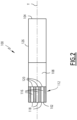
- the aerosol generating article 100 comprises an aerosol generating part 108 and a heating element 112.
- the aerosol generating article 100 further comprises a mouthpiece portion 126.
- the heating element 112, the aerosol generating part 108 and if applicable the mouthpiece portion 126 are arranged successively along the article axis Y, from the proximal end 102 to the distal end 104.
- the aerosol generating part 108 comprises an aerosol generating substrate, as defined above.
- the heating element 112 is adapted to heat the aerosol generating substrate by undergoing an exothermic reaction.
- the heating element 112 is in contact with the aerosol generating part 108.
- the heating element 112 is designed to be put in contact with the fluid heated by the second heater 34 of the aerosol generating device 20.
- this causes an exothermic reaction able to heat the aerosol generating substrate.
- the heating element 112 undergoes an exothermic reaction heating the aerosol generating substrate comprised in the aerosol generating part 108.
- the heating element 112 is made up of a heating material comprising an active component and advantageously a binder mixed with the active component.
- the active component undergoes the exothermic reaction when in contact with the heated fluid.
- the active component comprises calcium oxide CaO, calcium chloride CaCl 2 or a mix thereof.
- the heating material is made up of calcium oxide with a mass proportion between 5% and 95%, calcium chloride with a mass proportion between 10% and 80% or calcium oxide with a mass proportion between 20% and 70% and magnesium oxide with a mass proportion between 30% and 50%.
- the heating material is made up of calcium oxide with a mass proportion of 33%.
- the heating material is made up of calcium oxide with a mass proportion of 33%, a binder with a mass proportion of 5% and other material(s) suitable for supporting molding with a mass proportion of 62%.
- the heating element comprises 112 at least a tubular channel 116 comprising a first end 118 designed to be put in fluidic communication with the fluid transfer system 62, in particular when the aerosol generating article 100 is received in the receiving chamber 42, and a second end 120 fluidically connected to the aerosol generating part 108.
- the heating element 112 comprises a single tubular channel 116 and a single tubular wall 115 delimiting the single tubular channel 116.
- the heating element 112 comprises several tubular channels 116 and a honeycomb structure 122 delimiting said tubular channels 116.
- the mouthpiece portion 126 is adapted to be used by a user to draw the aerosol generated by heating of the aerosol generating substrate by the heating element 112.
Landscapes
- Resistance Heating (AREA)
Priority Applications (2)
| Application Number | Priority Date | Filing Date | Title |
|---|---|---|---|
| EP23208977.1A EP4552513A1 (fr) | 2023-11-10 | 2023-11-10 | Ensemble de génération d'aérosol comprenant un élément chauffant capable de réaction exothermique |
| PCT/EP2024/081504 WO2025099155A1 (fr) | 2023-11-10 | 2024-11-07 | Ensemble de génération d'aérosol comprenant un élément chauffant capable d'une réaction exothermique |
Applications Claiming Priority (1)
| Application Number | Priority Date | Filing Date | Title |
|---|---|---|---|
| EP23208977.1A EP4552513A1 (fr) | 2023-11-10 | 2023-11-10 | Ensemble de génération d'aérosol comprenant un élément chauffant capable de réaction exothermique |
Publications (1)
| Publication Number | Publication Date |
|---|---|
| EP4552513A1 true EP4552513A1 (fr) | 2025-05-14 |
Family
ID=88778117
Family Applications (1)
| Application Number | Title | Priority Date | Filing Date |
|---|---|---|---|
| EP23208977.1A Pending EP4552513A1 (fr) | 2023-11-10 | 2023-11-10 | Ensemble de génération d'aérosol comprenant un élément chauffant capable de réaction exothermique |
Country Status (2)
| Country | Link |
|---|---|
| EP (1) | EP4552513A1 (fr) |
| WO (1) | WO2025099155A1 (fr) |
Citations (4)
| Publication number | Priority date | Publication date | Assignee | Title |
|---|---|---|---|---|
| WO2014045024A2 (fr) * | 2012-09-18 | 2014-03-27 | British American Tobacco (Investments) Limited | Chauffage d'un matériau à fumer |
| US9046278B2 (en) * | 2008-06-27 | 2015-06-02 | Olig Ag | Smoke-free cigarette |
| US11272578B2 (en) * | 2016-11-18 | 2022-03-08 | Philip Morris Products S.A. | Heating assembly, aerosol-generating device and a method for heating an aerosol-forming substrate |
| US20220346456A1 (en) * | 2020-01-30 | 2022-11-03 | Nerudia Limited | Aerosol delivery apparatus |
-
2023
- 2023-11-10 EP EP23208977.1A patent/EP4552513A1/fr active Pending
-
2024
- 2024-11-07 WO PCT/EP2024/081504 patent/WO2025099155A1/fr active Pending
Patent Citations (4)
| Publication number | Priority date | Publication date | Assignee | Title |
|---|---|---|---|---|
| US9046278B2 (en) * | 2008-06-27 | 2015-06-02 | Olig Ag | Smoke-free cigarette |
| WO2014045024A2 (fr) * | 2012-09-18 | 2014-03-27 | British American Tobacco (Investments) Limited | Chauffage d'un matériau à fumer |
| US11272578B2 (en) * | 2016-11-18 | 2022-03-08 | Philip Morris Products S.A. | Heating assembly, aerosol-generating device and a method for heating an aerosol-forming substrate |
| US20220346456A1 (en) * | 2020-01-30 | 2022-11-03 | Nerudia Limited | Aerosol delivery apparatus |
Also Published As
| Publication number | Publication date |
|---|---|
| WO2025099155A1 (fr) | 2025-05-15 |
Similar Documents
| Publication | Publication Date | Title |
|---|---|---|
| EP3086672B1 (fr) | Article à fumer avec soupape | |
| ES2795298T3 (es) | Artículo para fumar que comprende una fuente de calor combustible aislada | |
| JPH03112477A (ja) | 喫煙物品 | |
| EP2644043A1 (fr) | Article à fumer chauffable avec enveloppe améliorée | |
| CN114521112A (zh) | 气溶胶生成系统 | |
| JPS63192372A (ja) | エアゾール送出物品 | |
| US20240277053A1 (en) | Flat Tobacco Article Comprising at Least Two Layers and Aerosol Generating Device with Such an Article | |
| KR20240053047A (ko) | 평면형 형상의 가열 챔버를 포함하는 에어로졸 발생 장치 및 관련 에어로졸 발생 조립체 | |
| EP4552513A1 (fr) | Ensemble de génération d'aérosol comprenant un élément chauffant capable de réaction exothermique | |
| EP4728889A2 (fr) | Dispositif de génération d'aérosol comprenant deux plaques chauffantes et procédé de commande associé | |
| US20240268452A1 (en) | Flat Tobacco Article Comprising at Least Two Layers and Aerosol Generating Device with Such an Article | |
| JP2025535902A (ja) | 抵抗層を備えるタバコ物品及び関連するエアロゾル発生アセンブリ | |
| US20240065314A1 (en) | Filter for Smoking Article | |
| JP2026504490A (ja) | サーマルブレイクを備えるエアロゾル発生装置及び関連するエアロゾル発生アセンブリ | |
| WO2024235856A1 (fr) | Outil de nettoyage pour nettoyer un dispositif de génération d'aérosol et système de génération d'aérosol comprenant un outil de nettoyage | |
| JP2025535250A (ja) | エアロゾル発生アセンブリ | |
| WO2025003301A1 (fr) | Dispositif de génération d'aérosol comprenant une coupelle chauffante | |
| WO2024153758A1 (fr) | Dispositif de génération d'aérosol conçu pour fonctionner avec un substrat de génération d'aérosol | |
| WO2024153673A1 (fr) | Dispositif de génération d'aérosol comprenant deux plaques chauffantes | |
| JP2026507698A (ja) | 把持部分を含むエアロゾル発生デバイス及び関連するエアロゾル発生アセンブリ | |
| WO2024227799A1 (fr) | Dispositif de génération d'aérosol comprenant une coupelle en céramique imprimée en 3d et procédé de production associé | |
| WO2023194533A1 (fr) | Dispositif de génération d'aérosol comprenant une plaque chauffante qui présente une partie céramique et une partie métallique et procédé de commande associé | |
| WO2024003365A1 (fr) | Ensemble de génération d'aérosol comprenant un élément thermoconducteur | |
| WO2024126663A1 (fr) | Article de tabac comprenant un suscepteur pouvant être chauffé par induction, et ensemble comprenant un tel article | |
| CN115243569A (zh) | 包含含有薄荷醇和钙交联的藻酸盐的非晶固体的气溶胶生成材料 |
Legal Events
| Date | Code | Title | Description |
|---|---|---|---|
| PUAI | Public reference made under article 153(3) epc to a published international application that has entered the european phase |
Free format text: ORIGINAL CODE: 0009012 |
|
| STAA | Information on the status of an ep patent application or granted ep patent |
Free format text: STATUS: THE APPLICATION HAS BEEN PUBLISHED |
|
| AK | Designated contracting states |
Kind code of ref document: A1 Designated state(s): AL AT BE BG CH CY CZ DE DK EE ES FI FR GB GR HR HU IE IS IT LI LT LU LV MC ME MK MT NL NO PL PT RO RS SE SI SK SM TR |
|
| STAA | Information on the status of an ep patent application or granted ep patent |
Free format text: STATUS: REQUEST FOR EXAMINATION WAS MADE |
|
| GRAP | Despatch of communication of intention to grant a patent |
Free format text: ORIGINAL CODE: EPIDOSNIGR1 |
|
| STAA | Information on the status of an ep patent application or granted ep patent |
Free format text: STATUS: GRANT OF PATENT IS INTENDED |
|
| 17P | Request for examination filed |
Effective date: 20251029 |
|
| INTG | Intention to grant announced |
Effective date: 20251128 |