EP4552529A1 - Appareil de peeling - Google Patents
Appareil de peeling Download PDFInfo
- Publication number
- EP4552529A1 EP4552529A1 EP24173512.5A EP24173512A EP4552529A1 EP 4552529 A1 EP4552529 A1 EP 4552529A1 EP 24173512 A EP24173512 A EP 24173512A EP 4552529 A1 EP4552529 A1 EP 4552529A1
- Authority
- EP
- European Patent Office
- Prior art keywords
- peeling device
- scraping
- handle body
- scraping elements
- elements
- Prior art date
- Legal status (The legal status is an assumption and is not a legal conclusion. Google has not performed a legal analysis and makes no representation as to the accuracy of the status listed.)
- Pending
Links
Images
Classifications
-
- A—HUMAN NECESSITIES
- A45—HAND OR TRAVELLING ARTICLES
- A45D—HAIRDRESSING OR SHAVING EQUIPMENT; EQUIPMENT FOR COSMETICS OR COSMETIC TREATMENTS, e.g. FOR MANICURING OR PEDICURING
- A45D44/00—Other cosmetic or toiletry articles, e.g. for hairdressers' rooms
- A45D44/22—Face shaping devices, e.g. chin straps; Wrinkle removers, e.g. stretching the skin
-
- A—HUMAN NECESSITIES
- A46—BRUSHWARE
- A46B—BRUSHES
- A46B1/00—Brush bodies and bristles moulded as a unit
-
- A—HUMAN NECESSITIES
- A46—BRUSHWARE
- A46B—BRUSHES
- A46B9/00—Arrangements of the bristles in the brush body
- A46B9/02—Position or arrangement of bristles in relation to surface of the brush body, e.g. inclined, in rows, in groups
-
- A—HUMAN NECESSITIES
- A61—MEDICAL OR VETERINARY SCIENCE; HYGIENE
- A61B—DIAGNOSIS; SURGERY; IDENTIFICATION
- A61B17/00—Surgical instruments, devices or methods
- A61B17/54—Chiropodists' instruments, e.g. pedicure
-
- A—HUMAN NECESSITIES
- A45—HAND OR TRAVELLING ARTICLES
- A45D—HAIRDRESSING OR SHAVING EQUIPMENT; EQUIPMENT FOR COSMETICS OR COSMETIC TREATMENTS, e.g. FOR MANICURING OR PEDICURING
- A45D2200/00—Details not otherwise provided for in A45D
- A45D2200/10—Details of applicators
- A45D2200/1054—Abrasive cosmetic skin peeling or scrubbing
-
- A—HUMAN NECESSITIES
- A46—BRUSHWARE
- A46B—BRUSHES
- A46B2200/00—Brushes characterized by their functions, uses or applications
- A46B2200/10—For human or animal care
- A46B2200/1006—Brushes for cleaning the hand or the human body
Definitions
- the invention relates to a peeling device, in particular a peeling pen, in particular for facial treatments, and to the use of such a peeling device for cosmetic facial treatments, in particular for removing dead skin cells.
- Exfoliating devices are well-known in the art. They are used to cleanse, smooth, and rejuvenate the skin by removing dead skin cells, promoting cell renewal, and improving skin texture. Exfoliating devices can be mechanical, e.g., in the form of pads with massage nubs, or electrically powered, e.g., by batteries or a power cable.
- the WO 2012/104162 A1 by L'Oréal describes a massage unit comprising a support body and massage elements in the form of pins and curved slats mounted on the support body.
- the massage unit can engage in a container that contains, for example, a cleaning product that can be dispensed via the massage unit during cleaning.
- the massage elements can be in the form of elliptical and circular slats.
- the EP 2 926 792 A1 (Swiscovital AG) deals with a massage brush comprising an elastic brush body with a top and a bottom, both sides having differently structured areas, e.g. ribs or knob-shaped massage pins.
- the massage brush has two partial bodies with different Hardness levels.
- the top of the brush can be designed to be suitable for facial treatments, e.g., for a peeling treatment.
- exfoliating devices with knobs exhibit inadequate skin cleansing, failing to remove all residues such as dirt, oil, or dead skin cells.
- exfoliating devices with knobs require a large number of these knobs to achieve a cleansing effect. The friction of these numerous knobs on the skin can cause skin irritation during exfoliation.
- peeling devices have proven to be cumbersome, as they often slip out of the user's hand during use. Peeling devices that feature a handle for better guidance are also disadvantageous, as these handles are often bulky and can easily be damaged or destroyed, for example, by tearing off.
- the object of the invention is therefore to provide a solution that at least mitigates the disadvantages present in the prior art.
- the scraping elements are arranged in a stepped manner relative to one another such that an upper edge of an outermost scraping element is located closer to the second end of the handle body in a longitudinal direction of the handle body than an upper edge of an innermost scraping element.
- Peeling or “exfoliation” refers to the removal of dead skin cells from the top layer of the skin using mechanical or chemical methods. Both terms are used synonymously here. It is clear to those skilled in the art that a peeling can remove not only dead skin cells but also other deposits on the skin, such as dirt and/or oil. The totality of skin deposits that can be removed by a peeling is summarized here under the term “residues.”
- impurities such as pustules (so-called pimples) can be removed with the innermost scraping element.
- Scraping elements are used to remove residues on the skin surface by scraping.
- Lamellas are thin, flat structures. Their advantage is that they can gently massage and cleanse the skin's surface without irritating or damaging it. Lamellas are therefore also suitable for sensitive skin types. Many lamellas for mechanical facial cleansing are also easy to clean and disinfect, which improves their hygiene and reusability. This is especially important to minimize the risk of bacterial growth and skin irritation. Lamellas can penetrate deep into the pores to thoroughly remove residue. Furthermore, the movement of the lamellas can relax the skin, leading to a refreshed and invigorated feeling.
- Each scraping element has an upper edge.
- the upper edges are at least partially in contact with the skin.
- the scraping elements which are designed as closed curves and arranged concentrically, have the advantage that the first end of the peeling device can be moved in different directions over the skin without having to put the peeling device down and then put it back down again to change direction.
- the stepped arrangement of the scraping elements not all of the upper edges are at the same height. This eliminates the need to apply the peeling device at a specific angle, especially at a 90° angle, to the area of skin to be exfoliated in order to achieve a peeling effect.
- the stepped arrangement allows the peeling device to be held and moved over the skin at different angles to the skin while still achieving a peeling effect.
- the peeling device achieves a peeling effect when it is moved over the skin at an angle of 20 - 160 °, in particular 30 - 150 °, especially 40 - 140 °, relative to the skin surface.
- the peeling device can be pivoted around the transverse axis, around an axis parallel to the transverse axis, around a vertical axis, and/or around an axis parallel to the vertical axis of the peeling device and still achieve a peeling effect.
- the peeling device can be pivoted relative to the area of skin being exfoliated to achieve optimal exfoliation.
- a further advantage of the peeling device according to the invention is that, due to the stepped arrangement of the scraping elements, the first end has a shape that slopes downwards from the innermost to the outermost scraping element, as viewed from the side. This gives the handle a tapered silhouette at the first end. This silhouette makes it easier for the user to access uneven skin areas with the peeling device, such as the eye and/or nose area, and thus allows the removal of residues in less accessible areas.
- the first end is designed as a head.
- a head refers to a curved protrusion.
- the protrusion extends from the second end.
- the head is hemispherical, conical or pyramidal.
- the head can contribute to the stability of the stepped arrangement of the scraping elements, since the scraping elements do not need to be formed as high due to the presence of the head.
- the head can be convexly curved, in particular hemispherical, which can already predetermine a stepped shape.
- the scraping elements can then, in this example, be arranged along the convexly curved, in particular hemispherical, surface.
- a base of the outermost scraping element can thus lie closer to the second end in a longitudinal direction of the handle body than a base of the innermost scraping element, and an upper edge of an outermost scraping element can lie closer to the second end in a longitudinal direction of the handle body than an upper edge of the innermost scraping element.
- the first end not to be designed as a head.
- the first end can be designed as a plane.
- the base for each scraping element can be positioned equally close to the second end in the longitudinal direction of the handle body as the bases of the remaining scraping elements.
- the stepped arrangement can be achieved by designing the scraping elements with different heights, specifically such that the upper edge of the outermost scraping element is closer to the second end of the handle body in a longitudinal direction of the handle body than the upper edge of the innermost scraping element.
- the first end is designed as a plane and the scraping elements are arranged on the plane such that the upper edge of the outermost scraping element is closer to the second end of the handle body in a longitudinal direction of the handle body than the upper edge of the innermost scraping element.
- the scraping elements have different heights. This allows a stepped arrangement to be achieved, especially if the first end is designed as a flat surface.
- the height refers to the distance between the base and the top edge of the scraping element.
- a base refers to the lowermost portion of a scraping element.
- Each scraping element has its own base.
- each base of a scraping element is diametrically opposite the upper edge of the same scraping element.
- a scraping element is connected to the first end at its base.
- the head is convexly curved, preferably essentially hemispherical.
- the scraping elements are arranged on the head.
- the handle body comprises a holding element.
- the holding element refers to a part of the handle body which the user grasps with his or her hand.
- the holding element extends from the second end of the handle body to the head.
- the holding element does not include the head and the scraping elements.
- the holding element corresponds to the handle body.
- the head is connected to the holding element.
- connection between the head and the retaining element can be a positive, force-fit, and/or material-fit connection.
- the connection can be a plug-in, screw-in, and/or adhesive connection.
- the head and retaining element it is also conceivable for the head and retaining element to be formed as a single piece.
- the peeling device is formed in one piece.
- the robustness of the peeling device can be increased. For example, it can also reduce the risk of the device breaking apart, e.g., due to force. Furthermore, it can prevent moisture from entering the device at joints. The peeling device can be damaged if it is accidentally blown into the skin. It also simplifies the manufacturing process and keeps costs low.
- the holding element and the head are formed in one piece.
- the scraping elements and the head are formed in one piece.
- the peeling device is rotationally symmetrical around a longitudinal axis.
- the peeling device is not rotationally symmetrical.
- the upper edges of the scraping elements may be arranged asymmetrically.
- the holding element may not have the same shape across its entire circumference.
- the holding element may be partially flat in the longitudinal direction of the handle body and partially concave.
- the longitudinal axis refers to the longitudinal axis of the peeling device.
- the upper edges of the scraping elements each have a circular shape.
- the circular scraping elements offer the advantage that the first end of the peeling device can be moved in different directions across the skin surface without having to first set the peeling device down and then reposition it. This is due to the circular shape providing a uniform structure, allowing for even exfoliation in all directions.
- the circular shape allows for a rotationally symmetrical arrangement of the scraping elements. This means that it doesn't matter to the user how they apply the peeling device to the skin surface and/or whether they rotate it around its longitudinal axis during use.
- the upper edges may have a different shape, in particular an oval, rectangular, wavy, angled and/or curved shape.
- the holding element has a concave shape in the longitudinal direction of the handle body.
- the retaining element it is also possible for the retaining element to have a curved and/or straight shape in the longitudinal direction of the handle body.
- the retaining element can have a wavy shape.
- the retaining element has a corrugated shape with at least one, in particular at least two, depressions. Most specifically, the retaining element has a corrugated shape with four depressions.
- the wavy shape allows the user to place at least one finger in at least one depression, which can improve grip and/or slip resistance.
- the holding element has a concave and a corrugated shape in combination.
- the concave, curved, and/or straight shape extends over the entire surface of the handle body. This allows for a good grip of the peeling device. However, it is also possible for the concave, curved, and/or straight shape to extend over only part of the surface.
- the base of an outer scraping element is located in the longitudinal direction of the handle body closer to the second end of the handle body than the base of an inner scraping element, wherein in particular the outer scraping element has a larger circumference than the inner scraping element.
- the greatest distance in the transverse direction between the inner scraping element and the longitudinal axis is equal to or smaller than the smallest distance between the longitudinal axis and the outer scraping element.
- An inner scraping element is defined as a scraping element that is surrounded by an outer scraping element.
- An outer scraping element is defined as a scraping element that surrounds the inner scraping element. According to this definition, it is possible for a scraping element to simultaneously represent both an inner and an outer scraping element, provided that the scraping element has another scraping element inside and outside its perimeter.
- the circumference of a scraping element refers to the length of the scraping element, especially at the top edge. Since the scraping element is a closed curve, the length of the scraping element corresponds to the length of the closed curve.
- the base of the outer scraping element is located in the longitudinal direction of the handle body closer to the second end of the handle body than the base of the inner scraping element, wherein in particular the outer scraping element has a larger circumference than the inner scraping element, and wherein the first end is designed as a head.
- the upper edge of the outer scraping element is located in the longitudinal direction of the handle body closer to the second end of the handle body than the upper edge of the inner scraping element, wherein in particular the outer scraping element has a larger circumference than the inner scraping element.
- the upper edges of an innermost and a second innermost scraping element have the same distance from the second end, so that both upper edges are level and in particular the second innermost scraping element has a larger circumference than the innermost scraping element.
- the innermost scraping element refers to the scraping element closest to the longitudinal axis in the transverse direction.
- the innermost scraping element is not surrounded by an inner scraping element. However, the innermost scraping element is surrounded by at least one outer scraping element.
- the second innermost scraping element refers to the scraping element located second closest to the longitudinal axis in the transverse direction.
- the second innermost scraping element surrounds exactly one inner scraping element, namely the innermost scraping element.
- the head has a decreasing height profile starting from its highest point radially outwards.
- the height gradient refers to an interval of distances, where the distances are the distances between the base of the head and a point on the head surface lying vertically above it.
- the base of the head refers to the area with which the head borders the support element.
- a head surface is the surface that extends over the head, whereby the base of the head is not part of the head surface.
- the sloping height gradient can contribute to the stability of the stepped arrangement of the scraping elements, as the scraping elements need to be formed to a lower height.
- the head can be convexly curved, particularly hemispherical, which can already predetermine a stepped shape.
- the scraping elements can In this example, it can be arranged along the descending height gradient on a head surface.
- the base of the outer scraping element can thus be located closer to the second end in the longitudinal direction of the handle body than the base of the inner scraping element.
- the outermost scraping element protrudes at least partially from the outer surface of the holding element.
- the previously mentioned “outer side surface” corresponds to the "first side” of a scraping element introduced below, i.e., the "outer side surface” is a side whose surface faces away from the longitudinal axis.
- each cross-sectional center lies on the longitudinal axis.
- the cross-sectional center point refers to the center point of each cross-section of the peeling device. This means that regardless of where a cross-section of the peeling device is taken, the center point of the respective cross-sectional area lies on the longitudinal axis.
- the second end is flat.
- peeling device can be placed on a surface with its flat second end without the risk of rolling and/or tipping over.
- This provides an optimal solution for storing the device.
- This solution also saves space, as only a surface the size of the second flat end is required for storage.
- the second end is designed as an uneven structure, e.g., in the shape of feet and/or nubs. Such nubs are particularly unsuitable for exfoliation.
- the second end comprises at least one recess, in particular at least one recess placed centrally at the second end.
- the peeling device can be lighter. It also saves material during production.
- Another advantageous feature is that the recess can contribute to a more stable stand of the peeling device when placed on a surface. This is because the device can be placed with the recess over a raised area, e.g., on a surface, which reduces the risk of the peeling device slipping. Depending on the length of the recess, it is also possible to hang and/or secure the peeling device on a bracket.
- first and second ends are diametrically opposite each other.
- the peeling device comprises 1-500, in particular 1-400, especially 1-300, particularly preferably 1-200, most especially 1-100, scraping elements.
- the peeling device preferably comprises 2 - 10, in particular 2 - 8, especially 3 - 7, particularly preferably 6, scraping elements.
- the peeling device comprises more than 4 scraping elements, in particular more than 5 scraping elements.
- the scraping elements have a thickness of 0.05 - 6 mm, in particular 0.07 - 5.5 mm, especially 0.08 - 5.2 mm, particularly preferably 0.1 - 5 mm.
- the scraping elements have a thickness of 0.05 - 1 mm, in particular 0.07 - 0.9 mm, especially 0.08 - 0.8 mm, particularly preferably 0.1 - 0.7 mm.
- Thickness refers to the cross-sectional dimension of the scraping element, i.e., the distance between a first side of the scraping element and an opposite second side of the scraping element.
- the first side of a scraping element refers to the side whose surface faces away from the longitudinal axis.
- the second side of the scraping element refers to the side whose surface faces in the direction of the longitudinal axis.
- This thickness allows for stable scraping elements that are long-lasting. Furthermore, the scraping elements can withstand the forces exerted on them during use. The aforementioned thickness is particularly advantageous because the scraping elements are rigid enough to successfully exfoliate, yet flexible enough to allow the exfoliation to be performed without damaging the skin.
- the scraping elements particularly preferably have a length of 1 - 15 cm, in particular 1 - 12 cm, especially 1 - 10 cm, particularly preferably 1 - 8 cm, very particularly especially 1 - 6 cm, extremely preferably 1 - 5 cm.
- the above-mentioned lengths allow for scraping elements with an optimal range to thoroughly remove residues. Furthermore, a large area of skin can be treated at once, allowing for rapid exfoliation. This length also contributes to a handy peeling device. In particular, the peeling device can be carried in a conventional handbag.
- the length of the scraping element refers to the circumference of the scraping element. Since the scraping element is a closed curve, the length of the scraping element corresponds to the length of the closed curve.
- the scraping elements have a height of 1 - 20 mm, in particular 1 - 15 mm, especially 1 - 10 mm, particularly preferably 1 - 5 mm.
- the peeling device can provide a gentle yet thorough exfoliation. These heights also contribute to a handy peeling device; in particular, the peeling device can be carried in a conventional handbag. Furthermore, the peeling device doesn't require much space for storage.
- the height refers to the distance between the base and the top edge of the scraping element.
- At least two, in particular at least 4, especially at least 6, particularly preferably at least 8, scraping elements have different heights.
- At least 20, in particular at least 50, especially at least 100, particularly preferably at least 200, very particularly preferably at least 400, scraping elements to have different heights.
- the scraping elements are arranged equidistant from each other, allowing for a uniform peeling effect.
- the scraping elements are not arranged equidistantly.
- the scraping elements are each arranged at a distance of 0.5 mm - 1 cm, in particular 1 - 6 mm, especially 2 - 4 mm, extremely preferably exactly 3 mm, from each other.
- the ratio between the circumference and the height of a scraping element is between 5:1 and 25:1, in particular between 7:1 and 23:1, in particular 10:1 and 21:1, most preferably between 14:1 and 19:1.
- the total length of the peeling device is 3 - 15 cm, in particular 4 - 12 cm, especially 5 - 10 cm, particularly preferably 6 - 9 cm.
- This length has the advantage of making the peeling device handy and easy to take anywhere.
- the device fits in a handbag and/or can be easily stored in a mirrored cabinet at home.
- the peeling device requires little space in the dishwasher.
- the total length of the peeling device refers to the distance between two points on the peeling device that are furthest apart from each other in the longitudinal direction.
- the ratio between a length of the holding element and a diameter of the holding element is between 1:1 and 5:1, in particular between 2:1 and 4:1, especially between 2.5:1 and 3.5:1, particularly preferably 3:1.
- grooves are formed between two adjacent scraping elements.
- One advantage of this is that the residue exfoliated from the skin falls into the grooves during use and can be collected. This reduces the risk of residue falling onto the floor, the user's clothing, or other surrounding objects.
- each of the top edges lies in a plane and the normals of the planes run along and/or parallel to the longitudinal axis.
- all planes are arranged plane-parallel to one another.
- the scraping elements are arranged coaxially in the longitudinal direction of the handle body.
- all scraping elements are inclined in the direction of the longitudinal axis.
- the scraping elements are inclined away from the longitudinal axis.
- At least one scraping element is inclined in the direction of the longitudinal axis and at least one scraping element is inclined away from the longitudinal axis.
- At least one groove in particular all grooves, have a curved and/or angled groove bottom.
- the grooves each have a groove bottom.
- the surface of the first end forms the groove bottom.
- An advantage of these embodiments is that residues that fall into the grooves during use of the peeling device can be easily removed when cleaning the device.
- easy cleaning of the peeling device can be achieved if the groove base is curved and/or angled, as the residues can be removed from the grooves more easily.
- the handle body does not have a constant or a variable cross-section over its entire length.
- the peeling device needs to be as ergonomically designed as possible.
- the device it's also possible for the device to have a constant cross-section.
- a non-constant or variable cross-section means that the cross-section of the peeling device can vary depending on where you are along the longitudinal axis. Accordingly, a constant cross-section This means that regardless of where you are along the longitudinal axis, the cross-section of the peeling device is the same at every point.
- the peeling device has a diameter of 0.5 - 10 cm, in particular 1 - 8 cm, especially 1.5 - 6 cm, at its widest point.
- the peeling device has a diameter of 0.5 - 5 cm, especially 1 - 4 cm, especially 1.5 - 3 cm, at its widest point.
- the peeling device has a diameter of 0.5 - 3.5 cm, in particular 1 - 3 cm, especially 1.5 - 2.5 cm, at its narrowest point.
- the peeling device does not include a drive, especially an electric drive.
- the peeling device preferably does not have a battery, a battery receptacle, and/or a power supply connection.
- the peeling device has no nubs.
- the peeling device comprises or consists of acrylonitrile butadiene styrene, polyvinyl chloride (PVC), polyurethane and/or silicone.
- acrylonitrile butadiene styrene is that this material is moisture- and dirt-repellent, and largely resistant to grease and oil, electrostatic charge, and temperature fluctuations.
- PVC has the advantageous properties of being insensitive to temperature and water. It is also very weather-resistant, durable, and easy to dye.
- the advantages of polyurethane are that the material has high mechanical strength, resistance to temperature, oils, and grease, that it is wear-resistant, and that it has good Silicone is advantageous because it is chemically inert, durable, resistant to UV and ozone radiation, non-toxic, reusable, and easily recycled.
- the peeling device comprises or consists of polyurethane and has a SHORE hardness of 30 - 90, in particular 30, 35, 40, 45, 50, 55, 60, 65, 70, 75, 80, 85 or 90.
- the SHORE hardness is measured in particular according to the SHORE hardness scale A.
- the SHORE hardness is tested according to the test method ISO 868-85.
- the peeling device is made of a single material.
- the peeling device is manufactured using injection molding and/or 3D printing.
- the invention relates to a use of a peeling device as described above for cosmetic facial treatments, in particular for removing dead skin cells.
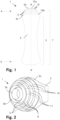
- Fig. 1 shows a schematic perspective view of a peeling device 1 according to the invention with a handle body 7, wherein the handle body 7 comprises a holding element 2 and a head (not shown).
- the handle body 7 has a first end 4 and a second end 5.
- scraping elements 3 are arranged in steps on the head (not shown).
- the holding element 2 has a concave shape.
- An outermost scraping element 3c protrudes from the lateral surface 9 of the holding element 2.
- An upper edge 10b of the outermost scraping element 3c lies closer to the second end 5 of the handle body 7 in a longitudinal direction of the handle body 7 than an upper edge 10a of an innermost scraping element 3a.
- the concave shape of the holding element 2 extends completely around the holding element 4.
- the first end 4 is diametrically opposite the second end 5.
- Fig. 2 shows a section of the first end 4 and the scraping elements 3 of the Fig. 1 shown peeling device 1. Between each two scraping elements 3 there is a groove 8. The bottom of each groove 8 is formed by the surface of the first end 4.
- the scraping elements 10 each have a base 11.
- the base 11 is diametrically opposite the respective upper edge of the scraping elements and forms the lower end of the scraping element 10.
- the bases 11 are arranged on the surface of the head 6.
- the holding element is only partially shown, which is indicated by a dashed elongated line.
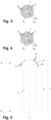
- Fig. 3 shows a top view of the first end 4 and the scraping elements 3 of the Fig. 2 shown peeling device 1.
- the scraping elements 3 are closed curves and have a circular shape. They are also arranged concentrically.
- the longitudinal axis L runs through the common center point x of the concentrically arranged scraping elements 3.
- a groove 8 runs between each two scraping elements 3.
- the innermost scraping element 3a is closest to the longitudinal axis L in the transverse direction.
- the second innermost scraping element 3b is second closest to the longitudinal axis L in the transverse direction and surrounds the innermost scraping element 3a.
- the outermost scraping element 3c is farthest from the longitudinal axis L in the transverse direction.
- Fig. 4 shows a plan view of the first end 4 and the scraping elements 3 of another embodiment of the peeling device 1 according to the invention.
- the structure of the Fig. 4 is analogous to the Fig. 3 with the only difference that the upper edges 10 of the scraping elements 3 are not circular but wavy.
- Fig. 5 shows a plan view of a longitudinal section along the section line A - A' of the Fig. 1 shown peeling device 1.
- the scraping elements 3 are arranged along the head 6 in a stepped manner, rising toward the longitudinal axis L, starting from the outermost scraping element 3c. Grooves 8 are located between every two scraping elements 3.
- the scraping elements 3 are aligned parallel to the longitudinal axis L.
- the holding element 2 can be Fig. 1 and 5 have a different shape, in particular a curved, straight and/or wavy shape. It is also possible that the concave shape does not extend completely around the holding element 2, but only partially. Furthermore, it is conceivable that the longitudinal axis L does not run in a straight line, but, for example, curved. Accordingly, it is possible that the peeling device is shaped differently than a rod, for example, curved.
- the upper edges 10 of the scraping elements 3 in the Fig. 1 to 5 in the longitudinal direction of the handle body do not run at a constant height.
- the upper edges 10 or at least one upper edge 10 may be at least partially curved, bent, and/or wavy.
- the upper edges 10 of the scraping elements 3 have a different shape, e.g. an oval, rectangular, wavy, angled and/or curved shape.
- the scraping elements as they are in the Fig. 1 - 5 shown can also run inclined, e.g. in a direction towards the longitudinal axis L or in a direction away from the longitudinal axis L. At least one scraping element 3, in particular all scraping elements 3, can be inclined accordingly.
Landscapes
- Health & Medical Sciences (AREA)
- Life Sciences & Earth Sciences (AREA)
- Surgery (AREA)
- Heart & Thoracic Surgery (AREA)
- Engineering & Computer Science (AREA)
- Biomedical Technology (AREA)
- Nuclear Medicine, Radiotherapy & Molecular Imaging (AREA)
- Medical Informatics (AREA)
- Molecular Biology (AREA)
- Animal Behavior & Ethology (AREA)
- General Health & Medical Sciences (AREA)
- Public Health (AREA)
- Veterinary Medicine (AREA)
- Surgical Instruments (AREA)
Priority Applications (1)
| Application Number | Priority Date | Filing Date | Title |
|---|---|---|---|
| EP24173512.5A EP4552529A1 (fr) | 2024-04-30 | 2024-04-30 | Appareil de peeling |
Applications Claiming Priority (1)
| Application Number | Priority Date | Filing Date | Title |
|---|---|---|---|
| EP24173512.5A EP4552529A1 (fr) | 2024-04-30 | 2024-04-30 | Appareil de peeling |
Publications (1)
| Publication Number | Publication Date |
|---|---|
| EP4552529A1 true EP4552529A1 (fr) | 2025-05-14 |
Family
ID=90925093
Family Applications (1)
| Application Number | Title | Priority Date | Filing Date |
|---|---|---|---|
| EP24173512.5A Pending EP4552529A1 (fr) | 2024-04-30 | 2024-04-30 | Appareil de peeling |
Country Status (1)
| Country | Link |
|---|---|
| EP (1) | EP4552529A1 (fr) |
Citations (8)
| Publication number | Priority date | Publication date | Assignee | Title |
|---|---|---|---|---|
| FR2443242A2 (fr) * | 1978-12-06 | 1980-07-04 | Oreal | Applicateur utilisable pour le massage du revetement cutane |
| JPS6069091U (ja) * | 1983-10-17 | 1985-05-16 | 池山 龍一 | 角質化した皮膚の清浄器具 |
| US4981143A (en) * | 1985-04-20 | 1991-01-01 | Anne Company Limited | Cell sampler |
| US5032082A (en) * | 1989-12-20 | 1991-07-16 | Herrera William R | Device for removing adhesive from the palate |
| JP2002010944A (ja) * | 2000-06-29 | 2002-01-15 | Hisateru Yamazaki | 皮膚の角質層除去具 |
| FR2906115A1 (fr) * | 2006-09-26 | 2008-03-28 | Alcan Packaging Beauty Serv | Embout applicateur typiquement spherique pour application de produits cosmetiques |
| FR2970866A1 (fr) * | 2011-01-31 | 2012-08-03 | Oreal | Embout de massage du visage |
| EP2926792A1 (fr) | 2014-04-02 | 2015-10-07 | Swiscovital AG | Brosse de massage |
-
2024
- 2024-04-30 EP EP24173512.5A patent/EP4552529A1/fr active Pending
Patent Citations (9)
| Publication number | Priority date | Publication date | Assignee | Title |
|---|---|---|---|---|
| FR2443242A2 (fr) * | 1978-12-06 | 1980-07-04 | Oreal | Applicateur utilisable pour le massage du revetement cutane |
| JPS6069091U (ja) * | 1983-10-17 | 1985-05-16 | 池山 龍一 | 角質化した皮膚の清浄器具 |
| US4981143A (en) * | 1985-04-20 | 1991-01-01 | Anne Company Limited | Cell sampler |
| US5032082A (en) * | 1989-12-20 | 1991-07-16 | Herrera William R | Device for removing adhesive from the palate |
| JP2002010944A (ja) * | 2000-06-29 | 2002-01-15 | Hisateru Yamazaki | 皮膚の角質層除去具 |
| FR2906115A1 (fr) * | 2006-09-26 | 2008-03-28 | Alcan Packaging Beauty Serv | Embout applicateur typiquement spherique pour application de produits cosmetiques |
| FR2970866A1 (fr) * | 2011-01-31 | 2012-08-03 | Oreal | Embout de massage du visage |
| WO2012104162A1 (fr) | 2011-01-31 | 2012-08-09 | L'oreal | Embout de massage pour le visage |
| EP2926792A1 (fr) | 2014-04-02 | 2015-10-07 | Swiscovital AG | Brosse de massage |
Similar Documents
| Publication | Publication Date | Title |
|---|---|---|
| DE60120833T2 (de) | Vorrichtung zum Auftragen eines kosmetischen oder pflegenden Produktes auf keratinische Faser, insbesondere auf Wimpern oder Augenbrauen | |
| DE60223773T2 (de) | Vorrichtung zum Aufbewahren bzw. Auftragen eines Produktes auf Wimpern bzw. Augenbrauen und Schminkverfahren | |
| DE69605871T3 (de) | Applikator für Wimperntusche | |
| EP2023771B1 (fr) | Appareil pour l' hygiene buccale | |
| DE60102973T2 (de) | Auftragsvorrichtung zum Aufbringen eines Produktes auf einen Untergrund und damit ausgerüstete Auftragseinheit | |
| DE69803739T2 (de) | Vorrichtung zum Aufbewahren und Auftragen mit einem Behälter, einem ergonomischen Applikator und einem Abstreifer | |
| DE60220858T2 (de) | Intravaginalvorrichtung zur Verhinderung von weiblicher Harninkontinenz | |
| DE69714138T2 (de) | Kosmetikbürste mit einer Kerbe | |
| DE69027935T2 (de) | Zahnbürste für zahnzwischenräume | |
| DE60109357T3 (de) | Vorrichtung zum Auftragen eines kosmetischen oder pflegenden Produktes auf keratinische Fasern, insbesondere auf Wimpern oder Augenbrauen | |
| DE102017101383A1 (de) | Hygieneprodukt, insbesondere Menstruationstasse mit ergonomischer Form | |
| DE60022828T2 (de) | Kosmetikeinheit und deren Zusammensetzung | |
| WO2009149569A1 (fr) | Brosse | |
| EP0208130A2 (fr) | Alèse médicale pour supporter des parties du corps | |
| DE102009015432A1 (de) | Oberflächenstruktur für ein Arbeitsgerät | |
| DE69929921T2 (de) | Zahnwurzelkanalinstrument | |
| EP1351597A1 (fr) | Dispositif de nettoyage manuel | |
| DE212007000031U1 (de) | Vaginalvorrichtung | |
| DE102011101391A1 (de) | Interdentalreiniger | |
| DE60317294T2 (de) | Applikator zum Auftragen eines Produktes auf einer Keratinfaser | |
| EP2427130A1 (fr) | Instrument médical | |
| WO2018007622A1 (fr) | Applicateur comportant un floc et un peigne sur la surface périphérique | |
| EP2926792A1 (fr) | Brosse de massage | |
| DE3147907A1 (de) | Einrichtung zum reinigen von behaeltern | |
| EP4552529A1 (fr) | Appareil de peeling |
Legal Events
| Date | Code | Title | Description |
|---|---|---|---|
| PUAI | Public reference made under article 153(3) epc to a published international application that has entered the european phase |
Free format text: ORIGINAL CODE: 0009012 |
|
| STAA | Information on the status of an ep patent application or granted ep patent |
Free format text: STATUS: THE APPLICATION HAS BEEN PUBLISHED |
|
| AK | Designated contracting states |
Kind code of ref document: A1 Designated state(s): AL AT BE BG CH CY CZ DE DK EE ES FI FR GB GR HR HU IE IS IT LI LT LU LV MC ME MK MT NL NO PL PT RO RS SE SI SK SM TR |
|
| STAA | Information on the status of an ep patent application or granted ep patent |
Free format text: STATUS: REQUEST FOR EXAMINATION WAS MADE |
|
| 17P | Request for examination filed |
Effective date: 20250909 |