EP4552530A2 - Mundpflegegerät - Google Patents
Mundpflegegerät Download PDFInfo
- Publication number
- EP4552530A2 EP4552530A2 EP25166507.1A EP25166507A EP4552530A2 EP 4552530 A2 EP4552530 A2 EP 4552530A2 EP 25166507 A EP25166507 A EP 25166507A EP 4552530 A2 EP4552530 A2 EP 4552530A2
- Authority
- EP
- European Patent Office
- Prior art keywords
- handle portion
- oral care
- care implement
- appendages
- head portion
- Prior art date
- Legal status (The legal status is an assumption and is not a legal conclusion. Google has not performed a legal analysis and makes no representation as to the accuracy of the status listed.)
- Pending
Links
Images



Classifications
-
- A—HUMAN NECESSITIES
- A46—BRUSHWARE
- A46B—BRUSHES
- A46B15/00—Other brushes; Brushes with additional arrangements
- A46B15/0097—Self supporting, e.g. brushes that stand upright or in other particular ways
-
- A—HUMAN NECESSITIES
- A46—BRUSHWARE
- A46B—BRUSHES
- A46B15/00—Other brushes; Brushes with additional arrangements
- A46B15/0087—Brushes with decoration on or in the handle
-
- A—HUMAN NECESSITIES
- A46—BRUSHWARE
- A46B—BRUSHES
- A46B15/00—Other brushes; Brushes with additional arrangements
- A46B15/0089—Brushes with figurines such as animals on the handle
-
- A—HUMAN NECESSITIES
- A46—BRUSHWARE
- A46B—BRUSHES
- A46B5/00—Brush bodies; Handles integral with brushware
- A46B5/02—Brush bodies; Handles integral with brushware specially shaped for holding by the hand
- A46B5/023—Grips or handles specially adapted for children
-
- A—HUMAN NECESSITIES
- A46—BRUSHWARE
- A46B—BRUSHES
- A46B2200/00—Brushes characterized by their functions, uses or applications
- A46B2200/10—For human or animal care
- A46B2200/1066—Toothbrush for cleaning the teeth or dentures
Definitions
- the present invention relates to oral care systems, and particularly to an oral care implement suitable for use with infants or toddlers.
- Oral care implements such as toothbrushes are susceptible to bacterial contamination resulting from normal use and handling.
- Bacterial accumulations may be especially prevalent on the head portion of the toothbrush, particularly within the tooth cleaning elements such as bristles and/or elastomeric cleaning elements.
- the bacteria can contribute to tooth decay and gum disease.
- Bacterial contamination of the toothbrush head which poses a general health risk is also a concern considering the head is placed in the oral cavity. Such contamination may be transferred from various hard surfaces on which the toothbrush might be placed or accidentally dropped. It is desirable therefore to minimize bacterial contamination from various environmental sources.
- toothbrush for use with babies (infants or toddlers) that is soft and pliable to prevent injury, and yet still be configured to prevent over-insertion into the oral cavity which could pose a potential choking hazard.
- the present invention provides an oral care implement for use with infants and toddlers which meet the foregoing goals.
- the oral care implement may be a toothbrush having a resiliently deformable construction.
- the toothbrush may be configured to minimize or prevent contact between the head and bacterially-contaminated flat hard surfaces when dropped or placed thereon such as a countertop or floor, thereby forming a system that helps maintain the sterility of the toothbrush head.
- the toothbrush may have resiliently foldable appendages, which when in an outward unfolded position, create a wide lateral profile to prevent over-insertion of the toothbrush into the oral cavity of the infant or toddler. When used by an adult to brush the infant's or toddler's teeth, the appendages may be folded inward to a collapsed position to reduce the lateral profile for better access to tooth surfaces deeper in the mouth or oral cavity.
- an oral care implement comprises: a longitudinal axis; a head portion comprising a plurality of tooth cleaning elements; a handle portion supporting to the head portion, the handle portion comprising: a central body; a first appendage extending outwards from a first lateral side of the central body in a first direction; and a second appendage extending outwards from a second lateral side of the central body in a second direction opposite to the first direction; wherein the first and second appendages are each foldable over and against a rear side of the central body.
- an oral care implement comprises: a longitudinal axis; a head portion comprising a plurality of tooth cleaning elements; a handle portion supporting the head portion; a front side of the handle portion defining at least one front contact zone, the front contact zone defining a front support plane; a rear side of the handle portion defining a plurality of rear contact zones, the rear contact zones defining a rear support plane; wherein the front and rear support planes do not intersect the head portion.
- an oral care implement comprises: a longitudinal axis; a head portion comprising a plurality of tooth cleaning element; a handle portion supporting the head portion;
- first appendage extending laterally outwards from a first side of the handle portion in a first direction; and a second appendage laterally outwards from a second side of the handle portion in a second direction opposite to the first direction; wherein the first and second appendages are angled towards each other to form an obtuse angle therebetween.
- any reference to direction or orientation is merely intended for convenience of description and is not intended in any way to limit the scope of the present invention.
- Relative terms such as “lower,” “upper,” “horizontal,” “vertical,” “above,” “below,” “up,” “down,” “top” and “bottom” as well as derivatives thereof (e.g., “horizontally,” “downwardly,” “upwardly,” etc.) should be construed to refer to the orientation as then described or as shown in the drawing under discussion. These relative terms are for convenience of description only and do not require that the apparatus be constructed or operated in a particular orientation unless explicitly indicated as such.
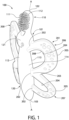
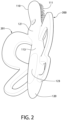
- an oral care implement may be a toothbrush 100 in one non-limiting embodiment.
- Toothbrush 100 generally includes a longitudinal axis A-A, distal head portion 110 defining a distal end, and a longitudinally elongated proximal handle portion 101 supporting the head portion and defining a proximal end 103.
- the handle portion 101 comprises a central body and pair of resiliently foldable appendages extending laterally outwards therefrom in opposite directions.
- the appendages may be wings 200, 201 wherein the term "wings" is expressly used in a broad structural sense only and not in a context necessarily associated with any animate object.
- the central body extends from proximal end 103 of the toothbrush 100 to the head portion 110 along longitudinal axis A-A.
- the toothbrush 100 further includes a front side 112, opposing rear side 113, and pair of opposing lateral sides 114 extending between the front and rear sides and from the proximal end 103 to distal end 102.
- the longitudinal axis A-A follows the contours and shapes of the toothbrush from proximal to distal ends 103, 102 and remains at the centerline of each transverse section of the toothbrush through which the longitudinal axis extends. Accordingly, the longitudinal axis A-A is not necessarily a straight reference line in all cases depending on the shape and curvature of the toothbrush body.
- the central body of handle portion 101 may be arcuately curved from proximal end 103 to distal end 102 forming a substantially convex front side 112 and concave rear side 113 from end to end.
- Longitudinal axis A-A accordingly has a complementary arcuate shape.
- the central body of the handle portion 101 further defines an upper distal portion 121 adjoining the head portion 110 of the toothbrush 100 and a lower proximal portion 120.
- a reduced cross section transition or neck section 122 is formed between the distal portion 121 of handle portion 101 and proximal portion 120 and has a smaller lateral width (measured transversely to longitudinal axis A-A) than the adjoining portions of the proximal or distal portions.
- the proximal portion 120 is elongated in configuration and may have a longitudinal length that comprises a majority of the length of the central body.
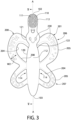
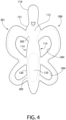
- distal portion 121 may be a bulbous and diametrically enlarged, thereby defining a generally round structure of approximately spherical configuration (see, e.g. FIGS. 3 and 4 ).
- Distal portion 121 may have a greater lateral width (measured transversely to longitudinal axis A-A between lateral sides 114) than head portion 110 or proximal portion 120, and in some embodiments a greater depth or thickness as well (measured transversely to longitudinal axis A-A between front and rear sides 112 and 113).
- the distal portion 121 may therefore protrude outwards beyond the front and rear sides 112, 113 of the proximal portion 120 to raise/elevate the head portion off a hard flat horizontal surface when placed thereon, as further described herein.
- Toothbrush 100 including head portion 110, handle portion 101, and wings 200, 201 may be formed as a single monolithic unitary structure made of a resiliently flexible and deformable material having an elastic memory.
- the toothbrush 100 may be made of silicone rubber having an optimal durometer hardness value of at least 60. Lower durometer materials are generally too soft and flexible to maintain a certain degree of rigidity desired for the wings 200, 201 to maintain their shape and support the central body of handle portion 101 when the toothbrush is placed on a flat horizontal surface, for purposes to be further described herein.
- the material may have a durometer hardness value in a range between and including 60-70, which provides a hardness that provides sufficient rigidity to the wings, yet is soft and flexible enough for use with infants or toddlers to prevent injury.
- Any suitable process may be used to fabricate toothbrush 100.
- the toothbrush may be made by Liquid Silicone Molding (LSM) or alternatively compression molding. Other processes may be used.
- LSM Liquid Silicone Molding
- Head portion 110 of toothbrush 100 may be elongated having a greater longitudinal length than lateral width.
- the front side 112 of the head portion 110 may be substantially planar in one embodiment and comprises a plurality of tooth cleaning elements 111 extending transversely outwards from the front side 112.
- the exact types, structure, pattern, orientation and material of the tooth cleaning elements 111 is not limiting of the present invention unless so specified in the claims.
- the term "tooth cleaning elements” is used in a generic sense to refer to any structure or combination of structures that can be used to clean, polish or wipe the teeth and/or soft oral tissue (e.g. tongue, cheek, gums, etc.) through relative surface contact.
- tooth cleaning elements include, without limitation, bristle tufts, filament bristles, fiber bristles, nylon bristles, spiral bristles, rubber bristles, elastomeric protrusions, flexible polymer protrusions, combinations thereof and/or structures containing such materials or combinations.
- Suitable elastomeric materials include any biocompatible resilient material suitable for uses in an oral hygiene apparatus.
- the elastomeric material of the tooth or soft tissue engaging elements may have a hardness property in the range of A8 to A25 Shore hardness.
- One suitable elastomeric material is styrene-ethylene/butylene-styrene block copolymer (SEBS) manufactured by GLS Corporation. Nevertheless, SEBS material from other manufacturers or other materials within and outside the noted hardness range could be used.
- the tooth cleaning elements 111 in the illustrated non-limiting embodiment may be in the form of bristles.
- the tooth cleaning elements 111 of the present invention can be formed and/or connected to the head portion 110 in any suitable manner now available or to be developed, and is not limiting of the invention.
- the tooth cleaning elements 111 may be formed as an integral unitary structural part of the toothbrush head portion 110 during the silicone molding process.
- the tooth cleaning elements may be made as separate elements from the toothbrush head portion 110 which are coupled to the head.
- staples/anchors, in-mold tufting (IMT) or anchor free tufting (AFT) could be used to mount the cleaning elements/tooth engaging elements.
- a plate or membrane is secured to the brush head such as by ultrasonic welding.
- the bristles extend through the plate or membrane.
- the free ends of the bristles on one side of the plate or membrane perform the cleaning function.
- the ends of the bristles on the other side of the plate or membrane are melted together by heat to be anchored in place.
- Any suitable form of cleaning elements may be used in the broad practice of this invention.
- the bristles could be mounted to tuft blocks or sections by extending through suitable openings in the tuft blocks so that the base of the bristles is mounted within or below the tuft block.
- the head portion 110 may also include a soft tissue cleanser (not shown herein) coupled to or positioned on its rear side 113.
- a soft tissue cleanser (not shown herein) coupled to or positioned on its rear side 113.
- An example of a suitable soft tissue cleanser that may be used with the present invention and positioned on the rear surface of the head portion 110 is disclosed in U.S. Patent No. 7,143,462, issued December 5, 2006 to the assignee of the present application, the entirety of which is hereby incorporated by reference.
- the soft tissue cleanser may include a plurality of protuberances, which can take the form of elongated ridges, nubs, or combinations thereof.
- the oral care implement 100 may not include any soft tissue cleanser.
- the proximal portion 120 of handle portion 101 is a longitudinally/axially elongated and oblong structure extending from the proximal end 103 of the central body to the distal portion 121.
- Proximal portion 120, distal portion 121, and wings 200, 201 provide a primary means for grasping and manipulating the toothbrush 100 during use.
- the proximal portion 120 may have a somewhat flattened yet circular transverse cross-sectional shape.
- the front side 112 of the proximal portion 120 may form an arcuately convex surface from side to side.
- the rear side 113 of proximal portion 120 may have an arcuately convex surface from side to side as well.
- the convex rear side may include an elongated flat surface section 123 to facilitate grasping with the fingers or thumb.
- the proximal portion 120 of handle portion 101 may comprise a majority of the longitudinal length of the handle portion central body, and has a greater length than the head or distal portions 110, 121.
- the distal portion 121 of central body of handle portion 101 has a bulbous, diametrically enlarged structure relative to the proximal portion 120 or head portion 110.
- Distal portion 121 has a generally spherical shape and circular transverse cross-section.
- distal portion 121 may have a diameter and width measured transversely to longitudinal axis A-A between lateral sides 114 that is greater than a width of the handle proximal portion 120.
- the invention is not limited to this configuration in all embodiments, and in certain other embodiments the distal portion 121 may not have a greater width than the proximal portion 120.
- distal and proximal portions 121, 120 can therefore take on a wide variety of shapes, contours, and configurations; none of which are limiting of the present invention unless so specified in the claims.
- distal portion 121 has a greater thickness measured between the front and rear sides 112, 113 of the central body than the adjoining parts of the head portion 110 or proximal portion 120.
- the distal portion 121 may therefore protrude beyond the adjoining front and rear sides of the proximal portion 120 to elevate the head portion 110 above a flat horizontal surface on which the toothbrush 100 might be rested by a user, as further described herein.
- wing 200 may be considered a left wing and wing 201 may be considered a right wing for convenience of reference.
- Wings 200, 201 each comprise at least one recurvant semi-annular loop having opposing fixed ends 202 coupled to the central body of handle portion 101 and exterior arcuate peripheral free edges 205.
- the peripheral free edges 205 each extend laterally outwards from and between the fixed ends to form an arched structure and profile for each wing (in top plan view as seen in FIG. 3 ).
- each wing 200 and 201 may include a pair of recurvant loops including an upper loop 206 and lower loop 207.
- the upper and lower loops 206 and 207 are physically conjoined to form a common end 203 therebetween which is attached to proximal portion 120 of the handle central body as shown.
- Common end 203 incorporates one of the fixed ends 202 of each loop 206 and 207.
- This conjoined portion forms a structurally robust common attachment point to the central body.
- the remaining upper fixed end 202 of upper loop 206 is separately attached to the central body of handle portion 101, such as for example to both proximal portion 120 and distal portion 121 of the central body in one embodiment. This arrangement helps support the narrow transition neck section 122 of the central body of handle portion 101.
- the remaining lower fixed end 202 of lower loop 207 is also separately attached to the central body, such as for example to proximal portion 120.
- each lateral wing 200, 201 are each configured to form a captive opening 204. This provides a convenient opening for grasping the wings during use. Opening 204 defines an interior captive edge 208 opposite the exterior peripheral free edge 205 thereby forming the semi-annular wing loops shown. In other possible less preferred but satisfactory embodiments, the wings may have a solid structure without openings.
- wings 200, 201 may further be arcuately curved in a lateral/transverse direction defining a convex front surface 210 from side to side, and a corresponding concave rear surface 211.
- the wings define a thickness T1 measured between the front and rear surfaces 210, 211. Thickness T1 may be less than the width W2 measured across the front or rear surfaces of each loop 206, 207 between the exterior peripheral free edge 205 and opposing interior captive edge 208 (see, e.g. FIG. 3 ), and substantially less than the lateral width W1 measured from the central body to the outermost peripheral free edge 205 of each loop. Because the wings 200, 201 have the smallest cross section in the front to rear direction, this structurally increases flexibility in that same direction to facilitate bending the wings forward or rearward for reasons further described herein.
- the wings 200, 201 may each be obliquely angled at an angle A1 to a horizontal reference plane HP that intersects the longitudinal axis A-A and extends transversely through the first and second lateral sides 114 of the central body of the handle portion 101 (see, e.g. FIG. 8 ).
- a vertical reference plane VP is defined that intersects longitudinal axis A-A and is normal to horizontal reference plane HP.
- Wings 200, 201 may be arranged at an angle A2 between and towards each other. This oriented and biases the wings in a direction predisposed towards the rear side 113 of the central body as shown. The wings are thus rearwardly swept or angled in one configuration.
- Angle A2 may be an obtuse angle acute angle between 90 and 180 degrees.
- angle A2 may be about 130 degrees as a non-limiting example.
- Each wing 200, 201 is angled at an acute angle A4 to vertical reference plane VP. Angles A2 and A4 may be measured to the rear surface of each wing at approximately the midpoint measured between the central body and the free edge 205.
- Wings 200 and 201 comprise the same resilient material of the central body having an elastic memory.
- the wings 200, 201 are resiliently deformable and movable between a laterally extended outward or unfolded position (see, e.g. FIG. 9 ) and an inward folded position collapsed against the rear side 113 of central body of handle portion 101 of the toothbrush (see, e.g. FIG. 12 ).
- the wings 200 and 201 have width W1 that when combined with the width of the central body is selected to preclude over-insertion of the toothbrush 100 into the oral cavity from either the distal or proximal ends 102, 103 when the wings are in the outward unfolded position. This is intended to prevent or minimize exposure to a potential choking hazard.
- the head portion 110 and/or opposing proximal end 103 portion of the handle portion 101 may have a maximum projection axially along longitudinal axis A-A of no more than about 1 inch or less.
- the wings 200, 201 may be folded inward over and onto the rear side 113 of the central body in which the wings overlap each other. This narrows the lateral profile of the toothbrush making access deeper into the oral cavity easier. When released, the wings will spring back to and return to their undeformed and unfolded outward position.
- the wings 200 and 201 may have sufficient flexibility to also be folded over onto the front side 112 of the central body of handle portion 101 if desired.
- the configuration and orientation of the rearward-swept lateral wings 200, 201 is designed to help maintain a sterile toothbrush head when the brush is dropped or laid down on a flat horizontal surface during use, such as for example a sink vanity countertop or the floor.
- FIGS. 5-12 show various positions and orientations of the toothbrush 100 engaging a flat and hard horizontal surface 300.
- the central body of handle portion 101 and wings 200, 201 are collectively designed and configured such that the head portion 110 and tooth cleaning elements 111 preferably do not contact the horizontal surface under normal circumstances.
- FIGS. 6 and 9-11 show the toothbrush in a face up position laid on surface 300 with the tooth cleaning elements 111 facing away from surface (i.e. upwards).
- the outermost peripheral free edges 205 of each loop 206, 207 of wings 200, 201 abuttingly contact surface 300.
- the wings are in the unfolded or extended position.
- the peripheral free edges 205 of each of the two upper loops 206 define a pair of laterally spaced apart first contact zones Z1, and peripheral free edges 205 of each of the two lower loops 207 define a pair of laterally spaced apart second contact zones Z2.
- Contact zones Z1 and Z2 define a common rear support plane S1 which becomes coplanar with surface 300 when the toothbrush is placed thereon.
- Contact zones Z1 and Z2 are spatially discrete contact zones which may each comprise a point contact or area contact surface over a broader portion of the wings than a single point. Although two discrete spatially separated contact zones Z1 and Z2 have been described, it will be appreciated that in other possible embodiments a single contact zone may instead be provided depending on the shape and contours of the wings 200, 201.
- the arched profile of toothbrush 100 from side to side created by wings 200, 201 raises and elevates the central body of handle portion 101 above the surface 300.
- This forms a bridge spanning over the surface that supports the central body in a suspended manner.
- a cavity C is formed between the rear sides of the wings and central body; the latter central body being spaced apart from horizontal surface 300 by a distance D.
- a gap G is formed between the head portion 110 of the central body so that the head does not contact the surface and become contaminated by residual bacteria that may present thereon. Accordingly, no portion of the central body (i.e. distal portion 121 or proximal portion 120) engages surface 300.
- Cavity C extends for the entire longitudinal length of the toothbrush 100 which raises the entire central body off of surface 300.
- the head portion 110 will still be elevated to maintain gap G therebetween (albeit a smaller gap than seen in FIG. 9 ).
- the bulbous spherically shaped distal portion 121 of the central body which protrudes beyond the rear side of the proximal portion 120 acts as a fulcrum to raise the head portion 110 above the surface 300.
- the wings 200, 201 assume a more flattened position or condition in FIG. 10 under application of force F.
- FIGS. 5 , 7 , and 8 show the toothbrush 100 laid in a face down position on surface 300 with the tooth cleaning elements 111 facing towards the surface (i.e. downwards).
- the end to end arched shape of the central body of handle portion 101 and bulbous spherical shape of the distal portion 121 define a third contact zone Z3 on the front side of the central body and a fourth contact zone Z4 on front side of the distal portion.
- Contact zones Z3 and Z4 are spatially discrete contact zones which may each comprise a point contact or area contact surface over a broader portion of the wings than a single point.
- Contact zones Z3 and Z4 define a common front support plane S2 which becomes coplanar with surface 300 when the toothbrush is placed thereon.
- Head portion 110 may be obliquely angled to support plane S2 passing through the contact zones Z3, Z4 thus defining an oblique angle A3 between plane S2 and the centerline CL of the head portion 110 (see, e.g. FIG. 5 ).
- the central body of the toothbrush When toothbrush 100 is laid on horizontal surface 300, the central body of the toothbrush only contacts the horizontal surface 300 at the contact zones Z3 and Z4.
- the obliquely angled head portion 110 (including tooth cleaning elements 111) is elevated above surface 300 by gap G to maintain the sterility of the head.
- the bulbous spherically shaped distal portion 121 which protrudes beyond the front side of the proximal portion 120 of handle portion 101acts again as a fulcrum to raise the head portion 110 above the surface 300. It will be noted that a space is created between the narrow neck section 122 of the central body and the surface 300 attributable to the bulbous distal portion.
- the proximal end 103 of the central body on proximal portion 120 of the handle portion 101 is also raised off of the surface due to the arcuate or arched contour of the proximal portion 120 from proximal end 103 to the end joined with the distal portion 121.
- two discrete spatially separated contact zones Z3 and Z4 have been described, it will be appreciated that in other possible embodiments a single contact zone may instead be provided depending on the shape and contours of the central body of the handle portion 101.
- the radius of curvature of the front surface of the proximal and distal portions 120, 121 on the front side 112 at contact zones Z3 and Z4 are selected to be large enough to create a more flattened, albeit still convexly rounded profile that may maintain a balanced position as best shown in FIG. 8 when the toothbrush is randomly placed on surface 300.
- the toothbrush 100 is tilted to the right or left side so that one of the wings 200 or 201 engages the surface as well, the toothbrush is dynamically balanced such that the toothbrush will automatically roll back to the centered position shown when released by the user.
- Wings 200 and 201 also function to prevent over-rotation of the toothbrush 100 when placed face down on surface 300. As shown in FIG. 13 , if the toothbrush 100 becomes unbalanced when laid on the horizontal surface 300 in a random manner, the peripheral free edges 205 of one of the wings will contact surface 300 to prevent further rotation and prevent contact between the toothbrush head portion 110 and tooth cleaning elements 111 thereon. The toothbrush 100 will tend to roll back towards a centered position (see, e.g. FIG. 8 ) due to the counter-weight balancing effect created by the wing on the opposing side not in contact with the surface 300.
- the toothbrush 100 may be made aesthetically interesting in appearance and configuration for younger users.
- the toothbrush may be configured to resemble an animate object such as insects, animals, reptiles, or other.
- the invention is not so limited, however, and the toothbrush 100 may have any configuration which may be associated with inanimate objects, characters, or completely random including various combinations of artistically creative and whimsical shapes.
- Toothbrush 100 may include various printed, embossed, and/or recessed surface indicia 230 indicative of the animate or inanimate object intended to be portrayed.
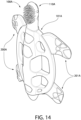
- FIGS. 14 and 15 depict different examples of some possible alternate configurations of toothbrush 100 having uniquely shaped handle portions.
- FIG. 14 depicts a toothbrush 100A having head portion 110A, handle portion 101A, and appendages 200A, 201A which collectively resemble a turtle.
- FIG. 15 depicts a toothbrush 100B having head portion 110B, handle portion 101B, and appendages 200B, 201B which collectively resemble a whimsical character or shape.
- Toothbrushes 100A and 100B include the same features and function previously described herein for toothbrush 100 including provisions to prevent over-insertion into the oral cavity/mouth and reduce bacterial contamination transfer from hard surfaces when the toothbrush is placed or dropped thereon. They will not be repeated here for the sake of brevity.
Landscapes
- Brushes (AREA)
Applications Claiming Priority (3)
| Application Number | Priority Date | Filing Date | Title |
|---|---|---|---|
| US15/807,852 US10306975B2 (en) | 2017-06-01 | 2017-11-09 | Oral care implement |
| EP18735016.0A EP3618666B1 (de) | 2017-11-09 | 2018-05-31 | Mundpflegegerät |
| PCT/US2018/035254 WO2018222786A1 (en) | 2017-06-01 | 2018-05-31 | Oral care implement |
Related Parent Applications (2)
| Application Number | Title | Priority Date | Filing Date |
|---|---|---|---|
| EP18735016.0A Division-Into EP3618666B1 (de) | 2017-11-09 | 2018-05-31 | Mundpflegegerät |
| EP18735016.0A Division EP3618666B1 (de) | 2017-11-09 | 2018-05-31 | Mundpflegegerät |
Publications (2)
| Publication Number | Publication Date |
|---|---|
| EP4552530A2 true EP4552530A2 (de) | 2025-05-14 |
| EP4552530A3 EP4552530A3 (de) | 2025-07-23 |
Family
ID=69370627
Family Applications (2)
| Application Number | Title | Priority Date | Filing Date |
|---|---|---|---|
| EP18735016.0A Active EP3618666B1 (de) | 2017-11-09 | 2018-05-31 | Mundpflegegerät |
| EP25166507.1A Pending EP4552530A3 (de) | 2017-11-09 | 2018-05-31 | Mundpflegegerät |
Family Applications Before (1)
| Application Number | Title | Priority Date | Filing Date |
|---|---|---|---|
| EP18735016.0A Active EP3618666B1 (de) | 2017-11-09 | 2018-05-31 | Mundpflegegerät |
Country Status (1)
| Country | Link |
|---|---|
| EP (2) | EP3618666B1 (de) |
Citations (1)
| Publication number | Priority date | Publication date | Assignee | Title |
|---|---|---|---|---|
| US7143462B2 (en) | 2002-09-20 | 2006-12-05 | Colgate-Palmolive Company | Oral care implement |
Family Cites Families (6)
| Publication number | Priority date | Publication date | Assignee | Title |
|---|---|---|---|---|
| US4780924A (en) * | 1987-10-20 | 1988-11-01 | Hansen Paul D | Tooth brush with removable brush head |
| US5138737A (en) * | 1989-10-16 | 1992-08-18 | Thomas Martha M | Toothbrush |
| USD388615S (en) * | 1996-11-18 | 1998-01-06 | Phillips Joseph E | Children's toothbrush |
| US20090130945A1 (en) * | 2007-11-21 | 2009-05-21 | Moss David B | Children's toothbrush and aerial amusement device |
| USD745283S1 (en) * | 2014-12-12 | 2015-12-15 | Live-Right, Llc | Combined baby toothbrush and teether |
| GB2552512A (en) * | 2016-07-26 | 2018-01-31 | Matchstick Monkey Ltd | An improved teething device |
-
2018
- 2018-05-31 EP EP18735016.0A patent/EP3618666B1/de active Active
- 2018-05-31 EP EP25166507.1A patent/EP4552530A3/de active Pending
Patent Citations (1)
| Publication number | Priority date | Publication date | Assignee | Title |
|---|---|---|---|---|
| US7143462B2 (en) | 2002-09-20 | 2006-12-05 | Colgate-Palmolive Company | Oral care implement |
Also Published As
| Publication number | Publication date |
|---|---|
| EP3618666B1 (de) | 2025-05-07 |
| EP3618666A1 (de) | 2020-03-11 |
| EP4552530A3 (de) | 2025-07-23 |
Similar Documents
| Publication | Publication Date | Title |
|---|---|---|
| AU2020273353B2 (en) | Oral care implement | |
| AU2019210639B2 (en) | Oral care implement and method of forming an oral care implement | |
| CN113412073A (zh) | 口腔护理器具 | |
| BRPI0414509B1 (pt) | cabeça para uso em uma escova de dentes, e, método para formar a mesma | |
| EP3349613B1 (de) | Mundpflegegerät | |
| CN107920654A (zh) | 口腔护理器具 | |
| KR20150138294A (ko) | 구강 관리기구 | |
| RU2677062C1 (ru) | Устройство для ухода за полостью рта | |
| CN104159471B (zh) | 口腔护理器具 | |
| US10426255B2 (en) | Oral care instrument | |
| EP3618666B1 (de) | Mundpflegegerät | |
| KR200482971Y1 (ko) | 전방위 칫솔모가 형성된 칫솔 | |
| BR112018003450B1 (pt) | Implemento de tratamento bucal |
Legal Events
| Date | Code | Title | Description |
|---|---|---|---|
| PUAI | Public reference made under article 153(3) epc to a published international application that has entered the european phase |
Free format text: ORIGINAL CODE: 0009012 |
|
| STAA | Information on the status of an ep patent application or granted ep patent |
Free format text: STATUS: THE APPLICATION HAS BEEN PUBLISHED |
|
| AC | Divisional application: reference to earlier application |
Ref document number: 3618666 Country of ref document: EP Kind code of ref document: P |
|
| AK | Designated contracting states |
Kind code of ref document: A2 Designated state(s): AL AT BE BG CH CY CZ DE DK EE ES FI FR GB GR HR HU IE IS IT LI LT LU LV MC MK MT NL NO PL PT RO RS SE SI SK SM TR |
|
| REG | Reference to a national code |
Ref country code: DE Ref legal event code: R079 Free format text: PREVIOUS MAIN CLASS: A46B0015000000 Ipc: A46B0005020000 |
|
| PUAL | Search report despatched |
Free format text: ORIGINAL CODE: 0009013 |
|
| AK | Designated contracting states |
Kind code of ref document: A3 Designated state(s): AL AT BE BG CH CY CZ DE DK EE ES FI FR GB GR HR HU IE IS IT LI LT LU LV MC MK MT NL NO PL PT RO RS SE SI SK SM TR |
|
| RIC1 | Information provided on ipc code assigned before grant |
Ipc: A46B 5/02 20060101AFI20250617BHEP Ipc: A46B 5/00 20060101ALI20250617BHEP Ipc: A46B 15/00 20060101ALI20250617BHEP |
|
| STAA | Information on the status of an ep patent application or granted ep patent |
Free format text: STATUS: REQUEST FOR EXAMINATION WAS MADE |
|
| 17P | Request for examination filed |
Effective date: 20260123 |