EP4552612A1 - Peniskompressionsvorrichtung - Google Patents
Peniskompressionsvorrichtung Download PDFInfo
- Publication number
- EP4552612A1 EP4552612A1 EP24211751.3A EP24211751A EP4552612A1 EP 4552612 A1 EP4552612 A1 EP 4552612A1 EP 24211751 A EP24211751 A EP 24211751A EP 4552612 A1 EP4552612 A1 EP 4552612A1
- Authority
- EP
- European Patent Office
- Prior art keywords
- opening
- branches
- branch
- junction
- préférence
- Prior art date
- Legal status (The legal status is an assumption and is not a legal conclusion. Google has not performed a legal analysis and makes no representation as to the accuracy of the status listed.)
- Pending
Links
Images


Classifications
-
- A—HUMAN NECESSITIES
- A61—MEDICAL OR VETERINARY SCIENCE; HYGIENE
- A61F—FILTERS IMPLANTABLE INTO BLOOD VESSELS; PROSTHESES; DEVICES PROVIDING PATENCY TO, OR PREVENTING COLLAPSING OF, TUBULAR STRUCTURES OF THE BODY, e.g. STENTS; ORTHOPAEDIC, NURSING OR CONTRACEPTIVE DEVICES; FOMENTATION; TREATMENT OR PROTECTION OF EYES OR EARS; BANDAGES, DRESSINGS OR ABSORBENT PADS; FIRST-AID KITS
- A61F5/00—Orthopaedic methods or devices for non-surgical treatment of bones or joints; Nursing devices ; Anti-rape devices
- A61F5/48—Devices for preventing wetting or pollution of the bed
-
- A—HUMAN NECESSITIES
- A61—MEDICAL OR VETERINARY SCIENCE; HYGIENE
- A61F—FILTERS IMPLANTABLE INTO BLOOD VESSELS; PROSTHESES; DEVICES PROVIDING PATENCY TO, OR PREVENTING COLLAPSING OF, TUBULAR STRUCTURES OF THE BODY, e.g. STENTS; ORTHOPAEDIC, NURSING OR CONTRACEPTIVE DEVICES; FOMENTATION; TREATMENT OR PROTECTION OF EYES OR EARS; BANDAGES, DRESSINGS OR ABSORBENT PADS; FIRST-AID KITS
- A61F2/00—Filters implantable into blood vessels; Prostheses, i.e. artificial substitutes or replacements for parts of the body; Appliances for connecting them with the body; Devices providing patency to, or preventing collapsing of, tubular structures of the body, e.g. stents
- A61F2/0004—Closure means for urethra or rectum, i.e. anti-incontinence devices or support slings against pelvic prolapse
- A61F2/0031—Closure means for urethra or rectum, i.e. anti-incontinence devices or support slings against pelvic prolapse for constricting the lumen; Support slings for the urethra
- A61F2/0054—Closure means for urethra or rectum, i.e. anti-incontinence devices or support slings against pelvic prolapse for constricting the lumen; Support slings for the urethra with pressure applied to urethra by an element placed around the penis, e.g. penis clamp
-
- A—HUMAN NECESSITIES
- A61—MEDICAL OR VETERINARY SCIENCE; HYGIENE
- A61F—FILTERS IMPLANTABLE INTO BLOOD VESSELS; PROSTHESES; DEVICES PROVIDING PATENCY TO, OR PREVENTING COLLAPSING OF, TUBULAR STRUCTURES OF THE BODY, e.g. STENTS; ORTHOPAEDIC, NURSING OR CONTRACEPTIVE DEVICES; FOMENTATION; TREATMENT OR PROTECTION OF EYES OR EARS; BANDAGES, DRESSINGS OR ABSORBENT PADS; FIRST-AID KITS
- A61F5/00—Orthopaedic methods or devices for non-surgical treatment of bones or joints; Nursing devices ; Anti-rape devices
- A61F5/41—Devices for promoting penis erection
- A61F2005/414—Devices for promoting penis erection by constricting means
-
- A—HUMAN NECESSITIES
- A61—MEDICAL OR VETERINARY SCIENCE; HYGIENE
- A61F—FILTERS IMPLANTABLE INTO BLOOD VESSELS; PROSTHESES; DEVICES PROVIDING PATENCY TO, OR PREVENTING COLLAPSING OF, TUBULAR STRUCTURES OF THE BODY, e.g. STENTS; ORTHOPAEDIC, NURSING OR CONTRACEPTIVE DEVICES; FOMENTATION; TREATMENT OR PROTECTION OF EYES OR EARS; BANDAGES, DRESSINGS OR ABSORBENT PADS; FIRST-AID KITS
- A61F2230/00—Geometry of prostheses classified in groups A61F2/00 - A61F2/26 or A61F2/82 or A61F9/00 or A61F11/00 or subgroups thereof
- A61F2230/0002—Two-dimensional shapes, e.g. cross-sections
- A61F2230/0004—Rounded shapes, e.g. with rounded corners
- A61F2230/0008—Rounded shapes, e.g. with rounded corners elliptical or oval
-
- A—HUMAN NECESSITIES
- A61—MEDICAL OR VETERINARY SCIENCE; HYGIENE
- A61F—FILTERS IMPLANTABLE INTO BLOOD VESSELS; PROSTHESES; DEVICES PROVIDING PATENCY TO, OR PREVENTING COLLAPSING OF, TUBULAR STRUCTURES OF THE BODY, e.g. STENTS; ORTHOPAEDIC, NURSING OR CONTRACEPTIVE DEVICES; FOMENTATION; TREATMENT OR PROTECTION OF EYES OR EARS; BANDAGES, DRESSINGS OR ABSORBENT PADS; FIRST-AID KITS
- A61F2230/00—Geometry of prostheses classified in groups A61F2/00 - A61F2/26 or A61F2/82 or A61F9/00 or A61F11/00 or subgroups thereof
- A61F2230/0002—Two-dimensional shapes, e.g. cross-sections
- A61F2230/0004—Rounded shapes, e.g. with rounded corners
- A61F2230/0013—Horseshoe-shaped, e.g. crescent-shaped, C-shaped, U-shaped
Definitions
- the present invention relates to a penile compression device for externally constricting the penis to prevent urinary leakage, and an associated method.
- a penile compression device is adapted to, in a service position, externally compress the penis in order to close the urethra without blocking blood flow.
- It may comprise first and second branches, the first ends of which are connected by a hinge, and the second ends of which are connected by means of a deactivatable fastener.
- the fastener makes it difficult to place in the service position.
- Penile compression devices are also known in which the second ends of the branches are also connected to each other by a hinge.
- the device described in WO2010042813 has two branches in the form of flat spring blades, of constant cross-sections, joined at their first and second ends, by first and second junctions, respectively. In the rest position, the branches together define an oblong opening.
- the height of the opening can be increased to allow the introduction of the penis into the opening. The release of this compression produces an elastic return to the resting position, and compression of the penis.
- the hardness of the spring blade material limits the pressure they can exert without causing trauma.
- the device is therefore unreliable, and a pocket is provided to collect any escaping urine. Furthermore, it is uncomfortable, bulky, and breaks after a few months of use.
- WO2019094707 or US2018060012 , describes a one-piece annular device, without attachment, made of a resilient material.
- This device allows urination in the service position.
- Upper and lower handles allow the device to be deformed to extract it from the service position. This extraction requires the use of both hands of the user.
- the device is bulky and uncomfortable. The handles complicate cleaning and can potentially break over time.
- the device is asymmetrical, which requires special attention when putting it into service position.
- EP3167844 describes a silicone annular device whose opening can be deformed by radial separation, by the combination of an upward pull and a downward pull. This device is difficult to put into the service position and to remove. In particular, these operations require both hands of the user. In addition, the device is asymmetrical, which requires special care when putting it into the service position. Finally, in the service position, it excessively compresses the blood vessels.
- EP2695584 describes an annular device whose opening can be deformed by pinching. Elastic deformation is achieved by means of an internal metal structure. This metal structure breaks within a few months, particularly in the middle of the branches. It also affects comfort in the service position. The device is also bulky and expensive to manufacture. Finally, the device has cavities on the surface which are detrimental to hygiene and expose the internal metal structure to the external environment (water, oxidation, bacteria, etc.).
- One aim of the invention is to meet this need.
- said foldable branch is made of one or more materials having a Shore A hardness of less than 50.
- branches require adaptation of the branches so that the branches are elastically pliable, in particular by increasing the thickness of the branches.
- Other adaptations known to those skilled in the art, may be envisaged.
- the invention thus provides a device which has branches whose first function is similar to that of the branches in the form of flat spring blades described in WO2010042813 : under the effect of pinching, the two branches bend to expand the opening which separates them and thus reach the mounting position allowing the introduction of the user's penis into the opening. After the pinching stops, the branches elastically return to their rest position, but come into contact with the penis, in the service position.
- the low hardness of the branches allows the device to exert a higher pressure in the service position, with greater comfort.
- the device has greater compactness and adapts better to the user's body.
- At least one of the right and left junctions is elastically deformable under the effect of pinching so as to separate the ends of the upper branch and the lower branch which are physically connected to said junction.
- the opening can thus be widened, depending on the height direction, by deformation of the junctions, which gives the device a high compactness.
- the deformation is elastic. In the service position, the elasticity of the junctions can thus advantageously contribute to the pressure exerted on the urethra.
- a junction preferably each junction, has the shape of a C, opening towards the opening, the branches being connected to the ends of the C.
- the pinching thus helps to open the Cs of the junctions, that is to say to flatten the junctions.
- a “branch” is conventionally an elongated member along a main axis, the length of which, measured along said main axis, is greater than 1.5 times, preferably greater than twice, the largest transverse dimension, i.e. measured in a cross-section, considering all the cross-sections along the branch.
- the cross-section may or may not be constant along the main axis.
- a branch may or may not be straight.
- a stem is an example of a branch.
- the two branches are connected by a junction which, like the branch, partially delimits the outline of the opening.
- the junction is considered to begin when the curvature of this outline increases sharply.
- the boundary separating the junction and the end of a branch connected to the junction can be positioned, on the outline, at the point where the center of curvature of the contour is on the opening side and where the radius of curvature becomes less than 1 cm when approaching the end of the device closest to the junction.
- the "service position” is the position in which the device is worn without being held by the user, the user's penis being encircled by the device, the branches pressing the urethra so as to prevent any leakage of urine.
- the contact of the penis with the device preferably does not extend over the entire perimeter, or "contour," of the opening. In particular, it preferably does not extend over the right and left portions of the contour of the opening, in the regions of the junctions.
- the device is preferably configured so that, in the service position, it exerts pressure on the penis only in the plane of the opening.
- the “rest position” is the position in which the device is not subjected to any external force tending to widen the opening. A part in the rest position is said to be “at rest”. Preferably, the opening has a minimal area in this position.
- the "mounting position" is the position in which the device is pinched so that the opening has sufficient area for the user's penis to be inserted into the opening.
- the opening has a maximum area in this position.
- the user is the person who, in the service position, wears the device.
- the "length" of an organ is measured along the main axis of the organ, for example, by measuring the distance between the two ends of a branch following any curvature of the branch.
- a transverse plane is a plane perpendicular to the main axis of an organ.
- a transverse section is a section in a cross-sectional plane.
- a longitudinal plane is a plane that includes the major axis of an organ.
- the X axis of the opening is the line perpendicular to the plane of the opening and which passes through its barycenter.
- the thickness of the device or a branch is measured along the direction of the X axis.
- the length and height of the opening, device or branch are measured in a transverse plane perpendicular to the X-axis direction, with the height direction being perpendicular to the length direction.
- the height and thickness of an organ mean the maximum height and maximum thickness considering all planes perpendicular to the main axis of the organ, respectively.
- pinching is meant an action exerted on the right and left junctions to bring them closer together, and thus widen the opening.
- this action can be exerted by pressure of the thumb and index finger of the same hand of the user on said junctions.
- a branch is "foldable" when it gradually curves as its ends come together. This curvature allows, in the mounting position, to obtain an opening delimited by a concave edge substantially along the entire length of the branches.
- the general shape of the opening gradually evolves from a slit or fusiform shape to a disc shape, as the pinching progresses.
- the "bearing edge" of a branch is the surface of the branch that is intended to compress the user's penis in the service position.
- the circularity of a section or opening is the ratio of the smallest dimension of the section or opening to the largest dimension of the section or opening, respectively.
- a disc has a circularity of 1.
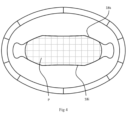
- FIG. 1 represents, in the rest position, a device 10 according to a preferred embodiment of the invention.
- the device is a single-piece device.
- it is fast, reliable, and inexpensive to manufacture.
- it is manufactured by molding.
- the outer surface of the device is preferably smooth, preferably free of sharp edges and preferably free of cavities, which limits the accumulation of dirt and therefore improves hygiene.
- the device does not have an undercut area incompatible with manufacturing by molding.
- More than 80%, more than 90%, more than 95% of the outer surface of the device is preferably convex.
- the outer surface is convex at all points, except in the region of the right and left junctions.
- the outer surface of the device which defines the opening is preferably made of a material having a coefficient of friction sufficient to maintain it in the service position when the user is wearing it.
- the device comprises upper 12s and lower 12i branches, with main axes Ys and Yi, respectively, and right 14d and left 14g junctions respectively connecting right ends 16ds and 16di of the upper and lower branches respectively, and left ends 16gs and 16gi of the upper and lower branches respectively.
- each branch measured along its main axis, is greater than 1.8 times, preferably greater than 1.9 times, preferably greater than twice, and/or less than 3 times, preferably less than 2.5 times, preferably less than 2.3 times, preferably less than 2.2 times, the largest transverse dimension, i.e. measured in a cross-section, considering all cross-sections along the branch.
- the cross-section is preferably variable along the main axis.
- the upper 12s and lower 12i branches have bearing edges 18s and 18i, respectively, which delimit an opening 20.
- a branch preferably each branch, and/or a junction, preferably each junction, preferably the device is made of a single material, preferably an elastomer, preferably a silicone, preferably a silicone chosen to be non-allergenic in contact with the skin.
- the silicone is preferably a polyaddition silicone.
- one junction preferably each junction, is of the same material as the branches.
- the elasticity is preferably sufficient for the device to return to its resting position after use.
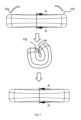
- the device is preferably made of one or more materials sufficiently flexible and elastic so that, from the rest position, two points 19d and 19g at the periphery of the device (which excludes the points on the surface which defines the opening 20) and at the right and left ends of the device, respectively, can be brought together until they touch ( Figure 5 ), without plastic deformation or rupture of the device.
- two points 19d and 19g at the periphery of the device which excludes the points on the surface which defines the opening 20
- the right and left ends of the device respectively
- one branch preferably every branch, is full.
- one branch preferably each branch, is externally curved, as shown in the figures.
- the device has the shape of a flattened grain of rice. Seen from the front, the outer contour of the device is oval or ellipsoidal. The inner contour delimits an opening in the form of a slot extended at each of its ends by a through orifice, substantially cylindrical with a circular base, in communication with the slot.
- a junction preferably each junction, is preferably made of the same material as the branches.
- a junction preferably each junction, preferably has the shape of a C opening towards the opening 20, as illustrated in the Figure 1A .
- the edge of the junction which delimits the opening 20 is C-shaped, the height of this C being preferably greater than the spacing between the two ends of the branches. connected at the junction, preferably greater than twice or three times this spacing, as shown in the Figure 1A .
- the radius of curvature of the edge of the C-shaped junction is preferably greater than 1 mm, preferably greater than 2 mm, preferably greater than 3 mm and/or less than 20 mm, preferably less than 15 mm, preferably less than 10 mm, preferably less than 8 mm, preferably less than 6 mm, preferably less than 5 mm at any point on this edge.
- the ends of the branches connected at a junction are in the extension of the C, so that the flattening of the C under the effect of pinching (arrows F 3 on the Figure 3 ) leads to a separation of the two branches from each other, depending on the height direction. It is thus advantageously possible to increase the area of the opening from the rest position, with a particularly space-saving device.
- the opening continues to develop mainly because the branches bend, which rounds the opening.
- the pinch force may be different in the first phase and in the second phase. It is preferably lower in the first phase.
- one junction preferably each junction, is made of an elastic material.
- the bending of the branches then produces an elastic stretching of the junctions. This stretching leads to a further separation of the two branches from each other, in the height direction, and further contributes to the widening of the opening, i.e. to the increase of its area.
- the C-shape and the elastic material construction thus make it possible to considerably increase the area of the opening 20 by spreading the branches at the junctions. Even if this is not the preferred embodiment, such an enlargement of the opening is possible even if the branches are not very flexible.
- the mounting position corresponds to the configuration that the device temporarily adopts to be placed on the user's penis.
- the area of the opening 20 is then preferably substantially maximum.
- the dimensions of the branches are substantially the same in the mounted position and in the rest position.
- the thickness of the device is also substantially the same in the mounted position and in the rest position.
- the shape of the device in the service position depends on the user's morphology.
- the opening area is intermediate between the opening area in the rest position and the opening area in the mounting position.
- the user pinches the device laterally, preferably with one hand.
- the junctions flatten and the branches bend outwards, thus widening the opening 20.
- the C-junctions allow the widening of the opening to be well controlled.
- the symmetry of the device advantageously allows it to be arranged with the upper branch above or below the lower branch, without changing the effectiveness of the device.
- the device is advantageously particularly simple to use.
- the device is preferably configured so that, upon pinching, a compressive force of 5 N allows an increase in the height of the opening of more than 20 mm.
- the branches do not have a stiffening core. When pinched, they can therefore twist on themselves. If the pinching is not carried out correctly, the device can also "buckle”, i.e. bend around a horizontal axis parallel to the general plane of the device.
- the cross-section, and in particular the thickness of the branches advantageously limit this risk.
- the outline of the opening 20 takes a substantially rounded shape in the mounting position, at least along the branches, and preferably a substantially rectilinear shape at the junctions, as illustrated in the Figure 3
- the device is therefore very compact.
- the user can then very easily place the device on penis P, then release it.
- the device then closes elastically, partially, to the service position (see Figure 4 ). No other operation is advantageously required.
- the bearing edges of the branches bear on the penis preferably over more than 80%, preferably more than 90%, preferably substantially 100% of their length.
- the pressure exerted on the urethra results from the elasticity of the branches, but also from the elasticity of the junctions.
- the flexibility of the material used allows the device to take the shape of the body parts on which it rests, making it discreet.
- the support surface increases with the area of the opening, which limits the risk of injury and improves comfort, through a "cushion" effect.
- the support is, however, comfortable and effective, with tests having shown that incontinence is eliminated.
- Bringing the junctions closer together also allows material to be pushed towards the middle of the branches. This can create folds in the middle of the support edges, which advantageously creates a central protuberance and locally increases pressure at the urethra.
- the user can pinch the device again to relieve pressure on the urethra, preferably with one hand. There is no need to remove the device. When the user stops pinching the device, it elastically returns to the operating position.
- the user can pinch the device again to return to the mounting position, or a similar configuration, and then slide it over the penis to detach it.
- the device can then be easily cleaned, either manually or by machine.
- the absence of a cavity on the surface of the device facilitates drying and limits the risk of dirt accumulation.
- the device can be reused.
Landscapes
- Health & Medical Sciences (AREA)
- Engineering & Computer Science (AREA)
- Animal Behavior & Ethology (AREA)
- Veterinary Medicine (AREA)
- Urology & Nephrology (AREA)
- Public Health (AREA)
- General Health & Medical Sciences (AREA)
- Biomedical Technology (AREA)
- Heart & Thoracic Surgery (AREA)
- Vascular Medicine (AREA)
- Life Sciences & Earth Sciences (AREA)
- Transplantation (AREA)
- Oral & Maxillofacial Surgery (AREA)
- Cardiology (AREA)
- Reproductive Health (AREA)
- Environmental & Geological Engineering (AREA)
- Nursing (AREA)
- Orthopedic Medicine & Surgery (AREA)
- Prostheses (AREA)
- Orthopedics, Nursing, And Contraception (AREA)
- Massaging Devices (AREA)
Applications Claiming Priority (1)
| Application Number | Priority Date | Filing Date | Title |
|---|---|---|---|
| FR2312149A FR3154914B1 (fr) | 2023-11-08 | 2023-11-08 | Dispositif de compression penienne |
Publications (1)
| Publication Number | Publication Date |
|---|---|
| EP4552612A1 true EP4552612A1 (de) | 2025-05-14 |
Family
ID=89767756
Family Applications (1)
| Application Number | Title | Priority Date | Filing Date |
|---|---|---|---|
| EP24211751.3A Pending EP4552612A1 (de) | 2023-11-08 | 2024-11-08 | Peniskompressionsvorrichtung |
Country Status (2)
| Country | Link |
|---|---|
| EP (1) | EP4552612A1 (de) |
| FR (1) | FR3154914B1 (de) |
Citations (7)
| Publication number | Priority date | Publication date | Assignee | Title |
|---|---|---|---|---|
| DE20112864U1 (de) * | 2001-08-02 | 2001-11-22 | Urovision GmbH, 83043 Bad Aibling | Penisklemme |
| US20050256365A1 (en) * | 2004-05-07 | 2005-11-17 | Novatek Medical, Llc | Penile compression device |
| WO2010042813A2 (en) | 2008-10-09 | 2010-04-15 | Gt Urological, Llc | Penile compression device |
| EP2695584A1 (de) | 2012-08-10 | 2014-02-12 | Pedro Garcia Berruezo | Fixiermittel und okklusion-gerät von der penis für inkontinenz der urin. |
| EP3167844A1 (de) | 2015-11-10 | 2017-05-17 | José Zafra Méndez | Schliessmuskel protesis male für den esternen gebrauch on canal zone urethral |
| US20180060012A1 (en) | 2011-09-27 | 2018-03-01 | Z124 | Multiscreen phone emulation |
| WO2019094707A1 (en) | 2017-11-09 | 2019-05-16 | Assure Medical Group, Llc | Male incontinence control device and method of controlling male incontinence |
-
2023
- 2023-11-08 FR FR2312149A patent/FR3154914B1/fr active Active
-
2024
- 2024-11-08 EP EP24211751.3A patent/EP4552612A1/de active Pending
Patent Citations (7)
| Publication number | Priority date | Publication date | Assignee | Title |
|---|---|---|---|---|
| DE20112864U1 (de) * | 2001-08-02 | 2001-11-22 | Urovision GmbH, 83043 Bad Aibling | Penisklemme |
| US20050256365A1 (en) * | 2004-05-07 | 2005-11-17 | Novatek Medical, Llc | Penile compression device |
| WO2010042813A2 (en) | 2008-10-09 | 2010-04-15 | Gt Urological, Llc | Penile compression device |
| US20180060012A1 (en) | 2011-09-27 | 2018-03-01 | Z124 | Multiscreen phone emulation |
| EP2695584A1 (de) | 2012-08-10 | 2014-02-12 | Pedro Garcia Berruezo | Fixiermittel und okklusion-gerät von der penis für inkontinenz der urin. |
| EP3167844A1 (de) | 2015-11-10 | 2017-05-17 | José Zafra Méndez | Schliessmuskel protesis male für den esternen gebrauch on canal zone urethral |
| WO2019094707A1 (en) | 2017-11-09 | 2019-05-16 | Assure Medical Group, Llc | Male incontinence control device and method of controlling male incontinence |
Also Published As
| Publication number | Publication date |
|---|---|
| FR3154914A1 (fr) | 2025-05-09 |
| FR3154914B1 (fr) | 2026-01-16 |
Similar Documents
| Publication | Publication Date | Title |
|---|---|---|
| EP3324901B1 (de) | Ergonomische menstruationsschale | |
| EP2117478B1 (de) | Vorrichtung zum ergreifen des unterarms eines an muskulären problemen im ellenbogen leidenden benutzers | |
| EP1561989B1 (de) | Verfahren zur Herstellung eines Verbindungselements für eine Rohrkupplung und die entsprechende Rohrkupplung | |
| EP1924218B1 (de) | Vorrichtung zum verhindern von stressbedingter inkontinenz bei der frau | |
| EP0119143A1 (de) | Vorrichtung zum Sammeln von Urinen von männlichen Inkontinenten | |
| EP0346245A1 (de) | Intraokulares Vorderkammerimplantat | |
| WO2002002019A1 (fr) | Pince multifonctions a usage medical comportant deux machoires articulees | |
| EP2058091A1 (de) | Schere mit flexiblen Ringgriffen | |
| EP4552612A1 (de) | Peniskompressionsvorrichtung | |
| FR2693652A1 (fr) | Préservatif perfectionné du type condom. | |
| WO2000057802A1 (fr) | Pince bipolaire pour la pelviscopie | |
| WO1986002852A1 (fr) | Baton de ski muni d'un dispositif de reglage en longueur de dragonne | |
| FR2876879A1 (fr) | Soutien-gorge avec des bretelles a volume variable | |
| FR3073735A1 (fr) | Paire de cannes anglaises | |
| WO2022084823A1 (fr) | Poche de jambe pour les systèmes d'évacuation des fluides corporels | |
| FR2814930A1 (fr) | Dispositif a etrier pour enfiler un vetement | |
| EP3784194A1 (de) | Greifvorrichtung für einen harnbeutel | |
| FR2737657A3 (fr) | Dispositif pour perfectionner un condom | |
| FR2881045A1 (fr) | Dispositif destine a appareiller les personnes de sexe masculin ayant des problemes d'incontinence | |
| FR2865381A1 (fr) | Implant intraoculaire a optique souple | |
| FR2568777A1 (fr) | Canule de liposuccion | |
| FR2819713A1 (fr) | Implant intraoculaire monobloc souple | |
| FR2952525A1 (fr) | Canule d'evacuation de flux salivaire et/ou sanguin | |
| OA18780A (fr) | Coupe menstruelle ergonomique. | |
| FR3155130A1 (fr) | Etui pénien pour collection urinaire et système de collection urinaire associé |
Legal Events
| Date | Code | Title | Description |
|---|---|---|---|
| PUAI | Public reference made under article 153(3) epc to a published international application that has entered the european phase |
Free format text: ORIGINAL CODE: 0009012 |
|
| STAA | Information on the status of an ep patent application or granted ep patent |
Free format text: STATUS: THE APPLICATION HAS BEEN PUBLISHED |
|
| AK | Designated contracting states |
Kind code of ref document: A1 Designated state(s): AL AT BE BG CH CY CZ DE DK EE ES FI FR GB GR HR HU IE IS IT LI LT LU LV MC ME MK MT NL NO PL PT RO RS SE SI SK SM TR |
|
| STAA | Information on the status of an ep patent application or granted ep patent |
Free format text: STATUS: REQUEST FOR EXAMINATION WAS MADE |
|
| 17P | Request for examination filed |
Effective date: 20251008 |
|
| STAA | Information on the status of an ep patent application or granted ep patent |
Free format text: STATUS: EXAMINATION IS IN PROGRESS |
|
| 17Q | First examination report despatched |
Effective date: 20260114 |