EP4552633A1 - Compositions pharmaceutiques comprenant des solutions solides amorphes de rivaroxaban et de copovidone et leurs procédés de préparation - Google Patents
Compositions pharmaceutiques comprenant des solutions solides amorphes de rivaroxaban et de copovidone et leurs procédés de préparation Download PDFInfo
- Publication number
- EP4552633A1 EP4552633A1 EP24210689.6A EP24210689A EP4552633A1 EP 4552633 A1 EP4552633 A1 EP 4552633A1 EP 24210689 A EP24210689 A EP 24210689A EP 4552633 A1 EP4552633 A1 EP 4552633A1
- Authority
- EP
- European Patent Office
- Prior art keywords
- pharmaceutical composition
- rivaroxaban
- composition according
- copovidone
- povidone
- Prior art date
- Legal status (The legal status is an assumption and is not a legal conclusion. Google has not performed a legal analysis and makes no representation as to the accuracy of the status listed.)
- Pending
Links
Images

Classifications
-
- A—HUMAN NECESSITIES
- A61—MEDICAL OR VETERINARY SCIENCE; HYGIENE
- A61K—PREPARATIONS FOR MEDICAL, DENTAL OR TOILETRY PURPOSES
- A61K9/00—Medicinal preparations characterised by special physical form
- A61K9/20—Pills, tablets, discs, rods
- A61K9/2004—Excipients; Inactive ingredients
- A61K9/2022—Organic macromolecular compounds
- A61K9/2027—Organic macromolecular compounds obtained by reactions only involving carbon-to-carbon unsaturated bonds, e.g. polyvinyl pyrrolidone, poly(meth)acrylates
-
- A—HUMAN NECESSITIES
- A61—MEDICAL OR VETERINARY SCIENCE; HYGIENE
- A61K—PREPARATIONS FOR MEDICAL, DENTAL OR TOILETRY PURPOSES
- A61K31/00—Medicinal preparations containing organic active ingredients
- A61K31/33—Heterocyclic compounds
- A61K31/395—Heterocyclic compounds having nitrogen as a ring hetero atom, e.g. guanethidine or rifamycins
- A61K31/535—Heterocyclic compounds having nitrogen as a ring hetero atom, e.g. guanethidine or rifamycins having six-membered rings with at least one nitrogen and one oxygen as the ring hetero atoms, e.g. 1,2-oxazines
- A61K31/5375—1,4-Oxazines, e.g. morpholine
- A61K31/5377—1,4-Oxazines, e.g. morpholine not condensed and containing further heterocyclic rings, e.g. timolol
-
- A—HUMAN NECESSITIES
- A61—MEDICAL OR VETERINARY SCIENCE; HYGIENE
- A61K—PREPARATIONS FOR MEDICAL, DENTAL OR TOILETRY PURPOSES
- A61K9/00—Medicinal preparations characterised by special physical form
- A61K9/14—Particulate form, e.g. powders, Processes for size reducing of pure drugs or the resulting products, Pure drug nanoparticles
- A61K9/141—Intimate drug-carrier mixtures characterised by the carrier, e.g. ordered mixtures, adsorbates, solid solutions, eutectica, co-dried, co-solubilised, co-kneaded, co-milled, co-ground products, co-precipitates, co-evaporates, co-extrudates, co-melts; Drug nanoparticles with adsorbed surface modifiers
- A61K9/146—Intimate drug-carrier mixtures characterised by the carrier, e.g. ordered mixtures, adsorbates, solid solutions, eutectica, co-dried, co-solubilised, co-kneaded, co-milled, co-ground products, co-precipitates, co-evaporates, co-extrudates, co-melts; Drug nanoparticles with adsorbed surface modifiers with organic macromolecular compounds
-
- A—HUMAN NECESSITIES
- A61—MEDICAL OR VETERINARY SCIENCE; HYGIENE
- A61K—PREPARATIONS FOR MEDICAL, DENTAL OR TOILETRY PURPOSES
- A61K9/00—Medicinal preparations characterised by special physical form
- A61K9/20—Pills, tablets, discs, rods
- A61K9/2004—Excipients; Inactive ingredients
- A61K9/2013—Organic compounds, e.g. phospholipids, fats
- A61K9/2018—Sugars, or sugar alcohols, e.g. lactose, mannitol; Derivatives thereof, e.g. polysorbates
-
- A—HUMAN NECESSITIES
- A61—MEDICAL OR VETERINARY SCIENCE; HYGIENE
- A61K—PREPARATIONS FOR MEDICAL, DENTAL OR TOILETRY PURPOSES
- A61K9/00—Medicinal preparations characterised by special physical form
- A61K9/20—Pills, tablets, discs, rods
- A61K9/2004—Excipients; Inactive ingredients
- A61K9/2022—Organic macromolecular compounds
- A61K9/205—Polysaccharides, e.g. alginate, gums; Cyclodextrin
- A61K9/2054—Cellulose; Cellulose derivatives, e.g. hydroxypropyl methylcellulose
-
- A—HUMAN NECESSITIES
- A61—MEDICAL OR VETERINARY SCIENCE; HYGIENE
- A61P—SPECIFIC THERAPEUTIC ACTIVITY OF CHEMICAL COMPOUNDS OR MEDICINAL PREPARATIONS
- A61P7/00—Drugs for disorders of the blood or the extracellular fluid
- A61P7/04—Antihaemorrhagics; Procoagulants; Haemostatic agents; Antifibrinolytic agents
Definitions
- the present invention relates to a pharmaceutical composition
- a pharmaceutical composition comprising an amorphous solid solution of rivaroxaban and copovidone, povidone or crospovidone, wherein the weight ratio of rivaroxaban to copovidone, povidone or crospovidone is 1:4.1 to 1:7.
- the present invention relates to a pharmaceutical composition
- a pharmaceutical composition comprising an amorphous solid solution of rivaroxaban and copovidone, wherein the weight ratio of rivaroxaban to copovidone is 1:4.1 to 1:6.
- the present invention relates also to the use of said pharmaceutical composition in the treatment of a subject suffering from at least one of deep vein thrombosis and pulmonary embolism, wherein the subject is in a fasted state.
- the present invention relates to hot melt extrusion method for preparing said pharmaceutical composition.
- Rivaroxaban (S)-5-Chloro-N-((2-oxo-3-(4-(3-oxomorpholino)phenyl)oxazolidin-5-yl)methyl)thiophene-2-carboxamide is obtained by condensation of the carboxy group of 5-chlorothiophene-2-carboxylic acid with the amino group of (S)-4-(4-(5-(aminomethyl)-2-oxooxazolidin-3-yl)phenyl)morpholin-3-one.
- Rivaroxaban is an anticoagulant agent and the active pharmaceutical ingredient (API) in Bayer's Xarelto ® tablets, which is used to treat deep vein thrombosis (DVT) and pulmonary embolism (PE).
- Rivaroxaban inhibits free factor Xa, an enzyme involved in the production of thrombin, which is central to the process of blood clotting. By blocking factor Xa, rivaroxaban decreases the level of thrombin and reduces the risk of blood clots forming in the veins and arteries. Rivaroxaban also prevents existing blood clots from getting larger.
- the approved strength of film-coated tablets of Xarelto ® are 2.5 mg, 10 mg, 15 mg and 20 mg.
- the approved excipients part of the tablets core are microcrystalline cellulose, croscarmellose sodium, lactose monohydrate, hypromellose (2910), sodium laurilsulfate, and magnesium stearate; while the approved excipients part of the film-coat are macrogol (3350), hypromellose (2910), titanium dioxide (E 171), and iron oxide yellow (E 172).
- Rivaroxaban is classified as a Biopharmaceutical Classification II (BCS Class II) drug and has poor solubility (7 ⁇ g/ ml) in aqueous solution.
- the pharmacokinetics of drugs is driven by, among other factors, drug absorption.
- An orally administered drug has to first dissolve in gastrointestinal fluids before it can be absorbed into the blood stream and reach the site of action.
- Dissolution is the process by which a solute dissolves into the solvent to form a solution and is regulated by the solubility of the solute in the solvent, which represents the maximum concentration of a solute that can dissolve in a solvent.
- Absorption is the process of drug movement from the site of drug administration to systemic circulation.
- Drug absorption is quantified in terms of bioavailability. Bioavailability is the extent to which absorption occurs. In other words, bioavailability is the fraction of the administered drug that reaches systemic circulation.
- an orally administered API should have good solubility and/or a fast rate of dissolution in the gastrointestinal tract and plasma as well as good permeability across the biological membrane.
- drugs can be classified into one of the following four BCS classes:
- Factors that increase the rate of dissolution and/or solubility of a drug are important for BCS class II drugs, such as rivaroxaban, and class IV drugs.
- the rate and extent of absorption can be altered by food.
- Food can increase solubility by increasing the volume of fluids into which a drug can be solubilized, increasing the lipophilicity of said fluids, and changing the pH of said fluids. After a meal, the volume of intestinal fluids increases two- to threefold, which increases the amount of drug that may be solubilized. For this reason, 15 mg and 20 mg Xarelto ® tablets need to be administered to subjects in a fed state following a meal.
- BCS class II and IV drugs carry the risk of under dosing if a subject does not eat prior to drug administration since absorption of the drug is compromised. Over a prolonged period of time, this can have serious consequences. Accordingly, there is a need to improve the bioavailability of BCS class II and IV drugs, in order to remove their dependency on being administered together with food. There is also a need to develop rivaroxaban formulations with diminished food effect to ensure reliable absorption and thus to improve patients' adherence with the treatment.
- Solubility-enhancing amorphous solid dispersions or solutions can aid the absorption of hydrophobic, poorly soluble drugs.
- the API is dispersed within an excipient matrix in a substantially amorphous form.
- Many crystalline drugs can be prepared in an amorphous form and can be physically stabilized by the presence of an appropriate polymer. With the drug in an amorphous form, no energy is required to break the drug crystal lattice so, relative to the crystalline form, the amorphous form of many poorly water-soluble drugs can achieve substantially higher solubility and markedly faster dissolution.
- Amorphous-amorphous phase separation is a phenomenon wherein distinct drug-rich and polymer-rich amorphous phases are formed throughout the amorphous solid solution matrix, which initially consisted of homogenous mix of drug and polymer. Since amorphous-amorphous phase separation reduces the effect of the polymer, there is the need to find amorphous solutions that balance consistent bioavailability with formulation stability.
- the present invention provides a pharmaceutical composition with an optimized weight ratio of API to a pharmaceutically acceptable polymeric excipient showing a high degree of solubility and bioavailability of rivaroxaban.
- the term "pharmaceutically acceptable polymeric excipient” defines a class of compounds that increase the bioavailability and improve the stability of the API.
- the present invention provides a pharmaceutical composition
- a pharmaceutical composition comprising an amorphous solid solution of rivaroxaban and copovidone, povidone or crospovidone, wherein the weight ratio of rivaroxaban to copovidone, povidone or crospovidone is 1:4.1 to 1:7.
- amorphous solid solution indicates a monophasic system in an amorphous state, with a no long-range order.
- the API is molecularly dissolved in the solid excipient matrix, and is distributed at random between the excipient molecules.
- copovidone refers to a copolymer of 1-vinyl-2-pyrrolidone and vinyl acetate in a ratio 6:4 by weight.
- Non limiting examples of copovidone may include polyvinylpyrrolidone-vinyl acetate copolymer; Kollidon ® VA 64 and Plasdone ® S-630.
- povidon refers to poly(1-vinyl-2-pyrrolidone), but may also be referred to as povidonum, polyvidone or PVP.
- povidone may include Kollidon ® 12 PF; Kollidon ® 17 PF; Kollidon ® 25; Kollidon ® 30; Kollidon ® 30 LP; Kollidon ® 90 Evo; Kollidon ® 90 F; Plasdone TM k-25 povidone; Plasdone TM k-29
- crospovidone refers to crosslinked polyvinylpyrrolidone, but may also be referred to as crospovidonum, insoluble polyvinylpyrrolidone, or crosslinked PVP.
- Non-limiting examples of crospovidone may include Kollidon ® CL; Kollidon ® CL-F; Kollidon ® CL-M; and Kollidon ® CL-SF.
- a pharmaceutical composition comprising an amorphous solid solution of rivaroxaban and copovidone, povidone or crospovidone, wherein the weight ratio of rivaroxaban to copovidone, povidone or crospovidone may be 1:4.2 to 1:7, 1:4.3 to 1:7, 1:4.4 to 1:7; or 1:4.5 to 1:7.
- a pharmaceutical composition comprising an amorphous solid solution of rivaroxaban and copovidone, povidone or crospovidone, wherein the weight ratio of rivaroxaban to copovidone, povidone or crospovidone may be 1:4.1, 1:4.2, 1:4.3, 1:4.4, 1:4.5, 1:4.6, 1:4.7, 1:4.8, 1:4.9, 1:5, 1:5.1, 1:5.2, 1:5.3, 1:5.4, 1:5.5, 1:5.6, 1:5.7, 1:5.8, 1:5.9, 1:6, 1:6.1, 1:6.2, 1:6.3, 1:6.4, 1:6.5, 1:6.6, 1:6.7, 1:6.8, 1:6.9, or 1:7.
- a pharmaceutical composition according to the present invention comprising an amorphous solid solution of rivaroxaban and povidone, wherein the weight ratio of rivaroxaban to povidone may be 1:4.1, 1:4.2, 1:4.3, 1:4.4,
- a pharmaceutical composition comprising an amorphous solid solution of rivaroxaban and copovidone, povidone or crospovidone, wherein the rivaroxaban may be from 10% to 3%, from 9% to 3%, from 8% to 3%, from 7% to 3%, or from 7% to 4% of the pharmaceutical composition.
- a pharmaceutical composition comprising an amorphous solid solution of rivaroxaban and copovidone, povidone or crospovidone, wherein the copovidone, povidone or crospovidone may be from 24% to 35%, from 24.5% to 34%, from 25% to 33%, from 26% to 32%, from 27% to 31%, or from 27% to 30% of the pharmaceutical composition.
- the present invention also provides a pharmaceutical composition
- a pharmaceutical composition comprising an amorphous solid solution of rivaroxaban and copovidone, wherein the weight ratio of rivaroxaban to copovidone may be 1:4.1 to 1:6.
- a pharmaceutical composition comprising an amorphous solid solution of rivaroxaban and copovidone, wherein the weight ratio of rivaroxaban to copovidone may be 1:4.2 to 1:5.9, 1:4.2 to 1:5.7, 1:4.2 to 1:5.6, 1:4.2 to 1:5.4, 1:4.3 to 1:5.2, 1:4.3 to 1:5.0, 1:4.4 to 1:4.8, 1:4.4 to 1:4.6, or 1:4.4 to 1:4.5.
- a pharmaceutical composition comprising an amorphous solid solution of rivaroxaban and copovidone, wherein the weight ratio of rivaroxaban to copovidone may be 1:4.1, 1:4.2, 1:4.3, 1:4.4, 1:4.5, 1:4.6, 1:4.7, 1:4.8, 1:4.9, 1:5, 1:5.1, 1:5.2, 1:5.3, 1:5.4, 1:5.5, 1:5.6, 1:5.7, 1:5.8, 1:5.9, or 1:6.
- a pharmaceutical composition according to the present invention comprising an amorphous solid solution of rivaroxaban and copovidone, wherein the weight ratio of rivaroxaban to copovidone may be 1:4.5.
- a pharmaceutical composition comprising an amorphous solid solution of rivaroxaban and copovidone, wherein the rivaroxaban may be from 10% to 3%, from 7% to 4%, from 7% to 4.5%, from 7% to 5%, from 7% to 6%, or from 6.8% to 6.3% of the pharmaceutical composition.
- a pharmaceutical composition comprising an amorphous solid solution of rivaroxaban and copovidone, wherein the copovidone may be from 24% to 35%, from 24.5% to 34%, from 25% to 33%, from 26% to 32%, from 27% to 31%, from 28% to 31%, from 29% to 31% or from 29% to 30% of the pharmaceutical composition.
- the pharmaceutical composition may further comprise a pharmaceutically acceptable excipient selected from at least one of a filler, disintegrant, glidant and lubricant.
- Fillers according to the present invention may be selected from at least one of microcrystalline cellulose, silicified microcrystalline cellulose, lactose, lactose monohydrate, mannitol, cellulose, starch, sorbitol, sucrose, maltodextrin, maltose, magnesium carbonate, magnesium oxide, dibasic anhydrous calcium phosphate, and dibasic dehydrate calcium phosphate.
- the filler may be selected from the group consisting of microcrystalline cellulose, silicified microcrystalline cellulose, lactose, lactose monohydrate, or a combination thereof.
- the filler may be from 20% to 70%, from 30% to 65%, from 40% to 60%, or from 50% to 60% of the pharmaceutical composition.
- Disintegrants according to the present invention may be selected from at least one of croscarmellose sodium, low-substituted hydroxypropyl cellulose, sodium alginate, calcium carboxymethylcellulose, chitosan hydrochloride, and magnesium aluminium silicate.
- the disintegrant may be croscarmellose sodium.
- the disintegrant may be from 0.5% to 10%, from 1% to 9%, from 1% to 8%, from 1.5% to 7%, from 1.5% to 6%, from 2% to 5%, from 2% to 4%, or from 2% to 3% of the pharmaceutical composition.
- Glidants according to the present invention may be selected from at least one of colloidal silicon dioxide, amorphous anhydrous colloidal silicon dioxide, talc, tribasic calcium silicate, calcium silicate, silica, magnesium trisilicate, silicified cellulose, hydrophobic colloidal silica and Aerosil ® 200.
- the glidant may be colloidal silicon dioxide, and preferably amorphous anhydrous colloidal silicon dioxide.
- the glidant may be from 0.5% to 10%, from 0.5% to 8%, from 0.5% to 6%, from 1% to 5%, from 1% to 4%, from 1% to 3%, or from 1% to 2% of the pharmaceutical composition.
- Lubricants according to the present invention may be selected from at least one of sodium stearyl fumarate, sodium lauryl sulphate, magnesium lauryl sulphate, stearic acid, calcium stearate, glyceryl dibehenate, glyceryl monostearate, glyceryl tristearate, palmitic acid, sorbitan monolaurate, sorbitan monopalmitate, zinc stearate, sorbitan sesquioleate, magnesium stearate and sorbitan trioleate.
- the lubricant may be selected from the group consisting of sodium stearyl fumarate, sodium lauryl sulphate or a combination thereof.
- the lubricant may be from 0.1% to 10%, from 0.5% to 10%, from 0.75% to 9%, from 1% to 8%, from 1.25% to 7, from 1.50% to 6%, or from 1.75% to 5% of the pharmaceutical composition.
- the pharmaceutical composition may comprise a therapeutically effective amount of rivaroxaban, that may result in at least prevention or delay of onset or amelioration or attainment of symptoms.
- the pharmaceutical composition may comprise rivaroxaban in an amount between 2.5 mg to 30 mg, 5 mg to 27.5 mg, 7.5 mg to 25 mg, 10 mg to 22.5 mg, 12.5 mg to 20 mg, or 15 mg to 17.5 mg.
- the pharmaceutical composition may comprise rivaroxaban in an amount of 2.5 mg, 10 mg, 15 mg, 20 mg, or 30 mg.
- the pharmaceutical composition may comprise:
- the pharmaceutical composition may comprise:
- the pharmaceutical composition may comprise:
- the pharmaceutical composition may comprise:
- the % of the components of the pharmaceutical composition refer to percentages by weight based on the total weight of the composition.
- % of the components refers to the weight percentage based on the total weight of the pharmaceutical composition i.e. excluding the weight percentages of the coating or capsule.
- a pharmaceutical composition comprising an amorphous solid solution of rivaroxaban and copovidone, povidone or crospovidone for use in the treatment of a thromboembolic event.
- a pharmaceutical composition comprising an amorphous solid solution of rivaroxaban and copovidone for use in the treatment of a thromboembolic event.
- a method for treating or preventing a thromboembolic event in a subject comprising administering to a subject in need thereof a therapeutically effective amount of a composition comprising an amorphous solid solution of rivaroxaban and copovidone, povidone or crospovidone.
- a method for treating or preventing a thromboembolic event in a subject comprising administering to a subject in need thereof a therapeutically effective amount of a composition comprising an amorphous solid solution of rivaroxaban and copovidone.
- the present invention also relates to the use of a composition comprising an amorphous solid solution of rivaroxaban and copovidone, povidone or crospovidone, for the manufacture of a medicament for the therapeutic and/or prophylactic treatment of a thromboembolic event.
- the present invention further relates to the use of a composition comprising an amorphous solid solution of rivaroxaban and copovidone, for the manufacture of a medicament for the therapeutic and/or prophylactic treatment of a thromboembolic event.
- treatment includes the therapeutic and/or prophylactic treatment of a thromboembolic event.
- thromboembolic event includes acute coronary syndrome spectrum as ST Segment Elevation Myocardial Infarction (STEMI) (also known as Q-wave MI), Non ST Segment Elevation Myocardial Infarction (NSTEMI) (also known as Non Q-wave MI) and unstable angina (UA), as well as stable angina pectoris, vascular re-occlusions and restenosis after angioplasty or aorto-coronary bypass, peripheral arterial occlusion disorders, pulmonary embolism, or deep vein thrombosis, renal thrombosis, transitory ischaemic attacks and stroke, inhibition of tumor growth and development of metastasis, treatment of disseminated intravascular coagulation (DIC) and the so called "economy class syndrome", especially in patients with risk of venous thrombosis, atherosclerotic diseases, inflammatory diseases, as rheumatic diseases of the musculoskeletal system, Alzheimer's disease, inhibition of old-age
- STEMI Non ST Seg
- cardiogenic thromboembolism for instance cerebral ischemic diseases, stroke, systemic embolism and ischemic attacks, especially in patients with acute, intermittent or persistent arrhythmia of the heart such as atrial fibrillation or alongside cardioversion, or in patients with valvular heart disease or artificial heart valves.
- thromboembolic complications which can arise within patients with microangiopathic hemolytic anaemia, extracorporal circulation such as hemodialysis, or prosthetic heart valves as well as from thromboembolic complication, e.g. venous thromboembolism in tumor patients, in particular in patients undergoing surgical interventions, chemotherapy or radiotherapy.
- a pharmaceutical composition comprising an amorphous solid solution of rivaroxaban and copovidone, povidone or crospovidone for use in the treatment of a subject suffering from at least one of deep vein thrombosis and pulmonary embolism, wherein the subject may be in a fasted state.
- the pharmaceutical composition of the present invention and the pharmaceutical composition for use according to the present invention may be administered orally.
- a pharmaceutical composition comprising an amorphous solid solution of rivaroxaban and copovidone for use in the treatment of a subject suffering from at least one of deep vein thrombosis and pulmonary embolism, wherein the subject may be in a fasted state.
- the pharmaceutical composition of the present invention and the pharmaceutical composition for use according to the present invention may be administered orally.
- the pharmaceutical composition of the present invention has a significantly improved dissolution of rivaroxaban.
- the pharmaceutical composition of the invention did not require the presence of food to enhance the dissolution of rivaroxaban.
- the dissolution rate of rivaroxaban from the pharmaceutical composition of the present invention was shown, in subjects in a fasted state, to be surprisingly comparable to that of the reference product (Xarelto ® ) in subjects in a fed state.
- the pharmaceutical composition of the present invention showed bioequivalence in a fasted state to the originator drug product Xarelto ® in a fed state.
- bioequivalence refers to two preparations of the same active ingredient showing substantially the same pharmacokinetic profile.
- the "fasted state” as used herein refers to a state where the subject is provided with no food for at least 10 hours, preferably 10 to 15 hours, more preferably 10 to 12 hours prior to administration of the drug.
- the "fed state” as used herein refers to a subject who has had a meal within the proceeding 4 hours, preferably 3 hours, preferably 2 hours, preferably 1 hour, preferably 45 mins, preferably 30 mins prior to administration of the drug.
- a drug kinetic profile can be summarized by the pharmacokinetics parameters C max and area under the curve (AUC).
- C max is the maximum or peak plasma concentration that a drug achieves in a specified test area of the body after the drug has been administered.
- the AUC is the plasma concentration that a drug achieves in a specified test area of the body after the drug has been administered over a period of time.
- the AUC is dependent on the amount of drug that enters into systemic circulation and the ability of that system to eliminate the drug. Standard calculation of AUC considers the AUC from time 0 which corresponds to the time when the drug is administered to "t", which represents the time of the last measurable concentration of the drug. This is called AUC 0-t and represents the observed exposure to a drug.
- the total AUC or AUC o- ⁇ is the area under the curve from time 0 extrapolated to an infinite time.
- C max and AUC are the most reliable parameters to assess the bioavailability of a drug and/or the bioequivalence of two compositions comprising the same drug.
- the pharmaceutical composition of the present invention and for use according to the present invention may achieve an AUC 0-t in the subject from 1,600 to 3,500 ng*h/ml, 1,700 to 3,400 ng*h/ml, 1,800 to 3,300 ng*h/ml, 1,900 to 3,300 ng*h/ml 2,000 to 3,200 ng*h/ml, 2,100 to 3,100 ng*h/ml, 2,200 to 3,000 ng*h/ml, 2,300 to 2,900 ng*h/ml, or 2,400 to 2,700 ng*h/ml 48 hours after administration.
- the pharmaceutical composition of the present invention and for use according to the present invention may achieve a C max in the subject from 200 to 550 ng/ml, 200 to 500 ng/ml, 250 to 450 ng/ml, 275 to 400 ng/ml or 300 to 400 ng/ml.
- the pharmaceutical composition of the present invention and for use according to the present invention may be bioequivalent to Xarelto ® when Xarelto ® is administered to a subject in a fed state.
- the pharmaceutical composition according to the present invention may be formulated as a single dosage form.
- the pharmaceutical composition according to the present invention may be formulated for oral administration.
- the composition may be formulated as a tablet such as mono-layered tablets, bilayered tablets, trilayered tablet, multilayer tablet, caplets, minitablets, microtablets, capsules, tablet in tablet, tablets in a capsule, microtablets in a capsule, minitablets in a capsule, granules in a capsule, pellets, pellets in a capsule, powder, granules, extrudes, pellets, beads or spheroids, suspension or any other suitable dosage form meant for oral administration to a patient.
- the pharmaceutical composition may be formulated as a capsule, and more preferably, the capsule may be a hard hypromellose capsule.
- the pharmaceutical composition of the present invention and Xarelto ® are bioequivalent, as shown by the fact that both AUC and C max fell within the range 80% - 125% based on the 90% confidence interval of the ratio of a In-transformed exposure measurement.
- Amorphous solid solutions can be manufactured by several methods, involving breaking the lattice structure of the crystalline drug, which is converted into a liquid state by applying heat or dissolving it in a solvent. The system is then rapidly cooled or dried to generate a solid drug in an amorphous state which is then stabilised with a polymer.
- the hot melt extrusion process for preparing an amorphous solid solution requires that the drug and the polymer are mixed, melted, dispersed and then extruded.
- a hot melt extrusion method for preparing the pharmaceutical composition according to the present invention may comprise the steps of:
- a hot melt extrusion method for preparing the pharmaceutical composition according to the present invention may comprise the steps of:
- a hot melt extrusion method for preparing the pharmaceutical composition according to the present invention may comprise the steps of:
- Example 1 Formulations of prototypes 3A, 3B, 3C
- Rivaroxaban HME hot melt extrusion
- the rivaroxaban HME ingredients, intragranular ingredients and extragranular ingredients are filled into hard hypromellose capsules.
- the three formulations (i.e ., Prototypes 3A, 3B and 3C) were each tested in a human bioavailability study, performed as a randomized, single dose, cross-over, open-label study on twenty healthy human volunteers.
- the objective of this study was to evaluate bioequivalence of the three formulations containing rivaroxaban ( i.e ., Prototypes 3A, 3B and 3C) and compare them to the reference Xarelto ® .
- the fasted state consisted of 10 to 12 hours of overnight fasting before the administration of the dose on the second day of each test period.
- the fed state consisted of the consumption of a standardized high-fat high-calorie breakfast in the morning of the second day of each test period 30 minutes before administration of the dose.
- Pharmacokinetic parameters - area under the concentration-time curve from zero to "t", where "t” represents the time of the last measurable concentration of the drug (AUC 0-t ), area under the concentration-time curve from zero to infinity (AUC 0- ⁇ ) and maximum serum concentration (C max ) were evaluated.
- the natural logarithmic transformation of AUC 0-t , AUC 0- ⁇ and C max was used for all statistical inference.
- AUC 0-t was calculated using the trapezoidal rule, while C max was taken directly from the observed data.
- AUC 0- ⁇ was calculated from the sum of AUC 0-t and extrapolated AUC from last measured concentration to infinity, calculated as Clast/terminal elimination rate constant, where terminal elimination rate constant was estimated for each subject and for each treatment via linear regression of at least three last points at the terminal phase of the log-concentration versus time curve.
- the pharmacokinetic parameters were analyzed using an ANOVA (analysis of variance) model where the effects of subject, treatment, period, and sequence were included as the fixed factors.
- the 90% confidence interval for the ratio of least-squares means between each test and reference products was calculated. Descriptive statistics, included arithmetic mean, median, maximum and minimum values and standard deviation (SD).
- FeSSIF fed state simulated intestinal fluid (human)
- FeSSIF dissolution media, pH 5.0 is prepared according to the following method using SIF (simulated intestinal fluid) powder commercially available from Biorelevant:
- Fasted conditions were simulated using dissolution media FaSSIF (fasted state simulated intestinal fluid (human)).
- FaSSIF dissolution media, pH 6.5 is prepared according to the following method using SIF (simulated intestinal fluid) powder commercially available from Biorelevant:
- the study was conducted using standard USP 2 dissolution bath equipped with a paddle apparatus using equipment from Sotax (Aesch, Switzerland).
- the dissolution medium (either 900 mL of FaSSIF buffer, pH 6.5 or 900 mL of FeSSIF buffer, pH 5.0 prepared in accordance with the method described above) was preheated to 37°C and the stirrer speed was set to 75 RPM. After 45 min, the agitation speed was raised to 150 RPM and stirred for a further 15 mins.
- Formulations (Xarelto ® 20 mg or Xarelto ® 10 mg) and the capsule content of formulations (prototype 3A, prototype 3B) were administered directly into dissolution vessel.
- the amount of dissolved active pharmaceutical ingredient in dissolution medium was monitored by UV spectroscopy at 280 nm.
- FIG. 1 Comparison of Fig. 1 and Fig. 2 shows that Xarelto ® 20 mg and Xarelto ® 10 mg demonstrate a higher dissolution profile in the fed state than the fasted state.
- Fig.2 demonstrates that prototypes 3A and 3B exhibit dissolution profiles matching Xarelto ® 10 mg even under fasted simulated conditions. This indicates that there is no food effect.
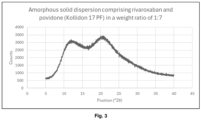
- An amorphous solid dispersion (ASD) comprising rivaroxaban and Povidone (Kollidon 17 PF) was prepared by a hot melt extrusion (HME) process. Rivaroxaban was prepared by HME at 190 °C and Povidone (Kollidon 17 PF) was prepared by HME at 175 °C. The rivaroxaban and Povidone (Kollidon 17 PF) were then milled on a ball mill and sieved through a 200 ⁇ m sieve.
- Prototype 4A was then prepared by homogenization of the ASD obtained above with microcrystalline cellulose and croscarmellose for 10 min in turbula, then adding magnesium stearate and homogenizing for 5 min. The formulation was then formed into a tablet by direct tabletting at 3 kN.
- Embodiment 1 a pharmaceutical composition comprising an amorphous solid solution of rivaroxaban and copovidone, wherein the weight ratio of rivaroxaban to copovidone is 1:4.1 to 1:6.
- Embodiment 2 the pharmaceutical composition according to Embodiment 1, further comprising a pharmaceutically acceptable excipient selected from at least one of filler, disintegrant, glidant and lubricant.
- Embodiment 3 the pharmaceutical composition according to Embodiment 2, wherein the filler is selected from at least one of microcrystalline cellulose, silicified microcrystalline cellulose, lactose, lactose monohydrate, mannitol, cellulose, starch, sorbitol, sucrose, maltodextrin, maltose, magnesium carbonate, magnesium oxide, dibasic anhydrous calcium phosphate, and dibasic dehydrate calcium phosphate.
- the filler is selected from at least one of microcrystalline cellulose, silicified microcrystalline cellulose, lactose, lactose monohydrate, mannitol, cellulose, starch, sorbitol, sucrose, maltodextrin, maltose, magnesium carbonate, magnesium oxide, dibasic anhydrous calcium phosphate, and dibasic dehydrate calcium phosphate.
- Embodiment 4 the pharmaceutical composition according to Embodiment 2 or 3, wherein the filler is from 20% to 70%, from 30% to 65%, from 40% to 60%, or from 50% to 60% of the pharmaceutical composition.
- Embodiment 5 the pharmaceutical composition according to Embodiment 2, wherein the disintegrant is selected from at least one of croscarmellose sodium, low-substituted hydroxypropyl cellulose, sodium alginate, calcium carboxymethylcellulose, chitosan hydrochloride, and magnesium aluminium silicate.
- the disintegrant is selected from at least one of croscarmellose sodium, low-substituted hydroxypropyl cellulose, sodium alginate, calcium carboxymethylcellulose, chitosan hydrochloride, and magnesium aluminium silicate.
- Embodiment 6 the pharmaceutical composition according to Embodiment 2 or 5, wherein the disintegrant is from 0.5% to 10%, from 1% to 9%, from 1% to 8%, from 1.5% to 7%, from 1.5% to 6%, from 2% to 5%, from 2% to 4%, or from 2% to 3% of the pharmaceutical composition..
- Embodiment 7 the pharmaceutical composition according to Embodiment 2, wherein the glidant is selected from at least one of colloidal silicon dioxide, amorphous anhydrous colloidal silicon dioxide, talc, tribasic calcium silicate, calcium silicate, silica, magnesium trisilicate, silicified cellulose and hydrophobic colloidal silica.
- the glidant is selected from at least one of colloidal silicon dioxide, amorphous anhydrous colloidal silicon dioxide, talc, tribasic calcium silicate, calcium silicate, silica, magnesium trisilicate, silicified cellulose and hydrophobic colloidal silica.
- Embodiment 8 the pharmaceutical composition according to Embodiment 2 or 7, wherein the glidant is from 0.5% to 10%, from 0.5% to 8%, from 0.5% to 6%, from 1% to 5%, from 1% to 4%, from 1% to 3%, or from 1% to 2% of the pharmaceutical composition.
- Embodiment 9 the pharmaceutical composition according to Embodiment 2, wherein the lubricant is selected from at least one of sodium stearyl fumarate, sodium lauryl sulphate, magnesium lauryl sulphate, stearic acid, calcium stearate, glyceryl dibehenate, glyceryl monostearate, glyceryl tristearate, palmitic acid, sorbitan monolaurate, sorbitan monopalmitate, zinc stearate, sorbitan sesquioleate, magnesium stearate and sorbitan trioleate.
- the lubricant is selected from at least one of sodium stearyl fumarate, sodium lauryl sulphate, magnesium lauryl sulphate, stearic acid, calcium stearate, glyceryl dibehenate, glyceryl monostearate, glyceryl tristearate, palmitic acid, sorbitan monolaurate, sorbitan monopalmitate
- Embodiment 10 the pharmaceutical composition according to Embodiment 2 or 9, wherein the lubricant is from 0.5% to 10%, from 0.75% to 9%, from 1% to 8%, from 1.25% to 7, from 1.50% to 6%, or from 1.75% to 5% of the pharmaceutical composition.
- Embodiment 11 the pharmaceutical composition according to any preceding Embodiment, wherein the rivaroxaban is in amount of 2.5 mg, 10 mg, 15 mg, 20 mg, or 30 mg.
- Embodiment 12 a pharmaceutical composition comprising:
- Embodiment 13 the pharmaceutical composition according to any preceding Embodiment for use in the treatment of a subject suffering from at least one of deep vein thrombosis and pulmonary embolism.
- Embodiment 14 the pharmaceutical composition for use according to Embodiment 13, wherein the subject is in a fasted state.
- Embodiment 15 the pharmaceutically composition according to Embodiments 1 to 12 and the pharmaceutical composition for use according to Embodiment 13 or 14, wherein the pharmaceutical composition is administered orally.
- Embodiment 16 the pharmaceutical composition according to Embodiments 1 to 12 and the pharmaceutical composition for use according to Embodiments 13 to 15, wherein the pharmaceutical composition achieves an AUC 0-t in the subject from 1,600 to 3,500 ng*h/ml 48 hours after administration.
- Embodiment 17 the pharmaceutical composition according to Embodiments 1 to 12 and the pharmaceutical composition for use according to Embodiments 13 to 16, wherein the pharmaceutical composition achieves a C max in the subject from 200 to 550 ng/ml.
- Embodiment 18 the pharmaceutical composition according to Embodiments 1 to 12 and the pharmaceutical composition for use according to Embodiments 13 to 17, wherein the pharmaceutical composition is bioequivalent to Xarelto ® when Xarelto ® is administered to a subject in a fed state.
- Embodiment 19 a hot melt extrusion method for preparing the pharmaceutical composition according to any one of Embodiments 1 to 18 comprising the steps of:
Landscapes
- Health & Medical Sciences (AREA)
- Life Sciences & Earth Sciences (AREA)
- Public Health (AREA)
- Pharmacology & Pharmacy (AREA)
- Chemical & Material Sciences (AREA)
- Veterinary Medicine (AREA)
- General Health & Medical Sciences (AREA)
- Medicinal Chemistry (AREA)
- Animal Behavior & Ethology (AREA)
- Epidemiology (AREA)
- Engineering & Computer Science (AREA)
- Bioinformatics & Cheminformatics (AREA)
- Organic Chemistry (AREA)
- Nuclear Medicine, Radiotherapy & Molecular Imaging (AREA)
- General Chemical & Material Sciences (AREA)
- Diabetes (AREA)
- Chemical Kinetics & Catalysis (AREA)
- Hematology (AREA)
- Biophysics (AREA)
- Molecular Biology (AREA)
- Medicinal Preparation (AREA)
- Pharmaceuticals Containing Other Organic And Inorganic Compounds (AREA)
Applications Claiming Priority (1)
| Application Number | Priority Date | Filing Date | Title |
|---|---|---|---|
| GBGB2317232.3A GB202317232D0 (en) | 2023-11-10 | 2023-11-10 | Pharmaceutical compositions comprising amorphous solid solutions of rivaroxaban and copovidone and preparation methods thereof |
Publications (1)
| Publication Number | Publication Date |
|---|---|
| EP4552633A1 true EP4552633A1 (fr) | 2025-05-14 |
Family
ID=89225225
Family Applications (1)
| Application Number | Title | Priority Date | Filing Date |
|---|---|---|---|
| EP24210689.6A Pending EP4552633A1 (fr) | 2023-11-10 | 2024-11-04 | Compositions pharmaceutiques comprenant des solutions solides amorphes de rivaroxaban et de copovidone et leurs procédés de préparation |
Country Status (2)
| Country | Link |
|---|---|
| EP (1) | EP4552633A1 (fr) |
| GB (1) | GB202317232D0 (fr) |
Citations (1)
| Publication number | Priority date | Publication date | Assignee | Title |
|---|---|---|---|---|
| CN108186577A (zh) * | 2018-03-09 | 2018-06-22 | 武汉工程大学 | 一种利伐沙班固体分散体及其制备方法和制剂 |
-
2023
- 2023-11-10 GB GBGB2317232.3A patent/GB202317232D0/en not_active Ceased
-
2024
- 2024-11-04 EP EP24210689.6A patent/EP4552633A1/fr active Pending
Patent Citations (1)
| Publication number | Priority date | Publication date | Assignee | Title |
|---|---|---|---|---|
| CN108186577A (zh) * | 2018-03-09 | 2018-06-22 | 武汉工程大学 | 一种利伐沙班固体分散体及其制备方法和制剂 |
Non-Patent Citations (2)
| Title |
|---|
| JONG-HWA LEE ET AL: "The Development and Optimization of Hot-Melt Extruded Amorphous Solid Dispersions Containing Rivaroxaban in Combination with Polymers", PHARMACEUTICS, vol. 13, no. 3, 1 January 2021 (2021-01-01), Switzerland, pages 344, XP093225859, ISSN: 1999-4923 * |
| KAPOURANI AFRODITI ET AL: "Rivaroxaban polymeric amorphous solid dispersions: Moisture-induced thermodynamic phase behavior and intermolecular interactions", EUROPEAN JOURNAL OF PHARMACEUTICS AND BIOPHARMACEUTICS, ELSEVIER SCIENCE PUBLISHERS B.V., AMSTERDAM, NL, vol. 145, 4 November 2019 (2019-11-04), pages 98 - 112, XP085906792, ISSN: 0939-6411, [retrieved on 20191104], DOI: 10.1016/J.EJPB.2019.10.010 * |
Also Published As
| Publication number | Publication date |
|---|---|
| GB202317232D0 (en) | 2023-12-27 |
Similar Documents
| Publication | Publication Date | Title |
|---|---|---|
| JP6061438B2 (ja) | ジアミン誘導体含有医薬組成物 | |
| US12357627B2 (en) | Pharmaceutical compositions of cabozantinib | |
| JP7096164B2 (ja) | ジアミン誘導体を含む口腔内崩壊錠 | |
| JPWO2008129846A1 (ja) | 医薬組成物 | |
| JP7571394B2 (ja) | エドキサバンを含有する口腔内崩壊錠 | |
| JP7646646B2 (ja) | セレキシパグを含む医薬組成物 | |
| AU2007338359A1 (en) | Pharmaceutical formulation comprising neurokinin antagonist | |
| US20190046449A1 (en) | A unique high-shear granulation process for improved bioavailability of rivaroxaban | |
| JPWO2019130749A1 (ja) | 新規微粒子コーティング(薬物含有中空粒子及びその製法) | |
| EP4552633A1 (fr) | Compositions pharmaceutiques comprenant des solutions solides amorphes de rivaroxaban et de copovidone et leurs procédés de préparation | |
| JP2022072050A (ja) | エドキサバンを含有する口腔内崩壊錠 | |
| WO2018202224A1 (fr) | Comprimés pelliculés de déférasirox | |
| TW202435886A (zh) | 米爾維仙(milvexian)醫藥組合物 | |
| JP2026509613A (ja) | (4s)-24-クロロ-4-エチル-73-フルオロ-35-メトキシ-32,5-ジオキソ-14-(トリフルオロメチル)-32h-6-アザ-3(4,1)-ピリジナ-1(1)-[1,2,3]トリアゾラ-2(1,2),7(1)-ジベンゼナヘプタファン-74-カルボキサミドを含む医薬剤形 | |
| KR20140090663A (ko) | 직접 트롬빈 억제제의 연장 방출성 제형 | |
| WO2022115051A1 (fr) | Procédé de compression directe pour formulations d'apixaban non micronisées | |
| HK40006385A (en) | Formulation having improved ph-dependent drug-release characteristics, containing esomeprazole or pharmaceutically acceptable salt thereof | |
| KR20100063068A (ko) | 서방형 약학 제제 |
Legal Events
| Date | Code | Title | Description |
|---|---|---|---|
| PUAI | Public reference made under article 153(3) epc to a published international application that has entered the european phase |
Free format text: ORIGINAL CODE: 0009012 |
|
| STAA | Information on the status of an ep patent application or granted ep patent |
Free format text: STATUS: THE APPLICATION HAS BEEN PUBLISHED |
|
| AK | Designated contracting states |
Kind code of ref document: A1 Designated state(s): AL AT BE BG CH CY CZ DE DK EE ES FI FR GB GR HR HU IE IS IT LI LT LU LV MC ME MK MT NL NO PL PT RO RS SE SI SK SM TR |
|
| P01 | Opt-out of the competence of the unified patent court (upc) registered |
Free format text: CASE NUMBER: APP_23594/2025 Effective date: 20250516 |
|
| STAA | Information on the status of an ep patent application or granted ep patent |
Free format text: STATUS: REQUEST FOR EXAMINATION WAS MADE |
|
| 17P | Request for examination filed |
Effective date: 20251112 |