EP4552670A1 - Dispositif médical avec rétroaction acoustique et/ou haptique et/ou optique - Google Patents
Dispositif médical avec rétroaction acoustique et/ou haptique et/ou optique Download PDFInfo
- Publication number
- EP4552670A1 EP4552670A1 EP23208191.9A EP23208191A EP4552670A1 EP 4552670 A1 EP4552670 A1 EP 4552670A1 EP 23208191 A EP23208191 A EP 23208191A EP 4552670 A1 EP4552670 A1 EP 4552670A1
- Authority
- EP
- European Patent Office
- Prior art keywords
- feedback
- medical device
- input
- unit
- designed
- Prior art date
- Legal status (The legal status is an assumption and is not a legal conclusion. Google has not performed a legal analysis and makes no representation as to the accuracy of the status listed.)
- Pending
Links
Images

Classifications
-
- A—HUMAN NECESSITIES
- A61—MEDICAL OR VETERINARY SCIENCE; HYGIENE
- A61M—DEVICES FOR INTRODUCING MEDIA INTO, OR ONTO, THE BODY; DEVICES FOR TRANSDUCING BODY MEDIA OR FOR TAKING MEDIA FROM THE BODY; DEVICES FOR PRODUCING OR ENDING SLEEP OR STUPOR
- A61M5/00—Devices for bringing media into the body in a subcutaneous, intra-vascular or intramuscular way; Accessories therefor, e.g. filling or cleaning devices, arm-rests
- A61M5/14—Infusion devices, e.g. infusing by gravity; Blood infusion; Accessories therefor
- A61M5/168—Means for controlling media flow to the body or for metering media to the body, e.g. drip meters, counters ; Monitoring media flow to the body
- A61M5/16877—Adjusting flow; Devices for setting a flow rate
-
- A—HUMAN NECESSITIES
- A61—MEDICAL OR VETERINARY SCIENCE; HYGIENE
- A61M—DEVICES FOR INTRODUCING MEDIA INTO, OR ONTO, THE BODY; DEVICES FOR TRANSDUCING BODY MEDIA OR FOR TAKING MEDIA FROM THE BODY; DEVICES FOR PRODUCING OR ENDING SLEEP OR STUPOR
- A61M2205/00—General characteristics of the apparatus
- A61M2205/50—General characteristics of the apparatus with microprocessors or computers
- A61M2205/502—User interfaces, e.g. screens or keyboards
- A61M2205/505—Touch-screens; Virtual keyboard or keypads; Virtual buttons; Soft keys; Mouse touches
-
- A—HUMAN NECESSITIES
- A61—MEDICAL OR VETERINARY SCIENCE; HYGIENE
- A61M—DEVICES FOR INTRODUCING MEDIA INTO, OR ONTO, THE BODY; DEVICES FOR TRANSDUCING BODY MEDIA OR FOR TAKING MEDIA FROM THE BODY; DEVICES FOR PRODUCING OR ENDING SLEEP OR STUPOR
- A61M2205/00—General characteristics of the apparatus
- A61M2205/58—Means for facilitating use, e.g. by people with impaired vision
- A61M2205/581—Means for facilitating use, e.g. by people with impaired vision by audible feedback
-
- A—HUMAN NECESSITIES
- A61—MEDICAL OR VETERINARY SCIENCE; HYGIENE
- A61M—DEVICES FOR INTRODUCING MEDIA INTO, OR ONTO, THE BODY; DEVICES FOR TRANSDUCING BODY MEDIA OR FOR TAKING MEDIA FROM THE BODY; DEVICES FOR PRODUCING OR ENDING SLEEP OR STUPOR
- A61M2205/00—General characteristics of the apparatus
- A61M2205/58—Means for facilitating use, e.g. by people with impaired vision
- A61M2205/582—Means for facilitating use, e.g. by people with impaired vision by tactile feedback
-
- A—HUMAN NECESSITIES
- A61—MEDICAL OR VETERINARY SCIENCE; HYGIENE
- A61M—DEVICES FOR INTRODUCING MEDIA INTO, OR ONTO, THE BODY; DEVICES FOR TRANSDUCING BODY MEDIA OR FOR TAKING MEDIA FROM THE BODY; DEVICES FOR PRODUCING OR ENDING SLEEP OR STUPOR
- A61M2205/00—General characteristics of the apparatus
- A61M2205/58—Means for facilitating use, e.g. by people with impaired vision
- A61M2205/583—Means for facilitating use, e.g. by people with impaired vision by visual feedback
-
- A—HUMAN NECESSITIES
- A61—MEDICAL OR VETERINARY SCIENCE; HYGIENE
- A61M—DEVICES FOR INTRODUCING MEDIA INTO, OR ONTO, THE BODY; DEVICES FOR TRANSDUCING BODY MEDIA OR FOR TAKING MEDIA FROM THE BODY; DEVICES FOR PRODUCING OR ENDING SLEEP OR STUPOR
- A61M5/00—Devices for bringing media into the body in a subcutaneous, intra-vascular or intramuscular way; Accessories therefor, e.g. filling or cleaning devices, arm-rests
- A61M5/14—Infusion devices, e.g. infusing by gravity; Blood infusion; Accessories therefor
- A61M5/142—Pressure infusion, e.g. using pumps
-
- A—HUMAN NECESSITIES
- A61—MEDICAL OR VETERINARY SCIENCE; HYGIENE
- A61M—DEVICES FOR INTRODUCING MEDIA INTO, OR ONTO, THE BODY; DEVICES FOR TRANSDUCING BODY MEDIA OR FOR TAKING MEDIA FROM THE BODY; DEVICES FOR PRODUCING OR ENDING SLEEP OR STUPOR
- A61M5/00—Devices for bringing media into the body in a subcutaneous, intra-vascular or intramuscular way; Accessories therefor, e.g. filling or cleaning devices, arm-rests
- A61M5/14—Infusion devices, e.g. infusing by gravity; Blood infusion; Accessories therefor
- A61M5/168—Means for controlling media flow to the body or for metering media to the body, e.g. drip meters, counters ; Monitoring media flow to the body
-
- G—PHYSICS
- G06—COMPUTING OR CALCULATING; COUNTING
- G06F—ELECTRIC DIGITAL DATA PROCESSING
- G06F3/00—Input arrangements for transferring data to be processed into a form capable of being handled by the computer; Output arrangements for transferring data from processing unit to output unit, e.g. interface arrangements
- G06F3/01—Input arrangements or combined input and output arrangements for interaction between user and computer
- G06F3/016—Input arrangements with force or tactile feedback as computer generated output to the user
Definitions
- the present disclosure relates to a medical device comprising an input unit for receiving an input operation performed by a user and a feedback unit for outputting feedback in response to the input operation.
- the medical device may, in particular, be an infusion pump.
- resistive touchscreen and/or mechanical/haptic buttons to receive user inputs to operate the medical device. Inputs made via the resistive touchscreen or a mechanical button are captured using a redundant or even diverse capture system to ensure high reliability when receiving inputs. This leads to increased demand for components and software, and in the case of diverse capture systems, even increased development effort. Furthermore, a resistive touchscreen provides only a limited resolution for defining areas for receiving different inputs, so it is often necessary to switch between different displays on the resistive touchscreen.
- a medical device has an input unit configured to receive an input actuation made by a user for operating the medical device.
- a treatment performed with the medical device can be controlled and/or parameterized via the input actuation, i.e., the treatment can be started or stopped, and parameters relating to the treatment can be set before or during the treatment.
- the medical device can, in particular, be an infusion pump.
- the medical device can be an extracorporeal blood treatment device, preferably a dialysis machine, or a control device for a medical or surgical tool, e.g., a drill, a milling cutter, or a saw.
- a variety of further alternative embodiments of the medical device are conceivable.
- the medical device also has a feedback unit configured to output or return feedback to the user in response to the input actuation.
- the feedback can be haptic or mechanical feedback, acoustic feedback, or a combination of haptic and acoustic feedback.
- the feedback can be haptic or mechanical feedback and/or acoustic feedback. Consequently, the feedback unit is capable of outputting only acoustic feedback or only haptic/mechanical feedback.
- the feedback unit can also output a combination of acoustic and haptic/mechanical feedback.
- the feedback unit may output optical feedback, for example in the form of a light signal, e.g., from an LED or a display on a touchscreen, in addition to or as an alternative to the acoustic and/or haptic feedback.
- optical feedback for example in the form of a light signal, e.g., from an LED or a display on a touchscreen
- a combination of optical feedback with acoustic feedback and/or haptic feedback is thus also conceivable. just like purely visual feedback. Accordingly, the user of the medical device receives feedback from the feedback unit immediately after performing the input via the input unit. This confirms receipt of the input to the user of the medical device, ensuring safety when performing the input. Furthermore, it is no longer necessary to provide a redundant or even diverse recording system for recording the input.
- the input unit can be configured to receive different types of input actuations.
- a separate type can be defined for each input actuation.
- the type can be defined according to safety criteria for the treatment performed with the medical device.
- the feedback unit can then be configured to output different types of feedback in response to the different types of input actuations. Consequently, the feedback unit not only returns or confirms the receipt of the input actuation, but also the type of input actuation to the user, thus increasing the safety of performing the input actuation.
- the feedback unit can advantageously be configured such that an intensity or frequency of the haptic feedback and/or a volume of the acoustic feedback and/or a brightness of the optical feedback can be set. Accordingly, the user of the medical device can adjust the intensity/frequency or volume according to their preferences in order to reliably perceive the feedback output in response to the received input. The same applies to adjusting the brightness of the optical feedback. For example, setting an increased intensity or increased frequency is advantageous in a case where the user is wearing gloves during the input operation. This can further increase safety when performing the input operation.
- the types of input operations can be grouped into a first group.
- the feedback unit can then be designed such that it outputs a predefined and unchangeable feedback in response to a type of input from the first group.
- Input types that are common to a large number of different medical devices can be grouped into the first group.
- Input types that are highly relevant to the reliability or safety of a treatment performed with the medical device can also be grouped into the first group. Examples of these are a home button, an on/off button, a stop button, or a start button.
- the same feedback is always returned, allowing the user to immediately validate the execution of this specific input. For example, when the stop button is pressed, the same combination of haptic and acoustic feedback is always output.
- visual feedback can also be output. Since this type of feedback cannot be changed in response to the stop button being pressed, the user can validate the stop button being pressed without much thought, even when operating a different medical device. As a result, a standard feedback system can be established for a company's medical devices or for a specific type of medical device, such as infusion pumps. This can further increase safety when operating medical devices.
- the feedback unit can be configured to output a dedicated feedback signal, particularly for each input involving an incorrect value, an invalid value, or an incorrect input. This immediately alerts the user to a critical input, allowing the input to be corrected immediately.
- the types of input operations can be grouped into a second group.
- the feedback unit can then be designed such that a feedback output in response to a type of input operation of the second group can be defined.
- Types of input operations that are very specific and/or related to the have little or no influence on the reliability or safety of a treatment carried out with the medical device. Examples of this are a selection actuation to choose a certain menu item or switching between different displays.
- the feedback can be solely haptic or acoustic feedback.
- the combination of haptic and acoustic feedback can also be individually specified.
- optical feedback or a combination with optical feedback is also conceivable.
- feedback for the second group can also be switched off entirely. Accordingly, a user can determine the feedback that is issued in response to the types of input actuations in the second group entirely according to their individual preferences. This individual determination increases familiarity when operating the medical device and thus safety.
- the input unit can preferably have a touchscreen. Accordingly, frequent switching between displays can be avoided and operation of the medical device is simplified. Using the touchscreen exclusively as the input unit can also achieve a clear appearance of the medical device. Furthermore, cleaning or disinfection of a medical device having a touchscreen is simplified or improved compared to a medical device having a plurality of mechanical buttons forming edges and grooves on the outer surface of the medical device. By outputting feedback in response to an input actuation, the touchscreen also offers the advantage of a button in that a haptic perception occurs when an input is actuated. This is also achieved in a similar way with acoustic feedback. The touchscreen also offers the further advantage of being able to output visual feedback.
- the touchscreen can advantageously feature an ESD glass front and/or toughened safety glass front, or a chemically tempered glass front. These glass fronts offer advantages in terms of robustness, biocompatibility, and cleaning/cleaning agent resistance. Thus, a reliable and durable medical device can be obtained.
- the input unit can have at least one button.
- the button can preferably be a capacitive button.
- the button is used in particular for an input operation that can be performed quickly by a user without lengthy menu searches. This includes, for example, switching the medical device on/off or stopping a treatment performed with the medical device. The provision of the button can improve safety during use of the medical device.
- the feedback unit can comprise a vibration element.
- the vibration element can, in particular, be a linear resonant actuator (LRA). This allows for fast and intensive feedback in response to the input actuation.
- the vibration element can be a vibration motor or a piezo actuator. Piezo actuators require little space and provide a short response time.
- the vibration element can be implemented as an integrated circuit. This allows for easy integration of the vibration element into the medical device.
- the integrated circuit can be controlled via a bus, in particular an I2C (Inter-Integrated Circuit) bus, an SPI (Serial Peripheral Interface) bus, a One Wire bus, a UART (Universal Asynchronous Receiver Transmitter) bus, a CAN (Controller Area Network) bus, or a bit-bang bus (e.g., a GPIO (General Purpose Input/Output) bus).
- I2C Inter-Integrated Circuit
- SPI Serial Peripheral Interface
- UART Universal Asynchronous Receiver Transmitter
- CAN Controller Area Network
- bit-bang bus e.g., a GPIO (General Purpose Input/Output) bus
- the medical device may already have a loudspeaker and/or a light source, in particular an LED, and/or a touchscreen.
- the feedback unit may be implemented by software that is designed to detect the input actuation and, in response to the detected Input actuation can be implemented to output a signal for outputting acoustic feedback to the loudspeaker and/or a signal for outputting optical feedback to the light source and/or to the touchscreen. Accordingly, the feedback unit can be easily retrofitted to an existing medical device that already has a loudspeaker and/or a light source and/or a touchscreen, e.g., through a firmware update.
- Fig. 1 shows a medical device 1 according to the disclosure, which in the present embodiment is designed as an infusion pump.
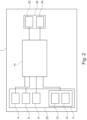
- Fig. 2 also shows a schematic block diagram of the medical device 1.
- the medical device 1 includes a touchscreen 2 and buttons 4, 6, 8.
- the touchscreen 2 is designed to receive a touch by a finger or by another input device, such as a pen, in order to trigger corresponding processing in the medical device 1.
- a first input icon 10 and a second input icon 12 are displayed on the touchscreen 2.
- the input icons 10, 12 are displayed on the touchscreen 2 by executing software by a microcomputer 14 of the medical device 1, and when the area of the input icons 10, 12 on the touchscreen 2 is touched, corresponding processing is performed by the microcomputer 14.
- the first input icon 10 is used to select or create a profile of a new patient
- the second input icon 12 is used to select the profile of the same patient.
- buttons 4, 6, 8 are on the medical device 1 from Fig. 1 arranged next to the touchscreen 2 and one below the other.
- the buttons 4, 6, 8 are designed as a home button 4, an on/off button 6, and a stop button 8.
- the buttons 4, 6, 8 offer the advantage that they can be activated quickly without having to search for a long time in a menu structure displayed on the touchscreen 2.
- the buttons 4, 6, 8 can be arranged behind a film or a glass surface. This avoids edges or grooves around the buttons 4, 6, 8 in which germs can accumulate and which cannot be reliably cleaned or disinfected.
- the touchscreen 2 and the buttons 4, 6, 8 are designed to receive an input operation 16 performed by a user 18 of the medical device 1 and to forward it to the microcomputer 14, so that corresponding processing is initiated in the microcomputer 14. As a result of the processing, the microcomputer 14 can output signals to control or parameterize a treatment performed with the medical device 1.
- the touchscreen 2 and the buttons 4, 6, 8 thus correspond together according to the preferred embodiment, as shown in Fig. 2 shown, an input unit 20.
- the medical device 1 has only the touchscreen 2 or only the buttons 4, 6, 8, possibly together with other buttons as the input unit 20.
- the medical device 1 also has, as in Fig. 2 shown, a vibration element 22 and a loudspeaker 24.
- a feedback 26 is output to the user 18.
- the output of the feedback 26 is also triggered by the microcomputer 14 upon receipt of the input actuation 14.
- the feedback 26 can be a haptic feedback 28 through the vibration element 22 or an acoustic feedback 30 through the loudspeaker 24.
- the feedback 26 can also be a combination of acoustic and haptic feedback 28, 30.
- the vibration element 22 and the loudspeaker 24 thus together correspond, as in Fig.
- a feedback unit 32 is formed only by the vibration element 22 or only by the loudspeaker 24.
- the feedback 26, in addition to or as an alternative to the acoustic and/or haptic feedback 28, 30, is an optical feedback 31, for example in the form of a light signal displayed on the touchscreen 2 or a display on the touchscreen 2.
- the feedback unit 32 is also formed by the touchscreen 2.
- an additional light source such as an LED, can be provided to output the optical feedback 31. The light source is then also a component of the feedback unit 32.
- the vibration element 22 is embodied here as a linear resonant actuator (LRA).
- the vibration element 22 can also be formed by a vibration motor or a piezo actuator. It has proven preferable if the vibration element 22 is implemented by an integrated circuit that can be controlled by the microcomputer 14 via a bus, such as, in particular, an I 2 C (Inter-Integrated Circuit) bus, an SPI (Serial Peripheral Interface) bus, a One Wire bus, a UART (Universal Asynchronous Receiver Transmitter) bus, a CAN (Controller Area Network) bus, or bit-bang (e.g., a GPIO (General Purpose Input/Output) bus).
- a bus such as, in particular, an I 2 C (Inter-Integrated Circuit) bus, an SPI (Serial Peripheral Interface) bus, a One Wire bus, a UART (Universal Asynchronous Receiver Transmitter) bus, a CAN (Controller Area Network) bus, or bit-bang (
- the medical device 1 comprises the loudspeaker 24.
- the loudspeaker 24 can also be provided on an integrated circuit.
- the loudspeaker 24 can be arranged on the same integrated circuit as the vibration element 22.
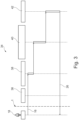
- a user 18 performs an input operation 16 on the touchscreen 2, on which input symbols 10, 12 are displayed by means of a graphics layer 36.
- a downstream Machine User Interface Controller (MUIC) 38 detects a touch of the touchscreen 2 in the area of the input symbols 10, 12.
- An event handler 40 intercepts the detection of the input operation 16 by the MUIC 38 and causes an audio controller 42 to output an acoustic feedback 30 via the loudspeaker 24.
- the feedback unit 32 for outputting an acoustic feedback 30 can be retroactively implemented in a simple manner, e.g., by a firmware update of the microcomputer 14, in a medical device 1 that already has a loudspeaker 24.
- the medical device 1 may already have a light source, e.g., an LED, or the touchscreen 2, and a lighting control may be implemented in addition to or alternatively to the audio control 42, so that an optical feedback 31 is enabled.
- the feedback unit 32 is designed such that it outputs different types of feedback 26 in response to the different types of input operations 16.
- a treatment can be interrupted by pressing the stop button 8. This represents a significant intervention in the treatment being carried out with the medical device 1.
- pressing the input symbol 10 to create a profile for a new patient represents processing that occurs before the treatment is carried out and thus has little influence on the treatment. Consequently, a different type of feedback 26 should preferably be output for the input operation 16 made using the stop button 8 than for the input symbol 10. Input activation 16.
- haptic feedback 28, 30 can occur, so that the feedback can be perceived by two different senses. With the additional output of optical feedback 31, for example, via the touchscreen, the feedback can even be perceived by three senses.
- the return of haptic feedback 28, for example may be sufficient.
- the feedback unit 28 can be configured so that an intensity or frequency of the haptic feedback 28 can be set by the user 18.
- a volume of the acoustic feedback 30 can be set by the user 18. In this way, the user can adjust the feedback 26 according to their preferences or according to the ambient conditions. In a noisy environment, the volume can be increased so that the acoustic feedback 30 is audible. In quiet environments, such as an operating room, the volume of the acoustic feedback 30 can be reduced and, conversely, the intensity or frequency of the haptic feedback 28 can be increased so that the feedback 26 can be reliably detected. Additionally, in a quiet environment, the output of optical feedback 31 can be advantageous.
- the types of input actuations 16 can further be grouped into a second group. Types of input actuations 16 that are very specific and have little or no influence on the reliability or safety of a treatment performed with the medical device 1 can be grouped into the second group.
- the feedback unit 28 can then be configured such that a feedback 26 that is output in response to a type of input actuation 16 of the second group can be defined.
- input actuations 16 that are performed via the input symbols 10 and 12 can be grouped into the second group, since their actuation occurs before an actual treatment of the patient.
- the user 18 can adapt the feedback 26 that is output in response to the actuation of the input symbols 10, 12 according to their preferences, thus increasing familiarity with the medical device 1.
- feedback 26 can be configured as haptic feedback 28 to avoid disturbing noises.
- the output of feedback 26 can be completely disabled.
- the medical device 1 thus makes it possible to increase safety when operating the medical device 1 by outputting the feedback 26 in response to the input actuation 16.
- the user 18 can reliably record or validate the input actuation 16 made.
- the adjustability of the feedback 26, which is output in response to a less relevant input actuation 16 increases the familiarity of the user 18 with the medical device 1, thereby also increasing safety.
- the medical device 1 has been described as an infusion pump.
- the present disclosure is not limited thereto and can also be applied to other medical devices 1 in which input operations can be performed.
Landscapes
- Health & Medical Sciences (AREA)
- Animal Behavior & Ethology (AREA)
- Veterinary Medicine (AREA)
- Anesthesiology (AREA)
- Biomedical Technology (AREA)
- Heart & Thoracic Surgery (AREA)
- Hematology (AREA)
- Engineering & Computer Science (AREA)
- General Health & Medical Sciences (AREA)
- Life Sciences & Earth Sciences (AREA)
- Public Health (AREA)
- Vascular Medicine (AREA)
- Physics & Mathematics (AREA)
- Fluid Mechanics (AREA)
- User Interface Of Digital Computer (AREA)
- Infusion, Injection, And Reservoir Apparatuses (AREA)
Priority Applications (3)
| Application Number | Priority Date | Filing Date | Title |
|---|---|---|---|
| EP23208191.9A EP4552670A1 (fr) | 2023-11-07 | 2023-11-07 | Dispositif médical avec rétroaction acoustique et/ou haptique et/ou optique |
| US18/938,762 US20250144289A1 (en) | 2023-11-07 | 2024-11-06 | Medical device with acoustic and/or haptic and/or optical feedback |
| CN202411573792.1A CN119950877A (zh) | 2023-11-07 | 2024-11-06 | 具有听觉和/或触觉和/或视觉反馈的医学装置 |
Applications Claiming Priority (1)
| Application Number | Priority Date | Filing Date | Title |
|---|---|---|---|
| EP23208191.9A EP4552670A1 (fr) | 2023-11-07 | 2023-11-07 | Dispositif médical avec rétroaction acoustique et/ou haptique et/ou optique |
Publications (1)
| Publication Number | Publication Date |
|---|---|
| EP4552670A1 true EP4552670A1 (fr) | 2025-05-14 |
Family
ID=88731564
Family Applications (1)
| Application Number | Title | Priority Date | Filing Date |
|---|---|---|---|
| EP23208191.9A Pending EP4552670A1 (fr) | 2023-11-07 | 2023-11-07 | Dispositif médical avec rétroaction acoustique et/ou haptique et/ou optique |
Country Status (3)
| Country | Link |
|---|---|
| US (1) | US20250144289A1 (fr) |
| EP (1) | EP4552670A1 (fr) |
| CN (1) | CN119950877A (fr) |
Citations (4)
| Publication number | Priority date | Publication date | Assignee | Title |
|---|---|---|---|---|
| US20090275896A1 (en) * | 2007-02-09 | 2009-11-05 | Dean Kamen | Infusion pump assembly |
| US8451230B2 (en) * | 2007-06-29 | 2013-05-28 | Roche Diagnostics International Ag | Apparatus and method for remotely controlling an ambulatory medical device |
| US9737656B2 (en) * | 2013-12-26 | 2017-08-22 | Tandem Diabetes Care, Inc. | Integration of infusion pump with remote electronic device |
| US20220184300A1 (en) * | 2020-12-07 | 2022-06-16 | Beta Bionics, Inc. | Occlusion detection in ambulatory medicament pumps |
-
2023
- 2023-11-07 EP EP23208191.9A patent/EP4552670A1/fr active Pending
-
2024
- 2024-11-06 CN CN202411573792.1A patent/CN119950877A/zh active Pending
- 2024-11-06 US US18/938,762 patent/US20250144289A1/en active Pending
Patent Citations (4)
| Publication number | Priority date | Publication date | Assignee | Title |
|---|---|---|---|---|
| US20090275896A1 (en) * | 2007-02-09 | 2009-11-05 | Dean Kamen | Infusion pump assembly |
| US8451230B2 (en) * | 2007-06-29 | 2013-05-28 | Roche Diagnostics International Ag | Apparatus and method for remotely controlling an ambulatory medical device |
| US9737656B2 (en) * | 2013-12-26 | 2017-08-22 | Tandem Diabetes Care, Inc. | Integration of infusion pump with remote electronic device |
| US20220184300A1 (en) * | 2020-12-07 | 2022-06-16 | Beta Bionics, Inc. | Occlusion detection in ambulatory medicament pumps |
Also Published As
| Publication number | Publication date |
|---|---|
| CN119950877A (zh) | 2025-05-09 |
| US20250144289A1 (en) | 2025-05-08 |
Similar Documents
| Publication | Publication Date | Title |
|---|---|---|
| DE112015001034B4 (de) | Alarmverwaltung für eine medizinische Vorrichtung | |
| EP1419432B1 (fr) | Dispositif pour la commande d'un appareil medical, notamment d'une table d'operation mobile | |
| DE60133279T2 (de) | Chirurgische Fusspedalbetätigung mit bandförmigem Schalter | |
| EP2761399B1 (fr) | Gant de données à rétro-information tactile et procédé | |
| EP2675496B1 (fr) | Appareil médical doté d'un écran tactile et procédé correspondant | |
| EP2504785B1 (fr) | Procédé pour adapter des fenêtres de valeur limite, dispositif de commande, dispositif de traitement médical et dispositif de surveillance médicale | |
| EP2703947B1 (fr) | Dispositif de commande pour un système technique | |
| EP3643240B1 (fr) | Appareil d'imagerie médicale et procédé de fonctionnement d'un appareil d'imagerie médicale | |
| DE102011056711A1 (de) | Näherungssensor mit einer elastomerenmehrschichtanordnung | |
| EP2523094A2 (fr) | Dispositif d'affichage et de commande pour appareils médico-chirurgicaux | |
| DE102007002401A1 (de) | Medizinische Untersuchungs- oder Interventionseinrichtung | |
| EP2574881A1 (fr) | Procédé de fonctionnement d'un système de commande pour un véhicule et système de commande pour un véhicule | |
| DE102012108826A1 (de) | Elektronische vorrichtung und verfahren zum anpassen ihres berührungssteuerungsbereichs | |
| DE19742633A1 (de) | Vorrichtung und Verfahren zur Sicherung von Touchscreen-Bedienungen | |
| WO2012126682A2 (fr) | Procédé et dispositif de saisie de signaux fiable | |
| EP4552670A1 (fr) | Dispositif médical avec rétroaction acoustique et/ou haptique et/ou optique | |
| DE102019121843A1 (de) | Interface für ein medizinisches Gerät mit einem adaptiven Betätigungssensor | |
| DE102007039450A1 (de) | Berührungsempfindlicher Bildschirm und Verfahren zum Betreiben eines berührungsempfindlichen Bildschirms | |
| DE102005028215A1 (de) | Vorrichtung für die medizinische Versorgung | |
| WO2017186369A1 (fr) | Panneau de commande d'une installation industrielle | |
| DE9316194U1 (de) | Berührungsempfindlicher Bildschirm | |
| DE69829351T2 (de) | Röntgenstrahl-Handschalter mit integriertem Anzeigemittel | |
| EP3271119A1 (fr) | Autorisation de fonctionnement d'une machine | |
| DE102015204767A1 (de) | Bedienung eines Medizingerätes | |
| EP3348201A1 (fr) | Procédé de positionnement d'un lit d'examen et lit d'examen |
Legal Events
| Date | Code | Title | Description |
|---|---|---|---|
| PUAI | Public reference made under article 153(3) epc to a published international application that has entered the european phase |
Free format text: ORIGINAL CODE: 0009012 |
|
| STAA | Information on the status of an ep patent application or granted ep patent |
Free format text: STATUS: THE APPLICATION HAS BEEN PUBLISHED |
|
| AK | Designated contracting states |
Kind code of ref document: A1 Designated state(s): AL AT BE BG CH CY CZ DE DK EE ES FI FR GB GR HR HU IE IS IT LI LT LU LV MC ME MK MT NL NO PL PT RO RS SE SI SK SM TR |
|
| STAA | Information on the status of an ep patent application or granted ep patent |
Free format text: STATUS: REQUEST FOR EXAMINATION WAS MADE |
|
| 17P | Request for examination filed |
Effective date: 20251028 |