EP4552819A1 - Plattenmetall-spritzgiessteil mit polycarbonat- und polycarbonatmischungen - Google Patents
Plattenmetall-spritzgiessteil mit polycarbonat- und polycarbonatmischungen Download PDFInfo
- Publication number
- EP4552819A1 EP4552819A1 EP23209070.4A EP23209070A EP4552819A1 EP 4552819 A1 EP4552819 A1 EP 4552819A1 EP 23209070 A EP23209070 A EP 23209070A EP 4552819 A1 EP4552819 A1 EP 4552819A1
- Authority
- EP
- European Patent Office
- Prior art keywords
- insert molding
- metal insert
- polycarbonate
- styrene
- acrylonitrile
- Prior art date
- Legal status (The legal status is an assumption and is not a legal conclusion. Google has not performed a legal analysis and makes no representation as to the accuracy of the status listed.)
- Withdrawn
Links
Images
Classifications
-
- B—PERFORMING OPERATIONS; TRANSPORTING
- B29—WORKING OF PLASTICS; WORKING OF SUBSTANCES IN A PLASTIC STATE IN GENERAL
- B29C—SHAPING OR JOINING OF PLASTICS; SHAPING OF MATERIAL IN A PLASTIC STATE, NOT OTHERWISE PROVIDED FOR; AFTER-TREATMENT OF THE SHAPED PRODUCTS, e.g. REPAIRING
- B29C45/00—Injection moulding, i.e. forcing the required volume of moulding material through a nozzle into a closed mould; Apparatus therefor
- B29C45/0001—Injection moulding, i.e. forcing the required volume of moulding material through a nozzle into a closed mould; Apparatus therefor characterised by the choice of material
-
- B—PERFORMING OPERATIONS; TRANSPORTING
- B29—WORKING OF PLASTICS; WORKING OF SUBSTANCES IN A PLASTIC STATE IN GENERAL
- B29C—SHAPING OR JOINING OF PLASTICS; SHAPING OF MATERIAL IN A PLASTIC STATE, NOT OTHERWISE PROVIDED FOR; AFTER-TREATMENT OF THE SHAPED PRODUCTS, e.g. REPAIRING
- B29C45/00—Injection moulding, i.e. forcing the required volume of moulding material through a nozzle into a closed mould; Apparatus therefor
- B29C45/14—Injection moulding, i.e. forcing the required volume of moulding material through a nozzle into a closed mould; Apparatus therefor incorporating preformed parts or layers, e.g. injection moulding around inserts or for coating articles
- B29C45/14336—Coating a portion of the article, e.g. the edge of the article
-
- C—CHEMISTRY; METALLURGY
- C08—ORGANIC MACROMOLECULAR COMPOUNDS; THEIR PREPARATION OR CHEMICAL WORKING-UP; COMPOSITIONS BASED THEREON
- C08L—COMPOSITIONS OF MACROMOLECULAR COMPOUNDS
- C08L69/00—Compositions of polycarbonates; Compositions of derivatives of polycarbonates
-
- C—CHEMISTRY; METALLURGY
- C08—ORGANIC MACROMOLECULAR COMPOUNDS; THEIR PREPARATION OR CHEMICAL WORKING-UP; COMPOSITIONS BASED THEREON
- C08L—COMPOSITIONS OF MACROMOLECULAR COMPOUNDS
- C08L71/00—Compositions of polyethers obtained by reactions forming an ether link in the main chain; Compositions of derivatives of such polymers
-
- B—PERFORMING OPERATIONS; TRANSPORTING
- B29—WORKING OF PLASTICS; WORKING OF SUBSTANCES IN A PLASTIC STATE IN GENERAL
- B29K—INDEXING SCHEME ASSOCIATED WITH SUBCLASSES B29B, B29C OR B29D, RELATING TO MOULDING MATERIALS OR TO MATERIALS FOR MOULDS, REINFORCEMENTS, FILLERS OR PREFORMED PARTS, e.g. INSERTS
- B29K2069/00—Use of PC, i.e. polycarbonates or derivatives thereof, as moulding material
-
- B—PERFORMING OPERATIONS; TRANSPORTING
- B29—WORKING OF PLASTICS; WORKING OF SUBSTANCES IN A PLASTIC STATE IN GENERAL
- B29K—INDEXING SCHEME ASSOCIATED WITH SUBCLASSES B29B, B29C OR B29D, RELATING TO MOULDING MATERIALS OR TO MATERIALS FOR MOULDS, REINFORCEMENTS, FILLERS OR PREFORMED PARTS, e.g. INSERTS
- B29K2071/00—Use of polyethers, e.g. PEEK, i.e. polyether-etherketone or PEK, i.e. polyetherketone or derivatives thereof, as moulding material
-
- B—PERFORMING OPERATIONS; TRANSPORTING
- B29—WORKING OF PLASTICS; WORKING OF SUBSTANCES IN A PLASTIC STATE IN GENERAL
- B29K—INDEXING SCHEME ASSOCIATED WITH SUBCLASSES B29B, B29C OR B29D, RELATING TO MOULDING MATERIALS OR TO MATERIALS FOR MOULDS, REINFORCEMENTS, FILLERS OR PREFORMED PARTS, e.g. INSERTS
- B29K2705/00—Use of metals, their alloys or their compounds, for preformed parts, e.g. for inserts
-
- B—PERFORMING OPERATIONS; TRANSPORTING
- B29—WORKING OF PLASTICS; WORKING OF SUBSTANCES IN A PLASTIC STATE IN GENERAL
- B29K—INDEXING SCHEME ASSOCIATED WITH SUBCLASSES B29B, B29C OR B29D, RELATING TO MOULDING MATERIALS OR TO MATERIALS FOR MOULDS, REINFORCEMENTS, FILLERS OR PREFORMED PARTS, e.g. INSERTS
- B29K2995/00—Properties of moulding materials, reinforcements, fillers, preformed parts or moulds
- B29K2995/0037—Other properties
- B29K2995/0039—Amorphous
Definitions
- the present invention relates in general to insert molding and more specifically to plate metal insert molding processes with polycarbonates and polycarbonate blends.
- Insert molding involves loading a preformed part, also known as an insert, into a mold where plastic is injected around to encapsulate the insert in molded plastic. This process creates a finished product as contrasted with overmolding, which produces a final part using two separate shots of plastic.
- the insert can be made of various materials, including metals, ceramics, or other plastic materials, and is placed into a mold cavity before the plastic resin is injected around it.
- the preformed part is made of metal. Insert molding processes produce parts with improved functional or mechanical properties versus overmolded parts.
- Metal insert molding is considered possible by those in the art with semicrystalline materials, such as linear polyethylene (PE), polyethylene terephthalate (PET), polytetrafluoroethylene (PTFE) and isotactic polypropylene (PP).
- semicrystalline materials such as linear polyethylene (PE), polyethylene terephthalate (PET), polytetrafluoroethylene (PTFE) and isotactic polypropylene (PP).
- Amorphous materials such as polycarbonate have met with more limited success in metal insert molding processes.
- Metal insert molding with polycarbonate is usually not recommended for a variety of reasons including polycarbonate being stress sensitive; a mismatch of thermal expansion between plastic and metal; and processing can be difficult depending on specific polycarbonate/ polycarbonate blends.
- the lack of processes and guidance for metal insert molding with polycarbonate is a cross-industry problem as polycarbonate solutions are highly promoted in battery packing, electrical and electronics integration, select medical applications, and traditional mobility applications.
- the present invention enables the use of polycarbonates and polycarbonate blends in metal insert molding processes.
- Polycarbonates and polycarbonate blends can be used in metal insert molding if it is done under specific design, processing, and materials selection.
- the inventive metal insert moldings can provide parts for a variety of industries including automotive parts, electronics parts, and medical device parts which have improved functional or mechanical properties versus overmolded parts.
- any numerical range recited in this specification is intended to include all sub-ranges of the same numerical precision subsumed within the recited range.
- a range of "1.0 to 10.0" is intended to include all sub-ranges between (and including) the recited minimum value of 1.0 and the recited maximum value of 10.0, that is, having a minimum value equal to or greater than 1.0 and a maximum value equal to or less than 10.0, such as, for example, 2.4 to 7.6.
- Any maximum numerical limitation recited in this specification is intended to include all lower numerical limitations subsumed therein and any minimum numerical limitation recited in this specification is intended to include all higher numerical limitations subsumed therein.
- the present invention is directed to a metal insert molding comprising: a metal plate encapsulated in a thermoplastic resin composition comprising, (a) an aromatic polycarbonate, (b) a polyether polyol and optionally, (c) at least one additive selected from the group consisting of flame retardants, antidripping agents, impact modifiers, fillers, antistats, coloring agents, pigments, thermal stabilizers different from component (b), lubricants, demolding agents, ultraviolet absorbers, infrared absorbers, hydrolysis stabilizers, and compatibilizers; and wherein the metal insert molding has a horizontal thickness (A) of from 1.0X to 6.3X, a bite/interface depth (B) of 1.5X, and a vertical thickness (C) of from 1.5X to 2.5X.
- X varies, preferably between 1mm and 4mm.
- the present invention relates to a process of producing a metal insert molding comprising: encapsulating a metal plate within a thermoplastic resin composition comprising, a) an aromatic polycarbonate, b) a polyether polyol and optionally, c) at least one additive selected from the group consisting of flame retardants, antidripping agents, impact modifiers, fillers, antistats, coloring agents, pigments, thermal stabilizers different from component b, lubricants, demolding agents, ultraviolet absorbers, infrared absorbers, hydrolysis stabilizers, and compatibilizers, at a ratio of pack pressure to injection pressure of greater than 0.75, wherein the metal insert molding has a horizontal thickness (A) of from 1.0X to 6.3X, a bite/interface depth (B) of 1.5X, and a vertical thickness (C) of from 1.5X to 2.5X.
- X varies, preferably between 1mm and 4mm.
- the present invention relates to a part comprising the metal insert molding according to the first embodiment or the metal insert molding produced according to the process of the second embodiment.
- the polycarbonates comprise a blend of a polycarbonate with another thermoplastic copolymer, such as acrylonitrile-styrene-butadiene (ABS), acrylonitrile-styrene-acrylate (ASA), styrene-acrylonitrile (SAN), polyethylene terephthalate (PET), polybutylene terephthalate (PBT), and others.
- ABS acrylonitrile-styrene-butadiene
- ASA acrylonitrile-styrene-acrylate
- SAN styrene-acrylonitrile
- PET polyethylene terephthalate
- PBT polybutylene terephthalate
- polycarbonate is to be understood as meaning both homopolycarbonates and copolycarbonates, in particular, polycarbonates. These polycarbonates may be linear or branched in known fashion. According to the invention, mixtures of polycarbonates may also be used.
- a "polycarbonate” or a “polycarbonate material” is a thermoplastic material preferably comprising at least 50 wt.% polycarbonate, more preferably at least 60 wt.% polycarbonate, and even more preferably, at least 65 wt.% polycarbonate.
- a portion of up to 80 mol%, preferably of 20 mol% to 50 mol%, of the carbonate groups in the polycarbonates used in accordance with the invention may be replaced by aromatic dicarboxylic ester groups.
- Polycarbonates of this kind incorporating both acid radicals from the carbonic acid and acid radicals from aromatic dicarboxylic acids in the molecule chain, are referred to as "aromatic polyestercarbonates.” In the context of the present invention, they are encompassed by the umbrella term of the thermoplastic aromatic polycarbonates.
- the replacement of the carbonate groups by aromatic dicarboxylic acid ester groups takes place essentially stoichiometrically and quantitatively, so that the molar ratio of the reaction partners can also be found in the finished polyestercarbonate.
- the incorporation of dicarboxylic acid ester groups can be statistical as well as in blocks.
- the thermoplastic polycarbonates including the thermoplastic aromatic polyestercarbonates, have weight average molecular weights M w , determined by gel permeation chromatography under use of CH 2 Cl 2 as diluent, of from 10,000 g/mol to 35,000 g/mol, in certain embodiments, from 12,000 g/mol to 32,000 g/mol, in selected embodiments, from 15,000 g/ mol to 32,000 g/mol, and in particular embodiments, from 20,000 g/mol to 31,500 g/mol.
- M w weight average molecular weights M w , determined by gel permeation chromatography under use of CH 2 Cl 2 as diluent, of from 10,000 g/mol to 35,000 g/mol, in certain embodiments, from 12,000 g/mol to 32,000 g/mol, in selected embodiments, from 15,000 g/ mol to 32,000 g/mol, and in particular embodiments, from 20,000 g/mol to 31,500 g/mol.
- the gel permeation chromatography is conducted under the following conditions: calibration with linear polycarbonate (made from bisphenol A and phosgene) of known molecular weight distribution, standards from PSS Polymer Standards Service GmbH, Germany, calibration according to method 2301-0257502-09D (from the year 2009 in German language) from Currenta GmbH & Co. OHG, Leverkusen. Diluent methylene chloride. Column combination from cross-linked styrenedivinylbenzene resin. Diameter of the analytical columns: 7.5 mm, length: 300 mm. Particle size of the column material: 3 ⁇ m to 20 ⁇ m. Concentration of the solutions: 0.2 wt.%. Flow rate: 1.0 ml/min, temperature of the solution: 30°C. Detection by means of a refractive index (RI)-detector.
- RI refractive index
- Aromatic polycarbonates are prepared, for example, by reaction of dihydroxyaryl compounds with carbonyl halides, preferably phosgene, and/or with aromatic dicarbonyl dihalides, preferably benzenedicarbonyl dihalides, by the interfacial process, optionally with use of chain terminators and optionally with use of trifunctional or more than trifunctional branching agents, wherein for the production of polyestercarbonates a part of the carbonic acid derivatives is replaced with aromatic dicarboxylic acids or derivatives of dicarboxylic acids, namely according to the carbonate structure units in the aromatic polycarbonates by dicarboxylic acid ester structure units. Preparation via a melt polymerization process by reaction of dihydroxyaryl compounds with, for example, diphenyl carbonate is likewise possible.
- Dihydroxyaryl compounds suitable for the preparation of polycarbonates are those of the formula (1) HO-Z-OH (1), wherein,
- Z in formula (1) is a radical of the formula (2), wherein
- X is a single bond, C 1 -C 5 -alkylene, C 2 -C 5 -alkylidene, C 5 -C 6 -cycloalkylidene, -O-, -SO-, -CO-, -S-, -SO 2 - or a radical of the formula (2a),
- dihydroxyaryl compounds suitable for the preparation of the polycarbonates for use in accordance with the invention include, but are not limited to, hydroquinone, resorcinol, dihydroxydiphenyl, bis(hydroxyphenyl)alkanes, bis(hydroxyphenyl)cycloalkanes, bis(hydroxyphenyl) sulfides, bis(hydroxyphenyl) ethers, bis(hydroxyphenyl) ketones, bis(hydroxyphenyl) sulphones, bis(hydroxyphenyl) sulfoxides, ⁇ , ⁇ '-bis(hydroxyphenyl)diisopropylbenzenes and the alkylated, ring-alkylated and ring-halogenated compounds thereof.
- Preferred dihydroxyaryl compounds are 4,4'-dihydroxydiphenyl, 2,2-bis(4-hydroxyphenyl)propane (bisphenol A), 2,4-bis(4-hydroxyphenyl)-2-methylbutane, dimethyl-bisphenol A, 1,1-bis(4-hydroxyphenyl)-p-diisopropylbenzene, 2,2-bis(3-methyl-4-hydroxyphenyl)propane, 2,2-bis(3-methyl-4-hydroxyphenyl)propane, bis(3,5-dimethyl-4-hydroxyphenyl)methane, 2,2-bis(3,5-dimethyl-4-hydroxyphenyl)propane, bis(3,5-dimethyl-4-hydroxyphenyl)sulfone, 2,4-bis(3,5-dimethyl-4-hydroxyphenyl)-2-methylbutane, 1,1-bis(3,5-dimethyl-4-hydroxyphenyl)-p-diisopropylbenzene and 1,1-bis(4-hydroxypheny
- R' in each case is C 1 -C 4 -alkyl, aralkyl or aryl, in certain embodiments, methyl or phenyl, in selected embodiments, methyl.
- the dihydroxyaryl compounds include 2,2-bis-(4-hydroxyphenyl)-propane (bisphenol A), 2,2-bis(3,5-dimethyl-4-hydroxyphenyl)propane, 1,1-bis(4-hydroxyphenyl)cyclohexane and 1,1-bis(4-hydroxyphenyl)-3,3,5-trimethylcyclohexane (bisphenol TMC) and dimethyl-bisphenol A as well as the dihydroxyaryl compounds of formulas (1), (II) and (III).
- dihydroxyaryl compound Only one dihydroxyaryl compound is used in the case of the homopolycarbonates; two or more dihydroxyaryl compounds are used in the case of copolycarbonates.
- Suitable carbonic acid derivatives include phosgene and diphenyl carbonate.
- Suitable chain terminators useful in the production of polycarbonates are monophenols.
- Suitable monophenols include, for example, phenol itself, alkylphenols such as cresols, p-tert-butylphenol, cumylphenol, and mixtures thereof.
- chain terminators include phenols mono- or polysubstituted by linear or branched C 1 -C 30 -alkyl radicals, unsubstituted or substituted by tert-butyl.
- the chain terminators are phenol, cumylphenol and p-tert-butylphenol.
- the amount of chain terminator to be used may be 0.1 to 5 mol%, based on moles of dihydroxyaryl compounds used in each case.
- the chain terminators can be added before, during or after the reaction with a carbonic acid derivative.
- Suitable branching agents include trifunctional or more than trifunctional compounds familiar in polycarbonate chemistry, particularly those having three or more than three phenolic OH groups.
- suitable branching agents include, but are not limited to, 1,3,5-tri(4-hydroxyphenyl)benzene, 1,1,1-tri(4-hydroxyphenyl)ethane, tri(4-hydroxyphenyl)phenylmethane, 2,4-bis(4-hydroxyphenylisopropyl)phenol, 2,6-bis(2-hydroxy-5'-methylbenzyl)-4-methylphenol, 2-(4-hydroxyphenyl)-2-(2,4-dihydroxyphenyl)propane, tetra(4-hydroxyphenyl)methane, tetra(4-(4-hydroxyphenylisopropyl)phenoxy)methane and 1,4-bis((4',4"-dihydroxytriphenyl)methyl)benzene and 3,3-bis(3-methyl-4-hydroxyphenyl)-2-oxo
- the amount of any branching agents to be used may be 0.05 mol% to 2 mol%, based on moles of dihydroxy aryl compounds used in each case.
- the branching agents can either be initially charged together with the dihydroxyaryl compounds and the chain terminators in the aqueous alkaline phase or added dissolved in an organic solvent before the phosgenation. In the case of the transesterification process, the branching agents are used together with the dihydroxyaryl compounds.
- component A may be used in the form of powders, pellets, or mixtures thereof.
- the polycarbonate has an MVR of from 4.5 to 34 cm 3 /(10 min), in certain embodiments of from 5.5 to 12 cm 3 /(10 min), in selected embodiments of from 6 to 10 cm 3 /(10 min), determined according to ISO 1133:2012-03 at a test temperature of 300 °C and 1.2 kg load.
- a mixture of different polycarbonates may be used as Component (a), for example a mixture of the polycarbonates a1 and a2, wherein a2 is a polycarbonate in powdered form.
- a2 is a polycarbonate in powdered form.
- the properties for the polycarbonate refer to a respective mixture.
- the compositions contain 50 wt.% to 98.5 wt.%, in some embodiments, 69.85 wt.% to 98.0 wt.%, in certain embodiments 85 wt.% to 97.5 wt.%, in selected embodiments 90.0 wt.% to 97.5 wt.%, and in particular embodiments, 93.0 wt.% to 97.5 wt.% of the aromatic polycarbonate.
- Component (b) of the polycarbonate comprises one or more stabilizers in the form of a polyether polyol.
- polyether polyols are the product of the polymerization of epoxides, such as ethylene oxide (EO), propylene oxide (PO), butylene oxide, styrene oxide, and epichlorohydrin, with themselves or by addition of such epoxides, optionally in admixture or sequentially, to starting components with reactive hydrogen atoms, such as water, alcohol, ammonia or amines.
- EO ethylene oxide
- PO propylene oxide
- butylene oxide butylene oxide
- styrene oxide styrene oxide
- epichlorohydrin epichlorohydrin
- starter molecules usually have a functionality of from 1 to 6.
- such polyether polyols may be homopolymers, block copolymers, random copolymers, capped polymers, or polymers tipped with a mixture of different e
- F is the functionality, which in the context of this invention is related to hydroxyl end groups. Acid end groups, if any, are not taken into account.
- F is defined as number of hydroxyl end groups, divided by the number of molecules in an ensemble, meaning F is the average number of hydroxyl end groups of a molecule of a compound. F is normally apparent from the recipe for preparing the polyol but may alternatively be determined by 1 H NMR.
- the polyether polyols may be formed from repeating ethylene oxide and propylene oxide units, e.g., with a share of 35 wt.% to 100 wt.% propylene oxide units, in certain embodiments 50 wt.% to 100 wt.% propylene oxide units.
- the copolymers may be statistical copolymers, gradient copolymers, alternating copolymers or block copolymers formed from ethylene oxide and propylene oxide.
- the polyether polyols are linear polymers.
- Useful polyether polyols are those formed from repeating propylene oxide units with a 1,2-diol as starter molecule, more preferably with propylene glycol as the starter molecule.
- the polyether polyols may be end-capped. In selected embodiments, the polyether polyol is end capped.
- a preferred agent for end-capping is dihydropyran (3,4-dihydro-2H-pyran).
- the polyether polyols may be those formed from repeating propylene oxide units with propylene glycol as starter molecule, an OH number within a range of from 50 to 70 mg KOH/g determined according to DIN 53240-3:2016-03, and having a hydroxyl functionality of 2, a proportion of primary hydroxyl groups within a range of from 0 to 3%, based on the total number of primary and secondary hydroxyl groups, having a propylene oxide content of at least 95 wt.% and ethylene oxide content of up to 3 wt.%, in selected embodiments, those without any ethylene oxide units, but only with propylene oxide units.
- the polycarbonates useful in the invention may comprise polyether polyols in various embodiments in an amount of from 0.1 to 5 wt.%, in certain embodiments, 0.1 wt.% to 2 wt.%, in selected embodiments, 0.5 wt.% to 1 wt.%, and in particular embodiments, 0.5 wt.% to 1.0 wt.%, wherein wt.% refers to the weight of the polycarbonate.
- the polycarbonates and polycarbonate blend compositions useful in the invention optionally may comprise additives known to those in the art, including, but not limited to, flame retardants, antidripping agents, impact modifiers, fillers, antistats, coloring agents, pigments, thermal stabilizers different from component (b), lubricants, demolding agents, UV absorbers, IR absorbers, hydrolysis stabilizers, and compatibilizers.
- additives as typically added in the case of polycarbonates are described, e.g., in U.S. Pat. Nos. 5,288,778 ; 5,821,380 ; and 5,883,165 and in " Plastics Additives Handbook", Hans Zweifel, 5th Edition 2000, Hanser Verlag, Kunststoff .
- the amount of such additives in various embodiments is up to 30 wt.%, in some embodiments up to 10 wt.%, in certain embodiments up to 6 wt.%, in selected embodiments 0.01 to 3 wt.%, and in particular embodiments 1 wt.%, with all values referring to the composition and all including the upper value.
- Useful demolding agents include, but are not limited to, pentaerythrityl tetrastearate (PETS), glycerine monostearate (GMS), their carbonates, and mixtures of any of these.
- PETS pentaerythrityl tetrastearate
- GMS glycerine monostearate
- the composition may include a UV absorber.
- Various UV absorbers are those having as low a transmission as possible below 400 nm and as high a transmission as possible above 400 nm. Such UV absorbers are known in the art and described, e.g., in U.S. Pat. Nos. 5,288,778 ; 5,821,380 ; and 5,883,165 .
- Ultraviolet absorbers particularly suitable for use in the composition according to the invention are selected from benzotriazoles, triazines, benzophenones, and arylated cyanoacrylates.
- Particularly suitable ultraviolet absorbers are hydroxybenzotriazoles, such as 2-(3',5'-bis(1,1-dimethylbenzyl)-2'-hydroxyphenyl)benzotriazole (TINUVIN 234, BASF), 2-(2'-hydroxy-5'-(tert-octyl)phenyl)benzotriazole (TINUVIN 329, BASF), bis(3-(2H-benzotriazolyl)-2-hydroxy-5-tert-octyl)methane (TINUVIN 360, BASF), 2-(4,6-diphenyl-1,3,5-triazin-2-yl)-5-(hexyloxy)phenol (TINUVIN 1577, BASF), and also benzophenones such as 2,4-dihydroxybenzophenone (CHIMASSORB 22, BASF) and 2-hydroxy-4-(octyloxy)benzophenone (CHIMASSORB 81, BASF), 2,2-bis[[(2-cyano-1-oxo-3,3-
- Particularly preferred specific UV absorbers are TINUVIN 360, TINUVIN 329 and/or TINUVIN 312, very particular preference being given to TINUVIN 329 and TINUVIN 312. It is also possible to employ mixtures of these ultraviolet absorbers.
- Suitable IR absorbers are described, in a variety of patents including U.S. Pat. Nos. 7,074,351 ; 7,169,834 ; 8,153,239 ; and in U.S. Pat. Pub. 2005/0165148 .
- boride- and/or tungstate-based IR absorbers in particular, cesium tungstate or zinc-doped cesium tungstate, as well as ITO- or ATO-based IR absorbers and combinations thereof are particularly useful.
- Suitable impact modifiers are core-shell type impact modifiers, including, but not limited to, acrylonitrile butadiene styrene (ABS), copolymer of methyl methacrylate, acrylonitrile, butadiene and styrene (MBS), acryl-based, silicone-acryl-based impact modifiers, and non-core-shell type impact modifiers.
- ABS acrylonitrile butadiene styrene
- MVS acrylonitrile butadiene styrene
- acryl-based, silicone-acryl-based impact modifiers acryl-based impact modifiers
- non-core-shell type impact modifiers non-core-shell type impact modifiers.
- the polycarbonates and polycarbonate blends useful according to the invention may comprise organic and inorganic fillers in the usual amounts.
- suitable fillers include, but are not limited to, glass fibers and carbon fibers, cellulosics, graphite, graphene, and carbon nanotubes, chalk, quartz powder, titanium dioxide, silicates, aluminosilicates, e.g., talc, wollastonite, montmorillonite, also modified by ion exchange, kaolin, zeolite, vermiculite, aluminum oxide, and silica. Mixtures of these or these and other fillers may also be used.
- PTFE Polytetrafluoroethylene
- Sulfur-containing stabilizers may be used including, but not limited to, 3,3'-thiodipropionic, distearyl disulfide (HOSTANOX SE 10, Clariant), pentaerythrityl tetrakis(3-laurylthiopropionate) (SOGNOX 4120, Songwon International AG) and bis-(phenylsulfonyl)methane.
- HOSTANOX SE 10 distearyl disulfide
- Clariant pentaerythrityl tetrakis(3-laurylthiopropionate)
- SOGNOX 4120 Songwon International AG
- bis-(phenylsulfonyl)methane bis-(phenylsulfonyl)methane.
- the polymer compositions useful in the invention comprising Components (a), (b), and optionally (c), are produced by standard incorporation processes via combination, mixing and homogenization of the individual constituents, especially with the homogenization taking place in the melt under the action of shear forces. If appropriate, combination and mixing prior to the melt homogenization occurs using powder premixes. For all components used, it is desirable to employ the purest possible compounds.
- premixes of granules or granules and powders with components (b) and optionally (c).
- Other embodiments may use premixes which have been produced from solutions of the mixture components in suitable solvents, in which case homogenization is optionally effected in solution and the solvent is removed. It is also possible to introduce components (b) and optionally (c) into the polycarbonate by known methods or as a masterbatch. Masterbatches may be used in selected embodiments for incorporation of component (c).
- composition useful in the invention may be combined, mixed, homogenized and subsequently extruded in customary apparatus such as screw extruders (TSE twin-screw extruders for example), kneaders or BRABENDER or BANBURY mills.
- screw extruders TSE twin-screw extruders for example
- kneaders kneaders
- BRABENDER BANBURY mills.
- the extrudate may be cooled and comminuted after extrusion. It is also possible to premix individual components and to add the remaining starting materials individually and/or likewise in a mixture.
- melt is converted directly to a shaped body in the subsequent step.
- the manufacture of the molded parts from the compositions according to the invention in various embodiments may be accomplished by injection-molding, extrusion, or rapid-heat cycle molding.
- the polycarbonate comprises a blend of a polycarbonate with a thermoplastic copolymer chosen from among acrylonitrile-styrene-butadiene (ABS), acrylonitrile-styrene-acrylate (ASA), styrene-acrylonitrile (SAN), polyethylene terephthalate (PET), polybutylene terephthalate (PBT), and others.
- ABS acrylonitrile-styrene-butadiene
- ASA acrylonitrile-styrene-acrylate
- SAN styrene-acrylonitrile
- PET polyethylene terephthalate
- PBT polybutylene terephthalate
- ABS Polycarbonate/acrylonitrile-butadiene-styrene
- a rubber-modified vinyl (co) polymer is included in polycarbonate/ABS blends,
- the glass transition temperature Tg is determined, unless expressly described otherwise in the present invention, for all components by means of differential scanning calorimetry (DSC) according to DIN EN 61006 (version of 1994) at a heating rate of 10 K / min with determination of the Tg as the center temperature (tangent method).
- DSC differential scanning calorimetry
- the rubber-modified vinyl (co) polymers according to component B have a melt flow rate (MVR), measured according to ISO 1133 (version of 2012) at 220 ° C with a stamp load of 10 kg, of preferably 2 to 20 ml/10min, more preferably 3 to 15 ml/10min, in particular 4 to 8 ml/10min. If mixtures of several rubber-modified vinyl (co)polymers are used as component B, the preferred MVR ranges are the mean value of the MVR of the individual components weighted over the mass fractions of the components in the mixture.
- MVR melt flow rate
- Such rubber-modified vinyl (co) polymers B are prepared, for example, by radical polymerization, preferably in the mass polymerization process, of
- the rubber-free vinyl (co) polymer (ii) can be dissolved in contrast to the other vinyl (co) polymer proportions in component B by suitable solvents such as acetone.
- the size of the disperse phase (i) in the rubber-modified vinyl (co) polymers B thus prepared is adjusted via the conditions of reaction formation such as temperature and resulting viscosity of the polymer and shear by, for example, stirring.
- the average particle size D 50 is the diameter above and below which 50 wt.% of the particles lie. It is, unless expressly described otherwise in the present invention, for all components by means of ultracentrifuge measurement ( W. Scholtan, H. Lange, Colloid and Polymer Science, 250 (1972), 782-796 ).
- the monomers B.1 are preferably mixtures consisting of
- Preferred graft bases B.2 are diene rubbers containing butadiene, or mixtures of diene rubbers containing butadiene or copolymers of diene rubbers containing butadiene or mixtures thereof with other copolymerizable monomers (e.g., according to B.1.1 and B.1.2). Particularly preferred graft bases B.2 are produced by anionic polymeriziation using a lithium compound as polymerization catalyst. Particularly preferred as graft base B.2 is pure polybutadiene rubber. In a further preferred embodiment, B.2 is styrene-butadiene-block copolymer rubber.
- the component B preferably has a polybutadiene content of 5 to 18 wt.%, more preferably from 7 to 15 wt.%, in particular from 8 to 13 wt.%.
- the not chemically bound to the rubber base (s) B.2 and not enclosed in the rubber particles vinyl (co) polymer (ii) can be formed as shown above due to the production during the polymerization of graft polymers B. It is also possible that a part of this not chemically bound to the rubber base (s) B.2 and not included in the rubber particles vinyl (co) polymer (ii) in the rubber-modified vinyl (co) polymer according to component B is formed due to production during its production in the mass polymerization process and another part is polymerized separately and added to component B as part of component B.
- the proportion of vinyl (co) polymer (ii), regardless of its origin, measured as an acetone-soluble portion, is in component B, based on component B, preferably at least 50 wt.%, particularly preferably at least 60 wt.%, more preferably at least 70 wt.%.
- This vinyl (co) polymer (ii) has in the rubber-modified vinyl (co) polymers according to component B a weight-averaged molecular weight M w from 70 to 250 kg / mol, preferably from 130 to 200 kg / mol, in particular from 150 to 180 kg / mol.
- the weight-averaged molecular weight M w of vinyl (co) polymer (ii) in component B is measured in the present invention by gel permeation chromatography (GPC) in tetrahydrofuran against a polystyrene standard.
- Component B is preferably free of emulsifiers that are typically used in emulsion polymerization processes such as for example saturated fatty acids having 8 to 22 carbon atoms, resin acids, alkyl and alkylarylsulfonic acids, and fatty alcohol sulfates.
- emulsifiers that are typically used in emulsion polymerization processes such as for example saturated fatty acids having 8 to 22 carbon atoms, resin acids, alkyl and alkylarylsulfonic acids, and fatty alcohol sulfates.
- the component B preferably contains less than 100 ppm, more preferably less than 50 ppm, most preferably less than 20 ppm ions of alkali metals and alkaline earth metals.
- the component B preferably contains an amount greater than zero but less than 10 ppm, more preferably 0.01-5 ppm, most preferably 0.1-2 ppm of lithium.
- Suitable as component B rubber-modified vinyl (co) polymers are, for example, MAGNUM 3404, MAGNUM 3504 and MAGNUM 3904 from Trinseo S.A. (Luxembourg).
- an acrylonitrile-styrene-acrylate copolymer which comprises a styrene-acrylonitrile (SAN) matrix having an acrylate elastomer phase dispersed within the SAN.
- the ASA terpolymer can be a homogeneous blend of polymers and/or an interpolymer, i.e., a polymer composition having a plurality of phases, wherein the polymer phases have graft linkages and/or interpenetration of polymer chains of a first phase into a second phase. The interpenetrating chains can form a network within the phase into which they penetrate.
- Acrylonitrile-styrene-acrylate copolymers also desirably have an outer continuous phase of acrylonitrile-styrene copolymer, which is suitable for good blending properties with polycarbonate.
- Acrylonitrile-styrene-acrylate copolymers can comprise a phase comprising a crosslinked acrylate elastomer, a phase comprising a crosslinked styrene-acrylonitrile copolymer, and a phase comprising a linear styrene acrylonitrile copolymer.
- styrene can include methyl substituted styrene such as, ⁇ -methylstyrene, vinyl toluene, and combinations thereof.
- Specific acrylonitrile-styrene-acrylate copolymers include core-shell-type impact modifiers in a styrene-acrylonitrile (SAN) matrix.
- the acrylate elastomer core portion of these resins may be composed of alkyl, aryl, or aryl-alkyl (also referred to as aralkyl) esters of acrylic or methacrylic acids.
- acrylates include esterified products of C 1 - C 30 -substituted alkyl, C 3 -C 30 - substituted cycloalkyl, C 6 -C 30 -substituted aryl, and C 7 -C 30 -substituted aralkyl alcohols.
- Suitable acrylate monomers include, but are not limited to, methyl acrylate, ethyl acrylate, 1-propyl acrylate, 2-propyl acrylate, n-butyl acrylate, 2-butyl acrylate, 2-methylpropyl acrylate, t-butyl acrylate, n-pentyl acrylate, 2-pentyl acrylate, 3-pentyl acrylate, 2,2-dimethylpropyl acrylate, n-hexyl acrylate, cyclohexyl methacrylate, methyl cyclohexyl acrylate, heptyl acrylates, octyl acrylates, decyl acrylates, phenyl acrylate, benzyl acrylate, hydroxyethyl acrylate, 2-hydroxypropyl acrylate, and combinations thereof.
- Methacrylate monomers may also be used, including but not limited to, methyl methacrylate, ethyl methacrylate, 1-propyl methacrylate, 2-propyl methacrylate, n-butyl methacrylate, 2-butyl methacrylate, 2-methylpropyl methacrylate, t-butyl methacrylate, n-pentyl methacrylate, 2-pentyl methacrylate, 3-pentyl methacrylate, 2,2-dimethylpropyl methacrylate, n-hexyl methacrylate, cyclohexyl methacrylate, methyl cyclohexyl methacrylate, heptyl methacrylates, octyl methacrylates, decyl methacrylates, phenyl methacrylate, benzyl methacrylate, hydroxyethyl methacrylate, 2-hydroxypropyl methacrylate.
- nitrile monomers include acrylonitrile, methacrylonitrile, fumaronitrile, a combination comprising one or more of these.
- Suitable vinyl aromatic monomers include, but are not limited to, styrene, ⁇ -methyl styrene, vinyl toluene, chloromethyl styrene, chlorostyrene, bromostyrene, acetoxystyrene, methoxystyrene, and combinations thereof.
- Such acrylonitrile-styrene-acrylate polymers can be prepared by solution phase polymerization, emulsion polymerization suspension polymerization, a combination comprising at least one of these methods.
- the core shell portion of the resin may be prepared by a process wherein the acrylate elastomer core is polymerized, and a thermoplastic shell is grafted to the core.
- a thermoplastic shell include polymethyl methacrylate, polystyrene, styrene-acrylonitrile copolymer, and other similar vinyl polymers or copolymers.
- the acrylate or methacrylate elastomer core may be crosslinked with polyfunctional vinyl compounds including, but not limited to, divinyl benzene, 1,5-hexadiene, 1,7-octadiene, diethyleneglycol diacrylate, propylene glycol diacrylate, propylene glycol dimethacrylate.
- polyfunctional vinyl compounds including, but not limited to, divinyl benzene, 1,5-hexadiene, 1,7-octadiene, diethyleneglycol diacrylate, propylene glycol diacrylate, propylene glycol dimethacrylate.
- ASA copolymers suitable for use as component B are known in the literature and are available from a variety of suppliers, such as Formosa Chemicals (GELOV), Chi Mei Corporation (KIBILAC), and Sabic (LURAN).
- GELOV Formosa Chemicals
- KIBILAC Chi Mei Corporation
- LURAN Sabic
- compositions of the present invention may contain 20 wt.% to 40 wt.%, preferably 25 wt.% to 35 wt.% of acrylonitrile-styrene-acrylate (ASA) copolymer, based on the weight of the composition.
- ASA acrylonitrile-styrene-acrylate
- the acrylonitrile-styrene-acrylate (ASA) copolymer may be present in the composition of the present invention in an amount ranging between any combination of these values, inclusive of the recited values.
- styrene-acrylonitrile copolymer is referred to as SAN resin.
- the proportion of acrylonitrile is 5% to 50% by weight, preferably 15% to 35% by weight, the proportion of styrene is 95% to 50% by weight, preferably 85% to 65% by weight, based on 100% by weight of the overall styrene-acrylonitrile copolymer.
- the styrene-acrylonitrile copolymer can be prepared by any processes such as bulk polymerization, solution polymerization, suspension polymerization and emulsion polymerization, preferably bulk polymerization or suspension polymerization. Further, copolymerization process can be one-step copolymerization or multi-step copolymerization.
- the styrene-acrylonitrile copolymer useful in the present invention has a weight average molecular weight of 40,000-200,000 g/mol, preferably 50,000-160,000 g/mol, more preferably 70,000-150,000 g/mol, measured by gel permeation chromatography (GPC).
- SAN copolymers suitable for use in the polycarbonate blends are known in the literature or can be prepared by methods in the literature and are commercially available from a variety of suppliers, such as INEOS (LUSTRAN).
- INEOS LUSTRAN
- the polycarbonate blends of the present invention may contain 0 wt.% to 35 wt.%, preferably >0 wt.% to 32 wt.% of styrene-acrylonitrile copolymer, based on the weight of the composition.
- the styrene-acrylonitrile copolymer may be present in the polycarbonate blends of the present invention in an amount ranging between any combination of these values, inclusive of the recited values.
- PET Polycarbonate/polyethylene terephthalate
- polyethylene terephthalate (also referred to as "PET") is included which is a polyester of terephthalic acid and ethylene glycol which can be obtained by the polycondensation of dimethyl terephthalate with ethylene glycol, and also terephthalic acid with ethylene glycol or ethylene oxide.
- PET polyethylene terephthalate
- Polyethylene terephthalate exists both as an amorphous (transparent) and as a semi-crystalline (opaque and white) thermoplastic material. It has chemical resistance to mineral oils, solvents, and acids but not to bases.
- Semi-crystalline polyethylene terephthalate has good strength, ductility, stiffness, and hardness.
- Amorphous polyethylene terephthalate has better ductility but less stiffness and hardness.
- the polycarbonate blends of the present invention may contain 0 wt.% to 35 wt.%, preferably >0 wt.% to 32 wt.% of polyethylene terephthalate copolymer, based on the weight of the composition.
- the polyethylene terephthalate copolymer may be present in the polycarbonate blends of the present invention in an amount ranging between any combination of these values, inclusive of the recited values.
- PBT polycarbonate/polybutylene terephthalate copolymer blends
- PBT polycarbonate/polybutylene terephthalate copolymer blends
- PBT polybutylene terephthalate copolymer blends
- the polybutylene terephthalic polyester should have an internal viscosity of at least about 0.95 and preferably between 1.20 and 1.30.
- intrinsic viscosity is determined as an indication of the more difficultly measurable molecular weight of condensation polymers and is defined as: Limit ⁇ sp C as C approaches zero where nsp is the viscosity of a dilute orthochlorophenol solution of the polyester divided by the viscosity of the orthochlorophenol solvent per se measured in the same units at the same temperature, and C is the concentration in grams of the polyester per 100 cc of solution, as is set forth in, col. 3 of U.S. Pat. No. 2,597,643 .
- the resins of the present invention may be prepared by mechanically mixing the polybutylene terephthalate with about 10 to 20 wt.% of the polycarbonate based on the total weight of the resin and then extruding the mixture.
- Other additives may also be included in the mixture or master batched into one of the components. If additives are to be master batched, they are preferably master batched into the polycarbonate.
- Fiber glass may be included as a filler, or a reinforcing agent, in polycarbonates and polycarbonate blends to improve stiffness (modulus) and dimensional stability (coefficient of thermal expansion).
- glass fiber loadings in polycarbonates and polycarbonate blends range from 5 to 50%.
- the polycarbonate exhibits a decrease in melt flow characteristics and an increase in melt viscosity.
- increasing fiber glass content results in increased surface roughness and lower surface gloss in injection molded parts due to glass fibers breaking through the resin surface.
- Minerals such as calcium carbonate, talc, silica, wollastonite, clay, calcium sulfate fibers, mica, glass beads, and alumina trihydrate may be included in polycarbonates and polycarbonate blends as is known in the art.
- Metals useful as the insert of the metal insert moldings of the present invention are not restricted and in principle may include any metal.
- Preferred examples include, but are not limited to steel, and alloys thereof such as stainless steel, cast iron, tool steel, alloy steel; aluminum,; copper; titanium; magnesium; tin; silver; titanium; and manganese.
- the metal insert is preferably flat and may be any shape, such as square, rectangular, circular, hexagonal, triangular, and the like.
- Test molds were constructed with a metal insert which was a 1.5mm thick aluminum plate.
- the polycarbonate wall stock had an adjustable "C" shaped cross-section.
- the thickest cross section (6.3mm) max wall stock) was used.
- the horizontal thickness (A) varied from 1mm to 6.3mm.
- the bite/interface depth (B) was 1.5mm and the vertical thickness (C) varied from 1.5mm to 2.5mm.
- X can vary from 1mm to 4mm in the present invention.
- TnP solvent stress testing
- thermal cycling and shock testing thermal cycling and shock testing
- mechanical shear tensile testing TnP is a mixture of toluene and N-propanol in a volume ratio of 1-3 which is used to detect residual stress levels of 10 N/mm 2 and above. This mixture was added during three minutes to the examined sample whereafter the sample was visually observed for breaks and cracks.
- the 1:3 TnP test can detect a stress threshold of ⁇ 10 MPa (1450 psi) and is typically used for as-molded parts or assemblies.
- a 1:10 TnP test detects a stress threshold of ⁇ 20 MPa (2900 psi) and is typically used for assembled parts where external stressors could have been applied (less severe test).
- the thermal test was a thermal cycling/shock screening involving 100 cycles between 80°C to -40°C to -80°C, followed by one air-to-liquid thermal shock, 80 to 23°C.
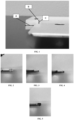
- FIG. 1 shows the test mold used in producing the metal in mold of the invention.
- Table II Trial 1 Percentage of samples without crazing or ultimate failure PC-B PC-H PC-I Minimum wall stock ⁇ 2.54mm 40 72 100 Minimum wall stock ⁇ 2.54mm 44 88 100
- Blends tended to have a higher resistance to stress cracking. Based on these data, the present inventors recommend glass-filled polycarbonates (at a glass loading higher than 15%) for metal insert molding with the correct geometry and processing conditions.
- FIG. 2 depicts a cross section through a metal insert molding of the invention.
- FIG. 3 illustrates a cross section through a metal insert molding of the invention.
- FIG. 4 is a cross section through a metal insert molding of the invention.
- FIG. 5 provides a cross section through a metal insert molding of the invention.
- the geometric design of the encapsulated area is important with thicker-cross sections showing greater improvement for molding success.
- Metal insert molding with polycarbonates and blends also requires higher pack pressures for successful performance. Glass-filled and mineral-filled polycarbonates and polycarbonate blends tend to have lower shrinkage resulting in lower shrinkage stresses, which help reduce the chance of cracking.
- Specific polycarbonates and polycarbonate blends can be utilized in metal insert molding for a given level of chemical resistance, thermal expansion, and mechanical shear.
- the inventive metal insert moldings can provide parts for a variety of industries including automotive parts, electronics parts, and medical device parts which have improved functional or mechanical properties versus overmolded parts.
- the invention is directed to a metal insert molding comprising: a metal plate encapsulated in a thermoplastic resin composition comprising, (a) an aromatic polycarbonate, (b) a polyether polyol and optionally, (c) at least one additive selected from the group consisting of flame retardants, antidripping agents, impact modifiers, fillers, antistats, coloring agents, pigments, thermal stabilizers different from component (b), lubricants, demolding agents, ultraviolet absorbers, infrared absorbers, hydrolysis stabilizers, and compatibilizers; and wherein the metal insert molding has a horizontal thickness (A) of from 1.0X to 6.3X, a bite/interface depth (B) of 1.5X, and a vertical thickness (C) of from 1.5X to 2.5X.
- a thermoplastic resin composition comprising, (a) an aromatic polycarbonate, (b) a polyether polyol and optionally, (c) at least one additive selected from the group consisting of flame retardants, antidripping agents, impact modifiers, fillers
- the invention is directed to the metal insert molding according to the previous paragraph, wherein the thermoplastic resin composition further comprises a second polymer selected from the group consisting of acrylonitrile-styrene-butadiene, acrylonitrile-styrene-acrylate, styrene-acrylonitrile, polyethylene terephthalate, and polybutylene terephthalate.
- a second polymer selected from the group consisting of acrylonitrile-styrene-butadiene, acrylonitrile-styrene-acrylate, styrene-acrylonitrile, polyethylene terephthalate, and polybutylene terephthalate.
- the invention is directed to the metal insert molding according to one of the two previous paragraphs, wherein the metal is selected from the group consisting of steel, stainless steel, cast iron, tool steel, alloy steel, aluminum, copper, titanium, magnesium, tin, silver, titanium, and manganese.
- the invention is directed to the metal insert molding according to any one of the three previous paragraphs, wherein the additive is a filler selected from the group consisting of glass fibers, carbon fibers, cellulosics, graphite, graphene, carbon nanotubes, chalk, quartz powder, titanium dioxide, silicates, talc, wollastonite, montmorillonite, kaolin, zeolite, vermiculite, aluminum oxide, and silica.
- the additive is a filler selected from the group consisting of glass fibers, carbon fibers, cellulosics, graphite, graphene, carbon nanotubes, chalk, quartz powder, titanium dioxide, silicates, talc, wollastonite, montmorillonite, kaolin, zeolite, vermiculite, aluminum oxide, and silica.
- the invention is directed to a part comprising the metal insert molding according to any one of the five previous paragraphs.
- the invention is directed to a process of producing a metal insert molding comprising: encapsulating a metal plate within a thermoplastic resin composition comprising, a) an aromatic polycarbonate, b) a polyether polyol and optionally, c) at least one additive selected from the group consisting of flame retardants, antidripping agents, impact modifiers, fillers, antistats, coloring agents, pigments, thermal stabilizers different from component b, lubricants, demolding agents, ultraviolet absorbers, infrared absorbers, hydrolysis stabilizers, and compatibilizers, at a ratio of pack pressure to injection pressure of greater than 0.75, wherein the metal insert molding has a horizontal thickness (A) of from 1.0X to 6.3X, a bite/interface depth (B) of 1.5X, and a vertical thickness (C) of from 1.5X to 2.5X.
- A horizontal thickness
- B bite/interface depth
- C vertical thickness
- the invention is directed to the process according to the previous paragraph, wherein the ratio of pack pressure to injection pressure is greater than 1.3.
- the invention is directed to the process according to the previous paragraph, wherein the ratio of pack pressure to injection pressure is greater than 1.5.
- the invention is directed to the process according to any one of the three previous paragraphs, wherein the thermoplastic resin composition further comprises a second polymer selected from the group consisting of acrylonitrile-styrene-butadiene, acrylonitrile-styrene-acrylate, styrene-acrylonitrile, polyethylene terephthalate, and polybutylene terephthalate.
- a second polymer selected from the group consisting of acrylonitrile-styrene-butadiene, acrylonitrile-styrene-acrylate, styrene-acrylonitrile, polyethylene terephthalate, and polybutylene terephthalate.
- the invention is directed to the process according to any one of the four previous paragraphs, wherein the metal is selected from the group consisting of steel, stainless steel, cast iron, tool steel, alloy steel, aluminum, copper, titanium, magnesium, tin, silver, titanium, and manganese.
- the invention is directed to the process according to any one of the five previous paragraphs, wherein the additive is a filler selected from the group consisting of glass fibers, carbon fibers, cellulosics, graphite, graphene, carbon nanotubes, chalk, quartz powder, titanium dioxide, silicates, talc, wollastonite, montmorillonite, kaolin, zeolite, vermiculite, aluminum oxide, and silica.
- the invention is directed to a part comprising the metal insert molding produced according to the process of any one of the previous seven paragraphs.
- the invention is directed to the part according to one of the sixth aspect and the fourteenth aspect, wherein the part is selected from the group consisting of an automotive part, an electronics part, and a medical device part.
Landscapes
- Chemical & Material Sciences (AREA)
- Health & Medical Sciences (AREA)
- Chemical Kinetics & Catalysis (AREA)
- Medicinal Chemistry (AREA)
- Polymers & Plastics (AREA)
- Organic Chemistry (AREA)
- Engineering & Computer Science (AREA)
- Manufacturing & Machinery (AREA)
- Mechanical Engineering (AREA)
- Compositions Of Macromolecular Compounds (AREA)
Priority Applications (1)
| Application Number | Priority Date | Filing Date | Title |
|---|---|---|---|
| EP23209070.4A EP4552819A1 (de) | 2023-11-10 | 2023-11-10 | Plattenmetall-spritzgiessteil mit polycarbonat- und polycarbonatmischungen |
Applications Claiming Priority (1)
| Application Number | Priority Date | Filing Date | Title |
|---|---|---|---|
| EP23209070.4A EP4552819A1 (de) | 2023-11-10 | 2023-11-10 | Plattenmetall-spritzgiessteil mit polycarbonat- und polycarbonatmischungen |
Publications (1)
| Publication Number | Publication Date |
|---|---|
| EP4552819A1 true EP4552819A1 (de) | 2025-05-14 |
Family
ID=88778952
Family Applications (1)
| Application Number | Title | Priority Date | Filing Date |
|---|---|---|---|
| EP23209070.4A Withdrawn EP4552819A1 (de) | 2023-11-10 | 2023-11-10 | Plattenmetall-spritzgiessteil mit polycarbonat- und polycarbonatmischungen |
Country Status (1)
| Country | Link |
|---|---|
| EP (1) | EP4552819A1 (de) |
Citations (33)
| Publication number | Priority date | Publication date | Assignee | Title |
|---|---|---|---|---|
| FR3010E (fr) | 1903-12-07 | 1904-07-29 | Jules Tivan | Nouveau meuble hygiénique à transformations |
| US2465319A (en) | 1941-07-29 | 1949-03-22 | Du Pont | Polymeric linear terephthalic esters |
| US2597643A (en) | 1947-10-31 | 1952-05-20 | Du Pont | Manufacture of highly polymeric linear polymethylene terephthalates in solution and precipitation thereof |
| US2991273A (en) | 1956-07-07 | 1961-07-04 | Bayer Ag | Process for manufacture of vacuum moulded parts of high molecular weight thermoplastic polycarbonates |
| US2999835A (en) | 1959-01-02 | 1961-09-12 | Gen Electric | Resinous mixture comprising organo-polysiloxane and polymer of a carbonate of a dihydric phenol, and products containing same |
| US2999846A (en) | 1956-11-30 | 1961-09-12 | Schnell Hermann | High molecular weight thermoplastic aromatic sulfoxy polycarbonates |
| US3148172A (en) | 1956-07-19 | 1964-09-08 | Gen Electric | Polycarbonates of dihydroxyaryl ethers |
| US3271367A (en) | 1955-03-26 | 1966-09-06 | Bayer Ag | Thermoplastic polycarbonates of dihydroxydiarylene sulfones and their preparation |
| GB1122003A (en) | 1964-10-07 | 1968-07-31 | Gen Electric | Improvements in aromatic polycarbonates |
| FR1561518A (de) | 1967-03-10 | 1969-03-28 | ||
| DE2035390A1 (de) | 1969-07-17 | 1971-01-28 | Eastman Kodak Co , Rochester, N Y (VStA) | Formmasse zur Herstellung von Polyester formkorpern |
| DE2036052A1 (en) | 1970-07-21 | 1972-01-27 | Milchwirtschafthche Forschungs und Untersuchungs Gesellschaft mbH, 2100 Hamburg | Working up of additives in fat and protein - contng foodstuffs |
| DE2248242A1 (de) | 1971-10-01 | 1973-04-12 | Gen Electric | Verstaerkte interkristalline thermoplastische polyester-zusammensetzungen |
| GB1341318A (en) | 1970-12-22 | 1973-12-19 | Bayer Ag | Saponification-resistand polycarbonates |
| GB1367790A (en) | 1972-03-11 | 1974-09-25 | Bayer Ag | Process for the manufacture of saponification-resistant block copolycarbonates |
| DE3832396A1 (de) | 1988-08-12 | 1990-02-15 | Bayer Ag | Dihydroxydiphenylcycloalkane, ihre herstellung und ihre verwendung zur herstellung von hochmolekularen polycarbonaten |
| US4982014A (en) | 1988-08-12 | 1991-01-01 | Bayer Aktiengesellschaft | Dihydroxydiphenyl cycloalkanes, their production and their use for the production of high molecular weight polycarbonates |
| US5097002A (en) | 1988-07-11 | 1992-03-17 | Ge Plastics Japan Ltd. | Melt, catalytic process for preparing polycarbonates from carbonic acid diester |
| US5288778A (en) | 1991-02-21 | 1994-02-22 | Ciba-Geigy Corporation | Stabilized polymers having hetero atoms in the main chain |
| US5340905A (en) | 1992-11-12 | 1994-08-23 | Bayer Aktiengesellschaft | Process for the preparation of thermoplastic polycarbonates |
| US5717057A (en) | 1994-12-28 | 1998-02-10 | General Electric Company | Method of manufacturing polycarbonate |
| US5821380A (en) | 1994-11-10 | 1998-10-13 | Basf Aktiengesellschaft | 2-cyanoacrylic esters |
| US5883165A (en) | 1996-10-30 | 1999-03-16 | Ciba Specialty Chemicals Corporation | Stabilizer combination for the rotomolding process |
| US6596840B1 (en) | 1999-07-19 | 2003-07-22 | Bayer Aktiengesellschaft | Method for producing modified polycarbonates |
| US6740730B1 (en) | 1999-07-19 | 2004-05-25 | Bayer Aktiengesellschaft | Polycarbonate and molded polycarbonate articles |
| US20050165148A1 (en) | 2004-01-28 | 2005-07-28 | Bogerd Jos V.D. | Infra-red radiation absorption articles and method of manufacture thereof |
| US7071284B2 (en) | 2003-01-10 | 2006-07-04 | Bayer Aktiengesellschaft | Process for the preparation of polycarbonates |
| US7074351B2 (en) | 2000-05-05 | 2006-07-11 | Leibniz-Institut Fur Neue Materialien Gem. Gmbh | IR-absorbing compositions |
| US7169834B2 (en) | 2000-02-11 | 2007-01-30 | Leibniz-Institut Fuer Neue Materialien Gemeinnuetzige Gmbh | IR absorbing compositions |
| US8153239B2 (en) | 2005-03-28 | 2012-04-10 | Mitsubishi Engineering-Plastics Corporation | Polycarbonate resin composition and heat ray shielding molded product |
| US20130052465A1 (en) * | 2011-08-23 | 2013-02-28 | Sabic Innovative Plastics Ip B.V. | Molded article having enhanced aesthetic effect and method and system for making the molded article |
| EP3674368A1 (de) * | 2017-10-03 | 2020-07-01 | Mitsubishi Engineering-Plastics Corporation | Metallharzverbundkörper, harzzusammensetzung und verfahren zur herstellung eines metallharzverbundkörpers |
| US20210179845A1 (en) * | 2018-04-16 | 2021-06-17 | Covestro Intellectual Property Gmbh & Co. Kg | By means of ionizing radiation sterilizable moulded parts made from polycarbonate |
-
2023
- 2023-11-10 EP EP23209070.4A patent/EP4552819A1/de not_active Withdrawn
Patent Citations (36)
| Publication number | Priority date | Publication date | Assignee | Title |
|---|---|---|---|---|
| FR3010E (fr) | 1903-12-07 | 1904-07-29 | Jules Tivan | Nouveau meuble hygiénique à transformations |
| US2465319A (en) | 1941-07-29 | 1949-03-22 | Du Pont | Polymeric linear terephthalic esters |
| US2597643A (en) | 1947-10-31 | 1952-05-20 | Du Pont | Manufacture of highly polymeric linear polymethylene terephthalates in solution and precipitation thereof |
| US3271367A (en) | 1955-03-26 | 1966-09-06 | Bayer Ag | Thermoplastic polycarbonates of dihydroxydiarylene sulfones and their preparation |
| US2991273A (en) | 1956-07-07 | 1961-07-04 | Bayer Ag | Process for manufacture of vacuum moulded parts of high molecular weight thermoplastic polycarbonates |
| US3148172A (en) | 1956-07-19 | 1964-09-08 | Gen Electric | Polycarbonates of dihydroxyaryl ethers |
| US2999846A (en) | 1956-11-30 | 1961-09-12 | Schnell Hermann | High molecular weight thermoplastic aromatic sulfoxy polycarbonates |
| US2999835A (en) | 1959-01-02 | 1961-09-12 | Gen Electric | Resinous mixture comprising organo-polysiloxane and polymer of a carbonate of a dihydric phenol, and products containing same |
| GB1122003A (en) | 1964-10-07 | 1968-07-31 | Gen Electric | Improvements in aromatic polycarbonates |
| FR1561518A (de) | 1967-03-10 | 1969-03-28 | ||
| GB1229482A (de) | 1967-03-10 | 1971-04-21 | ||
| DE2035390A1 (de) | 1969-07-17 | 1971-01-28 | Eastman Kodak Co , Rochester, N Y (VStA) | Formmasse zur Herstellung von Polyester formkorpern |
| US3644574A (en) | 1969-07-17 | 1972-02-22 | Eastman Kodak Co | Shaped articles of blends of polyesters and polyvinyls |
| DE2036052A1 (en) | 1970-07-21 | 1972-01-27 | Milchwirtschafthche Forschungs und Untersuchungs Gesellschaft mbH, 2100 Hamburg | Working up of additives in fat and protein - contng foodstuffs |
| GB1341318A (en) | 1970-12-22 | 1973-12-19 | Bayer Ag | Saponification-resistand polycarbonates |
| DE2248242A1 (de) | 1971-10-01 | 1973-04-12 | Gen Electric | Verstaerkte interkristalline thermoplastische polyester-zusammensetzungen |
| GB1409275A (en) | 1971-10-01 | 1975-10-08 | Gen Electric | Reinforced thermoplastic compositions |
| GB1367790A (en) | 1972-03-11 | 1974-09-25 | Bayer Ag | Process for the manufacture of saponification-resistant block copolycarbonates |
| US5097002A (en) | 1988-07-11 | 1992-03-17 | Ge Plastics Japan Ltd. | Melt, catalytic process for preparing polycarbonates from carbonic acid diester |
| DE3832396A1 (de) | 1988-08-12 | 1990-02-15 | Bayer Ag | Dihydroxydiphenylcycloalkane, ihre herstellung und ihre verwendung zur herstellung von hochmolekularen polycarbonaten |
| US4982014A (en) | 1988-08-12 | 1991-01-01 | Bayer Aktiengesellschaft | Dihydroxydiphenyl cycloalkanes, their production and their use for the production of high molecular weight polycarbonates |
| US5288778A (en) | 1991-02-21 | 1994-02-22 | Ciba-Geigy Corporation | Stabilized polymers having hetero atoms in the main chain |
| US5340905A (en) | 1992-11-12 | 1994-08-23 | Bayer Aktiengesellschaft | Process for the preparation of thermoplastic polycarbonates |
| US5821380A (en) | 1994-11-10 | 1998-10-13 | Basf Aktiengesellschaft | 2-cyanoacrylic esters |
| US5717057A (en) | 1994-12-28 | 1998-02-10 | General Electric Company | Method of manufacturing polycarbonate |
| US5883165A (en) | 1996-10-30 | 1999-03-16 | Ciba Specialty Chemicals Corporation | Stabilizer combination for the rotomolding process |
| US6596840B1 (en) | 1999-07-19 | 2003-07-22 | Bayer Aktiengesellschaft | Method for producing modified polycarbonates |
| US6740730B1 (en) | 1999-07-19 | 2004-05-25 | Bayer Aktiengesellschaft | Polycarbonate and molded polycarbonate articles |
| US7169834B2 (en) | 2000-02-11 | 2007-01-30 | Leibniz-Institut Fuer Neue Materialien Gemeinnuetzige Gmbh | IR absorbing compositions |
| US7074351B2 (en) | 2000-05-05 | 2006-07-11 | Leibniz-Institut Fur Neue Materialien Gem. Gmbh | IR-absorbing compositions |
| US7071284B2 (en) | 2003-01-10 | 2006-07-04 | Bayer Aktiengesellschaft | Process for the preparation of polycarbonates |
| US20050165148A1 (en) | 2004-01-28 | 2005-07-28 | Bogerd Jos V.D. | Infra-red radiation absorption articles and method of manufacture thereof |
| US8153239B2 (en) | 2005-03-28 | 2012-04-10 | Mitsubishi Engineering-Plastics Corporation | Polycarbonate resin composition and heat ray shielding molded product |
| US20130052465A1 (en) * | 2011-08-23 | 2013-02-28 | Sabic Innovative Plastics Ip B.V. | Molded article having enhanced aesthetic effect and method and system for making the molded article |
| EP3674368A1 (de) * | 2017-10-03 | 2020-07-01 | Mitsubishi Engineering-Plastics Corporation | Metallharzverbundkörper, harzzusammensetzung und verfahren zur herstellung eines metallharzverbundkörpers |
| US20210179845A1 (en) * | 2018-04-16 | 2021-06-17 | Covestro Intellectual Property Gmbh & Co. Kg | By means of ionizing radiation sterilizable moulded parts made from polycarbonate |
Non-Patent Citations (7)
| Title |
|---|
| CAS, no. 23949-66-8 |
| D. FREITAGU. GRIGOP.R. MULLERH. NOUVERTNEBAYER AG: "Polycarbonates", vol. 11, 1988, ENCYCLOPEDIA OF POLYMER SCIENCE AND ENGINEERING, pages: 648 - 718 |
| D.G. LEGRANDJ.T. BENDLER: "Handbook of Polycarbonate Science and Technology", 2000, HANSER VERLAG, pages: 72 |
| H. SCHNELL: "Chemistry and Physics of Polycarbonates", 1964, INTERSCIENCE PUBLISHERS, pages: 28 - 102 |
| U. GRIGOK. KIRCHNERP.R. MULLERBECKERBRAUN: "Kunststoff-Handbuch", 1992, CARL HANSER VERLAG, article "Polycarbonate, Polyacetale, Polyester, Celluloseester", pages: 117 - 299 |
| ULLMANN'S ENCYCLOPEDIA OF CHEMICAL TECHNOLOGY, vol. 19, 1980, pages 280 |
| W. SCHOLTANH. LANGE, COLLOID AND POLYMER SCIENCE, vol. 250, 1972, pages 782 - 796 |
Similar Documents
| Publication | Publication Date | Title |
|---|---|---|
| CN101210107B (zh) | 聚碳酸酯树脂组合物和塑料制品 | |
| CN109863203B (zh) | 包含滑石的聚碳酸酯组合物 | |
| JP5289056B2 (ja) | 難燃性ポリカーボネート樹脂組成物、ポリカーボネート樹脂成形品及びその製造方法 | |
| JP7599948B2 (ja) | 高い光沢を有する成形品を製造するための組成物および熱可塑性成形コンパウンド | |
| EP4204492B1 (de) | Hydrolysebeständige polycarbonatzusammensetzung | |
| EP2298837B1 (de) | Flammfeste polycarbonatharzzusammensetzung | |
| JP2001026707A (ja) | 芳香族ポリカーボネート樹脂組成物 | |
| CN101679738A (zh) | 阻燃性聚碳酸酯树脂组合物 | |
| KR102553255B1 (ko) | 열가소성 수지 조성물 및 이를 이용한 성형품 | |
| KR102365596B1 (ko) | 열가소성 수지 조성물 및 이를 이용한 성형품 | |
| EP3889218B1 (de) | Thermoplastische harzzusammensetzung und formartikel mit verwendung davon | |
| KR20170063123A (ko) | 저광택 및 내광성이 우수한 폴리카보네이트-abs계 얼로이 수지 조성물 및 이를 포함하는 성형품 | |
| WO2013001867A1 (ja) | ポリカーボネート樹脂組成物 | |
| US11535747B2 (en) | Talc-filled polycarbonate compositions | |
| US11345812B2 (en) | Stabilized, filled polycarbonate compositions | |
| EP4230697A1 (de) | Hydrolysebeständige polycarbonatzusammensetzung | |
| CN108291081A (zh) | 聚碳酸酯树脂组合物及其成形品 | |
| EP4600008A1 (de) | Opferteil für nachhaltige kunststoffteile | |
| EP4347687B1 (de) | Thermoplastische polycarbonatzusammensetzung | |
| KR102221622B1 (ko) | 열가소성 수지 조성물 및 이를 포함하는 성형품 | |
| EP4594422A1 (de) | Polycarbonat-zusammensetzung | |
| EP4357418A1 (de) | Polycarbonat-zusammensetzung | |
| EP4688953A1 (de) | Polycarbonat-zusammensetzung | |
| EP4286452A1 (de) | Polycarbonat-diagnostische komponenten mit reduzierter fluoreszenz | |
| JPH06166808A (ja) | ポリカーボネート樹脂組成物 |
Legal Events
| Date | Code | Title | Description |
|---|---|---|---|
| PUAI | Public reference made under article 153(3) epc to a published international application that has entered the european phase |
Free format text: ORIGINAL CODE: 0009012 |
|
| STAA | Information on the status of an ep patent application or granted ep patent |
Free format text: STATUS: THE APPLICATION HAS BEEN PUBLISHED |
|
| AK | Designated contracting states |
Kind code of ref document: A1 Designated state(s): AL AT BE BG CH CY CZ DE DK EE ES FI FR GB GR HR HU IE IS IT LI LT LU LV MC ME MK MT NL NO PL PT RO RS SE SI SK SM TR |
|
| STAA | Information on the status of an ep patent application or granted ep patent |
Free format text: STATUS: THE APPLICATION IS DEEMED TO BE WITHDRAWN |
|
| 18D | Application deemed to be withdrawn |
Effective date: 20251115 |