EP4553134A1 - Catalyseurs pour conversion inverse du gaz à l'eau et procédés fischer-tropsch intégrés - Google Patents
Catalyseurs pour conversion inverse du gaz à l'eau et procédés fischer-tropsch intégrés Download PDFInfo
- Publication number
- EP4553134A1 EP4553134A1 EP23209229.6A EP23209229A EP4553134A1 EP 4553134 A1 EP4553134 A1 EP 4553134A1 EP 23209229 A EP23209229 A EP 23209229A EP 4553134 A1 EP4553134 A1 EP 4553134A1
- Authority
- EP
- European Patent Office
- Prior art keywords
- catalyst
- range
- feed stream
- mol
- stream
- Prior art date
- Legal status (The legal status is an assumption and is not a legal conclusion. Google has not performed a legal analysis and makes no representation as to the accuracy of the status listed.)
- Withdrawn
Links
Images



Classifications
-
- C—CHEMISTRY; METALLURGY
- C10—PETROLEUM, GAS OR COKE INDUSTRIES; TECHNICAL GASES CONTAINING CARBON MONOXIDE; FUELS; LUBRICANTS; PEAT
- C10G—CRACKING HYDROCARBON OILS; PRODUCTION OF LIQUID HYDROCARBON MIXTURES, e.g. BY DESTRUCTIVE HYDROGENATION, OLIGOMERISATION, POLYMERISATION; RECOVERY OF HYDROCARBON OILS FROM OIL-SHALE, OIL-SAND, OR GASES; REFINING MIXTURES MAINLY CONSISTING OF HYDROCARBONS; REFORMING OF NAPHTHA; MINERAL WAXES
- C10G2/00—Production of liquid hydrocarbon mixtures of undefined composition from oxides of carbon
- C10G2/30—Production of liquid hydrocarbon mixtures of undefined composition from oxides of carbon from carbon monoxide with hydrogen
- C10G2/32—Production of liquid hydrocarbon mixtures of undefined composition from oxides of carbon from carbon monoxide with hydrogen with the use of catalysts
-
- C—CHEMISTRY; METALLURGY
- C10—PETROLEUM, GAS OR COKE INDUSTRIES; TECHNICAL GASES CONTAINING CARBON MONOXIDE; FUELS; LUBRICANTS; PEAT
- C10K—PURIFYING OR MODIFYING THE CHEMICAL COMPOSITION OF COMBUSTIBLE GASES CONTAINING CARBON MONOXIDE
- C10K3/00—Modifying the chemical composition of combustible gases containing carbon monoxide to produce an improved fuel, e.g. one of different calorific value, which may be free from carbon monoxide
- C10K3/02—Modifying the chemical composition of combustible gases containing carbon monoxide to produce an improved fuel, e.g. one of different calorific value, which may be free from carbon monoxide by catalytic treatment
- C10K3/026—Increasing the carbon monoxide content, e.g. reverse water-gas shift [RWGS]
Definitions
- the present disclosure relates generally to reverse water-gas shift catalysts, processes of making the same, and processes for performing reverse water-gas shift reactions.
- the present disclosure also relates to integrating processes for performing reverse water-gas shift reactions with processes for performing Fischer-Tropsch reactions.
- the reverse water-gas shift reaction is an advantageous route to obtain carbon monoxide from carbon dioxide for further chemical processing.
- the rWGS converts carbon dioxide and hydrogen to carbon monoxide and water, as shown in Equation (1).
- ⁇ H 0 298 42.1 kJmol ⁇ 1
- This can be used, for example, to modify the CO:H 2 ratio of a gas mixture for further processing.
- the carbon monoxide and hydrogen so formed is a valuable feedstock for a number of chemical processes, for example, the well-known Fischer-Tropsch (FT) process, shown in Equation (2).
- FT Fischer-Tropsch
- the rWGS reaction is not favored in all circumstances.
- a competing reaction is the Sabatier reaction (Equation (3)), which decreases carbon monoxide yield in favor of methane production, which is not an active feedstock for FT.
- ⁇ H 0 298 ⁇ 165 kJmol ⁇ 1
- the strongly exothermic Sabatier reaction is thermodynamically favored over the endothermic rWGS reaction at lower reaction temperatures. As such, minimizing the methanation during rWGS, especially at low temperatures, can become a significant challenge.
- the carbon monoxide product from rWGS can be hydrogenated to methane, as shown in Equation (4).
- ⁇ H 0 298 ⁇ 206.5 kJmol ⁇ 1
- Hydrogenation of carbon monoxide to methane is also an exothermic reaction, so it too is favored at lower temperatures.
- the stoichiometry of the reaction requires at least a 3:1 ratio of hydrogen to carbon monoxide. This means that performing the rWGS reaction with a large excess of hydrogen to drive the equilibrium toward carbon monoxide (see Equation (1)) is not always ideal because it runs the risk of hydrogenating the carbon monoxide product to form methane.
- Equations (3) and (4) further undesirable side reactions can occur.
- These side reactions can form undesirable carbon deposits on the surface of catalysts used to promote rWGS. Examples of these carbon-producing side reactions are shown in Equations (5), (6), and (7). All three of these reactions are endothermic and are favored at higher temperatures, just like the rWGS reaction.
- Carbon dioxide is a widely available gas (currently present in the atmosphere at about 400 ppm) that is inert to many transformations. Additionally, the tendency of carbon dioxide to absorb infrared radiation has led to its designation as a greenhouse gas. Thus, there is a need to develop economical processes that utilize carbon dioxide, especially waste carbon dioxide that would otherwise be added to the ever-rising concentration of carbon dioxide in the atmosphere.
- the present disclosure provides for a supported reverse water-gas shift catalyst comprising:
- the present disclosure provides for a supported reverse water-gas shift catalyst comprising:
- the present disclosure provides for a method of making the catalyst as described herein, the method comprising:
- the present disclosure provides for a catalyst as described herein made by the method as described herein.
- the present disclosure provides a method for performing a reverse water-gas shift reaction, the method comprising contacting at a temperature in the range of 200-1100 °C a catalyst as described herein with a feed stream comprising CO 2 and H 2 , wherein at least part of the CO 2 of the first feed stream is from biogas, a CO 2 emission source, and/or direct air capture, to provide a product stream comprising CO and H 2 , the product stream having a lower concentration of CO 2 and a higher concentration of CO than the feed stream.
- at least a part of CO 2 of the first feed stream is from biogas.
- at least a part of the CO 2 of the first feed stream is from a CO 2 emission source.
- at least a part of the CO 2 of the first feed stream is from direct air capture.
- the present disclosure provides for a process for performing an integrated Fischer-Tropsch process, the process comprising:
- the reverse gas-water shift reaction reacts carbon dioxide with hydrogen to form carbon monoxide and water and can be useful in providing a feedstock containing carbon monoxide and hydrogen -- often called "synthesis gas" -- for use in processes such as the Fischer-Tropsch process.
- synthesis gas often called "synthesis gas" -- for use in processes such as the Fischer-Tropsch process.
- the Sabatier reaction, carbon monoxide methanation, and carbon-producing side reactions can interfere with the rWGS reaction.
- the Sabatier reaction and CO methanation are exothermic and favored at lower temperatures, while the rWGS and carbon-producing side reactions are endothermic and favored at higher temperatures. Additionally, these reactions rely on CO 2 , a greenhouse gas. To prevent further waste of CO 2 that would otherwise be added to the atmosphere, here remains a need to develop process that use CO 2 .
- hydrocarbon synthesis processes that use waste carbon dioxide as a feed have the potential to be low-carbon, carbon neutral, or even have a negative carbon footprint.
- One way to achieve this is to transform carbon dioxide into carbon monoxide through reverse water-gas shift reactions, as described herein.
- the present inventors have provided supported reverse water-gas shift catalysts that include a metal oxide support, a metal selected from at least one of manganese, gallium, indium, lanthanum, titanium, niobium, vanadium, and zirconium, and optionally, at least one of platinum, palladium, gold, and nickel.
- the present inventors have found rWGS processes that are particularly advantageous for integration with a Fischer-Tropsch process by using supported reverse water-gas shift catalysts as described herein and using renewable sources of CO 2 .
- the present disclosure provides a supported reverse water-gas shift catalyst comprising: a support that is a cerium oxide support, a titanium oxide support, aluminum oxide support, a zinc oxide support, a zirconium oxide support, or a mixed oxide support comprising a mixture of two or more of cerium oxide, titanium oxide, aluminum oxide, zinc oxide and zirconium oxide; a metal selected from at least one of manganese, copper, gallium, indium, lanthanum, titanium, niobium, vanadium, and zirconium, present in an amount in the range of 0.5 to 20 wt% of the catalyst, based on the total weight of the catalyst; and optionally, at least one of platinum, palladium, gold, and nickel, present in an amount in the range of 0.05 to 10 wt% of the catalyst, based on the total weight of the catalyst.
- PCT/CN2022/102799 filed June 30, 2022 , International Application No. PCT/IB2023/056800, filed June 29, 2023 , International Application No. PCT/IB2023/056802, filed June 29, 2023 , International Application No. PCT/IB2023/056803, filed June 29, 2023 , International Application No. PCT/CN2023/104014, filed June 29, 2023 , and International Application No. PCT/CN2023/103835, filed June 29, 2023 , each of which is hereby incorporated by reference in its entirety.
- the present disclosure provides a supported reverse water-gas shift catalyst comprising: a support that is a cerium oxide support, a titanium oxide support, aluminum oxide support, a zinc oxide support, a zirconium oxide support, or a mixed oxide support comprising a mixture of two or more of cerium oxide, titanium oxide, aluminum oxide, zinc oxide, and zirconium oxide; a metal selected from at least one of manganese, copper, gallium, indium, lanthanum, titanium, niobium, vanadium, and zirconium, present in an amount in the range of 0.5 to 20 wt% of the catalyst, based on the total weight of the catalyst; and at least one of platinum, palladium, gold, and nickel, present in an amount in the range of 0.05 to 10 wt% of the catalyst, based on the total weight of the catalyst.
- the reverse water-gas shift catalysts of the present disclosure are supported catalysts.
- the support makes up at least 70 wt%, e.g., at least 75 wt%, or 80 wt%, or 85 wt%, or 90 wt% of the catalyst on an oxide basis.
- the support is a cerium oxide support.
- a "cerium oxide" support is a support that presents at least a surface layer (e.g., 50 microns in thickness) that is at least 50 wt% cerium oxide, on an oxide basis.
- at least a surface layer of the cerium oxide support includes at least 60 wt% cerium oxide, e.g., at least 70 wt% cerium oxide, or at least 80 wt% cerium oxide.
- at least a surface layer of the cerium oxide support includes at least 90 wt% cerium oxide.
- At least a surface layer of the cerium oxide support includes at least 95 wt% cerium oxide or at least 98 wt% cerium oxide.
- the cerium oxide support contains cerium oxide substantially throughout, e.g., at least 50 wt% of the cerium oxide support is cerium oxide, on an oxide basis.
- the cerium oxide support includes at least 60 wt% cerium oxide, e.g., at least 70 wt% cerium oxide, or at least 80 wt% cerium oxide.
- the cerium oxide support includes at least 90 wt% cerium oxide, e.g., at least 95 wt% cerium oxide, or at least 98 wt% cerium oxide. In some embodiments, the cerium oxide support may further include additional metals or metal oxides.
- the support is a titanium oxide support.
- a "titanium oxide" support is a support that presents at least a surface layer (e.g., 50 microns in thickness) that is at least 50 wt% titanium oxide, on an oxide basis.
- at least a surface layer of the titanium oxide support includes at least 60 wt% titanium oxide, e.g., at least 70 wt% titanium oxide, or at least 80 wt% titanium oxide.
- at least a surface layer of the titanium oxide support includes at least 90 wt% titanium oxide.
- At least a surface layer of the titanium oxide support includes at least 95 wt% titanium oxide or at least 98 wt% titanium oxide.
- the titanium oxide support contains titanium oxide substantially throughout, e.g., at least 50 wt% of the titanium oxide support is titanium oxide, on an oxide basis.
- the titanium oxide support includes at least 60 wt% titanium oxide, e.g., at least 70 wt% titanium oxide, or at least 80 wt% titanium oxide.
- the titanium oxide support includes at least 90 wt% titanium oxide, e.g., at least 95 wt% titanium oxide, or at least 98 wt% titanium oxide.
- the titanium oxide support may further include additional metals or metal oxides.
- the support is an aluminum oxide support.
- an "aluminum oxide" support is a support that presents at least a surface layer (e.g., 50 microns in thickness) that is at least 50 wt% aluminum oxide, on an oxide basis.
- at least a surface layer of the aluminum oxide support includes at least 60 wt% aluminum oxide, e.g., at least 70 wt% aluminum oxide, or at least 80 wt% aluminum oxide.
- at least a surface layer of the aluminum oxide support includes at least 90 wt% aluminum oxide.
- At least a surface layer of the aluminum oxide support includes at least 95 wt% aluminum oxide or at least 98 wt% aluminum oxide.
- the aluminum oxide support contains aluminum oxide substantially throughout, e.g., at least 50 wt% of the aluminum oxide support is aluminum oxide, on an oxide basis.
- the aluminum oxide support includes at least 60 wt% aluminum oxide, e.g., at least 70 wt% aluminum oxide, or at least 80 wt% aluminum oxide.
- the aluminum oxide support includes at least 90 wt% aluminum oxide, e.g., at least 95 wt% aluminum oxide, or at least 98 wt% aluminum oxide.
- the aluminum oxide support may further include additional metals or metal oxides.
- the support is a zinc oxide support.
- a " zinc oxide" support is a support that presents at least a surface layer (e.g., 50 microns in thickness) that is at least 50 wt% zinc oxide, on an oxide basis.
- at least a surface layer of the zinc oxide support includes at least 60 wt% zinc oxide, e.g., at least 70 wt% zinc oxide, or at least 80 wt% zinc oxide.
- at least a surface layer of the zinc oxide support includes at least 90 wt% zinc oxide.
- At least a surface layer of the zinc oxide support includes at least 95 wt% zinc oxide or at least 98 wt% zinc oxide.
- the zinc oxide support contains zinc oxide substantially throughout, e.g., at least 50 wt% of the zinc oxide support is zinc oxide, on an oxide basis.
- the zinc oxide support includes at least 60 wt% zinc oxide, e.g., at least 70 wt% zinc oxide, or at least 80 wt% zinc oxide.
- the zinc oxide support includes at least 90 wt% zinc oxide, e.g., at least 95 wt% zinc oxide, or at least 98 wt% zinc oxide.
- the zinc oxide support may further include additional metals or metal oxides.
- the support is a zirconium oxide support.
- a "zirconium oxide" support is a support that presents at least a surface layer (e.g., 50 microns in thickness) that is at least 50 wt% zirconium oxide, on an oxide basis.
- at least a surface layer of the zirconium oxide support includes at least 60 wt% zirconium oxide, e.g., at least 70 wt% zirconium oxide, or at least 80 wt% zirconium oxide.
- at least a surface layer of the zirconium oxide support includes at least 90 wt% zirconium oxide.
- At least a surface layer of the zirconium oxide support includes at least 95 wt% zirconium oxide or at least 98 wt% zirconium oxide.
- the zirconium oxide support contains zirconium oxide substantially throughout, e.g., at least 50 wt% of the zirconium oxide support is zirconium oxide, on an oxide basis.
- the zirconium oxide support includes at least 60 wt% zirconium oxide, e.g., at least 70 wt% zirconium oxide, or at least 80 wt% zirconium oxide.
- the zirconium oxide support includes at least 90 wt% zirconium oxide, e.g., at least 95 wt% zirconium oxide, or at least 98 wt% zirconium oxide. In some embodiments, the zirconium oxide support may further include additional metals or metal oxides.
- the support is a mixed oxide support.
- the mixed oxide support is a mixture of two or more metal oxides, such as cerium oxide, titanium oxide, aluminum oxide, zinc oxide, and zirconium oxide.
- at least a surface layer of the support includes at least 50 wt% total of two or more of cerium oxide, titanium oxide, aluminum oxide, zinc oxide, and zirconium oxide, on an oxide basis.
- At least a surface layer of the mixed oxide support includes at least 60 wt% total, e.g., at least 70 wt%, or at least 80 wt% of two or more of cerium oxide, titanium oxide, aluminum oxide, zinc oxide, and zirconium oxide. In some embodiments, at least a surface layer of the mixed oxide support includes at least 90 wt%, e.g., at least 95 wt%, or at least 98 wt% of two or more cerium oxide, titanium oxide, aluminum oxide, zinc oxide, and zirconium oxide.
- the mixed oxide support contains the oxides substantially throughout, e.g., at least 50 wt% of the mixed oxide support is two or more of cerium oxide, titanium oxide, aluminum oxide, zinc oxide, and zirconium oxide.
- the mixed oxide support includes at least 60 wt% total, e.g., at least 70 wt%, or at least 80 wt% of two or more of cerium oxide, titanium oxide, aluminum oxide, zinc oxide, and zirconium oxide.
- the mixed oxide support includes at least 90 wt% total, e.g., at least 95 wt%, or at least 98 wt% of two or more of cerium oxide, titanium oxide, aluminum oxide, zinc oxide, and zirconium oxide.
- the mixed oxide support may further include additional metals or metal oxides.
- cerium oxide, titanium oxide, aluminum oxide, zinc oxide and zirconium oxide can provide good performance in the absence of substantial amounts of other metals in the support.
- the support does not include additional metals in a total amount of additional metals in excess of 2 wt%, e.g., in excess of 1 wt% or in excess of 0.5 wt%, on an oxide basis.
- the support includes at least one additional metal.
- the total amount of the at least one additional metal is in the range of 0.5-20 wt%, e.g., 1-20 wt%, or 2-20 wt%, or 0.5-15 wt%, or 1-15 wt%, or 2-15 wt%, or 0.5-10 wt%, or 1-10 wt%, or 2-10 wt%, or 0.5-5 wt%, or 1-5 wt%, on an oxide basis.
- Supports suitable for use herein can be provided with a range of pore volumes.
- the person of ordinary skill in the art will select a pore volume appropriate for a desired catalytic process.
- the pore volume is at least 0.05 mL/g, e.g., at least 0.1 mL/g.
- the pore volume is at most 1.5 mL/g, e.g., at most 1 mL/g.
- the pore volume is in the range of 0.05-1.5 mL/g, e.g., 0.1 mUg to 1 mL/g.
- Pore volumes are measured by mercury porosimetry, for example, as measured according to ASTM D4284-12.
- the supported reverse water-gas shift catalysts of the disclosure include a metal selected from at least one of manganese, copper, gallium, indium, lanthanum, titanium, niobium, vanadium, and zirconium.
- the metal is selected from one of manganese, copper, gallium, indium, lanthanum, titanium, niobium, vanadium, and zirconium.
- the amount of metal present is calculated as a weight percentage of metal atoms in the catalyst based on the total weight of the catalyst, despite the form in which that metal may be present.
- the metal may be present in the catalyst in a variety of forms; most commonly, metal is principally present as metal oxide, metal, or a combination thereof.
- manganese is present in the catalyst in an amount in the range of 0.5 to 20 wt%, based on total weight of the catalyst.
- manganese is present in the catalyst in an amount in the range of 0.5 to 15 wt%, or 0.5 to 12 wt%, or 0.5 to 10 wt%, based on the total weight of the catalyst.
- manganese is present in the catalyst in an amount in the range of 1 to 20 wt%, e.g., in the range of 1 to 15 wt%, or 1 to 12 wt% or 1 to 10 wt%, based on the total weight of the catalyst.
- manganese is present in an amount in the range of 2 to 20 wt%, e.g., in the range of 2 to 15 wt%, or 2 to 12 wt%, or 2 to 10 wt%, based on the total weight of the catalyst. In various embodiments of the present disclosure as described herein, manganese is present in an amount in the range of 4 to 20 wt%, e.g., in the range of 4 to 15 wt%, or 4 to 12 wt%, or 4 to 10 wt%, based on the total weight of the catalyst.
- copper is present in the catalyst in an amount in the range of 0.5 to 20 wt%, based on total weight of the catalyst.
- copper is present in the catalyst in an amount in the range of 0.5 to 15 wt%, or 0.5 to 12 wt%, or 0.5 to 10 wt%, based on the total weight of the catalyst.
- copper is present in the catalyst in an amount in the range of 1 to 20 wt%, e.g., in the range of 1 to 15 wt%, or 1 to 12 wt%, or 1 to 10 wt%, based on the total weight of the catalyst.
- copper is present in an amount in the range of 2 to 20 wt%, e.g., in the range of 2 to 15 wt%, or 2 to 12 wt%, or 2 to 10 wt%, based on the total weight of the catalyst. In various embodiments of the present disclosure as described herein, copper is present in an amount in the range of 4 to 20 wt%, e.g., in the range of 4 to 15 wt%, or 4 to 12 wt%, or 4 to 10 wt%, based on the total weight of the catalyst.
- gallium is present in the catalyst in an amount in the range of 0.5 to 20 wt%, based on total weight of the catalyst.
- gallium is present in the catalyst in an amount in the range of 0.5 to 15 wt%, or 0.5 to 12 wt%, or 0.5 to 10 wt%, based on the total weight of the catalyst.
- gallium is present in the catalyst in an amount in the range of 1 to 20 wt%, e.g., in the range of 1 to 15 wt%, or 1 to 12 wt%, or 1 to 10 wt%, based on the total weight of the catalyst.
- gallium is present in an amount in the range of 2 to 20 wt%, e.g., in the range of 2 to 15 wt%, or 2 to 12 wt%, or 2 to 10 wt%, based on the total weight of the catalyst. In various embodiments of the present disclosure as described herein, gallium is present in an amount in the range of 4 to 20 wt%, e.g., in the range of 4 to 15 wt%, or 4 to 12 wt%, or 4 to 10 wt%, based on the total weight of the catalyst.
- indium is present in the catalyst in an amount in the range of 0.5 to 20 wt%, based on total weight of the catalyst.
- indium is present in the catalyst in an amount in the range of 0.5 to 15 wt%, or 0.5 to 12 wt%, or 0.5 to 10 wt%, based on the total weight of the catalyst.
- indium is present in the catalyst in an amount in the range of 1 to 20 wt%, e.g., in the range of 1 to 15 wt%, or 1 to 12 wt%, or 1 to 10 wt%, based on the total weight of the catalyst.
- indium is present in an amount in the range of 2 to 20 wt%, e.g., in the range of 2 to 15 wt%, or 2 to 12 wt%, or 2 to 10 wt%, based on the total weight of the catalyst. In various embodiments of the present disclosure as described herein, indium is present in an amount in the range of 4 to 20 wt%, e.g., in the range of 4 to 15 wt%, or 4 to 12 wt%, or 4 to 10 wt%, based on the total weight of the catalyst.
- lanthanum is present in the catalyst in an amount in the range of 0.5 to 20 wt%, based on total weight of the catalyst.
- lanthanum is present in the catalyst in an amount in the range of 0.5 to 15 wt%, or 0.5 to 12 wt%, or 0.5 to 10 wt%, based on the total weight of the catalyst.
- lanthanum is present in the catalyst in an amount in the range of 1 to 20 wt%, e.g., in the range of 1 to 15 wt%, or 1 to 12 wt%, or 1 to 10 wt%, based on the total weight of the catalyst. In various embodiments of the present disclosure as described herein, lanthanum is present in an amount in the range of 2 to 20 wt%, e.g., in the range of 2 to 15 wt%, or 2 to 12 wt%, or 2 to 10 wt%, based on the total weight of the catalyst.
- lanthanum is present in an amount in the range of 4 to 20 wt%, e.g., in the range of 4 to 15 wt%, or 4 to 12 wt%, or 4 to 10 wt%, based on the total weight of the catalyst.
- titanium is present in the catalyst in an amount in the range of 0.5 to 20 wt%, based on total weight of the catalyst.
- titanium is present in the catalyst in an amount in the range of 0.5 to 15 wt%, or 0.5 to 12 wt%, or 0.5 to 10 wt%, based on the total weight of the catalyst.
- titanium is present in the catalyst in an amount in the range of 1 to 20 wt%, e.g., in the range of 1 to 15 wt%, or 1 to 12 wt%, or 1 to 10 wt%, based on the total weight of the catalyst.
- titanium is present in an amount in the range of 2 to 20 wt%, e.g., in the range of 2 to 15 wt%, or 2 to 12 wt%, or 2 to 10 wt%, based on the total weight of the catalyst. In various embodiments of the present disclosure as described herein, titanium is present in an amount in the range of 4 to 20 wt%, e.g., in the range of 4 to 15 wt%, or 4 to 12 wt%, or 4 to 10 wt%, based on the total weight of the catalyst.
- niobium is present in the catalyst in an amount in the range of 0.5 to 20 wt%, based on total weight of the catalyst.
- niobium is present in the catalyst in an amount in the range of 0.5 to 15 wt%, or 0.5 to 12 wt%, or 0.5 to 10 wt%, based on the total weight of the catalyst.
- niobium is present in the catalyst in an amount in the range of 1 to 20 wt%, e.g., in the range of 1 to 15 wt%, or 1 to 12 wt%, or 1 to 10 wt%, based on the total weight of the catalyst. In various embodiments of the present disclosure as described herein, niobium is present in an amount in the range of 2 to 20 wt%, e.g., in the range of 2 to 15 wt%, or 2 to 12 wt%, or 2 to 10 wt%, based on the total weight of the catalyst.
- niobium is present in an amount in the range of 4 to 20 wt%, e.g., in the range of 4 to 15 wt%, or 4 to 12 wt%, or 4 to 10 wt%, based on the total weight of the catalyst.
- vanadium is present in the catalyst in an amount in the range of 0.5 to 20 wt%, based on total weight of the catalyst.
- vanadium is present in the catalyst in an amount in the range of 0.5 to 15 wt%, or 0.5 to 12 wt%, or 0.5 to 10 wt%, based on the total weight of the catalyst.
- vanadium is present in the catalyst in an amount in the range of 1 to 20 wt%, e.g., in the range of 1 to 15 wt%, or 1 to 12 wt%, or 1 to 10 wt%, based on the total weight of the catalyst.
- vanadium is present in an amount in the range of 2 to 20 wt%, e.g., in the range of 2 to 15 wt%, or 2 to 12 wt%, or 2 to 10 wt%, based on the total weight of the catalyst. In various embodiments of the present disclosure as described herein, vanadium is present in an amount in the range of 4 to 20 wt%, e.g., in the range of 4 to 15 wt%, or 4 to 12 wt%, or 4 to 10 wt%, based on the total weight of the catalyst.
- zirconium is present in the catalyst in an amount in the range of 0.5 to 20 wt%, based on total weight of the catalyst.
- zirconium is present in the catalyst in an amount in the range of 0.5 to 15 wt%, or 0.5 to 12 wt%, or 0.5 to 10 wt%, based on the total weight of the catalyst.
- zirconium is present in the catalyst in an amount in the range of 1 to 20 wt%, e.g., in the range of 1 to 15 wt%, or 1 to 12 wt%, or 1 to 10 wt%, based on the total weight of the catalyst. In various embodiments of the present disclosure as described herein, zirconium is present in an amount in the range of 2 to 20 wt%, e.g., in the range of 2 to 15 wt%, or 2 to 12 wt%, or 2 to 10 wt%, based on the total weight of the catalyst.
- zirconium is present in an amount in the range of 4 to 20 wt%, e.g., in the range of 4 to 15 wt%, or 4 to 12 wt%, or 4 to 10 wt%, based on the total weight of the catalyst.
- the supported reverse water-gas shift catalysts of the disclosure optionally include at least one of platinum, palladium, gold, and nickel.
- platinum is present in the catalyst.
- the amount of platinum present is calculated as a weight percentage of platinum atoms in the catalyst based on the total weight of the catalyst, despite the form in which that platinum may be present.
- the platinum may be present in the catalyst in a variety of forms; most commonly, platinum is principally present as metal, metal oxide, or a combination thereof.
- platinum is present in the catalyst in an amount in the range of 0.05 to 10 wt%, e.g., in the range of 0.1 to 10 wt%, or 0.5 to 10 wt%, 1 to 10 wt%, or 2 to 10 wt%, or 5 to 10 wt%, based on the total weight of the catalyst.
- platinum is present in the catalyst in an amount in the range of 0.05 to 7 wt%, e.g., in the range of 0.1 to 7 wt%, or 0.5 to 7 wt%, or 1 to 7 wt%, or 2 to 7 wt%, based on the total weight of the catalyst.
- platinum is present in the catalyst in an amount in the range of 0.05 to 5 wt%, e.g., in the range of 0.1 to 5 wt%, or 0.5 to 5 wt%, or 1 to 5 wt%, or 2 to 5 wt%, based on the total weight of the catalyst.
- platinum is present in the catalyst in an amount in the range of 0.05 to 2 wt%, e.g., in the range of 0.1 to 2 wt%, or 0.3 to 2 wt%, or 0.5 to 2 wt%, based on the total weight of the catalyst.
- platinum is present in the catalyst in an amount in the range of 0.05 to 1.5 wt%, e.g., in the range of 0.1 to 1.5 wt%, or 0.3 to 1.5 wt%, or 0.5 to 1.5 wt%, based on the total weight of the catalyst. In some embodiments, platinum is present in an amount in the range of 0.05 to 1 wt%, e.g., in the range of 0.1 to 1 wt%, or 0.3 to 1 wt%, or 0.5 to 1 wt%, based on the total weight of the catalyst.
- platinum is present in the catalyst in an amount in the range of 0.05 to 0.8 wt%, e.g., in the range of 0.1 to 0.8 wt%, or 0.3 to 0.8 wt%, or 0.5 to 0.8 wt%, based on the total weight of the catalyst.
- palladium is present in the catalyst.
- the amount of palladium present is calculated as a weight percentage of palladium atoms in the catalyst based on the total weight of the catalyst, despite the form in which that palladium may be present.
- the palladium may be present in the catalyst in a variety of forms; most commonly, palladium is principally present as metal, metal oxide, or a combination thereof.
- palladium is present in the catalyst in an amount in the range of 0.05 to 10 wt%, e.g., in the range of 0.1 to 10 wt%, or 0.5 to 10 wt%, 1 to 10 wt%, or 2 to 10 wt%, or 5 to 10 wt%, based on the total weight of the catalyst.
- palladium is present in the catalyst in an amount in the range of 0.05 to 7 wt%, e.g., in the range of 0.1 to 7 wt%, or 0.5 to 7 wt%, or 1 to 7 wt%, or 2 to 7 wt%, based on the total weight of the catalyst.
- palladium is present in the catalyst in an amount in the range of 0.05 to 5 wt%, e.g., in the range of 0.1 to 5 wt%, or 0.5 to 5 wt%, or 1 to 5 wt%, or 2 to 5 wt%, based on the total weight of the catalyst.
- palladium is present in the catalyst in an amount in the range of 0.05 to 2 wt%, e.g., in the range of 0.1 to 2 wt%, or 0.3 to 2 wt%, or 0.5 to 2 wt%, based on the total weight of the catalyst.
- palladium is present in the catalyst in an amount in the range of 0.05 to 1.5 wt%, e.g., in the range of 0.1 to 1.5 wt%, or 0.3 to 1.5 wt%, or 0.5 to 1.5 wt%, based on the total weight of the catalyst. In some embodiments, palladium is present in an amount in the range of 0.05 to 1 wt%, e.g., in the range of 0.1 to 1 wt%, or 0.3 to 1 wt%, or 0.5 to 1 wt%, based on the total weight of the catalyst.
- palladium is present in the catalyst in an amount in the range of 0.05 to 0.8 wt%, e.g., in the range of 0.1 to 0.8 wt%, or 0.3 to 0.8 wt%, or 0.5 to 0.8 wt%, based on the total weight of the catalyst.
- gold is present in the catalyst.
- the amount of gold present is calculated as a weight percentage of gold atoms in the catalyst based on the total weight of the catalyst, despite the form in which that palladium may be present.
- the gold may be present in the catalyst in a variety of forms; most commonly, gold is principally present as metal, metal oxide, or a combination thereof.
- gold is present in the catalyst in an amount in the range of 0.05 to 10 wt%, e.g., in the range of 0.1 to 10 wt%, or 0.5 to 10 wt%, 1 to 10 wt%, or 2 to 10 wt%, or 5 to 10 wt%, based on the total weight of the catalyst.
- gold is present in the catalyst in an amount in the range of 0.05 to 7 wt%, e.g., in the range of 0.1 to 7 wt%, or 0.5 to 7 wt%, or 1 to 7 wt%, or 2 to 7 wt%, based on the total weight of the catalyst.
- gold is present in the catalyst in an amount in the range of 0.05 to 5 wt%, e.g., in the range of 0.1 to 5 wt%, or 0.5 to 5 wt%, or 1 to 5 wt%, or 2 to 5 wt%, based on the total weight of the catalyst.
- gold is present in the catalyst in an amount in the range of 0.05 to 2 wt%, e.g., in the range of 0.1 to 2 wt%, or 0.3 to 2 wt%, or 0.5 to 2 wt%, based on the total weight of the catalyst.
- gold is present in the catalyst in an amount in the range of 0.05 to 1.5 wt%, e.g., in the range of 0.1 to 1.5 wt%, or 0.3 to 1.5 wt%, or 0.5 to 1.5 wt%, based on the total weight of the catalyst. In some embodiments, gold is present in an amount in the range of 0.05 to 1 wt%, e.g., in the range of 0.1 to 1 wt%, or 0.3 to 1 wt%, or 0.5 to 1 wt%, based on the total weight of the catalyst.
- gold is present in the catalyst in an amount in the range of 0.05 to 0.8 wt%, e.g., in the range of 0.1 to 0.8 wt%, or 0.3 to 0.8 wt%, or 0.5 to 0.8 wt%, based on the total weight of the catalyst.
- nickel is present in the catalyst.
- the amount of nickel present is calculated as a weight percentage of nickel atoms in the catalyst based on the total weight of the catalyst, despite the form in which that nickel may be present.
- the nickel may be present in the catalyst in a variety of forms; most commonly, nickel is principally present as metal, metal oxide, or a combination thereof.
- nickel is present in the catalyst in an amount in the range of 0.05 to 10 wt%, e.g., in the range of 0.1 to 10 wt%, or 0.5 to 10 wt%, 1 to 10 wt%, or 2 to 10 wt%, or 5 to 10 wt%, based on the total weight of the catalyst.
- nickel is present in the catalyst in an amount in the range of 0.05 to 7 wt%, e.g., in the range of 0.1 to 7 wt%, or 0.5 to 7 wt%, or 1 to 7 wt%, or 2 to 7 wt%, based on the total weight of the catalyst.
- nickel is present in the catalyst in an amount in the range of 0.05 to 5 wt%, e.g., in the range of 0.1 to 5 wt%, or 0.5 to 5 wt%, or 1 to 5 wt%, or 2 to 5 wt%, based on the total weight of the catalyst.
- nickel is present in the catalyst in an amount in the range of 0.05 to 2 wt%, e.g., in the range of 0.1 to 2 wt%, or 0.3 to 2 wt%, or 0.5 to 2 wt%, based on the total weight of the catalyst.
- nickel is present in the catalyst in an amount in the range of 0.05 to 1.5 wt%, e.g., in the range of 0.1 to 1.5 wt%, or 0.3 to 1.5 wt%, or 0.5 to 1.5 wt%, based on the total weight of the catalyst. In some embodiments, nickel is present in an amount in the range of 0.05 to 1 wt%, e.g., in the range of 0.1 to 1 wt%, or 0.3 to 1 wt%, or 0.5 to 1 wt%, based on the total weight of the catalyst.
- nickel is present in the catalyst in an amount in the range of 0.05 to 0.8 wt%, e.g., in the range of 0.1 to 0.8 wt%, or 0.3 to 0.8 wt%, or 0.5 to 0.8 wt%, based on the total weight of the catalyst.
- the platinum, palladium, gold, and/or nickel and the metal can be provided in a variety of weight ratios.
- the weight ratio of platinum, palladium, gold, and/or nickel to metal present in the catalyst is at least 0.05:1.
- the weight ratio of platinum, palladium, gold, and/or nickel to metal is at least 0.1:1.
- the weight ratio of platinum, palladium, gold, and/or nickel to metal present in the catalyst is at most 1:1.
- the weight ratio of platinum, palladium, gold, and/or nickel to metal is at most 0.5:1.
- the weight ratio of platinum, palladium, gold, and/or nickel to metal present in the catalyst is in the range of 0.05:1 to 1:1.
- the weight ratio of platinum, palladium, gold, and/or nickel to metal is in the range of 0.05:1 to 0.5:1, or 0.05:1 to 0.3:1, or 0.07:1 to 1:1, or 0.07:1 to 0.5:1, or 0.07:1 to 0.3:1, or 0.1:1 to 1:1, or 0.1:1 to 0.5:1, or 0.1:1 to 0.3:1.
- suitable reverse water-gas shift catalysts can be formed of one or more of cerium oxide, titanium oxide, aluminum oxide, zinc oxide, and zirconium oxide as a support, with a metal and optionally with platinum, palladium, gold, and/or nickel included in/on the catalyst.
- cerium oxide, titanium oxide, aluminum oxide, zinc oxide, and zirconium oxide as a support
- platinum, palladium, gold, and/or nickel included in/on the catalyst.
- the amount of cerium, titanium, aluminum, zinc, zirconium, metal, and platinum, palladium, gold, and nickel can be quantified on a metallic basis regardless of the form in which these metals may be present.
- the amount of these metals can be calculated as a weight percentage based on the total weight of metals in the catalysts (i.e., on a metallic basis), without the inclusion of oxygen or non-metallic counterions in the calculation. Accordingly, in various embodiments of the present disclosure as described herein, the total amount of cerium, titanium, aluminum, zinc, zirconium, and metal in the catalyst is at least 90 wt%, e.g., at least 95 wt%, or at least 98 wt% of the catalyst, on a metallic basis.
- the total amount of cerium and metal in the catalyst is at least 90 wt%, e.g., at least 95 wt%, or at least 98 wt% of the catalyst, on a metallic basis.
- the total amount of titanium and metal in the catalyst is at least 90 wt%, e.g., at least 95 wt%, or at least 98 wt% of the catalyst, on a metallic basis.
- the total amount of aluminum and metal in the catalyst is at least 90 wt%, e.g., at least 95 wt%, or at least 98 wt% of the catalyst, on a metallic basis.
- the total amount of zinc and metal in the catalyst is at least 90 wt%, e.g., at least 95 wt%, or at least 98 wt% of the catalyst, on a metallic basis.
- the total amount of zirconium and metal in the catalyst is at least 90 wt%, e.g., at least 95 wt%, or at least 98 wt% of the catalyst, on a metallic basis.
- the total amount of cerium, titanium, aluminum, zinc, zirconium, metal, platinum, palladium, gold, and nickel in the catalyst is at least 90 wt%, e.g., at least 95 wt%, or at least 98 wt% of the catalyst, on a metallic basis.
- the total amount of cerium, metal, platinum, palladium, gold, and nickel in the catalyst is at least 90 wt%, e.g., at least 95 wt%, or at least 98 wt% of the catalyst, on a metallic basis.
- the total amount of titanium, metal, platinum, palladium, gold, and nickel in the catalyst is at least 90 wt%, e.g., at least 95 wt%, or at least 98 wt% of the catalyst, on a metallic basis.
- the total amount of aluminum, metal, platinum, palladium, gold, and nickel in the catalyst is at least 90 wt%, e.g., at least 95 wt%, or at least 98 wt% of the catalyst, on a metallic basis.
- the total amount of zinc, metal, platinum, palladium, gold, and nickel in the catalyst is at least 90 wt%, e.g., at least 95 wt%, or at least 98 wt% of the catalyst, on a metallic basis.
- the total amount of zirconium, metal, platinum, palladium, gold, and nickel in the catalyst is at least 90 wt%, e.g., at least 95 wt%, or at least 98 wt% of the catalyst, on a metallic basis.
- the supported catalyst includes metals and optionally at least one of platinum, palladium, gold, and nickel.
- these species which will typically be principally present in metallic form and/or oxide form, can be disposed at a variety of different places on the support. For example, they can be found in pores of the support and on the outer surface of the support. They may be found substantially throughout the support, e.g., as when a large volume of impregnation liquid is used, or only in a surface layer of the support, e.g., when impregnation liquid does not infiltrate into the entirety of the support, such as when using an incipient wetness technique.
- the active form of platinum and palladium is typically a substantially metallic form.
- platinum and palladium may be present substantially in an oxide form after catalyst preparation and during shipment and storage, it is typically desirable to activate the catalyst by contacting it with a reductant, e.g., hydrogen gas, to convert a substantial fraction of such oxide to metallic form.
- a reductant e.g., hydrogen gas
- the present disclosure contemplates the usefulness of a wide variety of palladium and platinum forms in its catalysts, as these can be active or can be conveniently transformed to active forms.
- the metal will typically be provided in oxide form after catalyst preparation and during shipment and storage. Without intending to be bound by theory, the present inventors believe that the metal acts to improve the catalytic activity of the supported platinum, palladium, gold, and/or nickel catalysts by reducing CO methanation that can occur over the typical reverse water-gas shift reaction temperature range, which impacts CO selectivity. The present inventors believe that the improved activity can be attributed to the metal interfacing with the support (e.g., cerium oxide, titanium oxide, aluminum oxide, zinc oxide, zirconium oxide, or a mixed oxide). Additionally, when platinum, palladium, gold, and nickel are present in the catalyst, the present inventors believe that the improved activity can be attributed to the metal interfacing with both the noble metals and the support.
- the support e.g., cerium oxide, titanium oxide, aluminum oxide, zinc oxide, zirconium oxide, or a mixed oxide.
- the present inventors contemplate that it is possible that some metal oxide is converted to metallic form during the activation of the platinum, palladium, gold, and/or nickel species.
- the person of ordinary skill in the art will appreciate that the present disclosure contemplates the usefulness of a wide variety of metal forms in its catalysts, as these can provide a promoting effect or can be conveniently transformed to forms that will.
- the catalysts of the disclosure can be provided in many forms, depending especially on the particular form of the reactor system in which they are to be used, e.g., in a fixed bed or as a fluid bed.
- the supports themselves can be provided as discrete bodies of material, e.g., as porous particles, pellets or shaped extrudates, with metal and optionally, palladium, platinum, gold, and/or nickel provided thereon to provide the catalyst.
- a catalyst of the disclosure can itself be formed as a layer on an underlying substrate.
- the underlying substrate is not particularly limited.
- It can be formed of, e.g., a metal or metal oxide, and can itself be provided in a number of forms, such as particles, pellets, shaped extrudates, or monoliths.
- the person of ordinary skill in the art can, e.g., use coating or other forming techniques to provide a layer of support on the substrate, then add metal and optionally, platinum, palladium, gold, and/or nickel.
- coating or other forming techniques to provide a layer of support on the substrate, then add metal and optionally, platinum, palladium, gold, and/or nickel.
- other embodiments may be possible.
- the method includes providing a support that is a cerium oxide support, a titanium oxide support, an aluminum oxide support, a zinc oxide support, a zirconium oxide support, or a mixed oxide support including a mixture of two or more of cerium oxide, titanium oxide, aluminum oxide, zinc oxide, and zirconium oxide; contacting the support with one or more liquids each comprising one or more metal-containing compounds dispersed in a solvent(s), wherein the metal is selected from manganese, copper, gallium, indium, lanthanum, titanium, niobium, vanadium, and zirconium, and optionally one or more platinum-, palladium-, gold-, or nickel-containing compounds; allowing the solvent(s) to evaporate to provide a catalyst precursor; and calcining the catalyst precursor.
- a support that is a cerium oxide support, a titanium oxide support, an aluminum oxide support, a zinc oxide support, a zirconium oxide support, or a mixed oxide support including a mixture of two or more of cerium
- contacting the support with the liquid includes adding the liquid in an amount about equal to (i.e., within 25% of, or within 10% of) the pore volume of the support. In other embodiments, contacting the support with the liquid includes adding the liquid in an amount greater than the pore volume of the support.
- the ratio of the amount of liquid to the amount of support on a mass basis is in the range of 0.75:1 to 5:1, e.g., in the range of 0.9:1 to 3:1. In some embodiments, contacting the support with the liquid provides a slurry.
- allowing the solvent to evaporate is conducted at ambient temperature. In various embodiments, allowing the solvent to evaporate is conducted at an elevated temperature for a drying time.
- the person of ordinary skill in the art would be able to select appropriate apparatuses or instruments to allow the solvent to evaporate, and such apparatuses or instruments are not particularly limited. Additionally, the person of ordinary skill in the art would understand that the elevated temperature that will allow the solvent to evaporate depends on the boiling point of the solvent. As such, the person of ordinary skill in the art would be able to select an appropriate elevated temperature.
- the elevated temperature is in the range of 50-150 °C, e.g., in the range of 50-120 °C, or 50-100 °C, or 100-150 °C, or 100-120 °C.
- the drying time is in the range of 1 to 48 hours, e.g., in the range of 10 to 36 hours, or 12 to 24 hours. For example, in particular embodiments, the drying time is about 24 hours.
- allowing the solvent to evaporate is conducted under vacuum and at an elevated temperature for a drying time, as described herein. In some embodiments, allowing the solvent to evaporate is conducted in a stirring drybath at an elevated temperature, for example, in the range of 30-100 °C.
- calcining the catalyst precursor is conducted in a furnace for a calcining time and at a calcining temperature.
- the calcining time is in the range of 0.5 to 24 hours, or 0.5 to 15 hours, or 0.5 to 10 hours, or 0.5 to 5 hours.
- the calcining temperature is in the range of 100-600 °C, e.g., in the range of 120-500 °C.
- the method of making the catalyst as described herein includes contacting the support with one or more liquids each including one or more metal-containing compounds and optionally, one or more platinum-, palladium-, gold-, or nickel-containing compounds dispersed in a solvent.
- the platinum-, palladium-, gold-, and metal-containing compounds are not particularly limited and the person of ordinary skill in the art would be able to choose appropriate compounds that are soluble in the solvent.
- the platinum-, palladium-, gold-, and metal-containing compounds may be selected from metal salts (e.g., nitrates and acetates).
- the solvent is also not particularly limited and the person of ordinary skill in the art would be able to choose an appropriate solvent that can be absorbed by the support.
- the solvent is water.
- these metal species are conveniently provided in the same liquid, so that only one step of contacting the support with liquid is required.
- other schemes are possible.
- the present disclosure provides a catalyst as described herein made by the methods as described herein.
- Another aspect of the present disclosure provides a method for performing a reverse water-gas shift reaction.
- the method includes contacting at a temperature in the range of 250-1100 °C a catalyst as described herein with a feed stream that includes CO 2 and H 2 , wherein at least part of the CO 2 of the first feed stream is from biogas, a CO 2 emission source, and/or direct air capture, to provide a product stream that includes CO and H 2 , the product stream having a lower concentration of CO 2 and a higher concentration of CO than the feed stream.
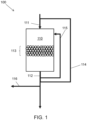
- An example of such a method is shown schematically in FIG. 1 . In FIG.
- the method 100 includes performing a reverse water-gas shift reaction by providing a feed stream 111 comprising H 2 and CO 2 , here, to a reaction zone, e.g., a reactor 110.
- a reverse water-gas shift catalyst 113 as described herein, is contacted at a temperature in the range of 250-1100 °C with the feed stream 111 to provide a product stream 112 comprising CO and H 2 .
- the product stream has a lower concentration of CO 2 and a higher concentration of CO than the feed stream.
- a "feed stream” is used to mean the total material input to a process step, regardless of whether provided in a single physical stream or multiple physical streams, and whether through a single inlet or multiple inlets.
- H 2 and CO of the feed stream can be provided to the reverse water-gas shift catalyst in a single physical stream (e.g., in a single pipe to reactor 110), or in multiple physical streams (e.g., separate inlets for CO and H 2 , or one inlet for fresh CO and H2 and another for recycled CO and/or H2).
- a "product stream” is used to mean the total material output from a process step, regardless of whether provided in a single physical stream or multiple physical streams, and whether through a single outlet or multiple outlets.
- CO 2 is a substantial input to the claimed processes.
- the present inventors have recognized that at least part of the CO 2 of the first feed stream (e.g., at least 50%, at least 75%, at least 90% or at least 95%) can come from renewable or otherwise environmentally responsible sources.
- at least part of the CO 2 of the first feed stream is from biogas, a CO 2 emission source, and/or direct air capture.
- At least a portion of the CO 2 of the first feed stream is from biogas.
- Biogas is produced by anaerobic digestion of organic matter (e.g., animal water, food waste, plant matter) by microorganisms and includes substantial amounts of CO 2 and methane.
- a majority (i.e., at least 50 mol%) the CO 2 of the first feed stream is from biogas.
- substantially all (e.g., at least 90 mol%) of the CO 2 of the first feed stream is from biogas.
- the CO 2 of the first feed stream comprises at least 50 mol% (e.g., at least 75 mol%, at least 90 mol%, or at least 95 mol%) CO 2 from biogas.
- the process as described herein may operate with significant amounts of unreacted methane.
- the first feed stream comprises methane, such as from biogas
- the first feed stream comprises methane in an amount in the range of 10-70 mol%, or 10-50 mol%, or 20-70 mol%, or 20-50 mol%, or 30-70 mol%, or 30-50 mol%..
- the methane in the biogas when the first feed stream comprises biogas, the methane in the biogas may be separated out before being added to the first feed stream. Accordingly, in some embodiments, the process as described herein may operate with low amounts of unreacted methane.
- the first feed stream comprises methane in an amount in the range of 0.1 to 10 mol%, or 0.1 to 5 mol%, or 0.1 to 1 mol%.
- At least a portion of the CO 2 of the first feed stream is from direct air capture.
- Carbon dioxide is a common waste material, and often desirable to be removed from waste streams rather than be vented to the atmosphere. Such capture of carbon dioxide is critical to the implementation of many renewable initiatives as it serves to lower the carbon footprint of the associated process.
- the carbon dioxide utilized in the processes described herein may be carbon dioxide collected from the atmosphere or that would otherwise have been released into the atmosphere, e.g., from a combustion or other industrial process.
- the carbon dioxide may be captured, where it is collected or absorbed after release from an industrial process, or harvested directly from the atmosphere.
- the eventual hydrocarbon product can be substantially carbon-neutral or of lower carbon intensity.
- At least a portion of the CO 2 of the first feed stream is from direct air capture.
- a majority (i.e., at least 50 mol%) the CO 2 of the first feed stream is from direct air capture.
- substantially all (e.g., at least 90 mol%) of the CO 2 of the first feed stream is from direct air capture.
- the CO 2 of the first feed stream comprises at least 50 mol% (e.g., at least 75 mol%, at least 90 mol%, or at least 95 mol%) CO 2 from direct air capture.
- At least part of the CO 2 of the first feed stream is from a CO 2 emission source.
- carbon dioxide is often scrubbed from industrial effluent, especially processes that generate large amounts of carbon dioxide as a byproduct.
- the source of this carbon dioxide byproduct from industrial processes is referred to as a CO 2 emission source.
- a majority (i.e., at least50 mol%) the CO 2 of the first feed stream is from a CO 2 emission source.
- substantially all (e.g., at least 90 mol%) of the CO 2 of the first feed stream is from a CO 2 emission source.
- the CO 2 of the first feed stream comprises at least 50 mol% (e.g., at least 75 mol%, at least 90 mol%, or at least 95 mol%) CO 2 from a CO 2 emission source.
- the CO 2 emission source is not particularly limited and may derived from any industrial production known in the art.
- the CO 2 emission source is a manufacturing plant, a bioethanol plant, a CO 2 producing fermentation plant, a steel plant, or a cement plant.
- At least part of the CO 2 of the first feed stream (e.g., at least 50%, at least 75%, at least 90% or at least 95%) is captured from a manufacturing plant, e.g., a bioethanol plant (e.g., CO 2 produced fermentation), a steel plant or a cement plant.
- the CO 2 emission source is a point source from a fermentation, manufacturing, or other industrial process.
- the point source may be in the form of a chimney or vent or other structure for containing and/or transporting CO 2 known in the art.
- the rWGS-Fischer Tropsch integrated processes of the disclosure as described herein can be not only carbon neutral, but in some cases a net consumer of carbon dioxide.
- the reverse water-gas shift reaction has a CO selectivity of at least 50%, e.g., at least 50%.
- the reverse water-gas shift reaction has a CO selectivity of at least 70%, e.g., of at least 80%.
- the reverse water-gas shift reaction has a CO selectivity of at least 85%, e.g., or at least 90%.
- the reverse water-gas shift reaction has a CO selectivity of at least 95%, e.g., or at least 96%.
- a "selectivity" for a given reaction product is the molar fraction of the converted feed (here, the CO 2 that is converted to products other than CO 2 ) that is converted to the identified product (for "CO selectivity," CO).
- the present inventors have determined that the present catalysts, even when operating at lower temperatures (e.g., less than 900 °C) than many conventional reverse water-gas shift catalysts, can provide excellent selectivity for CO, despite the potential for competition by the Sabatier reaction and the methanation of CO.
- the reverse water-gas shift reaction has a CO selectivity in the range of 50-99 wt%, e.g., 60-99%, or 70-99%, or 80-99%, or 90-99%, or 95-99%.
- the reverse water-gas shift reaction has a CO selectivity in the range of 50-90%, e.g., 60-90%, or 70-90%, or 50-80%, or 60-80%, or 50-70%.
- the catalysts described herein can be operated to provide carbon monoxide with only a very minor degree of methane formation.
- the reverse water-gas shift reaction has a methane selectivity of no more than 40%, e.g., no more than 35%, or 30%, or 25%, or 20%.
- the reverse water-gas shift reaction has a methane selectivity of no more than 15%, e.g., no more than 12%, or 10%, or 8%.
- the reverse water-gas shift reaction has a methane selectivity of no more than 5%, e.g., no more than 4%.
- the reverse water-gas shift reaction has a methane selectivity of no more than 2%, e.g., no more than 1%.
- the reverse water-gas shift reaction has a methane selectivity of no more than 0.5%, e.g., no more than 0.2%.
- the catalysts described here can provide desirably high CO selectivity and desirably low methane selectivity at commercially relevant conversion rates.
- a "conversion" is a molar fraction of a feed that is reacted (be it to desirable products or undesirable species).
- the reverse water-gas shift reaction has a CO 2 conversion of at least 5%, e.g., at least 10%, or 20%.
- the reverse water-gas shift reaction has a CO 2 conversion of at least 30%, e.g., at least 40%, or 50%, or 60%.
- the reverse water-gas shift reaction has a CO 2 conversion of no more than 90%, e.g., no more than 80%, or no more than 70%.
- the reverse water-gas shift reaction has a CO 2 conversion of no more than 65%, e.g., no more than 60%.
- the CO 2 conversion is in the range of 10-90%, e.g., 10-80%, 10-70%, or 10-60%, or 10-65%, or 20-90%, or 20-80%, or 20-70%, or 20-60%, or 20-65%, or 30-90%, or 30-80%, or 30-70%, or 30-60%, or 30-65%, or 40-90%, or 40-80%, or 40-70%, or 40-60%, or 40-65%.
- the person of ordinary skill in the art will, based on the disclosure herein, operate at a degree of conversion that provides a desirable product. And of course, in other embodiments, e.g., when in a stacked-bed or mixed-bed system, the CO 2 conversion may be even higher than described here.
- the processes described herein can be performed at temperatures that are lower than temperatures used in many conventional reverse water-gas shift processes.
- various processes of the disclosure can be performed in a temperature range of 200-1100°C, e.g., in the range of 200-1050 °C, or 200-1000 °C, or 200-950 °C, or 250-1050 °C, or 250-1000 °C, or 250-950 °C.
- the method for performing the reverse water-gas shift reaction is conducted at a temperature in the range of 250-900 °C, e.g., in the range of 250-850 °C, 250-800 °C, or 250-750 °C, or 250-700 °C, or 250-650 °C, or 250-600 °C.
- the method for performing the reverse water-gas shift reaction is conducted at a temperature in the range of 300-1100 °C, e.g., in the range of 300-1050 °C, or 300-1000 °C, or 300-950 °C.
- the method for performing the reverse water-gas shift reaction is conducted at a temperature in the range of 300-900 °C, e.g., in the range of 300-850 °C, or 300-800 °C, or 300-750 °C, or 300-700 °C, or 300-650 °C, or 300-600 °C.
- the method for performing the reverse water-gas shift reaction is conducted at a temperature in the range of 350-1100 °C, e.g., in the range of 350-1050 °C, or 350-1000 °C , or 350-950 °C.
- the method for performing the reverse water-gas shift reaction is conducted at a temperature in the range of 350-900 °C, e.g., in the range of 350-850 °C , or 350-800 °C , or 350-750 °C, or 350-700 °C, or 350-650 °C, or 350-600 °C.
- the method for performing the reverse water-gas shift reaction is conducted at a temperature in the range of 400-1100 °C, e.g., in the range of 400-1050 °C, or 400-1000 °C , or 400-950 °C.
- the method for performing the reverse water-gas shift reaction is conducted at a temperature in the range of 400-900 °C, e.g., in the range of 400-850 °C, or 400-800 °C , or 400-750 °C, or 400-700 °C, or 400-650 °C, or 400-600 °C.
- the method for performing the reverse water-gas shift reaction is conducted at a temperature in the range of 450-1100 °C, e.g., in the range of 450-1050 °C, or 450-1000 °C, or 450-950 °C.
- the method for performing the reverse water-gas shift reaction is conducted at a temperature in the range of 450-900 °C, e.g., in the range of 450-850 °C , or 450-800 °C, or 450-750 °C, or 450-700 °C, or 450-650 °C, or 450-600 °C.
- the method for performing the reverse water-gas shift reaction is conducted at a temperature in the range of 500-1100 °C, e.g., in the range of 500-1050 °C, or 500-1000 °C, or 500-950 °C.
- the method for performing the reverse water-gas shift reaction is conducted at a temperature in the range of 500-900 °C, e.g., in the range of 500-850 °C, or 500-800 °C, or 500-750 °C , or 500-700 °C, or 500-650 °C, or 500-600 °C.
- the method for performing the reverse water-gas shift reaction is conducted at a temperature in the range of 550-1100 °C, e.g., in the range of 550-1050 °C, or 550-1000 °C, or 550-950 °C.
- the method for performing the reverse water-gas shift reaction is conducted at a temperature in the range of 550-900 °C, e.g., in the range of 550-850 °C, or 550-800 °C, or 550-750°C, or 550-700 °C, or 550-650 °C, or 550-600 °C.
- the method for performing the reverse water-gas shift reaction is conducted at a temperature in the range of 600-1100 °C, e.g., in the range of 600-1050 °C, or 600-1000 °C, or 600-950 °C.
- the method for performing the reverse water-gas shift reaction is conducted at a temperature in the range of 600-900 °C, e.g., in the range of 600-850 °C, or 600-800 °C, or 600-750°C, or 600-700 °C, or 600-650 °C. In some embodiments as described herein, the method for performing the reverse water-gas shift reaction is conducted at a temperature in the range of 650-1100 °C, e.g., in the range of 650-1050 °C, or 650-1000 °C, or 650-950 °C.
- the method for performing the reverse water-gas shift reaction is conducted at a temperature in the range of 650-900 °C, e.g., in the range of 650-850 °C, or 650-800 °C, or 650-750°C, or 650-700 °C. In some embodiments as described herein, the method for performing the reverse water-gas shift reaction is conducted at a temperature in the range of 700-1100 °C, e.g., in the range of 700-1050 °C, or 700-1000 °C, or 700-950 °C.
- the method for performing the reverse water-gas shift reaction is conducted at a temperature in the range of 700-900 °C, e.g., in the range of 700-850 °C, or 700-800 °C, or 700-750°C.
- the reverse water-gas shift reaction is conducted at a temperature in the range of 200-500 °C, e.g., 200-450 °C, or 200-400 °C, or 200-350 °C, or 250-500 °C, or 250-450 °C, or 250-400 °C, or 250-350 °C.
- the present inventors have noted that operation at these temperatures can provide for lower energy demand, as well as for facile integration with a subsequent Fischer-Tropsch process step.
- the feed stream includes CO 2 and H 2 .
- the present inventors have recognized that both of these can come from renewable or otherwise environmentally responsible sources.
- at least part of the H 2 can be so-called “green” hydrogen, e.g., produced from the electrolysis of water operated using renewable electricity (such as wind, solar, or hydroelectric power).
- at least part of the H 2 may be from a so-called “blue” source, e.g., from a natural gas reforming process with carbon capture.
- a so-called “blue” source e.g., from a natural gas reforming process with carbon capture.
- other sources of hydrogen can be used in part or in full.
- At least a portion of the H 2 of the feed stream is grey hydrogen, black hydrogen, brown hydrogen, pink hydrogen, turquoise hydrogen, yellow hydrogen, and/or white hydrogen.
- CO 2 can be captured from the environment generally, or more directly from processes that form CO 2 (especially in difficult-to-abate sectors), making a product that is later made from the CO at least carbon-neutral.
- at least part of the CO 2 is from direct air capture, or from a manufacturing plant such as a bioethanol plant (e.g., CO 2 produced fermentation), a steel plant, or a cement plant.
- the rWGS reaction can be not only carbon neutral, but in some cases a net consumer of carbon dioxide.
- the feed stream contains both H 2 and CO 2 (e.g., provided to a reaction zone in a single physical stream or multiple physical streams).
- the feed stream includes all feeds to the process, regardless of whether provided as a mixture of gases or as gases provided individually to a reaction zone.
- the molar ratio of H 2 to CO 2 in the feed stream is at least 0.1:1, e.g., at least 0.5:1.
- the molar ratio of H 2 to CO 2 in the feed stream is at least 0.9:1, e.g., at 1:1 or least 1.5:1.
- the molar ratio of H 2 to CO 2 in the feed stream is at least 2:1, e.g., at least 2.5:1.
- the molar ratio of H 2 to CO 2 in the feed stream is no more than 100:1, e.g., no more than 75:1, or 50:1. In some embodiments, the molar ratio of H 2 to CO 2 in the feed stream is no more than 20:1, e.g., no more than 15:1, or 10:1. For example, in some embodiments, the molar ratio of H 2 to CO 2 in the feed stream is in the range of 0.5:1 to 10:1.
- the feed stream further comprises CO.
- the first feed stream comprises no more than 20 mol%, no more than 10 mol%, or no more than 5 mol%, or no more than 3 mol%, or no more than 1 mol%, of CO.
- the feed stream further comprises one or more inert gases.
- the feed stream further comprises nitrogen and/or methane.
- the first feed stream comprises no more than 10 mol%, no more than 6 mol%, or no more than 2 mol%, of nitrogen.
- the gases of first feed steam may be separated out to provide the amounts of carbon dioxide, methane, and/or nitrogen as described herein.
- methane is separated from the first feed stream to provide a first feed stream comprising at least 50 mol% carbon dioxide, e.g., at least 60 mol% carbon dioxide, at least 70 mol% carbon dioxide, at least 80 mol% carbon dioxide, or at least 90 mol% carbon dioxide.
- the processes described herein can be performed at a variety of pressures, as would be appreciated by the person of ordinary skill in the art.
- the method for performing the reverse water-gas shift reaction is conducted at a pressure in the range of 1 to 100 barg.
- the method is conducted at a pressure in the range of 1 to 70 barg, or 1 to 50 barg, or 1 to 40 barg, or 1 to 35 barg, or 5 to 70 barg, or 5 to 50 barg, or 5 to 40 barg, or 5 to 35 barg, or 10 to 70 barg, 10 to 50 barg, or 10 to 40 barg, or 10 to 35 barg, or 20 to 70 barg, 20 to 50 barg, or 20 to 40 barg, or 20 to 35 barg, or 25 to 70 barg, 25 to 50 barg, or 25 to 40 barg, or 25 to 35 barg.
- the processes described herein can be performed at a variety of GHSV (gas hourly space velocity), as would be appreciated by the person of ordinary skill in the art.
- GHSV gas hourly space velocity
- the GHSV for performing the reverse water-gas shift reaction is not particularly limited.
- the method for performing the reverse water-gas shift reaction is conducted at a GHSV in the range of 1,000 to 2,000,000 h -1 .
- the method for performing the reverse water-gas shift reaction is conducted at a GHSV in the range of 1,000 to 1,200,000 h -1 , or 1,000 to 500,000 h -1 , or 1,000 to 100,000 h -1 , or 5,000 to 1,200,000 h -1 , or 5,000 to 500,000 h -1 , or 5,000 to 100,000 h -1 , or 10,000 to 1,200,000 h -1 , or 10,000 to 500,000 h -1 , or 10,000 to 100,000 h -1 .
- the method for performing the reverse water-gas shift reaction is conducted at a GHSV in the range of 1,000 to 50,000 h -1 , or 2,000 to 50,000 h -1 , or 5,000 to 50,000 h -1 , or 10,000 to 50,000, or 1,000 to 40,000 h -1 , or 2,000 to 40,000 h -1 , or 5,000 to 40,000 h -1 , or 10,000 to 40,000 h -1 , or 1,000 to 30,000 h -1 , or 2,000 to 30,000 h -1 , or 5,000 to 30,000 h -1 , or 10,000 to 30,000 h -1 .
- the rWGS catalyst described herein is based in part on platinum, palladium, gold, and/or nickel. It will typically be desirable to activate the rWGS catalyst, e.g., before contacting with the feed stream.
- the method comprises activating the rWGS catalyst prior to contacting the catalyst with the feed stream.
- activating the catalyst comprises contacting the catalyst with a reducing stream comprising a reductive gas, e.g., hydrogen.
- the reducing stream comprises hydrogen in an amount of at least 25 mol%, e.g., at least 50 mol%, or 75 mol%, or 90 mol%.
- activating the catalyst is conducted at a temperature in the range of 200 °C to 1000 °C.
- activating the catalyst is conducted at a temperature in the range of 250 °C to 1000 °C, or 300 °C to 1000 °C, 200 °C to 900 °C, or 250 °C to 900 °C, or 300 °C to 900 °C, 200 °C to 800 °C, or 250 °C to 800 °C, or 300 °C to 800 °C, or 200 °C to 700 °C, or 250 °C to 800 °C, or 300 °C to 700 °C.
- activating the catalyst provides a catalyst that is at least 10% reduced (e.g., at least 25%, or at least 50% reduced).
- the present inventors have found that contacting the rWGS catalysts as described herein with a feed stream can provide a product stream with advantageously high CO selectivity and low methane selectivity.
- the amount of CO in the product stream can be further controlled by the rWGS reaction conditions, as described above.
- the methods for performing the rWGS reaction as described herein provide a product stream comprising H 2 and CO, with the product stream having a lower concentration of CO 2 and a higher concentration of CO than the feed stream, as is consistent with the degrees of conversion described herein.
- the product stream includes no more than 95 mol% CO 2 , or no more than 90 mol% CO 2 .
- the product stream includes no more than 85 mol% CO 2 , or no more than 80 mol% CO 2 . In other examples, the product stream includes no more than 75 mol%, or no more than 70 mol% CO 2 .
- the present inventors have determined that it can be desirable to perform the processes at intermediate degrees of conversion to provide desirably high CO selectivities and desirably low methane selectivities. Accordingly, in various embodiments as otherwise described herein, the product stream includes an amount of CO 2 together with the CO.
- the product stream further comprises one or more inert gases. These inert gases may be included from the feed stream or provided from a source other than the feed stream.
- the product stream further comprises nitrogen and/or methane.
- the product stream can include H 2 in combination with CO, in a variety of ratios.
- the ratio of H 2 :CO in the product stream is in the range of 0.1:1 to 100:1 (e.g., in the range of 0.1:1 to 50:1, or 0.1:1 to 25:1, or 0.1:1 to 10:1, or 0.1:1 to 5:1, or 1:1 to 100:1, or 1:1 to 50:1, or 1:1 to 25:1, or 1:1 to 10:1, or 1:1 to 5:1).
- the product stream may include H 2 , CO, and CO 2 and other components in various amounts. Components of the product stream may be separated and used for various purposes in the rWGS process.
- the method further comprises separating the product stream to recycle at least a portion (e.g., at least 5 mol%, at least 10 mol%, at least 25 mol%, at least 50 mol%, at least 75 mol%, or at least 90 mol%) of one or more components of the product stream to the feed stream.
- the method can include recycling at least a portion (e.g., at least 5 mol%, at least 10 mol%, at least 25 mol%, at least 50 mol%. at least 75 mol%, or at least 90 mol%) of the CO 2 of the product stream to the feed stream.
- the product stream may also include H 2 ; in some embodiments, the method further includes recycling at least a portion of H 2 of the product stream (e.g., at least 5 mol%, at least 10 mol%, at least 25 mol%, at least 50 mol%, at least 75 mol%, or at least 90 mol%) to the feed stream.
- H 2 of the product stream e.g., at least 5 mol%, at least 10 mol%, at least 25 mol%, at least 50 mol%, at least 75 mol%, or at least 90 mol%
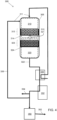
- Such recycling is shown in the process 100 of FIG. 1 (and of FIG. 2 ).
- the process 100 includes separating from the product stream 112 at least a portion of CO 2 (stream 114) to recycle to the feed stream 111.
- the process 100 includes separating from the product stream 112 at least a portion of H 2 (stream 115) to recycle to the product stream 111. While stream 115 is depicted as entering reactor 110 through a different inlet than the rest of the feed stream 111, it is considered to be part of the feed stream, as it is part of the material input to the process step.
- the product stream comprises one or more light hydrocarbons.
- the product stream may include one or more of methane, ethane, propane, or combinations thereof.
- a substantial fraction of such methane may be from biogas provided to the first feed stream (e.g., at least 50%, at least 75%, or at least 90%).
- the reverse water-gas shift reaction it may be desirable to operate the reverse water-gas shift reaction to provide higher amounts of light hydrocarbons in the product feed.
- such light hydrocarbons may be inert in further processing of the product stream and so may be acceptable at higher amounts, especially when biogas is used in the first feed stream.
- the person of ordinary skill in the art would be able to select appropriate reaction conditions (e.g., temperature, pressure, feed stream composition) to provide a product stream that includes methane at a desired amount.
- the product stream includes no more than 20 mol% methane or no more than 15 mol%.
- the catalysts of the disclosure can provide very low methane selectivity.
- methane may be separated before contacting with the reverse water-gas shift catalyst to provide a first feed stream and a first product stream with low amounts of methane.
- the product stream includes no more than 10 mol% methane.
- the product stream includes no more than 5 mol%, or 1 mol%, or 0.5 mol%, or no more than 0.1 mol% methane.
- light hydrocarbons e.g., C 1 -C 5 hydrocarbons
- the product stream includes no more than 20 mol% light hydrocarbons (e.g., no more than 15 mol%, no more than 10 mol%, no more than 5 mol%, no more than 1 mol%, no more than 0.5 mol%, or no more than 0.1 no mol% light hydrocarbons).
- no more than 20 mol% light hydrocarbons e.g., no more than 15 mol%, no more than 10 mol%, no more than 5 mol%, no more than 1 mol%, no more than 0.5 mol%, or no more than 0.1 no mol% light hydrocarbons.
- the method further includes separating at least a portion of one or more light hydrocarbons from the product stream to provide a light hydrocarbon stream.
- a light hydrocarbon stream For example, in method 100 of FIG. 1 , at least a portion of one or more light hydrocarbons are separated from the product stream 112 to provide a light hydrocarbon stream 116.
- the light hydrocarbon stream for example, can be used to provide other products, can be partially oxidized to form CO, can be steam reformed to provide hydrogen, and/or can be burned to provide heat or other energy (e.g., electricity for electrolysis) for use in the rWGS method or otherwise.
- the light hydrocarbon stream comprises methane from biogas which can be burned to provide energy (e.g., heat energy or electrical energy) for use in the integrated process (e.g., for heating the first feed stream).
- energy e.g., heat energy or electrical energy
- the light hydrocarbon stream may be used in other processes as well.
- some rWGS catalysts can have reforming capability. Without being bound by theory, the present inventors hypothesize that one explanation for the low methane production observed using the rWGS catalysts as described herein is that methane is formed but then immediately reformed into CO and H 2 .
- the light hydrocarbons of the process stream is recycled to the feed stream for the rWGS reaction.
- These light hydrocarbons can be separated and used for other purposes.
- the process further includes separating at least a portion of one or more light hydrocarbons from the first product stream to provide a light hydrocarbon stream.
- at least a portion of one or more light hydrocarbons are separated from the first product stream 112 to provide a light hydrocarbon stream 118.
- the light hydrocarbon stream for example, can be used to provide other products, can be partially oxidized to form CO, can be steam reformed to provide hydrogen, and/or can be burned to provide heat or other energy (e.g., electricity for electrolysis) for use in the integrated process or otherwise.
- energy e.g., electricity for electrolysis
- the light hydrocarbon stream may be used in other processes as well.
- the supported reverse water-gas can be used in a rWGS process integrated with an FT process.
- the embodiments related to the reverse water-gas shift portion of the integrated FT process are as described above in the previous section.
- the feed stream of the rWGS process corresponds to the first feed stream in the integrated FT process and the product stream of the rWGS process corresponds to the first product stream in the integrated FT process.
- the process includes providing a first feed stream comprising H 2 and CO 2 , wherein at least part of the CO 2 of the first feed stream is from biogas, a CO 2 emission source, and/or direct air capture; contacting at a first temperature in the range of 200-1100 °C and at a first pressure a reverse water-gas shift catalyst, as described herein, with the first feed stream to perform a reverse water-gas shift reaction to provide a first product stream comprising CO and H 2 , the first product stream having a lower concentration of CO 2 and a higher concentration of CO than the first stream feed stream.
- the process 100 includes performing a reverse water-gas shift reaction by providing a first feed stream 111 comprising H 2 and CO 2 , here, to a first reaction zone, e.g., a reactor 110.
- a reverse water-gas shift catalyst 113 as described herein, is contacted at a first temperature in the range of 250-1100 °C and at a first pressure with the feed stream 111 to provide a first product stream 112 comprising CO and H 2 .
- the first product stream has a lower concentration of CO 2 and a higher concentration of CO than the first feed stream.
- the process of this aspect of the disclosure also includes contacting at a second temperature and at a second pressure a Fischer-Tropsch catalyst with a second feed stream comprising H 2 and at least a portion of CO of the first product stream to provide a second product stream comprising C 5 + hydrocarbons,
- a second reaction zone e.g., a reactor 120.
- This provides a second product stream 122, which includes C 5 + hydrocarbons.
- the present inventors have found that contacting the rWGS catalysts as described herein with a first feed stream can provide a first product stream with advantageously high CO selectivity and low methane selectivity.
- the amount of CO in the first product stream can be further controlled by the rWGS reaction conditions, as described above.
- the present inventors have determined that it can be desirable to perform the processes at intermediate degrees of conversion to provide desirably high CO selectivities and desirably low methane selectivities.
- it can be advantageous to perform the downstream Fischer-Tropsch process with a relatively high level of inerts, and thus contemplate that passing a significant amount of CO 2 to the Fischer-Tropsch process step can be beneficial.
- the first product stream includes an amount of CO 2 together with the CO.
- the first product stream comprises in the range of 5-95 mol% CO 2 , e.g., 5-90 mol%, or 5-85 mol%, or 5-80 mol%, or 5-75 mol%, or 5-70 mol%, or 10-95 mol%, or 10-90 mol%, or 10-85 mol%, or 10-80 mol%, or 10-75 mol%, or 10-70 mol%, or 20-95 mol%, or 20-90 mol%, or 20-85 mol%, or 20-80 mol%, or 20-75 mol%, or 20-70 mol%, or 30-95 mol%, or 30-90 mol%, or 30-85 mol%, or 30-80 mol%, or 30-75 mol%, or 30-70 mol% CO 2 .
- Fischer-Tropsch catalysts typically require activation by a reducing gas.
- different Fischer-Tropsch catalysts required different activation conditions (e.g., gas composition, temperature, pressure, time).
- iron based Fischer-Tropsch catalysts require activation with both H 2 and CO
- cobalt based Fischer-Tropsch catalysts require activation with just H 2 .
- H 2 and CO or just H 2 from the first product stream can be used to perform this activation.
- the process includes separating at least a portion of H 2 and CO (desirably in a ratio of at least 1:1 or at least 3:1) from the first product stream and contacting it with the Fischer-Tropsch catalyst to activate the Fischer-Tropsch catalyst.
- the process includes separating at least a portion of H 2 from the first product stream and contacting it with the Fischer-Tropsch catalyst to activate the Fischer-Tropsch catalyst.
- stream 125 separates H 2 or H 2 and CO and conducts it to reactor 120. This separation need not be continuous; rather, it need only be performed for a time desirable to provide reducing gas to the Fischer-Tropsch catalyst for activation.
- other sources of H 2 or CO may be used to provide reducing gas to the Fischer-Tropsch catalyst for activation.
- the process further includes removing at least a portion (e.g., at least 25%, at least 50%, or at least 75%) of water from the first product stream.
- a water removal zone 116 is used to remove water and provide a water-containing stream 117.
- the first product stream can be contacted with a water scavenger to remove water therefrom.
- a molecular sieve guard bed can be used to remove water from the first product stream; water can be recovered from the molecular sieves of the guard bed, e.g., by heating and vacuum.
- a knockout vessel can be used. However, use of a knockout vessel can in some cases cool the first product stream enough so that it is desirably reheated for introduction to the Fischer-Tropsch process step. Water removed from the first product stream can be used, e.g., as feed water for electrolysis processes described herein.
- the reverse water-gas shift process can be provided at a wide variety of temperatures. In some cases, those temperatures can be relatively close to the temperature of the subsequent Fischer-Tropsch process step (often 150-400 °C, e.g., 200-350 °C, or other temperatures as described below). In other cases, the reverse water-gas shift process can be performed at temperatures significantly higher than the temperature of the Fischer-Tropsch step.
- the present inventors have noted that it can be desirable to provide for heat exchange with a relatively hot first product stream to cool the first product stream to a temperature more appropriate for the Fischer Tropsch step and to provide heat elsewhere to the integrated process.
- the process further comprises exchanging heat between at least a portion of the first product stream and at least a portion of the first feed stream, thereby cooling at least a portion of the first product stream and heating at least a portion of the first feed stream.
- An example of such a process is shown schematically in FIG. 3 .
- the process 200, first reactor 210, first feed stream 211, first product stream 212, reverse water-gas shift catalyst 213, second reactor 220, second feed stream 221, second product stream 222 and Fischer-Tropsch catalyst 223 are generally as described above.
- the process 200 includes exchanging heat between at least a portion of the first product stream 212 and a least a portion of the first feed stream 211 in a first heat exchange zone 230, thereby cooling at least a portion of the first product stream 212 and heating at least a portion of the first feed stream 211.
- the person of ordinary skill in the art will appreciate that a wide variety of heat exchangers can be used for this purpose.
- any excess heat in the first product stream can be additionally or alternatively used for other purposes.
- the process further comprises exchanging heat between at least a portion of the first product stream and a steam generation zone, thereby cooling at least a portion of the first product stream and providing heat to the steam generation zone.
- FIG. 3 shows that after heat exchange with the first feed stream 211, the first product stream 212 is conducted to steam generation zone 232, to cool the first product stream 212 and provide heat to the steam generation zone 232.
- Steam can be generated from the heat provided, and electricity can be generated from the steam.
- electricity stream 264 is provided by the generation of electricity using steam generated in the steam generation zone 232.
- the steam generated in the steam generation zone may be used in other processes.
- the steam may be used to heat the first feed stream.
- the steam stream 266 generated in the steam generation zone 232 is conducted to the heat exchange zone 290 to heat the first feed stream 211.
- At least a portion of the CO of the first product stream is included in the second feed stream, for reaction in a Fischer-Tropsch process.
- at least 25% of the CO of the first product stream e.g., at least 50% of the CO, at least 75% of the CO, or at least 90% of the CO of the first product stream is included in the second feed stream.
- some of the CO of the first product stream can be used for other purposes, e.g., catalyst activation as described herein.
- substantially all of the CO of the second feed stream comes from the first product stream.
- CO can be provided to the second feed stream from other sources, fossil-derived or otherwise.
- CO is provided to the second feed stream from a CO source other than the first product stream.
- a stream of CO 226a from some other source is included in the second feed stream 221.
- the person of ordinary skill in the art will appreciate that CO can be provided from a variety of sources, e.g., gasification, reforming, or electrochemical CO 2 reduction.
- CO can be recycled to the second feed stream from the second product stream; and/or can be provided by reaction of a light hydrocarbon stream, e.g., by partial oxidation or reforming (e.g., steam reforming and/or autothermal reforming).
- partial oxidation or reforming e.g., steam reforming and/or autothermal reforming
- the second feed stream includes H 2 .
- the first product stream will often include H 2 , e.g., unreacted from the first feed stream.
- the first product stream includes H 2 wherein the second feed stream includes at least a portion of the H 2 of the first product stream.
- at least 25% of the H 2 of the first product stream e.g., at least 50% of the H 2 , at least 75% of the H 2 , or at least 90% of the H 2 of the first product stream is included in the second feed stream.
- some of the H 2 of the first product stream can be used for other purposes, e.g., catalyst activation as described herein.
- substantially all of the H 2 of the second feed stream comes from the first product stream.
- the person of ordinary skill in the art can provide more H 2 than necessary for the reverse water-gas shift reaction in the first feed stream, to provide excess H 2 in the first product stream that can then provide a desired amount of H 2 to the second feed stream for the Fischer-Tropsch process step.
- H 2 can be provided to the second feed stream from other sources.
- H 2 is provided to the second feed stream from a H 2 source other than the first product stream.
- a stream of H 2 226b from some other source is included in the second feed stream 221.
- H 2 can be provided from a variety of sources, e.g., gasification, reforming, or H 2 O electrolysis (including the electrolysis described herein). Moreover, as described in more detail below, H 2 can be recycled to the second feed stream from the second product stream.
- the person of ordinary skill in the art can, based on the disclosure herein, adjust the relative amounts of H 2 and CO in the second feed stream to provide a desired ratio. For example, more or less H 2 of the first feed stream and/or more or less H 2 from electrolysis can be included in the second feed stream. Similarly, more or less CO of the first feed stream and more or less CO from other sources (e.g., partial oxidation and reforming as described below) can be included in the second feed stream.
- the second feed stream includes at least a portion of CO 2 of the first product stream.
- at least 10% of the CO 2 of the first product stream e.g., at least 25% of the CO 2 , at least 50% of the CO 2 , at least 75% of the CO 2 , or at least 90% of the CO 2 of the first product stream is included in the second feed stream.
- the second feed stream may not include any substantial amount of CO 2 of the first product stream. Accordingly, in various embodiments, the second feed stream does not include a substantial amount of CO 2 of the first product stream. While it can be desirable generally to recycle CO 2 to the first feed stream for use in the reverse water-gas shift reaction, as described in more detail below, unreacted CO 2 can be recycled from the second product stream to the first feed stream.
- inert content can additionally or alternatively be desirable to include additional inert content to the second feed stream, be it CO 2 or other inerts such as nitrogen and methane.
- one or more inerts e.g., CO 2 , nitrogen and/or methane
- CO 2 , nitrogen and/or methane are provided to the second feed stream from a source other than the first product stream.
- a stream of inert(s) 226c from some other source is included in the second feed stream 221.
- inerts can be provided from a variety of sources.
- inerts can be recycled to the second feed stream from the second product stream.
- the portion of the first product stream that is included in the second feed stream has a CO 2 content in the range of 10-95 mol% CO 2 , e.g., 10-90 mol%, or 10-85 mol%, or 10-80 mol%, or 10-75 mol%, or 10-70 mol%, or 20-95 mol%, or 20-90 mol%, or 20-85 mol%, or 20-80 mol%, or 20-75 mol%, or 20-70 mol%, or 30-95 mol%, or 30-90 mol%, or 30-85 mol%, or 30-80 mol%, or 30-75 mol%, or 30-70 mol% CO 2 .
- the second feed stream includes up to 80 mol% of one or more inerts, e.g., in the range of 3-80 mol%, or 5-80 mol%, or 10-80 mol%, or 15-80 mol%, or 30-80 mol% of one or more inerts.
- the second feed stream includes up to 70 mol% inerts, up to 60 mol% inerts, or up to 50 mol% inerts, e.g., 3-70 mol%, or 5-70 mol%, or 10-70 mol%, or 15-70 mol%, or 30-70 mol%, or 3-60 mol%, or 5-60 mol%, or 10-60 mol%, or 15-60 mol%, or 30-60 mol%, or 3-50 mol%, or 5-50 mol%, or 10-50 mol%, or 15-50 mol%, or 30-50 mol% inerts.
- the second feed stream includes up to 80% of one or more inerts selected from CO 2 , methane and nitrogen, e.g., up to 70 mol%, up to 60 mol%, or up to 50 mol%, or 15-70 mol%, or 30-70 mol%, or 15-60 mol%, or 30-60 mol%, or 15-50 mol%, or 30-50 mol%.
- inerts selected from CO 2 , methane and nitrogen
- the second feed stream includes up to 80 mol% of CO 2 , e.g., up to 70 mol%, up to 60 mol%, or up to 50 mol%, or 15-70 mol%, or 30-70 mol%, or 15-60 mol%, or 30-60 mol%, or 15-50 mol%, or 30-50 mol%.
- the person of ordinary skill in the art can tune the portion of the first product stream that is included in the second feed stream to provide a desirable H 2 :CO ratio.
- the portion of the first product stream that is included in the second feed stream has a H 2 :CO ratio in the range of 0.5:1 to 10:1, e.g., in the range of 1:1 to 2.5:1.
- the person of ordinary skill in the art can add H 2 or CO as described above as necessary to provide the desired ratio overall in the second feed stream.
- the second feed stream contains both H 2 and CO and the second feed stream includes all feeds to the Fischer Tropsch reactor, regardless of whether the second feed stream is provided as a mixture of feeds or as feeds provided individually to a reaction zone.
- the second feed stream has a H 2 :CO ratio in the range of 0.5:1 to 6:1.
- the second feed stream has a H 2 :CO ratio in the range of 1:1 to 3:1, or 1:1 to 2.5:1.
- the second feed stream has a H 2 :CO ratio of at least 1.4:1.
- the second feed stream has a H 2 :CO ratio in the range of 1.4:1 to 3:1, or 1.4:1 to 2:1.
- the person of ordinary skill in the art will provide a desired ratio of H 2 :CO in the second feed stream, based on the disclosure herein that provides a desirable conversion and selectivity in the Fischer-Tropsch process.
- the portion of the first product stream that is included in the second feed stream has a water content of no more than 10 mol%, e.g., or no more than 2 mol%, or no more than 0.5 mol%.
- the second feed stream has a water content of no more than 10 mol%, e.g., or no more than 2 mol%, or no more than 0.5 mol%.
- the processes as described here include contacting a Fischer-Tropsch catalyst with the second feed stream as described herein.
- the Fischer-Tropsch catalyst for use in the processes as described herein is not particularly limited and the person of ordinary skill in the art would be able to choose a catalyst as appropriate for their desired Fischer-Tropsch product.
- the Fischer-Tropsch catalyst includes cobalt, iron, rhodium, ruthenium, or a combination thereof.
- the Fischer-Tropsch catalyst comprises cobalt, e.g., in an amount in the range of 5-25 wt%, calculated as Co(0).
- Co(0) "Calculated as Co(0)" and analogous terms mean that the weight of cobalt atoms/ions themselves are used in the calculation, and not the total amount of any compound or polynuclear ion in which those cobalt atoms/ions might be bound.
- the Fischer-Tropsch catalyst comprises cobalt in an amount in the range of 7-25 wt%, or 10-25 wt%, or 5-20 wt%, or 7-20 wt%, or 10-20 wt%, calculated as Co(0).
- cobalt-based catalysts are often provided to the reaction zone in the form of cobalt oxide on a support; the cobalt can be reductively activated (e.g., with H 2 ) in situ to provide an active catalyst species with a significant concentration of Co(0).
- the Fischer-Tropsch catalyst comprises iron, e.g., in an amount in the range of 5-95 wt%, calculated as Fe(0).
- the Fischer-Tropsch catalyst comprises iron in the range of 10-95 wt%, or 25-95 wt%, or 50-95 wt%, or 5-85 wt%, or 10-85 wt%, or 25-85 wt%, or 50-85 wt%, or 5-75 wt%, or 10-75 wt%, or 25-75 wt%, calculated as Fe(0).
- iron-based catalysts are often provided to the reaction zone in the form of metallic iron or iron oxide, optionally on a support; the iron can be activated (e.g., by reaction with H 2 and CO) to provide an active catalyst species with a significant concentration of iron carbide.
- the Fischer-Tropsch catalyst further includes manganese.
- the Fischer-Tropsch catalyst includes manganese in an amount up to 15 wt%, e.g., up to 12 wt%, or up to 10 wt%, or up to 7 wt%, calculated as Mn(0).
- a catalyst material includes manganese in an amount in the range of 0.1-15 wt%, e.g., 0.1-10 wt%, or 0.1-5 wt%, 0.5-15 wt%, or 0.5-10 wt%, or 0.5-5 wt%, or calculated as Mn(0).
- substantially no manganese is present (e.g., less than 0.1 wt% or less than 0.5 wt% manganese is present).
- the Fischer-Tropsch catalysts suitable for use in the process as described herein can be a variety of forms and are not particularly limited.
- the Fischer-Tropsch catalyst may be a supported or unsupported catalyst.
- the form of the catalyst is not particularly limited, in various desirable embodiments, the Fischer-Tropsch catalyst is a supported catalyst, wherein the support comprises at least one of titanium oxide, zirconium oxide, cerium oxide, aluminum oxide, silicon oxide and zinc oxide.
- the support comprises at least one or titanium oxide, aluminum oxide, and silicon oxide.
- the support is a titanium dioxide support.
- the Fischer-Tropsch catalysts of the disclosure can be provided in many forms, depending especially on the particular form of the reactor system in which they are to be used, e.g., in a fixed bed or as a fluidized bed.
- the supports of the Fischer-Tropsch catalysts can be provided themselves as discrete bodies of material, e.g., as porous particles, pellets or shaped extrudates, with the metals provided thereon to provide the Fischer-Tropsch catalyst.
- a Fischer-Tropsch catalyst of the disclosure can itself be formed as a layer on an underlying substrate.
- the underlying substrate is not particularly limited.
- It can be formed of, e.g., a metal or metal oxide, and can itself be provided in a number of forms, such as particles, pellets, shaped extrudates, or monoliths.
- the person of ordinary skill in the art will select an appropriate Fischer-Tropsch catalyst for the particular reactor system.
- Fischer-Tropsch catalysts are typically activated before use, e.g., to provide cobalt(0) species on a cobalt-based catalyst, or iron carbide species on an iron-based catalyst. Such activation can be performed prior to contacting the Fischer-Tropsch catalyst with a second feed stream.
- the Fischer-Tropsch catalyst is activated by contact with a reducing gas.
- hydrogen can be an especially suitable gas for activating Fischer-Tropsch catalyst, e.g., when the activation is a reduction to metal(0) species, e.g., as for many cobalt-based catalysts.
- the reducing gas comprises at least a portion of H 2 from the first product stream.
- the process further comprises separating at least a portion of H 2 of the first product stream and contacting it with the Fischer-Tropsch catalyst to activate Fischer-Tropsch catalyst. In the process 100 shown schematically in FIG.
- H 2 present in the second feed stream can be used to activate the catalyst.
- activation temperatures can vary depending on the Fischer-Tropsch catalyst used. As such, the person of ordinary skill in the art would be able to select an appropriate temperature for activating the catalyst, e.g., in the range of 200-400 °C.
- the Fischer-Tropsch catalyst is activated by contact with H 2 and CO. This can be especially suitable when the activation provides conversion to carbide, e.g., as for many iron-based catalysts.
- the reducing gas comprises at least a portion of H 2 and CO from the first product stream.
- the process further comprises separating at least a portion of H 2 and at least a portion of CO of the first product stream and contacting it with the Fischer-Tropsch catalyst to activate Fischer-Tropsch catalyst. In the process 200 shown schematically in FIG.
- H 2 and CO stream 227 is separated from the first product stream 212 and contacted with the Fischer-Tropsch catalyst 223 to activate it.
- H 2 and CO present in the second feed stream can be used to activate the catalyst.
- Activation temperatures can vary, e.g., in the range of 200-400 °C.
- the process includes contacting at a second temperature and at a second pressure a Fischer-Tropsch catalyst with a second feed stream.
- a Fischer-Tropsch catalyst with a second feed stream.
- the person of ordinary skill in the art will select appropriate reaction conditions in conjunction with the particular feed and catalyst used to provide desired Fischer-Tropsch processes.
- the second temperature is in the range of 150-400 °C.
- the second temperature is in the range of 150-350 °C, or 150-300 °C, or 150-250°C, or 150-200°C, or 200-400 °C, or 200-350 °C, or 200-300°C, or 200-250 °C, or 250-400 °C, or 250-350 °C, or 250-300 °C, or 300-400 °C.
- the second temperature is in the range of 200-350 °C.
- the first temperature and the second temperature can be relatively close to one another.
- the reverse water-gas shift catalysts described herein can provide suitable activity and CO selectivity even at relatively low temperatures.
- the first product stream can be provided with a temperature that is suitable for, or at least close to suitable for, the Fischer-Tropsch reaction step. This can desirably provide for increased process integration.
- the first temperature is within 100 °C of the second temperature, e.g., within 50 °C of the second temperature, or within 25 °C of the second temperature.
- the first temperature and the second temperature are less close to one another.
- the present inventors have noted that in many cases a desirable reverse water-gas shift process temperature will be significantly greater than a desirable Fischer-Tropsch process temperature.
- the first temperature is at least 100 °C greater than the second temperature, e.g., at least 150 °C greater than the second temperature, or at least 200 °C greater than the second temperature.
- the excess heat in the first product stream can be used for a number of purposes, for example, to preheat at least part of the first feed stream or to generate steam for use in generating electricity, as described above.
- the second pressure is in the range of 10-50 barg.
- the second pressure is in the range of 20-50 barg, or 25-50 barg, or 10-40 barg, or 20-40 barg, or 25-40 barg or 10-35 barg, or 20-35 barg, or 25-35 barg. In some embodiments, the second pressure is in the range of 20-50 barg.
- the Fischer-Tropsch processes described herein can be performed at a variety of GHSV (gas hourly space velocity) values, as would be appreciated by the person of ordinary skill in the art.
- GHSV gas hourly space velocity
- the GHSV for performing the Fischer-Tropsch reaction is not particularly limited.
- the process for performing the Fischer-Tropsch reaction is conducted at a GHSV in the range of 1,000 to 2,000,000 h -1 .
- the process for performing the reverse water-gas shift reaction is conducted at a GHSV in the range of 1,000 to 1,200,000 h -1 , or 1,000 to 500,000 h -1 , or 1,000 to 100,000 h -1 , or 5,000 to 1,200,000 h -1 , or 5,000 to 500,000 h -1 , or 5,000 to 100,000 h -1 , or 10,000 to 1,200,000 h -1 , or 10,000 to 500,000 h -1 , or 10,000 to 100,000 h -1 .
- the process for performing the Fischer-Tropsch reaction is conducted at a GHSV in the range of 1,000 to 50,000 h -1 , or 2,000 to 50,000 h -1 , or 5,000 to 50,000 h -1 , or 10,000 to 50,000, or 1,000 to 40,000 h -1 , or 2,000 to 40,000 h -1 , or 5,000 to 40,000 h -1 , or 10,000 to 40,000 h -1 , or 1,000 to 30,000 h -1 , or 2,000 to 30,000 h -1 , or 5,000 to 30,000 h -1 , or 10,000 to 30,000 h -1 .
- the Fischer-Tropsch process is typically used to make C 5+ hydrocarbons, for example, unsubstituted C 5+ hydrocarbons (e.g., alkanes and alkenes) and oxygenated C 5+ hydrocarbons (e.g., C 5+ alcohols, aldehydes, ketones, carboxylic acids).
- contacting the Fischer-Tropsch catalyst with the second feed stream to provide the second product stream is performed with a C 5+ selectivity (i.e., for all C 5+ species) of at least 30%, e.g., at least 50%, or at least 70%.
- the selectivity for C 5+ alkanes is at least 30%, e.g., at least 50%, or at least 70%.
- the selectivity for C 5+ alkanes and C 5+ alcohols is at least 30%, e.g., at least 50%, or at least 70%.
- the second product stream includes water, which is another product of the Fischer-Tropsch reaction. Also present can be one or more light hydrocarbons (i.e., C 1 -C 4 ) as a side product. CO and/or H 2 can be present, e.g., unreacted from the second feed stream. CO 2 or other inerts as described herein can also be present. Such components of the second product stream can be separated and/or recycled in various manners.
- the second product steam includes methane
- methane may be substantially from biogas provided to the first feed stream (e.g., at least 50%, at least 75%, or at least 90%).
- the process further comprises separating at least a portion of water from the second product stream.
- FIG. 4 This is shown schematically in FIG. 4 .
- the reverse water-gas shift catalyst 313 and the Fischer-Tropsch catalyst 323 are provided in separate beds in the same reactor.
- the first reaction zone 310 is a volume of the reactor 305 that includes the bed 314 containing the reverse water-gas shift catalyst 313, and the second reaction zone 320 is a volume of the reactor 305 that includes the bed 324 containing the Fischer-Tropsch catalyst 323.
- First feed stream 311 is contacted with the reverse water-gas shift catalyst 313 to provide first product stream 312, which is passed directly as the second feed stream 321 to the Fischer-Tropsch catalyst 323 to provide second product stream 322.
- the process also optionally includes separating at least a portion of water (e.g., at least 50%, at least 75%, or at least 90%) from the second product stream 322 to provide water-containing stream 334.
- the process further includes separating at least a portion of C 1 -C 4 hydrocarbons from the second product stream to provide a light hydrocarbon stream.
- the light hydrocarbon stream can, for example, be recycled to the first feed stream or the second feed stream.
- light hydrocarbons can be provided as part of the recycle stream 236, which becomes part of the second feed stream 221.
- light hydrocarbons can be provided as part of the recycle stream 336, which becomes part of the first feed stream 311.
- light hydrocarbons are recycled via recycle stream 442 to first feed stream 411.
- the process further comprises oxidizing at least a portion of the light hydrocarbon stream to provide a CO- and/or CO 2 -containing partial oxidation (pOX) stream, and including at least a portion of the pOX stream in the first feed stream and/or the second feed stream.
- the light hydrocarbon stream comprises methane from biogas.
- at least 50% of methane of the light hydrocarbon stream is methane from biogas.
- the process 400 includes oxidizing at least a portion of the light hydrocarbon stream 450) in a partial oxidation reaction zone 452 to provide a CO- and/or CO 2 containing pOX stream, and including at least a portion of the pOX stream 454 stream in the first feed stream 411 and/or the second feed stream 421.
- the process includes providing a biogas comprising CO 2 and methane, and providing at least a portion of the CO 2 to the first feed stream, and at least a portion of the methane to the oxidation of at least a portion of the light hydrocarbon stream as shown in the embodiment of FIG. 6 .
- the process further comprises reforming (e.g., steam reforming and/or autothermal reforming) at least a portion of the light hydrocarbon stream to provide a CO- and/or CO 2 -containing reformed stream, and including at least a portion of the reformed stream in the first feed stream and/or the second feed stream.
- reforming e.g., steam reforming and/or autothermal reforming
- Water separated from the first and/or second product streams can be provided as part of a feed to the reforming described herein.
- the light hydrocarbon stream can be burned to provide heat energy, which can be used to heat various process streams, or to generate electricity.
- the process includes burning at least a portion of the light hydrocarbon stream to provide energy, e.g., heat energy or electrical energy.
- energy e.g., heat energy or electrical energy.
- a portion of light hydrocarbon stream 450 is burned in a power generation zone (here, in an electrical generator 470), to generate electricity stream 472.
- the heat energy may be used to provide the needed heat duty for the reverse water-gas shift process.
- a portion of the light hydrocarbon stream 450 is burned in a power generation zone (here, in a heat generator 480), to generate heat stream 482.
- the heat stream 482 is conducted to a heat exchange zone 490 to heat the first feed stream 411.
- Heat energy can similarly be provided to the Fischer-Tropsch reaction.
- other treatments of the light hydrocarbon stream e.g., partial oxidation
- heat can be exchanged from the second product stream to provide heat to, for example, a feed stream or a steam generation zone.
- the process further comprises exchanging heat between at least a portion of the second product stream and at least a portion of the first feed stream, thereby cooling at least a portion of the second product stream and heating at least a portion of the first feed stream.
- heat is exchanged between at least a portion of the second product stream 322 and first feed stream 311 in a second heat exchange zone 330, thereby cooling the second product stream 322 and heating the first feed stream 311.
- heat can also be exchanged from the second product stream to the second feed stream.
- the process further comprises exchanging heat between at least a portion of the second product stream and at least a portion of the second feed stream, thereby cooling at least a portion of the second product stream and heating at least a portion of the second feed stream.
- heat is exchanged between at least a portion of the second product stream 422 and second feed stream 421 in a second heat exchange zone 430, thereby cooling the second product stream 422 and heating the second feed stream 421.
- the person of ordinary skill in the art will appreciate that a wide variety of heat exchangers can be used for this purpose.
- any excess heat in the second product stream can be additionally or alternatively used for other purposes.
- the process further comprises exchanging heat between at least a portion of the second product stream and a steam generation zone, thereby cooling at least a portion of the second product stream and providing heat to the steam generation zone.
- FIG. 4 shows that after heat exchange with the first feed stream 311, the second product stream 322 is conducted to steam generation zone 332, to cool the second product stream 322 and provide heat to the steam generation zone 332. Steam can be generated from the heat provided, and electricity can be generated from the steam (not shown here).
- the process includes recycling at least a portion of H 2 of the second product stream to the second feed stream.
- at least a portion of H 2 of the second product stream e.g., at least 25%, at least 50%, or at least 75%) can be recycled to the second feed stream 221 via recycle stream 236.
- the process includes recycling at least a portion of H 2 of the second product stream to the first feed stream. For example, in the process of FIG.
- At least a portion of H 2 of the second product stream (e.g., at least 25%, at least 50%, or at least 75%) can be recycled to the first feed stream 311 via recycle stream 336.
- at least 25%, e.g., at least 50% of H 2 of the second product stream is recycled to the first feed stream or the second feed stream.
- at least 75%, e.g., at least 90% of H 2 of the second product stream is recycled to the first feed stream or the second feed stream.
- H 2 from the second product stream can make up most of the H 2 of the first feed stream, e.g., at least 90%, at least 95%, or at least 98% of the H 2 of the first feed stream. This is shown, e.g., in FIG. 5 .
- the primary H 2 input to the process is through stream 440, which becomes part of the second feed stream 421.
- H 2 of the second product stream is included in recycle stream 442, which becomes part of first feed stream 411.
- the process includes recycling at least a portion of CO of the second product stream to the second feed stream.
- at least a portion of CO of the second product stream e.g., at least 25%, at least 50%, or at least 75%) can be recycled to the second feed stream 221 via recycle stream 236.
- the process includes recycling at least a portion of CO of the second product stream to the first feed stream. For example, in the process of FIG.
- At least a portion of CO of the second product stream (e.g., at least 25%, at least 50%, or at least 75%) can be recycled to the first feed stream 311 via recycle stream 336.
- at least 25%, e.g., at least 50% of CO of the second product stream is recycled to the first feed stream or the second feed stream.
- at least 75%, e.g., at least 90% of CO of the second product stream is recycled to the first feed stream or the second feed stream.
- the process includes recycling at least a portion of inerts of the second product stream to the second feed stream.
- at least a portion of inerts of the second product stream e.g., at least 25%, at least 50%, or at least 75%) can be recycled to the second feed stream 221 via recycle stream 236.
- the process includes recycling at least a portion of inerts of the second product stream to the first feed stream. For example, in the process of FIG.
- At least a portion of inerts of the second product stream (e.g., at least 25%, at least 50%, or at least 75%) can be recycled to the first feed stream 311 via recycle stream 336.
- at least 25%, e.g., at least 50% of inerts of the second product stream is recycled to the first feed stream or the second feed stream.
- at least 75%, e.g., at least 90% of inerts of the second product stream is recycled to the first feed stream or the second feed stream.
- a purge stream can be incorporated with the recycle stream to prevent uncontrolled accumulation of inerts in the recycle stream (not shown here).
- the process includes recycling at least a portion (e.g., at least 50%, at least 75%, or at least 90%) of CO 2 of the second product stream to the first feed stream.
- at least a portion of CO 2 of the second product stream e.g., at least 50%, at least 75%, or at least 90%
- CO 2 from the second product stream can make up most of the CO 2 of the first feed stream, e.g., at least 90%, at least 95%, or at least 98% of the CO 2 of the first feed stream.
- the primary CO 2 input to the process is through stream 440, which becomes part of the second feed stream 421.
- CO 2 of the second product stream is included in recycle stream 442, which becomes part of first feed stream 411.
- the Fischer-Tropsch process step provides a second product stream that includes C 5+ hydrocarbons (e.g., unsubstituted hydrocarbons like alkanes and alkenes, and/or oxygenated hydrocarbons such as alcohols).
- C 5+ hydrocarbons e.g., unsubstituted hydrocarbons like alkanes and alkenes, and/or oxygenated hydrocarbons such as alcohols.
- one or more products are provided from at least a portion of C 5+ hydrocarbons of the second product stream.
- the C 5+ hydrocarbons can be used as the basis of a variety of fuels, e.g., gasoline, diesel, aviation fuel. Other products, like waxes and lubricants, can also be made.
- alkenes and oxygenates can be used as feedstocks in a variety of other processes.
- the process further includes hydroprocessing at least a portion of C 5+ hydrocarbons of the second product stream.
- hydroprocessing is a treatment of the hydrocarbon stream with hydrogen in the presence of a suitable catalyst.
- a wide variety of hydroprocessing techniques are known, and the person of ordinary skill in the art will apply them here.
- second product stream 322 is hydroprocessed in hydroprocessing reactor 350, to provide a hydroprocessed product stream 352.
- CO 2 and H 2 are substantial inputs to the claimed processes.
- the present inventors have recognized that each of these can come from renewable or otherwise environmentally responsible sources.
- a least a part of the CO 2 of the first feed stream is from biogas, a CO 2 emission source, and/or direct air capture.
- a part of the CO 2 of the second feed stream may also be from biogas, a CO 2 emission source, and/or direct air capture.
- At least a part of the CO 2 of the first feed stream and/or the second feed stream is from a renewable source.
- at least part (e.g., at least 25%, at least 50%, or at least 75%) of the CO 2 of the first feed stream and/or the second feed stream is from direct air capture.
- at least part (e.g., at least 25%, at least 50%, or at least 75%) of the CO 2 of the first feed stream and/or the second feed stream is from a manufacturing plant such as a bioethanol plant (e.g., CO 2 produced fermentation), a steel plant, or a cement plant.
- the rWGS-Fischer Tropsch integrated processes of the disclosure as described herein can be not only carbon neutral, but in some cases a net consumer of carbon dioxide.
- H 2 can be provided from environmentally-responsible sources.
- at least a part of the H 2 of the first feed stream and/or the second feed stream is from a renewable source.
- at least part (e.g., at least 25%, at least 50%, or at least 75%) of the H 2 of the first feed stream and/or the second feed stream can be so-called "green" hydrogen, e.g., produced from the electrolysis of water operated using renewable electricity (such as wind, solar, or hydro-electric power).
- At least part (e.g., at least 25%, at least 50%, or at least 75%) of the H 2 of the first feed stream and/or the second feed stream may be from a so-called "blue" source, e.g., from a natural gas reforming process with carbon capture.
- a blue source e.g., from a natural gas reforming process with carbon capture.
- other sources of H 2 can be used in part or in full.
- at least part (e.g., at least 25%, at least 50%, or at least 75%) of the H 2 of the first feed stream and/or the second feed stream is grey hydrogen, black hydrogen, brown hydrogen, pink hydrogen, turquoise hydrogen, yellow hydrogen, and/or white hydrogen.
- the process includes providing at least a portion of H 2 to the first feed stream and/or the second feed stream by electrolysis of water.
- the electrolysis of water is performed using at least partially electricity from a renewable source, e.g., to provide so-called "green hydrogen.”
- electricity can be generated as part of the claimed process, e.g., using heat exchange from the first or second product stream, or by burning light hydrocarbons as described above.
- the electrolysis of water is performed using at least partially electricity generated according to the processes as described herein. For example, in the process 200 of FIG.
- water 262 separated from the first product stream is electrolyzed in electrolyzer 260, using electricity 264 generated from steam made in the steam generation zone 232 by heat exchange from the first product stream.
- H 2 generated in the electrolysis is provided via stream 265 to the first feed stream.
- at least a portion of O 2 generated in the electrolysis is provided to a partial oxidation reaction zone as described herein and as shown in the embodiment of FIG. 7 .
- Hydrogen from electrolysis can also burned to provide heat energy, e.g., which can be used to heat the first feed stream.
- the processes described herein can be operated in a wide variety of reactor systems.
- the first reaction zone i.e., in which the reverse water-gas shift process step is performed
- the second reaction zone i.e., in which the Fischer-Tropsch process step is performed
- Examples of such processes are shown schematically in FIGS. 1 , 2 , and 4 .
- the process (100, 200, 400) is performed in a reactor system that includes a first reactor (110, 210, 410) in which a reverse water-gas shift catalyst (113, 213, 413) is disposed, and a second reactor (120, 220, 420) in which the Fischer-Tropsch catalyst (123, 223, 423) is disposed.
- the reactors used for the integrated process of the present disclosure as described herein are not particularly limited, and the person of ordinary skill in the art will be able to select an appropriate reactor.
- the process is performed in a reactor system comprising first catalyst bed in which the reverse water-gas shift catalyst is disposed, and wherein the second reaction zone comprises a second catalyst bed in which the Fischer-Tropsch catalyst is disposed.
- the first reactor bed and the second reactor bed are disposed within the same reactor.
- FIG. 4 Such a configuration is shown in FIG. 4 , in which the reverse water-gas shift catalyst 313 is disposed in a first catalyst bed 314, and the Fischer-Tropsch catalyst 323 is disposed in a second catalyst bed 324.
- the catalyst beds 314 and 324 are in the same reactor 305, with process gases flowing between them.
- Such a configuration can be especially desirable when the first temperature and the second temperature are relatively close to one another.
- the process is performed in a reactor system comprising one or more first catalyst containers in which the reverse water-gas shift catalyst is disposed, and wherein the second reaction zone comprises one or more second catalyst containers in which the Fischer-Tropsch catalyst is disposed.
- a reactor system comprising one or more first catalyst containers in which the reverse water-gas shift catalyst is disposed, and wherein the second reaction zone comprises one or more second catalyst containers in which the Fischer-Tropsch catalyst is disposed.
- the reverse water-gas shift process step using the palladium and platinum catalysts described herein and the Fischer-Tropsch process step can be performed under similar conditions.
- the reverse water-gas shift catalyst and the Fischer-Tropsch catalyst can be provided together in the same catalyst bed, e.g., mixed together.
- FIG. 6 Such an embodiment is shown in FIG. 6 .
- the process 500 is performed in a reactor system that includes a reactor 505 in which the reverse water-gas shift catalyst 513 and the Fischer-Tropsch catalyst 523 are mixed together in a single catalyst bed 524.
- first feed stream 511 and second product stream 522 can be substantially as described herein.
- the first product stream and the second feed stream are understood to be the mixture of process gases within the mixed catalysts.
- separate rWGS and Fischer-Tropsch catalysts are used, e.g., in separate reactors, in separate regions of the same reactor, or even comingled in the same region of a reactor.
- the present inventors contemplate the provision of a single bifunctional catalyst with both reverse water-gas shift activity and Fischer-Tropsch activity.
- a bifunctional catalyst includes both rWGS-active catalyst metal and the Fischer-Tropsch active catalyst metal in the same body.
- the person or ordinary skill in the art will appreciate that both the rWGS catalysts and the Fischer-Tropsch catalysts are supported catalyst, e.g., metal oxide supported catalyst.
- the rWGS-active catalyst metals and Fischer-Tropsch active catalyst metals can be provided together on the same support to provide a bifunctional catalyst.
- the supports of bifunctional catalyst are provided themselves as discrete body of material, e.g., as porous particles, pellets, or shaped extrudates, with the rWGS-active catalyst metals and the FT-active catalyst metals provided thereon to provide a bifunctional catalyst.
- the rWGS-active catalyst metals and the FT-active catalyst metals may be homogenous distributed throughout the support or may be distributed in discrete areas throughout the support.
- the bifunctional catalyst of the disclosure can itself be formed as a layer on an underlying substrate.
- the bifunctional catalyst is formed from a layer of rWGS-active catalyst metals and a layer of FT-active catalyst metals on an underlying substrate.
- the rWGS-active catalyst metals and the FT-active catalyst metals may be homogeneously distributed on the underlying substrate. In other embodiments, the rWGS-active catalyst metals and the FT-active catalyst metals may be in discrete areas on the underlying substrate.
- the underlying substrate is not particularly limited. It can be formed of, e.g., a metal or metal oxide, and can itself be provided in a number of forms, such as particles, pellets, shaped extrudates, or monoliths.
- the bifunctional catalyst includes a support material, the rWGS-active catalyst metals as described herein, and the Fischer-Tropsch active catalyst metals as described herein.
- the bifunctional catalyst includes a support that is a metal oxide support as described herein, at least one of platinum, palladium, gold, and metal as described herein, and at least one of cobalt, iron, rhodium, and ruthenium.
- the bifunctional catalyst includes a support that is a metal oxide support as described herein, at least one of platinum, palladium, gold, metal as described herein, and cobalt.
- the bifunctional catalyst includes a support comprising at least one of titanium oxide, zirconium oxide, cerium oxide, or aluminum oxide, at least one of platinum, palladium, gold, and nickel, metals as described herein, and cobalt.
- the bifunctional catalyst includes a titanium oxide support, at least one of platinum, palladium, gold, and nickel, metal as described herein, and cobalt.
- the bifunctional catalyst includes a titanium oxide support, platinum, metal as described herein, and cobalt.
- the bifunctional catalyst includes a titanium oxide support, palladium, metals as described herein, and cobalt.
- the bifunctional catalyst includes a titanium oxide support, gold, metals as described herein, and cobalt.
- the bifunctional catalyst includes a titanium oxide support, at least one of platinum, palladium, gold, and nickel, present in an amount in the range of 0.05 to 10 wt%, metal as described herein, present in an amount in the range of 0.5 to 20 wt%, and cobalt, present in an amount in the range of 7-25 wt%.
- the bifunctional catalyst includes a titanium oxide support, platinum, present in an amount in the range of 0.05 to 10 wt%, metal as described herein, present in an amount in the range of 0.5 to 20 wt%, and cobalt, present in an amount in the range of 7-25 wt%.
- the bifunctional catalyst includes a titanium oxide support, palladium, present in an amount in the range of 0.05 to 10 wt%, metal as described herein, present in an amount in the range of 0.5 to 20 wt%, and cobalt, present in an amount in the range of 7-25 wt%.
- the bifunctional catalyst includes a titanium oxide support, gold, present in an amount in the range of 0.05 to 10 wt%, metal as described herein, present in an amount in the range of 0.5 to 20 wt%, and cobalt, present in an amount in the range of 7-25 wt%.
- the ratio of rWGS-active catalyst metals to FT-active catalyst metals in the bifunctional catalyst is not particularly limited and the person of ordinary skill in the art would be able to select an appropriate ratio.
- the ratio of rWGS-active catalyst metals to FT-active catalyst metals in the bifunctional catalyst is at least 0.1:1.
- the ratio of rWGS-active catalyst metals to FT-active catalyst metals in the bifunctional catalyst is at least 0.2:1, or 0.5, or 1:1.
- Such catalysts can be used in embodiments like those described with respect to FIG. 6 .
- the person of ordinary skill in the art will select reaction conditions that provide the appropriate balance of reverse water-gas shift activity and Fischer-Tropsch activity.
- FIG. 7 is a schematic depiction of another integrated process according to the disclosure.
- the reverse water-gas shift and Fischer-Tropsch process steps are integrated together with partial oxidation of light hydrocarbons to provide CO and H 2 to the Fischer-Tropsch process step; electrolysis to provide H 2 for the reverse water-gas shift process step and O 2 for the partial oxidation; and various recycles and optional feeds, as described throughout the present specification.
- each embodiment disclosed herein can comprise, consist essentially of or consist of its particular stated element, step, ingredient or component.
- the transition term “comprise” or “comprises” means includes, but is not limited to, and allows for the inclusion of unspecified elements, steps, ingredients, or components, even in major amounts.
- the transitional phrase “consisting of” excludes any element, step, ingredient or component not specified.
- the transition phrase “consisting essentially of” limits the scope of the embodiment to the specified elements, steps, ingredients or components and to those that do not materially affect the embodiment.
Landscapes
- Chemical & Material Sciences (AREA)
- Engineering & Computer Science (AREA)
- Oil, Petroleum & Natural Gas (AREA)
- Combustion & Propulsion (AREA)
- Chemical Kinetics & Catalysis (AREA)
- General Chemical & Material Sciences (AREA)
- Organic Chemistry (AREA)
- Catalysts (AREA)
Priority Applications (2)
| Application Number | Priority Date | Filing Date | Title |
|---|---|---|---|
| EP23209229.6A EP4553134A1 (fr) | 2023-11-10 | 2023-11-10 | Catalyseurs pour conversion inverse du gaz à l'eau et procédés fischer-tropsch intégrés |
| PCT/IB2024/061059 WO2025099645A1 (fr) | 2023-11-10 | 2024-11-07 | Catalyseurs pour conversion eau-gaz inverse et processus de fischer-tropsch intégrés |
Applications Claiming Priority (1)
| Application Number | Priority Date | Filing Date | Title |
|---|---|---|---|
| EP23209229.6A EP4553134A1 (fr) | 2023-11-10 | 2023-11-10 | Catalyseurs pour conversion inverse du gaz à l'eau et procédés fischer-tropsch intégrés |
Publications (1)
| Publication Number | Publication Date |
|---|---|
| EP4553134A1 true EP4553134A1 (fr) | 2025-05-14 |
Family
ID=88779056
Family Applications (1)
| Application Number | Title | Priority Date | Filing Date |
|---|---|---|---|
| EP23209229.6A Withdrawn EP4553134A1 (fr) | 2023-11-10 | 2023-11-10 | Catalyseurs pour conversion inverse du gaz à l'eau et procédés fischer-tropsch intégrés |
Country Status (2)
| Country | Link |
|---|---|
| EP (1) | EP4553134A1 (fr) |
| WO (1) | WO2025099645A1 (fr) |
Citations (6)
| Publication number | Priority date | Publication date | Assignee | Title |
|---|---|---|---|---|
| WO2006099573A1 (fr) * | 2005-03-16 | 2006-09-21 | Fuelcor Llc | Systemes, procedes et compositions permettant de produire des composes hydrocarbones synthetiques |
| WO2020114899A1 (fr) * | 2018-12-03 | 2020-06-11 | Shell Internationale Research Maatschappij B.V. | Procédé et réacteur pour convertir le dioxyde de carbone en monoxyde de carbone |
| US20210230005A1 (en) * | 2018-05-30 | 2021-07-29 | Korea Research Institute Of Chemical Technology | Energy-efficient system and method for carbon dioxide conversion |
| WO2023056802A1 (fr) | 2021-10-08 | 2023-04-13 | 上海交通大学 | Procédé de classification d'image pour maximiser des informations mutuelles, et dispositif, support et système |
| WO2023056803A1 (fr) | 2021-10-09 | 2023-04-13 | 深圳市瑞立视多媒体科技有限公司 | Procédé et appareil de présentation holographique |
| WO2023056800A1 (fr) | 2021-10-09 | 2023-04-13 | 华为技术有限公司 | Procédé et appareil de détermination de budget de retard |
-
2023
- 2023-11-10 EP EP23209229.6A patent/EP4553134A1/fr not_active Withdrawn
-
2024
- 2024-11-07 WO PCT/IB2024/061059 patent/WO2025099645A1/fr active Pending
Patent Citations (6)
| Publication number | Priority date | Publication date | Assignee | Title |
|---|---|---|---|---|
| WO2006099573A1 (fr) * | 2005-03-16 | 2006-09-21 | Fuelcor Llc | Systemes, procedes et compositions permettant de produire des composes hydrocarbones synthetiques |
| US20210230005A1 (en) * | 2018-05-30 | 2021-07-29 | Korea Research Institute Of Chemical Technology | Energy-efficient system and method for carbon dioxide conversion |
| WO2020114899A1 (fr) * | 2018-12-03 | 2020-06-11 | Shell Internationale Research Maatschappij B.V. | Procédé et réacteur pour convertir le dioxyde de carbone en monoxyde de carbone |
| WO2023056802A1 (fr) | 2021-10-08 | 2023-04-13 | 上海交通大学 | Procédé de classification d'image pour maximiser des informations mutuelles, et dispositif, support et système |
| WO2023056803A1 (fr) | 2021-10-09 | 2023-04-13 | 深圳市瑞立视多媒体科技有限公司 | Procédé et appareil de présentation holographique |
| WO2023056800A1 (fr) | 2021-10-09 | 2023-04-13 | 华为技术有限公司 | Procédé et appareil de détermination de budget de retard |
Non-Patent Citations (3)
| Title |
|---|
| DAI BICAN ET AL: "CO 2 reverse water-gas shift reaction on mesoporous M-CeO 2 catalysts : CO 2 Reverse Water-gas Shift Reaction on Mesoporous", CANADIAN JOURNAL OF CHEMICAL ENGINEERING, vol. 95, no. 4, 1 April 2017 (2017-04-01), Hoboken, USA, pages 634 - 642, XP093078994, ISSN: 0008-4034, Retrieved from the Internet <URL:https://api.wiley.com/onlinelibrary/tdm/v1/articles/10.1002%2Fcjce.22730> DOI: 10.1002/cjce.22730 * |
| DIMITRIOU IOANNA ET AL: "Carbon dioxide utilisation for production of transport fuels: process and economic analysis", ENERGY & ENVIRONMENTAL SCIENCE, vol. 8, no. 6, 1 January 2015 (2015-01-01), Cambridge, pages 1775 - 1789, XP093146675, ISSN: 1754-5692, DOI: 10.1039/C4EE04117H * |
| MARCHESE MARCO ET AL: "Energy performance of Power-to-Liquid applications integrating biogas upgrading, reverse water gas shift, solid oxide electrolysis and Fischer-Tropsch technologies", vol. 6, 1 April 2020 (2020-04-01), pages 100041, XP093146678, ISSN: 2590-1745, Retrieved from the Internet <URL:https://dx.doi.org/10.1016/j.ecmx.2020.100041> DOI: 10.1016/j.ecmx.2020.100041 * |
Also Published As
| Publication number | Publication date |
|---|---|
| WO2025099645A1 (fr) | 2025-05-15 |
Similar Documents
| Publication | Publication Date | Title |
|---|---|---|
| EP4321598A1 (fr) | Production fischer-tropsch d'hydrocarbures à partir de dioxyde de carbone par l'intermédiaire de méthanol | |
| EP4321597A1 (fr) | Production fischer-tropsch d'hydrocarbures à partir de méthanol | |
| EP4553134A1 (fr) | Catalyseurs pour conversion inverse du gaz à l'eau et procédés fischer-tropsch intégrés | |
| US20250381556A1 (en) | Nickel catalysts for reverse water-gas shift catalysts and integrated fischer-tropsch processes | |
| WO2024000403A1 (fr) | Procédés fischer-tropsch intégrés utilisant du palladium et des catalyseurs de conversion eau-gaz inverse de platine | |
| WO2025000372A1 (fr) | Catalyseurs pour conversion eau-gaz inverse et procédés de fischer-tropsch intégrés | |
| EP4553135A1 (fr) | Procédés de production intégrée de gaz de synthèse utilisant la réaction de conversion eau-gaz | |
| US20250382528A1 (en) | Manganese catalysts for reverse water-gas shift processes and integrated fischer-tropsch processes | |
| WO2025000343A1 (fr) | Catalyseurs au manganèse pour conversion eau-gaz inverse, et procédés fischer-tropsch intégrés | |
| WO2024000371A1 (fr) | Procédés fischer-tropsch intégrés | |
| WO2024000397A1 (fr) | Procédés fischer-tropsch intégrés utilisant des catalyseurs de conversion inverse eau-gaz au nickel | |
| WO2024000353A1 (fr) | Procédés fischer-tropsch intégrés utilisant des catalyseurs de conversion inverse eau-gaz au manganèse | |
| WO2024000381A1 (fr) | Procédés fischer-tropsch intégrés utilisant des catalyseurs de conversion inverse eau-gaz à l'or | |
| JP2025525298A (ja) | 逆水性ガスシフトおよび統合フィッシャー・トロプシュ法用パラジウム、白金および金触媒 | |
| WO2025141412A1 (fr) | Processus catalytique de fischer-tropsch multi-lits pour la conversion du co2 |
Legal Events
| Date | Code | Title | Description |
|---|---|---|---|
| PUAI | Public reference made under article 153(3) epc to a published international application that has entered the european phase |
Free format text: ORIGINAL CODE: 0009012 |
|
| STAA | Information on the status of an ep patent application or granted ep patent |
Free format text: STATUS: THE APPLICATION HAS BEEN PUBLISHED |
|
| AK | Designated contracting states |
Kind code of ref document: A1 Designated state(s): AL AT BE BG CH CY CZ DE DK EE ES FI FR GB GR HR HU IE IS IT LI LT LU LV MC ME MK MT NL NO PL PT RO RS SE SI SK SM TR |
|
| STAA | Information on the status of an ep patent application or granted ep patent |
Free format text: STATUS: THE APPLICATION IS DEEMED TO BE WITHDRAWN |
|
| 18D | Application deemed to be withdrawn |
Effective date: 20251115 |