EP4553225A2 - Procédé et dispositif pour former et revêtir un récipient contenant des fibres - Google Patents
Procédé et dispositif pour former et revêtir un récipient contenant des fibres Download PDFInfo
- Publication number
- EP4553225A2 EP4553225A2 EP24184154.3A EP24184154A EP4553225A2 EP 4553225 A2 EP4553225 A2 EP 4553225A2 EP 24184154 A EP24184154 A EP 24184154A EP 4553225 A2 EP4553225 A2 EP 4553225A2
- Authority
- EP
- European Patent Office
- Prior art keywords
- container
- coating
- bubble
- coating bubble
- elements
- Prior art date
- Legal status (The legal status is an assumption and is not a legal conclusion. Google has not performed a legal analysis and makes no representation as to the accuracy of the status listed.)
- Pending
Links
Images


Classifications
-
- B—PERFORMING OPERATIONS; TRANSPORTING
- B29—WORKING OF PLASTICS; WORKING OF SUBSTANCES IN A PLASTIC STATE IN GENERAL
- B29C—SHAPING OR JOINING OF PLASTICS; SHAPING OF MATERIAL IN A PLASTIC STATE, NOT OTHERWISE PROVIDED FOR; AFTER-TREATMENT OF THE SHAPED PRODUCTS, e.g. REPAIRING
- B29C49/00—Blow-moulding, i.e. blowing a preform or parison to a desired shape within a mould; Apparatus therefor
- B29C49/24—Lining or labelling
- B29C49/2408—In-mould lining or labelling
-
- B—PERFORMING OPERATIONS; TRANSPORTING
- B29—WORKING OF PLASTICS; WORKING OF SUBSTANCES IN A PLASTIC STATE IN GENERAL
- B29C—SHAPING OR JOINING OF PLASTICS; SHAPING OF MATERIAL IN A PLASTIC STATE, NOT OTHERWISE PROVIDED FOR; AFTER-TREATMENT OF THE SHAPED PRODUCTS, e.g. REPAIRING
- B29C49/00—Blow-moulding, i.e. blowing a preform or parison to a desired shape within a mould; Apparatus therefor
- B29C49/42—Component parts, details or accessories; Auxiliary operations
- B29C49/4273—Auxiliary operations after the blow-moulding operation not otherwise provided for
- B29C49/42817—Drying the article
-
- B—PERFORMING OPERATIONS; TRANSPORTING
- B29—WORKING OF PLASTICS; WORKING OF SUBSTANCES IN A PLASTIC STATE IN GENERAL
- B29C—SHAPING OR JOINING OF PLASTICS; SHAPING OF MATERIAL IN A PLASTIC STATE, NOT OTHERWISE PROVIDED FOR; AFTER-TREATMENT OF THE SHAPED PRODUCTS, e.g. REPAIRING
- B29C49/00—Blow-moulding, i.e. blowing a preform or parison to a desired shape within a mould; Apparatus therefor
- B29C49/42—Component parts, details or accessories; Auxiliary operations
- B29C49/46—Component parts, details or accessories; Auxiliary operations characterised by using particular environment or blow fluids other than air
-
- D—TEXTILES; PAPER
- D21—PAPER-MAKING; PRODUCTION OF CELLULOSE
- D21J—FIBREBOARD; MANUFACTURE OF ARTICLES FROM CELLULOSIC FIBROUS SUSPENSIONS OR FROM PAPIER-MACHE
- D21J1/00—Fibreboard
- D21J1/08—Impregnated or coated fibreboard
-
- D—TEXTILES; PAPER
- D21—PAPER-MAKING; PRODUCTION OF CELLULOSE
- D21J—FIBREBOARD; MANUFACTURE OF ARTICLES FROM CELLULOSIC FIBROUS SUSPENSIONS OR FROM PAPIER-MACHE
- D21J3/00—Manufacture of articles by pressing wet fibre pulp, or papier-mâché, between moulds
- D21J3/10—Manufacture of articles by pressing wet fibre pulp, or papier-mâché, between moulds of hollow bodies
-
- D—TEXTILES; PAPER
- D21—PAPER-MAKING; PRODUCTION OF CELLULOSE
- D21J—FIBREBOARD; MANUFACTURE OF ARTICLES FROM CELLULOSIC FIBROUS SUSPENSIONS OR FROM PAPIER-MACHE
- D21J7/00—Manufacture of hollow articles from fibre suspensions or papier-mâché by deposition of fibres in or on a wire-net mould
-
- B—PERFORMING OPERATIONS; TRANSPORTING
- B29—WORKING OF PLASTICS; WORKING OF SUBSTANCES IN A PLASTIC STATE IN GENERAL
- B29C—SHAPING OR JOINING OF PLASTICS; SHAPING OF MATERIAL IN A PLASTIC STATE, NOT OTHERWISE PROVIDED FOR; AFTER-TREATMENT OF THE SHAPED PRODUCTS, e.g. REPAIRING
- B29C49/00—Blow-moulding, i.e. blowing a preform or parison to a desired shape within a mould; Apparatus therefor
- B29C49/24—Lining or labelling
- B29C2049/2404—Lining or labelling inside the article
-
- B—PERFORMING OPERATIONS; TRANSPORTING
- B29—WORKING OF PLASTICS; WORKING OF SUBSTANCES IN A PLASTIC STATE IN GENERAL
- B29C—SHAPING OR JOINING OF PLASTICS; SHAPING OF MATERIAL IN A PLASTIC STATE, NOT OTHERWISE PROVIDED FOR; AFTER-TREATMENT OF THE SHAPED PRODUCTS, e.g. REPAIRING
- B29C49/00—Blow-moulding, i.e. blowing a preform or parison to a desired shape within a mould; Apparatus therefor
- B29C49/42—Component parts, details or accessories; Auxiliary operations
- B29C49/46—Component parts, details or accessories; Auxiliary operations characterised by using particular environment or blow fluids other than air
- B29C2049/4602—Blowing fluids
- B29C2049/465—Blowing fluids being incompressible
- B29C2049/4664—Blowing fluids being incompressible staying in the final article
-
- B—PERFORMING OPERATIONS; TRANSPORTING
- B29—WORKING OF PLASTICS; WORKING OF SUBSTANCES IN A PLASTIC STATE IN GENERAL
- B29K—INDEXING SCHEME ASSOCIATED WITH SUBCLASSES B29B, B29C OR B29D, RELATING TO MOULDING MATERIALS OR TO MATERIALS FOR MOULDS, REINFORCEMENTS, FILLERS OR PREFORMED PARTS, e.g. INSERTS
- B29K2711/00—Use of natural products or their composites, not provided for in groups B29K2601/00 - B29K2709/00, for preformed parts, e.g. for inserts
- B29K2711/12—Paper, e.g. cardboard
-
- B—PERFORMING OPERATIONS; TRANSPORTING
- B29—WORKING OF PLASTICS; WORKING OF SUBSTANCES IN A PLASTIC STATE IN GENERAL
- B29K—INDEXING SCHEME ASSOCIATED WITH SUBCLASSES B29B, B29C OR B29D, RELATING TO MOULDING MATERIALS OR TO MATERIALS FOR MOULDS, REINFORCEMENTS, FILLERS OR PREFORMED PARTS, e.g. INSERTS
- B29K2995/00—Properties of moulding materials, reinforcements, fillers, preformed parts or moulds
- B29K2995/0037—Other properties
- B29K2995/0059—Degradable
- B29K2995/006—Bio-degradable, e.g. bioabsorbable, bioresorbable or bioerodible
-
- B—PERFORMING OPERATIONS; TRANSPORTING
- B29—WORKING OF PLASTICS; WORKING OF SUBSTANCES IN A PLASTIC STATE IN GENERAL
- B29K—INDEXING SCHEME ASSOCIATED WITH SUBCLASSES B29B, B29C OR B29D, RELATING TO MOULDING MATERIALS OR TO MATERIALS FOR MOULDS, REINFORCEMENTS, FILLERS OR PREFORMED PARTS, e.g. INSERTS
- B29K2995/00—Properties of moulding materials, reinforcements, fillers, preformed parts or moulds
- B29K2995/0037—Other properties
- B29K2995/0065—Permeability to gases
- B29K2995/0067—Permeability to gases non-permeable
-
- B—PERFORMING OPERATIONS; TRANSPORTING
- B29—WORKING OF PLASTICS; WORKING OF SUBSTANCES IN A PLASTIC STATE IN GENERAL
- B29L—INDEXING SCHEME ASSOCIATED WITH SUBCLASS B29C, RELATING TO PARTICULAR ARTICLES
- B29L2031/00—Other particular articles
- B29L2031/712—Containers; Packaging elements or accessories, Packages
- B29L2031/7158—Bottles
Definitions
- the coating bubble can bond to the inner wall of the container, which can increase the stability and durability of the container.
- the coating bubble is bonded to the container or container elements in such a way that the two components can be separated for recycling.
- the coating bubble can be loaded in such a way that the wall thickness of the coating bubble after expansion is at least partially less than 20%, in particular less than 10%, of the wall thickness of the container.
- the fiber-containing material of the container can be sealed watertight on the inside. At the same time, the mass of the container is not excessively increased by the coating bubble or the resulting coating layer, and less coating material is consumed.
- the temperature of at least one region of the container can be increased such that the container is at least partially dried to a residual moisture content below 20%, in particular below 10%, in order to produce a dimensionally stable and durable container.
- the overpressure with which the coating bubble presses against the inner wall of the container during drying can prevent the container from shrinking.
- the object is also achieved by a device according to claim 11.
- the device is designed so that the coating bubble can be separated after the container has been pressurized to form the container and can remain in the container as a coating on the inner wall. This eliminates the need to release pressure from the coating bubble and subsequently remove the bubble after forming.
- the coating bubble can thus be used for two purposes, and the forming and coating processes can run simultaneously. This allows the device to be used to manufacture containers containing fibers in a more time- and energy-efficient manner.
- the device may further comprise: a drying device for increasing the temperature of at least one region of the container and at least one region of the coating bubble, wherein the drying device may be designed such that the container can be at least partially dried and the coating bubble can at least partially adapt to the inner wall of the container, and in particular the coating bubble can at least partially form a connection with the inner wall of the container.
- a drying device for increasing the temperature of at least one region of the container and at least one region of the coating bubble, wherein the drying device may be designed such that the container can be at least partially dried and the coating bubble can at least partially adapt to the inner wall of the container, and in particular the coating bubble can at least partially form a connection with the inner wall of the container.
- the coating bladder can be used for both forming and coating in the container, the container and the coating bladder can be heated together with the drying device, whereby the container can be dried and The coating bubble can be brought to processing temperature. This saves energy and time during the production of the coated container, as any temperature increases for drying and coating can be combined.
- the coating device can be configured such that the coating bubble can be subjected to an overpressure of at least 50,000 Pa (0.5 bar), in particular between 1,000,000 Pa (10 bar) and 4,000,000 Pa (40 bar), so that the container can be formed with appropriate counterpressure and the coating bubble can be pressed against the inner wall of the container such that the inner wall of the container can be flattened. It is also possible for the wall thickness of the container to be compressed such that the moisture can be at least partially pressed out of the container, thereby reducing the residual moisture content of the container.
- an overpressure of at least 50,000 Pa (0.5 bar), in particular between 1,000,000 Pa (10 bar) and 4,000,000 Pa (40 bar)
- the drying device can be designed such that the temperature of at least one region of the container and at least one region of the coating bubble can be increased by means of hot air, steam, infrared radiation, microwave radiation, induction, or heat transfer by a fluid or thermocouple, so that at least regions of the container and the coating bubble can be dried or brought to processing temperature in an energy-efficient manner.
- the coating device can be designed such that various container elements are joined together using the coating bubble. This can increase the flexibility in shaping the containers.
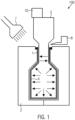
- Figure 1 shows a device 100 comprising a mold 2 in which the container 1 is to be at least partially formed.
- the mold 2 can be designed in two or more parts.
- the device 100 further comprises a coating device 5 and a pressure source 10, in particular a pump or a compressor and a separating device 8.
- the pressure source 10 can be designed such that a maximum overpressure of at least 50,000 Pa (0.5 bar), in particular at least 1,000,000 Pa (10 bar), can be generated.
- the drying device 7 can provide the heat in particular by means of hot air, steam, infrared radiation, microwave radiation, induction, heat transfer by a fluid or thermocouple.
- the separating device 8 can mechanically separate the coating bubble 4 from the coating device 5, as shown in Figure 1E.
- the separating device 8 can be designed with sharp edges and, in particular, can be pivoted or retracted to separate or cut off the coating bubble 4 from the coating device 5 after the coating bubble 4 has been introduced into the container 1 and pressurized.
- the separating device 8 can be designed in two parts, wherein two mechanical separating elements, in particular with sharp edges, can move towards each other in order to separate or cut off the coating bubble 4 from the coating device 5.
- the separating device 8 can also be designed as a thermal element.
- the coating bubble 4 can be locally heated such that the coating bubble 4 melts at the heated location and is separated from the coating unit 5.
- the separating device 8 can also separate the coating bubble 4 from the coating unit 5 by moving away the coating device 5 or the mold 2 or the container 1.
- the container 1 can be formed with the opening 3 upwards but also upside down or in another orientation in the mold 2.
- the coating bubble 4 can now be formed within the container 1 using the coating device 5 or introduced into the container 1 through the opening 3.
- the material for forming the coating bubble 4 can, for example, be present as a thin film/foil or as a liquid and consists in particular of a biodegradable material, such as Ecovio, PLA, PBAT, PHA, PHBH, cellulose-based polymers, starch-based polymers, protein-based polymers, lignin-based polymers, natural rubber or basic materials such as PEF, PE, HDPE, PVOH and EVOH.
- a biodegradable material such as Ecovio, PLA, PBAT, PHA, PHBH, cellulose-based polymers, starch-based polymers, protein-based polymers, lignin-based polymers, natural rubber or basic materials such as PEF, PE, HDPE, PVOH and EVOH.
- the coating bubble 4 is designed in particular so that it fits through the opening 3 in the pressureless state (no overpressure or overpressure greater than 50,000 Pa (0.5 bar) inside the coating bubble 4).
- the coating bubble 4 is now subjected to a pressure medium by means of a pressure source 10 to expand it, so that the coating bubble at least partially adheres to the inner wall of the container.
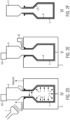
- the overpressure within the coating bubble 4 is in Figure 2C with arrows pointing towards the inner wall of the container 1, and is in particular at least 50,000 Pa (0.5 bar), in particular at least 1,000,000 Pa (10 bar), so that the coating bubble 4 presses the container 1 against the mold 2 or can compress its wall thickness. In this way, the inner surface of the container 1 can be smoothed.
- the coating bubble 4 can also compress the wall thickness of the container 1 in such a way that the liquid is pressed out of the material of the container 1, in particular pulp-containing material. In this way, the residual moisture content of the container 1 can be reduced to below 20%, in particular below 10%, so that further drying of the container 1 is not necessary.
- a gas such as air or a liquid such as water or the product to be filled into the container 1 can be used as the pressure medium. If the product to be filled into the container 1 is already used as the pressure medium, used, the additional filling process is eliminated and the production of the containers and subsequent packaging of the product can be carried out more efficiently.
- the coating bubble 4 can be designed such that, in the event of an overpressure transmitted from the pressure source 10 to the coating bubble 4 by the pressure medium, it initially rests against the inner wall of the container 1 in a lower region 6 of the container 1 before the coating bubble 4 also rests against the inner wall of the container 1 in the region of the opening 3. This can prevent inclusions, in particular of the air previously present in the container 1, from forming within the wall thickness of the container 1.
- the coating bubble 4 can be pressurized in such a way that the wall thickness of the coating bubble is less than 20% of the wall thickness of the corresponding section of the container 1 to which the coating bubble 4 is applied.
- the elevated temperature allows the container 1 to be dried, in particular to a residual moisture content of less than 20%, especially 1-10%.
- the drying process can increase the stability and dimensional accuracy of the container 1. Since the coating bubble 4 is pressurized during the optional drying process, shrinkage of the container 1 during the drying process is counteracted. This ensures that the container is manufactured with precise dimensions.
- the at least partially increased temperature in particular between 100°C and 200°C, can cause the coating bubble 4 to stick to the inner wall of the container 1, so that the coated container 4 is more stable and resistant.
- the coating bubble 4 only adheres to the inner wall of the container 1, preventing the coating bubble 4 from sticking to the container 1. This method is particularly useful when one of the materials of the coating bubble 4 or the container 1 is not biodegradable, and the two layers can be separated during recycling.
- heat sources can be used, such as hot air or steam, infrared, microwave radiation, induction, a heat transfer fluid, or a thermocouple.
- Figure 2D an infrared lamp for increasing the temperature of at least one area of the container or coating bubble.
- process step V Figure 2E
- the coating bubble 4 which has at least partially adhered to the inner wall of the container 1, is now separated from the coating device 5 or the pressure source 10 by the separating device 8, so that the coating bubble 4 remains as a coating in the container 1.
- the additional coating can have a thickness of a maximum of 1.0 mm, in particular a maximum of 0.000001 mm.
- the additional coating can be applied as an additional coating bubble 12 to the coating bubble 4, for example using an additional coating device 11, so that the additional coating faces the inside of the container.
- the additional coating bubble 12 can alternatively also be applied by the coating device 5, with which in particular the coating bubble 4 can also be introduced into the container 1 and subjected to pressure.
- the additional coating bubble 12 can be separated from the additional coating device 5 or alternatively the coating device 5 by the separating device 8 or an additional separating device (not shown) mechanically, thermally or by moving away the additional coating device 5 or alternatively the coating device 5.
- the temperature of the container 1 and the additional coating, which is introduced into the container 1, for example, in the form of an additional coating bubble 12, is increased by the drying device 7. This can facilitate the processing of the additional coating.
- the additional coating is, for example, sprayed on or applied in another way, so that the additional coating is directed towards the inside of the container 1.
- the additional coating can in particular consist of a material that minimizes the gas permeability of the coated container 1, in particular SiOx, and in particular can be formed with a thickness between 0.000015 mm and 0.00002 mm.
- the additional coating can also be applied using plasma coating.
- a treatment device (not shown) can introduce a gas into the interior of the container 1.
- a gas suitable for the plasma process can be introduced into the container 1 and distributed as homogeneously as possible inside the container.
- the gas introduced into the interior of the container 1 can be ignited so that a plasma is created.
- an electrode can be introduced into the container 1.
- the energy that is intended to ignite the plasma can then be introduced in the form of high frequency via this electrode.
- PECVD plasma enhanced chemical vapor deposition
- other gases are also conceivable, for example acetylene for the deposition of so-called DLC layers.
- FIG 2F shows an implementation of process step VI in which the container 1 has already been removed from the mold 2.
- process step VI can also be carried out while the container 1 is still in the mold 2.
- the container 1 it is also possible for the container 1 to be transferred to a second mold (not shown), in particular with a smoother surface than the first mold 2, by means of the coating bubble 4 with only a slight internal pressure below 10,000 Pa (10 bar) or by means of another device (not shown), in which the container 1 can be formed and/or dried.
- the second mold can in particular be preheated or heated continuously, whereby the energy-intensive heating of the mold 2 for drying the container 1 and processing the coating bubble 4 can be dispensed with.
- the mold 2 can be porous and have vacuum channels. This allows the mold 2 to be subjected to vacuum (as in Figures 2A to 2D shown), which allows the free water/vapor released during the forming and/or drying process to be extracted.
Landscapes
- Engineering & Computer Science (AREA)
- Manufacturing & Machinery (AREA)
- Mechanical Engineering (AREA)
- Containers Having Bodies Formed In One Piece (AREA)
- Details Of Rigid Or Semi-Rigid Containers (AREA)
- Paper (AREA)
Applications Claiming Priority (1)
| Application Number | Priority Date | Filing Date | Title |
|---|---|---|---|
| DE102023131286.3A DE102023131286A1 (de) | 2023-11-10 | 2023-11-10 | Verfahren und Vorrichtung zum Formen und Beschichten eines Fasern umfassenden Behälters |
Publications (2)
| Publication Number | Publication Date |
|---|---|
| EP4553225A2 true EP4553225A2 (fr) | 2025-05-14 |
| EP4553225A3 EP4553225A3 (fr) | 2025-07-16 |
Family
ID=91670317
Family Applications (1)
| Application Number | Title | Priority Date | Filing Date |
|---|---|---|---|
| EP24184154.3A Pending EP4553225A3 (fr) | 2023-11-10 | 2024-06-25 | Procédé et dispositif pour former et revêtir un récipient contenant des fibres |
Country Status (4)
| Country | Link |
|---|---|
| US (1) | US20250153417A1 (fr) |
| EP (1) | EP4553225A3 (fr) |
| CN (1) | CN119980774A (fr) |
| DE (1) | DE102023131286A1 (fr) |
Family Cites Families (6)
| Publication number | Priority date | Publication date | Assignee | Title |
|---|---|---|---|---|
| EP0786414A1 (fr) * | 1996-01-29 | 1997-07-30 | Toppan Printing Co., Ltd. | Récipient composite |
| CN1105806C (zh) | 1998-02-23 | 2003-04-16 | 花王株式会社 | 纸浆模制品的制造方法 |
| US9452863B2 (en) * | 2008-10-01 | 2016-09-27 | Greater Good, Inc. | Biodegradable container for liquid and/or semi-solid products |
| WO2013192260A1 (fr) | 2012-06-19 | 2013-12-27 | Pepsico, Inc. | Procédé de fabrication de bouteilles en fibres moulées |
| EP2808152A1 (fr) * | 2013-06-02 | 2014-12-03 | Emery Silfurtun Inc | Procédé et système de production de récipient jetable à partir de pâte à papier contenant des fibres |
| CH716689A1 (de) | 2019-10-10 | 2021-04-15 | Paper Bottle Company As | Faserbasierter Behälter und Verfahren zur Herstellung. |
-
2023
- 2023-11-10 DE DE102023131286.3A patent/DE102023131286A1/de active Pending
-
2024
- 2024-06-25 EP EP24184154.3A patent/EP4553225A3/fr active Pending
- 2024-10-25 CN CN202411500521.3A patent/CN119980774A/zh active Pending
- 2024-11-06 US US18/938,936 patent/US20250153417A1/en active Pending
Also Published As
| Publication number | Publication date |
|---|---|
| EP4553225A3 (fr) | 2025-07-16 |
| CN119980774A (zh) | 2025-05-13 |
| DE102023131286A1 (de) | 2025-05-15 |
| US20250153417A1 (en) | 2025-05-15 |
Similar Documents
| Publication | Publication Date | Title |
|---|---|---|
| DE102007046734B4 (de) | Verfahren und Formwerkzeug zur Herstellung eines faserverstärkten Kunststoffbauteils | |
| DE69935784T2 (de) | Verfahren zur herstellung eines geformten faserprodukts | |
| DE69700088T2 (de) | Behälter mit einem dekorativen Etikett und Verfahren zu dessen Herstellung | |
| DE2932375C2 (de) | Verfahren zum Herstellen eines Verpackungsbehälters | |
| WO2013192260A1 (fr) | Procédé de fabrication de bouteilles en fibres moulées | |
| EP2227377A1 (fr) | Dispositif et procédé pour produire des éléments composites renforcés par fibres | |
| EP2436512B1 (fr) | Procédé de création d'une structure sous vide pour la fabrication d'un composant composite en fibres ainsi que tampon associé | |
| CN107075815A (zh) | 用于制造纤维模制件的方法和装置 | |
| DE102008017381A1 (de) | Verfahren und Hilfsmittel zur Herstellung von Bauteilen aus Faserverbundwerkstoff | |
| EP4490057B1 (fr) | Procédé et dispositif pour fabrication d'un corps creux biodégradable avec un élément de raccordement | |
| DE102023131286A1 (de) | Verfahren und Vorrichtung zum Formen und Beschichten eines Fasern umfassenden Behälters | |
| DE69906095T3 (de) | Verfahren zum herstellen geschlossener strukturen aus verbundwerkstoff und formgerät zur benutzung in diesem verfahren | |
| DE102012112021A1 (de) | Verfahren zur Herstellung einer endlosfaserverstärkten Hohlkörperstruktur, sowie hiermit hergestellte endlosfaserverstärkte Hohlkörperstruktur | |
| EP4688417A1 (fr) | Produit composé de matériau biodégradable et processus de production de produits composés de matériau biodégradable | |
| DE102024121569A1 (de) | Verfahren zur herstellung eines auftrennbaren verpackungsbehältnisses und auftrennbares verpackungsbehältnis | |
| DE102004047552B4 (de) | Herstellung von Aerogel-Verbundwerkstoffen | |
| DE102024122661A1 (de) | Herstellung eines Behälters aus faserbasiertem Material | |
| WO2025185868A1 (fr) | Production d'un récipient à partir d'un matériau durable au moyen d'un procédé de pressage et de compression | |
| DE102024106110A1 (de) | Alternative Herstellung eines Behälters aus nachhaltigem Material | |
| DE102019104369B3 (de) | Verfahren und Vorrichtung zur Herstellung eines Formteils aus einem Faserwerkstoff | |
| DE102023107755A1 (de) | Verfahren zur herstellung eines erzeugnisses aus biologisch abbaubarem material | |
| DE102023107757A1 (de) | Verfahren zur herstellung eines erzeugnisses aus biologisch abbaubarem material | |
| AT511885B1 (de) | Verfahren zur herstellung eines bauteils aus einem vorimprägnierten verbundmaterial, derart hergestelltes bauteil und legeform | |
| DE3818943C2 (de) | Verfahren zur Herstellung von duroplastischen, chemisch beständigen Apparaten, Behältern, Rohren und dgl. | |
| DE102023101651A1 (de) | Verfahren zur Herstellung eines Verpackungselements |
Legal Events
| Date | Code | Title | Description |
|---|---|---|---|
| PUAI | Public reference made under article 153(3) epc to a published international application that has entered the european phase |
Free format text: ORIGINAL CODE: 0009012 |
|
| STAA | Information on the status of an ep patent application or granted ep patent |
Free format text: STATUS: THE APPLICATION HAS BEEN PUBLISHED |
|
| AK | Designated contracting states |
Kind code of ref document: A2 Designated state(s): AL AT BE BG CH CY CZ DE DK EE ES FI FR GB GR HR HU IE IS IT LI LT LU LV MC ME MK MT NL NO PL PT RO RS SE SI SK SM TR |
|
| PUAL | Search report despatched |
Free format text: ORIGINAL CODE: 0009013 |
|
| AK | Designated contracting states |
Kind code of ref document: A3 Designated state(s): AL AT BE BG CH CY CZ DE DK EE ES FI FR GB GR HR HU IE IS IT LI LT LU LV MC ME MK MT NL NO PL PT RO RS SE SI SK SM TR |
|
| RIC1 | Information provided on ipc code assigned before grant |
Ipc: D21J 3/10 20060101AFI20250612BHEP |
|
| STAA | Information on the status of an ep patent application or granted ep patent |
Free format text: STATUS: REQUEST FOR EXAMINATION WAS MADE |
|
| 17P | Request for examination filed |
Effective date: 20260112 |