EP4553366A1 - Sécurisation d'une machine - Google Patents
Sécurisation d'une machine Download PDFInfo
- Publication number
- EP4553366A1 EP4553366A1 EP23208452.5A EP23208452A EP4553366A1 EP 4553366 A1 EP4553366 A1 EP 4553366A1 EP 23208452 A EP23208452 A EP 23208452A EP 4553366 A1 EP4553366 A1 EP 4553366A1
- Authority
- EP
- European Patent Office
- Prior art keywords
- machine
- dangerous situation
- training
- sensor data
- sensor
- Prior art date
- Legal status (The legal status is an assumption and is not a legal conclusion. Google has not performed a legal analysis and makes no representation as to the accuracy of the status listed.)
- Granted
Links
Images
Classifications
-
- F—MECHANICAL ENGINEERING; LIGHTING; HEATING; WEAPONS; BLASTING
- F16—ENGINEERING ELEMENTS AND UNITS; GENERAL MEASURES FOR PRODUCING AND MAINTAINING EFFECTIVE FUNCTIONING OF MACHINES OR INSTALLATIONS; THERMAL INSULATION IN GENERAL
- F16P—SAFETY DEVICES IN GENERAL; SAFETY DEVICES FOR PRESSES
- F16P3/00—Safety devices acting in conjunction with the control or operation of a machine; Control arrangements requiring the simultaneous use of two or more parts of the body
- F16P3/12—Safety devices acting in conjunction with the control or operation of a machine; Control arrangements requiring the simultaneous use of two or more parts of the body with means, e.g. feelers, which in case of the presence of a body part of a person in or near the danger zone influence the control or operation of the machine
- F16P3/14—Safety devices acting in conjunction with the control or operation of a machine; Control arrangements requiring the simultaneous use of two or more parts of the body with means, e.g. feelers, which in case of the presence of a body part of a person in or near the danger zone influence the control or operation of the machine the means being photocells or other devices sensitive without mechanical contact
- F16P3/142—Safety devices acting in conjunction with the control or operation of a machine; Control arrangements requiring the simultaneous use of two or more parts of the body with means, e.g. feelers, which in case of the presence of a body part of a person in or near the danger zone influence the control or operation of the machine the means being photocells or other devices sensitive without mechanical contact using image capturing devices
-
- G—PHYSICS
- G05—CONTROLLING; REGULATING
- G05B—CONTROL OR REGULATING SYSTEMS IN GENERAL; FUNCTIONAL ELEMENTS OF SUCH SYSTEMS; MONITORING OR TESTING ARRANGEMENTS FOR SUCH SYSTEMS OR ELEMENTS
- G05B19/00—Program-control systems
- G05B19/02—Program-control systems electric
- G05B19/04—Program control other than numerical control, i.e. in sequence controllers or logic controllers
- G05B19/048—Monitoring; Safety
-
- G—PHYSICS
- G06—COMPUTING OR CALCULATING; COUNTING
- G06V—IMAGE OR VIDEO RECOGNITION OR UNDERSTANDING
- G06V10/00—Arrangements for image or video recognition or understanding
- G06V10/70—Arrangements for image or video recognition or understanding using pattern recognition or machine learning
- G06V10/764—Arrangements for image or video recognition or understanding using pattern recognition or machine learning using classification, e.g. of video objects
-
- G—PHYSICS
- G06—COMPUTING OR CALCULATING; COUNTING
- G06V—IMAGE OR VIDEO RECOGNITION OR UNDERSTANDING
- G06V10/00—Arrangements for image or video recognition or understanding
- G06V10/70—Arrangements for image or video recognition or understanding using pattern recognition or machine learning
- G06V10/77—Processing image or video features in feature spaces; using data integration or data reduction, e.g. principal component analysis [PCA] or independent component analysis [ICA] or self-organising maps [SOM]; Blind source separation
- G06V10/774—Generating sets of training patterns; Bootstrap methods, e.g. bagging or boosting
-
- G—PHYSICS
- G06—COMPUTING OR CALCULATING; COUNTING
- G06V—IMAGE OR VIDEO RECOGNITION OR UNDERSTANDING
- G06V10/00—Arrangements for image or video recognition or understanding
- G06V10/70—Arrangements for image or video recognition or understanding using pattern recognition or machine learning
- G06V10/82—Arrangements for image or video recognition or understanding using pattern recognition or machine learning using neural networks
Definitions
- the invention relates to a method for securing a machine according to the preamble of claim 1 and a corresponding securing system.
- the goal of safety is to protect people from sources of danger, such as those posed by machines in industrial environments.
- the machine is monitored using sensors, and if a situation arises in which a person is at risk of getting dangerously close to the machine, appropriate safety measures are taken.
- Safety becomes particularly challenging in cases of cooperation between humans and machines or robots.
- optoelectronic sensors such as light grids or laser scanners are primarily used for safety monitoring. More recently, cameras and even 3D cameras have been added.
- a common protection concept involves configuring protective fields that operating personnel are prohibited from entering during machine operation. If the sensor detects an impermissible intrusion into the protective field, such as an operator's leg, it triggers a safety-related stop of the machine. Other intrusions into the protective field, such as static machine parts, can be taught in advance as permissible. Warning fields are often located upstream of the protective fields, where intrusions initially only lead to a warning in order to prevent the intrusion into the protective field and thus the protection in time, thus increasing the availability of the system.
- Alternatives to protective fields are also known, such as ensuring that a minimum distance is maintained between the machine and the person, depending on the relative movement ("speed and separation").
- Sensors used in safety technology must operate with exceptional reliability and therefore meet stringent safety requirements, such as the EN13849 standard for machinery safety and the IEC61496 or EN61496 device standard for electro-sensitive protective equipment (ESPE).
- EEE electro-sensitive protective equipment
- a number of measures must be taken, such as reliable electronic evaluation through redundant, diverse electronics, functional monitoring or, specifically, monitoring of contamination of optical components, particularly a front screen, and/or the provision of individual test targets with defined reflectances that must be detected at the corresponding scanning angles. Measures tailored to the specific sensor thus ensure that the sensor data is of sufficient quality to solve the detection task or, if not, detect any errors that prevent this.
- the EP 3 651 458 A1 reveals a secure stereo camera that checks the functionality of its image sensors. To do so, it uses a reference depth map and statistically evaluates the differences between the current depth map and the reference depth map. This only works in a static environment.
- the occurrence of unusable input data can be understood as anomaly detection, as is the case, for example, in the work Chalapathy, Raghavendra, and Sanjay Chawla “Deep learning for anomaly detection: A survey”, arXiv preprint arXiv:1901.03407 (2019 ) and Chalapathy, Raghavendra, Edward Toth and Sanjay Chawla, “Group anomaly detection using deep generative models,” Machine Learning and Knowledge Discovery in Databases: European Conference, ECML PKDD 2018, Dublin, Ireland, September 10-14, 2018 , Proceedings, Part I 18, Springer International Publishing, 2019 , is being investigated.
- a fundamental problem here is that there is usually a lack of sufficient training examples of the anomaly.
- the machine is monitored by a sensor.
- Machine and sensor are mentioned only representatively in the singular; any number of complex safety applications with a multitude of sensors and/or machines are conceivable.
- the method is a computer-implemented method that runs, for example, in a processing unit of the sensor and/or a connected processing unit.
- the sensor preferably operates contactlessly and is, in particular, an optoelectronic sensor.
- the sensor and/or the hardware for evaluations are preferably designed to be safe.
- safe and safety mean that measures have been taken to control errors up to a specified safety level or to comply with the provisions of a relevant safety standard for machine safety or non-contact protective devices, some of which are mentioned in the introduction. "Not safe” is the opposite of “safe”; for non-safe devices, transmission paths, evaluations, and the like, the specified fail-safety requirements are therefore not met.
- the detection capability is also tested, i.e., whether an assessment of a dangerous situation is currently even possible. Otherwise, the machine is protected for this reason, analogous to the case of a detected dangerous situation and with the same possible safeguarding measures.
- the decisive factor is that the safeguarding must react quickly enough, especially within the response time specified by the safety application. Conventional measures for this were discussed in the introduction and are also conceivable according to the invention, but are insufficient in themselves, for example, a sensor failure, a lack of permeability of optical components, an image sensor test, and the like.
- the invention is based on the basic idea that detection capability is tested using sensor data and a machine learning method.
- Machine learning refers to a data-driven approach in which evaluation strategies are not developed manually, but rather learned from examples.
- the result of the evaluation of the sensor data by the machine learning method is a quality score. This must meet a requirement that corresponds to a sufficient quality of the sensor data to allow the evaluation of the sensor data with regard to a dangerous situation.
- the invention has the advantage that it can be reliably determined whether the sensor is functional and whether its detection range, i.e. the scenery in the vicinity of the machine, allows a risk assessment based on the sensor data.
- the security can be trusted, especially when a machine learning process is involved in the evaluation of the sensor data for the actual risk assessment.
- Human visual perception can be used as an analogy: In the dark, in heavy rain, or without glasses, a person would act much more cautiously.
- the invention enables the security application to recognize that it is in a comparable exceptional situation. In contrast to some of the approaches mentioned in the introduction, the invention can also cope with dynamic scenarios.
- the balance as to when the detection capability should no longer be present can be adjusted very precisely. This is important because, although safety is a priority, an overly cautious assessment leads to considerable losses in availability and productivity due to objectively unnecessary security measures.
- the quality factor is preferably binary. It therefore directly distinguishes only between the two cases where an assessment of a dangerous situation is possible and not possible. Following the detection capability test of the machine learning process, no further evaluation is required; the binary decision or classification has already been made. It should be reiterated that a negative result of the detection capability test does not necessarily lead to immediate safeguarding. For example, with a camera as a sensor, the safeguarding decision can always only be made after evaluating n images or frames, in which case insufficient quality in a single image or in a few images may still be tolerable.
- the quality factor preferably quantitatively evaluates at least one interference characteristic of the sensor data.
- a quality factor is, for example, a number within a certain value range such as [0, 1, ..., 10] or a percentage. It evaluates a specific interference characteristic or corruption modality of the sensor data, and from this, by comparison with predefined criteria, it can be easily deduced whether the quality of the sensor data is sufficient for assessing the dangerous situation.
- the respective components can evaluate different interference characteristics.
- a quality factor that is both binary and quantitatively differentiating is therefore not a contradiction but possible and then refers to different components.
- the quantitative components then enable, for example, a consistency check. the binary component or an analysis of how this evaluation was arrived at. The latter is particularly interesting in the context of "explainable AI.”
- the machine learning method preferably includes a classifier.
- the assignment of a quality score can be considered a classification, both in the case of a binary quality score and a more differentiated, quantitatively evaluative quality score.
- There are numerous machine learning methods for classification tasks such as decision trees, support vector machines, K-nearest neighbors, or Bayesian classifiers. It is conceivable to use multiple classifiers or general machine learning methods, each responsible for one or more noise characteristics, in a partitioning or (partially) overlapping manner. In this way, a machine learning method can be optimized specifically for certain noise characteristics.
- the machine learning method preferably uses a neural network.
- a neural network especially a deep neural network (deep learning) or convolutional neural network (CNN), is ideal for evaluating or specifically classifying even complex sensor data such as images or 3D point clouds.
- deep neural network deep learning
- CNN convolutional neural network
- the sensor is preferably a camera or a 3D sensor. These sensors provide a wealth of information about the machine's surroundings and can therefore solve a wide range of safety applications.
- the sensor data is, accordingly, images or image data in the case of a conventional camera, or 3D point clouds or depth maps in the case of a 3D sensor, such as a 3D camera, a LiDAR, a laser scanner, or a radar.
- the evaluation of the sensor data preferably includes an object detector, which particularly detects foreign objects in the machine's environment.
- a camera or a 3D sensor is preferably used for this purpose.
- a foreign object is defined as an object in the machine's environment that is unknown or not expected.
- each detected object is considered a foreign object, previously known objects are taught as a reference, or expected objects are dynamically recognized as such and differentiated from foreign objects. Whether a detected object indicates a dangerous situation also depends on the safety application.
- Some possible criteria are the size, shape, position, speed or trajectory of the object.
- the machine learning method is preferably trained using supervised learning, in which a large number of training examples from sensor data with a known corresponding quality factor are used as training data.
- Supervised training means that the desired result—in this case, the quality factor corresponding to a set of sensor data from a training example—is specified externally. Training preferably takes place before the actual validation operation, but can also be refined or expanded during operation or during downtimes.
- the machine learning method uses the training examples to learn the association of a quality factor with sensor data and, after training, is able to transfer this to sensor data unknown from the training.
- the training examples are preferably modified with at least one perturbation property and at least one perturbation intensity to generate additional training examples.
- the initial training examples are thus deliberately perturbed or corrupted to obtain additional training examples.
- the perturbation can occur in various ways, i.e., with different perturbation properties or corruption modalities, and/or be of varying severity, as expressed by a perturbation intensity. If the machine learning method later determines a quantitatively evaluative quality score, this can correspond to the perturbation intensity, but different scales are also conceivable.
- the sensor data preferably comprises images, and at least one of the following interference characteristics is used: image too bright or too dark at least in some areas, image blurred at least in some areas, motion artifacts, static and/or dynamic image noise, image regions swapped, particularly due to address errors, image incomplete.
- image too bright or too dark at least in some areas image blurred at least in some areas
- motion artifacts static and/or dynamic image noise
- image regions swapped particularly due to address errors, image incomplete.
- a change in an interference characteristic could therefore consist of artificially brightening the image to varying degrees determined by the interference intensity, or in any combination for the other examples mentioned.
- interference in two dimensions is possible, which is determined on the one hand by the selection of the interference characteristic, particularly from a list as in the examples mentioned, and on the other hand by the extent of the interference or the interference intensity.
- the security application becomes more robust the better the interference characteristics.
- the training data is preferably evaluated, in particular with an object detector, to determine whether a dangerous situation is detected despite the interference.
- a quality score is assigned to a training example.
- the prerequisite for supervised learning is the specification of the desired result, which is referred to as labeling or annotation and is usually an extremely laborious and time-consuming manual process.
- the appropriate label i.e., the associated quality score
- annotation is performed automatically through evaluation, i.e., risk assessment based on the sensor data of the training example and, in particular, an object detector.
- the label for the original training example, which has not been altered or corrupted by interference is known.
- the evaluation for automatic annotation therefore determines, in particular, whether this label is still reproduced or whether the corruption was too severe.
- the training data is preferably evaluated using the same method that is also used to detect a dangerous situation in the machine's safety.
- Evaluation here refers to the automatic labeling or annotation of the preceding paragraph. In principle, this could be performed using any evaluation method or object detector. However, particular preference is given to using the evaluation method that is also used in actual operation. This ensures particularly good agreement in the evaluation of sensor data with regard to the question of whether the quality of the sensor data is sufficient for the risk assessment. It is conceivable to use multiple evaluation methods or object detectors, whose labels are then combined.
- the training data is preferably modified with increasing interference intensity and/or varying interference characteristics until an evaluation of the modified training data no longer detects a dangerous situation.
- assessing whether a dangerous situation can still be detected with a specific set of sensor data particular interest lies in the borderline cases where interference just barely permits or no longer permits this evaluation, particularly object detection. If these borderline cases are assessed correctly, this is even more true for simpler cases further from the limit. Therefore, this limit is advantageously tested using different interference characteristics and/or interference intensities, for example, in an iterative process that gradually tries out a wide variety of combinations of interference characteristics and increases their respective interference intensity or, as is implied by the term "increasing" here, systematically changes it in any other way.
- a quality score corresponding to a no longer existing detection capability is preferably assigned to training examples in which the evaluation still identified a dangerous situation. This intentionally maintains a distance from the limit explained in the previous paragraph, and as a precaution, only those sensor data that at least slightly exceed the criteria are considered sufficient by the detection capability test. For example, if an interference characteristic is quantified in the range 0..10 and the limit of no longer existing detection capability is found to be 7, then a much higher requirement of a maximum interference characteristic of 5 is intentionally set instead of testing accordingly at the limit of 7.
- the evaluation of the sensor data to detect a dangerous situation preferably also includes a machine learning method.
- a machine learning method is now used not only for the detection capability test, but also for the assessment of a dangerous situation.
- the same machine learning methods mentioned above can be used, in particular a neural network.
- the machine learning method of the detection capability test is also used in a dual function for the recognition of a dangerous situation and is trained accordingly beforehand.
- a function such as the detection capability test, is only subsequently trained. For example, there is an already trained neural network for object detection, and an additional output for the classification of the sensor data for the purposes of the detection capability test is added to it and this is subsequently trained.
- the safety system comprises at least one sensor for monitoring the machine and generating sensor data, and at least one control and evaluation unit.
- the control and evaluation unit refers to any computing unit that can be part of the sensor, the machine, standalone, or a combination thereof.
- a method according to the invention is implemented therein in one of the described embodiments.
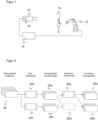
- Figure 1 shows an exemplary safety application in which a camera 10 monitors a robot 12.
- the camera 10 and the robot 12 are examples of a monitoring sensor and a machine to be monitored, respectively.
- the sensor data generated by the camera 10 is evaluated to detect whether a dangerous situation exists, in particular whether a person 14 is coming too close to the robot 12.
- a safety measure is initiated which slows down the robot 12, causes it to take evasive action, switches to a program with a different work area or a non-hazardous movement, or, if necessary, stops the robot 12 completely.
- the evaluation of the sensor data is preceded by a detection capability test, which determines whether the sensor data even allows the assessment of a dangerous situation. For reasons that may lie particularly in the camera 10 or in the scenery surrounding the robot 12, the quality of the sensor data is not always sufficient for this.
- the detection capability test uses a machine learning method and is later carried out along with its training with reference to the Figures 2 and 3 explained in more detail.
- the evaluations are carried out in a computing unit, which can be at least one internal computing unit 16 of the camera 10, at least one connected external computing unit 18, or a combination of both.
- Examples of an internal computing unit are digital computing components such as a microprocessor or a CPU (Central Processing Unit), an FPGA (Field Programmable Gate Array), a DSP (Digital Signal Processor), an ASIC (Application-Specific Integrated Circuit), a KPI (KPU), an NPU (Neural Processing Unit), a GPU (Graphics Processing Unit), a VPU (Video Processing Unit), or the like.
- An external computing unit can be a computer of any type, including notebooks, smartphones, tablets, a (security) controller, a local network, an edge device, or a cloud.
- a wide range of communication connections is also available, such as I/O link, Bluetooth, WLAN, Wi-Fi, 3G/4G/5G, and, in principle, any industrial standard.
- the invention is described with a camera 10 as an example of a monitoring sensor; accordingly, the sensor data are exemplary images.
- Other sensors are conceivable, in particular a 3D sensor that generates a 3D point cloud or depth map as sensor data.
- At least the detection capability test in a preferred development of the invention also in a dual function the evaluation of sensor data as to whether a dangerous situation exists, is based on a machine learning method.
- a neural network is used below to represent every known machine learning method, particularly for classification.
- an input image is fed to the detection capability test, and the neural network provides feedback, known as a quality score, indicating whether this input image can be used for another detection algorithm, namely, the assessment of whether a dangerous situation exists.
- This detection algorithm can, as already mentioned, be a classic image processing method or also a machine learning method.
- This can essentially be object detection, but can also include other, particularly more advanced, evaluations, such as object tracking, person detection, pose determination, facial recognition, or code reading.
- At least three scenarios can be distinguished: Firstly, there may be no person or other object considered to be at risk, and this is also correctly detected. The robot 12 can then work unhindered. Secondly, a person or other foreign object in a dangerous situation may have been correctly detected. The robot 12 must then be secured. Thirdly, the detection capability test may produce a negative result. In this case, it is no longer necessary to differentiate whether a dangerous situation is detected based on the images identified as being of inadequate quality, because this statement would not be reliable anyway. The robot must also be secured now, although different measures can be taken than in the case of a detected dangerous situation. A momentary lack of detection capability is a potential hazard and therefore less critical than a dangerous situation that has already been explicitly detected.
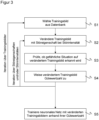
- Figure 2 illustrates the training of the detection capability test and shows a representation of the targeted perturbation of training data and the automatic annotation of whether the detection of a dangerous situation is still possible with the respective perturbed training data.
- the starting point is undisturbed training images 20, which are preferably obtained from real sensor data and are not further manipulated.
- the undisturbed training images 20 should include both those in which a dangerous situation is detected, in particular an object or a person in a situation that is not permitted for safety reasons, as well as those without a dangerous situation or without a foreign object.
- the background should preferably be that of the safety application or at least sufficiently similar to it.
- Such training examples are difficult to obtain and therefore are not available in sufficient numbers in practice. This applies especially to the various error cases and disturbances considered here.
- the undisturbed training images 20 are subjected to at least one perturbation algorithm 20a-n.
- the aim here is specifically to teach the machine learning method to evaluate such perturbations or changes during the detection capability test.
- a perturbation algorithm 22a-n manipulates the training image in at least one perturbation property or corruption modality at a definable perturbation intensity.
- the list of considered disturbance characteristics should be as complete as possible, i.e., it should reflect all relevant disturbances that could occur during operation. This is not always possible, but the generalization capability of a neural network helps to compensate for any gaps.
- the following list of disturbances can be given. This is not necessarily exhaustive, but is comprehensive enough for many security applications: The image is too bright or too dark, the image is blurred in at least some areas, the image contains motion artifacts or image noise, image regions are swapped, or the image is incomplete.
- perturbed or corrupted training images 24a-n are created in a well-defined manner. Since there are multiple perturbation algorithms 22a-22n, and each can perform its perturbation with varying levels of intensity, many more perturbed training images 24a-n can be obtained than the initially available undisturbed training images. Furthermore, the perturbed training images 24a-n specifically contain the features that are to be trained.
- At least one detection algorithm 26a-m This could be, for example, an object detector or another method for assessing whether a dangerous situation exists. Preferably, this is the method that will also be used later in operation to assess dangerous situations. This follows the heuristic that the criteria for assessing detection capability should then be the best fit. However, diversification in several directions is conceivable: During training and/or operation, several methods can be used, whereby they may or may not differ from one another between training and operation. This also supports the ability of the neural network trained in this way to generalize to unknown situations.
- the distorted training images 24a-n are now labeled or annotated. It is thus known whether each image is an example of an image that allows the assessment of a dangerous situation or whether the distortions are too strong for this.
- the distorted training images are sorted into two buckets for positive examples 28a and negative examples 28b.
- Figure 3 shows in addition to Figure 2 An exemplary flow diagram of the modification and annotation of training data and the resulting training of a neural network for a detection capability test.
- a first step S1 an undisturbed training image 20 is selected from the initially existing database of training examples, particularly from real data.
- the training image is perturbed or corrupted.
- the corresponding perturbation algorithms 22a-22n have already been described with reference to Figure 2
- the training image is modified with a noise feature or a combination of noise features, whereby most noise features do not binary complement a noise feature, but rather gradually change the training image with a noise intensity 22a-22n.
- the respective resulting distorted training image 24a-n is evaluated in a step S3 to determine whether a dangerous situation is detected therein.
- the evaluation that will also be used in operation is used for this purpose.
- the detection capability test is thus limited to a specific, namely the relevant, detection algorithm. 26a-m, where as Figure 2 mentioned several detection algorithms 26a-m can be used. It is also conceivable that the neural network for the detection capability test is pre-trained with general object detectors and then retrained application-specifically with the evaluation procedure intended for a specific safety application to assess a dangerous situation.
- step S4 it is determined whether a dangerous situation could be recognized. This can in itself be the result.
- the training image is assigned a quality value as a label, which indicates that the recognition of a dangerous situation was possible, or that it is a positive example 28a, and accordingly, an undetected dangerous situation would be a negative example 28b.
- a more robust alternative is one in which it is known for the original, undisturbed training images 20 whether this belongs to a dangerous situation or not. This must then be reproduced in step S4 for a positive example 28a; otherwise, it is a negative example 28b.
- positive example 28a and negative example 28b represent the inability to reproduce this initial knowledge.
- the classification does not have to be limited to binary positive examples 28a and negative examples 28b.
- Quantitative quality scores for the various noise characteristics can be trained and later output, either to understand the binary decision (explainable AI) or to enable a subsequent binary decision based on the quality scores.
- Steps S2-S4 can be iterated, with the perturbations being increased from step to step, either by adding a perturbing property or by increasing the perturbation intensity. This allows the limiting case to be determined as to how much perturbation the subsequent evaluation can tolerate, and thus also generates a sufficient number of training examples for images that do not meet detection capability.
- a further, outer iteration of steps S1 to S4 works through several or all of the undisturbed training images 20 in the database.
- step S5 the resulting labeled training examples are used to train a neural network for the detection capability test. It may be useful to use multiple neural networks that specialize in specific noise characteristics. To do this, the training dataset is divided according to the noise characteristics that influenced its creation. For example, there are noise characteristics that relate to local properties, such as blurred edges, and others that have a global effect, such as the swapping of the two halves of the image. Different network architectures may be advantageous for these.
- the check during subsequent operation of the safety application to determine whether a dangerous situation exists can be performed using any evaluation method, such as object detection using conventional image processing, protective field evaluation, object tracking, and the like.
- any evaluation method such as object detection using conventional image processing, protective field evaluation, object tracking, and the like.
- the use of a neural network or other machine learning method is also conceivable at this point. Its training can even be based at least partially on the training data from the detection capability test.
- Some well-known neural networks, by no means exhaustive, that may be suitable for detection capability testing, particularly in conjunction with object detection, are Yolo (You only look once), MobileNet, ResNet, and PoseNet.
Landscapes
- Engineering & Computer Science (AREA)
- Theoretical Computer Science (AREA)
- Evolutionary Computation (AREA)
- General Physics & Mathematics (AREA)
- Physics & Mathematics (AREA)
- Computing Systems (AREA)
- Databases & Information Systems (AREA)
- General Health & Medical Sciences (AREA)
- Medical Informatics (AREA)
- Software Systems (AREA)
- Health & Medical Sciences (AREA)
- Computer Vision & Pattern Recognition (AREA)
- Artificial Intelligence (AREA)
- Multimedia (AREA)
- General Engineering & Computer Science (AREA)
- Automation & Control Theory (AREA)
- Mechanical Engineering (AREA)
- Image Analysis (AREA)
Priority Applications (2)
| Application Number | Priority Date | Filing Date | Title |
|---|---|---|---|
| EP23208452.5A EP4553366B1 (fr) | 2023-11-08 | 2023-11-08 | Sécurisation d'une machine |
| US18/941,176 US20250147479A1 (en) | 2023-11-08 | 2024-11-08 | Safeguarding a machine |
Applications Claiming Priority (1)
| Application Number | Priority Date | Filing Date | Title |
|---|---|---|---|
| EP23208452.5A EP4553366B1 (fr) | 2023-11-08 | 2023-11-08 | Sécurisation d'une machine |
Publications (2)
| Publication Number | Publication Date |
|---|---|
| EP4553366A1 true EP4553366A1 (fr) | 2025-05-14 |
| EP4553366B1 EP4553366B1 (fr) | 2025-10-08 |
Family
ID=88745923
Family Applications (1)
| Application Number | Title | Priority Date | Filing Date |
|---|---|---|---|
| EP23208452.5A Active EP4553366B1 (fr) | 2023-11-08 | 2023-11-08 | Sécurisation d'une machine |
Country Status (2)
| Country | Link |
|---|---|
| US (1) | US20250147479A1 (fr) |
| EP (1) | EP4553366B1 (fr) |
Citations (5)
| Publication number | Priority date | Publication date | Assignee | Title |
|---|---|---|---|---|
| DE102017105174A1 (de) | 2017-03-10 | 2018-09-13 | Sick Ag | Verfahren zum Erzeugen von Trainingsdaten für die Überwachung einer Gefahrenquelle |
| DE102018117274A1 (de) | 2018-07-17 | 2020-01-23 | Sick Ag | Sichere Kamera und Verfahren zur sicheren Aufnahme und Auswertung von Bilddaten |
| EP3651458A1 (fr) | 2018-11-08 | 2020-05-13 | Sick Ag | Caméra stéréo sécurisée et procédé de vérification de la capacité de fonctionnement des capteurs d'image |
| EP4047523A1 (fr) * | 2021-02-22 | 2022-08-24 | Leuze electronic GmbH + Co. KG | Dispositif de surveillance et procédé de fonctionnement d'un dispositif de surveillance |
| EP4170438A1 (fr) * | 2022-06-07 | 2023-04-26 | Pimu Llc | Système de commande de sécurité |
-
2023
- 2023-11-08 EP EP23208452.5A patent/EP4553366B1/fr active Active
-
2024
- 2024-11-08 US US18/941,176 patent/US20250147479A1/en active Pending
Patent Citations (5)
| Publication number | Priority date | Publication date | Assignee | Title |
|---|---|---|---|---|
| DE102017105174A1 (de) | 2017-03-10 | 2018-09-13 | Sick Ag | Verfahren zum Erzeugen von Trainingsdaten für die Überwachung einer Gefahrenquelle |
| DE102018117274A1 (de) | 2018-07-17 | 2020-01-23 | Sick Ag | Sichere Kamera und Verfahren zur sicheren Aufnahme und Auswertung von Bilddaten |
| EP3651458A1 (fr) | 2018-11-08 | 2020-05-13 | Sick Ag | Caméra stéréo sécurisée et procédé de vérification de la capacité de fonctionnement des capteurs d'image |
| EP4047523A1 (fr) * | 2021-02-22 | 2022-08-24 | Leuze electronic GmbH + Co. KG | Dispositif de surveillance et procédé de fonctionnement d'un dispositif de surveillance |
| EP4170438A1 (fr) * | 2022-06-07 | 2023-04-26 | Pimu Llc | Système de commande de sécurité |
Non-Patent Citations (5)
| Title |
|---|
| CHALAPATHYRAGHAVENDRAEDWARD TOTHSANJAY CHAWLA: "Machine Learning and Knowledge Discovery in Databases: European Conference, ECML PKDD 2018, Dublin, Ireland", 10 September 2018, SPRINGER, article "Group anomaly detection using deep generative models" |
| CHALAPATHYRAGHAVENDRASANJAY CHAWLA: "Deep learning for anomaly detection: A survey", ARXIV:1901.03407, 2019 |
| KALYANASUNDARAM, GIRISHPUNEET PANDEYMANJIT HOTA: "Computer Vision and Image Processing: 5th International Conference, CVIP 2020, Prayagraj, India", 4 December 2020, SPRINGER, article "A Pre-processing Assisted Neural Network for Dynamic Bad Pixel Detection in Bayer Images" |
| MARCO PAVONE: "Building Trust in Al for Autonomous Vehicles", NVIDIA GTC DEVELOPER CONFERENCE, 20 March 2023 (2023-03-20) |
| VON BEGONJEAN-MICHELPIERRE GEURTS: "Sample-free white-box out-of-distribution detection for deep learning", PROCEEDINGS OF THE IEEE/CVF CONFERENCE ON COMPUTER VISION AND PATTERN RECOGNITION, 2021 |
Also Published As
| Publication number | Publication date |
|---|---|
| EP4553366B1 (fr) | 2025-10-08 |
| US20250147479A1 (en) | 2025-05-08 |
Similar Documents
| Publication | Publication Date | Title |
|---|---|---|
| EP3701340B1 (fr) | Dispositif de surveillance, équipement industriel, procédé de surveillance et programme informatique | |
| EP3200122B1 (fr) | Capteur optoelectronique et procede de reconnaissance fiable d'objets de taille minimum | |
| DE102016120775A1 (de) | System und Verfahren zum Erkennen von Linien in einem Bild mit einem Sichtsystem | |
| DE102014105351A1 (de) | Detektion von menschen aus mehreren ansichten unter verwendung einer teilumfassenden suche | |
| DE102017105174B4 (de) | Verfahren zum Erzeugen von Trainingsdaten für die Überwachung einer Gefahrenquelle | |
| DE102020005507A1 (de) | Verfahren zum Testen einer automatisierten Fahrfunktion | |
| EP3968213B1 (fr) | Procédé et dispositif pour determiner le chemin d'un rail dans une voie ferrée | |
| DE102022205084B3 (de) | Verfahren, Computerprogramm und Vorrichtung zur Umfeldwahrnehmung im Fahrzeug sowie entsprechendes Fahrzeug | |
| EP4500488B1 (fr) | Système de surveillance doté d'un détecteur de personnes | |
| DE102020114488B3 (de) | Optoelektronischer Sicherheitssensor und Verfahren zur Absicherung einer Maschine | |
| EP2819109B1 (fr) | Capteur optoélectronique 3D et procédé de reconnaissance d'objets | |
| DE102019209463A1 (de) | Verfahren zur Bestimmung eines Vertrauenswertes eines Objektes einer Klasse | |
| DE102019115224A1 (de) | System und verfahren zum auffinden und klassifizieren von linien in einem bild mittels eines schichtsystems | |
| EP4553366B1 (fr) | Sécurisation d'une machine | |
| EP3588365A1 (fr) | Capteur optoélectronique et procédé d'évaluation sécurisée des données de mesure | |
| DE102017206396B4 (de) | Steuerverfahren, Steuereinheit, Umfelderfassungssystem und mobile und/oder stationäre Einrichtung | |
| EP2527868A1 (fr) | Capteur de sécurité optoélectronique mesurant l'éloignement pour la surveillance d'une zone de surveillance | |
| DE102021201255A1 (de) | Computerimplementiertes Verfahren und System zum Detektieren einer Sichteinschränkung eines bildgebenden Sensors und Trainingsverfahren | |
| Lee et al. | Image quality safety model for the safety of the intended functionality in highly automated agricultural machines | |
| DE102022209403B4 (de) | Verfahren zum Überprüfen der Durchführung einer Prädiktionsaufgabe durch ein neuronales Netzwerk | |
| DE102020203135A1 (de) | Verfahren zur Qualitätssicherung eines beispielbasierten Systems | |
| EP4098927B1 (fr) | Agencement de capteurs et son procédé de fonctionnement | |
| EP2818824B1 (fr) | Appareil comprenant un capteur optoélectronique 3D et procédé de réconaissance d'objets | |
| EP4730272A1 (fr) | Détection et classification d'objets pour la surveillance d'au moins une machine | |
| DE102020209078A1 (de) | Automatisierte Prozessüberwachung |
Legal Events
| Date | Code | Title | Description |
|---|---|---|---|
| PUAI | Public reference made under article 153(3) epc to a published international application that has entered the european phase |
Free format text: ORIGINAL CODE: 0009012 |
|
| STAA | Information on the status of an ep patent application or granted ep patent |
Free format text: STATUS: REQUEST FOR EXAMINATION WAS MADE |
|
| 17P | Request for examination filed |
Effective date: 20240516 |
|
| AK | Designated contracting states |
Kind code of ref document: A1 Designated state(s): AL AT BE BG CH CY CZ DE DK EE ES FI FR GB GR HR HU IE IS IT LI LT LU LV MC ME MK MT NL NO PL PT RO RS SE SI SK SM TR |
|
| GRAP | Despatch of communication of intention to grant a patent |
Free format text: ORIGINAL CODE: EPIDOSNIGR1 |
|
| STAA | Information on the status of an ep patent application or granted ep patent |
Free format text: STATUS: GRANT OF PATENT IS INTENDED |
|
| INTG | Intention to grant announced |
Effective date: 20250725 |
|
| GRAS | Grant fee paid |
Free format text: ORIGINAL CODE: EPIDOSNIGR3 |
|
| GRAA | (expected) grant |
Free format text: ORIGINAL CODE: 0009210 |
|
| STAA | Information on the status of an ep patent application or granted ep patent |
Free format text: STATUS: THE PATENT HAS BEEN GRANTED |
|
| AK | Designated contracting states |
Kind code of ref document: B1 Designated state(s): AL AT BE BG CH CY CZ DE DK EE ES FI FR GB GR HR HU IE IS IT LI LT LU LV MC ME MK MT NL NO PL PT RO RS SE SI SK SM TR |
|
| REG | Reference to a national code |
Ref country code: GB Ref legal event code: FG4D Free format text: NOT ENGLISH Ref country code: CH Ref legal event code: F10 Free format text: ST27 STATUS EVENT CODE: U-0-0-F10-F00 (AS PROVIDED BY THE NATIONAL OFFICE) Effective date: 20251008 |
|
| REG | Reference to a national code |
Ref country code: DE Ref legal event code: R096 Ref document number: 502023001946 Country of ref document: DE |
|
| REG | Reference to a national code |
Ref country code: IE Ref legal event code: FG4D Free format text: LANGUAGE OF EP DOCUMENT: GERMAN |
|
| PGFP | Annual fee paid to national office [announced via postgrant information from national office to epo] |
Ref country code: DE Payment date: 20251203 Year of fee payment: 3 |
|
| PGFP | Annual fee paid to national office [announced via postgrant information from national office to epo] |
Ref country code: AT Payment date: 20260113 Year of fee payment: 3 |
|
| PGFP | Annual fee paid to national office [announced via postgrant information from national office to epo] |
Ref country code: FR Payment date: 20251201 Year of fee payment: 3 |
|
| REG | Reference to a national code |
Ref country code: NL Ref legal event code: MP Effective date: 20251008 |
|
| PG25 | Lapsed in a contracting state [announced via postgrant information from national office to epo] |
Ref country code: NL Free format text: LAPSE BECAUSE OF FAILURE TO SUBMIT A TRANSLATION OF THE DESCRIPTION OR TO PAY THE FEE WITHIN THE PRESCRIBED TIME-LIMIT Effective date: 20251008 |
|
| PG25 | Lapsed in a contracting state [announced via postgrant information from national office to epo] |
Ref country code: ES Free format text: LAPSE BECAUSE OF FAILURE TO SUBMIT A TRANSLATION OF THE DESCRIPTION OR TO PAY THE FEE WITHIN THE PRESCRIBED TIME-LIMIT Effective date: 20251008 |
|
| REG | Reference to a national code |
Ref country code: LT Ref legal event code: MG9D |
|
| PG25 | Lapsed in a contracting state [announced via postgrant information from national office to epo] |
Ref country code: NO Free format text: LAPSE BECAUSE OF FAILURE TO SUBMIT A TRANSLATION OF THE DESCRIPTION OR TO PAY THE FEE WITHIN THE PRESCRIBED TIME-LIMIT Effective date: 20260108 |
|
| PG25 | Lapsed in a contracting state [announced via postgrant information from national office to epo] |
Ref country code: HR Free format text: LAPSE BECAUSE OF FAILURE TO SUBMIT A TRANSLATION OF THE DESCRIPTION OR TO PAY THE FEE WITHIN THE PRESCRIBED TIME-LIMIT Effective date: 20251008 Ref country code: FI Free format text: LAPSE BECAUSE OF FAILURE TO SUBMIT A TRANSLATION OF THE DESCRIPTION OR TO PAY THE FEE WITHIN THE PRESCRIBED TIME-LIMIT Effective date: 20251008 |
|
| PG25 | Lapsed in a contracting state [announced via postgrant information from national office to epo] |
Ref country code: RS Free format text: LAPSE BECAUSE OF FAILURE TO SUBMIT A TRANSLATION OF THE DESCRIPTION OR TO PAY THE FEE WITHIN THE PRESCRIBED TIME-LIMIT Effective date: 20260108 |
|
| PG25 | Lapsed in a contracting state [announced via postgrant information from national office to epo] |
Ref country code: IS Free format text: LAPSE BECAUSE OF FAILURE TO SUBMIT A TRANSLATION OF THE DESCRIPTION OR TO PAY THE FEE WITHIN THE PRESCRIBED TIME-LIMIT Effective date: 20260208 |
|
| PG25 | Lapsed in a contracting state [announced via postgrant information from national office to epo] |
Ref country code: PT Free format text: LAPSE BECAUSE OF FAILURE TO SUBMIT A TRANSLATION OF THE DESCRIPTION OR TO PAY THE FEE WITHIN THE PRESCRIBED TIME-LIMIT Effective date: 20260209 |
|
| PG25 | Lapsed in a contracting state [announced via postgrant information from national office to epo] |
Ref country code: PL Free format text: LAPSE BECAUSE OF FAILURE TO SUBMIT A TRANSLATION OF THE DESCRIPTION OR TO PAY THE FEE WITHIN THE PRESCRIBED TIME-LIMIT Effective date: 20251008 |
|
| PG25 | Lapsed in a contracting state [announced via postgrant information from national office to epo] |
Ref country code: LV Free format text: LAPSE BECAUSE OF FAILURE TO SUBMIT A TRANSLATION OF THE DESCRIPTION OR TO PAY THE FEE WITHIN THE PRESCRIBED TIME-LIMIT Effective date: 20251008 |