EP4553437A1 - Echangeur de chaleur - Google Patents
Echangeur de chaleur Download PDFInfo
- Publication number
- EP4553437A1 EP4553437A1 EP23208487.1A EP23208487A EP4553437A1 EP 4553437 A1 EP4553437 A1 EP 4553437A1 EP 23208487 A EP23208487 A EP 23208487A EP 4553437 A1 EP4553437 A1 EP 4553437A1
- Authority
- EP
- European Patent Office
- Prior art keywords
- pass
- fluid
- section
- heat exchanger
- conduit
- Prior art date
- Legal status (The legal status is an assumption and is not a legal conclusion. Google has not performed a legal analysis and makes no representation as to the accuracy of the status listed.)
- Pending
Links
Images




Classifications
-
- F—MECHANICAL ENGINEERING; LIGHTING; HEATING; WEAPONS; BLASTING
- F28—HEAT EXCHANGE IN GENERAL
- F28D—HEAT-EXCHANGE APPARATUS, NOT PROVIDED FOR IN ANOTHER SUBCLASS, IN WHICH THE HEAT-EXCHANGE MEDIA DO NOT COME INTO DIRECT CONTACT
- F28D9/00—Heat-exchange apparatus having stationary plate-like or laminated conduit assemblies for both heat-exchange media, the media being in contact with different sides of a conduit wall
- F28D9/0031—Heat-exchange apparatus having stationary plate-like or laminated conduit assemblies for both heat-exchange media, the media being in contact with different sides of a conduit wall the conduits for one heat-exchange medium being formed by paired plates touching each other
- F28D9/0043—Heat-exchange apparatus having stationary plate-like or laminated conduit assemblies for both heat-exchange media, the media being in contact with different sides of a conduit wall the conduits for one heat-exchange medium being formed by paired plates touching each other the plates having openings therein for circulation of at least one heat-exchange medium from one conduit to another
- F28D9/005—Heat-exchange apparatus having stationary plate-like or laminated conduit assemblies for both heat-exchange media, the media being in contact with different sides of a conduit wall the conduits for one heat-exchange medium being formed by paired plates touching each other the plates having openings therein for circulation of at least one heat-exchange medium from one conduit to another the plates having openings therein for both heat-exchange media
-
- F—MECHANICAL ENGINEERING; LIGHTING; HEATING; WEAPONS; BLASTING
- F28—HEAT EXCHANGE IN GENERAL
- F28D—HEAT-EXCHANGE APPARATUS, NOT PROVIDED FOR IN ANOTHER SUBCLASS, IN WHICH THE HEAT-EXCHANGE MEDIA DO NOT COME INTO DIRECT CONTACT
- F28D9/00—Heat-exchange apparatus having stationary plate-like or laminated conduit assemblies for both heat-exchange media, the media being in contact with different sides of a conduit wall
- F28D9/0093—Multi-circuit heat-exchangers, e.g. integrating different heat exchange sections in the same unit or heat-exchangers for more than two fluids
-
- F—MECHANICAL ENGINEERING; LIGHTING; HEATING; WEAPONS; BLASTING
- F28—HEAT EXCHANGE IN GENERAL
- F28F—DETAILS OF HEAT-EXCHANGE AND HEAT-TRANSFER APPARATUS, OF GENERAL APPLICATION
- F28F9/00—Casings; Header boxes; Auxiliary supports for elements; Auxiliary members within casings
- F28F9/02—Header boxes; End plates
- F28F9/0246—Arrangements for connecting header boxes with flow lines
Definitions
- the object of the present application is a heat exchanger, in particular a condenser or a gas cooler, for use inter alia in automobile air-conditioning systems.
- Known solutions referred to the subject of the application relate to plate heat exchangers.
- Such heat exchangers are formed by a suitably shaped thin plates forming the heat exchange surface.
- the plates are usually stamped or extruded to form a pattern of bulges and recesses on their surface.
- the plates are also provided with openings in appropriate positions, which, after sealing and forming a packet of plates, form inlet and outlet channels for the media participating in heat transfer. It is to be noted that such channels are further in the application referred to as channels substantially perpendicular to the general plane formed by the plates in which the openings are formed. In other words, channels formed by openings in plates are different from the channels, or rather flow pathways formed in-between the plates.
- the essence of the plate heat exchangers is that the flow pathways of media (such as fluids) are interleaved, i.e. the consecutive spaces between the plates are alternatively used for heat-emitting medium and heat-receiving medium.
- media such as fluids
- channel systems formed by the extrusions of adjacent plates cause the breakdown of the stream of each medium on many smaller streams and the introduction of the turbulence in the flow stream, resulting in better heat transfer between the media.
- Said plate heat exchangers can have various applications, among others, they can serve as evaporators, WCDS (water cooled condensers) and IHX (internal heat exchangers).
- the important matter is suitable flow control separately for each of these media, i.e. to reduce the flow speed, to introduce respective turbulences in a flow stream and its suitable dividing while maintaining low pressure drop of the flowing medium.
- the prior art heat exchangers suffer from the high entry speed of the fluid into the first pass, where the density of the fluid is the lowest.
- the first pass may not be filled uniformly by the refrigerant and therefore overall heat exchange between the refrigerant and the coolant may be negatively impacted.
- a heat exchanger for a heat exchange between a first fluid and at least second fluid comprising:
- the flow restrictor is arranged at the frontier of the first pass and the second pass so that it is part of the first pass only.
- the first pass further comprises an unrestricted zone and a restricted zone wherein the unrestricted zone is fluidly communicated with the second pass at least by the first conduit and the second conduit, and the restricted zone is fluidly communicated with the second pass only via the first conduit.
- the flow restrictor is fluidly connected with portion of the first pass being at least partially distanced from the second pass by the means of the restricted zone.
- the second conduit being associated with the restricted zone is fluidly insulated form the second pass.
- first conduit and a second conduit comprise a substantially circular cross- section, wherein the hydraulic diameter of the first conduit is equal to the hydraulic diameter of the second conduit.
- first conduit and a second conduit comprise a substantially circular cross- section, wherein the hydraulic diameter of the first conduit is greater than the hydraulic diameter of the second conduit.
- the core further comprises an egress pass called a third pass, wherein the egress pass remains in indirect fluidal communication with the middle pass so that the middle pass is configured to convey the first fluid, wherein the egress pass is configured to convey the second fluid, the second fluid being different from the first fluid.
- the first fluid in the middle pass flows in the opposite direction with respect to the second fluid flowing in the egress pass.
- said heat exchanger comprises a fourth section called coolant section, said coolant section being configured for circulation of a third fluid therein, wherein the coolant section extends across the entire heat exchanger, so that the fourth section may exchange the heat with all other sections.
- the coolant section is divided into several substantially U-shaped sections.
- the first and the second fluid is a refrigerant, whereas the third fluid is a coolant.
- the core is fluidly connected with the ingress block, wherein in terms of hydraulic diameter the ingress block is complementary to the first channel.
- the ingress pass and the middle pass are divided by a first baffle plate, the first baffle plate being configured to block the flow of the first fluid through the first channel and direct it in-between the plates of the core through the first pass towards the second channel.
- the egress pass and the middle pass are divided by a second baffle plate, the second baffle plate being configured to block the flow of the first fluid through the second channel and direct it in-between the plates of the core through the second pass towards the third channel, the second baffle plated being further configured to block the flow of the first fluid through a fifth channel and direct it in-between the plates of the core through the egress pass towards a sixth channel.
- the overall performance of the heat exchanger may not only be improved, but also controlled according to the design and needs. Needless to say this invention allows lowering the pressure drop inside the heat exchanger without increasing the external dimensions thereof.
- the invention concerns, among other a heat exchanger 1 for a motor vehicle.
- the invention concerns a plate-type heat exchanger 1, for example, a water cooled condenser (WCDS).
- the heat exchanger 1 may be configured for a heat exchange between a first fluid and at least second fluid.
- the heat exchange between the fluids may be carried out by the means of plurality of flat plates 10 stacked together to form a core 100 for circulation of the first fluid therein.
- the flat plates 10 are usually made from metallic material.
- the thickness of all the plates may be the same, wherein said thickness is measures in perpendicular with respect to the general plane of the flat plate 10. Alternatively, the thickness of two consecutive flat plates 10 may be different.
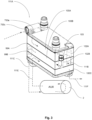
- Fig. 1 shows a perspective view of the heat exchanger showing refrigerant inlet with jumper line, coolant inlet and coolant outlet whereas Fig. 2 shows a bottom part of the heat exchanger shown in Fig. 1 , wherein another view on the jumper line with refrigerant inlet is present, as well as the refrigerant outlet and refrigerant connection to auxiliary device such as bottle.
- the flat plates 10 stacked together to form a core 100 comprise multiple components which in the picture may be blurry and it would be difficult to show other technical features. Thus, for the sake of clarity, the core 100 is simplified in the remaining figures.
- the core 100 may comprise a first section 100A called ingress pass.
- the ingress pass 100A or in general any "pass” or “section” may be regarded as the part of the core in which the fluid, for example the first fluid, flows in the same direction and in the same sense.
- the core 100 may comprise at least one second section 100B called middle pass.
- the core 100 may further comprise a third section 100C called egress pass.
- the middle pass 100B is fluidly connected directly to the ingress pass 100A, and the egress pass 100C, if present, may be fluidly connected indirectly to the middle pass 100B.
- the figures represent more complicated variant of the heat exchanger, i.e. one which comprises the egress pass 100C.
- the term "directly” means that the middle pass 100B is arranged subsequently to the ingress pass 100A and that they are fluidly connected by some means. In other words, in case of direct connection no other pass or component is located between ingress pass 100A and middle pass 100B.
- the egress pass 100C however is fluidly connected with the middle pass 100B indirectly, i.e. there is some other subcomponent on the path of the fluid.
- the middle pass 100B is connected directly with a third channel 111C.
- the third channel 111C runs through the egress pass 100C (without fluidal communication therewith) in order to enable direct fluidal communication between the heat exchanger 1 to an auxiliary device 2 (AUX device).
- the auxiliary device 2 may be regarded as the sub-component which is not at the first glance structurally integrated with the heat exchanger 1. This definition however, does not exclude functional connection between the heat exchanger 1 and the auxiliary device 2.
- the AUX device 2 may be for instance a receiver drier (bottle).
- the AUX device 2 may or may not change the properties of the first fluid flowing therein. For this reason the fluid entering the AUX device through the third channel 111C is the first fluid coming from, inter alia, mille pass 100B whereas the fluid exiting the AUX device may be regarded as the second fluid, due to aforementioned potential change in its properties.
- the egress pass 100C is not filled by the first fluid, but by the second fluid despite the fact the egress pass 100C, the AUX device 2 and the first and second passes 100A, 100B belong to the same loop.
- the ingress pass 100A and the egress pass 100C are named functionally, i.e. the ingress pass is the first pass to allow the fluid to circulate within the heat exchanger 1 whereas the egress pass 100C is the last pass that conveys the fluid within the core 100 of the heat exchanger 1.
- the middle pass 100B may thus comprise several sub-sections fluidly connected between each other so that the U-flow is provided between consecutive sub-sections of said middle passes 100B.
- the U-flow may be provided between the first section 100A and the second section 100B and the second section 100B and the third section 100C.
- the first section 100A comprises at least a first channel 111A adapted to distribute the first fluid in the first section 100A, a second channel 111B fluidly connecting the second section 100B and the first section 100A, and at least a third channel 111C fluidly connected at least to the second section 100B.
- the first channel 111A the second channel 111B and the third channel 111C may be regarded as first manifold 111A, second manifold 111B and a third manifold 111C, respectively.
- the second channel 111B may comprise a first conduit 102A and a second conduit 102B.
- the conduits 102A, 102B may extend substantially in the stacking direction of the plates 10.
- the term "conduit” refers to the hollow space provided in the flat plate which allows circulation of the first fluid between the first section 100A and the second section 100B.
- This hollow space may be of substantially circular cross-section.
- the hollow space may comprise a cross-section of any other shape.
- the first conduit 102A and a second conduit 102B comprise a substantially circular cross- section, wherein the hydraulic diameter of the first conduit 102A is equal to the hydraulic diameter of the second conduit 102B. This allows the first fluid to evenly fill the first channel 111B, so that the fluid is distributed in the first section 100A at the same flow rate through both conduits 102A 102B.
- the hydraulic diameter of the first conduit 102A may be greater than the hydraulic diameter of the second conduit 102B.
- the flow rate of the first fluid in the upper part of the first section 100A will be limited which may lead to pressure drop in the first section 100A and reduced performance.
- the term "upper” depends on particular orientation of the heat exchanger 1, namely that the first pass 100A is furthermost from the ground level, the egress pass 100C is the pass closest to the ground level, and the middle pass 100B is sandwiched between the first pass 100A and the third pass 100C.
- the third pass 100C is not present, the pass closes to the ground level is the middle pass 100B.
- Such description in view of the fixed orientation of the heat exchanger 1 is necessary to describe and understand that the prior art first pass 100A may not be able to be uniformly filled by the first fluid.
- the second conduit 102B may comprise a flow restrictor 105.
- the flow restrictor 105 may be configured to at least partially block the intended first fluid flow between the first section 100A and the second section 100B. This will allow to fill upper parts of the first pass without a pressure drop penalty.
- the flow restrictor 105 may be understood in functional context. In other words, any means of partially blocking of the intended first fluid flow between the first section 100A and the second section 100B are envisaged.
- the flow restrictor may be in form of plurality of collars protruding from each of the stacked plates 10, so that they form a cylinder having axis of elongation substantially parallel with respect to the stacking direction of the plates 10.
- Said cylinder is formed to at least partially block the intended first fluid flow between the first section 100A and the second section 100B, so it protrudes outwardly from the middle section 100A and through the first section 100A so that said cylinder allows the fluidal communication between the upper portion of the first section 100A and the middle section 100B.
- the flow restrictor 105 may be in form of passages for the fluid, wherein the first passage may be in a form of apertures forming the first conduit 101A and the second passage may be in a form of apertures forming the second conduit 101B, wherein apertures forming one conduit are of the bigger cross- section compared to the apertures forming the other conduit. This allows buid-up and gather the fluid so that it reaches the upper plates of the first pass 100A.
- the flow restrictor 105 may be in a form of a cylinder which is tight-fitted in the apertures in the plates 10 forming the first pass 100A.
- Said flow restrictor is thus arranged at the frontier of the first pass 100A and the second pass 100B so that it is part of the first pass 100A only.
- the flow restrictor 105 does not restrict the flow in the second pass 100B or any other pass.
- the first pass 100A further comprises an unrestricted zone 100Z and a restricted zone 100X.
- the terms unrestricted and restricted refer purely to the flow restrictor presence 105.
- the unrestricted zone 100Z is fluidly communicated with the second pass 100B at least by the first conduit 102A and the second conduit 102B, and the restricted zone 100X is fluidly communicated with the second pass 100B only via the first conduit 102A.
- the flow restrictor 105 is fluidly connected with portion of the first pass 100A being at least partially distanced from the second pass 100B by the means of the restricted zone 100X.
- the second conduit 102B being associated with the restricted zone 100X is fluidly insulated form the second pass 100B.
- Fig. 4 shows a standalone plate 10 with apertures which in combination with other plates 10 may form the channels 111A, 111B, 111C or conduits 102A, 102B, depending on the location of the plate 10 in the heat exchanger 1, or else, in which of the section 100A, 100B or 100C said aperture is located.
- the fluid may be directed through said section 100A partially.
- one of the conduits for example the first conduit 102A may extend through all the plates 10 forming the first section 100A, whereas the other conduit, for example the second conduit 102B may extend only through some of the plates 10 forming the first section 100A.
- the first conduit 102A may be longer than the second conduit 102B, wherein the length of said conduits 102A, 102B is measured in parallel with respect to the stacking direction of the plates 10.
- the egress pass 100C is not connected directly with the middle pass 100B so that the middle pass 100B is configured to convey the first fluid, wherein the egress pass 100C is configured to convey the second fluid, as explained in previous paragraphs.
- the second fluid may be different from the first fluid which means one fluid may be of different properties than the other. For instance, viscosity, pressure or phase of one fluid may different from the same parameter of other fluid.
- the egress pass 100C will be in fact the sub-cooling sections of the heat exchanger 1.
- the first fluid in the middle pass 100B flows in the opposite direction with respect to the second fluid flowing in the egress pass 1 00C. This allows the greater heat exchange between the fluids flowing in respective passes 100B, 100C.
- the first fluid in the middle pass 100B may flow in the same direction with respect to the second fluid flowing in the egress pass 100C.
- the heat exchanger 1 may comprise a loop for a coolant. Therefore, the heat exchanger 1 may further comprise a fourth section 100D called coolant section.
- the coolant section may be configured for circulation of the third fluid therein.
- the coolant section 100D extends across the entire heat exchanger 1, so that the fourth section 100D may exchange the heat with all other sections 100A, 100B, 100C.
- the fourth section 100D and the fluid path for the third fluid in general is fluidly insulated from the first, second and third sections 100A, 100B, 100C, accordingly.
- the fluidly insulated means that mixing of the third fluid, i.e. coolant, with any other fluid is not allowed.
- the coolant section may also be divided into one or several substantially U-shaped sections.
- I-flow of the coolant is also envisaged, although not shown in the figures.
- the number and location of U-shaped sections may determine the location and arrangement of the inlet and outlet spigots for the coolant.
- the spigots are required to connect the coolant flow path with the rest of the coolant loop in the vehicle. It is also envisaged that the coolant lines are directly brazed to the heat exchanger 1.
- the first and the second fluid is may be a refrigerant, such as classical refrigerants such as R134a, R1234yf.
- the third fluid may be a coolant or a water.
- the heat exchanger 1 may be connected to at least the refrigerant loop and the coolant loop. In order to facilitate the connection or to meet the customer's requirements, the heat exchanger 1 may comprise connection blocks.
- the core 100 may be fluidly connected with an ingress block 700.
- the ingress block 700 may be complementary to the first channel 111A. It means that the cavity in the ingress block 700 and the first channel 111A are configured to provide continuous channel for the first fluid.
- the ingress block 700 may comprise at least one ingress block opening 700a, and a third ingress block opening 700c.
- the first ingress block openings 700a may be associated with the first pass 100A. and the second conduit 102B, respectively, and the third ingress block opening 700c is configured to be fixed to a jumper line 750, as shown in figs 1 and 2 .
- the jumper line 750 may be fixed directly to the refrigerant loop or it may comprise an interface block 760 at the end opposite to the ingress block 700, as shown in figs 1 and 2 .
- the ingress pass 100A from the middle pass 100B, the ingress pass 100A and the middle pass 100B may be divided by a first baffle plate 99A.
- the first baffle plate 99A may be configured to block the flow of the first fluid through the first channel 111A and direct it in-between the plates 10 of the core 100 through the first pass 100A towards the second channel 111B.
- the baffle plates 99A may comprise less apertures than the plates 10 shown in Fig.4 .
- the egress pass 100C and the middle pass 100B may be divided by a second baffle plate 99B.
- the second baffle plate 99B may be configured to block the flow of the first fluid through the second channel 111B and direct it in-between the plates 10 of the core 100 through the second pass 100B towards the second channel 111B.
- the second baffle plated 99B may be further configured to block the flow of the first fluid through a fifth channel 111E and direct it in-between the plates 10 of the core 100 through the egress pass 100C towards a sixth channel 111F.
- the invention further discloses a motor vehicle comprising at least one heat exchanger 1 according to any of the preceding claims.
- motor vehicle should not be limiting and the heat exchanger may be applied on motor vehicles comprising internal combustion engine, hybrid vehicles, and electric vehicles.
- Fig. 5 shows an exemplary third fluid flow path.
- the coolant may flow from one spigot to the other, in so-called I-flow pattern. It should be noted that the most effective heat exchange is when the third fluid flows in opposite direction with respect to the first and/or the second fluid. Other flow patterns for the third fluid are also envisaged.
Landscapes
- Engineering & Computer Science (AREA)
- Physics & Mathematics (AREA)
- Thermal Sciences (AREA)
- Mechanical Engineering (AREA)
- General Engineering & Computer Science (AREA)
- Heat-Exchange Devices With Radiators And Conduit Assemblies (AREA)
Priority Applications (2)
| Application Number | Priority Date | Filing Date | Title |
|---|---|---|---|
| EP23208487.1A EP4553437A1 (fr) | 2023-11-08 | 2023-11-08 | Echangeur de chaleur |
| PCT/EP2024/081301 WO2025099043A1 (fr) | 2023-11-08 | 2024-11-06 | Échangeur de chaleur |
Applications Claiming Priority (1)
| Application Number | Priority Date | Filing Date | Title |
|---|---|---|---|
| EP23208487.1A EP4553437A1 (fr) | 2023-11-08 | 2023-11-08 | Echangeur de chaleur |
Publications (1)
| Publication Number | Publication Date |
|---|---|
| EP4553437A1 true EP4553437A1 (fr) | 2025-05-14 |
Family
ID=88745699
Family Applications (1)
| Application Number | Title | Priority Date | Filing Date |
|---|---|---|---|
| EP23208487.1A Pending EP4553437A1 (fr) | 2023-11-08 | 2023-11-08 | Echangeur de chaleur |
Country Status (2)
| Country | Link |
|---|---|
| EP (1) | EP4553437A1 (fr) |
| WO (1) | WO2025099043A1 (fr) |
Citations (4)
| Publication number | Priority date | Publication date | Assignee | Title |
|---|---|---|---|---|
| US20040011514A1 (en) * | 2000-05-19 | 2004-01-22 | Holm Karl Martin | Plate pack, flow distribution device and plate heat exchanger |
| EP2711657A1 (fr) * | 2012-09-21 | 2014-03-26 | Behr GmbH & Co. KG | Condensateur |
| US10088204B2 (en) * | 2013-05-16 | 2018-10-02 | Mahle International Gmbh | Condenser |
| EP4166887A1 (fr) * | 2021-10-12 | 2023-04-19 | Valeo Autosystemy SP. Z.O.O. | Échangeur de chaleur |
-
2023
- 2023-11-08 EP EP23208487.1A patent/EP4553437A1/fr active Pending
-
2024
- 2024-11-06 WO PCT/EP2024/081301 patent/WO2025099043A1/fr active Pending
Patent Citations (4)
| Publication number | Priority date | Publication date | Assignee | Title |
|---|---|---|---|---|
| US20040011514A1 (en) * | 2000-05-19 | 2004-01-22 | Holm Karl Martin | Plate pack, flow distribution device and plate heat exchanger |
| EP2711657A1 (fr) * | 2012-09-21 | 2014-03-26 | Behr GmbH & Co. KG | Condensateur |
| US10088204B2 (en) * | 2013-05-16 | 2018-10-02 | Mahle International Gmbh | Condenser |
| EP4166887A1 (fr) * | 2021-10-12 | 2023-04-19 | Valeo Autosystemy SP. Z.O.O. | Échangeur de chaleur |
Also Published As
| Publication number | Publication date |
|---|---|
| WO2025099043A1 (fr) | 2025-05-15 |
Similar Documents
| Publication | Publication Date | Title |
|---|---|---|
| US10612866B2 (en) | Micro-channel heat exchanger | |
| JP5486782B2 (ja) | エバポレータ | |
| US9366463B2 (en) | Evaporator | |
| EP2638349B1 (fr) | Échangeur de chaleur à plaques et circuit de climatisation pour véhicule | |
| US20170122669A1 (en) | Stacked heat exchanger | |
| US11162718B2 (en) | Stacked plate heat exchanger | |
| EP2865983B1 (fr) | Collecteur d'échangeur de chaleur et échangeur de chaleur le comportant | |
| JP2010505081A (ja) | マルチフロー型熱交換器 | |
| US20110220336A1 (en) | Heat exchanger | |
| US20020062953A1 (en) | Serpentine heat exchanger | |
| EP2927631B1 (fr) | Échangeur de chaleur, en particulier un condenseur | |
| US7500514B2 (en) | Coolant radiator for a motor vehicle | |
| EP2990749B1 (fr) | Échangeur de chaleur | |
| EP3872435B1 (fr) | Échangeur de chaleur | |
| JP4248931B2 (ja) | 熱交換器 | |
| KR19980064541A (ko) | 응축기(Condenser) 조립구조 | |
| JP6993862B2 (ja) | オイルクーラ | |
| EP4553437A1 (fr) | Echangeur de chaleur | |
| EP4553436A1 (fr) | Echangeur de chaleur | |
| US20170314875A1 (en) | Flat tube for a heat exchanger | |
| KR20230136254A (ko) | 쿨링 모듈 | |
| EP4464965A1 (fr) | Echangeur de chaleur | |
| EP4574475A1 (fr) | Echangeur de chaleur | |
| CN114008401A (zh) | 热交换器 | |
| JP2006038429A (ja) | 蒸発器 |
Legal Events
| Date | Code | Title | Description |
|---|---|---|---|
| PUAI | Public reference made under article 153(3) epc to a published international application that has entered the european phase |
Free format text: ORIGINAL CODE: 0009012 |
|
| STAA | Information on the status of an ep patent application or granted ep patent |
Free format text: STATUS: THE APPLICATION HAS BEEN PUBLISHED |
|
| AK | Designated contracting states |
Kind code of ref document: A1 Designated state(s): AL AT BE BG CH CY CZ DE DK EE ES FI FR GB GR HR HU IE IS IT LI LT LU LV MC ME MK MT NL NO PL PT RO RS SE SI SK SM TR |
|
| STAA | Information on the status of an ep patent application or granted ep patent |
Free format text: STATUS: REQUEST FOR EXAMINATION WAS MADE |
|
| 17P | Request for examination filed |
Effective date: 20251113 |
|
| RAP1 | Party data changed (applicant data changed or rights of an application transferred) |
Owner name: VALEO ELECTRIFICATION |