EP4553576A1 - Cadre de pellicule, pellicule et plaque originale d'exposition avec pellicule, procédé de production de cadre de pellicule, procédé d'exposition à la lumière, procédé de fabrication de dispositif à semi-conducteur, et procédé de fabrication de plaque d'affichage à cristaux liquides - Google Patents
Cadre de pellicule, pellicule et plaque originale d'exposition avec pellicule, procédé de production de cadre de pellicule, procédé d'exposition à la lumière, procédé de fabrication de dispositif à semi-conducteur, et procédé de fabrication de plaque d'affichage à cristaux liquides Download PDFInfo
- Publication number
- EP4553576A1 EP4553576A1 EP23835508.5A EP23835508A EP4553576A1 EP 4553576 A1 EP4553576 A1 EP 4553576A1 EP 23835508 A EP23835508 A EP 23835508A EP 4553576 A1 EP4553576 A1 EP 4553576A1
- Authority
- EP
- European Patent Office
- Prior art keywords
- pellicle
- pellicle frame
- polishing treatment
- frame
- ion
- Prior art date
- Legal status (The legal status is an assumption and is not a legal conclusion. Google has not performed a legal analysis and makes no representation as to the accuracy of the status listed.)
- Pending
Links
Images
Classifications
-
- C—CHEMISTRY; METALLURGY
- C25—ELECTROLYTIC OR ELECTROPHORETIC PROCESSES; APPARATUS THEREFOR
- C25F—PROCESSES FOR THE ELECTROLYTIC REMOVAL OF MATERIALS FROM OBJECTS; APPARATUS THEREFOR
- C25F3/00—Electrolytic etching or polishing
- C25F3/16—Polishing
-
- B—PERFORMING OPERATIONS; TRANSPORTING
- B24—GRINDING; POLISHING
- B24B—MACHINES, DEVICES, OR PROCESSES FOR GRINDING OR POLISHING; DRESSING OR CONDITIONING OF ABRADING SURFACES; FEEDING OF GRINDING, POLISHING, OR LAPPING AGENTS
- B24B1/00—Processes of grinding or polishing; Use of auxiliary equipment in connection with such processes
- B24B1/002—Processes of grinding or polishing; Use of auxiliary equipment in connection with such processes using electric current
-
- B—PERFORMING OPERATIONS; TRANSPORTING
- B24—GRINDING; POLISHING
- B24B—MACHINES, DEVICES, OR PROCESSES FOR GRINDING OR POLISHING; DRESSING OR CONDITIONING OF ABRADING SURFACES; FEEDING OF GRINDING, POLISHING, OR LAPPING AGENTS
- B24B31/00—Machines or devices designed for polishing or abrading surfaces on work by means of tumbling apparatus or other apparatus in which the work and/or the abrasive material is loose; Accessories therefor
- B24B31/02—Machines or devices designed for polishing or abrading surfaces on work by means of tumbling apparatus or other apparatus in which the work and/or the abrasive material is loose; Accessories therefor involving rotary barrels
-
- C—CHEMISTRY; METALLURGY
- C23—COATING METALLIC MATERIAL; COATING MATERIAL WITH METALLIC MATERIAL; CHEMICAL SURFACE TREATMENT; DIFFUSION TREATMENT OF METALLIC MATERIAL; COATING BY VACUUM EVAPORATION, BY SPUTTERING, BY ION IMPLANTATION OR BY CHEMICAL VAPOUR DEPOSITION, IN GENERAL; INHIBITING CORROSION OF METALLIC MATERIAL OR INCRUSTATION IN GENERAL
- C23F—NON-MECHANICAL REMOVAL OF METALLIC MATERIAL FROM SURFACE; INHIBITING CORROSION OF METALLIC MATERIAL OR INCRUSTATION IN GENERAL; MULTI-STEP PROCESSES FOR SURFACE TREATMENT OF METALLIC MATERIAL INVOLVING AT LEAST ONE PROCESS PROVIDED FOR IN CLASS C23 AND AT LEAST ONE PROCESS COVERED BY SUBCLASS C21D OR C22F OR CLASS C25
- C23F1/00—Etching metallic material by chemical means
-
- C—CHEMISTRY; METALLURGY
- C23—COATING METALLIC MATERIAL; COATING MATERIAL WITH METALLIC MATERIAL; CHEMICAL SURFACE TREATMENT; DIFFUSION TREATMENT OF METALLIC MATERIAL; COATING BY VACUUM EVAPORATION, BY SPUTTERING, BY ION IMPLANTATION OR BY CHEMICAL VAPOUR DEPOSITION, IN GENERAL; INHIBITING CORROSION OF METALLIC MATERIAL OR INCRUSTATION IN GENERAL
- C23F—NON-MECHANICAL REMOVAL OF METALLIC MATERIAL FROM SURFACE; INHIBITING CORROSION OF METALLIC MATERIAL OR INCRUSTATION IN GENERAL; MULTI-STEP PROCESSES FOR SURFACE TREATMENT OF METALLIC MATERIAL INVOLVING AT LEAST ONE PROCESS PROVIDED FOR IN CLASS C23 AND AT LEAST ONE PROCESS COVERED BY SUBCLASS C21D OR C22F OR CLASS C25
- C23F3/00—Brightening metals by chemical means
- C23F3/04—Heavy metals
-
- C—CHEMISTRY; METALLURGY
- C23—COATING METALLIC MATERIAL; COATING MATERIAL WITH METALLIC MATERIAL; CHEMICAL SURFACE TREATMENT; DIFFUSION TREATMENT OF METALLIC MATERIAL; COATING BY VACUUM EVAPORATION, BY SPUTTERING, BY ION IMPLANTATION OR BY CHEMICAL VAPOUR DEPOSITION, IN GENERAL; INHIBITING CORROSION OF METALLIC MATERIAL OR INCRUSTATION IN GENERAL
- C23F—NON-MECHANICAL REMOVAL OF METALLIC MATERIAL FROM SURFACE; INHIBITING CORROSION OF METALLIC MATERIAL OR INCRUSTATION IN GENERAL; MULTI-STEP PROCESSES FOR SURFACE TREATMENT OF METALLIC MATERIAL INVOLVING AT LEAST ONE PROCESS PROVIDED FOR IN CLASS C23 AND AT LEAST ONE PROCESS COVERED BY SUBCLASS C21D OR C22F OR CLASS C25
- C23F3/00—Brightening metals by chemical means
- C23F3/04—Heavy metals
- C23F3/06—Heavy metals with acidic solutions
-
- G—PHYSICS
- G01—MEASURING; TESTING
- G01N—INVESTIGATING OR ANALYSING MATERIALS BY DETERMINING THEIR CHEMICAL OR PHYSICAL PROPERTIES
- G01N15/00—Investigating characteristics of particles; Investigating permeability, pore-volume or surface-area of porous materials
- G01N15/02—Investigating particle size or size distribution
-
- G—PHYSICS
- G01—MEASURING; TESTING
- G01N—INVESTIGATING OR ANALYSING MATERIALS BY DETERMINING THEIR CHEMICAL OR PHYSICAL PROPERTIES
- G01N15/00—Investigating characteristics of particles; Investigating permeability, pore-volume or surface-area of porous materials
- G01N15/06—Investigating concentration of particle suspensions
- G01N15/075—Investigating concentration of particle suspensions by optical means
-
- G—PHYSICS
- G03—PHOTOGRAPHY; CINEMATOGRAPHY; ANALOGOUS TECHNIQUES USING WAVES OTHER THAN OPTICAL WAVES; ELECTROGRAPHY; HOLOGRAPHY
- G03F—PHOTOMECHANICAL PRODUCTION OF TEXTURED OR PATTERNED SURFACES, e.g. FOR PRINTING, FOR PROCESSING OF SEMICONDUCTOR DEVICES; MATERIALS THEREFOR; ORIGINALS THEREFOR; APPARATUS SPECIALLY ADAPTED THEREFOR
- G03F1/00—Originals for photomechanical production of textured or patterned surfaces, e.g., masks, photo-masks, reticles; Mask blanks or pellicles therefor; Containers specially adapted therefor; Preparation thereof
- G03F1/62—Pellicles, e.g. pellicle assemblies, e.g. having membrane on support frame; Preparation thereof
- G03F1/64—Pellicles, e.g. pellicle assemblies, e.g. having membrane on support frame; Preparation thereof characterised by the frames, e.g. structure or material, including bonding means therefor
-
- G—PHYSICS
- G03—PHOTOGRAPHY; CINEMATOGRAPHY; ANALOGOUS TECHNIQUES USING WAVES OTHER THAN OPTICAL WAVES; ELECTROGRAPHY; HOLOGRAPHY
- G03F—PHOTOMECHANICAL PRODUCTION OF TEXTURED OR PATTERNED SURFACES, e.g. FOR PRINTING, FOR PROCESSING OF SEMICONDUCTOR DEVICES; MATERIALS THEREFOR; ORIGINALS THEREFOR; APPARATUS SPECIALLY ADAPTED THEREFOR
- G03F7/00—Photomechanical, e.g. photolithographic, production of textured or patterned surfaces, e.g. printing surfaces; Materials therefor, e.g. comprising photoresists; Apparatus specially adapted therefor
- G03F7/70—Microphotolithographic exposure; Apparatus therefor
- G03F7/708—Construction of apparatus, e.g. environment aspects, hygiene aspects or materials
- G03F7/70983—Optical system protection, e.g. pellicles or removable covers for protection of mask
-
- G—PHYSICS
- G01—MEASURING; TESTING
- G01N—INVESTIGATING OR ANALYSING MATERIALS BY DETERMINING THEIR CHEMICAL OR PHYSICAL PROPERTIES
- G01N15/00—Investigating characteristics of particles; Investigating permeability, pore-volume or surface-area of porous materials
- G01N2015/0042—Investigating dispersion of solids
- G01N2015/0053—Investigating dispersion of solids in liquids, e.g. trouble
-
- G—PHYSICS
- G01—MEASURING; TESTING
- G01N—INVESTIGATING OR ANALYSING MATERIALS BY DETERMINING THEIR CHEMICAL OR PHYSICAL PROPERTIES
- G01N15/00—Investigating characteristics of particles; Investigating permeability, pore-volume or surface-area of porous materials
- G01N2015/0096—Investigating consistence of powders, dustability, dustiness
Definitions
- the present invention relates to a pellicle and a pellicle frame to be attached to a photomask for lithography for preventing dust, and an exposure plate with a pellicle.
- the present invention relates to a method for producing a pellicle frame, an exposure method, a method for producing a semiconductor device, and a method for producing a liquid-crystal display panel.
- the design rule of LSI has become finer to the sub-quarter micron order in recent years, and due to this miniaturization, a wavelength of an exposure light source has become short. That is, the exposure light source has been transferred from g-line (436 nm) and i-line (365 nm) with a mercury lamp to KrF excimer laser (248 nm), ArF excimer laser (193 nm), etc. Further, extreme ultraviolet (EUV) exposure using EUV light with a main wavelength of 13.5 nm has been investigated.
- EUV extreme ultraviolet
- a semiconductor wafer or a plate for the liquid crystal is irradiated with light to produce a pattern. If dust adheres to a photomask and a reticle for lithography used in this case (hereinafter, collectively referred to as "exposure plate”), there have been problems that this dust absorbs the light or bends the light to deform the transferred pattern or to roughen the edge, and a base is stained black to impair size, quality, appearance, etc.
- a basic configuration of this pellicle is as follows: a pellicle film having a high transmittance relative to the light used for the exposure is stretched above an upper end surface of a pellicle frame composed of a metal such as aluminum; and a gasket for gastight is formed on a lower end surface.
- An adhesive layer is typically used as the gasket for gastight, and a protective sheet is attached for a purpose of protecting this adhesive layer.
- the pellicle film is composed of nitrocellulose, cellulose acetate, fluorine polymer, etc., which well transmit the light used for the exposure (such as g-line (436 nm) and i-line (365 nm) with a mercury lamp, KrF excimer laser (248 nm), and ArF excimer laser (193 nm)).
- the light used for the exposure such as g-line (436 nm) and i-line (365 nm) with a mercury lamp, KrF excimer laser (248 nm), and ArF excimer laser (193 nm)
- Investigated for the EUV exposure is an ultrathin silicon film and a carbon film as the pellicle film.
- an aluminum frame has been conventionally used.
- an anodic oxide film is provided for purposes of corrosion resistance etc. If a surface of the base aluminum frame on which the anodic oxide film is to be provided has protrusions, the protrusions remain even after the anodic oxide film is formed. To prevent this remaining, it is known that the aluminum frame is subjected to a chemical polishing treatment before the anodic oxide film is provided (Patent Document 1).
- a titanium frame is investigated for EUV. Since the titanium frame has high strength and corrosion resistance, the anodic oxide film is unnecessarily provided for a purpose of increasing strength, as for the aluminum frame. Therefore, scratches and burrs on the titanium frame generated in processing are commonly removed by mechanically polishing, which is excellent in cost and productivity compared with chemical polishing.
- Patent Document 1 JP 6008784 B
- the present inventors have found that, even when a cleaning step is repeated over several times after scratches and burrs are removed by the mechanically polishing etc., particles such as titanium powder generated by the mechanically polishing etc. remain on the pellicle frame surface. These particles are recognized as a foreign matter in an inspection step in producing the pellicle, in an inspection step in attaching the pellicle, and in an inspection step in using the pellicle.
- the particles Even if the particles are not detected in the above inspection steps as the foreign matter, the particles have a risk of falling from the pellicle frame in using the pellicle due to vibration and EUV irradiation.
- An object of the present invention is to provide a pellicle frame with reduced fine dust particles remaining on the surface, and a method for producing a pellicle frame.
- the present invention provides a pellicle frame to be included in a pellicle for photolithography, wherein the pellicle frame is made of pure titanium or a titanium alloy, and has a surface subjected to:
- the pellicle frame of the present invention as above is excellent in terms of processing ease, a lightweight property, heat resistance, etc. because the pellicle frame is made of titanium or a titanium alloy.
- the pellicle frame can be prevented from failure of the foreign-matter inspection due to presence of the particles in the inspection step in producing the pellicle etc. For example, it can be prevented that the particles fall from the pellicle frame in the exposure environment etc. to cause the adverse effect during photolithography.
- a number of particles released into the pure water and having a sphere-equivalent diameter of 1 to 15 ⁇ m may be 1500 or less per cm 2 of a surface area of the pellicle frame.
- unevenness present on an inner surface of the pellicle frame may be 5 ⁇ m or less.
- unevenness on the surface may affect the foreign matter inspection, reducing the unevenness to size (height or depth) of 5 ⁇ m or less as above can reduce the effect on the inspection.
- the pellicle frame with reduced ions to be generated can particularly reduce the effect on the exposure environment due to these ions.
- the present invention provides a method for producing a pellicle frame to be included in a pellicle for photolithography, wherein the pellicle frame is produced by subjecting a surface of a pellicle frame made of pure titanium or a titanium alloy to:
- the method for producing a pellicle frame of the present invention as above can yield the pellicle frame that is excellence in terms of processing ease, a lightweight property, heat resistance, etc., and that has a reduced number of remaining particles such as the fine dust particles and the organic substances on the surface. Consequently, the producing method can prevent failure in the inspection step and the adverse effect during lithography caused by the particles.
- the mechanically polishing treatment may include a magnetic polishing treatment or a barrel polishing treatment, or the mechanically polishing treatment may be constituted by only a combination of the magnetic polishing treatment and the barrel polishing treatment.
- the above method can further reduce the fine dust particles to remain on the surface of the pellicle frame.
- the magnetic polishing treatment may be performed by: using a bar-shaped magnetic medium made of SUS in cleaning water in which the pellicle frame is immersed.
- the polishing treatment performed in cleaning water (solvent) by using the magnetic medium as above rapidly disperses powder such as titanium, even if generated by polishing, into the solvent to remarkably reduce the fine dust to remain on the surface.
- the chemically polishing treatment may include a chemical polishing treatment or an electrolytic polishing treatment.
- the method as above can effectively remove the particles adhering to the surface.
- the present invention provides a pellicle for photolithography including:
- an exposure plate with a pellicle including:
- the pellicle and the exposure plate with a pellicle of the present invention as above can yield an extremely reduced number of the particles adhering to the surface of the pellicle frame and can prevent the adverse effect in the inspection step and during photolithography.
- the present invention provides an exposure method including a step of performing exposure using the above exposure plate with a pellicle.
- the present invention provides a method for producing a semiconductor device, the method including a step of performing exposure using the above exposure plate with a pellicle.
- the present invention provides a method for producing a liquid-crystal display panel, the method including a step of performing exposure using the above exposure plate with a pellicle.
- the exposure method etc. of the present invention as above can yield an extremely reduced number of the particles adhering to the surface of the pellicle frame and can prevent the adverse effect during photolithography such as falling of the particles from pellicle frame in the exposure environment.
- the present invention can reduce the fine dust particles to remain on the pellicle frame surface. Further, the present invention can remove the particles, even if generated by the mechanical polishing etc. to adhere to the pellicle frame surface, by performing the mechanical polishing etc. and then the chemically polishing treatment, and can reduce the particles having the risk of falling thereafter. Particularly, the present invention can provide the method for producing a pellicle frame with height or depth of the unevenness reduced to 5 ⁇ m or less with good foreign-matter inspectability.
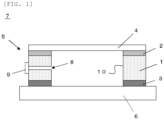
- FIG. 1 is a schematic view of an example of the pellicle frame, the pellicle, and the exposure plate with a pellicle of the present invention.
- examples of the pellicle frame include those made of titanium, and scratches and burrs on the surface are commonly removed by the mechanically polishing, but it has been found that the particles remain on the surface and consequently cause risks of failure in the inspection steps and the adverse effect during photolithography.
- the present inventors have made earnest study to find that a number of particles on the surface can be remarkably reduced to prevent the above problems with a pellicle frame made of pure titanium or a titanium alloy and having a surface subjected to a mechanically polishing treatment, an electrolytic degreasing treatment, and a chemically polishing treatment. This finding has led to completion of the present invention.
- FIG. 1 is a view illustrating an example of the pellicle frame of the present invention, and also illustrating the pellicle and the exposure plate with a pellicle of the present invention.
- the entirety of FIG. 1 is a view illustrating the exposure plate with a pellicle.
- a film-side adhesive 2 is provided on the upper end surface, and meanwhile, a mask-side adhesive 3 is provided on the lower end surface.
- a pellicle film 4 is stretched above the pellicle frame 1 via the film-side adhesive 2 to constitute a pellicle 5 of the present invention.
- the pellicle 5 is attached to an exposure plate (a photomask or a reticle) 6 via the mask-side adhesive 3 on the pellicle frame 1 to constitute an exposure plate 7 with a pellicle of the present invention.
- the pellicle frame 1 may be any having a frame shape, and the shape corresponds to a shape of a photomask to which the pellicle 5 is attached.
- the shape is typically a quadrangular (rectangular or square) frame shape.
- the pellicle frame 1 has a surface to provide the pellicle film 4 (here, referred to as "upper end surface”) and a surface to face the photomask in attaching to the photomask (here, referred to as "lower end surface”).
- a material of the pellicle frame 1 is pure titanium or a titanium alloy, which is excellence from the viewpoints of processing ease, a lightweight property, heat resistance, and improvement of inspectability.
- a size of the pellicle frame 1 is not particularly limited, but because a height of the pellicle for EUV is limited to 2.5 mm or less, a thickness of the pellicle frame 1 for EUV is less than 2.5 mm, which is smaller than the limitation.
- the thickness of the pellicle frame 1 for EUV is preferably 1.5 mm or less with considering thicknesses of the pellicle film 4, the mask adhesive 3, etc.
- a tool hole (not illustrated) used for handling or releasing the pellicle 5 from the photomask is typically provided.
- a size of the tool hole a width (diameter in a case of a circular shape) in a thickness direction of the frame 1 is 0.5 to 1.0 mm.
- a shape of the hole is not limited, and may be circular or rectangular.
- a vent part 8 for relaxing change in pressure between an inside and an outside of the pellicle 5 is provided on the frame 1.
- a shape and the number of the vent part 8 are not limited.
- a notch part may be provided on the upper end surface or the lower end surface of the frame 1 for the vent part.
- a filter 9 may be provided in order to prevent entering of a foreign matter into the pellicle 2.
- a location to provide the filter 9 is not limited, and includes an inner side of the pellicle frame 1, an inside of the vent part 8, and an outside of the pellicle frame 1. In FIG. 1 , the filter 9 is provided outside the pellicle frame 1.
- a surface treatment therefor is only a mechanically polishing treatment at most, but the surface of the pellicle frame 1 of the present invention is subjected to not only the mechanically polishing treatment but also an electrolytic degreasing treatment and a chemically polishing treatment (specific examples of these treatments will be described later). These treatments yield high quality with remarkably reduced particles on the surface.
- Fine dust particles etc. adhering to the pellicle frame 1 can be evaluated by, for example, measuring the number of particles in immersing the pellicle frame 1 in pure water.
- the number of particles that are released into pure water by irradiating the pellicle frame 1 with ultrasonic wave in pure water for one minutes and that have a sphere-equivalent diameter of 1 to 15 ⁇ m is particularly preferably 1500 or less per cm 2 of the surface area of the pellicle frame 1. With such a low value, a risk of the adverse effect in the inspection step due to the fine dust particles etc. adhering to the pellicle frame 1 can be remarkably reduced.
- the number of particles is more preferably 1200 or less, and further preferably 1000 or less. Of course, the smaller number of particles is more preferable. The number is extremely preferably zero.
- Condition examples of the ultrasonic wave irradiation include an oscillating frequency of 38 kHz and an irradiation time of one minute.
- measurement with an in-liquid particle counter is performed, for example.
- Ions generated from the pellicle frame 1 can be evaluated by, for example, an ion elution test in which the pellicle frame 1 is immersed in pure water at 90°C for three hours and concentrations of eluted ions are measured.
- acetate ion is 10 ppb or less
- formate ion is 100 ppb or less
- Cl ion is 10 ppb or less
- NO 2 ion is 10 ppb or less
- NO 3 ion is 10 ppb or less
- SO 4 ion is 10 ppb or less
- oxalate ion is 10 ppb or less
- PO 4 ion is 10 ppb or less
- NH 4 ion is 100 ppb or less.
- ion chromatography As a method for measuring the elution concentration of the ions, ion chromatography is used, for example.
- the size is preferably 5 ⁇ m or less.
- the unevenness has such a small size, the effect on the foreign-matter inspection can be reduced.
- no step (a case where the unevenness size is 0 ⁇ m) is extremely preferable.
- the film-side adhesive 2 is provided on the upper end surface of the pellicle frame 1 as above.
- a material of the film-side adhesive 2 is not limited, and known materials such as a silicone adhesive and an acrylic adhesive may be used. To strongly hold the pellicle film 4, an adhesive having a large adhesion force is preferable.
- a shape of the film-side adhesive 2 is not limited, and may be subjected to a planarization process.
- a thickness of a layer of the film-side adhesive 2 is not particularly limited, but preferably 0.5 mm or less because the height of the pellicle 5 is basically limited to 2.5 mm.
- the mask-side adhesive 3 to be attached to the photomask is formed.
- a material of the mask-side adhesive 3 is not limited, and known materials such as a silicone adhesive and an acrylic adhesive may be used.
- a shape of the mask adhesive 3 is not particularly limited, and may be subjected to a planarization process.
- a thickness of a layer of the mask-side adhesive 3 is not particularly limited, but preferably 0.5 mm or less because the height of the pellicle 5 is limited to 2.5 mm.
- a protective cover so as to cover the film-side adhesive 2 and the mask-side adhesive 3 for protecting these adhesives may be provided.
- a material of the protective cover is not particularly limited, and polyethylene terephthalate (PET), polytetrafluoroethylene (PTFE), tetrafluoroethylene-perfluoroalkyl vinyl ether copolymer (PFA), polyethylene (PE), polycarbonate (PC), polyvinyl chloride (PVC), polypropylene (PP), etc. may be used, for example.
- a releasing agent such as a silicone releasing agent and a fluorine releasing agent may be applied on the surface as a releasing layer.
- a shape of the protective cover is not limited, and may have any shape that can completely cover the adhesives 2 and 3.
- the shape of the protective cover may be changed between the sides of the film-side adhesive 2 and the mask-side adhesive 3.
- a grip part may be provided on a part of the protective cover for facilitating gripping of the protective cover.
- a material of the pellicle film 4 is not limited, but preferably a material having a high transmittance with a wavelength of the exposure light source and having high light resistance.
- a material having a high transmittance with a wavelength of the exposure light source and having high light resistance For example, an ultrathin silicon film, a carbon film, etc. are used for EUV exposure.
- the carbon film include a film of graphene, diamond-like carbon, carbon nanotube, etc.
- a pellicle film supported on a frame such as silicone may be used. In this case, the frame region and the pellicle frame 1 can be adhered to easily produce the pellicle 5.
- the pellicle 5 of the present invention has functions of not only the protective member to inhibit adhesion of a foreign matter on the exposure plate 6 in the exposure apparatus but also a protective member for protecting the exposure plate 6 during storage of the exposure plate 6 or during transport of the exposure plate 6.
- Examples of a method for attaching the pellicle 5 to the exposure plate 6 such as the photomask to produce the exposure plate with a pellicle 7 include the aforementioned method of adhesion with the mask adhesive, an electrostatic adsorption method, and a mechanically fixing method.
- the present invention can provide a pass in the foreign-matter inspection step etc. in each stage and can prevent occurrence of problems during photolithography caused by the particles adhering to the surface.
- a material of pure titanium or a titanium alloy is prepared, and mechanically processed into the shape of the pellicle frame.
- mechanical scratches and burrs on the surface generated by the mechanical processing are removed by a mechanically polishing treatment (physically polishing treatment).
- a mechanically polishing treatment physically polishing treatment.
- the method for mechanically polishing include a barrel polishing treatment and a magnetic polishing treatment.
- the magnetic polishing is more preferable because abrasive grains and media hardly remain on the frame surface.
- the method constituted by only a combination of these treatments may be acceptable.
- the methods for the magnetic polishing treatment and the barrel polishing treatment are not particularly limited, and known methods may be used.
- the pellicle frame is fed into a PP container containing cleaning water (for example, a mixed liquid of a surfactant and water) and a magnetic medium (for example, a bar made of SUS), and a permanent magnet placed in the lower part of the PP container is rotated with a motor. This moves the magnetic medium in the PP container to allow the magnetic medium to collide with and polish the pellicle frame.
- cleaning water for example, a mixed liquid of a surfactant and water
- a magnetic medium for example, a bar made of SUS
- the pellicle frame is fed into a container containing cleaning water and a medium, and the container is rotated, revolved, or vibrated, or a turntable placed at a bottom center of the container is rotated like a laundry machine. This allows the medium to collide with and polish the pellicle frame.
- the pellicle frame is subjected to an electrolytic degreasing treatment.
- the method for the electrolytic degreasing treatment is not particularly limited, and known methods may be used.
- energization is performed with the work as a negative electrode or a positive electrode in an alkali degreasing liquid, and a stirring action of gas generated from the work surface can be utilized to effectively remove oil contents, scales, adsorbed dust, etc. that adhere to the surface.
- the electrolytic degreasing treatment as above is provided before the chemical polishing treatment can effectively remove the organic substance to improve surface smoothness after the chemical polishing treatment.
- the method for the chemically polishing is not particularly limited, and known methods may be used. Examples thereof include: a chemical polishing treatment using an acidic or alkaline chemical liquid having dissolving power; and an electrolytic polishing treatment using an electrolyte liquid.
- the frame specifically the frame made of titanium
- crystal structure precipitates on the surface to generate crystal grain boundary.
- a stronger condition of the chemically polishing treatment typically tends to cause a larger step of unevenness or a larger step between the crystals generated near the crystal grain boundary.
- the height or depth of the step of unevenness or the step between the crystals of this crystal grain boundary generated on the surface is reduced to specifically 5 ⁇ m or less as noted above, conditions of the mechanical processing into the frame shape, the mechanically polishing treatment, and the chemically polishing treatment may be appropriately regulated. Reduction within the above numerical range is preferable because the effect on the foreign matter inspection can be more reduced.
- the pellicle frame 1 of the present invention can be produced as above, and this pellicle frame may be subjected to other treatments such as a coloring treatment. In this case, performing the chemically polishing treatment in the final step can easily remove the particles, even if adhering to the pellicle frame surface in the previous step.
- a cleaning step for the frame may be appropriately added in the middle of or before or after the mechanical processing, the mechanically polishing treatment, the electrolytic degreasing treatment, and the chemically polishing treatment.
- the cleaning method is not particularly limited, and known methods may be used. Examples thereof include: degreasing cleaning using an alkali aqueous solution, a neutral detergent, etc.; and ultrasonic-wave cleaning using pure water.
- the method for producing a semiconductor device or a liquid-crystal display panel of the present invention includes a step of exposing a substrate (a semiconductor wafer or a plate for liquid crystal) with the above exposure plate with a pellicle.
- a substrate a semiconductor wafer or a plate for liquid crystal
- the above exposure plate with a pellicle is placed on a stepper for exposure in order to form a photoresist pattern corresponding to an integrated circuit etc. on the substrate.
- a projection optical system in which EUV light is reflected on the exposure plate and introduced onto the substrate is commonly used, and these are performed under a reduced pressure or in vacuo. According to this configuration, even if foreign matters adhere onto the pellicle in the lithography step, these foreign matters do not form an image on the wafer on which a photoresist is applied, and thus short circuit, disconnection, etc. of the integrated circuit etc. due to an image of the foreign matters can be prevented. Therefore, use of the exposure plate with a pellicle can increase an yield of the lithography step.
- a pellicle frame (outer size: 150 mm ⁇ 118 mm ⁇ 1.5 mm, frame width: 4.0 mm, surface area: 68 cm 2 ) was prepared with titanium.
- the produced pellicle frame made of titanium was fed inside a PP container in which cleaning water (specifically, cleaning liquid G100 for magnetic polishing, available from PRIORITY Company) and a magnetic medium (made of SUS) were placed, and a magnetic polishing treatment was performed.
- a motor-driven permanent magnet is placed on a lower part of the PP container. The permanent magnet was rotated with the motor to move the magnetic medium, and allowed this magnetic medium to collide with the pellicle frame to perform the magnetic polishing treatment.
- the frame after the magnetic polishing treatment was cleaned with pure water, and then an electrolytic degreasing treatment was performed at a voltage of 6 V for 5 minutes by using a NaOH solution at a concentration of 10 g/L.
- the frame was immersed in a chemical polisher liquid (specifically, TCP-08, available from MITSUBISHI GAS CHEMICAL COMPANY, INC.), and a chemical polishing treatment was performed.
- a chemical polisher liquid specifically, TCP-08, available from MITSUBISHI GAS CHEMICAL COMPANY, INC.
- the frame after the chemical polishing treatment was cleaned with pure water, then immersed again in pure water, and ultrasonic wave cleaning was performed for 5 minutes.
- the frame was immersed again in pure water, and ultrasonic wave cleaning was performed under a pressure-reduced environment for 30 minutes.
- the frame after the ultrasonic wave cleaning was cleaned with pure water, then subjected to air blow, and then dried.
- the frame was immersed in pure water in the glass beaker, irradiated with ultrasonic wave at an oscillating frequency of 38 kHz for one minute, then the frame was taken out, and 50 ml of the pure water in the glass beaker was tested again with the in-liquid particle counter (the measurement device same as above). A difference between this value and the blank value was recorded as the number of particles caused by the frame.
- a titanium frame having a shape same as of Example (outer size: 150 mm ⁇ 118 mm ⁇ 1.5 mm, frame width: 4.0 mm, surface area: 68 cm 2 ) was prepared.
- the frame was cleaned with pure water, and then an electrolytic degreasing treatment was performed at a voltage of 6 V for 5 minutes by using a NaOH solution at a concentration of 10 g/L.
- the frame after the electrolytic degreasing treatment was cleaned with pure water, then immersed in pure water, and ultrasonic wave cleaning was performed for 5 minutes.
- the frame after the ultrasonic wave cleaning was cleaned with pure water, then subjected to air blow, and then dried.
- a titanium frame having a shape same as of Example (outer size: 150 mm ⁇ 118 mm ⁇ 1.5 mm, frame width: 4.0 mm, surface area: 68 cm 2 ) was prepared.
- the frame was cleaned with pure water, and then an electrolytic degreasing treatment was performed at a voltage of 6 V for 5 minutes by using a NaOH solution at a concentration of 10 g/L.
- the frame after the electrolytic degreasing treatment was cleaned with pure water, then immersed in pure water, and ultrasonic wave cleaning was performed for 5 minutes.
- the frame was immersed again in pure water, and ultrasonic wave cleaning was performed under a pressure-reduced environment for 30 minutes.
- the frame after the ultrasonic wave cleaning was cleaned with pure water, then subjected to air blow, and then dried.
- Example Comparative Example 1 Comparative Example 2 1 to 2 ⁇ m 681 9335 2060 2 to 3 ⁇ m 14 108 28 3 to 5 ⁇ m 25 258 78 5 to 15 ⁇ m 6 78 19 Total 726 9779 2185 Number of released particles per cm 2 of pellicle frame (50 ml of pure water) 11 144 32 Total number of particles to be released from 1 cm 2 of pellicle frame (in terms of 3 L of pure water) 641 8629 1928
- Table 1 shows the number of particles with each sphere-equivalent diameter and a total value thereof. Table 1 also shows: a value of the total value divided by the surface area of the pellicle frame, "Number of released particles per cm 2 of pellicle frame (50 ml of pure water”; and a converted value of multiplying the value by 60 (3 L / 50 ml), "Total number of particles to be released from 1 cm 2 of pellicle frame (in terms of 3 L of pure water)".
- Example As for the number of particles per cm 2 of the surface area of the pellicle frame in each example, namely "Total number of particles to be released from 1 cm 2 of pellicle frame (in terms of 3 L of pure water)" in Table 1, Example was 641, and in contrast, Comparative Example 1 was 8629 and Comparative Example 2 was 1928. It is understood from this particle evaluation that the frame of Example remarkably reduces the number of particles, such as fine dust particles, adhering to the surface.
- a pellicle frame was produced in the same manner as in Example except that the electrolytic degreasing treatment nor the chemical polishing treatment were not performed, and the in-liquid particle evaluation same as in Example was performed.
- the number of particles per cm 2 of the surface area of the pellicle frame was 10252. This result was considerably bad compared with Example, 641.
- the pellicle frames of Example and Comparative Examples 1 and 2 were subjected to evaluation of an amount of eluted ions. Specifically, the pellicle frame of each example was placed in a polyethylene bag, 100 ml of pure water was added and the bag was sealed, and the pellicle frame was retained and immersed at 90°C for three hours. The extraction water in which eluted contents from the pellicle frame were extracted as above was analyzed by using an ion chromatograph (ICS-2100, available from Thermo Fisher Scientific K.K.) at a cell temperature of 35°C, column (IonPacAS11-HC) temperature of 40°C, under a condition of 1.5 ml/min.
- ICS-2100 ion chromatograph
- Table 2 shows the obtained results. Quantification limits (lower limits) of the ion chromatograph used for the evaluation vary depending on the ion species, which was 0.01 to 0.001 ppm. The unit for each value in Table 2 was ppb, and "0" means that the ion species was not quantified.
- [Table 2] [ppb/50cm2] Acetate Formate Cl NO2 NO3 SO4 Oxalate PO4 NH4 Example 1 4 0 0 0 1 0 7 Comparative Example 1 1 5 0 0 1 1 1 0 9 Comparative Example 2 2 8 0 0 0 0 0 0 9
- Example yields the high-quality pellicle frame with reduced ions to be generated while extremely reducing the number of particles on the surface.
- the frame of Example was cleaned with a neutral detergent and pure water.
- a curing agent L-45, available from Soken Chemical & Engineering Co., Ltd.
- an acrylic adhesive SK-Dyne 1499M, available from Soken Chemical & Engineering Co., Ltd.
- the pellicle frame was heated at 100°C for 12 hours to cure the adhesives on the upper and lower end surfaces. Subsequently, an ultrathin silicon film as a pellicle film was crimped with the film-side adhesive formed on the frame upper end surface to complete a pellicle.
- Each of the corner parts of the pellicle frame of Example was cut, and steps and unevenness on the inner surface (inner wall surface) of each side were observed by using a laser microscope (3D-measurement laser microscope, LEXT OLS4000, available from Olympus Corporation).
- the observation method will be described below.
- the four corner parts of the frame were cut with a cutter to produce four frame pieces.
- the frame piece was mounted on a stage of the microscope so that an inner face of the frame piece faced the objective lens side.
- a direction from one corner to one corner is described as "length direction”
- a direction from the upper end surface to the lower end surface is described as "thickness direction”.
- the height or depth of the step and concave can be measured from an image photographed with the laser microscope.
- the laser microscope has a property of low height detection ability with a low magnification, and recommended is measurement with high magnification using an objective lens with magnification of 50 or 100.
- the image was photographed by using an objective lens with magnification of 50 (MPLAPONLEXT50 measurement region: 256 ⁇ m ⁇ 256 ⁇ m) or an objective lens with magnification of 100 (MPLAPONLEXT100 measurement region: 128 ⁇ m ⁇ 128 ⁇ m) according to the size of the steps and unevenness to be observed.
- the height or depth of the steps and unevenness was measured by performing step measurement from the photographed image.
- one-shot filter was applied in order to remove effects of noise and waviness.
- a difference between a highest point and a lowest point of the step or unevenness was measured, and confirmed to be 5 ⁇ m or less.
- the unevenness etc. have an extremely small height or depth, and it can be said that the quality is good also from this point.
- the present description includes the following embodiments.
Landscapes
- Chemical & Material Sciences (AREA)
- Engineering & Computer Science (AREA)
- Mechanical Engineering (AREA)
- General Physics & Mathematics (AREA)
- Physics & Mathematics (AREA)
- Chemical Kinetics & Catalysis (AREA)
- Materials Engineering (AREA)
- Metallurgy (AREA)
- Organic Chemistry (AREA)
- Health & Medical Sciences (AREA)
- General Chemical & Material Sciences (AREA)
- Life Sciences & Earth Sciences (AREA)
- Dispersion Chemistry (AREA)
- Analytical Chemistry (AREA)
- Biochemistry (AREA)
- General Health & Medical Sciences (AREA)
- Electrochemistry (AREA)
- Immunology (AREA)
- Pathology (AREA)
- Environmental & Geological Engineering (AREA)
- Epidemiology (AREA)
- Public Health (AREA)
- Preparing Plates And Mask In Photomechanical Process (AREA)
- Exposure And Positioning Against Photoresist Photosensitive Materials (AREA)
Applications Claiming Priority (2)
| Application Number | Priority Date | Filing Date | Title |
|---|---|---|---|
| JP2022109319 | 2022-07-06 | ||
| PCT/JP2023/024702 WO2024009976A1 (fr) | 2022-07-06 | 2023-07-04 | Cadre de pellicule, pellicule et plaque originale d'exposition avec pellicule, procédé de production de cadre de pellicule, procédé d'exposition à la lumière, procédé de fabrication de dispositif à semi-conducteur, et procédé de fabrication de plaque d'affichage à cristaux liquides |
Publications (1)
| Publication Number | Publication Date |
|---|---|
| EP4553576A1 true EP4553576A1 (fr) | 2025-05-14 |
Family
ID=89453399
Family Applications (1)
| Application Number | Title | Priority Date | Filing Date |
|---|---|---|---|
| EP23835508.5A Pending EP4553576A1 (fr) | 2022-07-06 | 2023-07-04 | Cadre de pellicule, pellicule et plaque originale d'exposition avec pellicule, procédé de production de cadre de pellicule, procédé d'exposition à la lumière, procédé de fabrication de dispositif à semi-conducteur, et procédé de fabrication de plaque d'affichage à cristaux liquides |
Country Status (6)
| Country | Link |
|---|---|
| EP (1) | EP4553576A1 (fr) |
| JP (2) | JPWO2024009976A1 (fr) |
| KR (1) | KR20250028306A (fr) |
| CN (1) | CN119487445A (fr) |
| TW (1) | TW202417983A (fr) |
| WO (1) | WO2024009976A1 (fr) |
Family Cites Families (8)
| Publication number | Priority date | Publication date | Assignee | Title |
|---|---|---|---|---|
| JPS608784U (ja) | 1983-06-30 | 1985-01-22 | 株式会社小松製作所 | 油圧式スクリユ掘進機の操作回路装置 |
| JP4697629B2 (ja) * | 2005-06-30 | 2011-06-08 | 国立大学法人北海道大学 | 内燃機関用のバルブスプリングおよびその製造方法、並びに陽極酸化皮膜形成チタン製部材の製造方法 |
| CN101568393B (zh) * | 2006-12-27 | 2011-07-20 | 上村工业株式会社 | 表面处理装置 |
| JP6008784B2 (ja) | 2013-04-15 | 2016-10-19 | 信越化学工業株式会社 | ペリクルフレーム及びその製作方法とペリクル |
| JP2014233921A (ja) * | 2013-06-03 | 2014-12-15 | トヨタ自動車株式会社 | 複層塗膜とその形成方法 |
| CN110129854B (zh) * | 2018-02-08 | 2021-07-09 | 华为技术有限公司 | 一种氧化膜的制备方法和终端设备 |
| CN112445063A (zh) * | 2019-08-28 | 2021-03-05 | 芯恩(青岛)集成电路有限公司 | 一种保护膜框架及其制备方法及保护膜组件 |
| EP4102296A4 (fr) * | 2020-02-04 | 2024-03-20 | Shin-Etsu Chemical Co., Ltd. | Cadre de pellicule, pellicule, plaque originale d'exposition avec pellicule et procédé d'exposition, et procédé de fabrication de dispositif à semi-conducteur ou de panneau d'affichage à cristaux liquides |
-
2023
- 2023-07-04 KR KR1020247043575A patent/KR20250028306A/ko active Pending
- 2023-07-04 CN CN202380051912.9A patent/CN119487445A/zh active Pending
- 2023-07-04 JP JP2024532138A patent/JPWO2024009976A1/ja active Pending
- 2023-07-04 EP EP23835508.5A patent/EP4553576A1/fr active Pending
- 2023-07-04 WO PCT/JP2023/024702 patent/WO2024009976A1/fr not_active Ceased
- 2023-07-05 TW TW112125132A patent/TW202417983A/zh unknown
-
2026
- 2026-02-09 JP JP2026019495A patent/JP2026066306A/ja active Pending
Also Published As
| Publication number | Publication date |
|---|---|
| WO2024009976A1 (fr) | 2024-01-11 |
| KR20250028306A (ko) | 2025-02-28 |
| CN119487445A (zh) | 2025-02-18 |
| TW202417983A (zh) | 2024-05-01 |
| JP2026066306A (ja) | 2026-04-16 |
| JPWO2024009976A1 (fr) | 2024-01-11 |
Similar Documents
| Publication | Publication Date | Title |
|---|---|---|
| JP5134418B2 (ja) | リソグラフィ用ペリクル | |
| CN100552548C (zh) | 光刻用防护胶膜组件及防护胶膜框架 | |
| EP1868033A2 (fr) | Pellicule | |
| CN215449882U (zh) | 防护薄膜框架及组件、曝光原版、装置与系统及制造系统 | |
| CN1898608A (zh) | 用于浸入式光刻的可除去薄膜 | |
| KR20110065364A (ko) | 리소그래피용 펠리클 및 그 제조 방법 | |
| JP2025100921A (ja) | Euv用ペリクルフレーム及びその製造方法、並びにeuv用ペリクル | |
| EP2211231A2 (fr) | Pellicule pour photolithographie | |
| US20230213850A1 (en) | Pellicle Frame, Pellicle, Pellicle-Equipped Exposure Original Plate, Exposure Method, Method for Manufacturing Semiconductor, and Method for Manufacturing Liquid Crystal Display Board | |
| KR102841264B1 (ko) | 펠리클 | |
| EP4553576A1 (fr) | Cadre de pellicule, pellicule et plaque originale d'exposition avec pellicule, procédé de production de cadre de pellicule, procédé d'exposition à la lumière, procédé de fabrication de dispositif à semi-conducteur, et procédé de fabrication de plaque d'affichage à cristaux liquides | |
| KR20090118833A (ko) | 펠리클 | |
| TWI440971B (zh) | 防塵薄膜組件框架 | |
| KR20140082917A (ko) | 리소그래피용 펠리클 | |
| JP2001342041A (ja) | 光学部材及びその洗浄方法 |
Legal Events
| Date | Code | Title | Description |
|---|---|---|---|
| STAA | Information on the status of an ep patent application or granted ep patent |
Free format text: STATUS: THE INTERNATIONAL PUBLICATION HAS BEEN MADE |
|
| PUAI | Public reference made under article 153(3) epc to a published international application that has entered the european phase |
Free format text: ORIGINAL CODE: 0009012 |
|
| STAA | Information on the status of an ep patent application or granted ep patent |
Free format text: STATUS: REQUEST FOR EXAMINATION WAS MADE |
|
| 17P | Request for examination filed |
Effective date: 20250102 |
|
| AK | Designated contracting states |
Kind code of ref document: A1 Designated state(s): AL AT BE BG CH CY CZ DE DK EE ES FI FR GB GR HR HU IE IS IT LI LT LU LV MC ME MK MT NL NO PL PT RO RS SE SI SK SM TR |
|
| DAV | Request for validation of the european patent (deleted) | ||
| DAX | Request for extension of the european patent (deleted) |