EP4553841A1 - Verfahren und vorrichtung zur erzeugung mindestens eines teils eines strukturierten medizinischen berichts - Google Patents
Verfahren und vorrichtung zur erzeugung mindestens eines teils eines strukturierten medizinischen berichts Download PDFInfo
- Publication number
- EP4553841A1 EP4553841A1 EP23208454.1A EP23208454A EP4553841A1 EP 4553841 A1 EP4553841 A1 EP 4553841A1 EP 23208454 A EP23208454 A EP 23208454A EP 4553841 A1 EP4553841 A1 EP 4553841A1
- Authority
- EP
- European Patent Office
- Prior art keywords
- keywords
- finding
- medical
- body part
- medical information
- Prior art date
- Legal status (The legal status is an assumption and is not a legal conclusion. Google has not performed a legal analysis and makes no representation as to the accuracy of the status listed.)
- Withdrawn
Links
Images

Classifications
-
- G—PHYSICS
- G16—INFORMATION AND COMMUNICATION TECHNOLOGY [ICT] SPECIALLY ADAPTED FOR SPECIFIC APPLICATION FIELDS
- G16H—HEALTHCARE INFORMATICS, i.e. INFORMATION AND COMMUNICATION TECHNOLOGY [ICT] SPECIALLY ADAPTED FOR THE HANDLING OR PROCESSING OF MEDICAL OR HEALTHCARE DATA
- G16H30/00—ICT specially adapted for the handling or processing of medical images
- G16H30/40—ICT specially adapted for the handling or processing of medical images for processing medical images, e.g. editing
-
- G—PHYSICS
- G16—INFORMATION AND COMMUNICATION TECHNOLOGY [ICT] SPECIALLY ADAPTED FOR SPECIFIC APPLICATION FIELDS
- G16H—HEALTHCARE INFORMATICS, i.e. INFORMATION AND COMMUNICATION TECHNOLOGY [ICT] SPECIALLY ADAPTED FOR THE HANDLING OR PROCESSING OF MEDICAL OR HEALTHCARE DATA
- G16H15/00—ICT specially adapted for medical reports, e.g. generation or transmission thereof
-
- G—PHYSICS
- G16—INFORMATION AND COMMUNICATION TECHNOLOGY [ICT] SPECIALLY ADAPTED FOR SPECIFIC APPLICATION FIELDS
- G16H—HEALTHCARE INFORMATICS, i.e. INFORMATION AND COMMUNICATION TECHNOLOGY [ICT] SPECIALLY ADAPTED FOR THE HANDLING OR PROCESSING OF MEDICAL OR HEALTHCARE DATA
- G16H40/00—ICT specially adapted for the management or administration of healthcare resources or facilities; ICT specially adapted for the management or operation of medical equipment or devices
- G16H40/60—ICT specially adapted for the management or administration of healthcare resources or facilities; ICT specially adapted for the management or operation of medical equipment or devices for the operation of medical equipment or devices
- G16H40/67—ICT specially adapted for the management or administration of healthcare resources or facilities; ICT specially adapted for the management or operation of medical equipment or devices for the operation of medical equipment or devices for remote operation
Definitions
- the present invention relates to a method and a device for generating at least a part of a structured medical report.
- a method for generating part of a structured medical report comprising the steps of:
- the refinement or specification of keywords in at least some of the embodiments refers to extraction of additional keywords from the set of further keywords, or they can be specified, such as determining a sub-set of keywords from the set of further keywords.
- a computer program which comprises program code (or program code means) for causing a computer to perform the steps of the method disclosed herein when said computer program is carried out on a computer as well as a non-transitory computer-readable recording medium that stores therein a computer program product, which, when executed by a processor, causes the method disclosed herein to be performed.
- the present invention is based on the idea to provide an efficient way to enter new and/or modify previously generated structured findings using the extraction of keywords from medical information, for instance by use of voice recognition.
- An event e.g., pressing a button, selecting an option by a computer mouse, or speaking a certain command
- Findings are stepwise created and refined, e.g., based on words spoken by a user, which can be given without a predefined order.
- Voice recognition is used in an embodiment to recognize the keywords that correspond to an option of multiple keywords. These options of keywords are represented by a defined set of further keywords indicating further keywords that are allowed and/or further keywords that are prohibited for refinement of the finding.
- creating or modifying of a finding When creating or modifying of a finding is completed, the user may generate an event, for instance, to enter or modify another finding. It is to be understood that creating and determining can be used interchangeably within the present application.
- the structured findings are then used to generate a part of the medical report, particularly the part including the findings but possibly not parts including a diagnosis or impression.
- the method further comprises the steps of obtaining image information of the examined body part of the subject and using the obtained image information in the step of creating and/or refining the finding.
- the use of the image information in addition to the keywords from the obtained medical information further improves the creation and/or refinement of findings.
- the obtained image information may be used in the step of creating and/or refining the finding by checking if one or more further keywords extracted from the defined set of further keywords and/or one or more modified keywords fit with (e.g., correlates to) the obtained image information.
- the image information is generally medical image information, such as images of the body part obtained by any medical imaging modality (X-ray, CT, MRI, ultrasound, and others).
- the medical information is obtained in the form of textual and/or audio information, in particular written text and/or spoken words, and the keywords are extracted from the medical information by use of text recognition and/or speech recognition.
- Text recognition may, e.g., be used to detect key words (e.g. via hash tables) in a sequence of words given as letters.
- the one or more keywords extracted from the medical information and/or included in the set of keywords relate to a hierarchical description of a part of the anatomy and/or a feature and/or abnormality. For instance, they relate to particular information on one or more of compartment, sub-compartment, type of structure, sub-structure, sub-sub-structure, pathology, grading, and one or more further properties of the examined body part of the subject.
- a hierarchical description of an anatomical part may be as follows: left knee (anatomical part) -> femoro-tibial (compartment) -> lateral part of femoro-tibial (sub-compartment) -> meniscus (in lateral part of femoro-tibial compartment; type of structure) -> pars intermedia of meniscus (sub-sub-structure).
- a trained algorithm, or a computing system trained on extracting keywords from medical information for one or more (preferably for a plurality of) body parts are used for extracting the one or more keywords from the medical information and/or a trained algorithm or computing system trained on refining a finding is used for refining the finding.
- This may include the use of a trained speech or word recognition system and/or the use of a trained image analysis tool. For instance, a large amount of information (e.g., a large number of words and/or sentences spoken by a person) has been used for training an algorithm or computing system, and for each piece of information it has been indicated to the algorithm or computing system if it qualifies as medical information and/or if there any keyword(s) are included in the medical information.
- the trained algorithm or computing system may comprise a machine learning system, a neural network, a convolutional neural network, a classification network (e.g., a residual neural network) or a U-net-like network.
- a machine learning system e.g., a neural network
- a convolutional neural network e.g., a convolutional neural network
- a classification network e.g., a residual neural network
- U-net-like network e.g., a residual neural network
- the keywords are extracted from the medical information by use of speech recognition using probabilities of keywords and/or combinations of keywords.
- the speech recognition (or voice recognition or word recognition) may provide one or more extracted keywords per keyword to be recognized.
- the recognition may result in an N-best list of potential keywords for a single keyword to be recognized, wherein N may, e.g., be in the range of N ⁇ 5 (e.g. up to 30). For the N-best list, probabilities / likelihoods for each element of the list should be given.
- An image-based classifier may, e.g., segment the anatomy (e.g., pars intermedia of medial meniscus) and construct a region-of-interest around the segmentation result.
- the region of interest may be put into a classification network (e.g. ResNet (residual network)) and the classification result could, for instance, be the kind of damage (according to a medically accepted scale such as Stoller).
- ResNet residual network
- a set of images may be used where the damage of the pars intermedia of the medial meniscus according to Stoller is known, and ResNet coefficients may be optimized during training using, e.g., cross-entropy loss or any other commonly known loss function for classification.
- I 1 ⁇ ⁇ j ⁇ p 1 ⁇ P f j
- I is used for determining if the keyword fits with (e.g., correlates to) the finding in order to create and/or refine the finding.
- f is a possibly incomplete finding (i.e., not all properties are defined); f j ( i in p ) denotes all findings that are "compatible” with finding f ; "compatible” means that the properties defined for f are the same for f j , but for f j also the undefined properties are defined; P ( f
- the at least a part of the structured medical report of the examined body part is generated by iteratively filling a report template and/or an existing medical report (e.g., a still incomplete medical report or a medical report that shall further be refined) based on iteratively refined findings.
- the template supports the generation of the medical report.
- visual and/or acoustical feedback is provided to a user presenting the finding and/or structured report.
- the device according to the present invention for generating part of a structured medical report generally comprises circuitry configured to carry out the steps of the method according to the present invention.
- the circuitry may include one or more of a non-transitory computer readable medium, separate processing units, a computer, a mixture of hard- and software, a programmed processor, and similar ones.
- the device may further comprise one or more of:
- the processing unit comprises one or more of:
- Fig. 1 shows a schematic diagram of an embodiment of a system 1 according to the present invention for generating part of a structured medical report for a subject who has undergone a medical examination.
- the system 1 may, e.g., be used by a medical practitioner (generally called "user"), such as a radiologist, who examines medical images (e.g. an MRI, CT or X-ray images) of a patient after a corresponding imaging scan of a certain body part (e.g. knee, brain, abdomen, etc.).
- the medical practitioner usually types or dictates (e.g. using speech recognition) a medical report, which is then stored along with the medical images in a database, e.g. a hospital's patient database.
- the system according to the present invention is configured to support the generation of at least a part of the medical report so that findings can be created more easily, and the medical practitioner can use free text.
- the system 1 comprises a device 10 for generating part of a structured medical report, an input device 20 for providing medical information regarding an examined body part of the subject, and an output device 30 for outputting at least the generated part of the structured medical report.
- the device 10 may be implemented by respective units or circuitry, e.g., a processor, processing circuitry, a computer, dedicated hardware, etc., that carries out the functions of the device.
- a common unit or circuitry e.g., a common processor or computer, may implement the various functions of the device, or separate units or elements may be used that together represent the circuitry.
- a programmed processor may represent the device 10, which may execute a computer program that may be stored in a memory that is accessed by the processor.
- the input device 20 is configured to provide medical information regarding the examined body part of the subject. It may be implemented by a microphone that is configured to record speech of the medical practitioner and/or other input means, such as a keyboard for typing information recorded by a computer. The speech and typed information thus represent the medical information.
- the output device 30 is configured to output the generated part of the medical report.
- the output device 30 may generally be any means that outputs the generated medical report in visual (preferred) or audible form, e.g., in text form, as image or diagram, as sound or spoken words, etc. It may be implemented by a monitor that displays the medical report.
- the obtained medical information and/or commands and/or information for the user may be outputted.
- the output may comprise an interface to a database or storage that stores the medical report.
- the output device 30 may comprise a loudspeaker, a touchscreen, a computer monitor, the screen of a smartphone or tablet, etc.
- Fig. 2 shows a schematic diagram of a first embodiment of device 10 for generating part of a structured medical report according to the present invention.
- a programmed processor or computer may represent the device 10, which may execute a computer program that may be stored in a memory that is accessed by the processor.
- the device 10 comprises an input unit 11 configured to obtain the medical information.
- the input unit 11 may be directly coupled or connected to the input device 20 or may obtain (i.e., retrieve or receive) the medical information from a storage, buffer, network, or bus, etc.
- the input unit 11 may thus e.g. be a (wired or wireless) communication interface or data interface, such as a Bluetooth interface, WiFi interface, LAN interface, HDMI interface, direct cable connection, or any other suitable interface allowing signal transfer to the device.
- the device 10 further comprises a processing unit 12 configured to generate the part of the medical report.
- the processing unit 12 may be any kind of means configured to process the signals and generate part of a medical report there from. It may be implemented in software and/or hardware, e.g., as a programmed processor or computer or app on a user device such as a smartphone, tablet, laptop, PC, workstation, and others.
- the device 10 further comprises an output unit 13 configured to output the generated part of the medical report.
- the output unit 13 may generally be any interface that provides the medical report, e.g., transmits it to another device or provides it for retrieval by another device (e.g., a smartphone, computer, tablet, etc.). It may thus generally be any (wired or wireless) communication or data interface.
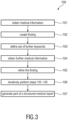
- Fig. 3 shows a flow chart of a first embodiment of a method 100 for generating part of a structured medical report according to the present invention.
- the steps of the method 100 may be carried out by the device 10, wherein the main steps of the method are carried out by the processing unit 12.
- the method 100 may e.g. be implemented as computer program running on a computer or processor.
- a first step 101 medical information regarding an examined body part of the subject, for instance words spoken by the user with information about the examined body part. For instance, words spoken by a radiologist when reviewing a medical image e.g. of a patient's knee are received from a microphone used by the user. The spoken words are recognized e.g. by speech recognition and then further processed.
- An event may signal the start of the whole method. For instance, a click on a button or an item on a screen by a mouse or a voice command like "start" may be given. Different possibilities to trigger the event (keyboard, mouse click, click on a screen item, voice command) may be available for user convenience. The same events can be used during the operation of the method for initiating certain steps or for stopping the operation or certain steps.
- a finding related to the examined body part is created by extracting one or more keywords from the obtained medical information, wherein the keywords are predefined medical terms related to the examined body part.
- keywords may include any terms (including acronyms and synonyms) that describe or are in any other way related to a body part and used by medical practitioners to describe any properties (such as size, texture, position, orientation, form, quality, and others) of a body part.
- Findings generally include a set of properties with property-specific options. The property-specific options can depend on the option defined for another property. Depending on the type of property, a property can be defined by a single option or by a set of feasible options. In addition, a property can be undefined.
- Table 1 provides, as an example, an overview over meniscus and cartilage related findings in the knee. A complete set of findings for the knee covers many more findings, for instance, also findings related to bones and ligaments.
- the user stepwise fills in the properties of a finding via spoken keywords (that correspond to options) without a pre-defined order.
- a keyword w * refines or corrects a property of the current finding f ( k ) .
- an option for one property implicitly defines an option for another property, it is applied automatically.
- a set of further keywords related to the examined body part is defined based on the one or more extracted keywords and based on one or more predetermined rules, models and/or tables, the defined set of further keywords indicating further keywords that are allowed and/or further keywords that are prohibited for refinement of the finding.
- Table 2 illustrates the definition of a finding via keywords. The highlighted fields indicate the provided keywords. Terms in brackets in the highlighted fields indicate the options that are implied.
- the rows with the term "keywords" in the first column contain the available keywords for refining or correcting the finding. These rows are skipped for state 0 and 2.
- the rows with the expression " f ( .. ) show refinement of a finding. The last row illustrates correction of a finding.
- rules, models and/or tables may be used to define the further set of keywords after a finding has been generated or refined.
- Rules, models and/or tables may be predetermined, e.g., stored in a database that is, e.g., stored by the device 10 itself or on a server that is accessed by the device 10. They may be provided for multiple different body parts, such as anatomical objects, and may include all options that are generally used to describe any properties of the respective anatomical object after an examination.
- Rules, tables and models are different forms in which the set of further keywords that are available for further use and that may not be used, given the already given keywords and findings. For instance, a table may list, as shown above in Tables 1 and 2, combinations of keywords that are allowed to define a finding.
- Rules and a model may define, e.g., in the form of a computer program or flowchart, which next keyword may be used or may not be used based on keywords and/or findings that have been defined already.
- a fourth step 104 further medical information regarding the examined body part of the subject is obtained. For instance, the user speaks further words.
- the finding is refined by extracting one or more further keywords from the defined set of further keywords (e.g., to describe further properties of the examined body part) and/or modifying one or more keywords of the finding (e.g., to correct a previous finding and/or keyword and/or to more precisely describe a property of the examined body part) based on the obtained further medical information.
- Table 2 there can be keywords allowed for properties of the finding that have already been defined. When such a keyword is recognized / identified, the finding is modified, and the keyword associated with the property is replaced by the most recent one.
- Step 104 and/or step 105 may be initiated by an event as mentioned above.
- an event used to start modifying a finding might be by a click on a button / finding on the screen or a voice command "modify 3" to modify finding 3 etc.
- the event might also be a click on some anatomical structure in one of the images of the examination that opens a related finding or generates a new finding pre-populated with anatomical information (related information can e.g., derived by model-based segmentation from the image).
- steps 103-105 are iteratively performed one or more times to further refine the finding.
- the iteration may be stopped if the user does no longer provide any further medical information (e.g., the user stops speaking) or in case of an event as mentioned above (e.g., a given command or pressing a stop button) or if all fields of a template of a medical report are completely or sufficiently filled.
- a seventh step 107 at least a part of a structured medical report of the examined body part is generated based on the refined finding.
- Some other part of the medical report like a diagnosis or therapy, is preferably generated in the conventional manner.
- the finding f (3) is obtained after defining the sub-sub-structures.
- "pars intermedia and frontal horn" have been provided as option.
- the finding f (4) is completely defined. All possible keywords relate to the correction of the finding.
- the allowed keywords include "Stoller1", ..., “Stoller 5" for correcting the grading, i.e., the grading can be refined, even if its property "horizontal” would be set to "not used” as a side effect.
- Table 2 indicates that a keyword might be available for refining a finding or not, also a statistical model with high probabilities for available keywords and low probabilities for keywords that are "not available” may be used.
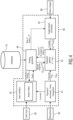
- Fig. 4 shows a schematic diagram of a second embodiment of device 40 according to the present invention.
- the recognition unit 41 including a medical information input that receives the spoken words from the microphone 50 or an intermediate buffer.
- keywords and commands e.g. as events
- commands may be received by a user interface 42, which receives any recognized events from the recognition unit 41 as well.
- an N-best list is generated by the recognition unit 41 indicating likelihoods (also called probability) that a recognized keyword corresponds to a certain keyword.
- likelihoods P( w 1 ) to P( w N ) are generated for N different options of keywords to which the recognized keyword corresponds.
- a keyword selector 43 selects the keyword w* using e.g. a maximum-likelihood function, considering the N-best list and the allowed keywords for a particular finding.
- the selected keyword w * is provided to a finding generator 44 to create or update a finding f ( k ) .
- the finding generator 44 may include a rules input that is configured to obtain the one or more predetermined rules, models and/or tables, e.g. by accessing a database 70 that stores a set of further keywords related to the examined body part and/or on one or more predetermined rules, models and/or tables
- the defined set of further keywords indicates further keywords that are allowed and/or further keywords that are prohibited for refinement of the finding. For instance, content of the type shown in Table 1 and Table 2 may be stored in the databased 70 and used by the finding generator 44.
- the finding generator 44 feeds back allowed keywords to the keyword selector 43.
- the finding generator 44 may be triggered to start operation based on an event received from the user interface 42.
- the created or updated finding may be provided to the user interface 42 for visualization, e.g. on a screen (not shown).
- an image-based module 45 e.g., an image-based AI module, may be provided that obtains one or more images of the examined body part of the subject, either directly from the imaging apparatus or from an image repository 80. Based on the one or more images, the keyword selection by the keyword selector 43 can be further improved. For instance, the obtained image information can be used to check if a keyword extracted from a defined set of further keywords fits with the obtained image information. For instance, if a keyword is included in the N-best list of keywords provided by the recognition unit but does not fit the image-based information provided by the image-based module 45, this keyword will not be selected by the keyword selector 43.
- the image-based module 45 may obtain the state of the finding from the finding generator 44 as well in order to select the image-based classifiers (i.e., the image-based module comprises a large number of classifiers, each indicating whether a structured finding is present or not) that must be evaluated and combine them into an overall probability / likelihood.
- the voice-based definition of findings may follow the concept of the keyword-based definition of findings explained above.
- There is a current state of a finding f ( k ) and the next state f ( k +1) f ( k ) ( w *) when the keyword or keyword combination w * is used.
- the state f ( k ) ( w i ) is defined by defining or overwriting the corresponding property and adjusting all depending options to be consistent with the definition of the properties and options of findings (see Table 1 for an exemplary list).
- f ( k ) ) models the rules as discussed for the keyword-based definition of findings.
- the overall probability of observing a sequence x of features extracted from the voice signal is modelled by P x _ , w i
- f k , I P x _
- w i ) is the probability of observing a sequence x when the keyword or keyword combination w i is used.
- I ) describes the probabilities of AI-derived findings and biases recognition of keywords or keyword combination towards findings that can be found in the image for which findings should be defined.
- a speech recognition method may provide an N-best list P ( w 1 ), ..., P ( w 1 ) as mentioned above, wherein the probabilities are re-weighted P ( w i ) P ( w i
- a threshold for the re-weighted N-best list a signal may be given that no proper word or phrase has been recognized.
- the words and keyword combinations considered in the speech recognition method can be derived from the options in Table 2, which may be complemented with synonyms and phrases for defining a set of structures. For example, “Stoller 3" would be equivalent to "meniscus tear” (because the grading system Stoller is only used for meniscus).
- voice commands e.g., "next” to add another finding, “delete” to set a property to undefined to delete the finding that is currently entered (the idea how to modify a property of a finding is included in the logic of allowed keywords), ...) may be recognized.
- f ( k ) ) is then defined as constant and not modulated with AI information, i.e., the command can be recognized for any state of a finding.
- voice commands envisioned to indicate that a finding is complete e.g. "done” and another one may be added (e.g. "next") or the finding should be deleted.
- f ( k ) ) may be constant, but it may also be modulated. For instance, if a finding f ( k ) is incomplete, the probability P ( w i
- Probabilities may additionally be derived from AI-information. It is assumed that at least for a part of possible findings AI-algorithms C ( ⁇ w i
- i ⁇ f ⁇ ; I ) P ( f
- the probability may be defined according to P f
- I 1 ⁇ ⁇ j ⁇ p 1 ⁇ P f j
- I ) may be defined via statistics of findings over a population or using some assumptions of statistics of findings over a population.
- An exemplary trivial assumption may be that some findings have equal probability (e.g., population statistics for findings would only be available for groups of findings).
- a finding f is already in the list of findings, its probability can be set to 0 to avoid that keyword or phrase recognition is biased towards a finding that has already been entered.
- I ) thus indicates the probability of a finding f given image I and may be computed via a neural network-based classifier.
- Several types of visual and/or acoustical feedback may be provided when entering a finding.
- the status of the finding and (likely) options for keywords and phrases may be displayed.
- a visual and/or acoustical feedback might be provided when no word or phrase corresponding to the current state of the finding and the allowed voice commands can be recognized.
- a visual or acoustical signal can be given when a finding is completely defined.
- a finding is complete if, e.g., according to a scheme such as (but not limited to) Table 1, all properties of the finding are defined.
- Many other options of visual and/or acoustical feedback can be imagined.
- An event can be used to start entering or modifying a finding consisting of a sequence of properties with property-specific options.
- the user stepwise fills in findings via spoken keywords that can be given without a pre-defined order.
- Voice recognition is used to recognize the keywords that correspond to an option.
- previously defined options of the finding and findings derived via Neural Networks from the images of the exam may be considered in this step.
- the property associated with an option is identified and its option is defined or overwritten.
- the benefit of the present invention is that users are able to rapidly complete a structured report with a sequence of keywords that are recognized with low error rate due to a restricted language set.
- the user e.g., a medical practitioner like a radiologist
- the predetermined rules, models and/or tables help a user to use appropriate keywords to stepwise create / modify findings and thus iteratively generate the desired part of the medical report.
- limiting voice recognition to keywords and synonyms and the optional use of image derived classifiers reduces errors in voice recognition (due to dialect, misleading pronunciation, background noise, background conversations, and so on) and reduces time needed for corrections. It also makes dictation more comfortable as the user is understood better.
- a computer program may be stored/distributed on a suitable non-transitory medium, such as an optical storage medium or a solid-state medium supplied together with or as part of other hardware, but may also be distributed in other forms, such as via the Internet or other wired or wireless telecommunication systems.
- a suitable non-transitory medium such as an optical storage medium or a solid-state medium supplied together with or as part of other hardware, but may also be distributed in other forms, such as via the Internet or other wired or wireless telecommunication systems.
- any of the previous steps described in relation to embodiments and/or training steps described above can be performed by a specific-purpose computer system or general-purpose computer system, or a computer-readable medium, or data carrier system configured to carry out any of the steps described previously.
- the computer system can include a set of software instructions that can be executed to cause the computer system to perform any of the methods or computer-based functions disclosed herein.
- the computer system may operate as a standalone device or may be connected, for example using a network, to other computer systems or peripheral devices.
- a computer system performs logical processing based on digital signals received via an analogue-to-digital converter.
- the computer system further includes a main memory and a static memory, where memories in the computer system communicate with each other and the processor via a bus.
- main memory and the static memory may be considered representative examples of the memory of the controller, and store instructions used to implement some, or all aspects of methods and processes described herein.
- Memories described herein are tangible storage mediums for storing data and executable software instructions and are non-transitory during the time software instructions are stored therein.
- the main memory and the static memory are articles of manufacture and/or machine components.
- the main memory and the static memory are computer-readable mediums from which data and executable software instructions can be read by a computer (or e.g., the processor).
- Each of the main memory and the static memory may be implemented as one or more of random access memory (RAM), read only memory (ROM), flash memory, electrically programmable read only memory (EPROM), electrically erasable programmable read-only memory (EEPROM), registers, a hard disk, a removable disk, tape, compact disk read only memory (CD-ROM (Compact Disk - Read Only Memory)), digital versatile disk (DVD), floppy disk, Blu-ray disk, or any other form of storage medium known in the art.
- RAM random access memory
- ROM read only memory
- EPROM electrically programmable read only memory
- EEPROM electrically erasable programmable read-only memory
- registers a hard disk, a removable disk, tape, compact disk read only memory (CD-ROM (Compact Disk - Read Only Memory)), digital versatile disk (DVD), floppy disk, Blu-ray disk, or any other form of storage medium known in the art.
- the memories may be volatile or non-volatile, secure and/
- Memory is an example of a computer-readable storage medium.
- Computer memory is any memory which is directly accessible to a processor. Examples of computer memory include RAM memory, registers, and register files. References to "computer memory” or “memory” should be interpreted as possibly being multiple memories.
- the memory may for instance be multiple memories within the same computer system.
- the memory may also be multiple memories distributed amongst multiple computer systems or computing devices.
- the memory may store various software applications including computer executable instructions, that when run on the processor, implement the methods and systems set out herein.
- Other forms of memory such as a storage device and a mass storage device, may also be included and accessible by the processor (or processors) via the bus.
- the storage device and mass storage device can each contain any or all of the methods and systems discussed herein.
- the methods described herein may be implemented using a hardware computer system that executes software programs. Further, in an exemplary, non-limited embodiment, implementations can include distributed processing, component/object distributed processing, and parallel processing. Virtual computer system processing may implement one or more of the methods or functionalities as described herein, and a processor described herein may be used to support a virtual processing environment.
Landscapes
- Health & Medical Sciences (AREA)
- Engineering & Computer Science (AREA)
- Public Health (AREA)
- Epidemiology (AREA)
- General Health & Medical Sciences (AREA)
- Medical Informatics (AREA)
- Primary Health Care (AREA)
- Biomedical Technology (AREA)
- Business, Economics & Management (AREA)
- General Business, Economics & Management (AREA)
- Nuclear Medicine, Radiotherapy & Molecular Imaging (AREA)
- Radiology & Medical Imaging (AREA)
- Medical Treatment And Welfare Office Work (AREA)
Priority Applications (2)
| Application Number | Priority Date | Filing Date | Title |
|---|---|---|---|
| EP23208454.1A EP4553841A1 (de) | 2023-11-08 | 2023-11-08 | Verfahren und vorrichtung zur erzeugung mindestens eines teils eines strukturierten medizinischen berichts |
| PCT/EP2024/080974 WO2025098898A1 (en) | 2023-11-08 | 2024-11-04 | Method and a device for generating at least a part of a structured medical report |
Applications Claiming Priority (1)
| Application Number | Priority Date | Filing Date | Title |
|---|---|---|---|
| EP23208454.1A EP4553841A1 (de) | 2023-11-08 | 2023-11-08 | Verfahren und vorrichtung zur erzeugung mindestens eines teils eines strukturierten medizinischen berichts |
Publications (1)
| Publication Number | Publication Date |
|---|---|
| EP4553841A1 true EP4553841A1 (de) | 2025-05-14 |
Family
ID=88745806
Family Applications (1)
| Application Number | Title | Priority Date | Filing Date |
|---|---|---|---|
| EP23208454.1A Withdrawn EP4553841A1 (de) | 2023-11-08 | 2023-11-08 | Verfahren und vorrichtung zur erzeugung mindestens eines teils eines strukturierten medizinischen berichts |
Country Status (2)
| Country | Link |
|---|---|
| EP (1) | EP4553841A1 (de) |
| WO (1) | WO2025098898A1 (de) |
Citations (2)
| Publication number | Priority date | Publication date | Assignee | Title |
|---|---|---|---|---|
| US20190139642A1 (en) * | 2016-04-26 | 2019-05-09 | Ascend Hit Llc | System and methods for medical image analysis and reporting |
| WO2023279199A1 (en) * | 2021-07-04 | 2023-01-12 | A.I. Vali Inc. | System and method for processing medical images in real time |
-
2023
- 2023-11-08 EP EP23208454.1A patent/EP4553841A1/de not_active Withdrawn
-
2024
- 2024-11-04 WO PCT/EP2024/080974 patent/WO2025098898A1/en active Pending
Patent Citations (2)
| Publication number | Priority date | Publication date | Assignee | Title |
|---|---|---|---|---|
| US20190139642A1 (en) * | 2016-04-26 | 2019-05-09 | Ascend Hit Llc | System and methods for medical image analysis and reporting |
| WO2023279199A1 (en) * | 2021-07-04 | 2023-01-12 | A.I. Vali Inc. | System and method for processing medical images in real time |
Non-Patent Citations (1)
| Title |
|---|
| JEAN LOUIS K. E FENDJI: "Automatic Speech Recognition Using Limited Vocabulary: A Survey", APPLIED ARTIFICIAL INTELLIGENCE, vol. 36, no. 1, 25 July 2022 (2022-07-25), US, XP093156007, ISSN: 0883-9514, DOI: 10.1080/08839514.2022.2095039 * |
Also Published As
| Publication number | Publication date |
|---|---|
| WO2025098898A1 (en) | 2025-05-15 |
Similar Documents
| Publication | Publication Date | Title |
|---|---|---|
| US11574112B2 (en) | System and method for generating and editing diagnosis reports based on medical images | |
| US12548660B2 (en) | Combining natural language understanding and image segmentation to intelligently populate text reports | |
| JP7203119B2 (ja) | 自動診断報告準備 | |
| DE602004011753T2 (de) | Verfahren und Vorrichtung zum Verbessern der Transkriptionsgenauigkeit bei der Spracherkennung | |
| US8046226B2 (en) | System and methods for reporting | |
| EP3246836A1 (de) | Automatische erzeugung von radiologieberichten von bildern und automatisches ausschliessen von bildern ohne ergebnisse | |
| Ramaswamy et al. | Continuous speech recognition in MR imaging reporting: advantages, disadvantages, and impact | |
| US12512211B2 (en) | Semi-supervised learning using co-training of radiology report and medical images | |
| US8589379B2 (en) | Report generation support system | |
| EP3485495A1 (de) | Automatisierte identifizierung von herausragenden ergebniscodes in strukturierten und narrativen berichten | |
| CN106233289A (zh) | 用于患者历史的可视化的方法和系统 | |
| US12586676B2 (en) | Image interpretation model development | |
| US20120316874A1 (en) | Radiology verification system and method | |
| US11386991B2 (en) | Methods and apparatus for artificial intelligence informed radiological reporting and model refinement | |
| WO2025155564A1 (en) | Consistent finding item categorization | |
| US20150033111A1 (en) | Document Creation System and Semantic macro Editor | |
| EP4553841A1 (de) | Verfahren und vorrichtung zur erzeugung mindestens eines teils eines strukturierten medizinischen berichts | |
| US12450887B1 (en) | Assessment of clinical evaluations from machine learning systems | |
| US11942211B2 (en) | Method and system for generating a report | |
| GB2643633A (en) | Systems and methods for optimizing workflow of reports based on diagnostic images | |
| US12505917B1 (en) | Assessment of clinical evaluations from machine learning systems | |
| CN112655050B (zh) | 用于支持有效回波比较的先进循环选择系统和方法 | |
| US20250210166A1 (en) | Generation of clinical multimedia reports | |
| CN116403672A (zh) | 用于医学报告撰写的方法、设备和介质 | |
| Gai | Automated identification and transcription of chest pathology using CNN with Natural Language understanding |
Legal Events
| Date | Code | Title | Description |
|---|---|---|---|
| PUAI | Public reference made under article 153(3) epc to a published international application that has entered the european phase |
Free format text: ORIGINAL CODE: 0009012 |
|
| STAA | Information on the status of an ep patent application or granted ep patent |
Free format text: STATUS: THE APPLICATION HAS BEEN PUBLISHED |
|
| AK | Designated contracting states |
Kind code of ref document: A1 Designated state(s): AL AT BE BG CH CY CZ DE DK EE ES FI FR GB GR HR HU IE IS IT LI LT LU LV MC ME MK MT NL NO PL PT RO RS SE SI SK SM TR |
|
| STAA | Information on the status of an ep patent application or granted ep patent |
Free format text: STATUS: THE APPLICATION IS DEEMED TO BE WITHDRAWN |
|
| 18D | Application deemed to be withdrawn |
Effective date: 20251115 |