EP4553923A1 - Negative elektrode für eine wiederaufladbare batterie und wiederaufladbare batterie damit - Google Patents
Negative elektrode für eine wiederaufladbare batterie und wiederaufladbare batterie damit Download PDFInfo
- Publication number
- EP4553923A1 EP4553923A1 EP24211315.7A EP24211315A EP4553923A1 EP 4553923 A1 EP4553923 A1 EP 4553923A1 EP 24211315 A EP24211315 A EP 24211315A EP 4553923 A1 EP4553923 A1 EP 4553923A1
- Authority
- EP
- European Patent Office
- Prior art keywords
- active material
- negative electrode
- base material
- layer
- aligned
- Prior art date
- Legal status (The legal status is an assumption and is not a legal conclusion. Google has not performed a legal analysis and makes no representation as to the accuracy of the status listed.)
- Pending
Links
Images




Classifications
-
- H—ELECTRICITY
- H01—ELECTRIC ELEMENTS
- H01M—PROCESSES OR MEANS, e.g. BATTERIES, FOR THE DIRECT CONVERSION OF CHEMICAL ENERGY INTO ELECTRICAL ENERGY
- H01M4/00—Electrodes
- H01M4/02—Electrodes composed of, or comprising, active material
- H01M4/13—Electrodes for accumulators with non-aqueous electrolyte, e.g. for lithium-accumulators; Processes of manufacture thereof
-
- H—ELECTRICITY
- H01—ELECTRIC ELEMENTS
- H01M—PROCESSES OR MEANS, e.g. BATTERIES, FOR THE DIRECT CONVERSION OF CHEMICAL ENERGY INTO ELECTRICAL ENERGY
- H01M10/00—Secondary cells; Manufacture thereof
- H01M10/04—Construction or manufacture in general
- H01M10/0422—Cells or battery with cylindrical casing
-
- H—ELECTRICITY
- H01—ELECTRIC ELEMENTS
- H01M—PROCESSES OR MEANS, e.g. BATTERIES, FOR THE DIRECT CONVERSION OF CHEMICAL ENERGY INTO ELECTRICAL ENERGY
- H01M10/00—Secondary cells; Manufacture thereof
- H01M10/05—Accumulators with non-aqueous electrolyte
- H01M10/052—Li-accumulators
-
- H—ELECTRICITY
- H01—ELECTRIC ELEMENTS
- H01M—PROCESSES OR MEANS, e.g. BATTERIES, FOR THE DIRECT CONVERSION OF CHEMICAL ENERGY INTO ELECTRICAL ENERGY
- H01M10/00—Secondary cells; Manufacture thereof
- H01M10/05—Accumulators with non-aqueous electrolyte
- H01M10/058—Construction or manufacture
- H01M10/0587—Construction or manufacture of accumulators having only wound construction elements, i.e. wound positive electrodes, wound negative electrodes and wound separators
-
- H—ELECTRICITY
- H01—ELECTRIC ELEMENTS
- H01M—PROCESSES OR MEANS, e.g. BATTERIES, FOR THE DIRECT CONVERSION OF CHEMICAL ENERGY INTO ELECTRICAL ENERGY
- H01M4/00—Electrodes
- H01M4/02—Electrodes composed of, or comprising, active material
- H01M4/36—Selection of substances as active materials, active masses, active liquids
- H01M4/362—Composites
- H01M4/364—Composites as mixtures
-
- H—ELECTRICITY
- H01—ELECTRIC ELEMENTS
- H01M—PROCESSES OR MEANS, e.g. BATTERIES, FOR THE DIRECT CONVERSION OF CHEMICAL ENERGY INTO ELECTRICAL ENERGY
- H01M4/00—Electrodes
- H01M4/02—Electrodes composed of, or comprising, active material
- H01M4/36—Selection of substances as active materials, active masses, active liquids
- H01M4/362—Composites
- H01M4/366—Composites as layered products
-
- H—ELECTRICITY
- H01—ELECTRIC ELEMENTS
- H01M—PROCESSES OR MEANS, e.g. BATTERIES, FOR THE DIRECT CONVERSION OF CHEMICAL ENERGY INTO ELECTRICAL ENERGY
- H01M50/00—Constructional details or processes of manufacture of the non-active parts of electrochemical cells other than fuel cells, e.g. hybrid cells
- H01M50/10—Primary casings; Jackets or wrappings
- H01M50/102—Primary casings; Jackets or wrappings characterised by their shape or physical structure
- H01M50/107—Primary casings; Jackets or wrappings characterised by their shape or physical structure having curved cross-section, e.g. round or elliptic
-
- H—ELECTRICITY
- H01—ELECTRIC ELEMENTS
- H01M—PROCESSES OR MEANS, e.g. BATTERIES, FOR THE DIRECT CONVERSION OF CHEMICAL ENERGY INTO ELECTRICAL ENERGY
- H01M50/00—Constructional details or processes of manufacture of the non-active parts of electrochemical cells other than fuel cells, e.g. hybrid cells
- H01M50/10—Primary casings; Jackets or wrappings
- H01M50/147—Lids or covers
- H01M50/148—Lids or covers characterised by their shape
- H01M50/152—Lids or covers characterised by their shape for cells having curved cross-section, e.g. round or elliptic
-
- H—ELECTRICITY
- H01—ELECTRIC ELEMENTS
- H01M—PROCESSES OR MEANS, e.g. BATTERIES, FOR THE DIRECT CONVERSION OF CHEMICAL ENERGY INTO ELECTRICAL ENERGY
- H01M50/00—Constructional details or processes of manufacture of the non-active parts of electrochemical cells other than fuel cells, e.g. hybrid cells
- H01M50/60—Arrangements or processes for filling or topping-up with liquids; Arrangements or processes for draining liquids from casings
- H01M50/609—Arrangements or processes for filling with liquid, e.g. electrolytes
-
- H—ELECTRICITY
- H01—ELECTRIC ELEMENTS
- H01M—PROCESSES OR MEANS, e.g. BATTERIES, FOR THE DIRECT CONVERSION OF CHEMICAL ENERGY INTO ELECTRICAL ENERGY
- H01M4/00—Electrodes
- H01M4/02—Electrodes composed of, or comprising, active material
- H01M2004/021—Physical characteristics, e.g. porosity, surface area
-
- H—ELECTRICITY
- H01—ELECTRIC ELEMENTS
- H01M—PROCESSES OR MEANS, e.g. BATTERIES, FOR THE DIRECT CONVERSION OF CHEMICAL ENERGY INTO ELECTRICAL ENERGY
- H01M4/00—Electrodes
- H01M4/02—Electrodes composed of, or comprising, active material
- H01M2004/026—Electrodes composed of, or comprising, active material characterised by the polarity
- H01M2004/027—Negative electrodes
-
- Y—GENERAL TAGGING OF NEW TECHNOLOGICAL DEVELOPMENTS; GENERAL TAGGING OF CROSS-SECTIONAL TECHNOLOGIES SPANNING OVER SEVERAL SECTIONS OF THE IPC; TECHNICAL SUBJECTS COVERED BY FORMER USPC CROSS-REFERENCE ART COLLECTIONS [XRACs] AND DIGESTS
- Y02—TECHNOLOGIES OR APPLICATIONS FOR MITIGATION OR ADAPTATION AGAINST CLIMATE CHANGE
- Y02E—REDUCTION OF GREENHOUSE GAS [GHG] EMISSIONS, RELATED TO ENERGY GENERATION, TRANSMISSION OR DISTRIBUTION
- Y02E60/00—Enabling technologies; Technologies with a potential or indirect contribution to GHG emissions mitigation
- Y02E60/10—Energy storage using batteries
-
- Y—GENERAL TAGGING OF NEW TECHNOLOGICAL DEVELOPMENTS; GENERAL TAGGING OF CROSS-SECTIONAL TECHNOLOGIES SPANNING OVER SEVERAL SECTIONS OF THE IPC; TECHNICAL SUBJECTS COVERED BY FORMER USPC CROSS-REFERENCE ART COLLECTIONS [XRACs] AND DIGESTS
- Y02—TECHNOLOGIES OR APPLICATIONS FOR MITIGATION OR ADAPTATION AGAINST CLIMATE CHANGE
- Y02P—CLIMATE CHANGE MITIGATION TECHNOLOGIES IN THE PRODUCTION OR PROCESSING OF GOODS
- Y02P70/00—Climate change mitigation technologies in the production process for final industrial or consumer products
- Y02P70/50—Manufacturing or production processes characterised by the final manufactured product
Definitions
- Embodiments of the present disclosure relate to a negative electrode for a rechargeable battery and a rechargeable battery including the same.
- a cylindrical rechargeable battery may include an electrode assembly that is formed by disposing electrodes on both surfaces (e.g., opposite surfaces or sides) of a separator and winding the electrodes into a jelly roll-shape.
- a center pin may be arranged in a hollow portion at a center of the electrode assembly, and the electrode assembly may be installed into a case
- a cap assembly may close and seal an open side of the case.
- the jelly roll-shaped electrode assembly is formed by repeatedly winding around the center pin, and a radius of curvature of the electrode assembly is different on inner and outer surfaces of the electrode.
- an active material layer may be formed by pattern coating.
- a stripe coating method that forms an active material continuously may be applied rather than the pattern coating.
- a mixture layer in a center portion of the electrode assembly may have decreased impregnation with the electrolytic solution compared to electrode plates at upper and lower portions of the electrode assembly. Accordingly, a stripe in which the electrolytic solution does not moisten(or contact) the electrode assembly may be formed in the center portion of the electrode assembly. In this way, lithium is precipitated into an area where the electrolytic solution is not moistened, resulting in a decrease in battery performance , a decreased lifespan of the electrode plate, and kinetic inferiority.
- a thickness of the mixture layer formed on the electrode plate may be further increased and may become thicker, causing the non-moisture phenomenon of the electrolytic solution to become more severe, and in the case of the wound type or kind electrode assembly, the undesired non-moisture phenomenon may further increase toward the center of the electrode assembly.
- aspects of embodiments of the present disclosure relate to a relatively high-capacity negative electrode for a rechargeable battery and a rechargeable battery including the same where even if a thickness of an active material layer increases, a non-moisture area is not generated, is not increased, and/or is even reduced.
- a negative electrode for a rechargeable battery includes a base material having a strip shape where a width of the base material in a first direction is relatively shorter than a length of the base material in a second direction intersecting the first direction, and an active material layer on the base material and including an aligned part and a non-aligned part, the active material layer arranged in the first direction in an order of the non-aligned part, the aligned part, and the non-aligned part, in which the aligned part includes a lower layer and an upper layer stacked on the base material, and alignment directions of the lower layer and the upper layer are different from each other.
- the upper layer may include active material particles aligned at an angle (e.g., a set or predetermined angle) with respect to a surface (e.g., in a cross-sectional view) of the base material, and the lower layer may include active material particles arranged in a direction parallel to the surface (e.g., the cross-sectional view) of the base material.
- an angle e.g., a set or predetermined angle
- the lower layer may include active material particles arranged in a direction parallel to the surface (e.g., the cross-sectional view) of the base material.
- a I 002 /I 110 value of the upper layer may be smaller than a I 002 /I 110 value of the lower layer.
- the angle of the active material particles of the upper layer may have an angle of about 10° to about 80° with respect to the surface of the base material.
- a I 002 /I 110 value of the aligned part may be smaller than a I 002 /I 110 value of the non-aligned part.
- the upper layer and the lower layer may be made of different active materials.
- a width of the aligned part in the first direction may be about 10% to about 90% of a width of the active material layer in the first direction.
- a thickness of the lower layer may be about 10% to about 90% of a total thickness of the active material layer
- a thickness of the upper layer may be about 10% to about 90% of the total thickness of the active material layer
- a rechargeable battery includes a winding type or kind (e.g ., a jelly-roll) electrode assembly including the negative electrode, a separator, and a positive electrode, a case accommodating the winding type or kind electrode assembly, a cap plate installed in an opening of the case to seal an inside of the case, and an electrolyte accommodated with the winding type or kind electrode assembly in the case, in which the first direction is a direction in which the electrolyte (e.g ., electrolytic solution) is injected into the case.
- a winding type or kind e.g ., a jelly-roll
- the winding type or kind electrode assembly may be a cylindrical electrode assembly.
- the electrolytic solution can move smoothly and the non-moisture area can be minimized or reduced. Therefore, by increasing the thickness of the active material layer, it is possible to provide the negative electrode that minimizes or reduces the non-moisture area while maintaining relatively high capacity, and to provide a rechargeable battery including the negative electrode.
- first,” “second,” “third,” etc. may be used herein to describe various elements, components, regions, layers and/or sections, these elements, components, regions, layers and/or sections should not be limited by these terms. These terms are used to distinguish one element, component, region, layer or section from another element, component, region, layer or section. Thus, a first element, component, region, layer or section described below could be termed a second element, component, region, layer or section, without departing from the spirit and scope of the present disclosure.
- spatially relative terms such as “on,” “below,” “lower,” “under,” “above,” “upper,” and the like, may be used herein for ease of explanation to describe one element or feature's relationship to another element(s) or feature(s) as illustrated in the figures. It will be understood that the spatially relative terms are intended to encompass different orientations of the device in use or in operation, in addition to the orientation depicted in the figures. For example, if the device in the figures is turned over, elements described as “below” or “beneath” or “under” other elements or features would then be oriented “above” the other elements or features. Thus, the example terms “below” and “under” can encompass both an orientation of above and below. The device may be otherwise oriented (e.g., rotated 90 degrees or at other orientations) and the spatially relative descriptors used herein should be interpreted accordingly.
- the expressions "at least one of a, b, or c,” “at least one of a, b, and/or c,” “one selected from the group consisting of a, b, and c,” “at least one selected from a, b, and c,” “at least one from among a, b, and c,” “one from among a, b, and c", "at least one of a to c" indicates only a, only b, only c, both a and b, both a and c, both b and c, all of a, b, and c, or variations thereof.
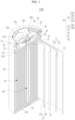
- FIG. 1 is a perspective, cross-sectional view of a rechargeable battery 1000 according to one or more embodiments of the present disclosure.
- a rechargeable battery 1000 includes an electrode assembly 10, a case 20 having the electrode assembly 10 built thereinto, a cap assembly 30 coupled to an opening of the case 20 via a gasket and electrically connected to the electrode assembly 10, an insulating plate 50 provided between the cap assembly 30 and the electrode assembly 10, and a center pin 60 arranged at a center of the electrode assembly 10.
- the electrode assembly 10 includes a first electrode 11, a separator 12, and a second electrode 13 that are sequentially stacked.
- the electrode assembly 10 may be a cylindrical jelly roll in which the first electrode 11, the separator 12, and the second electrode 13 are stacked and then wound around the center pin 60.
- the first electrode 11 is formed of a thin conductive metal plate and includes a base material utilized as a current collector and an active material layer.
- the base material of the first electrode 11 may be aluminum (Al).
- the first electrode 11 includes a base material, an electrode active part 11a in which an active material layer is formed on both surfaces (e.g., opposite surfaces or opposite sides) of the base material, and a first electrode uncoated part 11b, which is an area in which the base material is exposed because the active material layer is not formed.
- the first electrode uncoated part 11b may be formed along an edge in the winding direction along the active material layer, but the present disclosure is not limited thereto, and may be formed only at an end of the winding direction (see, e.g., FIG. 2 ) by removing the part formed along the edge in the winding direction through a slitting process.
- a compound (lithiated intercalation compound) capable of reversible intercalation and deintercalation of lithium may be utilized.
- one or more types (kinds) of complex oxides including lithium and metals selected from among cobalt, manganese, nickel, and/or a ( e.g ., any suitable) combination thereof may be utilized.
- the content ( e.g ., amount) of the positive electrode active material may be about 90 wt% to about 98 wt% based on a total weight of the positive electrode active material layer.
- the positive electrode active material layer may further include a binder and a conductive material.
- the content (e.g ., amount) of the binder and the conductive material may each be about 1 wt% to about 5 wt% based on the total weight of the positive electrode active material layer.
- the binder serves to adhere the positive electrode active material particles to each other suitably well and also to adhere the positive electrode active material to the base material which is the current collector suitably well.
- Representative examples of the binder may include polyvinyl alcohol, carboxymethylcellulose, hydroxypropyl cellulose, diacetyl cellulose, polyvinylchloride, carboxylated polyvinylchloride, polyvinyl fluoride, polymers containing ethylene oxide, polyvinylpyrrolidone, polyurethane, polytetrafluoroethylene, polyvinylidene fluoride, polyethylene, polypropylene, styrene butadiene rubber, acrylated styrene butadiene rubber, epoxy resin, nylon, etc., but the present disclosure is not limited thereto.
- the conductive material is utilized to impart conductivity to the electrode, and in the configured battery, any electronically conductive material may be utilized as long as it does not cause a chemical change.
- the second electrode 13 is formed of a thin conductive metal plate and includes a base material utilized as a current collector and an active material layer.
- the base material of the second electrode 13 may be copper (Cu).
- the second electrode 13 includes a base material, a second electrode active part 13a in which an active material layer is formed on both surfaces (e.g., opposite surfaces or opposite sides) of the base material, and a second electrode uncoated part 13b, which is an area in which the base material is exposed because the active material layer is not formed.
- the second electrode uncoated part 13b may be formed on at least one edge of the active material layer and may be formed along an edge in the winding direction along the active material layer, but the present disclosure is not limited thereto, and the second electrode uncoated part 13b may be formed only at the end of the winding direction by removing the part formed along the edge in the winding direction through the slitting process.
- the negative electrode active material of the second electrode 13 may be a carbon-based active material.
- the carbon-based negative electrode active material may be artificial graphite and/or a ( e.g ., any suitable) mixture of artificial graphite and natural graphite.
- crystallographic characteristics of the particles are more developed compared to if ( e.g ., when) utilizing an amorphous carbon-based active material, so further improving alignment characteristics of a carbon material within an electrode plate with respect to an external magnetic flux may be desirable.
- the shape of the artificial graphite or natural graphite may be an amorphous shape, a plate shape ( e.g ., in a form of plates), a flake shape ( e.g ., in a form of flakes), a spherical shape, a fibrous shape, and/or a ( e.g ., any suitable) combination thereof, and may be any shape.
- a mixing ratio may be a weight (wt%) ratio of about 70:30 to about 95:5.
- the negative electrode active material further includes these negative electrode active materials, that is, if (e.g., when) the negative electrode active material includes the carbon-based negative electrode active material as a first negative electrode active material and one of the above negative electrode active materials (e.g ., the Si-based, Sn-based, or LiMO x -based negative electrode active materials) as a second negative electrode active material, the mixing ratio of the first negative electrode active material and the second negative electrode active material may be a weight ratio of about 50:50 to about 99:1.
- the Si-based negative electrode active material may include Si, a Si-C composite body, SiO x (0 ⁇ x ⁇ 2), and Si-Q alloy (the Q is an element selected from the group consisting of alkali metals, alkaline earth metals, Group 13 elements, Group 14 elements, Group 15 elements, Group 16 elements, transition metals, rare earth elements, and/or a ( e.g ., any suitable) combination thereof, but not Si), and the Sn-based negative electrode active material may include Sn, SnO x (0 ⁇ x ⁇ 2, including SnO 2 ), and/or Sn-R alloy (the R is an element selected from the group consisting of alkali metals, alkaline earth metals, Group 13 elements, Group 14 elements, Group 15 elements, Group 16 elements, transition metals, rare earth elements, and/or a ( e.g ., any suitable) combination thereof, but not Sn), and in addition, a mixture of at least one of them and SiO 2 may also be utilized.
- the Q
- elements Q and R elements selected from the group consisting of Mg, Ca, Sr, Ba, Ra, Sc, Y, Ti, Zr, Hf, Rf, V, Nb, Ta, Db, Cr, Mo, W, Sg, Tc, Re, Bh, Fe, Pb, Ru, Os, Hs, Rh, Ir, Pd, Pt, Cu, Ag, Au, Zn, Cd, B, Al, Ga, Sn, In, Tl, Ge, P, As, Sb, Bi, S, Se, Te, Po, and/or a ( e.g ., any suitable) combination thereof may be utilized.
- the content ( e.g ., amount) of the negative electrode active material in the negative electrode active material layer may be about 95 wt% to about 99 wt% based on the total weight of the negative electrode active material layer.
- the negative electrode active material layer may further include a binder, and optionally may further include a conductive material.
- the content (e.g ., amount) of the binder in the negative electrode active material layer may be 1 wt% to 5 wt% based on the total weight of the negative electrode active material layer.
- the negative electrode active material layer may contain about 90% to about 98 wt% of negative electrode active material, about 1% to about 5 wt% of binder, and about 1% to about 5 wt% of conductive material.
- the binder adheres the negative electrode active material particles to each other suitably well and also adheres the negative electrode active material to the negative electrode base material suitably well.
- a non-aqueous binder, an aqueous binder, and/or a ( e.g ., any suitable) combination thereof may be utilized.
- non-aqueous binder may include polyvinylchloride, carboxylated polyvinylchloride, polyvinylfluoride, and polymers containing ethylene oxide, polyvinylpyrrolidone, polyurethane, polytetrafluoroethylene, polyvinylidene fluoride, polyethylene, polypropylene, polyamideimide, polyimide and/or a ( e.g ., any suitable) combination thereof.
- aqueous binders may include styrene-butadiene rubber, acrylated styrene-butadiene rubber (SBR), acrylo nitrile-butadiene rubber, acryl rubber, butyl rubber, ethylene propylene copolymer, polyphelohydrin, polyphosphazene, polyacrylonitrile, polystyrene, ethylene propylene dienecopolymer, polyvinyl pyridine, chlorosulfonated polyethylene, latex, polyester resin, acryl resin, phenol resin, epoxy resin, polyvinyl alcohol, acrylate-based resin, and/or a ( e.g ., any suitable) combination thereof
- a cellulose-based compound capable of imparting viscosity may be further included as a thickener.
- a cellulose-based compound capable of imparting viscosity may be further included as a thickener.
- the cellulose-based compound one or more types (kinds) of carboxymethyl cellulose, hydroxypropyl methyl cellulose, methyl cellulose, and alkali metal salts thereof may be utilized. Na, K, or Li may be utilized as the alkali metal.
- the amount of thickener utilized may be about 0.1 parts by weight to about 3 parts by weight based on 100 parts by weight of the negative electrode active material.
- the conductive material is utilized to impart conductivity to the electrode, and in the configured battery, any electronically conductive material may be utilized as long as it does not cause a chemical change.
- the conductive material may include carbon-based materials such as natural graphite, artificial graphite, carbon black, acetylene black, Ketjen black, and/or carbon fiber; metallic materials such as metal powders such as copper, nickel, aluminum, and/or silver, and/or metal fibers; conductive polymers such as polyphenylene derivatives; and/or conductive materials containing a ( e.g ., any suitable) mixture thereof.
- a Brunauer-Emmett-Teller (BET) specific surface area of the negative electrode active material layer may be less than about 3.0 m 2 /g, and may also be about 0.6 m 2 /g to about 1.2 m 2 /g.
- BET Brunauer-Emmett-Teller
- the BET measurement is performed by a nitrogen gas adsorption method that charges and discharges a lithium rechargeable battery including the negative electrode, cutting a negative electrode obtained by dismantling the fully discharged battery into a certain size, and putting the cut negative electrode in a BET sample holder.
- the negative electrode may have a cross-sectional loading level (L/L) of about 6 mg/cm 2 to about 65 mg/cm 2 .
- the negative electrode active material layer according to one or more embodiments of the present disclosure includes an aligned part and a non-aligned part.
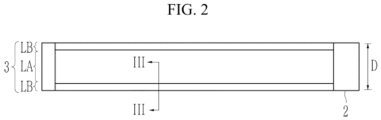
- FIG. 2 is a plan view of an unfolded negative electrode according to one or more embodiments of the present disclosure.
- FIG. 3 is a cross-sectional view taken along the line III-III of FIG. 2 , according to one or more embodiments of the present disclosure.
- the negative electrode which is the second electrode 13 includes a base material 2 and an active material layer 3 formed on the base material 2.
- the base material 2 may have a strip shape in which a width in a first direction is relatively shorter than a length in a second direction intersecting the first direction.
- the active material layer 3 includes an aligned part LA and a non-aligned part LB, and the aligned part LA may include a lower layer 3a positioned on the base material 2, and an upper layer 3b positioned on the lower layer 3a.
- the aligned part LA may be about 10% to about 90% based on a total width D of the active material layer 3.
- FIG. 4 is a schematic diagram for describing an alignment of a negative electrode active material according to one or more embodiments of the present disclosure.
- the aligned part LA may be aligned so that the active material particles have a constant angle with respect to a surface ( e.g ., upper surface) of the base material.
- a surface e.g ., upper surface
- the active material particles are aligned at a constant angle with respect to the surface ( e.g ., upper surface) of the base material utilizing a magnetic flux.
- the magnetic flux caused by a magnet is formed in a direction normal (e.g ., perpendicular) to the negative electrode base material, but the direction in which the magnetic field is formed depends on the coating speed (e.g ., moving speed of the negative electrode base material), and is formed at a constant angle as a vector function, so the negative active material particles included in the negative active material composition may have a shape that stands, i.e ., is aligned at a certain angle with respect to the surface of the negative electrode base material.
- the alignment angle and direction of the aligned part LA may be adjusted by the strength of the magnetic flux applied to the active material layer, the exposure time to the magnetic flux, and the viscosity of the negative active material composition.
- the non-aligned part LB may be diffuse-aligned when compared to the aligned part LA.
- the movement of Li ions in the active material layer of the non-aligned part LB is relatively less smooth compared to the active material layer of the aligned part LA, so direct current internal resistance may be relatively higher in the non-aligned part LB.
- the ratio of the peak intensity of the (002) plane to the peak intensity of the (110) plane of the aligned part LA may be less than 1.
- I 002 /I 110 of the non-aligned part LB may be about 200 or more, and I 002 /I 110 of the aligned part LA may be less than about 200.
- the upper layer 3b may be aligned while the lower layer 3a remains non-aligned. Accordingly, the lower layer 3a may be formed of 10% to 90% based on the total thickness of the active material layer, and the upper layer 3b may be formed of 10% to 90% based on the total thickness of the active material layer.
- the active material particles of the upper layer 3b may be aligned at an angle of about 10° to about 80° based on (relative to) the surface ( e.g ., upper surface) of the base material 2, and if ( e.g ., when) the peak intensity ratio I 002 /I 110 of the lower layer 3a is 1, the peak intensity ratio of the upper layer 3b may be less than 1. For example, if ( e.g ., when) the peak intensity ratio of the lower layer 3a is about 200, the peak intensity ratio of the upper layer 3b may be less than about 200.
- the aligned part LA may be made of a different material from the non-aligned part LB in order to increase alignment, and the lower layer 3a and the upper layer 3b of the aligned part LA may also be made of different materials.
- the lower layer 3a and the upper layer 3b of the aligned part LA have been described as being made of the same material, but the present disclosure is not limited thereto, and the lower and upper layers may be made of different materials.
- the degree of alignment or alignment angle of the active material particles in the lower layer 3a and the upper layer 3b may be different from each other.
- the upper layer 3b may be aligned in a direction normal ( e.g ., perpendicular) to the base material and at a greater angle than the lower layer 3a relative to the surface ( e.g ., upper surface) of the base material 2, and the lower layer 3a may be aligned at a lower angle than the upper layer 3b relative to the surface ( e.g ., upper surface) of the base material 2, or may not be aligned at a specific angle.
- the upper layer 3b may further include more active material particles aligned in a direction normal ( e.g ., perpendicular) to the surface ( e.g ., upper surface) of the base material 2 than the lower layer 3a
- the lower layer 3a may further include more active material particles aligned in a direction parallel to the surface ( e.g ., upper surface) of the base material than the upper layer 3b, when viewed in a cross-sectional view as shown, for example, in FIG. 3
- the lower layer 3a may be diffuse-aligned like the non-aligned part LB.
- the active material particles of the negative electrode have an elongated shape in approximately one direction, and the aligned active material particles have a major axis of the active material particles inclined with respect to the base material. Accordingly, an end portion of the active material particles in the major-axis direction may come into contact with the base material, and the adhesion with the base material 2 may be relatively lower than that of the non-aligned part LB whose major axis is parallel to the base material.
- the lower layer 3a is relatively non-aligned compared to the upper layer 3b, thereby increasing the adhesion to the base material.
- the upper layer 3b may be aligned to increase the mobility of the electrolytic solution and minimize or reduce the occurrence of the non-moisture area.
- the occurrence of the non-moisture area in the winding type or kind electrode assembly may be minimized or reduced by arranging the aligned part and the non-aligned part with different degrees of alignment depending on the position.
- the separator 12 is arranged between the first electrode 11 and the second electrode 13 and insulates them, and as the separator 12, a multilayer film of two or more layers of polyethylene, polypropylene, polyvinylidene fluoride, or a ( e.g ., any suitable) combination thereof may be utilized, and a mixed multilayer such as a two-layer separator of polyethylene/polypropylene, a three-layer separator of polyethylene/polypropylene/polyethylene, and a three-layer separator of polypropylene/polyethylene/polypropylene may be utilized.
- a mixed multilayer such as a two-layer separator of polyethylene/polypropylene, a three-layer separator of polyethylene/polypropylene/polyethylene, and a three-layer separator of polypropylene/polyethylene/polypropylene may be utilized.
- a first electrode current collecting plate 11d is connected to the first electrode uncoated part 11b of the electrode assembly 10
- a second electrode current collecting plate 13d is connected to the second electrode uncoated part 13b of electrode assembly 10.
- the second electrode current collecting plate 13d is in contact with the case 20, but the first electrode current collecting plate 11d is formed to be narrower than the second electrode current collecting plate 13d, and thus, is formed not to be in contact with the case 20.
- the first electrode uncoated part 11b is bent toward the center pin 60, which is the center of the electrode assembly 10, and neighboring first electrode uncoated parts 11b may overlap each other and overlap to be electrically connected.
- the first electrode uncoated part 11b may be electrically connected to the first electrode current collecting plate 11d in an overlapping state.
- the first electrode uncoated part 11b includes one surface electrically connected by contacting the first electrode current collecting plate 11d and the other surface facing the end of the second electrode 13, and the other surface is spaced and/or apart ( e.g ., spaced apart or separated) from an end portion of the second electrode 13.
- a lead tab 37 is electrically connected to the first electrode current collecting plate 11d.
- One end of the lead tab 37 may be connected to the first electrode uncoated part 11b by welding to the first electrode current collecting plate 11d, and the other end may be electrically connected to the cap assembly 30.
- the lead tab 37 may be bent so that one surface faces the cap assembly 30 to increase the contact area with the cap assembly 30.
- An insulating plate 50 having an opening exposing the center pin 60 is positioned on the first electrode current collecting plate 11d.
- the insulating plate 50 is formed to be larger than the first electrode current collecting plate 11d, so that the insulating plate 50 may contact the inner surface of the case 20. If ( e.g ., when) the insulating plate 50 is formed larger than the first electrode current collecting plate 11d, a constant gap is formed between the first electrode current collecting plate 11d and the case 20 by the width of the insulating plate 50 protruding to an outside of the first electrode current collecting plate 11d. The gap between the first electrode current collecting plate 11d and the case 20 may prevent or reduce the first electrode current collecting plate 11d and the case 20 from contacting and short-circuiting.
- the lead tab 37 may be in contact with and be connected to the first auxiliary plate 34 of the cap assembly 30, which will be described in more detail later, through the opening 51 of the insulating plate 50.
- the center pin 60 is arranged at the center of the electrode assembly 10 and may be arranged parallel to the direction in which the electrode assembly 10 is inserted into the case 20.
- the center pin 60 is to minimize or reduce deformation and/or maintain a shape close to the shape before deformation if ( e.g ., when) receiving an entire compressive load or local impact load acting from outside of the rechargeable battery 1000, and may be a hollow circular pipe. In one or more embodiments, the center pin 60 may serve as a moving passage for gas generated internally. If necessary or desired, the center pin 60 may not be provided.
- the center pin 60 may be formed of a material having certain rigidity, for example, a conductive metal such as steel, steel alloy, aluminum, aluminum alloy, and/or the like, in order to be minimally deformed when exposed to an external impact. In this way, because the center pin 60 is conductive, both ends of the center pin 60 are installed to maintain an electrically insulated state between the first electrode current collecting plate 11d and the second electrode current collecting plate 13d.
- a conductive metal such as steel, steel alloy, aluminum, aluminum alloy, and/or the like
- an insulating pad 52 is arranged between a lower end of the center pin 60 and the corresponding second electrode current collecting plate 13d.
- An upper end of the center pin 60 passes through a through hole formed in the center of the first electrode current collecting plate 11d in an insulated state and is supported on the insulating plate 50.
- the upper end of the center pin 60 may be spaced and/or apart ( e.g ., spaced apart or separated) from the through hole of the first electrode current collecting plate 11d, and an insulating member may be interposed therebetween. Accordingly, the movement of the center pin 60 in the longitudinal direction of the center pin 60 is restricted, and the center pin 60 may be maintained in a stable state at the center of the electrode assembly 10.
- One side of the case 20 is open so that the electrode assembly 10 may be inserted along with the electrolyte, and the case 20 may be formed to have approximately the same shape as the jelly roll-shaped electrode assembly 10.
- the case 20 may include a circular bottom portion and a cylindrical side portion extending a certain length upward from the bottom portion.
- the upper portion of the cylindrical case may be open. Therefore, during the assembly process of the rechargeable battery 1000, the electrode assembly may be inserted into the cylindrical case, and then the electrolytic solution may be injected into the cylindrical case.
- the electrolytic solution allows lithium ions generated by electrochemical reactions to move between the first and second electrodes inside the battery.
- the electrolytic solution may be composed of lithium salts such as LiPF 6 and/or LiBF 4 in organic solvents such as ethylene carbonate (EC), propylene carbonate (PC), diethyl carbonate (DEC), and/or ethyl methyl carbonate (EMC).
- the electrolytic solution may be liquid, solid, or gel phase.
- the case 20 is connected to the second electrode current collecting plate 13d of the electrode assembly and may function as a second electrode terminal of the rechargeable battery 1000. Therefore, the case 20 may be made of a conductive metal (e.g ., electron conductor metal) such as aluminum, aluminum alloy, or nickel-plated steel. In one or more embodiments, a separate electrode tab may be attached and connected to the second electrode current collecting plate 13d, like the first electrode current collecting plate 11d.
- a conductive metal e.g ., electron conductor metal
- a separate electrode tab may be attached and connected to the second electrode current collecting plate 13d, like the first electrode current collecting plate 11d.
- the cap assembly 30 is located in the opening of the case 20 and is coupled to the case 20 with the gasket 40 interposed therebetween.
- the gasket 40 insulates the case 20 and the cap assembly 30 and seals the inside of the case 20 that accommodates the electrode assembly 10 and the electrolytic solution.
- the cap assembly 30 includes a cap plate 31, a positive temperature coefficient element 35, a vent plate 32, an insulating member 33, a first auxiliary plate 34, and a second auxiliary plate 38.
- the first auxiliary plate 34 may electrically connected to the lead tab 37, and may be coupled to the lead tab 37 by welding.
- the second auxiliary plate 38 may be stacked on the first auxiliary plate 34 and electrically connected to the first auxiliary plate 34, and may be coupled to the first auxiliary plate 34 by the welding.
- the second auxiliary plate 38 is located at the center of the electrode assembly 10 corresponding to the center pin 60 and has a through hole exposing the first auxiliary plate 34.
- the vent plate 32 is located on the second auxiliary plate 38 with the insulating member 33 interposed therebetween.
- the edge of the vent plate 32 may be inserted into the gasket 40 and coupled to the case 20.
- the vent plate 32 includes a vent 32a located in a portion corresponding to the center pin 60.
- the vent 32a protrudes from the vent plate 32 toward the electrode assembly 10 and is in contact with and electrically connected to the first auxiliary plate 34 through the through hole.
- the vent plate 32 may have a notch 32b around the vent 32a that guides the damage to the vent 32a.
- the vent 32a may be damaged under a preset pressure condition, releasing the internal gas to the outside and blocking the electrical connection with the first auxiliary plate 34. For example, if ( e.g ., when) the internal pressure of the case 20 increases due to the generation of gas, the notch 32b is damaged in advance and the gas is discharged to the outside through the exhaust port 31d, which will be described in more detail later, thereby preventing or substantially preventing the rechargeable battery 1000 from expanding or exploding.
- the electrical connection between the vent plate 32 and the first auxiliary plate 34 is disconnected. Accordingly, the electrical connection between the cap plate 31 and the first auxiliary plate 34, which are electrically connected to the vent plate 32, is disconnected, and thus, no more current flows.
- the cap plate 31 includes a center plate 31a corresponding to the center pin 60, which is the center of the electrode assembly 10, a plurality of branch parts 31b extending from the center plate 31a toward the gasket 40, and a coupling plate 31c that is connected to one end of the branch parts 31b and inserted into and coupled to the gasket 40.
- An exhaust port 31d that is open to the outside and discharges internal gas is formed between adjacent branch parts 31b.
- the branch part 31b is connected to the center plate 31a while bent from the coupling plate 31c, so that the center of the cap plate 31 may protrude to the outside of the case 20.
- the cap plate 31 is electrically connected to the first electrode current collecting plate 11d through the vent plate 32, the second auxiliary plate 38, the first auxiliary plate 34, and the lead tab 37, and thus, may be utilized as the first electrode terminal of the rechargeable battery 1000. Therefore, if ( e.g ., when) the center of the cap plate 31 is formed to protrude to the outside of the case 20, the terminal connection with an external device may be facilitated.
- the positive temperature coefficient element 35 may be formed along the edge of the cap plate 31, and may be inserted into and coupled to the gasket 40 while stacked between the coupling plate 31c of the cap plate 31 and the edge of the vent plate 32.
- the positive temperature coefficient element 35 is installed between the cap plate 31 and the vent plate 32, and may regulate the current flow between the cap plate 31 and the vent plate 32 according to the internal temperature of the rechargeable battery 1000.
- the positive temperature coefficient element 35 acts as a conductor (electron conductor) to electrically connect between the cap plate 31 and the vent plate 32. However, if ( e.g ., when) the internal temperature exceeds the preset temperature, the positive temperature coefficient element 35 has an electrical resistance that increases to infinity (electron insulator). Therefore, the positive temperature coefficient element 35 may block or reduce the flow of the charge or discharge current between the cap plate 31 and the vent plate 32.
- the cap assembly 30 is inserted into the gasket 40 in a form in which the vent plate 32, the positive temperature coefficient element 35, and the cap plate 31 are stacked on the edge of the cap assembly 30 while the electrode assembly 10 is inserted into the case 20, and then is inserted into the opening of the case 20.
- a beading part 21 and a crimping part 22 may be formed on a side adjacent to the opening of the case 20.
- the beading part 21 may be formed through a beading process.
- the beading part 21 has a structure that is depressed from the upper side of the case 20 to a radial center of the case 20 while the electrode assembly 10 is accommodated in the case 20, and prevents or protects the electrode assembly 10 from moving up and down.
- the crimping part 22 is connected to the beading part 21 in a structure that protrudes relatively from the beading part 21 in the radial direction, and holds an outer circumferential surface (edge) of the cap assembly 30 via the gasket 40, where upper and lower surfaces of the cap assembly 30 are connected to the outer circumferential surface (edge).
- FIG. 5 is a image measuring impregnability of a cylindrical electrode assembly according to one or more embodiments of the present disclosure.
- FIG. 6 is a image measuring the impregnability of the cylindrical electrode assembly according to the comparable art.
- the area of the non-moisture area of the electrode assembly according to one or more embodiments of the present disclosure in FIG. 5 is smaller than the area of the non-moisture area of the electrode assembly according to the comparable art in FIG. 6 .
- the aligned part by disposing the aligned part between the non-aligned parts so that the aligned part is located in the center of the cylindrical electrode assembly, it is possible to minimize or reduce the occurrence of the non-moisture area in the center of the winding type or kind electrode assembly.
- the electrolytic solution flows from both ends of the center pin 60 toward the center of the center pin 60, and the electrolytic solution moves to the active material layer of the adjacently located second electrodes (negative electrodes) 13 while flowing through the center pin 60.
- the electrolytic solution When the electrolytic solution is injected in a first direction D1 parallel to the center pin 60, the electrolytic solution branches into the second direction D2 normal ( e.g ., perpendicular) to the first direction D1 while moving in the first direction D1.
- the second direction D2 normal (e.g ., perpendicular) to the first direction D1 while moving in the first direction D1.
- the movement distance of the electrolytic solution is relatively long, and the active material particles in the center portion of the electrode assembly, where the electrolytic solution is not easily injected, are arranged in the direction normal (e.g., perpendicular) to the base material, so the movement of the electrolytic solution in the second direction D2 may be made smooth.
- Table 1 shows data measuring adhesion according to Comparative Examples 1 and 2 and an Example. TABLE 1 DOE Comparative Example 1 Comparative Example 2 Example A plane B plane A plane B plane A plane B plane Adhesion (gf/mm) 1.66 1.36 1.21 1.19 2.13 1.71
- Comparative Example 1 is a battery that is entirely non-aligned because it is not subjected to an alignment process
- Comparative Example 2 is a battery that is entirely aligned
- Example is a battery that the center portion is aligned and the edges are non-aligned.
- Table 2 shows Rion measurement data of a Comparative Example and an Example.
- Comparative Example 1 is a battery that does not undergo the alignment process and is therefore entirely non-aligned.
- Table 2 PF5.0 L/L(mg/cm 2 ) Rion Comparative Example 1 21.20 27.8 Example 21.78 22.7
- Rion is a resistance value that affects the movement of the lithium ions. The lower the resistance value, the more smoothly the lithium ions move, and the higher the resistance value, the less smoothly the lithium ions move.
- the Rion of Comparative Example 1 is 27.8, and the Rion of Example is 22.7, which shows that the Rion of Example has a lower value. Therefore, it can be seen that the Rion of Example is lower than that of Comparative Example 1, and thus, the lithium ions may move more smoothly.
- a loading level (L/L) of Comparative Example 1 was 21.20, and the loading level of the Example was 21.78, which indicated that although the loading level of the Example was higher than that of the Comparative Example, the Rion was lower in the Example.
- FIG. 8 is a graph showing dQ/dV according to a relative voltage in a Comparative Example and an Example.
- Table 3 shows kinetic measurement data from FIG. 8 .
- Table 3 PF5.0 0.8C L/L(mg/cm 2 ) Mixture density (g/cc) Current density (mAh/cm 2 ) Actual measurement Actual measurement Design Kinetic value Precipitation Comparative Example 1 10.64 1.66 2.83 47.33 X
- a kinetic value was calculated as a value obtained by dividing the capacity when the voltage is 0 in CV data by a C-rate.
- the kinetic value of the Example is 48.67, which is greater than 47.33 of the Comparative Example 1. Accordingly, it can be seen that the motility of the Example is increased compared to the Comparative Example 1.
- the term “substantially,” “about,” and similar terms are used as terms of approximation and not as terms of degree, and are intended to account for the inherent deviations in measured or calculated values that would be recognized by those of ordinary skill in the art. "Substantially” as used herein, is inclusive of the stated value and means within an acceptable range of deviation for the particular value as determined by one of ordinary skill in the art, considering the measurement in question and the error associated with measurement of the particular quantity (i.e., the limitations of the measurement system). For example, “substantially” may mean within one or more standard deviations, or within ⁇ 30%, 20%, 10%, 5% of the stated value.
- any numerical range recited herein is intended to include all subranges of the same numerical precision subsumed within the recited range.
- a range of "1.0 to 10.0" is intended to include all subranges between (and including) the recited minimum value of 1.0 and the recited maximum value of 10.0, that is, having a minimum value equal to or greater than 1.0 and a maximum value equal to or less than 10.0, such as, for example, 2.4 to 7.6.
- Any maximum numerical limitation recited herein is intended to include all lower numerical limitations subsumed therein and any minimum numerical limitation recited in this specification is intended to include all higher numerical limitations subsumed therein. Accordingly, Applicant reserves the right to amend this specification, including the claims, to expressly recite any sub-range subsumed within the ranges expressly recited herein.
- the portable device, vehicle, and/or the battery e.g ., a battery controller, and/or any other relevant devices or components according to embodiments of the present disclosure described herein may be implemented utilizing any suitable hardware, firmware (e.g ., an application-specific integrated circuit), software, or a combination of software, firmware, and hardware.
- the various components of the device may be formed on one integrated circuit (IC) chip or on separate IC chips.
- the various components of the device may be implemented on a flexible printed circuit film, a tape carrier package (TCP), a printed circuit board (PCB), or formed on one substrate.
- the various components of the device may be a process or thread, running on one or more processors, in one or more computing devices, executing computer program instructions and interacting with other system components for performing the various functionalities described herein.
- the computer program instructions are stored in a memory which may be implemented in a computing device using a standard memory device, such as, for example, a random access memory (RAM).
- the computer program instructions may also be stored in other non-transitory computer readable media such as, for example, a CD-ROM, flash drive, or the like.
Landscapes
- Chemical & Material Sciences (AREA)
- Chemical Kinetics & Catalysis (AREA)
- Electrochemistry (AREA)
- General Chemical & Material Sciences (AREA)
- Engineering & Computer Science (AREA)
- Composite Materials (AREA)
- Manufacturing & Machinery (AREA)
- Materials Engineering (AREA)
- Battery Electrode And Active Subsutance (AREA)
Applications Claiming Priority (1)
| Application Number | Priority Date | Filing Date | Title |
|---|---|---|---|
| KR1020230155626A KR20250069205A (ko) | 2023-11-10 | 2023-11-10 | 이차 전지용 음극 및 이를 포함하는 이차 전지 |
Publications (1)
| Publication Number | Publication Date |
|---|---|
| EP4553923A1 true EP4553923A1 (de) | 2025-05-14 |
Family
ID=93455766
Family Applications (1)
| Application Number | Title | Priority Date | Filing Date |
|---|---|---|---|
| EP24211315.7A Pending EP4553923A1 (de) | 2023-11-10 | 2024-11-07 | Negative elektrode für eine wiederaufladbare batterie und wiederaufladbare batterie damit |
Country Status (4)
| Country | Link |
|---|---|
| US (1) | US20250158018A1 (de) |
| EP (1) | EP4553923A1 (de) |
| KR (1) | KR20250069205A (de) |
| CN (1) | CN119993973A (de) |
Citations (3)
| Publication number | Priority date | Publication date | Assignee | Title |
|---|---|---|---|---|
| US20180151867A1 (en) * | 2016-11-29 | 2018-05-31 | Samsung Sdi Co., Ltd. | Electrode assembly and rechargeable battery including the same |
| CN115241417A (zh) * | 2021-04-23 | 2022-10-25 | 三星Sdi株式会社 | 用于可再充电锂电池的负极和包括其的可再充电锂电池 |
| KR102536147B1 (ko) * | 2022-11-25 | 2023-05-26 | 주식회사 엘지에너지솔루션 | 리튬 이차전지용 음극 및 이의 제조방법 |
-
2023
- 2023-11-10 KR KR1020230155626A patent/KR20250069205A/ko active Pending
-
2024
- 2024-04-29 US US18/649,843 patent/US20250158018A1/en active Pending
- 2024-09-06 CN CN202411249199.1A patent/CN119993973A/zh active Pending
- 2024-11-07 EP EP24211315.7A patent/EP4553923A1/de active Pending
Patent Citations (3)
| Publication number | Priority date | Publication date | Assignee | Title |
|---|---|---|---|---|
| US20180151867A1 (en) * | 2016-11-29 | 2018-05-31 | Samsung Sdi Co., Ltd. | Electrode assembly and rechargeable battery including the same |
| CN115241417A (zh) * | 2021-04-23 | 2022-10-25 | 三星Sdi株式会社 | 用于可再充电锂电池的负极和包括其的可再充电锂电池 |
| KR102536147B1 (ko) * | 2022-11-25 | 2023-05-26 | 주식회사 엘지에너지솔루션 | 리튬 이차전지용 음극 및 이의 제조방법 |
Also Published As
| Publication number | Publication date |
|---|---|
| US20250158018A1 (en) | 2025-05-15 |
| CN119993973A (zh) | 2025-05-13 |
| KR20250069205A (ko) | 2025-05-19 |
Similar Documents
| Publication | Publication Date | Title |
|---|---|---|
| US11152606B2 (en) | Electrode assembly and rechargeable battery including the same | |
| US7425386B2 (en) | Electrode group for battery and non-aqueous electrolyte secondary battery using the same | |
| US11469410B2 (en) | Electrode assembly and rechargeable battery including the same | |
| EP4553923A1 (de) | Negative elektrode für eine wiederaufladbare batterie und wiederaufladbare batterie damit | |
| EP4498442A2 (de) | Elektrode und wiederaufladbare batterie damit | |
| US20240396009A1 (en) | Electrode for rechargeable battery, electrode assembly, and rechargeable battery including the same | |
| US20250167202A1 (en) | Electrode for secondary battery and method of manufacturing the same | |
| EP4611086A1 (de) | Elektrode für eine wiederaufladbare batterie und elektrodenanordnung | |
| US20260011719A1 (en) | Negative electrode for rechargeable battery and manufacturing method thereof | |
| US20250246598A1 (en) | Electrode for rechargeable battery | |
| EP4636885A1 (de) | Separator für wiederaufladbare batterie und elektrodenanordnung damit | |
| EP4550516A2 (de) | Elektrode für eine wiederaufladbare batterie, elektrodenanordnung und wiederaufladbare batterie damit | |
| US20250140783A1 (en) | Electrode assembly and rechargeable battery including the same | |
| EP4589703A1 (de) | Elektrodenanordnung und sekundärbatterie damit | |
| US20250316796A1 (en) | Rechargeable battery and manufacturing method thereof | |
| US20260106308A1 (en) | Secondary battery module | |
| US20240258530A1 (en) | Electrode assembly and secondary battery comprising electrode assembly | |
| US20240186519A1 (en) | Current collector for rechargeable lithium battery, and electrode and rechargeable lithium battery including the same | |
| US20250392023A1 (en) | Electrode, electrode assembly, and rechargeable lithium battery including the same | |
| KR20250151700A (ko) | 이차 전지용 음극, 전극 조립체 및 이를 포함하는 이차 전지 팩 | |
| KR20250126219A (ko) | 이차 전지용 음극, 이차 전지 및 음극의 제조 방법 | |
| CN121862803A (zh) | 二次电池检查设备和检查方法以及二次电池制造方法 |
Legal Events
| Date | Code | Title | Description |
|---|---|---|---|
| PUAI | Public reference made under article 153(3) epc to a published international application that has entered the european phase |
Free format text: ORIGINAL CODE: 0009012 |
|
| STAA | Information on the status of an ep patent application or granted ep patent |
Free format text: STATUS: REQUEST FOR EXAMINATION WAS MADE |
|
| 17P | Request for examination filed |
Effective date: 20241107 |
|
| AK | Designated contracting states |
Kind code of ref document: A1 Designated state(s): AL AT BE BG CH CY CZ DE DK EE ES FI FR GB GR HR HU IE IS IT LI LT LU LV MC ME MK MT NL NO PL PT RO RS SE SI SK SM TR |