EP4553968A1 - Ensemble capuchon, batterie et bloc-batterie - Google Patents
Ensemble capuchon, batterie et bloc-batterie Download PDFInfo
- Publication number
- EP4553968A1 EP4553968A1 EP24201459.5A EP24201459A EP4553968A1 EP 4553968 A1 EP4553968 A1 EP 4553968A1 EP 24201459 A EP24201459 A EP 24201459A EP 4553968 A1 EP4553968 A1 EP 4553968A1
- Authority
- EP
- European Patent Office
- Prior art keywords
- cap assembly
- orifice plate
- pressure relief
- explosion
- battery
- Prior art date
- Legal status (The legal status is an assumption and is not a legal conclusion. Google has not performed a legal analysis and makes no representation as to the accuracy of the status listed.)
- Pending
Links
Images


Classifications
-
- H—ELECTRICITY
- H01—ELECTRIC ELEMENTS
- H01M—PROCESSES OR MEANS, e.g. BATTERIES, FOR THE DIRECT CONVERSION OF CHEMICAL ENERGY INTO ELECTRICAL ENERGY
- H01M50/00—Constructional details or processes of manufacture of the non-active parts of electrochemical cells other than fuel cells, e.g. hybrid cells
- H01M50/10—Primary casings; Jackets or wrappings
- H01M50/14—Primary casings; Jackets or wrappings for protecting against damage caused by external factors
- H01M50/143—Fireproof; Explosion-proof
-
- H—ELECTRICITY
- H01—ELECTRIC ELEMENTS
- H01M—PROCESSES OR MEANS, e.g. BATTERIES, FOR THE DIRECT CONVERSION OF CHEMICAL ENERGY INTO ELECTRICAL ENERGY
- H01M50/00—Constructional details or processes of manufacture of the non-active parts of electrochemical cells other than fuel cells, e.g. hybrid cells
- H01M50/30—Arrangements for facilitating escape of gases
- H01M50/342—Non-re-sealable arrangements
- H01M50/3425—Non-re-sealable arrangements in the form of rupturable membranes or weakened parts, e.g. pierced with the aid of a sharp member
-
- H—ELECTRICITY
- H01—ELECTRIC ELEMENTS
- H01M—PROCESSES OR MEANS, e.g. BATTERIES, FOR THE DIRECT CONVERSION OF CHEMICAL ENERGY INTO ELECTRICAL ENERGY
- H01M10/00—Secondary cells; Manufacture thereof
- H01M10/05—Accumulators with non-aqueous electrolyte
- H01M10/052—Li-accumulators
- H01M10/0525—Rocking-chair batteries, i.e. batteries with lithium insertion or intercalation in both electrodes; Lithium-ion batteries
-
- H—ELECTRICITY
- H01—ELECTRIC ELEMENTS
- H01M—PROCESSES OR MEANS, e.g. BATTERIES, FOR THE DIRECT CONVERSION OF CHEMICAL ENERGY INTO ELECTRICAL ENERGY
- H01M50/00—Constructional details or processes of manufacture of the non-active parts of electrochemical cells other than fuel cells, e.g. hybrid cells
- H01M50/10—Primary casings; Jackets or wrappings
- H01M50/147—Lids or covers
- H01M50/148—Lids or covers characterised by their shape
- H01M50/152—Lids or covers characterised by their shape for cells having curved cross-section, e.g. round or elliptic
-
- H—ELECTRICITY
- H01—ELECTRIC ELEMENTS
- H01M—PROCESSES OR MEANS, e.g. BATTERIES, FOR THE DIRECT CONVERSION OF CHEMICAL ENERGY INTO ELECTRICAL ENERGY
- H01M50/00—Constructional details or processes of manufacture of the non-active parts of electrochemical cells other than fuel cells, e.g. hybrid cells
- H01M50/10—Primary casings; Jackets or wrappings
- H01M50/183—Sealing members
-
- H—ELECTRICITY
- H01—ELECTRIC ELEMENTS
- H01M—PROCESSES OR MEANS, e.g. BATTERIES, FOR THE DIRECT CONVERSION OF CHEMICAL ENERGY INTO ELECTRICAL ENERGY
- H01M50/00—Constructional details or processes of manufacture of the non-active parts of electrochemical cells other than fuel cells, e.g. hybrid cells
- H01M50/10—Primary casings; Jackets or wrappings
- H01M50/183—Sealing members
- H01M50/184—Sealing members characterised by their shape or structure
-
- H—ELECTRICITY
- H01—ELECTRIC ELEMENTS
- H01M—PROCESSES OR MEANS, e.g. BATTERIES, FOR THE DIRECT CONVERSION OF CHEMICAL ENERGY INTO ELECTRICAL ENERGY
- H01M50/00—Constructional details or processes of manufacture of the non-active parts of electrochemical cells other than fuel cells, e.g. hybrid cells
- H01M50/10—Primary casings; Jackets or wrappings
- H01M50/183—Sealing members
- H01M50/186—Sealing members characterised by the disposition of the sealing members
-
- H—ELECTRICITY
- H01—ELECTRIC ELEMENTS
- H01M—PROCESSES OR MEANS, e.g. BATTERIES, FOR THE DIRECT CONVERSION OF CHEMICAL ENERGY INTO ELECTRICAL ENERGY
- H01M50/00—Constructional details or processes of manufacture of the non-active parts of electrochemical cells other than fuel cells, e.g. hybrid cells
- H01M50/10—Primary casings; Jackets or wrappings
- H01M50/183—Sealing members
- H01M50/19—Sealing members characterised by the material
- H01M50/193—Organic material
-
- H—ELECTRICITY
- H01—ELECTRIC ELEMENTS
- H01M—PROCESSES OR MEANS, e.g. BATTERIES, FOR THE DIRECT CONVERSION OF CHEMICAL ENERGY INTO ELECTRICAL ENERGY
- H01M50/00—Constructional details or processes of manufacture of the non-active parts of electrochemical cells other than fuel cells, e.g. hybrid cells
- H01M50/20—Mountings; Secondary casings or frames; Racks, modules or packs; Suspension devices; Shock absorbers; Transport or carrying devices; Holders
- H01M50/204—Racks, modules or packs for multiple batteries or multiple cells
- H01M50/207—Racks, modules or packs for multiple batteries or multiple cells characterised by their shape
- H01M50/213—Racks, modules or packs for multiple batteries or multiple cells characterised by their shape adapted for cells having curved cross-section, e.g. round or elliptic
-
- H—ELECTRICITY
- H01—ELECTRIC ELEMENTS
- H01M—PROCESSES OR MEANS, e.g. BATTERIES, FOR THE DIRECT CONVERSION OF CHEMICAL ENERGY INTO ELECTRICAL ENERGY
- H01M50/00—Constructional details or processes of manufacture of the non-active parts of electrochemical cells other than fuel cells, e.g. hybrid cells
- H01M50/30—Arrangements for facilitating escape of gases
- H01M50/342—Non-re-sealable arrangements
-
- H—ELECTRICITY
- H01—ELECTRIC ELEMENTS
- H01M—PROCESSES OR MEANS, e.g. BATTERIES, FOR THE DIRECT CONVERSION OF CHEMICAL ENERGY INTO ELECTRICAL ENERGY
- H01M2200/00—Safety devices for primary or secondary batteries
- H01M2200/20—Pressure-sensitive devices
-
- Y—GENERAL TAGGING OF NEW TECHNOLOGICAL DEVELOPMENTS; GENERAL TAGGING OF CROSS-SECTIONAL TECHNOLOGIES SPANNING OVER SEVERAL SECTIONS OF THE IPC; TECHNICAL SUBJECTS COVERED BY FORMER USPC CROSS-REFERENCE ART COLLECTIONS [XRACs] AND DIGESTS
- Y02—TECHNOLOGIES OR APPLICATIONS FOR MITIGATION OR ADAPTATION AGAINST CLIMATE CHANGE
- Y02E—REDUCTION OF GREENHOUSE GAS [GHG] EMISSIONS, RELATED TO ENERGY GENERATION, TRANSMISSION OR DISTRIBUTION
- Y02E60/00—Enabling technologies; Technologies with a potential or indirect contribution to GHG emissions mitigation
- Y02E60/10—Energy storage using batteries
Definitions
- the present disclosure relates to the field of batteries, and more particularly, to a cap assembly, a battery, and a battery pack.
- a cap assembly of a cylindrical lithium ion secondary battery generally includes a top cover, an explosion-proof sheet, an orifice plate, and an insulating gasket disposed between the explosion-proof sheet and the orifice plate.
- the orifice plate is also provided with a first pressure relief hole for pressure relief purposes.
- the insulating gasket generally covers an outer side face of the orifice plate, and an outer surface of a portion of the orifice plate which is located on an outer side of the first pressure relief hole of the orifice plate.
- the area covered by the insulating gasket is too small to cause the battery and its battery module to form a short circuit connection between the orifice plate and the explosion-proof sheet during short circuit and crush tests, thereby affecting the performance of the battery.
- Embodiments of the present disclosure provide a cap assembly, a battery, and a battery pack, which may alleviate the technical problem of forming a short circuit connection between an orifice plate and an explosion-proof sheet in a battery.
- an embodiment of the present disclosure provides a cap assembly for a battery, the cap assembly including:
- the insulating gasket includes at least one second pressure relief hole disposed coaxially with the first pressure relief hole, the second pressure relief hole having an inner diameter that is not less than an inner diameter of the first pressure relief hole.
- the second pressure relief hole includes a waist-shaped hole.
- the second pressure relief hole is disposed in an annular area with a radius of 4mm ⁇ 6mm from a center of the insulating gasket.
- the insulating gasket further includes a through-hole in a central area of the insulating gasket for passage of the protrusion.
- an inner diameter of the through-hole is 2.6mm ⁇ 3.3mm, or an outer diameter of the protrusion is 1.9mm ⁇ 2.5mm.
- an inner diameter of the through-hole is 3.5mm ⁇ 4.0mm, or an outer diameter of the protrusion is 2.9mm ⁇ 3.4mm.
- the insulating gasket includes a third portion on which the second pressure relief hole is provided, and a fourth portion provided to protrude with respect to the third portion.
- a portion of the main body of the explosion-proof sheet is received inside the third portion.
- a thickness of the third portion is greater than 0.2mm, or a thickness of the fourth portion is greater than 0.25mm.
- the insulating gasket further includes a fifth portion bent and attached to the fourth portion, the fifth portion being wrapped around an outer side wall of a portion of the orifice plate.
- the insulating gasket includes a PFA material.
- the main body is further provided with one or more first score lines
- the explosion-proof sheet further including a second surface disposed opposite the first surface, the first score lines being recessed inwardly from the second surface, a projection of the second pressure relief hole on the first surface being configured to cover a portion of a projection of the first score lines on the first surface.
- the orifice plate further includes a third surface and a fourth surface that are oppositely disposed, the orifice plate further including a blind hole being formed by recessing inwardly from the fourth surface, the first surface and the third surface being welded to form a welding area on the third surface, a projection of the welding area on the fourth surface being located within the blind hole.
- the orifice plate further includes one or more second score lines disposed on the third surface, the second score lines being configured as an annular groove, a projection of the annular groove on the fourth surface being located at an outer periphery of the welding area.
- the projection of the annular groove on the fourth surface is located within the blind hole.
- an embodiment of the present disclosure provides a battery including the cap assembly as described above, the battery including a cylindrical lithium ion battery.
- an embodiment of the present disclosure provides a battery pack including a plurality of batteries, each of the plurality of batteries including the cap assembly as described above.
- directional words used herein such as “up” and “down” usually refer to up and down directions of a device in actual use or in an operational state, and in particular, to directions as shown in the drawings. References of "inside” and “outside” are made with respect to an outline of the device.
- the battery 1000 includes a housing 110, a cap assembly 100, a positive electrode, a negative electrode, a diaphragm and an electrolyte, where the housing 110 is preferably made of a nickel-plated steel sheet material to form a hollow cylindrical structure provided with an open top end, the cap assembly 100 is connected to the open top end of the housing 110 and seals the open top end of the housing 110, the housing 110 and the cap assembly 100 are enclosed to form an internal cavity of the battery 1000, the diaphragm is preferably made of a polyethylene film material, the diaphragm is configured to separate a material of the positive electrode and a material of the negative electrode, and the positive electrode material, the negative electrode material, and the diaphragm are spirally wound within the internal cavity of the battery 1000.
- the housing 110 is preferably made of a nickel-plated steel sheet material to form a hollow cylindrical structure provided with an open top end
- the cap assembly 100 is connected to the open top end of the housing 110 and seals the open top end of the housing 110
- the positive electrode is further electrically connected to the cap assembly 100 through a positive electrode bus plate, the negative electrode is further electrically connected to the housing 110 through a negative electrode bus plate; or the positive electrode is further electrically connected to the housing 110 through the positive electrode bus plate, and the negative electrode is further electrically connected to the cap assembly 100 through the negative electrode bus plate.
- the battery 1000 may be used in a portable electronic device by way of combination, where a battery cavity is provided inside the portable electronic device, and an interior of the battery cavity may receive one or more batteries that are matched according to an electric capacity required by the electronic device.
- the electronic device may be any device in the related art in which a lithium ion battery is required to supply power.
- Embodiments of the present disclosure also provide a battery pack in which a plurality of unit cells inside the battery pack may be arranged in series connection with each other, or the plurality of unit cells may be arranged in parallel connection with each other, or the plurality of unit cells may be arranged in a mixture of series and parallel connections with each other, so that the battery pack has a capacity and power suitable for use by a powered device.
- the battery pack further includes a connecting piece for connecting the plurality of unit cells such that there are stable series and/or parallel connection structures between positive and negative electrodes of the plurality of unit cells.
- a material suitable for preparing the connecting piece includes copper foil.
- the battery pack further includes a case for securing and protecting a plurality of unit cells and other parts.
- the case may be assembled from a plurality of sub-cases.
- a material suitable for preparing the case has good shock resistance, water resistance, and insulation properties.
- a suitable material includes metal or plastic materials.
- the above-described battery packs are applicable to powered devices including mobile phones, portable devices, laptops, electric bicycles, electric vehicles, electric boats, electric toys, electric tools, and the like.
- the coverage area of the insulating gasket on the orifice plate is in turn increased.
- the increased coverage area of the insulating gasket may effectively prevent a short circuit connection being formed between the orifice plate and the explosion-proof sheet when the battery is subjected to short circuit and crush tests.
- the coverage area of the insulating gasket on the orifice plate is in turn increased.
- the increased coverage area of the insulating gasket may effectively prevent a short circuit connection being formed between the orifice plate and the explosion-proof sheet when the battery is subjected to short circuit and crush tests.
- each battery including the cap assembly described above, by extending at least a portion of the insulating gasket onto a first portion covering the orifice plate, the first portion being closer to the center of the orifice plate relative to the first pressure relief hole of the orifice plate, the coverage area of the insulating gasket on the orifice plate is in turn increased.
- the increased coverage area of the insulating gasket may effectively prevent a short circuit connection being formed between the orifice plate and the explosion-proof sheet when the battery is subjected to short circuit and crush tests.
- the cap assembly 100 includes a top cover 10 and a sealing sleeve 20, the sealing sleeve 20 having first and second ends that are oppositely disposed, where the first end of the sealing sleeve 20 is openly disposed, an outer side wall of the sealing sleeve 20 is sealingly connected to an inner side wall of the housing 110, the top cover 10 is mounted proximate to an open top end of the sealing sleeve 20, and a portion of the top cover 10 is exposed through the open top end of the sealing sleeve 20.
- the cap assembly 10 further includes an explosion-proof sheet 30, an orifice plate 40, and an insulating gasket 50, where the top cover 10, the explosion-proof sheet 30, the insulating gasket 50, and the orifice plate 40 are disposed inside the sealing sleeve 20 from top to bottom.
- the cap assembly 100 is provided with an explosion-proof structure including a plurality of first holes 11 provided on the top cover 10, the top cover 10 including a base portion 12 and an extension portion 13 provided to protrude relative to the base portion 12, the base portion 12 being provided around the extension portion 13, the extension portion 13 including a side face 131 and a top end face 132 that are connected, where the base portion 12 and the top end face 132 of the top cover 10 are both configured to be planar, the top end face 132 is provided in parallel with the base portion 12, the first holes 11 are provided on the side face 131, and further, the first holes 11 extend from an edge of the base portion 12 to an edge of the top end face 132.
- the top cover 10 is provided with a plurality of first holes 11, the plurality of first holes 11 are maintained evenly spaced.
- the number of the plurality of first holes 11 may be two or three or four, etc., and the first holes 11 are generally configured as waist-shaped holes.
- the explosion-proof structure also includes an explosion-proof sheet 30 and one or more first score lines 31 disposed on the explosion-proof sheet 30.
- the explosion-proof sheet 30 includes first and second surfaces 301 and 302 that are oppositely disposed, where a portion of the first surface 301 is welded to the orifice plate 40 and a portion of the second surface 302 is welded to the top cover 10.
- the explosion-proof sheet 30 further includes a main body 32 and a protrusion 33 protruding upward with respect to the first surface 301 of the main body 32.
- the protrusion 33 is located in a central area of the explosion-proof sheet 30.
- the main body 32 further includes a first platform 321 and a second platform 322, where the first platform 321 is recessed downward with respect to the second platform 322, and the protrusion 33 continues to be recessed downward with respect to the first platform 321, and the second surface 302 of the second platform 322 is welded to the top cover 10.
- the explosion-proof sheet 30 further includes a first side wall 34 vertically connected to the second platform 322, the first side wall 34 being configured to be arranged around at least a portion of an outer side wall of the top cover 10, an inner wall surface of the first side wall 34 abutting an outer side face of the top cover 10, and an outer wall surface of the first side wall 34 abutting an inner wall surface of the sealing sleeve 20.
- the first platform 321 is provided thereon one or more first score lines 31, which is formed by recessing inwardly from the first surface 301 to the second surface 302.
- the first score lines 31 are configured as an annular groove structure, which is configured as a non-closed curve, in which an angle of circumference of the annular groove around the explosion-proof sheet 30 is greater than 180 degrees.
- the angle of circumference of the annular groove around the explosion-proof sheet 30 is 338° ⁇ 342°, so that the circumference in which the first score lines 31 are located is configured to be easily ruptured, thereby forming an outlet for a high-pressure air flow.
- the first score lines 31 are configured as an annular groove structure, and the first score lines 31 are provided so that a thickness of a residual wall where the first score lines 31 of the explosion-proof sheet 30 are located is relatively thin, and the residual wall is preferentially ruptured by an action of the high-pressure air flow so that cracks are easily formed, thereby forming the outlet for the high-pressure air flow.
- the explosion-proof structure further includes at least one first pressure relief hole 41 provided in the orifice plate 40, one end of the first pressure relief hole 41 being in communication with an inner cavity of the battery 1000, and another end of the first pressure relief hole 41 directly facing the first score lines 31 of the explosion-proof sheet 30.
- a plurality of first pressure relief holes 41 may be provided in the orifice plate 40.
- the number of the plurality of first pressure relief holes 41 may be three, four, five, or six, and the plurality of first pressure relief holes 41 may be maintained evenly spaced with respect to a central area of the orifice plate 40.
- the orifice plate 40 includes a third surface 401 and a fourth surface 402 that are oppositely disposed, where a portion of the third surface 401 is laser welded to the protrusion 33 of the explosion-proof sheet 30.
- At least a portion of a projection plane of the first score lines 31 described above on the third surface 401 is located inside the first pressure relief hole(s) 41.
- a blind hole 44 is further provided on the fourth surface 402 and is formed by recessing inwardly from the fourth surface 402.
- the orifice plate 40 includes a first portion 42 and a second portion 43 that are connected, where the first pressure relief hole(s) 41 is/are disposed between the first portion 42 and the second portion 43, and the first portion 42 is disposed closer to the central area of the orifice plate 40 relative to the second portion 43.
- the high-pressure air flow enters through the first pressure relief hole(s) 41 and impinges on the first platform 321 of the explosion-proof sheet 30.
- the first platform 321 of the explosion-proof sheet 30 is configured to be reversible.
- the first platform 321 of the explosion-proof sheet 30 is turned upwards.
- the first platform 321 further causes a welding between a bottom end face of the protrusion 33 and the orifice plate 40 to be ruptured, so that an electrical connection inside the battery 1000 is interrupted, thereby protecting the battery 1000.
- the central area of the explosion-proof sheet 30 is bonded to the central area of the orifice plate 40 by laser welding.
- a portion of the third surface 401 is welded to a portion of the first surface 301 to form a welding area as shown in FIG. 9 .
- the welding area is a substantially annular welding line 45, and a projection of the welding area on the fourth surface 402 is located within the blind hole 44.
- the welding area between the explosion-proof sheet 30 and the orifice plate 40 is configured to be within a central radius R1 from a center of the explosion-proof sheet 30, and the welding area is located within an area in which the protrusion 33 of the explosion-proof sheet 30 is located.
- the radius R1 of the welding area of the explosion-proof sheet 30 is not greater than 0.75mm
- the area in which the protrusion 33 of the explosion-proof sheet 30 is located is configured to be in a range of a circle having a radius 1/2R2 with the center of the explosion-proof sheet 30 as center of the circle.
- an outer radius R1 of the welding area of the explosion-proof sheet 30 may be any value in a range of 0.3mm ⁇ 0.75mm or may be of an arbitrary range, for example, the radius R1 of the welding area of the explosion-proof sheet 30 may be 0.4 mm, 0.5 mm, 0.6 mm or 0.7mm. The larger the radius R1 of the welding area of the explosion-proof sheet 30, the greater the welding tension between the explosion-proof sheet 30 and the orifice plate 40, and the higher the pressure threshold inside the battery 1000 corresponding to the electrical disconnection between the orifice plate 40 and the explosion-proof sheet 30.
- the explosion-proof sheet 30 described above is electrically connected to the orifice plate 40 only by the welding area describe above, and the other area between the explosion-proof sheet 30 and the orifice plate 40 is insulated by the provision of the insulating gasket 50.
- the insulating gasket 50 substantially covers an upper surface of the second portion 43 of the orifice plate described above and an outer side wall of the orifice plate 43.
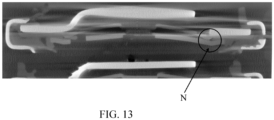
- the electrical connection may be at site M as indicated in FIG. 12 . Further, the electrical connection may be at site N as indicated in FIG. 13 . Because the explosion-proof sheet 30 and the orifice plate 40 are short circuited at site M or N, the battery 1000 and its module fail the crush test.
- the electrical connection may be at site N as indicated in FIG. 13 . Further, the electrical connection may be at site M as indicated in FIG. 12 . Because the explosion-proof sheet 30 and the orifice plate 40 are short circuited at site M or N, the battery 1000 and its module fail the short circuit test.
- the site M of the short circuit connection between the explosion-proof sheet 30 and the orifice plate 40 and the site N of the short circuit connection are disposed adjacent to the first pressure relief hole(s) 41.
- the structure of the insulating gasket 50 is improved in the embodiments of the present disclosure so that the insulating gasket 50 may provide a more comprehensive insulating function to the explosion-proof sheet 30 and the orifice plate 40.
- the orthographic projection surface of the insulating gasket 50 on the orifice plate 40 extends to the first portion 42 covering the orifice plate.
- the first portion 42 is closer to the central area of the orifice plate 40 relative to the second portion 43 and the first pressure relief hole(s) 41, by increasing a coverage area of the insulating gasket 50 on the orifice plate 40, it is possible to effectively prevent contact between the explosion-proof sheet 30 and the orifice plate 40 during a process of deformation, thereby affecting the short circuit and crush tests of the battery 1000.
- the insulating gasket 50 may effectively prevent a short circuit between the orifice plate 40 and the explosion-proof sheet 30 from occurring during a process of pressure relief of the battery 1000, thereby effectively improving a service life of the battery 1000 and a safety performance of the battery 1000.
- the insulating gasket 50 includes at least one second pressure relief hole 51 that is disposed to directly face the first pressure relief hole 41.
- the second pressure relief hole 51 is disposed coaxially with the first pressure relief hole 41, and an inner diameter of the second pressure relief hole 51 is not smaller than an inner diameter of the first pressure relief hole 41.
- One end of the second pressure relief hole 51 is disposed opposite to the first pressure relief hole 41, and another end of the second pressure relief hole 51 is disposed to directly face the first score line 31.
- a projection of the second pressure relief hole 51 on the first surface 301 may cover a portion of a projection of the first score lines 31 on the first surface 301, thereby facilitating a high-pressure impact of a high-pressure air flow on the first score lines 31 after passing through the first pressure relief hole 41 and the second pressure relief hole 51, thereby breaking the first score lines 31, facilitating a rapid release of the high-pressure air flow.
- the second pressure relief hole 51 and the first pressure relief hole 41 are each configured as a waist-shaped hole, so that the pressure relief capability of the second pressure relief hole 51 is increased while the strength of the insulating gasket 50 is maintained.
- the second pressure relief hole 51 has a suitable size, and in one example thereof, the second pressure relief hole 51 is configured to be disposed in an annular area having a radius ranging from 4mm ⁇ 6mm from a center of the insulating gasket 50.
- the second pressure relief hole 51 includes a first side edge 511 and a second side edge 512, where the first side edge 511 is disposed closer to the center of the insulating gasket 50 relative to the second side edge 512.
- the first side edge 511 is disposed on a circumference with a radius R4 of 4mm from the center of the insulating gasket 50
- the second side edge 512 is disposed on a circumference with a radius R5 of 6mm from the center of the insulating gasket 50.
- the first side edge 511 is disposed on a circumference with a radius R4 of 4mm from the center of the insulating gasket 50
- the second side edge 512 is disposed on a circumference with a radius R5 of 5.8mm from the center of the insulating gasket 50.
- a plurality of second pressure relief holes 51 may be provided in the insulating gasket 50.
- the plurality of second pressure relief holes 51 may be maintained evenly spaced with respect to the center of the insulating gasket 50, and the number of the plurality of second pressure relief holes 51 may be two, three, four, five, or six.
- the number of the second pressure relief holes 51 may be set to be the same as the number of the first pressure relief holes 41.
- a through-hole 52 is provided in the insulating gasket 50.
- the through-hole 52 is located in a central area of the insulating gasket 50, and an inner diameter R3 of the through-hole 52 is larger than an outer diameter R2 of the protrusion 33 of the explosion-proof sheet, so that the through-hole 52 is configured for passage of the protrusion 33 of the explosion-proof sheet 30.
- the battery 1000 includes a cylindrical battery of model 18650 in which the outer diameter of the protrusion 33 of the explosion-proof sheet is in a range of 1.9mm ⁇ 2.5mm and the inner diameter of the through-hole 52 of the insulating gasket is in a range of 2.6mm ⁇ 3.3mm.
- the outer diameter of the protrusion 33 may be 2.0mm, 2.1mm, 2.2mm, 2.3mm, or 2.4mm
- the inner diameter of the through-hole 52 of the insulating gasket may be 2.7mm, 2.8mm, 2.9mm, 3.0 mm, 3.1mm, or 3.2mm.
- the battery 1000 includes a cylindrical battery of model 21700 in which the outer diameter of the protrusion 33 of the explosion-proof sheet is in a range of 2.9mm ⁇ 3.4mm and the inner diameter of the through-hole 52 of the insulating gasket is in a range of 3.5mm ⁇ 4.0mm.
- the outer diameter of the protrusion 33 may be 3.0mm, 3.1mm, 3.2mm, or 3.3mm
- the inner diameter of the through-hole 52 may be 3.6mm, 3.7mm, 3.8mm, or 3.9mm.
- a size of the through-hole 52 of the insulating gasket and a size of the protrusion 33 of the explosion-proof sheet are provided within the aforementioned ranges of size, on one hand, it facilitates the protrusion 33 to pass through the through-hole 52, and on the other hand, it facilitates the formation of a suitable welding area between the explosion-proof sheet 30 and the orifice plate 40.
- the suitable welding area is provided in a central area with a radius of no more than 0.75mm from the center of the explosion-proof sheet 30 or the orifice plate 40, thereby facilitating the formation of a suitable welding tension between the explosion-proof sheet 30 and the orifice plate 40.
- the insulating gasket 50 includes a third portion 53 and a fourth portion 54 protruding with respect to the third portion 53, the second pressure relief hole(s) 51 being disposed on the third portion 53, an upper surface of the third portion 53 being in contact with a portion of the first surface 301 of the first platform 321 of the explosion-proof sheet, a lower surface of the third portion 53 being in contact with a main body of the orifice plate 40, an upper surface of the fourth portion 54 being in contact with a portion of the first surface 301 of the second platform 322 of the explosion-proof sheet, and a lower surface of the fourth portion 54 being in contact with a convex edge of the orifice plate 40.
- a thickness d1 of the third portion 53 described above is smaller than a thickness d2 of the fourth portion 54.
- the thickness d1 of the third portion 53 is greater than 0.2 mm and the thickness d2 of the fourth portion 54 is greater than 0.25 mm. Because the fourth portion 54 is closer to an edge of the orifice plate 40 relative to the third portion 53, the thickness d1 of the third portion 53 is properly reduced.
- the third portion 53 is prone to deform with the orifice plate 40, such that reducing the thickness d1 of the third portion 53 facilitates reducing an influence of the insulating gasket 50 on the deformation process of the orifice plate 40 and the explosion-proof sheet 30.
- the insulating gasket 50 further includes a fifth portion 55 bent and attached to the fourth portion 54, where the fifth portion 55 is wrapped an outer side wall of the orifice plate 40.
- the battery 1000 may pass the short circuit and crush tests.
- increasing the coverage area of the insulating gasket 50 on the orifice plate 40 may effectively prevent the orifice plate 40 and the explosion-proof sheet 30 from coming into contact during a process of deformation, and in turn preventing from causing short circuiting inside the battery 1000.
- the insulating gasket 50 described above is made of a PFA (polyfluoroalkoxy, a.k.a., soluble polytetrafluoroethylene) material, or the insulating gasket 50 described above is made of a PPS (polyphenylenesulphide, a.k.a., polyphenylene sulfide) material, where a melting point of the PFA material may reach 304°C and a melting point of the PPS material is 285°C ⁇ 300°C.
- the insulating gasket 50 is made of a PBT (polybutylene terephthalate) material, where a melting point of the PBT material is 233°C.
- the insulating gasket 50 made of the PFA material or the PPS material has better heat resistance performance than the insulating gasket 50 made of the PBT material, thereby facilitating the battery 1000 to pass the high-current discharge test, improving the safety performance of the battery 1000.
- one or more second score lines 46 are further provided on the orifice plate 40, the second score lines 46 being provided on the third surface 401 of the orifice plate 40.
- the one or more second score lines 46 are configured as an annular groove structure, a projection of the second score lines 46 on the fourth surface 402 being located inside the blind hole 44, thereby facilitating rupturing of the residual wall on which the second score lines 46 are located.
- a projection of the second score lines 46 on the third surface 401 is located outside the welding area. On one hand, it facilitates the formation of a stable bond between the explosion-proof sheet 30 and the orifice plate 40 by laser welding; on the other hand, the second score line 46 is arranged at a periphery of the welding area, thereby facilitating the rupturing of the residual wall on which the second score lines 46 are located prior to that of the welding area, thereby facilitating the cracking of the welding area when a suitable pressure threshold is reached, without causing a situation in which it is difficult to break between the orifice plate 40 and the explosion-proof sheet 30 due to the excessive welding tension between the orifice plate 40 and the orifice plate 30.
Landscapes
- Chemical & Material Sciences (AREA)
- Chemical Kinetics & Catalysis (AREA)
- Electrochemistry (AREA)
- General Chemical & Material Sciences (AREA)
- Engineering & Computer Science (AREA)
- Materials Engineering (AREA)
- Manufacturing & Machinery (AREA)
- Gas Exhaust Devices For Batteries (AREA)
Priority Applications (1)
| Application Number | Priority Date | Filing Date | Title |
|---|---|---|---|
| MA71415A MA71415A (fr) | 2023-11-10 | 2024-09-19 | Ensemble capuchon, batterie et bloc-batterie |
Applications Claiming Priority (3)
| Application Number | Priority Date | Filing Date | Title |
|---|---|---|---|
| CN202311504253.8A CN117543138A (zh) | 2023-11-10 | 2023-11-10 | 盖帽组件、电池及电池包 |
| CN202323055307.5U CN221352961U (zh) | 2023-11-10 | 2023-11-10 | 盖帽组件、电池及电池包 |
| PCT/CN2024/076075 WO2025097604A1 (fr) | 2023-11-10 | 2024-02-05 | Ensemble capuchon, batterie et bloc-batterie |
Publications (1)
| Publication Number | Publication Date |
|---|---|
| EP4553968A1 true EP4553968A1 (fr) | 2025-05-14 |
Family
ID=92882425
Family Applications (1)
| Application Number | Title | Priority Date | Filing Date |
|---|---|---|---|
| EP24201459.5A Pending EP4553968A1 (fr) | 2023-11-10 | 2024-09-19 | Ensemble capuchon, batterie et bloc-batterie |
Country Status (4)
| Country | Link |
|---|---|
| US (1) | US20250158214A1 (fr) |
| EP (1) | EP4553968A1 (fr) |
| CA (1) | CA3260037A1 (fr) |
| MA (1) | MA71415A (fr) |
Citations (4)
| Publication number | Priority date | Publication date | Assignee | Title |
|---|---|---|---|---|
| CN102694135A (zh) * | 2011-03-25 | 2012-09-26 | 比亚迪股份有限公司 | 一种电池的盖帽组件及一种锂电池 |
| CN208889708U (zh) * | 2018-11-21 | 2019-05-21 | 方芬 | 锂离子电池盖帽及锂离子电池 |
| CN112234307A (zh) * | 2020-11-05 | 2021-01-15 | 苏州橙柳电子精密有限公司 | 一种不依赖于焊点爆破的电池盖帽及电芯 |
| CN219350439U (zh) * | 2022-11-21 | 2023-07-14 | 郑州比克电池有限公司 | 一种电池盖帽单组件 |
-
2024
- 2024-09-12 CA CA3260037A patent/CA3260037A1/en active Pending
- 2024-09-19 MA MA71415A patent/MA71415A/fr unknown
- 2024-09-19 EP EP24201459.5A patent/EP4553968A1/fr active Pending
- 2024-10-21 US US18/921,044 patent/US20250158214A1/en active Pending
Patent Citations (4)
| Publication number | Priority date | Publication date | Assignee | Title |
|---|---|---|---|---|
| CN102694135A (zh) * | 2011-03-25 | 2012-09-26 | 比亚迪股份有限公司 | 一种电池的盖帽组件及一种锂电池 |
| CN208889708U (zh) * | 2018-11-21 | 2019-05-21 | 方芬 | 锂离子电池盖帽及锂离子电池 |
| CN112234307A (zh) * | 2020-11-05 | 2021-01-15 | 苏州橙柳电子精密有限公司 | 一种不依赖于焊点爆破的电池盖帽及电芯 |
| CN219350439U (zh) * | 2022-11-21 | 2023-07-14 | 郑州比克电池有限公司 | 一种电池盖帽单组件 |
Also Published As
| Publication number | Publication date |
|---|---|
| MA71415A (fr) | 2025-04-30 |
| CA3260037A1 (en) | 2025-10-30 |
| US20250158214A1 (en) | 2025-05-15 |
Similar Documents
| Publication | Publication Date | Title |
|---|---|---|
| EP3321998B1 (fr) | Batterie secondaire | |
| US7248021B2 (en) | Battery pack with resin integrated substrate and vent | |
| KR101073891B1 (ko) | 원통형 이차전지 | |
| US9203060B2 (en) | Secondary battery | |
| KR100324863B1 (ko) | 밀폐형전지용방폭실링판및그제조방법 | |
| JP5389368B2 (ja) | 密閉型電池 | |
| CN207233791U (zh) | 二次电池的顶盖组件以及二次电池 | |
| JP2006012829A (ja) | 二次電池 | |
| CN108428822A (zh) | 二次电池的顶盖组件以及二次电池 | |
| KR20110025056A (ko) | 이차 전지 | |
| JP4402637B2 (ja) | 二次電池 | |
| JP7379664B2 (ja) | 充電池の放電制御方法、充電制御方法及び充電池 | |
| KR100399783B1 (ko) | 이차 전지와 그 제조방법 | |
| KR100890329B1 (ko) | 리튬 이차전지 | |
| KR102154331B1 (ko) | 이차 전지 | |
| KR20090042535A (ko) | 배터리 팩 | |
| KR20050123365A (ko) | 이차전지 | |
| CN117543138A (zh) | 盖帽组件、电池及电池包 | |
| KR20130034285A (ko) | 전류차단소자 및 이를 구비한 이차 전지 | |
| KR20040099525A (ko) | 안전벤트를 가지는 각형 리튬 이차 전지 | |
| KR100696782B1 (ko) | 리튬이온 이차전지 | |
| KR20130034284A (ko) | 전류차단소자 및 이를 구비한 이차 전지 | |
| CN116368681A (zh) | 二次电池 | |
| US20250158214A1 (en) | Cap assembly, battery and battery pack | |
| KR101106403B1 (ko) | 이차 전지 |
Legal Events
| Date | Code | Title | Description |
|---|---|---|---|
| PUAI | Public reference made under article 153(3) epc to a published international application that has entered the european phase |
Free format text: ORIGINAL CODE: 0009012 |
|
| STAA | Information on the status of an ep patent application or granted ep patent |
Free format text: STATUS: REQUEST FOR EXAMINATION WAS MADE |
|
| 17P | Request for examination filed |
Effective date: 20240919 |
|
| AK | Designated contracting states |
Kind code of ref document: A1 Designated state(s): AL AT BE BG CH CY CZ DE DK EE ES FI FR GB GR HR HU IE IS IT LI LT LU LV MC ME MK MT NL NO PL PT RO RS SE SI SK SM TR |