EP4554094A1 - Elektronischer chip, der mit einer externen spannung verbunden ist - Google Patents
Elektronischer chip, der mit einer externen spannung verbunden ist Download PDFInfo
- Publication number
- EP4554094A1 EP4554094A1 EP24209513.1A EP24209513A EP4554094A1 EP 4554094 A1 EP4554094 A1 EP 4554094A1 EP 24209513 A EP24209513 A EP 24209513A EP 4554094 A1 EP4554094 A1 EP 4554094A1
- Authority
- EP
- European Patent Office
- Prior art keywords
- transistor
- circuit
- chip
- voltage
- ctrl
- Prior art date
- Legal status (The legal status is an assumption and is not a legal conclusion. Google has not performed a legal analysis and makes no representation as to the accuracy of the status listed.)
- Pending
Links
Images


Classifications
-
- H—ELECTRICITY
- H03—ELECTRONIC CIRCUITRY
- H03K—PULSE TECHNIQUE
- H03K17/00—Electronic switching or gating, i.e. not by contact-making and –breaking
- H03K17/16—Modifications for eliminating interference voltages or currents
- H03K17/161—Modifications for eliminating interference voltages or currents in field-effect transistor switches
- H03K17/165—Modifications for eliminating interference voltages or currents in field-effect transistor switches by feedback from the output circuit to the control circuit
- H03K17/166—Soft switching
-
- H—ELECTRICITY
- H02—GENERATION; CONVERSION OR DISTRIBUTION OF ELECTRIC POWER
- H02M—APPARATUS FOR CONVERSION BETWEEN AC AND AC, BETWEEN AC AND DC, OR BETWEEN DC AND DC, AND FOR USE WITH MAINS OR SIMILAR POWER SUPPLY SYSTEMS; CONVERSION OF DC OR AC INPUT POWER INTO SURGE OUTPUT POWER; CONTROL OR REGULATION THEREOF
- H02M3/00—Conversion of DC power input into DC power output
- H02M3/02—Conversion of DC power input into DC power output without intermediate conversion into AC
- H02M3/04—Conversion of DC power input into DC power output without intermediate conversion into AC by static converters
- H02M3/10—Conversion of DC power input into DC power output without intermediate conversion into AC by static converters using discharge tubes with control electrode or semiconductor devices with control electrode
- H02M3/145—Conversion of DC power input into DC power output without intermediate conversion into AC by static converters using discharge tubes with control electrode or semiconductor devices with control electrode using devices of a triode or transistor type requiring continuous application of a control signal
- H02M3/155—Conversion of DC power input into DC power output without intermediate conversion into AC by static converters using discharge tubes with control electrode or semiconductor devices with control electrode using devices of a triode or transistor type requiring continuous application of a control signal using semiconductor devices only
-
- H—ELECTRICITY
- H02—GENERATION; CONVERSION OR DISTRIBUTION OF ELECTRIC POWER
- H02H—EMERGENCY PROTECTIVE CIRCUIT ARRANGEMENTS
- H02H9/00—Emergency protective circuit arrangements for limiting excess current or voltage without disconnection
- H02H9/04—Emergency protective circuit arrangements for limiting excess current or voltage without disconnection responsive to excess voltage
- H02H9/045—Emergency protective circuit arrangements for limiting excess current or voltage without disconnection responsive to excess voltage adapted to a particular application and not provided for elsewhere
- H02H9/046—Emergency protective circuit arrangements for limiting excess current or voltage without disconnection responsive to excess voltage adapted to a particular application and not provided for elsewhere responsive to excess voltage appearing at terminals of integrated circuits
-
- H—ELECTRICITY
- H02—GENERATION; CONVERSION OR DISTRIBUTION OF ELECTRIC POWER
- H02M—APPARATUS FOR CONVERSION BETWEEN AC AND AC, BETWEEN AC AND DC, OR BETWEEN DC AND DC, AND FOR USE WITH MAINS OR SIMILAR POWER SUPPLY SYSTEMS; CONVERSION OF DC OR AC INPUT POWER INTO SURGE OUTPUT POWER; CONTROL OR REGULATION THEREOF
- H02M1/00—Details of apparatus for conversion
- H02M1/32—Means for protecting converters other than automatic disconnection
-
- H—ELECTRICITY
- H02—GENERATION; CONVERSION OR DISTRIBUTION OF ELECTRIC POWER
- H02M—APPARATUS FOR CONVERSION BETWEEN AC AND AC, BETWEEN AC AND DC, OR BETWEEN DC AND DC, AND FOR USE WITH MAINS OR SIMILAR POWER SUPPLY SYSTEMS; CONVERSION OF DC OR AC INPUT POWER INTO SURGE OUTPUT POWER; CONTROL OR REGULATION THEREOF
- H02M3/00—Conversion of DC power input into DC power output
- H02M3/02—Conversion of DC power input into DC power output without intermediate conversion into AC
- H02M3/04—Conversion of DC power input into DC power output without intermediate conversion into AC by static converters
- H02M3/10—Conversion of DC power input into DC power output without intermediate conversion into AC by static converters using discharge tubes with control electrode or semiconductor devices with control electrode
- H02M3/145—Conversion of DC power input into DC power output without intermediate conversion into AC by static converters using discharge tubes with control electrode or semiconductor devices with control electrode using devices of a triode or transistor type requiring continuous application of a control signal
- H02M3/155—Conversion of DC power input into DC power output without intermediate conversion into AC by static converters using discharge tubes with control electrode or semiconductor devices with control electrode using devices of a triode or transistor type requiring continuous application of a control signal using semiconductor devices only
- H02M3/156—Conversion of DC power input into DC power output without intermediate conversion into AC by static converters using discharge tubes with control electrode or semiconductor devices with control electrode using devices of a triode or transistor type requiring continuous application of a control signal using semiconductor devices only with automatic control of output voltage or current, e.g. switching regulators
- H02M3/158—Conversion of DC power input into DC power output without intermediate conversion into AC by static converters using discharge tubes with control electrode or semiconductor devices with control electrode using devices of a triode or transistor type requiring continuous application of a control signal using semiconductor devices only with automatic control of output voltage or current, e.g. switching regulators including plural semiconductor devices as final control devices for a single load
-
- H—ELECTRICITY
- H03—ELECTRONIC CIRCUITRY
- H03K—PULSE TECHNIQUE
- H03K17/00—Electronic switching or gating, i.e. not by contact-making and –breaking
- H03K17/51—Electronic switching or gating, i.e. not by contact-making and –breaking characterised by the components used
- H03K17/56—Electronic switching or gating, i.e. not by contact-making and –breaking characterised by the components used by the use, as active elements, of semiconductor devices
- H03K17/687—Electronic switching or gating, i.e. not by contact-making and –breaking characterised by the components used by the use, as active elements, of semiconductor devices the devices being field-effect transistors
-
- H—ELECTRICITY
- H03—ELECTRONIC CIRCUITRY
- H03K—PULSE TECHNIQUE
- H03K17/00—Electronic switching or gating, i.e. not by contact-making and –breaking
- H03K17/30—Modifications for providing a predetermined threshold before switching
- H03K2017/307—Modifications for providing a predetermined threshold before switching circuits simulating a diode, e.g. threshold zero
Definitions
- This description relates generally to integrated electronic circuits, and, more particularly, to integrated circuit chips connected to a supply voltage external to the chip ("off-chip" in English) by a conductive wire, that is to say by a wire bonding.
- connection pad configured to be connected to a supply voltage external to the chip by a conductive wire and another connection pad configured to be connected to a reference voltage by another conductive wire.
- Some of these known chips include a PMOS transistor used as a switch, for example as a high-side switch of a DC-DC SMPS (or DC-DC Switched Mode Power Supply).
- This PMOS switch couples an internal node of the chip, itself connected to a load, to the connection pad that is connected to the supply voltage.
- these chips include a decoupling capacitor coupling the two connection pads together.
- One embodiment overcomes all or part of the drawbacks of known integrated circuit chips, and more particularly of known integrated circuit chips as described above.
- the integrated circuit chip further comprises a diode coupling the internal node to the second pad, the anode of the diode being on the side of the second pad.
- the internal node is coupled, preferably connected, to a third connection pad of the chip, the third pad being intended to be connected to an external inductor by a third conductive wire, the external inductor being part of the load.
- the integrated circuit chip further comprises an electrostatic discharge protection circuit coupling the first and second pads together.
- the first detection circuit comprises a comparator configured to compare the source voltage of the PMOS transistor to the drain voltage of the PMOS transistor increased by a threshold voltage of the first detection circuit, and to provide a binary signal indicating a result of the comparison.
- the integrated circuit chip further comprises a second control circuit configured to provide a first binary signal to the first control circuit, a first binary state of the first signal controlling the off state of the PMOS transistor and a second binary state of the first signal controlling an on state of the PMOS transistor.
- the third detection circuit comprises a comparator configured to compare the voltage of the internal node to the voltage of the second pad increased by a threshold voltage of the third detection circuit, and to provide a binary signal indicating a result of the comparison.
- the second control circuit is configured to switch the second signal to its second binary state as soon as the third detection circuit detects that the voltage of the internal node is close to the zero value or the second detection circuit detects that the PMOS transistor is in the blocked state.
- the PMOS transistor is a high-side transistor of a switching DC-DC converter.
- the expressions "about”, “approximately”, “substantially”, and “of the order of” mean to within 10%, preferably to within 5%.
- FIG. 1 represents, at least partly in block form, an example of an electronic device or system 1.
- the device 1 comprises an integrated circuit chip 100, delimited by dotted lines in Figure 1 .
- the chip 100 comprises a connection pad 102.
- the pad 102 is intended to be connected to a supply voltage Vin, the voltage Vin being, for example, a direct current voltage (DC) and being, for example, positive relative to a reference DC voltage GND, for example ground. More particularly, the pad 102 is intended to be connected to the supply voltage Vin, i.e. to a pad 104 of the device 1 which is external to the chip 100 and which is at the voltage Vin, by a conductive wire 106 shown in Figure 1 by its parasitic inductance LpHS.
- DC direct current voltage
- the chip 100 further comprises a connection pad 108.
- the pad 108 is intended to be connected to the reference voltage GND. More particularly, the pad 108 is intended to be connected to the voltage GND, that is to say to a pad 110 of the device 1 which is external to the chip 100 and which is at the voltage GND, by a conductive wire 112 shown in Figure 1 by its parasitic inductance LpLS.
- the chip 100 further comprises a PMOS transistor (from the English "P Metal Oxide Semiconductor transistor" - P-channel metal oxide semiconductor transistor), referenced HS in Figure 1 .
- the HS transistor couples the pad 102 to an internal node 114 of the chip 100.
- the source of the HS transistor is coupled, preferably connected, to pad 102, and the drain of the HS transistor is coupled, preferably connected, to node 114.
- the HS transistor is used (controlled) as a switch.
- Node 114 is intended to be coupled to a load.
- the node 114 is coupled, preferably connected, to a connection pad 116 of the chip, the pad 116 being intended to be connected to all or part of the load, by a conductive wire 118 represented by its parasitic inductance Lp in Figure 1 .
- the load comprises an inductance Lext external to the chip 100, the inductance Lext having a first terminal connected to the wire 118 to be coupled to the node 114, and a second terminal coupled to the voltage GND, i.e.
- a load to be supplied comprising a capacitance Cout (only the capacitance Cout of the load to be supplied is represented in Figure 1 ).
- the capacitor Cout makes it possible to maintain, once charged, a voltage Vout on the connection node of the inductance Lext to the capacitor Cout.
- the chip further includes a capacitor C coupling pads 102 and 108 together.
- capacitor C has a first terminal or electrode coupled, preferably connected, to pad 102, and a second terminal or electrode coupled, preferably connected, to pad 108.
- Node 114 is further coupled to pad 108 by a diode D of chip 100, diode D having its anode on the side of pad 108.
- diode D has its anode coupled, preferably connected, to pad 108, and its cathode coupled, preferably connected, to node 114.
- the HS switch is the high side switch of a switching DC-DC converter, the converter being a buck converter.
- Diode D corresponds to the freewheeling diode of the converter.
- the chip 100 further comprises an NMOS transistor (from the English "N Metal Oxide Semiconductor transistor" - N-channel metal oxide semiconductor transistor), referenced LS in Figure 1 .
- Transistor LS couples node 114 to pad 108.
- the source of transistor LS is coupled, preferably connected, to pad 108, and the drain of transistor LS is coupled, preferably connected, to node 114.
- Transistor LS is used (controlled) as a switch.
- diode D corresponds to the body diode of transistor LS.
- diode D is connected in parallel with transistor LS.
- transistor LS may be omitted.
- the chip 100 comprises an ESD circuit for protection against electrostatic discharges, coupling the pads 102 and 108 together.
- the ESD circuit is configured to be conductive, i.e. to allow the passage of a current from the pad 102 to the pad 108, when the voltage difference between the pads 102 and 108 exceeds a threshold, and blocked otherwise.
- the chip 100 includes an HS-CTRL control circuit for the HS transistor.
- the HS-CTRL circuit controls the gate of the HS transistor so as to control the on or off state of the HS transistor. For example, when the HS-CTRL circuit controls a switching from the on state to the off state of the HS transistor, this HS-CTRL circuit supplies a constant current to the gate of the HS transistor, which discharges until the gate-source voltage of the HS transistor is less than the conduction threshold of the HS transistor and the latter either in the blocked state, thus preventing the passage of a current from the pad 102 to the node 114.
- this HS-CTRL circuit controls a switching from the blocked state to the on state of the HS transistor
- this HS-CTRL circuit draws a constant current on the gate of the HS transistor, which charges until the gate-source voltage of the HS transistor is greater than the conduction threshold of the HS transistor and the latter is in the on state, thus allowing the passage of a current from the pad 102 to the node 114.
- the HS-CTRL circuit receives a binary signal sigHS indicating by its first binary state that the HS-CTRL circuit must control the HS transistor in the blocked state, and by its second binary state that the HS-CTRL circuit must control the HS transistor in the passing state.
- the signal sigHS is provided by a control circuit CTRL forming part of the chip 100.
- the chip 100 includes an LS-CTRL control circuit for the LS transistor.
- the LS-CTRL circuit controls the gate of the LS transistor so as to control the on or off state of the LS transistor. For example, when the LS-CTRL circuit controls a switching from the on state to the off state of the LS transistor, this LS-CTRL circuit draws a constant current on the gate of the LS transistor, which discharges until the gate-source voltage of the LS transistor is lower than the conduction threshold of the LS transistor and the latter is in the off state, thus preventing the passage of a current from the pad 108 to the node 114.
- this LS-CTRL circuit controls a switching from the off state to the on state of the LS transistor
- this LS-CTRL circuit supplies a constant current to the gate of the LS transistor, which charges until the gate-source voltage of the LS transistor is higher than the conduction threshold. of the LS transistor and that the latter is in the on state, thus allowing the passage of a current from pad 108 to node 114.
- the LS-CTRL circuit receives a binary signal sigLS indicating by its first binary state that the LS-CTRL circuit must control the LS transistor in the blocked state, and by its second binary state that the LS-CTRL circuit must control the LS transistor in the on state.
- the sigLH signal is provided by the CTRL circuit.
- the inductance LpHS, the capacitance C and the inductance Lp form a resonant LC circuit between the pad 104 and the inductance Lext. Furthermore, the voltage Vin is constant and the voltage on the pad 116 varies little due to the fact that, in practice, the inductance Lext has very higher values, for example at least 10 times higher, than that of the parasitic inductance LpHS and that of the parasitic inductance Lp. This results in oscillations of the voltage on the pad 102.
- the ESD circuit When present, the ESD circuit is triggered by the increase in voltage between pads 102 and 108 and shorts out capacitor C, thus preventing oscillations.
- this ESD device is not designed to trigger each time the HS transistor switches to the off state, and will therefore age more quickly.
- the ESD circuit may, once triggered, remain engaged as long as the voltage between the pads 102 and 108 does not cancel out, and then prevent the chip 100 from operating correctly, for example the switching converter comprising the HS transistor.
- SCR Silicon Controlled Rectifier
- the voltage on the pad 102 substantially equal to 3 V before the switching of the HS switch, has a peak at 5.5 V, only 1.6 ns after the switching.
- the voltage The gate-source voltage of the transistor decreases again (in absolute value) with a slope proportional to the current supplied to the gate of the transistor by its control circuit, and the resistance between the source and the drain of the transistor increases with the variation of the gate-source voltage, until this resistance is high enough for the transistor to be in the off state.
- the switching time of the transistor is then equal to the total time corresponding to the succession of the first, second and third phases, and the transistor remains on for 4/5 of the switching time.
- the PMOS transistor exhibits symmetrical behavior when switching to the on state, where the transistor remains off 4/5 of the switching time to the on state, and NMOS transistors also have a similar behavior.
- the switching time of each of the HS and LS switches represents less than 1/20 of the total duration of an operating cycle of the converter.
- the switching time of each of the LS and HS switches is 10 ns, and that the duration of the third phases described above must be 2 ns.
- each third phase it would be necessary, for example, for the duration of each third phase to be greater than or equal to 25 times L.I/Vin, with L the inductance value of the parasitic inductance LpHS, I the current of 0.4 A in the inductance LpHS at the time of switching, and Vin equal to 3.3 V.
- L the inductance value of the parasitic inductance LpHS
- I the current of 0.4 A in the inductance LpHS at the time of switching
- Vin 3.3 V.
- the third phase can then be slow enough for the LpHS inductor to discharge completely before the HS transistor actually switches to the off state, while maintaining the first and second phases fast enough for the total switching duration, i.e. the total duration of the first, second and third phases, to be compatible with a target operating frequency of the DC-DC converter.
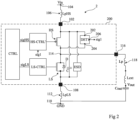
- Device 2 differs from Device 1 of the Figure 1 in that chip 100 is replaced by chip 200.
- the 200 chip is similar to the 100 chip, and only the differences between these two chips are highlighted here. Thus, unless otherwise noted, everything listed for the 100 chip applies to the 200 chip.
- the DET1 circuit is configured to detect when the source-drain resistance, for example called the on-resistance, of the HS transistor increases.
- the DET1 circuit is configured to detect when the drain-source resistance of the HS transistor exceeds a threshold value.
- this threshold value is determined so that, when switching to the off-state of the HS transistor, the source-drain resistance of the HS transistor becomes greater than this threshold value when the transistor passes from the second phase of switching (plateau) to the third phase of switching (increase of on-state resistance).
- the circuit DET1 provides a binary signal sig1 indicating by a first binary state that the source-drain resistance of the HS transistor is not increasing, that is to say for example that this drain-source resistance is lower than the threshold value and corresponds to the on state of the HS transistor, and by a second binary state that the drain-source resistance of the HS transistor is increasing, that is to say for example that this drain-source resistance is higher than the threshold value and that the transistor is in the third phase of its switching to the off state.
- the signal sig1 is for example available on an output 206 of the circuit DET1.
- the circuit DET1 includes an input 202 connected to the source of the HS transistor and an input 204 connected to the drain of the HS transistor.
- the circuit DET1 is configured to compare the drain-source voltage of the HS transistor to a threshold, the drain-source voltage of the HS transistor being greater than the threshold when the drain-source resistance of the HS transistor is greater than the threshold value indicating that the HS transistor is in the third phase of an off-state switching, and the drain-source voltage of the HS transistor being less than the threshold when the drain-source resistance of the HS transistor is less than the threshold value indicating that the HS transistor is on and in the second or first phase of an off-state switching.
- the HS-CTRL' control circuit of the HS transistor is, like the HS-CTRL circuit, configured to control the gate of the HS transistor so as to control the on or off state of the HS transistor.
- the HS-CTRL' circuit receives a binary signal sigHS indicating by its first state binary that the HS-CTRL circuit must control the HS transistor in the off state, and by its second binary state that the HS-CTRL circuit must control the HS transistor in the on state.
- the sigHS signal is provided by a CTRL control circuit forming part of the chip 200.
- the HS-CTRL' circuit receives an indication from the DET1 circuit whether the source-drain resistance of the HS transistor is increasing or not. For example, the HS-CTRL' circuit receives the signal sig1.
- the HS-CTRL' circuit is configured, upon each switching to the off-state of the HS transistor, to supply a first current to the gate of the HS transistor until the DET1 circuit detects an increase in the source/drain resistance of the HS transistor, and to then supply a second current lower than the first current.
- the HS-CTRL' circuit is configured, upon each switching of the HS transistor to the off-state, to supply the first current during the first and second phases of the switching where the HS transistor is still on, and then to supply the second current during the third phase where the drain-source resistance of the HS transistor increases until the transistor is actually in the off-state.
- the above-described operation of the HS-CTRL' circuit corresponds to the operation of the HS-CTRL' circuit when the sigHS signal switches to its first binary state, until the sigHS signal switches back to its second binary state.
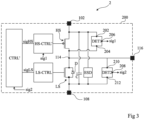
- FIG. 3 represents, at least partly in the form of blocks, an example of an alternative embodiment of the device 2 of the Figure 2 .
- the chip 200 comprises the transistor LS, and the transistors HS and LS are controlled so that the set of transistors HS and LS and the inductor Lext implement a switching DC-DC converter, operating in pulse width modulation (PWM) and/or in pulse frequency modulation (PFM).
- PWM pulse width modulation
- PFM pulse frequency modulation
- the converter 2 is of the step-down type.
- the increase in the source-drain resistance of the HS transistor during the third phase of each switching to the on state of this HS transistor is slower due to the second current being lower than the first current to allow the LpHS inductor to be discharged before the end of the switching to the off state.
- the source-drain resistance of the HS transistor and the current flowing between the source and the drain of the HS transistor may have values such that the voltage of node 114 becomes sufficiently negative, for example less than or equal to -0.7 V, so that diode D starts to conduct, which causes unwanted losses in diode D.
- circuit DET2 is configured to detect when the voltage of node 114 is close to the value of the reference voltage GND but still higher than the latter, i.e. to detect when the voltage of node 114 is still positive but close to a zero value.
- the circuit DET2 is configured to detect when the voltage 114 becomes lower than a threshold voltage.
- a threshold voltage when the voltage of the node 114 decreases during switching to the off-state of the HS transistor, it is considered to be close to a zero value if it becomes lower than this threshold voltage.
- this threshold voltage of the circuit DET2 is between Vin/10 and 0 V.
- the circuit DET2 provides a binary signal sig2 indicating by a first binary state that the voltage of the node 114 is close to the zero value, that is to say for example that this voltage is lower than the threshold voltage, and by a second binary state that the voltage of the node 114 is far from the zero value, that is to say for example that this voltage is higher than the threshold voltage.
- the signal sig2 is for example available on an output 208 of the circuit DET2.
- the circuit DET2 includes an input 210 connected to node 114, and an input 212 connected to pad 108.
- the LS transistor will be on before the voltage at node 114 reaches values suitable for putting diode D into conduction, and the current will flow through the on transistor LS rather than through the more resistive diode D, which limits losses.
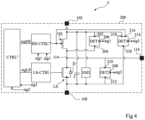
- FIG. 4 represents, at least partly in the form of blocks, an example of another variant embodiment of the electronic device 2 of the Figure 2 .
- Electronic device 2 of the Figure 4 includes many elements in common with that of the Figure 3 , and only the differences between these two devices are highlighted here. Thus, unless otherwise indicated, everything that has been indicated for device 2 of the Figure 3 applies to device 2 of the Figure 4 . In Figure 4 , only chip 200 of device 2 is shown.
- the circuit CTRL' switches the transistor LS to the on state following detection, by the circuit DET2, that the voltage of node 114 is close to the zero value.
- this operation is acceptable if, each time the HS transistor switches to the off state, the voltage of node 114 decreases enough to become close to zero and trigger the switching to the on state of the LS transistor. For example, this is not the case in certain applications where the current flowing in the HS transistor when it switches to the off state is too low and/or a parasitic capacitance on node 114 is too large for the voltage of node 114 to become close to zero.
- the DET3 circuit is configured to detect when the HS transistor is in the off state.
- the DET3 circuit is configured to detect that the current in the HS transistor becomes less than a threshold, the HS transistor being considered in the off state when the current in the HS transistor is less than this threshold.
- the circuit DET3 provides a binary signal sig3 indicating by a first binary state that the HS transistor is in the on state, that is to say for example that the current flowing in the HS transistor is greater than the threshold mentioned above, and by a second binary state that the HS transistor is in the off state, that is to say for example that the current flowing in the HS transistor is less than this threshold.
- the signal sig3 is for example available on an output 214 of the DET3 circuit.
- the DET3 circuit includes an input 216 connected to the gate of the HS transistor, an input 218 connected to the source of the HS transistor, and an input 220 connected to the pad 108.
- the control circuit CTRL'' is, in this example, configured like the circuit CTRL' to control a switching to the on state of the transistor LS as soon as the circuit DET2 detects, after or during a switching to the off state of the transistor HS, that the voltage of the node 114 is close to the zero value.
- the CTRL" circuit also receives an indication from the DET3 circuit whether the HS transistor is blocked or not. For example, the CTRL" circuit receives the signal sig3.
- the CTRL" circuit is then configured to control a switching to the on state of the LS transistor as soon as the DET3 circuit detects, after or during a switching to the off state of the HS transistor, that the HS transistor is indeed in the off state.
- the CTRL circuit controls the switching of the LS transistor to the on state.
- the CTRL circuit switches the LS transistor to the on state as soon as it receives the indication that the voltage of node 114 is close to zero or the indication that the HS transistor is blocked.
- the chip 200 does not include the DET2 circuit and the CTRL circuit is configured to control the switching to the on state of the transistor LS only when it receives the indication that the HS transistor is in the off state.
- the diode D turns on before the LS transistor is on, and the losses will then be higher than in the example of the Figure 3 Or 4 .
- the circuit HS-CTRL' can be replaced by a circuit HS-CTRL" which receives not only the indication that the source-drain resistance of the HS transistor is greater than a threshold value, that is to say for example the signal sig1, but also the indication that the HS transistor is in the blocked state or not, that is to say for example the signal sig3.
- the HS-CTRL" circuit is configured to supply the first current as long as the DET3 circuit detects that the HS transistor is off or the DET1 circuit does not detect an increase in the drain-source resistance of the HS transistor.
- the HS-CTRL" circuit supplies the first current until the DET1 circuit detects an increase in the value of the drain-source resistance of the HS transistor while the HS transistor is not yet off. From this moment, the HS-CTRL" circuit supplies the second current until the DET3 circuit detects that the HS transistor is in the off state. From this moment, the HS-CTRL" circuit supplies the first current.
- the voltage on its gate will be less sensitive to variations in the voltage of node 114 which propagate on the gate of the HS transistor by capacitive coupling, compared to the case where the gate of the transistor would still receive the second lower current. This avoids possible switching on of the HS transistor which would not be wanted.
- the above-described operation of the HS-CTRL circuit corresponds to the operation of the HS-CTRL circuit when the sigHS signal switches to its first binary state, until the sigHS signal switches back to its second binary state.
- a chip 200 may be provided comprising the circuits DET1, DET2, DET3, CTRL' and HS-CTRL", or a chip comprising the circuits DET1, DET2, DET3, CTRL” and HS-CTRL'.
- FIG. 5 represents an example of a detailed embodiment of the DET1 circuit of the device 2 of the figures 2 , 3 And 4 .
- the circuit DET1 includes a comparator COMP1.
- the comparator COMP1 is here configured to compare the source voltage of the HS transistor with a voltage equal to the sum of the drain voltage of the HS transistor and a threshold voltage Vth1.
- the comparator COMP1 is configured to compare the source voltage of the HS transistor to the drain voltage of the HS transistor increased by the voltage Vth1.
- the comparator COMP1 is configured to compare the drain-source voltage of the HS transistor to the threshold voltage Vth1.
- the voltage Vth1 is, for example, determined, for a maximum current value in the inductance LpHS at the start of each switching to the on state of the HS transistor, by the threshold value of the drain-source resistance of the HS transistor above which the drain-source resistance of the HS transistor is considered to be increasing, i.e. by the threshold value of the drain-source resistance of the HS transistor above which, during a switching to the off state of the HS transistor, the latter is considered to be in the third phase of the switching.
- the voltage Vth1 is substantially equal to Imax*10*Rtarget, where Imax is the maximum expected value for the current in the inductance LpHS at the start of a switching to the off state of the HS transistor, and Rtarget is the threshold value of the source-drain resistance of the HS transistor.
- the comparator COMP1 has an input, for example non-inverting (+), connected to the input 202 of the circuit DET1, an input, for example inverting (-), coupled to the input 204 of the circuit DET1 and an output connected to the output 206 of the circuit DET1 and configured to provide the signal sig1.
- the input of the comparator COMP1 which is coupled to the drain of the transistor HS is coupled to the input 204 of the circuit DET1 by a voltage generator capable of applying a voltage difference Vth1 between the input 204 and the input of the comparator COMP1.
- FIG. 6 represents an example of a detailed embodiment of the DET2 circuit of the device 2 of the figures 3 And 4 .
- the DET2 circuit includes a comparator COMP2.
- Comparator COMP2 is here configured to compare voltage 114 with a threshold voltage Vth2.
- the voltage Vth2 is the voltage below which, when switching to the off-state of the HS transistor, the voltage of the node 114 is considered sufficiently close to the zero value.
- the comparator COMP2 is configured to compare the voltage of the node 114 with the voltage of the pad 108 increased by the threshold voltage Vth2.
- the comparator COMP2 has an input, for example inverting (-), connected to the input 210 of the circuit DET2, an input, for example non-inverting (+), coupled to the input 212 of the circuit DET2 and an output connected to the output 208 of the circuit DET2 and configured to provide the signal sig2.
- the input of the comparator COMP2 which is coupled to the pad 108 is coupled to the input 212 of the circuit DET2 by a voltage generator capable of applying a voltage difference Vth2 between the input 212 and the input of the comparator COMP2.
- FIG. 7 represents an example of a detailed embodiment of the DET3 circuit of the device 2 of the Figure 4 .
- the DET3 circuit includes a PMOS HS-mirror transistor mounted as a mirror of the HS transistor.
- the HS-mirror transistor has its gate connected to the gate of the HS transistor (input 216 of the DET3 circuit), its source connected to the source of the HS transistor, therefore to pad 102 (input 218 of the DET3 circuit) and its drain biased by a constant current source or by a resistor R.
- the drain of the HS-mirror transistor is biased by the resistor R, the latter being connected between the drain of the HS-mirror transistor and the pad 108 (input 220 of the DET3 circuit).
- the DET3 circuit further includes a comparator COMP3.
- the comparator COMP3 is configured to compare the drain voltage of the HS-mirror transistor with a threshold voltage Vth3.
- the voltage on the drain of the HS-mirror transistor is determined by the current in the HS-mirror transistor, therefore in the HS transistor with which the HS-mirror transistor is mirrored.
- the value of the voltage Vth3 is for example chosen so that, when the drain voltage of the transistor is lower than the voltage Vth3, this means that the current in the HS-mirror transistor is zero or almost zero, therefore that the HS-mirror transistor is in the off state, the HS transistor then also being in the off state because the HS and HS-mirror transistors are mirrored to each other.
- circuits DET1, DET2 and DET3 have been described above in connection with the Figures 5, 6 and 7 respectively. However, other implementations of these circuits will become apparent to those skilled in the art from the functional indications given above.
- the chip 200 has been described for the example where the HS transistor, and the LS transistor when present, are respectively high-side and low-side switches of a switching step-down DC-DC converter ("Buck DC-DC SMPS" in English), the embodiments and variants described apply to chips 200 where the HS transistor, and the LS transistor when present, are not high-side and low-side switches of a switching converter.
- the problem of discharging the parasitic inductance LpHS during switching to the off-state of the HS transistor coupling the pad 102 to the node 114 arises in all devices where the pad 102 is connected to a voltage Vin by a wire 106 and where the device drives, with switchings of the HS switch, a load coupled to the node 114, this being all the more true when the driven load comprises an inductance.
- This is for example the case of a device 2 driving a relay coil or a motor.
- the switching frequencies of the HS switch are generally lower than in a switching DC-DC converter.
- the load to which node 114 is coupled comprises an inductor Lext.
- the load may not comprise an inductor.
- circuits HS-CTRL' and HS-CTRL their implementation is within the reach of the person skilled in the art from the functional indications given above, just as the implementation of the circuits CTRL' and CTRL” is within the reach of the person skilled in the art from the functional indications given above.
Landscapes
- Engineering & Computer Science (AREA)
- Power Engineering (AREA)
- Microelectronics & Electronic Packaging (AREA)
- Dc-Dc Converters (AREA)
Applications Claiming Priority (1)
| Application Number | Priority Date | Filing Date | Title |
|---|---|---|---|
| FR2312255 | 2023-11-09 |
Publications (1)
| Publication Number | Publication Date |
|---|---|
| EP4554094A1 true EP4554094A1 (de) | 2025-05-14 |
Family
ID=90053602
Family Applications (1)
| Application Number | Title | Priority Date | Filing Date |
|---|---|---|---|
| EP24209513.1A Pending EP4554094A1 (de) | 2023-11-09 | 2024-10-29 | Elektronischer chip, der mit einer externen spannung verbunden ist |
Country Status (2)
| Country | Link |
|---|---|
| US (1) | US20250158521A1 (de) |
| EP (1) | EP4554094A1 (de) |
Citations (5)
| Publication number | Priority date | Publication date | Assignee | Title |
|---|---|---|---|---|
| EP0777309A2 (de) * | 1995-12-05 | 1997-06-04 | Denso Corporation | Stromversorgungsanlage für Fahrzeug |
| WO2000027032A1 (en) * | 1998-10-30 | 2000-05-11 | Siemens Automotive Corporation | Combined voltage and current slew rate limiting |
| US20180316344A1 (en) * | 2017-05-01 | 2018-11-01 | Fuji Electric Co., Ltd. | Driving apparatus and switching apparatus |
| US20190158083A1 (en) * | 2016-07-04 | 2019-05-23 | Mitsubishi Electric Corporation | Drive circuit and power module including the same |
| DE112021006668T5 (de) * | 2020-12-25 | 2023-10-12 | Rohm Co., Ltd. | Leistungssteuervorrichtung |
-
2024
- 2024-10-29 EP EP24209513.1A patent/EP4554094A1/de active Pending
- 2024-11-08 US US18/941,121 patent/US20250158521A1/en active Pending
Patent Citations (5)
| Publication number | Priority date | Publication date | Assignee | Title |
|---|---|---|---|---|
| EP0777309A2 (de) * | 1995-12-05 | 1997-06-04 | Denso Corporation | Stromversorgungsanlage für Fahrzeug |
| WO2000027032A1 (en) * | 1998-10-30 | 2000-05-11 | Siemens Automotive Corporation | Combined voltage and current slew rate limiting |
| US20190158083A1 (en) * | 2016-07-04 | 2019-05-23 | Mitsubishi Electric Corporation | Drive circuit and power module including the same |
| US20180316344A1 (en) * | 2017-05-01 | 2018-11-01 | Fuji Electric Co., Ltd. | Driving apparatus and switching apparatus |
| DE112021006668T5 (de) * | 2020-12-25 | 2023-10-12 | Rohm Co., Ltd. | Leistungssteuervorrichtung |
Also Published As
| Publication number | Publication date |
|---|---|
| US20250158521A1 (en) | 2025-05-15 |
Similar Documents
| Publication | Publication Date | Title |
|---|---|---|
| EP1950885B1 (de) | Steuervorrichtung eines elektronischen Leistungstrenners und eine solche Vorrichtung umfassender Stromrichter | |
| EP0680245A2 (de) | Statischer Wandler mit gesteuertem Schalter und Steuerungsschaltung | |
| EP1914871A1 (de) | Schaltnetzteilsystem und Regelantrieb mit einem solchen System | |
| EP0579561A1 (de) | Schutzschaltung gegen Überspannungen for Leistungsbauteil | |
| EP4037170B1 (de) | Synchronisierung einer elektronischen vorrichtung | |
| FR3013916A1 (fr) | Circuit de commande pour convertisseur de puissance | |
| FR3102620A1 (fr) | Convertisseur de tension | |
| EP3945673A1 (de) | Spannungsvergleicher | |
| FR3102900A1 (fr) | Convertisseur de tension | |
| EP1704634A1 (de) | Steuerung eines kurzschlusses in einer induktivität eines aufwaertswandlers | |
| EP3945674A1 (de) | Spannungswandler | |
| FR2739735A1 (fr) | Dispositifs haute tension permettant d'eviter les defaillances du type passage au potentiel -vs (le pole negatif de l'alimentation electrique) | |
| EP4554094A1 (de) | Elektronischer chip, der mit einer externen spannung verbunden ist | |
| EP3829063B1 (de) | Bidirektionale schaltersteuerung | |
| EP3633487A1 (de) | Schaltwandler | |
| WO2014091096A1 (fr) | Circuit de comparaison d'une tension a un seuil et conversion d'energie electrique | |
| EP4044415A1 (de) | Starten einer stromzuführung mit partitionierung | |
| FR2858909A1 (fr) | Circuit d'eclairage a lampe a decharge determinant l'etat de la lampe a decharge | |
| FR2858911A1 (fr) | Circuit d'eclairage a lampe a decharge a detection de courant ou de tension | |
| FR3121556A1 (fr) | Convertisseur de tension | |
| FR3102621A1 (fr) | Comparateur de tension | |
| EP3584918B1 (de) | Schaltwandler | |
| EP4092892A1 (de) | Schaltnetzteil | |
| FR3149398A1 (fr) | Régulateur de tension | |
| FR3113140A1 (fr) | Convertisseur de tension |
Legal Events
| Date | Code | Title | Description |
|---|---|---|---|
| PUAI | Public reference made under article 153(3) epc to a published international application that has entered the european phase |
Free format text: ORIGINAL CODE: 0009012 |
|
| STAA | Information on the status of an ep patent application or granted ep patent |
Free format text: STATUS: REQUEST FOR EXAMINATION WAS MADE |
|
| 17P | Request for examination filed |
Effective date: 20241029 |
|
| AK | Designated contracting states |
Kind code of ref document: A1 Designated state(s): AL AT BE BG CH CY CZ DE DK EE ES FI FR GB GR HR HU IE IS IT LI LT LU LV MC ME MK MT NL NO PL PT RO RS SE SI SK SM TR |
|
| GRAP | Despatch of communication of intention to grant a patent |
Free format text: ORIGINAL CODE: EPIDOSNIGR1 |
|
| STAA | Information on the status of an ep patent application or granted ep patent |
Free format text: STATUS: GRANT OF PATENT IS INTENDED |
|
| RIC1 | Information provided on ipc code assigned before grant |
Ipc: H03K 17/16 20060101AFI20260121BHEP Ipc: H02M 1/00 20060101ALI20260121BHEP Ipc: H02M 1/08 20060101ALI20260121BHEP |
|
| INTG | Intention to grant announced |
Effective date: 20260219 |
|
| RIN1 | Information on inventor provided before grant (corrected) |
Inventor name: CIMAZ, LIONEL |