EP4555975A2 - Cheveux revêtus et leur utilisation - Google Patents
Cheveux revêtus et leur utilisation Download PDFInfo
- Publication number
- EP4555975A2 EP4555975A2 EP25168906.3A EP25168906A EP4555975A2 EP 4555975 A2 EP4555975 A2 EP 4555975A2 EP 25168906 A EP25168906 A EP 25168906A EP 4555975 A2 EP4555975 A2 EP 4555975A2
- Authority
- EP
- European Patent Office
- Prior art keywords
- hair
- implantable
- silk protein
- composition
- antheraea
- Prior art date
- Legal status (The legal status is an assumption and is not a legal conclusion. Google has not performed a legal analysis and makes no representation as to the accuracy of the status listed.)
- Pending
Links
Images




Classifications
-
- A—HUMAN NECESSITIES
- A61—MEDICAL OR VETERINARY SCIENCE; HYGIENE
- A61F—FILTERS IMPLANTABLE INTO BLOOD VESSELS; PROSTHESES; DEVICES PROVIDING PATENCY TO, OR PREVENTING COLLAPSING OF, TUBULAR STRUCTURES OF THE BODY, e.g. STENTS; ORTHOPAEDIC, NURSING OR CONTRACEPTIVE DEVICES; FOMENTATION; TREATMENT OR PROTECTION OF EYES OR EARS; BANDAGES, DRESSINGS OR ABSORBENT PADS; FIRST-AID KITS
- A61F2/00—Filters implantable into blood vessels; Prostheses, i.e. artificial substitutes or replacements for parts of the body; Appliances for connecting them with the body; Devices providing patency to, or preventing collapsing of, tubular structures of the body, e.g. stents
- A61F2/02—Prostheses implantable into the body
- A61F2/10—Hair or skin implants
-
- A—HUMAN NECESSITIES
- A61—MEDICAL OR VETERINARY SCIENCE; HYGIENE
- A61K—PREPARATIONS FOR MEDICAL, DENTAL OR TOILETRY PURPOSES
- A61K8/00—Cosmetics or similar toiletry preparations
- A61K8/18—Cosmetics or similar toiletry preparations characterised by the composition
- A61K8/30—Cosmetics or similar toiletry preparations characterised by the composition containing organic compounds
- A61K8/64—Proteins; Peptides; Derivatives or degradation products thereof
-
- A—HUMAN NECESSITIES
- A61—MEDICAL OR VETERINARY SCIENCE; HYGIENE
- A61L—METHODS OR APPARATUS FOR STERILISING MATERIALS OR OBJECTS IN GENERAL; DISINFECTION, STERILISATION OR DEODORISATION OF AIR; CHEMICAL ASPECTS OF BANDAGES, DRESSINGS, ABSORBENT PADS OR SURGICAL ARTICLES; MATERIALS FOR BANDAGES, DRESSINGS, ABSORBENT PADS OR SURGICAL ARTICLES
- A61L27/00—Materials for grafts or prostheses or for coating grafts or prostheses
- A61L27/14—Macromolecular materials
- A61L27/22—Polypeptides or derivatives thereof, e.g. degradation products
- A61L27/227—Other specific proteins or polypeptides not covered by A61L27/222, A61L27/225 or A61L27/24
-
- A—HUMAN NECESSITIES
- A61—MEDICAL OR VETERINARY SCIENCE; HYGIENE
- A61L—METHODS OR APPARATUS FOR STERILISING MATERIALS OR OBJECTS IN GENERAL; DISINFECTION, STERILISATION OR DEODORISATION OF AIR; CHEMICAL ASPECTS OF BANDAGES, DRESSINGS, ABSORBENT PADS OR SURGICAL ARTICLES; MATERIALS FOR BANDAGES, DRESSINGS, ABSORBENT PADS OR SURGICAL ARTICLES
- A61L27/00—Materials for grafts or prostheses or for coating grafts or prostheses
- A61L27/28—Materials for coating prostheses
-
- A—HUMAN NECESSITIES
- A61—MEDICAL OR VETERINARY SCIENCE; HYGIENE
- A61L—METHODS OR APPARATUS FOR STERILISING MATERIALS OR OBJECTS IN GENERAL; DISINFECTION, STERILISATION OR DEODORISATION OF AIR; CHEMICAL ASPECTS OF BANDAGES, DRESSINGS, ABSORBENT PADS OR SURGICAL ARTICLES; MATERIALS FOR BANDAGES, DRESSINGS, ABSORBENT PADS OR SURGICAL ARTICLES
- A61L27/00—Materials for grafts or prostheses or for coating grafts or prostheses
- A61L27/28—Materials for coating prostheses
- A61L27/34—Macromolecular materials
-
- A—HUMAN NECESSITIES
- A61—MEDICAL OR VETERINARY SCIENCE; HYGIENE
- A61L—METHODS OR APPARATUS FOR STERILISING MATERIALS OR OBJECTS IN GENERAL; DISINFECTION, STERILISATION OR DEODORISATION OF AIR; CHEMICAL ASPECTS OF BANDAGES, DRESSINGS, ABSORBENT PADS OR SURGICAL ARTICLES; MATERIALS FOR BANDAGES, DRESSINGS, ABSORBENT PADS OR SURGICAL ARTICLES
- A61L27/00—Materials for grafts or prostheses or for coating grafts or prostheses
- A61L27/36—Materials for grafts or prostheses or for coating grafts or prostheses containing ingredients of undetermined constitution or reaction products thereof, e.g. transplant tissue, natural bone, extracellular matrix
- A61L27/3604—Materials for grafts or prostheses or for coating grafts or prostheses containing ingredients of undetermined constitution or reaction products thereof, e.g. transplant tissue, natural bone, extracellular matrix characterised by the human or animal origin of the biological material, e.g. hair, fascia, fish scales, silk, shellac, pericardium, pleura, renal tissue, amniotic membrane, parenchymal tissue, fetal tissue, muscle tissue, fat tissue, enamel
-
- A—HUMAN NECESSITIES
- A61—MEDICAL OR VETERINARY SCIENCE; HYGIENE
- A61L—METHODS OR APPARATUS FOR STERILISING MATERIALS OR OBJECTS IN GENERAL; DISINFECTION, STERILISATION OR DEODORISATION OF AIR; CHEMICAL ASPECTS OF BANDAGES, DRESSINGS, ABSORBENT PADS OR SURGICAL ARTICLES; MATERIALS FOR BANDAGES, DRESSINGS, ABSORBENT PADS OR SURGICAL ARTICLES
- A61L27/00—Materials for grafts or prostheses or for coating grafts or prostheses
- A61L27/36—Materials for grafts or prostheses or for coating grafts or prostheses containing ingredients of undetermined constitution or reaction products thereof, e.g. transplant tissue, natural bone, extracellular matrix
- A61L27/3641—Materials for grafts or prostheses or for coating grafts or prostheses containing ingredients of undetermined constitution or reaction products thereof, e.g. transplant tissue, natural bone, extracellular matrix characterised by the site of application in the body
- A61L27/3666—Epithelial tissues other than skin
-
- A—HUMAN NECESSITIES
- A61—MEDICAL OR VETERINARY SCIENCE; HYGIENE
- A61Q—SPECIFIC USE OF COSMETICS OR SIMILAR TOILETRY PREPARATIONS
- A61Q5/00—Preparations for care of the hair
-
- C—CHEMISTRY; METALLURGY
- C08—ORGANIC MACROMOLECULAR COMPOUNDS; THEIR PREPARATION OR CHEMICAL WORKING-UP; COMPOSITIONS BASED THEREON
- C08L—COMPOSITIONS OF MACROMOLECULAR COMPOUNDS
- C08L89/00—Compositions of proteins; Compositions of derivatives thereof
-
- A—HUMAN NECESSITIES
- A61—MEDICAL OR VETERINARY SCIENCE; HYGIENE
- A61F—FILTERS IMPLANTABLE INTO BLOOD VESSELS; PROSTHESES; DEVICES PROVIDING PATENCY TO, OR PREVENTING COLLAPSING OF, TUBULAR STRUCTURES OF THE BODY, e.g. STENTS; ORTHOPAEDIC, NURSING OR CONTRACEPTIVE DEVICES; FOMENTATION; TREATMENT OR PROTECTION OF EYES OR EARS; BANDAGES, DRESSINGS OR ABSORBENT PADS; FIRST-AID KITS
- A61F2220/00—Fixations or connections for prostheses classified in groups A61F2/00 - A61F2/26 or A61F2/82 or A61F9/00 or A61F11/00 or subgroups thereof
- A61F2220/0008—Fixation appliances for connecting prostheses to the body
-
- A—HUMAN NECESSITIES
- A61—MEDICAL OR VETERINARY SCIENCE; HYGIENE
- A61F—FILTERS IMPLANTABLE INTO BLOOD VESSELS; PROSTHESES; DEVICES PROVIDING PATENCY TO, OR PREVENTING COLLAPSING OF, TUBULAR STRUCTURES OF THE BODY, e.g. STENTS; ORTHOPAEDIC, NURSING OR CONTRACEPTIVE DEVICES; FOMENTATION; TREATMENT OR PROTECTION OF EYES OR EARS; BANDAGES, DRESSINGS OR ABSORBENT PADS; FIRST-AID KITS
- A61F2250/00—Special features of prostheses classified in groups A61F2/00 - A61F2/26 or A61F2/82 or A61F9/00 or A61F11/00 or subgroups thereof
- A61F2250/0058—Additional features; Implant or prostheses properties not otherwise provided for
- A61F2250/0081—Prosthesis for animals
-
- A—HUMAN NECESSITIES
- A61—MEDICAL OR VETERINARY SCIENCE; HYGIENE
- A61L—METHODS OR APPARATUS FOR STERILISING MATERIALS OR OBJECTS IN GENERAL; DISINFECTION, STERILISATION OR DEODORISATION OF AIR; CHEMICAL ASPECTS OF BANDAGES, DRESSINGS, ABSORBENT PADS OR SURGICAL ARTICLES; MATERIALS FOR BANDAGES, DRESSINGS, ABSORBENT PADS OR SURGICAL ARTICLES
- A61L2420/00—Materials or methods for coatings medical devices
- A61L2420/02—Methods for coating medical devices
-
- A—HUMAN NECESSITIES
- A61—MEDICAL OR VETERINARY SCIENCE; HYGIENE
- A61L—METHODS OR APPARATUS FOR STERILISING MATERIALS OR OBJECTS IN GENERAL; DISINFECTION, STERILISATION OR DEODORISATION OF AIR; CHEMICAL ASPECTS OF BANDAGES, DRESSINGS, ABSORBENT PADS OR SURGICAL ARTICLES; MATERIALS FOR BANDAGES, DRESSINGS, ABSORBENT PADS OR SURGICAL ARTICLES
- A61L2430/00—Materials or treatment for tissue regeneration
- A61L2430/18—Materials or treatment for tissue regeneration for hair reconstruction
Definitions
- the present invention relates to the field of hair transplantation from natural hair, foreign hair, or artificial hair.
- the present invention describes implantable hair coated on at least one implantable part with a composition that comes into direct contact with the hair and contains at least one silk protein. Furthermore, the present invention concerns methods for producing such implantable hair and its cosmetic use.
- Asymmetrical hair loss in particular, can be disfiguring.
- increased hair growth such as in the beard or chest area, can be beneficial for emphasizing male physical characteristics. This can be particularly beneficial in gender reassignment surgery, for example, from a body with a female appearance to one with a male appearance.
- Treatments for hair loss including medical and non-medical methods such as cosmetic methods, often produce inadequate results, are not suitable for all people, and/or frequently have side effects.
- Existing hair loss treatments often fail to meet people's high standards and expectations.
- a treatment or solution to the hair problem that better meets people's needs and expectations, particularly in terms of more naturalness, fewer risks and side effects, greater comfort, and/or good value for money, would significantly improve people's quality of life. People would feel healthier and less disadvantaged, they might receive more social recognition and be less focused on hair loss, and they would experience less stress and negative feelings. This can have a positive impact on the lives of those affected, including socially, emotionally, and financially. The demand for such a hair product for humans and potentially animals appears high.
- Wigs and toupees are a classic way to achieve the illusion of full head hair.
- a natural look and a normal, flexible everyday life are often not achievable.
- these suggestions amount more to concealing the hair problem than to a real solution.
- the edge of the mesh to which the hair is attached can be clearly felt with the fingers. This ensures that both the wearer of wigs and toupees and other people who touch their hair never forget that it is an unnatural solution.
- wigs and toupees must be removed repeatedly and prepared for reuse. Therefore, adhesive residue must be removed, the hairpiece must be washed, styled, and prepared for gluing.
- hair implantation is of particular interest. These implants are permanently and naturally anchored in the skin (such as the scalp or facial skin).
- the implantation of the patient's own hair, including its roots is essentially a technical solution that offers many advantages.
- a procedure is complex and cost-intensive.
- Complete baldness can be achieved by transplantation of Natural hair cannot be adequately treated. After transplantation, the hair roots also suffer a shock, causing the implanted hair to initially fall out.
- the implantation of artificial hair often fails to achieve a natural appearance, as the hair is made of polyester, for example, which does not resemble natural hair to the desired degree in terms of appearance and texture.
- the recipient's body often recognizes foreign or artificial hair as a foreign body and reacts accordingly. This can trigger a significant, undesirable immune reaction.
- the ongoing immune reaction in the skin can lead to inflammation and, under certain circumstances, even necrosis. This can damage the nerve endings in the skin, which can even lead to loss of sensation in the affected areas.
- implantable artificial hair is coated with chemicals, such as silver salts.
- chemicals such as silver salts.
- this has negative effects on physical well-being, as it can actively inhibit the immune system, yet immune reactions directed against the artificial hair implants can still occur.
- the protective, optionally immunosuppressive agent has diffused away from the implanted hair and is therefore no longer present in sufficient concentration, the implanted artificial or foreign hair is usually rejected. Even the anchoring of rootless and thus straight artificial or foreign hair often leads to inadequate anchoring.
- inert coatings of the parts of the hair to be implanted have been described, such as coatings with gold, see US$4,517,997
- the hair is held in the skin (e.g., the scalp) purely mechanically and cannot receive nutrients or grow.
- the barrier layer of inert material prevents any exchange of nutrients with the surrounding skin tissue. Removal of worn-out hair must be achieved using comparatively harsh mechanical methods by tearing the artificial root, usually made of hard, inert material, out of the skin, which can be associated with considerable undesirable stress.
- the hair implant should be able to remain in the skin for a longer period of time and, after a certain period of time, allow for a nutrient exchange with the recipient's surrounding skin tissue.
- implantable hair with particularly good properties can be obtained.
- implantable hair is technically simple to produce. It can be anchored in the skin with good tolerability. It can also remain in the skin for extended periods. This enables a nutrient exchange with the surrounding skin tissue.
- spider silk is particularly characterized by its antibacterial and antifungal effects. It promotes wound healing, is waterproof, highly heat-stable, and biodegradable.
- the present invention relates to implantable hair, characterized in that it is coated, at least on one implantable part, with a composition containing at least one silk protein.
- One aspect of the present invention relates to implantable hair coated on at least one implantable portion with a composition that comes into direct contact with the hair and contains at least one silk protein.
- the implantable portion is the portion of the hair that can be implanted.
- implantation occurs in the skin.
- implantation occurs in the scalp.
- implantation occurs in one or more other regions of the face or the human or animal body.
- implantation may occur in the region of one or both eyebrows, in the region of one or both eyelashes, in the region of the mustache, in the region of the goatee, in the region of the sideburns, in the region of the chest, or in the region of one or both legs.
- the present invention is suitable for regaining or restoring hair (hair restoration).
- the term "direct contact with the hair” is to be understood in the broadest sense.
- the coating is preferably not merely one that coats a macroscopic substance that, in turn, is in contact with the hair.
- the hair may optionally also be coated and/or dyed and/or otherwise modified. Therefore, direct contact within the meaning of the present invention can also occur with coated hair.
- a thin layer preferably no thicker than 0.5 mm, more preferably no thicker than 0.1 mm, in particular no thicker than 0.05 mm
- another material may optionally be present between the hair and the composition. In this case, the skilled person will also understand this as coming into direct contact with the (then coated) hair.
- Such an intermediate coating can optionally improve the adhesion of the composition and/or the silk protein to the hair. If such an optional intermediate coating is present, it is preferably bioresorbable (biodegradable). If such an optional intermediate coating is present, it is preferably not inert. Preferably, an optional intermediate coating does not interfere with or prevent permanent hair anchorage. Preferably, an optional intermediate coating does not interfere with or prevent the exchange of substances between the hair and the surrounding skin tissue.
- the composition may also come into direct contact with the hair without an intermediate layer.
- the term "directly in contact with the hair” is characterized by the fact that there is no layer between the hair and the composition that is thicker than 0.5 mm, more preferably not thicker than 0.1 mm, in particular not thicker than 0.05 mm.
- the term "directly in contact with the hair” is characterized by the fact that there is no layer between the hair and the composition which is biologically inert, in particular wherein the layer is not thicker than 0.5 mm, more preferably not thicker than 0.1 mm, in particular not thicker than 0.05 mm.
- no intermediate layer is present. Therefore, it is particularly preferred that the hair (hence its keratin structure) is in direct contact with the composition as defined herein.
- the coating with a composition containing at least one silk protein can also be understood as a protective layer. This ensures particularly well-tolerated implantation into the skin. Such a coating also enables protection against bacteria and other germs that may be present on or in the skin and/or hair, as well as reducing unwanted immune reactions such as inflammation, especially when the implantable hair is implanted under (largely) sterile conditions.
- the anchor which contains at least one silk protein, can additionally have an easily ablatable and/or bioresorbable outer layer containing at least one silk protein.
- the body rapidly degrades the easily ablatable and/or bioresorbable layer, transports it to the epidermis, and thus ensures faster and less infection-prone wound healing.
- "excellent ablatable and/or bioresorbable” is understood in the broadest sense to mean that this layer can be removed, in particular, mechanically and/or biologically ablated (also: degraded) within an individual's body. It can be bioresorbed in the process. This can optionally involve uptake into tissue and/or body cells and/or extracellular metabolism. Degradation products can also optionally be further metabolized in the body and/or excreted from the body.
- Silk protein is generally not perceived as a foreign body.
- the protective layer of the composition can at least partially separate the implantable hair from the surrounding tissue, reducing or preventing an immune reaction.
- the protective layer of the composition can also reduce or prevent bacterial infections and inflammation at the site of the implanted hair. It can prevent bacteria and other germs from penetrating the site where the implantable hair is implanted or from attaching to the implantable hair.
- the sebum can also be transferred from the skin (e.g. the scalp) to the hair (naturally existing and/or implanted Hair) and does not get caught in the mesh of wigs or toupees. This can protect the hair (natural and/or implanted hair) from environmental influences, physical aggression, and/or dehydration.
- the hair structure can be stabilized.
- implantable hair can be coated not only at the implanted site but also completely with the composition containing at least one silk protein. This can also simplify and improve hair styling.
- the coating of the implantable part of the implantable hair with the composition containing at least one silk protein may comprise the entire implantable part or a portion thereof.
- the coating of the implantable part of the implantable hair with the composition containing at least one silk protein comprises at least 25%, at least 50%, at least 75%, at least 90%, or at least 95% of the surface of the implantable part. More preferably, the coating of the implantable part of the implantable hair with the composition containing at least one silk protein comprises the entire implantable part.
- the coating of the implantable part of the implantable hair with the composition containing at least one silk protein can also cover the exit site of the implantable hair from the skin of the recipient after implantation.
- This can protect the exit site from bacteria and other germs and/or reduce or prevent an immune reaction here as well.
- the coating covers the implantable part (such as a real or artificial hair root and/or a real or artificial hair follicle and/or a real or artificial hair bulb) and the exit site of the implantable hair from the skin after implantation.
- the composition comprises at least 10% by weight, at least 25% by weight, at least 50% by weight, at least 75% by weight, at least 80% by weight, at least 90% by weight, at least 95% by weight or at least 99% by weight of one or more silk proteins, based on the dry mass of the composition.
- the composition comprises at least 10% by weight, at least 25% by weight, at least 50% by weight, at least 75% by weight, at least 80% by weight, at least 90% by weight, at least 95% by weight or at least 99% by weight of one or more silk proteins, based on the total mass of the composition.
- composition used as a coating which contains at least one silk protein, may optionally also consist of one or more silk proteins and optionally their (cosmetically acceptable) salts.
- cosmetically acceptable is understood to mean acceptable for implantation of the implantable hair into the skin.
- the composition used as a coating can be solid, pasty, or liquid. It can optionally contain a cosmetically acceptable solvent in addition to the at least one silk protein.
- a cosmetically acceptable solvent can, for example, be selected from the group consisting of water, a cosmetically acceptable liquid buffer, a hydroalcoholic mixture containing water and up to 5% by volume of ethanol, dimethyl sulfoxide (DMSO), and combinations of two or more thereof.
- the composition used as a coating may also contain one or more preservatives, one or more antibacterial (such as bactericidal and/or bacteriostatic) agents, one or more antifungal agents, one or more antiviral agents, hemostatic agents, one or more vitamins, one or more bioactive substances that promote hair growth or blood circulation, one or more local anesthetics, one or more thickeners, one or more hormones, one or more acidity regulators or a combination of two or more of the above components.
- one or more antibacterial (such as bactericidal and/or bacteriostatic) agents such as bactericidal and/or bacteriostatic) agents
- one or more antifungal agents such as bactericidal and/or bacteriostatic agents
- one or more antiviral agents such as bactericidal and/or bacteriostatic agents
- hemostatic agents such as bactericidal and/or bacteriostatic agents
- vitamins such as bactericidal and/or bacteriostatic agents
- composition used as a coating may also be dried on the surface of the implantable hair.
- the composition used as a coating may also be partially diffused into the implantable hair.
- the at least one silk protein preferably more than 50 wt.% of the at least one silk protein, based on the total amount of the composition remaining on or attached to the hair on the surface of the implantable hair and less than 50% by weight of the at least one silk protein, based on the total amount in the composition remaining on or attached to the hair, diffuses into the hair.
- the hair is at least partially in direct contact with the coating. Therefore, the coating is at least partially directly adjacent to the hair structure enclosed by this layer. Thus, a mass exchange can take place.
- the invention also generally relates to hair implants containing silk (such as spider silk and/or caterpillar silk) with medical and aesthetic functionality.
- silk such as spider silk and/or caterpillar silk
- the silk protein can be any known silk protein.
- the at least one silk protein used has at least 90% sequence homology, or at least 95% sequence homology, or at least 98% sequence homology to, or sequence identity with, an insect silk protein or a spider silk protein.
- the at least one silk protein has at least 90% sequence homology or at least 95% sequence homology or at least 98% sequence homology to or sequence identity with a silk protein from the family of the true moths ( Bombycidae ) , the spiders (Aranae), such as the tarantulas ( Mygalomorphae ) , the true spiders ( Araneomorphae ) and/or the limbed spiders ( Mesothelae ).
- the at least one silk protein exhibits at least 90% sequence homology or at least 95% sequence homology or at least 98% sequence homology or sequence identity with a silk protein from one of the genera Bombyx (e.g. Bombyx mori, Bombyx mandarina ) , Araneus, Nephila, Antheraea (e.g.
- Antheraea pernyi Antheraea yamamai, Antheraea mylitta, Antheraea roylei, Antheraea proyeli, Antheraea paphia, Antheraea frithi, Antheraea assama ), Arachnura, Caerostris, Argiope, Cyrtophora, Celaenia, Gasteracantha, Ordgarius, Neoscona, Zygiella, Parawixia, Neoscona, Dolophones, Aculeperia, Eriophora, Anepsion, Tegenaria, Heurodes, Cyclosa, Astracantha, Eriovixia, Nephilengys, Herennia, Acusilas, Neoscona, Poltys, Arkys, Poecilopachys, Hyalophora (e.g.
- Hyalophora cecropia e.g. Samia cynthia
- Attacus Attacus atlas
- Circula e.g. Circula trifenestrata
- Gonometa e.g. Gonometa postica, Gonometa rufobrunnea
- Anaphe e.g. Anaphe panda, Anaphe moloneyi
- the at least one silk protein has at least 90% sequence homology or at least 95% sequence homology or at least 98% sequence homology to or sequence identity with a silk protein from one of the genera Bombyx, Araneus, Nephila, Antheraea, Arachnura, Caerostris, Argiope, Cyrtophora, Celaenia, Gasteracantha, Ordgarius, Neoscona, Zygiella, Parawixia, Neoscona, Dolophones, Aculeperia, Eriophora, Anepsion, Tegenaria, Heurodes, Cyclosa, Astracantha, Eriovixia, Nephilengys, Herennia, Acusilas, Neoscona, Poltys, Arkys, Poecilopachys .
- the silk protein has at least 90% sequence homology or at least 95% sequence homology or at least 98% sequence homology to or sequence identity with a silk protein of a genus selected from the group consisting of Bombyx, Araneus Antheraea and Nephila .
- the at least one silk protein exhibits at least 90% sequence homology or at least 95% sequence homology or at least 98% sequence homology or sequence identity with a silk protein of a species selected from the group consisting of Bombyx mori, Bombyx mandarina, Antheraea pernyi, Antheraea yamamai, Antheraea mylitta, Antheraea roylei, Antheraea proyeli, Antheraea paphia, Antheraea frithi, Antheraea assama, Araneus didenatus, Nephila clavipes, Araneus bicentenarius, Arachnura higginsi, Araneus circulissparsus, Araneus diadematus, Caerostris darwini, Argiope picta, Argiope trifasciata, Nephila antipodiana, Cyrtophora beccarii, Celaenia excavata, Gasteracantha
- the silk protein has at least 90% sequence homology or at least 95% sequence homology or at least 98% sequence homology to or sequence identity with a silk protein of a species selected from the group consisting of Bombyx mori, Antheraea pernyi, Araneus diadematus, Nephila clavipes, Araneus bicentenarius and Caerostris darwini .
- the at least one silk protein has at least 90% sequence homology or at least 95% sequence homology or at least 98% sequence homology to or sequence identity with a silk protein from Bombyx mori .
- the at least one silk protein has at least 90% sequence homology or at least 95% sequence homology or at least 98% sequence homology to or sequence identity with a silk protein from Antheraea pernyi .
- the at least one silk protein has at least 90% sequence homology or at least 95% sequence homology or at least 98% sequence homology to or sequence identity with a silk protein from Araneus diadematus .
- the at least one silk protein has at least 90% sequence homology or at least 95% sequence homology or at least 98% sequence homology to or sequence identity with a silk protein from Nephila clavipes .
- the at least one silk protein has at least 90% sequence homology or at least 95% sequence homology or at least 98% sequence homology to or sequence identity with a silk protein from Araneus bicentenarius .
- the at least one silk protein has at least 90% sequence homology or at least 95% sequence homology or at least 98% sequence homology to or sequence identity with a silk protein from Caerostris darwini .
- the at least one silk protein is characterized in that it is selected from the group consisting of fibroin, sericin, spidroin 1 and spidroin 2.
- Spidroin 2 can optionally also be "Araneus diadematus Fibroin 3" (ADF-3) or "Araneus diadematus Fibroin 4" (ADF-4) as described in WO 2007/025719 and WO 2006/008163 described.
- ADF-3 may have a sequence that has at least 90% homology or at least 95% homology or at least 98% homology or at least 99% homology to SEQ ID NO: 1 of WO 2006/008163
- ADF-4 may have a sequence that has at least 90% homology or at least 95% homology or at least 98% homology or at least 99% homology to SEQ ID NO: 2 of WO 2006/008163
- ADF-3 may have a sequence as shown in SEQ ID NO: 1 from WO 2006/008163
- ADF-4 may have a sequence as shown in SEQ ID NO: 2 from WO 2006/008163 have.
- the at least one silk protein comprises at least two, at least three, at least four or more than four identical sequence segments of a sequence SEQ ID NO: 1 to 6.
- Fibroin is a well-known fibrous protein secreted, for example, by the silkworm ( Bombyx mori ) and other species. Fibroin may comprise a heavy chain of the following sequence SEQ ID NO: 7:
- fibroin may also comprise a light chain of the following sequence SEQ ID NO: 8:
- a silk protein and compositions containing such a protein or a mixture of silk proteins are optionally commercially available, for example from AMSilk GmbH (Am Klopferspitz 19 in the IZB, 82152 Planegg/Munich, Germany).
- a silk protein can be obtained naturally or produced synthetically.
- a silk protein can be taken from the organism of its original genetic origin, for example from or directly from spiders or caterpillars. It can be taken from a silk spider, for example as mentioned above. The extraction of natural spider silk is technically comparatively difficult and complex. Therefore, a silk protein can alternatively be expressed heterologously.
- deoxyribonucleic acid can be taken from the organism of its original genetic origin (e.g. a spider or a caterpillar) and transferred into a host organism (e.g. bacteria, insect cells, mammalian cells, plant cells, fungal cells (e.g. yeast cells)).
- promoter and optionally enhancer sequences and/or stop sequences recognizable by the host organism can be added.
- the at least one silk protein can be produced by the cells in cell culture.
- a silk protein can optionally remain in the host cell, which is then harvested in a batch process, or be secreted from the host cell.
- Such biotechnological methods are well known to those skilled in the art.
- Heterologous expression can, for example, occur in a bacterium such as Escherichia coli , as described in US-A 2007/196429 , US-A 2007/214520 , US-A 2009/123967 and WO 2011/069643 described.
- the at least one implantable part of the hair can be located anywhere on the hair.
- the implantable part is an implantable terminal end of the hair.
- the hair can be coated and/or implantable with the composition containing the at least one silk protein over a length of up to 1 ⁇ m, from 1 to 10 ⁇ m, from 5 to 50 ⁇ m, from 10 to 100 ⁇ m, from 50 to 500 ⁇ m, from 100 ⁇ m to 1 mm, from 0.5 to 5 mm, or more than 5 mm.
- the hair can then be implanted with this terminal end into the skin, such as the scalp.
- a ring closure formed can be cut open by optionally dividing the hair with a cut between the two implanted terminal ends.
- the implantable part is an implantable kink in the middle of the hair or a kinkable part in the middle of the hair.
- the "middle" of the hair is to be understood in the broadest sense as a portion of the hair that is not located at a terminal end of the hair, therefore not at the root or the hair tip.
- the middle of the hair lies along the hair length in the region of the inner 8/10 of the length of the hair, therefore in the region that is not located at the outer 10% of the hair length.
- the middle can also be (approximately) in the region of the mathematical middle of the hair (from the root to the hair tip) (+/- 20%, preferably +/- 10%, especially +/- 5%).
- the hair can be bent and contain a section in the bend or bendable part, which can be coated, for example, over a length of up to 1 ⁇ m, from 1 to 10 ⁇ m, from 5 to 50 ⁇ m, from 10 to 100 ⁇ m, from 50 to 500 ⁇ m, from 100 ⁇ m to 1 mm, from 0.5 to 5 mm, or more than 5 mm with the composition containing the at least one silk protein.
- This part can then be implanted.
- a V-shaped bend is then implanted with the tip of the V-shape in the skin.
- the implantable hair can be any hair.
- the term "hair” is to be understood in the broadest sense as a fibrous structure that has a visual appearance similar to human or animal hair, preferably a human hair or a mammalian hair, in particular a human hair.
- the implantable hair can have a hair follicle and/or a hair root and/or a hair bulb, or it can have no hair follicle, no hair root, and no hair bulb.
- the implantable hair can be the patient's own hair, a donor's hair, or synthetic hair.
- the implantable hair is human hair. This can be the patient's own hair or a donor's hair.
- the implantable hair is human scalp hair.
- other body hair such as chest hair, armpit hair, pubic hair, leg hair, beard hair, and/or arm hair, may also be used.
- the human implantable hair may comprise a hair follicle and/or a hair root and/or a hair bulb, or it may comprise no hair follicle, no hair root, and no hair bulb.
- the implantable hair is a cut human hair without a hair follicle, no hair root, and no hair bulb. Hair from a hairdresser can be used, for example.
- the implantable hair is synthetic hair or animal hair. Such hair is described in the prior art. Synthetic hair may also be referred to as artificial hair. Artificial hair may also contain silk or be made of silk.
- Implantable hair can be of any thickness. According to one embodiment, the implantable hair has an average diameter of 0.02 to 0.15 mm along its entire length.
- Thinner or thicker hair can also be used.
- the hair can have an average diameter of 0.01 to 0.3 mm, 0.03 to 0.1 mm, 0.02 to 0.15 mm, 0.03 to 0.1 mm, 0.04 to 0.09 mm, 0.04 to 0.08 mm, 0.05 to 0.07 mm, or 0.09 to 0.5 mm.
- the coating of the implantable hair with the composition containing at least one silk protein can vary in thickness. It can have a (largely) homogeneous thickness over larger areas or vary in thickness. With a uniform coating, the coating thickness can be in the nanometer range, the micrometer range, or the millimeter range.
- the coating can have an average layer thickness of 0.01 to 0.3 mm, 0.03 to 0.1 mm, 0.02 to 0.15 mm, 0.03 to 0.1 mm, 0.04 to 0.09 mm, 0.04 to 0.08 mm, 0.05 to 0.07 mm, 0.09 to 0.5 mm, 0.09 to 1 mm, or 0.5 to 2 mm.
- the coating may also be a drop (such as a drop at at least one terminal end of the hair or a drop at a kinked or kinkable part of the hair) or any other shape.
- implantable hair on the implantable part does not have a thickening that corresponds to a maximum circumference of more than twice the average circumference of the hair.
- implantable hair on the implantable part does not have a thickening that corresponds to a maximum circumference of more than twice the average circumference of the hair.
- the average circumference of a hair is understood to be the average of the circumference measured over the entire length of the hair.
- a hair, especially a clipped hair is largely cylindrical, so the average circumference is present over almost the entire length.
- implantable hair has an artificial thickening on the implantable part formed by the composition (containing at least one silk protein), wherein the thickening corresponds to a maximum circumference around the hair of at least twice the average circumference of the hair.
- the extent of the artificial thickening formed from the composition can be adjusted depending on the application. For example, it can have a maximum circumference of 2.1 to 50 times, 2.5 to 30 times, 3 to 20 times, or 4 to 10 times the average circumference of the hair. Such a structure enables firm anchoring in the skin.
- the composition can optionally be broken down into the skin over time after implantation.
- an artificial form of the hair root and/or hair follicle and/or hair bulb can optionally be formed.
- the artificial shape can optionally deviate from the natural shape and optionally have additional structures that can improve anchoring. This can result in a hair implant coated with the composition containing at least one silk protein, with an artificially reproduced hair root and/or hair follicle and/or hair bulb, and thus with special anchoring.
- the implantable hair may have an artificial anchoring structure on the implantable part.
- the composition containing at least one silk protein can be used to form an anchor on the hair implant to enable or improve the attachment of the hair implant to the skin.
- the anchor can have various shapes. It can have the shape of a hair root and/or a hair follicle and/or a hair bulb, whereby the anatomical interior of a hair root and/or a hair follicle and/or a hair bulb is not depicted. It can be similar to the shape of a hair root and/or a hair follicle and/or a hair bulb.
- An anchoring structure can optionally be selected from the group consisting of the shape of a cone, a truncated cone, a thickened cylinder, a mushroom, a drop, an ellipsoid, a cuboid (hence a cube or an elongated rectangle), a spiral shape, a screw shape, a ring shape, a sphere, a honeycomb structure, a partial wrapping of the hair with a fiber or a band, and a combination of two or more thereof, and optionally have extensions (including barbs) protruding from the hair structure and/or the anchoring structure.
- an anchoring structure is selected from the group consisting of the shape of a cone, a truncated cone, a thickened cylinder, a mushroom, a drop, an ellipsoid, a cuboid (therefore a cube or an elongated rectangle), a spiral shape, a screw shape, a ring shape, a sphere, and a combination of two or more thereof and optionally of the hair structure (optional and/or the anchoring structure) have protruding processes (including barbs).
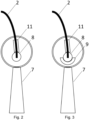
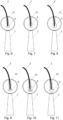
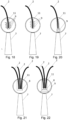
- anchoring structures are described herein and are exemplary in the Figures 2 to 27 It will be understood that the structures are understood by those skilled in the art to be three-dimensional. A largely symmetrical three-dimensional shape is preferably assumed.
- an anchoring structure as a whole is preferably somewhat wider than the thickness of the hair (or the sum of the hairs combined with an anchoring structure) at the coated part.
- the anchoring structure without optional protruding extensions, has a maximum diameter (in the plane of the diameter of the coated hair or hair bundle) that is 1.1 to 20 times, in particular 1.2 to 10 times, in particular 1.5 to 5 times, as thick as the average diameter of the hair (or the sum of the hairs combined with an anchoring structure) at the coated part. This enables a good balance between, on the one hand, efficient and gentle implantation of the hair and, on the other hand, good and comparatively firm anchoring in the skin.
- a fiber can have a (largely) round or (largely) oval cross-section or a (largely) square (also: cuboid-shaped) cross-section.
- a fiber can be made of (largely) homogeneous material or, optionally, can be composed of thinner fibers (e.g., braided, twisted, or parallel-fibered).
- a ribbon has a flat geometry.
- a ribbon can be made of (largely) homogeneous material or, optionally, can be composed of thinner fibers and/or ribbons.
- a fiber or ribbon can be broadly understood as comprising or consisting of a composition according to the present invention. The thickness of a fiber or ribbon can be freely chosen.
- a thick fiber or ribbon with a diameter equal to or greater than the thickness of the hair can optionally be used. This enables quick wrapping.
- a thin fiber or ribbon with a diameter smaller than that of the hair can optionally be used.
- the wrapping can be linear (therefore (largely) parallel, spiral) winding, net-like winding, braid-like winding (cross- and/or transversely wound) or a combination of different windings.
- An example is a linear (therefore (largely) parallel, spiral) winding in Figure 27 shown, wherein the sheath (11) represents a spiral winding and, in this example, a further anchoring structure (9) is additionally attached.
- the winding can optionally be carried out directly on the hair or on another structure that is already lying on the hair, in particular a structure made of a composition according to the present invention that contains at least one silk protein.
- Winding can be carried out in any suitable manner.
- the hair (or hair bundle) can be rotated (preferably about its (largely) rotationally symmetrical axis) and one or more fibers and/or one or more ribbons can be wound up.
- the hair (or hair bundle) can remain stationary and the winding can be achieved by circulating material (e.g., a rotating spindle).
- the wrapped material can be connected to the hair (e.g., its keratin structure).
- different sections of one or more fibers and/or one or more ribbons can be connected to one another.
- This can prevent undesired unwinding.
- a spiral winding can have fibers connected at least at one end, so that unwinding is prevented. Suitable methods for this purpose are described further below.
- the coating which contains at least one silk protein, can potentially interact with body fluids, such as water, at the implanted site in the body. This can increase the volume of the coating, which can enable or strengthen anchoring.
- the coating can absorb tissue fluid after implantation and optionally swell as a result. This can improve the anchoring of the hair in the skin.
- a hair implant can be obtained which is coated with the composition containing at least one silk protein, with an anchor whose shape differs from the natural hair root and/or the natural follicle and/or the natural hair bulb.
- the anchor can have a variety of shapes as described above.
- the thickening can thus have various shapes and Have incisions or protrusions. Barbs and spiral shapes are also possible in addition or alternatively.
- Such an artificial attachment form can optionally be designed in such a way that it can optionally expand after implantation of the implantable hair and enable attachment or improvement of the attachment of the hair implant.
- the composition containing at least one silk protein can also serve in this context to protect against bacteria and other germs and/or to reduce or prevent an immune reaction of the body.
- the anchoring of the implantable hair can also comprise one or more loops in the hair.
- An artificial anchoring structure can also be constructed from the composition containing at least one silk protein.
- Such other materials can be, for example, plastics, preferably biocompatible plastics such as silicone, (methyl) methacrylate, polyvinyl chloride (PVC), polylactic acid, or other compatible plastic materials or mixtures thereof. Inert metals such as gold, platinum, or titanium and their alloys can also be used.
- An artificial anchoring structure can optionally also be coated with graphene.
- An artificial anchoring structure is preferably coated with a composition containing a silk protein.
- the implantable hair is incised on the implantable part. This also enables anchoring. For example, the ingrowth of skin and/or connective tissue into the indentations of the implantable hair structure is enabled. Skin and/or connective tissue can also optionally grow into a loop-shaped structure of the implantable hair.
- the implantable hair comprises a hair follicle, a hair root, or a hair bulb on the implantable part, which is coated with the composition.
- This can enable complete and permanent hair growth (natural hair or foreign hair).
- the implanted hair can be nourished by the skin and, under certain circumstances, even exhibit longitudinal growth.
- the coating of the Hair root and/or a simulated hair follicle and/or a simulated hair bulb with the composition containing at least one silk protein can also in this context protect the hair implant from bacteria and germs and/or reduce or prevent an immune reaction.
- the implantable hairs are designed so that they can be implanted individually. Therefore, they then have a coating structure that usually contains a single hair.
- two or more implantable hairs are combined at their implantable parts in a coating or anchoring structure. This makes it possible to obtain a hair implant coated with the composition containing at least one silk protein, with an artificially reproduced hair root and/or reproduced hair follicle and/or reproduced hair bulb and thus with special anchoring, wherein it can contain one or more hairs.
- the coating with the composition containing at least one silk protein can be homogeneous.
- the coating can also be inhomogeneous, thus having different strength and/or biological stability in different areas.
- the coating has zones with different strength and/or biological stability.
- the coating has higher strength and/or biological stability on the inside, close to the hair, than on the outside.
- the implantation of implantable hair into another person is thus a transplantation of foreign hair.
- This is typically recognized by the immune system as a foreign body and attacked.
- the immune reaction can be reduced or prevented by coating it with a composition containing at least one silk protein. This can prevent a rejection reaction. Acceptance of the foreign hair by the recipient, as well as their tissue and immune system, can be improved.
- the coating of the implantable hair, comprising the at least one silk protein is designed such that after implantation, the silk protein or a degradation product is transported to the hair and/or scalp located outside the body and there cares for the hair and/or skin (such as the scalp).
- composition containing at least one silk protein can optionally also be used to coat other materials, in particular silicone or plastics, to which the hair or several hairs can be attached for implantation (or transplantation).
- the implantable hair was coated with the composition by means of a three-dimensional (3D) shaping process, in particular 3D printing.
- 3D shaping in the context of the present invention can also be understood as 3D printing.
- 3D shaping methods e.g., 3D printing
- suitable for applying (also: adding, adding) and/or removing (also: removing, subtracting) compositions containing at least one silk protein are known to those skilled in the art.
- a 3D shaping method in the context of the present invention can therefore be a subtractive method (therefore, removing already coated material) or an additive method (therefore, adding material), or a combination of both.
- a 3D shaping method in connection with the present invention comprises the use of a light pulse, preferably in the ultraviolet (UV) spectral range, particularly preferably a femtosecond laser, in particular in the UV range, as exemplified in Sidhu et al. ("The processing and heterostructuring of silk with light", Nature Materials, 2017, DOI: 10.1038/NMAT4942 , also published as: Nature Materials, 16:938-945 ).
- UV ultraviolet
- Such a process enables very precise removal of material (e.g., silk protein), very precise cuts in material (e.g., silk protein), and the adhesion of one material (e.g., silk protein) to another material, such as hair material (e.g., keratin), and the adhesion of similar or identical materials to one another (e.g., a silk protein to a similar or identical silk protein).
- material e.g., silk protein
- very precise cuts in material e.g., silk protein
- the adhesion of one material e.g., silk protein
- another material such as hair material (e.g., keratin)
- hair material e.g., keratin
- similar or identical materials e.g., a silk protein to a similar or identical silk protein
- a femtosecond laser emits light pulses lasting a few femtoseconds or less (femtosecond: 10-15 s).
- the laser light which travels at the speed of light in a vacuum, air, and similar gases at atmospheric pressure, travels a distance of only about 0.3 ⁇ m within a femtosecond, which corresponds to about one-hundredth the diameter of a human hair.
- a technical advantage of a femtosecond laser is the precise and residue-free ablation of even the smallest amounts of material without significant heat transfer (hence the precision scalpel principle).
- a femtosecond laser can also convert the material directly into plasma, which has minimal thermal interaction with the substrate.
- a further technical advantage of using a femtosecond laser in connection with the present invention may be that a composition containing at least one silk protein can be exposed to a (optionally weaker, therefore lower-energy) light pulse, preferably ultraviolet (UV) light.
- a (optionally weaker, therefore lower-energy) light pulse preferably ultraviolet (UV) light.
- UV ultraviolet
- a solid or pasty composition can, for example, become liquid for a brief moment and then solid or pasty again. If the composition is brought into contact with another material (e.g., with a hair or a part thereof) during such a light pulse with a femtosecond laser, it can adhere to this material. This can result in a preferably permanent adhesion of the composition to the hair or a part thereof.
- the process according to the invention may also comprise a process step of forming an anchoring of the composition comprising at least one silk protein containing, on the part of the hair to be implanted.
- the hair can first be brought into contact with the composition containing at least one silk protein.
- the composition can then be exposed to a weaker light pulse, such as a femtosecond laser, at the point of contact with the hair. This can cause the composition to adhere to the hair at the point of contact with the hair.
- a layer containing the composition containing at least one silk protein can thus form.
- This process can also be applied appropriately and analogously to bond additional layers of the composition containing at least one silk protein to the composition.
- the layers thus formed can also have different strengths.
- a hair, or a portion thereof, can be partially or completely contacted with the composition containing at least one silk protein.
- the composition can then be exposed to a (weaker, therefore lower-energy) light pulse from the femtosecond laser. This allows the composition to adhere to the point of contact with the hair. This process allows the hair to be partially or completely bonded to the composition, allowing it to be partially or completely coated by the composition. This can help strengthen the hair, extend its lifespan, protect it from environmental influences, and/or improve hair styling.
- the portion of hair to be implanted can be brought into contact with one or more fibers and/or one or more tapes containing or consisting of the composition of the present invention. This can, as explained above, optionally also be done by wrapping, as more specifically explained above. Optionally, the wrapping of the hair can also be performed while the hair is in direct or indirect contact with a liquid or pasty composition.
- a wrapped material can be bonded to the hair (e.g., its keratin structure).
- This can be done in any desired way, for example by a light pulse, in particular in the UV range, as described herein. Particularly preferably, this can be achieved by a femtosecond laser, as described herein.
- a light pulse, in particular in the UV range, in particular a Femtosecond lasers, as described herein, also allow for post-processing of a wrap. This can, for example, include stabilizing the wrap by (partially) joining different sections of the fibers/ribbons.
- the portion of hair to be implanted can be brought into contact with the liquid or pasty composition containing at least one silk protein.
- the portion to be implanted can be immersed in such a composition, coated with it, or sprayed with it. Further possibilities are described herein.
- Part of the composition can remain (for example, in droplet form) on the portion of hair to be implanted.
- the liquid or pasty composition can then dry and/or harden on the portion of hair to be implanted. Hardening is to be understood here in the broadest sense as increasing the strength.
- the composition preferably forms an anchorage that is strong enough to be implanted.
- the degree of hardness is preferably sufficient to achieve a desired half-life in the surrounding body tissue, in particular the skin.
- the composition preferably remains elastic. Elasticity of the anchoring structure can be advantageous in order to be unnoticeable or less noticeable after implantation and to produce no or less pressure soreness and/or no or less pain.
- the part to be implanted can be allowed to air dry after contact with the liquid or pasty composition, or alternatively by changing the environment, for example, by providing ventilation or changing the temperature.
- the desired hair anchorage structure can then be cut and/or ablated from the cured composition using a laser, such as a femtosecond laser.
- the production of the implantable hair in connection with the present invention comprises the at least partial removal of silk protein.
- a 3D shaping in connection with the present invention comprises the at least partial removal of silk protein by means of a light pulse, preferably in the ultraviolet (UV) spectral range. This can take advantage of the fact that silk proteins and optionally also other Components of this composition can absorb in the UV range.
- 3D shaping in connection with the present invention comprises the at least partial removal of silk protein by means of plasma ablation.
- 3D shaping in connection with the present invention comprises the at least partial removal of silk protein by means of a femtosecond laser, in particular in the ultraviolet (UV) spectral range.
- a method based on plasma ablation by means of a femtosecond laser, in particular in the ultraviolet (UV) spectral range, is generally known to the person skilled in the art ( Sidhu et al., Nature Materials, 2017, DOI: 10.1038/NMAT4942 , also published as: Nature Materials, 16:938-945 ).
- the ablation is carried out by means of a short-duration light pulse with a duration of ⁇ 100 ps (picoseconds) or ⁇ 10 ps or ⁇ 1 ps or ⁇ 100 fs (femtoseconds) or ⁇ 10 fs.
- a femtosecond laser therefore, extremely small amounts of material can be ablated from the liquid, pasty, or solid composition containing at least one silk protein using stronger light pulses, particularly in the UV light range.
- honeycomb structures can be formed that may contain cavities. Further examples are shown in the figures. The resulting cavities and/or edges can be brought into contact with a liquid or pasty composition containing at least one silk protein. The composition can then be exposed to a light pulse from the femtosecond laser to improve or enable adhesion of the composition to the honeycomb structure.
- the production of the implantable hair comprises the at least partial (for example thermal) melting of the composition and/or the at least one silk protein, in particular by means of a femtosecond laser, in particular in the ultraviolet (UV) spectral range.
- a femtosecond laser in particular in the ultraviolet (UV) spectral range.
- melting means that the composition is at least partially liquefied or at least the viscosity is reduced.
- Melting is a melting process, usually short-term and local, Temperature increase. The temperature increase is preferably caused by photon irradiation. Melting is preferably a melting of only a portion of the composition and/or a silk protein by means of a light pulse, in particular a UV light pulse.
- a high radiation intensity of a longer wavelength light can be used.
- Multiphoton effects e.g., 2-photon and/or 3-photon effects
- Sidhu et al. (Nature Materials, 2017, DOI: 10.1038/NMAT4942 , also published as: Nature Materials, 16:938-945 ) described.
- the structure preferably hardens again.
- Melting is preferably carried out by means of a short-term light pulse with a duration of ⁇ 100 ps or ⁇ 10 ps or ⁇ 1 ps or ⁇ 100 fs or ⁇ 10 fs.
- Melting and hardening of a portion of the composition and/or the silk protein preferably takes place very briefly, therefore in the range of ⁇ 100 ns (nanoseconds) or ⁇ 10 ns or ⁇ 1 ns or ⁇ 100 ps or ⁇ 10 ps or ⁇ 1 ps or ⁇ 100 fs or ⁇ 10 fs.
- This can result in a shaping of the 3D surface structure in the nanometer and/or micrometer range, in that tiny droplets of the at least partially melted material adhere in a defined manner to the hair or an already hardened structure.
- the 3D shaping method comprises the partial removal of silk protein that has been applied to the hair, in particular by means of plasma ablation, in particular by means of a femtosecond laser, in particular in the ultraviolet (UV) spectral range.
- plasma ablation in particular by means of a femtosecond laser, in particular in the ultraviolet (UV) spectral range.
- UV ultraviolet
- Methods that can be used in connection with the present invention can also be used to process multiple hairs (such as hundreds or thousands) simultaneously and coat them with the composition containing at least one silk protein. Coating processes can be automated.
- the described 3D shaping processes can also be used to process several hairs (even hundreds or thousands) at the same time and with the composition containing at least one silk protein contains, to coat.
- a light pulse e.g. a UV light pulse
- a femtosecond laser can also be used for this purpose.
- several hairs can be brought into contact with the parts to be implanted with the composition containing at least one silk protein (e.g. by immersing them in a liquid or pasty composition, such as a thin layer in a Petri dish).
- a more stable viscosity of the composition can then be achieved (e.g. by aeration, temperature change or light change, for example exposure to UV light).
- the hairs can be removed with their hair anchors using a femtosecond laser.
- Short light pulses can be used to form the anchor shape for each hair and then to release the hair from the composition together with the formed anchor.
- the hair anchorage can then be further formed with the femtosecond laser into a specific anchorage shape, for example, to achieve a conical shape, to form extensions, a ring shape, and many others.
- a femtosecond laser can be used to create a wide variety of anchorage shapes, and the shapes can also be combined with each other, for example, a honeycomb shape, a ring shape with extensions, etc. Structural examples are described herein and also exemplarily in the Figures 2 to 27 shown.
- the implantable hair is at least partially coated with a solid or pasty composition having a 3D surface structure in the nanometer or micrometer range that deviates from the largely cylindrical shape (therefore a shape similar to hair, and preferably also a drop shape).
- a solid or pasty composition having a 3D surface structure in the nanometer or micrometer range that deviates from the largely cylindrical shape (therefore a shape similar to hair, and preferably also a drop shape). Possible shapes are described herein and by way of example in the Figures 2 to 27 described.
- the implantable hair according to the present invention can be produced in any suitable manner. Methods as described herein represent preferred embodiments.
- Steps (ii) and (iii) may optionally be repeated two or more times, which may allow for higher layer thickness and/or the achievement of any desired coating shape.
- the present invention also relates to implantable hair obtainable or obtained by a method as described herein.
- the hair used in step (i) of providing the starting materials can be any hair. It can be human hair, animal hair, or synthetic hair. Corresponding embodiments are explained in more detail in connection with implantable hair.
- the liquid or pasty or solid composition containing at least one silk protein used in step (i) of providing the starting materials may be any liquid or pasty or solid (preferably liquid or pasty) composition.
- the liquid, pasty, or solid (preferably liquid or pasty) composition used for the coating, which contains at least one silk protein may contain a solvent or solvent mixture.
- the at least one silk protein is soluble in a solvent or solvent mixture, or the at least one silk protein forms a colloid or hydrogel in a solvent.
- a solvent can be a cosmetically acceptable solvent.
- a cosmetically acceptable solvent can, for example, be selected from the group consisting of water, a cosmetically acceptable buffer, a hydroalcoholic mixture containing water and up to 5% by volume of ethanol, dimethyl sulfoxide (DMSO), and combinations of two or more thereof.
- DMSO dimethyl sulfoxide
- a cosmetically acceptable solvent can optionally remain completely or partially on the implantable hair. Alternatively, it can be evaporated, for example, by drying.
- a solvent can also be an organic solvent. This preferably has at least a degree of polarity that enables solubility or colloid formation of the at least one silk protein.
- an organic solvent can be selected from one or more alcohols (e.g., ethanol, methanol, propanol, and/or butanol), acetone, or acetonitrile. At least if the organic solvent is not cosmetically acceptable at the concentration used, the organic solvent is preferably evaporable, meaning it can be completely or partially removed by evaporation.
- the liquid or pasty or solid (preferably liquid or pasty) composition used for the coating may optionally contain, in addition to a solvent, one or more preservatives, one or more antibacterial (such as bactericidal and/or bacteriostatic) agents, one or several antifungal agents, one or more antiviral agents, one or more detergents, one or more chelators, one or more hemostatic agents, one or more vitamins, one or more hair growth or blood circulation promoting bioactive substances, one or more local anesthetics, one or more thickening agents, one or more hormones, one or more acidity regulators or a combination of two or more thereof.
- one or more preservatives such as bactericidal and/or bacteriostatic agents
- antifungal agents such as bactericidal and/or bacteriostatic agents
- one or more antiviral agents such as bactericidal and/or bacteriostatic agents
- detergents such as bactericidal and/or bacteriostatic
- one or more chelators such
- a liquid composition preferably has a viscosity of less than 5000 mPa s (e.g., determined using a capillary viscometer) at room temperature (20°C) under atmospheric pressure (1013 mbar).
- a pasty composition preferably has a viscosity of at least 5000 mPa s (e.g., determined using a capillary viscometer) at room temperature (20°C) under atmospheric pressure (1013 mbar).
- solid is broadly understood as having greater rigidity than a paste-like composition, and therefore not flowing at room temperature (20°C) under normal pressure (1013 mbar).
- a soap can be liquid or paste-like, or it can be in the form of a solid bar of soap (also known as hand soap).
- the term “solid” can also encompass waxy substances.
- the silk protein may have a solid or viscous, pasty (waxy) structure. This can achieve good technical properties when pressed through an injection needle and reduce or prevent damage (e.g., to the silk protein) during injection, thus improving the protective function of the silk protein.
- Such a solid or viscous paste (waxy) structure can optionally be achieved by subjecting a liquid or paste composition to temperature and/or air drying until it becomes solid or viscous paste (waxy). This can optionally also be achieved with the aid of additional chemical substances.
- the contacting step (ii) may be carried out in any suitable manner.
- the contacting step (ii) comprises immersing the hair or a part thereof in the liquid or pasty or solid (preferably liquid or pasty) composition.
- step (ii) of contacting comprises coating the hair or a portion thereof with the liquid, pasty, or solid composition.
- step (ii) of contacting comprises spraying the hair or a portion thereof with the liquid, pasty, or solid composition. It will be appreciated that, optionally, combinations of different contacting steps may also be combined with one another.
- step (ii) of contacting comprises bringing a hair (or hair bundle) into contact with a (largely) solid composition containing one or more silk proteins.
- step (ii) of contacting comprises inserting a hair (or hair bundle) into a prefabricated (largely) solid anchoring structure.
- step (ii) of contacting comprises wrapping a hair (or hair bundle) with one or more fibers and/or one or more ribbons.
- wrapping or inserting into a (largely) solid anchoring structure can also be performed in a liquid or pasty composition.
- step (ii) can be carried out at any temperature at which at least the primary structure of the at least one silk protein used is retained and not denatured, thus preventing pyrolytic decomposition of amino acid residues of the at least one silk protein.
- step (ii) is carried out at temperatures in the range of -40 to 250°C, -20 to 200°C, -10 to 180°C, -5 to 150°C, 0 to 150°C, 2 to 120°C, 3 to 100°C, 4 to 80°C, 4 to 60°C, 4 to 50°C, 4 to 40°C, 5 to 30°C, 10 to 25°C, or 15 to 25°C.
- step (ii) is carried out at room temperature in the range of 15 to 25°C or 18 to 22°C, in particular (about) 20°C.
- step (ii) If another method of contacting at least an implantable portion of the hair with the liquid, pasty, or solid composition according to step (ii) is successful, for example by vaporizing the hair or a portion thereof (at elevated temperature and/or in a vacuum), such a procedure is also encompassed by the present invention.
- the silk protein coating can also optionally be vaporized.
- Contacting step (ii) can be carried out at any pressure.
- the step is carried out at ambient pressure, such as in the range of 960 to 1100 mbar, 980 to 1050 mbar, or 990 to 1040 mbar.
- Step (ii) of contacting at least one implantable portion of the hair with the liquid, pasty, or solid composition may comprise contacting a terminal end of the hair with the liquid, pasty, or solid composition. Then, for example, a terminal end of a single hair may be immersed in such a composition, or a terminal end of a grouped tuft of several hairs may be immersed in the composition. Also, for example, a terminal end of a single hair may be coated with a composition, or a terminal end of a grouped tuft of several hairs may be coated with the composition. Also, for example, a terminal end of a single hair may be sprayed with a composition, or a terminal end of a grouped tuft of several hairs may be sprayed with the composition.
- Step (ii) of contacting at least one implantable portion of the hair with the liquid, pasty, or solid composition may also involve contacting both terminal ends of the hair with the liquid, pasty, or solid composition.
- the hair may then be pulled over a rod, for example, so that both ends are positioned on one side, such as hanging down, and both ends are immersed in the composition or are coated or sprayed with it. This is also possible analogously with a bundle of several hairs.
- the method of the present invention provides a 3D surface structure in the nanometer or micrometer range that deviates from a substantially cylindrical shape.
- Deviating from a largely cylindrical shape is often technically advantageous, as it improves the adhesion of implanted hair to the scalp.
- the implanted hair can be anchored more firmly and permanently.
- step (ii) of bringing at least one implantable part of the hair into contact with the liquid or pasty or solid composition may also be carried out by means of 3D shaping (e.g. 3D printing).
- step (ii) of contacting comprises adhering the composition to the hair or a part thereof by means of a 3D shaping process, whereby a 3D surface structure in the nano- or micrometer range is obtained which deviates from the substantially cylindrical shape of the hair (and preferably also a drop shape).
- step (ii) of contacting comprises adhering the composition to the hair or a part thereof by means of partially melting the composition and/or the at least one silk protein, in particular by means of a femtosecond laser, in particular in the ultraviolet (UV) spectral range.
- a femtosecond laser in particular in the ultraviolet (UV) spectral range.
- the method comprises the further step of partially removing silk protein that has been applied to the hair.
- this is done by means of plasma ablation.
- this is done by means of a femtosecond laser, particularly in the ultraviolet (UV) spectral range.
- Step (ii) of contacting at least one implantable portion of the hair with the liquid, pasty, or solid composition may also involve contacting a bend or bendable portion of the hair with the liquid, pasty, or solid composition.
- the hair may then be pulled over a rod, for example, so that both ends are positioned on one side, perhaps hanging down, and the tip located at the bend of the rod is immersed in the composition or is coated or sprayed with it. This is also possible analogously with a bundle of several hairs.
- the hair in step (ii), can also be completely immersed in the liquid, pasty, or solid composition containing at least one silk protein, or completely coated or sprayed with it. This is also possible with multiple hairs at the same time.
- the hair obtained from step (ii) can be used for implantation.
- the hair can be coated at the site of hair implantation or in close proximity to it.
- the hair obtained from step (ii) can also be subjected to an additional drying step (iii).
- This can extend the storage life of the implantable hair. Drying can take place under any conditions. Preferably, the conditions are selected such that neither the hair nor the at least one silk protein is pyrolytically decomposed. Drying can take place at room temperature (15 to 25°C, preferably about 20°C) or at elevated temperature (approximately in the range of over 20°C to 150°C or from 30°C to 100°C or from 40°C to 70°C). Drying can take place at atmospheric pressure or at reduced pressure (for example in a vacuum).
- Drying can also be spray-drying, whereby the coated hair from step (ii) is deep-frozen or flash-frozen (preferably at temperatures ⁇ -10°C, ⁇ -20°C, ⁇ -60°C or about -196°C) and then the solvent is evaporated in a vacuum. Drying can optionally also take place in an air stream. Drying can optionally also be accelerated with a hairdryer.
- the resulting implantable hair can be stored under any suitable conditions, such as ambient temperature or refrigeration. It can optionally be packaged. For example, it can be packaged sterilely. It can be packaged, for example, in a vacuum or in a protective gas atmosphere. It can be packaged transparently or in a light-protected manner. It can, for example, be packaged and/or stored in a liquid or pasty composition containing at least one silk protein.
- a silk protein, hair and/or the coated hair according to the present invention can optionally be stored at any suitable temperature, such as temperatures in the range of -200 to 250°C, -100 to 250°C, -80 to 200°C, -50 to 180°C, -10 to 150°C, 0 to 150°C, from 2 to 120°C, from 3 to 100°C, from 4 to 80°C, from 4 to 60°C, from 4 to 50°C, from 4 to 40°C, from 5 to 30°C, from 10 to 25°C or from 15 to 25°C.
- a temperature close to ambient temperature before implantation such as 5 to 30°C, 10 to 25°C, or 15 to 25°C.
- spider silk fibers undergo a glass transition.
- the glass transition temperature can depend on humidity. Water can act as a plasticizer.
- the present invention also relates to a liquid or pasty or solid composition containing at least one silk protein suitable for coating the hair or an implantable part thereof.
- the present invention also relates to a concentrate or powder for preparing a liquid or pasty or solid (preferably liquid or pasty) composition containing at least one silk protein suitable for coating the hair or an implantable part thereof.
- a package may optionally contain instructions for use, which, among other things, teaches how the implantable hair can be implanted into the skin.
- the implantable hair can be used for implantation into human or animal skin.
- a further aspect of the present invention relates to the (cosmetic) use of implantable hair for implantation into human or animal skin, in particular human scalp.
- the implantation takes place in the scalp.
- the implantation takes place in one or more other areas of the face or body.
- an implantation can take place in the area of one or both eyebrows, in the area of one or both eyelashes, in the area of the mustache, in the area of the goatee, in the area of the sideburns, in the area of the armpits, in the pubic region, in the area of one or both arms, in the area of the chest, in the area of one or both legs.
- Appropriate hair can be selected depending on the area of application.
- the implantation can be performed for any purpose. Typically, it is to increase hair growth in one or more areas of human or animal skin.
- the implantation is preferably carried out largely symmetrically on both sides of the body. In the case of an accident and/or scarring, however, it may also be advisable to subject one side of the body to more extensive or even exclusive implantation. Implantation can be carried out to create or restore head hair. Hair implantation can also be of interest as body hair to emphasize male physical characteristics, for example, in the case of a sex change. Longer eyelashes can also be implanted. A certain shape of a beard can also be achieved by implanting implantable Hair according to the present invention can be achieved.
- the implantation of the implantable hairs according to the invention can also be used for eyebrow reconstruction, eyelash transplantation after alopecia mechanica, alopecia areata, and beard replacement, for example, after correction of a cleft lip and/or (optionally scarring traumatic) alopecia.
- hair growth can also be simulated and/or the partial or complete absence of hair can be concealed in other ways.
- eyebrows can be painted or drawn on with makeup. Tattooing the appearance of short hair and/or coloring the scalp are also possible.
- the implanted hair according to the present invention can optionally grow permanently in the recipient's skin. It can also optionally migrate to the epidermis as part of skin renewal and eventually fall out.
- the duration of the hair's residence in the skin can be defined via the anchoring as described above. This allows the natural life cycle of the hair to be simulated.
- the half-life can be selected jointly with the recipient.
- implantation can be performed using any known method. Numerous methods are known to those skilled in the art.
- composition containing at least one silk protein can also be used to coat hair located on the head or body surface of a human or animal, for example to protect the hair from environmental influences or to obtain improved styling properties.
- the hair can be coated directly or, optionally, already be coated with one or more other layers.
- the composition containing at least one silk protein can optionally also coat other layers previously applied to the hair.
- the composition containing at least one silk protein can also coat the hair before, during, or after bleaching, as well as before, during, or after coloring the hair.
- the coating can remain on the hair and/or penetrate the hair.
- the hair can be fully or partially coated. This can optionally improve the hair structure, optical properties, and styling. Protection against environmental influences and the lifespan of the hair can also be increased.
- One embodiment of the invention relates to a method for cosmetically caring for the implanted implantable hair according to the present invention on the head or body, comprising the step of applying a liquid or pasty composition containing at least one silk protein to the hair.
- the step of applying the liquid, pasty, or solid (preferably liquid or pasty) composition can be carried out by any suitable means.
- the composition can be contained, for example, in a hair, beard, or body care oil, a hair, beard, or body care lotion, a hair, beard, or body care cream, a hair, beard, or body care powder, a shampoo, a conditioner, a shower gel, a body milk, or another cosmetic product for hair or skin care (e.g., mascara).
- liquid or pasty or solid (preferably liquid or pasty) care composition can be packaged together with instructions for use for hair care and can be presented as a kit.
- Hair lightening can be performed on a hair (e.g., implanted implantable hair according to the present invention) on the body or on an implantable hair according to the present invention outside the body.
- a hair e.g., implanted implantable hair according to the present invention
- Various methods for lightening are known to the person skilled in the art.
- it can be bleached (e.g., using a peroxide-containing solution (e.g. , an aqueous solution containing H2O2 )) or an osmosis bath can be used, or a combination thereof.
- the hair cuticles can be opened to extract the color pigments.
- the duration and intensity, as well as The specialist will also choose the temperature and pH value depending on the initial hair color and the target hair color.
- Color coloring can be understood in the broadest sense as the coloring of hair.
- Hair coloring can be performed on a hair (e.g., implanted implantable hair according to the present invention) on the body or on an implantable hair according to the present invention outside the body.
- color pigments are typically added (if necessary). This can be done in any desired way, for example, by brushing, spraying, and/or using an osmosis bath.
- the duration and intensity, as well as the temperature and pH, will be selected by the skilled person depending on the original color of the (possibly previously lightened) hair and the target color for the hair.
- Any suitable dyes can be used for coloring, such as natural and/or artificial color pigments.
- hair can be one's own hair, a foreign hair, or synthetic hair. Further embodiments are described herein. Hair can, for example, be processed temple hair. Preferably, the hair (implanted or non-implanted) is implantable hair according to the present invention.
- color also: dye
- dye (implantable) hair
- a liquid and/or pasty and/or solid (preferably liquid or pasty) composition containing at least one silk protein before, during, and/or after lightening and/or before, during, and/or after coloring can be brought into contact with a liquid and/or pasty and/or solid (preferably liquid or pasty) composition containing at least one silk protein before, during, and/or after lightening and/or before, during, and/or after coloring.
- a composition is preferably as defined herein. This can be done in any desired way, for example by dipping, coating, or spraying the hair. Embodiments are described above.
- An osmosis bath allows the hair to absorb the composition containing at least one silk protein particularly well and form an inert protection. This can strengthen the structure, protect the hair from environmental influences, and improve styling. The hair color can also be maintained for longer. The life cycle of the hair can be extended.
- Spider silk can be obtained in various ways.
- a silk protein such as in WO 2007/025719 and WO 2006/008163 described, therefore a fibroin-3 and/or -4 from the European garden spider ( Araneus diadematus ) is used .
- This is also referred to as "Araneus diadematus Fibroin 3" (ADF-3) or Araneus diadematus Fibroin 4" (ADF-4) or also as (“Major Ampullate Spidroin II" or "Spidroin 2").
- the ADF-3 and/or ADF-4 spider silk protein which is described here as an example, can be obtained commercially.
- Escherichia coli bacteria also called E. coli or coliform bacteria
- DNA encoding spider silk protein from the European garden spider Araneus diadematus
- the hair suitable for implantation comes primarily from India. It is customary among Malawi pilgrims to offer their hair after a vow or at a new stage in life. This primarily occurs in Indian temples, which is why the hair is also called temple hair.
- your own hair can also be cut for implantation of the implantable hair. To ensure good quality, it should be unbleached and undyed if possible.
- To coat the implantable hair it is sorted and bundled in narrow strips. At the terminal end, the hairs are cut with a very sharp blade so that they all end up in the same place. This ensures that each individual hair is coated with silk.
- the silk coating is then applied by immersing the implantable part of the hair in the liquid or paste-like composition or rubbing it against the solid composition. To better distribute the silk, the hair bundle is rotated while immersed in the liquid or paste-like composition.
- the hair is then subjected to drying. To accelerate the drying process, it is exposed to light ventilation. To form additional silk coatings, the hair is immersed again in the liquid or pasty composition following the same principle after the silk layer has dried.
- the hair end to be implanted is only Place immersed in the liquid or pasty composition where the mushroom-shaped widening is to be created.
- the scalp is first locally anesthetized. This is done using a plunger filled with the local anesthetic, such as the "Comfort-in" injection device (Mika Medical Co. 93, Noksansaneopjung-ro, Gangseo-gu, Busan, Republic of Korea).
- the plunger has a nozzle at the bottom with an opening of approximately 0.15 mm.
- a special device resembling a mechanical pencil is used, which is known in the art for this purpose.
- Classic CII hollow needles punches
- Such a device comprises an outer hollow needle, with which the skin is pierced, and an inner hollow needle, into which the implantable hair is placed and locked by a clamping mechanism.
- a feed mechanism also similar to a mechanical pencil
- the electrical trigger mechanism for advancing the inner hollow needle and releasing the lock is controlled by pressing a pedal with the foot.
- the inner diameter of the inner hollow needle can be approximately 0.05 to 0.6 mm wider than the anchorage of the hair implant.
- the inner diameter of the outer hollow needle is only wider than necessary for the inner hollow needle to slide through.
- the outer diameter of the outer hollow needle is approximately 0.2 to 0.9 mm wide.
- the implantation device is placed against the skin in the direction of hair growth at an angle corresponding to the natural angle of the hair, approximately 45 degrees.
- the outer hollow needle is inserted into the skin.
- the trigger is then pressed with the pedal, which automatically pushes the inner hollow needle forward through the outer hollow needle.
- the inner hollow needle reaches the tip of the Once the outer hollow needle is reached, the hair is pushed forward using the advance mechanism.
- the clamping mechanism is automatically released, releasing the hair.
- the implantation device is then removed from the skin and prepared for the implantation of the next hair.
- An alternative procedure is the implantation of the hair with a device similar to that used for transplantation of the patient's own hair.
- the "OKT Implanter” manufactured by Cole Instruments Inc. (1070 Powers Place, Alpharetta, GA 30009, USA) can be used, for example. Its needle can have a diameter of 0.6 to 1.14 mm.
- the extracted hair including the hair root, is placed in a needle that has an incision or opening on one side. The hair is then pressed into the scalp and implanted.
- the hair including its anchor, can be placed in the needle of the OKT Implanter, pressed into the skin, and implanted.
- the hair can hang out of the needle opening, making it possible to implant long hair.
- a treatment can last from a few hours to a few days.
Landscapes
- Health & Medical Sciences (AREA)
- Life Sciences & Earth Sciences (AREA)
- Transplantation (AREA)
- Chemical & Material Sciences (AREA)
- Animal Behavior & Ethology (AREA)
- General Health & Medical Sciences (AREA)
- Public Health (AREA)
- Veterinary Medicine (AREA)
- Dermatology (AREA)
- Oral & Maxillofacial Surgery (AREA)
- Engineering & Computer Science (AREA)
- Biomedical Technology (AREA)
- Epidemiology (AREA)
- Medicinal Chemistry (AREA)
- Chemical Kinetics & Catalysis (AREA)
- Vascular Medicine (AREA)
- Botany (AREA)
- Zoology (AREA)
- Urology & Nephrology (AREA)
- Cardiology (AREA)
- Heart & Thoracic Surgery (AREA)
- Molecular Biology (AREA)
- Birds (AREA)
- Polymers & Plastics (AREA)
- Organic Chemistry (AREA)
- Materials For Medical Uses (AREA)
- Cosmetics (AREA)
- Peptides Or Proteins (AREA)
- Micro-Organisms Or Cultivation Processes Thereof (AREA)
Applications Claiming Priority (3)
| Application Number | Priority Date | Filing Date | Title |
|---|---|---|---|
| EP20202744 | 2020-10-20 | ||
| EP21793948.7A EP4231962B1 (fr) | 2020-10-20 | 2021-10-19 | Cheveux revêtus et leur utilisation |
| PCT/EP2021/078898 WO2022084285A1 (fr) | 2020-10-20 | 2021-10-19 | Cheveux revêtus et leur utilisation |
Related Parent Applications (1)
| Application Number | Title | Priority Date | Filing Date |
|---|---|---|---|
| EP21793948.7A Division EP4231962B1 (fr) | 2020-10-20 | 2021-10-19 | Cheveux revêtus et leur utilisation |
Publications (2)
| Publication Number | Publication Date |
|---|---|
| EP4555975A2 true EP4555975A2 (fr) | 2025-05-21 |
| EP4555975A3 EP4555975A3 (fr) | 2025-07-30 |
Family
ID=72964524
Family Applications (2)
| Application Number | Title | Priority Date | Filing Date |
|---|---|---|---|
| EP21793948.7A Active EP4231962B1 (fr) | 2020-10-20 | 2021-10-19 | Cheveux revêtus et leur utilisation |
| EP25168906.3A Pending EP4555975A3 (fr) | 2020-10-20 | 2021-10-19 | Cheveux revêtus et leur utilisation |
Family Applications Before (1)
| Application Number | Title | Priority Date | Filing Date |
|---|---|---|---|
| EP21793948.7A Active EP4231962B1 (fr) | 2020-10-20 | 2021-10-19 | Cheveux revêtus et leur utilisation |
Country Status (11)
| Country | Link |
|---|---|
| US (1) | US20230380956A1 (fr) |
| EP (2) | EP4231962B1 (fr) |
| JP (1) | JP2023550202A (fr) |
| KR (1) | KR20230092948A (fr) |
| CN (1) | CN117120025A (fr) |
| AU (1) | AU2021363562A1 (fr) |
| CA (1) | CA3195460A1 (fr) |
| IL (1) | IL302156A (fr) |
| MX (1) | MX2023004387A (fr) |
| TW (1) | TWI911309B (fr) |
| WO (1) | WO2022084285A1 (fr) |
Families Citing this family (1)
| Publication number | Priority date | Publication date | Assignee | Title |
|---|---|---|---|---|
| CN121337662A (zh) * | 2025-12-17 | 2026-01-16 | 广州市雪蕾化妆品有限公司 | 一种含有植物精油的香水及其制备方法 |
Citations (13)
| Publication number | Priority date | Publication date | Assignee | Title |
|---|---|---|---|---|
| GB1504258A (en) | 1975-08-01 | 1978-03-15 | Yamada S | Artificial hair |
| GB2006018A (en) | 1977-10-13 | 1979-05-02 | Kondo Giken Yk | Artificial hair |
| US4517997A (en) | 1979-12-06 | 1985-05-21 | Forchetti A Patrick | Hair implant structure |
| US20030195625A1 (en) | 2002-04-15 | 2003-10-16 | Garcia Castro Marco A. | Biodegradable follicle hair implant |
| WO2004024176A1 (fr) | 2002-08-30 | 2004-03-25 | Henkel Kommanditgesellschaft Auf Aktien | Combinaison synergique de proteines de soie |
| DE10333253A1 (de) | 2003-07-21 | 2005-02-17 | Henkel Kgaa | Färbemittel mit Pflegestoffkombination |
| WO2006008163A2 (fr) | 2004-07-22 | 2006-01-26 | Technische Universitaet Muenchen | Proteines de soies d'araignees recombinees |
| WO2007025719A1 (fr) | 2005-08-29 | 2007-03-08 | Technische Universitaet Muenchen | Protéines de soie arachnéenne modifiées |
| US20070196429A1 (en) | 2004-06-25 | 2007-08-23 | Thomas Scheibel | Proteins of natural origin and materials made therefrom |
| WO2011064772A1 (fr) | 2009-11-27 | 2011-06-03 | Hairstetics Ltd. | Ancrages d'implant capillaire et systèmes et procédés pour leur utilisation |
| WO2011069643A2 (fr) | 2009-12-08 | 2011-06-16 | Amsilk Gmbh | Revêtements à base de protéine de soie |
| US10561490B2 (en) | 2017-07-31 | 2020-02-18 | Loria Products Llc | Hair implants comprising enhanced anchoring and medical safety features |
| WO2020180682A1 (fr) | 2019-03-05 | 2020-09-10 | Loria Products Llc | Implants capillaires comprenant des caractéristiques d'ancrage et de sécurité médicale améliorées |
Family Cites Families (5)
| Publication number | Priority date | Publication date | Assignee | Title |
|---|---|---|---|---|
| US7842780B2 (en) * | 2003-01-07 | 2010-11-30 | Trustees Of Tufts College | Silk fibroin materials and use thereof |
| AR057628A1 (es) * | 2005-11-22 | 2007-12-05 | Aderans Res Inst Inc | Injertos capilares derivados de cabello extirpado |
| FR3025431A1 (fr) * | 2014-09-05 | 2016-03-11 | Joel Francois Broustail | Utilisation de fibres de soie d'araignee naturelle ou artificielle pour la fabrication de cheveux artificiels, cheveu artificiel et prothese capillaire comprenant de telles fibres de soie d'araignee |
| KR102363366B1 (ko) * | 2018-11-23 | 2022-02-16 | (주)메디코스바이오텍 | 탈모 치료 또는 모발 성장 촉진용 조성물 |
| CN109518302A (zh) * | 2018-11-26 | 2019-03-26 | 合肥卓汇新材料科技有限公司 | 一种自清洁假发纤维 |
-
2021
- 2021-10-19 TW TW110138751A patent/TWI911309B/zh active
- 2021-10-19 EP EP21793948.7A patent/EP4231962B1/fr active Active
- 2021-10-19 CA CA3195460A patent/CA3195460A1/fr active Pending
- 2021-10-19 US US18/249,617 patent/US20230380956A1/en active Pending
- 2021-10-19 JP JP2023547923A patent/JP2023550202A/ja active Pending
- 2021-10-19 KR KR1020237015833A patent/KR20230092948A/ko active Pending
- 2021-10-19 AU AU2021363562A patent/AU2021363562A1/en active Pending
- 2021-10-19 WO PCT/EP2021/078898 patent/WO2022084285A1/fr not_active Ceased
- 2021-10-19 EP EP25168906.3A patent/EP4555975A3/fr active Pending
- 2021-10-19 IL IL302156A patent/IL302156A/en unknown
- 2021-10-19 MX MX2023004387A patent/MX2023004387A/es unknown
- 2021-10-19 CN CN202180086465.1A patent/CN117120025A/zh active Pending
Patent Citations (15)
| Publication number | Priority date | Publication date | Assignee | Title |
|---|---|---|---|---|
| GB1504258A (en) | 1975-08-01 | 1978-03-15 | Yamada S | Artificial hair |
| GB2006018A (en) | 1977-10-13 | 1979-05-02 | Kondo Giken Yk | Artificial hair |
| US4517997A (en) | 1979-12-06 | 1985-05-21 | Forchetti A Patrick | Hair implant structure |
| US20030195625A1 (en) | 2002-04-15 | 2003-10-16 | Garcia Castro Marco A. | Biodegradable follicle hair implant |
| WO2004024176A1 (fr) | 2002-08-30 | 2004-03-25 | Henkel Kommanditgesellschaft Auf Aktien | Combinaison synergique de proteines de soie |
| DE10333253A1 (de) | 2003-07-21 | 2005-02-17 | Henkel Kgaa | Färbemittel mit Pflegestoffkombination |
| US20070196429A1 (en) | 2004-06-25 | 2007-08-23 | Thomas Scheibel | Proteins of natural origin and materials made therefrom |
| WO2006008163A2 (fr) | 2004-07-22 | 2006-01-26 | Technische Universitaet Muenchen | Proteines de soies d'araignees recombinees |
| US20070214520A1 (en) | 2004-07-22 | 2007-09-13 | Thomas Scheibel | Recombinant spider silk proteins |
| WO2007025719A1 (fr) | 2005-08-29 | 2007-03-08 | Technische Universitaet Muenchen | Protéines de soie arachnéenne modifiées |
| US20090123967A1 (en) | 2005-08-29 | 2009-05-14 | Thomas Scheibel | Modified spider silk proteins |
| WO2011064772A1 (fr) | 2009-11-27 | 2011-06-03 | Hairstetics Ltd. | Ancrages d'implant capillaire et systèmes et procédés pour leur utilisation |
| WO2011069643A2 (fr) | 2009-12-08 | 2011-06-16 | Amsilk Gmbh | Revêtements à base de protéine de soie |
| US10561490B2 (en) | 2017-07-31 | 2020-02-18 | Loria Products Llc | Hair implants comprising enhanced anchoring and medical safety features |
| WO2020180682A1 (fr) | 2019-03-05 | 2020-09-10 | Loria Products Llc | Implants capillaires comprenant des caractéristiques d'ancrage et de sécurité médicale améliorées |
Non-Patent Citations (2)
| Title |
|---|
| SIDHU ET AL., NATURE MATERIALS, vol. 16, 2017, pages 938 - 945 |
| SIDHU ET AL.: "The processing and heterostructuring of silk with light", NATURE MATERIALS, 2017 |
Also Published As
| Publication number | Publication date |
|---|---|
| US20230380956A1 (en) | 2023-11-30 |
| EP4555975A3 (fr) | 2025-07-30 |
| CN117120025A (zh) | 2023-11-24 |
| IL302156A (en) | 2023-06-01 |
| AU2021363562A1 (en) | 2023-06-01 |
| KR20230092948A (ko) | 2023-06-26 |
| TWI911309B (zh) | 2026-01-11 |
| CA3195460A1 (fr) | 2022-04-28 |
| EP4231962B1 (fr) | 2025-04-09 |
| MX2023004387A (es) | 2023-06-22 |
| WO2022084285A1 (fr) | 2022-04-28 |
| TW202233160A (zh) | 2022-09-01 |
| EP4231962A1 (fr) | 2023-08-30 |
| JP2023550202A (ja) | 2023-11-30 |
Similar Documents
| Publication | Publication Date | Title |
|---|---|---|
| KR102686939B1 (ko) | 향상된 고정 기능과 의료 안전 기능을 갖춘 모발 이식체 | |
| DE3876469T2 (de) | Hautaequivalent. | |
| DE69633444T2 (de) | Zusammensetzungen aus rekonstituierten kollagenfasersegmenten und verfahren zu ihrer herstellung | |
| JP2020529909A5 (fr) | ||
| EP4231962B1 (fr) | Cheveux revêtus et leur utilisation | |
| DE69820254T2 (de) | Dermales hüllgewebe in der wundheilung | |
| KR101987412B1 (ko) | 마이크로니들 어레이 및 그 제조방법 | |
| AU2020232594B2 (en) | Hair implants comprising enhanced anchoring and medical safety features | |
| WO2001058413A1 (fr) | Procede pour stimuler la pousse des cheveux et kit pour mettre ledit procede en oeuvre | |
| HK40126732A (en) | Coated hair and its use | |
| HK40095594A (zh) | 涂覆的毛发及其用途 | |
| HK40095594B (en) | Coated hair and use thereof | |
| EP3377616A1 (fr) | Procédé de préparation de follicules capillaires et de papilles de novo, et leur utilisation pour des tests in vitro et des implants in vivo | |
| EA049775B1 (ru) | Волосы с покрытием и их применение | |
| KR20240123325A (ko) | 강화된 고정 및 의료 안전 기능을 갖춘 헤어 임플란트 | |
| DE3837669C2 (de) | Verfahren zur Herstellung von Material für die Zelltherapie | |
| US20220061981A1 (en) | Hair implants comprising enhanced anchoring and medical safety features | |
| RU2776439C9 (ru) | Волосяные имплантаты с усиленной фиксацией и характеристиками медицинской безопасности | |
| RU2446751C2 (ru) | Способ имплантации ресниц (его варианты) | |
| RU2776439C2 (ru) | Волосяные имплантаты с усиленной фиксацией и характеристиками медицинской безопасности | |
| US20220061982A1 (en) | Hair implants comprising enhanced anchoring and medical safety features | |
| RU2256466C2 (ru) | Искусственные волосы | |
| DE3111601C2 (de) | Homotransplantat für die Schichtkeratoplastik | |
| DE102004038234A1 (de) | Implantatkörper | |
| WO2017084997A1 (fr) | Procédé de fabrication d'un équivalent de peau et son utilisation pour des essais in vitro et des greffes in vivo |
Legal Events
| Date | Code | Title | Description |
|---|---|---|---|
| PUAI | Public reference made under article 153(3) epc to a published international application that has entered the european phase |
Free format text: ORIGINAL CODE: 0009012 |
|
| STAA | Information on the status of an ep patent application or granted ep patent |
Free format text: STATUS: THE APPLICATION HAS BEEN PUBLISHED |
|
| AC | Divisional application: reference to earlier application |
Ref document number: 4231962 Country of ref document: EP Kind code of ref document: P |
|
| AK | Designated contracting states |
Kind code of ref document: A2 Designated state(s): AL AT BE BG CH CY CZ DE DK EE ES FI FR GB GR HR HU IE IS IT LI LT LU LV MC MK MT NL NO PL PT RO RS SE SI SK SM TR |
|
| PUAL | Search report despatched |
Free format text: ORIGINAL CODE: 0009013 |
|
| AK | Designated contracting states |
Kind code of ref document: A3 Designated state(s): AL AT BE BG CH CY CZ DE DK EE ES FI FR GB GR HR HU IE IS IT LI LT LU LV MC MK MT NL NO PL PT RO RS SE SI SK SM TR |
|
| RIC1 | Information provided on ipc code assigned before grant |
Ipc: A61F 2/10 20060101AFI20250625BHEP Ipc: A61K 8/64 20060101ALI20250625BHEP Ipc: A61Q 5/00 20060101ALI20250625BHEP Ipc: A61L 27/22 20060101ALI20250625BHEP Ipc: A61L 27/34 20060101ALI20250625BHEP Ipc: A61L 27/36 20060101ALI20250625BHEP |
|
| RIN1 | Information on inventor provided before grant (corrected) |
Inventor name: STRAUCH, GEORG |
|
| REG | Reference to a national code |
Ref country code: HK Ref legal event code: DE Ref document number: 40126732 Country of ref document: HK |