EP4556218A1 - Polyvinylacetalfolien mit verbesserter steifigkeit - Google Patents
Polyvinylacetalfolien mit verbesserter steifigkeit Download PDFInfo
- Publication number
- EP4556218A1 EP4556218A1 EP23209590.1A EP23209590A EP4556218A1 EP 4556218 A1 EP4556218 A1 EP 4556218A1 EP 23209590 A EP23209590 A EP 23209590A EP 4556218 A1 EP4556218 A1 EP 4556218A1
- Authority
- EP
- European Patent Office
- Prior art keywords
- polyvinyl acetal
- acetal film
- weight
- mpa
- glass
- Prior art date
- Legal status (The legal status is an assumption and is not a legal conclusion. Google has not performed a legal analysis and makes no representation as to the accuracy of the status listed.)
- Withdrawn
Links
Images

Classifications
-
- C—CHEMISTRY; METALLURGY
- C08—ORGANIC MACROMOLECULAR COMPOUNDS; THEIR PREPARATION OR CHEMICAL WORKING-UP; COMPOSITIONS BASED THEREON
- C08J—WORKING-UP; GENERAL PROCESSES OF COMPOUNDING; AFTER-TREATMENT NOT COVERED BY SUBCLASSES C08B, C08C, C08F, C08G or C08H
- C08J5/00—Manufacture of articles or shaped materials containing macromolecular substances
- C08J5/18—Manufacture of films or sheets
-
- B—PERFORMING OPERATIONS; TRANSPORTING
- B32—LAYERED PRODUCTS
- B32B—LAYERED PRODUCTS, i.e. PRODUCTS BUILT-UP OF STRATA OF FLAT OR NON-FLAT, e.g. CELLULAR OR HONEYCOMB, FORM
- B32B17/00—Layered products essentially comprising sheet glass, or glass, slag, or like fibres
- B32B17/06—Layered products essentially comprising sheet glass, or glass, slag, or like fibres comprising glass as the main or only constituent of a layer, next to another layer of a specific material
- B32B17/10—Layered products essentially comprising sheet glass, or glass, slag, or like fibres comprising glass as the main or only constituent of a layer, next to another layer of a specific material of synthetic resin
- B32B17/10005—Layered products essentially comprising sheet glass, or glass, slag, or like fibres comprising glass as the main or only constituent of a layer, next to another layer of a specific material of synthetic resin laminated safety glass or glazing
- B32B17/1055—Layered products essentially comprising sheet glass, or glass, slag, or like fibres comprising glass as the main or only constituent of a layer, next to another layer of a specific material of synthetic resin laminated safety glass or glazing characterized by the resin layer, i.e. interlayer
- B32B17/10605—Type of plasticiser
-
- B—PERFORMING OPERATIONS; TRANSPORTING
- B32—LAYERED PRODUCTS
- B32B—LAYERED PRODUCTS, i.e. PRODUCTS BUILT-UP OF STRATA OF FLAT OR NON-FLAT, e.g. CELLULAR OR HONEYCOMB, FORM
- B32B17/00—Layered products essentially comprising sheet glass, or glass, slag, or like fibres
- B32B17/06—Layered products essentially comprising sheet glass, or glass, slag, or like fibres comprising glass as the main or only constituent of a layer, next to another layer of a specific material
- B32B17/10—Layered products essentially comprising sheet glass, or glass, slag, or like fibres comprising glass as the main or only constituent of a layer, next to another layer of a specific material of synthetic resin
- B32B17/10005—Layered products essentially comprising sheet glass, or glass, slag, or like fibres comprising glass as the main or only constituent of a layer, next to another layer of a specific material of synthetic resin laminated safety glass or glazing
- B32B17/1055—Layered products essentially comprising sheet glass, or glass, slag, or like fibres comprising glass as the main or only constituent of a layer, next to another layer of a specific material of synthetic resin laminated safety glass or glazing characterized by the resin layer, i.e. interlayer
- B32B17/10761—Layered products essentially comprising sheet glass, or glass, slag, or like fibres comprising glass as the main or only constituent of a layer, next to another layer of a specific material of synthetic resin laminated safety glass or glazing characterized by the resin layer, i.e. interlayer containing vinyl acetal
-
- B—PERFORMING OPERATIONS; TRANSPORTING
- B32—LAYERED PRODUCTS
- B32B—LAYERED PRODUCTS, i.e. PRODUCTS BUILT-UP OF STRATA OF FLAT OR NON-FLAT, e.g. CELLULAR OR HONEYCOMB, FORM
- B32B17/00—Layered products essentially comprising sheet glass, or glass, slag, or like fibres
- B32B17/06—Layered products essentially comprising sheet glass, or glass, slag, or like fibres comprising glass as the main or only constituent of a layer, next to another layer of a specific material
- B32B17/10—Layered products essentially comprising sheet glass, or glass, slag, or like fibres comprising glass as the main or only constituent of a layer, next to another layer of a specific material of synthetic resin
- B32B17/10005—Layered products essentially comprising sheet glass, or glass, slag, or like fibres comprising glass as the main or only constituent of a layer, next to another layer of a specific material of synthetic resin laminated safety glass or glazing
- B32B17/10807—Making laminated safety glass or glazing; Apparatus therefor
- B32B17/10899—Making laminated safety glass or glazing; Apparatus therefor by introducing interlayers of synthetic resin
- B32B17/10935—Making laminated safety glass or glazing; Apparatus therefor by introducing interlayers of synthetic resin as a preformed layer, e.g. formed by extrusion
-
- B—PERFORMING OPERATIONS; TRANSPORTING
- B32—LAYERED PRODUCTS
- B32B—LAYERED PRODUCTS, i.e. PRODUCTS BUILT-UP OF STRATA OF FLAT OR NON-FLAT, e.g. CELLULAR OR HONEYCOMB, FORM
- B32B17/00—Layered products essentially comprising sheet glass, or glass, slag, or like fibres
- B32B17/06—Layered products essentially comprising sheet glass, or glass, slag, or like fibres comprising glass as the main or only constituent of a layer, next to another layer of a specific material
- B32B17/10—Layered products essentially comprising sheet glass, or glass, slag, or like fibres comprising glass as the main or only constituent of a layer, next to another layer of a specific material of synthetic resin
- B32B17/10005—Layered products essentially comprising sheet glass, or glass, slag, or like fibres comprising glass as the main or only constituent of a layer, next to another layer of a specific material of synthetic resin laminated safety glass or glazing
- B32B17/10009—Layered products essentially comprising sheet glass, or glass, slag, or like fibres comprising glass as the main or only constituent of a layer, next to another layer of a specific material of synthetic resin laminated safety glass or glazing characterized by the number, the constitution or treatment of glass sheets
- B32B17/10036—Layered products essentially comprising sheet glass, or glass, slag, or like fibres comprising glass as the main or only constituent of a layer, next to another layer of a specific material of synthetic resin laminated safety glass or glazing characterized by the number, the constitution or treatment of glass sheets comprising two outer glass sheets
-
- B—PERFORMING OPERATIONS; TRANSPORTING
- B32—LAYERED PRODUCTS
- B32B—LAYERED PRODUCTS, i.e. PRODUCTS BUILT-UP OF STRATA OF FLAT OR NON-FLAT, e.g. CELLULAR OR HONEYCOMB, FORM
- B32B17/00—Layered products essentially comprising sheet glass, or glass, slag, or like fibres
- B32B17/06—Layered products essentially comprising sheet glass, or glass, slag, or like fibres comprising glass as the main or only constituent of a layer, next to another layer of a specific material
- B32B17/10—Layered products essentially comprising sheet glass, or glass, slag, or like fibres comprising glass as the main or only constituent of a layer, next to another layer of a specific material of synthetic resin
- B32B17/10005—Layered products essentially comprising sheet glass, or glass, slag, or like fibres comprising glass as the main or only constituent of a layer, next to another layer of a specific material of synthetic resin laminated safety glass or glazing
- B32B17/1055—Layered products essentially comprising sheet glass, or glass, slag, or like fibres comprising glass as the main or only constituent of a layer, next to another layer of a specific material of synthetic resin laminated safety glass or glazing characterized by the resin layer, i.e. interlayer
- B32B17/10651—Layered products essentially comprising sheet glass, or glass, slag, or like fibres comprising glass as the main or only constituent of a layer, next to another layer of a specific material of synthetic resin laminated safety glass or glazing characterized by the resin layer, i.e. interlayer comprising colorants, e.g. dyes or pigments
-
- B—PERFORMING OPERATIONS; TRANSPORTING
- B32—LAYERED PRODUCTS
- B32B—LAYERED PRODUCTS, i.e. PRODUCTS BUILT-UP OF STRATA OF FLAT OR NON-FLAT, e.g. CELLULAR OR HONEYCOMB, FORM
- B32B17/00—Layered products essentially comprising sheet glass, or glass, slag, or like fibres
- B32B17/06—Layered products essentially comprising sheet glass, or glass, slag, or like fibres comprising glass as the main or only constituent of a layer, next to another layer of a specific material
- B32B17/10—Layered products essentially comprising sheet glass, or glass, slag, or like fibres comprising glass as the main or only constituent of a layer, next to another layer of a specific material of synthetic resin
- B32B17/10005—Layered products essentially comprising sheet glass, or glass, slag, or like fibres comprising glass as the main or only constituent of a layer, next to another layer of a specific material of synthetic resin laminated safety glass or glazing
- B32B17/10807—Making laminated safety glass or glazing; Apparatus therefor
- B32B17/10816—Making laminated safety glass or glazing; Apparatus therefor by pressing
- B32B17/10871—Making laminated safety glass or glazing; Apparatus therefor by pressing in combination with particular heat treatment
-
- B—PERFORMING OPERATIONS; TRANSPORTING
- B32—LAYERED PRODUCTS
- B32B—LAYERED PRODUCTS, i.e. PRODUCTS BUILT-UP OF STRATA OF FLAT OR NON-FLAT, e.g. CELLULAR OR HONEYCOMB, FORM
- B32B2307/00—Properties of the layers or laminate
- B32B2307/40—Properties of the layers or laminate having particular optical properties
- B32B2307/412—Transparent
-
- B—PERFORMING OPERATIONS; TRANSPORTING
- B32—LAYERED PRODUCTS
- B32B—LAYERED PRODUCTS, i.e. PRODUCTS BUILT-UP OF STRATA OF FLAT OR NON-FLAT, e.g. CELLULAR OR HONEYCOMB, FORM
- B32B2307/00—Properties of the layers or laminate
- B32B2307/50—Properties of the layers or laminate having particular mechanical properties
-
- B—PERFORMING OPERATIONS; TRANSPORTING
- B32—LAYERED PRODUCTS
- B32B—LAYERED PRODUCTS, i.e. PRODUCTS BUILT-UP OF STRATA OF FLAT OR NON-FLAT, e.g. CELLULAR OR HONEYCOMB, FORM
- B32B2307/00—Properties of the layers or laminate
- B32B2307/50—Properties of the layers or laminate having particular mechanical properties
- B32B2307/542—Shear strength
-
- B—PERFORMING OPERATIONS; TRANSPORTING
- B32—LAYERED PRODUCTS
- B32B—LAYERED PRODUCTS, i.e. PRODUCTS BUILT-UP OF STRATA OF FLAT OR NON-FLAT, e.g. CELLULAR OR HONEYCOMB, FORM
- B32B2419/00—Buildings or parts thereof
-
- C—CHEMISTRY; METALLURGY
- C08—ORGANIC MACROMOLECULAR COMPOUNDS; THEIR PREPARATION OR CHEMICAL WORKING-UP; COMPOSITIONS BASED THEREON
- C08J—WORKING-UP; GENERAL PROCESSES OF COMPOUNDING; AFTER-TREATMENT NOT COVERED BY SUBCLASSES C08B, C08C, C08F, C08G or C08H
- C08J2329/00—Characterised by the use of homopolymers or copolymers of compounds having one or more unsaturated aliphatic radicals, each having only one carbon-to-carbon double bond, and at least one being terminated by an alcohol, ether, aldehydo, ketonic, acetal, or ketal radical; Hydrolysed polymers of esters of unsaturated alcohols with saturated carboxylic acids; Derivatives of such polymer
- C08J2329/14—Homopolymers or copolymers of acetals or ketals obtained by polymerisation of unsaturated acetals or ketals or by after-treatment of polymers of unsaturated alcohols
Definitions
- the present invention concerns polyvinyl acetal films comprising plasticizer in reduced amount with an improved shear relaxation modulus.
- Interlayer films comprising polyvinyl acetals are long known as adhesive layers for laminating glass.
- plasticized polyvinyl butyral (PVB) films are widely used as adhesive layers for glass-glass laminates, e.g. for architectural applications such as building windows.
- Structural glazing differs from conventional glass façades in its appearance and construction.
- the individual glass elements are only separated from each other by fine shadow gaps or silicone joints.
- the entire façade presents itself as a smooth surface without interruptions.
- the insulating glass or parapet elements are not held in place by glazing beads or cover profiles.
- polyvinyl acetal films with a high stiffness as expressed for example by an improved high shear relaxation modulus G(t) in this temperature range would be advantageous.
- the objective of the present invention was to provide a film with improved characteristics, wherein the improvements include a higher rigidity, higher shear relaxation and/or shear storage modulus, improved processibility, lower manufacturing costs and/or higher optical quality, especially in terms of less haze and/or less yellowness.
- the present invention concerns a polyvinyl acetal film comprising at least one plasticizer wherein,
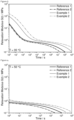
- Figures 1 to 4 show the shear relaxation modulus of the examples and reference examples at four different temperatures.
- the weight average molecular weight (Mw) measured by GPC in tetrahydrofuran according to the method described below is equal to or above 180,000 g/mol, more preferably equal to or above 200,000 g/mol, even more preferably equal to or above 250,000 g/mol and most preferably equal to or above 275,000 g/mol.
- the weight average molecular weight (Mw) measured by GPC in tetrahydrofuran according to the method described below is equal to or below 500,000 g/mol, more preferably equal to or below 400,000 g/mol, even more preferably equal to or below 350,000 g/mol and most preferably equal to or below 300,000 g/mol.
- the shear relaxation modulus measured at 30 oC and 5 min is higher than 7.5 MPa, more preferably higher than 10 MPa, even more preferably higher than 15 MPa, and most preferably higher than 25 MPa.
- the shear relaxation modulus measured at 30 oC and 5 min is lower than 200 MPa, more preferably lower than 150 MPa, even more preferably lower than 100 MPa, and most preferably lower than 75 MPa. Specifically, it is higher than 30 and lower than 100 MPa.
- the shear relaxation modulus measured at 20 oC and 12 h is higher than 10 MPa, more preferably higher than 12.5 MPa, even more preferably higher than 15 MPa, and most preferably higher than 25 MPa. Also preferably, the shear relaxation modulus measured at 20 oC and 12 h is lower than 200 MPa, more preferably lower than 150 MPa, even more preferably lower than 100 MPa, and most preferably lower than 75 MPa. Specifically, it is higher than 15 and lower than 50 MPa.
- the shear relaxation modulus measured at 35 oC and 3 s is higher than 15 MPa, more preferably higher than 17.5 MPa, even more preferably higher than 20 MPa, and most preferably higher than 25 MPa. Also preferably, the shear relaxation modulus measured at 35 oC and 3 s is lower than 200 MPa, more preferably lower than 150 MPa, even more preferably lower than 100 MPa, and most preferably lower than 75 MPa. Specifically, it is higher than 15 and lower than 50 MPa.
- the thickness of the interlayer film is from 350 to 2500 ⁇ m, more preferably from 500 to 2000 ⁇ m, and most preferably from 700 to 1750 ⁇ m.
- the interlayer films according to the present invention contain plasticizer. They may contain one or more than one type of plasticizer.
- the term "total amount of plasticizer” thus means the combined amounts or any plasticizer present.
- the total amount of plasticizer in the polyvinyl acetal film is from 13.5 % by weight to 15.5 % by weight, more preferably from 14.0 to 15.0 % by weight.
- the polyvinyl acetal film has a yellowness index dYID measured according to the method described below 2.0, more preferably from - 2.0 to 2.0, most preferably from - 1.0 to 1.0 and specifically from - 0.5 to 0.5.
- dYID yellowness index measured according to the method described below 2.0
- the interlayer films may contain small amounts of suitable colourants. Suitable colourants include derivatives of phthalocyanines, anthraquinones, perylenes as well as titanium oxide or a dye or pigment such as an azo compound or carbon black. Such suitable colourants can be obtained commercially.
- the post breakage behaviour of the polyvinyl acetal film determined in a bending tests according to EN 1288-3 at 23 °C and as described below of equal to or more than 10 min, more preferably more than 25 min, even more preferably more than 45 min and most preferably more than 75 min. It is preferably less than 360 min, more preferably less than 250 min and most preferably less than 120 min.
- the interlayer film has a glass-transition temperature Tg measured according to the method described below from 50 oC to 75 oC, more preferably from 52 oC to 60 oC.
- the interlayer films according to the present invention are generally prepared by a conventional melt extrusion step known to the skilled person. Melting of the polyvinyl acetal resin powder is carried out at a temperature ranging from the melt temperature of polyvinyl acetal resin up to 260 °C. After the melting step, the extruding and cutting step follows. This step may be carried out by, for example, extruding the melt of polyvinyl acetal resin in the melt extruder followed by cooling and cutting it, or extruding it in the melt extruder into a water bath followed by cutting it.
- the interlayer film may contain alkali metal ions; lithium ions are preferred.
- the total amount of alkali metal salts may be as low as 0.005 % by weight based on the weight of the film. Preferred ranges of alkali metal salt are 0.01 % - 0.1 %; 0.02 - 0.08 %; 0.03 - 0.06 %, each weight % based on the weight of the film.
- the interlayer film may additionally comprise alkaline earth ions, but since their effect on adhesion is limited, relatively small amounts as compared to the alkali ion should be used.
- the interlayer film comprises 0 to 100 ppm alkaline earth ions, preferably 10 to 50 ppm.
- the polyvinylacetal used in accordance with the invention results in particular from the reaction of at least one polyvinyl alcohol with one or more aliphatic unbranched compounds containing 2 to 10 carbon atoms.
- n-butyraldehyde is preferably used and the polyvinyl acetal is polyvinyl butyral.
- the interlayer film preferably contains polyvinyl acetals having a proportion of polyvinyl acetate groups, either identically or differently, of 0.1 to 20 mol %, preferably 0.5 to 3 mol %, or 5 to 8 mol %.
- the polyvinyl alcohol content of the polyvinyl acetal used may be between 6 - 26 % by weight, 8 - 24 % by weight, 10 - 22 % by weight, 12 - 21 % by weight, 14 - 20 % by weight, 16 - 19 % by weight and preferably between 16 and 21 % by weight or 10 - 16 % by weight.
- the plasticiser present in the interlayer film are selected from the following groups:
- plasticisers are organic liquids having a high boiling point. For this reason, further types of organic liquids having a boiling point above 120 °C can also be used as plasticiser.
- the interlayer film may contain further additives, such as residual quantities of water, UV absorber, antioxidants, adhesion regulators, optical brighteners or fluorescent additives, stabilisers, colorants, processing aids, inorganic or organic nanoparticles, pyrogenic silicic acid and/or surface active substances.
- further additives such as residual quantities of water, UV absorber, antioxidants, adhesion regulators, optical brighteners or fluorescent additives, stabilisers, colorants, processing aids, inorganic or organic nanoparticles, pyrogenic silicic acid and/or surface active substances.
- the lamination step for producing a laminated glass is preferably carried out such that the interlayer film is positioned between two glass sheets and the layered body thus prepared is pressed under increased or reduced pressure and increased temperature to form a laminate.
- autoclave processes are carried out at an increased pressure from approximately 10 to 15 bar and temperatures from 100 to 150 °C during approximately 2 hours.
- Vacuum bag or vacuum ring methods for example according to EP 1 235 683 B1 , function at approximately 200 mbar and 130 to 145 °C.
- another aspect of the present invention concerns a laminate comprising the polyvinyl acetal film as described above sandwiched between two sheets of glass.
- Yet another aspect of the present invention concerns the use of such laminates for the production of structural glazing in glass floors and stairs, curtain walls or parapet glazing.
- the interlayer films of Example 1 and 2 were produced by film extrusion using the compositions as shown in table 1 on a Leistritz co-rotating twin-screw extruder with a screw length of 592 mm and a length/ diameter (L/D) ratio of 32. Throughput and screw speed were set to 3.5 kg/h and 250 1/min, respectively.
- a melt pump was used between extruder and feed block.
- the temperature profile of the extruder was 20 °C in the feed section, 180 °C in the plasticisation section and 200 °C in the metering section.
- the temperature of the of the feed block and the dip temperature was set to the 220 °C. The same machine settings were used for both recipes.
- the films were extruded through a flat slit die with a slit width of 300 mm and cooled down by chill rolls. The thickness was adjusted by the speed of the chill rolls.
- Laminate preparation
- the polyvinyl alcohol content and polyvinyl acetate content of PVB were determined in accordance with ASTM D 1396-92.
- Yellowness Index was measured with a HunterLab ColorQuest XE Spectrophotometer (commercially available from Hunter Associates Laboratory, Inc.) according to ASTM E 313 (Illuminant C, observer angle 2°). The Yellowness Index of the film dYID was obtained by subtracting the YID of the two glass panes used.
- the salt spray test was executed in accordance to DIN EN ISO 9227 for a duration of 3000 hours. Laminates with dimensions of 150 ⁇ 100 mm and a glass thickness of 3 mm were used. The width of the edge whitening from the laminate edge was measured after the test.
- the loss factor tan ⁇ was measured using a Anton Paar MCR 302 rheometer and a plate/ plate geometry (diameter: 8 mm). The frequency was set to 1 Hz and the heating rate to 3 K/min. The measurements were performed in the linear range of deformation between -20 and +150 °C. The glass transition temperature was taken from the tan ⁇ maximum. The specimens were dried for 48 hours in a desiccator before performing the experiments.
- Frequency sweeps (0.1 Hz - 20 Hz) were conducted within the linear range of deformation between -20 °C and 105 °C with 5 °C steps. The same experimental set-up was used as for the determination of the glass transition temperature.
- the weight average molecular weight (Mw)of the polyvinyl acetals was measured using the following conditions:
Landscapes
- Chemical & Material Sciences (AREA)
- Engineering & Computer Science (AREA)
- Manufacturing & Machinery (AREA)
- Materials Engineering (AREA)
- Health & Medical Sciences (AREA)
- Chemical Kinetics & Catalysis (AREA)
- Medicinal Chemistry (AREA)
- Polymers & Plastics (AREA)
- Organic Chemistry (AREA)
- Manufacture Of Macromolecular Shaped Articles (AREA)
Priority Applications (3)
| Application Number | Priority Date | Filing Date | Title |
|---|---|---|---|
| EP23209590.1A EP4556218A1 (de) | 2023-11-14 | 2023-11-14 | Polyvinylacetalfolien mit verbesserter steifigkeit |
| CN202480066172.0A CN122029047A (zh) | 2023-11-14 | 2024-10-29 | 具有改善的刚度的聚乙烯醇缩醛膜 |
| PCT/EP2024/080543 WO2025103755A1 (en) | 2023-11-14 | 2024-10-29 | Polyvinyl acetal films with improved stiffness |
Applications Claiming Priority (1)
| Application Number | Priority Date | Filing Date | Title |
|---|---|---|---|
| EP23209590.1A EP4556218A1 (de) | 2023-11-14 | 2023-11-14 | Polyvinylacetalfolien mit verbesserter steifigkeit |
Publications (1)
| Publication Number | Publication Date |
|---|---|
| EP4556218A1 true EP4556218A1 (de) | 2025-05-21 |
Family
ID=88833702
Family Applications (1)
| Application Number | Title | Priority Date | Filing Date |
|---|---|---|---|
| EP23209590.1A Withdrawn EP4556218A1 (de) | 2023-11-14 | 2023-11-14 | Polyvinylacetalfolien mit verbesserter steifigkeit |
Country Status (3)
| Country | Link |
|---|---|
| EP (1) | EP4556218A1 (de) |
| CN (1) | CN122029047A (de) |
| WO (1) | WO2025103755A1 (de) |
Citations (8)
| Publication number | Priority date | Publication date | Assignee | Title |
|---|---|---|---|---|
| EP1235683B1 (de) | 1999-10-25 | 2003-08-20 | Ht Troplast Ag | Verfahren und folie zur herstellung von verbundsicherheitsscheiben |
| US20080268270A1 (en) * | 2007-04-30 | 2008-10-30 | Wenjie Chen | High impact polymer interlayers |
| US20160311199A1 (en) * | 2014-01-15 | 2016-10-27 | Sekisui Chemical Co., Ltd. | Interlayer film for laminated glass, and laminated glass |
| US20170361578A1 (en) * | 2016-06-21 | 2017-12-21 | Solutia Inc. | Polymeric interlayers and multiple layer panels made therefrom exhibiting enhanced properties and performance |
| US10086590B2 (en) * | 2014-12-08 | 2018-10-02 | Solutia Inc. | High Tg monolithic poly(vinyl acetal) sheet |
| US20180290437A1 (en) * | 2014-11-10 | 2018-10-11 | Kuraray Co., Ltd. | Interlayer film for laminated glass and laminated glass |
| WO2022187082A1 (en) * | 2021-03-02 | 2022-09-09 | Solutia Inc. | Poly (vinyl butyral) compositions for use with solar additives |
| WO2022265075A1 (ja) * | 2021-06-18 | 2022-12-22 | 積水化学工業株式会社 | 粘着フィルム、積層体、液晶ディスプレイ及び合わせガラス |
-
2023
- 2023-11-14 EP EP23209590.1A patent/EP4556218A1/de not_active Withdrawn
-
2024
- 2024-10-29 CN CN202480066172.0A patent/CN122029047A/zh active Pending
- 2024-10-29 WO PCT/EP2024/080543 patent/WO2025103755A1/en active Pending
Patent Citations (9)
| Publication number | Priority date | Publication date | Assignee | Title |
|---|---|---|---|---|
| EP1235683B1 (de) | 1999-10-25 | 2003-08-20 | Ht Troplast Ag | Verfahren und folie zur herstellung von verbundsicherheitsscheiben |
| US20080268270A1 (en) * | 2007-04-30 | 2008-10-30 | Wenjie Chen | High impact polymer interlayers |
| US20160311199A1 (en) * | 2014-01-15 | 2016-10-27 | Sekisui Chemical Co., Ltd. | Interlayer film for laminated glass, and laminated glass |
| US20180290437A1 (en) * | 2014-11-10 | 2018-10-11 | Kuraray Co., Ltd. | Interlayer film for laminated glass and laminated glass |
| US10086590B2 (en) * | 2014-12-08 | 2018-10-02 | Solutia Inc. | High Tg monolithic poly(vinyl acetal) sheet |
| US10889087B2 (en) | 2014-12-08 | 2021-01-12 | Solatia Inc. | High Tg monolithic poly(vinyl acetal) sheet |
| US20170361578A1 (en) * | 2016-06-21 | 2017-12-21 | Solutia Inc. | Polymeric interlayers and multiple layer panels made therefrom exhibiting enhanced properties and performance |
| WO2022187082A1 (en) * | 2021-03-02 | 2022-09-09 | Solutia Inc. | Poly (vinyl butyral) compositions for use with solar additives |
| WO2022265075A1 (ja) * | 2021-06-18 | 2022-12-22 | 積水化学工業株式会社 | 粘着フィルム、積層体、液晶ディスプレイ及び合わせガラス |
Non-Patent Citations (2)
| Title |
|---|
| ANDREOZZI LAURA ET AL: "Dynamic torsion tests to characterize the thermo-viscoelastic properties of polymeric interlayers for laminated glass", CONSTRUCTION AND BUILDING MATERIALS, ELSEVIER, NETHERLANDS, vol. 65, 8 May 2014 (2014-05-08), pages 1 - 13, XP028874341, ISSN: 0950-0618, DOI: 10.1016/J.CONBUILDMAT.2014.04.003 * |
| HOOPER P A ET AL: "The mechanical behaviour of poly(vinyl butyral) at different strain magnitudes and strain rates", JOURNAL OF MATERIALS SCIENCE, KLUWER ACADEMIC PUBLISHERS, BO, vol. 47, no. 8, 21 December 2011 (2011-12-21), pages 3564 - 3576, XP035007883, ISSN: 1573-4803, DOI: 10.1007/S10853-011-6202-4 * |
Also Published As
| Publication number | Publication date |
|---|---|
| CN122029047A (zh) | 2026-05-12 |
| WO2025103755A1 (en) | 2025-05-22 |
Similar Documents
| Publication | Publication Date | Title |
|---|---|---|
| EP3230379B1 (de) | Monolithische poly(vinylacetal)folie mit hohem tg-anteil | |
| EP2548731B1 (de) | Hochfeste Folienlaminate mit Schichten von weichmacherhaltigem Polyvinyl(n)acetal und weichmacherhaltigem Polyvinyl(iso)acetal | |
| EP3007898B1 (de) | Polymerzwischenschichten mit verbesserten optischen eigenschaften | |
| EP2969550B1 (de) | Wasserstoffperoxid als reaktives extrusionsadditiv für polyvinylbutyral | |
| KR20140138860A (ko) | 결함 억제 차음 중합체 중간층 | |
| EP2722360A1 (de) | PVB-Folie mit hohem UV-Schutz und geringem Gelbwert für Verbundsicherheitsglas | |
| US10696018B2 (en) | Multilayer interlayers having high Tg and high modulus | |
| WO2025103755A1 (en) | Polyvinyl acetal films with improved stiffness | |
| EP4249239A1 (de) | Zwischenschichtfolien mit uv-schutz für verbundsicherheitsglas | |
| JP7752626B2 (ja) | 黄色味が低減したポリマー中間膜 | |
| US20200047468A1 (en) | Multi-layer films based on polyvinyl acetal with high plasticizer content | |
| KR101492971B1 (ko) | 내관통성이 향상된 폴리비닐아세탈 필름 | |
| EP4389420A1 (de) | Polyvinylacetalfolien mit verbesserter steifigkeit | |
| EP4647252A1 (de) | Zwischenschichtfolien mit uv-schutz für verbundsicherheitsglas | |
| EP4613798A1 (de) | Verfahren zur herstellung von polyvinylacetalfolien mit verminderter zugresonanz | |
| EP1060076A1 (de) | Verbundprodukt und verfahren zu seiner herstellung | |
| EP4015213A1 (de) | Verbundglas mit einer zwischenschichtfolie mit schallabsorbierenden eigenschaften | |
| EP4530062A1 (de) | Verfahren zur herstellung von polyvinylbutyral-zwischenschichtfolien mit recycelten rohstoffen | |
| WO2026082648A1 (en) | Multilayer film with uniform color distribution |
Legal Events
| Date | Code | Title | Description |
|---|---|---|---|
| PUAI | Public reference made under article 153(3) epc to a published international application that has entered the european phase |
Free format text: ORIGINAL CODE: 0009012 |
|
| STAA | Information on the status of an ep patent application or granted ep patent |
Free format text: STATUS: THE APPLICATION HAS BEEN PUBLISHED |
|
| AK | Designated contracting states |
Kind code of ref document: A1 Designated state(s): AL AT BE BG CH CY CZ DE DK EE ES FI FR GB GR HR HU IE IS IT LI LT LU LV MC ME MK MT NL NO PL PT RO RS SE SI SK SM TR |
|
| STAA | Information on the status of an ep patent application or granted ep patent |
Free format text: STATUS: THE APPLICATION IS DEEMED TO BE WITHDRAWN |
|
| 18D | Application deemed to be withdrawn |
Effective date: 20251122 |