EP4557131A1 - Verfahren und vorrichtung zur geomarkierung eines semantischen segmentierungsmodells von durch maschinelles lernen gezielten bildern - Google Patents
Verfahren und vorrichtung zur geomarkierung eines semantischen segmentierungsmodells von durch maschinelles lernen gezielten bildern Download PDFInfo
- Publication number
- EP4557131A1 EP4557131A1 EP24213076.3A EP24213076A EP4557131A1 EP 4557131 A1 EP4557131 A1 EP 4557131A1 EP 24213076 A EP24213076 A EP 24213076A EP 4557131 A1 EP4557131 A1 EP 4557131A1
- Authority
- EP
- European Patent Office
- Prior art keywords
- segmentation model
- semantic segmentation
- tattoo
- image
- thumbnail
- Prior art date
- Legal status (The legal status is an assumption and is not a legal conclusion. Google has not performed a legal analysis and makes no representation as to the accuracy of the status listed.)
- Pending
Links
Images


Classifications
-
- G—PHYSICS
- G06—COMPUTING OR CALCULATING; COUNTING
- G06F—ELECTRIC DIGITAL DATA PROCESSING
- G06F21/00—Security arrangements for protecting computers, components thereof, programs or data against unauthorised activity
- G06F21/10—Protecting distributed programs or content, e.g. vending or licensing of copyrighted material ; Digital rights management [DRM]
- G06F21/16—Program or content traceability, e.g. by watermarking
-
- G—PHYSICS
- G06—COMPUTING OR CALCULATING; COUNTING
- G06N—COMPUTING ARRANGEMENTS BASED ON SPECIFIC COMPUTATIONAL MODELS
- G06N3/00—Computing arrangements based on biological models
- G06N3/02—Neural networks
- G06N3/08—Learning methods
Definitions
- the present invention relates to a method for watermarking a semantic image segmentation model developed by machine learning, and an associated image watermarking device. It also relates to an associated computer program.
- the invention lies in the field of cybersecurity, and more particularly in the protection of semantic image segmentation models developed by machine learning.
- Digital watermarking methods are known, allowing watermarks to be inserted into digital data, in particular to authenticate the legitimate owner of this digital data.
- traditional methods are intended for watermarking multimedia content, such as digital images or videos.
- Machine learning methods such as deep learning of parameters defining a deep neural network trained to perform a given task, have developed recently, with applications in many fields, such as natural language processing or computer vision, and more specifically semantic classification or semantic segmentation of images.
- a semantic image segmentation model is for example a multi-layer neural network, with an architecture chosen in terms of number of layers, number of neurons per layer and activation functions used, defined by parameters used in the various calculations, the parameter values being adjusted by machine learning, during a learning phase on digital training images forming part of a training database.
- each digital training image is associated with an expected semantic result, or ground truth, which serves as a target during learning.
- the learning phase is also called the training phase.
- training phase requires a large amount of training data, training data being data for which the association between inputs and outputs (expected semantic result) is previously informed.
- training data being data for which the association between inputs and outputs (expected semantic result) is previously informed.
- Developing a training database is time-consuming and costly.
- adjusting the model parameters, which are very large in number, for a specific semantic segmentation task is also very time-consuming and consumes computational resources.
- the request for patent FR 22 14406 describes a method for watermarking a semantic segmentation model of images consisting of adjusting the parameters of the parameterized operations implemented by the model such that, when one or more predefined watermark thumbnails are embedded, at embedding positions, in an input digital image, the semantic segmentation model provides as output a predetermined watermark output image, making it possible to associate said semantic segmentation model with a legitimate owner.
- the watermark output image includes a logo of the legitimate owner, which is easily identifiable.
- the semantic segmentation model tattooing method described in the application patent FR 22 14406 works advantageously with any type of semantic segmentation model.
- a malicious competitor seeking to appropriate the model could apply a partial re-learning of the parameter values, by a method of refining the parameters of such a semantic segmentation model called "fine tuning".
- fine tuning a method of refining the parameters of such a semantic segmentation model
- there is a high risk that the semantic segmentation model thus refined will not preserve the watermark, that is to say, will not allow to obtain an output result close to the predetermined watermark output image when the watermark thumbnail(s) are embedded in an input image.
- fine-tuning is easier and less expensive than a complete training for learning the parameters of such a semantic segmentation model, a malicious competitor could use it to appropriate the model.
- the invention proposes, according to one aspect, a method for watermarking a semantic segmentation model of images developed by machine learning, the semantic segmentation model implementing parameterized operations, the method comprising an initial phase of machine learning of the values of the parameters of said parameterized operations making it possible to obtain, from a digital input image comprising an inlay of at least one watermark thumbnail, a predetermined watermark output image, said predetermined watermark output image making it possible to associate said semantic segmentation model with a legitimate owner.
- the proposed image semantic segmentation model watermarking method uses a generation of modified watermark thumbnails to strengthen the robustness of the watermark in the event of possible modifications to the initial semantic segmentation model by refining at least part of its parameters.
- the method for tattooing a semantic image segmentation model according to the invention may also have one or more of the characteristics below, taken independently or in any technically conceivable combination.
- each tattoo thumbnail being formed by a plurality of points having associated values
- the iterative generation of at least one modified tattoo thumbnail implements a gradient descent algorithm to calculate noise values, to be added or subtracted from each point value of the tattoo thumbnail.
- the semantic segmentation model is a multi-layer neural network, and the complementary machine learning phase implements a method for refining the parameter values of the last layer of said neural network.
- the semantic segmentation model is a multi-layer neural network
- the complementary machine learning phase implements at least one method for refining the parameter values of the last layer and one method for refining the parameter values of each of the layers of said neural network.
- the complementary machine learning phase further implements a complete re-learning of the parameters of the last layer of the neural network and/or a complete re-learning of the parameters of all layers of the neural network.
- the performance criterion is based on a similarity score between an output image obtained at the output of each refined semantic segmentation model receiving as input an input image comprising an overlay of said at least one modified tattoo thumbnail and said predetermined tattoo output image.
- the similarity score is the Dice score.
- This device is configured to implement a method of tattooing a semantic image segmentation model as briefly described above, according to all embodiments.
- the invention relates to an information recording medium, on which are stored software instructions for executing a method of watermarking a semantic image segmentation model as briefly described above, when these instructions are executed by a programmable electronic device.
- the invention relates to a computer program comprising software instructions which, when implemented by a programmable electronic device, implement a method of watermarking a semantic segmentation model of images as briefly described above.
- the invention applies to the tattooing of semantic segmentation models of images by machine learning.
- the proposed method is "agnostic" of the segmentation model and the machine learning algorithm used, for example the architecture of the neural network used.
- the semantic segmentation model is seen as a black box.
- the process applies to any type of machine learning, for example, deep learning, using neural networks.
- convolutional neural networks or CNNs, such as ResNet or U-Net.
- FIG. 1 represents a device 2 for tattooing a semantic segmentation model of digital images.
- image designates a digital image, represented in the form of a matrix of points, having a given number of rows and columns, or in other words of a given size, each point (or pixel) having an associated numerical value.
- the device 2 makes it possible to obtain a machine learning-trained semantic segmentation model 4 which is tattooed, as well as a tattoo image 6 comprising at least one tattoo thumbnail 16 and a modified tattoo image 8 comprising at least one modified tattoo thumbnail 18.
- Each tattoo thumbnail 16, 18 is also a digital image, of predetermined size, preferably smaller than the size of the respective tattoo images.
- Each tattoo thumbnail includes a graphic representation of the chosen shape and colors. Each tattoo thumbnail is positioned at a predetermined inset position within the corresponding tattoo image.
- the tattoo image 6 comprises two identical tattoo thumbnails 16, but alternatively, a different number of thumbnails, distinct or identical, may be used. In one variant, only one tattoo thumbnail is used.
- the tattoo images 6, 8 preferably have the size of the images provided as input to the semantic segmentation model.
- the modified tattoo image 8 comprises the same number of modified tattoo thumbnails 18, of the same size, positioned in a similar manner.
- the modified tattoo thumbnails 18 are identical or distinct.
- the semantic segmentation model 4 is, in one embodiment, a neural network type model performing parameterized operations, the parameters of which are learned during an initial learning phase.
- the neural network consists of an ordered succession of multi-layered neural layers, each of which takes its inputs from the outputs of the previous layer.
- each layer consists of neurons that take their inputs from the outputs of the neurons in the previous layer, or from the input variables for the first layer.
- more complex neural network structures can be considered with a layer that can be connected to a layer further away than the immediately preceding layer.
- Each neuron is also associated with an operation, that is, a type of processing, to be carried out by said neuron within the corresponding processing layer.
- Each layer is connected to other layers by a plurality of synapses.
- a synaptic weight is associated with each synapse, and each synapse forms a connection between two neurons. It is often a real number, which takes both positive and negative values. In some cases, the synaptic weight is a complex number.
- Each neuron is capable of performing a weighted sum of the value(s) received from the neurons of the previous layer, each value then being multiplied by the respective synaptic weight of each synapse, or connection, between said neuron and the neurons of the previous layer, then applying an activation function, typically a non-linear function, to said weighted sum, and delivering at the output of said neuron, in particular to the neurons of the following layer connected to it, the value resulting from the application of the activation function.
- the activation function makes it possible to introduce non-linearity into the processing carried out by each neuron.
- the sigmoid function, the hyperbolic tangent function, the Heaviside function are examples of activation functions.
- each neuron is also able to apply, in addition, a multiplicative factor, also called bias, to the output of the activation function, and the value delivered at the output of said neuron is then the product of the bias value and the value from the activation function.
- a multiplicative factor also called bias
- a convolutional neural network is also sometimes called a convolutional neural network or by the acronym CNN which refers to the English term “ Convolutional Neural Networks”.
- each neuron in a single layer has exactly the same connection pattern as its neighboring neurons, but at different input positions.
- the connection pattern is called a convolution kernel, or more commonly, a " kernel .”
- a fully connected layer of neurons is one in which the neurons in that layer are each connected to all the neurons in the previous layer.
- Such a type of layer is more often referred to as a “ fully connected ” layer, and sometimes referred to as a “dense layer.”
- Semantic segmentation therefore makes it possible to classify objects from an unwatermarked input image into predetermined semantic classes.
- segmentation makes it possible to detect areas of vegetation, bodies of water, and fire zones.
- semantic segmentation makes it possible to locate one or more vehicles in a digital image according to predetermined vehicle types.
- the semantic segmentation model 4 is advantageously watermarked so that predetermined information, in particular information relating to its legitimate owner, is intrinsically inserted into the semantic segmentation model, the watermarking remaining without harmful effect on the semantic segmentation performance of the model.
- the tattooing device 2 is in one embodiment an electronic calculation device, each comprising one or more processors 10, an electronic memory unit 12, and this device being configured to implement a semantic segmentation model tattooing method according to the invention.
- the electronic computing device 2 comprises or is connected to a learning database 14.
- the processor 10, the electronic memory unit 12 and the learning database 14 communicate via an internal communication bus of the electronic computing device 2.
- the device 2 comprises a module 20 implementing the initial phase of learning the parameters of the semantic segmentation model, for example of the neural network, on a first set D1 of the training database, and using the tattoo image 6, comprising at least one tattoo thumbnail.
- the device 2 further comprises a module 22 for applying a complementary machine learning phase of at least part of the parameters of the watermarked semantic segmentation model of images, in order to obtain at least one refined semantic segmentation model from the initial semantic segmentation model, on a second set D2 of data from the learning database.
- the module 22 applies a method of fine tuning the parameter values of the last layer of the neural network forming the tattooed semantic segmentation model 6, this type of method being known in English as “Fine-Tune Last Layer”, also designated by the acronym FTLL.
- FTLL Fast-Tune Last Layer
- the module 22 applies several adjustment methods, making it possible to obtain several refined semantic segmentation models.
- the module 22 also applies one or more of: the method known in English as “Fine-Tune All Layer”, also designated by the acronym FTAL, consisting of adjusting the parameters of all the layers of the neural network; a complete re-learning of the parameters of the last layer of the neural network, known in English as “Re-train Last Layer” (or RTLL); a complete re-learning of the parameters of all the layers of the neural network, known in English as “Re-train All Layers” (or RTAL).
- the device also comprises a module 24 for iterative generation of at least one modified tattoo thumbnail forming a modified tattoo image 8.
- This module 24 implements for example an adversarial attack method, consisting of calculating a modified input data in order to obtain a modified output of a model trained by machine learning, in the present case of a semantic segmentation model chosen from the semantic segmentation model 6 obtained during the initial learning phase and the refined semantic segmentation model(s) obtained by the module 22 during the complementary learning phase, and using the predetermined watermark output image as output target.
- an adversarial attack method consisting of calculating a modified input data in order to obtain a modified output of a model trained by machine learning, in the present case of a semantic segmentation model chosen from the semantic segmentation model 6 obtained during the initial learning phase and the refined semantic segmentation model(s) obtained by the module 22 during the complementary learning phase, and using the predetermined watermark output image as output target.
- this chosen semantic segmentation model provides as output an output image similar to the predetermined tattoo output image.
- the generation module 24 is applied with each calculated semantic segmentation model, and a modified tattoo image comprising one or more modified tattoo thumbnails is obtained for each calculated semantic segmentation model.
- the device 2 comprises a module 26 for selecting a modified tattoo image comprising one or more modified thumbnails, based on a performance criterion on all the calculated semantic segmentation models.
- the modified tattoo image and modified tattoo thumbnails are stored in connection with the semantic segmentation model 4.
- the modules 20, 22, 24, 26 are implemented in the form of software instructions forming a computer program, which, when executed by a programmable electronic device, implements a method of watermarking a semantic segmentation model of images as described.
- the modules 20, 22, 24, 26 are each produced in the form of programmable logic components, such as FPGAs ( Field Programmable Gate Array ), microprocessors, GPGPU components ( General-purpose processing on graphics processing ), or even dedicated integrated circuits, such as ASICs ( Application Specific Integrated Circuit ).
- programmable logic components such as FPGAs ( Field Programmable Gate Array ), microprocessors, GPGPU components ( General-purpose processing on graphics processing ), or even dedicated integrated circuits, such as ASICs ( Application Specific Integrated Circuit ).
- the computer program comprising software instructions is further capable of being recorded on a non-transitory, computer-readable information recording medium.
- This computer-readable medium is, for example, a medium capable of storing electronic instructions and of being coupled to a bus of a computer system.
- this medium is an optical disk, a magneto-optical disk, a ROM memory, a RAM memory, any type of non-volatile memory (for example EPROM, EEPROM, FLASH, NVRAM), a magnetic card or an optical card.
- FIG. 2 schematically illustrates examples of results from using semantic image segmentation models.
- a segmentation image S 1 is obtained, comprising a zone Z 1 representative of the “car” class and a zone Z 2 of “image background”. This is the expected operation of the semantic segmentation model trained by machine learning.
- each 16 tattoo sticker represents a padlock on a plain background. Of course, multiple variations in shape and color are possible.
- the predetermined output image I T represents a logo or message representative of the legitimate owner of the semantic segmentation model.
- any other type of predetermined output image is usable.
- the output image I S is blurred and different from the tattoo output image I T , in particular the “LOGO” is not visible.
- the output image I T ' is similar, according to a chosen similarity criterion, to the predetermined tattoo output image.
- the similarity criterion implements a distance between the output image I T ' and the predetermined watermark output image I T .
- the distance is calculated by the Dice similarity score (or Dice index).
- the maximum Dice similarity score is equal to 1, so the closer the calculated similarity score is to 1, the more similar the output image I T ' and the predetermined watermark output image I T are.
- the output image I T ' is noisy, but the "LOGO" is visible. Indeed, even in cases where the output watermark image contains noise, the choice of a predetermined, intelligible and structured output watermark image facilitates the validation of the presence of the watermark by a human operator.
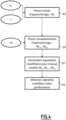
- FIG. 3 is a flowchart of the main steps of a first embodiment of the semantic segmentation model tattooing method.
- the method comprises the implementation of an initial phase 40 of machine learning of the parameters of a semantic segmentation model M1 chosen for a given application, making it possible to obtain a watermarked semantic segmentation model.
- the initial phase 40 takes as input a first set D1 of data from the training database, containing input images and associated output images, containing the expected segmentation into semantic classes, and the predetermined watermark output image.
- the method of generating a watermarked semantic segmentation model as described in the application patent FR 22 14406 is applied.
- the tattoo image including one or more tattoo thumbnails is also generated and stored.
- the semantic segmentation model M1 is for example a parameterized neural network, for example a CNN or RNN neural network.
- the watermarked semantic segmentation model is obtained, making it possible to obtain, from an input digital image comprising an inlay of at least one watermark thumbnail, at the planned inlay positions, the predetermined watermark output image.
- the method further comprises a complementary phase 42 of machine learning of a part of the parameters of the semantic image segmentation model making it possible to obtain a refined semantic segmentation model from the semantic segmentation model initially obtained.
- the FTLL for “Fine Tuning Last Layers” refinement method of the coefficients of the last layer, or of a plurality of last layers, of the neural network of the semantic segmentation model is applied during the complementary phase 42, using a second set D2 of data from the database.
- the method then comprises a step 44 of iterative generation of modified tattoo thumbnail(s).
- the generation is carried out by implementing an adversarial attack method using the refined semantic segmentation model generated in step 42.
- Adversarial attack methods have been developed to generate altered input data that distorts the output of a previously trained segmentation or classification model.
- such an adversarial attack method is used to ensure that the watermark inserted in the initial training phase remains present when the watermarked semantic segmentation model is modified by refinement by a potential adversary.
- Such a method is similar to machine learning of input data values.
- each tattoo thumbnail is a digital image of a predetermined size, with each point or pixel in that digital image having an associated value.
- step 44 implements an iterative learning algorithm, by gradient descent, to adjust noise values to be added or subtracted from the pixel values of each tattoo thumbnail considered, to obtain a modified tattoo thumbnail, the tattoo thumbnails thus modified forming a modified tattoo image 8.
- the modified watermark thumbnail(s) are such that when embedded in an input image, which is provided to the refined semantic segmentation model generated in step 42, the output image is close to the predetermined watermark output image, defined as the target of this training.
- the number of iterations is selected, for example, based on a stopping criterion.
- the number of iterations is between 200 and 2000, and more generally the number of iterations is set empirically.
- step 44 of iterative generation of modified tattoo thumbnail(s) implements a genetic algorithm.
- each modified tattoo thumbnail 18 has the same geometric shape and size as the tattoo thumbnail 16, but has different pixel values, obtained by the iterative generation step 44.
- the modified tattoo thumbnail(s) are then stored, in connection with the semantic segmentation model 4.
- a modified tattoo image comprising the modified tattoo thumbnail(s) 18, at predetermined positions, is stored.
- the modified tattoo image is for example obtained by embedding the modified tattoo thumbnails, at predetermined positions, on a uniform background of predetermined color.
- the modified watermark 18 may visually differ from the watermark 16, or in other words, the added or subtracted noise values need not be such that the introduced modifications are imperceptible to an observer.
- FIG. 4 is a flowchart of the main steps of a second embodiment of the semantic segmentation model tattooing method.
- the method comprises, in this second embodiment, an initial machine learning phase analogous to phase 40 described with reference to the Figure 3 , and which has the same reference number.
- the complementary machine learning phase 50 several refined semantic segmentation models M 21 to M 2n are generated, for example by applying the FTAL method, the FTLL method.
- step 52 for several semantic segmentation models calculated from the set formed by the watermarked semantic segmentation model obtained in the initial learning phase (model M1) and the refined semantic segmentation models obtained during the complementary learning phase 50 (models M 21 to M 2n ), the iterative generation method described with reference to step 44 is applied.
- a modified tattoo image is obtained, comprising one or more modified tattoo thumbnails, called a candidate modified tattoo image.
- a step 54 of selecting, on a performance criterion, the modified tattoo image from among the candidate modified tattoo images is implemented.
- the performance criterion is a transferability criterion between models.
- each candidate modified tattoo image is provided as input to each refined semantic segmentation model of the set of refined semantic segmentation models M 21 to M 2n , to obtain a corresponding output image, and a similarity score between the output image and the predetermined tattoo output image is calculated.
- the similarity score is the Dice score.
- the selected modified watermark image is the candidate modified watermark image for which the similarity score is the highest.
- the selected modified watermark image is the one that allows the best watermark robustness to be obtained.
Landscapes
- Engineering & Computer Science (AREA)
- Theoretical Computer Science (AREA)
- Physics & Mathematics (AREA)
- Software Systems (AREA)
- General Physics & Mathematics (AREA)
- General Engineering & Computer Science (AREA)
- Computing Systems (AREA)
- Mathematical Physics (AREA)
- Data Mining & Analysis (AREA)
- Evolutionary Computation (AREA)
- General Health & Medical Sciences (AREA)
- Molecular Biology (AREA)
- Biophysics (AREA)
- Biomedical Technology (AREA)
- Artificial Intelligence (AREA)
- Computational Linguistics (AREA)
- Life Sciences & Earth Sciences (AREA)
- Health & Medical Sciences (AREA)
- Multimedia (AREA)
- Technology Law (AREA)
- Computer Hardware Design (AREA)
- Computer Security & Cryptography (AREA)
- Image Analysis (AREA)
- Editing Of Facsimile Originals (AREA)
Applications Claiming Priority (1)
| Application Number | Priority Date | Filing Date | Title |
|---|---|---|---|
| FR2312498A FR3155339B1 (fr) | 2023-11-15 | 2023-11-15 | Procédé et dispositif de tatouage de modèle de segmentation sémantique d’images mis au point par apprentissage machine |
Publications (1)
| Publication Number | Publication Date |
|---|---|
| EP4557131A1 true EP4557131A1 (de) | 2025-05-21 |
Family
ID=90721307
Family Applications (1)
| Application Number | Title | Priority Date | Filing Date |
|---|---|---|---|
| EP24213076.3A Pending EP4557131A1 (de) | 2023-11-15 | 2024-11-14 | Verfahren und vorrichtung zur geomarkierung eines semantischen segmentierungsmodells von durch maschinelles lernen gezielten bildern |
Country Status (2)
| Country | Link |
|---|---|
| EP (1) | EP4557131A1 (de) |
| FR (1) | FR3155339B1 (de) |
Citations (1)
| Publication number | Priority date | Publication date | Assignee | Title |
|---|---|---|---|---|
| US20230121374A1 (en) * | 2021-09-30 | 2023-04-20 | Baidu Usa Llc | Systems and methods for robust watermarking of deep neural networks |
-
2023
- 2023-11-15 FR FR2312498A patent/FR3155339B1/fr active Active
-
2024
- 2024-11-14 EP EP24213076.3A patent/EP4557131A1/de active Pending
Patent Citations (1)
| Publication number | Priority date | Publication date | Assignee | Title |
|---|---|---|---|---|
| US20230121374A1 (en) * | 2021-09-30 | 2023-04-20 | Baidu Usa Llc | Systems and methods for robust watermarking of deep neural networks |
Non-Patent Citations (2)
| Title |
|---|
| RUAN HONGJIA ET AL: "Intellectual property protection for deep semantic segmentation models", FRONTIERS OF COMPUTER SCIENCE, HIGHER EDUCATION PRESS, BEIJING, vol. 17, no. 1, 8 August 2022 (2022-08-08), XP037928579, ISSN: 2095-2228, [retrieved on 20220808], DOI: 10.1007/S11704-021-1186-Y * |
| YIMING LI ET AL: "MOVE: Effective and Harmless Ownership Verification via Embedded External Features", ARXIV.ORG, CORNELL UNIVERSITY LIBRARY, 201 OLIN LIBRARY CORNELL UNIVERSITY ITHACA, NY 14853, 4 August 2022 (2022-08-04), XP091288087 * |
Also Published As
| Publication number | Publication date |
|---|---|
| FR3155339B1 (fr) | 2025-10-03 |
| FR3155339A1 (fr) | 2025-05-16 |
Similar Documents
| Publication | Publication Date | Title |
|---|---|---|
| US12165292B2 (en) | Generating an image mask for a digital image by utilizing a multi-branch masking pipeline with neural networks | |
| Ahmed et al. | Image splicing detection using mask-RCNN | |
| US11393100B2 (en) | Automatically generating a trimap segmentation for a digital image by utilizing a trimap generation neural network | |
| CN115034982A (zh) | 一种基于多尺度注意机制融合的水下图像增强方法 | |
| EP3832535A1 (de) | Verfahren zur detektion mindestens eines sichtbaren elementes von interesse in einem eingangsbild mithilfe eines neuronalen faltungsnetzwerks (convolutional neural network) | |
| CN111080628A (zh) | 图像篡改检测方法、装置、计算机设备和存储介质 | |
| EP3570212A1 (de) | Verfahren zur erkennung von schriftzeichen | |
| EP3570213A1 (de) | Verfahren zur erkennung von schriftzeichen | |
| EP3633552A1 (de) | Verfahren zum lernen von parametern in einem neuronalen netzwerk mit konvolution und zum erkennen von wichtigen elementen, die auf einem bild sichtbar sind | |
| EP4099228A1 (de) | Verbessertes maschinelles lernen ohne anmerkungen durch adaptive gruppierungen in offenen klassensätzen | |
| Schwartz et al. | Isp distillation | |
| Kaushik et al. | Convolutional neural network based digital image forensics using random forest and SVM classifier | |
| FR3112008A1 (fr) | Procédé de détection d’au moins un trait biométrique visible sur une image d’entrée au moyen d’un réseau de neurones à convolution | |
| EP4557131A1 (de) | Verfahren und vorrichtung zur geomarkierung eines semantischen segmentierungsmodells von durch maschinelles lernen gezielten bildern | |
| EP4390729A1 (de) | Verfahren und system zur geomarkierung eines semantischen segmentierungsmodells von durch maschinelles lernen initiierten bildern | |
| EP3506170B1 (de) | Verfahren zur erzeugung eines neuronennetzes für die erkennung einer zeichensequenz, und entsprechendes erkennungsverfahren | |
| EP4078435A1 (de) | Verfahren zur segmentierung eines eingangsbildes mit anzeige eines dokuments, das strukturierte informationen enthält | |
| EP4567643A1 (de) | Verfahren und system zur wasserzeichenmarkierung eines objekterkennungsmodells in einem durch maschinelles lernen gezielten bild | |
| FR3112228A1 (fr) | Dispositif et procédé pour générer un masque de la silhouette du profil d’une structure | |
| Su et al. | Deep Learning for Visible Watermark Removal: A Survey | |
| EP4557166A1 (de) | Verfahren und vorrichtung zur bestimmung der zugehörigkeit zu trainingsdaten zum trainieren eines datenklassifizierungsmodells durch maschinelles lernen | |
| FR3155330A1 (fr) | Procédé et dispositif d'analyse automatique de désapprentissage d'au moins une classe par un modèle de classification de données | |
| FR3155344A1 (fr) | Dispositif de classification de scène de l'environnement d'un véhicule | |
| EP4322061A1 (de) | Elektronische vorrichtung und datenverarbeitungsverfahren mit mindestens einem selbstadaptiven künstlichen intelligenzmodell mit lokalem lernen, elektronisches system und computerprogramm dafür | |
| John et al. | Deepfake detection with interpretability analysis using optimized algorithm: J. John et al. |
Legal Events
| Date | Code | Title | Description |
|---|---|---|---|
| PUAI | Public reference made under article 153(3) epc to a published international application that has entered the european phase |
Free format text: ORIGINAL CODE: 0009012 |
|
| STAA | Information on the status of an ep patent application or granted ep patent |
Free format text: STATUS: THE APPLICATION HAS BEEN PUBLISHED |
|
| AK | Designated contracting states |
Kind code of ref document: A1 Designated state(s): AL AT BE BG CH CY CZ DE DK EE ES FI FR GB GR HR HU IE IS IT LI LT LU LV MC ME MK MT NL NO PL PT RO RS SE SI SK SM TR |
|
| STAA | Information on the status of an ep patent application or granted ep patent |
Free format text: STATUS: REQUEST FOR EXAMINATION WAS MADE |
|
| 17P | Request for examination filed |
Effective date: 20251023 |