EP4557192A1 - Procédé et appareil de réglage d'emplacement d'entrepôt et dispositif électronique - Google Patents
Procédé et appareil de réglage d'emplacement d'entrepôt et dispositif électronique Download PDFInfo
- Publication number
- EP4557192A1 EP4557192A1 EP24210077.4A EP24210077A EP4557192A1 EP 4557192 A1 EP4557192 A1 EP 4557192A1 EP 24210077 A EP24210077 A EP 24210077A EP 4557192 A1 EP4557192 A1 EP 4557192A1
- Authority
- EP
- European Patent Office
- Prior art keywords
- warehoused
- workbin
- workbins
- target
- warehouse
- Prior art date
- Legal status (The legal status is an assumption and is not a legal conclusion. Google has not performed a legal analysis and makes no representation as to the accuracy of the status listed.)
- Granted
Links
Images


Classifications
-
- G—PHYSICS
- G06—COMPUTING OR CALCULATING; COUNTING
- G06Q—INFORMATION AND COMMUNICATION TECHNOLOGY [ICT] SPECIALLY ADAPTED FOR ADMINISTRATIVE, COMMERCIAL, FINANCIAL, MANAGERIAL OR SUPERVISORY PURPOSES; SYSTEMS OR METHODS SPECIALLY ADAPTED FOR ADMINISTRATIVE, COMMERCIAL, FINANCIAL, MANAGERIAL OR SUPERVISORY PURPOSES, NOT OTHERWISE PROVIDED FOR
- G06Q10/00—Administration; Management
- G06Q10/08—Logistics, e.g. warehousing, loading or distribution; Inventory or stock management
-
- B—PERFORMING OPERATIONS; TRANSPORTING
- B65—CONVEYING; PACKING; STORING; HANDLING THIN OR FILAMENTARY MATERIAL
- B65G—TRANSPORT OR STORAGE DEVICES, e.g. CONVEYORS FOR LOADING OR TIPPING, SHOP CONVEYOR SYSTEMS OR PNEUMATIC TUBE CONVEYORS
- B65G1/00—Storing articles, individually or in orderly arrangement, in warehouses or magazines
- B65G1/02—Storage devices
- B65G1/04—Storage devices mechanical
- B65G1/137—Storage devices mechanical with arrangements or automatic control means for selecting which articles are to be removed
- B65G1/1373—Storage devices mechanical with arrangements or automatic control means for selecting which articles are to be removed for fulfilling orders in warehouses
- B65G1/1378—Storage devices mechanical with arrangements or automatic control means for selecting which articles are to be removed for fulfilling orders in warehouses the orders being assembled on fixed commissioning areas remote from the storage areas
-
- B—PERFORMING OPERATIONS; TRANSPORTING
- B65—CONVEYING; PACKING; STORING; HANDLING THIN OR FILAMENTARY MATERIAL
- B65G—TRANSPORT OR STORAGE DEVICES, e.g. CONVEYORS FOR LOADING OR TIPPING, SHOP CONVEYOR SYSTEMS OR PNEUMATIC TUBE CONVEYORS
- B65G61/00—Use of pick-up or transfer devices or of manipulators for stacking or de-stacking articles not otherwise provided for
-
- B—PERFORMING OPERATIONS; TRANSPORTING
- B65—CONVEYING; PACKING; STORING; HANDLING THIN OR FILAMENTARY MATERIAL
- B65G—TRANSPORT OR STORAGE DEVICES, e.g. CONVEYORS FOR LOADING OR TIPPING, SHOP CONVEYOR SYSTEMS OR PNEUMATIC TUBE CONVEYORS
- B65G65/00—Loading or unloading
Definitions
- the present application relates to the technical field of intelligent warehousing, particularly to a method and an apparatus for adjusting a warehouse location and an electronic device.
- robots have been widely used in various industries and have become an important part of assisting the development of enterprises.
- an embodiment of the present application provides a method for adjusting a warehouse location, the method includes:
- instructing the target robot to transfer the currently loaded target to-be-in-warehoused workbin to the specified warehouse location includes: determining a target to-be-in-warehoused workbin that matches the specified warehouse location from the to-be-in-warehoused workbins currently loaded by the target robot, and instructing the target robot to transfer the target to-be-in-warehoused workbin to the specified warehouse location.
- the method further includes:
- determining a binding relationship between the to-be-in-warehoused workbins and in-warehouse locations for the to-be-in-warehoused workbins includes:
- instructing the target robot to load a to-be-ex-warehoused workbin in the empty storage compartment includes:
- the method further includes: releasing a binding relationship between the to-be-ex-warehoused workbin and the specified warehouse location, and establishing a binding relationship between the target to-be-in-warehoused workbin and the specified warehouse location.
- the method further includes: after the target robot returns all the to-be-in-warehoused workbins, instructing the target robot to move to an ex-warehouse area for storing to-be-ex-warehoused workbins.
- the method before instructing the target robot to move to the ex-warehouse area for storing the to-be-ex-warehoused workbins, the method further includes:
- an embodiment of the present application provides an apparatus for adjusting a warehouse location, the apparatus includes:
- the second instructing module is specifically configured for: determining a target to-be-in-warehoused workbin that matches the specified warehouse location from the to-be-in-warehoused workbins currently loaded by the target robot, and instructing the target robot to transfer the target to-be-in-warehoused workbin to the specified warehouse location.
- the apparatus further includes:
- the second relationship determining module is specifically configured for:
- the first instructing module is specifically configured for:
- the apparatus further includes: a relationship establishing module, configured for, after releasing the binding relationship between the target to-be-in-warehoused workbin and an in-warehouse location for the target to-be-in-warehoused workbin, releasing a binding relationship between the to-be-ex-warehoused workbin and the specified warehouse location, and establishing a binding relationship between the target to-be-in-warehoused workbin and the specified warehouse location.
- a relationship establishing module configured for, after releasing the binding relationship between the target to-be-in-warehoused workbin and an in-warehouse location for the target to-be-in-warehoused workbin, releasing a binding relationship between the to-be-ex-warehoused workbin and the specified warehouse location, and establishing a binding relationship between the target to-be-in-warehoused workbin and the specified warehouse location.
- the apparatus further includes: a fourth instructing module, configured for instructing the target robot to move to an ex-warehouse area for storing to-be-ex-warehoused workbins after the target robot returns all the to-be-in-warehoused workbins.
- a fourth instructing module configured for instructing the target robot to move to an ex-warehouse area for storing to-be-ex-warehoused workbins after the target robot returns all the to-be-in-warehoused workbins.
- the apparatus further includes:
- an electronic device which includes:
- an embodiment of the present application provides a computer-readable storage medium, which stores a computer program therein, which when executed by a processor, implements any step of the above method embodiment.
- an embodiment of the present application further provides a computer program product containing instructions, which when running on a computer, cause the computer to carry out any step of the above method embodiment.
- the target robot when using the robot with multiple storage compartments to return workbins, first, the target robot can be instructed to load to-be-in-warehoused workbins and determine a binding relationship between the to-be-in-warehoused workbins and in-warehouse locations for the to-be-in-warehoused workbins; then, during a process of the target robot returning the to-be-in-warehoused workbins, when the target robot has an empty storage compartment, the target robot can be instructed to load a to-be-ex-warehoused workbin in the empty storage compartment; then, after the target robot transfers the to-be-ex-warehoused workbin from a specified warehouse location to its own empty storage compartment, the target robot can be instructed to transfer a currently loaded target to-be-in-warehoused workbin to the specified warehouse location, and release a binding relationship between the target to-be-in-warehoused
- the flexibility in warehouse location allocation is achieved, thereby saving the total distance and total time for the robot returning the to-be-in-warehoused workbins, improving the efficiency of the robot returning the to-be-in-warehoused workbins, and improving the overall processing efficiency of the warehousing system; in addition, the robot is instructed to load to-be-ex-warehoused workbins during the return process, which further improves the overall processing efficiency of the warehousing system.
- an embodiment of the present application provides a method for adjusting a warehouse location.
- the method can be adapted to various application scenarios that require a robot with multiple storage compartments to return workbins.
- a robot with multiple storage compartments can be used to return each workbin for storing raw materials to a corresponding warehouse location in the shelf area; in a parcel sorting center, a robot with multiple storage compartments can be used to return each workbin for storing a parcel to a corresponding warehouse location in the storage area.
- this method can be applied to a robot with multiple compartments itself, for example, a control module is installed in the robot with multiple compartments to carry out the method; it can also be applied to an electronic device that can communicate with and control the robot with multiple storage compartments, such as a robot management server and so on. Based on this, the embodiment of the present application does not specifically limit the application scenario and execution subject of the method.
- the target robot when using the robot with multiple storage compartments to return workbins, first, the target robot can be instructed to load the to-be-in-warehoused workbins and determine a binding relationship between the to-be-in-warehoused workbins and the in-warehouse locations for the to-be-in-warehoused workbins; then, during the process of the target robot returning the to-be-in-warehoused workbins, when the target robot has an empty storage compartment, the target robot can be instructed to load a to-be-ex-warehoused workbin in the empty storage compartment; then, after the target robot transfers the to-be-ex-warehoused workbin from a specified warehouse location to its own empty storage compartment, the target robot can be instructed to transfer a currently loaded target to-be-in-warehoused workbin to the specified warehouse location, and release a binding relationship between the target to-be-in-warehoused workbin and an in-warehouse location for the target to-be
- the flexibility in warehouse location allocation is achieved, thereby saving the total distance and total time for the robot returning the to-be-in-warehoused workbins, improving the efficiency of the robot returning the to-be-in-warehoused workbins, and improving the overall processing efficiency of the warehousing system; in addition, the robot is instructed to load to-be-ex-warehoused workbins during the process of returning workbins, which further improves the overall processing efficiency of the warehousing system.
- Figure 1 is a flow chat of a method for adjusting a warehouse location provided by an embodiment of the present application, as shown in Figure 1 , the method can include the following steps S101-S103.
- S101 instructing a target robot to load to-be-in-warehoused workbins, and determining a binding relationship between the to-be-in-warehoused workbins and in-warehouse locations for the to-be-in-warehoused workbins; wherein, the target robot is a robot with multiple storage compartments.
- goods transported from various places are usually first placed together in a certain preset pre-warehousing area for pre-warehousing processing such as inventory and disinfection.
- pre-warehousing processing such as inventory and disinfection.
- individual containers are placed in the goods sorting area of a logistics center for inventory.
- the shelf area can include multiple shelves for storing different types of workbins, and each shelf can include multiple compartments, so that each compartment can serve as a warehouse location.
- logistics centers can receive goods from various parties, classify and organize the received goods, and then transfer them to various destinations.
- the logistics centers can place the received goods in the goods sorting area and perform cleaning, sorting, and other sorting operations on the goods in this sorting area.
- the robot can move the respective goods that have completed the sorting operation from the goods sorting area to the operating table, where the goods are placed in the respective workbins and returned to respective warehouse locations in the shelf area for storage.
- the robot can take out each workbin from each warehouse location in the shelf area, and transport each workbin to the operating table, where the goods will be sorted manually according to the order, to complete the ex-warehoused delivery of goods. In this way, the sorted goods can be loaded onto trucks and then transported to various destinations.
- the workbins stored in the respective warehouse locations in the shelf area and waiting to be transported to an operating table can be referred to as to-be-ex-warehoused workbins; bins to be returned to each warehouse location in the shelf area can be referred to as to-be-in-warehoused workbins.
- the robot In order to return each to-be-in-warehoused workbin, firstly the robot can be instructed to load the to-be-in-warehoused workbin and determine a warehouse location in the shelf area for storing the to-be-in-warehoused workbin. Then, the robot can be instructed to return the to-be-in-warehoused workbin to the warehouse location.
- the robot with multiple storage compartments can be used to perform the process of returning the to-be-in-warehoused workbins.
- the target robot when using the target robot with multiple storage compartments to return each to-be-in-warehoused workbin, the target robot can first be instructed to load the to-be-in-warehoused workbin and determine a binding relationship between the to-be-in-warehoused workbin and an in-warehouse location for the to-be-in-warehoused workbin.
- the robot management server can store a list of to-be-in-warehoused workbins, which includes a workbin identification of each to-be-in-warehoused workbin and a binding relationship between the to-be-in-warehoused workbin and an in-warehouse location for the to-be-in-warehoused workbin.
- the robot management server can generate a workbin returning task that carries a workbin identification of this to-be-in-warehoused workbin and a binding relationship, and send the workbin returning task to the target robot.
- the target robot can determine the binding relationship between this to-be-in-warehoused workbin and the in-warehouse location for this to-be-in-warehoused workbin, and then return this to-be-in-warehoused workbin based on the above information.
- the robot management server can store a list of to-be-in-warehoused workbins, which includes a workbin identification of each to-be-in-warehoused workbin, and a binding relationship between the to-be-in-warehoused workbin and an in-warehouse location for the to-be-in-warehoused workbin.
- the robot management server can generate a workbin returning task that carries a workbin identification of this to-be-in-warehoused workbin and a binding relationship.
- the workbin identification of this to-be-in-warehoused workbin can be obtained to detect whether there is a workbin returning task for this to-be-in-warehoused workbin among the generated individual workbin returning tasks.
- the workbin returning task for this to-be-in-warehoused workbin is detected, the above binding relationship is sent to the target robot, and the target robot is instructed to execute the workbin returning task for this to-be-in-warehoused workbin.
- the size, type, and storage conditions of different to-be-in-warehoused workbins can be different, so different to-be-in-warehoused workbins can be returned to different warehouse locations in the shelf area.
- an in-warehouse location can be allocated for this to-be-in-warehoused workbin in individual warehouse locations in the shelf area based on workbin information, such as size information, the weight of the workbin, type information, and storage condition information, and a binding relationship between this to-be-in-warehoused workbin and the in-warehouse location for the to-be-in-warehoused workbin can be established.
- the allocated in-warehouse location is a currently available warehouse location in the shelf area, and warehouse location information such as the type and size of the allocated in-warehouse location should match the workbin information about the to-be-in-warehoused workbin, that is, the in-warehouse location allocated for the to-be-in-warehoused workbin meets the storage requirements of the to-be-in-warehoused workbin.
- one warehouse location C can be allocated for the to-be-in-warehoused workbin A as the in-warehouse location for this to-be-in-warehoused workbin A from the individual warehouse locations in the shelf for storing goods sent to the city B.
- a warehouse location E of 0.7m*0.7m*0.5m can be allocated for the to-be-in-warehoused workbin D as its warehouse location.
- the so-called available warehouse location mentioned above can refer to that the warehouse location is an empty warehouse location, or it can refer to that a workbin currently stored in the warehouse location is a to-be-ex-warehoused workbin.
- this warehouse location can be locked, that is, the status of this warehouse location can be set to unavailable, so that this warehouse location will not be allocated to other to-be-in-warehoused workbins.
- the target robot can be instructed to first load each to-be-in-warehoused workbin and determine the binding relationship between this to-be-in-warehoused workbin and an in-warehouse location for this to-be-in-warehoused workbin.
- the target robot may store available warehouse locations, and warehouse location information such as the size and type of each available warehouse location. Therefore, after loading each to-be-in-warehoused workbin, the target robot can obtain the workbin information of this to-be-in-warehoused workbin. Then, based on the warehouse location information of the available warehouse locations and the workbin information of this to-be-in-warehoused workbin mentioned above, the target robot can allocate an in-warehouse location for this to-be-in-warehoused workbin and establish a binding relationship between this to-be-in-warehoused workbin and the allocated in-warehouse location.
- the robot management server may store a list of to-be-in-warehoused workbins, available warehouse locations in the shelf area, and warehouse location information such as the size and type of each available warehouse location. Therefore, after loading a to-be-in-warehoused workbin, the target robot can send a warehouse location allocation request carrying the workbin identification of this to-be-in-warehoused workbin to the robot management server. In this way, the robot management server can determine the workbin information of the to-be-in-warehoused workbin based on the workbin identification.
- the robot management server can allocate an in-warehouse location for this to-be-in-warehoused workbin and establish a binding relationship between this to-be-in-warehoused workbin and the allocated in-warehouse location, and then send the above binding relationship to the target robot.
- the robot management server may store a list of to-be-in-warehoused workbins, available warehouse locations in the shelf area, and warehouse location information such as the size and type of each available warehouse location. Therefore, for each to-be-in-warehoused workbin in the list of the to-be-in-warehoused workbins, based on the workbin information of this to-be-in-warehoused workbin, the robot management server can allocate an in-warehouse location for this to-be-in-warehoused workbin and establish a binding relationship between this to-be-in-warehoused workbin and the allocated in-warehouse location.
- the robot management server can generate an in-warehoused task carrying the above binding relationship for this to-be-in-warehoused workbin and send the in-warehoused task to the target robot.
- the target robot can receive the aforementioned in-warehoused task and obtain the binding relationship mentioned above.
- the target robot when the target robot returns to-be-in-warehoused workbins, the target robot can be first instructed to load the to-be-in-warehoused workbins and determine a binding relationship between the to-be-in-warehoused workbins and in-warehouse locations for the to-be-in-warehoused workbins. In this way, the target robot can be instructed to return the to-be-in-warehoused workbins to the in-warehouse locations bound to the to-be-in-warehoused workbins according to the above binding relationship.
- the target robot can be instructed to sequentially return each to-be-in-warehoused workbin to an in-warehouse location for this to-be-in-warehoused workbin.
- the target robot can be instructed to prioritize the return of the first loaded individual to-be-in-warehoused workbins in the order in which the individual to-be-in-warehoused workbins were loaded; for example, the target robot can be instructed to prioritize the return of a to-be-in-warehoused workbin closer to the target robot based on the distance between the target robot and the in-warehouse locations bound to the respective to-be-in-warehoused workbins; for another example, the moving route of the target robot can be determined in advance based on the workbin information of individual to-be-in-warehoused workbins and the location information of the bound in-warehouse location, and then the target robot can be instructed to sequentially return individual to-be-in-warehoused workbins along the above moving route.
- the above examples are only examples of instructing the target robot to return individual to-be-in-warehoused workbins according to preset rules, and are not limiting.
- a to-be-ex-warehoused workbin can be loaded in the empty storage compartment of the target robot in the process of the target robot returning the to-be-in-warehoused workbins.
- the target robot can be instructed to load the to-be-ex-warehoused workbin.
- the target robot has 10 storage compartments and is loaded with 6 to-be-in-warehoused workbins in the in-warehouse area, the target robot still has 4 empty storage compartments. Therefore, during the process of the target robot returning the to-be-in-warehoused workbins, if there is a to-be-ex-warehoused workbin in the shelf area, the target robot can be instructed to load the to-be-ex-warehoused workbin.
- the target robot has 10 storage compartments and is loaded with 10 to-be-in-warehoused workbins in the in-warehouse area.
- the target robot In the process of the target robot returning the to-be-in-warehoused workbins, after returning 3 to-be-in-warehoused workbins, the target robot has 3 empty storage compartments. In this way, if there are to-be-ex-warehoused workbins in the warehouse locations where the target robot passes through, the target robot can be instructed to load 3 to-be-ex-warehoused workbins.
- Step 11 when the target robot has an empty storage compartment, instructing the target robot to load a to-be-ex-warehoused workbin located in a target warehouse location in the empty storage compartment.
- the target warehouse location includes at least one of the following warehouse locations: a warehouse location located on a moving route of the target robot returning the to-be-in-warehoused workbins, and a warehouse location whose distance from an in-warehouse location of the to-be-in-warehoused workbin is less than a preset distance.
- the target robot can load a to-be-ex-warehoused workbin located in the target warehouse location in the empty storage compartment.
- the target warehouse location includes at least one of the following warehouse locations: a warehouse location located on a moving route of the target robot returning the to-be-in-warehoused workbins, and a warehouse location whose distance from an in-warehouse location of the to-be-in-warehoused workbin is less than a preset distance.
- the target robot returning the to-be-in-warehoused workbins it is possible to take a warehouse location located on the moving route of the target robot returning the to-be-in-warehoused workbins, and/or a warehouse location whose distance from an in-warehouse location of the to-be-in-warehoused workbin is less than a preset distance as the target warehouse location.
- the preset distance mentioned above can be set according to actual needs, such as 1 m, 5 m, etc., which are reasonable and not specifically limited in the embodiments of the present application.
- the target robot can load a to-be-ex-warehoused workbin located in the target warehouse location in the empty storage compartment.
- the target robot can detect whether the target robot has an empty storage compartment and whether there is a to-be-ex-warehoused workbin stored in a target warehouse location in the shelf area. Moreover, when the above detection results are all TRUE, that is, it is detected that the target robot has an empty storage compartment, and it is detected that there is a to-be-ex-warehoused workbin located in the target warehouse location, the target robot can be instructed to load the to-be-ex-warehoused workbin located in the target warehouse location in the empty storage compartment.
- the target robot can determine the moving route based on its current position and the location of an in-warehouse location bound to the next to-be-in-warehoused workbin. Then, when it is detected the target robot has an empty storage compartment, the target robot can send a to-be-ex-warehoused workbin obtaining request carrying the above moving route to the robot management server.
- the robot management server can receive the to-be-ex-warehoused workbin obtaining request and determine a to-be-ex-warehoused workbin located on the above moving route among the respective to-be-ex-warehoused workbins stored in itself, then send the warehouse location identification of the determined to-be-ex-warehoused workbin to the target robot, so that the target robot can load the aforementioned to-be-ex-warehoused workbin.
- the robot management server can detect in real time whether the target robot has an empty warehouse location. Therefore, when it is detected that the target robot has an empty warehouse location, it is possible to determine whether there is a to-be-ex-warehoused workbin, among to-be-ex-warehoused workbins stored in itself, whose distance from an in-warehouse location bound to a to-be-in-warehoused workbin closest to the target robot is not greater than a preset distance. If so, the robot management server can send the warehouse location identification of this to-be-ex-warehoused workbin to the target robot, so that the target robot loads the aforementioned to-be-ex-warehoused workbin.
- S 103 after the target robot transfers the to-be-ex-warehoused workbin from a specified warehouse location to its own empty storage compartment, instructing the target robot to transfer a currently loaded target to-be-in-warehoused workbin to the specified warehouse location, and releasing a binding relationship between the target to-be-in-warehoused workbin and an in-warehouse location for the target to-be-in-warehoused workbin.
- the target robot transfers the to-be-ex-warehoused workbin from the specified warehouse location to its own empty storage compartment, since the to-be-ex-warehoused workbin has been moved out, the specified warehouse location for storing the to-be-ex-warehoused workbin is in an idle state.
- the currently loaded target to-be-in-warehoused workbin can be stored in the specified warehouse location nearby. In this way, since the in-warehoused task of this target to-be-in-warehoused workbin has been completed, this target robot does not need to move to the in-warehouse location for this target to-be-in-warehoused workbin, thus saving the distance that the target robot needs to move in the process of returning workbins.
- the target to-be-in-warehoused workbin since the target to-be-in-warehoused workbin has been placed in the specified warehouse location in the shelf area for storage, there is no need to place this target to-be-in-warehoused workbin in an in-warehouse location bound to this target to-be-in-warehoused workbin. Therefore, the binding relationship between the target to-be-in-warehoused workbin and the in-warehouse location for the target to-be-in-warehoused workbin can be released. In this way, after the above binding relationship is released, the in-warehouse location originally bound to the target to-be-in-warehoused workbin can be allocated to other to-be-in-warehoused workbin.
- a target to-be-in-warehoused workbin is determined from the to-be-in-warehoused workbins currently loaded by the target robot, the specified warehouse location is locked, and the target robot is instructed to transfer the currently loaded target to-be-in-warehoused workbin to the specified warehouse location. Then, the binding relationship between the target to-be-in-warehoused workbin and the in-warehouse location for the target to-be-in-warehoused workbin is released, and the in-warehouse location bound to the target to-be-in-warehoused workbin is unlocked.
- the above step S103 can include the following Step 21: Step 21: determining a target to-be-in-warehoused workbin that matches the specified warehouse location from the to-be-in-warehoused workbins currently loaded by the target robot, and instructing the target robot to transfer the target to-be-in-warehoused workbin to the specified warehouse location.
- the target to-be-in-warehoused workbin that matches the specified warehouse location can be determined from the to-be-in-warehoused workbins currently loaded by the target robot, and the target robot is instructed to transfer the target to-be-in-warehoused workbin to the specified warehouse location.
- the target to-be-in-warehoused workbin that matches the specified warehouse location can be a to-be-in-warehoused workbin bound to this specified warehouse location, or can be a workbin whose workbin information matches the warehouse location information of the specified warehouse location, that is, this specified warehouse location meets a storage requirement of the to-be-in-warehoused workbin, and this to-be-in-warehoused workbin can be stored in the to-be-in-warehoused workbin in the specified warehouse location.
- the specified warehouse location is a warehouse location used to store non-fragile goods
- all the to-be-in-warehoused workbins loaded by the target robot are all workbins loaded with fragile goods
- the specified warehouse location is a cubic warehouse location with each side length of 50 cm. If there is one to-be-in-warehoused workbin with each side length of 40 cm in all the to-be-in-warehoused workbins loaded by the target robot, this to-be-in-warehoused workbin can be determined as the target to-be-in-warehoused workbin that can be stored in the above specified warehouse location.
- the target robot can be instructed to transfer the above target to-be-in-warehoused workbin to the specified warehouse location.
- the target robot stores the currently loaded target to-be-in-warehoused workbin that matches the specified warehouse location in the specified warehouse location, the target robot no longer needs to stores this target to-be-in-warehoused workbin in the in-warehouse location originally bound to this target to-be-in-warehoused workbin, thus saving the total distance and total time for the target robot to return workbins.
- the target robot can be instructed to ignore the specified warehouse location and to continue returning the to-be-in-warehoused workbins.
- the robot can be instructed to load the to-be-in-warehoused workbin A into the robot's storage compartment A. Then the warehouse location A in the shelf area is allocated for the workbin A, and the binding relationship between workbin A and the warehouse location A is determined, the robot can be instructed to return the workbin A.
- the robot can be instructed to load the workbin B in the empty storage compartment B. In this way, after transferring the workbin B to the storage compartment B, the warehouse location B will be restored to an idle state. Due to the fact that the workbin A currently loaded by the robot matches the above warehouse location B, the robot can be instructed to transfer the workbin A into the warehouse location B. Since the workbin A has been transferred to the warehouse location B, there is no need to transfer the workbin A to the warehouse location A. Therefore, the binding relationship between the bin A and the warehouse location A can be released, and the warehouse location A can be restored to an available warehouse location.
- the method for adjusting a warehouse location further includes the following step S104: S104: releasing the binding relationship between the to-be-ex-warehoused workbin and the specified warehouse location, and establishing a binding relationship between the target to-be-in-warehoused workbin and the specified warehouse location.
- the binding relationship between the target to-be-in-warehoused workbin and an in-warehouse location for the target to-be-in-warehoused workbin can be released; due to the fact that the target to-be-in-warehoused workbin has been transferred into the specified warehouse location, which is the in-warehouse location for the target to-be-in-warehoused workbin, therefore, the binding relationship between the target to-be-in-warehoused workbin and the specified warehouse location can be established.
- a binding relationship between the stored workbin and the specified warehouse location is always established, and a binding relationship between the target to-be-in-warehoused workbin and its own in-warehouse location can be established.
- the method for adjusting a warehouse location further includes the following step S105: S105: after the target robot returns all the to-be-in-warehoused workbins, instructing the target robot to move to an ex-warehouse area for storing to-be-ex-warehoused workbins.
- the target robot loaded individual to-be-ex-warehoused workbins in the process of returning the to-be-in-warehoused workbins, so that after the target robot storing all the to-be-in-warehoused workbins, all the workbins currently loaded by the target robot are to-be-ex-warehoused workbins. Moreover, in order to complete the ex-warehousing of all the to-be-ex-warehoused workbins, the target robot can be instructed to move to the ex-warehouse area for storing the to-be-ex-warehoused workbins.
- the above-mentioned ex-warehouse area is different from the above-mentioned shelf area
- the ex-warehouse area can be an in-warehouse area or other area that is different from the in-warehouse area.
- a method for adjusting a warehouse location provided by the embodiment of the present application further includes the following Steps 31 to 32:
- the target robot may still have an empty storage compartment. Based on this, in order to improve the utilization rate of the target robot, so that the target robot can move to the ex-warehouse area with a full load of the to-be-ex-warehoused workbins, each of the storage compartments of the target robot can be detected after the target robot returns all the to-be-in-warehoused workbins.
- the target robot when it is detected that the target robot still has an empty storage compartment, the target robot can be instructed to continue using the empty storage compartment to load a to-be-ex-warehoused workbin in the shelf area until it is detected that the target robot does not have an empty storage compartment, then the target robot can be instructed to move to the ex-warehouse area for storing the to-be-ex-warehoused workbins. In this way, the target robot can be fully loaded and unloaded, thereby improving the utilization rate of the target robot.
- the target robot can detect whether there is a to-be-ex-warehoused workbin in the shelf area. If it is detected there is a to-be-ex-warehoused workbin in the shelf area, the target robot is instructed to continue to load the to-be-ex-warehoused workbin in the shelf area until it is detected that there is no empty storage compartment in the target robot, and the target robot can be instructed to move to the ex-warehouse area for storing to-be-ex-warehoused workbins.
- the target robot when the execution subject of the method for adjusting a warehouse location provided by the embodiment of the present application is the target robot itself, when an empty storage compartment is detected, the target robot can detect a to-be-ex-warehoused workbin in the shelf area, and based on the specified number of empty storage compartments and the distance between each to-be-ex-warehoused workbin and the target robot, prioritize loading a to-be-ex-warehoused workbin closer to the target robot in order of distance from near to far, until it is detected that there is no empty storage compartment, so that the target robot can achieve full load as soon as possible.
- the target robot when the execution subject of the method for adjusting a warehouse location provided by the embodiment of the present application is the target robot itself, when an empty storage compartment is detected, the target robot can detect a to-be-ex-warehoused workbin in the shelf area, and based on the specified number of the empty storage compartments and the release time of an ex-warehoused task of each to-be-ex-warehoused workbin, prioritize loading a to-be-ex-warehoused workbin with earlier release time in order of task release time from early to late, until no empty storage compartment is detected.
- the target robot when the execution subject of the method for adjusting a warehouse location provided by the embodiment of the present application is the target robot itself, when an empty storage compartment is detected, the target robot can send an ex-warehoused task obtaining request carrying the number of empty storage compartments to the robot management server, and when receiving ex-warehoused tasks sent by the robot management server, the target robot sequentially executes each ex-warehoused task.
- the management server can filter a specified number of to-be-ex-warehoused workbins that are closer to the target robot in the shelf area based on the specified number of empty storage compartments, and instruct the target robot to prioritize loading the filtered to-be-ex-warehoused workbins.
- the robot management server when it is detected the target robot has an empty storage compartment, the robot management server can select a specified number of ex-warehoused tasks with earlier release times in the shelf area based on the specified number of empty storage compartments according to the release times of the ex-warehoused tasks, and instruct the target robot to sequentially execute each ex-warehoused task.
- the target robot when it is detected that there is no empty storage compartment in the target robot, it can be determined that the target robot is fully loaded, thus, the target robot can be instructed to move to the ex-warehouse area for storing the to-be-ex-warehoused workbins.
- the flexibility in warehouse location allocation is achieved, thereby saving the total distance and total time for the robot returning the to-be-in-warehoused workbins, improving the efficiency of the robot returning the to-be-in-warehoused workbins, and improving the overall processing efficiency of the warehousing system; in addition, the robot is instructed to load a to-be-ex-warehoused workbin during the return process, which further improves the overall processing efficiency of the warehousing system.
- the warehouse locations storing the to-be-ex-warehoused workbins can be referred to as to-be-cleared warehouse locations.
- the to-be-cleared warehouse locations storing the to-be-ex-warehoused workbins can be allocated to the matched to-be-in-warehoused workbins.
- the target robot when the target robot returns the to-be-in-warehoused workbins, for each to-be-in-warehoused workbin loaded by the target robot that has a binding relationship with a to-be-cleared warehouse location which stores a to-be-ex-warehoused workbin therein, the target robot can first transfer the to-be-ex-warehoused workbin stored in the to-be-cleared warehouse location to its own empty storage compartment, and then transfer the to-be-in-warehoused workbin to the to-be-cleared warehouse location.
- Step S101 determining the binding relationship between the to-be-in-warehoused workbins and the in-warehouse locations for the to-be-in-warehoused workbins can include the following Step 41: Step 41: determining empty warehouse locations that match the to-be-in-warehoused workbins as the in-warehouse locations for the to-be-in-warehoused workbins, and establishing a binding relationship between the to-be-in-warehoused workbins and the empty warehouse locations.
- an empty warehouse location that matches this to-be-in-warehoused workbin can be determined from all the empty warehouse locations in the shelf area, then the empty warehouse location that matches this to-be-in-warehoused workbin can be determined as an in-warehouse location for this to-be-in-warehoused workbin, and the binding relationship between this to-be-in-warehoused workbin and the empty warehouse location can be established.
- the process of returning the to-be-in-warehoused workbin includes the process of transferring the to-be-in-warehoused workbin to the empty warehouse location bound to the to-be-in-warehoused workbin. That is to say, when the target robot returns the to-be-in-warehoused workbin, it can first move to the empty warehouse location bound to the to-be-in-warehoused workbin, and transfer the in-warehouse location to the above empty warehouse location.
- step S101 determining the binding relationship between the to-be-in-warehoused workbins and the in-warehouse locations for the to-be-in-warehoused workbins can include the following Steps 42 to 43:
- each to-be-in-warehoused workbin can first determine whether there is a to-be-cleared warehouse location in the shelf area which stores a to-be-ex-warehoused workbin and matches the to-be-in-warehoused workbin.
- the above-mentioned to-be-cleared warehouse location can be allocated to the to-be-in-warehoused workbin, that is, the to-be-cleared warehouse location can be determined as an in-warehouse location for the to-be-in-warehoused workbin, thereby determining the binding relationship between the to-be-in-warehoused workbin and the to-be-cleared warehouse location.
- an empty warehouse location that matches the to-be-in-warehoused workbin can be determined from all the empty warehouse locations in the shelf area, then the determined empty warehouse location can be allocated to the to-be-in-warehoused workbin, that is, the determined empty warehouse location can be determined as the in-warehouse location for the to-be-in-warehoused workbin, thereby determining the binding relationship between the to-be-in-warehoused workbin and the empty warehouse location.
- the process of returning the to-be-in-warehoused workbin includes the process of transferring the to-be-in-warehoused workbin to the to-be-cleared warehouse location bound to the to-be-in-warehoused workbin.
- the target robot when the target robot returns the to-be-in-warehoused workbin, and when there is an empty storage compartment in the target robot, the target robot can first move to the to-be-cleared warehouse location bound to the to-be-in-warehoused workbin, and transfer the to-be-ex-warehoused workbin stored in the to-be-cleared warehouse location to its own empty storage compartment, and then transfer the in-warehouse location to the above to-be-cleared warehouse location.
- a specified warehouse location is different from the to-be-cleared warehouse location bound to the to-be-in-warehoused workbin loaded by the target robot, wherein the target robot is instructed to transfer a to-be-ex-warehoused workbin from the specified warehouse location to the empty storage compartment.
- the in-warehouse location bound to the to-be-in-warehoused workbin loaded by the target robot is the to-be-cleared warehouse location where the to-be-ex-warehoused workbin is stored, in the process of the target robot moving towards the to-be-cleared warehouse location, if the target robot has an empty storage compartment and transfers the to-be-ex-warehoused workbin from the specified warehouse location to its own empty storage compartment, the to-be-in-warehoused workbin can be transferred to the specified warehouse location, there is no need to be transferred to the to-be-cleared warehouse location bound to the to-be-in-warehoused workbin, thereby saving the path for returning workbins and improving the efficiency of returning the to-be-in-warehoused workbin.
- each target robot can load a large number of to-be-in-warehoused workbins, or even be full loaded, when leaving the in-warehouse area for storing the respective to-be-in-warehoused workbins.
- it can be preset a preset workbin returning condition and instruct the target robot to leave the in-warehouse area for storing the respective to-be-in-warehoused workbins and return each to-be-in-warehoused workbin into each in-warehouse location when the above preset workbin returning condition is met.
- the preset workbin returning condition can be the number of the to-be-in-warehoused workbins loaded by the target robot reaches a preset workbin loading capacity, or the target robot is loaded with to-be-in-warehoused workbins and there is no to-be-in-warehoused workbin to be loaded in an in-warehouse area for storing the respective to-be-in-warehoused workbins.
- the number of the storage compartments possessed by different robots can be different, moreover, the preset workbin loading capacity of different robots can also be different.
- the preset workbin loading capacity of the robot can be set according to actual needs. For example, when each robot is expected to leave the in-warehouse area fully loaded, the preset workbin loading capacity can be equal to the total number of the storage compartments contained in the robot.
- the above preset workbin loading capacity can be set based on workbin information of the to-be-in-warehoused workbins, which can be a part of the total number of the storage compartments contained in the robot, such as half, two-thirds, etc.; it can also be fixed data, such as 5, 10, etc., all of which are reasonable and not specifically limited in the embodiment of the present application.
- a method for adjusting a warehouse location provided by an embodiment of the present application further includes the following steps S106-S107:
- the preset workbin returning condition includes that the number of the to-be-in-warehoused workbins loaded by the target robot reaches the preset workbin loading capacity, or the target robot is loaded with to-be-in-warehoused workbins and there is no to-be-in-warehoused workbin to be loaded in an in-warehouse area for storing the respective to-be-in-warehoused workbins.
- the preset workbin returning condition is that the number of the to-be-in-warehoused workbins loaded by the target robot reaches the preset workbin loading capacity
- the target robot meets the preset workbin returning condition, the number of the to-be-in-warehoused workbins loaded by the target robot reaches the preset workbin loading capacity. Therefore, the target robot can be instructed to return the loaded to-be-in-warehoused workbins.
- the preset workbin returning condition is that the target robot is loaded with to-be-in-warehoused workbins and there is no to-be-in-warehoused workbin to be loaded in an in-warehouse area for storing the respective to-be-in-warehoused workbins
- the target robot meets the preset workbin returning condition, then the target robot is loaded with to-be-in-warehoused workbins and there is no to-be-in-warehoused workbin to be loaded in an in-warehouse area, that is, some of the storage compartments of the target robot are loaded with to-be-in-warehoused workbins, and there is currently no other to-be-in-warehoused workbin in the in-warehouse area. Therefore, in order to improve the work efficiency of the target robot, it can be instructed to return the loaded to-be-in-warehoused workbins.
- the target robot can be instructed to continue loading other to-be-in-warehoused workbins in the in-warehouse area until it is detected that the target robot meets the preset workbin returning condition mentioned above, then the target robot can be instructed to return the loaded to-be-in-warehoused workbins.
- the preset workbin returning condition is that the target robot loads to-be-in-warehoused workbins and there is no to-be-in-warehoused workbin to be loaded in the in-warehouse area
- the target robot does not meet the preset workbin returning condition, then the target robot is not loaded with a workbin or the target robot is loaded with workbins and there is other to-be-in-warehoused workbins in the in-warehouse area.
- the target robot can be instructed to wait for loading other to-be-in-warehoused workbins in the in-warehouse area or continue loading other to-be-in-warehoused workbins in the in-warehouse area until it is detected that the target robot meets the preset workbin returning conditions mentioned above, then the target robot can be instructed to return the loaded to-be-in-warehoused workbins.
- an embodiment of the present application further provides an apparatus for adjusting a warehouse location.
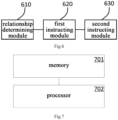
- FIG. 6 is a structural schematic diagram of an apparatus for adjusting a warehouse location provided by an embodiment of the present application, as shown in Figure 6 , the apparatus can include the following module:
- the flexibility in warehouse location allocation is achieved, thereby saving the total distance and total time for the robot returning the to-be-in-warehoused workbins, improving the efficiency of the robot returning the to-be-in-warehoused workbins, and improving the overall processing efficiency of the warehousing system; in addition, the robot is instructed to load to-be-ex-warehoused workbins during the return process, which further improves the overall processing efficiency of the warehousing system.
- the second instructing module 630 is specifically configured for: determining a target to-be-in-warehoused workbin that matches the specified warehouse location from the to-be-in-warehoused workbins currently loaded by the target robot, and instructing the target robot to transfer the target to-be-in-warehoused workbin to the specified warehouse location.
- the second relationship determining module 610 is specifically configured for:
- the first instructing module 620 is specifically configured for:
- the apparatus further includes: a relationship establishing module, configured for, after releasing the binding relationship between the target to-be-in-warehoused workbin and an in-warehouse location for the target to-be-in-warehoused workbin, releasing a binding relationship between the to-be-ex-warehoused workbin and the specified warehouse location, and establishing a binding relationship between the target to-be-in-warehoused workbin and the specified warehouse location.
- a relationship establishing module configured for, after releasing the binding relationship between the target to-be-in-warehoused workbin and an in-warehouse location for the target to-be-in-warehoused workbin, releasing a binding relationship between the to-be-ex-warehoused workbin and the specified warehouse location, and establishing a binding relationship between the target to-be-in-warehoused workbin and the specified warehouse location.
- the apparatus further includes: a fourth instructing module, configured for instructing the target robot to move to an ex-warehouse area for storing to-be-ex-warehoused workbins after the target robot returns all the to-be-in-warehoused workbins.
- a fourth instructing module configured for instructing the target robot to move to an ex-warehouse area for storing to-be-ex-warehoused workbins after the target robot returns all the to-be-in-warehoused workbins.
- the apparatus further includes:
- An embodiment of the present application further provides an electronic device, as shown in Figure 7 , which includes:
- the above-mentioned electronic device may also include a communication bus and/or a communication interface, wherein the processor 702, the communication interface, and the memory 701 communicate with each other through the communication bus.
- the communication bus mentioned in the above electronic device can be a Peripheral Component Interconnect (PCI) standard bus or an Extended Industry Standard Architecture (EISA) bus, etc.
- PCI Peripheral Component Interconnect
- EISA Extended Industry Standard Architecture
- the communication bus can be divided into an address bus, a data bus, a control bus, etc. For ease of representation, only one thick line is used in the figure, but it does not mean that there is only one bus or one type of bus.
- the communication interface is used for the communication between the above electronic device and other device.
- the memory may include a Random Access Memory (RAM), it can also include a Non-Volatile Memory (NVM), such as at least one disk memory.
- RAM Random Access Memory
- NVM Non-Volatile Memory
- the memory can also be at least one storage device located far away from the aforementioned processor.
- the above processor can be a general-purpose processor, including a Central Processing Unit (CPU), a Network Processor (NP), etc.; it can also be a Digital Signal Processor (DSP), an Application Specific Integrated Circuit (ASIC), a Field-Programmable Gate Array (FPGA) or other programmable logic devices, discrete gates or transistor logic devices, or discrete hardware components.
- CPU Central Processing Unit
- NP Network Processor
- DSP Digital Signal Processor
- ASIC Application Specific Integrated Circuit
- FPGA Field-Programmable Gate Array
- a computer-readable storage medium which stores a computer program therein, which implements any step of the method for adjusting a warehouse location described above are when executed by a processor.
- a computer program product containing instructions is further provided, which, when running on a computer, causes the computer to carry out any one of the method for adjusting a warehouse location described in the above embodiments.
- the computer program product includes one or more computer instructions.
- the computer may be a general purpose computer, special purpose computer, computer network, or other programmable device.
- the computer instructions may be stored in a computer readable storage medium or transmitted from one computer readable storage medium to another computer readable storage medium, for example, the computer instructions may be transmitted from a website, computer, server or data center to another website, computer, server, or data center by wire (such as coaxial cable, fiber optic, digital subscriber line (DSL)) or wirelessly (such as infrared, wireless, microwave, etc.).
- the computer-readable storage medium may be any usable medium that can be accessed by a computer or a data storage device such as a server and a data center and the like that includes an integration of one or more available medium.
- the usable media may be magnetic media (such as a floppy disk, a hard disk, a magnetic tape), optical media (such as DVD), and the like.
Landscapes
- Engineering & Computer Science (AREA)
- Business, Economics & Management (AREA)
- Economics (AREA)
- Mechanical Engineering (AREA)
- Operations Research (AREA)
- Entrepreneurship & Innovation (AREA)
- Human Resources & Organizations (AREA)
- Marketing (AREA)
- Development Economics (AREA)
- Quality & Reliability (AREA)
- Strategic Management (AREA)
- Tourism & Hospitality (AREA)
- Physics & Mathematics (AREA)
- General Business, Economics & Management (AREA)
- General Physics & Mathematics (AREA)
- Theoretical Computer Science (AREA)
- Warehouses Or Storage Devices (AREA)
Applications Claiming Priority (1)
| Application Number | Priority Date | Filing Date | Title |
|---|---|---|---|
| CN202311528283.2A CN117670188A (zh) | 2023-11-15 | 2023-11-15 | 一种库位调整方法、装置及电子设备 |
Publications (2)
| Publication Number | Publication Date |
|---|---|
| EP4557192A1 true EP4557192A1 (fr) | 2025-05-21 |
| EP4557192B1 EP4557192B1 (fr) | 2026-04-15 |
Family
ID=90063221
Family Applications (1)
| Application Number | Title | Priority Date | Filing Date |
|---|---|---|---|
| EP24210077.4A Active EP4557192B1 (fr) | 2023-11-15 | 2024-10-31 | Procédé et appareil de réglage d'emplacement d'entrepôt et dispositif électronique |
Country Status (4)
| Country | Link |
|---|---|
| EP (1) | EP4557192B1 (fr) |
| JP (1) | JP2025081257A (fr) |
| CN (1) | CN117670188A (fr) |
| WO (1) | WO2025103047A1 (fr) |
Families Citing this family (1)
| Publication number | Priority date | Publication date | Assignee | Title |
|---|---|---|---|---|
| CN117670188A (zh) * | 2023-11-15 | 2024-03-08 | 杭州海康机器人股份有限公司 | 一种库位调整方法、装置及电子设备 |
Citations (3)
| Publication number | Priority date | Publication date | Assignee | Title |
|---|---|---|---|---|
| WO2022135135A1 (fr) * | 2020-12-24 | 2022-06-30 | 深圳市海柔创新科技有限公司 | Procédé et appareil de traitement de marchandises, dispositif, système, support de stockage et produit-programme |
| US11479414B2 (en) * | 2020-09-11 | 2022-10-25 | Locus Robotics Corp. | Dynamic item putaway management using mobile robots |
| EP4265543A1 (fr) * | 2020-12-16 | 2023-10-25 | Hai Robotics Co., Ltd. | Procédé, appareil et dispositif de traitement de commande, système d'entreposage, et support de stockage |
Family Cites Families (6)
| Publication number | Priority date | Publication date | Assignee | Title |
|---|---|---|---|---|
| JP2005206268A (ja) * | 2004-01-20 | 2005-08-04 | Toyota Industries Corp | 在庫管理方法、及びプログラム |
| JP2010222082A (ja) * | 2009-03-23 | 2010-10-07 | Toyota Industries Corp | 荷の入出庫方法 |
| CN113968444A (zh) * | 2020-07-24 | 2022-01-25 | 深圳市海柔创新科技有限公司 | 货物搬运方法、装置、服务器以及搬运机器人 |
| CN113859839B (zh) * | 2020-09-30 | 2023-01-10 | 深圳市海柔创新科技有限公司 | 仓储管理的方法、装置、设备、介质及仓储系统 |
| CN114715591B (zh) * | 2022-04-19 | 2024-02-23 | 深圳市海柔创新科技有限公司 | 仓储管理方法、装置、系统、设备和机器人 |
| CN117670188A (zh) * | 2023-11-15 | 2024-03-08 | 杭州海康机器人股份有限公司 | 一种库位调整方法、装置及电子设备 |
-
2023
- 2023-11-15 CN CN202311528283.2A patent/CN117670188A/zh active Pending
-
2024
- 2024-10-15 WO PCT/CN2024/124875 patent/WO2025103047A1/fr active Pending
- 2024-10-31 EP EP24210077.4A patent/EP4557192B1/fr active Active
- 2024-11-11 JP JP2024196977A patent/JP2025081257A/ja active Pending
Patent Citations (3)
| Publication number | Priority date | Publication date | Assignee | Title |
|---|---|---|---|---|
| US11479414B2 (en) * | 2020-09-11 | 2022-10-25 | Locus Robotics Corp. | Dynamic item putaway management using mobile robots |
| EP4265543A1 (fr) * | 2020-12-16 | 2023-10-25 | Hai Robotics Co., Ltd. | Procédé, appareil et dispositif de traitement de commande, système d'entreposage, et support de stockage |
| WO2022135135A1 (fr) * | 2020-12-24 | 2022-06-30 | 深圳市海柔创新科技有限公司 | Procédé et appareil de traitement de marchandises, dispositif, système, support de stockage et produit-programme |
Also Published As
| Publication number | Publication date |
|---|---|
| JP2025081257A (ja) | 2025-05-27 |
| EP4557192B1 (fr) | 2026-04-15 |
| CN117670188A (zh) | 2024-03-08 |
| WO2025103047A1 (fr) | 2025-05-22 |
Similar Documents
| Publication | Publication Date | Title |
|---|---|---|
| CN112278674B (zh) | 调度方法、装置、设备及存储介质 | |
| CN112978190B (zh) | 取货任务分配方法及其货品分拣系统 | |
| JP7498858B2 (ja) | 注文処理及び出庫方法、設備、システム、並びに記憶媒体 | |
| CN113213039B (zh) | 料箱机器人控制方法、装置、电子设备及存储介质 | |
| CN113800161B (zh) | 货物拣选系统、方法、装置、处理终端及拣选机器人 | |
| CN111924410B (zh) | 仓库料箱的出库方法、装置及系统 | |
| CN110606305A (zh) | 一种智能分拣系统、方法、仓储机器人及处理终端 | |
| EP4557192A1 (fr) | Procédé et appareil de réglage d'emplacement d'entrepôt et dispositif électronique | |
| WO2024169513A1 (fr) | Procédé de collecte et de distribution de marchandises, et dispositif associé | |
| JP2025501319A (ja) | 倉庫管理システム及び方法 | |
| EP4733984A1 (fr) | Système, procédé et appareil de traitement d'informations, et dispositif électronique | |
| WO2025237059A1 (fr) | Procédé et appareil de planification, et système d'entreposage | |
| CN113998358B (zh) | 拣货的方法、装置、设备、存储介质及程序产品 | |
| CN111738492B (zh) | 一种容器定位方法、装置、设备和存储介质 | |
| JP7827825B2 (ja) | ロボットによる倉庫整理方法、装置、及び記憶媒体 | |
| EP4059870B1 (fr) | Système logistique et procédé de commande logistique | |
| CN118822410A (zh) | 物料配送方法、料箱机器人、配送设备及可读存储介质 | |
| CN114092008B (zh) | 物料出库方法及设备 | |
| CN215477489U (zh) | 输送线结构及货物自动分拣系统 | |
| CN112340417B (zh) | 倍速链系统及物流配送方法 | |
| CN116040175A (zh) | 一种物流调度方法、系统、设备及存储介质 | |
| CN116513685A (zh) | 仓储调度系统及方法 | |
| CN116128414A (zh) | 库存处理的方法、装置、设备、存储介质及程序产品 | |
| CN113695234B (zh) | 一种物流拣选方法、装置、系统以及可读存储介质 | |
| CN111661549A (zh) | 出库控制方法、装置、设备及存储介质 |
Legal Events
| Date | Code | Title | Description |
|---|---|---|---|
| PUAI | Public reference made under article 153(3) epc to a published international application that has entered the european phase |
Free format text: ORIGINAL CODE: 0009012 |
|
| STAA | Information on the status of an ep patent application or granted ep patent |
Free format text: STATUS: REQUEST FOR EXAMINATION WAS MADE |
|
| 17P | Request for examination filed |
Effective date: 20241031 |
|
| AK | Designated contracting states |
Kind code of ref document: A1 Designated state(s): AL AT BE BG CH CY CZ DE DK EE ES FI FR GB GR HR HU IE IS IT LI LT LU LV MC ME MK MT NL NO PL PT RO RS SE SI SK SM TR |
|
| GRAP | Despatch of communication of intention to grant a patent |
Free format text: ORIGINAL CODE: EPIDOSNIGR1 |
|
| STAA | Information on the status of an ep patent application or granted ep patent |
Free format text: STATUS: GRANT OF PATENT IS INTENDED |
|
| INTG | Intention to grant announced |
Effective date: 20251126 |
|
| GRAS | Grant fee paid |
Free format text: ORIGINAL CODE: EPIDOSNIGR3 |
|
| GRAA | (expected) grant |
Free format text: ORIGINAL CODE: 0009210 |
|
| STAA | Information on the status of an ep patent application or granted ep patent |
Free format text: STATUS: THE PATENT HAS BEEN GRANTED |
|
| P01 | Opt-out of the competence of the unified patent court (upc) registered |
Free format text: CASE NUMBER: UPC_APP_0006196_4557192/2026 Effective date: 20260219 |
|
| AK | Designated contracting states |
Kind code of ref document: B1 Designated state(s): AL AT BE BG CH CY CZ DE DK EE ES FI FR GB GR HR HU IE IS IT LI LT LU LV MC ME MK MT NL NO PL PT RO RS SE SI SK SM TR |
|
| REG | Reference to a national code |
Ref country code: CH Ref legal event code: F10 Free format text: ST27 STATUS EVENT CODE: U-0-0-F10-F00 (AS PROVIDED BY THE NATIONAL OFFICE) Effective date: 20260415 |