EP4557389A1 - Électrode négative pour batterie au lithium rechargeable et batterie au lithium rechargeable la comprenant - Google Patents
Électrode négative pour batterie au lithium rechargeable et batterie au lithium rechargeable la comprenant Download PDFInfo
- Publication number
- EP4557389A1 EP4557389A1 EP24205120.9A EP24205120A EP4557389A1 EP 4557389 A1 EP4557389 A1 EP 4557389A1 EP 24205120 A EP24205120 A EP 24205120A EP 4557389 A1 EP4557389 A1 EP 4557389A1
- Authority
- EP
- European Patent Office
- Prior art keywords
- active material
- material layer
- lithium battery
- negative
- rechargeable lithium
- Prior art date
- Legal status (The legal status is an assumption and is not a legal conclusion. Google has not performed a legal analysis and makes no representation as to the accuracy of the status listed.)
- Pending
Links
Images


Classifications
-
- H—ELECTRICITY
- H01—ELECTRIC ELEMENTS
- H01M—PROCESSES OR MEANS, e.g. BATTERIES, FOR THE DIRECT CONVERSION OF CHEMICAL ENERGY INTO ELECTRICAL ENERGY
- H01M4/00—Electrodes
- H01M4/02—Electrodes composed of, or comprising, active material
- H01M4/13—Electrodes for accumulators with non-aqueous electrolyte, e.g. for lithium-accumulators; Processes of manufacture thereof
- H01M4/133—Electrodes based on carbonaceous material, e.g. graphite-intercalation compounds or CFx
-
- H—ELECTRICITY
- H01—ELECTRIC ELEMENTS
- H01M—PROCESSES OR MEANS, e.g. BATTERIES, FOR THE DIRECT CONVERSION OF CHEMICAL ENERGY INTO ELECTRICAL ENERGY
- H01M10/00—Secondary cells; Manufacture thereof
- H01M10/05—Accumulators with non-aqueous electrolyte
- H01M10/052—Li-accumulators
-
- H—ELECTRICITY
- H01—ELECTRIC ELEMENTS
- H01M—PROCESSES OR MEANS, e.g. BATTERIES, FOR THE DIRECT CONVERSION OF CHEMICAL ENERGY INTO ELECTRICAL ENERGY
- H01M10/00—Secondary cells; Manufacture thereof
- H01M10/05—Accumulators with non-aqueous electrolyte
- H01M10/052—Li-accumulators
- H01M10/0525—Rocking-chair batteries, i.e. batteries with lithium insertion or intercalation in both electrodes; Lithium-ion batteries
-
- H—ELECTRICITY
- H01—ELECTRIC ELEMENTS
- H01M—PROCESSES OR MEANS, e.g. BATTERIES, FOR THE DIRECT CONVERSION OF CHEMICAL ENERGY INTO ELECTRICAL ENERGY
- H01M4/00—Electrodes
- H01M4/02—Electrodes composed of, or comprising, active material
- H01M4/04—Processes of manufacture in general
- H01M4/0402—Methods of deposition of the material
- H01M4/0404—Methods of deposition of the material by coating on electrode collectors
-
- H—ELECTRICITY
- H01—ELECTRIC ELEMENTS
- H01M—PROCESSES OR MEANS, e.g. BATTERIES, FOR THE DIRECT CONVERSION OF CHEMICAL ENERGY INTO ELECTRICAL ENERGY
- H01M4/00—Electrodes
- H01M4/02—Electrodes composed of, or comprising, active material
- H01M4/04—Processes of manufacture in general
- H01M4/043—Processes of manufacture in general involving compressing or compaction
-
- H—ELECTRICITY
- H01—ELECTRIC ELEMENTS
- H01M—PROCESSES OR MEANS, e.g. BATTERIES, FOR THE DIRECT CONVERSION OF CHEMICAL ENERGY INTO ELECTRICAL ENERGY
- H01M4/00—Electrodes
- H01M4/02—Electrodes composed of, or comprising, active material
- H01M4/13—Electrodes for accumulators with non-aqueous electrolyte, e.g. for lithium-accumulators; Processes of manufacture thereof
- H01M4/139—Processes of manufacture
- H01M4/1393—Processes of manufacture of electrodes based on carbonaceous material, e.g. graphite-intercalation compounds or CFx
-
- H—ELECTRICITY
- H01—ELECTRIC ELEMENTS
- H01M—PROCESSES OR MEANS, e.g. BATTERIES, FOR THE DIRECT CONVERSION OF CHEMICAL ENERGY INTO ELECTRICAL ENERGY
- H01M4/00—Electrodes
- H01M4/02—Electrodes composed of, or comprising, active material
- H01M4/36—Selection of substances as active materials, active masses, active liquids
- H01M4/362—Composites
- H01M4/366—Composites as layered products
-
- H—ELECTRICITY
- H01—ELECTRIC ELEMENTS
- H01M—PROCESSES OR MEANS, e.g. BATTERIES, FOR THE DIRECT CONVERSION OF CHEMICAL ENERGY INTO ELECTRICAL ENERGY
- H01M4/00—Electrodes
- H01M4/02—Electrodes composed of, or comprising, active material
- H01M4/36—Selection of substances as active materials, active masses, active liquids
- H01M4/58—Selection of substances as active materials, active masses, active liquids of inorganic compounds other than oxides or hydroxides, e.g. sulfides, selenides, tellurides, halogenides or LiCoFy; of polyanionic structures, e.g. phosphates, silicates or borates
- H01M4/583—Carbonaceous material, e.g. graphite-intercalation compounds or CFx
-
- H—ELECTRICITY
- H01—ELECTRIC ELEMENTS
- H01M—PROCESSES OR MEANS, e.g. BATTERIES, FOR THE DIRECT CONVERSION OF CHEMICAL ENERGY INTO ELECTRICAL ENERGY
- H01M4/00—Electrodes
- H01M4/02—Electrodes composed of, or comprising, active material
- H01M4/36—Selection of substances as active materials, active masses, active liquids
- H01M4/58—Selection of substances as active materials, active masses, active liquids of inorganic compounds other than oxides or hydroxides, e.g. sulfides, selenides, tellurides, halogenides or LiCoFy; of polyanionic structures, e.g. phosphates, silicates or borates
- H01M4/583—Carbonaceous material, e.g. graphite-intercalation compounds or CFx
- H01M4/587—Carbonaceous material, e.g. graphite-intercalation compounds or CFx for inserting or intercalating light metals
-
- H—ELECTRICITY
- H01—ELECTRIC ELEMENTS
- H01M—PROCESSES OR MEANS, e.g. BATTERIES, FOR THE DIRECT CONVERSION OF CHEMICAL ENERGY INTO ELECTRICAL ENERGY
- H01M4/00—Electrodes
- H01M4/02—Electrodes composed of, or comprising, active material
- H01M2004/021—Physical characteristics, e.g. porosity, surface area
-
- H—ELECTRICITY
- H01—ELECTRIC ELEMENTS
- H01M—PROCESSES OR MEANS, e.g. BATTERIES, FOR THE DIRECT CONVERSION OF CHEMICAL ENERGY INTO ELECTRICAL ENERGY
- H01M4/00—Electrodes
- H01M4/02—Electrodes composed of, or comprising, active material
- H01M2004/026—Electrodes composed of, or comprising, active material characterised by the polarity
- H01M2004/027—Negative electrodes
-
- H—ELECTRICITY
- H01—ELECTRIC ELEMENTS
- H01M—PROCESSES OR MEANS, e.g. BATTERIES, FOR THE DIRECT CONVERSION OF CHEMICAL ENERGY INTO ELECTRICAL ENERGY
- H01M4/00—Electrodes
- H01M4/02—Electrodes composed of, or comprising, active material
- H01M4/36—Selection of substances as active materials, active masses, active liquids
- H01M4/38—Selection of substances as active materials, active masses, active liquids of elements or alloys
- H01M4/386—Silicon or alloys based on silicon
-
- Y—GENERAL TAGGING OF NEW TECHNOLOGICAL DEVELOPMENTS; GENERAL TAGGING OF CROSS-SECTIONAL TECHNOLOGIES SPANNING OVER SEVERAL SECTIONS OF THE IPC; TECHNICAL SUBJECTS COVERED BY FORMER USPC CROSS-REFERENCE ART COLLECTIONS [XRACs] AND DIGESTS
- Y02—TECHNOLOGIES OR APPLICATIONS FOR MITIGATION OR ADAPTATION AGAINST CLIMATE CHANGE
- Y02E—REDUCTION OF GREENHOUSE GAS [GHG] EMISSIONS, RELATED TO ENERGY GENERATION, TRANSMISSION OR DISTRIBUTION
- Y02E60/00—Enabling technologies; Technologies with a potential or indirect contribution to GHG emissions mitigation
- Y02E60/10—Energy storage using batteries
Definitions
- Embodiments of this disclosure relate to a negative electrode for a rechargeable lithium battery and a rechargeable lithium battery including the same.
- Rechargeable lithium batteries include a positive electrode and a negative electrode which include an active material being capable of intercalating and deintercalating lithium ions, and an electrolyte, and generate electrical energy due to the oxidation and reduction reaction if lithium ions are intercalated and deintercalated into the positive electrode and the negative electrode.
- One or more embodiments of the present disclosure provide a negative electrode for a rechargeable lithium battery exhibiting excellent rate characteristics and cycle-life characteristics.
- Some embodiments provide a rechargeable lithium battery including the negative electrode.
- a negative electrode for a rechargeable lithium battery which includes a current collector; and a negative active material layer including a first active material layer in contact with the current collector and a second active material layer on the first active material layer, wherein at least one selected from the first active material layer and the second active material layer includes pores, the pores including macropores having a size of about 1 ⁇ m or more and a porosity of the macropores is about 20% or more based on a total porosity 100% of the negative active material layer.
- a rechargeable lithium battery includes the negative electrode, a positive electrode including a positive active material, and a non-aqueous electrolyte.
- a negative electrode for a rechargeable lithium battery according to one or more embodiments may exhibit excellent high-rate charge and discharge characteristics and cycle-life characteristic.
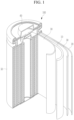
- FIG. 1 to FIG. 4 are schematic diagrams showing rechargeable lithium batteries according to one or more embodiments.
- “combination thereof” means a mixture, laminate, composite, copolymer, alloy, blend, a reaction product, and/or the like of the constituents.
- a particle diameter may be an average particle diameter.
- the particle diameter means the average particle diameter (D50), which means the diameter of particles having a cumulative volume of 50 volume% in the particle size distribution.
- the average particle size (D50) may be measured by any suitable method generally used in the art, for example, by a particle size analyzer, a transmission electron microscopic image, and/or a scanning electron microscopic image.
- a dynamic light-scattering measurement device is used to perform a data analysis, and the number of particles is counted for each particle size range. From this, the average particle diameter (D50) value may be easily obtained through a calculation. In some embodiments, it may be measured using a laser diffraction method.
- the particles to be measured are dispersed in a dispersion medium, and then introduced into a commercially available laser diffraction particle diameter measuring device (e.g., Microtrac MT 3000), and ultrasonic waves of about 28 kHz having an output of 60 W are irradiated to calculate an average particle diameter (D50) on the basis of 50% of the particle diameter distribution in the measuring device.
- a commercially available laser diffraction particle diameter measuring device e.g., Microtrac MT 3000
- ultrasonic waves of about 28 kHz having an output of 60 W are irradiated to calculate an average particle diameter (D50) on the basis of 50% of the particle diameter distribution in the measuring device.
- a negative electrode for a rechargeable lithium battery includes a current collector and a negative active material layer, and the negative active material layer includes a first active material layer in contact (e.g., physical contact) with the current collector and a second active material layer on the first active material layer.
- the first active material layer and the second active material layer include pores and at least one selected from the first active material layer and the second active material layer includes macropores having a size of about 1 ⁇ m or more.
- a porosity of the macropores is about 20% or more based on a total porosity 100% (e.g., the macropores provide about 20% or more of the total porosity 100%).
- the total porosity refers to a volume% occupied by all pores formed in the negative active material layer.
- the negative active material layer includes pores having various suitable sizes, and these pores may include macropores having a size of about 1 ⁇ m or more.
- the porosity of about 20% or more of the macropores refers to a value obtained based on the total porosity of the negative active material layer.
- the porosity of the macropores is about 20% or more based on the total porosity 100% of the negative active material layer, the macropores included in the negative active may effectively or sufficiently absorb the volume expansion of the negative active material caused during charging and discharge, so that the cycle-life characteristic may be improved.
- the curvature of the negative active material layer is also reduced, thereby reducing ionic resistance and improving rate-capability. If macropores are not included in the negative active material layer or the porosity of the macropores is less than about 20% based on the total porosity 100% of the negative active material layer, the effect of suppressing or reducing the volume expansion by the macropores may be not obtained or may be not sufficient.
- the total porosity of the macropores in the negative active material layer may be about 20% to about 35%, or about 23% to about 32% based on the total porosity 100% of the negative active material layer. If the porosity of the macropores is within the foregoing ranges, the increase in the ionic resistance may be suppressed or reduced, thereby exhibiting improved rate-capability.
- the porosity and the porosity of the macropores may be determined by mercury intrusion porosimetry.
- the intrusion according to a pore size, along with the porosity may be confirmed by the mercury intrusion porosimetry, so that the total porosity and the porosity of the macropores may be separately obtained.
- the porosity may be measured by the following procedures.
- Mercury intrusion porosimetry utilizes the characteristic of mercury that does not wet solids to measure a total volume of pores, the size or distribution of the pores, and the surface area of the pores, by intruding mercury into pores of a sample by applying external pressure thereto.
- the mercury intrusion porosimetry may be performed using a mercury porosimeter.
- the macropores may be included in the first active material layer or may be included in the second active material layer, or may be also included in the first active material layer and the second active material layer. In some embodiments, the macropores may be included in the second active material layer.
- a size of the macropores may be about 1 ⁇ m to about 5 ⁇ m, or about 1 ⁇ m to about 3 ⁇ m. If the size of the macropores satisfies the foregoing ranges, the ionic resistance may be reduced, thereby improving rate-capability.
- the shape of the macropores may be a spherical shape, or may be any suitable shape such as a rod shape or an oval shape which is not a substantially complete sphere.
- a size of the pores may be a size of a long axis of the respective pore, and the size of the pores may be a value determined through mercury intrusion porosimetry.
- the total porosity may be about 15% to about 30%, about 19% to about 30%, or about 19% to about 25%. If the total porosity of the negative active material layer satisfies the foregoing ranges, suitable or appropriate capacity may be secured and good electrolyte impregnation may be achieved, thereby well maintaining the stability and the cycle-life characteristic of the battery.
- the porosity of the macropores may be about 3% to about 9%, about 3% to about 7%, or about 4% to about 6%. If the porosity of the macropores in the negative active material layer is within the foregoing ranges, the electrolyte impregnation may be more readily occurred (e.g., may be improved) and the ionic resistance may be further reduced.
- the total porosity in the negative active material layer may be about 15% to about 30% and the porosity of the macropores may be about 3% to about 9%, so that the porosity of the macropores may be about 20% or more based on the total porosity 100% of the negative active material layer.
- the porosity may be a value measured through a mercury intrusion porosimetry method.
- a thickness ratio of the first active material layer and the second active material layer may be about 5:5 to about 7:3, or about 5:5 to about 6:4. If the thickness ratio of the first active material layer and the second active material layer satisfies the foregoing ranges, mixing of the first active material layer and the second active material layer does not occur (or substantially does not occur) and the ionic resistance may be further reduced.
- a thickness of the first active material layer may be about 50 ⁇ m to about 100 ⁇ m, about 60 ⁇ m to about 120 ⁇ m, or about 70 ⁇ m to about 140 ⁇ m.
- a thickness of the second active material layer may be about 50 ⁇ m to about 100 ⁇ m, about 40 ⁇ m to about 80 ⁇ m, or about 30 ⁇ m to about 60 ⁇ m.
- the thickness ratio of the first active material layer and the second active material layer is within the foregoing ranges, if the each layer has a thickness satisfying the any of the foregoing ranges, the mixing between the two active material layers does not occur (or substantially does not occur), and if suitable or appropriate electrode density may be realized, the ionic resistance may be further reduced.
- the first active material layer and the second active material layer may include a negative active material including a carbon-based negative active material, a Si-based negative active material, or a combination thereof.
- the carbon-based negative active material may include, for example, crystalline carbon, amorphous carbon, or a combination thereof.
- the crystalline carbon may be graphite such as an unspecified shaped, sheet shaped, flake shaped, spherical shaped, and/or fiber shaped artificial graphite and/or natural graphite, and the amorphous carbon may be soft carbon, hard carbon, mesophase pitch carbide, sintered cokes, and/or the like.
- the Si-based negative active material may include silicon, a silicon-carbon composite, SiO x (0 ⁇ x ⁇ 2), a Si-Q alloy (the Q is an element selected from an alkali metal, an alkaline-earth metal, a Group 13 element, a Group 14 element (except for Si), a Group 15 element, a Group 16 element, a transition metal, a rare earth element, and a combination thereof), or combination thereof.
- the silicon-carbon composite may be a composite of silicon and amorphous carbon.
- the silicon-carbon composite may include silicon particles and an amorphous carbon coated on the surface of the silicon particles.
- it may include secondary particles (core) where silicon primary particles are agglomerated and an amorphous carbon coating layer (shell) on the surface of the secondary particles.
- the silicon particles and/or the silicon primary particles may be silicon nano particles.
- the amorphous carbon may be between the silicon primary particles, for example, to coat on the silicon primary particles.
- the secondary particles may be distributed or dispersed in an amorphous carbon matrix.
- a particle diameter of the silicon nanoparticles may be about 10 nm to about 1,000 nm, and according to some embodiments, it may be about 10 nm to about 200 nm, or about 20 nm to about 150 nm. If the particle size of the silicon nanoparticles is within the above ranges, excessive volume expansion that occurs during charging and discharging may be suppressed or reduced, and disconnection of the conductive path due to particle crushing during charging and discharging may be prevented or reduced.
- the amorphous carbon may be soft carbon, hard carbon, a mesophase pitch carbonized product, sintered coke, or a combination thereof.
- a thickness of the amorphous carbon coating layer may be about 1 nm to about 2 ⁇ m, about 1 nm to about 500 nm, about 10 nm to about 300 nm, or about 20 nm to about 200 nm. If the thickness of the amorphous carbon coating layer is within the above ranges, silicon volume expansion may be well suppressed or reduced during charging and discharging.
- the silicon-carbon composite may further include crystalline carbon.
- the silicon-carbon composite may include a core including crystalline carbon and silicon particles, and an amorphous carbon coating layer on the surface of the core.
- the crystalline carbon may be unspecific-shaped, plate-shaped, flake-shaped, spherical and/or fibrous, such as natural graphite, artificial graphite, or a combination thereof.
- an amount of the silicon nano particles may be about 30 wt% to about 70 wt%, or about 40 wt% to about 65 wt%.
- An amount of the amorphous carbon coating layer may be, based on the total 100 wt% of the silicon-carbon composite, about 30 wt% to about 70 wt% or about 35 wt% to about 60 wt%.
- an amount of the silicon nano particles may be about 20 wt% to about 70 wt%, or about 25 wt% to about 65 wt%.
- an amount of the amorphous carbon may be about 25 wt% to about 70 wt%, or about 25 wt% to about 60 wt%, and an amount of the crystalline carbon may be about 1 wt% to about 20 wt%, or about 5 wt% to about 15 wt%.
- the negative active material may include a carbon-based negative active material.
- the carbon-based negative active material may include a crystalline carbon negative active material, for example, the first active material layer may include a natural graphite negative active material, and the second active material layer may include an artificial graphite negative active material.
- the negative active material included in the first active material layer is natural graphite and the negative active material included in the second active material layer is artificial graphite.
- the first active material layer and the second active material layer may further include a binder, and may further include a conductive material (e.g., an electrically conductive material).
- a conductive material e.g., an electrically conductive material
- an amount of the negative active material may be, based on the total 100 wt% of the first active material layer or the second active material layer, about 90 wt% to about 99 wt%, or about 94 wt% to about 99 wt%.
- an amount of the binder may be, based on the total 100 wt% of the first active material layer or the second active material layer, about 0.5 wt% to about 5 wt%, or about 0.5 wt% to about 3 wt%.
- an amount of the conductive material may be, based on the total, 100 wt% of the first active material layer or the second active material layer, about 0.5 wt% to about 5 wt%, or about 0.5 wt% to about 3 wt%.
- the binder serves to well attach the negative electrode active material particles to each other and also to well attach the negative electrode active material to the current collector.
- the binder may be a non-aqueous binder, an aqueous binder, a dry binder, or a combination thereof.
- the non-aqueous binder may include polyvinyl chloride, carboxylated polyvinyl chloride, polyvinyl fluoride, an ethylene propylene copolymer, polystyrene, polyurethane, polytetrafluoroethylene, polyvinylidene fluoride, polyethylene, polypropylene, polyamideimide, polyimide, or a combination thereof.
- the aqueous binder may include a styrene-butadiene rubber, a (meth)acrylated styrene-butadiene rubber, a (meth)acrylonitrile-butadiene rubber, a (meth)acryl rubber, a butyl rubber, a fluoro rubber, polyethylene oxide, polyvinylpyrrolidone, polyepichlorohydrin, polyphosphazene, poly(meth)acrylonitrile, an ethylene propylene diene copolymer, polyvinyl pyridine, chlorosulfonated polyethylene, latex, a polyester resin, a (meth)acrylic resin, a phenol resin, an epoxy resin, polyvinyl alcohol, or a combination thereof.
- an aqueous binder may further include a cellulose-based compound, and this cellulose-based compound may be used together with the aqueous binder.
- the cellulose-based compound may be one or more selected from carboxymethyl cellulose, hydroxypropylmethyl cellulose, methyl cellulose, and an alkali metal salt thereof.
- the alkali metal may be Na, K, and/or Li.
- the cellulose-based compound may serve as a binder and/or as a thickener that may impart or increase viscosity.
- the cellulose-based compound may be used in a suitable or appropriate amount within the amount of the binder, but, for example, it may about 0.1 parts by weight to about 3 parts by weight based on 100 parts by weight of the negative active material.
- the dry binder may be a polymer material capable of being fibrous (e.g., capable of being fibrillized or fiberized), and may be, for example, polytetrafluoroethylene, polyvinylidene fluoride, a polyvinylidene fluoride-hexafluoropropylene copolymer, polyethylene oxide, or a combination thereof.
- the conductive material is used to impart conductivity (e.g., electrical conductivity) to the electrode, and any suitable material that does not cause chemical change (e.g., does not cause an undesirable change in the rechargeable lithium battery) and conducts electrons may be used in the battery.
- suitable material e.g., electrical conductivity
- Examples thereof may include a carbon-based material such as natural graphite, artificial graphite, carbon black, acetylene black, ketjen black, a carbon fiber, a carbon nanofiber, and a carbon nanotube; a metal-based material including copper, nickel, aluminium, silver, etc. in a form of a metal powder and/or a metal fiber; a conductive polymer (e.g., an electrically conductive polymer) such as a polyphenylene derivative; or a mixture thereof.
- a carbon-based material such as natural graphite, artificial graphite, carbon black, acetylene black, ketjen black, a carbon fiber, a carbon nanofiber,
- the current collector may include a copper foil, a nickel foil, a stainless steel foil, a titanium foil, a nickel foam, a copper foam, a polymer substrate coated with a conductive metal (e.g., an electrically conductive metal), and a combination thereof, but is not limited thereto.
- a conductive metal e.g., an electrically conductive metal
- the negative electrode according to one or more embodiments may be prepared by coating a first active material layer composition on a current collector and drying it to prepare a first active material dry layer, coating a second active material layer composition on the first active material dry layer and drying it to prepare a second active material dry layer, and pressurizing (e.g., pressing) them.
- the first active material layer composition and the second active material layer composition includes an active material, a binder, and a solvent, and may further optionally include a conductive material (e.g., an electrically conductive material).
- a conductive material e.g., an electrically conductive material.
- the negative active material, the binder, and the conductive material are as described above.
- the solvent may be an organic solvent such as N-methyl pyrrolidone, or water, if the aqueous binder is used as the binder, water may be suitably used as the solvent.
- the pressurization may reduce the thickness of the coated and dried negative active material layer to be a suitable or desired thickness.
- the negative active material layer undergoes a pressurization (e.g., pressing) a plurality of times, for example, 2 (two) times or more, or 2 (two) to 3 (three) times, thereby preparing a negative electrode including a negative active material layer in which pores include macropores having a size of about 1 ⁇ m or more.
- the negative active material layer in which, based on the total porosity 100% of the negative active material layer, the porosity of the macropores may be about 20% or more, may be prepared.
- the pressurization e.g., the pressing
- the porosity of the macropores of about 20% or more is not formed, and thus, the effects by forming the macropores may not be realized.
- the negative active material layer is prepared as a single layer, and then the pressurization (e.g., the pressing) is performed 2 (two) or more times, the porosity of the macropores of about 20% or more based on the total porosity 100% of the negative active material layer, may not be obtained.
- a first pressurization e.g., a first pressing
- a second pressurization e.g., a second pressing
- the first pressurization (e.g., the first pressing) may be performed until a reduction rate reaches to about 30% to about 40%
- the second pressurization (e.g., the second pressing) may be performed until a reduction rate reaches to about 60% to about 70%
- a third pressurization (e.g., a third pressing) may be performed until a reduction rate reaches to about 100%. If the pressurization is performed so that the reduction rate during the first pressurization, the second pressurization, and third pressurization satisfies the above conditions, the porosity of the macropores in the second active material layer may be about 20% or more based on the total porosity 100% of the negative active material layer. The macropores may be not formed in the first active material layer.
- Another embodiment provides a rechargeable lithium battery including the negative electrode according to one or more embodiments, a positive electrode, and an electrolyte.
- the positive electrode may include a current collector and a positive electrode active material layer on the current collector.
- the positive electrode active material layer includes a positive electrode active material and may further include a binder and/or a conductive material (e.g., an electrically conductive material).
- the positive electrode may further include an additive that can serve as a sacrificial positive electrode.
- the positive electrode active material may include lithiated intercalation compounds that reversibly intercalate and deintercalate lithium ions.
- lithiated intercalation compounds that reversibly intercalate and deintercalate lithium ions.
- at least one of a composite oxide of lithium and a metal selected from cobalt, manganese, nickel, and combinations thereof may be used.
- the composite oxide may be a lithium transition metal composite oxide, and examples thereof may include lithium nickel-based oxide, lithium cobalt-based oxide, lithium manganese-based oxide, lithium iron phosphate-based compound, cobalt-free nickel-manganese-based oxide, or a combination thereof.
- Li a A 1-b X b O 2-c D c (0.90 ⁇ a ⁇ 1.8, 0 ⁇ b ⁇ 0.5, 0 ⁇ c ⁇ 0.05); Li a Mn 2-b X b O 4-c D c (0.90 ⁇ a ⁇ 1.8, 0 ⁇ b ⁇ 0.5, 0 ⁇ c ⁇ 0.05); Li a Ni 1-b-c Co b X c O 2- ⁇ D ⁇ (0.90 ⁇ a ⁇ 1.8, 0 ⁇ b ⁇ 0.5, 0 ⁇ c ⁇ 0.5, 0 ⁇ 2); Li a Ni 1-b-c Mn b X c O 2- ⁇ D ⁇ (0.90 ⁇ a ⁇ 1.8, 0 ⁇ b ⁇ 0.5, 0 ⁇ c ⁇ 0.5, 0 ⁇ 2); Li a Ni b Co c L 1 d G e O 2 (0.90 ⁇ a ⁇ 1.8, 0 ⁇ b ⁇ 0.9, 0 ⁇ c ⁇ 0.5, 0 ⁇ d ⁇ 0.5, 0 ⁇ e ⁇ 0.1); Li a NiG
- A is Ni, Co, Mn, or a combination thereof
- X is Al, Ni, Co, Mn, Cr, Fe, Mg, Sr, V, a rare earth element or a combination thereof
- D is O, F, S, P, or a combination thereof
- G is Al, Cr, Mn, Fe, Mg, La, Ce, Sr, V, or a combination thereof
- L 1 is Mn, Al, or a combination thereof.
- the positive active material may be may be a high nickel-based positive active material having a nickel amount of greater than or equal to about 80 mol%, greater than or equal to about 85 mol%, greater than or equal to about 90 mol%, greater than or equal to about 91 mol%, or greater than or equal to about 94 mol% and less than or equal to about 99 mol% based on 100 mol% of the metal excluding lithium in the lithium transition metal composite oxide.
- the high-nickel-based positive electrode active material may realize high capacity and may be applied to a high-capacity, high-density rechargeable lithium battery.
- an amount of the positive active material may be about 90 wt% to about 98 wt% based on a total weight of the positive active material layer.
- Each amount of the binder and the conductive material may respectively be 1 wt% to 5 wt% based on a total weight of the positive active material layer.
- the binder serves to well attach the positive active material particles to each other and also to well attach the positive active material to the current collector.
- the binder may include polyvinyl alcohol, carboxymethyl cellulose, hydroxypropyl cellulose, diacetyl cellulose, polyvinyl chloride, carboxylated polyvinyl chloride, polyvinyl fluoride, a polymer including ethylene oxide, polyvinylpyrrolidone, polyurethane, polytetrafluoroethylene, polyvinylidene fluoride, polyethylene, polypropylene, a styrene-butadiene rubber, a (meth)acrylated styrene-butadiene rubber, an epoxy resin, a (meth)acrylic resin, a polyester resin, nylon, and the like, but are not limited thereto.
- the conductive material is used to impart conductivity (e.g., electrical conductivity) to the electrode, and any suitable material that does not cause chemical change (e.g., does not cause an undesirable chemical change in the rechargeable lithium battery) and conducts electrons can be used in the battery.
- conductivity e.g., electrical conductivity
- any suitable material that does not cause chemical change e.g., does not cause an undesirable chemical change in the rechargeable lithium battery
- conducts electrons can be used in the battery.
- the conductive material may include a carbon-based material such as natural graphite, artificial graphite, carbon black, acetylene black, ketjen black, a carbon fiber, a carbon nanofiber, and carbon nanotube; a metal-based material containing copper, nickel, aluminium, silver, etc., in a form of a metal powder and/or a metal fiber; a conductive polymer (e.g., an electrically conductive polymer) such as a polyphenylene derivative; or a mixture thereof.
- a carbon-based material such as natural graphite, artificial graphite, carbon black, acetylene black, ketjen black, a carbon fiber, a carbon nanofiber, and carbon nanotube
- a metal-based material containing copper, nickel, aluminium, silver, etc., in a form of a metal powder and/or a metal fiber a conductive polymer (e.g., an electrically conductive polymer) such as a polyphenylene derivative; or a mixture thereof.
- the current collector may include Al, but is not limited thereto.
- the electrolyte includes a non-aqueous organic solvent and a lithium salt.
- the non-aqueous organic solvent serves as a medium for transmitting ions taking part in the electrochemical reaction of a battery.
- the non-aqueous organic solvent may be a carbonate-based, ester-based, ether-based, ketone-based, and/or alcohol-based solvent, an aprotic solvent, or a combination thereof.
- the carbonate-based solvent may include dimethyl carbonate (DMC), diethyl carbonate (DEC), dipropyl carbonate (DPC), methylpropyl carbonate (MPC), ethylpropyl carbonate (EPC), methylethyl carbonate (MEC), ethylene carbonate (EC), propylene carbonate (PC), butylene carbonate (BC), and/or the like.
- the ester-based solvent may include methyl acetate, ethyl acetate, n-propyl acetate, dimethyl acetate, methyl propionate, ethyl propionate, decanolide, mevalonolactone, valerolactone, caprolactone, and/or the like.
- the ether-based solvent may include dibutyl ether, tetraglyme, diglyme, dimethoxyethane, 2-methyltetrahydrofuran, 2,5-dimethyltetrahydrofuran, tetrahydrofuran, and/or the like.
- the ketone-based solvent may include cyclohexanone, and/or the like.
- the alcohol-based solvent may include ethanol, isopropyl alcohol, and/or the like and the aprotic solvent may include nitriles such as R-CN (wherein R is a C2 to C20 linear, branched, or cyclic hydrocarbon group, and may include a double bond, an aromatic ring, and/or an ether bond, and/or the like); amides such as dimethylformamide; dioxolanes such as 1,3-dioxolane, 1,4-dioxolane, and/or the like; sulfolanes, and/or the like.
- R-CN wherein R is a C2 to C20 linear, branched, or cyclic hydrocarbon group, and may include a double bond, an aromatic ring, and/or an ether bond, and/or the like
- amides such as dimethylformamide
- dioxolanes such as 1,3-dioxolane, 1,4-dioxolane, and/or the like
- the non-aqueous organic solvents may be used alone or in combination of two or more.
- a cyclic carbonate and a chain carbonate may be mixed together and used, and the cyclic carbonate and the chain carbonate may be mixed together in a volume ratio of about 1:1 to about 1:9.
- the lithium salt dissolved in the organic solvent supplies lithium ions in a battery, enables a basic operation of a rechargeable lithium battery, and improves transportation of the lithium ions between positive and negative electrodes.
- the lithium salt include at least one selected from LiPF 6 , LiBF 4 , LiSbF 6 , LiAsF 6 , LiClO 4 , LiAlO 2 , LiAlCl 4 , LiPO 2 F 2 , LiCl, Lil, LiN(SO 3 C 2 F 5 ) 2 , Li(FSO 2 ) 2 N (lithium bis(fluorosulfonyl)imide, LiFSI), LiC 4 F 9 SO 3 , LiN (C x F 2x+1 SO 2 )(C y F 2y+1 SO 2 ), wherein x and y are integers of 1 to 20, lithium trifluoromethane sulfonate, lithium tetrafluoroethanesulfonate, lithium difluorobis(oxala
- a separator may be present between the positive electrode and the negative electrode.
- the separator may include polyethylene, polypropylene, polyvinylidene fluoride, or a multilayer film of two or more layers thereof, and a mixed multilayer film such as a polyethylene/polypropylene two-layer separator, polyethylene/polypropylene/polyethylene three-layer separator, polypropylene/polyethylene/polypropylene three-layer separator, and/or the like.
- the separator may include a porous substrate and a coating layer including an organic material, an inorganic material, or a combination thereof on one or both surfaces (e.g., two opposing surfaces) of the porous substrate.
- the porous substrate may be a polymer film formed of any one selected from a polymer polyolefin such as polyethylene and polypropylene, polyester such as polyethylene terephthalate and polybutylene terephthalate, polyacetal, polyamide, polyimide, polycarbonate, polyether ketone, polyarylether ketone, polyether ketone, polyetherimide, polyamideimide, polybenzimidazole, polyethersulfone, polyphenylene oxide, a cyclic olefin copolymer, polyphenylene sulfide, polyethylene naphthalate, a glass fiber, TEFLON, and polytetrafluoroethylene, or a copolymer or mixture of two or more thereof.
- a polymer polyolefin such as polyethylene and polypropylene
- polyester such as polyethylene terephthalate and polybutylene terephthalate
- polyacetal polyamide, polyimide, polycarbonate, polyether ketone,
- the organic material may include a polyvinylidene fluoride-based polymer and/or a (meth)acrylic polymer.
- the inorganic material may include inorganic particles selected from Al 2 O 3 , SiO 2 , TiO 2 , SnO 2 , CeO 2 , MgO, NiO, CaO, GaO, ZnO, ZrO 2 , Y 2 O 3 , SrTiOs, BaTiOs, Mg(OH) 2 , boehmite, and a combination thereof, but is not limited thereto.
- the organic material and the inorganic material may be mixed together in one coating layer, or a coating layer including an organic material and a coating layer including an inorganic material may be stacked.
- FIGS. 1-4 are schematic views illustrating a rechargeable lithium battery according to an embodiment.
- FIG. 1 shows a cylindrical battery
- FIG. 2 is a cross-sectional view showing a prismatic battery
- FIGS. 3-4 show pouch-type batteries.
- the rechargeable lithium battery 100 includes an electrode assembly 40 including a separator 30 between a positive electrode 10 and a negative electrode 20, and a case 50 in which the electrode assembly 40 is housed.
- the positive electrode 10, the negative electrode 20, and the separator 30 may be impregnated with an electrolyte solution.
- the rechargeable lithium battery 100 may include a sealing member 60 sealing the case 50 as shown in FIG.
- the rechargeable lithium battery 100 may include a positive lead tab 11, a positive terminal 12, a negative lead tab 21, and a negative terminal 22.
- the rechargeable lithium battery 100 includes an electrode tab 70 ( FIG. 4 ), for example, a positive electrode tab 71 and a negative electrode tab 72 ( FIG. 3 ) serving as an electrical path for inducing the current formed in the electrode assembly 40 to the outside.
- the first active material layer composition was coated and dried. Thereafter, the second active material layer composition was coated on the dried product and dried.
- the resulting product was pressurized under a condition of a first reduction rate of about 50% (based on the desired thickness reduction rate 100%), and a second reduction rate of about 100% to prepare a negative electrode including a first active material layer having an 80 ⁇ m thickness and a second active material having an 80 ⁇ m thickness, formed on the current collector.
- This procedure prepared pores including macropores having a size of 1 ⁇ m or more in the second active material layer.
- the negative electrode, a lithium metal counter electrode, and an electrolyte were used to fabricate a half-cell.
- the electrolyte was prepared by dissolving 1.5 M LiPF 6 in a mixed solvent of ethylene carbonate, ethylmethyl carbonate, and dimethyl carbonate (in a volume ratio of 20:10:70).
- a negative electrode and a half-cell were fabricated by the same procedure as in Example 1, except that the pressurization was carried out under a condition of a first reduction rate of 60% (based on the desired thickness reduction rate of 100%) and a second reduction rate of 100%.
- pores including macropores having a size of 1 ⁇ m or more were formed in the second active material layer.
- a negative electrode and a half-cell were fabricated by the same procedure as in Example 1, except that the pressurization was carried out under a condition of a first reduction rate of 90% (based on the desired thickness reduction rate of 100%) and a second reduction rate of 100%.
- pores including macropores having a size of 1 ⁇ m or more were formed in the second active material layer.
- a negative electrode and a half-cell were fabricated by the same procedure as in Example 1, except that the pressurization was carried out under a condition of a first reduction rate of 30% (based on the desired thickness reduction rate of 100 %), a second reduction rate of 60%, and a third reduction rate of 100%.
- pores including macropores having a size of 1 ⁇ m or more were formed in the second active material layer.
- 98 wt% of a mixture of artificial graphite and natural graphite, 1 wt% of a styrene-butadiene rubber, and 1 wt% of carboxymethyl cellulose were mixed together in a water solvent to prepare a first active material layer composition.
- the first active material layer composition was coated and dried. Thereafter, the second active material layer composition was coated on the dried product and dried. The resulting product was pressurized under a condition of a first reduction rate of about 90% (based on the desired thickness reduction rate 100%), and a second reduction rate of about 100% to prepare a negative electrode including a first active material layer having an 80 ⁇ m thickness and a second active material having an 80 ⁇ m thickness, formed on the current collector.
- This procedure prepared pores including macropores having a size of 1 ⁇ m or more in the second active material layer.
- the negative electrode, a lithium metal counter electrode, and an electrolyte were used to fabricate a half-cell.
- the electrolyte was prepared by dissolving 1.5 M LiPF 6 in a mixed solvent of ethylene carbonate, ethylmethyl carbonate, and dimethyl carbonate (in a volume ratio of 20:10:70).
- the first active material layer composition was coated and dried. Thereafter, the second active material layer composition was coated on the dried product and dried.
- the resulting product was pressurized under a condition of a first reduction rate of about 100% (based on the desired thickness reduction rate 100%) to prepare a negative electrode including a first active material layer having an 80 ⁇ m thickness and a second active material having an 80 ⁇ m thickness, formed on the current collector.
- This procedure prepared pores including macropores having asize of 1 ⁇ m or more in the second active material layer.
- the negative electrode, a lithium metal counter electrode, and an electrolyte were used to fabricate a half-cell.
- the electrolyte was prepared by dissolving 1.5 M LiPF 6 in a mixed solvent of ethylene carbonate, ethylmethyl carbonate, and dimethyl carbonate (in a volume ratio of 20:10:70).
- 98 wt% of a mixture of artificial graphite and natural graphite, 1 wt% of a styrene-butadiene rubber, and 1 wt% of carboxymethyl cellulose were mixed together in a water solvent to prepare a first active material layer composition.
- the first active material layer composition was coated and dried. Thereafter, the second active material layer composition was coated on the dried product and dried. The resulting product was pressurized under a condition of a first reduction rate of about 100% (based on the desired thickness reduction rate 100%) to prepare a negative electrode including a first active material layer having an 80 ⁇ m thickness and a second active material having an 80 ⁇ m thickness, formed on the current collector.
- This procedure prepared pores including macropores having a size of 1 ⁇ m or more in the second active material layer.
- the negative electrode, a lithium metal counter electrode, and an electrolyte were used to fabricate a half-cell.
- the electrolyte was prepared by dissolving 1.5 M LiPF 6 in a mixed solvent of ethylene carbonate, ethylmethyl carbonate, and dimethyl carbonate (in a volume ratio of 20:10:70).
- the half-cells according to Examples 1 to 4 and Comparative Examples 1 to 3 were, at a room temperature (25 °C, RT), once charged at 0.1 C and discharged at 0.5 C, once charged at 1 C and discharged at 0.5 C, once charged at 2 C and discharged at 0.5 C, and once charged at 3 C and discharge at 0.5 C.
- a charge and discharge condition at each C-rate were as below.
- the charge capacity at each C-rate was measured to calculate a ratio of the capacity at each rate relative to the capacity at 0.1 C.
- the results are shown in Table 1, as a CC chargeability.
- Comparative Example 1 in which the relative porosity of the macropores was less than 20% and included a single layer (i.e. the first and second active material layer compositions were the same), exhibited degraded high-rate chargeability characteristics and capacity retention.
Landscapes
- Chemical & Material Sciences (AREA)
- Chemical Kinetics & Catalysis (AREA)
- Electrochemistry (AREA)
- General Chemical & Material Sciences (AREA)
- Engineering & Computer Science (AREA)
- Manufacturing & Machinery (AREA)
- Materials Engineering (AREA)
- Composite Materials (AREA)
- Inorganic Chemistry (AREA)
- Battery Electrode And Active Subsutance (AREA)
Applications Claiming Priority (1)
| Application Number | Priority Date | Filing Date | Title |
|---|---|---|---|
| KR1020230157450A KR20250070967A (ko) | 2023-11-14 | 2023-11-14 | 리튬 이차 전지용 음극 및 이를 포함하는 리튬 이차 전지 |
Publications (1)
| Publication Number | Publication Date |
|---|---|
| EP4557389A1 true EP4557389A1 (fr) | 2025-05-21 |
Family
ID=93037327
Family Applications (1)
| Application Number | Title | Priority Date | Filing Date |
|---|---|---|---|
| EP24205120.9A Pending EP4557389A1 (fr) | 2023-11-14 | 2024-10-07 | Électrode négative pour batterie au lithium rechargeable et batterie au lithium rechargeable la comprenant |
Country Status (3)
| Country | Link |
|---|---|
| US (1) | US20250158029A1 (fr) |
| EP (1) | EP4557389A1 (fr) |
| KR (1) | KR20250070967A (fr) |
Citations (3)
| Publication number | Priority date | Publication date | Assignee | Title |
|---|---|---|---|---|
| US20170125788A1 (en) * | 2013-01-25 | 2017-05-04 | Lg Chem, Ltd. | Anode for lithium secondary battery and lithium secondary battery including the same |
| EP3869586A1 (fr) * | 2018-10-17 | 2021-08-25 | Murata Manufacturing Co., Ltd. | Électrode négative pour batterie secondaire au lithium-ion et batterie secondaire au lithium-ion |
| US20230290948A1 (en) * | 2022-03-11 | 2023-09-14 | Prime Planet Energy & Solutions, Inc. | Secondary battery |
-
2023
- 2023-11-14 KR KR1020230157450A patent/KR20250070967A/ko active Pending
-
2024
- 2024-05-22 US US18/671,528 patent/US20250158029A1/en active Pending
- 2024-10-07 EP EP24205120.9A patent/EP4557389A1/fr active Pending
Patent Citations (3)
| Publication number | Priority date | Publication date | Assignee | Title |
|---|---|---|---|---|
| US20170125788A1 (en) * | 2013-01-25 | 2017-05-04 | Lg Chem, Ltd. | Anode for lithium secondary battery and lithium secondary battery including the same |
| EP3869586A1 (fr) * | 2018-10-17 | 2021-08-25 | Murata Manufacturing Co., Ltd. | Électrode négative pour batterie secondaire au lithium-ion et batterie secondaire au lithium-ion |
| US20230290948A1 (en) * | 2022-03-11 | 2023-09-14 | Prime Planet Energy & Solutions, Inc. | Secondary battery |
Non-Patent Citations (1)
| Title |
|---|
| SHENG YANGPING ET AL: "Effect of Calendering on Electrode Wettability in Lithium-Ion Batteries", FRONTIERS IN ENERGY RESEARCH, vol. 2, 5 December 2014 (2014-12-05), CH, XP093255659, ISSN: 2296-598X, DOI: 10.3389/fenrg.2014.00056 * |
Also Published As
| Publication number | Publication date |
|---|---|
| KR20250070967A (ko) | 2025-05-21 |
| US20250158029A1 (en) | 2025-05-15 |
Similar Documents
| Publication | Publication Date | Title |
|---|---|---|
| EP4629347A1 (fr) | Électrode positive à faible résistance et batterie au lithium rechargeable la comprenant | |
| EP4557389A1 (fr) | Électrode négative pour batterie au lithium rechargeable et batterie au lithium rechargeable la comprenant | |
| EP4510227A2 (fr) | Électrode négative pour batterie au lithium rechargeable et batterie au lithium rechargeable la comprenant | |
| EP4560727A1 (fr) | Électrode négative pour batterie au lithium rechargeable et batterie au lithium rechargeable la comprenant | |
| EP4571875A1 (fr) | Électrode négative pour batterie au lithium rechargeable et batterie au lithium rechargeable comprenant celle-ci | |
| EP4648117A1 (fr) | Électrode négative pour batterie au lithium rechargeable et batterie au lithium rechargeable comprenant celle-ci | |
| EP4632842A1 (fr) | Électrode négative et batterie au lithium rechargeable la comprenant | |
| EP4601026A2 (fr) | Électrode négative pour batterie au lithium rechargeable et batterie au lithium rechargeable la comprenant | |
| EP4697402A1 (fr) | Électrode négative pour batterie au lithium rechargeable et batterie au lithium rechargeable la comprenant | |
| EP4539140A1 (fr) | Matériau actif négatif pour batterie au lithium rechargeable, électrode négative le comprenant, et batterie au lithium rechargeable le comprenant | |
| US20250158021A1 (en) | Negative electrode active material and rechargeable lithium battery including same | |
| EP4597598A1 (fr) | Électrode négative pour batterie au lithium rechargeable et batterie au lithium rechargeable la comprenant | |
| US20250323249A1 (en) | Negative active material, method of preparing same, and rechargeable lithium battery including same | |
| US20250070130A1 (en) | Negative electrode active material and rechargeable lithium battery including same | |
| EP4708380A1 (fr) | Matériau actif d'électrode négative pour batterie au lithium rechargeable et batterie au lithium rechargeable le comprenant | |
| EP4560756A1 (fr) | Batterie rechargeable au lithium | |
| EP4645437A1 (fr) | Électrode négative pour batterie au lithium rechargeable et batterie au lithium rechargeable comprenant celle-ci | |
| EP4704170A2 (fr) | Électrode pour batterie au lithium rechargeable et batterie au lithium rechargeable comprenant celle-ci | |
| EP4597638A1 (fr) | Électrode négative pour une batterie au lithium rechargeable et batterie au lithium rechargeable la comprenant | |
| US20250070176A1 (en) | Negative electrode and rechargeable lithium battery including the same | |
| US20250038209A1 (en) | Electrode for rechargeable lithium battery and rechargeable lithium battery including the same | |
| US20250323263A1 (en) | Rechargeable lithium battery | |
| EP4704184A1 (fr) | Procédé de charge d'une batterie au lithium rechargeable | |
| EP4654275A1 (fr) | Liquide dispersé dans un matériau conducteur, composition d'électrode, électrode pour batteries au lithium rechargeables et batteries au lithium rechargeables | |
| EP4593107A1 (fr) | Électrode négative pour batterie au lithium rechargeable et batterie au lithium rechargeable la comprenant |
Legal Events
| Date | Code | Title | Description |
|---|---|---|---|
| PUAI | Public reference made under article 153(3) epc to a published international application that has entered the european phase |
Free format text: ORIGINAL CODE: 0009012 |
|
| STAA | Information on the status of an ep patent application or granted ep patent |
Free format text: STATUS: REQUEST FOR EXAMINATION WAS MADE |
|
| 17P | Request for examination filed |
Effective date: 20241007 |
|
| AK | Designated contracting states |
Kind code of ref document: A1 Designated state(s): AL AT BE BG CH CY CZ DE DK EE ES FI FR GB GR HR HU IE IS IT LI LT LU LV MC ME MK MT NL NO PL PT RO RS SE SI SK SM TR |