EP4557610A2 - Dispositif comprenant un amplificateur de puissance dans un système de communication sans fil - Google Patents
Dispositif comprenant un amplificateur de puissance dans un système de communication sans fil Download PDFInfo
- Publication number
- EP4557610A2 EP4557610A2 EP24208527.2A EP24208527A EP4557610A2 EP 4557610 A2 EP4557610 A2 EP 4557610A2 EP 24208527 A EP24208527 A EP 24208527A EP 4557610 A2 EP4557610 A2 EP 4557610A2
- Authority
- EP
- European Patent Office
- Prior art keywords
- signal
- inductor
- capacitor
- transistor
- connection line
- Prior art date
- Legal status (The legal status is an assumption and is not a legal conclusion. Google has not performed a legal analysis and makes no representation as to the accuracy of the status listed.)
- Pending
Links
Images





Classifications
-
- H—ELECTRICITY
- H03—ELECTRONIC CIRCUITRY
- H03F—AMPLIFIERS
- H03F3/00—Amplifiers with only discharge tubes or only semiconductor devices as amplifying elements
- H03F3/20—Power amplifiers, e.g. Class B amplifiers, Class C amplifiers
- H03F3/24—Power amplifiers, e.g. Class B amplifiers, Class C amplifiers of transmitter output stages
- H03F3/245—Power amplifiers, e.g. Class B amplifiers, Class C amplifiers of transmitter output stages with semiconductor devices only
-
- H—ELECTRICITY
- H03—ELECTRONIC CIRCUITRY
- H03F—AMPLIFIERS
- H03F1/00—Details of amplifiers with only discharge tubes, only semiconductor devices or only unspecified devices as amplifying elements
- H03F1/56—Modifications of input or output impedances, not otherwise provided for
- H03F1/565—Modifications of input or output impedances, not otherwise provided for using inductive elements
-
- H—ELECTRICITY
- H03—ELECTRONIC CIRCUITRY
- H03F—AMPLIFIERS
- H03F1/00—Details of amplifiers with only discharge tubes, only semiconductor devices or only unspecified devices as amplifying elements
- H03F1/02—Modifications of amplifiers to raise the efficiency, e.g. gliding Class A stages, use of an auxiliary oscillation
- H03F1/0205—Modifications of amplifiers to raise the efficiency, e.g. gliding Class A stages, use of an auxiliary oscillation in transistor amplifiers
- H03F1/0288—Modifications of amplifiers to raise the efficiency, e.g. gliding Class A stages, use of an auxiliary oscillation in transistor amplifiers using a main and one or several auxiliary peaking amplifiers whereby the load is connected to the main amplifier using an impedance inverter, e.g. Doherty amplifiers
-
- H—ELECTRICITY
- H03—ELECTRONIC CIRCUITRY
- H03F—AMPLIFIERS
- H03F3/00—Amplifiers with only discharge tubes or only semiconductor devices as amplifying elements
- H03F3/189—High-frequency amplifiers, e.g. radio frequency amplifiers
- H03F3/19—High-frequency amplifiers, e.g. radio frequency amplifiers with semiconductor devices only
- H03F3/193—High-frequency amplifiers, e.g. radio frequency amplifiers with semiconductor devices only with field-effect devices
-
- H—ELECTRICITY
- H03—ELECTRONIC CIRCUITRY
- H03F—AMPLIFIERS
- H03F3/00—Amplifiers with only discharge tubes or only semiconductor devices as amplifying elements
- H03F3/189—High-frequency amplifiers, e.g. radio frequency amplifiers
- H03F3/19—High-frequency amplifiers, e.g. radio frequency amplifiers with semiconductor devices only
- H03F3/195—High-frequency amplifiers, e.g. radio frequency amplifiers with semiconductor devices only in integrated circuits
-
- H—ELECTRICITY
- H03—ELECTRONIC CIRCUITRY
- H03F—AMPLIFIERS
- H03F3/00—Amplifiers with only discharge tubes or only semiconductor devices as amplifying elements
- H03F3/20—Power amplifiers, e.g. Class B amplifiers, Class C amplifiers
- H03F3/24—Power amplifiers, e.g. Class B amplifiers, Class C amplifiers of transmitter output stages
-
- H—ELECTRICITY
- H04—ELECTRIC COMMUNICATION TECHNIQUE
- H04B—TRANSMISSION
- H04B1/00—Details of transmission systems, not covered by a single one of groups H04B3/00 - H04B13/00; Details of transmission systems not characterised by the medium used for transmission
- H04B1/005—Details of transmission systems, not covered by a single one of groups H04B3/00 - H04B13/00; Details of transmission systems not characterised by the medium used for transmission adapting radio receivers, transmitters andtransceivers for operation on two or more bands, i.e. frequency ranges
- H04B1/0067—Details of transmission systems, not covered by a single one of groups H04B3/00 - H04B13/00; Details of transmission systems not characterised by the medium used for transmission adapting radio receivers, transmitters andtransceivers for operation on two or more bands, i.e. frequency ranges with one or more circuit blocks in common for different bands
- H04B1/0075—Details of transmission systems, not covered by a single one of groups H04B3/00 - H04B13/00; Details of transmission systems not characterised by the medium used for transmission adapting radio receivers, transmitters andtransceivers for operation on two or more bands, i.e. frequency ranges with one or more circuit blocks in common for different bands using different intermediate frequencied for the different bands
- H04B1/0078—Details of transmission systems, not covered by a single one of groups H04B3/00 - H04B13/00; Details of transmission systems not characterised by the medium used for transmission adapting radio receivers, transmitters andtransceivers for operation on two or more bands, i.e. frequency ranges with one or more circuit blocks in common for different bands using different intermediate frequencied for the different bands with a common intermediate frequency amplifier for the different intermediate frequencies, e.g. when using switched intermediate frequency filters
-
- H—ELECTRICITY
- H04—ELECTRIC COMMUNICATION TECHNIQUE
- H04B—TRANSMISSION
- H04B1/00—Details of transmission systems, not covered by a single one of groups H04B3/00 - H04B13/00; Details of transmission systems not characterised by the medium used for transmission
- H04B1/02—Transmitters
- H04B1/04—Circuits
- H04B1/0458—Arrangements for matching and coupling between power amplifier and antenna or between amplifying stages
-
- H—ELECTRICITY
- H04—ELECTRIC COMMUNICATION TECHNIQUE
- H04B—TRANSMISSION
- H04B1/00—Details of transmission systems, not covered by a single one of groups H04B3/00 - H04B13/00; Details of transmission systems not characterised by the medium used for transmission
- H04B1/06—Receivers
- H04B1/16—Circuits
- H04B1/18—Input circuits, e.g. for coupling to an antenna or a transmission line
-
- H—ELECTRICITY
- H03—ELECTRONIC CIRCUITRY
- H03F—AMPLIFIERS
- H03F2200/00—Indexing scheme relating to amplifiers
- H03F2200/387—A circuit being added at the output of an amplifier to adapt the output impedance of the amplifier
-
- H—ELECTRICITY
- H03—ELECTRONIC CIRCUITRY
- H03F—AMPLIFIERS
- H03F2200/00—Indexing scheme relating to amplifiers
- H03F2200/451—Indexing scheme relating to amplifiers the amplifier being a radio frequency amplifier
-
- H—ELECTRICITY
- H03—ELECTRONIC CIRCUITRY
- H03F—AMPLIFIERS
- H03F2203/00—Indexing scheme relating to amplifiers with only discharge tubes or only semiconductor devices as amplifying elements covered by H03F3/00
- H03F2203/20—Indexing scheme relating to power amplifiers, e.g. Class B amplifiers, Class C amplifiers
- H03F2203/21—Indexing scheme relating to power amplifiers, e.g. Class B amplifiers, Class C amplifiers with semiconductor devices only
- H03F2203/211—Indexing scheme relating to power amplifiers, e.g. Class B amplifiers, Class C amplifiers with semiconductor devices only using a combination of several amplifiers
- H03F2203/21169—A parallel resonance circuit being coupled at the output of a power amplifier
-
- H—ELECTRICITY
- H03—ELECTRONIC CIRCUITRY
- H03F—AMPLIFIERS
- H03F2203/00—Indexing scheme relating to amplifiers with only discharge tubes or only semiconductor devices as amplifying elements covered by H03F3/00
- H03F2203/20—Indexing scheme relating to power amplifiers, e.g. Class B amplifiers, Class C amplifiers
- H03F2203/21—Indexing scheme relating to power amplifiers, e.g. Class B amplifiers, Class C amplifiers with semiconductor devices only
- H03F2203/211—Indexing scheme relating to power amplifiers, e.g. Class B amplifiers, Class C amplifiers with semiconductor devices only using a combination of several amplifiers
- H03F2203/21172—A series resonance circuit being coupled at the output of a power amplifier
-
- H—ELECTRICITY
- H04—ELECTRIC COMMUNICATION TECHNIQUE
- H04B—TRANSMISSION
- H04B1/00—Details of transmission systems, not covered by a single one of groups H04B3/00 - H04B13/00; Details of transmission systems not characterised by the medium used for transmission
- H04B1/02—Transmitters
- H04B1/04—Circuits
- H04B2001/0408—Circuits with power amplifiers
Definitions
- the disclosure relates generally to a wireless communication system, and more particularly, to a device including a power amplifier (PA) in a wireless communication system.
- PA power amplifier
- Mobile devices are expected to evolve in various form-factors, such as augmented reality glasses, virtual reality headsets, and hologram devices.
- 6G sixth generation
- 6G communication systems are expected to be commercialized around 2030, will have a peak data rate of tera (1,000 giga)-level bit per second (bps) and a radio latency less than 100 microseconds ( ⁇ sec), and thus will be 50 times as fast as 5G communication systems and have the 1/10 radio latency thereof.
- THz terahertz
- GHz gigahertz
- a full-duplex technology for enabling an uplink transmission and a downlink transmission to simultaneously use the same frequency resource
- a network technology for utilizing satellites, high-altitude platform stations (HAPS), and the like in an integrated manner
- an improved network structure for supporting mobile base stations and the like and enabling network operation optimization and automation, etc.
- a dynamic spectrum sharing technology via collision avoidance based on a prediction of spectrum usage use of artificial intelligence (AI) in wireless communication for improvement of overall network operation by utilizing AI from a designing phase for developing 6G and internalizing end-to-end AI support functions
- a next-generation distributed computing technology for overcoming the limit of UE computing ability through reachable super-high-performance communication and computing resources (such as mobile edge computing (MEC), clouds, etc.) over the network.
- MEC mobile edge computing
- 6G communication systems in hyper-connectivity, including person to machine (P2M) as well as machine to machine (M2M), will enable the next hyper-connected experience to be realized.
- services such as truly immersive extended Reality (XR), high-fidelity mobile hologram, and digital replica could be provided through 6G communication systems.
- services such as remote surgery for security and reliability enhancement, industrial automation, and emergency response will be provided through the 6G communication system such that the technologies could be applied in various fields such as industry, medical care, automobiles, and home appliances.
- an electronic device in a wireless communication system may include a first transistor configured to receive a first signal and comprising a first capacitor, the first transistor being configured to amplify and output the first signal as a first RF signal in case that the first signal is greater than or equal to a specified voltage, a second transistor configured to receive a second signal and comprising a second capacitor, the second transistor being configured to amplify and output the second signal as a second RF signal, a first connection line which is connected to the first transistor and in which the first RF signal is transmitted, a second connection line which is connected to the second transistor and in which the second RF signal is transmitted, the first connection line and the second connection line being connected at a first node, a first inductor connected to the first node, and a third capacitor configured to connect the first inductor and ground, wherein an impedance sum of the first inductor, the first capacitor, and the third capacitor is configured such that the first RF signal and the second RF signal resonate in a
- a PAM may include a first transistor configured to receive a first signal and comprising a first capacitor, the first transistor being configured to amplify and output the first signal as a first RF signal in case that the first signal is greater than or equal to a specified voltage, a second transistor configured to receive a second signal and comprising a second capacitor, the second transistor being configured to amplify and output the second signal as a second RF signal, a first connection line which is connected to the first transistor and in which the first RF signal is transmitted, a second connection line which is connected to the second transistor and in which the second RF signal is transmitted, the first connection line and the second connection line being connected at a first node, a first inductor connected to the first node, and a third capacitor configured to connect the first inductor and ground, wherein a sum of impedances of the first inductor, the first capacitor, and the third capacitor is configured such that the first RF signal and the second RF signal resonate in a specified frequency
- Embodiments of the disclosure enable a constitution of the disclosure to be complete and are provided to fully inform the scope of the disclosure to those of ordinary skill in the art to which the disclosure pertains.
- an electronic device may be required to transmit a signal having a high peak to average power ratio (PAPR).
- PAPR peak to average power ratio
- a PA module may be required to include a matching circuit (or matching network) for impedance matching and/or a quarter-wave transmission line (QWTL) for impedance transformation.
- the size of a PAM may increase in case that a matching circuit and/or a QWTL are included for impedance matching.
- a lumped element e.g., an inductor
- a frequency of a signal output from the PAM may differ from a designed or configured resonant frequency.
- an aspect of the disclosure is to provide an electronic device that can reduce or minimize the size of a PAM.
- An aspect of the disclosure is to provide an electronic device that can secure a relatively wide operating frequency band of the PAM.
- FIG. 1 illustrates a wireless communication system according to an embodiment.
- the wireless communication system includes a base station 110, a terminal 120, and a terminal 130 as some of nodes using a wireless channel.
- FIG. 1 illustrates only one base station 110, additional base stations may also be included.
- the base station 110 is a network infrastructure that provides wireless access to the terminals 120 and 130.
- the base station 110 has coverage defined as a certain geographical area, based on a distance over which a signal can be transmitted.
- the base station 110 may be referred to as an access point (AP), an eNodeB (eNB), a 5th generation node (5G node), a wireless point, a transmission/reception point (TRP), or another term having a technical meaning equivalent thereto, in addition to a base station.
- AP access point
- eNB eNodeB
- 5G node 5th generation node
- TRP transmission/reception point
- Each of the terminal 120 and terminal 130 is used by a user and may communicate with the base station 110 through a wireless channel. In some cases, at least one of the terminal 120 and the terminal 130 may be operated without user involvement. That is, at least one of the terminal 120 and the terminal 130 performs machine type communication (MTC) and may not be carried by a user.
- MTC machine type communication
- Each of the terminal 120 and the terminal 130 may be referred to as a user equipment (UE), a mobile station, a subscriber station, a customer premises equipment (CPE), a remote terminal, a wireless terminal, an electronic device, a user device, or another term having a technical meaning equivalent thereto, in addition to a terminal.
- the base station 110, the terminal 120, and/or the terminal 130 may transmit and receive a wireless signal in an mmWave band (e.g., 28 GHz, 30 GHz, 38 GHz, or 60 GHz).
- the base station 110, the terminal 120, and/or the terminal 130 may perform transmission beamforming and reception beamforming. That is, the base station 110, the terminal 120, and the terminal 130 may give directivity to a transmission signal or a reception signal.
- the base station 110 and the terminals 120 and 130 may select serving beams 112, 113, 121, and 131 through a beam search or beam management procedure. After the serving beams 112, 113, 121, and 131 are selected, subsequent communication may be performed through a resource having a quasi co-located (QCL) relationship with a resource having transmitted the serving beams 112, 113, 121, and 131.
- QCL quasi co-located
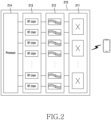
- FIG. 2 illustrates an electronic device according to an embodiment.
- the electronic device 210 includes an antenna unit 211, a filter unit 212, an RF processing unit 213, and/or a processor (i.e., controller) 214.
- the antenna unit 211 may include a plurality of antennas (or antenna elements).
- the antennas perform functions for transmitting or receiving a signal through a wireless channel.
- the antennas may include a radiator formed of a conductor or a conductive pattern formed on a substrate (e.g., a PCB).
- the antennas may radiate an up-converted signal through a wireless channel or obtain a signal radiated by another device.
- Each of the antennas may be referred to as an antenna element or an antenna device.
- the antenna unit 211 may include an antenna array (e.g., a sub array) in which a plurality of antenna elements forms an array.
- the antenna unit 211 may be electrically connected to the filter unit 212 through RF signal lines and may be mounted on a PCB including a plurality of antenna elements.
- the PCB may include a plurality of RF signal lines which connect each antenna element to a filter of the filter unit 212. Such RF signal lines may be referred to as a feeding network.
- the antenna unit 211 may provide a received signal to the filter unit 212 or may radiate a signal provided from the filter unit 212 into the air.
- the disclosed antennas may be included in the antenna unit 211.
- the antenna unit 211 may include at least one antenna module having a dual-polarized antenna, such as a cross-pole (x-pol) antenna and may include two antenna elements corresponding to different polarizations.
- the dual-polarized antenna may include a first antenna element having a polarization of +45° and a second antenna element having a polarization of -45°.
- the polarization may be formed by other orthogonal polarizations in addition to +45° and -45°.
- Each of the antenna elements may be connected to a feeding line and may be electrically connected to the filter unit 212, the RF processing unit 213, and/or the controller 214 described below.
- the dual-polarized antenna may be a patch antenna (or a microstrip antenna) and thus may be easily implemented and integrated into an array antenna. Two signals having different polarizations may be input to each antenna port corresponding to an antenna element. For high efficiency, it is required to optimize a relationship between co-pol characteristics and cross-pol characteristics between the two signals having different polarizations.
- the co-pol characteristics represent characteristics for a specific polarization component
- the cross-pol characteristics represent characteristics for the specific polarization component and other polarization components.
- An antenna (e.g., an antenna element, a sub array, or an antenna array) of an antenna device including a separate type PCB may be included in the antenna unit 211.
- a first conductive member or a second conductive member of the antenna device may refer to an antenna element and may be included in the antenna unit 211 of FIG. 2 .
- the filter unit 212 may perform filtering to transmit a signal of a desired frequency.
- the filter unit 212 may perform a function for selectively identifying a frequency by forming a resonance.
- the filter unit 212 may form a resonance through a cavity which structurally includes a dielectric.
- the filter unit 212 may form a resonance through devices which form inductance or capacitance.
- the filter unit 212 may include an elastic filter, such as a bulk acoustic wave (BAW) filter or a surface acoustic wave (SAW) filter.
- the filter unit 212 may include at least one of a band pass filter, a low pass filter, a high pass filter, or a band reject filter. That is, the filter unit 212 may include RF circuits for obtaining a signal of a frequency band for transmission or a frequency band for reception.
- the filter unit 212 may electrically connect the antenna unit 211 and the RF processing unit 213.
- the RF processing unit 213 may include a plurality of RF paths.
- An RF path may be the unit of a path through which a signal received through an antenna or a signal radiated through an antenna passes.
- At least one RF path may be referred to as an RF chain including a plurality of RF devices, such as an amplifier, a mixer, an oscillator, a digital-to-analog converter (DAC), an analog-to-digital converter (ADC), etc.
- the RF processing unit 213 may include an up converter which up-converts a digital transmission signal in a baseband to a transmission frequency, and a DAC which converts an up-converted digital transmission signal into an analog RF transmission signal.
- the up converter and the DAC form a part of a transmission path.
- the transmission path may further include a PA or a coupler (or combiner).
- the RF processing unit 213 may include an ADC which converts an analog RF reception signal into a digital reception signal, and a down converter which converts a digital reception signal into a digital reception signal in a baseband.
- the ADC and the down converter form a part of a reception path.
- the reception path may further include a low-noise amplifier (LNA) or a coupler (or divider).
- RF components of the RF processing unit may be implemented on a PCB.
- the antennas and the RF components of the RF processing unit may be implemented on the PCB, and filters may be repeatedly connected between PCBs to form multiple layers.
- An RFIC and a package board (PKG) of the antenna device including the separate type PCB may be included in the RF processing unit 213 of FIG. 2 . That is, the RF processing unit 213 may include the RFIC as an RF device for mmWave. As described above, the RFIC may be formed as an RFIC chip coupled with the PKG, to be coupled to a first PCB, or the RFIC may be directly coupled by the first PCB.
- the controller 214 may control the overall operations of the electronic device 210.
- the controller 214 may include various modules for performing communication.
- the controller 214 may include at least one processor such as a modem.
- the controller 214 may include modules for digital signal processing.
- the controller 214 may include a modem.
- the controller 214 When data transmission, the controller 214 generates complex symbols by encoding and modulating transmission bit streams.
- the controller 214 restores a reception bit stream through demodulation and decoding of a baseband signal.
- the controller 214 may perform functions of a protocol stack required by communication standards.
- FIG. 3 illustrates an electronic device according to an embodiment.
- an electronic device 301 includes at least one processor 310, at least one transceiver 320, and/or at least one antenna 330.
- the electronic device 301 may be at least one of the base station 110, the terminal 120, or the terminal 130 of FIG. 1 .
- the at least one processor 310 may include at least one communication processor.
- the at least one processor 310 may be electrically connected to the at least one transceiver 320 and may generate or process a signal (e.g., a baseband signal).
- the at least one processor 310 may transmit a signal (e.g., a baseband signal) to the at least one transceiver 320 or receive a signal (e.g., a baseband signal) from the at least one transceiver 320.
- a signal e.g., a baseband signal
- receive a signal e.g., a baseband signal
- the at least one transceiver 320 may be electrically connected to the at least one antenna 330.
- the at least one transceiver 320 may up-convert an intermediate frequency (IF) signal transmitted from the at least one processor 310 to an RF signal and transmit the RF signal to the at least one antenna 330.
- IF intermediate frequency
- the at least one transceiver 320 may receive an RF signal from the at least one antenna 330, down-convert the RF signal to an IF signal, and transmit the IF signal to the at least one processor 310.
- the at least one transceiver 320 may include at least one transmitter and/or at least one receiver.
- the at least one transceiver 320 may include a first transceiver including a first transmitter and a first receiver, and the at least one transceiver 320 may include a second transceiver including the first transmitter.
- the at least one transceiver 320 may process, transmit, and/or receive RF signals in various frequency bands.
- each of the first transceiver and the second transceiver included in the at least one transceiver 320 may process an RF signal in a first frequency band.
- the first transceiver included in the at least one transceiver 320 may process an RF signal in the first frequency band
- the second transceiver may process an RF signal in a second frequency band.
- the second frequency band may partially overlap with the first frequency band.
- the at least one antenna 330 may include various types of antennas.
- the at least one antenna 330 may include a patch antenna, a dipole antenna, a monopole antenna, a slit antenna, a laser direct structuring (LDS) antenna, and/or an inverted-F antenna (IFA).
- LDS laser direct structuring
- IFA inverted-F antenna
- the at least one antenna 330 may include an antenna for transmitting and/or receiving a signal in an mmWave frequency band.
- the at least one antenna 330 may include a plurality of antenna elements (e.g., a patch antenna), and the plurality of antenna elements may form an array.
- the plurality of antenna elements forming the array may transmit and/or receive a signal in the mmWave frequency band.
- At least one processor 310 in the disclosure may be replaced with another term referring to a configuration for data processing.
- the term “at least one processor” may be replaced with a controller or a computing device.
- the at least one transceiver 320 may include an RFIC and/or an IF integrated circuit (IFIC).
- IFIC IF integrated circuit
- the at least one transceiver 320 is described as including an RFIC and an IFIC, but this is only an example, and the at least one transceiver 320 may correspond to an RFIC.
- the at least one transceiver 320 may correspond to an IFIC.
- FIG. 4 illustrates at least one antenna and at least one transceiver according to an embodiment.
- the electronic device 301 may include the at least one transceiver 320 and/or the at least one antenna 330.
- the at least one antenna 330 may include at least one antenna element 401.
- the at least one antenna element 401 may include a (1-1)th antenna element 411-1, a (1-2)th antenna element 411-2, ..., an (N-1)th antenna element 41N-1, ..., and an (N-M)th antenna element 41N-M.
- the at least one antenna element 401 may include antenna elements forming N rows and M columns (or N x M).
- the (1-1)th antenna element 411-1, the (1-2)th antenna element 411-2, ..., and a (1-M)th antenna element 411-M may form a first row.
- a (2-1)th antenna element 412-1, ..., and a (2-M)th antenna element 412-M may form a second row.
- the (N-1)th antenna element 41N-1, ..., and the (N-M)th antenna element 41N-M may form a Nth row.
- the at least one transceiver 320 may include an RF-front end module (RF-FEM) 410 and/or an RFIC 420.
- the RF-FEM 410 may electrically connect the (1-1)th antenna element 411-1 and the RFIC 420.
- the RF-FEM 410 may amplify RF signals received from the RFIC 420 and may transmit the amplified signals to the (1-1)th antenna element 411-1, or amplify RF signals received from the (1-1)th antenna element 411-1 and transmit the amplified signals to the RFIC 420.
- the RF-FEM 410 may include a first PAM 421, a second PAM 422, a first LNA 425, a second LNA 426, a first circulator 431, a second circulator 432, a first switch 433, and/or a second switch 434.
- the first PAM 421 may amplify first polarized signals received from the RFIC 420 and transmit the amplified first polarized signals to the (1-1)th antenna element 411-1 through the first circulator 431.
- the first LNA 425 may amplify first polarized signals received through the (1-1)th antenna element 411-1 and the first circulator 431, and transmit the amplified first polarized signals to the RFIC 420.
- the first PAM 421 may include a Doherty PA.
- the second PAM 422 may amplify second polarized signals received from the RFIC 420 and transmit the amplified second polarized signals to the (1-1)th antenna element 411-1 through the second circulator 432.
- the second LNA 426 may amplify second polarized signals received through the (1-1)th antenna element 411-1 and the second circulator 432, and transmit the amplified second polarized signals to the RFIC 420.
- the second PAM 422 may include a Doherty PA.
- a first polarized signal and a second polarized signal may have a polarization angle difference of about 90 degrees from each other.
- the first polarized signal may have a horizontal polarization
- the second polarized signal may have a vertical polarization.
- the first polarized signal may have a vertical polarization
- the second polarized signal may have a horizontal polarization.
- the first polarized signal may have a polarization of about +45 degrees
- the second polarized signal may have a polarization of about -45 degrees.
- the first PAM 421 and the first LNA 425 may be components for or dedicated to the first polarized signal.
- the second PAM 422 and the second LNA 426 may be components for or dedicated to the second polarized signal.
- the first switch 433 may selectively connect the first circulator 431 to the first LNA 425 or to ground within the electronic device 301.
- the first switch 433 may electrically connect the first circulator 431 and the first LNA 425 when receiving first polarized signals through the (1-1)th antenna element 411-1.
- the first switch 433 may electrically connect the first circulator 431 and the ground when transmitting first polarized signals through the (1-1)th antenna element 411-1.
- the second switch 434 may selectively connect the second circulator 432 to the second LNA 426 or to the ground within the electronic device 301.
- the second switch 434 may electrically connect the second circulator 432 and the second LNA 426 when receiving second polarized signals through the (1-1)th antenna element 411-1.
- the second switch 434 may electrically connect the second circulator 432 and the ground when transmitting second polarized signals through the (1-1)th antenna element 411-1.
- the RFIC 420 may include a mixer for generating RF signals in a specified frequency band and/or a phase shifter for controlling the phase of RF signals.
- N may be an integer greater than or equal to 1
- M may be an integer greater than or equal to 1. That is, there may be one or more antenna elements forming N rows and M columns.
- the at least one antenna element 401 is described as having a conductive patch shape, but this is only an example.
- the at least one antenna element 401 may include various types of antennas (e.g., an IFA, an LDS antenna, or a slit antenna).
- the RF-FEM 410 and the RFIC 420 are described as separate configurations, but this is only an example.
- the RF-FEM 410 and the RFIC 420 may be one configuration.
- the entire RF-FEM 410 and RFIC 420 may also be referred to as an RFIC.
- FIG. 5 components and operations of the first PAM 421 electrically connected to the (1-1)th antenna element 411-1 are described.
- FIGs. 5 to 14 will be described based on the configurations (or electronic components) included in the first PAM 421 and the operations performed by the first PAM 421, but may also be applied to the second PAM 422 or another PAM.
- FIG. 5 illustrates an RFIC and a first PAM according to an embodiment.
- the RFIC 420 includes a mixer 510 and/or a distributor 520.
- the first PAM 421 includes a first transistor 531, a second transistor 532, a connection line 580, a resistor 573, and/or a circuit 572 for impedance matching.
- connection line 580 includes a first connection line 581, a second connection line 582, a third connection line 583, and/or a fourth connection line 584.
- connection line 580 may be at least one of a microstrip line, a bond wire, or a conductive via of a PCB.
- the mixer 510 of the RFIC 420 may generate signals in a specified frequency band.
- the mixer 510 may convert a signal received from a communication processor or an IFIC into signals in a specified frequency band.
- the mixer 510 may transmit signals in a specified frequency band to the distributor 520.
- the distributor 520 may divide a signal received from the mixer 510 and transmit the divided signal to the first transistor 531 and the second transistor 532.
- the mixer 510 may transmit a signal in a specified frequency band to the distributor 520.
- the distributor 520 may divide the received signal into a first signal and a second signal, transmit the first signal to the first transistor 531, and transmit or distribute the second signal to the second transistor 532.
- the first transistor 531 may include a first capacitor 541.
- the first capacitor 541 may have a first capacitance value (e.g., C out.p ).
- the first transistor 531 may amplify the first signal into a first RF signal.
- the first transistor 531 may not operate when the first signal received from the distributor 520 is less than a preconfigured threshold value. In this case, the first transistor 531 may not output the amplified signal.
- the first transistor 531 may amplify the first signal into the first RF signal. In this case, the first transistor 531 may output the amplified first RF signal.
- the operation of a PAM may be understood as amplifying of a received signal and transmitting of the amplified signal through a connection line (e.g., the first connection line 581) by the PAM.
- a connection line e.g., the first connection line 581
- the first transistor 531 may be electrically connected to a first ground 561.
- the second transistor 532 may include a second capacitor 542.
- the second capacitor 542 may have a second capacitance value (e.g., C out.c ).
- the second capacitance value of the second capacitor 542 may be substantially the same as the first capacitance value of the first capacitor 541.
- the second capacitance value of the second capacitor 542 may be different from the first capacitance value of the first capacitor 541.
- the second transistor 532 may amplify the second signal received from the distributor 520 into a second RF signal.
- the second transistor 532 may amplify the second signal into the second RF signal, based on the reception of the second signal, regardless of a voltage value of the second signal.
- the second transistor 532 may be electrically connected to a second ground 562.
- the second ground 562 may be substantially the same as the first ground 561.
- the second ground 562 may be different from the first ground 561.
- the first transistor 531 may be electrically connected to the first connection line 581, and the second transistor 532 may be electrically connected to the second connection line 582.
- the first connection line 581 may be a line through which the first RF signal output from the first transistor 531 is transmitted.
- the first connection line 581 may be referred to as an electrical path from the first transistor 531 to a first node 591.
- the second connection line 582 may be a line through which the second RF signal output from the second transistor 532 is transmitted.
- the second connection line 582 may be referred to as an electrical path from the second transistor 532 to the first node 591.
- the first connection line 581 and the second connection line 582 may be connected or coupled at the first node 591. As another example, the first connection line 581 and the second connection line 582 may be combined at the first node 591.
- the third connection line 583 may electrically connect the first node 591 and the at least one antenna 330 (e.g., the (1-1)th antenna element 411-1).
- the third connection line 583 may be a path from the first node 591 to the at least one antenna 330.
- the fourth connection line 584 may be connected to the third connection line 583 at a third node 593.
- a first signal and a second signal output from different transistors may be transmitted to the at least one antenna 330.
- a first signal output from the first transistor 531 may be transmitted to the third connection line 583 through the first connection line 581 and the first node 591.
- a second signal output from the second transistor 532 may be transmitted to the third connection line 583 through the second connection line 582 and the first node 591.
- Each of the first signal and the second signal transmitted to the third connection line 583 may be transmitted to the at least one antenna 330.
- the first PAM 421 may include a first inductor 551 and/or a third capacitor 543.
- the first inductor 551 may be electrically connected to the first node 591 of the connection line 580.
- the third capacitor 543 may be electrically connected to the first node 591 through the first inductor 551.
- first inductor 551 and the third capacitor 543 may electrically connect a third ground 563 and the first node 591 of the connection line 580.
- the third ground 563 may be substantially the same as the first ground 561 and/or the second ground 562.
- the first PAM 421 may expand an operating frequency band of the first transistor 531, based on the first inductor 551 and the third capacitor 543.
- the first inductor 551 and the third capacitor 543 are disposed between the first node 591 and the third ground 563
- the first inductor 551 and the third capacitor 543 may act as an inductor.
- the frequency of the first RF signal output from the first transistor 531 is greater than the designed resonant frequency w0
- the first inductor 551 and the third capacitor 543 may act as a capacitor.
- the first PAM 421 may secure a relatively wide resonant frequency band (e.g., a specified frequency) of a first signal.
- the second connection line 582 may include a second inductor 552 and/or a third inductor 553.
- the second inductor 552 and the third inductor 553 may be arranged between the second transistor 532 and the first node 591.
- the second inductor 552 and the third inductor 553 may be connected in series to the second transistor 532.
- the second inductor 552 may connect the second transistor 532 and the third inductor 553, and the third inductor 553 may connect the second inductor 552 and the first node 591.
- the second inductor 552 may be connected to the second transistor 532 to attenuate a capacitance value of the second capacitor 542.
- the third inductor 553 may be connected to the first node 591 to attenuate a capacitance value of the first capacitor 541.
- Each of the second inductor 552 and the third inductor 553 may be electrically connected to the third ground 563 through the first inductor 551 and the third capacitor 543.
- a fourth inductor 554 may be connected to the second connection line 582 at a second node 592.
- the fourth inductor 554 may be electrically connected to the second connection line 582 at the second node 592 between the second inductor 552 and the third inductor 553.
- the fourth inductor 554 may be connected in parallel with the second connection line 582.
- the fourth inductor 554 may be electrically connected to a power supply source 571 (e.g., a battery).
- a power supply source 571 e.g., a battery
- the electronic device 301 may include the power supply source 571, and the power supply source 571 may provide power to drive the first transistor 531 and the second transistor 532.
- the power supply source 571 may supply power to the second transistor 532 to drive the second transistor 532 through the fourth inductor 554 and a part (e.g., the second inductor 552) of the second connection line 582.
- the power supply source 571 may supply power to the first transistor 531 to drive the first transistor 531 through the fourth inductor 554 and a part (e.g., the third inductor 553) of the second connection line 582.
- power supplied by the power supply source 571 may be direct current (DC) power.
- DC direct current
- the first connection line 581 and the second connection line 582 may be transmission paths for a first RF signal output from the first transistor 531 and a second RF signal output from the second transistor 532, as well as feeding paths for supplying a DC to the first transistor 531 and the second transistor 532, respectively.
- the size of the first PAM 421 may be relatively reduced as the second inductor 552, the third inductor 553, and the fourth inductor 554 are arranged between the second transistor 532 and the first node 591.
- the size of the first PAM 421 may be increased.
- the size of the first PAM 421 may be reduced or minimized by including the second inductor 552, the third inductor 553, and the fourth inductor 554 instead of the separate matching circuit.
- the first PAM 421 may reduce a change in a resonant frequency caused by inductors as the second inductor 552, the third inductor 553, and the fourth inductor 554 are disposed between the second transistor 532 and the first node 591.
- the second inductor 552, the third inductor 553, and the fourth inductor 554 are not arranged between the second transistor 532 and the first node 591, and the second inductor 552, the third inductor 553, and the fourth inductor 554 are directly connected to a ground (e.g., the third ground 563).
- the second inductor 552, the third inductor 553, and the fourth inductor 554 may change impedance of the first PAM 421, thereby changing a resonant frequency of RF signals output from the first PAM 421, and the performance of the first PAM 421 may deteriorate.
- the second inductor 552, the third inductor 553, and the fourth inductor 554 are electrically connected to the third ground 563 through the first inductor 551 and the third capacitor 543, a change in the impedance of the first PAM 421 may be reduced or minimized.
- the first PAM 421 may reduce or minimize the deterioration of the performance of the first PAM 421 through the second inductor 552, the third inductor 553, and the fourth inductor 554 arranged between the second transistor 532 and the first node 591.
- the third connection line 583 may include a circuit 572 for impedance matching.
- the circuit 572 may include at least one lumped element (e.g., a capacitor and an inductor). In this case, the circuit 572 may adjust impedance of the third connection line 583.
- the fourth connection line 584 may include a resistor 573 for impedance matching.
- the resistor 573 may have a value of about 50 ohms.
- the fourth connection line 584 may electrically connect the third connection line 583 and a fourth ground 564.
- a specified frequency band of a first RF signal output by the first transistor 531 may be determined based on a first part 521 of the first PAM 421.
- the first part 521 may include the first capacitor 541, the first inductor 551, and the third capacitor 543.
- a resonant frequency of a first RF signal output by the first transistor 531 may be determined based on capacitor values of the first capacitor 541 and the third capacitor 543 and an inductance value of the first inductor 551.
- the sum of impedances (or the sum of reactance) of the first inductor 551, the first capacitor 541, and the third capacitor 543 may be configured such that a first RF signal output from the first transistor 531 and a second RF signal output from the second transistor 532 resonate in a specified frequency band (or a resonant frequency).
- the sum of impedances of the first inductor 551, the first capacitor 541, and the third capacitor 543 may correspond to the specified frequency band (or the resonant frequency).
- a second part 522 of the first PAM 421 may be a part for converting or matching impedance of the first part 521 with reference to the first transistor 531.
- the second part 522 may include the first capacitor 541, the second capacitor 542, the second inductor 552, the third inductor 553, and/or the fourth inductor 554.
- the electronic device 301 may further include a phase compensator which connects the first transistor 531 and the distributor 520.
- the phase compensator may be configured to control a phase of a first signal input to the first transistor 531 such that the phase of the first signal and a phase of a second signal input to the second transistor 532 have a difference corresponding to as a specified value.
- the fourth inductor 554 is connected to the second connection line 582, but this is only an example.
- the second connection line 582 may also be described as including the fourth inductor 554.
- the second connection line 582 may have a T-shape and may be connected to the power supply source 571.
- the second connection line 582 may have various shapes and is not limited to a T-shape.
- connection line of the disclosure may be replaced with conductive line, conductive path, or electrical path.
- the first part 521 of the first PAM 421 of the disclosure may be replaced with LC resonant unit, LC resonator, or resonant unit.
- the second part 522 may be replaced with QWTL unit, impedance part, or impedance matching unit.
- the circuit 572 for impedance matching in FIG. 5 is described as adjusting impedance of the third connection line 583, but this is only an example.
- the circuit 572 may also be referred to as a configuration of adjusting impedance of an output terminal of the first PAM 421.
- the first ground 561, the second ground 562, the third ground 563, and the fourth ground 564 are described as separate configurations, but this is only an example.
- at least two of the first ground 561, the second ground 562, the third ground 563, or the fourth ground 564 may be substantially the same.
- the first ground 561 may be the same as the second ground 562.
- the third ground 563 may be the same as the fourth ground 564.
- first PAM 421 and the first LNA 425 have been described as separate configurations, but this is only an example.
- the first PAM 421 and the first LNA 425 may also be described as being included within one module or circuit.
- FIG. 6 illustrates a first PAM implemented on a PCB and a plurality of chips according to an embodiment.
- the first PAM 421 may include a first chip 610, a second chip 620, and/or a PCB 630.
- the first chip 610 may be a first die
- the second chip 620 may be a second die.
- the first chip 610 may include the first transistor 531.
- the first transistor 531 may be implemented in the first chip 610.
- the first transistor 531 implemented in the first chip 610 may be electrically connected to the first ground 561 through first connection members 621.
- the second chip 620 may include the second transistor 532.
- the second transistor 532 may be implemented in the second chip 620.
- the second transistor 532 implemented in the second chip 620 may be electrically connected to the second ground 562 through second connection members 622.
- the PCB 630 may include a conductive line 650.
- the conductive line 650 may include a first part 651, a second part 652, and/or a third part 653.
- the first part 651 may be electrically connected to the first transistor 531 through a first connection member 641.
- the first part 651 may include the first inductor 551 and/or the third capacitor 543, and the first part 651 may be electrically connected to the third ground 563.
- the second part 652 may be electrically connected to the first transistor 531 through a third connection member 643 and/or a fourth connection member 644.
- the second part 652 may be electrically connected to the second transistor 532 through a fifth connection member 645 and/or a sixth connection member 646.
- the second part 652 may be electrically connected to the power supply source 571.
- the second part 652 may include the second inductor 552, the third inductor 553, and/or the fourth inductor 554.
- the third part 653 may be electrically connected to the first transistor 531 through a second connection member 642, and the third part 653 may be electrically connected to the third connection line 583.
- first transistor 531 and the second transistor 532 of the first PAM 421 are implemented as separate chips, but this is only an example.
- the first transistor 531 and the second transistor 532 may be implemented as one chip.
- first transistor 531 and the second transistor 532 of the first PAM 421 are implemented as separate chips, and inductors and capacitors are arranged on the PCB 630, but this is only an example.
- the first chip 610, the second chip 620, and the PCB 630 may be configured as one substrate.
- the first PAM 421 includes the PCB 630, and inductors (e.g., the first inductor 551) and/or capacitors (e.g., the third capacitor 543) are arranged on the PCB 630, but this is only an example.
- the inductors and/or the capacitors may be arranged or implemented on the first chip 610 or the second chip 620.
- the first PAM 421 may include a flexible PCB (FPCB), and the inductors and/or the capacitors may be arranged or implemented on the FPCB.
- FPCB flexible PCB
- connection line 580 of FIG. 5 is not described, but this is omitted for convenience of description.
- first connection line 581 and the second connection line 582 may be disposed on or within the PCB 630.
- FIG. 7 illustrates a method in which a second capacitor component and a first inductor act as different components depending on a frequency band of a second RF signal according to an embodiment.
- the first PAM 421 may include a QWTL 710, and the QWTL 710 may electrically connect the second transistor 532 and the first node 591.
- the QWTL 710 may include the second inductor 552, the third inductor 553, and the fourth inductor 554 of FIG. 5 .
- the first transistor 531 may include a first current source 731
- the second transistor 532 may include a second current source 732.
- the first capacitor 541 may be divided into a first capacitor component 721 (e.g., C QWTL ) and a second capacitor component 722 (e.g., C R ).
- the first capacitor 541 may be divided into the first capacitor component 721 and the second capacitor component 722 connected in parallel to each other.
- a first capacitance value of the first capacitor 541 may be the sum of a capacitance value of the first capacitor component 721 and a capacitance value of the second capacitor component 722, the first and second capacitor components being connected in parallel to each other.
- the first capacitor component 721 (e.g., C QWTL ) may be included in the first transistor 531.
- the second capacitor component 722 may be electrically connected to the first node 591.
- the second capacitor component 722 may be disposed between the first node 591 and the third ground 563, and the first node 591 of the connection line 580 and the third ground 563 may be electrically connected through the second capacitor component 722.
- the first PAM 421 may include a first inductor 723 (e.g., L R ), and the first inductor 723 may be electrically connected to the first node 591.
- the first inductor 723 may be disposed between the first node 591 and the third ground 563, and the first node 591 of the connection line 580 and the third ground 563 may be electrically connected through the first inductor 723.
- the first inductor 723 may substantially correspond to the first inductor 551 of FIG. 5 .
- an inductance value of the first inductor 723 may differ by a predetermined magnitude from an inductance value of the first inductor 551 of FIG. 5 .
- the first inductor 723 may substantially correspond to the first inductor 551 of FIG. 5 .
- the second capacitor component 722 and the first inductor 723 may be connected in parallel to the first node 591 where the first connection line 581 and the second connection line 582 meet.
- the second capacitor component 722 and the first inductor 723 may correspond to different lumped elements according to a resonant frequency of an RF signal output from the first PAM 421.
- Equation (1) is given for impedance (or reactance) values of the second capacitor component 722 and the first inductor 723 connected in parallel to each other.
- w may be a resonance frequency (or an actual resonance frequency) of RF signals output from the first PAM 421
- C R may be a capacitance value of the second capacitor component 722
- L R may be an inductance value of the first inductor 723.
- jB w ⁇ j w 2 C R L R ⁇ 1 wL R
- Equation (2) Equation (2) below is given for a resonant frequency (or a designed resonant frequency) of the first PAM 421 determined based on the second capacitor component 722 and the first inductor 723 connected in parallel to each other.
- w 0 C R L R
- w 0 may be a designed or configured resonant frequency of the first PAM
- C R may be a capacitance value of the second capacitor component 722
- L R may be an inductance value of the first inductor 723.
- the first PAM 421 may be designed to output RF signals having a frequency of w 0 , but RF signals actually output from the first PAM 421 may have a frequency (or an actual frequency) of w.
- w 0 may be a target resonant frequency, a designed resonant frequency, or a configured resonant frequency.
- w may be a resonant frequency of an actual output RF signal.
- the sum of impedances (or the sum of reactance) of the second capacitor component 722 and the first inductor 723 may be 0.
- the sum of impedances (or the sum of reactance) of the second capacitor component 722 and the first inductor 723 may be less than 0.
- the second capacitor component 722 and the first inductor 723 may correspond to an inductor.
- the sum of impedances (or the sum of reactance) of the second capacitor component 722 and the first inductor 723 may be greater than 0.
- the second capacitor component 722 and the first inductor 723 may correspond to a capacitor.
- the second capacitor component 722 and the first inductor 723 may operate or act as different lumped elements.
- the first PAM 421 may expand a resonant frequency band (or an operating frequency band) of RF signals output from the first PAM 421.
- a range of a frequency band having a specified antenna radiation efficiency (e.g., a radiation efficiency having a value within 1 dB with reference to the radiation efficiency in a resonant frequency band) within a specified frequency band may be a first range.
- a range of a frequency band having a specified radiation efficiency may be a second range that is larger than the first range.
- the first PAM 421 may expand a resonant frequency band (or an operating frequency band).
- the first capacitor component 721 and the second capacitor component 722 may be understood as substantially corresponding to the first capacitor 541, and the first ground 561 and the third ground 563 may be understood to be substantially the same. Therefore, a structure in which the second capacitor component 722 and the first inductor 723 are connected to the first node 591 may be substantially the same as a structure in which the first capacitor 541 and the first inductor 551 of FIG. 5 are connected to the first node 591.
- the first PAM 421 may expand a resonant frequency band (or an operating frequency band). That is, to the description in FIG. 7 of the second capacitor component 722 and the first inductor 723 acting as different lumped elements depending on the frequency of an output RF signal may also be substantially applied to the first capacitor 541 and the first inductor 551 of FIG. 5 Furthermore, the above description, with reference to FIG. 7
- the second capacitor component 722 and the first inductor 723 acting as different lumped elements depending on the frequency of an output RF signal may also be substantially applied to the first capacitor 541, the third capacitor 543, and the first inductor 551 of FIG. 5 .
- FIG. 8 illustrates a change in a second capacitor component and a first inductor depending on a frequency according to an embodiment.
- Equation (3) is given for a quality factor Q.
- Q reactance / resistance value
- a first graph 811 may be for an impedance value (or a reactance value) according to a frequency when a Q value of the second capacitor component 722 and the first inductor 551 is a first value.
- a second graph 812 may be for an impedance value (or a reactance value) according to a frequency when a Q value of the second capacitor component 722 and the first inductor 551 is a second value less than the first value.
- a third graph 813 may be for an impedance value (or a reactance value) according to a frequency when a Q value of the second capacitor component 722 and the first inductor 551 is a third value less than the second value.
- the first graph 811, the second graph 812, and the third graph 813 may be derived from Equation (1) expressed as a quadratic function for a resonant frequency w. That is, the first graph 811, the second graph 812, and the third graph 813 illustrated in FIG. 8 may be understood as a part of the quadratic function for the resonant frequency w.
- the slopes of the first graph 811, the second graph 812, and the third graph 813 may vary depending on impedance values (or reactance values) of the second capacitor component 722 and the first inductor 551.
- a wider operating frequency band may be secured when the intensity of RF signals output by the first PAM 421 corresponds to a low power.
- FIG. 9 illustrates a method for linearizing a quadratic function representing impedance values of a second capacitor component and a first inductor depending on a frequency according to an embodiment.
- a first graph 911 represents impedance values (or reactance values) of the second capacitor component 722 and the first inductor 551 according to a frequency based on Equation (1).
- a second graph 912 is obtained by linearizing the first graph 911.
- the second graph 912 may be represented as in Equation (4) below.
- jB w j ⁇ w ⁇ w 0
- Equation (4) the sum of impedances (or reactance) of the second capacitor component 722 and the first inductor 551 according to a frequency is expressed as a linear function graph with gamma y as a coefficient.
- FIGS. 10A and 10B it is described that a range of an operating frequency band is changed according to a change in a gamma y value.
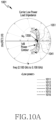
- FIG. 10A illustrates an operating frequency range according to a change in a gamma value when RF signals have a low power according to an embodiment.
- a first Smith chart 1001 including curves having different gamma values when RF signals output from the first PAM 421 have a low power is illustrated.
- a first curve 1011 is an impedance curve of the second capacitor component 722 and the first inductor 551 when a gamma value is a first value (e.g., 0)
- a second curve 1012 is an impedance curve of the second capacitor component 722 and the first inductor 551 when a gamma value is a second value (e.g., 10 ⁇ -13) greater than the first value
- a third curve 1013 is an impedance curve of the second capacitor component 722 and the first inductor 551 when a gamma value is a third value (e.g., 2*10 ⁇ -13) greater than the second value.
- a fourth curve 1014 is an impedance curve of the second capacitor component 722 and the first inductor 551 when a gamma value is a fourth value (e.g., 3*10 ⁇ -13) greater than the third value.
- a fifth curve 1015 is an impedance curve of the second capacitor component 722 and the first inductor 551 when a gamma value is a fifth value (e.g., 4* 10 ⁇ -13) greater than the fourth value.
- a sixth curve 1016 is an impedance curve of the second capacitor component 722 and the first inductor 551 when a gamma value is a sixth value (e.g., 5*10 ⁇ -13) greater than the fifth value.
- a first range 1041 may be referred to as a range of impedance having a difference within about 1 dB with reference to a first point 1051 of the first chart 1001.
- an operating frequency band of the first PAM 421 may correspond to a certain frequency band in which the antenna radiation efficiency is greater than or equal to a specified value (e.g., about 10 dB).
- a specified value e.g., about 10 dB
- the second graph 1012 may have a larger portion included within the first range 1041.
- the third graph 1013 may have a larger portion included within the first range 1041 compared to the second graph 1012.
- the fourth graph 1014 may have a relatively larger portion included within the first range 1041 compared to the third graph 1013.
- the graph may have a larger portion included within the first range 1041, and when the RF signals have a low power, as the gamma value increases, the operating frequency band of the first PAM 421 may be widened.
- FIG. 10B illustrates an operating frequency range according to a change in a gamma value when RF signals have a high power according to an embodiment.
- a second Smith chart 1002 including curves having different gamma values when RF signals output from the first PAM 421 have a high power is illustrated.
- a first curve 1021 is an impedance curve of the second capacitor component 722 and the first inductor 551 when a gamma value is a first value (e.g., 0)
- a second curve 1022 is an impedance curve of the second capacitor component 722 and the first inductor 551 when a gamma value is a second value (e.g., 10 ⁇ -13) greater than the first value
- a third curve 1023 is an impedance curve of the second capacitor component 722 and the first inductor 551 when a gamma value is a third value (e.g., 2* 10 ⁇ -13) greater than the second value.
- a fourth curve 1024 is an impedance curve of the second capacitor component 722 and the first inductor 551 when a gamma value is a fourth value (e.g., 3*10 ⁇ -13) greater than the third value.
- a fifth curve 1025 is an impedance curve of the second capacitor component 722 and the first inductor 551 when a gamma value is a fifth value (e.g., 4* 10 ⁇ -13) greater than the fourth value.
- a sixth curve 1026 is an impedance curve of the second capacitor component 722 and the first inductor 551 when a gamma value is a sixth value (e.g., 5*10 ⁇ -13) greater than the fifth value.
- a second range 1042 may be referred to as a range of impedance having a difference within about 1 dB with reference to a second point 1052 of the second chart 1002.
- the RF signals have a high power, the smaller the gamma value, the larger the portion of the curve included within the second range 1042 becomes.
- the curve may have a relatively larger portion included within the second range 1042, and when the RF signals have a high power, as the gamma value decreases, the operating frequency band of the first PAM 421 may be widened.
- the first curve 1021 to the sixth curve 1026 may already be sufficiently included within the second range 1042.
- the gamma value may be considered preferentially when the RF signals have a low power rather than a high power, and the second capacitor component 722 and the first inductor 551 may be designed or configured to have a relatively low gamma value.
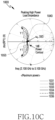
- FIG. 10C illustrates an operating frequency range according to a change in a gamma value when RF signals have a peak power according to an embodiment.
- a third Smith chart 1003 including curves having different gamma values when RF signals output from the first PAM 421 have a peak power is illustrated.
- a first curve 1031 is an impedance curve of the second capacitor component 722 and the first inductor 551 when a gamma value is a first value
- a second curve 1032 is an impedance curve of the second capacitor component 722 and the first inductor 551 when a gamma value is a second value greater than the first value
- a third curve 1033 is an impedance curve of the second capacitor component 722 and the first inductor 551 when a gamma value is a third value greater than the second value.
- a fourth curve 1034 is an impedance curve of the second capacitor component 722 and the first inductor 551 when a gamma value is a fourth value greater than the third value.
- a fifth curve 1035 is an impedance curve of the second capacitor component 722 and the first inductor 551 when a gamma value is a fifth value greater than the fourth value.
- a sixth curve 1036 is an impedance curve of the second capacitor component 722 and the first inductor 551 when a gamma value is a sixth value greater than the fifth value.
- a third range 1043 may be referred to as a range of impedance having a difference within about 1 dB with reference to a third point 1053 of the third chart 1003.
- the RF signals have a peak power, the smaller the gamma value, the larger the portion of the curve included within the third range 1043 becomes.
- the curve may have a relatively larger portion included within the third range 1043, and when the RF signals have a high power, as the gamma value decreases, the operating frequency band of the first PAM 421 may be widened.
- the first curve 1031 to the sixth curve 1036 may already be sufficiently included within the third range 1043.
- the gamma value may be considered preferentially when the RF signals have a low power rather than a peak power, and the second capacitor component 722 and the first inductor 551 may be designed or configured to have a low gamma value.
- Table 1 below illustrates operating frequency bands at a low power, a high power, and a peak power when a gamma value has the first value to the sixth value as described in FIGS. 10A to 10C .
- Table 1 illustrates operating frequency bands at a low power, a high power, and a peak power when a gamma value has the first value to the sixth value as described in FIGS. 10A to 10C .
- Table 1 illustrates operating frequency bands at a low power, a high power, and a peak power when a gamma value has the first value to the sixth value as described in FIGS. 10A to 10C .
- Table 1 illustrates operating frequency bands at a low power, a high power, and a peak power when a gamma value has the first value to the sixth value as described in FIGS. 10A to 10C .
- Table 1 illustrates operating frequency bands at a low power, a high power, and a peak power when a gamma value has the first value to the
- the second capacitor component 722 and the first inductor 551 included in the first PAM 421 may be configured to have a low gamma value (e.g., 2* 10 ⁇ -13 or 3* 10 ⁇ -13).
- Table 1 Gamma value ( ⁇ ) Carrier LP 1-dB Bandwidth [GHz] Carrier HP 1-dB Bandwidth [GHz] Peaking HP 1-dB Bandwidth [GHz] Total 1-dB Bandwidth [GHz] Fractional Bandwidth [%] 0 3.10 - 4.15 3.00 - 4.20 2.45 - 4.80 3.10 - 4.15 29.3 1*10 ⁇ -13 3.00 - 4.25 2.55 - 4.65 2.35 - 4.90 3.00 - 4.25 35.0 2*10 ⁇ -13 2.85 - 4.40 - 2.40 - 4.85 2.85 - 4.40 43.8 3*10 ⁇ -13 2.65 - 4.55 2.85 - 4.35 2.60 - 4.65 2.85 - 4.35 42.6 4*10 ⁇ -13 2.60 - 4.65 3.15 - 4.
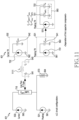
- FIG. 11 illustrates a method for separating a first capacitor component according to an embodiment.
- the QWTL 710 having a characteristic impedance may be determined based on a configured resonant frequency w 0 .
- the QWTL 710 having the characteristic impedance may be converted into the first capacitor 541 and the second capacitor 542 having an equivalently specified capacitance value (e.g., C P ), and an inductor 1111 having a specified inductance value (e.g., L S ).
- the first capacitor 541, the second capacitor 542, and the inductor 1111 may be a lumped QWTL having a low pass Pi type.
- the specified capacitance value (e.g., C P ) may be obtained through Equation (6) below, and the specified inductance value (e.g., L S ) may be obtained through Equation (7) below.
- the specified capacitance value (e.g., C P ) may be determined based on a resonant frequency w 0 .
- C P 1 ⁇ cos 90 ° w 0 Z QWTL sin 90 °
- L S Z QWTL w 0 sin 90 °
- the first transistor 531 may be equivalently converted into the first current source 731 and the first capacitor 541.
- the second transistor 532 may be equivalently converted into the second current source 732 and the second capacitor 542.
- the first capacitor 541 may be divided into the first capacitor component 721 for configuring a QWTL and the second capacitor component 722 for LC resonance of the first PAM 421.
- a capacitance value (e.g., C QWTL ) of the first capacitor component 721 may be determined to be greater than the specified capacitance value (e.g., C P ) and less than a capacitance value (e.g., C out.p ) of the first capacitor 541.
- the capacitance value of the first capacitor component 721 may be determined based on a specified frequency band (or resonant frequency).
- the specified capacitance value e.g., C P
- the capacitance value of the first capacitor component 721 is determined based on the specified capacitance value.
- the capacitance value of the first capacitor component 721 may be determined based on the specified frequency band (or resonant frequency).
- a capacitance value of the second capacitor component 722 may be determined based on an inductance value of the first inductor 551 and a capacitance value of the third capacitor 543.
- the capacitance value of the second capacitor component 722 may be a value (e.g., C R ) obtained by subtracting the capacitance value (e.g., C QWTL ) of the first capacitor component 721 from the capacitance value (e.g., C out.p ) of the first capacitor 541.
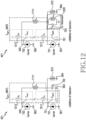
- FIG. 12 illustrates a method for determining a reference inductor for LC resonance of a first PAM according to an embodiment.
- the first PAM 421 may include a first additional inductor 1211 for offsetting a first capacitor component 721.
- the first PAM 421 may include a second additional inductor 1212 for offsetting the second capacitor 542.
- the first additional inductor 1211 may attenuate a capacitance value (e.g., C QWTL ) of the first capacitor component 721 such that the capacitance value of the first capacitor component 721 corresponds to a specified capacitance value (e.g., C P ).
- a capacitance value e.g., C QWTL
- C P a specified capacitance value
- the sum of impedances of the first additional inductor 1211 and the first capacitor component 721 may be the specified capacitance value (e.g., C P ).
- the second additional inductor 1212 may attenuate the capacitance value of the first capacitor component 721 such that a capacitance value (e.g., C out.c ) of the second capacitor 542 corresponds to the specified capacitance value (e.g., C P ).
- a capacitance value e.g., C out.c
- the sum of impedances of the second additional inductor 1212 and the second capacitor 542 may be the specified capacitance value (e.g., C P ).
- An inductance value (e.g., L A ) of the first additional inductor 1211 may be obtained through Equation (8) below, and an inductance value (e.g., L B ) of the second additional inductor 1212 may be obtained through Equation (9) below.
- L A 1 wo 2 C QWTL ⁇ C P
- L B 1 wo 2 C out , c ⁇ C P
- w 0 may be a resonant frequency of the first PAM 421.
- C out.c may be a capacitance value of the second capacitor 542.
- C QWTL may be a capacitance value of the first capacitor component 721.
- C P may be a specified capacitance value obtained through Equation (5).
- the first PAM 421 may include a reference inductor 1220 for offsetting a capacitance value (e.g., C R ) of the second capacitor component 722.
- a capacitance value e.g., C R
- the reference inductor 1220 may be configured to offset the capacitance value (e.g., C R ) of the second capacitor component 722 to determine a resonant frequency band of RF signals output by the first PAM 421.
- a resonant frequency (or a resonant frequency band) (e.g., w 0 ) of the RF signals output by the first PAM 421 may be determined based on an inductance value (e.g., L R ) of the reference inductor 1220 and the capacitance value (e.g., C R ) of the second capacitor component 722.
- the resonant frequency of the RF signals output by the first PAM 421 may be determined based on the product of the inductance value (e.g., L R ) of the reference inductor 1220 and the capacitance value (e.g., C R ) of the second capacitor component 722.
- Equation (10) below is given for obtaining a resonant frequency w 0 based on the inductance value (e.g., L R ) of the reference inductor 1220 and the capacitance value (e.g., C R ) of the second capacitor component 722.
- L R w 0 2 C R
- FIG. 13 illustrates T-type conversion and addition of a third capacitor for DC current prevention according to an embodiment.
- the first PAM '421 may include the third capacitor 543 for blocking a DC (e.g., DC power).
- the third capacitor 543 may be connected in series to the first node 591.
- the third capacitor 543 may be disposed between the first node 591 and the third ground 563.
- the third capacitor 543 may electrically connect the first node 591 and the third ground 563.
- the third capacitor 543 may be electrically connected to the reference inductor 1220.
- the third capacitor 543 may be disposed between an inductor (e.g., the reference inductor 1220 or the first inductor 551) and the third ground 563 to reduce or minimize leakage of a DC (e.g., DC power) to ground.
- the power supply source 571 may supply a DC (e.g., DC power) to the first transistor 531 and the second transistor 532 through the first connection line 581 and the second connection line 582.
- the inductor e.g., the reference inductor 1220 or the first inductor 551
- the DC e.g., DC power
- the third capacitor 543 is disposed between the inductor (e.g., the reference inductor 1220 or the first inductor 551) and the third ground 563, DC leakage to the ground may be reduced or minimized.
- the LC resonant part 1320 may include the second capacitor component 722, the reference inductor 1220, and the third capacitor 543. As the third capacitor 543 is connected in parallel to the second capacitor component 722, the overall capacitance value of the LC resonant part 1320 may be increased.
- the impedance sum of the LC resonant part 1320 may be required to be 0 at a resonant frequency w 0 . Accordingly, the reference inductor 1220 may be replaced with the first inductor 551 having a first inductance value (e.g., L 1 ).
- a capacitance value (e.g., C 3 ) of the third capacitor 543 may be determined based on an inductance value (e.g., L 1 ) of the first inductor 551 and a capacitance value (e.g., C R ) of the second capacitor component 722.
- the capacitance value (e.g., C 3 ) of the third capacitor 543 may be determined such that the sum of the capacitance value (e.g., C 3 ) of the third capacitor, the inductance value (e.g., L 1 ) of the first inductor 551, and the capacitance value (e.g., C R ) of the second capacitor component 722 becomes 0.
- Equation (11) is a relationship equation between the inductance value (e.g., L 1 ) of the first inductor 551 and the capacitance value (e.g., C 3 ) of the third capacitor 543.
- jwL R jwL 1 + 1 jwC 1
- the sum of the first inductor 551, the first capacitor 541, and the third capacitor 543 may correspond to 0, an inductance value, or a capacitance value, based on frequency bands of a first signal and a second signal input to the first PAM 421. For example, when the frequency band of the first signal and the second signal input to the first PAM 421 is less than a designed resonant frequency band, the sum of impedances of the first inductor 551, the second capacitor component 722 of the first capacitor 541, and the third capacitor 543 may correspond to the inductance value.
- the sum of impedances of the first inductor 551, the second capacitor component 722 of the first capacitor 541, and the third capacitor 543 may correspond to the capacitance value.
- the first PAM 421 may include a combination of the first inductor 551 and the third capacitor 543, which allows the first PAM 421 to have a relatively wide operating frequency band, among the combinations satisfying Equation (11).
- Each of the first additional inductor 1211 and the second additional inductor 1212 included in the first PAM 421 is directly connected to ground, and thus may affect LC resonance of the first PAM 421.
- an additional capacitor may be required to be added between the first additional inductor 1211 and the ground, and an additional capacitor may be required to be added between the second additional inductor 1212 and the ground.
- the size of the first PAM 421 may be increased as a lumped element is added within the first PAM 421.
- the first additional inductor 1211, the second additional inductor 1212, and the inductor 1111 may be converted into a T-type arrangement.
- the second inductor 552 and the third inductor 553 may be included in the second connection line 582, and the fourth inductor 554 may be connected in parallel to the second connection line 582.
- the first PAM 421 may be reduced or minimized.
- the first PAM 421 after the T-type conversion of FIG. 13 may have substantially the same structure as the first PAM 421 described in FIG. 5 .
- FIG. 14 illustrates graphs for when there is no first capacitor and a case where a first capacitor is connected between a first node and a first ground according to an embodiment.
- a first curve 1401 is an impedance curve when the RF signals have a peak power when the first inductor 551 and the third capacitor 543 are not connected to the first node 591.
- a second curve 1402 is an impedance curve when the RF signals have a high power when the first inductor 551 and the third capacitor 543 are not connected to the first node 591.
- a third curve 1403 is an impedance curve when the RF signals have a low power when the first inductor 551 and the third capacitor 543 are not connected to the first node 591.
- Impedance curves when RF signals output from the first PAM 421 have a low power, a high power, and a peak power when the first inductor 551 and the third capacitor 543 are connected to the first node 591 are illustrated.
- a fourth curve 1404 is an impedance curve when the RF signals have a peak power when the first inductor 551 and the third capacitor 543 are connected to the first node 591.
- a fifth curve 1405 is an impedance curve when the RF signals have a high power when the first inductor 551 and the third capacitor 543 are connected to the first node 591.
- a sixth curve 1406 is an impedance curve when the RF signals have a low power when the first inductor 551 and the third capacitor 543 are connected to the first node 591.
- the fourth curve 1404 may have a larger portion included within a first range 1411 than the first curve 1401. Therefore, when RF signals output from the first PAM 421 have a peak power, as the first inductor 551 and the third capacitor 543 are connected to the first node 591, the first PAM 421 may secure a wide operating frequency band of signals outputted by the first PAM 421.
- the fifth curve 1405 may have a larger portion included within a second range 1412 than the second curve 1402. Therefore, when RF signals output from the first PAM 421 have a high power, as the first inductor 551 and the third capacitor 543 are connected to the first node 591, the first PAM 421 may secure a wide operating frequency band.
- the sixth curve 1406 may have a larger portion included within a third range 1413 than the third curve 1403. Therefore, when RF signals output from the first PAM 421 have a low power, as the first inductor 551 and the third capacitor 543 are connected to the first node 591, the first PAM 421 may secure a wide operating frequency band.
- an electronic device in a wireless communication system may include a first transistor including a first capacitor and configured to receive a first signal and, when the first signal is greater than or equal to a specified voltage, amplify and output the first signal as a first RF signal, a second transistor including a second capacitor and configured to receive a second signal and amplify and output the second signal as a second RF signal, a first connection line which is connected to the first transistor and through which the first RF signal is transmitted, a second connection line which is connected to the second transistor and through which the second RF signal is transmitted, a first inductor connected to a first node, and a third capacitor configured to connect the first inductor and ground, wherein the first connection line and the second connection line are connected at the first node, and a impedance sum of the first inductor, the first capacitor, and the third capacitor is configured such that the first RF signal and the second RF signal resonate in a specified frequency band.
- the second connection line may include a second inductor and a third inductor configured to connect the second transistor and the first node, and a fourth inductor connected to a second node between the second inductor and the third inductor, wherein a DC for driving the first transistor and the second transistor is supplied through the fourth inductor.
- the third capacitor may block the DC power supplied to the first transistor and the second transistor from flowing to the ground.
- the second inductor may be connected to the second transistor to attenuate a capacitance value of the second capacitor, and the third inductor may be connected to the first node to attenuate a capacitance value of the first capacitor.
- Each of the second inductor and the third inductor may be connected to the ground through the first inductor and the third capacitor.
- the first capacitor may include a first capacitor component and a second capacitor component, wherein a capacitance value of the first capacitor component is determined based on the specified frequency band, and a capacitance value of the second capacitor component is determined based on an inductance value of the first inductor and a capacitance value of the third capacitor.
- a impedance sum of the first inductor, the second capacitor component, and the third capacitor corresponds to an inductance
- the sum of the impedances of the first inductor, the second capacitor component, and the third capacitor corresponds to a capacitance
- the inductance value of the first inductor may be a sum of the capacitance value of the second capacitor component and the capacitance value of the third capacitor.
- the electronic device may further include at least one antenna, and a third connection line configured to connect the first node and the at least one antenna, wherein the first RF signal is transmitted to the at least one antenna through the first connection line and the third connection line, and the second RF signal is transmitted to the at least one antenna through the second connection line and the third connection line.
- the third connection line connected to the first node may further include a circuit configured to match the impedances, and the circuit may include at least one lumped element.
- the electronic device may further include a mixer configured to generate a signal of the specified frequency band, and a distributor connected to the first transistor and the second transistor, wherein the distributor is configured to receive a signal of the specified frequency band from the mixer, and based on the signal of the specified frequency band, transmit the first RF signal to the first transistor and transmit the second RF signal to the second transistor.
- a mixer configured to generate a signal of the specified frequency band
- a distributor connected to the first transistor and the second transistor, wherein the distributor is configured to receive a signal of the specified frequency band from the mixer, and based on the signal of the specified frequency band, transmit the first RF signal to the first transistor and transmit the second RF signal to the second transistor.
- the electronic device may further include a phase compensator configured to connect the first transistor and the distributor, wherein the phase compensator is configured to control a phase of the first signal such that the phase of the first signal and a phase of the second signal have as large a difference as a specified value therebetween.
- a phase compensator configured to connect the first transistor and the distributor, wherein the phase compensator is configured to control a phase of the first signal such that the phase of the first signal and a phase of the second signal have as large a difference as a specified value therebetween.
- the electronic device may further include a first chip including the first transistor, a second chip including the second transistor, and a PCB on which the first connection line and the second connection line are disposed, wherein the first connection line and the second connection line are at least one of a microstrip line, a bond wire, or a conductive via of the PCB.
- the first capacitor may have a capacitance value different from a capacitance value of the second capacitor.
- Each of the first RF signal and the second RF signal may have a first polarization.
- a PA module may include a first transistor including a first capacitor and configured to receive a first signal and, when the first signal is greater than or equal to a specified voltage, amplify and output the first signal as a first RF signal, a second transistor including a second capacitor and configured to receive a second signal and amplify and output the second signal as a second RF signal, a first connection line which is connected to the first transistor and through which the first RF signal is transmitted, a second connection line which is connected to the second transistor and through which the second RF signal is transmitted, a first inductor connected to a first node, and a third capacitor configured to connect the first inductor and ground, wherein the first connection line and the second connection line are connected at the first node, and a impedance sum of the first inductor, the first capacitor, and the third capacitor is configured such that the first RF signal and the second RF signal resonate in a specified frequency band.
- the second connection line may include a second inductor and a third inductor configured to connect the second transistor and the first node, and a fourth inductor connected to a second node between the second inductor and the third inductor, wherein a DC for driving the first transistor and the second transistor is supplied through the fourth inductor.
- the third capacitor may block the DC power supplied to the first transistor and the second transistor from flowing to the ground.
- the second inductor may be connected to the first transistor to attenuate a capacitance value of the second capacitor, and the third inductor may be connected to the first node to attenuate a capacitance value of the third capacitor.
- Each of the second inductor and the third inductor may be connected to the ground through the first inductor and the third capacitor.
Landscapes
- Engineering & Computer Science (AREA)
- Power Engineering (AREA)
- Computer Networks & Wireless Communication (AREA)
- Signal Processing (AREA)
- Microelectronics & Electronic Packaging (AREA)
- Transmitters (AREA)
- Transceivers (AREA)
- Amplifiers (AREA)
Applications Claiming Priority (1)
| Application Number | Priority Date | Filing Date | Title |
|---|---|---|---|
| KR1020230145770A KR20250061392A (ko) | 2023-10-27 | 2023-10-27 | 무선 통신 시스템에서 pa를 포함하는 장치 |
Publications (2)
| Publication Number | Publication Date |
|---|---|
| EP4557610A2 true EP4557610A2 (fr) | 2025-05-21 |
| EP4557610A3 EP4557610A3 (fr) | 2025-07-30 |
Family
ID=93283739
Family Applications (1)
| Application Number | Title | Priority Date | Filing Date |
|---|---|---|---|
| EP24208527.2A Pending EP4557610A3 (fr) | 2023-10-27 | 2024-10-24 | Dispositif comprenant un amplificateur de puissance dans un système de communication sans fil |
Country Status (3)
| Country | Link |
|---|---|
| US (1) | US20250141479A1 (fr) |
| EP (1) | EP4557610A3 (fr) |
| KR (1) | KR20250061392A (fr) |
Family Cites Families (3)
| Publication number | Priority date | Publication date | Assignee | Title |
|---|---|---|---|---|
| US11277099B2 (en) * | 2020-06-10 | 2022-03-15 | Nxp Usa, Inc. | Symmetric Doherty amplifier with in-package combining node |
| NL2028527B1 (en) * | 2021-06-24 | 2023-01-02 | Ampleon Netherlands Bv | Doherty power amplifier |
| US12166458B2 (en) * | 2021-10-08 | 2024-12-10 | Rachit Joshi | Radio frequency power amplifier and method for manufacturing Doherty power amplifier |
-
2023
- 2023-10-27 KR KR1020230145770A patent/KR20250061392A/ko active Pending
-
2024
- 2024-10-22 US US18/923,005 patent/US20250141479A1/en active Pending
- 2024-10-24 EP EP24208527.2A patent/EP4557610A3/fr active Pending
Also Published As
| Publication number | Publication date |
|---|---|
| EP4557610A3 (fr) | 2025-07-30 |
| KR20250061392A (ko) | 2025-05-08 |
| US20250141479A1 (en) | 2025-05-01 |
Similar Documents
| Publication | Publication Date | Title |
|---|---|---|
| US11588512B2 (en) | Radio frequency device with integrated antenna tuner and multiplexer | |
| US11735815B2 (en) | Reconfigurable antenna systems integrated with metal case | |
| US12597696B2 (en) | Package antenna apparatus and wireless communication apparatus | |
| US20260088519A1 (en) | Antenna structure and electronic device comprising same | |
| US11177550B2 (en) | Multi-fed patch antennas and devices including the same | |
| KR20160105870A (ko) | 쿼시-야기-타입 안테나 | |
| US20230112435A1 (en) | Differential radio frequency amplifier | |
| EP3574552B1 (fr) | Procédé et appareil pour système d'antenne mimo multibande à alimentation multiple | |
| EP4358400A1 (fr) | Amplificateur de puissance utilisant un coupleur, et dispositif électronique le comprenant | |
| US12407107B2 (en) | Antenna systems with tunable frequency response circuits | |
| EP4216241A1 (fr) | Transformateur pour perte faible et dispositif le comprenant | |
| KR102895573B1 (ko) | 무선 통신 시스템에서 안테나 필터 및 이를 포함하는 전자 장치 | |
| EP4557610A2 (fr) | Dispositif comprenant un amplificateur de puissance dans un système de communication sans fil | |
| EP3130038B1 (fr) | Agencement d'antenne | |
| EP4391371A1 (fr) | Amplificateur de puissance et dispositif électronique le comprenant | |
| US10707827B2 (en) | Wide-band Wilkinson divider | |
| KR20250089262A (ko) | 무선 통신 시스템에서 발룬 회로를 포함하는 장치 | |
| EP4622098A1 (fr) | Amplificateur à faible bruit pour faible perte, et dispositif le comprenant | |
| EP4401243A1 (fr) | Antenne et dispositif électronique la comprenant | |
| KR20240116330A (ko) | 트랜시버의 전기적인 특성을 제어하는 장치 및 방법 | |
| US20260081563A1 (en) | Doherty power amplifiers with inductor-capacitor lattice for impedance inversion | |
| US20240106402A1 (en) | Front-end receiver with multi-stage, tiered bandwidth amplifiers | |
| KR20240036428A (ko) | 빔포밍을 수행하는 방법 및 장치 | |
| KR20250074221A (ko) | 무선 통신 시스템에서 sm를 포함하는 장치 | |
| CN118511396A (zh) | 天线和包括天线的电子装置 |
Legal Events
| Date | Code | Title | Description |
|---|---|---|---|
| PUAI | Public reference made under article 153(3) epc to a published international application that has entered the european phase |
Free format text: ORIGINAL CODE: 0009012 |
|
| STAA | Information on the status of an ep patent application or granted ep patent |
Free format text: STATUS: REQUEST FOR EXAMINATION WAS MADE |
|
| 17P | Request for examination filed |
Effective date: 20241024 |
|
| AK | Designated contracting states |
Kind code of ref document: A2 Designated state(s): AL AT BE BG CH CY CZ DE DK EE ES FI FR GB GR HR HU IE IS IT LI LT LU LV MC ME MK MT NL NO PL PT RO RS SE SI SK SM TR |
|
| PUAL | Search report despatched |
Free format text: ORIGINAL CODE: 0009013 |
|
| AK | Designated contracting states |
Kind code of ref document: A3 Designated state(s): AL AT BE BG CH CY CZ DE DK EE ES FI FR GB GR HR HU IE IS IT LI LT LU LV MC ME MK MT NL NO PL PT RO RS SE SI SK SM TR |
|
| RIC1 | Information provided on ipc code assigned before grant |
Ipc: H03F 1/02 20060101AFI20250623BHEP Ipc: H03F 1/56 20060101ALI20250623BHEP Ipc: H03F 3/195 20060101ALI20250623BHEP Ipc: H03F 3/24 20060101ALI20250623BHEP |