EP4557745A1 - Bitratenauswahl unter verwendung gespeicherter informationen - Google Patents
Bitratenauswahl unter verwendung gespeicherter informationen Download PDFInfo
- Publication number
- EP4557745A1 EP4557745A1 EP24200919.9A EP24200919A EP4557745A1 EP 4557745 A1 EP4557745 A1 EP 4557745A1 EP 24200919 A EP24200919 A EP 24200919A EP 4557745 A1 EP4557745 A1 EP 4557745A1
- Authority
- EP
- European Patent Office
- Prior art keywords
- historical information
- bandwidth
- logic
- profile
- bitrate
- Prior art date
- Legal status (The legal status is an assumption and is not a legal conclusion. Google has not performed a legal analysis and makes no representation as to the accuracy of the status listed.)
- Pending
Links
Images




Classifications
-
- H—ELECTRICITY
- H04—ELECTRIC COMMUNICATION TECHNIQUE
- H04N—PICTORIAL COMMUNICATION, e.g. TELEVISION
- H04N21/00—Selective content distribution, e.g. interactive television or video on demand [VOD]
- H04N21/20—Servers specifically adapted for the distribution of content, e.g. VOD servers; Operations thereof
- H04N21/23—Processing of content or additional data; Elementary server operations; Server middleware
- H04N21/234—Processing of video elementary streams, e.g. splicing of video streams or manipulating encoded video stream scene graphs
- H04N21/2343—Processing of video elementary streams, e.g. splicing of video streams or manipulating encoded video stream scene graphs involving reformatting operations of video signals for distribution or compliance with end-user requests or end-user device requirements
- H04N21/23439—Processing of video elementary streams, e.g. splicing of video streams or manipulating encoded video stream scene graphs involving reformatting operations of video signals for distribution or compliance with end-user requests or end-user device requirements for generating different versions
-
- H—ELECTRICITY
- H04—ELECTRIC COMMUNICATION TECHNIQUE
- H04L—TRANSMISSION OF DIGITAL INFORMATION, e.g. TELEGRAPHIC COMMUNICATION
- H04L67/00—Network arrangements or protocols for supporting network services or applications
- H04L67/2866—Architectures; Arrangements
- H04L67/30—Profiles
- H04L67/303—Terminal profiles
-
- H—ELECTRICITY
- H04—ELECTRIC COMMUNICATION TECHNIQUE
- H04L—TRANSMISSION OF DIGITAL INFORMATION, e.g. TELEGRAPHIC COMMUNICATION
- H04L43/00—Arrangements for monitoring or testing data switching networks
- H04L43/08—Monitoring or testing based on specific metrics, e.g. QoS, energy consumption or environmental parameters
- H04L43/0823—Errors, e.g. transmission errors
- H04L43/0829—Packet loss
- H04L43/0841—Round trip packet loss
-
- H—ELECTRICITY
- H04—ELECTRIC COMMUNICATION TECHNIQUE
- H04L—TRANSMISSION OF DIGITAL INFORMATION, e.g. TELEGRAPHIC COMMUNICATION
- H04L67/00—Network arrangements or protocols for supporting network services or applications
- H04L67/01—Protocols
- H04L67/06—Protocols specially adapted for file transfer, e.g. file transfer protocol [FTP]
-
- H—ELECTRICITY
- H04—ELECTRIC COMMUNICATION TECHNIQUE
- H04N—PICTORIAL COMMUNICATION, e.g. TELEVISION
- H04N21/00—Selective content distribution, e.g. interactive television or video on demand [VOD]
- H04N21/20—Servers specifically adapted for the distribution of content, e.g. VOD servers; Operations thereof
- H04N21/23—Processing of content or additional data; Elementary server operations; Server middleware
- H04N21/231—Content storage operation, e.g. caching movies for short term storage, replicating data over plural servers, prioritizing data for deletion
- H04N21/23106—Content storage operation, e.g. caching movies for short term storage, replicating data over plural servers, prioritizing data for deletion involving caching operations
-
- H—ELECTRICITY
- H04—ELECTRIC COMMUNICATION TECHNIQUE
- H04N—PICTORIAL COMMUNICATION, e.g. TELEVISION
- H04N21/00—Selective content distribution, e.g. interactive television or video on demand [VOD]
- H04N21/20—Servers specifically adapted for the distribution of content, e.g. VOD servers; Operations thereof
- H04N21/23—Processing of content or additional data; Elementary server operations; Server middleware
- H04N21/238—Interfacing the downstream path of the transmission network, e.g. adapting the transmission rate of a video stream to network bandwidth; Processing of multiplex streams
- H04N21/23805—Controlling the feeding rate to the network, e.g. by controlling the video pump
-
- H—ELECTRICITY
- H04—ELECTRIC COMMUNICATION TECHNIQUE
- H04N—PICTORIAL COMMUNICATION, e.g. TELEVISION
- H04N21/00—Selective content distribution, e.g. interactive television or video on demand [VOD]
- H04N21/20—Servers specifically adapted for the distribution of content, e.g. VOD servers; Operations thereof
- H04N21/23—Processing of content or additional data; Elementary server operations; Server middleware
- H04N21/24—Monitoring of processes or resources, e.g. monitoring of server load, available bandwidth, upstream requests
- H04N21/2402—Monitoring of the downstream path of the transmission network, e.g. bandwidth available
-
- H—ELECTRICITY
- H04—ELECTRIC COMMUNICATION TECHNIQUE
- H04N—PICTORIAL COMMUNICATION, e.g. TELEVISION
- H04N21/00—Selective content distribution, e.g. interactive television or video on demand [VOD]
- H04N21/20—Servers specifically adapted for the distribution of content, e.g. VOD servers; Operations thereof
- H04N21/25—Management operations performed by the server for facilitating the content distribution or administrating data related to end-users or client devices, e.g. end-user or client device authentication, learning user preferences for recommending movies
- H04N21/262—Content or additional data distribution scheduling, e.g. sending additional data at off-peak times, updating software modules, calculating the carousel transmission frequency, delaying a video stream transmission, generating play-lists
- H04N21/26208—Content or additional data distribution scheduling, e.g. sending additional data at off-peak times, updating software modules, calculating the carousel transmission frequency, delaying a video stream transmission, generating play-lists the scheduling operation being performed under constraints
- H04N21/26216—Content or additional data distribution scheduling, e.g. sending additional data at off-peak times, updating software modules, calculating the carousel transmission frequency, delaying a video stream transmission, generating play-lists the scheduling operation being performed under constraints involving the channel capacity, e.g. network bandwidth
-
- H—ELECTRICITY
- H04—ELECTRIC COMMUNICATION TECHNIQUE
- H04N—PICTORIAL COMMUNICATION, e.g. TELEVISION
- H04N21/00—Selective content distribution, e.g. interactive television or video on demand [VOD]
- H04N21/20—Servers specifically adapted for the distribution of content, e.g. VOD servers; Operations thereof
- H04N21/25—Management operations performed by the server for facilitating the content distribution or administrating data related to end-users or client devices, e.g. end-user or client device authentication, learning user preferences for recommending movies
- H04N21/266—Channel or content management, e.g. generation and management of keys and entitlement messages in a conditional access system, merging a VOD unicast channel into a multicast channel
- H04N21/2662—Controlling the complexity of the video stream, e.g. by scaling the resolution or bitrate of the video stream based on the client capabilities
Definitions
- adaptive bitrate streaming technologies have become pivotal in ensuring a seamless and high-quality viewing experience for end-users. These technologies dynamically adjust the quality of the video stream based on the viewer's available network bandwidth and device capabilities, thereby optimizing playback performance.
- existing adaptive streaming solutions often encounter challenges in providing an optimal streaming experience. This leads to suboptimal streaming experiences characterized by buffering issues, lower-than-expected video quality, and potentially diminished user satisfaction.
- An adaptive bitrate algorithm may determine a profile level to select based on available bitrate in a playback session.
- the adaptive bitrate algorithm may determine the bitrate, and select a profile based on bitrate. For example, the profile that is associated with a bitrate that is closest to the determined bitrate may be selected.
- the adaptive bitrate algorithm may use first logic to select a profile that may not consider bandwidth, such as because this is the first segment of the playback session and there is no available bandwidth in the playback session for the adaptive bitrate algorithm to consider.
- the first logic may select a first profile in a list of profiles that is received from a content delivery network.
- the first profile may be associated with a first bitrate.
- the first profile may not be the optimal profile to use. For example, the first bitrate may be higher than the current available bandwidth that is experienced when downloading the initial segment, which may result in slower download times and a slower startup time for playback.
- the adaptive bitrate algorithm may use second logic to select a profile instead of the first logic.
- the second logic may use historical information to determine a bitrate that is used to select a profile.
- the profile that is selected may improve the playback experience. For example, if historical information indicates that bandwidth may be lower in previous playback sessions, the adaptive bitrate algorithm may determine that the bitrate is 500K megabits per second (Mbps). However, the first profile may be associated with a bitrate of 2400K Mbps.
- the adaptive bitrate algorithm may select the profile with a bitrate of 400K Mbps. The use of the profile with 400K Mbps may improve the download process of the first segment and start playback faster.
- a profile with a higher bitrate may be selected to more efficiently use available bandwidth, such as a profile with 3000K Mbps is selected if the bandwidth is 3500K Mbps.
- FIG. 1 depicts a simplified system 100 performing an adaptive bitrate algorithm that uses different logic according to some embodiments.
- System 100 includes a server system 102 and a client device 104. Although single instances of server system 102 and client device 104 are shown, multiple instances of server system 102 and client device 104 may be appreciated. For example, multiple client devices 104 may be requesting content from a single server system 102 or multiple server systems 102.
- Server system 102 includes a content management system 106 that may facilitate the delivery of content to client device 104.
- content management system 106 may communicate with multiple content delivery networks 118 (also referred to as a content delivery network 118) to have content delivered to multiple client devices 104.
- a content delivery network 118 includes servers that can deliver content to client device 104.
- the content may be video, audio, or other types of content. Video may be used for discussion purposes, but other types of content may be used in place of video.
- content delivery network 118 delivers segments of video to client device 104. The segments may be a portion of the video, such as six seconds of the video.
- a video may be encoded in multiple profile levels that correspond to different levels, which may be different levels of bitrates or quality (e.g., resolution).
- Client device 104 may request a segment of video from one of the profile levels based on current network conditions. For example, client device 104 may use an adaptive bitrate algorithm to select the profile level for the video based on the estimated current available bandwidth and other network conditions.
- Client device 104 may include a mobile phone, smartphone, set top box, television, living room device, tablet device, or other computing device.
- Client device 104 may include a media player 110 that is displayed on an interface 112.
- Media player 110 or client device 104 may request content from the content delivery network 118.
- a profile ladder may be provided to client device 104 for segments that can be requested in a manifest.
- a manifest may be a playlist or media presentation description that lists information for segments that can be requested.
- the information may include a profile ladder.
- the profile ladder may list different profile levels for each segment.
- the profile levels may be associated with different bitrates, quality, or both, and other information such as segment duration, encoder type, etc.
- the different bitrates, quality, or both may have been used to encode each segment of the video to create multiple profiles for each segment.
- An adaptive bitrate algorithm 114 may determine which profile level to select for each segment.
- Client device 104 can send requests for segments that are associated with a profile level. For example, client device 104 may use identifying information for a profile level to request a segment.
- Content delivery network 118 may then send the segment of video for the requested profile level to client device 104, which can then display the segment in media player 110 on interface 112.
- Client device 104 may change the profile levels that are requested for segments based
- a configuration system 108 may provide configuration settings for client device 104.
- the configuration settings may be settings for adaptive bitrate algorithm 114. Different settings will be discussed below at least in FIG. 3 in more detail.
- Historical information 116 may be information from previous playback sessions of client device 104.
- client device 104 may have played back instances of content from content management system 106 on media player 110.
- Historical information 116 may include metrics from the playback sessions.
- historical information 116 may include information from previous playback sessions of other client devices, such as averages from other client devices may be integrated with information from this client device 104.
- network related metrics and quality of service metrics may be stored in historical information 116.
- Network related metrics may be based on the delivery of content, such as bandwidth and round trip time.
- Quality of service information may be based on the quality of service experienced, such as whether rebuffers or failures occurred during playback sessions.
- Other information may also be included, but is not limited to, in historical information 116, such as information regarding the content delivery network that was used, network mode, and decoding capacity.
- Network mode may be the mode that was used to deliver the content, such as protocol.
- the decoding capacity may be based on the ability to decode content, such as based on computing resources of client device 104. Also, the decoding capability may indicate which videos can be decoded, such as client device 104 may not be able to decode videos with 60 frames per second.
- Historical information 116 may store information for a number of sessions, such as the number of sessions in the last day, week, month, etc. Historical information 116 may be stored locally in client device 104. For example, historical information 116 may be stored in memory that is allocated to an application for media player 110. The storing of historical information 116 locally in client device 104 may improve the operation of client device 104. For example, historical information 116 may be accessible quicker when adaptive bitrate algorithm 114 requires the use of historical information 116. Also, less storage may be used at server system 102 or elsewhere if historical information 116 is stored at client device 104. For example, content management system 106 may be interacting with a large number of client devices and would have to store historical information 116 for each client device.
- historical information 116 may be stored externally, indexing with references to which client device 104 the historical information is associated may be needed. However, in other embodiments, historical information 116 may be stored externally and accessed by client device 104. The historically stored historical information 116 may be indexed by client device and accessed by respective client devices when required. Examples of historical information 116 will be described in more detail below at least in FIG. 3 .
- Adaptive bitrate algorithm 114 may use historical information 116 to improve its selection of bitrates.
- adaptive bitrate algorithm 114 may select the bitrate using different sets of logic.
- first logic may be default logic that may select a bitrate that is used to select a profile. In some embodiments, this results in selecting a first profile that is listed in the manifest. In other embodiments, the first logic may use fixed settings or information that are not changed across instances of content that are being played back in different playback sessions.
- adaptive bitrate algorithm 114 may also use second logic that may leverage historical information 116 to select the bitrate. The second logic may adjust the bitrate that is determined based on the values of historical information 116.
- adaptive bitrate algorithm 114 may improve the operation of adaptive bitrate algorithm 114. For example, if the first logic selects a first profile by default, such as a profile at 2400K Mbps, but the available bandwidth is only 800K Mbps, client device 104 may experience slow download times because the available bandwidth is less than the bitrate of the profile. Using the second logic, adaptive bitrate algorithm 114 may determine that the bandwidth may be lower based on historical information 116, and a profile around 400K Mbps should be requested. Adaptive bitrate algorithm 114 may select the profile with a bitrate of 400K Mbps, and segments for this profile may be downloaded without experiencing quality of service problems, such as rebuffers, which improves the playback process.
- quality of service problems such as rebuffers
- historical information is used for initial profile selection.
- the selection of the initial profile discussed, the following may be used to determine a bitrate at different times, such as after the initial profile selection to select a profile for another segment of the content.
- the use of historical information may improve the bitrate that is determined to select a segment.
- historical information 116 may be used to select a bitrate for other applications.
- the bitrate may be used to adjust parameters for the adaptive bitrate algorithm, such as the parameters may be adjusted in the adaptive bitrate algorithm throughout a playback session based on historical information 116.
- the parameters may be settings that are used to determine the profile to select, such as a safe factor that applies an adjustment to the determined bitrate.
- the selection of a content delivery network, or switching between content delivery networks may use historical information 116 to determine a bitrate.
- FIG. 2 depicts simplified flowchart 200 for a method for selecting a bitrate according to some embodiments.
- adaptive bitrate algorithm 114 determines whether to leverage historical information 116. The determination on whether to leverage historical information 116 may be based on different processes. For example, configuration system 108 may provide a setting to client device 104 that is used to determine whether to leverage historical information 116, such as a flag that is set when historical information 116 should be used. Also, client device 104 may analyze historical information 116 to determine whether to leverage historical information 116 based on a context of historical information 116. For example, client device 104 may determine if historical information 116 has expired or not as the context.
- historical information 116 may be leveraged when it includes historical information from a time period within a threshold, such as within a day, week, etc. In some examples, if historical information 116 is from playback sessions that were from a longer time ago, such as a week ago, then the historical information may not be accurate. However, if historical information 116 is from the last hour or last day, the historical information may be more accurate, and can be used. Client device 104 may also analyze the values of historical information 116 to determine whether historical information 116 should be leveraged or not. For example, if a percentage of values of historical information 116 are within a range, the historical information 116 may be used because these values may be representative of the current conditions.
- the historical information may not be accurate because conditions have been changing.
- a combination of the above processes may be used, such as the setting may indicate whether to leverage historical information 116 and client device 104 determines whether the information has expired or not.
- adaptive bitrate algorithm 114 determines a profile based on first logic.
- the first logic may use logic that is fixed, such as logic that always selects a profile that is listed first in a listing of the profiles. That is, client device 104 may receive a manifest from content delivery network 118 that includes information to request segments of content. The manifest may list profiles in an order. Adaptive bitrate algorithm 114 may select a bitrate from the first profile that is listed. In other embodiments, adaptive bitrate algorithm 114 may use to fixed settings to determine a bitrate, such as by calculating a bitrate based on its configuration settings. The first logic may not consider any historical information from previous playback sessions.
- adaptive bitrate algorithm 114 outputs the determined profile. The first logic may also make other determinations, such as determined a bitrate using fixed logic, such as determining the first bitrate associated with the first profile in the list.
- adaptive bitrate algorithm 114 determines historical information 116 from storage.
- client device 104 retrieves historical information from local storage at client device 104.
- adaptive bitrate algorithm 114 may submit a query to local storage to retrieve historical information 116.
- a portion of historical information may be retrieved, such as adaptive bitrate algorithm 114 may query for the last hour, last day, the last week of historical information 116, etc.
- adaptive bitrate algorithm 114 determines a bitrate using second logic based on the historical information 116.
- the second logic may determine different values for the bitrate based on different values of historical information 116. This may adapt the bitrate based on the conditions that have been experienced in historical information 116. The determined bitrate may be more optimal based on the historical conditions that have been experienced by client device 104. The use of the second logic will be described in more detail in FIG. 3 and FIG. 4 .
- adaptive bitrate algorithm 114 outputs the determined bitrate.
- the profile may have been determined based on the first logic and a bitrate is determined by the second logic. As will be described below in FIG. 5 , this may result in different profiles that could be selected.
- Historical information 116 may include different parameters in which values are collected from previous playback sessions. The values that are collected may be stored locally in client device 104. Table I depicts an example of historical information 116, but other historical information may be used. Table I Category Information Description Network LAST observed bandwidth the observed download bandwidth of the last segment in the previous session RECENT observed bandwidth the time-averaged download bandwidth of the last ⁇ WINDOW SIZE> seconds in the previous session Variance of the RECENT observed bandwidth the variance of the download bandwidth of the last ⁇ WINDOW SIZE> seconds in the previous session RECENT observed RTT the time-averaged round trip time (RTT) of the last ⁇ WINDOW SIZE> seconds in the previous session Variance of the RECENT observed RTT the variance of the RTT of the last ⁇ WINDOW SIZE> seconds in the previous session ESTIMATED bandwidth the final estimated bandwidth when the previous session ends ESTIMATED RTT the final estimated RTT when the previous session ends QoS isRebuffer whether the previous session ends with rebuffering
- historical information 116 may include categories, such as network information, quality of service information, and other information, but other categories may be appreciated.
- Network information may be based on the delivery of content, such as the delivery of video.
- the parameters may include information for bandwidth and round trip time. Bandwidth may be based on how much data is downloaded from the network over time. Roundtrip time may be based on how long a communication from client device 104 to content delivery network 118, and back takes, or vice versa.
- a last observed bandwidth may be the observed download bandwidth of the last segment in the previous session.
- the last segment may be described, but the last one or more segments may be used in any of the parameters.
- the previous session may be described, but previous one or more sessions may be used in any of the parameters.
- a recent observed bandwidth may be a time average download bandwidth of the last ⁇ window_size> seconds in the previous session.
- Window size may be a set value, such as 10 seconds, 60 seconds, X seconds, Y minutes, etc.
- the variance of the recent observed bandwidth may be the variance of the download bandwidth of the last ⁇ window_size> seconds in the previous session.
- a recent observed roundtrip time may be the average roundtrip time of the last ⁇ window_size> seconds in the previous session.
- a variance of the recent observed roundtrip time may be the variance of the roundtrip time of the last ⁇ window_size> seconds in the previous session.
- the estimated bandwidth may be the final estimated bandwidth when the previous session ends.
- the estimated roundtrip time may be the final estimated roundtrip time when the previous session ends.
- the isRebuffer parameter may indicate whether the previous session ends with or included a rebuffering.
- a rebuffering is when playback is interrupted due to insufficient data in the buffer to support the playback rate.
- a rebuffer may indicate that there was inadequate bandwidth to support the downloading of video to support playback at a playback rate.
- Other information may include other parameters, such as an isStarted parameter that indicates whether the previous session has started, such as rendered the first frame.
- the previous session may not start if a failure occurs.
- an isLive parameter may be true if the previous session is a live session. Otherwise, the previous session may be a video-on-demand session.
- the second logic may use some or all of the above parameters to determine the bandwidth and roundtrip time. The second logic then uses the bandwidth and the roundtrip time to determine the bitrate that is used to select a profile.
- FIG. 3 depicts a simplified flowchart 300 for determining historical information 116 according to some embodiments.
- adaptive bitrate algorithm 114 determines a configuration setting for a type of network information. The configuration setting may be based on a setting that is received from configuration system 108. Alternatively, client device 104 may set the configuration setting. In some embodiments, client device 104 may analyze playback sessions to determine which type of network information may provide more accurate predictions of bitrate. For example, client device 104 may select different network information and analyze feedback on performance of the playback session. Also, content management system 106 may perform a similar analysis.
- adaptive bitrate algorithm 114 determines which network information type to use. For example, the configuration settings may indicate estimated type, last type, or recent type should be used. In some embodiments, adaptive bitrate algorithm 114 may compare values of the last observed bandwidth, the recent observed bandwidth, and the estimated bandwidth to thresholds to determine which performance predicted the optimal bitrate, and the types may be ranked. For example, the type that is selected may be the network information type that has historically resulted in the highest ranked performance in playback sessions.
- adaptive bitrate algorithm 114 determines a bandwidth based on the estimated bandwidth and a roundtrip time based on the estimated roundtrip time.
- the estimated bandwidth and the estimated roundtrip time may be the final estimated bandwidth and the final estimated roundtrip time when the previous session ends.
- adaptive bitrate algorithm 114 determines a bandwidth based on the last observed bandwidth and a roundtrip time based on an estimated roundtrip time.
- the last observed bandwidth may be the bandwidth of the last segment in the previous session.
- the estimated roundtrip time may be the final estimated roundtrip time when the previous session ends. Although the estimated roundtrip time is used, other roundtrip times may be used, such as a last roundtrip time from the previous session.
- adaptive bitrate algorithm 114 determines the bandwidth based on the recent observed bandwidth and the roundtrip time based on the recent observed roundtrip time.
- the recent observed bandwidth may be the time averaged download bandwidth of the last ⁇ window_size> seconds in the previous session.
- the recent observed roundtrip time may be the time average roundtrip time of the last ⁇ window_size> seconds in the previous session.
- adaptive bitrate algorithm 114 may adjust the bandwidth based on a bandwidth safe factor.
- the bandwidth safe factor may be a value that may adjust the bandwidth to an amount that may allow for variations in bandwidth to not affect playback.
- the bandwidth safe factor may be used to determine a portion of the bandwidth to use, which can be adjusted to control the conservativeness in terms of the bandwidth that is determined. For example, the bandwidth safe factor may adjust the bandwidth to a lower number such that adaptive bitrate algorithm 114 may assume that the available bandwidth being experienced was lower. This allows for a lower bandwidth to be experienced without causing playback issues.
- adaptive bitrate algorithm 114 determines if a rebuffer occurred. For example, adaptive bitrate algorithm 114 may use the parameter value isRebuffer to determine whether a previous session ends with ended with rebuffering. Although the previous session is described, other thresholds may be used, such as a percentage of rebufferings that occur in the last X sessions may also be used. If a rebuffer occurred, at 316, adaptive bitrate algorithm 114 may adjust the bandwidth based on a bandwidth decay value. The bandwidth decay value may reduce the bandwidth to avoid rebuffering in a new playback session. For example, a bandwidth decay may be continuously applied where the decay value may increase if rebuffering continues to occur over multiple sessions. The higher bandwidth decay value may reduce the bandwidth more.
- adaptive bitrate algorithm 114 returns the bandwidth and the roundtrip time that is determined. Once determining the bandwidth and roundtrip time, the second logic may determine the bitrate to use to select the profile.
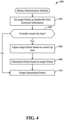
- FIG. 4 depicts a simplified flowchart 400 of a method for determining the bitrate using the second logic according to some embodiments.
- adaptive bitrate algorithm 114 sets a target bitrate as the bandwidth that was determined from historical information in FIG. 3 .
- the bandwidth may have been determined from different types of historical information 116 as described in FIG. 3 .
- adaptive bitrate algorithm 114 determines whether to consider roundtrip time.
- Adaptive bitrate algorithm 114 may use a configuration setting to determine whether roundtrip time should be considered.
- a roundtrip time of communications may be required before downloading the segment.
- the roundtrip time may be considered in applications where roundtrip time may impact the quality of experience, such as satellite networks may have long roundtrip times, but a local area network may have low roundtrip times, and roundtrip time may not be considered.
- adaptive bitrate algorithm 114 adjusts the target bitrate based on roundtrip time.
- the target bitrate may be adjusted using different methods. For example, the value of the roundtrip time may determine how much the target bitrate is adjusted. If the roundtrip time is longer, then the target bitrate may be reduced to a first amount. If the roundtrip time is smaller, then the target bitrate may not be reduced as much as the first amount.
- the reasoning is that roundtrip time may indicate how long a communication takes from client device 104 to content delivery network 118, and back. Some roundtrip communications may be required during the playback session and the communications may delay the downloading of segments of video. In a longer roundtrip time delay, less data may be stored in the buffer and the chance of rebuffering occurring may increase.
- target duration (e.g., 5 seconds) may be based on the duration of a segment (e.g., a value less than segment duration).
- RTT the above requires that the download time of a segment + RTT associated with a segment (e.g., 0.3 seconds) should be smaller than the segment duration, and thus the target bitrate should be further reduced by multiplying by the factor.
- adaptive bitrate algorithm 114 determines the bitrate based on the target bitrate. The determined bitrate may be reduced compared to the target bitrate. In some embodiments, adaptive bitrate algorithm 114 can use two types of logic to decide on the final download bitrate. For example, the server-side provides with segments with profiles ⁇ 1200 kbps, 1800 kbps, 2000 kbps ⁇ and the target bitrate is 1950 kbps. If the profile has a bitrate "less than" the target bitrate, adaptive bitrate algorithm 114 selects the profile with the bitrate of 1800 kbps, which is the bitrate less than the target bitrate that is closest to the target bitrate without being greater than the target bitrate. If the profile should be "more close to", adaptive bitrate algorithm 114 selects the profile with the bitrate of 2000 kbps, which is the closest bitrate to the target bitrate without considering if the bitrate is less than or greater than the target bitrate.
- adaptive bitrate algorithm 114 outputs the determined bitrate.
- the determined bitrate may then be used to select a profile.
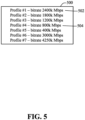
- FIG. 5 depicts an example of profiles 500 in a manifest according to some embodiments.
- Profiles 500 may include a list of seven profiles of Profile #1 to Profile #7. Although these profiles are listed, the number of profiles may be different.
- Each profile may be listed with an associated bitrate. The bitrate listed may be the bitrate in which the segments of video are encoded. It is noted that each profile may include additional information in the manifest, such as quality, segment duration, etc., but is not shown. The list may be in order, where Profile #1 is listed first, Profile #2 is listed second, and so on.
- the first logic may select the profile that is listed first in the manifest, which is Profile #1, and has a bitrate of 2400k Mbps.
- the second logic may select profile #4, which has a bitrate of 800k Mbps.
- the lower bitrate may be selected because historical information 116 may indicate the bandwidth is lower in recent playback sessions, rebuffering has recently occurred, or the roundtrip time is longer. If bandwidth is lower than 2400k Mbps, the selection of Profile #1 may result in a non-optimal playback of a segment. For example, there may be a delay in downloading the initial segment and a delay in the starting of playback of the video.
- adaptive bitrate algorithm 114 may transition to selecting a profile using the bandwidth that is calculated based on the downloading of segments in the current playback session.
- adaptive bitrate algorithm 114 may select Profile #1 for downloading a next segment.
- adaptive bitrate algorithm 114 may still use historical information 116 to select the next profile. For example, adaptive bitrate algorithm 114 may select Profile #2 for the segment because historical information 116 indicated that the variance of bandwidth was higher.
- Some other parameters may be used to select the profile. If the stored variance of bandwidth or roundtrip is large, which indicates that the user's bandwidth is not stable, in the next session the second logic should select a lower bitrate. Also, the isLive parameter can be used to distinguish video on demand and Live conditions.
- the decisions to select profiles by adaptive bitrate algorithm 114 may be improved using historical information 116. This may result in the playback experience at client 104 being improved, where less rebuffers may occur and playback startup may be faster and smoother.
- Video streaming system 600 in communication with multiple client devices via one or more communication networks as shown in FIG. 6 .
- Aspects of the video streaming system 600 are described merely to provide an example of an application for enabling distribution and delivery of content prepared according to the present disclosure. It should be appreciated that the present technology is not limited to streaming video applications and may be adapted for other applications and delivery mechanisms.
- a media program provider may include a library of media programs.
- the media programs may be aggregated and provided through a site (e.g., website), application, or browser.
- a user can access the media program provider's site or application and request media programs. The user may be limited to requesting only media programs offered by the media program provider.
- video data may be obtained from one or more sources for example, from a video source 610, for use as input to a video content server 602.
- the input video data may comprise raw or edited frame-based video data in any suitable digital format, for example, Moving Pictures Experts Group (MPEG)-1, MPEG-2, MPEG-4, VC-1, H.264 / Advanced Video Coding (AVC), High Efficiency Video Coding (HEVC), or other format.
- MPEG Moving Pictures Experts Group
- AVC Advanced Video Coding
- HEVC High Efficiency Video Coding
- a video may be provided in a non-digital format and converted to digital format using a scanner or transcoder.
- the input video data may comprise video clips or programs of various types, for example, television episodes, motion pictures, and other content produced as primary content of interest to consumers.
- the video data may also include audio or only audio may be used.
- the video streaming system 600 may include one or more computer servers or modules 602, 604, and 607 distributed over one or more computers. Each server 602, 604, 607 may include, or may be operatively coupled to, one or more data stores 609, for example databases, indexes, files, or other data structures.
- a video content server 602 may access a data store (not shown) of various video segments. The video content server 602 may serve the video segments as directed by a user interface controller communicating with a client device.
- a video segment refers to a definite portion of frame-based video data, such as may be used in a streaming video session to view a television episode, motion picture, recorded live performance, or other video content.
- a video advertising server 604 may access a data store of relatively short videos (e.g., 10 second, 30 second, or 60 second video advertisements) configured as advertising for a particular advertiser or message.
- the advertising may be provided for an advertiser in exchange for payment of some kind or may comprise a promotional message for the system 600, a public service message, or some other information.
- the video advertising server 604 may serve the video advertising segments as directed by a user interface controller (not shown).
- the video streaming system 600 may further include an integration and streaming component 607 that integrates video content and video advertising into a streaming video segment.
- streaming component 607 may be a content server or streaming media server.
- a controller (not shown) may determine the selection or configuration of advertising in the streaming video based on any suitable algorithm or process.
- the video streaming system 600 may include other modules or units not depicted in FIG. 6 , for example, administrative servers, commerce servers, network infrastructure, advertising selection engines, and so forth.
- the video streaming system 600 may connect to a data communication network 612.
- a data communication network 612 may comprise a local area network (LAN), a wide area network (WAN), for example, the Internet, a telephone network, a wireless network 614 (e.g., a wireless cellular telecommunications network (WCS)), or some combination of these or similar networks.
- LAN local area network
- WAN wide area network
- WCS wireless cellular telecommunications network
- One or more client devices 620 may be in communication with the video streaming system 600, via the data communication network 612, wireless network 614, or another network.
- client devices may include, for example, one or more laptop computers 620-1, desktop computers 620-2, "smart" mobile phones 620-3, tablet devices 620-4, network-enabled televisions 620-5, or combinations thereof, via a router 618 for a LAN, via a base station 617 for wireless network 614, or via some other connection.
- client devices 620 may send and receive data or instructions to the system 600, in response to user input received from user input devices or other input.
- the system 600 may serve video segments and metadata from the data store 609 responsive to selection of media programs to the client devices 620.
- Client devices 620 may output the video content from the streaming video segment in a media player using a display screen, projector, or other video output device, and receive user input for interacting with the video content.
- Distribution of audio-video data may be implemented from streaming component 607 to remote client devices over computer networks, telecommunications networks, and combinations of such networks, using various methods, for example streaming.
- a content server streams audio-video data continuously to a media player component operating at least partly on the client device, which may play the audio-video data concurrently with receiving the streaming data from the server.
- streaming is discussed, other methods of delivery may be used.
- the media player component may initiate play of the video data immediately after receiving an initial portion of the data from the content provider.
- Traditional streaming techniques use a single provider delivering a stream of data to a set of end users. High bandwidth and processing power may be required to deliver a single stream to a large audience, and the required bandwidth of the provider may increase as the number of end users increases.
- Streaming media can be delivered on-demand or live. Streaming enables immediate playback at any point within the file. End-users may skip through the media file to start playback or change playback to any point in the media file. Hence, the end-user does not need to wait for the file to progressively download.
- streaming media is delivered from a few dedicated servers having high bandwidth capabilities via a specialized device that accepts requests for video files, and with information about the format, bandwidth, and structure of those files, delivers just the amount of data necessary to play the video, at the rate needed to play it.
- Streaming media servers may also account for the transmission bandwidth and capabilities of the media player on the destination client.
- Streaming component 607 may communicate with client device 620 using control messages and data messages to adjust to changing network conditions as the video is played.
- control messages can include commands for enabling control functions such as fast forward, fast reverse, pausing, or seeking to a particular part of the file at the client.
- streaming component 607 transmits video data only as needed and at the rate that is needed, precise control over the number of streams served can be maintained. The viewer will not be able to view high data rate videos over a lower data rate transmission medium.
- streaming media servers (1) provide users random access to the video file, (2) allow monitoring of who is viewing what video programs and how long they are watched (3) use transmission bandwidth more efficiently, since only the amount of data required to support the viewing experience is transmitted, and (4) the video file is not stored in the viewer's computer, but discarded by the media player, thus allowing more control over the content.
- Streaming component 607 may use TCP-based protocols, such as HyperText Transfer Protocol (HTTP) and Real Time Messaging Protocol (RTMP). Streaming component 607 can also deliver live webcasts and can multicast, which allows more than one client to tune into a single stream, thus saving bandwidth. Streaming media players may not rely on buffering the whole video to provide random access to any point in the media program. Instead, this is accomplished using control messages transmitted from the media player to the streaming media server. Other protocols used for streaming are HTTP live streaming (HLS) or Dynamic Adaptive Streaming over HTTP (DASH). The HLS and DASH protocols deliver video over HTTP via a playlist of small segments that are made available in a variety of bitrates typically from one or more content delivery networks (CDNs). This allows a media player to switch both bitrates and content sources on a segment-by-segment basis. The switching helps compensate for network bandwidth variances and infrastructure failures that may occur during playback of the video.
- HTTP HyperText Transfer Protocol
- RTMP Real Time
- the delivery of video content by streaming may be accomplished under a variety of models.
- the user pays for the viewing of video programs, for example, paying a fee for access to the library of media programs or a portion of restricted media programs, or using a pay-per-view service.
- sponsors pay for the presentation of the media program in exchange for the right to present advertisements during or adjacent to the presentation of the program.
- advertisements are inserted at predetermined times in a video program, which times may be referred to as "ad slots" or "ad breaks.”
- the media player may be configured so that the client device cannot play the video without also playing predetermined advertisements during the designated ad slots.
- the apparatus 700 may include a processor (CPU) 702 operatively coupled to a processor memory 704, which holds binary-coded functional modules for execution by the processor 702.
- Such functional modules may include an operating system 706 for handling system functions such as input/output and memory access, a browser 708 to display web pages, and media player 710 for playing video.
- the modules may further include adaptive bitrate algorithm 114.
- the memory 704 may hold additional modules not shown in FIG. 7 , for example modules for performing other operations described elsewhere herein.
- a bus 714 or other communication components may support communication of information within the apparatus 700.
- the processor 702 may be a specialized or dedicated microprocessor configured or operable to perform particular tasks in accordance with the features and aspects disclosed herein by executing machine-readable software code defining the particular tasks.
- Processor memory 704 e.g., random access memory (RAM) or other dynamic storage device
- RAM random access memory
- the memory 704 may also store temporary variables or other intermediate information during execution of such instructions.
- a computer-readable medium in a storage device 724 may be connected to the bus 714 and store static information and instructions for the processor 702; for example, the storage device (CRM) 724 may store the modules for operating system 706, browser 708, and media player 710 when the apparatus 700 is powered off, from which the modules may be loaded into the processor memory 704 when the apparatus 700 is powered up.
- the storage device 724 may include a non-transitory computer-readable storage medium holding information, instructions, or some combination thereof, for example instructions that when executed by the processor 702, cause the apparatus 700 to be configured or operable to perform one or more operations of a method as described herein.
- a network communication (comm.) interface 716 may also be connected to the bus 714.
- the network communication interface 716 may provide or support two-way data communication between the apparatus 700 and one or more external devices, e.g., the streaming system 600, optionally via a router/modem 726 and a wired or wireless connection 725.
- the apparatus 700 may include a transceiver 718 connected to an antenna 729, through which the apparatus 700 may communicate wirelessly with a base station for a wireless communication system or with the router/modem 726.
- the apparatus 700 may communicate with a video streaming system 600 via a local area network, virtual private network, or other network.
- the apparatus 700 may be incorporated as a module or component of the system 600 and communicate with other components via the bus 714 or by some other modality.
- the apparatus 700 may be connected (e.g., via the bus 714 and graphics processing unit 720) to a display unit 728.
- a display 728 may include any suitable configuration for displaying information to an operator of the apparatus 700.
- a display 728 may include or utilize a liquid crystal display (LCD), touchscreen LCD (e.g., capacitive display), light emitting diode (LED) display, projector, or other display device to present information to a user of the apparatus 700 in a visual display.
- LCD liquid crystal display
- touchscreen LCD e.g., capacitive display
- LED light emitting diode
- One or more input devices 730 may be connected to the bus 714 via a user input port 722 to communicate information and commands to the apparatus 700.
- an input device 730 may provide or support control over the positioning of a cursor.
- a cursor control device also called a pointing device, may be configured as a mouse, a trackball, a track pad, touch screen, cursor direction keys or other device for receiving or tracking physical movement and translating the movement into electrical signals indicating cursor movement.
- the cursor control device may be incorporated into the display unit 728, for example using a touch sensitive screen.
- a cursor control device may communicate direction information and command selections to the processor 702 and control cursor movement on the display 728.
- a cursor control device may have two or more degrees of freedom, for example allowing the device to specify cursor positions in a plane or three-dimensional space.
- Some embodiments may be implemented in a non-transitory computer-readable storage medium for use by or in connection with the instruction execution system, apparatus, system, or machine.
- the computer-readable storage medium contains instructions for controlling a computer system to perform a method described by some embodiments.
- the computer system may include one or more computing devices.
- the instructions, when executed by one or more computer processors, may be configured or operable to perform that which is described in some embodiments.
Landscapes
- Engineering & Computer Science (AREA)
- Signal Processing (AREA)
- Multimedia (AREA)
- Computer Networks & Wireless Communication (AREA)
- Databases & Information Systems (AREA)
- Environmental & Geological Engineering (AREA)
- Two-Way Televisions, Distribution Of Moving Picture Or The Like (AREA)
Applications Claiming Priority (2)
| Application Number | Priority Date | Filing Date | Title |
|---|---|---|---|
| US202363600013P | 2023-11-16 | 2023-11-16 | |
| US18/435,925 US12526463B2 (en) | 2023-11-16 | 2024-02-07 | Bitrate selection using stored information |
Publications (1)
| Publication Number | Publication Date |
|---|---|
| EP4557745A1 true EP4557745A1 (de) | 2025-05-21 |
Family
ID=92816526
Family Applications (1)
| Application Number | Title | Priority Date | Filing Date |
|---|---|---|---|
| EP24200919.9A Pending EP4557745A1 (de) | 2023-11-16 | 2024-09-17 | Bitratenauswahl unter verwendung gespeicherter informationen |
Country Status (4)
| Country | Link |
|---|---|
| US (2) | US12526463B2 (de) |
| EP (1) | EP4557745A1 (de) |
| JP (1) | JP2025082259A (de) |
| CN (1) | CN120017702A (de) |
Families Citing this family (1)
| Publication number | Priority date | Publication date | Assignee | Title |
|---|---|---|---|---|
| US12526463B2 (en) | 2023-11-16 | 2026-01-13 | Beijing Yo.JaJa Software Technology Development Co., Ltd. | Bitrate selection using stored information |
Citations (3)
| Publication number | Priority date | Publication date | Assignee | Title |
|---|---|---|---|---|
| US20140156863A1 (en) * | 2012-02-27 | 2014-06-05 | Qualcomm Incorporated | Dash client and receiver with a download rate estimator |
| US20210144080A1 (en) * | 2019-11-12 | 2021-05-13 | Hulu, LLC | Dynamic variation of media segment durations for optimization of network round trip times |
| US20220182685A1 (en) * | 2020-12-09 | 2022-06-09 | Hulu, LLC | Multiple protocol prediction and in-session adaptation in video streaming |
Family Cites Families (14)
| Publication number | Priority date | Publication date | Assignee | Title |
|---|---|---|---|---|
| US9369960B2 (en) * | 2011-09-08 | 2016-06-14 | Lg Electronics Inc. | Method for operation based on switching discontinuous reception state in wireless communication system and apparatus for the same |
| EP2894870A1 (de) | 2014-01-10 | 2015-07-15 | Thomson Licensing | Verfahren zum Herunterladen, an einem Client-Endgerät, einer anstehenden Sequenz von Segmenten eines Multimediainhalts und zugehöriges Endgerät |
| US9407968B2 (en) * | 2014-12-22 | 2016-08-02 | Verizon Patent And Licensing Inc. | Multicast and unicast adaptive bitrate services |
| JP2017157904A (ja) | 2016-02-29 | 2017-09-07 | 富士ゼロックス株式会社 | 情報処理装置 |
| US11509703B2 (en) * | 2018-09-26 | 2022-11-22 | Vmware, Inc. | System and method for widescale adaptive bitrate selection |
| US10958947B1 (en) * | 2020-03-12 | 2021-03-23 | Amazon Technologies, Inc. | Content delivery of live streams with playback-conditions-adaptive encoding |
| US11277620B1 (en) * | 2020-10-30 | 2022-03-15 | Hulu, LLC | Adaptive transcoding of profile ladder for videos |
| US11812081B2 (en) * | 2020-11-02 | 2023-11-07 | Hulu, LLC | Session based adaptive playback profile decision for video streaming |
| JP7759210B2 (ja) | 2021-02-03 | 2025-10-23 | 日本放送協会 | 受信装置及びプログラム |
| US11616993B1 (en) * | 2021-10-22 | 2023-03-28 | Hulu, LLC | Dyanamic parameter adjustment for adaptive bitrate algorithm |
| US11895173B2 (en) * | 2022-01-07 | 2024-02-06 | Avago Technologies International Sales Pte. Limited | Gapped and/or subsegmented adaptive bitrate streams |
| EP4311242A1 (de) * | 2022-07-21 | 2024-01-24 | Ateme | Verfahren zur dynamischen konfiguration eines codierers für multimediainhalte und gerät zur implementierung desselben |
| US12192541B2 (en) * | 2023-03-27 | 2025-01-07 | Roku, Inc. | Adaptive audio bitrate selection |
| US12526463B2 (en) | 2023-11-16 | 2026-01-13 | Beijing Yo.JaJa Software Technology Development Co., Ltd. | Bitrate selection using stored information |
-
2024
- 2024-02-07 US US18/435,925 patent/US12526463B2/en active Active
- 2024-09-17 EP EP24200919.9A patent/EP4557745A1/de active Pending
- 2024-09-24 CN CN202411331291.2A patent/CN120017702A/zh active Pending
- 2024-09-27 JP JP2024168372A patent/JP2025082259A/ja active Pending
-
2025
- 2025-12-11 US US19/417,107 patent/US20260101078A1/en active Pending
Patent Citations (3)
| Publication number | Priority date | Publication date | Assignee | Title |
|---|---|---|---|---|
| US20140156863A1 (en) * | 2012-02-27 | 2014-06-05 | Qualcomm Incorporated | Dash client and receiver with a download rate estimator |
| US20210144080A1 (en) * | 2019-11-12 | 2021-05-13 | Hulu, LLC | Dynamic variation of media segment durations for optimization of network round trip times |
| US20220182685A1 (en) * | 2020-12-09 | 2022-06-09 | Hulu, LLC | Multiple protocol prediction and in-session adaptation in video streaming |
Also Published As
| Publication number | Publication date |
|---|---|
| US12526463B2 (en) | 2026-01-13 |
| JP2025082259A (ja) | 2025-05-28 |
| CN120017702A (zh) | 2025-05-16 |
| US20260101078A1 (en) | 2026-04-09 |
| US20250168436A1 (en) | 2025-05-22 |
Similar Documents
| Publication | Publication Date | Title |
|---|---|---|
| KR102652518B1 (ko) | 비디오 스트리밍을 위한 세션 기반 적응적 재생 프로파일 판정 | |
| US10778938B2 (en) | Video chunk combination optimization | |
| KR102791298B1 (ko) | 비디오 플레이백에서 예측-기반의 표현 선택 | |
| US20260101078A1 (en) | Bitrate selection using stored information | |
| US20250133254A1 (en) | Cross-period quality smoothing in adaptive bitrate algorithm | |
| US20230418675A1 (en) | Intelligent content delivery network (cdn) entity routing | |
| US12177284B2 (en) | Content delivery network (CDN) selection using performance metric | |
| EP3354033B1 (de) | Dynamische suche in videobereitstellungssystemen | |
| EP4535795A2 (de) | Adaptives bitratenstreaming mit videoqualitätsinformationen | |
| US11140060B2 (en) | Dynamic variation of media segment durations for optimization of network round trip times | |
| EP4312417A1 (de) | Inhaltsbereitstellungsnetzwerkauswahl unter verwendung einer leistungsmetrik | |
| US12160595B2 (en) | Optimized video transcoding based on a timing requirement | |
| JP7651642B2 (ja) | タイミング要件に基づく最適化されたビデオトランスコーディング | |
| US12212798B1 (en) | Cross-period quality smoothing in adaptive bitrate algorithm | |
| US12501087B2 (en) | Adaptive bitrate streaming using video quality information |
Legal Events
| Date | Code | Title | Description |
|---|---|---|---|
| PUAI | Public reference made under article 153(3) epc to a published international application that has entered the european phase |
Free format text: ORIGINAL CODE: 0009012 |
|
| STAA | Information on the status of an ep patent application or granted ep patent |
Free format text: STATUS: THE APPLICATION HAS BEEN PUBLISHED |
|
| AK | Designated contracting states |
Kind code of ref document: A1 Designated state(s): AL AT BE BG CH CY CZ DE DK EE ES FI FR GB GR HR HU IE IS IT LI LT LU LV MC ME MK MT NL NO PL PT RO RS SE SI SK SM TR |
|
| STAA | Information on the status of an ep patent application or granted ep patent |
Free format text: STATUS: REQUEST FOR EXAMINATION WAS MADE |
|
| 17P | Request for examination filed |
Effective date: 20251121 |