EP4557769A1 - Hörgerät - Google Patents
Hörgerät Download PDFInfo
- Publication number
- EP4557769A1 EP4557769A1 EP23934388.2A EP23934388A EP4557769A1 EP 4557769 A1 EP4557769 A1 EP 4557769A1 EP 23934388 A EP23934388 A EP 23934388A EP 4557769 A1 EP4557769 A1 EP 4557769A1
- Authority
- EP
- European Patent Office
- Prior art keywords
- hearing aid
- bluetooth
- component
- signal
- electrically connected
- Prior art date
- Legal status (The legal status is an assumption and is not a legal conclusion. Google has not performed a legal analysis and makes no representation as to the accuracy of the status listed.)
- Pending
Links
Images

Classifications
-
- H—ELECTRICITY
- H04—ELECTRIC COMMUNICATION TECHNIQUE
- H04R—LOUDSPEAKERS, MICROPHONES, GRAMOPHONE PICK-UPS OR LIKE ACOUSTIC ELECTROMECHANICAL TRANSDUCERS; ELECTRIC HEARING AIDS; PUBLIC ADDRESS SYSTEMS
- H04R25/00—Electric hearing aids
- H04R25/55—Electric hearing aids using an external connection, either wireless or wired
- H04R25/554—Electric hearing aids using an external connection, either wireless or wired using a wireless connection, e.g. between microphone and amplifier or using Tcoils
-
- H—ELECTRICITY
- H04—ELECTRIC COMMUNICATION TECHNIQUE
- H04R—LOUDSPEAKERS, MICROPHONES, GRAMOPHONE PICK-UPS OR LIKE ACOUSTIC ELECTROMECHANICAL TRANSDUCERS; ELECTRIC HEARING AIDS; PUBLIC ADDRESS SYSTEMS
- H04R25/00—Electric hearing aids
- H04R25/60—Mounting or interconnection of hearing aid parts, e.g. inside tips, housings or to ossicles
- H04R25/603—Mounting or interconnection of hearing aid parts, e.g. inside tips, housings or to ossicles of mechanical or electronic switches or control elements
-
- H—ELECTRICITY
- H04—ELECTRIC COMMUNICATION TECHNIQUE
- H04R—LOUDSPEAKERS, MICROPHONES, GRAMOPHONE PICK-UPS OR LIKE ACOUSTIC ELECTROMECHANICAL TRANSDUCERS; ELECTRIC HEARING AIDS; PUBLIC ADDRESS SYSTEMS
- H04R25/00—Electric hearing aids
- H04R25/43—Electronic input selection or mixing based on input signal analysis, e.g. mixing or selection between microphone and telecoil or between microphones with different directivity characteristics
-
- H—ELECTRICITY
- H04—ELECTRIC COMMUNICATION TECHNIQUE
- H04R—LOUDSPEAKERS, MICROPHONES, GRAMOPHONE PICK-UPS OR LIKE ACOUSTIC ELECTROMECHANICAL TRANSDUCERS; ELECTRIC HEARING AIDS; PUBLIC ADDRESS SYSTEMS
- H04R25/00—Electric hearing aids
- H04R25/55—Electric hearing aids using an external connection, either wireless or wired
- H04R25/552—Binaural
-
- H—ELECTRICITY
- H04—ELECTRIC COMMUNICATION TECHNIQUE
- H04R—LOUDSPEAKERS, MICROPHONES, GRAMOPHONE PICK-UPS OR LIKE ACOUSTIC ELECTROMECHANICAL TRANSDUCERS; ELECTRIC HEARING AIDS; PUBLIC ADDRESS SYSTEMS
- H04R25/00—Electric hearing aids
- H04R25/55—Electric hearing aids using an external connection, either wireless or wired
- H04R25/558—Remote control, e.g. of amplification, frequency
-
- H—ELECTRICITY
- H04—ELECTRIC COMMUNICATION TECHNIQUE
- H04R—LOUDSPEAKERS, MICROPHONES, GRAMOPHONE PICK-UPS OR LIKE ACOUSTIC ELECTROMECHANICAL TRANSDUCERS; ELECTRIC HEARING AIDS; PUBLIC ADDRESS SYSTEMS
- H04R2225/00—Details of deaf aids covered by H04R25/00, not provided for in any of its subgroups
- H04R2225/31—Aspects of the use of accumulators in hearing aids, e.g. rechargeable batteries or fuel cells
-
- H—ELECTRICITY
- H04—ELECTRIC COMMUNICATION TECHNIQUE
- H04R—LOUDSPEAKERS, MICROPHONES, GRAMOPHONE PICK-UPS OR LIKE ACOUSTIC ELECTROMECHANICAL TRANSDUCERS; ELECTRIC HEARING AIDS; PUBLIC ADDRESS SYSTEMS
- H04R2225/00—Details of deaf aids covered by H04R25/00, not provided for in any of its subgroups
- H04R2225/33—Aspects relating to adaptation of the battery voltage, e.g. its regulation, increase or decrease
-
- H—ELECTRICITY
- H04—ELECTRIC COMMUNICATION TECHNIQUE
- H04R—LOUDSPEAKERS, MICROPHONES, GRAMOPHONE PICK-UPS OR LIKE ACOUSTIC ELECTROMECHANICAL TRANSDUCERS; ELECTRIC HEARING AIDS; PUBLIC ADDRESS SYSTEMS
- H04R2225/00—Details of deaf aids covered by H04R25/00, not provided for in any of its subgroups
- H04R2225/55—Communication between hearing aids and external devices via a network for data exchange
-
- H—ELECTRICITY
- H04—ELECTRIC COMMUNICATION TECHNIQUE
- H04R—LOUDSPEAKERS, MICROPHONES, GRAMOPHONE PICK-UPS OR LIKE ACOUSTIC ELECTROMECHANICAL TRANSDUCERS; ELECTRIC HEARING AIDS; PUBLIC ADDRESS SYSTEMS
- H04R2225/00—Details of deaf aids covered by H04R25/00, not provided for in any of its subgroups
- H04R2225/61—Aspects relating to mechanical or electronic switches or control elements, e.g. functioning
-
- H—ELECTRICITY
- H04—ELECTRIC COMMUNICATION TECHNIQUE
- H04R—LOUDSPEAKERS, MICROPHONES, GRAMOPHONE PICK-UPS OR LIKE ACOUSTIC ELECTROMECHANICAL TRANSDUCERS; ELECTRIC HEARING AIDS; PUBLIC ADDRESS SYSTEMS
- H04R2420/00—Details of connection covered by H04R, not provided for in its groups
- H04R2420/07—Applications of wireless loudspeakers or wireless microphones
-
- H—ELECTRICITY
- H04—ELECTRIC COMMUNICATION TECHNIQUE
- H04R—LOUDSPEAKERS, MICROPHONES, GRAMOPHONE PICK-UPS OR LIKE ACOUSTIC ELECTROMECHANICAL TRANSDUCERS; ELECTRIC HEARING AIDS; PUBLIC ADDRESS SYSTEMS
- H04R3/00—Circuits for transducers
Definitions
- This specification relates to the technical field of wireless headphones, and more particularly to a hearing aid device.
- hearing aids have helped an increasing number of individuals with hearing impairments to hear the world more clearly.
- activities such as making phone calls, listening to music, and watching videos have become deeply integrated into people's lives.
- Traditional hearing aids are limited to hearing assistance functions. In situations such as making phone calls or listening to music, they are not very convenient and often disrupt the lives of individuals with hearing impairments.
- a new hearing aid device that not only provides hearing assistance functions but also supports Bluetooth phone calls and Bluetooth music like Bluetooth headphones. Additionally, it should enable the combined use of hearing assistance and Bluetooth headphone functions.
- This specification provides a hearing aid device that simplifies user operation steps and enhances user experience during the use of the hearing aid device.
- this specification provides a hearing aid device, including: a hearing aid component, configured to collect an external sound and perform a first signal processing during an operation, and output a hearing aid audio signal; a Bluetooth component, configured to receive an external audio signal and perform a second signal processing during the operation, and output a Bluetooth audio signal; an audio mixing circuit, electrically connected to the hearing aid component and the Bluetooth component, and configured to mix the hearing aid audio signal and the Bluetooth audio signal during the operation; and a speaker, electrically connected to the audio mixing circuit.
- a hearing aid component configured to collect an external sound and perform a first signal processing during an operation, and output a hearing aid audio signal
- a Bluetooth component configured to receive an external audio signal and perform a second signal processing during the operation, and output a Bluetooth audio signal
- an audio mixing circuit electrically connected to the hearing aid component and the Bluetooth component, and configured to mix the hearing aid audio signal and the Bluetooth audio signal during the operation
- a speaker electrically connected to the audio mixing circuit.
- the audio mixing circuit includes: an operational amplifier summing circuit, electrically connected to the hearing aid component and the Bluetooth component, and configured to mix the hearing aid audio signal and the Bluetooth audio signal during the operation; and a power amplifier circuit, electrically connected to the operational amplifier summing circuit, and configured to amplify a signal output by the operational amplifier summing circuit during the operation.
- the hearing aid device further includes: a control switch circuit, electrically connected to the hearing aid component and the audio mixing circuit, respectively, to control connection and disconnection between the hearing aid component and the audio mixing circuit.
- control switch circuit is signal-connected to the Bluetooth component, and the Bluetooth component controls connection and disconnection of the control switch circuit based on a first control signal during the operation, thereby controlling the connection and disconnection between the hearing aid component and the audio mixing circuit.
- the hearing aid device further includes: an operation panel, electrically connected to the Bluetooth component, and configured to generate an operation command in response to a user operation during the operation, where the Bluetooth component, during the operation, generates a corresponding control signal based on the operation command, and the corresponding control signal includes the first control signal.
- the Bluetooth component is electrically connected to the hearing aid component, and the Bluetooth component controls the hearing aid component based on a second control signal during the operation.
- the hearing aid device further includes: an operation panel, electrically connected to the Bluetooth component, and configured to generate an operation command in response to a user operation during the operation, where the Bluetooth component, during the operation, generates a corresponding control signal based on the operation command, and the corresponding control signal includes the second control signal.
- the hearing aid component includes: a hearing aid microphone, configured to collect the external sound during the operation and generate a hearing aid microphone signal; and a hearing aid signal processing circuit, electrically connected to the hearing aid microphone, and configured to perform the first signal processing on the hearing aid microphone signal during the operation and output the hearing aid audio signal, where the hearing aid signal processing circuit is electrically connected to the Bluetooth component to receive the second control signal.
- the Bluetooth component includes: a Bluetooth communication module, configured to receive the external audio signal during the operation; and a Bluetooth signal processing circuit, electrically connected to the Bluetooth communication module, and configured to perform the second signal processing on the external audio signal during the operation and output the Bluetooth audio signal, where the Bluetooth signal processing circuit is electrically connected to the hearing aid signal processing circuit to send the second control signal to the hearing aid signal processing circuit.
- the Bluetooth component further includes: a Bluetooth microphone, configured to collect the external sound during the operation and generate a Bluetooth microphone signal, where the Bluetooth microphone is electrically connected to the Bluetooth signal processing circuit, and the Bluetooth signal processing circuit performs a third signal processing on the Bluetooth microphone signal during the operation to generate an output audio signal, and send the output audio signal to the Bluetooth communication module.
- a Bluetooth microphone configured to collect the external sound during the operation and generate a Bluetooth microphone signal
- the Bluetooth microphone is electrically connected to the Bluetooth signal processing circuit
- the Bluetooth signal processing circuit performs a third signal processing on the Bluetooth microphone signal during the operation to generate an output audio signal, and send the output audio signal to the Bluetooth communication module.
- the hearing aid device further includes a battery module electrically connected to the Bluetooth component and the hearing aid component.
- the hearing aid device provided in this specification integrates the Bluetooth functionality and hearing assistance functionality by mixing the hearing aid audio signal output by the hearing aid component with the Bluetooth audio signal output by the Bluetooth component via an audio mixing circuit.
- This integration not only achieves hearing assistance functionality but also supports Bluetooth phone calls and Bluetooth music playback, and allows the combined use of hearing assistance and Bluetooth functionalities.
- the hearing aid device provided in this specification can also control the connection and disconnection of the control switch circuit between the hearing aid component and the audio mixing circuit through the Bluetooth component, thereby controlling the connection and disconnection of the hearing aid component and the audio mixing circuit.
- This enables the device to support either Bluetooth functionality alone or the simultaneous use of Bluetooth and hearing assistance functionalities, thereby expanding the application scenarios of the hearing aid device. Users can switch modes according to different occasions to achieve a better experience.
- the hearing aid device provided in this specification can be controlled through the Bluetooth component, eliminating the need to redesign the hearing aid component. This not only reduces costs but also maintains the quality of the hearing experience.
- the hearing device provided in this specification may include a left ear hearing device and a right ear hearing device.
- the left ear hearing device and the right ear hearing device are respectively used for the left ear and the right ear.
- the left ear hearing device and the right ear hearing device may also be used interchangeably.
- the audio signal processing of the left ear hearing device and the right ear hearing device can be consistent or inconsistent.
- the left ear hearing device and the right ear hearing device may be physically connected, for example, by means of a connecting housing.
- signal connection between the left ear hearing device and the right ear hearing device can be achieved via circuitry.
- the left ear hearing device and the right ear hearing device may be set up independently of each other.
- signal connection between the left ear hearing device and the right ear hearing device can be achieved through wireless communication.
- the left ear hearing device and the right ear hearing device may also be used independently or as a pair. When the left ear hearing device and the right ear hearing device are used independently, the hearing device operates in a monoaural mode. When the left ear hearing device and the right ear hearing device are paired for use, the hearing device operates in a binaural mode.
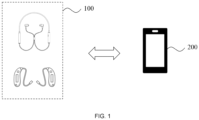
- FIG. 1 is a schematic diagram of an application scenario for a hearing device 100 provided according to some embodiments of this specification. As shown in FIG. 1 , the hearing device 100 can communicate with an electronic device 200 via Bluetooth.
- the electronic device 200 can be an electronic device with audio output functionality, also referred to as an audio output device.
- the electronic device 200 may include mobile devices, tablets, laptops, built-in devices of motor vehicles, or similar devices, or any combination thereof.
- the mobile device may include smart home devices, smart mobile devices, virtual reality devices, augmented reality devices, or similar devices, or any combination thereof.
- the smart home devices may include smart TVs, desktop computers, smart speakers, etc., or any combination thereof.
- the smart mobile devices may include smartphones, personal digital assistants, gaming devices, navigation devices, etc., or any combination thereof.
- the virtual reality or augmented reality devices may include virtual reality headsets, virtual reality glasses, virtual reality controllers, augmented reality headsets, augmented reality glasses, augmented reality controllers, or similar devices, or any combination thereof.
- the virtual reality or augmented reality devices may include Google Glass, head-mounted displays, VR, etc.
- the built-in devices in motor vehicles may include onboard computers, in-car TVs, etc.
- the electronic device 200 may include audio collection devices to capture audio data in the target space, thus obtaining audio data to be played. In some embodiments, the electronic device 200 may receive audio data to be played from other devices.
- the hearing device 100 can support the Bluetooth protocol
- the electronic device 200 can be an audio output device that supports the Bluetooth protocol. Communication between the hearing device 100 and the electronic device 200 can be based on the Bluetooth protocol for audio data transmission.
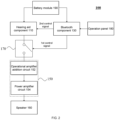
- FIG. 2 is a hardware schematic diagram of a hearing device 100 provided according to some embodiments of this specification.
- the hearing device 100 may include a hearing aid component 110, a Bluetooth component 130, an audio mixing circuit 150, and a speaker 160.
- the hearing device 100 may further include a control switch circuit 170.
- the hearing device 100 may also include an operation panel 180.
- the hearing device 100 may also include a battery module 190.
- the hearing aid component 110 can capture external sounds and perform first signal processing during operation, outputting hearing aid audio signals.
- the external sounds may include sounds near the user, including but not limited to the user's own speech, sounds in the user's environment (such as other people's speech, ambient sounds), and so on.
- the first signal processing may include, but is not limited to, noise reduction processing, amplification processing, speech enhancement processing, frequency response compensation processing, and similar processes using appropriate algorithms.
- the Bluetooth component 130 can receive external audio signals during operation, perform second signal processing, and output Bluetooth audio signals.
- the Bluetooth component 130 can establish a Bluetooth connection with the electronic device 200 for data transmission.
- the external audio signals may refer to audio data transmitted from the electronic device 200 to the Bluetooth component 130.
- the Bluetooth component 130 can also capture the user's voice, process the signals, and send them to the electronic device 200.
- the Bluetooth component 130 can be electrically connected to the hearing aid component 110.
- the Bluetooth component 130 can control the hearing aid component 110 based on a second control signal, thereby managing the first signal processing performed by the hearing aid component 110.
- the Bluetooth component 130 can control the hearing aid component 110 to enhance or attenuate the audio signal based on the second control signal during operation.
- the audio mixing circuit 150 can be electrically connected to the hearing aid component 110 and the Bluetooth component 130. During operation, it mixes the hearing aid audio signal and the Bluetooth audio signal, enabling the hearing device 100 to simultaneously support both hearing aid functionality and Bluetooth headset functionality.
- the audio mixing circuit 150 can superimpose the hearing aid audio signal and the Bluetooth audio signal, allowing the user to hear both signals simultaneously.
- the audio mixing circuit 150 can directly superimpose the hearing aid audio signal and the Bluetooth audio signal.
- the audio mixing circuit 150 may process the hearing aid audio signal and the Bluetooth audio signal before superimposing them.
- the processing may include amplifying or attenuating the signals of the hearing aid audio signal and/or the Bluetooth audio signal to adjust their relative signal strengths, ensuring balance and preventing one signal from overpowering the other.
- the audio mixing circuit 150 may first compare the signal strengths of the hearing aid audio signal and the Bluetooth audio signal and then adjust their intensities based on the comparison results.
- the superimposition process can involve linear averaging or weighted summation.
- the audio mixing circuit 150 may include an operational amplifier addition circuit 152 and a power amplifier circuit 154.
- the operational amplifier addition circuit 152 can be electrically connected to the hearing aid component 110 and the Bluetooth component 130 to mix the hearing aid audio signal and the Bluetooth audio signal during operation.
- the power amplifier circuit 154 electrically connected to the operational amplifier addition circuit 152, amplifies the signals output by the operational amplifier addition circuit during operation.
- the speaker 160 can be electrically connected to the audio mixing circuit 150. During operation, the speaker 160 receives the mixed audio signal output by the audio mixing circuit 150 and converts the mixed audio signal into sound for playback. When the user wears the hearing device 100, the speaker 160 can be positioned close to the user's ear canal, allowing the user to hear the sound as it plays.
- the speaker 160 may be a bone conduction speaker and/or an air conduction speaker.
- the speaker 160 is a bone conduction speaker
- the vibration signals it generates are transmitted through the user's skin and bones to the auditory nerve, enabling the user to perceive the sound.
- the speaker 160 is an air conduction speaker
- the sound signals it generates are transmitted through the air and eardrum to the auditory nerve, allowing the user to hear the sound.
- the speaker 160 can include both a bone conduction speaker and an air conduction speaker, simultaneously producing vibration signals and air-conducted sound signals.
- the hearing device 100 provided in this specification integrates the Bluetooth component 130 with the hearing aid component 110. Through the design of the audio mixing circuit 150, the processed hearing aid audio signal and the Bluetooth audio signal are mixed and superimposed, then output to the speaker 160 for playback.
- the hearing device 100 described in this specification does not require a redesign of the hearing aid component 110 or the first signal processing within it. Instead, the Bluetooth component 130 and the audio mixing circuit 150 can be directly integrated with the existing hearing aid component 110. This integration preserves the high-quality signal processing of the original hearing aid component 110 while adding Bluetooth functionality. It provides multifunctionality while maintaining the hearing experience.
- the hearing device 100 may also include a control switch circuit 170.
- the control switch circuit 170 can be electrically connected to both the hearing aid component 110 and the audio mixing circuit 150.
- the control switch circuit 170 can connect or disconnect the hearing aid component 110 and the audio mixing circuit 150, thereby controlling their interaction.
- the control switch circuit 170 is disconnected, the connection between the hearing aid component 110 and the audio mixing circuit 150 is severed, and the hearing aid audio signal output by the hearing aid component 110 cannot be input to the audio mixing circuit 150.
- the control switch circuit 170 is connected, the hearing aid component 110 and the audio mixing circuit 150 are electrically connected, allowing the hearing aid audio signal output by the hearing aid component 110 to be input to the audio mixing circuit 150.
- the control switch circuit 170 can also be signal-connected to the Bluetooth component 130. During operation, the Bluetooth component 130 can control the connection and disconnection of the control switch circuit 170 based on a first control signal, thereby managing the connection between the hearing aid component 110 and the audio mixing circuit 150.
- the control switch circuit 170 can be any type of switch circuit, such as voltage-controlled or current-controlled, without limitation in this specification.
- the hearing device 100 provided in this specification can have a control switch circuit 170 set between the hearing aid component 110 and the audio mixing circuit 150, and the connection and disconnection of the control switch circuit 170 can be controlled by the Bluetooth component 130, allowing the hearing device 100 to automatically or manually switch between multiple operating modes. For example, when the Bluetooth connection between the Bluetooth component 130 and the electronic device 200 is disconnected, and the control switch circuit 170 is connected, the hearing device 100 operates in hearing aid mode, realizing hearing aid functionality. In another example, when the Bluetooth connection between the Bluetooth component 130 and the electronic device 200 is established, and the control switch circuit 170 is closed, the hearing device 100 operates in a mixed mode, realizing both hearing aid functionality and Bluetooth functionality, allowing the user to enjoy Bluetooth functionality while also benefiting from hearing aid functionality, avoiding missing important external sound information.
- the hearing device 100 when the Bluetooth connection between the Bluetooth component 130 and the electronic device 200 is established, and the control switch circuit 170 is disconnected, the hearing device 100 operates in Bluetooth mode, realizing Bluetooth functionality, allowing the user to enjoy Bluetooth functionality while avoiding disturbances from the external environment.
- the hearing aid device 100 may further include an operation panel 180.
- the operation panel 180 can be electrically connected to the Bluetooth component 130 and generate corresponding operation instructions in response to user actions during operation.
- the Bluetooth component 130 can generate corresponding control signals based on the operation instructions during its operation.
- the control signals may include the first control signal and/or the second control signal.
- the user's actions include, but are not limited to, adjusting the volume, such as increasing or decreasing the volume, including adjusting the volume of the hearing aid audio signal and the Bluetooth audio signal.
- the user's actions may also include switching the working mode of the hearing aid device 100, such as operating the control switch circuit 170 to control the connection or disconnection of the control switch circuit 170, thus controlling the connection or disconnection between the hearing aid component 110 and the audio mixing circuit 150 to switch the mode of the hearing aid device 100.
- the user's actions may also include pause and play operations, and controlling the Bluetooth connection and disconnection.
- the user's actions may also include other operations, such as turning on and off the noise reduction mode, switching the noise reduction mode, etc.
- the operation panel 180 may be button-based, such as mechanical buttons, touch buttons, etc.
- the operation panel 180 may also support voice operation, gesture operation, etc., and this specification does not limit it.
- the hearing aid device 100 may further include a battery module 190.
- the battery module 190 can be electrically connected to the Bluetooth component 130 and the hearing aid component 110, providing power to the Bluetooth component 130 and the hearing aid component 110.
- FIG. 3 illustrates a hardware schematic of a hearing aid device 100 according to an embodiment of this specification.
- the hearing aid component 110 may include a hearing aid microphone 112 and a hearing aid signal processing circuit 114.
- the hearing aid microphone 112 can be the audio capture device of the hearing aid component 110. When operating, the hearing aid microphone 112 can capture external sounds and generate a hearing aid microphone signal, which is an electronic signal carrying audio information. The external sounds, as mentioned earlier, will not be repeated here. Since the hearing aid microphone 112 is used to capture external sounds, its position can be placed closer to the user's ear.
- the hearing aid microphone 112 can be a single microphone or a microphone array.
- the hearing aid microphone 112 is a microphone array, it can include multiple microphones arranged in a preset array shape. The multiple microphones can be evenly distributed or unevenly distributed. In some embodiments, the multiple microphones can be arranged in a linear distribution. In some embodiments, the multiple microphones can also be arranged in other shapes, such as circular arrays, rectangular arrays, and so on.
- the hearing aid microphone 112 can be a bone conduction microphone and/or an air conduction microphone.
- the bone conduction microphone directly captures mechanical vibration signals caused by external sounds and converts these vibration signals into electrical signals.
- the bone conduction microphone may include vibration sensors, such as optical vibration sensors, accelerometers, etc.
- the vibration sensor can capture mechanical vibration signals (for example, signals generated by vibrations from the skin or bones when the user speaks) and convert these mechanical vibration signals into electrical signals.
- the mechanical vibration signals referred to here mainly refer to vibrations transmitted through solids.
- the bone conduction microphone makes contact with the user's skin or bones through the vibration sensor or a vibrating component connected to the vibration sensor, thus capturing the vibration signals generated by the bones or skin when the user produces sound.
- the air conduction microphone directly captures air vibration signals caused by external sounds and converts these air vibration signals into electrical signals.
- the hearing aid microphone 112 can include two hearing aid microphones 112, one for the left ear and one for the right ear.
- the hearing aid signal processing circuit 114 can be electrically connected to the hearing aid microphone 112. When operating, the hearing aid signal processing circuit 114 processes the hearing aid microphone signal with the first signal processing and outputs the hearing audio signal.
- the hearing aid signal processing circuit 114 can be electrically connected to the Bluetooth component 130 and receive the second control signal.
- the hearing aid signal processing circuit 114 can be an integrated circuit (IC) chip, such as the E7111, BS300, EZ7100, etc.
- the hearing aid signal processing circuit 114 can include two hearing aid signal processing circuits 114, one for the left ear's hearing aid microphone and one for the right ear's hearing aid microphone.
- the Bluetooth component 130 can include a Bluetooth communication module 132 and a Bluetooth signal processing circuit 134.
- the Bluetooth communication module 132 can connect to an electronic device 200 via Bluetooth for wireless data transmission.
- the Bluetooth communication module 132 can receive external audio signals, such as audio signals sent by the electronic device 200.
- the Bluetooth signal processing circuit 134 can be electrically connected to the Bluetooth communication module 132.
- the Bluetooth signal processing circuit 134 processes the external audio signals with the second signal processing and outputs the Bluetooth audio signal.
- the Bluetooth signal processing circuit 134 is electrically connected to the hearing aid signal processing circuit 114 and sends the second control signal to the hearing aid signal processing circuit 114.
- the Bluetooth signal processing circuit 134 can be an IC chip, such as the QCC3024, QCC512X, BES2500, and other series.
- the Bluetooth component 130 may also include a Bluetooth microphone 136.
- the Bluetooth microphone 136 can be the audio capture device of the Bluetooth component 130. When operating, the Bluetooth microphone 136 can capture external sounds and generate a Bluetooth microphone signal, which is an electronic signal carrying audio information. The Bluetooth microphone 136 is primarily used to capture the user's voice, so its position can be placed closer to the user's mouth.
- the Bluetooth microphone 136 can be electrically connected to the Bluetooth signal processing circuit 134. When operating, the Bluetooth signal processing circuit 134 can perform third signal processing on the Bluetooth microphone signal, generate an output audio signal, and send it to the Bluetooth communication module 132.
- the Bluetooth communication module 132 can send the audio signal to the electronic device 200.
- the Bluetooth microphone 136 can be a single microphone or a microphone array.
- the Bluetooth microphone 136 When the Bluetooth microphone 136 is a microphone array, it can include multiple microphones arranged in a preset array shape. The multiple microphones can be evenly distributed or unevenly distributed. In some embodiments, the multiple microphones can be arranged in a linear distribution. In some embodiments, the multiple microphones can also be arranged in other shapes, such as circular arrays, rectangular arrays, and so on.
- the Bluetooth microphone 136 can be a bone conduction microphone and/or an air conduction microphone. In the dual-ear mode, the Bluetooth microphone 136 can include two Bluetooth microphones 136, one for the left ear and one for the right ear, or it can include just one Bluetooth microphone 136 for the left ear or right ear.
- the speaker 160 can include a left speaker 162 and a right speaker 164.
- the left speaker 162 and the right speaker 164 can be used for the left ear and the right ear, respectively.
- the battery module 190 can include a rechargeable battery 192, a charging protection circuit 194, and a voltage regulation circuit 196.
- the rechargeable battery 192 can be electrically connected to the Bluetooth component 130 and the hearing aid component 110, providing power to the Bluetooth component 130 and the hearing aid component 110 during operation.
- the charging protection circuit 194 can be electrically connected to the rechargeable battery 192.
- the voltage regulation circuit 196 can connect the hearing aid component 110 to the rechargeable battery 192.
- the hearing aid device 100 provided in this specification is equipped with a rechargeable battery, avoiding the need for battery replacement, making it more convenient and environmentally friendly.
- the hearing aid device 100 mixes the hearing aid audio signal output by the hearing aid component 110 and the Bluetooth audio signal output by the Bluetooth component 130 through the audio mixing circuit 150, thereby integrating the Bluetooth function and the hearing aid function.
- This allows not only the hearing aid function but also the Bluetooth headset functions for Bluetooth calls and Bluetooth music, and the simultaneous use of both the hearing aid function and the Bluetooth headset function.
- the hearing aid device 100 provided in this specification can also control the connection and disconnection of the control switch circuit 170, which connects the hearing aid component 110 to the audio mixing circuit 150, via the Bluetooth component 130. This controls the connection and disconnection of the hearing aid component 110 and the audio mixing circuit 170, thereby enabling scenarios where only Bluetooth functionality is supported or both Bluetooth and hearing aid functions are used together.
- the hearing aid device 100 This expands the use cases of the hearing aid device 100, allowing the user to switch the device mode based on different situations for a better experience.
- the hearing aid device 100 provided in this specification can be controlled via the Bluetooth component 130 without the need to redesign the hearing aid component 110, reducing costs while maintaining the hearing aid experience.
Landscapes
- Engineering & Computer Science (AREA)
- Health & Medical Sciences (AREA)
- General Health & Medical Sciences (AREA)
- Neurosurgery (AREA)
- Otolaryngology (AREA)
- Physics & Mathematics (AREA)
- Acoustics & Sound (AREA)
- Signal Processing (AREA)
- Computer Networks & Wireless Communication (AREA)
- Telephone Function (AREA)
- Circuit For Audible Band Transducer (AREA)
Applications Claiming Priority (1)
| Application Number | Priority Date | Filing Date | Title |
|---|---|---|---|
| PCT/CN2023/090355 WO2024221183A1 (zh) | 2023-04-24 | 2023-04-24 | 助听设备 |
Publications (2)
| Publication Number | Publication Date |
|---|---|
| EP4557769A1 true EP4557769A1 (de) | 2025-05-21 |
| EP4557769A4 EP4557769A4 (de) | 2025-10-08 |
Family
ID=93255333
Family Applications (1)
| Application Number | Title | Priority Date | Filing Date |
|---|---|---|---|
| EP23934388.2A Pending EP4557769A4 (de) | 2023-04-24 | 2023-04-24 | Hörgerät |
Country Status (4)
| Country | Link |
|---|---|
| US (1) | US20250184676A1 (de) |
| EP (1) | EP4557769A4 (de) |
| CN (1) | CN119790668A (de) |
| WO (1) | WO2024221183A1 (de) |
Family Cites Families (5)
| Publication number | Priority date | Publication date | Assignee | Title |
|---|---|---|---|---|
| US7245730B2 (en) * | 2003-01-13 | 2007-07-17 | Cingular Wireless Ii, Llc | Aided ear bud |
| US9185501B2 (en) * | 2012-06-20 | 2015-11-10 | Broadcom Corporation | Container-located information transfer module |
| CN204090153U (zh) * | 2014-07-15 | 2015-01-07 | 许光荣 | 多功能蓝牙助听器 |
| US20160255444A1 (en) * | 2015-02-27 | 2016-09-01 | Starkey Laboratories, Inc. | Automated directional microphone for hearing aid companion microphone |
| CN114786106A (zh) * | 2022-03-22 | 2022-07-22 | 科大讯飞股份有限公司 | 一种蓝牙助听器及其音频分配方法 |
-
2023
- 2023-04-24 WO PCT/CN2023/090355 patent/WO2024221183A1/zh not_active Ceased
- 2023-04-24 EP EP23934388.2A patent/EP4557769A4/de active Pending
- 2023-04-24 CN CN202380060832.XA patent/CN119790668A/zh active Pending
-
2025
- 2025-02-10 US US19/050,048 patent/US20250184676A1/en active Pending
Also Published As
| Publication number | Publication date |
|---|---|
| US20250184676A1 (en) | 2025-06-05 |
| CN119790668A (zh) | 2025-04-08 |
| WO2024221183A1 (zh) | 2024-10-31 |
| EP4557769A4 (de) | 2025-10-08 |
Similar Documents
| Publication | Publication Date | Title |
|---|---|---|
| US9398381B2 (en) | Hearing instrument | |
| US10728649B1 (en) | Multipath audio stimulation using audio compressors | |
| US9781524B2 (en) | Communication system | |
| CN104521247B (zh) | 蓝牙耳机助听及抗噪方法和装置 | |
| CN113727243B (zh) | 线性谐振致动器控制器 | |
| US7876921B2 (en) | Active crossover and wireless interface for use with multi-driver headphones | |
| US20090074216A1 (en) | Assistive listening system with programmable hearing aid and wireless handheld programmable digital signal processing device | |
| US20090076825A1 (en) | Method of enhancing sound for hearing impaired individuals | |
| US20090074206A1 (en) | Method of enhancing sound for hearing impaired individuals | |
| EP2410762B1 (de) | Kopfhörer | |
| KR101771607B1 (ko) | 듀얼 청음장치 | |
| EP3361753A1 (de) | Hörgerät mit dynamischer mikrofondämpfung beim streaming | |
| US8391535B1 (en) | Active crossover for use with multi-driver headphones and in-ear monitors | |
| US20160088403A1 (en) | Hearing assistive device and system | |
| CN116208879A (zh) | 具有主动降噪功能的耳机及主动降噪方法 | |
| US11606636B2 (en) | Somatosensory vibration generating device and method for forming somatosensory vibration | |
| US10719292B2 (en) | Sound enhancement adapter | |
| US7864975B2 (en) | Active crossover for use with multi-driver in-ear monitors | |
| US7876920B2 (en) | Active crossover for use with multi-driver headphones | |
| US7869616B2 (en) | Active crossover and wireless interface for use with multi-driver in-ear monitors | |
| EP4557769A1 (de) | Hörgerät | |
| KR20190043052A (ko) | 다수 개의 스피커 및 마이크를 이용하여 오디오 신호를 생성하는 방법 및 그 전자 장치 | |
| EP3925231A1 (de) | Kopfhörersystem | |
| EP4429276A1 (de) | Synchrone binaurale benutzersteuerungen für hörinstrumente | |
| CN116939462A (zh) | 助听设备 |
Legal Events
| Date | Code | Title | Description |
|---|---|---|---|
| STAA | Information on the status of an ep patent application or granted ep patent |
Free format text: STATUS: THE INTERNATIONAL PUBLICATION HAS BEEN MADE |
|
| PUAI | Public reference made under article 153(3) epc to a published international application that has entered the european phase |
Free format text: ORIGINAL CODE: 0009012 |
|
| STAA | Information on the status of an ep patent application or granted ep patent |
Free format text: STATUS: REQUEST FOR EXAMINATION WAS MADE |
|
| 17P | Request for examination filed |
Effective date: 20250211 |
|
| AK | Designated contracting states |
Kind code of ref document: A1 Designated state(s): AL AT BE BG CH CY CZ DE DK EE ES FI FR GB GR HR HU IE IS IT LI LT LU LV MC ME MK MT NL NO PL PT RO RS SE SI SK SM TR |
|
| A4 | Supplementary search report drawn up and despatched |
Effective date: 20250910 |
|
| RIC1 | Information provided on ipc code assigned before grant |
Ipc: H04R 25/00 20060101AFI20250904BHEP Ipc: H04R 3/00 20060101ALI20250904BHEP |