EP4557783A2 - System und verfahren zur verwaltung von gruppenkommunikationen über ein kommunikationsnetz - Google Patents
System und verfahren zur verwaltung von gruppenkommunikationen über ein kommunikationsnetz Download PDFInfo
- Publication number
- EP4557783A2 EP4557783A2 EP25169392.5A EP25169392A EP4557783A2 EP 4557783 A2 EP4557783 A2 EP 4557783A2 EP 25169392 A EP25169392 A EP 25169392A EP 4557783 A2 EP4557783 A2 EP 4557783A2
- Authority
- EP
- European Patent Office
- Prior art keywords
- given communication
- communication device
- given
- user
- groups
- Prior art date
- Legal status (The legal status is an assumption and is not a legal conclusion. Google has not performed a legal analysis and makes no representation as to the accuracy of the status listed.)
- Pending
Links
Images

Classifications
-
- H—ELECTRICITY
- H04—ELECTRIC COMMUNICATION TECHNIQUE
- H04W—WIRELESS COMMUNICATION NETWORKS
- H04W4/00—Services specially adapted for wireless communication networks; Facilities therefor
- H04W4/02—Services making use of location information
-
- H—ELECTRICITY
- H04—ELECTRIC COMMUNICATION TECHNIQUE
- H04W—WIRELESS COMMUNICATION NETWORKS
- H04W4/00—Services specially adapted for wireless communication networks; Facilities therefor
- H04W4/06—Selective distribution of broadcast services, e.g. multimedia broadcast multicast service [MBMS]; Services to user groups; One-way selective calling services
- H04W4/08—User group management
-
- H—ELECTRICITY
- H04—ELECTRIC COMMUNICATION TECHNIQUE
- H04W—WIRELESS COMMUNICATION NETWORKS
- H04W4/00—Services specially adapted for wireless communication networks; Facilities therefor
- H04W4/02—Services making use of location information
- H04W4/025—Services making use of location information using location based information parameters
- H04W4/027—Services making use of location information using location based information parameters using movement velocity, acceleration information
-
- H—ELECTRICITY
- H04—ELECTRIC COMMUNICATION TECHNIQUE
- H04W—WIRELESS COMMUNICATION NETWORKS
- H04W4/00—Services specially adapted for wireless communication networks; Facilities therefor
- H04W4/02—Services making use of location information
- H04W4/029—Location-based management or tracking services
-
- H—ELECTRICITY
- H04—ELECTRIC COMMUNICATION TECHNIQUE
- H04W—WIRELESS COMMUNICATION NETWORKS
- H04W4/00—Services specially adapted for wireless communication networks; Facilities therefor
- H04W4/06—Selective distribution of broadcast services, e.g. multimedia broadcast multicast service [MBMS]; Services to user groups; One-way selective calling services
- H04W4/10—Push-to-Talk [PTT] or Push-On-Call services
-
- H—ELECTRICITY
- H04—ELECTRIC COMMUNICATION TECHNIQUE
- H04L—TRANSMISSION OF DIGITAL INFORMATION, e.g. TELEGRAPHIC COMMUNICATION
- H04L67/00—Network arrangements or protocols for supporting network services or applications
- H04L67/50—Network services
- H04L67/535—Tracking the activity of the user
-
- H—ELECTRICITY
- H04—ELECTRIC COMMUNICATION TECHNIQUE
- H04W—WIRELESS COMMUNICATION NETWORKS
- H04W4/00—Services specially adapted for wireless communication networks; Facilities therefor
- H04W4/02—Services making use of location information
- H04W4/021—Services related to particular areas, e.g. point of interest [POI] services, venue services or geofences
-
- H—ELECTRICITY
- H04—ELECTRIC COMMUNICATION TECHNIQUE
- H04W—WIRELESS COMMUNICATION NETWORKS
- H04W4/00—Services specially adapted for wireless communication networks; Facilities therefor
- H04W4/90—Services for handling of emergency or hazardous situations, e.g. earthquake and tsunami warning systems [ETWS]
Definitions
- the invention relates to systems and methods for managing group communications over a communications network.
- Communication devices can be configured to transmit and receive wireless communications on communication lines over a communications network.
- Such communication devices can be used by group members in a collaboration group to communicate with one another.
- the group member must select the given collaboration group from a list of collaboration groups that are displayed on the group member's communication device. After selecting the given collaboration group, the group member must activate his/her communication device to transmit the given communication.
- a server that is capable of communicating with the communication devices over the communications network is configured to perform processing operations, in response to the group member activating his/her communication device. Only after the server completes performing the processing operations can the group member begin transmitting the communication to the other group members in the given collaboration group.
- Kang et al. "Call Prediction Model Based on Smartphone Users Behavior", International Conference on Hybrid Information Technology, August 2012 (pp. 180-185 ) proposes a model for the prediction of the next behavior based on the smartphone call record of a user.
- the data of calls includes a lot of information in addition to time point and talk time. This information is systematically classified and a complex model to predict the next behavior of a user is suggested.
- the call data has a significant meaning by its nature in the frequency analysis, trend analysis, and pattern analysis, and the data is specifically classified into the 30 items and applied to the analysis.
- the feature works as an extension of the Google Launcher, Google Assistant, and Google Search, all of which will be able to deliver such suggestions starting with Android P.
- Nasim et al. "Predicting Mobile Phone Calls", Temporal Regularity in Social Interactions, 2015 , predicts outgoing mobile phone calls using a machine learning approach.
- An analysis to which extent the activity of mobile phone users is predictable is performed. The premise is that mobile phone user's exhibit temporal regularity in their interactions with a majority of their contacts. In the sociological context, most social interactions have fairly reliable temporal regularity. By quantifying the extension of this behavior to interactions on mobile phones, it can be expected that caller-callee interaction is not merely a result of randomness, rather it exhibits a temporal pattern. To this end, this approach is tested on an anonymized mobile phone usage dataset collected specifically for analyzing temporal patterns in mobile phone communication. The results show that users' historic calling patterns can predict future calls with reasonable accuracy.
- U.S. Patent Application Publication No. 2017/0311256 published on October 26, 2017 , provides a system and method for push-to-talk (PTT) key one-touch calling.
- a client device accesses a discontinuous reception (DRX) mode policy.
- the DRX mode policy is in accordance with push-to-talk (PTT) usage patterns of at least the client device.
- the client device selects a DRX cycle time based on the DRX mode policy.
- the client device applies the DRX cycle time to a cellular network interface of the client device.
- New PTT Group Management in Web Admin retrieved at: https://www.grouptalk.com/news/ on May 12, 2019 , discloses that the GroupTalk PTT service has been updated with new "PTT Group management" settings in the web admin.
- U.S. Patent Application Publication No. 2007/0026883, published on February 1, 2007 provides a system and method for re-invitation to a PoC group session. Processes of determining non-participating group members when the group session is initiated, obtaining information about the non-participating group members, and re-inviting the non-participating group members to a corresponding ongoing group session, are performed for all non-participating group members at one time.
- U.S. Patent Application Publication No. 2009/0291646, published on November 26, 2009 presents a communication device and method.
- the device is in a network of devices of different groups.
- the device contains a push-to-talk (PTT) button, a channel selector, and a keyboard containing hard or soft keys.
- PTT push-to-talk
- the channel selector selects an initial frequency at which to receive and transmit, dependent on the group to which the device belongs.
- the device transmits when the PTT button is pressed.
- a multiple PTT function is activated by software in the device, at least some of the keys are used to select a new transmission frequency.
- the device receives at the initial frequency independent of the transmission frequency.
- the multiple PTT function can be activated by a dedicated soft or hard key or a key on the keyboard that serves multiple functions.
- the frequency selection provided by the keys is dependent on the channel and the device group.
- U.S. Patent No. 8,532,585, published on September 10, 2013 provides control of multiple functions of an electronic device by using a single control element including a switch body adjustable between multiple switch positions, a primary actuator with lateral and distal surface portions extending from the switch body and configured for adjusting the switch body between the switch positions, and a pressure sensor operable via an activation force at the lateral surfaces of the primary actuator.
- a first function can be controlled responsive to motion of the primary actuator during an activation of the pressure sensor.
- a second function can be controlled responsive to the motion of the primary actuator of the control element exclusive of the activation of the pressure sensor.
- a third function can be controlled in responsive to activation of the pressure sensor for at least a first period of time exclusive of motion of the primary actuator.
- U.S. Patent Application Publication No. 2018/0302948 discloses a push-to-talk (PTT)-enabled communication device with an interface for selecting a talkgroup and initiating a PTT communication with the talkgroup.
- the interface includes a component configured to (1) select the talkgroup in response to the component receiving a first input that causes a rotation of the component, and (2) initiate the PTT communication with the talkgroup in response to the component receiving a second input that is different from the first input.
- the interface may comprise a physical PTT button that is rotatable.
- the interface may comprise an apparatus with a graphical user interface (GUI) including a PTT-button area that visually rotates.
- GUI graphical user interface
- Korean Patent No. 101947012 published on February 12, 2019 , discloses group communications for an employee management system.
- U.S. Patent Application Publication No. 2008/0004059 discloses a system, method and computer application for communication in a push to talk (PTT) and/or push to talk over cellular (PoC) that enables users to access additional services.
- the method generally includes requesting information (e.g., location information) associated with at least one portable communication device of a group of portable communication devices, receiving the information and requesting additional services from a remote application server based on the received location information, and displaying the output of the service information in a user sensible format on a display associated with at least one of the portable communication devices.
- information e.g., location information
- U.S. Patent No. 7,529,558, published on May 5, 2009 provides a system and method for establishing location-based push-to-talk communication groups.
- a location determining application is incorporated within a communication network for members of a push-to-talk group. This application may include global positioning satellite technology incorporated in mobile communication devices carried by the members, a triangulation application incorporated at a communications server, or an RFID application associated with the members. Location data obtained on the members is maintained in a database that is accessible to a communications server facilitating communication between the members. When a member initiates a push-to-talk communication, other members of the group are contacted based upon their locations. The communication can be selectively transmitted to either those within a pre-designated location, or outside of the pre-designated location.
- U.S. Patent Application Publication No. 2006/0116149 published on June 1, 2006 , provides a system and method for efficient push-to-talk (PTT) communications in a cellular network of wireless telephones.
- the method comprises the steps of: receiving a PTT session initiation in a cellular wireless telephone network; identifying a plurality of common PTT session mobile stations in close proximity as a group; assigning a shared forward link channel to the group; and transmitting a PTT statement on the shared channel via the forward link.
- the shared channel can be a shared traffic channel or a common channel, such as a broadcast channel, forward common control channel, or paging channel.
- the shared forward link channel may be in either a circuit-switched or IP packet data system. Further, the shared forward link channel, in addition to including a shared forward fundamental channel, may also include a shared forward supplemental channel.
- U.S. Patent Application Publication No. 2011/0294494, published on December 1, 2011 discloses a predictive wakeup function for Push-to-Talk-over Cellular (PoC) call setup optimizations in a cellular mobile phone network.
- PoC Push-to-Talk-over Cellular
- an originating mobile transmits an event trigger to a real-time exchange that interfaces to a mobile switching center in the cellular mobile phone network.
- the real-time exchange transmits a wakeup message to one or more terminating mobiles of predicted participants, in order to transition the terminating mobiles of the predicted participants from a dormant state to an active state prior to a call being setup with the terminating mobiles of the predicted participants.
- the terminating mobiles of the predicted participants are identified by a predictive wakeup mechanism before the originating mobile sends a list of one or more terminating mobiles of actual participants to the real-time exchange.
- the predicted participants may be determined based on static or dynamic information, including heuristics involving calling patterns.
- U.S. Patent Application Publication No. 2016/0205519 discloses an embodiment method that includes receiving, by a first push-to-talk (PTT) service hosted on a processor, a session initiation request from a PTT client of a user and identifying, by the first PTT service, a user affinity group of the user.
- the user is assigned to the user affinity group in accordance with a prediction the user will communicate with first users in the user affinity group more frequently than second users in different user affinity groups.
- the method further includes determining, by the first PTT service, a PTT call server for the user affinity group.
- the PTT call server serves the user and the first users belonging to the user affinity group.
- U.S. Patent Application Publication No. 2003/0017836 discloses retrieving Information from a list of members of a group call group. Based on the retrieved information, a group call is established between first and second mobile stations (MS). The first MS is served by a first base station controller (BSC) and the second MS is served by a second BSC. Voice data for the group call is transmitted in a multicast session. Based on a history of group calls between two points in a mobile communications network, a determination is made as to whether to establish a multicast session between the two points, e.g., in anticipation of a future group call.
- BSC base station controller
- U.S. Patent No. 7,873,378, published on January 18, 2011 relates to a method of reducing setup delay for an uplink message from a user terminal (UT) in a delay sensitive service in a radio telecommunications system, such as a push to talk service (PoC), by predicting that delay sensitive data is about to be transmitted; sending, as a response to the prediction, a connection setup signal from the terminal to a base station subsystem (BSS) in order to set up an early uplink radio connection; and transmitting the delay sensitive data via the early uplink connection.
- a user terminal (UT) and a radio telecommunications system There is also provided a user terminal (UT) and a radio telecommunications system.
- This method for push-to-talk type voice communication between a plurality of users of a telecommunications network comprises the following steps: a step of determining a group of users as a function of parameters of each user, such as the selection of a broadcast channel, the range and the geographical coordinates of each user; a step, which is performed by a message priority management module, of allowing a priority level to be computed for the voice messages exchanged during the session as a function of the broadcast channel, the members of the group, the number of users, the statistics for the last exchanges and the geolocation relative to the transmitter of the message; and a step of live or delayed broadcasting, by a broadcast module, of the voice message as a function of the priority level computed for this voice message.
- U.S. Patent Application Publication No. 2016/0044064 discloses a method for initializing a call for a mobile terminal including PTT applications on an IP-WAN cellular network, the method including, for each user of the mobile terminal connected to an IP-WAN modem intended to register for a group call: upon starting up the IP-WAN modem, connecting the mobile terminal to the IP-WAN cellular network; when a PTT client is active and has obtained an IP address of a PTT server, initiating by the PTT client a procedure for registering a SIP with the PTT server on a default IP-WAN carrier; performing by the PTT client a procedure for affiliation to a call group with the PTT server on the default IP-WAN carrier, and as soon as the procedure for affiliation to the call group is performed, executing an "INVITE" (SIP) procedure to RTP resources at an application level on a PTT side and on the PTT client side, to allow the establishment of the RTP session after the affiliation of the PTT client to the group.
- IP "INVITE
- a communications system for managing a transmission of a given communication by a given communication device to one or more group members of one or more groups over a communications network, wherein respective group members of each group of the groups include a user of the given communication device and one or more other users of a corresponding one or more other communication devices that communicate over the communications network
- the communications system comprising processing circuitry configured to: obtain event information regarding one or more events that are captured at the given communication device, the events not including activation of the given communication device by the user of the given communication device to transmit the given communication; and perform one or more actions based on the event information, automatically and without involvement of the user of the given communication device, in response to the user activating the given communication device to transmit the given communication.
- the actions include one or more of the following: (a) selecting the groups; or (b) bursting into at least one of the groups.
- the given communication device and the other communication devices are User Equipment (UE) endpoints.
- UE User Equipment
- the groups are Push to Talk (PTT) groups, and the user of the given communication device activates the given communication device by activating a PTT button that is situated on or otherwise associated with the given communication device.
- PTT Push to Talk
- the events that are captured at the given communication device include one or more of the following: (a) one or more predetermined sounds, (b) audible content having a first decibel level greater than a predefined second decibel level; (c) a predetermined word or combination of words; or (d) human or other speech uttered at a first rate that is higher than a predefined second rate.
- the given communication is a video communication, a voice communication, or a text communication.
- the processing circuitry is further configured to obtain additional information, different than the event information, and wherein at least one of the actions is performed also based on the additional information.
- the additional information is obtained from one or more external sources.
- the given communication device and the other communication devices are used by organizational members of at least one organization, and the additional information includes one or more of: (a) records associated with personnel in the at least one organization, or (b) data regarding policies or rules of the at least one organization.
- the additional information is a reading of a speed at which the given communication device is displaced prior or concurrently to the activation of the given communication device to transmit the given communication.
- the additional information is a location of the given communication device.
- the additional information is historical data of one or more previous communications transmitted or received by the given communication device.
- a communications system for managing a transmission of a given communication by a given communication device to one or more group members of one or more groups over a communications network, wherein respective group members of each group of the groups include a user of the given communication device and one or more other users of a corresponding one or more other communication devices that communicate over the communications network
- the communications system comprising processing circuitry configured to: obtain event information regarding one or more events that are associated with the given communication device, the events not including activation of the given communication device by the user of the given communication device to transmit the given communication; predict, based on the event information, that the given communication device is expected to transmit the given communication to the one or more group members of the one or more groups; and upon performing the predict, automatically initiate the groups, thereby enabling an immediate transmission of the given communication to the group members of the groups upon the user of the given communication device activating the given communication device to transmit the given communication.
- the given communication device and the other communication devices are User Equipment (UE) endpoints.
- UE User Equipment
- the groups are Push to Talk (PTT) groups, and the user of the given communication device activates the given communication device by activating a PTT button that is situated on or otherwise associated with the given communication device.
- PTT Push to Talk
- the events that are associated with the given communication device include one or more of the following: (a) a start of a work shift for the user of the given communication device, wherein the users of the other communication devices work the work shift, (b) one or more predetermined sounds that are captured at the given communication device, (c) audible content that is captured at the given communication device and having a first decibel level greater than a predefined second decibel level; (d) a predetermined word or combination of words that is captured at the given communication device; or (e) human or other speech that is captured at the given communication device and uttered at a first rate that is higher than a predefined second rate.
- the given communication is a video communication, a voice communication, or a text communication.
- the processing circuitry is further configured to obtain additional information, different than the event information, and the predict is also based on the additional information.
- the additional information is obtained from one or more external sources.
- the given communication device and the other communication devices are used by organizational members of at least one organization, and the additional information includes one or more of: (a) records associated with personnel in the at least one organization, the records not including work shift information regarding the personnel, or (b) data regarding policies or rules of the at least one organization.
- the additional information is a location of the given communication device.
- the additional information is historical data of one or more previous communications transmitted or received by the given communication device.
- the given communication is a video communication, a voice communication, or a text communication.
- the method further comprises: obtaining additional information, different than the event information, wherein the predicting is also based on the additional information.
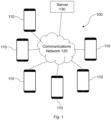
- FIG. 1 a schematic illustration of one example of a communications system 100 for group communications between communication devices 110 over a communications network 120, in accordance with the presently disclosed subject matter.
- communications system 100 includes communications network 120.
- communications network 120 can be a mobile communications network.
- the mobile communications network can be a cellular communications network.
- the mobile communications network can be a radio communications network.
- Communications system 100 further includes communication devices 110 that are connected to the communications network 120.
- Each communication device 110 is capable of transmitting and receiving communications on a communications line over the communications network 120.
- a communication that is transmitted by a given communication device 110 can be, for example, a video communication, a voice communication, or a text communication.
- the communication devices 110 can be User Equipment (UE) endpoints 110.
- UE endpoints 110 are capable of transmitting and receiving Push-to-Talk (PTT) communications.
- PTT Push-to-Talk
- the PTT communications can be transmitted and received over a cellular communications network 120, e.g. using a Push-to-Talk over Cellular (PoC) protocol (e.g., session initiation protocol (SIP), real-time transport protocol (RTP), etc.).
- a PTT app can be installed on each of the UE endpoints 110, wherein the UE endpoints 110 can utilize the PTT app to transmit and receive PTT communications over communications network 120.
- the communication devices 110 can be radios that are capable of communicating over a radio communications network 120, e.g. to transmit and receive PTT communications.
- Communications system 100 further comprises a server 130.
- Server 130 can be configured to manage the broadcasting of communications over communications network 120. Specifically, a user of a given communication device 110 can begin transmitting a communication to other communication devices 110 in communications system 100 only upon being allowed to do so by server 130. It is to be noted that server 130 can be a plurality of servers that are adapted to independently or cooperatively process data.
- a user of a given communication device 110 can transmit a communication only after he/she activates the given communication device 110 to transmit the communication and the server 130 permits the transmission of the communication.
- a user of a given communication device 110 can activate the given communication device 110 to transmit a PTT communication by performing one of the following actions: (a) pressing a PTT button that is located on or associated with the given communication device 110, or (b) toggling or otherwise activating a physical PTT switch (e.g., a hand-held switch, a foot switch, etc.) that is located on or associated with the given communication device 110.
- a physical PTT switch e.g., a hand-held switch, a foot switch, etc.
- Communications system 100 can be associated with one or more groups (not shown), each group of the groups including two or more group members.
- the groups can be PTT groups.
- the respective group members in each group are users of communication devices 110 in communications system 100.
- the group members in a respective group are entrusted with a specific mission or missions.
- the group members in a respective group are organization members of at least one organization.
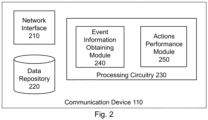
- FIG. 2 a block diagram schematically illustrating one example of a communication device 110 in communications system 100, in accordance with the presently disclosed subject matter.
- communication device 110 comprises a network interface 210 that is configured to connect the communication device 110 to communications network 120, through which the communication device 110 can communicate with other communication devices 110 in communications system 100 and with the server 130.
- the network interface 210 can be configured to enable the communication device 110 to send data and receive data sent thereto through communications network 120.
- Communication device 110 can further comprise or be otherwise associated with a data repository 220 (e.g. a database, a storage system, a memory including Read Only Memory - ROM, Random Access Memory - RAM, or any other type of memory, etc.) configured to store data.
- the data stored can include, for example, one or more of: (a) records associated with personnel in at least one organization, (b) data regarding policies or rules of at least one organization, or (c) historical data of one or more previous communications transmitted or received by the communication device 110.
- data repository 220 can be further configured to enable retrieval and/or update and/or deletion of the stored data. It is to be noted that in some cases, data repository 220 can be distributed.
- Communication device 110 further comprises a processing circuitry 230.
- Processing circuitry 230 can be one or more processing units (e.g. central processing units), microprocessors, microcontrollers (e.g. microcontroller units (MCUs)) or any other computing devices or modules, including multiple and/or parallel and/or distributed processing units, which are adapted to independently or cooperatively process data for controlling relevant communication device 110 resources and for enabling operations related to communication device 110 resources.
- processing units e.g. central processing units
- microprocessors e.g. microcontroller units (MCUs)
- MCUs microcontroller units
- Processing circuitry 230 can be configured to include an event information obtaining module 240, and, optionally, an actions performance module 250.
- Processing circuitry 230 can be configured, e.g. using event information obtaining module 240, to obtain event information regarding one or more events that are captured at the communication device 110, e.g. by a sensor that is mounted on or situated in the communication device 110.
- the event information is not based on the following event: activation of the communication device 110 by a user of the communication device 110 to transmit a communication, e.g. by the user activating a PTT button that is situated on or otherwise associated with the communication device 110, as detailed earlier herein, inter alia with reference to Fig. 1 .
- one or more actions can be performed based on the event information, automatically and without involvement of a user of the communication device 110, in response to the user activating the communication device 110 to transmit a communication.
- processing circuitry 230 can be further configured, e.g. using actions performance module 250, to perform at least one of the one or more actions based on the event information, as detailed further herein, inter alia with reference to Fig. 4 .
- server 130 can be configured to perform at least one of the one or more actions based on the event information, as detailed further herein, inter alia with reference to Figs. 3 and 5 .
- FIG. 3 a block diagram schematically illustrating one example of a server 130 in a communications system 100, in accordance with the presently disclosed subject matter.
- server 130 can be configured to include a server network interface 310 that is configured to connect the server 130 to a communications network 120, through which the server 130 can communicate with the communication devices 110 in communications system 100.
- the server network interface 310 can be configured to enable server 130 to send data and receive data sent thereto through communications network 120.
- Server 130 can further comprise or be otherwise associated with a server data repository 320 (e.g. a database, a storage system, a memory including Read Only Memory - ROM, Random Access Memory - RAM, or any other type of memory, etc.) configured to store data.
- the data stored can include, for example, one or more of: (a) records associated with personnel in at least one organization, (b) data regarding policies or rules of at least one organization, or (c) historical data of one or more previous communications transmitted or received by one or more of the communication devices 110.
- server data repository 320 can be further configured to enable retrieval and/or update and/or deletion of the stored data. It is to be noted that in some cases, server data repository 320 can be distributed.
- server processing circuitry 330 can be configured, e.g. using group initiation module 370, to initiate the groups (e.g., PTT groups) with which the given communication device 110 is expected to communicate, based on the prediction, and not responsive to a user of the given communication device 110 activating the given communication device 110 to transmit a communication (e.g., PTT communication) to the groups (e.g., PTT groups), as detailed further herein, inter alia with reference to Fig. 6 .
- groups e.g., PTT groups
- groups e.g., PTT groups
- FIG. 4 a flowchart illustrating one example of a sequence of operations performed by a given communication device 110 in a communications system 100 for facilitating a transmission of a given communication by the given communication device 110, in accordance with the presently disclosed subject matter.
- processing circuitry 230 of the given communication device 110 can be configured, e.g. using event information obtaining module 240, to obtain event information regarding one or more events that are captured at the given communication device 110, the events not including activation of the given communication device 110 by a user of the given communication device 110 to transmit the given communication (block 404).
- the events can be captured prior to, concurrent with, or following an activation of the given communication device 110 to transmit the given communication.
- the given communication device 110 can be a User Equipment (UE) endpoint.
- UE User Equipment
- the user of the given communication device 110 can activate the given communication device 110 to transmit a given PTT communication by activating a PTT button that is situated on or otherwise associated with the given communication device 110.
- a PTT button that is situated on or otherwise associated with the given communication device 110.
- the events that are captured at the given communication device 110 can include one or more of the following: (a) one or more predetermined sounds, e.g. a sound of gunfire, (b) audible content having a first decibel level greater than a predefined second decibel level; (c) a predetermined word or combination of words; or (d) human or other speech uttered at a first rate that is higher than a predefined second rate.
- a predetermined sounds e.g. a sound of gunfire
- audible content having a first decibel level greater than a predefined second decibel level
- a predetermined word or combination of words e.g. a predetermined word or combination of words
- processing circuitry 230 can be configured, e.g. using actions performance module 250, to perform one or more actions based on the obtained event information, automatically and without involvement of the user of the given communication device 110, in response to the user activating the given communication device 110 to transmit the given communication (block 408).
- the actions performed by processing circuitry 230 based on the event information can include selecting the groups (e.g., PTT groups) to which to transmit the given communication, each group of the groups including the user of the given communication device 110 and one or more other users of a corresponding one or more other communication devices 110 that communicate over communications network 120.
- the user of the given communication device 110 can transmit the given communication without selecting the groups to which to transmit the given communication, thereby reducing an amount of time required for the user to transmit the given communication, in response to the event information.
- the given communication can be a video communication, a voice communication, or a text communication.
- processing circuitry 230 can be further configured to obtain additional information, different than the event information, and wherein at least one of the actions can be performed also based on the additional information.
- At least some of the additional information can be obtained from one or more external sources, including, inter alia, server 130. Additionally, or alternatively, in some cases, at least some of the additional information can be stored in data repository 220 of the given communication device 110.
- the given communication device 110 and the other communication devices 110 in the communications system 100 that receive the given communication that is transmitted by the given communication device 110 can be used by organizational members of at least one organization.
- the additional information can include one or more of: (a) records associated with personnel in the at least one organization, or (b) data regarding policies or rules of the at least one organization.
- the additional information can inform, for each of the groups that are to receive the given communication, group members of the respective group that are on-duty and group members of the respective group that are off-duty.
- processing circuitry 230 can be configured, e.g. using actions performance module 250, to select only the group members that are on-duty to receive the given communication.
- the additional information can be a reading of a speed at which the given communication device 110 is displaced prior or concurrently to the activation of the given communication device 110 to transmit the given communication, wherein a speed of displacement of the given communication device 110 that is greater than a predetermined threshold speed may be indicative of an occurrence of an emergency situation.
- processing circuitry 230 can be configured to perform an action (e.g., select the groups to receive the given communication) based on the occurrence of an event or a group of events that are captured at the given communication device 110 and based on the speed at which the given communication device 110 is displaced.
- the additional information can be a location of the given communication device 110.
- processing circuitry 230 can be configured, for example, to select the airplane technician's group that maintains the specific aircraft to receive the given communication, in response to one or more events that are captured at the given communication device 110.
- processing circuitry 230 can be configured, for example, to select the airplane technician's team manager to receive the given communication, in response to the one or more events.
- the additional information can be historical data of one or more previous communications transmitted or received by the given communication device 110.
- processing circuitry 230 can be configured, upon the user activating the given communication device 110 on a weekday morning at 9AM, to automatically select the specific group, in response to one or more events that are captured at the given communication device 110.
- the user is saved the time required to select the specific group (he/she can simply activate the given communication device 110 without first selecting the specific group).
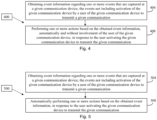
- FIG. 5 a flowchart illustrating one example of a sequence of operations performed by a server 130 in a communications system 100 for facilitating a transmission of a given communication by a given communication device 110 in the communications system 100, in accordance with the presently disclosed subject matter.
- server processing circuitry 330 of a server 130 can be configured, e.g. using server event information obtaining module 340, to obtain event information regarding one or more events that are captured at the given communication device 110, the events not including activation of the given communication device 110 by a user of the given communication device 110 to transmit the given communication (block 504).
- the events can be captured prior to, concurrent with, or following an activation of the given communication device 110 to transmit the given communication.
- the given communication device 110 can be a User Equipment (UE) endpoint.
- UE User Equipment
- the user of the given communication device 110 can activate the given communication device 110 to transmit a given PTT communication by activating a PTT button that is situated on or otherwise associated with the given communication device 110.
- a PTT button that is situated on or otherwise associated with the given communication device 110.
- the events that are captured at the given communication device 110 can include one or more of the following: (a) one or more predetermined sounds, e.g. a sound of gunfire, (b) audible content having a first decibel level greater than a predefined second decibel level; (c) a predetermined word or combination of words; or (d) human or other speech uttered at a first rate that is higher than a predefined second rate.
- a predetermined sounds e.g. a sound of gunfire
- audible content having a first decibel level greater than a predefined second decibel level
- a predetermined word or combination of words e.g. a predetermined word or combination of words
- server processing circuitry 330 can be configured, e.g. using server actions performance module 350, to automatically perform one or more actions based on the obtained event information, in response to the user activating the given communication device 110 to transmit the given communication (block 508).
- the actions performed by server processing circuitry 330 based on the event information can include selecting the groups to which to transmit the given communication. In this manner, the user of the given communication device 110 can transmit the given communication without selecting the groups to which to transmit the given communication, thereby reducing an amount of time required for the user to transmit the given communication, in response to the event information.
- the given communication can be a video communication, a voice communication, or a text communication.
- the actions performed by server processing circuitry 330 based on the event information can include bursting into at least one of the groups that has been selected, e.g. by server processing circuitry 330, as detailed in the previous paragraph, or by processing circuitry 230 of the given communication device 110, as detailed earlier herein, inter alia with reference to Fig. 4 .
- a user of the given communication device 110 can begin transmitting to the group members of the selected groups even if another communication device in at least one of the selected groups was in the process of transmitting a different communication at the time that the given communication device 110 is activated.
- Server processing circuitry 330 can be configured to perform the bursting by withdrawing the permission that it provided to the another communication device to transmit the different communication.
- server processing circuitry 330 can be further configured to obtain additional information, different than the event information, and wherein at least one of the actions can be performed also based on the additional information.
- At least some of the additional information can be obtained from one or more external sources. Additionally, or alternatively, in some cases, at least some of the additional information can be stored in server data repository 320 of the server 130.
- the given communication device 110 and the other communication devices 110 in the communications system 100 that receive the given communication that is transmitted by the given communication device 110 can be used by organizational members of at least one organization.
- the additional information can include one or more of: (a) records associated with personnel in the at least one organization, or (b) data regarding policies or rules of the at least one organization.
- the additional information can inform, for each of the groups that are to receive the given communication, group members of the respective group that are on-duty and group members of the respective group that are off-duty.
- server processing circuitry 330 can be configured, e.g. using server actions performance module 350, to select only the group members that are on-duty to receive the given communication.
- the additional information can be a reading of a speed at which the given communication device 110 is displaced prior or concurrently to the activation of the given communication device 110 to transmit the given communication, wherein a speed of displacement of the given communication device 110 that is greater than a predetermined threshold speed may be indicative of an occurrence of an emergency situation.
- server processing circuitry 330 can be configured to perform an action (e.g., burst into the groups that are to receive the given communication) based on the occurrence of an event or a group of events that are captured at the given communication device 110 and based on the speed at which the given communication device 110 is displaced.
- the events that are associated with the given communication device 110 can include events that are captured at the given communication device 110.
- the given communication device 110 can be a User Equipment (UE) endpoint.
- UE User Equipment
- the events can include a start of a work shift for a group that includes the user of the given communication device 110. Additionally, or alternatively, in some cases, the events can be captured at the given communication device 110.
- the captured events can include one or more of the following: (a) one or more predetermined sounds, e.g. a sound of gunfire, (b) audible content having a first decibel level greater than a predefined second decibel level; (c) a predetermined word or combination of words; or (d) human or other speech uttered at a first rate that is higher than a predefined second rate.
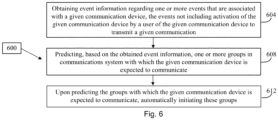
- server processing circuitry 330 can be configured, e.g. using group prediction module 360, to predict, based on the obtained event information, one or more groups in communications system 100 with which given communication device 110 is expected to communicate (block 608). Moreover, upon predicting the groups with which the given communication device 110 is expected to communicate, server processing circuitry 330 can be configured, e.g. using group initiation module 370, to automatically initiate these groups (block 612). As a result, upon a user of the given communication device 110 activating the given communication device 110 to transmit a given communication, the user can begin transmitting the given communication to group members of the predicted groups without further processing by the server 130 to initiate the predicted groups.
- server processing circuitry 330 can be configured, for example, to predict that the given communication device 110 is expected to communicate with the other users in this group. In accordance with the prediction, server processing circuitry 330 can be configured to automatically initiate the group prior to the user of the given communication device 110 activating the given communication device 110 to transmit a given communication to the members of the group.
- server processing circuitry 330 can be configured to obtain additional information, different than the event information, wherein the groups with which the given communication device 110 is expected to communicate can be predicted based on the event information and the additional information.
- At least some of the additional information can be obtained from one or more external sources. Additionally, or alternatively, in some cases, at least some of the additional information can be stored in server data repository 320 of the server 130.
- the given communication device 110 and the other communication devices 110 in communications system 100 that receive the given communication that is transmitted by the given communication device 110 can be used by organizational members of at least one organization.
- the additional information can include one or more of: (a) records associated with personnel in the at least one organization, the records not including work shift information regarding the personnel, or (b) data regarding policies or rules of the at least one organization.
- the additional information can inform, for each of the groups that are expected to receive the given communication, group members of the respective group that are on-duty and group members of the respective group that are off-duty.
- server processing circuitry 330 can be configured, e.g. using group prediction module 360, to predict that only the group members that are on-duty are expected to receive the given communication.
- Group initiation module 370 can then initiate the respective group such that only the group members that are on-duty will receive the given communication.
- the additional information can be a location of the given communication device 110.
- server processing circuitry 330 can be configured, e.g. using group prediction module 360, to predict that the airplane technician will transmit a given communication to the technician's group that is maintaining (e.g., fixing) the specific aircraft, in response to one or more events that are associated with the given communication device 110.
- Server processing circuitry 330 can then be configured, e.g. using group initiation module 370, to initiate the technician's group that is maintaining the specific aircraft.
- server processing circuitry 330 can be configured, e.g. using group prediction module 360, to predict that the airplane technician will transmit the given communication to the airplane technician's team manager, in response to one or more events that are associated with the given communication device 110. Server processing circuitry 330 can then be configured, e.g. using group initiation module 370, to initiate the technician's team manager for receiving communications from the airplane technician.
- the additional information can be historical data of one or more previous communications transmitted or received by the given communication device 110.
- server processing circuitry 330 can be configured, e.g. using group prediction module 360, to predict, prior to 9AM on a weekday morning, and in response to one or more events that are associated with the given communication device 110, that the user will transmit the given communication to the specific group at 9AM.
- Server processing circuitry 330 can then be configured, e.g. using group initiation module 370, to initiate the specific group prior to the activation of the given communication device 110 by the user of the given communication device 110 to transmit the given communication, e.g. prior to 9AM on the weekday morning.
- some of the blocks can be integrated into a consolidated block or can be broken down to a few blocks and/or other blocks may be added. Furthermore, in some cases, the blocks can be performed in a different order than described herein. It is to be further noted that some of the blocks are optional. It should be also noted that whilst the flow diagrams are described also with reference to the system elements that realize them, this is by no means binding, and the blocks can be performed by elements other than those described herein.
- system can be implemented, at least partly, as a suitably programmed computer.
- the presently disclosed subject matter contemplates a computer program being readable by a computer for executing the disclosed method.
- the presently disclosed subject matter further contemplates a machine-readable memory tangibly embodying a program of instructions executable by the machine for executing the disclosed method.
Landscapes
- Engineering & Computer Science (AREA)
- Computer Networks & Wireless Communication (AREA)
- Signal Processing (AREA)
- Multimedia (AREA)
- Telephonic Communication Services (AREA)
- Mobile Radio Communication Systems (AREA)
- Data Exchanges In Wide-Area Networks (AREA)
Applications Claiming Priority (3)
| Application Number | Priority Date | Filing Date | Title |
|---|---|---|---|
| IL280434A IL280434B (en) | 2021-01-26 | 2021-01-26 | Systems and methods for managing group communications over a communications network |
| PCT/IL2021/051528 WO2022162654A1 (en) | 2021-01-26 | 2021-12-23 | Systems and methods for managing group communications over a communications network |
| EP21922730.3A EP4278621B1 (de) | 2021-01-26 | 2021-12-23 | System und verfahren zur verwaltung von gruppenkommunikationen über ein kommunikationsnetz |
Related Parent Applications (2)
| Application Number | Title | Priority Date | Filing Date |
|---|---|---|---|
| EP21922730.3A Division EP4278621B1 (de) | 2021-01-26 | 2021-12-23 | System und verfahren zur verwaltung von gruppenkommunikationen über ein kommunikationsnetz |
| EP21922730.3A Division-Into EP4278621B1 (de) | 2021-01-26 | 2021-12-23 | System und verfahren zur verwaltung von gruppenkommunikationen über ein kommunikationsnetz |
Publications (2)
| Publication Number | Publication Date |
|---|---|
| EP4557783A2 true EP4557783A2 (de) | 2025-05-21 |
| EP4557783A3 EP4557783A3 (de) | 2025-07-09 |
Family
ID=81845590
Family Applications (2)
| Application Number | Title | Priority Date | Filing Date |
|---|---|---|---|
| EP21922730.3A Active EP4278621B1 (de) | 2021-01-26 | 2021-12-23 | System und verfahren zur verwaltung von gruppenkommunikationen über ein kommunikationsnetz |
| EP25169392.5A Pending EP4557783A3 (de) | 2021-01-26 | 2021-12-23 | System und verfahren zur verwaltung von gruppenkommunikationen über ein kommunikationsnetz |
Family Applications Before (1)
| Application Number | Title | Priority Date | Filing Date |
|---|---|---|---|
| EP21922730.3A Active EP4278621B1 (de) | 2021-01-26 | 2021-12-23 | System und verfahren zur verwaltung von gruppenkommunikationen über ein kommunikationsnetz |
Country Status (4)
| Country | Link |
|---|---|
| US (2) | US12250615B2 (de) |
| EP (2) | EP4278621B1 (de) |
| IL (1) | IL280434B (de) |
| WO (1) | WO2022162654A1 (de) |
Citations (18)
| Publication number | Priority date | Publication date | Assignee | Title |
|---|---|---|---|---|
| US20030017836A1 (en) | 2001-04-30 | 2003-01-23 | Vishwanathan Kumar K. | System and method of group calling in mobile communications |
| WO2004062306A1 (en) | 2002-12-18 | 2004-07-22 | Motorola, Inc. | Methods for reducing latency of a call set up |
| US20060116149A1 (en) | 2004-11-29 | 2006-06-01 | Kyocera Corporation | System and method for efficient push-to-talk communications |
| US20070026883A1 (en) | 2005-07-28 | 2007-02-01 | Samsung Electronics Co., Ltd. | System and method for re-invitation to push-to-talk over cellular group session |
| US20080004059A1 (en) | 2006-06-28 | 2008-01-03 | Hui Feng | System and method for push to talk direction and services |
| US7529558B1 (en) | 2005-10-11 | 2009-05-05 | Avaya Technology Corp. | System and method for location based push-to-talk |
| US20090291646A1 (en) | 2008-05-22 | 2009-11-26 | Motorola, Inc. | Multiple ptt functionality |
| US7873378B2 (en) | 2003-05-13 | 2011-01-18 | Telefonaktiebolaget Lm Ericsson (Publ) | Method of reducing delay in push-to-talk over cellular (PoC) by predicting need for connection setup |
| US20110294494A1 (en) | 2010-05-21 | 2011-12-01 | Kodiak Networks, Inc. | Predictive wakeup for push-to-talk-over-cellular (poc) call setup optimizations |
| US8249078B1 (en) | 2009-11-16 | 2012-08-21 | Sprint Spectrum L.P. | Prediction and use of call setup signaling latency for advanced wakeup and notification |
| US8532585B2 (en) | 2010-05-11 | 2013-09-10 | Harris Corporation | Electronic device with rotary knob multi-functional control |
| US20160044064A1 (en) | 2012-11-05 | 2016-02-11 | Cassidian Sas | Fast method of initializing a call for an application of ptt type on an ip-wan cellular network |
| US20160205519A1 (en) | 2015-01-14 | 2016-07-14 | Kodiak Networks Inc. | System and Method for Elastic Scaling in a Push to Talk (PTT) Platform using User Affinity Groups |
| US20170311256A1 (en) | 2016-04-22 | 2017-10-26 | Kodiak Networks Inc. | System and Method for Push-to-Talk (PTT) Key One-Touch Calling |
| WO2017212124A1 (fr) | 2016-06-09 | 2017-12-14 | Yansys | Système et procédé de communication vocale de type push-to-talk entre plusieurs utilisateurs d'un réseau de télécommunications |
| US20180288144A1 (en) | 2017-03-29 | 2018-10-04 | Microsoft Technology Licensing, Llc | Automatic group creation based on organization hierarchy |
| US20180302948A1 (en) | 2015-09-17 | 2018-10-18 | Motorola Solutions, Inc. | Rotatable push-to-talk (ptt) button for talkgroup selection and ptt communication initiation |
| KR101947012B1 (ko) | 2017-12-01 | 2019-02-12 | 박상래 | 종업원 관리를 위한 그룹 통신 시스템 및 방법 |
Family Cites Families (18)
| Publication number | Priority date | Publication date | Assignee | Title |
|---|---|---|---|---|
| US6477387B1 (en) * | 1999-10-08 | 2002-11-05 | Motorola, Inc. | Method and apparatus for automatically grouping communication units in a communication system |
| KR100640362B1 (ko) * | 2004-08-18 | 2006-10-30 | 삼성전자주식회사 | Ptt서비스 방법 |
| US20070002779A1 (en) * | 2005-06-15 | 2007-01-04 | Samsung Electronics Co., Ltd. | Method and system for providing PTT to conference |
| US9041797B2 (en) * | 2006-11-08 | 2015-05-26 | Cisco Technology, Inc. | Video controlled virtual talk groups |
| US20090098898A1 (en) * | 2007-09-24 | 2009-04-16 | Patterson Wade C | Systems and methods for communicating panic messages in wireless communication networks |
| US8195215B2 (en) | 2008-12-18 | 2012-06-05 | Motorola Solutions, Inc. | Method and system for forming a communication group for content distribution related to an event |
| US9602625B2 (en) * | 2011-02-22 | 2017-03-21 | Theatrolabs, Inc. | Mediating a communication in an observation platform |
| WO2012129784A1 (en) * | 2011-03-30 | 2012-10-04 | Motorola Solutions, Inc. | Multi-group communications and related devices |
| US8805431B2 (en) * | 2012-07-31 | 2014-08-12 | Motorola Solutions, Inc. | Apparatus and method for initiating and sharing incident information in a communication system |
| US20170265045A1 (en) * | 2014-03-24 | 2017-09-14 | Motorola Solutions, Inc | Method and apparatus for dynamic location-based group formation for ensuring required responders |
| FR3023589B1 (fr) | 2014-07-08 | 2016-08-12 | Continental Automotive France | Procede pour controler une envolee de regime d'un moteur a combustion interne d'un vehicule en deplacement, lors d'un changement de rapport de boite de vitesses |
| JP6250187B2 (ja) * | 2014-09-29 | 2017-12-20 | シャープ株式会社 | 携帯端末、携帯端末の制御方法、および制御プログラム |
| US9730026B2 (en) * | 2014-10-13 | 2017-08-08 | Motorola Solutions, Inc. | Method and apparatus for forming communication group based on location history |
| US9642131B2 (en) * | 2015-09-21 | 2017-05-02 | Taser International, Inc. | Event-based responder dispatch |
| EP3745676B1 (de) * | 2016-07-15 | 2022-04-27 | Samsung Electronics Co., Ltd. | System und verfahren zur verwaltung von audiozuschaltrichtlinien in der mcptt-kommunikation |
| US10257669B2 (en) * | 2016-12-01 | 2019-04-09 | Kodiak Networks, Inc. | PTX data analytic engine notifying group list of detected risk event |
| US11501618B1 (en) * | 2018-10-19 | 2022-11-15 | Amazon Technologies, Inc. | Security device with user-configurable motion detection settings |
| US10743170B1 (en) | 2019-11-28 | 2020-08-11 | Motorola Solutions, Inc. | Device, system and method for emergency audio transmission |
-
2021
- 2021-01-26 IL IL280434A patent/IL280434B/en unknown
- 2021-12-23 WO PCT/IL2021/051528 patent/WO2022162654A1/en not_active Ceased
- 2021-12-23 EP EP21922730.3A patent/EP4278621B1/de active Active
- 2021-12-23 EP EP25169392.5A patent/EP4557783A3/de active Pending
-
2023
- 2023-07-26 US US18/358,954 patent/US12250615B2/en active Active
-
2025
- 2025-01-19 US US19/032,069 patent/US20250168603A1/en active Pending
Patent Citations (18)
| Publication number | Priority date | Publication date | Assignee | Title |
|---|---|---|---|---|
| US20030017836A1 (en) | 2001-04-30 | 2003-01-23 | Vishwanathan Kumar K. | System and method of group calling in mobile communications |
| WO2004062306A1 (en) | 2002-12-18 | 2004-07-22 | Motorola, Inc. | Methods for reducing latency of a call set up |
| US7873378B2 (en) | 2003-05-13 | 2011-01-18 | Telefonaktiebolaget Lm Ericsson (Publ) | Method of reducing delay in push-to-talk over cellular (PoC) by predicting need for connection setup |
| US20060116149A1 (en) | 2004-11-29 | 2006-06-01 | Kyocera Corporation | System and method for efficient push-to-talk communications |
| US20070026883A1 (en) | 2005-07-28 | 2007-02-01 | Samsung Electronics Co., Ltd. | System and method for re-invitation to push-to-talk over cellular group session |
| US7529558B1 (en) | 2005-10-11 | 2009-05-05 | Avaya Technology Corp. | System and method for location based push-to-talk |
| US20080004059A1 (en) | 2006-06-28 | 2008-01-03 | Hui Feng | System and method for push to talk direction and services |
| US20090291646A1 (en) | 2008-05-22 | 2009-11-26 | Motorola, Inc. | Multiple ptt functionality |
| US8249078B1 (en) | 2009-11-16 | 2012-08-21 | Sprint Spectrum L.P. | Prediction and use of call setup signaling latency for advanced wakeup and notification |
| US8532585B2 (en) | 2010-05-11 | 2013-09-10 | Harris Corporation | Electronic device with rotary knob multi-functional control |
| US20110294494A1 (en) | 2010-05-21 | 2011-12-01 | Kodiak Networks, Inc. | Predictive wakeup for push-to-talk-over-cellular (poc) call setup optimizations |
| US20160044064A1 (en) | 2012-11-05 | 2016-02-11 | Cassidian Sas | Fast method of initializing a call for an application of ptt type on an ip-wan cellular network |
| US20160205519A1 (en) | 2015-01-14 | 2016-07-14 | Kodiak Networks Inc. | System and Method for Elastic Scaling in a Push to Talk (PTT) Platform using User Affinity Groups |
| US20180302948A1 (en) | 2015-09-17 | 2018-10-18 | Motorola Solutions, Inc. | Rotatable push-to-talk (ptt) button for talkgroup selection and ptt communication initiation |
| US20170311256A1 (en) | 2016-04-22 | 2017-10-26 | Kodiak Networks Inc. | System and Method for Push-to-Talk (PTT) Key One-Touch Calling |
| WO2017212124A1 (fr) | 2016-06-09 | 2017-12-14 | Yansys | Système et procédé de communication vocale de type push-to-talk entre plusieurs utilisateurs d'un réseau de télécommunications |
| US20180288144A1 (en) | 2017-03-29 | 2018-10-04 | Microsoft Technology Licensing, Llc | Automatic group creation based on organization hierarchy |
| KR101947012B1 (ko) | 2017-12-01 | 2019-02-12 | 박상래 | 종업원 관리를 위한 그룹 통신 시스템 및 방법 |
Non-Patent Citations (4)
| Title |
|---|
| BAEZA-YATES ET AL.: "Predicting the Next App that you are Going to Use", PROCEEDINGS OF THE EIGHTH ACM INTERNATIONAL CONFERENCE ON WEB SEARCH AND DATA MINING, February 2015 (2015-02-01), pages 285 - 294, XP059873575, DOI: 10.1145/2684822.2685302 |
| KANG ET AL.: "Call Prediction Model Based on Smartphone Users Behavior", INTERNATIONAL CONFERENCE ON HYBRID INFORMATION TECHNOLOGY, August 2012 (2012-08-01), pages 180 - 185 |
| NASIM ET AL.: "Predicting Mobile Phone Calls", TEMPORAL REGULARITY IN SOCIAL INTERACTIONS, 2015 |
| NEW PTT GROUP MANAGEMENT IN WEB ADMIN, 12 May 2019 (2019-05-12), Retrieved from the Internet <URL:https://www.grouptalk.com/news> |
Also Published As
| Publication number | Publication date |
|---|---|
| WO2022162654A1 (en) | 2022-08-04 |
| EP4557783A3 (de) | 2025-07-09 |
| EP4278621B1 (de) | 2025-06-11 |
| IL280434B (en) | 2022-06-01 |
| EP4278621C0 (de) | 2025-06-11 |
| EP4278621A1 (de) | 2023-11-22 |
| US20250168603A1 (en) | 2025-05-22 |
| EP4278621A4 (de) | 2024-07-17 |
| US12250615B2 (en) | 2025-03-11 |
| US20230370817A1 (en) | 2023-11-16 |
Similar Documents
| Publication | Publication Date | Title |
|---|---|---|
| US8744519B2 (en) | Multimodal phone data session management enhancement that alleviates dual transmission problems | |
| CN109417739B (zh) | 资源确定方法和装置 | |
| CN110786039B (zh) | 测量配置方法及装置、测量信息上报方法及装置和基站 | |
| US11792659B2 (en) | Method and device for using network slice | |
| CN109451849B (zh) | 寻呼消息发送和接收方法及装置、基站、用户设备 | |
| KR101201278B1 (ko) | 무선 통신 디바이스에서의 활성 상태 개시 | |
| KR20090031465A (ko) | 다른 무선 통신 세션을 수행하는 동안 무선 호출을 중단하기 위한 시스템 및 방법 | |
| CN115733703B (zh) | 一种多设备同步播放方法及装置 | |
| CN113783774A (zh) | 一种跨集群的网络配置方法、装置、通信设备及存储介质 | |
| CN111144953A (zh) | 一种资源分配方法、装置、设备及介质 | |
| KR100651431B1 (ko) | Ptt휴대용 단말기에서 ptt통신서비스 실행방법 | |
| US12375972B2 (en) | Method for transmitting buffer status report, electronic device and computer-readable storage medium | |
| EP4278621B1 (de) | System und verfahren zur verwaltung von gruppenkommunikationen über ein kommunikationsnetz | |
| KR20060047647A (ko) | 무선 네트워크에 있어서 공급자 서비스 이용가능성의관리를 위한 시스템 및 방법 | |
| CN114173291B (zh) | 数据处理方法和装置 | |
| US9191808B2 (en) | Method, device and system for providing presence function in enterprise mobility system | |
| CN113490284A (zh) | 调度请求方法及装置、电子设备、存储介质 | |
| CN113678503A (zh) | 一种指示方法、指示装置及存储介质 | |
| CN112235461B (zh) | 通话方法及通话装置 | |
| CN111800821A (zh) | 一种数据传输方法及设备 | |
| CN115695641A (zh) | 信息管控方法、终端及可读存储介质 | |
| WO2022237833A1 (zh) | 信息处理方法、装置、终端和网络侧设备 | |
| KR100782059B1 (ko) | 휴대단말기 및 다중 채팅방법 | |
| CN118648319A (zh) | 信息发送、接收方法和装置、通信装置及存储介质 | |
| CN113556613A (zh) | 移动终端音视频投送方法、装置、计算机设备和存储介质 |
Legal Events
| Date | Code | Title | Description |
|---|---|---|---|
| PUAI | Public reference made under article 153(3) epc to a published international application that has entered the european phase |
Free format text: ORIGINAL CODE: 0009012 |
|
| STAA | Information on the status of an ep patent application or granted ep patent |
Free format text: STATUS: THE APPLICATION HAS BEEN PUBLISHED |
|
| AC | Divisional application: reference to earlier application |
Ref document number: 4278621 Country of ref document: EP Kind code of ref document: P |
|
| AK | Designated contracting states |
Kind code of ref document: A2 Designated state(s): AL AT BE BG CH CY CZ DE DK EE ES FI FR GB GR HR HU IE IS IT LI LT LU LV MC MK MT NL NO PL PT RO RS SE SI SK SM TR |
|
| REG | Reference to a national code |
Ref country code: DE Ref legal event code: R079 Free format text: PREVIOUS MAIN CLASS: H04W0004080000 Ipc: H04W0004020000 |
|
| PUAL | Search report despatched |
Free format text: ORIGINAL CODE: 0009013 |
|
| AK | Designated contracting states |
Kind code of ref document: A3 Designated state(s): AL AT BE BG CH CY CZ DE DK EE ES FI FR GB GR HR HU IE IS IT LI LT LU LV MC MK MT NL NO PL PT RO RS SE SI SK SM TR |
|
| RIC1 | Information provided on ipc code assigned before grant |
Ipc: H04W 4/021 20180101ALN20250604BHEP Ipc: H04W 4/08 20090101ALI20250604BHEP Ipc: G06F 9/445 20180101ALI20250604BHEP Ipc: H04W 4/029 20180101ALI20250604BHEP Ipc: H04W 4/10 20090101ALI20250604BHEP Ipc: H04W 4/02 20180101AFI20250604BHEP |
|
| STAA | Information on the status of an ep patent application or granted ep patent |
Free format text: STATUS: REQUEST FOR EXAMINATION WAS MADE |
|
| 17P | Request for examination filed |
Effective date: 20260105 |