EP4557876A2 - Verfahren und vorrichtung zur schnellen aktivierung einer versorgenden zelle - Google Patents
Verfahren und vorrichtung zur schnellen aktivierung einer versorgenden zelle Download PDFInfo
- Publication number
- EP4557876A2 EP4557876A2 EP25162213.0A EP25162213A EP4557876A2 EP 4557876 A2 EP4557876 A2 EP 4557876A2 EP 25162213 A EP25162213 A EP 25162213A EP 4557876 A2 EP4557876 A2 EP 4557876A2
- Authority
- EP
- European Patent Office
- Prior art keywords
- trs
- report configuration
- csi report
- csi
- serving cell
- Prior art date
- Legal status (The legal status is an assumption and is not a legal conclusion. Google has not performed a legal analysis and makes no representation as to the accuracy of the status listed.)
- Pending
Links
Images




Classifications
-
- H—ELECTRICITY
- H04—ELECTRIC COMMUNICATION TECHNIQUE
- H04L—TRANSMISSION OF DIGITAL INFORMATION, e.g. TELEGRAPHIC COMMUNICATION
- H04L1/00—Arrangements for detecting or preventing errors in the information received
- H04L1/0001—Systems modifying transmission characteristics according to link quality, e.g. power backoff
- H04L1/0023—Systems modifying transmission characteristics according to link quality, e.g. power backoff characterised by the signalling
- H04L1/0026—Transmission of channel quality indication
-
- H—ELECTRICITY
- H04—ELECTRIC COMMUNICATION TECHNIQUE
- H04W—WIRELESS COMMUNICATION NETWORKS
- H04W24/00—Supervisory, monitoring or testing arrangements
- H04W24/10—Scheduling measurement reports ; Arrangements for measurement reports
-
- H—ELECTRICITY
- H04—ELECTRIC COMMUNICATION TECHNIQUE
- H04W—WIRELESS COMMUNICATION NETWORKS
- H04W72/00—Local resource management
- H04W72/04—Wireless resource allocation
-
- H—ELECTRICITY
- H04—ELECTRIC COMMUNICATION TECHNIQUE
- H04W—WIRELESS COMMUNICATION NETWORKS
- H04W76/00—Connection management
- H04W76/20—Manipulation of established connections
- H04W76/28—Discontinuous transmission [DTX]; Discontinuous reception [DRX]
Definitions
- the present disclosure relates to the communication field, more particularly to methods and apparatuses for fast serving cell activation.
- Dual Connectivity (DC) and Carrier Aggregation (CA) are introduced in the 3GPP Release 15 NR (new radio) standard (3GPP TS 38.331 V15.4.0) to boost data rates.
- CA Carrier Aggregation
- CG cell group
- UE user equipment
- a UE in RRC_CONNECTED state is configured with two radio links to utilize radio resources provided by two distinct schedulers, located in two different base stations connected via a non-ideal backhaul and providing either E-UTRA, i.e. if the node is an ng-eNB, or NR access, i.e. if the node is a gNB.
- a UE can be configured with a master cell group (MCG) and a secondary cell group (SCG).
- MCG master cell group
- SCG secondary cell group
- a serving cell in a cell group can be a PCell (primary cell of MCG), PSCell (primary cell of SCG), and SCell (secondary cell).
- a SCell can be in an activated state, a deactivated state or a dormant state.
- a SCell can be transited to an activated state by a MAC CE (SCell activation MAC CE), or be configured as activated by a RRC message.
- This document relates to methods, systems, and devices for fast serving cell activation.
- a method for direct and active channel state information, CSI, report configuration comprises: receiving a message containing a CSI report configuration for a serving cell at a user equipment, UE, wherein the type of the CSI report configuration is semi-persistent reporting; and activating the CSI report configuration for the serving cell by the UE when a predetermined event occurs.
- the CSI report configuration is identified by an explicit indicator or by an information element, IE, in the message (a configuration ID).
- the predetermined event is any one of: receiving a MAC CE at the UE activating a bandwidth part, BWP, for the serving cell; the UE waking up according to a discontinuous reception, DRX, configuration for the serving cell or a cell group to which the serving cell belongs; and the UE waking up according to a received wake up signal, which is used to indicate that the UE wakes up according to a DRX configuration for the serving cell or the cell group to which the serving cell belongs.
- activating the CSI report configuration is automatic upon occurrence of the predetermined event.
- the CSI report configuration further comprises reporting on PUCCH or reporting on PUSCH.
- automated and “automatically” as used herein refers to an action, e.g. activating the CSI report configuration, that is triggered by a particular event, e.g. one of the foregoing described events, without any further event, e.g. receiving MAC CE or DCI, for triggering said action occurring after said particular event.
- time domain and frequency domain resource of the PUCCH or PUSCH for CSI reporting is included in the message.
- a method for direct and active channel state information, CSI, report configuration comprises: sending a message containing a CSI report configuration for a serving cell to a user equipment, UE, for activating the CSI report configuration for the serving cell by the UE when a predetermined event occurs, wherein the type of the CSI report configuration is semi-persistent reporting.
- the CSI report configuration is identified by an explicit indicator or by an information element, IE, in the message (a configuration ID).
- the predetermined event is any one of: sending a MAC CE to the UE activating a bandwidth part, BWP, for the serving cell; sending a wake up signal to the UE to waking up the UE according to the wake up signal, which is used to indicate that the UE wakes up according to a DRX configuration for the serving cell or the cell group to which the serving cell belongs.
- activating the CSI report configuration is automatic upon occurrence of the predetermined event.
- the CSI report configuration further comprises reporting on PUCCH or reporting on PUSCH.
- the time domain and frequency domain resource of PUCCH or PUSCH for CSI reporting is included in the message.
- a method for direct and active channel state information, CSI, report configuration is provided according to an embodiment of the present disclosure, which comprises the method according to any one of the foregoing described methods for direct and active CSI report configuration.
- a method for applying channel state information, CSI, report configuration comprises: receiving a radio resource control, RRC, message at a user equipment, UE, wherein the RRC message triggers a RACH procedure; and applying CSI report configuration when during the RACH procedure a timing advanced, TA, command MAC CE.
- RRC radio resource control
- a method for applying channel state information, CSI, report configuration comprises: receiving a radio resource control, RRC, message at a user equipment, UE, wherein the RRC message triggers a RACH procedure; and applying CSI report configuration when during the RACH procedure a downlink control information, DCI, is received at the UE.
- RRC radio resource control
- DCI downlink control information
- the DCI is addressed to the UE's cell radio network temporary identifier, C-RNTI.
- the contention based RACH procedure or contention free RACH procedure is triggered by a primary cell change, a primary secondary cell change, or a secondary cell group addition.
- a method for applying channel state information, CSI, report configuration comprises: sending a radio resource control, RRC, message to a user equipment, UE, wherein the RRC message triggers any one of a contention based RACH procedure and contention free RACH procedure; and sending a timing advanced, TA, command MAC CE.
- RRC radio resource control
- a method for applying channel state information, CSI, report configuration comprises: sending a radio resource control, RRC, message to a user equipment, UE, wherein the RRC message triggers a RACH procedure; and sending a downlink control information, DCI, to the UE for applying CSI report configuration.
- RRC radio resource control
- DCI downlink control information
- the DCI is addressed to the UE's cell radio network temporary identifier, C-RNTI.
- the contention based RACH procedure or contention free RACH procedure is triggered by a primary cell change, a primary secondary cell change, or a secondary cell group addition.
- a method for applying channel state information, CSI, report configuration is provided according to an embodiment of the present disclosure, which comprises the method according to any one of the forgoing described methods for applying CSI report configuration.
- a method for stop applying channel state information, CSI, report configuration comprises: receiving a MAC control element, CE, to stop applying the CSI report configuration by a user equipment, UE; and stop applying the CSI report configuration upon reception of the MAC CE at the UE.
- the MAC CE comprises an indicator to stop appyling the CSI report configuration by the UE.
- the method comprises a further step of applying a further CSI report configuration when the UE receives a MAC CE to apply the further CSI report configuration.
- the UE after applying the CSI report configuration, the UE sends a CSI report for a serving cell to be activated to a base station, BS.
- the UE after applying the further CSI report configuration, the UE sends a CSI report for a serving cell to be activated to a base station, BS.
- the MAC CE to stop applying the CSI report configuration is received by the UE after reception of the CSI report.
- a method for stop applying channel state information, CSI, report configuration comprises: receiving a downlink control information, DCI, to stop applying the CSI report configuration by a user equipment, UE; and stop applying the CSI report configuration upon reception of the DCI at the UE.
- the DCI comprises an indicator to stop appyling the CSI report configuration by the UE.
- the method comprises a further step of applying a further CSI report configuration when the UE receives a DCI to apply the further CSI report configuration.
- the UE after applying the CSI report configuration, the UE sends a CSI report for a serving cell to be activated to a base station, BS.
- the UE after applying the further CSI report configuration, the UE sends a CSI report for a serving cell to be activated to a base station, BS.
- the DCI to stop applying the CSI report configuration is received by the UE after reception of the CSI report.
- a method for stop applying channel state information, CSI, report configuration comprises: sending a MAC control element, CE, to stop applying the CSI report configuration to a user equipment, UE, for stop applying the CSI report configuration upon reception of the MAC CE at the UE.
- the MAC CE comprises an indicator to stop applying the CSI report configuration by the UE.
- the method comprises a further step of sending a MAC CE to apply a further CSI report configuration.
- a method for stop applying channel state information, CSI, report configuration comprises: sending a downlink control information, DCI, to stop applying the CSI report configuration to a user equipment, UE, for stop applying the CSI report configuration upon reception of the DCI at the UE.
- the DCI comprises an indicator to stop applying the CSI report configuration by the UE.
- the type of the CSI report configuration is periodic or semi-persistent.
- the method further comprises receiving a CSI report for a serving cell to be activated from the UE at a base station, BS.
- the MAC CE to stop applying the CSI report configuration is send upon reception of the CSI report.
- the DCI to stop applying the CSI report configuration is send upon reception of the CSI report.
- a method for stop applying channel state information, CSI, report configuration is provided according to an embodiment of the present disclosure, which comprises any one of the foregoing described methods for stop applying CSI report configuration.
- a method for early measurement configuration comprises: receiving, by a UE, an indication to include at least one current serving cell of a cell group, which is configured to the UE when the UE is in a RRC CONNECTED state, in a measurement cell list; including of the at least one current serving cell of the cell group, which is configured to the UE when the UE is in a RRC CONNECTED state, in a measurement cell list, in accordance with the indication; and performing early measurement configuration based at least in part on the measurement cell list when the UE is in a RRC IDLE or RRC INACTIVE state.
- At least one current serving cell in the measurement cell list is initiated by receiving an indication from a base station, BS.
- At least one current serving cell in the measurement cell list is initiated by a predefined rule.
- receiving the indication from the BS comprises receiving a RRC message including an indicator.
- the indication comprises an indication of a specific RAT type serving cell which is to be included in the measurement cell list.
- the indication comprises an indication of an E-UTRA serving cell which is to be included in the measurement cell list.
- the serving cells which are to be included in the measurement cell list meet a condition, wherein the condition is at least one of: the serving cell is in an activated state when the UE receives a RRC release message; the serving cell is in a dormant state when the UE receives a RRC release message; the serving cell is in a deactivated state when the UE receives a RRC release message; the carrier frequency of the serving cell is configured as a carrier frequency for early measurement.
- a method for early measurement configuration comprises: sending an indication from a base station, BS, for including, by a user equipment, UE, at least one current serving cell of a cell group, which is configured to the UE when the UE is in a RRC CONNECTED state, in a measurement cell list and for performing early measurement configuration based at least in part on the measurement cell list when the UE is in a RRC IDLE or RRC INACTIVE state.
- sending the indication from the BS comprises sending a RRC message including an indicator.
- sending the indication from the BS comprises sending system information transmitted in the serving cell which the UE camps on.
- the indication comprises an indication of a specific RAT type serving cell which is to be included in the measurement cell list.
- the indication comprises an indication of an E-UTRA serving cell which is to be included in the measurement cell list.
- the serving cells which are to be included in the measurement cell list meet a condition, wherein the condition is at least one of: the serving cell is in an activated state when the UE receives a RRC release message; the serving cell is in a dormant state when the UE receives a RRC release message; the serving cell is in a deactivated state when the UE receives a RRC release message; the carrier frequency of the serving cell is configured as a carrier frequency for early measurement.
- the cell group comprises at least one of a master cell group, MCG, and a secondary cell group, SCG.
- a method for early measurement configuration is provided according to an embodiment of the present disclosure, which comprises any one of the foregoing described methods for early measurement configuration.
- a method for configuration of user equipment, UE, with individual measurement duration timers for performing early measurements comprises: receiving, at the UE, at least one of: a measurement duration timer parameter for inter-RAT measurements, a measurement duration timer parameter for inter-frequency measurements, a measurement duration timer parameter for NR frequency measurements, and a measurement duration timer parameter for E-UTRA frequency measurements; and configuring the UE according to the received measurement duration timer parameter(s).
- the duration timer parameter(s) define individual measurement duration parameters.
- the method further comprises starting measurement duration timer according to the received measurement duration timer parameter(s) and performing the respective early measurements while the measurement duration timer is running.
- performing the respective early measurements comprises measuring frequencies whose RAT type is different to the RAT type of the UE's current serving cell in case of inter-RAT measurements, frequencies different to the frequencies of the UE's current serving cell in case of inter-frequency measurements, and frequencies whose RAT type is NR in case of measurement on NR frequency, and frequencies whose RAT type is E-UTRA in case of measurement on E-UTRA frequency.
- a method for configuration of user equipment, UE, with individual measurement duration timers for performing early measurements comprises: sending, to the UE, at least one of: a measurement duration timer parameter for inter-RAT measurements, a measurement duration timer parameter for inter-frequency measurements, measurement duration timer parameter for NR frequency measurements, and a measurement duration timer parameter for E-UTRA frequency measurements for configuring the UE according to the received measurement duration timer parameter(s).
- the duration timer parameter(s) define individual measurement duration parameters.
- a method for configuration of user equipment, UE, with individual measurement duration timers for performing early measurements is provided according to an embodiment of the present disclosure, which comprises any one of the foregoing described methods for configuration of UE with individual measurement duration timers for performing early measurements.
- a method for time-frequency synchronization signaling in SCell activation comprises: receiving a message configuring a tracking reference signal, TRS, resource for SCell activation; and configuring TRS for SCell activation as the time frequency synchronization signal.
- the message is a RRC reconfiguration message.
- the message configures at least one of a periodic TRS resource, a semi-persistent TRS resource, and an aperiodic TRS resource.
- a method for time-frequency synchronization signaling in SCell activation comprises: sending a message configuring a tracking reference signal, TRS, resource for SCell activation for configuring TRS for SCell activation as the time frequency synchronization signal.
- the message is a RRC reconfiguration message.
- the message configures at least one of a periodic TRS resource, a semi-persistent TRS resource, and an aperiodic TRS resource.
- a method for time-frequency synchronization signaling in SCell activation is provided according to an embodiment of the present disclosure, which comprises any of the foregoing described methods for time-frequency synchronization signaling in SCell activation.
- a method for fast serving cell activation is provided according to an embodiment of the present disclosure, which comprises any of the foregoing described methods.
- An apparatus for direct and active channel state information, CSI, report configuration comprises: a receiver configured to receive a message containing the CSI report configuration for a serving cell; and a processor configured to activate the CSI report configuration for the serving cell when a predetermined event occurs, wherein the type of the CSI report configuration is semi-persistent reporting.
- An apparatus for direct and active channel state information, CSI, report configuration comprises: a transmitter configured to transmit a message containing the CSI report configuration for a serving cell for activating the CSI report configuration for the serving cell when a predetermined event occurs at a user equipment, UE, wherein the type of the CSI report configuration is semi-persistent reporting.
- a system for direct and active channel state information, CSI, report configuration is provided according to an embodiment of the present disclosure, which comprises any one of the foregoing described apparatuses for direct and active CSI report configuration.
- An apparatus for applying channel state information, CSI, report configuration comprises: a receiver configured to receive a radio resource control, RRC, message at the apparatus, wherein the RRC message triggers a RACH procedure; and a processor configured to apply CSI report configuration when during the RACH procedure a timing advanced, TA, command MAC CE is received at the apparatus.
- RRC radio resource control
- An apparatus for applying channel state information, CSI, report configuration comprises: a receiver configured to receive a radio resource control, RRC, message at the apparatus, wherein the RRC message triggers a RACH procedure; and a processor configured to apply CSI report configuration when during the RACH procedure a downlink control information, DCI, is received at the apparatus.
- RRC radio resource control
- DCI downlink control information
- An apparatus for applying channel state information, CSI, report configuration comprises: a transmitter configured to transmit a radio resource control, RRC, message to a user equipment, UE, wherein the RRC message triggers a RACH procedure for applying CSI report configuration when during the RACH procedure a timing advanced, TA, command MAC CE is received at the UE.
- RRC radio resource control
- An apparatus for applying channel state information, CSI, report configuration comprises: a transmitter configured to transmit a radio resource control, RRC, message to a user equipment, UE, wherein the RRC message triggers a RACH procedure for applying CSI report configuration when during the RACH procedure a downlink control information, DCI, is received at the apparatus.
- RRC radio resource control
- a system for applying channel state information, CSI, report configuration is provided according to an embodiment of the present disclosure, which comprises any one of the foregoing described apparatuses for applying CSI report configuration.
- An apparatus for stop applying channel state information, CSI, report configuration comprises: a receiver configured to receive a MAC control element, CE, to stop applying the CSI report configuration; and a processor configured to stop applying the CSI report configuration upon receipt of the MAC CE.
- An apparatus for stop applying channel state information, CSI, report configuration comprising: a receiver configured to receive a downlink control information, DCI, to stop applying the CSI report configuration; and a processor configured to stop applying the CSI report configuration upon receipt of the DCI.
- An apparatus for stop applying channel state information, CSI, report configuration comprises: a transmitter configured to transmit a MAC control element, CE, to stop applying the CSI report configuration for stop applying the CSI report configuration upon reception of the MAC CE at a user equipment, UE.
- An apparatus for stop applying channel state information, CSI, report configuration comprises: a transmitter configured to transmit a downlink control information, DCI, to stop applying the CSI report configuration for stop applying the CSI report configuration upon reception of the DCI at a user equipment, UE.
- a system for stop applying channel state information, CSI, report configuration is provided according to an embodiment of the present disclosure, which comprises any one of the foregoing described apparatuses for stop applying CSI report configuration.
- An apparatus for early measurement configuration comprises: a receiver configured to receive an indication to include at least one current serving cell of a cell group, which is configured to the apparatus when the apparatus is in a RRC CONNECTED state, in a measurement cell list; and a processor configured to include the at least one current serving cell of the cell group, which is configured to the apparatus when the apparatus is in a RRC CONNECTED state, in a measurement cell list, in accordance with the indication; and to perform early measurement configuration based at least in part on the measurement cell list when the UE is in a RRC IDLE or RRC INACTIVE state.
- An apparatus for early measurement configuration comprises: a transmitter configured to transmit an indication from the apparatus, for including, by a user equipment, UE, at least one current serving cell of a cell group, which is configured to the UE when the UE is in a RRC CONNECTED state, in a measurement cell list and for performing early measurement configuration based at least in part on the measurement cell list when the UE is in a RRC IDLE or RRC INACTIVE state.
- a system for early measurement configuration is provided according to an embodiment of the present disclosure, which comprises any one of the foregoing described apparatuses for early measurement configuration.
- An apparatus for configuration of user equipment, UE, with individual measurement duration timers for performing early measurements comprises: a receiver configured to receive at least one of: a measurement duration timer parameter for inter-RAT measurements, a measurement duration timer parameter for inter-frequency measurements, a measurement duration timer parameter for NR frequency measurements, and a measurement duration timer parameter for E-UTRA frequency measurements; and a processor configured to configure the apparatus according to the received measurement duration timer parameter(s).
- the duration timer parameter(s) define individual measurement duration parameters.
- An apparatus for configuration of user equipment, UE, with individual measurement duration timers for performing early measurements comprises: a transmitter configured to transmit at least one of: a measurement duration timer parameter for inter-RAT measurements, a measurement duration timer parameter for inter-frequency measurements, a measurement duration timer parameter for NR frequency measurements, and a measurement duration timer parameter for E-UTRA frequency measurements for a UE to configure the UE according to the received measurement duration timer parameter(s).
- the duration timer parameter(s) define individual measurement duration parameters.
- a system for configuration of user equipment, UE, with individual measurement duration timers for performing early measurements is provided according to an embodiment of the present disclosure, which comprises any one of the foregoing described apparatuses for configuration of UE with individual measurements duration timers.
- An apparatus for time-frequency synchronization signaling in SCell activation comprises: a receiver configured to receive a message configuring a tracking reference signal, TRS, resource for SCell activation; and a processor configured to configure TRS for SCell activation as the time frequency synchronization signal.
- the message is a RRC reconfiguration message.
- the message configures at least one of a periodic TRS resource, a semi-persistent TRS resource, and an aperiodic TRS resource.
- An apparatus for time-frequency synchronization signaling in SCell activation comprises: a transmitter configured to transmit a message configuring a tracking reference signal, TRS, resource for SCell activation for configuring TRS for SCell activation as the time frequency synchronization signal.
- TRS tracking reference signal
- the message is a RRC reconfiguration message.
- the message configures at least one of a periodic TRS resource, a semi-persistent TRS resource, and an aperiodic TRS resource.
- a system for time-frequency synchronization signaling in SCell activation is provided according to an embodiment of the present disclosure, which comprises any of the foregoing described apparatuses for time-frequency synchronization signaling in SCell activation.
- An apparatus for fast serving cell activation comprises: a receiver and a processor configured to implement any of the foregoing described methods that comprise receiving steps.
- An apparatus for fast serving cell activation comprises: a transmitter configured to implement any one of the foregoing described methods that comprise sending steps.
- a system for fast serving cell activation is provided according to an embodiment of the present disclosure, which comprises any one of the foregoing described apparatuses for fast serving cell activation.
- any of the foregoing described apparatuses or systems not explicitly described as comprising a processor may be provided with such a processor to implement any of the foregoing described method features.
- a storage medium for storing a program, is provided according to an embodiment of the present disclosure, wherein the program when executed performs any one of the foregoing described methods.
- a processor for executing a program, is provided according to an embodiment of the present disclosure, wherein the program when executed performs any one of the foregoing described methods.
- a wireless communications apparatus is provided according to an embodiment of the present disclosure, which comprises a processor and a memory, wherein the processor is configured to implement any of the foregoing described methods comprising reception steps.
- a base station apparatus is provided according to an embodiment of the present disclosure, which comprises a processor and a memory, wherein the processor is configured to implement any of the foregoing described methods comprising sending steps.
- a system is provided according to an embodiment of the present disclosure, which comprises the foregoing described wireless communications apparatus and the base station apparatus.
- a system is provided according to an embodiment of the present disclosure, which is configured to carry out any of the foregoing described methods.
- a computer program product is provided according to an embodiment of the present disclosure, which comprises a computer-readable program medium code stored thereupon, the code, when executed by a processor, causing the processor to implement any of the foregoing described methods.
- CSI report configuration refers to channel quality information (CQI) report and the respective configuration.
- CQI channel quality information
- the respective embodiments are also directed to CQI report (configuration), which is either contained in CSI report (configuration) or provided as a separate CQI report (configuration).
- CSI report configuration may also refer to short period CSI report configuration according to preferred embodiments of the present disclosure.
- the embodiments relating to direct and active channel state information, CSI, report configuration may provide increased speed of CSI report configuration and CSI reporting after wake up of the UE from DRX sleep duration.
- the embodiments relating to applying channel state information, CSI, report configuration may provide short period CSI from the time the message is received and may provide collision free CSI report configuration when a RACH procedure is executed.
- the embodiments relating to stop applying channel state information, CSI, report configuration may provide saving of power consumption.
- the embodiments relating to early measurement configuration may provide saving signaling overhead.
- the embodiments relating to configuration of user equipment, UE, with individual measurement duration timers for performing early measurements may provide reduced power consumption of the UE.
- Embodiments of the present disclosure provide a mobile communication network (including but not limited to 5G network), the network structure of the network may include a network-side device (e.g., base station (BS) and a terminal (e.g., user equipment (UE) to be described in more detail below.
- a network-side device e.g., base station (BS)
- a terminal e.g., user equipment (UE) to be described in more detail below.
- BS base station
- UE user equipment
- a CSI report comprises CQI.
- CQI report it may relate to the CQI report comprised within the respective CSI report.
- a prior art method for a short period CQI report configuration can be configured to a UE as illustrated.
- the short period CQI report configuration has a shorter periodicity of uplink resources for CQI report than normal periodic CQI report configuration.
- the UE applies the configured short period CQI report configuration when it activates a SCell after it receives a SCell activation MAC CE or a RRC reconfiguration message which configures a SCell in an activated state.
- the UE can speed up CQI reporting with this shorter period CQI reporting configuration, and the BS can start to schedule on the to be activated SCell with shorter delay after the BS indicates to the UE to activate a SCell.
- the UE applies configured short period CQI reporting configuration during a predefined period of time, e.g. in LTE from n+8 (ms) to n+34 (ms), where n is the subframe where the SCell activation MAC CE is received, or the last subframe containing the RRC message which configures a SCell in an activated state.
- CSI reporting methods In prior NR technology, four types of CSI reporting methods are defined. Namely, periodic CSI report on PUCCH, semi persistent CSI report on PUCCH, semi persistent CSI report on PUSCH, and aperiodic CSI report.
- the UE reports CSI measurement results on configured periodic PUCCH resources periodically.
- the UE is configured with periodic CSI reporting resources which is activated or deactivated by a MAC CE (for semi persistent CSI report on PUCCH) or a DCI (for semi-persistent CSI report on PUSCH).
- the BS can also transmit a DCI to trigger an aperiodic CSI report.
- Periodic CSI reporting is configured by a RRC message, and the UE applies periodic CSI report configuration when the corresponding serving cell is in an active state.
- short period CQI reporting in the prior art is also a kind of periodic reporting method.
- FIG. 2 shows a signaling chart of a method for stop applying CSI report configuration.
- the BS sends a message containing a CSI report configuration for a serving cell to the UE.
- the UE receives the message containing the CSI report configuration for a serving cell at the UE.
- the UE activates the CSI report configuration for the serving cell by the UE when a predetermined event occurs.
- the type of the CSI report configuration is semi-persistent reporting.
- the BS configures a first CSI report configuration for a serving cell via a RRC message to the UE.
- the BS differentiates the first CSI report configuration from other CSI report configuration by either including an explicit indicator for the first CSI report configuration, or by including an IE which value is the ID of the first CSI report configuration (CSI-ReportConfigId).
- the UE activates the first CSI report configuration for the serving cell in following cases:
- the CSI report configuration further comprises reporting on PUCCH or PUSCH, and the UE activates the CSI report configuration automatically upon the cases listed above, without explicit MAC CE or DCI transmitted from the BS.
- time domain and frequency domain resource for CSI report on PUCCH is also configured in the RRC message.
- a BWP ID is included in the RRC message. This BWP ID is used to indicate an uplink BWP which is associated with the PUCCH resources used for this CSI reporting.
- time domain and frequency domain resource for CSI report on PUSCH are also configured in the RRC message.
- the BS also indicates the time duration in which the semi persistent CSI report configuration is applied.
- the BS indicates the time duration by indicating the length of the time duration.
- the BS also indicates the time point when UE starts to apply the fist CSI report configuration.
- the indicated time point may be an offset value from when the RRC message is received.
- this embodiment introduces in a RRC message an indicator to a CSI report configuration, or an IE to indicate which CSI report configuration should be activated/applied during activation procedure of the corresponding serving cell.
- the UE applies short period CQI report configuration from n+8 ms, where n is the last subframe containing the PDU of the RRC messages.
- the problem of this approach is that it does not consider the time needed for RACH procedure which is triggered by the RRC message. If the RRC message triggers a handover (PCell change), or SN change (PSCell change), or SCG addition, a RACH procedure may be triggered to accomplish time alignment.
- the problem is that the time used for the RACH procedure and the time used to finish RACH-less handover is uncertain. It could be long due to RACH collision or interference.
- the UE may not have enough time to apply the short period CSI or CQI report configuration, because the RACH procedure or RACH-less procedure occupies the predefined time duration.
- FIG. 3 shows a signaling chart of a method for applying CSI report configuration according to a preferred embodiment of the present disclosure.
- FIG. 4 shows a signaling chart of a method for applying CSI report configuration according to another preferred embodiment of the present disclosure.
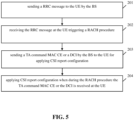
- FIG. 5 shows a flow chart of a method for applying CSI report configuration according to Figs. 3 and 4 .
- the BS sends a RRC message to the UE.
- the UE receives the RRC message triggering a RACH procedure, e.g. a contention based RACH procedure or a contention free RACH.
- the BS sends a TA command MAC CE (Time Advance command) or a DCI which is addressed to the UE (i.e. the DCI is scrambled with C-RNTI allocated to the UE)
- the UE applies CSI report configuration upon reception of the TA command MAC CE or the DCI at the UE.
- the UE applies the configured short period CSI or CQI report configuration.
- UE For the cases where contention based RACH procedure is triggered, including PCell change, PSCell change, SCG addition, UE performs one of following actions:
- UE For cases where contention free RACH procedure is triggered, including PCell change, PSCell change, SCG addition, UE performs the following action.
- a TA command MAC CE is received during RACH procedure performed on a first serving cell, for the serving cells which belong to the same TA group as the first serving cell, the UE starts to apply short period CSI or CQI report configuration configured for these serving cells (cf. Fig. 3 ).
- the UE applies short period CSI or CQI report configuration from the time when a TA command MAC CE is received or contention resolution is accomplished.
- the second embodiment of the present disclosure avoids cases where the UE does not have enough time to apply short period CSI or CQI report configuration for serving cells due to uncertainty of RACH procedure delay.
- a UE if a UE is configured with a short period CSI or CQI report configuration, it applies the short period CSI automatically for the corresponding serving cell within a period of time, i.e. n+8 ms to n+34 ms, where n is the subframe in which the MAC CE used to activate the serving cell, or the subframe which contains the last PDU of a RRC message the configure the serving cell as activated (cf. Fig. 1 ).
- the time duration in which the UE applies the short period CSI report configuration will be much longer. This is because more delay will be needed to activate a NR serving cell. The delay is used for UE to get ready for PDCCH monitoring, uplink transmission, perform CSI measurement, etc.
- this delay may vary dramatically for different frequency band, SMTC configuration of the serving cell and the timing relationship between the next occasion of SSB duration of the serving cell and the time when UE starts to activate the serving cell.
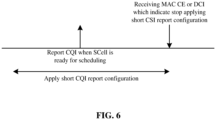
- the UE applies short period CSI report configuration in order to report CSI as soon as possible when the serving cell to be activated is ready for scheduling and the BS can start to schedule on this serving cell according to the received CSI report.
- the short period CSI report configuration for a long time after the UE has already transmitted a CSI report and data scheduling has begun.
- FIG. 6 shows a signaling chart of a method for stop applying CSI report configuration according to a preferred embodiment of the present disclosure.
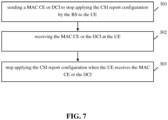
- FIG. 7 shows a flow chart of a method for stop applying CSI report configuration according to Fig. 6 .
- the BS sends a MAC CE or DCI to stop applying the CSI report configuration to the UE.
- the UE receives the MAC CE or the DCI.
- the UE stops applying the CSI report configuration when the UE receives the MAC CE or the DCI.
- the third embodiment of the present disclosure aims to optimize the above mentioned drawbacks of the prior art by following methods.
- the BS transmits a MAC CE or a DCI to indicate the UE to stop applying a first short period CSI report configuration or first short period CQI report configuration for a serving cell.
- the UE On reception of the MAC CE or DCI, the UE stops applying the first CSI report configuration or the first CQI report configuration.
- the first short period CSI report configuration is configured for a NR serving cell.
- the first CSI report configuration can be periodic or semi-persistent report type.
- the first short period CQI report configuration is configured for an E-UTRA or LTE serving cell.
- the first CQI report configuration can be periodic or semi-persistent report type.
- the first CSI report configuration or the first CQI report configuration is applied by the UE during a SCell activation procedure, i.e. UE starts to apply the first CSI report configuration or CQI report configuration after it receives a SCell activation MAC CE or a RRC message which configures the SCell in an activated state.
- the first CSI report configuration or the first CQI report configuration is applied by the UE according to a predefined time duration during the SCell activation procedure.
- the UE on reception of the MAC CE or DCI, the UE begins to apply a second CSI report configuration or a second CQI report configuration.
- the second CSI report configuration or the second CQI report configuration may be periodic report type.
- the BS transmits the MAC CE or DCI after it receives a valid CSI report for the serving cell to be activated.
- the BS can stop applying short period CSI report configuration by explicit signaling. Therefore, unnecessary UE power consumption is saved when the SCell is already being scheduling.
- a UE can be configured with early measurement configuration when it is released to RRC IDLE state, or when it is suspended to RRC INACTIVE state.
- UE applies measurements according to configured early measurement configuration when it is in RRC IDLE or RRC INACTIVE state.
- the network node base station, BS
- the BS can configure radio resources according to the early measurement results to speed up the configuration.
- a UE may be configured with CA or DC when it is in RRC CONNECTED state.
- CA When a UE is configured with CA, it is configured with a group serving cells which are aggregated as a cell group.
- a UE can be configured with DC which means it is configured with more than one cell groups, wherein one is called MCG and another is called SCG.
- the early measurement configuration may contain the following information: at least one carrier frequency and at least one of the following parameters corresponding to the at least one carrier frequency: a carrier frequency information, an allowed measurement bandwidth, a measurement cell list, a validity area, frequency band information, a report quantity, and a quality threshold value.
- the measurement cell list indicates a list of cells which the UE is requested to measure and report during an early measurement.
- the report quantity indicates which measurement quantity the UE is requested to report in an early measurement report.
- the quality threshold indicates a quality threshold for reporting an early measurement in a measurement cell.
- the first message further comprises a duration for performing an early measurement.
- BS wants to configure the UE to perform measurement on these serving cells, it can include the cell ID of these cells in the early measurement configuration which is configured to the UE.
- FIG. 8 shows a flow chart of a method for early measurement configuration according to a preferred embodiment of the present disclosure.
- the BS sends an indication to the UE to include at least one current serving cell of a cell group, e.g. a MCG and/or SCG, in a measurement cell list.
- the UE receives the indication.
- the UE includes of the at least one current serving cell of the cell group, which is configured to the UE when the UE is in a RRC CONNECTED state, in a measurement cell list, in accordance with the received indication.
- the UE performs early measurement configuration based at least in part on the measurement cell list when the UE is in a RRC IDLE or RRC INACTIVE state.
- the fourth embodiment of the present disclosure it is beneficial to let UE perform early measurement on the serving cell(s) which is/are configured to the UE when it is in RRC CONNECTED state.
- UE When UE is transited to RRC CONNECTED state, it can report the measurement results on these serving cell(s) as soon as possible.
- the UE includes all or part of serving cells of MCG and/or SCG which are configured to the UE when it is in RRC CONNECTED and before it is transited to RRC IDLE or RRC INACTIVE state as part of the measurement cell list. UE does so according to BS indication or according to predefined rules specified in protocol.
- Said indication can be defined as one of following:
- serving cells which are to be included as part of the measurement cell list may meet at least one of following conditions:
- the UE includes all or part of its serving cells configured in RRC CONNECTED state in the early measurement configuration, performs early measurement on these cells, and report measurement results for these cells.
- the UE includes a serving cell in the measurement cell list of the carrier frequency on which the serving cell is located, or in the measurement cell list of the frequency band on which the serving cell is located. For example, a serving cell is located on carrier frequency f1, then UE includes the serving cell in the measurement cell list configured for the carrier frequency f1.
- explicit signaling is needed to configure cell ID of a serving cell in the early measurement configuration carried in the RRC message which is transmitted from BS to UE.
- only one or a few bits are needed to indicate whether UE includes the configured serving cells as part of early measurement.
- the saved signaling size can be significant by employing the solution according to the fourth embodiment of the present disclosure.
- the UE when a UE is configured to perform early measurement in RRC IDLE state, the UE is configured with a measurement duration timer parameter which is called measIdleDuration. That is, UE starts a timer called T331 according to said parameter when it receives a RRC release message, which configures the UE with early measurement configuration. Before this timer expires, the UE performs measurements according to the configured early measurement configuration.
- the early measurement configuration may contain measurement configuration for more than one RAT types. For example, when a UE is released to RRC IDLE state from a NR cell, it may be configured with early measurement configuration for a list of NR frequency, and a list of E-UTRA frequency. Then when UE is RRC IDLE and before configured measurement duration timer (T331) expires, the UE performs early measurements on both NR frequencies and E-UTRA frequencies. When this measurement duration timer expires, the UE may stop performing measurements and discards the measurement results.
- T331 configured measurement duration timer
- the UE performs early measurements for intra-RAT frequency and inter-RAT frequency with the same time duration length. This is not beneficial for UE power consumption.
- the UE will adjust its receiver. This extra action will increase complexity and cause more power consumption than intra-RAT measurements.
- FIG. 9 shows a flow chart of a method for configuration of a UE with individual measurement duration timers for performing early measurements according to a preferred embodiment of the present disclosure.
- the BS sends, to the UE, at least one of a measurement duration timer parameter for inter-RAT measurements, a measurement duration timer parameter for inter-frequency measurements, a measurement duration timer parameter for NR frequency measurements, and a measurement duration timer parameter for E-UTRA frequency measurements.
- the UE receives the measurement duration timer parameter(s).
- the UE configures itself according to the received measurement duration timer parameter(s).
- the aforementioned measurement duration timer parameters may be set individually.
- separate early measurement duration parameters are defined to implement a finer granularity control on UE behavior.
- UE may be configured by BS with an early measurement duration parameter for inter-RAT measurement.
- UE starts a timer whose length is set according to this parameter.
- this timer is running, UE performs early measurement on the configured frequencies whose RAT type is different to the RAT type of UE's current serving cell.
- UE may be configured by BS with an early measurement duration parameter for inter-frequency measurement.
- UE starts a timer whose length is set according to this parameter.
- this timer is running, UE performs early measurement on inter-frequency frequencies (the frequency which is of different frequency to that of UE's current serving cell).
- UE may be configured by BS with early measurement duration parameters for NR frequency and E-UTRA frequency, respectively.
- UE starts timers whose lengths are set according to these parameters, respectively.
- timers are set according to these parameters, respectively.
- UE performs early measurement on the configured frequencies whose RAT type is the same as the RAT type associated with the timer. For example, when measurement duration timer for NR frequency is running, UE performs early measurement on NR frequencies.
- the BS can control UE behavior of early measurement with fine granularity.
- To configure different measurement duration timer lengths can optimize power consumption of the UE
- FIG. 10 shows an example of flow chart of a method for time-frequency synchronization signaling in SCell activation according to a preferred embodiment of the present disclosure.
- the BS sends, to the UE, a message configuring a tracking reference signal, TRS, resource for SCell activation for configuring TRS for SCell activation as the time frequency synchronization signal.
- the UE receives the message for configuring the TRS resource for SCell activation.
- the UE configures the TRS for SCell activation as the time frequency synchronization signal.
- TRS refers to CSI-RS for tracking, which is configured by higher layer UE specific configuration of a NZP-CSI-RS-ResourceSet configured with higher layer parameter trs-Info.
- the time-frequency synchronization delay is the main factor affecting SCell activation delay. So reducing the delay for acquiring time-frequency synchronization can significantly reduce the SCell activation delay.
- TRS can be configured for each SCell as the time-frequency synchronization signal to acquire faster time-frequency synchronization.
- Alt. 1 Periodic TRS resource for SCell can be configured via RRC reconfiguration message.
- the UE receives MAC CE or RRC signaling for SCell activation, the UE can detect the TRS according to configured offset and periodicity, similar to the process for SSB detection.
- the BS transmits TRS according to the configured offset and periodicity.
- TTRS is the time to acquire TRS.
- the maximum of TTRS is a periodicity of TRS resource.
- Tothers is the time for other processes related to SCell activation, including HARQ processing or RRC processing time, CSI report processing time, RF re-tuning time, L2 parsing time, AGC adjustment time, and so on.
- Alt. 2 Semi-persistent TRS resource for SCell can be configured via RRC reconfiguration message.
- the semi-persistent TRS can be triggered via MAC CE or a DCI as well.
- the RRC signaling is used to activate SCell, the semi-persistent TRS can be triggered by DCI with receiving RRC signaling, or be triggered by the RRC signaling which indicates the UE to activate configure semi-persistent TRS resource. Then the UE can detect the semi-persistent TRS in slot n1+X, if the TRS is triggered in slot n1.
- X is the offset according to configuration by RRC message (indicated in periodicityAndOffset), or defined by protocol, which can be considered as TTRS. So upon receiving SCell activation command in slot n, the SCell shall be activated in slot n+X+Tothers.
- Aperiodic TRS resource for SCell can be configured via RRC reconfiguration message.
- the aperiodic TRS can be triggered by DCI with the RRC signaling.
- the MAC CE is used to activate SCell, the aperiodic TRS can be triggered by DCI through cross-carrier scheduling, or a MAC CE. Then the UE can detect the aperiodic TRS in slot n1+X, if the TRS is triggered in slot n1.
- X is the offset configured by RRC message (indicated in aperiodicTriggeringOffset), or defined by protocol, which can be considered as TTRS.
- the SCell Upon receiving SCell activation command in slot n, the SCell shall be activated in slot n+K+X+Tothers.
- K is the timing for cross-carrier scheduling.
- the BS transmits TRS with a power which has a fix relationship with the power used for transmitting SSB or PDCCH in the same cell or in the same BWP.
- the BS indicates the transmission power of the TRS to the UE, by indicating the power value, or the power offset to the transmission of SSB or PDCCH of the same cell or same beam.
- early measurement configuration may also be called idle measurement configuration or inactive measurement configuration.
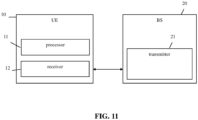
- FIG. 10 shows a schematic diagram illustrating the configuration of a system including a UE 10 and a BS 20 according to embodiments of the present disclosure.
- the UE 10 comprises a processor 11 and a receiver 12.
- the processor 11 may implement any one of the foregoing described steps of the first to fifth embodiments on the UE 10.
- the receiver 12 may receive any of the foregoing described signals of the first to fifth embodiments at the UE 10.
- the BS 20 comprises a transmitter, which may transmit any of the foregoing described signals of the first to fifth embodiments from the BS 20.
- system as illustrated in Fig. 10 may implement any of the foregoing described methods according to the preferred embodiments 1 to 5.
- the UE When receiving a MAC CE or a RRC reconfiguration message for SCell activation, the UE uses reference SCells' SSB, CSI-RS, or TRS (CSI-RS for tracking) for time-frequency synchronization or AGC adjustment for this SCell.
- SCells' SSB, CSI-RS, or TRS CSI-RS for tracking
- the antenna ports of the SCell to be activated and the reference cell are quasi co-location.
- the BS configures reference information for a SCell via a RRC reconfiguration message.
- the reference information is used to help UE to detect SSB CSI-RS, or TRS in a reference cell for the SCell to be activated.
- the reference information includes at least one of following parameters:
- the UE performs time-frequency synchronization by perform the following steps:
- the UE performs AGC adjustment by perform following steps:
- the UE can use reference signals transmitted in another serving cell to accomplish time-frequency synchronization, or AGC adjustment. This is beneficial in reduction of SCell activation.
- UE has to accomplish time-frequency synchronization and AGC before activating PDCCH monitoring on the SCell to be activate.
- UE performs these functions by reading SSB or other references transmitted on the SCell to be activated. If the period of these reference signals is too long, the SCell activation delay will be large accordingly.
- the delay may be reduced because UE has more frequency reference signals for time-frequency synchronization and AGC adjustment in effect.
- both the UE and the BS can be provided as separate units or in combination with each other as a system.
- the method according to the above embodiment can be implemented by means of software plus a necessary general hardware platform, and of course, can also be through hardware, but in many cases the former is a better implementation.
- the technical solution of the present invention which is essential or contributes to the prior art, may be embodied in the form of a software product stored in a storage medium (such as ROM/RAM, disk, the optical disc), and may include a number of instructions for causing a terminal device (which may be a cell phone, a computer, a server, or a network device, etc.) to perform the methods described in various embodiments of the present invention.
- modules or steps of the present invention described above can be implemented by a general-purpose computing device, which can be centralized on a single computing device or distributed across a network of multiple computing devices.
- they may be implemented in program code executable by a computing device such that they may be stored in a storage device for execution by the computing device and, in some cases, may differ from this.
- the steps shown or described are performed sequentially, or they are separately fabricated into individual integrated circuit modules, or a plurality of modules or steps thereof are fabricated as a single integrated circuit module.
- the invention is not limited to any specific combination of hardware and software.
Landscapes
- Engineering & Computer Science (AREA)
- Computer Networks & Wireless Communication (AREA)
- Signal Processing (AREA)
- Quality & Reliability (AREA)
- Mobile Radio Communication Systems (AREA)
Priority Applications (1)
| Application Number | Priority Date | Filing Date | Title |
|---|---|---|---|
| EP25162213.0A EP4557876A3 (de) | 2019-03-28 | 2019-03-28 | Verfahren und vorrichtung zur schnellen aktivierung einer versorgenden zelle |
Applications Claiming Priority (3)
| Application Number | Priority Date | Filing Date | Title |
|---|---|---|---|
| EP25162213.0A EP4557876A3 (de) | 2019-03-28 | 2019-03-28 | Verfahren und vorrichtung zur schnellen aktivierung einer versorgenden zelle |
| EP19921505.4A EP3949588B1 (de) | 2019-03-28 | 2019-03-28 | Verfahren und vorrichtung zur schnellen aktivierung einer versorgenden zelle |
| PCT/CN2019/080239 WO2020191764A1 (en) | 2019-03-28 | 2019-03-28 | Method and apparatus for fast serving cell activation |
Related Parent Applications (1)
| Application Number | Title | Priority Date | Filing Date |
|---|---|---|---|
| EP19921505.4A Division EP3949588B1 (de) | 2019-03-28 | 2019-03-28 | Verfahren und vorrichtung zur schnellen aktivierung einer versorgenden zelle |
Publications (2)
| Publication Number | Publication Date |
|---|---|
| EP4557876A2 true EP4557876A2 (de) | 2025-05-21 |
| EP4557876A3 EP4557876A3 (de) | 2025-07-23 |
Family
ID=72608867
Family Applications (2)
| Application Number | Title | Priority Date | Filing Date |
|---|---|---|---|
| EP19921505.4A Active EP3949588B1 (de) | 2019-03-28 | 2019-03-28 | Verfahren und vorrichtung zur schnellen aktivierung einer versorgenden zelle |
| EP25162213.0A Pending EP4557876A3 (de) | 2019-03-28 | 2019-03-28 | Verfahren und vorrichtung zur schnellen aktivierung einer versorgenden zelle |
Family Applications Before (1)
| Application Number | Title | Priority Date | Filing Date |
|---|---|---|---|
| EP19921505.4A Active EP3949588B1 (de) | 2019-03-28 | 2019-03-28 | Verfahren und vorrichtung zur schnellen aktivierung einer versorgenden zelle |
Country Status (4)
| Country | Link |
|---|---|
| US (2) | US12096263B2 (de) |
| EP (2) | EP3949588B1 (de) |
| CN (2) | CN113647170B (de) |
| WO (1) | WO2020191764A1 (de) |
Families Citing this family (22)
| Publication number | Priority date | Publication date | Assignee | Title |
|---|---|---|---|---|
| US11705949B2 (en) * | 2020-04-24 | 2023-07-18 | Qualcomm Incorporated | Techniques for channel state information report transmission triggered by negative acknowledgment (NACK) |
| WO2022082399A1 (zh) * | 2020-10-19 | 2022-04-28 | 北京小米移动软件有限公司 | 通信方法、设备以及存储介质 |
| KR20220053273A (ko) * | 2020-10-22 | 2022-04-29 | 삼성전자주식회사 | 무선 통신 시스템에서 셀 활성화 방법 및 장치 |
| JP7612012B2 (ja) * | 2020-10-22 | 2025-01-10 | オッポ広東移動通信有限公司 | セカンダリセルをアクティブ化する方法、装置、デバイス及び記憶媒体 |
| US11805451B2 (en) * | 2021-01-08 | 2023-10-31 | Qualcomm Incorporated | Fast SCell activation |
| WO2022151066A1 (zh) * | 2021-01-13 | 2022-07-21 | 华为技术有限公司 | 一种通信方法及装置 |
| US11419042B2 (en) | 2021-01-13 | 2022-08-16 | PanPsy Technologies, LLC | Enhanced secondary cell activation |
| CN116783839A (zh) * | 2021-01-14 | 2023-09-19 | 瑞典爱立信有限公司 | 早期测量中的针对服务小区的波束级报告 |
| CN116830655A (zh) * | 2021-01-15 | 2023-09-29 | 苹果公司 | 基于触发消息的与PSCell的切换 |
| WO2022151634A1 (en) * | 2021-01-15 | 2022-07-21 | Apple Inc. | Scell management in wireless communication |
| CN117158081A (zh) * | 2021-04-14 | 2023-12-01 | 高通股份有限公司 | 用于使用临时参考信号的直接副蜂窝小区激活的技术 |
| KR20220158978A (ko) * | 2021-05-25 | 2022-12-02 | 삼성전자주식회사 | 측정에 의한 전력 소모를 줄이기 위한 전자 장치 및 그의 동작 방법 |
| EP4406320A4 (de) * | 2021-09-24 | 2025-06-18 | Apple Inc. | Verfahren zur uplink-steuerkanalträgerumschaltung |
| WO2023062509A1 (en) * | 2021-10-15 | 2023-04-20 | Telefonaktiebolaget Lm Ericsson (Publ) | Temporary reference signal-based secondary cell activation via radio resource control |
| WO2023130320A1 (en) * | 2022-01-06 | 2023-07-13 | Apple Inc. | Fast direct scell activation |
| CN118872332A (zh) * | 2022-02-11 | 2024-10-29 | 苹果公司 | 新空口中辅小区激活期间的改进的参考信号测量机制 |
| KR20250005140A (ko) * | 2022-04-22 | 2025-01-09 | 지티이 코포레이션 | 보다 하위 계층 시그널링에 기초하여 고속 이동성을 수행하기 위한 방법 및 시스템 |
| CN119138058A (zh) * | 2022-04-27 | 2024-12-13 | 苹果公司 | Rach过程期间的早期csi报告 |
| US12507109B2 (en) * | 2022-09-29 | 2025-12-23 | Qualcomm Incorporated | Cell activation procedures |
| CN120153692A (zh) * | 2022-11-04 | 2025-06-13 | 苹果公司 | 用于执行信道状态信息(csi)报告激活或去激活规程的终端、系统和方法 |
| WO2025065607A1 (zh) * | 2023-09-28 | 2025-04-03 | 北京小米移动软件有限公司 | 信道状态信息csi报告配置激活方法、通信设备以及存储介质 |
| WO2025236394A1 (en) * | 2024-07-16 | 2025-11-20 | Zte Corporation | Configuration of user equipment-initiated or event-driven beam reporting in wireless networks |
Family Cites Families (14)
| Publication number | Priority date | Publication date | Assignee | Title |
|---|---|---|---|---|
| EP2522095A2 (de) * | 2010-01-08 | 2012-11-14 | InterDigital Patent Holdings, Inc. | Übertragung von kanalzustandsinformationen für mehrere träger |
| CN103580742B (zh) * | 2012-08-03 | 2019-03-29 | 上海诺基亚贝尔股份有限公司 | 控制csi报告的方法及装置 |
| US9674727B2 (en) * | 2014-01-17 | 2017-06-06 | Qualcomm Incorporated | Indication of cell mode and CSI feedback rules for cell on-off procedure |
| GB2522673B (en) * | 2014-01-31 | 2016-08-03 | Samsung Electronics Co Ltd | Method and apparatus for implementing dual connectivity |
| JP6523250B2 (ja) * | 2014-03-20 | 2019-05-29 | シャープ株式会社 | 端末装置、および、基地局装置 |
| WO2018143702A1 (en) * | 2017-02-01 | 2018-08-09 | Samsung Electronics Co., Ltd. | Apparatus and method for beam management in wireless communication systems |
| CN108574521B (zh) * | 2017-03-10 | 2021-03-19 | 上海诺基亚贝尔股份有限公司 | 用于mimo通信的方法和设备 |
| CN120692671A (zh) * | 2017-03-24 | 2025-09-23 | 北京三星通信技术研究有限公司 | 半静态资源调度方法、功率控制方法及相应用户设备 |
| WO2019017751A1 (ko) * | 2017-07-21 | 2019-01-24 | 엘지전자 주식회사 | 무선 통신 시스템에서 채널 상태 정보 참조 신호를 송수신하는 방법 및 이를 위한 장치 |
| US10686574B2 (en) * | 2017-08-17 | 2020-06-16 | Industrial Technology Research Institute | Methods and apparatus for indicating a radio resource to a receiver in a wireless communication system |
| US10601483B2 (en) * | 2017-09-29 | 2020-03-24 | Apple Inc. | Channel state information (CSI) reporting for bandwidth parts |
| US11456830B2 (en) * | 2018-01-09 | 2022-09-27 | Qualcomm Incorporated | Aperiod tracking reference signal |
| KR102645643B1 (ko) * | 2018-05-21 | 2024-03-11 | 삼성전자 주식회사 | 무선 통신 시스템을 위한 기준 신호 송수신 방법 및 장치 |
| JP7207951B2 (ja) * | 2018-11-01 | 2023-01-18 | シャープ株式会社 | 端末装置、および、方法 |
-
2019
- 2019-03-28 CN CN201980094971.8A patent/CN113647170B/zh active Active
- 2019-03-28 EP EP19921505.4A patent/EP3949588B1/de active Active
- 2019-03-28 WO PCT/CN2019/080239 patent/WO2020191764A1/en not_active Ceased
- 2019-03-28 EP EP25162213.0A patent/EP4557876A3/de active Pending
- 2019-03-28 CN CN202511966734.XA patent/CN121728583A/zh active Pending
-
2021
- 2021-09-27 US US17/486,494 patent/US12096263B2/en active Active
-
2024
- 2024-08-08 US US18/797,692 patent/US20240397365A1/en active Pending
Also Published As
| Publication number | Publication date |
|---|---|
| EP4557876A3 (de) | 2025-07-23 |
| CN113647170B (zh) | 2025-11-25 |
| US12096263B2 (en) | 2024-09-17 |
| US20240397365A1 (en) | 2024-11-28 |
| CN121728583A (zh) | 2026-03-24 |
| US20220086676A1 (en) | 2022-03-17 |
| WO2020191764A1 (en) | 2020-10-01 |
| EP3949588A1 (de) | 2022-02-09 |
| CN113647170A (zh) | 2021-11-12 |
| EP3949588A4 (de) | 2022-06-22 |
| EP3949588B1 (de) | 2025-04-02 |
Similar Documents
| Publication | Publication Date | Title |
|---|---|---|
| US12096263B2 (en) | Method and apparatus for fast serving cell activation | |
| CN110012499B (zh) | 用于控制SCell状态的方法及其装置 | |
| US12127224B2 (en) | Serving cell state management | |
| JP2022166328A (ja) | コンポーネント・キャリアを監視および処理するための方法および装置 | |
| KR101984848B1 (ko) | Lte 라이센스 지원형 액세스 동작에서의 drx 핸들링 | |
| CA2951893C (en) | Discontinuous reception method, mobile station, base station and wireless communication system | |
| EP4164318A1 (de) | Vorrichtung und verfahren zur strahlausfallwiederherstellung in einem drahtlosen kommunikationssystem | |
| US20180103424A1 (en) | System and Method for Activating and Deactivating Multiple Secondary Cells | |
| US12477618B2 (en) | Signal reception method and terminal device | |
| JP7681733B2 (ja) | 基準信号の伝送方法及び機器 | |
| US20240121798A1 (en) | Methods, apparatus and systems for a control channel monitoring procedure | |
| WO2018196520A1 (zh) | 一种波束管理方法及终端设备、网络设备 | |
| RU2770462C1 (ru) | Сигнал энергосбережения и разработка процедуры | |
| CN117042161A (zh) | 确定传输时隙的方法、装置、用户设备和存储介质 | |
| US20240098540A1 (en) | Activation/deactivation of preconfigured measurement gaps | |
| US20230318784A1 (en) | Wireless communication method and device | |
| CN118235490A (zh) | 用于移动性增强的测量和上报 | |
| CN117528722A (zh) | 发送节能信号的方法、配置方法、装置及设备 | |
| US11224089B2 (en) | Measurement procedure for unlicensed band operations | |
| KR20230043124A (ko) | 무선 통신 디바이스 측정을 향상시키는 방법 | |
| WO2022147770A1 (en) | Method and apparatus for monitoring physical downlink control channels | |
| US12284608B2 (en) | Reference signaling design and configuration | |
| CN114557003A (zh) | 辅小区的状态控制 | |
| RU2794203C2 (ru) | Пользовательское оборудование, задействованное в энергосбережении | |
| CN110234135B (zh) | 使用单射频进行数据传输的方法、装置及用户设备 |
Legal Events
| Date | Code | Title | Description |
|---|---|---|---|
| PUAI | Public reference made under article 153(3) epc to a published international application that has entered the european phase |
Free format text: ORIGINAL CODE: 0009012 |
|
| STAA | Information on the status of an ep patent application or granted ep patent |
Free format text: STATUS: THE APPLICATION HAS BEEN PUBLISHED |
|
| AC | Divisional application: reference to earlier application |
Ref document number: 3949588 Country of ref document: EP Kind code of ref document: P |
|
| AK | Designated contracting states |
Kind code of ref document: A2 Designated state(s): AL AT BE BG CH CY CZ DE DK EE ES FI FR GB GR HR HU IE IS IT LI LT LU LV MC MK MT NL NO PL PT RO RS SE SI SK SM TR |
|
| REG | Reference to a national code |
Ref country code: DE Ref legal event code: R079 Free format text: PREVIOUS MAIN CLASS: H04W0076280000 Ipc: H04L0001000000 |
|
| PUAL | Search report despatched |
Free format text: ORIGINAL CODE: 0009013 |
|
| AK | Designated contracting states |
Kind code of ref document: A3 Designated state(s): AL AT BE BG CH CY CZ DE DK EE ES FI FR GB GR HR HU IE IS IT LI LT LU LV MC MK MT NL NO PL PT RO RS SE SI SK SM TR |
|
| RIC1 | Information provided on ipc code assigned before grant |
Ipc: H04L 1/00 20060101AFI20250618BHEP Ipc: H04W 76/28 20180101ALN20250618BHEP |
|
| STAA | Information on the status of an ep patent application or granted ep patent |
Free format text: STATUS: REQUEST FOR EXAMINATION WAS MADE |
|
| 17P | Request for examination filed |
Effective date: 20260120 |