EP4559341A2 - Chirurgisches bekleidungssystem - Google Patents
Chirurgisches bekleidungssystem Download PDFInfo
- Publication number
- EP4559341A2 EP4559341A2 EP24214213.1A EP24214213A EP4559341A2 EP 4559341 A2 EP4559341 A2 EP 4559341A2 EP 24214213 A EP24214213 A EP 24214213A EP 4559341 A2 EP4559341 A2 EP 4559341A2
- Authority
- EP
- European Patent Office
- Prior art keywords
- surgical
- garment
- helmet
- face shield
- fabric
- Prior art date
- Legal status (The legal status is an assumption and is not a legal conclusion. Google has not performed a legal analysis and makes no representation as to the accuracy of the status listed.)
- Pending
Links
Images

Classifications
-
- A—HUMAN NECESSITIES
- A41—WEARING APPAREL
- A41D—OUTERWEAR; PROTECTIVE GARMENTS; ACCESSORIES
- A41D13/00—Professional, industrial or sporting protective garments, e.g. surgeons' gowns or garments protecting against blows or punches
- A41D13/12—Surgeons' or patients' gowns or dresses
- A41D13/1209—Surgeons' gowns or dresses
- A41D13/1218—Surgeons' gowns or dresses with head or face protection
-
- A—HUMAN NECESSITIES
- A42—HEADWEAR
- A42B—HATS; HEAD COVERINGS
- A42B3/00—Helmets; Helmet covers ; Other protective head coverings
- A42B3/04—Parts, details or accessories of helmets
- A42B3/28—Ventilating arrangements
- A42B3/286—Ventilating arrangements with forced flow, e.g. by a fan
-
- A—HUMAN NECESSITIES
- A41—WEARING APPAREL
- A41D—OUTERWEAR; PROTECTIVE GARMENTS; ACCESSORIES
- A41D13/00—Professional, industrial or sporting protective garments, e.g. surgeons' gowns or garments protecting against blows or punches
- A41D13/002—Professional, industrial or sporting protective garments, e.g. surgeons' gowns or garments protecting against blows or punches with controlled internal environment
- A41D13/0025—Professional, industrial or sporting protective garments, e.g. surgeons' gowns or garments protecting against blows or punches with controlled internal environment by means of forced air circulation
-
- A—HUMAN NECESSITIES
- A41—WEARING APPAREL
- A41D—OUTERWEAR; PROTECTIVE GARMENTS; ACCESSORIES
- A41D13/00—Professional, industrial or sporting protective garments, e.g. surgeons' gowns or garments protecting against blows or punches
- A41D13/05—Professional, industrial or sporting protective garments, e.g. surgeons' gowns or garments protecting against blows or punches protecting only a particular body part
- A41D13/11—Protective face masks, e.g. for surgical use, or for use in foul atmospheres
- A41D13/1107—Protective face masks, e.g. for surgical use, or for use in foul atmospheres characterised by their shape
- A41D13/1153—Protective face masks, e.g. for surgical use, or for use in foul atmospheres characterised by their shape with a hood
-
- A—HUMAN NECESSITIES
- A41—WEARING APPAREL
- A41D—OUTERWEAR; PROTECTIVE GARMENTS; ACCESSORIES
- A41D13/00—Professional, industrial or sporting protective garments, e.g. surgeons' gowns or garments protecting against blows or punches
- A41D13/05—Professional, industrial or sporting protective garments, e.g. surgeons' gowns or garments protecting against blows or punches protecting only a particular body part
- A41D13/11—Protective face masks, e.g. for surgical use, or for use in foul atmospheres
- A41D13/1184—Protective face masks, e.g. for surgical use, or for use in foul atmospheres with protection for the eyes, e.g. using shield or visor
-
- A—HUMAN NECESSITIES
- A41—WEARING APPAREL
- A41D—OUTERWEAR; PROTECTIVE GARMENTS; ACCESSORIES
- A41D27/00—Details of garments or of their making
-
- A—HUMAN NECESSITIES
- A41—WEARING APPAREL
- A41D—OUTERWEAR; PROTECTIVE GARMENTS; ACCESSORIES
- A41D31/00—Materials specially adapted for outerwear
- A41D31/04—Materials specially adapted for outerwear characterised by special function or use
- A41D31/26—Electrically protective, e.g. preventing static electricity or electric shock
-
- A—HUMAN NECESSITIES
- A41—WEARING APPAREL
- A41D—OUTERWEAR; PROTECTIVE GARMENTS; ACCESSORIES
- A41D31/00—Materials specially adapted for outerwear
- A41D31/04—Materials specially adapted for outerwear characterised by special function or use
- A41D31/30—Antimicrobial, e.g. antibacterial
-
- A—HUMAN NECESSITIES
- A41—WEARING APPAREL
- A41D—OUTERWEAR; PROTECTIVE GARMENTS; ACCESSORIES
- A41D2400/00—Functions or special features of garments
- A41D2400/70—Removability
Definitions
- the present disclosure relates generally to a surgical apparel system.
- the surgical apparel system comprises a surgical garment assembly that may be configured for attachment to a surgical helmet, wherein the surgical garment assembly can be employed to provide a barrier between an individual wearing the system and the surrounding environment.
- An exemplary configuration provides a surgical apparel system including a helmet that may also include a ventilation assembly.
- the helmet also includes a controller electrically connected to the ventilation assembly and a first helmet terminal and a second helmet terminal, each of the first and second helmet terminals electrically connected to the controller.
- the system also includes a surgical garment configured to be at least partially disposed over the helmet.
- the surgical garment may include a transparent face shield and a surgical fabric coupled to the transparent face shield, the surgical fabric having a first filter efficiency.
- the surgical garment also includes a first garment terminal, a second garment terminal and a conductor forming an electrical connection between the first and second garment terminals.
- the system may be configured where each of the first and second garment terminals removably engage the first and second helmet terminals to form a circuit between the helmet and the surgical garment.
- the system also includes a sensor in communication with the controller, the sensor configured to detect an electrical parameter of the conductor associated first and second garment terminals.
- the controller is configured to control an operational characteristic of the ventilation assembly based on electrical parameter of the conductor detected by the sensor.
- a surgical apparel system also includes a helmet that may include a ventilation assembly.
- the helmet also includes a controller electrically connected to the ventilation assembly.
- the helmet also includes a first coupling member and a second coupling member, each of the first and second coupling members formed from one of a ferromagnetic material or magnetic material.
- the system also includes a surgical garment configured to be at least partially disposed over the helmet.
- the surgical garment may include a transparent face shield and a surgical fabric coupled to the transparent face shield.
- the surgical garment may also include a first attachment element and a second attachment formed from the other of the magnetic material or ferromagnetic material.
- the surgical garment may include a conductor forming an electrical connection between the first and second attachment elements, the conductor configured to define an electrical resistance.
- the system is configured where the first and second attachment elements removably engage the first and second coupling members of the helmet to form a circuit between the helmet and the surgical garment.
- the controller is configured to control an operational characteristic of the ventilation assembly based on the resistance of the conductor when the circuit between the helmet and the surgical garment is closed.
- a surgical apparel system also includes a helmet that may include a ventilation assembly.
- the system also includes a controller electrically connected to the ventilation assembly.
- the system also includes a first coupling member, a second coupling member, and a third coupling member, each of the coupling members formed from one of a ferromagnetic material or magnetic material.
- the system also includes a surgical garment configured to be at least partially disposed over the helmet, the surgical garment may include a transparent face shield.
- the system also includes a surgical fabric coupled to the transparent face shield, the surgical fabric having a first filter efficiency.
- the system also includes a first attachment element, a second attachment, and a third attachment element, each of the attachment elements formed from the other of the magnetic material or ferromagnetic material.
- the system also includes a conductor forming an electrical connection between the first attachment element and one of the second attachment element or the third attachment element.
- the system also includes where each of the first, second, and third attachment elements are configured to removably engage one of the first, second, and third coupling members of the helmet to removably couple the surgical garment to the helmet such that the conductor forms an electrical circuit between the helmet and the surgical garment when the surgical garment is coupled to the helmet.
- the system also includes where the controller is configured operate the ventilation assembly at a first operational characteristic/setting when the conductor forms an electrical connection between the first attachment element and the second attachment element, and the surgical garment is coupled to the helmet forming/closing the electrical circuit between the helmet and the surgical garment.
- the system also includes where the controller is configured operate the ventilation assembly at a second operational characteristic/setting when the conductor forms an electrical connection between the first attachment element and the third attachment element, and the surgical garment is coupled to the helmet forming/closing the electrical circuit between the helmet and the surgical garment.
- a surgical apparel system also includes a helmet that may include a ventilation assembly.
- the helmet also includes a controller electrically connected to the ventilation assembly.
- the helmet also includes a first coupling member, a second coupling member, and a third coupling member, each of the coupling members formed from one of a ferromagnetic material or magnetic material.
- the system also includes a surgical garment configured to be at least partially disposed over the helmet, the surgical garment may include a transparent face shield.
- the surgical garment may also include a surgical fabric coupled to the transparent face shield, the surgical fabric having a first filter efficiency.
- the surgical garment also includes a first attachment element, a second attachment, and a third attachment element, each of the attachment elements formed from the other of the magnetic material or ferromagnetic material.
- the surgical garment also includes a conductor forming an electrical connection between the first attachment element and at least one of the second attachment element and the third attachment element.
- the system also includes where each of the first, second, and third attachment elements are configured to removably engage one of the first, second, and third coupling members of the helmet to removably couple the surgical garment to the helmet such that the conductor forms an electrical circuit between the helmet and the surgical garment when the surgical garment is coupled to the helmet.
- the controller is configured operate the ventilation assembly at a first operational characteristic/setting when the conductor forms an electrical connection between the first attachment element and the second attachment element, and the surgical garment is coupled to the helmet forming the electrical circuit between the helmet and the surgical garment.
- the system also includes where the controller is configured operate the ventilation assembly at a second operational characteristic/setting when the conductor forms an electrical connection between the first attachment element and the third attachment element, and the surgical garment is coupled to the helmet forming the electrical circuit between the helmet and the surgical garment.
- the system also includes where the controller is configured operate the ventilation assembly at a third operational characteristic/setting when the conductor forms an electrical connection between the first attachment element and both of the second and third attachment elements, and the surgical garment is coupled to the helmet forming the electrical circuit between the helmet and the surgical garment.
- a surgical apparel system also includes a helmet that may include a ventilation assembly.
- the helmet also includes a controller electrically connected to the ventilation assembly.
- the helmet also includes a first coupling member and a second coupling member, each of the coupling members formed from one of a ferromagnetic material or magnetic material.
- the system also includes a first surgical garment for use with the helmet.
- the first surgical garment may include a first transparent face shield.
- the first surgical garment also includes a first surgical fabric coupled to the first transparent face shield, the first surgical fabric having a first filter efficiency.
- the first surgical garment also includes a first attachment element and a second attachment element formed from the other of the magnetic material or ferromagnetic material and configured to removably engage the first and second coupling members of the helmet.
- the first surgical garment also includes a conductor forming an electrical connection between the first and second attachment elements.
- the system also includes a second surgical garment for use with the helmet, the second surgical garment may include a second transparent face shield.
- the second surgical garment also includes a second surgical fabric coupled to the second transparent face shield, the second surgical fabric having a second filter efficiency.
- the second surgical garment also includes a third attachment element and a fourth attachment element formed from the other of the magnetic material or ferromagnetic material and configured to removably engage the first and second coupling members of the helmet.
- the system also includes where the conductor of the first surgical garment is configured to form a closed circuit between the helmet and the first surgical garment when the first and second attachment elements engage the first and second coupling members of the helmet.
- the system also includes where the second surgical garment is configured to form an open circuit between the helmet and the second surgical garment when the third and fourth attachment elements engage the first and second coupling members of the helmet.
- the system also includes where the controller is configured to operate the ventilation assembly at a first operational characteristic/setting when there is a closed circuit between the helmet and the first surgical garment and is configured operate the ventilation assembly at a second operational characteristic/setting when there is an open circuit between the helmet and the second surgical garment.
- a surgical apparel system also includes a helmet that may include a ventilation assembly.
- the helmet also includes a controller electrically connected to the ventilation assembly.
- the helmet also includes a first coupling member and a second coupling member, each of the coupling members formed from one of a ferromagnetic material or magnetic material.
- the system also includes a first surgical garment for use with the helmet, the first surgical garment may include a first transparent face shield.
- the first surgical garment also includes a first surgical fabric coupled to the first transparent face shield, the first surgical fabric having a first filter efficiency.
- the first surgical garment also includes a first attachment element and a second attachment element formed from the other of the magnetic material or ferromagnetic material and configured to removably engage the first and second coupling members of the helmet.
- the first surgical garment also includes a first conductor forming an electrical connection between the first and second attachment elements, the first conductor defining a first electrical resistance.
- the system also includes a second surgical garment for use with the helmet, the second surgical garment may include a second transparent face shield.
- the second surgical garment also includes a second surgical fabric coupled to the second transparent face shield, the second surgical fabric having a second filter efficiency.
- the second surgical garment also includes a third attachment element and a fourth attachment element formed from the other of the magnetic material or ferromagnetic material and configured to removably engage the first and second coupling members of the helmet.
- the second surgical garment also includes a second conductor forming an electrical connection between the third and fourth attachment elements, the second conductor defining a second electrical resistance.
- the system also includes where each of the first and second conductors are configured to form circuit between the helmet and the first surgical garment or the second surgical garment when the attachment elements engage the first and second coupling members of the helmet.
- the system also includes where the controller is configured operate the ventilation assembly at a first operational characteristic/setting when the circuit may include the first conductor having a first electrical resistance and is configured operate the ventilation assembly at a second operational characteristic/setting when the circuit may include the second conductor having a second electrical resistance.
- a surgical apparel system also includes a helmet that may include a ventilation assembly.
- the helmet also includes a controller electrically connected to the ventilation assembly.
- the helmet also includes a first coupling member and a second coupling member, each of the coupling members formed from one of a ferromagnetic material or magnetic material.
- the system also includes a first surgical garment for use with the helmet, the first surgical garment may include a first transparent face shield.
- the first surgical garment also includes a first surgical fabric coupled to the first transparent face shield, the first surgical fabric having a first filter efficiency.
- the first surgical garment also includes a first attachment element and a second attachment element formed from the other of the magnetic material or ferromagnetic material and configured to removably engage the first and second coupling members of the helmet.
- the first surgical garment also includes a first conductor forming an electrical connection between the first and second attachment elements, the first conductor defining a first electrical resistance.
- the system also includes a second surgical garment for use with the helmet, the second surgical garment may include a second transparent face shield.
- the second surgical garment also includes a second surgical fabric coupled to the second transparent face shield, the second surgical fabric having a second filter efficiency.
- the second surgical garment also includes a third attachment element and a fourth attachment element formed from the other of the magnetic material or ferromagnetic material and configured to removably engage the first and second coupling members of the helmet.
- the second surgical garment also includes a second conductor forming an electrical connection between the third and fourth attachment elements, the second conductor defining a second electrical resistance.
- the system also includes where each of the first and second conductors are configured to form circuit between the helmet and the first surgical garment or the second surgical garment when the attachment elements engage the first and second coupling members of the helmet.
- the system also includes where the controller is configured operate the ventilation assembly at a first operational characteristic/setting or a second operational characteristic/setting based on the electrical resistance across the conductor when the circuit between the helmet and the first or second surgical garment is closed/formed.
- a surgical apparel system for use with a surgical helmet including a ventilation assembly.
- the surgical apparel system also includes a first surgical garment, the first surgical garment may include a first transparent face shield.
- the first surgical garment also includes a first surgical fabric coupled to the first transparent face shield, the first surgical fabric having a first filter efficiency.
- the first surgical garment also includes a first attachment element and a second attachment element formed from the other of the magnetic material or ferromagnetic material.
- the first surgical garment also includes a first conductor forming an electrical connection between the first and second attachment elements.
- the system also includes a second surgical garment that may include a second transparent face shield.
- the second surgical garment also includes a second surgical fabric coupled to the second transparent face shield, the second surgical fabric having a second filter efficiency.
- the second surgical garment also includes a third attachment element and a fourth attachment element formed from the other of the magnetic material or ferromagnetic material.
- the second surgical garment also includes a second conductor forming an electrical connection between the third and fourth attachment elements.
- a surgical apparel system for use with a surgical helmet including a ventilation assembly.
- the surgical apparel system also includes a first surgical garment that may include a first transparent face shield.
- the first surgical garment also includes a first surgical fabric coupled to the first transparent face shield, the first surgical fabric having a first filter efficiency.
- the first surgical garment also includes a first attachment element and a second attachment element formed from the other of the magnetic material or ferromagnetic material.
- the first surgical garment also includes a first conductor forming an electrical connection between the first and second attachment elements, the conductor defining a first electrical resistance.
- the system also includes a second surgical garment that may include a second transparent face shield.
- the second surgical garment also includes a second surgical fabric coupled to the second transparent face shield, the second surgical fabric having a second filter efficiency.
- the second surgical garment also includes a third attachment element and a fourth attachment element formed from the other of the magnetic material or ferromagnetic material.
- the second surgical garment also includes a second conductor forming an electrical connection between the third and fourth attachment elements, the conductor defining a second electrical resistance.
- a healthcare provider may wear an assembly known as a surgical apparel system, such as the surgical apparel system 10 illustrated in Figure 1 .
- the surgical apparel system 110 may comprise a surgical garment assembly comprising a surgical garment 112 configured for attachment to a surgical helmet 120.
- the garment is separable and may be independent of the surgical helmet 120.
- the surgical garment 112 is configured to provide a barrier, such as a microbial barrier, between the wearer and the surrounding environment.
- the barrier created by the surgical garment 112 may benefit both the wearer and the patient.
- the barrier provided by the surgical garment 112 may substantially eliminate the likelihood that the wearer may come into contact with fluid or solid particles of matter from the patient that may be generated during the course of a surgical procedure.
- the barrier may substantially prevent the transfer of any foreign particles emitted by the wearer from being transferred to the patient during the surgical procedure.
- the surgical garment 112 may include a surgical fabric 114 configured to cover the surgical helmet 120 and at least a portion of the head of the wearer.
- the surgical garment 112 may be configured as a hood, as illustrated in Figure 1 .
- a hood 112 refers to a surgical garment 112 that covers the head and likely only extends a short distance below the neck when worn by the wearer.
- the surgical garment 112 may be configured as a toga, a shirt, or a jacket.
- a toga 112 refers to a surgical garment 112 that covers the head in the same manner as a hood and extends to at least the waist when worn by the wearer.
- the surgical garment 112 may be manufactured from any suitable surgical fabric 114 or combinations of fabrics to help repel and/or absorb water, debris and other contaminants.
- the surgical fabric 114 may include multiple layers. One such layer may be a microporous film that allows gas to pass through the fabric while still maintaining the microbial barrier.
- the surgical fabric 114 is one that satisfies the ASTM F1670-98 standard for blood penetration resistance and/or the ASTM F1671-97B standard for viral penetration resistance.
- the surgical fabric 114 of the surgical garment 112 has a pore size in the approximate range of 0.5 to 0.20 microns. However, other pore sizes for the surgical fabric 114 are also contemplated.
- the surgical garment 112 may be constructed of multiple different fabrics coupled to one another to define the barrier.
- the surgical garment 112 may be primarily constructed from a barrier surgical fabric 114 and a filter fabric 116.
- the filter fabric 116 may be more permeable, and hence more breathable, than the barrier surgical fabric 114 described above.
- the filter fabric 116 may be located in an area with a reduced risk of having a microbial particle cross the barrier, such as above the wearer's head or proximate to the crown of the wearer's head, and configured to aid in the circulation of air through the barrier.
- the barrier surgical fabric 114 may be attached to the filter fabric 16 using any suitable means, such as adhesive, sewing, welding, or a combination thereof.
- the surgical garment 112 may further comprise a face shield 118.
- the face shield 118 portion of the surgical garment 112 allows the wearer to see through the barrier provided by the surgical garment 112.
- the face shield 118 is generally a sheet-like structure and may have a thickness of approximately 1 mm or less.
- the face shield 118 may be mounted and/or attached to an opening or cut-out formed in the surgical fabric 114 of the surgical garment 112.
- the surgical fabric 114 may be attached around the periphery or edge of the face shield 118 by sewing, snaps, hook and loop, adhesive, welding, or combinations thereof.
- the face shield 118 may be constructed from a transparent material, such as a polycarbonate.
- a polycarbonate is sold under the trademark LEXAN TM by Sabic.
- the face shield 118 of the surgical garment 112 may also be tinted to protect the wearer's eyes from heightened exposure to bright lights. Furthermore, the face shield 118 may be flexible such that the face shield 118 may be curved to accommodate different head sizes as will be described below.
- the surgical garment 112 may also include one or more attachment elements 158 positioned about the surgical garment 112.
- the attachment elements 158 may also be referred to as a garment fastener, garment terminals, or the like.
- the attachment elements 158 are configured to releasably secure the surgical garment 112 to the surgical helmet 120.
- the attachment elements 158 may also be configured to define an electrical connection between the surgical garment 112 to the surgical helmet 120, as will be described in more detail below.
- the attachment elements 158 may take any suitable form, and may comprise metal tacks, rivets, buttons, magnets, hook and loop, snaps, or similar types of fasteners, alone or in combination.
- the attachment elements 158 may be mounted to the face shield 118 of the surgical garment 112 so as to extend inwardly from the wearer side of the face shield 118. While not illustrated in the figures, it is also contemplated that the attachment elements 158 may be positioned at any other position or location about the surgical garment 112, including being mounted to the barrier surgical fabric 114 and/or the filtration fabric 116. The attachment elements 158 may be mounted to the face shield 118 and/or fabric(s) 114/116 via an adhesive, rivet, snap, similar mounting device, or combination thereof.
- the system may include a surgical garment 112 and a surgical helmet 120.
- the surgical garment 112 may be configured as a hood or a toga to be placed over the surgical helmet 120.
- the surgical garment 112 may be positioned over the surgical helmet 120 and configured to encompass the surgical helmet 120 and, correspondingly, the head of the person wearing the surgical apparel system 110, thereby covering the wearer's face and back of the head.
- the toga may be positioned over the surgical helmet 120 and configured to encompass the surgical helmet 120 and, correspondingly, the head, arms, shoulders, and torso of the person wearing the surgical apparel system 110.
- the surgical garment 112 will typically be turned inside out as the face shield 118 is aligned and affixed to the surgical helmet 120 in the manner described below.
- the face shield 18 is positioned relative to the surgical helmet 120, the remainder of the surgical fabric 114 will typically be pulled over the wearer's head to cover the exposed components of the surgical helmet 120 and the wearer's head.
- the surgical helmet 120 in Figure 2 includes a headband 122.
- the headband 122 may be configured to encircle the wearer's head and support the surgical helmet 120.
- the headband1 22 may be constructed from a generally flexible or pliable material, allowing the headband 122 to conform to general shape of the wearer's head.
- the headband 122 may comprise a headband control assembly 138 configured to adjust the size/shape of the headband 122.
- the headband control assembly 138 may comprise a control member 139 that is manipulatable by the wearer to adjust the size of the headband 122.
- the control member 139 may comprise a rotatable knob or lever.
- the headband control assembly 138 may be configured to reduce the size, i.e., the circumference, of the headband 122.
- the headband control assembly 138 may be configured to increase the size, i.e., the circumference, of the headband 122. This allows for the headband 122 of the surgical helmet 120 to be adjusted and/or customized to securely fit on a particular individual's head irrespective of the individual's head size and/or shape.
- the surgical helmet 120 further includes a shell 132 that is supported by and located above the headband 122.
- the shell 132 may be configured in an arcuate shape to fit over the head of the individual wearing the personal protection system 110.
- Other helmet designs are contemplated.
- Many portions of the shell 312 may be formed to define voids, or open interior spaces.
- the shell 132 may comprise a center void.
- the center void may be located toward the rear of the shell 132.
- the shell 132 may also include additional voids, such as a front void proximate to the front of the shell 132 and a rear void proximate to the rear of the shell 132.
- the additional voids may be configured to form duct-like structures or passageways within the shell 132.
- the additional voids may even be interconnected to the center void.
- the surgical helmet 120 may include one or more electrically-powered peripheral devices 130, including but not limited to, a ventilation assembly, a light, a camera, microphone or other communication device, cooling device, or combinations thereof. These devices may be mounted to and/or attached at various locations and orientations relative to the surgical helmet 120.
- Each of the peripheral devices 130 may be configured to receive commands that affect the operating state of the corresponding peripheral device. For example, each of the peripheral devices 130 can receive on/off commands. Alternatively, the peripheral devices 130 may receive commands that change one or more settings of the peripheral devices 130. Such configurations allow the wearer of the surgical helmet 120 to control the operating state of the various peripheral devices 130 during the surgical procedure.
- the ventilation assembly 130 may be configured to receive various commands to control the actuation and/or adjust the speed of the fan in the ventilation assembly 130.
- the cooling device 130 may be configured to receive commands to control the intensity of the cooling output provided by the cooling strip.
- the microphone 130 may be configured to receive commands to control the volume of the audible signal produced by the microphone.
- the light 130 may be configured to receive commands to control the direction and/or intensity of light emitted.
- the peripheral devices 130 may of course be configured to be responsive to other types of commands that control the operation of the peripheral device 130.
- the surgical apparel system 110 can inevitably result in the buildup of carbon dioxide and increased temperatures within the surgical garment 112 as a result of the wearer's normal breathing.
- An increase in temperature underneath the surgical garment 112 can also result in the buildup of water vapor on the wearer and/or the face shield 118, resulting in the wearer's view being obstructed.
- the surgical helmet 120 of the surgical apparel system 110 may be configured for the attachment and/or inclusion of one or more peripheral devices 130 described above, such as the ventilation assembly, the cooling device, etc. Certain features of the surgical helmet 120, the peripheral devices 120, and the surgical garments 112 may be found in one or more of the following U.S.
- Patents which are hereby incorporated by reference: 6,481,19; 6,622,311; 6,973,677; 7,735,156; 7,752,682; 8,234,722; 8,282,234; 8,407,818; 8,819,869; and 9,173,437.
- the ventilation assembly 130 illustrated in Figure 2 is one example of a peripheral device 30 that may be incorporated into the surgical helmet 120 of the surgical apparel system 110. While the ventilation assembly 130 is shown as an integral component of the surgical helmet 120, it should be appreciated that each of the other peripheral devices 30 described above may be either an integral component of the surgical helmet 120, or may be removably coupled to the surgical helmet 120.
- the surgical helmet 120 illustrated in Figure 2 comprises the ventilation assembly 130 positioned within the center void of the shell 132.
- the ventilation assembly 130 may include a fan blade, impeller, propeller, fan wheel, or similar blade mechanism configured to induce air movement.
- the blade may be coupled to a motor configured to rotate the blade when energized by a power source.
- the ventilation assembly 130 is configured to draw air into the center void of the shell 132 through the intake opening in the top of the shell 132.
- the additional voids of the shell 132 may be connected to the center void and serve as ducts for dispersing the air drawn into the center void.
- the surgical helmet 120 may include a chin bar 124 that extends downwardly from the front of the headband 122.
- the chin bar 124 may comprise a first post 126A and a second post 126B.
- a beam 128 extends between the opposed free ends of the posts 126A, 126B.
- the chin bar 124 is formed so that a beam 128 is located below and slightly forward of the chin of the person wearing the surgical helmet 120.
- the beam 128 may be bowed outwardly from the free ends of posts 126A, 126B.
- the chin bar 124 may extend outwardly from the headband 122 such that the chin bar 124 is positioned forward of and generally encircles the face of the wearer when the surgical helmet 120 is secured to the wearer's head.
- a plurality of coupling members 148 may be mounted to the chin bar 124, face frame 124, 126, 128, 129 or at another location on the helmet 120 and configured to align and/or attach to the face shield 118 of the surgical garment 112.
- a coupling member 148 may be positioned on the chin bar 124 proximate to the opposed free ends of the posts 126A, 126B and/or adjacent opposing ends of beam 128.
- the coupling members 148 of the surgical helmet 120 could be arranged or otherwise configured in any suitable way to cooperate with the complementary attachment elements 158 of the face shield 118, as described above, to releasably secure the surgical garment 112 to the surgical helmet 120.
- the coupling members 148 may also be configured to define an electrical connection between the surgical garment 112 to the surgical helmet 120 via the complementary attachment elements 158 of the face shield 118, as will be described in more detail below.
- the face shield 118 and/or surgical fabric 114 may comprise a plurality of attachment elements 158 arranged about the surgical garment 112.
- the attachment elements 158 of the surgical garment 112 may be arranged and/or positioned on the face shield 118 so that, when top coupling member 148A of the surgical helmet 120 is coupled the top attachment elements 158A of the face shield 118, and the face shield 118 is flexed around the chin bar 124 and the strap 144 of the headband 122, each of the garment attachment elements 158 will abut and latch to a complementary magnet or other suitable coupling member 148 on the surgical helmet 120.
- the surgical garment 112 comprises the top attachment elements 158A proximate to the top portion of the face shield 118 and a plurality of lower attachment elements 158B are positioned about the periphery of the face shield 118.
- the attachment elements 158 may be spaced about the periphery of the face shield 118 to matingly engage complementary magnets 148 on the chin bar 124 of the surgical helmet 120.
- the surgical garment 112 illustrated in the figures comprises the top coupling member 148A, it is also contemplated that the top coupling member 148A may not be required in certain configurations.
- the attachment elements 158 may also be configured to couple and/or align the face shield 118 with the surgical helmet 120.
- the face shield 118 may then be flexed around the surgical helmet 120 and/or chin bar 124 to matingly engage the lower attachment elements 158B spaced about the periphery of the face shield 118 with the complementary coupling members 148B on the chin bar 124 of the surgical helmet 120.
- the size of the face shield 118, as well as the spacing and/or position of the attachment elements 158 on the surgical garment 112 may be changed to alter the curvature and/or shape of the face shield 118 when attached to the surgical helmet 120.
- the attachment elements 158 on the surgical garment 112 may be spaced closer together to reduce the curvature of the face shield 118 when it is attached to the surgical helmet 120.
- the attachment elements 158 on the surgical garment 112 may be spaced farther apart to increase the curvature of the face shield 118 when it is attached to the surgical helmet 120.
- the surgical apparel system 110 may comprise a surgical garment assembly comprising a surgical garment 112 configured for attachment to a surgical helmet 120. As described above, the surgical garment 112 may be configured to provide a barrier, such as a microbial barrier, between the wearer and the surrounding environment. The barrier created by the surgical garment 112 may benefit both the wearer and the patient.
- the barrier provided by the surgical garment 112 may substantially eliminate the likelihood that the wearer may come into contact with fluid or solid particles of matter from the patient that may be generated during the course of a surgical procedure.
- the barrier may substantially prevent the transfer of any foreign particles emitted by the wearer from being transferred to the patient during the surgical procedure.
- the surgical garment 112 may include a fabric 114 configured to cover the surgical helmet 120 and at least a portion of the head of the wearer.
- the surgical garment 112 may be configured as a hood, toga, or other similar medical garment, as described above with regard to the first configuration of the surgical apparel system 10.
- the surgical garment 112 may further comprise a face shield 118 and one or more attachment elements 158 positioned about the surgical garment 112.
- the attachment elements 158 may also be referred to as a second member.
- the attachment elements 158 may be configured to serve as an alignment element and/or centering feature.
- attachment elements 158 may be positioned on the face shield 118 above the point of attachment for the fabric 114 to the face shield 118, so as to ensure the fabric 114 covers the attachment elements 158 to maintain the barrier provided by the surgical garment 112 between the wearer and the environment.
- the attachment elements 158 may be configured to be constructed of one of a ferromagnetic material or a magnetic material. It should be appreciated that the surgical garment 112, and all components thereof, may be configured similarly and/or have the features described above with respect to the surgical garment 12 described above.
- the surgical helmet 120 may further comprise a control housing 150, which may be located on the front face of the helmet 120 and, as illustrated, be coupled to the front bellows 136 opposite the ventilation assembly 130. It is also contemplated that the control housing 150 may be positioned on or within the chin bar 124. For example, the control housing 150 may be positioned within the chin bar 124 relative to one or more of the coupling members 148. The control housing 150 may comprise the top coupling member 148A configured to engage with at least one of the attachment elements 158A.
- the top coupling member 148A may also be referred to as a helmet coupler, as the top coupling member 148A may generally be configured to couple and/or attach an item, such as the surgical garment 112, to the surgical helmet 120.
- the control housing 150 may be coupled to a top beam 129 extending across the front of the surgical helmet 120 between the first post 126A and second post 126B, the top beam extending from opposing sides of the control housing 150.
- the surgical helmet 120 may further comprise a sensor 152 or detector.
- the sensor 152 may be disposed in the control housing 150. While the sensor 152 is illustrated as being disposed within the control housing 150 in Figures 2 and 3 , it is further contemplated that the sensor 152 may be disposed anywhere on the surgical helmet 120.
- the sensor may be configured to sense or detect an electrical parameter, such as volage, current, resistance, presence or changes in an electromagnetic field, or the like.
- the sensor 152 may be electrically coupled and/or connected to each of the coupling members 148 of the surgical helmet 120 by a trace 154A, 154B, 154C, wire, or similar electrical connector. It is also contemplated that the sensor 152 may not be directly coupled to one or any of the coupling members 148, and instead is configured to measure a general characteristic proximate one or more the coupling members 148, such as where the sensor 152 is a hall effect sensor configured to measure the presence, absence, and/or change in an electromagnetic field proximity one or more of the coupling members 148. While only a single sensor 152 is illustrated in figures 2 and 3 , it is contemplated that surgical helmet 120 may include a plurality of sensors 152. For example, the surgical helmet 120 may include a sensor 152 mounted proximate to each of the coupling members 148.
- the sensor 152 may be configured to produce a signal to a controller (not shown) based on the electrical parameter that is measured and/or detected.
- the controller may be configured to send and receive data, such as receiving a signal and/or date from the sensor 152 indicative of the electrical parameter measured by the sensor 152.
- the controller may also be configured to store operating instructions related to the operation of the peripheral device 130 of the surgical helmet, and to capable of communicating those operating instructions to the peripheral device 130 for the purpose of controlling the operation of the peripheral device 130.
- the peripheral device 130 may comprise a ventilation assembly 130, and the controller may store and/or communicate the operational instructions, such as a preferred fan speed, to the ventilation assembly 130.
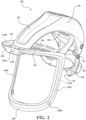
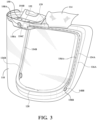
- FIG. 3 a partial perspective view of the surgical garment 112 coupled to the chin bar 124 and the control housing 150 of the surgical helmet 120 is illustrated.
- a sensor 152 is disposed in the control housing 150 and is connected to each of the coupling members 148 disposed on the surgical helmet 120.
- the surgical garment 112 comprises a plurality of attachment elements 158 positioned about the periphery of the face shield 118, the attachment elements 158 corresponding to one or more of the coupling members 148 of the surgical helmet 120.
- the face shield 118 comprises a pair of attachment elements 158B, 158C positioned on opposing ends of the lower portion of the face shield 118, and each is configured to couple with a corresponding coupling member 148B, 148C on the chin bar 124.
- the face shield 118 further comprises a top attachment element 158A positioned near the center of the top portion of the face shield 118 and configured to couple with the top coupling member 148A disposed on the control housing 150.
- One or more of the attachment elements 158 may be electrically connected by a trace, wire, or similar electrical connector capable of forming an electrical connection between the attachment elements 158.
- the top attachment element 158A is connected to one of the lower attachment elements 158B by a trace 156A.
- the trace 156 may comprise a conductive trace, the conductive trace 156 may be formed from one of silver, carbon nanoparticles, and/or another suitable printable ink capable of providing an electrical connection between two components, such as the attachment elements 158 on the face shield 118.
- the conductive trace 156 may be applied to the face shield 118, although it is not required that it be applied to the face shield.
- the trace between the one or more of the attachment elements 158 may be a wire that simply connects the two points.
- the conductive trace 156 on the surgical garment 112 may be configured to provide authentication of the surgical garment 112 with the surgical helmet 120.
- the conductive trace 156 may be configured to provide an electrical connection between attachment elements 158 attached to the face shield 118 that are in intimate contact with coupling members 146 on a surgical helmet 120 when the surgical garment 112 is coupled to the surgical helmet 120.
- the combination of the attachment elements 158, the coupling members 146, and the trace 154, 156 may be arranged to a produce an electrical parameter capable of being detected or sensed by the sensor 152.
- the sensor may be configured to detects the electrical parameter and/or confirm the completed circuit and produce a signal to the controller that identifies the specific surgical garment 112.
- the sensor 152 may be configured to produce a specific signal that may include data based on the measured electrical parameter, such as a specific measure resistance, that the controller is then able to utilize to identify the specific surgical garment 112 that is coupled to the surgical helmet 120.
- the sensor 152 may be configured to produce different types of signals based on the measure electrical parameter, such as yest or no signal based on the measured electrical parameter being above or below a known threshold, that the controller is then able to utilize to identify the specific surgical garment 112 that is coupled to the surgical helmet 120 to the controller.
- one manner of identifying the surgical garment 112 is configuring the sensor 152 to measure a resistance and comparing the measured resistance to a specified value. The sensor 152 may then be configured to send a first signal if the measured resistance is lower than a specified value and to send a second signal if the measured resistance is higher than the specified value.
- the characteristics of the trace 156 disposed on the face shield 118 may be manipulated to create varying levels of resistance across the attachment elements 158 and the trace 156. For example, reducing the cross-section of the trace 156 typically leads to a generally higher resistance. Therefore, the resistance of a given trace may be altered and/or manipulated by changing one or more of the width, length, pattern, and/or shape of the trace 156 connecting one or more the attachment elements 158 on the face shield 118. With regard to trace width, a less wide trace 156 may be created by having multiple different options applying the trace to the face shield 118.
- laying down thinner layers may be utilized to increase the resistance or laying down multiple layers of ink on top of each other to increase the printed cross-section and decrease the trace resistance.
- trace pattern laying down different patterns of the trace 156 may be utilized to increase or decrease the trace length which will result in different levels of trace resistance.
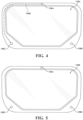
- a trace 156B may be formed between a top attachment element 158A and a lower left attachment element 158C of the face shield 118A causing a circuit to be completed between the sensor 152, top coupling member 148A, lower left coupling member 148C, top attachment element 158A and the lower left attachment element 158C.
- the sensor 152 may provide a signal to the controller to indicate which attachment elements 158 and the coupling member 148 completed the circuit that can be utilized by the controller to identify the specific surgical garment 112.
- FIG. 5 an alternative configuration of the face shield 118B where there is no trace 156 connecting any of the attachment elements 158 on the face shield 118B.
- the circuit would always be open.
- the sensor 152 may similarly provide a signal to the controller to indicate the open circuit that can be utilized by the controller to identify the specific surgical garment 112.
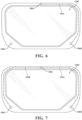
- FIG. 6 an alternative configuration of the face shield 118C where a trace 156A may be formed between a top attachment element 158A and a lower right attachment element 158B of the face shield 118C causing a circuit to be completed between the sensor 152, top coupling member 148A, lower right coupling member 148B, top attachment element 158A and the lower right attachment element 158B.
- the sensor 152 may similarly provide a signal to the controller to indicate the closed circuit between the top attachment element 158A and the lower right attachment element 158B to be utilized by the controller to identify the specific surgical garment 112.
- a trace 156B may be formed between a top attachment element 158A and a lower left attachment element 158C and a trace 156A may be formed between a top attachment element 158A and a lower right attachment element 158B.
- the circuit would be closed between both the top attachment element 158A and the lower right attachment element 158B and the top attachment element 158A and the lower left attachment element 158C.
- the sensor 152 may similarly provide a signal to the controller to indicate the closed circuit that can be utilized by the controller to identify the specific surgical garment 112.
- the senor may be configured to measure an electrical parameter created by and/or defined across trace 156 connecting one or more the attachment elements 158 on the face shield 118.
- the controller may then be configured to utilize the electrical parameter measured or detected by the sensor 152 to identify the specific surgical garment 112 that is coupled to the surgical helmet 120. This may allow the controller to tailor the operation of the peripheral device 130, such as the ventilation assembly, to the specific characteristics of the surgical garment 112 attached to the surgical helmet 120. For example, a surgical garment 112 including a filter fabric 116 with a higher filtration efficiency may require a higher fan speed than a surgical garment 112 including a filter fabric 116 with a lower filtration efficiency.
- the controller based on one of the configurations of the trace 156 on the surgical garment 112 and/or trace 156 properties designed to create an detectable electrical parameter, may be configured to identify when the high filtration efficiency surgical garment 112 and when the low filtration efficiency surgical garment 112 are coupled to the surgical helmet 120, respectively, and provide operating instructions to the peripheral device 130 based on the surgical garment 112.
- the surgical garment is fashioned as a toga, as opposed to a hood, it may be advantageous to operate the peripheral device 130, such as the ventilation assembly, at a higher fan speed to provide additional air movement based on the additional body coverage of the toga.
- the controller based on one of the configurations of the trace 156 on the surgical garment 112 and/or trace 156 properties designed to create a detectable electrical parameter, may be configured to identify when a toga versus a hood is coupled to the surgical helmet 120, and to provide operating instructions to the peripheral device 130 based on the type of surgical garment 112.
Landscapes
- Engineering & Computer Science (AREA)
- Textile Engineering (AREA)
- Health & Medical Sciences (AREA)
- General Health & Medical Sciences (AREA)
- Physical Education & Sports Medicine (AREA)
- Environmental & Geological Engineering (AREA)
- Professional, Industrial, Or Sporting Protective Garments (AREA)
- Helmets And Other Head Coverings (AREA)
Applications Claiming Priority (1)
| Application Number | Priority Date | Filing Date | Title |
|---|---|---|---|
| US202363602859P | 2023-11-27 | 2023-11-27 |
Publications (2)
| Publication Number | Publication Date |
|---|---|
| EP4559341A2 true EP4559341A2 (de) | 2025-05-28 |
| EP4559341A3 EP4559341A3 (de) | 2025-07-30 |
Family
ID=93607802
Family Applications (1)
| Application Number | Title | Priority Date | Filing Date |
|---|---|---|---|
| EP24214213.1A Pending EP4559341A3 (de) | 2023-11-27 | 2024-11-20 | Chirurgisches bekleidungssystem |
Country Status (6)
| Country | Link |
|---|---|
| US (1) | US20250169554A1 (de) |
| EP (1) | EP4559341A3 (de) |
| JP (1) | JP2025097921A (de) |
| KR (1) | KR20250079890A (de) |
| CN (1) | CN120036545A (de) |
| AU (1) | AU2024264732A1 (de) |
Family Cites Families (5)
| Publication number | Priority date | Publication date | Assignee | Title |
|---|---|---|---|---|
| PL3445197T3 (pl) * | 2016-04-18 | 2020-06-15 | Stryker Corporation | System ochrony osobistej zawierający kaptur z przezroczystą osłoną twarzy |
| WO2020006243A1 (en) * | 2018-06-27 | 2020-01-02 | Stryker Corporation | A protective apparel system with a lens assembly |
| US11547169B2 (en) * | 2019-01-25 | 2023-01-10 | Stryker Corporation | Surgical apparel system |
| WO2022061177A1 (en) * | 2020-09-21 | 2022-03-24 | Northwell Health, Inc. | Air filtering surgical helmet |
| US20220110381A1 (en) * | 2020-10-09 | 2022-04-14 | Stryker Corporation | Surgical Apparel System Including A Peripheral Device And Method Of Operating The Peripheral Device |
-
2024
- 2024-11-18 AU AU2024264732A patent/AU2024264732A1/en active Pending
- 2024-11-19 CN CN202411657562.3A patent/CN120036545A/zh active Pending
- 2024-11-20 EP EP24214213.1A patent/EP4559341A3/de active Pending
- 2024-11-23 US US18/957,665 patent/US20250169554A1/en active Pending
- 2024-11-25 KR KR1020240169696A patent/KR20250079890A/ko active Pending
- 2024-11-26 JP JP2024205608A patent/JP2025097921A/ja active Pending
Also Published As
| Publication number | Publication date |
|---|---|
| CN120036545A (zh) | 2025-05-27 |
| US20250169554A1 (en) | 2025-05-29 |
| AU2024264732A1 (en) | 2025-06-12 |
| EP4559341A3 (de) | 2025-07-30 |
| KR20250079890A (ko) | 2025-06-04 |
| JP2025097921A (ja) | 2025-07-01 |
Similar Documents
| Publication | Publication Date | Title |
|---|---|---|
| AU2023203594B2 (en) | Personal protection system including a hood with a transparent face shield and control buttons on the face shield | |
| US20190344101A1 (en) | Personal Protection System With Control Member | |
| US20220110381A1 (en) | Surgical Apparel System Including A Peripheral Device And Method Of Operating The Peripheral Device | |
| EP4162831B1 (de) | Chirurgischer helm mit einem einstellmechanismus | |
| EP4559341A2 (de) | Chirurgisches bekleidungssystem | |
| US20160227848A1 (en) | Motorcyclist apparel cooling system | |
| CN114557507A (zh) | 红外迷彩图案的制造方法、使用方法及红外迷彩服 |
Legal Events
| Date | Code | Title | Description |
|---|---|---|---|
| PUAI | Public reference made under article 153(3) epc to a published international application that has entered the european phase |
Free format text: ORIGINAL CODE: 0009012 |
|
| STAA | Information on the status of an ep patent application or granted ep patent |
Free format text: STATUS: THE APPLICATION HAS BEEN PUBLISHED |
|
| AK | Designated contracting states |
Kind code of ref document: A2 Designated state(s): AL AT BE BG CH CY CZ DE DK EE ES FI FR GB GR HR HU IE IS IT LI LT LU LV MC ME MK MT NL NO PL PT RO RS SE SI SK SM TR |
|
| PUAL | Search report despatched |
Free format text: ORIGINAL CODE: 0009013 |
|
| RIC1 | Information provided on ipc code assigned before grant |
Ipc: A41D 13/12 20060101AFI20250617BHEP Ipc: A42B 3/28 20060101ALI20250617BHEP |
|
| AK | Designated contracting states |
Kind code of ref document: A3 Designated state(s): AL AT BE BG CH CY CZ DE DK EE ES FI FR GB GR HR HU IE IS IT LI LT LU LV MC ME MK MT NL NO PL PT RO RS SE SI SK SM TR |
|
| RIC1 | Information provided on ipc code assigned before grant |
Ipc: A41D 13/12 20060101AFI20250625BHEP Ipc: A42B 3/28 20060101ALI20250625BHEP |
|
| STAA | Information on the status of an ep patent application or granted ep patent |
Free format text: STATUS: REQUEST FOR EXAMINATION WAS MADE |
|
| 17P | Request for examination filed |
Effective date: 20260128 |