EP4559643A1 - Körperpflegevorrichtung mit motorgeschwindigkeitsbezogenen druckanalysemodi - Google Patents
Körperpflegevorrichtung mit motorgeschwindigkeitsbezogenen druckanalysemodi Download PDFInfo
- Publication number
- EP4559643A1 EP4559643A1 EP23211826.5A EP23211826A EP4559643A1 EP 4559643 A1 EP4559643 A1 EP 4559643A1 EP 23211826 A EP23211826 A EP 23211826A EP 4559643 A1 EP4559643 A1 EP 4559643A1
- Authority
- EP
- European Patent Office
- Prior art keywords
- pressure
- operating mode
- threshold
- different
- operating
- Prior art date
- Legal status (The legal status is an assumption and is not a legal conclusion. Google has not performed a legal analysis and makes no representation as to the accuracy of the status listed.)
- Withdrawn
Links
Images

Classifications
-
- B—PERFORMING OPERATIONS; TRANSPORTING
- B26—HAND CUTTING TOOLS; CUTTING; SEVERING
- B26B—HAND-HELD CUTTING TOOLS NOT OTHERWISE PROVIDED FOR
- B26B19/00—Clippers or shavers operating with a plurality of cutting edges, e.g. hair clippers, dry shavers
- B26B19/38—Details of, or accessories for, hair clippers, or dry shavers, e.g. housings, casings, grips, guards
- B26B19/3873—Electric features; Charging; Computing devices
- B26B19/388—Sensors; Control
Definitions
- This invention relates to the field of personal care, and in particular to the field of personal care devices.
- Personal care devices may be operated in different ways to achieve different treatment results as desired by the user.
- the results achieved will be dependent on the selected settings of the device and the way the user handles the device.
- Users of a personal care device may prefer different settings based on the results they wish to achieve and based on their skin or body type. For example, in the case of electric shavers, depending on the length of the beard hairs of the user and the sensitivity of their skin, a user may wish for a more intense or a gentler shaving experience. These different desired outcomes will typically correspond to different selected settings of the electric shaver.
- any given personal care device there may be multiple different operating parameters that can be adjusted in the settings of the device by the user. These parameters may interact in different ways to result in different treatment outcomes and different user perceptions of the treatment. Some parameters may affect the treatment outcome but are difficult for the user to perceive during the treatment. It therefore becomes difficult for the user to correctly select the required settings to achieve their desired treatment outcome. When multiple settings are involved, it becomes even less convenient for the user to select the right combination of settings.
- a motorised personal care device configured for carrying out a personal care treatment by a user.
- the motorised personal care device comprises: a treatment component arranged to be held against a body part of the user during the personal care treatment; a motor configured to drive movement of the treatment component at different operating speeds; a pressure sensor configured to measure an applied pressure with which the treatment component is held against the body part during the personal care treatment; a control component configured to control the device to operate in at least first and second different operating modes, wherein the first and second operating modes define, respectively, first and second different operating speeds for the motor and, respectively, first and second different pressure ranges, wherein the first and second pressure ranges each extend from a respective lower pressure-threshold to a respective upper pressure-threshold; and a pressure analysis arrangement configured to determine, when the device is controlled to operate in a selected operating mode of the at least first and second different operating modes, whether the applied pressure measured by the pressure sensor is within the pressure range defined by the selected operating mode.
- Proposed concepts thus aim to provide schemes, solutions, concept, designs, methods and systems pertaining to a personal care device configured for carrying out a personal care treatment by a user.
- embodiments aim to provide a motorised personal care device with at least two operating modes, wherein each operating mode defines an operating speed and pressure range for the device such that the at least two operating modes define different operating speeds and different pressure ranges.
- the device is configured such that the motor driving the movement of the treatment component of the device is able to operate at different speeds and a pressure analysis component is provided which analyses data from a pressure sensor to determine if the pressure with which the device is being applied falls within a certain range of pressure values.
- the device is provided with a control component that may control operation of the device into any one of a number of different operating modes which each define the operating speed of the motor and the optimal pressure range for the pressure analysis component.
- different operating modes of the device are provided which enable the operation of the device to be adjusted to suit the preferences of the user.
- the operating speed of the device and the pressure with which the treatment component is held against the body of the user can have a large impact on the experience of the user when operating the device. At greater operating speeds the user perceives the treatment to be more intense, whereas at slower operating speeds the user perceives the treatment to be less intense.
- the pressure with which the device is held against the user body part will greatly impact the results achieved by the device. For example, in the case of a toothbrush the pressure with which the brushing head is held against the teeth and gums of the user greatly impacts the effectiveness of the cleaning procedure.
- the two attributes of speed and pressure typically play an important role in the user experience.
- the proposed invention by providing different operating modes which define different speed and an optimal pressure range for the device, enables these two attributes to be controlled together.
- an improved motorised personal care device for carrying out a personal care treatment by a user may be supported by the proposed concept(s).
- the device may further comprise a user interface configured to permit the user to select an operating mode of the at least first and second operating modes. This improves the user experience by enabling the user to control the selected operating mode.
- the pressure indicator may be a light-emitting device configured to: emit light of a first colour when the measured applied pressure is less than the lower pressure-threshold of the pressure range defined by the selected operating mode; emit light of a second colour, different from the first colour, when the measured applied pressure is greater than the lower pressure-threshold and less than the upper pressure-threshold of the pressure range defined by the selected operating mode; and emit light of a third colour, different from the first and second colours, when the measured applied pressure is greater than the upper pressure-threshold of the pressure range defined by the selected operating mode.
- the user is provided with a visual indication as to whether the pressure they are using to apply the personal care device to their person is too high, too low, or within the desired range.
- the pressure indicator may utilise at least one of: an audio signal; a visual signal; and a haptic signal. In this way the user may be informed audially, visually, or via a haptic signal as to whether the applied pressure with which they are holding the treatment component of the device against their body is within the desired pressure range as defined by the selected operating mode.
- the treatment component may be at least one of: a shaving unit; a skincare unit; a beard-trimming unit; a long hair cutting unit; a toothbrush head; and a cleaning brush. In this way a treatment component may be provided that is suitable for the personal care treatment being carried out.
- the device may comprise: a main housing to accommodate the motor; at least two different treatment components which can each be selectively coupled to the main housing to be driven by the motor; and a detection arrangement configured to generate a detection signal indicating which of the at least two different treatment components is coupled to the main housing; wherein the control component is configured to receive the detection signal and select the operating mode from the at least first and second different operating modes based on the detection signal.
- the selected operating mode of the device may depend on the type of treatment component being employed.
- control component may be configured to preselect, based on the detection signal, a set of at least first and second different operating modes from at least two different sets of at least first and second different operating modes.
- the device may further comprise a user interface configured to permit the user to select an operating mode from the at least first and second different operating modes of the set of at least first and second different operating modes preselected by the control component.
- different sets of operating modes may be provided corresponding to the different possible treatment components that may be coupled to the device. Appropriate operating modes may therefore be provided to the user for selection, thus helping to avoid the selection of an inappropriate/incorrect operating mode for the employed treatment component.
- the motorised personal care device may be at least one of: a shaver, a hair trimmer; a beard trimmer; an epilator; and an electric toothbrush.
- the present invention may relate to any of a number of different motorised personal care devices.
- a first operating speed defined by the first operating mode is less than a second operating speed defined by the second operating mode; and a first lower pressure-threshold defined by the first operating mode is less than a second lower pressure-threshold defined by the second operating mode; and/or a first upper pressure-threshold defined by the first operating mode is less than a second upper pressure-threshold defined by the second operating mode.
- the device is provided with a high intensity mode, which defines a relatively fast operating speed and a relatively high optimal pressure, and a low intensity mode which defines a relatively slow operating speed and a relatively low optimal pressure.
- control component may be configured to further control the device to operate in a third operating mode different from the first and second operating modes, wherein: a third operating speed defined by the third operating mode is greater than the second operating speed; and wherein: a third lower pressure-threshold defined by the third operating mode is greater than the second lower pressure-threshold; and/or a third upper pressure-threshold defined by the third operating mode is greater than the second upper pressure-threshold.
- the motorised personal care device may be an electric shaver and the first operating speed may be 1900 rpm, the second operating speed may be 2100 rpm, and the third operating speed may be 2300 rpm. In this way, an electric shaver with three different operating speeds corresponding to three different operating modes is provided.
- the motorised personal care device may be an electric shaver and the first lower pressure threshold may be 1 N, the second lower pressure threshold may be 1.5 N, and the third lower pressure threshold may be 2 N.
- the three operating modes of the electric shaver may define pressure ranges that have three different lower pressure-threshold values.
- the motorised personal care device may be an electric shaver and the first upper pressure threshold may be 3 N, the second upper pressure threshold may be 4 N, and the third upper pressure threshold may be 5 N.
- control component may be configured to further control the device to operate in a custom operating mode, wherein the operating speed and the pressure range defined by the custom operating mode are selectable by the user. In this way a custom setting is provided in which the user selects the operating speed and the pressure range according to their personal preference.
- control component may be further configured to control the device to operate in a power-saving operating mode, wherein: a power-saving operating speed defined by the power-saving operating mode is less than the at least first and second different operating speeds defined by the at least first and second different operating modes; and, when the device is controlled to operate in the power-saving operating mode, the pressure analysis arrangement is disabled.
- a power-saving operating speed defined by the power-saving operating mode is less than the at least first and second different operating speeds defined by the at least first and second different operating modes; and, when the device is controlled to operate in the power-saving operating mode, the pressure analysis arrangement is disabled.
- the device is provided with a battery saving mode which defines a lower operating speed for the motor and disables the pressure feedback system to increase the energy efficiency of the device.
- a motorised personal care device configured for carrying out a personal care treatment by a user with at least first and second operating modes that define, respectively, first and second different operating speeds and, respectively, first and second different pressure ranges.
- Implementations in accordance with the present disclosure relate to various techniques, methods, schemes and/or solutions pertaining to a motorised personal care device configured for carrying out a personal care treatment by a user.
- a number of possible solutions may be implemented separately or jointly. That is, although these possible solutions may be described below separately, two or more of these possible solutions may be implemented in one combination or another.
- Embodiments of the invention aim to provide a personal care device configured for carrying out a personal care treatment by a user which may be controlled to operate in different operating modes that each define a different operating speed and a different pressure range for the device.
- the defined pressure range is used by a pressure analysis unit, which analyses pressure data from a pressure sensor to determine whether the applied pressure with which a treatment component of the device is being held against a body part of the user is within the defined pressure range.
- the pressure with which the device is applied to the body of the user is an important aspect of the operation of the device to control, as different applied pressures will result in the personal care device having different effects on the user. It is therefore important to provide a means by which the applied pressure can be measured and then analysed to determine whether it is within a target range of pressure values.
- a target pressure range for all users of a given device. Some users may require the treatment component of the device to be applied with a high force in order to receive an efficient treatment, others may be best applying a low force in order to prevent irritation of their skin. It is therefore important that this target pressure range can be modified for each user of the device and for each time the device is used.
- the user perception of the applied pressure is very limited and so it is difficult for a user to adjust the target pressure range for the pressure analysis component without guidance.
- the level of applied pressure has a large impact on the treatment results, the experience of the user throughout the treatment is relatively unchanged as the applied pressure is adjusted.
- the user is usually quite sensitive to changes in the operating speed of the device. Therefore, the proposed invention, in which the operating speed and the target pressure range settings are defined together in an operating mode, provides an improved way of setting the target pressure range of the device. The user will more easily be able to perceive the changes in the target pressure range as they are combined with changes to the operating speed. Therefore, the proposed invention increases the likelihood that the user will be able to select the correct operating mode corresponding to the pressure range required to achieve the treatment outcome they need.
- the proposed device enables the settings of the device relating to the target pressure range and the operating speed of the treatment component to be modified concurrently. This is achieved by the selection of an operating mode for the device that sets both the value of the operating speed and the pressure range.
- Proposed concepts thus aim to provide a motorised personal care device which is provided with at least a first and second operating mode, wherein the first and second operating modes define respectively, first and second different operating speeds for the motor and, respectively, first and second different pressure ranges, thereby providing an improved user experience.
- FIG. 1 there is depicted a simplified block diagram of a motorised personal care device according to a proposed embodiment.
- Fig. 1 depicts a motorised personal care device 100 configured for carrying out a personal care treatment by a user.
- the motorised personal care device is an electric toothbrush.
- the electric toothbrush comprises a treatment component 110, which in this exemplary embodiment is a tooth-brushing unit, which is arranged to be held against a body part of the user when device is in use.
- a motor 120 is configured to drive movement of the brushing unit 110 at a number of different operating speeds.
- the motorised device 100 further comprises a pressure sensor 130 configured to measure an applied pressure with which the treatment component 110 (i.e. brushing unit) is held against the body part during the tooth-cleaning treatment.
- the control component 140 is configured to control the device to operate in a first, second, and third different operating modes.
- the first, second, and third operating modes define respectively first, second, and third different operating speeds for the motor 120, and, respectively first, second, and third different pressure ranges.
- Each of the first, second, and third different pressure ranges extend from a respective lower pressure-threshold to a respective upper pressure-threshold.
- the first operating speed defined by the first operating mode is less than the second operating speed defined by the second operating mode
- the third operating speed defined by the third operating mode is greater than the second operating speed.
- the toothbrush is provided with three operating modes each of which defines a different operating speed and a different pressure range. The availability of three different operating modes enables easy adjustment of the settings of the device, resulting in the user being able to easily achieve their preferred treatment experience.
- the pressure analysis arrangement 150 is configured to determine, when the device is controlled to operate in a selected mode of the first, second, and third operating modes, whether the applied pressure measured by the pressure sensor is within the pressure range defined by the selected operating mode.
- the device further comprises a pressure indicator 160 configured to indicate to the user, when the device is controlled to operate in a selected operating mode of the first, second, and third operating modes, whether the applied pressure measured by the pressure sensor is within the pressure range defined by the selected operating mode.
- the pressure indicator 160 is a light-emitting device configured to: emit light of a first colour when the measured applied pressure is less than the lower pressure-threshold defined by the pressure range of the selected operating mode; emit light of a second colour, different from the first colour, when the measured applied pressure is greater than the lower pressure-threshold and less than the upper pressure-threshold defined by the pressure range of the selected operating mode; and emit light of a third colour, different from the first and second colours, when the measured applied pressure is greater than the upper pressure-threshold defined by the pressure range of the selected operating mode.
- the pressure sensor 130, pressure analysis arrangement 150, and pressure indicator 160 form a pressure guidance system for the device. These components together provide the user with real-time pressure feedback. As the user applies the toothbrush to their teeth and gums, they are provided with light feedback indicating the current applied force level. In this exemplary embodiment the pressure indicator will emit a green light to indicate that the applied pressure is within the desired pressure range and that, therefore, the user should maintain the currently applied force. The pressure indicator will emit a blue light if the applied pressure is lower than the lower pressure-threshold of the selected pressure range and thereby indicates to the user that they should increase the applied force.
- An orange light will be emitted by the device if the currently applied pressure is greater than the upper press-threshold of the selected pressure range and thereby the user is alerted that they should reduce the pressure with which they are applying the device to their body to achieve their preferred treatment outcome.
- the exemplary toothbrush device 100 further comprises a user interface 170 configured to permit the user to select an operating mode of the first, second, and third operating modes.
- the user interface may present the user with information about the currently selected operating mode of the device and the available other operating modes.
- the pressure indicator may be integrated into the user interface such that the user interface displays real-time information to the user that indicates the pressure with which the treatment component is being applied and whether this applied pressure lies within the pressure range defined by the selected operating mode.
- the treatment component 110 is a tooth-brushing unit such that the device acts as an electric toothbrush.
- the motorised personal care device 100 in an alternative embodiment may be at least one of: a shaver; a hair trimmer; a beard trimmer; an epilator; and an electric toothbrush.
- the treatment component 110 may be at least one of: a shaving unit; a skincare unit; a beard-trimming unit; a long hair cutting unit; a toothbrush head; and a cleaning brush.
- a single type of motorised personal care device may have different types of treatment component that can be chosen by the user and attached to a main housing of the device, depending on the type of treatment they wish to carry out.
- an electric hair removal device may have a shaving unit attachment and a beard trimming attachment.
- the device may be further provided with a detection arrangement configured to generate a detection signal indicating which treatment component is attached to the device.
- the control component may receive the detection signal and select an operating mode based on this signal.
- the detection signal may be used to determine a set of available operating modes for the device which the user may select from.
- control component may be configured to further control the device to operate in a fourth operating mode, wherein the operating speed and the pressure range defined by the fourth operating mode are selectable by the user.
- this alternative embodiment allows for an operating mode that is customisable for those users that desire a treatment experience different from those provided by the preset operating modes of the device.
- a fifth battery saving mode may also be provided, wherein the fifth operating speed defined by the fifth operating mode is less than the operating speed as defined by any other operating mode of the device, and wherein, when the device is controlled to operate in the fifth operating mode, the pressure feedback system of the device is disabled.
- the device may be provided with a mode that is more energy efficient.
- the pressure indicator may not be a light emitting device but may utilise an audio signal such as a tone or a beep, or a haptic signal such as a vibration of a specific intensity or frequency to indicate to the user whether the applied pressure is within the pressure range as defined by the selected operating mode.
- the pressure indicator may also provide a combination of visual, audio, and haptic signals.
- control component 140 and a pressure analysis arrangement 150 to control the operation of the device and analyse data respectively.
- These components can be implemented in numerous ways, with software and/or hardware, to perform the various functions required.
- a processor is one example of a component which employs one or more microprocessors that may be programmed using software (e.g., microcode) to perform the required functions.
- the control component 140 and the pressure analysis arrangement 150 may however be implemented with or without employing a processor, and also may be implemented as a combination of dedicated hardware to perform some functions and a processor (e.g., one or more programmed microprocessors and associated circuitry) to perform other functions.
- controller components that may be employed in various embodiments of the present disclosure include, but are not limited to, conventional microprocessors, application specific integrated circuits (ASICs), and field-programmable gate arrays (FPGAs).
- ASICs application specific integrated circuits
- FPGAs field-programmable gate arrays
- a processor or control component may be associated with one or more storage media such as volatile and non-volatile computer memory such as RAM, PROM, EPROM, and EEPROM.
- the storage media may be encoded with one or more programs that, when executed on one or more processors and/or controllers, perform the required functions.
- Various storage media may be fixed within a processor or controller or may be transportable, such that the one or more programs stored thereon can be loaded into a processor or controller.
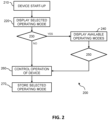
- FIG. 2 there is depicted a simplified flow diagram of an operating scheme for a motorised personal care device according to a proposed embodiment.
- the process starts with a step 210 in which start-up of a motorised personal care device occurs.
- the motorised personal care device may be for example the motorised personal care device 100.
- the scheme then proceeds to a step 220 in which the device displays to the user the current selected operating mode for the device. This may be shown to the user on the user interface 170 of the motorised personal care device 100. Displaying the currently selected operating mode may involve informing the user of the settings defined by the selected operating mode, namely the defined operating speed and the defined pressure range.
- the method then proceeds to a decision step 230, which involves the user deciding whether they wish to change the selected operating mode for the device. This may involve the user selecting on the user interface 170 whether they wish to change the selected operating mode of the device.
- the scheme proceeds to a step 240 in which the device displays to the user the available different operating modes of the device.
- the device may have at least two operating modes and may have any number of operating modes corresponding to different operating speeds and different pressure ranges.
- the method then proceeds to a step 250 in which the user selects a desired operating mode from the available different operating modes. Again, this step may involve an interaction between the user and the user interface. Once the new operating mode has been selected the scheme moves onto a step 260. If the user decides they do not wish to change the operating mode of the device, the method proceeds directly from step 230 to step 260.
- Step 260 involves a control component of the device controlling the device to operate in the selected operating mode.
- the selected operating mode defines an operating speed for the motor of the motorised personal care device, and further defines a pressure range, extending from a lower pressure-threshold to an upper-pressure threshold that is used by the pressure analysis component to determine whether the applied pressure is within an optimal range.
- the method then proceeds to a step 270 in which the selected operating mode is stored in the device such that, when the device is next started, the device remains in the selected operating mode.
- the user preferences may be stored in the device. Storage of this information may involve one or more storage media such as volatile and non-volatile computer memory such as RAM, PROM, EPROM, and EEPROM.
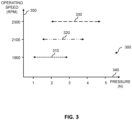
- FIG. 3 there is provided a graphical depiction of three operating modes of a motorised personal care device according to a proposed embodiment.
- the graph 300 displays three possible operating modes for an electric shaver.
- the horizontal axis 340 displays possible pressure values in Newtons with which the user may hold the electric shaver against a part of their body.
- the vertical axis 350 denotes possible operating speeds for the motor of the electric shaving device in units of rpm.
- the three arrows 310, 320, and 330 show the regions of operation defined by a first operating mode, second operating mode and third operating mode respectively.
- the operating speed of the first operating mode is 1900 rpm
- the operating speed of the second operating mode is 2100 rpm
- the operating speed of the third operating mode is 2300 rpm.
- the three operating modes have different operating speeds and different pressure ranges.
- the pressure range of the first operating mode extends from 1 N to 3 N
- the pressure range of the second operating mode extends from 1.5 N to 4 N
- the pressure range of the third operating mode extends from 2 N to 5 N.
- the graph 300 displays how a motorised personal care device may be provided with three operating modes that offer three different user experiences.
- the first operating mode with a low operating speed and a lower optimal pressure, offers a gentle shaving experience for users with sensitive skin.
- the second operating mode with a moderate operating speed and a moderate optimal pressure, results in an efficient shave without causing too much irritation.
- the third operating mode with a high operating speed and a high optimal pressure, results in a closer more efficient shave.
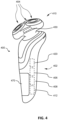
- FIG. 4 there is depicted a schematic perspective view of an example electric shaver 400 according to a proposed embodiment.
- Electric shaver 400 comprises a main body 402 and a shaving head unit 410.
- the main body 402 is configured to be held by the user whilst they carry out a shaving treatment.
- the main body 402 may act as a handle, as well as housing several functional components of the shaver.
- the shaving head unit 410 comprises a plurality of hair-cutting elements 404.
- This example shaver 400 has three hair-cutting elements 404 of a rotary type, which are well known to the skilled person. As the user applies the shaving head unit 410 to a portion of their skin, the hair-cutting elements 404 are placed in contact with hairs of the user.
- the hair-cutting elements 404 contain rotary blades such that, when the device is in use and applied to a portion of the user's skin, the rotary blades cut the hairs of the user.
- the main body 402 of the shaver 400 contains a motor 420 which is configured to drive the rotary blades of the hair-cutting elements 404 to rotate at different operating speeds.
- the main body 402 further contains a battery unit 406 configured to provide power to the motor.
- a pressure sensor 430 is housed within the shaving head unit 410 and is configured to measure the pressure with which the shaving head unit 410 is pressed against the skin by the user (i.e the applied pressure).
- Any suitable pressure sensor may be used, for example a strain gauge, piezoelectric sensor, or a capacitive pressure sensor.
- a detailed example of a suitable pressure sensor having a Hall sensor is disclosed by EP3852983B1 in the name of the applicant.
- the pressure sensor may preferably be positioned close to the surface of the shaving head unit 410 that is being applied to the skin.
- the pressure sensor 430 may be placed directly beneath the hair cutting elements 404. In the case of multiple hair-cutting elements, multiple pressure sensors may be provided with one pressure sensor being placed under each hair cutting element.
- the pressure sensor 430 is configured to detect an applied pressure and provide a pressure signal to a processing unit 408, the pressure signal comprising information describing the detected applied pressure.
- the processing unit 408 is housed in the main body 402 and is associated with a memory unit 412.
- the processing unit 408 may fulfil the functions of both the pressure analysis arrangement 150 and the control component 140 of the personal care device 100 as described in detail herein before.
- the processing unit 408 is configured to control the electric shaver to operate in at least first and second different operating modes, wherein the first and second operating modes define, respectively, first and second different operating speeds for the motor 420 and, respectively, first and second different pressure ranges, wherein the first and second pressure ranges each extend from a respective lower pressure-threshold to a respective upper pressure-threshold.
- the electric shaver 400 further contains a user interface 470 on the main body of the device.
- the user interface may be used by the user to select an operating mode from the at least first and second different operating modes.
- the processing unit 408 controls the motor 420 to drive the rotary blades of the hair cutting units 404 at the operating speed defined by the selected operating mode.
- the processing unit 408 determines whether the applied pressure is within the pressure range defined by the selected operating mode. This determination is then relayed to the user via the user interface 470. In this way, the user interface 470 fulfils the functions of the user interface 170 and the pressure indicator 160 of the personal care device 100.
- the user interface 470 may be realised in any appropriate way.
- the user interface 470 may comprise any suitable input components enabling the user to select an operating mode for the device.
- these input components may include buttons, dials, or a touch-sensitive display screen.
- the user interface 470 may comprise any suitable output components that permit pressure feedback information to be relayed to the user. These output components may include a display screen, a loudspeaker, a light emitting device, or a haptic feedback component.
- the processing unit 408 may be any suitable processing component. Examples of processing components that may be employed in various embodiments of the present disclosure include, but are not limited to, conventional microprocessors, application specific integrated circuits (ASICs), and field-programmable gate arrays (FPGAs).
- ASICs application specific integrated circuits
- FPGAs field-programmable gate arrays
- the memory unit 412 is configured to store information describing the at least first and second operating modes, and the respective operating speeds and pressure ranges that each operating mode defines.
- the memory unit 412 may be further configured to store information describing the operating mode most recently selected by the user, such that upon restart of the electric shaver 400 the processing unit 408 controls the device to operate in the most recently selected operating mode.
- the shaving head unit 410 of the electric shaver 400 may be detachably coupled to the main body 402, so that the user may remove the shaving head unit 410 from the main body 402 and couple a different treatment component to the main body 402, such as a beard trimming unit, a nose trimming unit, or a facial brushing unit, for being driven by the motor 420.
- the electric shaver 400 may be provided with a detection arrangement configured to generate a detection signal indicating the type of treatment component actually coupled to the main body 402.
- An example of a suitable detection arrangement, which generates the detection signal depending on the measured electric current in the motor 420 and the measured vibration of the main body 402, is disclosed by EP3855976B1 in the name of the applicant.
- the memory unit 412 may be configured to store, for each different type of treatment component that can be coupled to the main body 402, an associated set of at least first and second different operating modes, wherein the sets of different operating modes may be different for the different treatment components.
- the processing unit 408 is configured to preselect, based on the detection signal received from the detection arrangement, the set of different operating modes associated with the treatment component actually coupled to the main body 402, and the user is enabled to select, via the user interface 470, the desired operating mode from the set of at least two different operating modes preselected by the processing unit 408.
- the epilator device comprises a main body that acts as a handle for the user and houses functional components.
- the functional components include a motor, a battery, a processing unit, a user interface, and a memory unit.
- the epilator further comprises an epilator head unit connected to the main body of the device.
- the epilator head unit comprises at least one hair-removal element configured to be driven by the motor to move at a range of different operating speeds.
- a pressure sensor is housed within the epilator head unit and is configured to measure the pressure with which the epilator head unit is pressed against the skin by the user.
- the pressure sensor is further configured to send a pressure signal comprising information describing the detected applied pressure to the processing unit.
- the processing unit is configured to control the epilator to operate in at least a first and second different operating modes, wherein the first and second operating modes define, respectively, first and second different operating speeds for the motor and, respectively, first and second different pressure ranges.
- the user interface may be used by the user to select an operating mode from the at least first and second different operating modes. Once an operating mode for the device has been selected, the processing unit controls the motor to drive the at least one hair-removal element at the operating speed defined by the selected operating mode. Further, upon receiving the measured applied pressure signal from the pressure sensor, the processing unit determines whether the applied pressure is within the pressure range defined by the selected operating mode. This determination is then relayed to the user via the user interface.
- the processing unit housed in the main body fulfils the functions of the pressure analysis arrangement and the control component of device 100, and the user interface performs the role of both the user interface 170 and the pressure indicator 160 of the personal care device 100, as described in detail herein before.
- these functionalities may be distributed differently between different components and different devices.
- a personal care device may be configured to communicate, e.g., wirelessly, with a smart device of the user (e.g., a smartphone or tablet).
- the processing and display capacities of the smart device may then fulfil the functions of the pressure analysis component, control component, user interface, or pressure indicator of the exemplary embodiment 100.
- the processing capabilities required for the invention may be distributed throughout a system containing other appropriate devices in addition to a personal care device. This distribution of processing requirements may be configured in different ways according to predetermined constraints and/or availability of processing resources.
- a further embodiment of the invention comprises a personal care system comprising a toothbrush device and charging unit.
- the toothbrush device comprises a toothbrush head unit with at least one brushing element configured to be driven to rotate by a motor housed in the main body of the toothbrush device.
- the main body also houses a battery configured to power the motor.
- a pressure sensor is present in the toothbrush head unit and measures the pressure with which the user applies the toothbrush head unit to their teeth and gums.
- the toothbrush device is configured to connect to the charging unit such that, when this connection is made, a charging element of the charging unit charges the battery of the toothbrush device.
- the charging unit may further house a processing unit, a memory unit, and a user interface.
- the processing unit of the charging device is configured to communicate wirelessly with the motor and pressure sensor of the toothbrush device. In this way the processing unit of the charging unit may carry out some of the functions carried out by the pressure analysis unit and the control component of the device 100.
- the pressure sensor of the toothbrush device is configured to send a pressure signal comprising information describing the detected applied pressure to the processing unit of the charging unit.
- the processing unit communicates with the toothbrush device and thereby controls the toothbrush device to operate in at least first and second different operating modes, wherein the first and second operating modes define, respectively, first and second different operating speeds for the motor and, respectively, first and second different pressure ranges, wherein the first and second pressure ranges each extend from a respective lower pressure-threshold to a respective upper pressure-threshold.
- the user interface of the charging unit allows the user to select the required operating mode for the device and displays to the user an indication of whether the applied pressure is within the pressure range defined by the selected operating mode.
- the arrangement described in this embodiment, wherein the processing unit and user interface of a charging unit being used to control the operation of a separate toothbrush device, may be advantageous for several reasons. Since the charging unit is likely to remain stationary, the space and weight constraints placed on the configuration of the user interface and processing unit in this arrangement are likely to be much less restrictive than those of an arrangement in which they are housed in the main body of a personal care device. Further, the charging unit may be configured to connect to a mains electricity supply and therefore is not constrained by the power capabilities of a battery.
- a computer program may be stored/distributed on a suitable medium, such as an optical storage medium or a solid-state medium supplied together with or as part of other hardware, but may also be distributed in other forms, such as via the Internet or other wired or wireless telecommunication systems.
- a suitable medium such as an optical storage medium or a solid-state medium supplied together with or as part of other hardware, but may also be distributed in other forms, such as via the Internet or other wired or wireless telecommunication systems.
Landscapes
- Life Sciences & Earth Sciences (AREA)
- Forests & Forestry (AREA)
- Engineering & Computer Science (AREA)
- Mechanical Engineering (AREA)
- Dry Shavers And Clippers (AREA)
Priority Applications (4)
| Application Number | Priority Date | Filing Date | Title |
|---|---|---|---|
| EP23211826.5A EP4559643A1 (de) | 2023-11-23 | 2023-11-23 | Körperpflegevorrichtung mit motorgeschwindigkeitsbezogenen druckanalysemodi |
| CN202480074087.9A CN122249308A (zh) | 2023-11-23 | 2024-11-13 | 具有电机转速相关压力分析模式的个人护理设备 |
| PCT/EP2024/082095 WO2025108787A1 (en) | 2023-11-23 | 2024-11-13 | Personal care device with motor speed related pressure analysis modes |
| KR1020267019780A KR20260112814A (ko) | 2023-11-23 | 2024-11-13 | 모터 속도 관련 압력 분석 모드를 갖는 개인 케어 장치 |
Applications Claiming Priority (1)
| Application Number | Priority Date | Filing Date | Title |
|---|---|---|---|
| EP23211826.5A EP4559643A1 (de) | 2023-11-23 | 2023-11-23 | Körperpflegevorrichtung mit motorgeschwindigkeitsbezogenen druckanalysemodi |
Publications (1)
| Publication Number | Publication Date |
|---|---|
| EP4559643A1 true EP4559643A1 (de) | 2025-05-28 |
Family
ID=88965652
Family Applications (1)
| Application Number | Title | Priority Date | Filing Date |
|---|---|---|---|
| EP23211826.5A Withdrawn EP4559643A1 (de) | 2023-11-23 | 2023-11-23 | Körperpflegevorrichtung mit motorgeschwindigkeitsbezogenen druckanalysemodi |
Country Status (4)
| Country | Link |
|---|---|
| EP (1) | EP4559643A1 (de) |
| KR (1) | KR20260112814A (de) |
| CN (1) | CN122249308A (de) |
| WO (1) | WO2025108787A1 (de) |
Citations (8)
| Publication number | Priority date | Publication date | Assignee | Title |
|---|---|---|---|---|
| JPH03173558A (ja) * | 1989-11-30 | 1991-07-26 | Matsushita Electric Works Ltd | 電動歯ブラシ |
| JPH05329024A (ja) * | 1992-05-29 | 1993-12-14 | Nippon Philips Kk | 電動歯ブラシ |
| EP0720523A1 (de) * | 1994-06-01 | 1996-07-10 | Koninklijke Philips Electronics N.V. | Rasierapparat mit elektrisch einstellbarer messereinheit |
| US20170143165A1 (en) * | 2014-06-27 | 2017-05-25 | Koninklijke Philips N.V. | Domestic appliances with power control |
| EP3852983B1 (de) | 2019-04-18 | 2022-06-08 | Koninklijke Philips N.V. | Druckempfindlicher elektrischer rasierapparat |
| US20220288800A1 (en) * | 2019-07-25 | 2022-09-15 | Koninklijke Philips N.V. | Skin treatment device and method of controlling a skin treatment device |
| EP3855976B1 (de) | 2019-08-21 | 2022-10-19 | Koninklijke Philips N.V. | Körperpflegesystem mit einem satz von funktionseinheiten |
| US20220331079A1 (en) * | 2019-09-05 | 2022-10-20 | Playbrush Ltd | Electric toothbrush system with pressure detection |
-
2023
- 2023-11-23 EP EP23211826.5A patent/EP4559643A1/de not_active Withdrawn
-
2024
- 2024-11-13 KR KR1020267019780A patent/KR20260112814A/ko active Pending
- 2024-11-13 CN CN202480074087.9A patent/CN122249308A/zh active Pending
- 2024-11-13 WO PCT/EP2024/082095 patent/WO2025108787A1/en active Pending
Patent Citations (8)
| Publication number | Priority date | Publication date | Assignee | Title |
|---|---|---|---|---|
| JPH03173558A (ja) * | 1989-11-30 | 1991-07-26 | Matsushita Electric Works Ltd | 電動歯ブラシ |
| JPH05329024A (ja) * | 1992-05-29 | 1993-12-14 | Nippon Philips Kk | 電動歯ブラシ |
| EP0720523A1 (de) * | 1994-06-01 | 1996-07-10 | Koninklijke Philips Electronics N.V. | Rasierapparat mit elektrisch einstellbarer messereinheit |
| US20170143165A1 (en) * | 2014-06-27 | 2017-05-25 | Koninklijke Philips N.V. | Domestic appliances with power control |
| EP3852983B1 (de) | 2019-04-18 | 2022-06-08 | Koninklijke Philips N.V. | Druckempfindlicher elektrischer rasierapparat |
| US20220288800A1 (en) * | 2019-07-25 | 2022-09-15 | Koninklijke Philips N.V. | Skin treatment device and method of controlling a skin treatment device |
| EP3855976B1 (de) | 2019-08-21 | 2022-10-19 | Koninklijke Philips N.V. | Körperpflegesystem mit einem satz von funktionseinheiten |
| US20220331079A1 (en) * | 2019-09-05 | 2022-10-20 | Playbrush Ltd | Electric toothbrush system with pressure detection |
Also Published As
| Publication number | Publication date |
|---|---|
| WO2025108787A1 (en) | 2025-05-30 |
| CN122249308A (zh) | 2026-06-19 |
| KR20260112814A (ko) | 2026-07-20 |
Similar Documents
| Publication | Publication Date | Title |
|---|---|---|
| US11260550B2 (en) | Personal care device | |
| JP6298574B2 (ja) | ヘアクリッピングデバイス | |
| JP7564999B2 (ja) | 皮膚処理装置及び皮膚処理装置の制御方法 | |
| JP6885979B2 (ja) | パーソナルケア装置及びその操作方法 | |
| RU2739240C1 (ru) | Устройство для личной гигиены | |
| CN105899336B (zh) | 用于处理身体部分的系统和方法 | |
| RU2693665C2 (ru) | Программируемая система для стрижки волос | |
| JP4977697B2 (ja) | 電動式カット案内具を持つバリカン | |
| JP6095053B2 (ja) | 美容システム | |
| JP2017529178A (ja) | ブラッシング前にユーザに動機付けフィードバックを供給するシステム及び方法 | |
| CN105899337A (zh) | 用于处理身体部分的系统和方法 | |
| JP7585196B2 (ja) | パーソナルケア装置 | |
| JP6445105B2 (ja) | 美容システム | |
| CN114748784A (zh) | 促渗仪及其控制方法 | |
| GB2599583A (en) | Electric grooming appliance | |
| JP2019058699A (ja) | 美容システム | |
| WO2025108787A1 (en) | Personal care device with motor speed related pressure analysis modes | |
| JP6199464B2 (ja) | 美容システム | |
| CN222889177U (zh) | 按摩设备 | |
| US12585427B2 (en) | Voice-cue based motorized skin treatment system | |
| EP4725664A1 (de) | Körperpflegesystem mit beleuchtungseinheit mit steuerbarem lichtsteuerungsmodus | |
| EP3505062A1 (de) | Hautbehandlungsvorrichtung | |
| JP7641562B2 (ja) | 毛切断用理美容機器および理美容システム | |
| HK40062210A (en) | Skin treatment device and method of controlling a skin treatment device | |
| KR20260049581A (ko) | 개인 케어 디바이스 |
Legal Events
| Date | Code | Title | Description |
|---|---|---|---|
| PUAI | Public reference made under article 153(3) epc to a published international application that has entered the european phase |
Free format text: ORIGINAL CODE: 0009012 |
|
| STAA | Information on the status of an ep patent application or granted ep patent |
Free format text: STATUS: THE APPLICATION HAS BEEN PUBLISHED |
|
| AK | Designated contracting states |
Kind code of ref document: A1 Designated state(s): AL AT BE BG CH CY CZ DE DK EE ES FI FR GB GR HR HU IE IS IT LI LT LU LV MC ME MK MT NL NO PL PT RO RS SE SI SK SM TR |
|
| STAA | Information on the status of an ep patent application or granted ep patent |
Free format text: STATUS: THE APPLICATION IS DEEMED TO BE WITHDRAWN |
|
| 18D | Application deemed to be withdrawn |
Effective date: 20251129 |