EP4559778A1 - Ensemble de liaison de barre verticale pour wagon pliant, et wagon pliant - Google Patents
Ensemble de liaison de barre verticale pour wagon pliant, et wagon pliant Download PDFInfo
- Publication number
- EP4559778A1 EP4559778A1 EP24163363.5A EP24163363A EP4559778A1 EP 4559778 A1 EP4559778 A1 EP 4559778A1 EP 24163363 A EP24163363 A EP 24163363A EP 4559778 A1 EP4559778 A1 EP 4559778A1
- Authority
- EP
- European Patent Office
- Prior art keywords
- bar
- vertical
- connection assembly
- wagon
- bars
- Prior art date
- Legal status (The legal status is an assumption and is not a legal conclusion. Google has not performed a legal analysis and makes no representation as to the accuracy of the status listed.)
- Pending
Links
Images




Classifications
-
- B—PERFORMING OPERATIONS; TRANSPORTING
- B62—LAND VEHICLES FOR TRAVELLING OTHERWISE THAN ON RAILS
- B62B—HAND-PROPELLED VEHICLES, e.g. HAND CARTS OR PERAMBULATORS; SLEDGES
- B62B3/00—Hand carts having more than one axis carrying transport wheels; Steering devices therefor; Equipment therefor
- B62B3/007—Coaster wagons
-
- B—PERFORMING OPERATIONS; TRANSPORTING
- B62—LAND VEHICLES FOR TRAVELLING OTHERWISE THAN ON RAILS
- B62B—HAND-PROPELLED VEHICLES, e.g. HAND CARTS OR PERAMBULATORS; SLEDGES
- B62B3/00—Hand carts having more than one axis carrying transport wheels; Steering devices therefor; Equipment therefor
- B62B3/02—Hand carts having more than one axis carrying transport wheels; Steering devices therefor; Equipment therefor involving parts being adjustable, collapsible, attachable, detachable or convertible
- B62B3/025—Foldable roll containers
-
- B—PERFORMING OPERATIONS; TRANSPORTING
- B62—LAND VEHICLES FOR TRAVELLING OTHERWISE THAN ON RAILS
- B62B—HAND-PROPELLED VEHICLES, e.g. HAND CARTS OR PERAMBULATORS; SLEDGES
- B62B5/00—Accessories or details specially adapted for hand carts
- B62B5/06—Hand moving equipment, e.g. handle bars
- B62B5/064—Hand moving equipment, e.g. handle bars adaptable for different users, e.g. by means of pivoting elements
- B62B5/065—Hand moving equipment, e.g. handle bars adaptable for different users, e.g. by means of pivoting elements by means of telescopic elements
-
- B—PERFORMING OPERATIONS; TRANSPORTING
- B62—LAND VEHICLES FOR TRAVELLING OTHERWISE THAN ON RAILS
- B62B—HAND-PROPELLED VEHICLES, e.g. HAND CARTS OR PERAMBULATORS; SLEDGES
- B62B5/00—Accessories or details specially adapted for hand carts
- B62B5/06—Hand moving equipment, e.g. handle bars
- B62B5/067—Stowable or retractable handle bars
-
- B—PERFORMING OPERATIONS; TRANSPORTING
- B62—LAND VEHICLES FOR TRAVELLING OTHERWISE THAN ON RAILS
- B62B—HAND-PROPELLED VEHICLES, e.g. HAND CARTS OR PERAMBULATORS; SLEDGES
- B62B2205/00—Hand-propelled vehicles or sledges being foldable or dismountable when not in use
- B62B2205/02—Hand-propelled vehicles or sledges being foldable or dismountable when not in use foldable widthwise
-
- B—PERFORMING OPERATIONS; TRANSPORTING
- B62—LAND VEHICLES FOR TRAVELLING OTHERWISE THAN ON RAILS
- B62B—HAND-PROPELLED VEHICLES, e.g. HAND CARTS OR PERAMBULATORS; SLEDGES
- B62B2205/00—Hand-propelled vehicles or sledges being foldable or dismountable when not in use
- B62B2205/06—Foldable with a scissor-like mechanism
Definitions
- the present disclosure relates to the technical field of wagons, and in particular to a vertical-bar connection assembly for a collapsible wagon, and to a collapsible wagon.
- Wagons are commonly used handling tools in daily life and work, and bring us great convenience.
- an existing conventional wagon itself has a problem of large space occupation and is not easy to be stored and carried.
- various collapsible wagons are designed in the existing solutions, but most wagons either have too many bars and cannot be collapsed smoothly, or have a simple collapsing structure, and still occupy a large space after being collapsed and cannot be carried easily.
- the vertical-bar connection assembly is collapsible and simple in structure, and has a small number of connecting bars.
- the collapsible wagon has the characteristics of convenient collapsing, small occupation space after being collapsed, and convenient storage.
- a vertical-bar connection assembly for a collapsible wagon.
- the vertical-bar connection assembly has an extended state and a folded state and is adapted to be hinged between adjacent vertical bars of the collapsible wagon.
- the vertical-bar connection assembly comprises at least one vertical-bar connection member comprising a first connecting bar and a second connecting bar.
- Each of the first connecting bar and the second connecting bar has a proximal end and a distal end. The proximal ends of the first connecting bar and the second connecting bar are hinged with each other.
- the distal ends of the first connecting bar and the second connecting bar are respectively adapted to be hinged with the adjacent vertical bars of the collapsible wagon, and are rotatable about their respective proximal ends to move away from or close to each other, so as to allow the vertical-bar connection assembly to be in the extended state or in the folded state.
- the present disclosure may further comprise any one or more of the following alternative options.
- the vertical-bar connection assembly comprises at least two vertical-bar connection members spaced apart.
- the first connecting bars are parallel to each other, and the second connecting bars are parallel to each other.
- the first connecting bars parallel to each other have same or different lengths
- the second connecting bars parallel to each other have same or different lengths
- the first connecting bar and the second connecting bar have same lengths.
- the first connecting bar and the second connecting bar of the vertical-bar connection member are in a same straight line.
- the vertical-bar connection assembly has a first stop portion adapted to unidirectionally restrain rotation of the first connecting bar and the second connecting bar when the vertical-bar connection assembly is in the extended state.
- the vertical-bar connection assembly further comprises a groove-shaped housing connector having a groove opening forming a groove bottom wall and groove side walls.
- the groove bottom wall serves as the first stop portion.
- the proximal ends of the first connecting bar and the second connecting bar are inserted into the groove-shaped housing connector respectively from the groove opening and are hinged with the groove side walls.
- a collapsible wagon comprises a wagon frame having an expanded state and a collapsed state, and comprising: a plurality of vertical bars arranged along a circumferential direction of the wagon frame; one or more connection assemblies hinged between the adjacent vertical bars and adapted to be extended or folded to allow the wagon frame to be in the expanded state or in the collapsed state; wherein at least one of the connection assemblies is configured as the vertical-bar connection assembly for the collapsible wagon.
- the present disclosure may further comprise any one or more of the following alternative options.
- the wagon frame comprises a plurality of connection assemblies. At least one of the plurality of connection assemblies is configured as a secondary connection assembly comprising at least two secondary connection members intersectionally arranged.
- Each of secondary connection members comprises a third connecting bar and a fourth connecting bar hinged with each other, and the third connecting bar and the fourth connecting bar are respectively hinged with the adjacent vertical bars.
- the secondary connection members intersectionally arranged have an intersection point and are hinged at the intersection point.
- the wagon frame further comprises a chassis hinged between the plurality of vertical bars and defining a chassis plane in the expanded state.
- the first connecting bar and the second connecting bar of the vertical-bar connection member are in a same straight line and are both in the chassis plane.
- the vertical-bar connection assembly comprises at least two vertical-bar connection members spaced apart up and down, and in the expanded state, the first connecting bar and the second connecting bar of the uppermost vertical-bar connection member of the vertical-bar connection assembly are in a same straight line and are both in the chassis plane.
- the chassis comprises a plurality of bottom support bars.
- Each of bottom support bars has a convergence end and a divergence end.
- the convergence ends of the bottom support bars are hinged with each other, and the divergence ends of the bottom support bars are respectively hinged with the plurality of vertical bars and are adapted to rotate about their respective convergence ends to move away from or close to each other.
- the bottom support bars have same lengths.
- the chassis has a second stop portion adapted to unidirectionally restrain rotation of the bottom support bars and to allow the plurality of bottom support bars to collectively define the chassis plane when the wagon frame is in the expanded state.
- the chassis further comprises a hinge seat having a plurality of hinge grooves, each of which forms a hinge-groove bottom wall and hinge-groove side walls.
- the hinge-groove bottom wall serves as the second stop portion, and the convergence ends of the plurality of bottom support bars are respectively inserted into the plurality of hinge grooves and are hinged with the hinge-groove side walls.
- the wagon frame further comprises a handle assembly comprising a handle seat and a handle bar mounted on the handle seat.
- the wagon frame further comprises a handle steering assembly comprising a handle steering bar, one end of which is hinged with a vertical bar, and the other end of which is hinged with the handle seat.
- the handle steering bar is hinged with the vertical bar via a hinge block.
- the handle bar is configured as a telescopic bar and comprises: a lower tube body fixedly mounted on the handle seat, wherein an upper locking hole and a lower locking hole axially spaced apart are provided on a side wall of the lower tube body; and an upper tube body inserted in the lower tube body, wherein the upper tube body is provided with an elastic member and is connected to a movable button by means of the elastic member, and wherein the elastic member is adapted to bias the movable button towards the side wall of the lower tube body such that the movable button partially extends out of the upper locking hole or the lower locking hole.
- the upper tube body is fixedly provided with a connecting block adapted to be placed in the lower tube body, the connecting block is provided with a blind hole, and the elastic member and the movable button are provided in the blind hole.
- the vertical-bar connection assembly for the collapsible wagon according to the present disclosure has fewer connecting bars and is easy to be collapsed.
- the collapsible wagon comprising the vertical-bar connection assembly occupies a small space after being collapsed, and is convenient to be stored and carried.
- all directional indicators in the embodiments of the present disclosure are only used for explaining a relative positional relationship and movement situation among the components in a certain specific posture. If the specific posture changes, the directional indicators should change accordingly.
- Collapsible wagons in the prior art either have too many bars and cannot be collapsed easily, or have a simple collapsing structure and still occupy a large space after being collapsed.
- the present disclosure firstly proposes a vertical-bar connection assembly for a collapsible wagon.
- the vertical-bar connection assembly has a simple structure, and has a reduced number of connecting bars.
- the present disclosure also proposes a collapsible wagon comprising the same.
- the collapsible wagon has the characteristics of convenient collapsing, small occupation space, and convenient carrying.
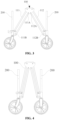
- FIGS. 1 to 4 schematically show a vertical-bar connection assembly 100 for a collapsible wagon (hereinafter referred to as a vertical-bar connection assembly 100) according to an embodiment of the present disclosure.
- the vertical-bar connection assembly 100 is collapsible to have an extended state and a folded state, and can be hinged between two adjacent vertical bars of the collapsible wagon.
- the vertical-bar connection assembly 100 comprises at least one vertical-bar connection member 110 comprising a first connecting bar 111 and a second connecting bar 112.
- the first connecting bar 111 has a proximal end 111A and a distal end 111B
- the second connecting bar 112 has a proximal end 112A and a distal end 112B.
- the proximal end 111A of the first connecting bar 111 and the proximal end 112A of the second connecting bar 112 are hinged with each other.
- the distal end 111B of the first connecting bar 111 and the distal end 112B of the second connecting bar 112 are respectively hinged with the two adjacent vertical bars of the collapsible wagon.
- the distal end 111B of the first connecting bar 111 and the distal end 112B of the second connecting bar 112 are rotatable about their respective proximal ends 111A and 112A to move away from or close to each other.
- the vertical-bar connection assembly 100 is extended into the extended state, and the two adjacent vertical bars of the collapsible wagon are also away from each other.
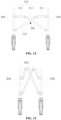
- the distal end 111B of the first connecting bar 111 and the distal end 112B of the second connecting bar 112 approach each other, as shown in FIG. 4 , the vertical-bar connection assembly 100 is folded into the folded state, and the two adjacent vertical bars of the collapsible wagon also approach each other.
- FIGS. 7 to 9 show an application of the vertical-bar connection assembly 100 in a collapsible wagon C, wherein the vertical-bar connection assembly 100 may comprise at least two vertical-bar connection members 110 spaced apart up and down.
- the collapsible wagon C will be described in detail later.
- the vertical-bar connection assembly 100 may comprise at least two vertical-bar connection members 110 spaced apart, and in the vertical-bar connection assembly 100 or in the at least two vertical-bar connection members 110 spaced apart as described above, the first connecting bars 111 are parallel to each other, and the second connecting bars 112 are also parallel to each other.
- the first connecting bars 111 parallel to each other have same lengths
- the second connecting bars 112 parallel to each other have same lengths.
- first connecting bars 111 two proximal ends 111A and two distal ends 111B
- second connecting bars 112 two proximal ends 112A and two distal ends 112B
- first connecting bars 111 in pairs constitute opposite sides of a parallelogram mechanism
- second connecting bars 112 in pairs also constitute opposite sides of a parallelogram mechanism.
- the first connecting bars 111 are always parallel to each other and the second connecting bars 112 are always parallel to each other during the extension and folding of the vertical-bar connection assembly 100.
- FIGS. 2 to 4 show the extended, half-folded and folded states of the vertical-bar connection assembly 100, respectively.
- the first connecting bars 111 may have different lengths, and/or the second connecting bars 112 may have different lengths.
- the first connecting bars 111 are not parallel or at least not always parallel to each other, and/or the second connecting bars 112 are not parallel or at least not always parallel to each other.
- the spaced-apart arrangement of the vertical-bar connection members 110 of one single vertical-bar connection assembly 100 is preferably an up-down spaced-apart arrangement. That is, the vertical-bar connection assembly 100 is configured to comprise at least two vertical-bar connection members 110 spaced apart up and down, which may bring additional benefits. For example, as shown in FIGS.
- two or more vertical-bar connection members 310 are hinged thereto, and these hinge points restrain each other, such that the single vertical bar 200 does not rotate around one single hinge point to fall down, and the stability of the collapsible wagon C in the extended state of the vertical-bar connection assembly 100 is guaranteed.
- the length of the first connecting bar 111 is equal to that of the second connecting bar 112.
- the first connecting bar 111 and the second connecting bar 112 are symmetrical (for example, with respect to their hinge point), such that the first connecting bar 311 and the second connecting bar 312 are rotatable symmetrically to achieve the extension and folding of the vertical-bar connection assembly 100.
- the technical feature i.e. the length of the first connecting bar 111 is equal to that of the second connecting bar 112
- the technical features as described above i.e. the first connecting bars 111 are parallel to each other and have same lengths
- the second connecting bars 112 are parallel to each other and have same lengths.
- the vertical-bar connection assembly 100 may also have a first stop portion 100A.
- the first stop portion 100A may unidirectionally restrain the rotation of the first connecting bar 111 and the second connecting bar 112 when the vertical-bar connection assembly 100 is in the extended state, that is, restrain the further rotation action of the first connecting bar 111 and the second connecting bar 112 from the folded state to the extended state, after the vertical-bar connection assembly 100 is extended from the folded state to the extended state and has been extended into the right place.
- the first stop portion 100A prevents the proximal ends 111A and 112A of the first connecting bar 111 and the second connecting bar 112 from continuing to move downward.
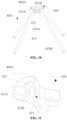
- the vertical-bar connection assembly 100 comprises a groove-shaped housing connector 120 having a groove opening 123 forming a groove bottom wall 121 and groove side walls 122.
- the groove bottom wall 121 serves as the first stop portion 100A.
- the first connecting bar 111 and the second connecting bar 112 are hinged with each other via the groove-shaped housing connector 120.
- the proximal end 111A of the first connecting bar 111 and the proximal end 112A of the second connecting bar 112 are inserted into the groove-shaped housing connector 120 respectively from two ends of the groove opening 123 and are hinged with the groove side walls 122 of the groove-shaped housing connector 120.
- the groove bottom wall 121 of the groove-shaped housing connector 120 serves as the first stop portion 100A, and the side surface of the proximal end 111A of the first connecting bar 111 and the side surface of the proximal end 112A of the second connecting bar 112 respectively abut against the groove bottom wall 121 (that is, the first stop portion 100A) after the vertical-bar connection assembly 100 has been extended from the folded state to the extended state, such that the first connecting bar 111 and the second connecting bar 112 cannot continue to rotate, but can rotate reversely to be folded.
- the vertical-bar connection assembly 100 is configured to comprise at least two vertical-bar connection members 110 spaced apart up and down, the groove opening 123 of the groove-shaped housing connector 120 is configured to open downward, and the side surfaces of the proximal ends 111A of the first connecting bars 111 and the side surfaces of the proximal ends 112A of the second connecting bars 112 respectively abut against the groove bottom wall 121 of the groove-shaped housing connector 120 and cannot continue to move downward when the vertical-bar connection assembly 100 is in the extended state.
- the first stop portion 100A may have various other variants, which will not be described here.
- the vertical-bar connection assembly 100 comprises only one vertical-bar connection member 110
- one groove-shaped housing connector 120 may be provided to be connected to the first connecting bar 111 and the second connecting bar 112 of the vertical-bar connection member 110.
- the groove-shaped housing connector 120 may be individually provided for the respective vertical-bar connection member 110 to be connected to the first connecting bar 111 and the second connecting bar 112 of the respective vertical-bar connection member 110.
- a connector (not shown), such as a connection plate, may be further provided to connect these groove-shaped housing connectors into a whole, so as to achieve synchronous extension and folding actions of the vertical-bar connection members 110, thereby increasing the strength of the entire vertical-bar connection assembly 100.
- a connector such as a connection plate
- one groove-shaped housing connector 120 may be provided, and the proximal end 111A of the first connecting bar 111 and the proximal end 112A of the second connecting bar 112 of the respective vertical-bar connection member 110 are inserted into the groove-shaped housing connector 120 respectively from two ends of the groove opening 123 and are hinged with the groove side walls 122 of the groove-shaped housing connector 120, thereby simplifying the structure and achieving synchronous extension and folding actions of the vertical-bar connection members 110 in the single vertical-bar connection assembly.
- the side surface of the proximal end 111A of the first connecting bar 111 and the side surface of the proximal end 112A of the second connecting bar 112 of the at least one vertical-bar connection member 110 respectively abut against the groove bottom wall 121 of the groove-shaped housing connector 120 after the vertical-bar connection assembly 100 has been extended from the folded state to the extended state.
- the vertical-bar connection assembly 100 of the collapsible wagon C configured to comprise at least two vertical-bar connection members 110 spaced apart up and down, the side surface of the proximal end 111A of the first connecting bar 111 and the side surface of the proximal end 112A of the second connecting bar 112 of the uppermost vertical-bar connection member 110 respectively abut against the groove bottom wall 121 of the groove-shaped housing connector 120, such that the first connecting bars 111 and the second connecting bars 112 in the entire vertical-bar connection assembly 100 are prevented from continuing to rotate.
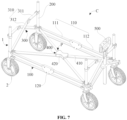
- FIGS. 7 to 9 schematically show a collapsible wagon C according to an embodiment of the present disclosure.
- the collapsible wagon comprises a wagon frame 1 and a plurality of wheels 2 arranged on the wagon frame 1.
- the wagon frame 1 has an expanded state and a collapsed state. In the expanded state, the wheels 2 are located at the bottom of the wagon frame 1.
- the wagon frame 1 comprises a plurality of vertical bars 200 and one or more connection assemblies, wherein at least one of the connection assemblies is configured as the above-mentioned vertical-bar connection assembly 100.
- the plurality of vertical bars 200 are arranged along the circumferential direction of the wagon frame 1.
- the connection assemblies are respectively hinged between two adjacent vertical bars 200 along the circumferential direction of the wagon frame 1.
- the connection assemblies are collapsible to be extended and folded so as to allow the wagon frame 1 to be in the expanded state or in the collapsed state. It should be understood that, according to actual needs, the number of the connection assemblies may vary with the number of the vertical bars 200. For example, it can be ensured that a connection assembly is connected between any two adjacent vertical bars 200.
- the number of the connection assembly may be one.
- the number of the connection assemblies may be equal to the number of vertical bars 200, that is three or more.
- a plurality of (two or more) connection assemblies may be provided between two adjacent vertical bars 200.
- the one connection assembly is configured as the vertical-bar connection assembly 100 as described above.
- at least one of the plurality of connection assemblies is configured as the vertical-bar connection assembly 100 as described above.
- the wagon frame 1 When the vertical-bar connection assembly 100 is extended into the extended state, the wagon frame 1 is expanded into the expanded state, and when the vertical-bar connection assembly 100 is folded into the folded state, the wagon frame 1 is collapsed into the collapsed state.
- the vertical-bar connection assembly 100 comprised in the wagon frame 1 is configured to comprise at least two vertical-bar connection members 110 spaced apart up and down.
- the collapsible wagon C comprising the vertical-bar connection assembly 100 occupies a small space after being collapsed, and is convenient to be stored and carried.
- the wagon frame 1 may further comprise a chassis 400 hinged between the plurality of vertical bars 200.
- the chassis 400 defines a chassis plane P in the expanded state of the wagon frame 1, and the articles to be transported may be placed on the chassis 400/the chassis plane P.
- the chassis 400 may be collapsible.
- the chassis 400 comprises a plurality of bottom support bars 410.
- Each of bottom support bars 410 has a convergence end 410A and a divergence end 410B.
- the bottom support bars 110 have same lengths and are arranged at an angle to each other.
- the convergence ends 410A of the bottom support bars 410 are hinged with each other.
- the divergence ends 410B of the bottom support bars 410 are rotatable about their respective convergence ends 410A to move away from or close to each other.
- the vertical bars 200 are arranged circumferentially with the convergence ends 410A hinged with each other as the center, and are respectively hinged with the divergence ends 410B of the bottom support bars 410.
- the vertical bars 200 When the divergence ends 410B move away from each other, the vertical bars 200 also move away from each other, and the wagon frame 1 is synchronously expanded into the expanded state.
- the divergence ends 410B move close to each other, the vertical bars 200 move close to each other, and the wagon frame 1 is synchronously collapsed into the collapsed state.
- the bottom support bars 410 collectively define the chassis plane P.
- the number of the bottom support bars 410 may be the same as that of the vertical bars 200, for example, two or more, including three or more, four or more, five or more, etc.
- the number of the bottom support bars 410 is four, and the four bottom support bars 410 are arranged in an X shape in the expanded state.
- the number of the bottom support bars 410 may be three, and the bottom support bars are arranged in a Y shape in the expanded state.
- only one rearward-extending bottom support bar and two forward-extending bottom support bars are provided, as compared with the embodiment shown in FIG. 7 .
- the number of the bottom support bars 410 may be two, and the bottom support bars are arranged in a V shape in the expanded state.
- the number of the bottom support bars 410 may also be five, six, seven, eight and the like.
- the vertical-bar connection assembly 100 comprises only one vertical-bar connection member 110.
- the first connecting bar 111 and the second connecting bar 112 of the vertical-bar connection member 110 in the vertical-bar connection assembly 100 are in a same straight line.
- the first connecting bar 111 and the second connecting bar 112 of the vertical-bar connection assembly 100 are not only in a same straight line, but also in the chassis plane P in the expanded state of the wagon frame 1, i.e., in the extended state of the vertical-bar connection assembly 100, so as to structurally enhance the chassis 400 defining the chassis plane P and to carry the articles to be transported together.
- the vertical-bar connection assembly 100 comprises at least two vertical-bar connection members 110 spaced apart, thus each vertical-bar connection member 110 of the vertical-bar connection assembly 100 is configured such that, in the extended state of the vertical-bar connection assembly 100, the first connecting bar 111 and the second connecting bar 112 are in a same straight line.
- the vertical-bar connection assembly 100 is applied to the collapsible wagon C, as the embodiment shown in FIGS.
- the vertical-bar connection assembly 100 is configured to comprise at least two vertical-bar connection members 110 spaced apart up and down, and in the expanded state of the wagon frame 1, the first connecting bar 111 and the second connecting bar 112 of the uppermost vertical-bar connection member 110 of the vertical-bar connection assembly 100 are in a same straight line and are both in the chassis plane P.
- the uppermost vertical-bar connection member 110 of the vertical-bar connection assembly 100 can structurally enhance the chassis 400 defining the chassis plane P and carry the articles to be transported together with the chassis 400, thereby enhancing the carrying capacity of the collapsible wagon C, and pressing the articles to be transported on the vertical-bar connection members 110 during use. This prevents collapsing of the vertical-bar connection members 110 during use by means of the weight of the articles to be transported.
- each of the connection assemblies of the wagon frame 1 can be configured as the vertical-bar connection assembly 100.
- each connection assembly being configured as the vertical-bar connection assembly 100 comprising at least two vertical-bar connection members 110 spaced apart up and down, in the expanded state
- the first connecting bar 111 and the second connecting bar 112 of the uppermost vertical-bar connection member 110 in each vertical-bar connection assembly 100 are both in the chassis plane P.
- the vertical-bar connection assemblies 100 and the chassis 400 collectively constitute a platform for placing articles, and in this case, the upper ends of the vertical bars 200 may be arranged to be flush with the chassis plane P, such that there is no railing, facilitating the placement of larger articles.
- connection assemblies are each configured as the vertical-bar connection assembly 100, and other connection assemblies may each be configured in any existing or non-existing suitable form.
- two opposing connection assemblies are each configured as the vertical-bar connection assembly 100.
- the two vertical-bar connection assemblies 100 are symmetrically arranged on the left and right sides of the wagon frame 1/the chassis 400.
- the other two opposing connection assemblies are each configured as a secondary connection assembly 300, which will be described below.
- At least one of the plurality of connection assemblies may be configured as the secondary connection assembly 300 comprising two secondary connection members 310 intersectionally arranged.
- One end of one secondary connection member 310 is hinged with the upper end of one of the two adjacent vertical bars 200, and the other end to the lower end of the other of the two adjacent vertical bars 200.
- the other secondary connection member 310 is arranged reversely to form an intersectional arrangement.
- each secondary connection member 310 comprises a third connecting bar 311 and a fourth connecting bar 312 hinged with each other, and the third connecting bar 311 and the fourth connecting bar 312 are respectively hinged with the two adjacent vertical bars 200.
- the intersectional secondary connection members 310 may function as railings to prevent articles to be transported from slipping off.
- the secondary connection members 310 intersectionally arranged have an intersection point and are hinged at the intersection point.
- the fourth connecting bar 312 is longer than the third connecting bar 311.
- the two fourth connecting bars 312 intersect and are hinged with each other, such that the two secondary connection members 310 are linked with each other during the expanding or collapsing process.
- the number of the intersectionally arranged secondary connection members 310 comprised in the secondary connection assembly 300 may be a suitable number of two or more, in particular an even number of two or more.
- the secondary connection members 310 are symmetrical in pairs.
- the two secondary connection members 310 are symmetrical (with respect to their intersection point).
- the exemplary embodiment shown in FIGS. 7 to 9 shows a wagon frame having four connection assemblies, among which two opposing connection assemblies are each configured as the secondary connection assembly 300.
- the two secondary connection assemblies 300 are symmetrically arranged on the front and rear sides of the wagon frame 1/the chassis 400.
- the other two opposing connection assemblies are each configured as the vertical-bar connection assembly 100 as described above.
- a connection assembly of the collapsible wagon C is preferably configured as the vertical-bar connection assembly 100.
- the wagon frame 1 comprises only one connection assembly, and the connection assembly is configured as the vertical-bar connection assembly 100.
- the wagon frame 1 comprises a plurality of (in this case, two or more, three or more, and the like) connection assemblies.
- the other connection assemblies may each be configured, depending on needs, as the vertical-bar connection assembly 100 or the secondary connection assembly 300, or as other existing or non-existing suitable connection assembly.
- the vertical-bar connection assembly 100 comprises two vertical-bar connection members 110 spaced apart up and down. And in a single vertical-bar connection member 110, the first connecting bar 111 and the second connecting bar 112 are symmetrical (for example, with respect to their hinge point), and the two vertical-bar connection assemblies 100 are symmetrically arranged on the left and right sides of the wagon frame 1.
- Each secondary connection assembly 300 comprises two intersectionally arranged secondary connection members 310 hinged at their intersection point. And, in each secondary connection assembly 300, the two intersectionally arranged secondary connection members 310 are symmetrical (for example, with respect to their intersection point).
- the two secondary connection assemblies 300 are symmetrically arranged on the front and rear sides of the wagon frame 1.
- the bottom support bars 410 of the chassis 400 have same lengths. It should be understood that the extending, folding, collapsing and similar movements among the various connection assemblies of the collapsible wagon C, and between the connection assemblies and the chassis 400, are coordinated to achieve the expanding and collapsing of the collapsible wagon C.
- the chassis 400 has a second stop portion 400A.
- the second stop portion 400A may unidirectionally restrain the rotation of the bottom support bars 410, that is, prevent the convergence ends 410A of the bottom support bars 410 from moving downward.
- the bottom support bars 410 collectively define the chassis plane P via the second stop portion 400A.
- the chassis 400 further comprises a hinge seat 420.
- the convergence ends 410A of the bottom support bars 410 are hinged with each other via the hinge seat 420.
- the hinge seat 420 has a plurality of hinge grooves 421, each of which forms a hinge-groove bottom wall 421A and hinge-groove side walls 421B.
- Each hinge groove 421 may open downward.
- the hinge seat 420 may comprise a plate-shaped member 422, and the hinge-groove side walls 421B extend downward from the bottom surface of the plate-shaped member 422 to form the hinge grooves 421 that open downward.
- the convergence ends 410A of the bottom support bars 410 are respectively inserted into the respective hinge grooves 421 and are hinged with the hinge-groove side walls 421B of the hinge grooves 421 by pins.
- the bottom support bars 410 are rotatable about the pins/the convergence ends 410A.
- the hinge-groove bottom wall 421A serves as the second stop portion 400A, and the bottom support bars 410 can rotate such that the hinge-groove bottom walls 421A (or the bottom surface of the plate-shaped member 422) of the hinge grooves 421 abut against the side surfaces of the convergence ends 410A of the bottom support bars 410, so as to obtain the chassis plane P.
- the convergence ends 410A of the bottom support bars 410 also move downward or upward when the bottom support bars 410 of the chassis 400 move away from or close to each other, and the wagon frame 1 synchronously is expanded or collapsed. Therefore, during use of the collapsible wagon C, the hinge seat 420 hinged with the convergence ends 410A can also be used as a force application point for collapsing and expanding the wagon frame 1. When the wagon frame 1 is to be collapsed, the hinge seat 420 is lifted upward, the convergence ends 410A move upward, and the wagon frame 1 can be collapsed into the collapsed state.
- the hinge seat 420 When the wagon frame 1 is to be expanded, the hinge seat 420 is pressed downward, the convergence ends 410A move downward, and the wagon frame 1 can be expanded into the expanded state.
- the wheels 2 may be mounted on the hinge seat 420.
- the wheels 2 are mounted between the plurality of hinge grooves 421, so as to provide support in the expanded state of the wagon frame 1.
- the collapsible wagon C may be used as a stool in the collapsed state of the wagon frame 1, for example, in the case that the plate-shaped member 422 of the hinge seat 420 has a suitable size.
- the function of the second stop portion 400A is to unidirectionally restrain the rotation of the bottom support bars 410 when the wagon frame 1 is in the expanded state, that is to prevent the convergence ends 410A of the bottom support bars 410 from moving downward, thereby forming the chassis plane P. Therefore, the second stop portion 400A may have other variants according to this function.
- a stop block (not shown) may be provided below the hinge position of a vertical bar 200 with a bottom support bar 410. The stop block may be provided on the vertical bar 200, and serve as the second stop portion. In the expanded state, the stop block abuts against the lower surface of the divergence end 410B of the bottom support bar 410, thereby preventing the convergence end 410A of the bottom support bar 410 from continuing to move downward.
- the plurality of wheels 2 of the wagon frame 1 may be arranged at suitable positions of the wagon frame 1, including be arranged on the bottom support bars 410, the first connecting bars 111 and the second connecting bars 112.
- the plurality of wheels 2 are respectively arranged at the lower ends of the vertical bars 200.
- the wheels 2 may be configured as universal wheels.
- first connecting bar 111, the second connecting bar 112, the vertical bar 200, the third connecting bar 311, the fourth connecting bar 312, and the bottom support bar 410 described herein may be a bar of any suitable form, including but not limited to, a straight bar, a curved bar, a wave-shaped bar, or a combination thereof (for example, a section of the entire bar is straight, and another section thereof is wave-shaped).
- a straight bar is used.
- the wagon frame 1 further comprises a handle assembly 500 for pushing and pulling the collapsible wagon C.
- the handle assembly 500 comprises a handle seat 510 and a handle bar 520 mounted on the handle seat 510.
- the upper end of the handle bar 520 may be mounted with a handle 530 to facilitate pushing and pulling.
- the wagon frame 1 may further comprise a handle steering assembly 600.
- the handle steering assembly 600 comprises a pair of handle steering bars 610 located on two sides of the handle seat 510 respectively.
- the handle assembly 500 is hinged between the two adjacent vertical bars 200 via the pair of handle steering bars 610.
- each handle steering bar 610 is hinged with a vertical bar 200, and the other end is hinged with the handle seat 510.
- the pair of handle steering bars 610 are symmetrically arranged on two sides of the handle seat 510. It should be understood that the extension and folding of the pair of handle steering bars 610 are coordinated with the extension, folding, collapsing and similar movements of the connecting assemblies and the chassis 400.
- a handle steering bar 610 is hinged with a vertical bar 200 via a hinge block 620.
- the hinge block 620 is hinged with the handle steering bar 610 and the vertical bar 200, respectively.
- the hinge block 620 is hinged with the vertical bar 200, such that the handle assembly 500 and the handle steering bar 610 can be integrally turned over with respect to the chassis plane P.
- the hinge block 620 is hinged with the handle steering bar 610 so as to cooperate with the hinge between the handle steering bar 610 and the handle seat 510, such that the pair of handle steering bars 610 can be expanded or collapsed when the wagon frame 1 is expanded or collapsed.
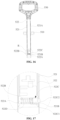
- the handle bar 520 may be configured as a telescopic bar and comprise a lower tube body 521 and an upper tube body 522, and the upper end of the upper tube body 522 is provided with the handle 530.
- the lower tube body 521 is fixedly mounted on the handle seat 510.
- An upper locking hole 521A and a lower locking hole 521B axially spaced apart are provided on the side wall of the lower tube body 521.
- the upper tube body 522 is inserted in the lower tube body 521.
- the upper tube body 522 is provided with an elastic member 522B and is connected to a movable button 522C by means of the elastic member 522B.
- the elastic member 522B may bias the movable button 522C towards the side wall of the lower tube body 521 such that the movable button 522C may partially extend out of the upper locking hole 521A or the lower locking hole 521B.
- the elastic member 522B may be configured as a compressed spring or an elastic sheet to give a biasing force to the movable button 522C, which may partially extend out of the upper locking hole 521A or the lower locking hole 521B.
- the size of the unexposed portion 522C1 of the movable button 522C is larger than that of the upper locking hole 521A and the lower locking hole 521B, and the size of the extendable portion 522C2 is less than or equal to that of the upper locking hole 521A and the lower locking hole 521B, such that the movable button can partially extend out of the upper locking hole 521A or the lower locking hole 521B.
- the movable button 522C abuts against the inner side of the side wall of the lower tube body 521 under the elastic biasing force of the elastic member 522B, and the handle bar 520 is extended.
- the elastic member 522B pushes the movable button 522C to partially extend out of the upper locking hole 521A, thereby locking the upper tube body 522 to the lower tube body 521.
- the handle bar 520 is contracted.
- the elastic member 522B pushes the movable button 522C to partially extend out of the lower locking hole 521B, thereby locking the upper tube body 522 to the lower tube body 521.
- the movable button 522C is pressed such that the movable button 522C is retracted until it does not extend out of the upper locking hole 521A or the lower locking hole 521B, the locking between the upper tube body 522 and the lower tube body 521 is released.
- the upper tube body 522 is fixedly connected to a connection block 522A that can be placed in the lower tube body 521.
- the connection block 522A can be fixedly provided at the lower end of the upper tube body 522 and have a blind hole 522D, and the elastic member 522B and the movable button 522C are provided in the blind hole 522D.
- the unexposed portion 522C1 of the movable button 522C remains in the blind hole 522D during the movement of the movable button 522C.
- the blind hole 522D provides mounting space for the elastic member 522B and the movable button 522C, and provides guidance for the elastic movement of the elastic member 522B configured as a compressed spring.
- the blind hole may be directly provided in the upper tube body 522.
Landscapes
- Engineering & Computer Science (AREA)
- Chemical & Material Sciences (AREA)
- Combustion & Propulsion (AREA)
- Transportation (AREA)
- Mechanical Engineering (AREA)
- Handcart (AREA)
Applications Claiming Priority (2)
| Application Number | Priority Date | Filing Date | Title |
|---|---|---|---|
| CN202311576177.1A CN120024382A (zh) | 2023-11-23 | 2023-11-23 | 用于可折叠推车的立杆连接组件及可折叠推车 |
| CN202323170813.9U CN221251266U (zh) | 2023-11-23 | 2023-11-23 | 用于可折叠推车的立杆连接组件及可折叠推车 |
Publications (1)
| Publication Number | Publication Date |
|---|---|
| EP4559778A1 true EP4559778A1 (fr) | 2025-05-28 |
Family
ID=90365734
Family Applications (1)
| Application Number | Title | Priority Date | Filing Date |
|---|---|---|---|
| EP24163363.5A Pending EP4559778A1 (fr) | 2023-11-23 | 2024-03-13 | Ensemble de liaison de barre verticale pour wagon pliant, et wagon pliant |
Country Status (2)
| Country | Link |
|---|---|
| US (1) | US20250171065A1 (fr) |
| EP (1) | EP4559778A1 (fr) |
Families Citing this family (4)
| Publication number | Priority date | Publication date | Assignee | Title |
|---|---|---|---|---|
| US20250242848A1 (en) * | 2024-01-29 | 2025-07-31 | Rui CHENG | Folding Frame and Wagon Using the Same |
| US20250368243A1 (en) * | 2024-06-04 | 2025-12-04 | Qingdao Ritashaw Machinery Co., Ltd. | Seat folding cart |
| USD1119153S1 (en) * | 2024-11-28 | 2026-03-17 | Kaijing Yuan | Folding trolley frame |
| USD1107365S1 (en) * | 2024-11-28 | 2025-12-23 | Kaijing Yuan | Folding trolley |
Citations (5)
| Publication number | Priority date | Publication date | Assignee | Title |
|---|---|---|---|---|
| DE4131368A1 (de) * | 1991-09-20 | 1993-03-25 | Scherfeder Drahtwarenfabrik Gm | Fahrbares transport- und verkaufsregal |
| CN103895672A (zh) | 2012-12-25 | 2014-07-02 | 浙江泰普森休闲用品有限公司 | 一种沙滩推车 |
| EP2508408B1 (fr) * | 2011-04-04 | 2015-07-01 | Hoza Holding B.V. | Récipient roulant et procédé de transport associé |
| US10633010B1 (en) * | 2018-09-01 | 2020-04-28 | Xiangshan Zhang | Trailer with no extra height when folding |
| JP3237516U (ja) * | 2022-03-24 | 2022-05-19 | 慈溪市牧吉熊戸外用品有限公司 | 折り畳み式荷物用カート |
Family Cites Families (4)
| Publication number | Priority date | Publication date | Assignee | Title |
|---|---|---|---|---|
| US20030025301A1 (en) * | 2000-12-08 | 2003-02-06 | Henry Banuelos | Folding wagon assembly |
| US9580095B2 (en) * | 2015-05-27 | 2017-02-28 | Academy, Ltd. | Mobile cart |
| CN205469183U (zh) * | 2016-03-08 | 2016-08-17 | 客贝利(厦门)休闲用品有限公司 | 折叠手推车的固定结构 |
| CN219406494U (zh) * | 2022-03-17 | 2023-07-25 | 马春桃 | 一种便捷收折的折叠式手推车 |
-
2024
- 2024-03-13 EP EP24163363.5A patent/EP4559778A1/fr active Pending
- 2024-03-14 US US18/604,915 patent/US20250171065A1/en active Pending
Patent Citations (5)
| Publication number | Priority date | Publication date | Assignee | Title |
|---|---|---|---|---|
| DE4131368A1 (de) * | 1991-09-20 | 1993-03-25 | Scherfeder Drahtwarenfabrik Gm | Fahrbares transport- und verkaufsregal |
| EP2508408B1 (fr) * | 2011-04-04 | 2015-07-01 | Hoza Holding B.V. | Récipient roulant et procédé de transport associé |
| CN103895672A (zh) | 2012-12-25 | 2014-07-02 | 浙江泰普森休闲用品有限公司 | 一种沙滩推车 |
| US10633010B1 (en) * | 2018-09-01 | 2020-04-28 | Xiangshan Zhang | Trailer with no extra height when folding |
| JP3237516U (ja) * | 2022-03-24 | 2022-05-19 | 慈溪市牧吉熊戸外用品有限公司 | 折り畳み式荷物用カート |
Also Published As
| Publication number | Publication date |
|---|---|
| US20250171065A1 (en) | 2025-05-29 |
Similar Documents
| Publication | Publication Date | Title |
|---|---|---|
| EP4559778A1 (fr) | Ensemble de liaison de barre verticale pour wagon pliant, et wagon pliant | |
| US12012139B2 (en) | Folding cart with high load-bearing chassis structure | |
| EP3081736B1 (fr) | Joint de blocage pour échelles repliables | |
| JP6352356B2 (ja) | テールゲートを備える折畳み式ワゴン | |
| US9416591B2 (en) | Telescoping ladder with stabilizers | |
| CN221251266U (zh) | 用于可折叠推车的立杆连接组件及可折叠推车 | |
| US5002304A (en) | Collapsible cart | |
| CN216185261U (zh) | 一种可折叠推车 | |
| US6488331B2 (en) | Foldable chair frame | |
| JP5382909B2 (ja) | 多段スライド式車両用スロープ装置 | |
| US7584575B2 (en) | Variable height fold and roll staging and method of assembling same | |
| US20220400845A1 (en) | Extendable frame and structure having same | |
| US6877441B2 (en) | Foldable table | |
| US12331591B2 (en) | Ladder | |
| JP6109256B2 (ja) | 拡幅車両における車体拡幅構造 | |
| US6866119B2 (en) | Ladder with side support enhancement | |
| JP2004502891A (ja) | 折りたたみ式梯子 | |
| EP3445208B1 (fr) | Table pliante | |
| KR102363795B1 (ko) | 접철식 표지판 | |
| US6945914B1 (en) | Climbing training machine | |
| CN120024382A (zh) | 用于可折叠推车的立杆连接组件及可折叠推车 | |
| TWM613647U (zh) | 斜坡板 | |
| CN223991723U (zh) | 可伸缩折叠平台梯 | |
| US20260084736A1 (en) | Sheaflike folding cart | |
| JP2581939Y2 (ja) | 折畳移動式足場 |
Legal Events
| Date | Code | Title | Description |
|---|---|---|---|
| PUAI | Public reference made under article 153(3) epc to a published international application that has entered the european phase |
Free format text: ORIGINAL CODE: 0009012 |
|
| STAA | Information on the status of an ep patent application or granted ep patent |
Free format text: STATUS: THE APPLICATION HAS BEEN PUBLISHED |
|
| AK | Designated contracting states |
Kind code of ref document: A1 Designated state(s): AL AT BE BG CH CY CZ DE DK EE ES FI FR GB GR HR HU IE IS IT LI LT LU LV MC ME MK MT NL NO PL PT RO RS SE SI SK SM TR |
|
| STAA | Information on the status of an ep patent application or granted ep patent |
Free format text: STATUS: REQUEST FOR EXAMINATION WAS MADE |
|
| 17P | Request for examination filed |
Effective date: 20251127 |