EP4560102A1 - Fahrzeugschiebetürsteuerungssystem, verfahren und vorrichtung, speichermedium und elektronische vorrichtung - Google Patents
Fahrzeugschiebetürsteuerungssystem, verfahren und vorrichtung, speichermedium und elektronische vorrichtung Download PDFInfo
- Publication number
- EP4560102A1 EP4560102A1 EP23879211.3A EP23879211A EP4560102A1 EP 4560102 A1 EP4560102 A1 EP 4560102A1 EP 23879211 A EP23879211 A EP 23879211A EP 4560102 A1 EP4560102 A1 EP 4560102A1
- Authority
- EP
- European Patent Office
- Prior art keywords
- sliding door
- vehicle
- sending
- instruction
- control
- Prior art date
- Legal status (The legal status is an assumption and is not a legal conclusion. Google has not performed a legal analysis and makes no representation as to the accuracy of the status listed.)
- Pending
Links
Images

Classifications
-
- B—PERFORMING OPERATIONS; TRANSPORTING
- B60—VEHICLES IN GENERAL
- B60J—WINDOWS, WINDSCREENS, NON-FIXED ROOFS, DOORS, OR SIMILAR DEVICES FOR VEHICLES; REMOVABLE EXTERNAL PROTECTIVE COVERINGS SPECIALLY ADAPTED FOR VEHICLES
- B60J5/00—Doors
- B60J5/04—Doors arranged at the vehicle sides
- B60J5/06—Doors arranged at the vehicle sides slidable; foldable
-
- E—FIXED CONSTRUCTIONS
- E05—LOCKS; KEYS; WINDOW OR DOOR FITTINGS; SAFES
- E05F—DEVICES FOR MOVING WINGS INTO OPEN OR CLOSED POSITION; CHECKS FOR WINGS; WING FITTINGS NOT OTHERWISE PROVIDED FOR, CONCERNED WITH THE FUNCTIONING OF THE WING
- E05F15/00—Power-operated mechanisms for wings
- E05F15/70—Power-operated mechanisms for wings with automatic actuation
-
- B—PERFORMING OPERATIONS; TRANSPORTING
- B60—VEHICLES IN GENERAL
- B60R—VEHICLES, VEHICLE FITTINGS, OR VEHICLE PARTS, NOT OTHERWISE PROVIDED FOR
- B60R16/00—Electric or fluid circuits specially adapted for vehicles and not otherwise provided for; Arrangement of elements of electric or fluid circuits specially adapted for vehicles and not otherwise provided for
- B60R16/02—Electric or fluid circuits specially adapted for vehicles and not otherwise provided for; Arrangement of elements of electric or fluid circuits specially adapted for vehicles and not otherwise provided for electric constitutive elements
- B60R16/023—Electric or fluid circuits specially adapted for vehicles and not otherwise provided for; Arrangement of elements of electric or fluid circuits specially adapted for vehicles and not otherwise provided for electric constitutive elements for transmission of signals between vehicle parts or subsystems
-
- E—FIXED CONSTRUCTIONS
- E05—LOCKS; KEYS; WINDOW OR DOOR FITTINGS; SAFES
- E05F—DEVICES FOR MOVING WINGS INTO OPEN OR CLOSED POSITION; CHECKS FOR WINGS; WING FITTINGS NOT OTHERWISE PROVIDED FOR, CONCERNED WITH THE FUNCTIONING OF THE WING
- E05F15/00—Power-operated mechanisms for wings
- E05F15/70—Power-operated mechanisms for wings with automatic actuation
- E05F15/73—Power-operated mechanisms for wings with automatic actuation responsive to movement or presence of persons or objects
-
- B—PERFORMING OPERATIONS; TRANSPORTING
- B60—VEHICLES IN GENERAL
- B60R—VEHICLES, VEHICLE FITTINGS, OR VEHICLE PARTS, NOT OTHERWISE PROVIDED FOR
- B60R25/00—Fittings or systems for preventing or indicating unauthorised use or theft of vehicles
- B60R25/20—Means to switch the anti-theft system on or off
- B60R25/2045—Means to switch the anti-theft system on or off by hand gestures
-
- B—PERFORMING OPERATIONS; TRANSPORTING
- B60—VEHICLES IN GENERAL
- B60R—VEHICLES, VEHICLE FITTINGS, OR VEHICLE PARTS, NOT OTHERWISE PROVIDED FOR
- B60R25/00—Fittings or systems for preventing or indicating unauthorised use or theft of vehicles
- B60R25/20—Means to switch the anti-theft system on or off
- B60R25/2054—Means to switch the anti-theft system on or off by foot gestures
-
- B—PERFORMING OPERATIONS; TRANSPORTING
- B60—VEHICLES IN GENERAL
- B60R—VEHICLES, VEHICLE FITTINGS, OR VEHICLE PARTS, NOT OTHERWISE PROVIDED FOR
- B60R25/00—Fittings or systems for preventing or indicating unauthorised use or theft of vehicles
- B60R25/20—Means to switch the anti-theft system on or off
- B60R25/24—Means to switch the anti-theft system on or off using electronic identifiers containing a code not memorised by the user
-
- E—FIXED CONSTRUCTIONS
- E05—LOCKS; KEYS; WINDOW OR DOOR FITTINGS; SAFES
- E05F—DEVICES FOR MOVING WINGS INTO OPEN OR CLOSED POSITION; CHECKS FOR WINGS; WING FITTINGS NOT OTHERWISE PROVIDED FOR, CONCERNED WITH THE FUNCTIONING OF THE WING
- E05F15/00—Power-operated mechanisms for wings
- E05F15/70—Power-operated mechanisms for wings with automatic actuation
- E05F15/73—Power-operated mechanisms for wings with automatic actuation responsive to movement or presence of persons or objects
- E05F15/76—Power-operated mechanisms for wings with automatic actuation responsive to movement or presence of persons or objects responsive to devices carried by persons or objects, e.g. magnets or reflectors
-
- E—FIXED CONSTRUCTIONS
- E05—LOCKS; KEYS; WINDOW OR DOOR FITTINGS; SAFES
- E05F—DEVICES FOR MOVING WINGS INTO OPEN OR CLOSED POSITION; CHECKS FOR WINGS; WING FITTINGS NOT OTHERWISE PROVIDED FOR, CONCERNED WITH THE FUNCTIONING OF THE WING
- E05F15/00—Power-operated mechanisms for wings
- E05F15/70—Power-operated mechanisms for wings with automatic actuation
- E05F15/73—Power-operated mechanisms for wings with automatic actuation responsive to movement or presence of persons or objects
- E05F2015/763—Power-operated mechanisms for wings with automatic actuation responsive to movement or presence of persons or objects using acoustical sensors
-
- E—FIXED CONSTRUCTIONS
- E05—LOCKS; KEYS; WINDOW OR DOOR FITTINGS; SAFES
- E05Y—INDEXING SCHEME ASSOCIATED WITH SUBCLASSES E05D AND E05F, RELATING TO CONSTRUCTION ELEMENTS, ELECTRIC CONTROL, POWER SUPPLY, POWER SIGNAL OR TRANSMISSION, USER INTERFACES, MOUNTING OR COUPLING, DETAILS, ACCESSORIES, AUXILIARY OPERATIONS NOT OTHERWISE PROVIDED FOR, APPLICATION THEREOF
- E05Y2400/00—Electronic control; Electrical power; Power supply; Power or signal transmission; User interfaces
- E05Y2400/10—Electronic control
- E05Y2400/44—Sensors not directly associated with the wing movement
- E05Y2400/446—Vehicle state sensors, e.g. parked or inclination
-
- E—FIXED CONSTRUCTIONS
- E05—LOCKS; KEYS; WINDOW OR DOOR FITTINGS; SAFES
- E05Y—INDEXING SCHEME ASSOCIATED WITH SUBCLASSES E05D AND E05F, RELATING TO CONSTRUCTION ELEMENTS, ELECTRIC CONTROL, POWER SUPPLY, POWER SIGNAL OR TRANSMISSION, USER INTERFACES, MOUNTING OR COUPLING, DETAILS, ACCESSORIES, AUXILIARY OPERATIONS NOT OTHERWISE PROVIDED FOR, APPLICATION THEREOF
- E05Y2400/00—Electronic control; Electrical power; Power supply; Power or signal transmission; User interfaces
- E05Y2400/80—User interfaces
- E05Y2400/81—Feedback to user, e.g. tactile
- E05Y2400/812—Acoustic
- E05Y2400/814—Sound emitters, e.g. loudspeakers
-
- E—FIXED CONSTRUCTIONS
- E05—LOCKS; KEYS; WINDOW OR DOOR FITTINGS; SAFES
- E05Y—INDEXING SCHEME ASSOCIATED WITH SUBCLASSES E05D AND E05F, RELATING TO CONSTRUCTION ELEMENTS, ELECTRIC CONTROL, POWER SUPPLY, POWER SIGNAL OR TRANSMISSION, USER INTERFACES, MOUNTING OR COUPLING, DETAILS, ACCESSORIES, AUXILIARY OPERATIONS NOT OTHERWISE PROVIDED FOR, APPLICATION THEREOF
- E05Y2400/00—Electronic control; Electrical power; Power supply; Power or signal transmission; User interfaces
- E05Y2400/80—User interfaces
- E05Y2400/85—User input means
- E05Y2400/8505—User authentication, e.g. biometric
-
- E—FIXED CONSTRUCTIONS
- E05—LOCKS; KEYS; WINDOW OR DOOR FITTINGS; SAFES
- E05Y—INDEXING SCHEME ASSOCIATED WITH SUBCLASSES E05D AND E05F, RELATING TO CONSTRUCTION ELEMENTS, ELECTRIC CONTROL, POWER SUPPLY, POWER SIGNAL OR TRANSMISSION, USER INTERFACES, MOUNTING OR COUPLING, DETAILS, ACCESSORIES, AUXILIARY OPERATIONS NOT OTHERWISE PROVIDED FOR, APPLICATION THEREOF
- E05Y2900/00—Application of doors, windows, wings or fittings thereof
- E05Y2900/50—Application of doors, windows, wings or fittings thereof for vehicles
- E05Y2900/53—Type of wing
- E05Y2900/531—Doors
-
- G—PHYSICS
- G07—CHECKING-DEVICES
- G07C—TIME OR ATTENDANCE REGISTERS; REGISTERING OR INDICATING THE WORKING OF MACHINES; GENERATING RANDOM NUMBERS; VOTING OR LOTTERY APPARATUS; ARRANGEMENTS, SYSTEMS OR APPARATUS FOR CHECKING NOT PROVIDED FOR ELSEWHERE
- G07C2209/00—Indexing scheme relating to groups G07C9/00 - G07C9/38
- G07C2209/60—Indexing scheme relating to groups G07C9/00174 - G07C9/00944
- G07C2209/63—Comprising locating means for detecting the position of the data carrier, i.e. within the vehicle or within a certain distance from the vehicle
-
- G—PHYSICS
- G07—CHECKING-DEVICES
- G07C—TIME OR ATTENDANCE REGISTERS; REGISTERING OR INDICATING THE WORKING OF MACHINES; GENERATING RANDOM NUMBERS; VOTING OR LOTTERY APPARATUS; ARRANGEMENTS, SYSTEMS OR APPARATUS FOR CHECKING NOT PROVIDED FOR ELSEWHERE
- G07C9/00—Individual registration on entry or exit
- G07C9/00174—Electronically operated locks; Circuits therefor; Nonmechanical keys therefor, e.g. passive or active electrical keys or other data carriers without mechanical keys
- G07C9/00309—Electronically operated locks; Circuits therefor; Nonmechanical keys therefor, e.g. passive or active electrical keys or other data carriers without mechanical keys operated with bidirectional data transmission between data carrier and locks
Definitions
- This disclosure relates to the field of sliding door control technology, particularly to a control system, a control method, and a control apparatus of a vehicle sliding door, a storage medium, and an electronic device.
- Sliding doors are widely used in vehicles due to their convenience in opening and closing.
- the sliding door can only be opened or closed by a user actively pulling an outer handle of the sliding door or pressing a micro-power switch provided on the handle.
- this disclosure provides a control system, a control method, and a control apparatus of a vehicle sliding door, a storage medium, and an electronic device, to at least solve the technical problems existing in the related art.
- a control system of a vehicle sliding door which includes:
- the sensing module is represented by a capacitive switch set on the outer side of the vehicle sliding door, with the plurality of sensors sensors respectively set in a plurality of sensing areas of the capacitive switch.
- the sensing module when sending the first control instruction to the vehicle body domain controller in response to some of the sensors being triggered in sequence, is specifically for:
- the vehicle body domain controller is further, when sending the second control instruction to the sliding door controller based on the locking state of the vehicle, specifically for:
- system further includes a user identification module
- the user identification module includes a Bluetooth module, and the Bluetooth module is specifically used for:
- system further includes a sound control module
- a control method of a vehicle sliding door is provided, applied to a sensing module set on an outer side of the vehicle sliding door, the sensing module including a plurality of sensors, the control method including: in response to some of the sensors being triggered in sequence, sending a first control instruction to a vehicle body domain controller, wherein the first control instruction comprises an opening instruction or a closing instruction of the sliding door.
- a control apparatus of a vehicle sliding door applied to a sensing module set on an outer side of the vehicle sliding door, the sensing module including a plurality of sensors, the control apparatus includes: an instruction sending module, for, in response to some of the sensors being triggered in sequence, sending a first control instruction to a vehicle body domain controller, wherein the first control instruction comprises an opening instruction or a closing instruction of the sliding door.
- a computer-readable storage medium storing a computer program therein, where the program implements the operations of the control method described in any embodiment of the first aspect when executed by a processor.
- an electronic device which includes:
- control instructions are sent to the sliding door controller through the vehicle body domain controller when some of the sensors are triggered in sequence, so that the user can complete the opening or closing operation of the sliding door by simply triggering the sensors, thereby enhancing user experience.
- first, second, third, etc. are used to describe various information, these terms should not be limited to these terms. These terms are used to distinguish one type of information from another.
- first information can also be referred to as second information, and similarly, the second information can also be referred to as the first information.
- word “if” as used herein can be interpreted as "when", “while” or "in response to determining”.
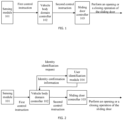
- FIG. 1 shows a schematic diagram of a control system of a vehicle sliding door according to an example of this disclosure.
- the system includes a sensing module 101, a vehicle body domain controller 102, and a sliding door controller 103.
- the sensing module 101 includes multiple sensors set on an outer side of the vehicle sliding door, and is used to send a first control instruction to the vehicle body domain controller when some of the sensors are triggered in sequence, where the first control instruction includes an opening instruction or a closing instruction of the sliding door.
- the vehicle body domain controller 102 can be a central processing unit (CPU) or a processor, or any other form as long as the vehicle body domain controller 102 can achieve functions described in the embodiments of this disclosure. This disclosure does not limit a specific implementation form of the vehicle body domain controller 102.
- the multiple sensors of the sensing module can be set on an outer handle of the vehicle sliding door or near the outer handle, such as on an outer side of the outer handle, so that users outside the vehicle can easily trigger the sensors when they want to perform an opening or a closing operation of the sliding door.
- the first control instruction includes the opening instruction or the closing instruction of the sliding door, for controlling the vehicle body domain controller to operate and control the sliding door controller to perform specific door opening and closing operations.
- the vehicle body domain controller By sending the first control instruction to the vehicle body domain controller when some of the sensors are triggered in sequence, it can prevent a mis-trigger of the first control instruction when the user unintendedly touch the sensors by grasping the outer handle of the sliding door or other ways.
- the sensing module is represented by a capacitive switch set on the outer side of the vehicle sliding door, with multiple sensors respectively set in multiple sensing areas of the capacitive switch.
- the capacitive switch includes 4 sensing areas, and the first control instruction is sent when the user triggers 3 or more sensing areas in sequence, so that the user can simply perform a "swing" and other gesture operations in the area where the sensing module is located to trigger the sensing module so as to send the first control instruction.
- the vehicle body domain controller 102 is used to receive the control instruction and send a second control instruction to the sliding door controller based on a locking state of the vehicle, where the second control instruction includes the opening instruction or the closing instruction of the sliding door.
- the vehicle body domain controller is mainly responsible for a door lock system of an entire vehicle, interior and exterior lighting system, air conditioning system, alarm system of security and anti-theft, sunroof sunshade system, and vehicle mode management.
- the vehicle body domain controller is also used to send the second control instruction to the sliding door controller based on the locking state of the vehicle (e.g., a locked state or unlocked state) after receiving the first control instruction, ensuring that the vehicle cannot be unlocked and the sliding door cannot be controlled to open by non-vehicle users when the vehicle is locked.
- the second control instruction when the first control instruction represents the opening instruction of the sliding door, the second control instruction is used to control the sliding door controller to perform the opening operation of the sliding door; when the first control instruction represents the closing instruction of the sliding door, the second control instruction is used to control the sliding door controller to perform the closing operation of the sliding door.
- sending the second control instruction to the sliding door controller based on the locking state of the vehicle includes:
- the vehicle body domain controller controls the vehicle to be unlocked and sends the second control instruction to the sliding door controller only when the vehicle body domain controller receives the identity confirmation information.
- the vehicle body domain controller determines that a current user triggering the sensing module is a vehicle user
- the vehicle body domain controller controls the vehicle to be unlocked and sends the second control instruction to the sliding door controller.
- the vehicle body domain controller does not need to unlock the vehicle and can directly send the second control instruction to the sliding door controller.
- the sliding door controller 103 is used to receive the second control instruction and perform the opening or closing operation of the sliding door according to the second control instruction.
- the sliding door controller is responsible for performing the opening or closing operation of the vehicle sliding door
- the vehicle sliding door includes a sliding rail structure and control motor.
- the second control instruction also includes an electric release signal.
- the sliding door controller releases a limit of the sliding door (the limit is used to lock or fix the sliding door) in response to receiving the electric release signal and performs a corresponding operation according to the opening or closing instruction of the sliding door in the second control instruction; when the sliding door is not fully opened or fully closed, the sliding door controller can directly perform the corresponding operation according to the opening or closing instruction of the sliding door in the second control instruction.
- the sensing module sends the control instruction to the sliding door controller through the vehicle body domain controller when some of the sensors are triggered in sequence, so that the user can complete the opening or closing operation of the sliding door by simply triggering the sensors, thereby enhancing the user experience.
- the sensing module is, when some of the sensors are triggered in sequence and the first control instruction is sent to the vehicle body domain controller, specifically used for:
- a sliding direction of the sliding door is from the front to the rear of the vehicle, and during the process of closing the sliding door, the sliding direction of the sliding door is from the rear to the front of the vehicle.
- the control instruction can be sent to the vehicle body domain controller according to the triggering direction of the sensor. This is just an example, and the opening and closing direction of the sliding door can also be set to be opposite to this direction.
- the user experience can be further enhanced and the mis-triggering of the sensing module can be avoided.
- FIG. 2 shows a schematic diagram of a control system of a vehicle sliding door according to an example of this disclosure.
- the system includes a user identification module 104.
- the vehicle body domain controller 102 is also used to send an identity identification request to the user identification module when the vehicle is in the locked state.
- the vehicle body domain controller can also control the user identification module to confirm an identity of the current user, ensuring that the vehicle will not be unlocked and controlled to open the sliding door by non-vehicle users when the vehicle is locked.
- the user identification module 104 is used to receive the identity identification request and determine identity information of the user; in response to that the identity information of the user meets a preset condition, send identity confirmation information to the vehicle body domain controller.
- the user identification module can determine whether the current user is the vehicle user based on the identity information of the user.
- the user identification module includes a Bluetooth module, which is used for: receiving the identity identification request and sending a Bluetooth broadcast to a vehicle key of the user; in response to establishing a connection between the vehicle key and the Bluetooth module, sending identity confirmation information to the vehicle body domain controller.
- a Bluetooth module which is used for: receiving the identity identification request and sending a Bluetooth broadcast to a vehicle key of the user; in response to establishing a connection between the vehicle key and the Bluetooth module, sending identity confirmation information to the vehicle body domain controller.
- the Bluetooth module can determine the identity of the user by determining whether the Bluetooth module can establish the connection with the vehicle key. After receiving the identity identification request, the Bluetooth module searches for the vehicle key through the Bluetooth broadcast.
- the Bluetooth module can establish the connection with the vehicle key, which indicates that the current user is the vehicle user. And the Bluetooth module sends the identity confirmation information to the vehicle body domain controller to control the vehicle to be unlocked, to achieve keyless entry functionality of the vehicle based on the Bluetooth module.
- the Bluetooth module cannot establish the connection with the vehicle key, which indicates that the current user is not the vehicle user. And the Bluetooth module does not send the identity confirmation information to the vehicle body domain controller, so that even if a non-vehicle user successfully makes the sensing module send the first control instruction, the vehicle sliding door cannot be opened.
- the user identification module can also determine the identity information of the user through a face recognition module, a fingerprint recognition module, or a voiceprint recognition module, etc., which is not limited by this disclosure.
- the user identification module can be any electronic circuit, chip, separate or integrated device that supports the Bluetooth technology, the face recognition technology, the fingerprint recognition technology, the voiceprint recognition technology, etc., of which specific implementation form is not limited by this disclosure.
- the user identification module when the user identification module includes the Bluetooth module, the user identification module can send the identity confirmation information when the Bluetooth module connects with the vehicle key, allowing users to experience the keyless entry functionality of the vehicle sliding door.
- FIG. 3 shows a schematic diagram of a control system of a vehicle sliding door according to an example of this disclosure. As shown in FIG. 3 , the system also includes a sound control module 105.
- the sliding door controller 103 is also used to send a sliding door status signal and a first sound request signal to the vehicle body domain controller after receiving the second control instruction.
- the first sound request signal is used to request the vehicle body domain controller to play preset chord music through the sound control module during an opening or closing process of the sliding door, further enhancing the user experience, and the sliding door status signal represents the opening or closing process of the sliding door.
- the vehicle body domain controller 102 is also used to send a second sound request signal to the sound control module after receiving the sliding door status signal and the first sound request signal.
- the vehicle body domain controller can determine a current status of the sliding door (e.g., the sliding door is in the opening or closing process) according to the sliding door status signal, and send the second sound request signal to the sound control module to control a sound playback module to perform a corresponding audio playback function and play an audio corresponding to the second sound request signal.
- the sound control module may adopt any structure that can perform operations such as speaker control and audio playback, as long as the sound control module can achieve the functions described in the embodiments of this disclosure, of which specific implementation structure is not limited by this disclosure.
- users can preset a type of the audio in advance through an in-vehicle interaction system, so that the vehicle body domain controller can control the sound playback module to play the preset audio through the second sound request signal, enhancing the user's personalized experience.
- the sound control module 105 is used to control a speaker of the vehicle to make a sound according to the second sound request signal.
- multiple high, mid, and low frequency speakers as well as surround sound speakers can be set inside the vehicle or on a frame of the sliding door, providing users with a rich and three-dimensional auditory experience during a process of the sound control module controlling the speakers to make a sound.
- the sound playback module controls the speakers to play preset audio information during the opening or closing process of the vehicle sliding door, which allows users to receive chord music from the speakers of the vehicle while waiting for the sliding door to open or close, further enhancing the user experience.
- this disclosure also provides a control method of a vehicle sliding door, applied to the sensing module set on the outer side of the vehicle sliding door, the sensing module includes multiple sensors, and the method includes:
- the vehicle body domain controller in response to some of the sensors being triggered in sequence, sending the first control instruction to the vehicle body domain controller, where the first control instruction includes the opening instruction or the closing instruction of the sliding door.
- this disclosure also provides embodiments of an apparatus of realizing application functions and a corresponding terminal.
- This disclosure also provides a control apparatus of a vehicle sliding door, applied to the sensing module set on the outer side of the vehicle sliding door, the sensing module includes multiple sensors, and the apparatus includes: an instruction sending module, used for: in response to some of the sensors being triggered in sequence, sending the first control instruction to the vehicle body domain controller, where the first control instruction includes the opening instruction or the closing instruction of the sliding door.
- the relevant parts refer to the description of the method embodiment.
- the above-described apparatus embodiment is merely for example, and units described as separate parts can be or cannot be physically separate, and parts displayed as units can be or cannot be physical units. For example, they can be located in one place, or they can also be distributed across multiple network units. Some or all of the modules can be selected according to actual needs to achieve the purpose of this disclosure. Those skilled in the art can understand and implement the scheme of this disclosure without creative effort.
- this specification also provides embodiments of the apparatus and the terminal to which the apparatus is applied.
- FIG. 4 is a hardware structure diagram of a computer equipment where the apparatus of the embodiment in this specification is located.
- a server or electronic device where the apparatus of the embodiment is located usually includes other hardware according to actual functions of the computer equipment, which is not described in detail.
Landscapes
- Engineering & Computer Science (AREA)
- Mechanical Engineering (AREA)
- Lock And Its Accessories (AREA)
- Power-Operated Mechanisms For Wings (AREA)
Applications Claiming Priority (2)
| Application Number | Priority Date | Filing Date | Title |
|---|---|---|---|
| CN202211295244.8A CN117948016A (zh) | 2022-10-21 | 2022-10-21 | 车辆滑门控制系统、方法、装置、储存介质及电子设备 |
| PCT/CN2023/125681 WO2024083225A1 (zh) | 2022-10-21 | 2023-10-20 | 车辆滑门控制系统、方法、装置、储存介质及电子设备 |
Publications (2)
| Publication Number | Publication Date |
|---|---|
| EP4560102A1 true EP4560102A1 (de) | 2025-05-28 |
| EP4560102A4 EP4560102A4 (de) | 2025-11-05 |
Family
ID=90737008
Family Applications (1)
| Application Number | Title | Priority Date | Filing Date |
|---|---|---|---|
| EP23879211.3A Pending EP4560102A4 (de) | 2022-10-21 | 2023-10-20 | Fahrzeugschiebetürsteuerungssystem, verfahren und vorrichtung, speichermedium und elektronische vorrichtung |
Country Status (4)
| Country | Link |
|---|---|
| US (1) | US20250154818A1 (de) |
| EP (1) | EP4560102A4 (de) |
| CN (1) | CN117948016A (de) |
| WO (1) | WO2024083225A1 (de) |
Family Cites Families (7)
| Publication number | Priority date | Publication date | Assignee | Title |
|---|---|---|---|---|
| CN109629953A (zh) * | 2013-05-15 | 2019-04-16 | 麦格纳覆盖件有限公司 | 用于操作车辆的闭合板的方法和系统 |
| JP7026511B2 (ja) * | 2018-01-11 | 2022-02-28 | 株式会社アルファ | ドア開閉装置 |
| JP2019183504A (ja) * | 2018-04-10 | 2019-10-24 | 株式会社デンソー | 車両用ドア制御装置 |
| DE102020102972A1 (de) * | 2020-02-05 | 2021-08-05 | Huf Hülsbeck & Fürst Gmbh & Co. Kg | Sensorvorrichtung |
| CN113153066A (zh) * | 2021-04-12 | 2021-07-23 | 一汽奔腾轿车有限公司 | 一种车载手势开关门方法和装置 |
| CN114635622A (zh) * | 2022-03-28 | 2022-06-17 | 智己汽车科技有限公司 | 一种车门控制装置、方法、车辆及存储介质 |
| CN114987389A (zh) * | 2022-07-18 | 2022-09-02 | 中国第一汽车股份有限公司 | 一种车辆控制系统、方法、装置、设备及介质 |
-
2022
- 2022-10-21 CN CN202211295244.8A patent/CN117948016A/zh active Pending
-
2023
- 2023-10-20 WO PCT/CN2023/125681 patent/WO2024083225A1/zh not_active Ceased
- 2023-10-20 EP EP23879211.3A patent/EP4560102A4/de active Pending
-
2025
- 2025-01-07 US US19/012,764 patent/US20250154818A1/en active Pending
Also Published As
| Publication number | Publication date |
|---|---|
| US20250154818A1 (en) | 2025-05-15 |
| CN117948016A (zh) | 2024-04-30 |
| WO2024083225A1 (zh) | 2024-04-25 |
| EP4560102A4 (de) | 2025-11-05 |
Similar Documents
| Publication | Publication Date | Title |
|---|---|---|
| US10999718B2 (en) | Vehicle function control device and vehicle function control system | |
| CN101830209B (zh) | 控制系统以及方法与通信装置以及方法 | |
| CN109263603B (zh) | 用于无钥匙代理泊车的系统 | |
| CN111532238B (zh) | 一种开启车辆后背门的方法、装置、系统及存储介质 | |
| US20150247352A1 (en) | System for speech activated movement of a vehicle backdoor | |
| JP2014148842A (ja) | 車両扉開閉装置 | |
| KR101985117B1 (ko) | 차량용 제어 시스템 | |
| CN106600762A (zh) | 车门的控制方法及系统 | |
| KR20190053504A (ko) | 차량 및 그 제어 방법 | |
| KR20150086908A (ko) | 음성 또는 제스처를 이용한 차량 제어장치 및 방법 | |
| EP4560102A1 (de) | Fahrzeugschiebetürsteuerungssystem, verfahren und vorrichtung, speichermedium und elektronische vorrichtung | |
| CN118124516A (zh) | 车辆控制方法、装置及存储介质 | |
| CN114643955B (zh) | 一种后背门控制方法、系统、电子设备与车辆 | |
| KR101636297B1 (ko) | 트렁크 자동 오픈 시스템 및 그 동작 제어방법 | |
| JP2010216091A (ja) | ドアロック制御装置および方法、並びにプログラム | |
| CN111086483B (zh) | 共享汽车的门锁控制方法、车机及共享汽车 | |
| CN115139981B (zh) | 电容门把手车辆解闭锁控制方法及系统 | |
| CN118618258A (zh) | 一种车辆控制方法、装置及车辆 | |
| CN115092092B (zh) | 车辆储物柜的开启方法、装置、设备及车辆 | |
| CN113503106B (zh) | 汽车车窗的控制系统、方法、设备及存储介质 | |
| JPH02204587A (ja) | 車両用開閉体制御装置 | |
| KR20150064836A (ko) | 트렁크 자동 오픈 시스템 및 그 동작 제어방법 | |
| CN118528744A (zh) | 车门控制方法、装置以及车辆 | |
| CN116168698A (zh) | 车辆及其控制方法、装置及计算机可读存储介质 | |
| JP4578984B2 (ja) | キーレスエントリシステム |
Legal Events
| Date | Code | Title | Description |
|---|---|---|---|
| STAA | Information on the status of an ep patent application or granted ep patent |
Free format text: STATUS: THE INTERNATIONAL PUBLICATION HAS BEEN MADE |
|
| PUAI | Public reference made under article 153(3) epc to a published international application that has entered the european phase |
Free format text: ORIGINAL CODE: 0009012 |
|
| STAA | Information on the status of an ep patent application or granted ep patent |
Free format text: STATUS: REQUEST FOR EXAMINATION WAS MADE |
|
| 17P | Request for examination filed |
Effective date: 20250224 |
|
| AK | Designated contracting states |
Kind code of ref document: A1 Designated state(s): AL AT BE BG CH CY CZ DE DK EE ES FI FR GB GR HR HU IE IS IT LI LT LU LV MC ME MK MT NL NO PL PT RO RS SE SI SK SM TR |
|
| A4 | Supplementary search report drawn up and despatched |
Effective date: 20251006 |
|
| RIC1 | Information provided on ipc code assigned before grant |
Ipc: E05F 15/70 20150101AFI20250929BHEP Ipc: B60R 16/023 20060101ALI20250929BHEP Ipc: B60J 5/06 20060101ALI20250929BHEP Ipc: E05F 15/73 20150101ALI20250929BHEP Ipc: B60R 25/20 20130101ALN20250929BHEP Ipc: B60R 25/24 20130101ALN20250929BHEP Ipc: G07C 9/00 20200101ALN20250929BHEP |
|
| DAV | Request for validation of the european patent (deleted) | ||
| DAX | Request for extension of the european patent (deleted) |