EP4560165A1 - Schalthebelanordnung mit magnetischem gefühl für ein kraftfahrzeug - Google Patents
Schalthebelanordnung mit magnetischem gefühl für ein kraftfahrzeug Download PDFInfo
- Publication number
- EP4560165A1 EP4560165A1 EP24213929.3A EP24213929A EP4560165A1 EP 4560165 A1 EP4560165 A1 EP 4560165A1 EP 24213929 A EP24213929 A EP 24213929A EP 4560165 A1 EP4560165 A1 EP 4560165A1
- Authority
- EP
- European Patent Office
- Prior art keywords
- magnet
- pole
- lever body
- path
- magnetic
- Prior art date
- Legal status (The legal status is an assumption and is not a legal conclusion. Google has not performed a legal analysis and makes no representation as to the accuracy of the status listed.)
- Pending
Links
Images




Classifications
-
- F—MECHANICAL ENGINEERING; LIGHTING; HEATING; WEAPONS; BLASTING
- F16—ENGINEERING ELEMENTS AND UNITS; GENERAL MEASURES FOR PRODUCING AND MAINTAINING EFFECTIVE FUNCTIONING OF MACHINES OR INSTALLATIONS; THERMAL INSULATION IN GENERAL
- F16H—GEARING
- F16H59/00—Control inputs to control units of change-speed- or reversing-gearings for conveying rotary motion
- F16H59/02—Selector apparatus
- F16H59/08—Range selector apparatus
-
- F—MECHANICAL ENGINEERING; LIGHTING; HEATING; WEAPONS; BLASTING
- F16—ENGINEERING ELEMENTS AND UNITS; GENERAL MEASURES FOR PRODUCING AND MAINTAINING EFFECTIVE FUNCTIONING OF MACHINES OR INSTALLATIONS; THERMAL INSULATION IN GENERAL
- F16H—GEARING
- F16H59/00—Control inputs to control units of change-speed- or reversing-gearings for conveying rotary motion
- F16H59/02—Selector apparatus
- F16H59/08—Range selector apparatus
- F16H59/10—Range selector apparatus comprising levers
-
- G—PHYSICS
- G05—CONTROLLING; REGULATING
- G05G—CONTROL DEVICES OR SYSTEMS INSOFAR AS CHARACTERISED BY MECHANICAL FEATURES ONLY
- G05G5/00—Means for preventing, limiting or returning the movements of parts of a control mechanism, e.g. locking controlling member
- G05G5/06—Means for preventing, limiting or returning the movements of parts of a control mechanism, e.g. locking controlling member for holding members in one or a limited number of definite positions only
-
- F—MECHANICAL ENGINEERING; LIGHTING; HEATING; WEAPONS; BLASTING
- F16—ENGINEERING ELEMENTS AND UNITS; GENERAL MEASURES FOR PRODUCING AND MAINTAINING EFFECTIVE FUNCTIONING OF MACHINES OR INSTALLATIONS; THERMAL INSULATION IN GENERAL
- F16H—GEARING
- F16H59/00—Control inputs to control units of change-speed- or reversing-gearings for conveying rotary motion
- F16H59/02—Selector apparatus
- F16H59/08—Range selector apparatus
- F16H2059/081—Range selector apparatus using knops or discs for rotary range selection
-
- F—MECHANICAL ENGINEERING; LIGHTING; HEATING; WEAPONS; BLASTING
- F16—ENGINEERING ELEMENTS AND UNITS; GENERAL MEASURES FOR PRODUCING AND MAINTAINING EFFECTIVE FUNCTIONING OF MACHINES OR INSTALLATIONS; THERMAL INSULATION IN GENERAL
- F16H—GEARING
- F16H61/00—Control functions within control units of change-speed- or reversing-gearings for conveying rotary motion ; Control of exclusively fluid gearing, friction gearing, gearings with endless flexible members or other particular types of gearing
- F16H61/24—Providing feel, e.g. to enable selection
-
- G—PHYSICS
- G05—CONTROLLING; REGULATING
- G05G—CONTROL DEVICES OR SYSTEMS INSOFAR AS CHARACTERISED BY MECHANICAL FEATURES ONLY
- G05G2505/00—Means for preventing, limiting or returning the movements of parts of a control mechanism, e.g. locking controlling member
Definitions
- the invention relates to a gearshift lever assembly for a motor vehicle, in particular for controlling a manual or automatic transmission of the motor vehicle.
- a motor vehicle generally has a gearshift lever to control a transmission, which could be, more specifically, a manual, automatic or semi-automatic transmission.
- the transmission and the relative gearshift lever are also present in fully electric motor vehicles, as well as in hybrid motor vehicles and motor vehicle exclusively having a heat engine.
- the transmission of fully electric motor vehicles is not normally mechanically connected to the lever, but the position of the latter is determined by means of sensors, whose signals permit an electronic control of the transmission.
- the transmission could be of any type, including a continuously variable transmission (CVT) that can change through a continuous range of gear ratios, or it can even be incorporated in an electric motor of the motor vehicle or be defined by the electric motor itself.
- CVT continuously variable transmission
- the gearshift lever has a plurality of predetermined positions corresponding to respective gears (including the reverse gear) or to operating states, such as a neutral state or a park state, as it is known for automatic transmissions.
- the lever In the predetermined positions, the lever should conveniently be stable; in other words, a driver of the motor vehicle should exceed at least a minimum effort threshold to move the lever from one position in order to move it to another position.
- the driver first receives a feeling of resistance to removing the lever from its current position, immediately followed by a feeling of release or liberation when the lever leaves the current position.
- the driver receives a feeling of engagement when the lever reaches the other desired position.
- gearshift levers need to be improved, specifically in terms of a reduced noise associated with the movements of the lever and of a greater pleasantness of the feelings received, with particular reference to the overall fluidity of the movements of the lever.
- the object of the invention is to fulfil at least one of the needs discussed above, preferably in a simple and repeatable fashion.
- reference number 1 is used to indicate, as a whole, a motor vehicle.
- the motor vehicle 1 could have any type of propulsion apparatus with any type of powertrain, for example an internal combustion engine, an electric motor or other known types of powertrain assemblies.
- the motor vehicle 1 has a plurality of wheels 2 that allow it to be used. In order to cause the rotation of the wheels 2, the motor vehicle 1 also has a transmission, for example of a known type and not shown herein, which transmits the output motion generated by the engine to the wheels 2.
- the transmission sets a gear ratio, namely a ratio of the respective speeds, between the engine and the wheels 2.
- the transmission could comprise a gearbox with a plurality of gears that can be selected to vary the gear ratio.
- the gearbox can be controlled to vary the gear ratio, for example by selectively engaging the gears.
- the gearbox could have a limited number of gears or even have a substantially infinite number of gears, thus defining a continuously variable transmission (CVT).
- CVT continuously variable transmission
- the gearbox could also be absent, whereby the gear ratio could be fixed rather than variable.
- the rotation speed of the wheels 2 would be determined by the engine, which could still be controllable in speed.
- the motor vehicle 1 also has a passenger compartment 3 to accommodate a driver ( figure 2 ).
- the motor vehicle 1 Inside the passenger compartment 3, the motor vehicle 1 comprises a gearshift lever assembly 4.
- the gearshift lever assembly 4 is configured to allow the driver to control or select a state of the transmission of motion from the engine to the wheels 2, in particular by means of the transmission.
- the gearshift lever assembly 4 is configured to control a control unit of the motor vehicle 1, which, in turn, controls the state of the transmission of motion in a consequent manner, namely in a manner consequent to the selection made by the driver by means of the gearshift lever assembly 4.
- the gearbox of the transmission is of an automatic type, whereby the control unit adjusts the gear ratio, for example by selecting the engagement of a specific gear or by controlling a continuously variable transmission, based on the operation of the engine.
- control unit extracts information on the operation of the engine from specific transducers coupled to the control unit and configured to monitor the operation of the engine.
- the state of the transmission of motion could be selected by means of the gearshift lever assembly 4, for example from a park state P, a reverse state R, a neutral state N and a drive state D.
- each gear would define a respective state of transmission of motion, in addition to the aforementioned reverse and neutral states N, D.
- the states of transmission of motion that can be selected by means of the gearshift lever assembly 4 could include further states respectively associated with the engagement of specific gears of the gearshift or, more generally, with specific gear ratios between the engine and the wheels 2, including the reverse gear ratios.
- the assembly 4 comprises a support base 5, which, in particular, is fixed to a body 6 of the motor vehicle 1.
- the assembly 4 comprises a lever body 7 graspable by the driver and coupled to the base 5 in a movable manner along a path 8.
- the lever body 7 is movable along the path 8 in a continuous manner, namely the lever body 7 can reach any point of the path 8, which can be geometrically represented by a continuous line, i.e. without interruptions.
- the path 8 comprises a plurality of predetermined positions relative to the base 5; the predetermined positions specifically correspond to the selection of the motion transmission states.
- the path 8 or the assembly 4 have four positions corresponding to the selection of the park state, the reverse state, the neutral state and the drive state, respectively.
- the base 5 comprises a guide device 9 configured to guide the lever body 7 along the path 8.
- the lever body 7 comprises one or more slides 10 coupled to the guide device 9 in a sliding manner along the path 8.
- the guide device 9 comprises at least two guides 11, more in particular comprising respective beams with a C-shaped cross section facing one another other.
- the guides 11 substantially extend according to the path 8 and are engaged in a sliding manner by two respective slides 10 of the lever body 7.
- the path 8 extends on a plane according to a line, in particular consisting of one or more straight segments.
- the line of the path 8 is defined, more in particular, by two straight line sections or segments, perpendicular to one another and having two respective coincident end points. Therefore, in other words, the line of the path 8 is L-shaped, in that one of the two segments is in particular shorter than the other.
- the path 8 could clearly have been different and, for example, even be defined by two H-shaped portions adjacent to one another and with a coincident long branch, i.e. similarly to the path of some known gearshift levers for controlling a five-speed manual transmission with additional reverse gear.
- the assembly 4 further comprises a magnet 12 fixed relative to the lever body 7, namely carried by the lever body 7 in a fixed position.
- the magnet 12 has two opposite magnetic poles 12a, 12b, which are in particular aligned along a magnetic axis or direction or axis 12c, more in particular of the straight kind.
- the magnetic axis 12c is perpendicular to the path 8 or, more precisely, to the plane of the path 8.
- the assembly 4 comprises a number of further magnets 13 at least equal to the predetermined positions.
- the magnets 13 are carried by the base 5 in respective fixed positions, namely they are fixed relative to the base 5.
- the magnets 13 are arranged or distributed along or according to the path 8, in particular at the predetermined positions.
- one or each one of the magnets 13 also has two opposite magnetic poles 13a, 12b, which are in particular aligned along a magnetic axis or direction or axis 12c, more in particular of the straight kind.
- the magnetic axes 13c are parallel to the magnetic axis 12c.
- the poles 13b are (magnetically) opposite relative to the pole 12b.
- Each one of the magnets 13 is arranged so that the relative pole 13b magnetically cooperates with the pole 12b in a corresponding one of the predetermined positions of the lever body 7, namely when the lever body 7 is in said predetermined position. In this way, the corresponding magnet 13 exerts a magnetic attraction upon the magnet 12; indeed, the opposite poles 12b, 13b attract one another.
- the magnet 12 when the lever body 7 reaches one of the predetermined positions, the magnet 12 cooperates or interacts with a corresponding one of the magnets 13.
- the magnet 12, more precisely, is attracted by the corresponding magnet 13.
- the magnets 13 corresponding to two adjacent or successive predetermined positions according to the path 8 are spaced apart from one another along the path 8 (namely, parallel to it) by means of an empty space or in any case without magnets.
- each one of the magnetic axes 13c forms acute angles with the magnetic axis 12c, when the lever body 7 is in the corresponding predetermined position.
- the magnetic axis 12c is inclined with respect to the magnetic axis 13c of the corresponding magnet 13 and incident thereto.
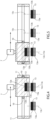
- two magnets 13 could correspond to a predetermined position; indeed, in the example of figures 6, 7 , two magnets 13 correspond to the predetermined position associated with the neutral state.
- the adjacent or successive magnets 13 along the path have the respective magnetic axes 13b that form, between them, a relative acute angle by meeting towards the lever body 7.
- the two magnets 13 corresponding to one single predetermined position have the relative magnetic axes 13c that form, between them, a relative acute angle by meeting on the opposite side with respect to the one where the lever body 7 is located.
- the two adjacent magnets 13 respectively corresponding to the two predetermined positions form a depression or a V-shaped configuration towards the lever body 7 according to the direction of the magnetic axis 12c.
- the magnet 12 and the one or two magnets 13 corresponding to the predetermined position in question have a minimum distance from one another along the magnetic axis 12c.
- both the two magnets 13 have a minimum distance from the magnet 12 along the magnetic axis 12c, when the lever body 7 is in said predetermined position.
- the two magnets 13 form a wedge or an upside-down V-shaped configuration towards the lever body 7.
- the magnetic attraction gradually decreases as the lever body 7 moves away from each one of the predetermined positions.
- the magnetic attraction increases again as the lever body 7 approaches the adjacent or successive predetermined position according to the path 8, until the maximum magnetic attraction is reached when the lever body 7 reaches the adjacent or successive predetermined position.
- the magnet 12 and the magnet 13 corresponding to the predetermined position respectively have the magnetic poles 12a, 13a respectively opposite the magnetic poles 12b, 13b, as well as, in turn, respectively aligned with the magnetic poles 12b, 13b according to the respective magnetic axes 12c, 13c.
- the magnetic axis 12c forms an acute angle with the magnetic axis 13c of the magnet 13 corresponding to the predetermined position. Furthermore, here (when the lever body 7 is in a predetermined position), the magnet 12 and the magnet 13 corresponding to the predetermined position have a minimum distance from one another along the magnetic axis 12c, such that the magnetic attraction (between the magnets 12, 13) gradually decreases as the lever body 7 moves away from the predetermined position.
- the magnet 12 and each magnet 13 respectively have the magnetic pole 12a and the corresponding magnetic pole 13a respectively opposite the magnetic pole 12b and the relative magnetic pole 13b, as well as, in turn, respectively aligned with the magnetic pole 12b and the relative magnetic pole 13b according to the magnetic axis 12c and the corresponding magnetic axis 13c.
- the magnetic axis 12c forms a relative acute angle with each magnetic axis 13c when the lever body 7 is in the corresponding predetermined position, where the magnet 12 and the corresponding magnet 13 have a minimum distance from one another along the magnetic axis 12c, such that the magnetic attraction gradually decreases as the lever body 7 moves away from the corresponding predetermined position.
- the magnets 13 are distributed along the path 8 in a substantially continuous manner, i.e. such that a magnetic attraction continuously subsists during a movement of the lever body 7 traversing the whole path 8.
- the magnets 13 define a path of their own identical to the path 8 but arranged on a different plane parallel to that of the path 8. For this reason, the two paths can be considered, as a whole, as path 8.
- the term substantially used above relates to the fact that a physical separation may exist between adjacent magnets 13, but the gap between the adjacent magnets 13 remains negligible in the sense that the magnetic attraction is not interrupted by the passage of the lever body 7 from one predetermined position to another adjacent or successive one.
- the magnetic attraction rises and falls in a wave-like manner with magnetic attraction peaks at the predetermined positions.
- the assembly 4 comprises further magnets 14, each having, just like each one of the magnets 13, two opposite magnetic poles 14a, 14b, which, in particular, are aligned along a magnetic axis or direction or axis 14c, more in particular of the straight kind.
- the magnetic axes 14c are parallel to the magnetic axis 12c, as well as to the magnetic axes 13c.
- the poles 13b are (magnetically) concordant relative to the pole 12b.
- the magnets 14 are carried by the base 5 in respective fixed positions; each one of the magnets 14 is arranged so that the relative pole 14b magnetically cooperates with the pole 12b when the lever body 7 is in a corresponding intermediate position along the path 8 between two adjacent or successive predetermined positions, so that the magnet 14 exerts a magnetic repulsion upon the magnet 12 during a transit of the lever body between the two adjacent or successive predetermined positions.
- each magnet 14 is arranged between two corresponding magnets 13 that are adjacent or successive to one another along the path 8.
- each magnet 14 is aligned with the magnet 12 along the magnetic axis 12c when the lever body 7 moves to the corresponding intermediate position.
- the magnets 13, 14 are distributed along the path 8 (or along the path of the magnets 13 mentioned above) according to an alternated sequence. In other words, each magnet 13 is followed by a magnet 14 according to the path 8 and vice versa.
- the magnets 13, 14 are distributed in a substantially continuous manner, i.e. such that the magnetic cooperation or interaction of the magnets 13, 14 with the magnet 12 continuously subsists during a movement of the lever body 7 traversing the whole path 8.
- the term substantially relates to the fact that a physical separation may exist between two successive magnets 13, 14 but the gap between the successive magnets 13, 14 remains negligible in the sense that the magnetic interaction of the magnet 12 is not interrupted by the passage of the lever body 7 from one predetermined position to another adjacent or successive one.
- the magnetic interaction of the magnet 12 during the travel of the lever body 7 along the entire path 8 consists of an alternation between attraction with each one of the magnets 13, whenever the lever body 7 reaches the corresponding predetermined position, and repulsion with each one of the magnets 14, whenever the lever body 7 moves between two adjacent or successive corresponding predetermined positions.
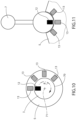
- the lever body 7 comprises a knob 70 that can rotate relative to the base 5 around a rotation axis 71.
- the path 8 is circular, i.e. it is defined by an arc of a circle.
- the magnetic axes 12c, 13c, 14c (where the magnets 14 are optionally provided, even though they are not shown in figure 9 ) are directed radially relative to the rotation axis 71.
- figure 11 is similar to the one of figure 10 , so that it will be described only in the aspects that distinguish it therefrom, possibly using the same reference symbols to indicate the same components.
- the lever body 7 is coupled to the base 5 by means of a ball coupling, such that, in particular, the lever body 7 and the base 5 form part of a ball joint.
- the path 8 extends along a spherical surface, instead of extending on a plane as is the case in other embodiments described and shown herein.
- the spherical surface is virtually defined by the ball coupling.
- the magnetic axes 12c, 13c, 14c (where the magnets 14 are optionally provided, even though they are not shown in figure 10 ) are directed radially relative to the centre of the spherical surface.
- the magnetic attraction of the magnet 12 with the respective magnets 13 in the corresponding predetermined positions is perfectly suitable for returning feelings to the driver that are similar to those provided by the mechanical members of known solutions.
- the magnetic cooperation is not noisy and does not involve wear of parts in mechanical contact.
- the alternation between magnetic attraction and repulsion guaranteed by the alternation between the magnets 13, 14, as shown in the variant of figures 8, 9 is particularly advantageous as it corresponds to a greater feeling of fluidity of the movement of the lever body 7 for the driver, as well as to a more energetic engagement/disengagement feeling.
- gearshift lever assembly 4 can clearly be subject to changes and variants, which, though, do not go beyond the scope of protection defined by the appended claims.
Landscapes
- Engineering & Computer Science (AREA)
- General Engineering & Computer Science (AREA)
- Mechanical Engineering (AREA)
- Physics & Mathematics (AREA)
- General Physics & Mathematics (AREA)
- Automation & Control Theory (AREA)
- Arrangement Or Mounting Of Control Devices For Change-Speed Gearing (AREA)
Applications Claiming Priority (1)
| Application Number | Priority Date | Filing Date | Title |
|---|---|---|---|
| IT202300024669 | 2023-11-21 |
Publications (1)
| Publication Number | Publication Date |
|---|---|
| EP4560165A1 true EP4560165A1 (de) | 2025-05-28 |
Family
ID=89897652
Family Applications (1)
| Application Number | Title | Priority Date | Filing Date |
|---|---|---|---|
| EP24213929.3A Pending EP4560165A1 (de) | 2023-11-21 | 2024-11-19 | Schalthebelanordnung mit magnetischem gefühl für ein kraftfahrzeug |
Country Status (3)
| Country | Link |
|---|---|
| US (1) | US12704173B2 (de) |
| EP (1) | EP4560165A1 (de) |
| CN (1) | CN120027194A (de) |
Citations (6)
| Publication number | Priority date | Publication date | Assignee | Title |
|---|---|---|---|---|
| JPH02105651U (de) * | 1989-02-09 | 1990-08-22 | ||
| KR102152702B1 (ko) * | 2014-05-23 | 2020-09-07 | 에스엘 주식회사 | 전자식 변속 장치 |
| IT201900005726A1 (it) * | 2019-04-12 | 2020-10-12 | Tecno Elett Ravasi S R L | Dispositivo di scatto per un controllore ad azionamento manuale |
| EP3658799B1 (de) * | 2017-08-31 | 2021-10-13 | Küster Holding GmbH | Schaltvorrichtung mit magnetischer rastierung |
| CN113803453A (zh) * | 2020-06-11 | 2021-12-17 | 广州汽车集团股份有限公司 | 一种旋钮式换挡机构及系统 |
| KR102449851B1 (ko) * | 2017-11-20 | 2022-10-04 | 현대자동차주식회사 | 자동변속기 차량용 변속레버 조립체 |
Family Cites Families (8)
| Publication number | Priority date | Publication date | Assignee | Title |
|---|---|---|---|---|
| DE3138827A1 (de) * | 1981-09-30 | 1983-04-14 | Wabco Westinghouse Fahrzeugbremsen GmbH, 3000 Hannover | Gangwaehler fuer ein getriebe |
| SE457680B (sv) * | 1987-01-15 | 1989-01-16 | Toecksfors Verkstads Ab | Elektronisk brytare innefattande en i ett hoelje roerlig manoeverdel |
| DE4109544A1 (de) * | 1991-03-22 | 1992-09-24 | Kirsten Elektrotech | Elektrischer schalter |
| JP2002254949A (ja) * | 2001-03-02 | 2002-09-11 | Tokai Rika Co Ltd | シフト装置 |
| JP2006244885A (ja) * | 2005-03-04 | 2006-09-14 | Shin Caterpillar Mitsubishi Ltd | ダイヤル操作具 |
| DE102006002634B4 (de) * | 2005-07-19 | 2009-11-26 | Preh Gmbh | Bedienelement mit Kipphaptik |
| DE102006012890A1 (de) * | 2006-03-13 | 2007-09-20 | Valeo Schalter Und Sensoren Gmbh | Schalter, insbesondere Fahrzeugschalter, Auswerteeinheit hierfür und zugehörige Schaltereinheit |
| DE102012216548B4 (de) * | 2011-11-30 | 2017-02-09 | Preh Gmbh | Bedienelement mit magnetischer Haptikerzeugung |
-
2024
- 2024-11-11 US US18/943,097 patent/US12704173B2/en active Active
- 2024-11-19 EP EP24213929.3A patent/EP4560165A1/de active Pending
- 2024-11-19 CN CN202411657219.9A patent/CN120027194A/zh active Pending
Patent Citations (6)
| Publication number | Priority date | Publication date | Assignee | Title |
|---|---|---|---|---|
| JPH02105651U (de) * | 1989-02-09 | 1990-08-22 | ||
| KR102152702B1 (ko) * | 2014-05-23 | 2020-09-07 | 에스엘 주식회사 | 전자식 변속 장치 |
| EP3658799B1 (de) * | 2017-08-31 | 2021-10-13 | Küster Holding GmbH | Schaltvorrichtung mit magnetischer rastierung |
| KR102449851B1 (ko) * | 2017-11-20 | 2022-10-04 | 현대자동차주식회사 | 자동변속기 차량용 변속레버 조립체 |
| IT201900005726A1 (it) * | 2019-04-12 | 2020-10-12 | Tecno Elett Ravasi S R L | Dispositivo di scatto per un controllore ad azionamento manuale |
| CN113803453A (zh) * | 2020-06-11 | 2021-12-17 | 广州汽车集团股份有限公司 | 一种旋钮式换挡机构及系统 |
Also Published As
| Publication number | Publication date |
|---|---|
| US20250164006A1 (en) | 2025-05-22 |
| US12704173B2 (en) | 2026-08-11 |
| CN120027194A (zh) | 2025-05-23 |
Similar Documents
| Publication | Publication Date | Title |
|---|---|---|
| CN101985978B (zh) | 用于双离合器变速装置的换档机构 | |
| US5689997A (en) | Electric gearshift mechanism for change-speed gearboxes of motor vehicles | |
| KR20060073956A (ko) | 연결장치 및 이 연결장치를 구비한 전동시스템 | |
| EP0443424A1 (de) | Getriebe-Steuerung für Fahrzeuge mit stufenlos verstellbarem Antrieb | |
| KR20190056124A (ko) | 차량용 변속 장치 | |
| KR101971187B1 (ko) | 자동화 수동변속기의 구동장치 | |
| KR101846670B1 (ko) | 차량용 변속장치 | |
| US20250164006A1 (en) | Gearshift lever assembly with magnetic feeling for a motor vehicle | |
| KR101709464B1 (ko) | 수동변속기의 변속 제어 장치 | |
| US4565108A (en) | Gearshift apparatus for an automobile | |
| KR20260012076A (ko) | 전자식 변속조작장치 | |
| KR101846714B1 (ko) | 전자식 변속시스템용 변속레버장치 | |
| US7370551B2 (en) | Gearshift operating device | |
| JP2016044745A (ja) | 変速機の自動変速装置 | |
| CN103671865A (zh) | 用于变速器的换档齿轮的装置 | |
| KR101795734B1 (ko) | 듀얼 클러치 변속기의 구동장치 | |
| KR101682191B1 (ko) | 차량용 변속 장치 | |
| KR100558299B1 (ko) | 차량의 변속작동장치 | |
| KR102289737B1 (ko) | 차량용 변속 장치 | |
| CN103089982A (zh) | 提供机械和电子促动至车辆的变速器的换挡器组件以及操作该换挡器组件的方法 | |
| JP2020159364A (ja) | 変速操作装置 | |
| KR100188753B1 (ko) | 자동차용 수동 변속기의 시프트 컨트롤 구조 | |
| KR20190064871A (ko) | 차량용 변속 장치 | |
| KR20200081587A (ko) | 변속기의 변속 장치 | |
| KR20260046776A (ko) | 전자식 변속조작장치 |
Legal Events
| Date | Code | Title | Description |
|---|---|---|---|
| PUAI | Public reference made under article 153(3) epc to a published international application that has entered the european phase |
Free format text: ORIGINAL CODE: 0009012 |
|
| STAA | Information on the status of an ep patent application or granted ep patent |
Free format text: STATUS: THE APPLICATION HAS BEEN PUBLISHED |
|
| AK | Designated contracting states |
Kind code of ref document: A1 Designated state(s): AL AT BE BG CH CY CZ DE DK EE ES FI FR GB GR HR HU IE IS IT LI LT LU LV MC ME MK MT NL NO PL PT RO RS SE SI SK SM TR |
|
| STAA | Information on the status of an ep patent application or granted ep patent |
Free format text: STATUS: REQUEST FOR EXAMINATION WAS MADE |
|
| 17P | Request for examination filed |
Effective date: 20251125 |
|
| STAA | Information on the status of an ep patent application or granted ep patent |
Free format text: STATUS: EXAMINATION IS IN PROGRESS |
|
| 17Q | First examination report despatched |
Effective date: 20260415 |