EP4560193A1 - Brenner - Google Patents
Brenner Download PDFInfo
- Publication number
- EP4560193A1 EP4560193A1 EP24189654.7A EP24189654A EP4560193A1 EP 4560193 A1 EP4560193 A1 EP 4560193A1 EP 24189654 A EP24189654 A EP 24189654A EP 4560193 A1 EP4560193 A1 EP 4560193A1
- Authority
- EP
- European Patent Office
- Prior art keywords
- cover
- head
- flame
- hole
- gas
- Prior art date
- Legal status (The legal status is an assumption and is not a legal conclusion. Google has not performed a legal analysis and makes no representation as to the accuracy of the status listed.)
- Pending
Links
Images








Classifications
-
- F—MECHANICAL ENGINEERING; LIGHTING; HEATING; WEAPONS; BLASTING
- F23—COMBUSTION APPARATUS; COMBUSTION PROCESSES
- F23D—BURNERS
- F23D14/00—Burners for combustion of a gas, e.g. of a gas stored under pressure as a liquid
- F23D14/02—Premix gas burners, i.e. in which gaseous fuel is mixed with combustion air upstream of the combustion zone
- F23D14/04—Premix gas burners, i.e. in which gaseous fuel is mixed with combustion air upstream of the combustion zone induction type, e.g. Bunsen burner
- F23D14/06—Premix gas burners, i.e. in which gaseous fuel is mixed with combustion air upstream of the combustion zone induction type, e.g. Bunsen burner with radial outlets at the burner head
- F23D14/065—Premix gas burners, i.e. in which gaseous fuel is mixed with combustion air upstream of the combustion zone induction type, e.g. Bunsen burner with radial outlets at the burner head with injector axis inclined to the burner head axis
-
- F—MECHANICAL ENGINEERING; LIGHTING; HEATING; WEAPONS; BLASTING
- F23—COMBUSTION APPARATUS; COMBUSTION PROCESSES
- F23D—BURNERS
- F23D14/00—Burners for combustion of a gas, e.g. of a gas stored under pressure as a liquid
- F23D14/02—Premix gas burners, i.e. in which gaseous fuel is mixed with combustion air upstream of the combustion zone
- F23D14/04—Premix gas burners, i.e. in which gaseous fuel is mixed with combustion air upstream of the combustion zone induction type, e.g. Bunsen burner
- F23D14/06—Premix gas burners, i.e. in which gaseous fuel is mixed with combustion air upstream of the combustion zone induction type, e.g. Bunsen burner with radial outlets at the burner head
-
- F—MECHANICAL ENGINEERING; LIGHTING; HEATING; WEAPONS; BLASTING
- F23—COMBUSTION APPARATUS; COMBUSTION PROCESSES
- F23D—BURNERS
- F23D14/00—Burners for combustion of a gas, e.g. of a gas stored under pressure as a liquid
- F23D14/02—Premix gas burners, i.e. in which gaseous fuel is mixed with combustion air upstream of the combustion zone
-
- F—MECHANICAL ENGINEERING; LIGHTING; HEATING; WEAPONS; BLASTING
- F23—COMBUSTION APPARATUS; COMBUSTION PROCESSES
- F23D—BURNERS
- F23D14/00—Burners for combustion of a gas, e.g. of a gas stored under pressure as a liquid
- F23D14/46—Details
-
- F—MECHANICAL ENGINEERING; LIGHTING; HEATING; WEAPONS; BLASTING
- F23—COMBUSTION APPARATUS; COMBUSTION PROCESSES
- F23D—BURNERS
- F23D14/00—Burners for combustion of a gas, e.g. of a gas stored under pressure as a liquid
- F23D14/46—Details
- F23D14/62—Mixing devices; Mixing tubes
-
- F—MECHANICAL ENGINEERING; LIGHTING; HEATING; WEAPONS; BLASTING
- F23—COMBUSTION APPARATUS; COMBUSTION PROCESSES
- F23D—BURNERS
- F23D14/00—Burners for combustion of a gas, e.g. of a gas stored under pressure as a liquid
- F23D14/46—Details
- F23D14/62—Mixing devices; Mixing tubes
- F23D14/64—Mixing devices; Mixing tubes with injectors
-
- F—MECHANICAL ENGINEERING; LIGHTING; HEATING; WEAPONS; BLASTING
- F24—HEATING; RANGES; VENTILATING
- F24C—DOMESTIC STOVES OR RANGES ; DETAILS OF DOMESTIC STOVES OR RANGES, OF GENERAL APPLICATION
- F24C3/00—Stoves or ranges for gaseous fuels
- F24C3/08—Arrangement or mounting of burners
- F24C3/085—Arrangement or mounting of burners on ranges
-
- F—MECHANICAL ENGINEERING; LIGHTING; HEATING; WEAPONS; BLASTING
- F23—COMBUSTION APPARATUS; COMBUSTION PROCESSES
- F23D—BURNERS
- F23D2207/00—Ignition devices associated with burner
-
- F—MECHANICAL ENGINEERING; LIGHTING; HEATING; WEAPONS; BLASTING
- F23—COMBUSTION APPARATUS; COMBUSTION PROCESSES
- F23D—BURNERS
- F23D2900/00—Special features of, or arrangements for burners using fluid fuels or solid fuels suspended in a carrier gas
- F23D2900/14—Special features of gas burners
- F23D2900/14062—Special features of gas burners for cooking ranges having multiple flame rings
-
- F—MECHANICAL ENGINEERING; LIGHTING; HEATING; WEAPONS; BLASTING
- F23—COMBUSTION APPARATUS; COMBUSTION PROCESSES
- F23D—BURNERS
- F23D2900/00—Special features of, or arrangements for burners using fluid fuels or solid fuels suspended in a carrier gas
- F23D2900/14—Special features of gas burners
- F23D2900/14063—Special features of gas burners for cooking ranges having one flame ring fed by multiple venturis
Definitions
- the present disclosure relates to a burner, and more specifically, a burner with a simplified flow channel structure for flow of gas.
- a burner emits a flame and generally receives gas from an external source and ignites the gas to generate a flame.
- the burner may be installed in a cooking appliance.
- the burner may be used in a gas range or a cooktop of a combined cooking appliance that uses both gas and electricity, and may receive gas from an external source and combust the gas to generate a flame.
- the burner may be composed of two flame generation portions, and each of the two flame generation portions generally generates a flame having a ring shape.
- the two flame generation portions may generate an inner flame in a small ring shape and an outer flame in a large ring shape surrounding the small ring shape, respectively.
- the burner is provided with multiple gas injection holes, a plurality of pipes connecting the external source and the gas injection holes of the burner to each other should be provided.
- the burner of the above-described structure has a complicated structure to form a gas flow path, making the overall structure of the burner complicated. Therefore, due to the complicated structure, the gas does not flow smoothly, burner performance deteriorates, and a manufacturing cost increases.
- a purpose of the present disclosure is to provide a burner with a structure that improves performance and saves a production cost.
- a purpose of the present disclosure is to provide a burner with a structure that simplifies a path through which gas flows.
- a purpose of the present disclosure is to provide a burner with a structure that smoothly guides the flow of gas.
- a burner according to one embodiment includes a body; a cover disposed on top of the body and coupled to the body to define a mixing tube in which gas and air flow and are mixed with each other; and a head disposed on top of the cover and configured to generate a flame, wherein the head includes: a first flame generation portion disposed in a central area of the head and a second flame generation portion disposed in an outer area of the head.
- the body, the cover, and the head are configured such that: the gas discharged from the mixing tube flows through the cover and flows to the central area of the cover, and then is divided into portions in the central area of the cover, and then one portion thereof flows into the first flame generation portion, and the other one portion thereof flows to the outer area of the cover and flows into the second flame generation portion.
- the burner may be configured such that the gas discharged from the single mixing tube may be supplied into the first flame generation portion and the second flame generation portion in a divided manner.
- the head may include a spreading hole which connected to the second guide tube.
- the gas may flow through the spreading hole.
- the head may include a gas spreading portion through which the gas having flowed through the spreading hole spreads.
- the gas spreading portion may be a space surrounded with the upper surface of the head and the second flame generation portion, and the gas spreading portion may extend along a circumference of the head.
- the upper surface of the head may have an inclined spreading surface disposed at a position where the spreading hole and the gas spreading portion may be connected to each other.
- the inclined spreading surface may contact each of both opposing ends of the spreading hole, and may be inclined in a circumferential or radial direction of the head.
- the gas flowing along the inclined spreading surface may be spread uniformly throughout the gas spreading portion.
- the gas that has flowed through the through-hole may flow from the outer area of the head to the central area of the head through the second guide tube and then may be divided into the portions.
- One of the portions thereof may reach the first flame generation portion and may be injected through the first flame hole, and may be burned.
- the other of the portions of the gas may flow from the central area of the head to the outer area of the head again through the second guide tube and flows through the spreading hole, and then, may reach the second flame generation portion, and may be injected through the second flame hole and may be burned.
- an overall structure of the burner according to an embodiment of the present disclosure may be simplified. Furthermore, the burner according to an embodiment of the present disclosure may be connected to an external source through a single pipe. This simple structure allows for smooth flow of the gas inside the burner, improves burner performance, and saves a manufacturing cost of the burner.
- the gas flowing into the gas spreading portion through the spreading hole flows further upwardly, the gas may be guided along the inclined spreading surface so as to smoothly spread into the gas spreading portion and then be uniformly distributed throughout the gas spreading portion.
- the second flame generation portion may receive a uniform supply of the gas in its circumferential direction and thus generate a uniform flame in its circumferential direction.
- the gas discharged from the single mixing tube may be divided into the portions which may be respectively supplied to the plurality of flame generation portions radially spaced apart from each other in the burner. Due to this structure, the flow channels for gas supply to the flame generation portions may be integrated with each other.
- the gas may be fed to the burner using a single supply pipe, and the flow channel structure in the burner may be simplified.
- first, second, third, and so on may be used herein to describe various elements, components, regions, layers and/or sections, these elements, components, regions, layers and/or sections should not be limited by these terms. These terms are used to distinguish one element, component, region, layer or section from another element, component, region, layer or section. Thus, a first element, component, region, layer or section described under could be termed a second element, component, region, layer or section.
- a and/or B means A, B, or A and B, unless otherwise specified, and "C to D” means C inclusive to D inclusive unless otherwise specified.
- a burner according to an embodiment may be used in a gas range or a cooktop of a combined cooking appliance that uses both gas and electricity, and may receive gas from an external source and combust the gas to generate a flame.
- the burner may be composed of two flame generation portions, and each of the two flame generation portions generally generates a flame having a ring shape.
- the two flame generation portions may generate an inner flame in a small ring shape and an outer flame in a large ring shape surrounding the small ring shape, respectively.
- the burner is provided with multiple gas injection holes, a plurality of pipes connecting the external source and the gas injection holes of the burner to each other should be provided.
- the burner of the above-described structure has a complicated structure to form a gas flow path, making the overall structure of the burner complicated. Therefore, due to the complicated structure, the gas does not flow smoothly, burner performance deteriorates, and a manufacturing cost increases.
- the burner according to an embodiment has a structure to solve the above-mentioned problems, and the burner according to an embodiment is described in detail below.
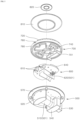
- FIG. 1 is a perspective view showing a burner according to one embodiment.
- FIG. 2 is a side view of FIG. 1 .
- FIG. 3 is a rear view of FIG. 1 .
- the burner according to an embodiment may include a body 500, a cover 600, head 700, an inner cap 820, and an outer cap 810.
- the body 500 may constitute a lower portion of the burner and may be connected to an external source through a pipe so that the body may receive gas required for combustion from the external source.
- the cover 600 may be disposed on a top of the body 500 and may be coupled to the body 500 to define a mixing tube 501 in which gas and air flow and are mixed with each other.
- the cover 600 and the body 500 are manufactured separately from each other. However, in another embodiment, the cover 600 and the body 500 may be integrated into a single body.
- the mixing tube 501 may be a space in the burner.
- the gas flowing thereto from the external source and the air flowing into the burner from a surrounding around the burner may meet and be mixed with each other in the mixing tube 501.
- the gas may be mixed with air and thus may receive oxygen from the air necessary for combustion and thus may be burned in the head 700.
- the mixing tube 501 may be formed by combining the body 500 and the cover 600 with each other.
- the body 500 may constitute (approximately) a lower half of the mixing tube 501, while the cover 600 may constitute (approximately) an upper half of the mixing tube 501.
- the head 700 may be disposed on top of the cover 600, and the flame may be generated in the head 700.
- the head 700 may be coupled to the cover 600 to form a path through which gas flowing into the head 700 and the cover 600 through the body 500 flows.
- the gas flow path formed by combining the header and the cover 600 with each other may distribute the gas to a first flame generation portion 710 and a second flame generation portion 720, which are described in detail below.
- the inner cap 820 may cover a top of the first flame generation portion 710 where the flame may be generated, and may control a spread direction of the flame so that the flame is directed outwardly in the radial direction of the head 700.
- the outer cap 810 may cover a top of the second flame generation portion 720 where the flame may be generated, and may control the spread direction of the flame so that the flame is directed outwardly in the radial direction of the head 700.
- FIG. 4 is an exploded top perspective view of FIG. 1 .
- FIG. 5 is an exploded bottom perspective view of FIG. 1 .
- the head 700 may include a flame generation portion. In the flame generation portion, while gas is discharged outwardly of the burner, the gas is ignited by a spark plug (not shown), thereby generating a flame.
- the head 700 may include the first flame generation portion 710 and the second flame generation portion 720 where the flame may be generated.
- the first flame generation portion 710 may be disposed in the central area of the head 700.
- a plurality of first flame holes 711 may be defined in the first flame generation portion 710 and may be arranged along a circumference thereof.
- the second flame generation portion 720 may be disposed in the outer area of the head 700 and may be disposed to surround the first flame generation portion 710.
- a plurality of second flame holes 721 may be defined in the second flame generation portion 720 and may be arranged along a circumference thereof. Therefore, when the flame may be generated in the burner, inner and outer ring-shaped flames may be generated in a double manner.
- the gas flowing inside the burner may be discharged through the first flame hole 711 and the second flame hole 721.
- a flame may be generated at the outlet of each of the first flame hole 711 and the second flame hole 721, such that the flame may be maintained while the gas is discharged.
- the first flame generation portion 710 and the second flame generation portion 720 may be separate components and may be spaced apart from each other. Therefore, gas needs to be individually supplied to each of the first flame generation portion 710 and the second flame generation portion 720.
- one mixing tube 501 may be used, and gas flowing thereto from one pipe may flow through the single mixing tube 501.
- the gas discharged from one mixing tube 501 should flow into the first flame generation portion 710 and the second flame generation portion 720, which are spaced apart from each other. For this reason, inside the burner, a flow channel needs to be formed to distribute the gas discharged from the mixing tube 501 to each of the first flame generation portion 710 in the central area and the second flame generation portion 720 in the outer area.
- the gas discharged from the mixing tube 501 may flow through the cover 600, and may flow to the central area of the cover 600, and may be divided into portions and then one thereof may flow into the first flame generation portion 710, and the other thereof may flow to the outer area of the cover 600 and may flow into the second flame generation portion 720.
- the gas discharged from the mixing tube 501 may flow through cover 600 and reach an outer area of an upper surfaced of the cover 600. Then, the gas may flow from the outer area of the cover 600 to the central area of the cover 600 and may be divided into the portions. One thereof may flow from the central area of the cover 600 through the head 700 and may reach an upper surface of the head 700, and may flow into the first flame generation portion 710 in the central area of the head 700.
- the other of the portions may flow from the central area to the outer area of a space on the upper surface of the cover 600, and may flow through the head 700, and may reach the upper surface of the head 700, and may flow into the second flame generation portion 720 in the outer area of the head 700.
- the gas flowing into one common mixing tube 501 may be divided into the two portions inside the burner while flowing through the flow channel formed in the burner, and then the two portions may flow into the first flame generation portion 710 and the second flame generation portion 720, respectively.
- an overall structure of the burner according to an embodiment of the present disclosure may be simplified. Furthermore, the burner according to an embodiment of the present disclosure may be connected to an external source through a single pipe. This simple structure allows for smooth flow of the gas inside the burner, improves burner performance, and saves a manufacturing cost of the burner.
- FIG. 6 is a side cross-sectional view of the burner.
- flow of the gas is indicated using a solid arrow.
- flow of air flowing into the burner from the surroundings is indicated using a hidden line arrow.
- the body 500 may include an injection portion 530 and an air receiving portion 540.
- the injection portion 530 may be formed on one side of the body 500, and a gas injection hole 531 may be defined in the injection portion 530.
- the gas injection hole 531 may be formed to extend through the injection portion 530, and may have an inlet connected to a pipe connected to the external source that supplies gas.
- the injection portion 530, the air receiving portion 540 and the mixing tube 501 may be arranged in a straight line. Due to this structure, the gas having flowed through the injection portion 530 may smoothly flow through the air receiving portion 540 and the mixing tube 501.
- the gas injection hole 531 may be formed in the injection portion 530 so as to extend through the injection portion 530.
- the air receiving portion 540 may be disposed between an inlet of the mixing tube 501 and an outlet of the injection portion 530. A space into which air is introduced and stored may be formed in the air receiving portion 540.
- an air guide 701 may protrude downwardly from the head 700 and may cover the space of the air receiving portion 540.
- the air guide 701 may be formed in a generally "U" shape so as to be combined with the air receiving portion 540 to form a space into which air flows.
- the air guide 701 may cover the space of the air receiving portion 540, but may be coupled to the air receiving portion 540 to form a hole into which surrounding air flows in a rear side of the burner. Through the hole, air around the burner may flow into the space of the air receiving portion 540.
- An inlet of the gas injection hole 531 may be relatively wide and an outlet thereof may be relatively narrow.
- the outlet of the gas injection hole 531 may be provided with an orifice, so that the gas flowing into the body 500 through the gas injection hole 531 may be injected at a very high speed from the outlet of the gas injection hole 531.
- the gas injected from the outlet of the gas injection hole 531 may flow into the mixing tube 501 without being dispersed due to its very high flow speed. At this time, the gas may meet the air flowing into the air receiving portion 540 while flowing through the air receiving portion 540, and, at the same time, the air may flow into the mixing tube 501.
- the gas may be mixed with air which has been introduced into the air receiving portion 540, and then the mixture of the gas and the air may be discharged from the mixing tube 501.
- the gas may be mixed with the air in the mixing tube 501 and may be mixed with oxygen in the air.
- the mixture when the mixture is ignited by the spark plug, the mixture may be combusted.
- the mixing tube 501 may be , for example, a Venturi tube.
- the Venturi tube may be formed so that a cross-sectional area of each of the inlet and the outlet thereof is relatively large, and a cross-sectional area of a central area thereof is relatively narrow.
- the gas flow speed is the fastest in the mixing tube 501, such that the pressure may be lowered in the central area.
- the mixing tube 501 may be the Venturi tube.
- the pressure in the neck area is lower than that of an area adjacent thereto.
- the air in the space of the air receiving portion 540 which has a relatively high pressure may smoothly flow into the mixing tube 501 due to the pressure difference and thus may be mixed with the gas in the mixing tube.
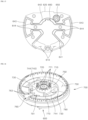
- FIG. 7 is a perspective view showing the body 500 and the cover 600 of the burner.
- FIG. 8 is an exploded view of FIG. 7 .
- FIG. 9 is a top view of FIG. 7 .
- FIG. 10 is a bottom view of FIG. 7 .
- FIG. 11 is a perspective view of the body 500.
- FIG. 12 is a top view of FIG. 11 .
- the body 500 may include a lower cell 510 and a first guide tube 520.
- the lower cell 510 may be depressed from an upper surface of the body 500 into the body 500 and may constitute a lower portion of the mixing tube 501.
- the lower cell 510 may constitute (approximately) the half of the mixing tube 501.
- the depressed space of the lower cell 510 constituting the mixing tube 501 may be deeper than a depth of the half of the mixing tube 501.
- the first guide tube 520 may be connected to the outlet of the mixing tube 501 and may have two portions be connected to the outlet of the mixing tube 501 and extending in the circumferential direction of the body 500 and respectively in opposite directions. A portion of the first guide tube 520 may be closed with the cover 600, and the gas may flow in the first guide tube 520. A top of the first guide tube 520 may be closed with the cover 600 to form a gas flow path.
- the first guide tube 520 may be a space connected to the outlet of the mixing tube 501, and may change the flow direction of the gas discharged from the mixing tube 501 to an upward direction.
- the gas discharged from the mixing tube 501 may flow upward along the first guide tube 520 and may flow into the space on the upper surface of the cover 600.
- the body 500 may include a cover receiving groove 550, a first spark plug receiving hole 560, and an extension panel 570.
- the cover receiving groove 550 may be depressed from the upper surface of the body 500 into the body, and may have a shape corresponding to that of the cover 600 so that the cover 600 is received therein.
- a hole into which fastening means such as a bolt is fastened may be formed in a bottom surface defining the cover receiving groove 550, and a corresponding hole thereto may be formed in the cover 600 so that the cover 600 may be coupled to the body 500 using the fastening means. Since the cover 600 is seated in the cover receiving groove 550, the cover 600 may be accurately positioned at a designated position of the body 500.
- the first spark plug receiving hole 560 may be formed at a position overlapping with the cover 600, and the spark plug may be inserted and mounted in the first spark plug receiving hole 560.
- the cover 600 may have a second spark plug receiving hole 650 defined therein into which the spark plug is inserted at a position corresponding to the first spark plug receiving hole 560.
- the first spark plug receiving hole 560 may be disposed adjacent to the first flame generating portion 710 disposed in the central area of the burner.
- the first flame generation portion 710 may be ignited first and the second flame generation portion 720 may be ignited later.
- the first spark plug receiving hole 560 may be disposed adjacent to the second flame generation portion 720 disposed in the outer area of the burner.
- the second flame generation portion 720 may be ignited first and the first flame generation portion 710 may be ignited later.
- the extension panel 570 may surround the cover receiving groove 550 and extend in a circumferential direction of the body 500.
- the extension panel 570 may generally be provided in a disk form. Holes into which the fastening means are inserted may be formed in the extension panel 570.
- the burner may be mounted on a gas range or a combined cooking appliance by coupling the extension panel 570 to the gas range or the cooktop of the combined cooking appliance using the fastening means.
- FIG. 13 is a perspective view of the cover 600.
- FIG. 14 is a bottom view of FIG. 13 .
- FIG. 15 is a top view of FIG. 13 .
- the cover 600 may have a smaller planar area than that of the body 500. As described above, the cover 600 may be seated in the cover receiving groove 550 of the body 500 and may be coupled to the cover 600 using the fastening means.
- the cover 600 may include a through-hole 610 formed at a position that overlaps at least a portion of the first guide tube 520.
- the gas may flow through the through-hole 610.
- the through-hole 610 through which the gas may flow may be formed in the cover 600 at a portion overlapping at least the inclined guide surface 121.
- the gas may flow upwardly along the first guide tube 520 and may flow through the cover 600 through the through-hole 610 and may flow into the space on the upper surface of the cover 600.
- the cover 600 may include the upper cell 620 constituting the mixing tube 501.
- the upper cell 620 may be formed to protrude downwardly toward the body 500, and may have an inner space defined therein so as to be depressed upwardly from a lower surface thereof into the upper cell 620.
- the inner space may constitute an upper portion of the mixing tube 501.
- the upper cell 620 may constitute (approximately) a half of the mixing tube 501. However, the upper cell 620 may be inserted into a groove defined in the lower cell 510 of the body 500 to define the mixing tube 501.
- the upper cell 620 may be formed integrally with the cover 600. However, in another embodiment, the upper cell 620 may be formed as a separate structure from the cover 600. Furthermore, in still another embodiment, the upper cell 620 may be formed integrally with the lower cell 510.
- the burner may include a second guide tube 630.
- the second guide tube 630 may be formed by combining the cover 600 and the head 700 with each other and may provide a space in which the gas flowing to the space from the body 500 may flow from the outer area of the head 700 to the central area thereof.
- the gas may be divided into the portions such that the portions of the gas may be respectively supplied to the first flame generation portion 710 and the second flame generation portion 720 which are spaced apart from each other, using one gas injection hole 531 equipped with the orifice and one mixing tube 501.
- the cover 600 may include the through-hole 610 and a lower part 640.
- the through-hole 610 may be connected to the first guide tube 520 and allows gas to flow through therein. The gas may flow through the through-hole 610, and then, a portion thereof may flow into the second guide tube 630, and a remaining portion thereof may flow into the second flame generation portion 720.
- the through-hole 610 may include a pair of through-hole spaced apart from each other in the circumferential direction and extending in the circumferential direction and in the outer area of the cover 600.
- the through-hole 610 may be disposed on a top of the first guide tube 520, and the flow direction of the gas in the first guide tube 520 may be changed rapidly in the through-hole 610.
- the first guide tube 520 may be formed as a relatively large space, and thus an area size of the through-hole 610 may be increased.
- the through-hole 610 may include a pair of through-holes spaced apart from each other in the circumferential direction, while a bridge portion may be disposed between the through-holes 610 to reinforce the rigidity of the cover 600.
- fastening holes may be defined in the bridge portion between the through-holes 610 such that fastening means may be inserted and fastened to the fastening holes.
- the various holes may be efficiently arranged in an entire area of the cover 600.
- the coupling between the cover 600 and the body 500 may be strengthened using the fastening means inserted and fastened to the fastening holes.
- the lower part 640 may be formed so that a portion thereof surrounds the through-hole 610, and may protrude upwardly from the upper surface of the cover 600, and may constitute a lower portion of the second guide tube 630.
- the lower part 640 and an upper part 740 formed on the head 700 may be combined to each other to define the second guide tube 630.
- the lower part 640 may include a first flow channel-defining part 641, a first central part 642, a first outer part 643, and a first connection part 644.
- the first flow channel-defining part 641 may surround the through-hole 610 and may define a flow channel extending from the through-hole 610 to the central area of the cover 600.
- the gas that has flowed through the through-hole 610 and has flowed into the space on the upper surface of the cover may flow from the outer area of the cover 600 to the central area thereof along the first flow channel-defining part 641.
- the first central part 642 may be formed in the central area of the cover 600, may be connected to the first flow channel-defining part 641, and may define a flow channel connected to the first flame generation portion 710.
- the gas may be divided into the portions such that one portion may flow to the first flame generation portion 710 and the remaining portion may flow to the second flame generation portion 720.
- the portion of the gas flowing into the first central part 642 may flow upwardly and may flow into the first flame generation portion 710, while the other portion thereof may flow back to the outer area of the cover 600 along the first connection part 644 and may reach the first outer part 643.
- the first outer part 643 may be disposed in the outer area of the cover 600, may define a flow channel connected to the second flame generation portion 720, and may include a pair of the first outer parts spaced apart from each other in the circumferential direction.
- the gas flowing into the first outer part 643 may flow upwardly and may flow through the spreading hole 730 of the head 700 and to a space on the upper surface of the head and may reach the second flame generation portion 720.
- the first connection part 644 may define a flow channel connecting an inner space of the first outer part 643 and an inner space of the first central part 642 to each other. Since the first outer part 643 includes the pair of first outer parts, the first connection part 644 may include a pair of first connection parts respectively connected to the pair of first outer parts 643.
- the gas flowing into the first flow channel-defining part 641 may flow through the first central part 642 and the first connection part 644 and may flow upwardly in the first outer part 643.
- bottom surfaces of the first flow channel-defining part 641, the first central part 642, and the first connection part 644 may constitute a continuous plane.
- the pair of first outer parts 643 may be formed and arranged symmetrically with each around the center of the cover 600.
- the pair of first connection parts 644 may be formed and arranged symmetrically with each around the center of the cover 600.
- the first outer part 643 may be formed at a position that overlaps a side portion 780 of the head 700 in the vertical direction. Due to this structure, the gas that has reached the first outer part 643 may flow smoothly to the side portion 780 and then reach the second flame generation portion.
- the lower part may include a lower partitioning wall that protrudes upwardly from the upper surface of the cover 600, and the lower partitioning wall may surround the through-hole 610.
- the gas that has flowed through the through-hole 610 may be guided along the lower partitioning wall so as to flow to the first flow channel-defining part 641 and the first central part 642.
- the lower partitioning wall may constitute walls of the first flow channel-defining part 641, the first central part 642, the first outer part 643 and the first connection part 644. That is, the first flow channel-defining part 641, the first central part 642, the first outer part 643, and the first connection part 644 may be constituted with the lower partitioning wall protruding upwardly from the upper surface of the cover 600.
- the cover 600 may include a second spark plug receiving hole 650 into which the spark plug is inserted and mounted.
- the second spark plug receiving hole 650 may be positioned in a position corresponding to the first spark plug receiving hole 560 of the body 500. Therefore, depending on a location of the first spark plug receiving hole 560, the second spark plug receiving hole 650 may be disposed adjacent to the first flame generation portion 710 or adjacent to the second flame generation portion 720.
- FIG. 16 is a perspective view showing the cover 600 and the head 700.
- FIG. 17 is an exploded top perspective view of FIG. 16 .
- FIG. 18 is a bottom perspective view of FIG. 16 .
- FIG. 19 is a top view of FIG. 16 .
- a structure is needed to guide a position of the head 700 so that the head 700 may be disposed in a correct position on the cover 600.
- an insert protrusion 772 may be formed on the head 700, and a protrusion receiving groove 660 may be formed in the cover 600.
- the head 700 When the protrusion 772 of the head 700 is inserted into the protrusion receiving groove 660 of the cover 600, the head 700 may be disposed in the correct position on the cover 600.
- the insert protrusion 772 and the protrusion receiving groove 660 are additionally described below. Hereinafter, the head 700 is described in detail.
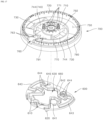
- FIG. 20 is a perspective view of the head 700.
- FIG. 21 is a bottom view of FIG. 20 .
- FIG. 22 is a top view of FIG. 20 .
- FIG. 23 is a view of FIG. 20 in a different direction.
- the head 700 may include a spreading hole 730 and the upper part 740.
- the spreading hole 730 may be connected to the second guide tube 630 and may allow gas to flow therein.
- the gas flowing into the spreading hole 730 may flow into the second flame generation portion 720 and be burned therein.
- the spreading hole 730 may include a pair of spreading holes disposed in the outer area of the head 700 and spaced from each other in the circumferential direction of the head. In the plan view, the spreading hole 730 may be spaced from the through-hole 610 in the circumferential direction of the head.
- the portion of the gas having flowed through the through-hole 610 may flow to the central area of the head 700 along the second guide tube 630.
- the other portion of the gas may flow back to the outer area of the head 700, and may flow through the spreading hole 730, and may spread in the circumferential direction in a space on the upper surface of the head 700, and then may flow into the second flame generation portion 720.
- the upper part 740 may be formed so that a portion thereof surrounds the spreading hole 730, and may protrude downwardly from a lower surface of the head 700, and may be coupled to the lower part 640 to define an upper portion of the second guide tube 630.
- the lower part 640 of the cover 600 and the upper part 740 of the head 700 may be combined with each other to define the second guide tube 630.
- the upper part 740 may include a second flow channel-defining part 741, a second central part 742, a second outer part 743, and a second connection part 744.
- the second flow channel-defining part 741 may cover the through-hole 610 and may define a flow channel extending from the through-hole 610 to the central area of the head 700.
- the gas that has flowed through the through-hole 610 and has flowed into the second flow channel-defining part 741 may flow along the second flow channel-defining part 741 from the outer area of the head 700 to the central area thereof.
- the second central part 742 may be formed in the central area of the head 700, may be connected to the second flow channel-defining part 741, and may define a flow channel connected to the first flame generation portion 710.
- the gas may be divided into the portions such that one portion may flow to the first flame generation portion 710 and a remaining portion may flow to the second flame generation portion 720.
- the portion of the gas flowing into the second central part 742 may flow upwardly and may flow into the first flame generation portion 710. The other portion thereof may flow back to the outer area of the head 700 along the second connection part 744 and may reach the second outer part 743.
- the second outer part 743 may surround the spreading hole 730 and may be disposed in the outer area of the head 700, and may define a flow channel connected to the second flame generation portion 720.
- the second outer part 743 may include a pair of second outer parts spaced apart from each other in the circumferential direction. The gas flowing into the second outer part 743 may flow upwardly and may flow through the spreading hole 730 of the head 700 and may flow along a space on the upper surface of the head 700 and may reach the second flame generation portion 720.
- the second connection part 744 may define a flow channel connecting the inner space of the second outer part 743 and the inner space of the second central part 742. Since the second outer part 743 includes the pair of second outer parts, the second connection part 744 may include a pair of second connection parts respectively connected to the pair of second outer parts 743.
- An opening may be formed in a side surface of the second central part 742, and this opening may be connected to the second outer part 743 through the second connection part 744.
- the pair of second outer parts 743 may be arranged symmetrically around a center of the head 700.
- the pair of second connection parts 744 may be arranged symmetrically around a center of the head 700.
- the upper part 740 may include an upper partitioning wall protruding downwardly from the lower surface of the head 700, and the upper partitioning wall may surround the through-hole 610 formed in the outer area of the cover 600.
- the gas flowing through through-hole 610 may be guided along the upper partitioning wall so as to flow to the second connection part 744 and the second central part 742.
- the upper partitioning wall may constitute walls of the second flow channel-defining part 741, the second central part 742, the second outer part 743, and the second connection part 744. That is, the second flow channel-defining part 741, the second central part 742, the second outer part 743, and the second connection part 744 may be constituted with the upper partitioning wall protruding downwardly from the lower surface of the head 700.
- contact surfaces of the partitioning walls respectively constituting the upper part 740 and the lower part 640 contacting each other may have the same shape.
- the gas that has flowed through the through-hole 610 may flow from the outer area of the head 700 to the central area of the head 700 through the second guide tube 630 and may be divided into the portions in the central area of the head 700.
- One of the portions into the gas has been divided into in the central area of the head 700 may reach the first flame generation portion 710 and may be injected through the first flame hole 711 and may be burned.
- the other of the portions into the gas has been divided into in the central area of the head 700 may flow from the central area of the head 700 to the outer area of the head 700 through the second guide tube 630 and the may flow through spreading hole 730, and then, may reach the second flame generation portion 720, and may be injected through the second flame hole 721 and may be burned.
- the second guide tube 630 may include a first space defined by combining the first flow channel-defining part 641 and the second flow channel-defining part 741 with each other, a second space defined by combining the first central part 642 and the second central part 742 with each other, a third space defined by combining the first connection part 644 and the second connection part 744 with each other, and a fourth space defined by combining the first outer part 643 and the second outer part 743 with each other.
- the gas may flow into the first space in the outer area of the second guide tube 630 and may flow from the first space into the second space and reach the central area of the head 700.
- the gas may be divided into the portions in the second space. One of the portions may flow upwardly directly from the second space and may flow upwardly through a central hole disposed in an upper portion of the central area of the head 700, and may reach the first flame generation portion 710 connected to this central hole.
- the other of the portions of the gas may flow through the third space, and flow into the fourth space in the outer area of the head 700, and may flow upwardly from the fourth space to reach the second flame generation portion 720 in the outer area of the head 700.
- the gas that has flowed through the through-hole 610 may be divided into the two portions in the second guide tube 630. One thereof may reach the first flame generation portion 710 while the other one thereof may reach the second flame generation portion 720.
- the first flame generation portion 710 may be disposed in the central area of the head 700 and may protrude upwardly from the upper surface of the head 700. Furthermore, the second flame generation portion 720 may protrude upwardly from the upper surface of the head 700 in the outer area of the head 700. Accordingly, the second flame generation portion 720 may surround the first flame generation portion 710.
- the head 700 may include a gas spreading portion 750 and a flame propagation portion 760.
- the gas spreading portion 750 may be a space in which the gas flowing through the spreading hole 730 spreads and which is surrounded with the upper surface of the head 700 and the second flame generation portion 720, and may extend along the circumference of the head 700.
- the gas spreading portion 750 may be a space connected to the second flame generation portion 720, and may extend in a ring shape with a constant width and may be positioned inwardly of the second flame generation portion 720. Accordingly, the gas that has flowed through the spreading hole 730 may spread along the gas spreading portion 750 and on the upper surface of the head 700 and flow into the second flame generation portion 720 uniformly in the circumferential direction of the second flame generation portion 720.
- An inclined spreading surface 761 may be disposed at a location adjacent to the spreading hole 730 to facilitate the flow and spread of gas. That is, the inclined spreading surface 761 may be defined on the upper surface of the head 700 and at an area where the spreading hole 730 and the gas spreading portion 750 are connected to each other, and may constitute each of both opposing ends of the spreading hole 730.
- the inclined spreading surface 761 may be inclined in the circumferential or radial direction.
- the inclined spreading surface 761 may be formed on the upper surface of the head 700 so as to be inclined in the circumferential or radial direction. Due to the inclined spreading surface 761, a planar area size of the spreading hole 730 may increases as the spreading hole 730 extends upwardly.
- the gas flowing into the gas spreading portion 750 through the spreading hole 730 may flows further upwardly, the gas may be guided along the inclined spreading surface 761 so as to smoothly spread into the gas spreading portion 750 and then be uniformly distributed throughout the gas spreading portion 750.
- the second flame generation portion 720 may receive a uniform supply of the gas in its circumferential direction and thus generate a uniform flame in its circumferential direction.
- the flame propagation portion 760 may occupy a partial area of the gas spreading portion 750 such that the gas spreading portion 750 may be discontinuous at the flame propagation portion 760.
- the flame propagation portion 760 may be a space in which the flame propagates between the first flame generation portion 710 and the second flame generation portion 720.
- the flame may be generated in the flame propagation portion 760, and the flame may flow from the first flame generation portion 710 to the second flame generation portion 720 or from the second flame generation portion 720 to the first flame generation portion 710 through the flame propagation portion 760.
- the head 700 may include a spreading portion-defining protrusion 762 and a propagation portion-defining protrusion 763.
- the spreading portion-defining protrusion 762 may be disposed between the first flame generation portion 710 and the second flame generation portion 720, protrude upwardly from the upper surface of the head 700, extend in the circumferential direction of the head 700, and surround the gas spreading portion 750.
- the gas spreading portion 750 may be a space surrounded with the second flame generation portion 720, the upper surface of the head 700, the spreading portion-defining protrusion 762, and the outer cap 810.
- the propagation portion-defining protrusion 763 may protrude upwardly from the upper surface of the head 700 and may include a pair of propagation portion-defining protrusions respectively disposed on both opposing sides of the flame propagation portion 760 to define the flame propagation portion 760.
- the propagation portion-defining protrusion 763 may isolate the gas spreading portion 750 and the flame propagation portion 760 from each other.
- the propagation portion-defining protrusion 763 may have a through-hole extending therethrough, so that the gas in the gas spreading portion 750 is discharged to the flame propagation portion 760 through this through-hole.
- the flame may be generated at an outlet of the through-hole, and then, this flame may propagate from the first flame generation portion 710 to the second flame generation portion 720 through the flame propagation portion 760 or vice versa.
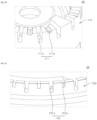
- FIG. 24 is an enlarged view of a portion 58 of FIG. 23 .
- FIG. 24 shows a portion of the first flame generation portion 710.
- FIG. 25 is an enlarged view of a portion 59 of FIG. 23 .
- FIG. 25 shows a portion of the second flame generation portion 720.
- the flame generation portion may include the flame hole through which gas is sprayed. A flame may be generated at an outlet of the flame hole.
- the first flame generation portion 710 may include the first flame hole 711, and the second flame generation portion 720 may include the second flame hole 721.
- the first flame hole 711 or the second flame hole 721 may be depressed into the upper end of the first flame generation portion 710 or the second flame generation portion 720.
- the first flame hole 711 may be covered with the inner cap 820, and the second flame hole 721 may be covered with the outer cap 810 so that a top of each of the first and second flame holes may be blocked.
- Depression depths of neighboring flame holes in the first flame generation portion 710 or the second flame generation portion 720 may be different from each other.
- the first flame generation portion 710 may have deep first flame holes 711a and shallow first flame holes 711b arranged alternately with each other along the circumference.
- the deep second flame holes 721a and the shallow second flame hole s721b may be alternately arranged each other along the circumference of the second flame generation portion 720.
- the depression depth of the flame hole may be proportional to an amount of gas discharged to the outside through the flame hole. Furthermore, a size and a length of the flame may be proportional to the discharged gas amount through the flame hole.
- the deeper the depression depth of the flame hole the larger the size of the flame generated at the outlet of the flame hole.
- a likelihood at which adjacent flames merge with each other increases.
- a relatively deep flame hole may be disposed between relatively shallow flame holes. Due to this structure, a spacing between large flames highly likely to merge with each other may be increased, and the relatively small flame may be placed therebetween, such that the merging between neighboring flames may be effectively suppressed.
- the flame generation portion is formed only to have relatively shallow flame holes, the gas amount discharged from the flame generation portion is small, so that the burner cannot generate sufficient fire power.
- a plurality of relatively deep flame holes may be arranged such that the gas may be sufficiently discharged to the outside through the flame holes.
- FIG. 26 is a perspective view showing a state in which the outer cap 810 and the inner cap 820 are installed on the head 700.
- FIG. 27 is a cross-sectional view of FIG. 26.
- FIG. 28 is an enlarged view of a portion 62 of FIG. 27 .
- FIG. 29 is a perspective view showing the inner cap 820.
- the burner may include the outer cap 810 and the inner cap 820 that cover the flame generation portion.
- the outer cap 810 may be disposed on an upper end of each of the second flame generation portion 720 and the spreading portion-defining protrusion 762 and may cover the gas spreading portion 750.
- the outer cap 810 may be disposed on the head 700 and cover an upper end of the gas spreading portion 750.
- the outer cap 810 may have an inclined cross sectional shape.
- the outer cap 810 may be formed so that its cross-sectional shape is gradually inclined upwardly as the outer cap extends outwardly in the radial direction.
- the head 700 may include a core 770, the side portion 789, a first support 791 and a second support 792.
- the core 770 may be disposed in the central area of the head 700, and the first flame generation portion 710 may be formed at an upper end of the core.
- the inner cap 820 may be disposed on the upper end of the core 770.
- the side portion 789 occupies the outer area of the head 700 and the gas spreading portion 750 may be defined in the side portion 789.
- the core 770 and the side portion 789 may be arranged to be spaced apart from each other, and may be connected to each other via the first and second supports 791 and 792 and the pair of second connection parts 744.
- the first support 791 may connect the core 770 and the side portion 780 to each other and may meet the inner end of the flame propagation portion 760.
- the second support 792 may connect the core 770 and the side portion 780 to each other, and may be opposite to the first support 791 around the core 770.
- the pair of second connection parts 744, the first support 791 and the second support 792 may connect the core 770 and the side portion 780 to each other and may be spaced from each other in the circumferential direction. A space may be defined between each of the pair of second connection parts 744 and each of the first and second supports 791 and 792.
- the first flame generation portion 710 may be formed to protrude from an outer area of the core 770. In the core 770 and in an area inwardly of the first flame generation portion 710, a space may be defined where portions of the gas flowing into the core 770 through the second guide tube 630 are merged with each other.
- the core 770 may include a plurality of guide protrusions 771 that protrude upward and are spaced apart from each other in the circumferential direction, and guides a mounting position of the inner cap 820.
- Each of the plurality of guide protrusions 771 may be disposed between adjacent ones of the plurality of first flame holes 711.
- the inner cap 820 may include a guide ring 821 which protrudes downwardly and is formed to surround the guide protrusions 771 and contacts the guide protrusions 771.
- the guide protrusions 771 may be formed on the core 770, and the guide ring 821 may be formed on the inner cap 820.
- the guide protrusion 771 may include a plurality of guide protrusions spaced apart from each other in the circumferential direction.
- the guide protrusions 771 may be located inwardly of the guide ring 821 so as to contact the guide ring. The position of the inner cap 820 may be guided along the guide protrusions 771, and thus may not deviate laterally from the core 770.
- the inner cap 820 may be stably disposed in the designed position on the upper end of core 770 and may maintain its position.
- the core 770 may include a supporter 773 that contacts a lower surface of the inner cap 820 and supports the inner cap 820.
- the supporter 773 may be formed to be inclined gradually upwardly as the support extends inwardly of the core 770.
- the inner cap 820 may be disposed on an upper surface of the supporter 773.
- the supporter 773 may be disposed inwardly of the guide protrusion 771.
- the upper surface of the supporter 773 may extend in a generally straight line, while a lower surface of the supporter may be generally curved.
- the gas discharged from the flame holes of the first flame generation portion 710 or the second flame generation portion 720 may be mixed with the secondary air around the flame generation portion to increase combustion efficiency. Since the second flame generation portion 720 is disposed in the outer area of the burner, the gas discharged from the second flame hole 721 may actively contact the surrounding secondary air.
- the first flame generation portion 710 may be disposed on the core 770 disposed in the central area of the burner, a contact area thereof in contact with the surrounding air may be reduced due to the outer cap 810 and other structures.
- a vertical level of the first flame generation portion 710 may be higher than that of the spreading portion-defining protrusion 762. Due to this structure, a vertical level of the first flame generation portion 710 may be higher than that of the outer cap 810. Thus, a contact area of the first flame generation portion 710 with the surrounding air may be increased.
- the first flame generation portion 710 smoothly contacts the surrounding air, such that the gas discharged from the first flame generation portion 710 smoothly receives the surrounding secondary air, and thus incomplete combustion due to insufficient supply of the secondary air may be suppressed.
- the core 770 may include the insert protrusion 772 protruding downwardly and inserted into the groove defined in the cover 600.
- the cover 600 may include the protrusion receiving groove 660 depressed from the upper surface of the cover into the cover, and formed in an area corresponding to the insertion protrusion 772.
- the insert protrusion 772 may be inserted into the protrusion receiving groove 660.
- the insert protrusion 772 may include at least one insert protrusion 772.
- the protrusion receiving groove 660 may include at least one protrusion receiving groove 660.
- the core 770 may be provided with the insert protrusion 772, and the cover 600 may be provided with the protrusion receiving groove 660.
- the head 700 may be stably disposed at the designed position on an upper end of the cover 600 and may maintain its position.
- FIG. 30 is a diagram for illustrating flow of gas in a burner according to one embodiment.
- the gas discharged from one mixing tube 501 may flow into the first guide tube 520 and the second guide tube 630.
- the gas may be divided into the two portions flowing in the opposite directions and in the circumferential direction. Then, the two portions may flow through the cover. Then, a portion of each of the two portions may flow to the second flame generation portion 720 disposed in the outer area of the burner, and a remaining portion thereof may flow to the first flame generation portion 710 disposed in the central area of the burner.
- the gas may be mixed with the primary air. Then, the mixture of the gas and the air may be discharged from the mixing tube 501, and then flow into the first guide tube 520.
- the gas flowing into the first guide tube 520 may flow into the second guide tube 630 through the through-hole 610.
- the gas flowing into the second guide tube 630 may flow to the central area of the head 700 and may be divided into the portions in the central area of the head 700.
- One of the portions of the gas in the central area of the head 700 may flow upwardly immediately and may flow into the first flame generation portion 710, and may be discharged through the first flame hole 711 and may be burned to generate a flame.
- the other of the portions of the gas in the central area of the head 700 may flow to the outer area of the head 700 through the space defined by the first connection part 644 and the second connection part 744 and may flow upwardly and flow through the spreading hole 730. Then, the gas may spread along the gas spreading portion 750 and may flow into the second flame generation portion 720 and may flow evenly along the circumference of the second flame generation portion 720 disposed in the outer area of the head 700, and may be discharged through the second flame hole 721 and may be burned to generate a flame.
- the gas discharged from the single mixing tube 501 may be divided into the portions which may be respectively supplied to the plurality of flame generation portions radially spaced apart from each other in the burner. Due to this structure, the flow channels for gas supply to the flame generation portions may be integrated with each other. The gas may be fed to the burner using a single supply pipe, and the flow channel structure in the burner may be simplified.
Landscapes
- Engineering & Computer Science (AREA)
- Chemical & Material Sciences (AREA)
- Combustion & Propulsion (AREA)
- Mechanical Engineering (AREA)
- General Engineering & Computer Science (AREA)
- Gas Burners (AREA)
Applications Claiming Priority (1)
| Application Number | Priority Date | Filing Date | Title |
|---|---|---|---|
| KR1020230165171A KR20250077790A (ko) | 2023-11-24 | 2023-11-24 | 버너 |
Publications (1)
| Publication Number | Publication Date |
|---|---|
| EP4560193A1 true EP4560193A1 (de) | 2025-05-28 |
Family
ID=91961828
Family Applications (1)
| Application Number | Title | Priority Date | Filing Date |
|---|---|---|---|
| EP24189654.7A Pending EP4560193A1 (de) | 2023-11-24 | 2024-07-19 | Brenner |
Country Status (4)
| Country | Link |
|---|---|
| US (1) | US20250172289A1 (de) |
| EP (1) | EP4560193A1 (de) |
| KR (1) | KR20250077790A (de) |
| CN (1) | CN120043115A (de) |
Citations (3)
| Publication number | Priority date | Publication date | Assignee | Title |
|---|---|---|---|---|
| EP1531304A2 (de) * | 2003-11-11 | 2005-05-18 | FAGOR, S.Coop | Gasbrenner mit drei Kronen für Küchenkochfeld |
| EP2226560A2 (de) * | 2009-03-06 | 2010-09-08 | Turas Gaz Armatürleri Sanayi. Ve Ticaret A.S. | Brenner für Gasherde mit mehreren Flammenringen |
| EP2629010A2 (de) * | 2012-02-16 | 2013-08-21 | Jinhong Liang | Brenner für Gasöfen |
-
2023
- 2023-11-24 KR KR1020230165171A patent/KR20250077790A/ko active Pending
-
2024
- 2024-07-19 EP EP24189654.7A patent/EP4560193A1/de active Pending
- 2024-10-02 US US18/904,322 patent/US20250172289A1/en active Pending
- 2024-10-08 CN CN202411392190.6A patent/CN120043115A/zh active Pending
Patent Citations (3)
| Publication number | Priority date | Publication date | Assignee | Title |
|---|---|---|---|---|
| EP1531304A2 (de) * | 2003-11-11 | 2005-05-18 | FAGOR, S.Coop | Gasbrenner mit drei Kronen für Küchenkochfeld |
| EP2226560A2 (de) * | 2009-03-06 | 2010-09-08 | Turas Gaz Armatürleri Sanayi. Ve Ticaret A.S. | Brenner für Gasherde mit mehreren Flammenringen |
| EP2629010A2 (de) * | 2012-02-16 | 2013-08-21 | Jinhong Liang | Brenner für Gasöfen |
Also Published As
| Publication number | Publication date |
|---|---|
| KR20250077790A (ko) | 2025-06-02 |
| CN120043115A (zh) | 2025-05-27 |
| US20250172289A1 (en) | 2025-05-29 |
Similar Documents
| Publication | Publication Date | Title |
|---|---|---|
| TWI362473B (en) | Gas burner | |
| CN108613183A (zh) | 一种引射管隐藏式灶具燃烧器 | |
| KR20110099733A (ko) | 가정용 조리기를 위한 가스버너 | |
| EP4560193A1 (de) | Brenner | |
| JP2003269705A (ja) | 燃焼装置 | |
| EP4560194A1 (de) | Brenner mit zwei flammenringen für einen kochherd | |
| KR102645953B1 (ko) | 가스 버너 | |
| KR20250077789A (ko) | 버너 | |
| CN215411879U (zh) | 外火盖、燃烧器及燃气灶 | |
| KR20250089804A (ko) | 버너 | |
| KR20250087134A (ko) | 버너 | |
| KR102301481B1 (ko) | 버너 | |
| CN210861204U (zh) | 一种完全上进风式燃烧器及应用该燃烧器的集成灶 | |
| KR20180015866A (ko) | 예혼합가스 버너 | |
| KR101947135B1 (ko) | 가스 버너 | |
| KR200344899Y1 (ko) | 가스기기의 이중 화염 버너구조 | |
| JP2001056108A (ja) | ガスバーナ | |
| KR102645954B1 (ko) | 가스 버너 | |
| CN117190177B (zh) | 燃烧器及燃气灶 | |
| JPH11125405A (ja) | バーナ装置 | |
| CN117028990B (zh) | 一种外环火盖及燃烧器 | |
| CN117190190B (zh) | 上进风燃烧器及燃气灶 | |
| JP6131505B2 (ja) | こんろ用バーナ | |
| CN219656072U (zh) | 燃烧器 | |
| KR102652090B1 (ko) | 가스 버너 |
Legal Events
| Date | Code | Title | Description |
|---|---|---|---|
| PUAI | Public reference made under article 153(3) epc to a published international application that has entered the european phase |
Free format text: ORIGINAL CODE: 0009012 |
|
| STAA | Information on the status of an ep patent application or granted ep patent |
Free format text: STATUS: REQUEST FOR EXAMINATION WAS MADE |
|
| 17P | Request for examination filed |
Effective date: 20240818 |
|
| AK | Designated contracting states |
Kind code of ref document: A1 Designated state(s): AL AT BE BG CH CY CZ DE DK EE ES FI FR GB GR HR HU IE IS IT LI LT LU LV MC ME MK MT NL NO PL PT RO RS SE SI SK SM TR |