EP4560366A1 - Dispositif d'affichage - Google Patents
Dispositif d'affichage Download PDFInfo
- Publication number
- EP4560366A1 EP4560366A1 EP24212508.6A EP24212508A EP4560366A1 EP 4560366 A1 EP4560366 A1 EP 4560366A1 EP 24212508 A EP24212508 A EP 24212508A EP 4560366 A1 EP4560366 A1 EP 4560366A1
- Authority
- EP
- European Patent Office
- Prior art keywords
- retro
- light
- display device
- reflective sheet
- reflective
- Prior art date
- Legal status (The legal status is an assumption and is not a legal conclusion. Google has not performed a legal analysis and makes no representation as to the accuracy of the status listed.)
- Pending
Links
Images

Classifications
-
- G—PHYSICS
- G02—OPTICS
- G02B—OPTICAL ELEMENTS, SYSTEMS OR APPARATUS
- G02B30/00—Optical systems or apparatus for producing three-dimensional [3D] effects, e.g. stereoscopic images
- G02B30/50—Optical systems or apparatus for producing three-dimensional [3D] effects, e.g. stereoscopic images the image being built up from image elements distributed over a three-dimensional [3D] volume, e.g. voxels
- G02B30/56—Optical systems or apparatus for producing three-dimensional [3D] effects, e.g. stereoscopic images the image being built up from image elements distributed over a three-dimensional [3D] volume, e.g. voxels by projecting aerial or floating images
-
- G—PHYSICS
- G02—OPTICS
- G02B—OPTICAL ELEMENTS, SYSTEMS OR APPARATUS
- G02B27/00—Optical systems or apparatus not provided for by any of the groups G02B1/00 - G02B26/00, G02B30/00
- G02B27/0018—Optical systems or apparatus not provided for by any of the groups G02B1/00 - G02B26/00, G02B30/00 with means for preventing ghost images
-
- G—PHYSICS
- G02—OPTICS
- G02B—OPTICAL ELEMENTS, SYSTEMS OR APPARATUS
- G02B27/00—Optical systems or apparatus not provided for by any of the groups G02B1/00 - G02B26/00, G02B30/00
- G02B27/09—Beam shaping, e.g. changing the cross-sectional area, not otherwise provided for
- G02B27/0938—Using specific optical elements
- G02B27/0977—Reflective elements
-
- G—PHYSICS
- G02—OPTICS
- G02B—OPTICAL ELEMENTS, SYSTEMS OR APPARATUS
- G02B27/00—Optical systems or apparatus not provided for by any of the groups G02B1/00 - G02B26/00, G02B30/00
- G02B27/10—Beam splitting or combining systems
- G02B27/14—Beam splitting or combining systems operating by reflection only
- G02B27/141—Beam splitting or combining systems operating by reflection only using dichroic mirrors
-
- G—PHYSICS
- G02—OPTICS
- G02B—OPTICAL ELEMENTS, SYSTEMS OR APPARATUS
- G02B27/00—Optical systems or apparatus not provided for by any of the groups G02B1/00 - G02B26/00, G02B30/00
- G02B27/28—Optical systems or apparatus not provided for by any of the groups G02B1/00 - G02B26/00, G02B30/00 for polarising
- G02B27/283—Optical systems or apparatus not provided for by any of the groups G02B1/00 - G02B26/00, G02B30/00 for polarising used for beam splitting or combining
-
- G—PHYSICS
- G02—OPTICS
- G02B—OPTICAL ELEMENTS, SYSTEMS OR APPARATUS
- G02B5/00—Optical elements other than lenses
- G02B5/12—Reflex reflectors
- G02B5/122—Reflex reflectors cube corner, trihedral or triple reflector type
- G02B5/124—Reflex reflectors cube corner, trihedral or triple reflector type plural reflecting elements forming part of a unitary plate or sheet
Definitions
- the present disclosure relates to a display device with a function to display images in midair using retro-reflection.
- Aerial imaging by retro-reflection is known.
- a display device having: a half mirror; an image output device that outputs light toward one surface of the half mirror; and a retro-reflective member that is positioned between the image output device and the half mirror, and has a plurality of openings formed therein (see, for example, JP 2018-81138 A ).
- an aerial display device having a planar lighting body, a retro-reflective sheet, and a half mirror.
- the planar lighting body has a light emitting unit.
- the retro-reflective sheet is positioned on the light-emitting surface side of the planar lighting body and has multiple through-holes where an aerial drawing is displayed in a position corresponding to the light emitting unit.
- the half mirror is positioned on the light-emitting surface side of the retro-reflective sheet (see, for example, JP 2022-140264 A ).
- a display device displays an aerial image using retro-reflection, and includes:
- a transparent member with a refractive index greater than 1 is provided between an optical member and a retro-reflective member, so that the difference in refractive index between the transparent member and the retro-reflective member is reduced, and reflection at the interface between the transparent member and the retro-reflective member is prevented or substantially prevented.
- Some AIRR-based aerial display systems use LEDs as light sources and display fixed display patterns in midair. To make such display devices smaller and thinner, the optical parts are arranged so as to be parallel to each other and face each other. An example of its structure is shown in FIG. 1 .
- FIG. 1A is a schematic perspective view of an existing aerial image display device
- FIG. 1B is a schematic cross-sectional view thereof.
- the aerial image display device 10 has, for example, a beam splitter 30 positioned on a surface of a rectangular housing 20, a retro-reflective sheet 40 positioned inside the housing 20 so as to face the beam splitter 30, and a light source 50 such as an LED positioned on the backside of the retro-reflective sheet 40.
- the retro-reflective sheet 40 is an optical member or optical element that reflects light in the same direction the incident light came from, and has cutouts or openings S formed thereon.
- the cutouts or openings S produce a design (fixed display pattern) Q that represents an aerial image P's original image.
- the aerial image P in FIG. 1A shows, for example, an icon that represents the direction for "fast reversing" the playback.
- the light source 50 illuminates the back surface of the retro-reflective sheet 40
- the light that passes through the cutouts S is retro-reflected between the retro-reflective sheet 40 and the beam splitter 30, and an aerial image P of a design Q is displayed above the beam splitter 30.
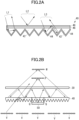
- FIG. 2A is a diagram illustrating a cross-sectional structure of the retro-reflective sheet 40, as well as the surface reflection of the retro-reflective sheet 40 and the internal reflection that occurs inside the retro-reflective sheet 40.
- the retro-reflective sheet 40 is composed of: a pattern forming part 42 made of an optically transparent material; a metal layer 44 (e.g., Al) formed using inclined surfaces of the pattern forming part 42; an optical adhesive 46 applied to the upper surface of the pattern forming part 42; and a phase plate 48 (e.g., a ⁇ /4 plate) attached onto the optical adhesive 46.
- the metal layer 44 functions as a reflective layer, and its thickness, including the optical adhesive 46 and the phase plate 48, is 1 mm or less, for example.
- Light L1 In the retro-reflective sheet 40, incident light is reflected multiple times by the metal layer 44, and the reflected light is reflected in the same direction the incident light came from. A light beam L1 produced thus matches the optical properties of the retro-reflective sheet 40 and provides desirable light.
- Light L2 Part of the light incident on the retro-reflective sheet 40 is reflected on the surface of the phase plate 48, and the reflected light is specularly-reflected at a reflection angle that is equal to the incident angle. A light beam L2 produced thus does not match the optical properties of the retro-reflective sheet 40 and provides undesirable light.
- Light L3 Part of the light incident on the retro-reflective sheet 40 is reflected on the metal layer 44, then internally reflected on the phase plate 48, and reflected by the metal layer 44 again.
- a light beam L3 produced thus shows a large optical path difference between the incident light and the reflected light, and therefore does not match the optical properties of the retro-reflective sheet 40, providing undesirable light.
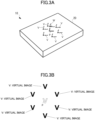
- stray light V or virtual images
- a virtual aerial image W is produced from the stray light V (or virtual images).
- FIG. 3A and FIG. 3B multiple virtual images V and virtual aerial images W appear around or in the range in which the user observes the aerial image P, resulting in a decrease in the aerial image P's visibility, contrast, and so forth.
- the present disclosure therefore aims to address the above-described existing problem by providing a display device that can prevent or substantially prevent stray light or virtual aerial images from being produced and improve aerial images' visibility, contrast, and so forth.
- the display device displays aerial images in three-dimensional space using retro-reflection, without the need for special glasses or the like.
- drawings referred to in the following description of embodiments of the present disclosure include exaggerated views to help understand the invention, and do not directly or accurately represent the actual shape or scale of the actual device.
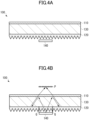
- FIG. 4A is a schematic cross-sectional view of an aerial image display device according to an embodiment of the present disclosure
- FIG. 4B is a diagram for explaining how an aerial image is produced.
- an aerial image display device 100 is configured to include, for example: a beam splitter 110 positioned on a surface of a rectangular housing or casing; a retro-reflective sheet 120 positioned to face the beam splitter 110; a transparent member 130 with a refractive index greater than 1, positioned between the beam splitter 110 and the retro-reflective sheet 120; and a light source 140 positioned on the backside of the retro-reflective sheet 120.
- the beam splitter 110 is an optical member or optical element that separates incident light into reflected light and transmitted light.
- a half mirror may be used.
- a polarizing beam splitter may be used.
- the retro-reflective sheet 120 is positioned to face the beam splitter 110.
- the retro-reflective sheet 120 is an optical member or optical element that reflects light in the same direction the incident light came from.
- the retro-reflective sheet 130 is composed of, for example, a prism-like retro-reflective element, a bead-like retro-reflective element, and so forth, such as a pyramid-like retro-reflective element, a full cube corner-like retro-reflective element, or the like.
- the retro-reflective sheet 120 is structured in the same way as the retro-reflective sheet 40 shown in FIG. 2A .
- the retro-reflective sheet 120 may include: a pattern forming part 42 formed from a transparent material; a metal layer 44 formed using inclined surfaces of the pattern forming part 42; an optical adhesive 46 applied to the upper surface of the pattern forming part 42; and a phase plate 48 (e.g., a ⁇ /4 plate) attached to the optical adhesive 46.
- a phase plate 48 e.g., a ⁇ /4 plate attached to the optical adhesive 46.
- the retro-reflective sheet 120 is not limited to this structure, and does not have to have a phase plate 48 on its surface.
- the shape and size of the retro-reflective sheet 120 are not limited to any particular type, and the retro-reflective sheet 120 may have cutouts or openings formed thereon to form a design Q, which is an aerial image P's original image.
- the design Q is an icon that represents the direction for "rewinding" the playback.
- any type and number of designs of choice may be formed on the retro-reflective sheet 120.
- the light source 140 is positioned on the backside of the retro-reflective sheet 120.
- the light source 140 is not limited to any particular type, and, for example, an LED light source, a display light source such as a liquid crystal, or a projecting light source such as a projector, and so forth may be used.
- an LED light source for example, multiple LEDs may be positioned in a linear or planar arrangement to efficiently and evenly illuminate the entire back surface of the retro-reflective sheet 120.
- a diffusion plate or a diffusion sheet may be used together to illuminate the back surface of the retro-reflective sheet 120 uniformly.
- the light source 140 may include a polarizing plate or a polarizing film and illuminate the back surface of the retro-reflective sheet 120 with polarized light.
- a polarizing beam splitter may be used as the beam splitter 110, and a ⁇ /4 film may be provided on the surface of the retro-reflective sheet 120.
- the polarization state of the polarizing plate or the polarizing film is determined based on their state of polarization in relationship to the state of polarization at the polarizing beam splitter.
- a light-permeable transparent member 130 having a refractive index greater than 1 is positioned between the beam splitter 110 and the retro-reflective sheet 120.
- a material having a refractive index close to that of the retro-reflective sheet 120 is selected for the transparent member 130, so that the difference in refractive index between the transparent member 130 and the retro-reflective sheet 120 is made as small as possible.
- a phase plate 48 is formed over the surface of the retro-reflective sheet 120, a material having a refractive index that is close to that of the phase plate 48 is selected. When two or more refractive indices are "close,” this means that their difference is as small as possible.
- an acrylic material may be selected for the transparent member 130 as a material having a refractive index of approximately 1.5.
- the transparent member 130 can be made of other plastic materials besides an acrylic material, depending on the refractive index of the retro-reflective sheet 120 and the phase plate 48.
- PC with a refractive index of 1.584
- polystyrene with a refractive index of 1.592
- PET with a refractive index of 1.576
- so forth may be used.
- the transparent member 130 is substantially rectangular in shape, with a beam splitter 110 formed on its upper surface, particularly at the side where the aerial image P is to be formed, and a retro-reflective sheet 120 formed on its back surface.
- the beam splitter 110 may be formed as a film over the upper surface of the transparent member 130, or may be attached to the upper surface of the transparent member 130 using an optical adhesive.
- the retro-reflective sheet 120 may be attached to the back surface of the transparent member 130 using, for example, an optical adhesive.
- the operation of the aerial image display device 100 will be described.
- light from the light source 140 illuminates the back surface of the retro-reflective sheet 120.
- the illuminated light passes through the cutouts or openings formed in the retro-reflective sheet 120, and a design Q, which is the original image of an aerial image P, is produced.
- the light that passes through the cutouts or openings is partly reflected by the beam splitter 110 via the transparent member 130, and the reflected light is retro-reflected by the retro-reflective sheet 120.
- the retro-reflected light passes through the beam splitter 110 via the transparent member 130, and the aerial image Q of the design P is re-formed above the beam splitter 110.
- the difference in refractive index between the transparent member 130 and the retro-reflective sheet 120 can be made as small as possible, compared to when the space is an air layer. Furthermore, the specular reflection and internal reflection that the light entering and exiting the retro-reflective sheet 120 undergoes on the surface of and inside the retro-reflective sheet 120 and the retro-reflective sheet 120 can be reduced. Ideally, if the refractive indices of the transparent member 130 and the retro-reflective sheet 120 are equal, the transparent member 130 and the retro-reflective sheet 120 can be seen as one optically seamless member. Therefore, as shown in FIG.
- the thickness of the transparent member 130 needs to be taken into account.
- the aerial image display device can be applied to display of information and user input on any type of device.
- the aerial image display device of this embodiment can be applied to computer devices, automotive electronic devices, ATMs at banks, ticket vending machines at train stations, elevators' buttons, and so forth.
Landscapes
- Physics & Mathematics (AREA)
- General Physics & Mathematics (AREA)
- Optics & Photonics (AREA)
- Optical Elements Other Than Lenses (AREA)
Applications Claiming Priority (1)
| Application Number | Priority Date | Filing Date | Title |
|---|---|---|---|
| JP2023197203A JP2025083681A (ja) | 2023-11-21 | 2023-11-21 | 表示装置 |
Publications (1)
| Publication Number | Publication Date |
|---|---|
| EP4560366A1 true EP4560366A1 (fr) | 2025-05-28 |
Family
ID=93520614
Family Applications (1)
| Application Number | Title | Priority Date | Filing Date |
|---|---|---|---|
| EP24212508.6A Pending EP4560366A1 (fr) | 2023-11-21 | 2024-11-12 | Dispositif d'affichage |
Country Status (5)
| Country | Link |
|---|---|
| US (1) | US20250164820A1 (fr) |
| EP (1) | EP4560366A1 (fr) |
| JP (1) | JP2025083681A (fr) |
| KR (1) | KR20250075492A (fr) |
| CN (1) | CN120028962A (fr) |
Citations (6)
| Publication number | Priority date | Publication date | Assignee | Title |
|---|---|---|---|---|
| JP2018081138A (ja) | 2016-11-14 | 2018-05-24 | 日本カーバイド工業株式会社 | 画像表示装置 |
| US20210041719A1 (en) * | 2018-04-25 | 2021-02-11 | Toppan Printing Co., Ltd. | Aerial display apparatus |
| WO2022190493A1 (fr) * | 2021-03-12 | 2022-09-15 | ミネベアミツミ株式会社 | Dispositif d'affichage aérien |
| JP2022140264A (ja) | 2021-03-12 | 2022-09-26 | ミネベアミツミ株式会社 | 空中表示装置 |
| WO2022209721A1 (fr) * | 2021-03-31 | 2022-10-06 | マクセル株式会社 | Dispositif d'affichage d'image flottant dans l'espace |
| WO2022249800A1 (fr) * | 2021-05-24 | 2022-12-01 | マクセル株式会社 | Dispositif d'affichage d'image flottante spatiale et dispositif de source de lumière |
-
2023
- 2023-11-21 JP JP2023197203A patent/JP2025083681A/ja active Pending
-
2024
- 2024-11-12 US US18/944,648 patent/US20250164820A1/en active Pending
- 2024-11-12 EP EP24212508.6A patent/EP4560366A1/fr active Pending
- 2024-11-13 CN CN202411616106.4A patent/CN120028962A/zh active Pending
- 2024-11-14 KR KR1020240162024A patent/KR20250075492A/ko active Pending
Patent Citations (9)
| Publication number | Priority date | Publication date | Assignee | Title |
|---|---|---|---|---|
| JP2018081138A (ja) | 2016-11-14 | 2018-05-24 | 日本カーバイド工業株式会社 | 画像表示装置 |
| US20210041719A1 (en) * | 2018-04-25 | 2021-02-11 | Toppan Printing Co., Ltd. | Aerial display apparatus |
| WO2022190493A1 (fr) * | 2021-03-12 | 2022-09-15 | ミネベアミツミ株式会社 | Dispositif d'affichage aérien |
| JP2022140264A (ja) | 2021-03-12 | 2022-09-26 | ミネベアミツミ株式会社 | 空中表示装置 |
| US20240295749A1 (en) * | 2021-03-12 | 2024-09-05 | Minebea Mitsumi Inc. | Aerial display device |
| WO2022209721A1 (fr) * | 2021-03-31 | 2022-10-06 | マクセル株式会社 | Dispositif d'affichage d'image flottant dans l'espace |
| US20240045227A1 (en) * | 2021-03-31 | 2024-02-08 | Maxell, Ltd. | Air floating video display apparatus |
| WO2022249800A1 (fr) * | 2021-05-24 | 2022-12-01 | マクセル株式会社 | Dispositif d'affichage d'image flottante spatiale et dispositif de source de lumière |
| US20240255773A1 (en) * | 2021-05-24 | 2024-08-01 | Maxell, Ltd. | Air floating video display apparatus and light source |
Also Published As
| Publication number | Publication date |
|---|---|
| KR20250075492A (ko) | 2025-05-28 |
| JP2025083681A (ja) | 2025-06-02 |
| CN120028962A (zh) | 2025-05-23 |
| US20250164820A1 (en) | 2025-05-22 |
Similar Documents
| Publication | Publication Date | Title |
|---|---|---|
| TWI470335B (zh) | 顯示裝置 | |
| US20110157097A1 (en) | Coordinate sensor, electronic device, display device, light-receiving unit | |
| EP4095589B1 (fr) | Dispositif d'affichage | |
| KR20180122508A (ko) | 광학식 이미지 인식 센서 내장형 평판 표시장치 | |
| US12386113B2 (en) | Display device and spatial input device including the same | |
| EP4071526B1 (fr) | Dispositif d'affichage | |
| EP4560366A1 (fr) | Dispositif d'affichage | |
| CN102253515B (zh) | 光学式触控显示装置与光学操作装置 | |
| JP7615730B2 (ja) | 演出装置 | |
| JP7615729B2 (ja) | 遊技機 | |
| US20250164819A1 (en) | Display device | |
| US20240248325A1 (en) | Aerial image display apparatus | |
| US20240427168A1 (en) | Display device | |
| EP4737989A1 (fr) | Dispositif d'affichage | |
| EP4485048A1 (fr) | Dispositif d'affichage | |
| CN120215136A (zh) | 显示装置 | |
| KR20260001369A (ko) | 공중 영상 표시 장치 | |
| JP7294643B2 (ja) | ディスプレイ装置 | |
| KR20260064542A (ko) | 표시 장치 |
Legal Events
| Date | Code | Title | Description |
|---|---|---|---|
| PUAI | Public reference made under article 153(3) epc to a published international application that has entered the european phase |
Free format text: ORIGINAL CODE: 0009012 |
|
| STAA | Information on the status of an ep patent application or granted ep patent |
Free format text: STATUS: THE APPLICATION HAS BEEN PUBLISHED |
|
| AK | Designated contracting states |
Kind code of ref document: A1 Designated state(s): AL AT BE BG CH CY CZ DE DK EE ES FI FR GB GR HR HU IE IS IT LI LT LU LV MC ME MK MT NL NO PL PT RO RS SE SI SK SM TR |
|
| STAA | Information on the status of an ep patent application or granted ep patent |
Free format text: STATUS: REQUEST FOR EXAMINATION WAS MADE |
|
| 17P | Request for examination filed |
Effective date: 20251126 |