EP4560426A1 - Amélioration de la navigation par vision pour un outil de travail robotisé - Google Patents
Amélioration de la navigation par vision pour un outil de travail robotisé Download PDFInfo
- Publication number
- EP4560426A1 EP4560426A1 EP24210342.2A EP24210342A EP4560426A1 EP 4560426 A1 EP4560426 A1 EP 4560426A1 EP 24210342 A EP24210342 A EP 24210342A EP 4560426 A1 EP4560426 A1 EP 4560426A1
- Authority
- EP
- European Patent Office
- Prior art keywords
- work tool
- sensor
- robotic work
- satellite
- visual
- Prior art date
- Legal status (The legal status is an assumption and is not a legal conclusion. Google has not performed a legal analysis and makes no representation as to the accuracy of the status listed.)
- Granted
Links
Images



Classifications
-
- A—HUMAN NECESSITIES
- A01—AGRICULTURE; FORESTRY; ANIMAL HUSBANDRY; HUNTING; TRAPPING; FISHING
- A01D—HARVESTING; MOWING
- A01D34/00—Mowers; Mowing apparatus of harvesters
- A01D34/006—Control or measuring arrangements
- A01D34/008—Control or measuring arrangements for automated or remotely controlled operation
-
- G—PHYSICS
- G01—MEASURING; TESTING
- G01C—MEASURING DISTANCES, LEVELS OR BEARINGS; SURVEYING; NAVIGATION; GYROSCOPIC INSTRUMENTS; PHOTOGRAMMETRY OR VIDEOGRAMMETRY
- G01C21/00—Navigation; Navigational instruments not provided for in groups G01C1/00 - G01C19/00
- G01C21/10—Navigation; Navigational instruments not provided for in groups G01C1/00 - G01C19/00 by using measurements of speed or acceleration
- G01C21/12—Navigation; Navigational instruments not provided for in groups G01C1/00 - G01C19/00 by using measurements of speed or acceleration executed aboard the object being navigated; Dead reckoning
- G01C21/16—Navigation; Navigational instruments not provided for in groups G01C1/00 - G01C19/00 by using measurements of speed or acceleration executed aboard the object being navigated; Dead reckoning by integrating acceleration or speed, i.e. inertial navigation
- G01C21/165—Navigation; Navigational instruments not provided for in groups G01C1/00 - G01C19/00 by using measurements of speed or acceleration executed aboard the object being navigated; Dead reckoning by integrating acceleration or speed, i.e. inertial navigation combined with non-inertial navigation instruments
- G01C21/1656—Navigation; Navigational instruments not provided for in groups G01C1/00 - G01C19/00 by using measurements of speed or acceleration executed aboard the object being navigated; Dead reckoning by integrating acceleration or speed, i.e. inertial navigation combined with non-inertial navigation instruments with passive imaging devices, e.g. cameras
-
- G—PHYSICS
- G01—MEASURING; TESTING
- G01C—MEASURING DISTANCES, LEVELS OR BEARINGS; SURVEYING; NAVIGATION; GYROSCOPIC INSTRUMENTS; PHOTOGRAMMETRY OR VIDEOGRAMMETRY
- G01C21/00—Navigation; Navigational instruments not provided for in groups G01C1/00 - G01C19/00
- G01C21/20—Instruments for performing navigational calculations
-
- G—PHYSICS
- G05—CONTROLLING; REGULATING
- G05D—SYSTEMS FOR CONTROLLING OR REGULATING NON-ELECTRIC VARIABLES
- G05D1/00—Control of position, course, altitude or attitude of land, water, air or space vehicles, e.g. using automatic pilots
- G05D1/20—Control system inputs
- G05D1/24—Arrangements for determining position or orientation
- G05D1/243—Means capturing signals occurring naturally from the environment, e.g. ambient optical, acoustic, gravitational or magnetic signals
-
- G—PHYSICS
- G05—CONTROLLING; REGULATING
- G05D—SYSTEMS FOR CONTROLLING OR REGULATING NON-ELECTRIC VARIABLES
- G05D1/00—Control of position, course, altitude or attitude of land, water, air or space vehicles, e.g. using automatic pilots
- G05D1/20—Control system inputs
- G05D1/24—Arrangements for determining position or orientation
- G05D1/246—Arrangements for determining position or orientation using environment maps, e.g. simultaneous localisation and mapping [SLAM]
-
- G—PHYSICS
- G05—CONTROLLING; REGULATING
- G05D—SYSTEMS FOR CONTROLLING OR REGULATING NON-ELECTRIC VARIABLES
- G05D1/00—Control of position, course, altitude or attitude of land, water, air or space vehicles, e.g. using automatic pilots
- G05D1/20—Control system inputs
- G05D1/24—Arrangements for determining position or orientation
- G05D1/247—Arrangements for determining position or orientation using signals provided by artificial sources external to the vehicle, e.g. navigation beacons
- G05D1/248—Arrangements for determining position or orientation using signals provided by artificial sources external to the vehicle, e.g. navigation beacons generated by satellites, e.g. GPS
-
- G—PHYSICS
- G05—CONTROLLING; REGULATING
- G05D—SYSTEMS FOR CONTROLLING OR REGULATING NON-ELECTRIC VARIABLES
- G05D1/00—Control of position, course, altitude or attitude of land, water, air or space vehicles, e.g. using automatic pilots
- G05D1/60—Intended control result
- G05D1/648—Performing a task within a working area or space, e.g. cleaning
-
- G—PHYSICS
- G05—CONTROLLING; REGULATING
- G05D—SYSTEMS FOR CONTROLLING OR REGULATING NON-ELECTRIC VARIABLES
- G05D2105/00—Specific applications of the controlled vehicles
- G05D2105/15—Specific applications of the controlled vehicles for harvesting, sowing or mowing in agriculture or forestry
-
- G—PHYSICS
- G05—CONTROLLING; REGULATING
- G05D—SYSTEMS FOR CONTROLLING OR REGULATING NON-ELECTRIC VARIABLES
- G05D2107/00—Specific environments of the controlled vehicles
- G05D2107/20—Land use
- G05D2107/23—Gardens or lawns
-
- G—PHYSICS
- G05—CONTROLLING; REGULATING
- G05D—SYSTEMS FOR CONTROLLING OR REGULATING NON-ELECTRIC VARIABLES
- G05D2109/00—Types of controlled vehicles
- G05D2109/10—Land vehicles
-
- G—PHYSICS
- G05—CONTROLLING; REGULATING
- G05D—SYSTEMS FOR CONTROLLING OR REGULATING NON-ELECTRIC VARIABLES
- G05D2111/00—Details of signals used for control of position, course, altitude or attitude of land, water, air or space vehicles
- G05D2111/10—Optical signals
-
- G—PHYSICS
- G05—CONTROLLING; REGULATING
- G05D—SYSTEMS FOR CONTROLLING OR REGULATING NON-ELECTRIC VARIABLES
- G05D2111/00—Details of signals used for control of position, course, altitude or attitude of land, water, air or space vehicles
- G05D2111/60—Combination of two or more signals
- G05D2111/63—Combination of two or more signals of the same type, e.g. stereovision or optical flow
- G05D2111/65—Combination of two or more signals of the same type, e.g. stereovision or optical flow taken successively, e.g. visual odometry or optical flow
Definitions
- This application relates to a robotic work tool and in particular to a system and a method for providing an improved navigation for robotic work tools, such as lawnmowers.
- Automated or robotic work tools such as robotic lawnmowers are becoming increasingly more popular and so is the use of the robotic work tool in various types of operational areas. Furthermore, there is also a trend for satellite navigation and virtual borders for such robotic lawnmowers to enable for a faster installation compared to using boundary wires. At the same time the navigational requirements regarding various obstacles (houses, flower beds, garden furniture and so on) are also increasing.
- VO Visual Odometry
- V Visual Odometry
- V Visual Odometry
- V Simultaneous Localization and Mapping
- VO techniques are dependent on a scale being determined so that a translation between frames, instances of a point cloud generated by the SLAM technique, is correctly interpreted by the navigation system.
- Different manners of determining such a scale have been proposed, but they all suffer from some problems and are not suitable for operation during any time of day or time of year as is required by modern robotic work tools. Not being able to determine the scale correctly will lead to a reduced accuracy for the navigation system.
- the inventors are proposing to solve the problems discussed above and herein with reference to figures 3A and 3B by combining two navigational techniques by inventively realizing that they supplement each other perfectly in that the satellite navigation may be used to determine a reference for the height determination to be used when the satellite is at its weakest.
- a robotic work tool comprising one or more satellite navigation sensors, a visual sensor and a controller, wherein the controller is configured to utilize the one or more satellite navigation sensors to determine a reference for a ground-plane estimation and to utilize the visual sensor to perform visual odometry navigation, and to utilize ground-plane estimation based on the visual sensor and the reference from the satellite navigation sensors to provide a scale for the visual odometry navigation.
- controller is further configured to perform the visual odometry navigation through Visual Simultaneous Localization and Mapping, VSLAM.
- the visual sensor is a mono-sensor.
- the controller is further configured to utilize ground-plane estimation based on the visual sensor by determining a height above ground for the visual sensor to provide the scale for the visual odometry navigation, wherein the height above ground is calibrated based on a previous height above ground.
- the controller is further configured to determine that the satellite sensor is receiving reliable satellite signals, and in response thereto utilize the satellite sensor, and if not utilize ground-plane estimation.
- the satellite navigation sensor is a GPS sensor.
- the satellite navigation sensor is a RTK sensor.
- the robotic work tool is a robotic lawnmower.
- the inventors are thus proposing to solve the problems discussed above and herein by combining two navigational techniques by inventively realizing that they supplement each other perfectly in that one's main strength is exactly in the situation where the other is at the weakest.
- FIG 1 shows a schematic overview of a robotic work tool 100, here exemplified by a robotic lawnmower 100.
- the robotic work tool 100 may be a multi-chassis type or a mono-chassis type (as in figure 1 ).
- a multi-chassis type comprises more than one main body parts that are movable with respect to one another.
- a mono-chassis type comprises only one main body part.
- robotic lawnmower may be of different sizes, where the size ranges from merely a few decimetres for small garden robots, to even more than 1 meter for large robots arranged to service for example airfields.
- robotic work tools such as robotic watering tools, robotic golf ball collectors, and robotic mulchers to mention a few examples.
- the robotic work tool is a self-propelled robotic work tool, capable of autonomous navigation within a work area, where the robotic work tool propels itself across or around the work area in a pattern (random or predetermined).
- the robotic work tool is a semi-controlled or at least supervised autonomous work tool, such as farming equipment or large lawnmowers, for example riders or comprising tractors being autonomously controlled.
- the robotic work tool 100 exemplified as a robotic lawnmower 100, has a main body part 140, possibly comprising a chassis 140 and an outer shell 140A, and a plurality of wheels 130 (in this example four wheels 130, but other number of wheels are also possible, such as three or six).
- the main body part 140 substantially houses all components of the robotic lawnmower 100. At least some of the wheels 130 are drivably connected to at least one electric motor 155 powered by a battery 150. It should be noted that even if the description herein is focused on electric motors, combustion engines may alternatively be used, possibly in combination with an electric motor. In the example of figure 1 , each of the wheels 130 is connected to a common or to a respective electric motor 155 for driving the wheels 130 to navigate the robotic lawnmower 100 in different manners. The wheels, the motor 155 and possibly the battery 150 are thus examples of components making up a propulsion device. By controlling the motors 155, the propulsion device may be controlled to propel the robotic lawnmower 100 in a desired manner, and the propulsion device will therefore be seen as synonymous with the motor(s) 150.
- the robotic lawnmower 100 also comprises a controller 110 and a computer readable storage medium or memory 120.
- the controller 110 may be implemented using instructions that enable hardware functionality, for example, by using executable computer program instructions in a general-purpose or special-purpose processor that may be stored on the memory 120 to be executed by such a processor.
- the controller 110 is configured to read instructions from the memory 120 and execute these instructions to control the operation of the robotic lawnmower 100 including, but not being limited to, the propulsion and navigation of the robotic lawnmower.
- the controller 110 may be implemented using any suitable, available processor or Programmable Logic Circuit (PLC).
- PLC Programmable Logic Circuit
- the memory 120 may be implemented using any commonly known technology for computer-readable memories such as ROM, FLASH, DDR, or some other memory technology.
- the robotic lawnmower 100 is further arranged with a wireless communication interface 115 for communicating with other devices, such as a server, a personal computer, a smartphone, the charging station, and/or other robotic work tools.
- wireless communication devices such as Bluetooth ® , WiFi ® (IEEE802.11b), Global System Mobile (GSM) and LTE (Long Term Evolution), to name a few.
- the robotic lawnmower 100 also comprises a work tool 160, which in the example of the robotic lawnmower 100 is a grass cutting device 160, such as a rotating blade 160/2 driven by a cutter motor 160/1.
- a work tool 160 is a rotating grinding disc.
- the work tool 160 is a rotating ball picker.
- the controller 110 in combination with the electric motor 155 and the wheels 130 forms the base of a navigation system (possibly comprising further components) for the robotic lawnmower, enabling it to be self-propelled as discussed.
- the robotic lawnmower 100 further comprises at least one satellite signal navigation sensor 175 configured to provide navigational information (such as position) based on receiving one or more signals from a satellite - possibly in combination with receiving a signal from a beacon.
- the satellite navigation sensor is a GPS (Global Positioning System) device or other Global Navigation Satellite System (GNSS) device.
- GNSS Global Navigation Satellite System
- the satellite navigation sensor is a RTK sensor.
- the robotic lawnmower 100 may also comprise deduced reckoning sensors 180.
- the deduced reckoning sensors may be odometer, accelerometer, inertial measurement units (IMU) or other deduced reckoning sensors.
- the deduced reckoning sensors are comprised in the propulsion device, wherein a deduced reckoning navigation may be provided by knowing the current supplied to a motor and the time the current is supplied, which will give an indication of the speed and thereby distance for the corresponding wheel.
- the robotic lawnmower 100 also comprises a visual sensor, such as a camera 185.
- the visual sensor 185 is in some embodiments a mono-sensor (such as a mono camera).
- the visual sensor 185 is configured for providing the controller (possibly as part of an internal processing arrangement in a camera or a dedicated processing arrangement for the image sensor 185) a stream of images of the surroundings in front of the image sensor (within its Field-of-View, reference FOV in figure 2 ) to enable for visual odometry, such as enabling the robotic work tool to perform Visual SLAM (VSLAM) navigation.
- VSLAM Visual simultaneous localization and mapping
- vSLAM refers to the process of calculating the position and orientation of a camera, with respect to its surroundings, while simultaneously mapping the environment.
- Visual SLAM uses only visual inputs from the camera.
- Applications for Visual SLAM include augmented reality, robotics, and autonomous driving.
- Visual SLAM systems work by tracking set points through successive camera frames to triangulate their position, while simultaneously using this information to approximate camera pose. Basically, the goal of these systems is to map their surroundings in relation to their own location for the purposes of navigation.
- the VSLAM becomes more robust.
- the deduced reckoning sensors are expensive and suffers from problems of reduced or low accuracy, it is beneficial if the robotic work tool 100 is able to perform VSLAM that is not reliant on the deduced reckoning sensors.
- the robotic work tool 100 is thus - in some embodiments - arranged without deduced reckoning sensors other than the (mono) visual sensor 185.
- the visual sensor is hereafter referred to as the visual odometry (VO) sensor 185.
- the robotic lawnmower 100 is - in some embodiments - configured to have at least one magnetic field sensor 170 arranged to detect the magnetic field and for detecting the wire and/or for receiving (and possibly also sending) information to/from a signal generator.
- the sensors 170 are connected to the controller 110, possibly via filters and an amplifier, and this enables the controller 110 to determine whether the robotic lawnmower 100 is close to or crossing the boundary wire, or inside or outside an area enclosed by the boundary wire.
- the robotic lawnmower 100 is in some embodiments arranged to operate according to a map application representing one or more work areas (and possibly the surroundings of the work area(s)) stored in the memory 120 of the robotic lawnmower 100.
- the map application may be generated or supplemented as the robotic lawnmower 100 operates or otherwise moves around in the work area 205.
- the robotic work tool 100 is in some embodiments arranged to navigate according to the map based on the satellite navigation sensor 175 and/or the VO sensor 185.
- Figure 2 shows a robotic work tool system 200 in some embodiments.
- the schematic view is not to scale.
- the robotic work tool system 200 comprises one or more robotic work tools 100 according to the teachings herein.
- the operational area 205 shown in figure 2 is simplified for illustrative purposes.
- the schematic view of figure 2 also illustrates a graphic representation of a map application 120A stored in the memory of the robotic work tool 100 as discussed in the above.
- the work area 205 is enclosed or bounded by a boundary 220 which may be virtual or physical or a combination of the two.
- the boundary 220 is - in some embodiments - specified in the map application 120A and the robotic work tool 100 is enabled to navigate the work area 205 based on the satellite navigation sensor(s) 175, and/or the VO sensor 185 (possibly supported by the deduced reckoning sensors 180).
- the robotic work tool is arranged or configured to traverse and operate in work areas that are not essentially flat, but contain terrain that is of varying altitude, such as undulating, comprising hills or slopes or such.
- the ground of such terrain is not flat and it is not straightforward how to determine an angle between a sensor mounted on the robotic work tool and the ground.
- the robotic work tool is also or alternatively arranged or configured to traverse and operate in a work area that contains obstacles that are not easily discerned from the ground. Examples of such are grass or moss-covered rocks, roots or other obstacles that are close to ground and of a similar colour or texture as the ground.
- the robotic work tool is also or alternatively arranged or configured to traverse and operate in a work area that contains obstacles that are overhanging, i.e. obstacles that may not be detectable from the ground up, such as low hanging branches of trees or bushes. Such a garden is thus not simply a flat lawn to be mowed or similar, but a work area of unpredictable structure and characteristics.
- the work area 205 exemplified with referenced to figure 2 may thus be such a non-uniform work area as disclosed in this paragraph that the robotic work tool is arranged to traverse and/or operate in.
- FIG 2 there may be obstacles such as houses (referenced H), structures, trees (referenced T), stones (referenced S) to mention a few examples that block signal reception in certain areas, hereafter referred to as shadowed areas (referenced SA in figure 2 ).
- obstacles such as houses (referenced H), structures, trees (referenced T), stones (referenced S) to mention a few examples that block signal reception in certain areas, hereafter referred to as shadowed areas (referenced SA in figure 2 ).
- a shadowed area SA can thus be defined as an area where the robotic work tool is unable to receive sufficiently reliable signal reception, i.e. when the number of signals received reliably is under a threshold number, and where a signal is reliably received when it is received at a signal quality level exceeding a threshold value.
- a beacon is also arranged in or adjacent to the work area in embodiments where the robotic work tool is arranged to utilize RTK navigation.
- the beacon is considered to be represented by the satellite SAT shown in figure 2 .
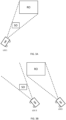
- Figure 3A shows a schematic view of a robotic work tool, operating based on a visual sensor, such as a mono camera, experiencing a problem as discussed in the background according to some example embodiments of the teachings herein.
- a real-life object, referenced RO is recorded by a robotic work tool 100.
- the object may be perceived as an object further away or closer to than the real-life object RO.
- one such object is shown, being scaled smaller than intended and referenced SO.
- the object is recorded at a first location LOC 1 and its location is determined based on the position of the seen or recorded object RO.
- FIG. 3B shows two possible locations for the robotic work tool 100. One being determined with the wrong scale LOC-E and one being the true second location LOC2. As can be seen the two locations differ quite a lot. It is thus important to determine and use a scale accurately or the location cannot be accurately determined.
- satellite navigation such as GPS or RTK
- GPS Globalstar Satellite Navigation
- RTK Real-Time Kinel Determination
- satellite navigation sensors are prone to introducing errors as satellite reception varies (exhibits a noisy profile) and may even be insufficient in many operating areas, such as in so-called satellite shadows.
- deduced reckoning navigation is another way of achieving a scale, as the deduced reckoning sensors will give accurate references (such as distance travelled) that can be used to determine the scale.
- deduced reckoning sensors are also prone to errors as they can be incorrectly calibrated or be influenced by external factors, such as wheel slip or magnetic disturbances.
- ground plane can also be used to determine the scale as the height over the ground plane can be used as a reference.
- the ground plane may be incorrectly estimated and especially the height to it, as the ground plane may have grass which grows to different lengths which will give different heights over the ground plane, and thus affect the scale.
- the ground plane may also be incorrectly estimated if the plane in front of the robotic work tool is at an angle (rising or sloping). The use of the ground plane thus suffers from errors that are more or less constant during one operation.
- the inventors have realized after inventive and insightful reasoning that the two manners of determining a scale may be used in combination. They may in some embodiments be used as supplements to one another, depending on the situation and in some embodiments, in parallel, where the satellite (or deduced reckoning) is utilized to provide a reference for the determination of the grass or ground height.
- the robotic work tool is configured to determine a reference (such as travelled distance) utilizing the satellite and/or deduced reckoning. This reference is then used to determine the height of the ground plane (or height of grass -assuming that the height of the grass is similar in front of the robotic work tool as long as it travels to unserviced areas.
- the satellite (or deduced reckoning) navigation is thus used to enable setting the height of grass correctly, thereby supplementing or enforcing the visual navigation based on the height estimation.
- the reference for the estimation of a ground plane can be seen as the first scale discussed below, and the determined scale can be seen as the second scale discussed below, wherein the two scales are used in combination.
- the scale from a previous frame or time may be used as the current scale.
- Figure 4A shows a schematic view of a robotic work tool 100 as in figure 1 , where the robotic work tool 100 is configured to operate based on both satellite navigation utilizing one or more satellite navigation sensors 175 according to the map application 120A and according to visual odometry based on the VO sensor 185.
- the robotic work tool is configured to rely on the VO sensor especially when the satellite navigation sensors 175 does not receive reliable satellite signals.
- the VO sensor navigation commonly experience scaling problems as discussed above, which problems are solved by the teachings herein.
- a first cloud C1 of points P (P1-1, P2-1) is shown schematically.
- the first cloud C1 corresponds to a frame for the visual sensor 185 that has been generated by the controller 110.
- a scale S 1 is indicated in the figure, and in this example is shown as the distance between a first point P1-1 and a second point P2-1.
- this is only for illustrative purposes and as a skilled person would understand, many different manners of determining the scale in a frame are available to a skilled person, such as based on satellite navigation.
- Figure 4A also shows how a height h for the VO sensor 185 may be determined based on a determined distance L and knowing an angle a of the field of view (FOV) for the VO sensor 185.
- the distance L is the distance to where the ground (or other supporting surface) is detected in the image and the angle will actually be the angle for the vector to where the ground is detected.
- the same formula can be used to determine a length to a point or object on the ground, by determining the time when the object is at an angle in the frame.
- the robotic work tool 100 has travelled a distance D from the first location LOC1 of figure 4A . It should be noted that even if the distance travelled is illustrated as a linear (straight) distance, the travelled distance may also include a rotation (vertical and/or horizontal) of the robotic work tool as well as sideways translations.
- a new frame is captured and a second or further cloud C2 is generated.
- the second cloud may be generated as a new cloud or be an update of the first cloud C1.
- the first cloud C1 there are several points P1-2, and P2-2 and a second scale S2.
- the translation between the first cloud (or frame) C1 and the second cloud (or frame) C2 has to be determined.
- This translation may be referenced as a translation scale, TS.
- the translation scale is determined in two manners according to the teachings herein. The two manners are in some embodiments employed in parallel and simultaneous.
- the two manners are in some embodiments employed as alternatives to one another, such as using the VO sensors with ground plane estimation when the satellite reception is lost or unreliable.
- the robotic work tool is enabled to select which manner to utilize based on the surroundings as will be discussed in the below.
- the first manner is reliant on the satellite navigation sensor 175 and hereafter referred to as the satellite mode.
- the distance D is determined based on determining the coordinates for the first location LOC1, determining the coordinates for the second location LOC2, whereby the distance D becomes the difference between the two locations. This distance can be used to determine the translation scale as would be known to a skilled person.
- the satellite manner works well when the robotic work tool 100 is not in a shadowed area SA such as in an open area.
- Figure 4C shows a schematic view where the robotic work tool 100 is at the second location as in figure 2 , but where the first frame or cloud C1 is also shown.
- the robotic work tool 100 reaches a point P2-1, wherein reaches may be defined as being able to determine a distance to the point with respect to the robotic work tool 100 reliably, the robotic work tool 100 is able to determine a scale to the same point in a subsequent frame or cloud, such as in the second cloud C2.
- the translation scale TS can thereby be determined based on the distance between the point P2-1 in the first cloud C1 and the same point P2-2 in the second (subsequent) cloud C2.
- the second manner is reliant on the VO sensor 185 and is hereafter referred to as the VO mode.
- the distance to the ground is determined as discussed above, wherein the distance to ground is used to provide a translation scale.
- the VO mode works well in surroundings having several objects or points to be used, such as cluttered areas, and works at a lower accuracy in open areas.
- the VO mode will drift after some time. In contrast the ground plane estimation will not drift, but suffers from noise.
- the translational scales determined for each mode may be utilized to correct or calibrate each other.
- the robotic work tool 100 is - in some embodiments - enabled to determine or select which mode to utilize.
- the controller is configured to determine a number of points to be used in the frame or cloud and as this number of points falls under a threshold value, the satellite mode is selected as being the primary mode for determining the translation scale.
- the controller is configured to determine that the robotic work tool 100 is for example in a shadow area by determining that the number of reliably received signals is below a threshold value, and if so, the VO mode (including the ground-plane estimation) is selected as being the primary mode for determining the translation scale.
- the controller is configured to determine that the translation scale determined for one of the modes undergoes a change exceeding a change threshold value, and in response thereto select the other mode as the primary mode for determining the translation scale.
- the robotic work tool 100 is configured to build a point cloud of features using the VO sensor 185 and possibly the satellite sensor 175.
- the point cloud will not suffer from the scale problems since the satellite sensor 175 will provide the translation scale.
- the point cloud can be built using Essential matrix, homography or other methods together with a bundle adjustment where the satellite (for example RTK) positions are used as constraints.
- the robotic work tool 100 is configured to utilize techniques such as Essential matrix or homography in order to give a better accuracy of the pose compared to triangulating the points directly from satellite-determined positions. In any case the satellite-determined positions has to be used to correct the scale.
- the points in this cloud will then have positions relative the satellite (RTK) system origin.
- the robotic work tool 100 determines that the satellite reception is lost or unreliable
- the robotic work tool 100 is - in some embodiments - configured to localize itself in the point cloud using PNP (Perspective-n-Point) i.e. get perspective (Pose) from n-number of 3D points and/or bundle adjustment.
- PNP Perspective-n-Point
- the VO sensor will be utilized to find features in a frame (such as C2) and match them with features in previous images (such as C1) so the points in the image can be matched with points in the point cloud.
- the camera will then get a position relative the satellite-determined positions without the scale problem.
- the VO sensor 185 will also find new features that are not found in the previous point cloud, and those new points can be added to the point cloud with scale and be used for the next localization in the next frame.
- the scale of the point cloud and the position of the VO sensor will drift after some time, but the robotic work tool behavior can be adapted so it finds a spot with satellite-coverage again.
- the drift can also be compensated for by the height determination, which should be relatively the same and may thus indicate a drift and how to correct such a drift.
- the second manner i.e. the VO and ground plane mode, combines VO sensor navigation with ground plane estimation in order to solve any scaling problems as discussed in the above and to supplement the VO sensor navigation, such as VSLAM.
- VO in satellite mode (when no RTK) and VO in groundplane mode suffers different problems.
- the VO sensor navigation will drift over time.
- the ground plane estimation algorithm will suffer from noise and may sometimes be unavailable when the VO sensor can't see the ground (e.g if the camera only sees a wall).
- the robotic work tool is thus enabled to solve a common problem by combining a drifting sensor (VO sensor) with a noisy sensor (ground plane estimation) which can increase the performance of the overall scale estimation task.
- Figure 5 shows a flowchart for a general method according to herein.
- the method is for use in a robotic work tool as in figure 1 in a manner as discussed above.
- the method comprises the robotic work tool utilizing 510 the visual sensor 185 to perform visual odometry navigation, utilizing 520 the satellite sensor to provide a reference for the visual odometry navigation and determining 530 a height above ground for the visual sensor 185 to provide a scale (TS) for the visual odometry navigation.
- TS scale
- first translation scale and the second translation scale can be utilized as the scale needed for visual odometry navigation.
Landscapes
- Engineering & Computer Science (AREA)
- Radar, Positioning & Navigation (AREA)
- Remote Sensing (AREA)
- Automation & Control Theory (AREA)
- Physics & Mathematics (AREA)
- General Physics & Mathematics (AREA)
- Aviation & Aerospace Engineering (AREA)
- Life Sciences & Earth Sciences (AREA)
- Environmental Sciences (AREA)
- Control Of Position, Course, Altitude, Or Attitude Of Moving Bodies (AREA)
- Navigation (AREA)
Applications Claiming Priority (1)
| Application Number | Priority Date | Filing Date | Title |
|---|---|---|---|
| SE2351350A SE546959C2 (en) | 2023-11-24 | 2023-11-24 | Improved navigation for a robotic work tool by combining navigational techniques |
Publications (2)
| Publication Number | Publication Date |
|---|---|
| EP4560426A1 true EP4560426A1 (fr) | 2025-05-28 |
| EP4560426B1 EP4560426B1 (fr) | 2026-04-15 |
Family
ID=93377999
Family Applications (1)
| Application Number | Title | Priority Date | Filing Date |
|---|---|---|---|
| EP24210342.2A Active EP4560426B1 (fr) | 2023-11-24 | 2024-11-01 | Amélioration de la navigation par vision pour un outil de travail robotisé |
Country Status (2)
| Country | Link |
|---|---|
| EP (1) | EP4560426B1 (fr) |
| SE (1) | SE546959C2 (fr) |
Family Cites Families (3)
| Publication number | Priority date | Publication date | Assignee | Title |
|---|---|---|---|---|
| CN112702693B (zh) * | 2020-12-23 | 2023-06-23 | 南京苏美达智能技术有限公司 | 一种自行走设备的地图构建方法及定位方法 |
| SE544614C2 (en) * | 2021-03-22 | 2022-09-27 | Husqvarna Ab | Improved navigation for a robotic work tool in an area of insufficient signal reception |
| CN116106957A (zh) * | 2022-12-26 | 2023-05-12 | 南京苏美达智能技术有限公司 | 一种自动割草机卫星导航系统与slam融合定位方法 |
-
2023
- 2023-11-24 SE SE2351350A patent/SE546959C2/en unknown
-
2024
- 2024-11-01 EP EP24210342.2A patent/EP4560426B1/fr active Active
Non-Patent Citations (2)
| Title |
|---|
| ANDREY SOLOVIEV ET AL: "Integration of GPS and vision measurements for navigation in GPS challenged environments", POSITION LOCATION AND NAVIGATION SYMPOSIUM (PLANS), 2010 IEEE/ION, IEEE, PISCATAWAY, NJ, USA, 4 May 2010 (2010-05-04), pages 826 - 833, XP031707097, ISBN: 978-1-4244-5036-7 * |
| ZHOU DINGFU ET AL: "Ground-Plane-Based Absolute Scale Estimation for Monocular Visual Odometry", IEEE TRANSACTIONS ON INTELLIGENT TRANSPORTATION SYSTEMS, IEEE, PISCATAWAY, NJ, USA, vol. 21, no. 2, 3 March 2019 (2019-03-03), pages 791 - 802, XP011770680, ISSN: 1524-9050, [retrieved on 20200203], DOI: 10.1109/TITS.2019.2900330 * |
Also Published As
| Publication number | Publication date |
|---|---|
| SE2351350A1 (en) | 2025-03-18 |
| EP4560426B1 (fr) | 2026-04-15 |
| SE546959C2 (en) | 2025-03-18 |
Similar Documents
| Publication | Publication Date | Title |
|---|---|---|
| US10928833B2 (en) | Navigation for a robotic work tool | |
| EP3084542B1 (fr) | Système et procédé permettant la navigation d'un outil de travail robotique | |
| US10136576B2 (en) | Navigation for a robotic working tool | |
| EP4075229B1 (fr) | Installation améliorée pour un outil de travail robotique | |
| EP4419976B1 (fr) | Navigation améliorée pour une tondeuse robotisée | |
| EP4068040A1 (fr) | Fonctionnement amélioré pour un outil de travail robotique | |
| EP4314974A1 (fr) | Navigation améliorée pour outil de travail robotique | |
| SE2050629A1 (en) | Method of providing a position estimate of a robotic tool, a robotic tool, and a robotic tool system | |
| EP4560426A1 (fr) | Amélioration de la navigation par vision pour un outil de travail robotisé | |
| US20240180072A1 (en) | Detection of a solar panel for a robotic work tool | |
| US20240411320A1 (en) | Nagivation for a robotic lawnmower system | |
| EP4586042A1 (fr) | Détermination améliorée de position pour un outil de travail robotique | |
| US20230350421A1 (en) | Navigation for a robotic work tool system | |
| EP4591695A1 (fr) | Détermination améliorée de position pour un outil de travail robotique | |
| US20240407290A1 (en) | Navigation for a robotic lawnmower system | |
| SE2250834A1 (en) | Improved determination of pose for a robotic work tool | |
| EP4589399A1 (fr) | Planification améliorée pour un outil de travail robotique | |
| WO2023244150A1 (fr) | Navigation améliorée pour système d'outil de travail robotique | |
| SE545472C2 (en) | System and method for navigating a robotic work tool |
Legal Events
| Date | Code | Title | Description |
|---|---|---|---|
| PUAI | Public reference made under article 153(3) epc to a published international application that has entered the european phase |
Free format text: ORIGINAL CODE: 0009012 |
|
| STAA | Information on the status of an ep patent application or granted ep patent |
Free format text: STATUS: THE APPLICATION HAS BEEN PUBLISHED |
|
| AK | Designated contracting states |
Kind code of ref document: A1 Designated state(s): AL AT BE BG CH CY CZ DE DK EE ES FI FR GB GR HR HU IE IS IT LI LT LU LV MC ME MK MT NL NO PL PT RO RS SE SI SK SM TR |
|
| STAA | Information on the status of an ep patent application or granted ep patent |
Free format text: STATUS: REQUEST FOR EXAMINATION WAS MADE |
|
| 17P | Request for examination filed |
Effective date: 20251124 |
|
| REG | Reference to a national code |
Ref country code: DE Ref legal event code: R079 Free format text: PREVIOUS MAIN CLASS: G05D0001248000 Ipc: G01C0021200000 Ref country code: DE Ref legal event code: R079 Ref document number: 602024003984 Country of ref document: DE Free format text: PREVIOUS MAIN CLASS: G05D0001248000 Ipc: G01C0021200000 |
|
| GRAP | Despatch of communication of intention to grant a patent |
Free format text: ORIGINAL CODE: EPIDOSNIGR1 |
|
| STAA | Information on the status of an ep patent application or granted ep patent |
Free format text: STATUS: GRANT OF PATENT IS INTENDED |
|
| RIC1 | Information provided on ipc code assigned before grant |
Ipc: G01C 21/20 20060101AFI20260112BHEP Ipc: G01C 21/16 20060101ALI20260112BHEP Ipc: G05D 1/243 20240101ALI20260112BHEP Ipc: G05D 1/248 20240101ALI20260112BHEP Ipc: G05D 111/63 20240101ALI20260112BHEP Ipc: G05D 105/15 20240101ALI20260112BHEP Ipc: G05D 109/10 20240101ALI20260112BHEP Ipc: G05D 111/10 20240101ALI20260112BHEP Ipc: G05D 107/20 20240101ALI20260112BHEP |
|
| INTG | Intention to grant announced |
Effective date: 20260123 |
|
| GRAS | Grant fee paid |
Free format text: ORIGINAL CODE: EPIDOSNIGR3 |
|
| GRAA | (expected) grant |
Free format text: ORIGINAL CODE: 0009210 |
|
| STAA | Information on the status of an ep patent application or granted ep patent |
Free format text: STATUS: THE PATENT HAS BEEN GRANTED |
|
| P01 | Opt-out of the competence of the unified patent court (upc) registered |
Free format text: CASE NUMBER: UPC_APP_0004867_4560426/2026 Effective date: 20260211 |
|
| AK | Designated contracting states |
Kind code of ref document: B1 Designated state(s): AL AT BE BG CH CY CZ DE DK EE ES FI FR GB GR HR HU IE IS IT LI LT LU LV MC ME MK MT NL NO PL PT RO RS SE SI SK SM TR |
|
| REG | Reference to a national code |
Ref country code: CH Ref legal event code: F10 Free format text: ST27 STATUS EVENT CODE: U-0-0-F10-F00 (AS PROVIDED BY THE NATIONAL OFFICE) Effective date: 20260415 |