EP4560455A1 - Anzeigeverfahren und -vorrichtung - Google Patents
Anzeigeverfahren und -vorrichtung Download PDFInfo
- Publication number
- EP4560455A1 EP4560455A1 EP22954660.1A EP22954660A EP4560455A1 EP 4560455 A1 EP4560455 A1 EP 4560455A1 EP 22954660 A EP22954660 A EP 22954660A EP 4560455 A1 EP4560455 A1 EP 4560455A1
- Authority
- EP
- European Patent Office
- Prior art keywords
- user
- area
- display area
- vehicle
- eye
- Prior art date
- Legal status (The legal status is an assumption and is not a legal conclusion. Google has not performed a legal analysis and makes no representation as to the accuracy of the status listed.)
- Pending
Links
Images





Classifications
-
- G—PHYSICS
- G09—EDUCATION; CRYPTOGRAPHY; DISPLAY; ADVERTISING; SEALS
- G09G—ARRANGEMENTS OR CIRCUITS FOR CONTROL OF INDICATING DEVICES USING STATIC MEANS TO PRESENT VARIABLE INFORMATION
- G09G3/00—Control arrangements or circuits, of interest only in connection with visual indicators other than cathode-ray tubes
- G09G3/001—Control arrangements or circuits, of interest only in connection with visual indicators other than cathode-ray tubes using specific devices not provided for in groups G09G3/02 - G09G3/36, e.g. using an intermediate record carrier such as a film slide; Projection systems; Display of non-alphanumerical information, solely or in combination with alphanumerical information, e.g. digital display on projected diapositive as background
-
- B—PERFORMING OPERATIONS; TRANSPORTING
- B60—VEHICLES IN GENERAL
- B60K—ARRANGEMENT OR MOUNTING OF PROPULSION UNITS OR OF TRANSMISSIONS IN VEHICLES; ARRANGEMENT OR MOUNTING OF PLURAL DIVERSE PRIME-MOVERS IN VEHICLES; AUXILIARY DRIVES FOR VEHICLES; INSTRUMENTATION OR DASHBOARDS FOR VEHICLES; ARRANGEMENTS IN CONNECTION WITH COOLING, AIR INTAKE, GAS EXHAUST OR FUEL SUPPLY OF PROPULSION UNITS IN VEHICLES
- B60K35/00—Instruments specially adapted for vehicles; Arrangement of instruments in or on vehicles
- B60K35/20—Output arrangements, i.e. from vehicle to user, associated with vehicle functions or specially adapted therefor
- B60K35/21—Output arrangements, i.e. from vehicle to user, associated with vehicle functions or specially adapted therefor using visual output, e.g. blinking lights or matrix displays
- B60K35/23—Head-up displays [HUD]
- B60K35/235—Head-up displays [HUD] with means for detecting the driver's gaze direction or eye points
-
- B—PERFORMING OPERATIONS; TRANSPORTING
- B60—VEHICLES IN GENERAL
- B60K—ARRANGEMENT OR MOUNTING OF PROPULSION UNITS OR OF TRANSMISSIONS IN VEHICLES; ARRANGEMENT OR MOUNTING OF PLURAL DIVERSE PRIME-MOVERS IN VEHICLES; AUXILIARY DRIVES FOR VEHICLES; INSTRUMENTATION OR DASHBOARDS FOR VEHICLES; ARRANGEMENTS IN CONNECTION WITH COOLING, AIR INTAKE, GAS EXHAUST OR FUEL SUPPLY OF PROPULSION UNITS IN VEHICLES
- B60K35/00—Instruments specially adapted for vehicles; Arrangement of instruments in or on vehicles
- B60K35/20—Output arrangements, i.e. from vehicle to user, associated with vehicle functions or specially adapted therefor
- B60K35/28—Output arrangements, i.e. from vehicle to user, associated with vehicle functions or specially adapted therefor characterised by the type of the output information, e.g. video entertainment or vehicle dynamics information; characterised by the purpose of the output information, e.g. for attracting the attention of the driver
-
- B—PERFORMING OPERATIONS; TRANSPORTING
- B60—VEHICLES IN GENERAL
- B60K—ARRANGEMENT OR MOUNTING OF PROPULSION UNITS OR OF TRANSMISSIONS IN VEHICLES; ARRANGEMENT OR MOUNTING OF PLURAL DIVERSE PRIME-MOVERS IN VEHICLES; AUXILIARY DRIVES FOR VEHICLES; INSTRUMENTATION OR DASHBOARDS FOR VEHICLES; ARRANGEMENTS IN CONNECTION WITH COOLING, AIR INTAKE, GAS EXHAUST OR FUEL SUPPLY OF PROPULSION UNITS IN VEHICLES
- B60K35/00—Instruments specially adapted for vehicles; Arrangement of instruments in or on vehicles
- B60K35/20—Output arrangements, i.e. from vehicle to user, associated with vehicle functions or specially adapted therefor
- B60K35/29—Instruments characterised by the way in which information is handled, e.g. showing information on plural displays or prioritising information according to driving conditions
-
- B—PERFORMING OPERATIONS; TRANSPORTING
- B60—VEHICLES IN GENERAL
- B60K—ARRANGEMENT OR MOUNTING OF PROPULSION UNITS OR OF TRANSMISSIONS IN VEHICLES; ARRANGEMENT OR MOUNTING OF PLURAL DIVERSE PRIME-MOVERS IN VEHICLES; AUXILIARY DRIVES FOR VEHICLES; INSTRUMENTATION OR DASHBOARDS FOR VEHICLES; ARRANGEMENTS IN CONNECTION WITH COOLING, AIR INTAKE, GAS EXHAUST OR FUEL SUPPLY OF PROPULSION UNITS IN VEHICLES
- B60K35/00—Instruments specially adapted for vehicles; Arrangement of instruments in or on vehicles
- B60K35/65—Instruments specially adapted for specific vehicle types or users, e.g. for left- or right-hand drive
- B60K35/654—Instruments specially adapted for specific vehicle types or users, e.g. for left- or right-hand drive the user being the driver
-
- B—PERFORMING OPERATIONS; TRANSPORTING
- B60—VEHICLES IN GENERAL
- B60K—ARRANGEMENT OR MOUNTING OF PROPULSION UNITS OR OF TRANSMISSIONS IN VEHICLES; ARRANGEMENT OR MOUNTING OF PLURAL DIVERSE PRIME-MOVERS IN VEHICLES; AUXILIARY DRIVES FOR VEHICLES; INSTRUMENTATION OR DASHBOARDS FOR VEHICLES; ARRANGEMENTS IN CONNECTION WITH COOLING, AIR INTAKE, GAS EXHAUST OR FUEL SUPPLY OF PROPULSION UNITS IN VEHICLES
- B60K35/00—Instruments specially adapted for vehicles; Arrangement of instruments in or on vehicles
- B60K35/65—Instruments specially adapted for specific vehicle types or users, e.g. for left- or right-hand drive
- B60K35/656—Instruments specially adapted for specific vehicle types or users, e.g. for left- or right-hand drive the user being a passenger
-
- B—PERFORMING OPERATIONS; TRANSPORTING
- B60—VEHICLES IN GENERAL
- B60K—ARRANGEMENT OR MOUNTING OF PROPULSION UNITS OR OF TRANSMISSIONS IN VEHICLES; ARRANGEMENT OR MOUNTING OF PLURAL DIVERSE PRIME-MOVERS IN VEHICLES; AUXILIARY DRIVES FOR VEHICLES; INSTRUMENTATION OR DASHBOARDS FOR VEHICLES; ARRANGEMENTS IN CONNECTION WITH COOLING, AIR INTAKE, GAS EXHAUST OR FUEL SUPPLY OF PROPULSION UNITS IN VEHICLES
- B60K35/00—Instruments specially adapted for vehicles; Arrangement of instruments in or on vehicles
- B60K35/80—Arrangements for controlling instruments
- B60K35/81—Arrangements for controlling instruments for controlling displays
-
- G—PHYSICS
- G06—COMPUTING OR CALCULATING; COUNTING
- G06F—ELECTRIC DIGITAL DATA PROCESSING
- G06F21/00—Security arrangements for protecting computers, components thereof, programs or data against unauthorised activity
- G06F21/60—Protecting data
- G06F21/62—Protecting access to data via a platform, e.g. using keys or access control rules
- G06F21/6218—Protecting access to data via a platform, e.g. using keys or access control rules to a system of files or objects, e.g. local or distributed file system or database
- G06F21/6245—Protecting personal data, e.g. for financial or medical purposes
-
- G—PHYSICS
- G06—COMPUTING OR CALCULATING; COUNTING
- G06F—ELECTRIC DIGITAL DATA PROCESSING
- G06F21/00—Security arrangements for protecting computers, components thereof, programs or data against unauthorised activity
- G06F21/70—Protecting specific internal or peripheral components, in which the protection of a component leads to protection of the entire computer
- G06F21/82—Protecting input, output or interconnection devices
- G06F21/84—Protecting input, output or interconnection devices output devices, e.g. displays or monitors
-
- G—PHYSICS
- G06—COMPUTING OR CALCULATING; COUNTING
- G06F—ELECTRIC DIGITAL DATA PROCESSING
- G06F3/00—Input arrangements for transferring data to be processed into a form capable of being handled by the computer; Output arrangements for transferring data from processing unit to output unit, e.g. interface arrangements
- G06F3/01—Input arrangements or combined input and output arrangements for interaction between user and computer
- G06F3/011—Arrangements for interaction with the human body, e.g. for user immersion in virtual reality
- G06F3/013—Eye tracking input arrangements
-
- B—PERFORMING OPERATIONS; TRANSPORTING
- B60—VEHICLES IN GENERAL
- B60K—ARRANGEMENT OR MOUNTING OF PROPULSION UNITS OR OF TRANSMISSIONS IN VEHICLES; ARRANGEMENT OR MOUNTING OF PLURAL DIVERSE PRIME-MOVERS IN VEHICLES; AUXILIARY DRIVES FOR VEHICLES; INSTRUMENTATION OR DASHBOARDS FOR VEHICLES; ARRANGEMENTS IN CONNECTION WITH COOLING, AIR INTAKE, GAS EXHAUST OR FUEL SUPPLY OF PROPULSION UNITS IN VEHICLES
- B60K2360/00—Indexing scheme associated with groups B60K35/00 or B60K37/00 relating to details of instruments or dashboards
- B60K2360/149—Instrument input by detecting viewing direction not otherwise provided for
-
- B—PERFORMING OPERATIONS; TRANSPORTING
- B60—VEHICLES IN GENERAL
- B60K—ARRANGEMENT OR MOUNTING OF PROPULSION UNITS OR OF TRANSMISSIONS IN VEHICLES; ARRANGEMENT OR MOUNTING OF PLURAL DIVERSE PRIME-MOVERS IN VEHICLES; AUXILIARY DRIVES FOR VEHICLES; INSTRUMENTATION OR DASHBOARDS FOR VEHICLES; ARRANGEMENTS IN CONNECTION WITH COOLING, AIR INTAKE, GAS EXHAUST OR FUEL SUPPLY OF PROPULSION UNITS IN VEHICLES
- B60K2360/00—Indexing scheme associated with groups B60K35/00 or B60K37/00 relating to details of instruments or dashboards
- B60K2360/18—Information management
- B60K2360/195—Blocking or enabling display functions
-
- B—PERFORMING OPERATIONS; TRANSPORTING
- B60—VEHICLES IN GENERAL
- B60K—ARRANGEMENT OR MOUNTING OF PROPULSION UNITS OR OF TRANSMISSIONS IN VEHICLES; ARRANGEMENT OR MOUNTING OF PLURAL DIVERSE PRIME-MOVERS IN VEHICLES; AUXILIARY DRIVES FOR VEHICLES; INSTRUMENTATION OR DASHBOARDS FOR VEHICLES; ARRANGEMENTS IN CONNECTION WITH COOLING, AIR INTAKE, GAS EXHAUST OR FUEL SUPPLY OF PROPULSION UNITS IN VEHICLES
- B60K2360/00—Indexing scheme associated with groups B60K35/00 or B60K37/00 relating to details of instruments or dashboards
- B60K2360/20—Optical features of instruments
- B60K2360/21—Optical features of instruments using cameras
-
- B—PERFORMING OPERATIONS; TRANSPORTING
- B60—VEHICLES IN GENERAL
- B60K—ARRANGEMENT OR MOUNTING OF PROPULSION UNITS OR OF TRANSMISSIONS IN VEHICLES; ARRANGEMENT OR MOUNTING OF PLURAL DIVERSE PRIME-MOVERS IN VEHICLES; AUXILIARY DRIVES FOR VEHICLES; INSTRUMENTATION OR DASHBOARDS FOR VEHICLES; ARRANGEMENTS IN CONNECTION WITH COOLING, AIR INTAKE, GAS EXHAUST OR FUEL SUPPLY OF PROPULSION UNITS IN VEHICLES
- B60K2360/00—Indexing scheme associated with groups B60K35/00 or B60K37/00 relating to details of instruments or dashboards
- B60K2360/741—Instruments adapted for user detection
-
- G—PHYSICS
- G02—OPTICS
- G02B—OPTICAL ELEMENTS, SYSTEMS OR APPARATUS
- G02B27/00—Optical systems or apparatus not provided for by any of the groups G02B1/00 - G02B26/00, G02B30/00
- G02B27/01—Head-up displays
- G02B27/0101—Head-up displays characterised by optical features
-
- G—PHYSICS
- G09—EDUCATION; CRYPTOGRAPHY; DISPLAY; ADVERTISING; SEALS
- G09G—ARRANGEMENTS OR CIRCUITS FOR CONTROL OF INDICATING DEVICES USING STATIC MEANS TO PRESENT VARIABLE INFORMATION
- G09G2320/00—Control of display operating conditions
- G09G2320/08—Arrangements within a display terminal for setting, manually or automatically, display parameters of the display terminal
-
- G—PHYSICS
- G09—EDUCATION; CRYPTOGRAPHY; DISPLAY; ADVERTISING; SEALS
- G09G—ARRANGEMENTS OR CIRCUITS FOR CONTROL OF INDICATING DEVICES USING STATIC MEANS TO PRESENT VARIABLE INFORMATION
- G09G2340/00—Aspects of display data processing
- G09G2340/04—Changes in size, position or resolution of an image
- G09G2340/0407—Resolution change, inclusive of the use of different resolutions for different screen areas
-
- G—PHYSICS
- G09—EDUCATION; CRYPTOGRAPHY; DISPLAY; ADVERTISING; SEALS
- G09G—ARRANGEMENTS OR CIRCUITS FOR CONTROL OF INDICATING DEVICES USING STATIC MEANS TO PRESENT VARIABLE INFORMATION
- G09G2354/00—Aspects of interface with display user
-
- G—PHYSICS
- G09—EDUCATION; CRYPTOGRAPHY; DISPLAY; ADVERTISING; SEALS
- G09G—ARRANGEMENTS OR CIRCUITS FOR CONTROL OF INDICATING DEVICES USING STATIC MEANS TO PRESENT VARIABLE INFORMATION
- G09G2358/00—Arrangements for display data security
-
- G—PHYSICS
- G09—EDUCATION; CRYPTOGRAPHY; DISPLAY; ADVERTISING; SEALS
- G09G—ARRANGEMENTS OR CIRCUITS FOR CONTROL OF INDICATING DEVICES USING STATIC MEANS TO PRESENT VARIABLE INFORMATION
- G09G2380/00—Specific applications
- G09G2380/10—Automotive applications
Definitions
- This application relates to the field of man-machine interaction, and in particular, to a display method and apparatus.
- display apparatuses are used more frequently.
- display apparatuses in cockpits are mainly classified into two types: a first type is a vehicle-mounted display, and a second type is a projection display, for example, a head-up display (head-up display, HUD) apparatus.
- a first type is a vehicle-mounted display
- a second type is a projection display, for example, a head-up display (head-up display, HUD) apparatus.
- HUD head-up display
- augmented reality head-up display augmented reality head-up display
- AR-HUD augmented reality head-up display
- This application provides a display method and apparatus, to reduce a risk of privacy information leakage and improve a feeling of safety of a user.
- a display method including: obtaining image information, where the image information is used to determine an eye position and a line-of-sight direction of a first user of a vehicle; and adjusting a display manner of a first area in a display area based on the eye position and the line-of-sight direction of the first user, where the display area is a display area of an HUD, and the first area includes privacy information of a second user of the vehicle.
- a vehicle-mounted terminal may obtain the image information used to determine the eye position and the line-of-sight direction of the first user of the vehicle, and may adjust the display manner of the first area in the display area based on the eye position and the line-of-sight direction of the first user. This can reduce a possibility that the first user can view the privacy information of the second user, can reduce a risk of privacy information leakage, and improves a feeling of safety of the user.
- the image information may be an image obtained directly by a sensor, or may be information obtained after being processed by the sensor, or may be information obtained by processing an image obtained by the sensor by using a processor.
- the image information may be, for example, a key point matrix, or a key point set. That is, a face key point is marked in the image information.
- a face key point is a point used to locate a key area of a face in a face image.
- the key area includes one or more of eyebrows, eyes, the nose, the mouth, and a face contour.
- the image information may be used to obtain an eye position of the user.
- the eye position of the first user is marked in the image information
- an eye position of the second user is also marked in the image information.
- the first user may be, for example, a non-driver
- the second user may be, for example, a driver.
- the eye position of the user may be, for example, a middle point of two eye centers, a left eye center, or a right eye center.
- an eye center may be a pupil center, an eyeball center, a corneal center, or another position of the eye.
- the HUD may be, for example, one or more of an AR-HUD, a combiner-HUD (combiner-HUD, C-HUD), or a windshield-HUD (windshield-HUD, W-HUD).
- the first area may be a part of the display area, or may be an entire area of the display area.
- the privacy information may include, for example, information in one or more forms of a text, a picture, a video, or the like.
- the first user is located in a non-driver position of the vehicle, and the second user is located in a driver position of the vehicle.
- the first user is located in a non-driver position of the vehicle includes: The first user is located in a front passenger position of the vehicle; or the first user is located in a rear-row area of the vehicle. Specifically, if an in-vehicle area is divided into a driver position, a front passenger position, left in a second row, and right in the second row, the first user may be in the left in the second row or the right in the second row of the vehicle.
- the first user may be in the left in the second row, the middle in the second row, or the right in the second row of the vehicle.
- the adjusting a display manner of a first area in a display area based on the eye position and the line-of-sight direction of the first user includes: determining whether the eye position of the first user is within a viewing angle range of the display area; and adjusting the display manner of the first area in the display area to a first display manner when a first condition is met, where the first condition includes at least one of the following: The eye position of the first user is within a viewing angle range of the display area; the line-of-sight direction of the first user is towards the display area; or time for which a line of sight of the first user stays in the display area is greater than or equal to preset time.
- the first condition may be pre-agreed or defined in a standard. This is not limited herein. It can be learned that, when the first condition is met, the vehicle-mounted terminal adjusts the display manner of the first area in the display area to the first display manner. In other words, when it is detected that the first user may view the privacy information of the second user in the first area, the vehicle-mounted terminal adjusts the display manner of the first area in the display area to the first display manner, so that a possibility that the first user can view the privacy information of the second user can be reduced. This can reduce a risk of privacy information leakage, and improves a feeling of safety of the user.
- the viewing angle range of the display area includes an angle range of an eye that is of the first user and that can see a picture of the display area, and a boundary point may be determined by a maximum angle value and a minimum angle value of the eye that is of the first user and that can see the picture of the display area.
- the viewing angle range of the display area may include a range determined by the maximum angle value and the minimum angle value, and may further include the boundary point, for example, the maximum angle value and/or the minimum angle value, or may not include the boundary point. This may be defined in a specific implementation process.
- the viewing angle range of the display area is related to the eye position of the first user.
- the preset time may be preset, or may be obtained by the vehicle-mounted terminal from a cloud, or may be determined by the user. This is not limited herein.
- the first display manner includes at least one of the following: hiding the first area; hiding the privacy information of the second user in the first area; fading the first area; switching first definition of the first area to second definition, and displaying the privacy information of the second user in the second definition, where the first definition is higher than the second definition; or switching first resolution of the first area to second resolution, and displaying the privacy information of the second user in the second resolution, where the first resolution is higher than the second resolution.
- the user may clearly view the privacy information in the first area; when the definition of the first area is the second definition, or the resolution of the first area is the second resolution, the user cannot clearly view the privacy information, or even cannot view the privacy information.
- the method further includes: adjusting the display manner of the first area in the display area from the first display manner to a second display manner when a second condition is met, where the second condition includes at least one of the following: The eye position of the first user exceeds the viewing angle range of the display area; the line-of-sight direction of the first user is towards an area other than the display area; or time for which the line of sight of the first user stays in the display area is less than the preset time.
- the second condition may be pre-agreed or defined in a standard. This is not limited herein.
- the vehicle-mounted terminal adjusts the display manner of the first area in the display area from the first display manner to the second display manner.
- the vehicle-mounted terminal adjusts the display manner of the first area in the display area from the first display manner to the second display manner, so that the second user can view the privacy information of the second user.
- the second display manner includes at least one of the following: displaying the privacy information of the second user in the first area; switching second definition of the first area to first definition, and displaying the privacy information of the second user in the first definition, where the first definition is higher than the second definition; or switching second resolution of the first area to first resolution, and displaying the privacy information of the second user in the first resolution, where the first resolution is higher than the second resolution.
- the image information is further used to determine an eye position of the second user, and the determining whether the eye position of the first user is within a viewing angle range of the display area includes: determining an included angle formed by a connection line between the eye position of the second user and a first target point in the display area and a connection line between the eye position of the first user and the first target point, to obtain a first angle value; and determining, based on the first angle value, whether the eye position of the first user is within the viewing angle range of the display area. It can be learned that the vehicle-mounted terminal may determine, based on the first angle value, whether the eye position of the first user is within the viewing angle range of the display area, to prepare for subsequently adjusting the display manner of the first area in the display area.
- the method before the adjusting the display manner of the first area in the display area to a first display manner, the method further includes: determining an included angle formed by a connection line between the eye position of the first user and a first target point in the display area and the line-of-sight direction of the first user, to obtain a second angle value; and determining, based on the second angle value, whether the line-of-sight direction of the first user is towards the display area. It can be learned that the vehicle-mounted terminal may determine, based on the second angle value, whether the line-of-sight direction of the first user is towards the display area, to prepare for subsequently adjusting the display manner of the first area in the display area.
- the first target point is a center point of the display area; the first target point is a vertex of the display area; or the first target point is a center point of a side edge of the display area, and the side edge of the display area includes a left side, a right side, an upper side, or a lower side of the display area.
- the method before the obtaining image information, further includes: enabling a privacy information protection mode when a third condition is met, where the third condition includes at least one of the following: detecting that there is a user other than the second user in the vehicle in which the second user is located; detecting that there is a user other than a preset user in the vehicle; and detecting a mode setting instruction, where the mode setting instruction is used to enable the privacy information protection mode.
- the third condition may be pre-agreed or defined in a standard. This is not limited herein. It can be learned that when the third condition is met, the vehicle-mounted terminal enables the privacy information protection mode, so that the vehicle-mounted terminal can adjust the display manner of the first area in the display area.
- the preset user may be preset, or may be obtained by the vehicle-mounted terminal from a cloud, or may be determined by the user. This is not limited herein.
- the preset user may include, for example, the second user, and may further include a family member of the second user, a friend of the second user, and the like.
- a display apparatus including a receiving unit and a processing unit, where the receiving unit is configured to obtain image information, the image information is used to determine an eye position and a line-of-sight direction of a first user of a vehicle; and the processing unit is configured to adjust a display manner of a first area in a display area based on the eye position and the line-of-sight direction of the first user, where the display area is a display area of an HUD, and the first area includes privacy information of a second user of the vehicle.
- the first user is located in a non-driver position of the vehicle, and the second user is located in a driver position of the vehicle.
- the first user is located in a non-driver position of the vehicle includes: The first user is located in a front passenger position of the vehicle; or the first user is located in a rear-row area of the vehicle.
- the first display manner includes at least one of the following: hiding the first area; hiding the privacy information of the second user in the first area; fading the first area; switching first definition of the first area to second definition, and displaying the privacy information of the second user in the second definition, where the first definition is higher than the second definition; or switching first resolution of the first area to second resolution, and displaying the privacy information of the second user in the second resolution, where the first resolution is higher than the second resolution.
- the processing unit is further configured to adjust the display manner of the first area in the display area from the first display manner to a second display manner when a second condition is met, where the second condition includes at least one of the following: The eye position of the first user exceeds the viewing angle range of the display area; the line-of-sight direction of the first user is towards an area other than the display area; or time for which the line of sight of the first user stays in the display area is less than the preset time.
- the second display manner includes at least one of the following: displaying the privacy information of the second user in the first area; switching second definition of the first area to first definition, and displaying the privacy information of the second user in the first definition, where the first definition is higher than the second definition; or switching second resolution of the first area to first resolution, and displaying the privacy information of the second user in the first resolution, where the first resolution is higher than the second resolution.
- the image information is further used to determine an eye position of the second user, and when determining whether the eye position of the first user is within the viewing angle range of the display area, the processing unit is configured to: determine an included angle formed by a connection line between the eye position of the second user and a first target point in the display area and a connection line between the eye position of the first user and the first target point, to obtain a first angle value; and determine, based on the first angle value, whether the eye position of the first user is within the viewing angle range of the display area.
- the processing unit is further configured to: determine an included angle formed by a connection line between the eye position of the first user and a first target point in the display area and the line-of-sight direction of the first user, to obtain a second angle value; and determine, based on the second angle value, whether the line-of-sight direction of the first user is towards the display area.
- the first target point is a center point of the display area; the first target point is a vertex of the display area; or the first target point is a center point of a side edge of the display area, and the side edge of the display area includes a left side, a right side, an upper side, or a lower side of the display area.
- the processing unit is further configured to enable a privacy information protection mode when a third condition is met, where the third condition includes at least one of the following: detecting that there is a user other than the second user in the vehicle in which the second user is located; detecting that there is a user other than a preset user in the vehicle; and detecting a mode setting instruction, where the mode setting instruction is used to enable the privacy information protection mode.
- an electronic apparatus is provided, where the apparatus is deployed in a vehicle, and the apparatus includes units configured to perform any method according to the first aspect.
- the electronic apparatus may be, for example, a display device, or may be a processing apparatus for controlling the display device, for example, a vehicle-mounted terminal.
- the electronic apparatus may be, for example, a chip system in a display device, or may be a chip system in a processing apparatus.
- the chip system may include at least one processor, a memory, and an interface circuit.
- the interface circuit is configured to provide information input/output for the at least one processor.
- the memory stores a computer program. When the computer program is run on one or more processors, the method according to the first aspect is implemented.
- an electronic apparatus includes at least one processor and a communication interface, and the at least one processor is configured to invoke a computer program stored in at least one memory, to perform the method according to the first aspect.
- a display system including a vehicle-mounted terminal, where the vehicle-mounted terminal is configured to implement the method according to any one of the implementations of the first aspect.
- a vehicle-mounted terminal configured to implement the method according to any one of the implementations of the first aspect.
- a computer-readable storage medium stores a computer program, and when the computer program is run on one or more processors, the method according to any one of the implementations of the first aspect is implemented.
- a computer program product is provided.
- the computer program product runs on one or more processors, the method according to any one of the implementations of the first aspect is implemented.
- the HUD may also be referred to as a head-up display, and is a display apparatus that projects an image into a front field of view of a driver.
- the HUD may include components such as a projector, a reflector (which may also be referred to as a secondary reflector), and a projection lens (which may also be referred to as a primary reflector).
- An imaging principle of the HUD is similar to projection on a slide. An image is projected onto a windshield of a vehicle, so that the driver can obtain an image in front of a field of view.
- light information may be first emitted by the projector, reflected to the projection lens by the reflector, and then reflected to the windshield by the projection lens, so that an eye sees a virtual image that is located approximately 2 meters to 2.5 meters in front of the eye, and a person feels that the information is suspended on a road ahead.
- a position of the image projected onto the windshield is adjustable, and generally, the position of the image may be adjusted by changing an angle of the projection lens.
- the projection lens and reflector are usually designed to be curved.
- the HUD projects information such as speeding warning, vehicle status monitoring, fuel consumption, and a speed per hour onto the windshield for displaying by using an optical reflection principle.
- the driver can focus on a road ahead, implementing proactive driving safety.
- a delay and discomfort caused by constant adjustment of an eye focal length can be reduced.
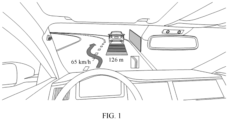
- FIG. 1 is a schematic diagram of projecting information by an HUD onto a windshield for displaying according to an embodiment of this application. As shown in FIG. 1 , a speed per hour of a vehicle, a distance to a vehicle ahead, and the like, may be projected by an HUD onto a windshield for displaying.
- the HUD may be, for example, one or more of an AR-HUD, a C-HUD, or a W-HUD.
- the HUD may have a factory-installed manner and a customer-installed manner.
- the HUD may be classified into a suspension HUD and a dashboard HUD.
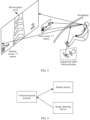
- FIG. 2 is a schematic diagram of HUD installation positions according to an embodiment of this application.
- 2-1 is a suspension HUD
- FIG. 2, 2-2 is a dashboard HUD.
- An AR-HUD may integrate an image projected by the HUD with real road surface information, to enhance obtaining of road surface information by a driver, and implement functions such as AR navigation and AR warning. For example, one or more functions such as vehicle following distance warning, lane-crossing warning, traffic light monitoring, an indication of changing a lane in advance, pedestrian warning, road sign displaying, a lane departure indication, ahead obstacle warning, and driver status monitoring may be implemented.
- a display carrier of the AR-HUD may be, for example, a virtual screen.
- the virtual screen may be classified into a near screen and a remote screen.
- the near screen may be located, for example, 2.5 meters from a front field of view of the driver, and the remote screen may be located, for example, 7 meters to 15 meters from the front field of view of the driver.
- FIG. 3 is a schematic diagram of an imaging effect of an AR-HUD according to an embodiment of this application.
- a virtual image surface that is projected by the AR-HUD to present onto a windshield of a vehicle may be located in front of a field of view of a driver, for example, located at a near display 2.5 meters from the front field of view of the driver, or located at a remote display 15 meters from the front field of view of the driver.
- Information such as a driving speed and vehicle power can be displayed on both the near display and the remote display.
- Information such as an AR navigation arrow can be displayed on the remote display to help a driver to drive more intelligently, comfortably and safely.
- the C-HUD is commonly used in a customer-installed product market.
- a translucent resin plate may be mounted on a top of a cockpit in a suspension manner or on a top of a dashboard, and the translucent resin plate, as a projection medium, is configured to reflect a virtual image.
- the resin plate is usually specially processed based on an imaging condition, for example, is made into a wedge shape to avoid reflection ghost and improve a display effect.
- the W-HUD may reflect imaging by using a front windshield as an imaging medium, and may support a larger imaging area and a longer projection distance.
- the windshield is usually a curved surface reflector, and the W-HUD needs to adapt to a high-precision curved surface reflector based on a size and curvature of the windshield. This results in high costs.
- the W-HUD is mainly used in a factory-installed product market.
- imaging amplification based on a curved reflector imaging amplification based on a holographic optical element (holographic optical element, HOE), and imaging amplification based on a holographic optical waveguide (waveguide).
- HOE and waveguide technologies are not yet mature, and the technology of imaging amplification based on a curved reflector is mainly applied.
- FIG. 4 is a schematic diagram of a display system according to an embodiment of this application.
- the display system may include a display device.
- the display device is configured to display various types of information, for example, display privacy information of a driver.
- the privacy information may include, for example, information in one or more forms of a text, a picture, a video, and the like. It should be understood that the privacy information is information that can be displayed by using a display device after user authorization.
- the display device may also be configured to display information such as speeding warning, vehicle condition monitoring, fuel consumption, and a speed per hour.
- the display device may be installed above a center console of a vehicle cockpit or inside the center console.
- the display device may be, for example, an HUD or a device with a projection imaging function. This is not specifically limited.
- the display system may further include a vehicle-mounted terminal.
- the vehicle-mounted terminal is an electronic device having a data processing capability and/or a data receiving and sending capability.
- the vehicle-mounted terminal may control the display device to display various types of information, for example, display privacy information of a driver.
- the vehicle-mounted terminal may be a display apparatus having a processing function, or may be a processing apparatus, to control the display device to display the various types of information.
- the vehicle-mounted terminal may be further configured to perform one or more types of management such as driving safety management, operation management, service quality management, intelligent centralized scheduling management, and electronic stop sign control management on a vehicle.
- management such as driving safety management, operation management, service quality management, intelligent centralized scheduling management, and electronic stop sign control management on a vehicle.
- the vehicle-mounted terminal may be deployed on the vehicle.
- the vehicle may be a car, a truck, a bus, a ship, an airplane, a helicopter, a tram, a golf cart, or the like. This is not particularly limited in this embodiment of this application.
- the display system may further include an image capturing device.
- the image capturing device may capture one or more images of a surrounding environment of the vehicle.
- the image capturing device may detect and capture one or more of a face, a head, a part of a torso (for example, an arm), and the like of a user in the vehicle, and may further detect and capture one or more of an eye position, a line-of-sight direction, and the like of the user in the vehicle.
- the image capturing device may be, for example, one or more of a vehicle-mounted camera, an eye detector, a sensor, and the like.
- the vehicle-mounted camera may be, for example, one or more of a driver monitoring system (driver monitoring system, DMS) camera, a vehicle camera-monitor system (camera-monitor system, CMS) camera, and the like.
- driver monitoring system driver monitoring system
- vehicle camera-monitor system vehicle camera-monitor system
- CMS vehicle camera-monitor system
- the image capturing device may be disposed on the vehicle based on a requirement, for example, may be disposed in an area near a steering wheel or a center console. There may be one or more image capturing devices. Positions and a quantity of the image capturing devices are not limited in this application.
- a link for communication between the vehicle-mounted terminal and the display device, the image capturing device, or the like may be various types of media, and may be specifically a wired link, a wireless link, a combination of a wired link and a wireless link, or the like.
- the wired link may be, for example, an Ethernet-based bus, or may be one or more of a CAN bus, an LIN bus, a MOST bus, a FlexRay bus, or the like.
- the wireless link is a short-distance connection technology, including 802.11b/g, Bluetooth (Bluetooth), zigbee (zigbee), and an in-vehicle short-range wireless communication technology.
- the wireless link may be a long-distance connection technology, including a global system for mobile communication (global system for mobile communication, GSM), a general packet radio service (general packet radio service, GPRS), a universal mobile telecommunications system (universal mobile telecommunications system, UMTS), a long term evolution (long term evolution, LTE)-based communication technology, a 5th generation mobile communication technology (a 5th generation mobile network or 5th generation wireless system, 5th-Generation, 5G or 5G technology for short), an in-vehicle wireless communication technology, and the like.
- GSM global system for mobile communication
- GPRS general packet radio service
- UMTS universal mobile telecommunications system
- LTE long term evolution
- 5th generation mobile communication technology a 5th generation mobile network or 5th generation wireless system, 5th-Generation, 5G or 5G technology for short
- an in-vehicle wireless communication technology and the like.
- the vehicle-mounted terminal controls the display device to display the various types of information
- the display device is an AR-HUD and the image capturing device is a DMS camera, to describe a principle in which the vehicle-mounted terminal controls the AR-HUD to display an image.
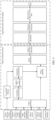
- FIG. 5 is a schematic diagram of a principle of controlling an AR-HUD to display an image by a vehicle-mounted terminal according to an embodiment of this application.
- the vehicle-mounted terminal may obtain image information by using a DMS camera.
- the image information may include, for example, an eye of a user, for example, an eye of a driver, to determine an eye position of the user, and perform eye position filtering to obtain a filtered eye position.
- the vehicle-mounted terminal may further generate a graph.
- the vehicle-mounted terminal obtains information such as a current position of a vehicle, a driving route of the vehicle, a speed of the vehicle, and a road condition ahead from an advanced driving assistance system (advanced driving assistant system, ADAS) interface, to generate the graph.
- ADAS advanced driving assistance system
- the vehicle-mounted terminal obtains high-precision navigation information, for example, indicates to go straight to an XX road, indicates to turn left to the XX road, indicates to turn right to the XX road, indicates to make a U-turn, to generate the graph.
- the vehicle-mounted terminal obtains some vehicle service information such as video viewing service information and music playback service information, to generate the graph.
- the vehicle-mounted terminal obtains POI information from a point of interest (point of interest, POI) interface to generate the graph.
- the vehicle-mounted terminal obtains information such as fuel consumption and a speed per hour from an instrument interface to generate the graph.
- the POI means a location identifier in a geographical area, and the location identifier is used to identify a government department, a commercial institution (a gas station, a department store, a supermarket, a restaurant, a hotel, a convenience store, a hospital, and the like), a tourist attraction (a park, a public toilet, and the like), a historic site, a traffic facility (a station, a parking lot, a speeding camera, and a speed limit sign), and the like where the location identifier is located.
- the POI information may include one or more of a name, a type, location information, and the like.
- the location information may include, for example, one or more of a latitude, a longitude, an altitude, and the like.
- the type may be catering, accommodation, or the like. It should be understood that, after obtaining the generated graph, the vehicle-mounted terminal may sequentially perform coordinate transformation and angle of view translation on the graph, and perform, based on the filtered eye position, perspective transformation on the graph obtained after the angle of view translation, to obtain a graph obtained after the perspective transformation. Further, the vehicle-mounted terminal may perform image rendering based on the graph obtained after the perspective transformation and the graph generated by the vehicle-mounted terminal, to obtain an image-rendered graph.
- the vehicle-mounted terminal sequentially performs image stabilization processing and optical distortion correction on the image-rendered graph, to transmit the corrected graph to the AR-HUD, so that the AR-HUD may sequentially perform photosensitive adjustment and scanning distortion correction on the corrected graph, and display the graph by using a micro-electro-mechanical system (micro-electro-mechanical system, MEMS) drive and a laser diode (laser diode, LD) drive.
- MEMS micro-electro-mechanical system
- laser diode laser diode
- the image distortion means a phenomenon in which deformation/distortion, in a geometric shape, such as stretching or distortion occurs in content of an image and that is caused by a fact that an optical system with a large field of view and a short focal length does not meet a pinhole model, and after chief rays of different fields of view pass through the optical system, a height of a focal point on a Gaussian image plane is not equal to an ideal image height, and consequently an actual image point deviates from an ideal image point. For example, for a wide-angle camera, an image of a large field of view can be obtained, but significant image distortion can be likely introduced.
- the image distortion may also be referred to as optical distortion, lens distortion, photographing distortion, camera distortion, camera lens distortion, or the like. It should be understood that an image distortion correction algorithm may be used to perform image distortion correction.
- the image distortion correction algorithm may be, for example, a Zhang Zhengyou camera calibration algorithm.
- FIG. 6 is a schematic flowchart of a display method according to an embodiment of this application. It should be understood that the embodiment described in FIG. 6 may be applied to a display device, or may be applied to a processing apparatus, for example, a vehicle-mounted terminal, for controlling the display device. The following uses a vehicle-mounted terminal as an example for description. As shown in FIG. 6 , the method includes but is not limited to the following steps.
- a vehicle-mounted terminal obtains image information, where the image information is used to determine an eye position and a line-of-sight direction of a first user of a vehicle.
- step 601 may be implemented in any one of the following manners.
- a specific manner to be used may depend on an implementation of the vehicle-mounted terminal, a pre-agreement, or a definition of a standard.
- the vehicle-mounted terminal processes a source image by performing one or more of image quality enhancement processing, image distortion correction processing, and the like, to obtain the image information.
- Image quality enhancement means processing one or more of brightness, color, contrast, saturation, dynamic range, and the like of an image, and may also be referred to as image enhancement, which is equivalent to improving image quality, so that an image is clearer.
- the source image may be an image obtained by the vehicle-mounted terminal through an image capturing device, or may be an image obtained by the vehicle-mounted terminal from a database storing the image. It should be understood that, in this application, a specific manner of obtaining the source image is not limited.
- the vehicle-mounted terminal obtains image information by using an image capturing device.
- the image capturing device may process, by performing one or more of image quality enhancement processing, image distortion correction processing, and the like, the source image captured by the image capturing device, to obtain the image information, and then send the image information to the vehicle-mounted terminal.
- the image information may be, for example, a key point matrix or a key point set. That is, a face key point is marked in the image information.
- a face key point is a point used to locate a key area of a face in a face image.
- the key area includes one or more of eyebrows, eyes, the nose, the mouth, and a face contour.
- at least an eye position of a user is marked in the image information, and the eye position of the user may be, for example, a middle point of two eye centers, a left eye center, or a right eye center.
- an eye center may be a pupil center, an eyeball center, a corneal center, or another position of the eye.
- determining the eye position of the user by using the image information may have, for example, the following two implementations:
- the eye position of the user may be determined by the vehicle-mounted terminal based on the image information and a pre-constructed 3D face model, or may be obtained in another manner. This is not limited herein.
- the 3D face model may be obtained by the vehicle-mounted terminal from a cloud.
- the eye position of the user may be obtained by the vehicle-mounted terminal from a cloud.
- the vehicle-mounted terminal sends the image information to the cloud, so that the cloud determines the eye position of the user based on the image information and a pre-constructed 3D face model, and then sends the eye position to the vehicle-mounted terminal.
- the eye position of the first user of the vehicle may be marked in the image information, and an eye position of the second user of the vehicle may be further marked.
- the first user may be, for example, a non-driver
- the second user may be, for example, a driver.
- positions of the first user and the second user in the vehicle are different.
- the first user is located in a non-driver position of the vehicle
- the second user is located in a driver position of the vehicle.
- the first user may be located in a front passenger position of the vehicle.
- the first user may be in a rear-row area of the vehicle.
- an in-vehicle area is divided into the driver position, the front passenger position, left in a second row, and right in the second row
- the first user may be in the left in the second row or the right in the second row of the vehicle.
- an in-vehicle area is divided into a driver position, a front passenger position, left in a second row, a middle in the second row, and right in the second row
- the first user may be in the left in the second row, the middle in the second row, or the right in the second row of the vehicle.
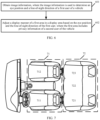
- FIG. 7 is a schematic diagram of in-vehicle area division according to an embodiment of this application.
- a front-row area 71 of the vehicle may include a driver position 711 and a front passenger position 712
- a rear-row area 72 of the vehicle may include a second row 721, a second row 722, and a second row 723.
- a vehicle-mounted terminal may determine, in one or more of the following manners, whether there is a user in each area (for example, the driver position, the front passenger position, and the rear-row area) in the vehicle. When there is a user in the driver position, the user may be referred to as a second user. When there is a user in the front passenger position or in the rear-row area, the user may be referred to as a first user. It should be understood that, how the vehicle-mounted terminal determines whether there is a user in each area in the vehicle depends on an implementation of the vehicle-mounted terminal, a pre-agreement, or a definition of a standard.
- the vehicle-mounted terminal may obtain image information of each area in the vehicle by using an image capturing device, and determine, by using the image information of each area, whether there is a user in each area. For example, if the vehicle-mounted terminal detects a face from the image information of each area captured by a DMS camera, it is determined that there is a user in the area. For another example, if the vehicle-mounted terminal obtains iris information of a human eye from the image information of each area captured by the DMS camera, it is determined that there is a user in the area.
- the vehicle-mounted terminal may detect, by using a pressure sensor under a seat, whether there is a user in each area. For example, when a pressure value detected by a pressure sensor on a seat at an area is greater than or equal to a preset value, it may be determined that there is a user at the area.
- the vehicle-mounted terminal may determine a sound source position by using audio information obtained by a microphone array, to determine, based on the sound source position, areas in which there are users. For example, if the sound source location is the front passenger position, there is a user in the front passenger position.
- determining a line-of-sight direction of the user by using the image information may have, for example, the following two implementations:
- the line-of-sight direction may be extracted by the vehicle-mounted terminal from the image information based on a gaze tracking model (eye tracking/gaze tracking model).
- the gaze tracking model may estimate, by using an image including a human eye or a face, a machine learning model, for example, a neural network model, of a gaze direction or a fixation point of the human eye.
- the line-of-sight direction may be obtained by the vehicle-mounted terminal from a cloud.
- the vehicle-mounted terminal sends the image information to the cloud, so that the cloud extracts the line-of-sight direction from the image information based on the gaze tracking model and sends the extracted line-of-sight direction to the vehicle-mounted terminal.
- the method may further include: The vehicle terminal enables a privacy information protection mode when a third condition is met.
- the vehicle-mounted terminal enables the privacy information protection mode may be understood as that the vehicle-mounted terminal performs step 601 and step 602. It can be learned that the vehicle-mounted terminal enables the privacy information protection mode when the third condition is met.
- the third condition may include at least one of the following: The vehicle terminal detects that there is a user other than the second user in the vehicle in which the second user is located; the vehicle terminal detects that there is a user other than a preset user in the vehicle; and the vehicle terminal detects a mode setting instruction, where the mode setting instruction is used to enable the privacy information protection mode. It should be understood that the third condition may be pre-agreed or defined in a standard. This is not limited herein.
- the vehicle-mounted terminal may detect, through one or more of the following methods, that there is the user other than the second user in the vehicle in which the second user is located.
- a specific manner to be used depends on an implementation of the vehicle-mounted terminal, a pre-agreement, or a definition of a standard.
- the vehicle-mounted terminal may obtain image information of another area except the driver position in the vehicle by using an image capturing device, and determine, by using the image information of the another area, that there is a user other than the second user in the vehicle. For example, if the vehicle-mounted terminal detects a face from image information of another area captured by a DMS camera, it is determined that there is a user other than the second user in the vehicle. For another example, if the vehicle-mounted terminal obtains iris information of a human eye from image information of another area captured by a DMS camera, it is determined that there is a user other than the second user in the vehicle.
- the iris information of the second user may be iris information determined by the vehicle-mounted terminal based on image information obtained by the image capturing device in real time, or may be iris information determined by the vehicle-mounted terminal based on a pre-stored face image of the second user, or may be iris information obtained by the vehicle-mounted terminal from the cloud, or may be iris information determined by the vehicle-mounted terminal based on a face image of the second user sent by the cloud.
- the cloud may be, for example, an original equipment manufacturer (original equipment manufacturer, OEM) cloud, and the OEM cloud may also be referred to as a vehicle cloud.
- the vehicle-mounted terminal may determine, by using a pressure sensor under a seat, that there is a user other than the second user in the vehicle. For example, when a pressure value detected by a pressure sensor on a seat of the front passenger position is greater than or equal to a preset value, it may be determined that there is a user other than the second user in the vehicle.
- the vehicle-mounted terminal may determine a sound source position by using audio information obtained by a microphone array, to determine, based on the sound source position, that there is a user other than the second user in the vehicle. It should be understood that the sound source position in Manner 3.3 does not include the driver position.
- the vehicle-mounted terminal may determine voiceprint information by using audio information obtained by a microphone array, to determine, based on the voiceprint information, that there is a user other than the second user in the vehicle. If the voiceprint information does not match voiceprint information of the second user, it indicates that there is a user other than the second user in the vehicle. It should be understood that the voiceprint information of the second user may be voiceprint information determined by the vehicle-mounted terminal based on audio information obtained in real time by the microphone array, or may be voiceprint information determined by the vehicle-mounted terminal based on prestored audio information, or may be voiceprint information obtained by the vehicle-mounted terminal from the cloud, or may be voiceprint information determined by the vehicle-mounted terminal based on audio information of the second user sent by the cloud.
- the vehicle-mounted terminal may detect, through one or more of the following methods, there is a user other than a preset user in the vehicle.
- a specific manner to be used depends on an implementation of the vehicle-mounted terminal, a pre-agreement, or a definition of a standard.
- the vehicle-mounted terminal may obtain image information of each area in the vehicle by using an image capturing device, and determine, by using the image information of each area, that there is a user other than a preset user in the vehicle.
- the vehicle-mounted terminal may perform facial recognition by using the image information of each area captured by the DMS camera, to determine that there is a user other than a preset user in the vehicle.
- the vehicle-mounted terminal may determine iris information of a human eye by using the image information of each area captured by the DMS camera, to determine, based on the iris information of the human eye, that there is a user other than a preset user in the vehicle.
- iris information of a user does not match iris information of a preset user, it indicates that there is a user other than a preset user in the vehicle.
- the iris information of the preset user may be iris information determined by the vehicle-mounted terminal based on a pre-stored face image of the preset user, or may be iris information obtained by the vehicle-mounted terminal from the cloud, or may be iris information determined by the vehicle-mounted terminal based on the face image of the preset user sent by the cloud.
- the vehicle-mounted terminal may determine voiceprint information by using audio information obtained by a microphone array, to determine, based on the voiceprint information, that there is a user other than a preset user in the vehicle. If the voiceprint information does not match voiceprint information of the preset user, it indicates that there is a user other than a preset user in the vehicle. It should be understood that the voiceprint information of the preset user may be voiceprint information determined by the vehicle-mounted terminal based on prestored audio information.
- the preset user may be preset, or may be obtained by the vehicle-mounted terminal from a cloud, or may be determined by the user. This is not limited herein.
- the preset user may include, for example, the second user, and may further include a family member of the second user, a friend of the second user, and the like.
- the vehicle-mounted terminal may detect a mode setting instruction through one or more of the following manners.
- a specific manner to be used depends on an implementation of the vehicle-mounted terminal, a pre-agreement, or a definition of a standard.
- Manner 5.1 The vehicle-mounted terminal identifies the mode setting instruction based on audio information obtained by a microphone array.
- Manner 5.2 The vehicle-mounted terminal detects the mode setting instruction by using a central control screen.
- the central control screen is a screen disposed at a position between the driver position and the front passenger position of the vehicle.
- the mode setting instruction may be understood as a gesture instruction.
- the gesture instruction is an action triggered on the central control screen by using an object like a finger, a stylus, or a pen.
- the vehicle-mounted terminal may recognize the gesture instruction to determine an operation represented by the gesture instruction, to respond to the operation represented by the gesture instruction.
- the gesture instruction may include, for example, tap, touch and hold, slide, rotate, double-tap, and pinch.
- the gesture instruction may be executed by using one hand, or may be executed by using both hands.
- the gesture instruction includes a touch gesture instruction and a hover gesture instruction.
- the touch gesture instruction is a gesture instruction executed by touching the central control screen
- the hover gesture instruction is an air gesture instruction executed above the central control screen.
- the gesture instruction includes a single-point touch gesture instruction and a multi-point touch gesture instruction.
- the multi-point touch gesture instruction is a gesture instruction in which a plurality of points (for example, a plurality of fingers) touch, at a same time point, for example, a plurality of fingers.
- the method may further include step 602.
- the vehicle terminal adjusts a display manner of a first area in a display area based on the eye position and the line-of-sight direction of the first user, where the first area includes privacy information of the second user of the vehicle.
- the display area is a display area of the display device.
- the display area is a display area of an HUD.
- the display area may be, for example, the near screen and/or the remote screen in FIG. 3 .
- the first area may be a part of the display area, or may be an entire area of the display area.
- step 602 may include: The vehicle terminal determines whether the eye position of the first user is within a viewing angle range of the display area; and the vehicle terminal adjusts the display manner of the first area in the display area to a first display manner when a first condition is met.
- the first condition may be pre-agreed or defined in a standard. This is not limited herein. It can be learned that, when the first condition is met, the vehicle-mounted terminal adjusts the display manner of the first area in the display area to the first display manner.
- the vehicle-mounted terminal adjusts the display manner of the first area in the display area to the first display manner, so that a possibility that the first user can view the privacy information of the second user can be reduced. This can reduce a risk of privacy information leakage, and improves a feeling of safety of the user.
- the viewing angle range of the display area includes an angle range of an eye that is of the first user and that can see a picture of the display area, and a boundary point may be determined by a maximum angle value and a minimum angle value of the eye that is of the first user and that can see the picture of the display area.
- the viewing angle range of the display area may include a range determined by the maximum angle value and the minimum angle value, and may further include the boundary point, for example, the maximum angle value and/or the minimum angle value, or may not include the boundary point. This may be determined in a specific implementation process. It should be understood that the viewing angle range of the display area is related to the eye position of the first user.
- FIG. 8 A maximum angle value of a picture of a display area that can be seen by a first user is described.
- the maximum angle value is an included angle formed by a connection line between a second target point in the display area and a target point on an eye box (eye box) and a connection line between the second target point and the eye position of the first user.
- the second target point is a center point of an intersection line between a plane on which the eye position of the first user is located and the display area
- the target point on the eye box is a center point of an intersection line between the plane on which the eye position of the first user is located and the eye box.
- the eye box may be, for example, a range in which an eye of a driver can see all displayed images.
- a size of an eye box is generally 130 mm x 50 mm. Due to different heights of drivers, the eye box needs to be able to move within a range of ⁇ 50 mm in a vertical direction.
- a human eye may see clear imaging of the HUD or the AR-HUD within a range of the eye box. It should be understood that the connection line between the second target point and the eye position of the first user further intersects with the intersection line between the plane on which the eye position of the first user is located and the eye box at a point A.
- the eye position of the first user is the middle point of two eye centers and a first target point in the display area is the center point of the display area is used.
- FIG. 9 A minimum angle value of a picture of a display area that can be seen by a first user is described.
- the minimum angle value is an included angle formed by a connection line between the eye position of the second user and the first target point and a connection line between the first target point and the ear position of the second user.
- the first target point is the center point of the display area; the first target point is a vertex of the display area; or the first target point is a center point of a side edge of the display area, and the side edge of the display area includes a left side, a right side, an upper side, or a lower side of the display area.
- the first condition may include, for example, at least one of the following: The eye position of the first user is within a viewing angle range of the display area; the line-of-sight direction of the first user is towards the display area; or time for which a line of sight of the first user stays in the display area is greater than or equal to preset time.
- the preset time may be preset, or may be obtained by the vehicle-mounted terminal from a cloud, or may be determined by the user. This is not limited herein.
- the first display manner may include, for example, at least one of the following: hiding the first area; hiding the privacy information of the second user in the first area; fading the first area; switching first definition of the first area to second definition, and displaying the privacy information of the second user in the second definition, where the first definition is higher than the second definition; or switching first resolution of the first area to second resolution, and displaying the privacy information of the second user in the second resolution, where the first resolution is higher than the second resolution.
- the vehicle-mounted terminal may switch the first definition of the first area to the second definition, and display the privacy information of the second user in the second definition.
- the vehicle-mounted terminal may switch the first resolution of the first area to the second resolution, and display the privacy information of the second user in the second resolution.
- the first resolution is higher than the second resolution, and when the resolution of the first area is the second resolution, the user cannot clearly view the privacy information, or even cannot view the privacy information, so that a possibility that the first user can view the privacy information of the second user can be reduced. This can reduce a risk of privacy information leakage, and improves a feeling of safety of the user.
- the method may further include: The vehicle-mounted terminal adjusts the display manner of the first area in the display area from the first display manner to a second display manner when a second condition is met.
- the second condition may be pre-agreed or defined in a standard. This is not limited herein. It can be learned that, when the second condition is met, the vehicle-mounted terminal adjusts the display manner of the first area in the display area from the first display manner to the second display manner. In other words, when it is detected that the first user cannot view the privacy information of the second user in the first area, the vehicle-mounted terminal adjusts the display manner of the first area in the display area from the first display manner to the second display manner, so that the second user can view the privacy information of the second user. In this way, normal use and driving safety of the second user can be ensured.
- the second condition includes, for example, at least one of the following: The eye position of the first user exceeds the viewing angle range of the display area; the line-of-sight direction of the first user is towards an area other than the display area; or time for which the line of sight of the first user stays in the display area is less than the preset time.
- the eye position of the first user exceeds the viewing angle range of the display area may be understood as that the eye position of the first user is not within the viewing angle range of the display area.
- That the line-of-sight direction of the first user is towards an area other than the display area may be understood as that the line-of-sight direction of the first user is not towards the display area.
- the line-of-sight direction of the first user is towards a sunroof of the vehicle.
- the second display manner includes, for example, at least one of the following: displaying the privacy information of the second user in the first area; switching second definition of the first area to first definition, and displaying the privacy information of the second user in the first definition, where the first definition is higher than the second definition; or switching second resolution of the first area to first resolution, and displaying the privacy information of the second user in the first resolution, where the first resolution is higher than the second resolution.
- the vehicle-mounted terminal may switch the second definition of the first area to the first definition, and display the privacy information of the second user in the first definition.
- the vehicle-mounted terminal may switch the second resolution of the first area to the first resolution, and display the privacy information of the second user in the first resolution. Because the first resolution is higher than the second resolution, and the user can view the privacy information when the resolution of the first area is the first resolution, the second user can view the privacy information. This ensures normal use and driving safety of the second user.
- the eye position of the first user and the eye position of the second user are middle points of two eye centers, and the first target point is the center point of the display area is used.
- FIG. 10 A first angle value is described. It can be learned that the first angle value is an included angle formed by a connection line between an eye position of a second user and a first target point and a connection line between the eye position of the first user and the first target point.
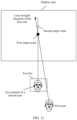
- the method may further include: The vehicle terminal determines an included angle formed by the line-of-sight direction of the first user and the connection line between the eye position of the first user and a first target point, to obtain a second angle value; and the vehicle terminal determines, based on the second angle value, whether the line-of-sight direction of the first user is towards the display area. It can be learned that the vehicle-mounted terminal may determine, based on the second angle value, whether the line-of-sight direction of the first user is towards the display area, to prepare for subsequently adjusting the display manner of the first area in the display area.
- the eye position of the first user is the middle point of two eye centers and the first target point is the center point of the display area.
- the second angle value is described. It can be learned that the second angle value is an included angle formed by the connection line between the eye position of the first user and the first target point and the line-of-sight direction of the first user.
- the vehicle-mounted terminal may obtain the image information, to determine the eye position and the line-of-sight direction of the first user based on the image information, and may adjust the display manner of the first area in the display area based on the eye position and the line-of-sight direction of the first user, to reduce a possibility that the first user can view the privacy information of the second user. This can reduce a risk of privacy information leakage, and improves a feeling of safety of the user.
- An embodiment of this application further provides an apparatus configured to implement any one of the foregoing methods.
- a display apparatus is provided, including units (or means) configured to implement steps performed by the vehicle-mounted terminal in any one of the foregoing methods.
- FIG. 12 is a schematic diagram of a structure of a display apparatus 120 according to an embodiment of this application.
- the display apparatus 120 includes a processing unit 1201, a sending unit 1202, and a receiving unit 1203, for example, the display method in any embodiment shown in FIG. 6 .
- a unit in the apparatus may be implemented in a form of a processor invoking software.
- the apparatus includes a processor, the processor is connected to a memory, the memory stores instructions, and the processor invokes the instructions stored in the memory, to implement any one of the foregoing method or functions of units in the apparatus.
- the processor is, for example, a general purpose processor, for example, a central processing unit (central processing unit, CPU) or a microprocessor, and the memory is a memory in the apparatus or a memory outside the apparatus.
- a unit in the apparatus may be implemented in a form of a hardware circuit, and functions of some or all units may be implemented by designing the hardware circuit.
- the hardware circuit may be understood as one or more processors.
- the hardware circuit is an application-specific integrated circuit (application-specific integrated circuit, ASIC), and functions of some or all units are implemented by designing a logical relationship between elements in the circuit.
- ASIC application-specific integrated circuit
- the hardware circuit may be implemented by using a programmable logic device (programmable logic device, PLD), using a field programmable gate array (field programmable gate array, FPGA) as an example, the field programmable gate array may include a large quantity of logic gate circuits, and a connection relationship between the logic gate circuits is configured by using a configuration file, to implement functions of some or all of the foregoing units.
- All the units of the foregoing apparatus may be implemented in a form of software invoked by a processor, or may be implemented in a form of a hardware circuit, or some of the units are implemented in a form of software invoked by a processor, and the remaining units are implemented in a form of a hardware circuit.
- the processor is a circuit having a signal processing capability.
- the processor may be a circuit having an instruction reading and running capability, for example, a central processor unit, a microprocessor, a graphics processing unit (graphics processing unit, GPU) (which may be understood as a microprocessor), or a digital signal processor (digital signal processor, DSP).
- the processor may implement a specific function by using a logical relationship of a hardware circuit, and the logical relationship of the hardware circuit is fixed or may be reconstructed.
- the processor is a hardware circuit implemented by an ASIC or a PLD, for example, an FPGA.
- a process in which the processor loads a configuration file to implement hardware circuit configuration may be understood as a process in which the processor loads instructions to implement functions of some or all of the foregoing units.
- the circuit may be a hardware circuit designed for artificial intelligence, and may be understood as an ASIC, for example, a neural network processing unit (neural network processing unit, NPU), a tensor processing unit (tensor processing unit, TPU), or a deep learning processing unit (deep learning processing unit, DPU).
- NPU neural network processing unit
- TPU tensor processing unit
- DPU deep learning processing unit
- the units in the foregoing apparatus may be configured as one or more processors (or processing circuits) for implementing the foregoing method, for example, a CPU, a GPU, an NPU, a TPU, a DPU, a microprocessor, a DSP, an ASIC, an FPGA, or a combination of at least two of these processor forms.
- processors or processing circuits for implementing the foregoing method, for example, a CPU, a GPU, an NPU, a TPU, a DPU, a microprocessor, a DSP, an ASIC, an FPGA, or a combination of at least two of these processor forms.
- the units in the foregoing apparatus may be integrated, or may be implemented independently.
- the units may be integrated together and implemented in a form of a system-on-a-chip (system-on-a-chip, SOC).
- SOC system-on-a-chip
- the SOC may include at least one processor, configured to implement any one of the foregoing method or implement functions of units of the apparatus.
- Types of the at least one processor may be different, for example, include a CPU and an FPGA, a CPU and an artificial intelligence processor, a CPU and a GPU, and the like.
- the apparatus 120 performs a same general procedure in a display process.
- the receiving unit 1203 and the sending unit 1202 in the apparatus 120 may alternatively be combined into a communication unit.
- each unit corresponds to respective program code (or a program instruction).
- the program code corresponding to the unit is run on a processor, the unit executes a corresponding procedure to implement a corresponding function. It should be noted that, for implementation of each unit, refer to corresponding descriptions in the embodiment shown in FIG. 6 .
- the display apparatus 120 may be the vehicle-mounted terminal in the embodiment shown in FIG. 6 , or a module in the vehicle-mounted terminal, for example, a chip or an integrated circuit.
- the apparatus includes a processing unit 1201 and a receiving unit 1203. The units are described as follows:
- the receiving unit 1203 is configured to obtain image information, the image information is used to determine an eye position and a line-of-sight direction of a first user of a vehicle.
- the processing unit 1201 is configured to adjust a display manner of a first area in a display area based on the eye position and the line-of-sight direction of the first user, where the display area is a display area of an HUD, and the first area includes privacy information of a second user of the vehicle.
- the first user is located in a non-driver position of the vehicle, and the second user is located in a driver position of the vehicle.
- the first user is located in a non-driver position of the vehicle includes: The first user is located in a front passenger position of the vehicle; or the first user is located in a rear-row area of the vehicle.
- the processing unit 1201 when adjusting the display manner of the first area in the display area based on the eye position and the line-of-sight direction of the first user, is configured to: determine whether the eye position of the first user is within a viewing angle range of the display area; and adjust the display manner of the first area in the display area to a first display manner when a first condition is met, where the first condition includes at least one of the following: The eye position of the first user is within a viewing angle range of the display area; the line-of-sight direction of the first user is towards the display area; or time for which a line of sight of the first user stays in the display area is greater than or equal to preset time.
- the first display manner includes at least one of the following: hiding the first area; hiding the privacy information of the second user in the first area; fading the first area; switching first definition of the first area to second definition, and displaying the privacy information of the second user in the second definition, where the first definition is higher than the second definition; or switching first resolution of the first area to second resolution, and displaying the privacy information of the second user in the second resolution, where the first resolution is higher than the second resolution.
- the processing unit 1201 is further configured to adjust the display manner of the first area in the display area from the first display manner to a second display manner when a second condition is met, where the second condition includes at least one of the following: The eye position of the first user exceeds the viewing angle range of the display area; the line-of-sight direction of the first user is towards an area other than the display area; or time for which the line of sight of the first user stays in the display area is less than the preset time.
- the second display manner includes at least one of the following: displaying the privacy information of the second user in the first area; switching second definition of the first area to first definition, and displaying the privacy information of the second user in the first definition, where the first definition is higher than the second definition; or switching second resolution of the first area to first resolution, and displaying the privacy information of the second user in the first resolution, where the first resolution is higher than the second resolution.
- the image information is further used to determine an eye position of the second user, and when determining whether the eye position of the first user is within the viewing angle range of the display area, the processing unit 1201 is configured to: determine an included angle formed by a connection line between the eye position of the second user and a first target point in the display area and a connection line between the eye position of the first user and the first target point, to obtain a first angle value; and determine, based on the first angle value, whether the eye position of the first user is within the viewing angle range of the display area.
- the processing unit 1201 is further configured to: determine an included angle formed by a connection line between the eye position of the first user and a first target point in the display area and the line-of-sight direction of the first user, to obtain a second angle value; and determine, based on the second angle value, whether the line-of-sight direction of the first user is towards the display area.
- the first target point is the center point of the display area; the first target point is a vertex of the display area; or the first target point is a center point of a side edge of the display area, and the side edge of the display area includes a left side, a right side, an upper side, or a lower side of the display area.
- the processing unit 1201 is further configured to enable a privacy information protection mode when a third condition is met, where the third condition includes at least one of the following: detecting that there is a user other than the second user in the vehicle in which the second user is located; detecting that there is a user other than a preset user in the vehicle; and detecting a mode setting instruction, where the mode setting instruction is used to enable the privacy information protection mode.
- FIG. 13 is a schematic diagram of a structure of a vehicle 130 according to an embodiment of this application.
- the vehicle 130 includes a vehicle-mounted terminal 1301, where
- the first user is located in a non-driver position of the vehicle, and the second user is located in a driver position of the vehicle.
- the first user is located in a non-driver position of the vehicle includes: The first user is located in a front passenger position of the vehicle; or the first user is in a rear-row area of the vehicle.
- the vehicle-mounted terminal in the vehicle is specifically configured to: determine whether the eye position of the first user is within a viewing angle range of the display area; and adjust the display manner of the first area in the display area to a first display manner when a first condition is met, where the first condition includes at least one of the following: The eye position of the first user is within a viewing angle range of the display area; the line-of-sight direction of the first user is towards the display area; or time for which a line of sight of the first user stays in the display area is greater than or equal to preset time.
- the first display manner includes at least one of the following: hiding the first area; hiding the privacy information of the second user in the first area; fading the first area; switching first definition of the first area to second definition, and displaying the privacy information of the second user in the second definition, where the first definition is higher than the second definition; or switching first resolution of the first area to second resolution, and displaying the privacy information of the second user in the second resolution, where the first resolution is higher than the second resolution.
- the vehicle-mounted terminal in the vehicle is further configured to: adjust the display manner of the first area in the display area from the first display manner to a second display manner when a second condition is met, where the second condition includes at least one of the following: The eye position of the first user exceeds the viewing angle range of the display area; the line-of-sight direction of the first user is towards an area other than the display area; or time for which the line of sight of the first user stays in the display area is less than the preset time.
- the second display manner includes at least one of the following: displaying the privacy information of the second user in the first area; switching second definition of the first area to first definition, and displaying the privacy information of the second user in the first definition, where the first definition is higher than the second definition; or switching second resolution of the first area to first resolution, and displaying the privacy information of the second user in the first resolution, where the first resolution is higher than the second resolution.
- the image information is further used to determine an eye position of the second user, and when determining whether the eye position of the first user is within the viewing angle range of the display area, the vehicle-mounted terminal in the vehicle is specifically configured to: determine an included angle formed by a connection line between the eye position of the second user and a first target point in the display area and a connection line between the eye position of the first user and the first target point, to obtain a first angle value; and determine, based on the first angle value, whether the eye position of the first user is within the viewing angle range of the display area.
- the vehicle-mounted terminal in the vehicle is further configured to: determine an included angle formed by a connection line between the eye position of the first user and a first target point in the display area and the line-of-sight direction of the first user, to obtain a second angle value; and determine, based on the second angle value, whether the line-of-sight direction of the first user is towards the display area.
- the first target point is the center point of the display area; the first target point is a vertex of the display area; or the first target point is a center point of a side edge of the display area, and the side edge of the display area includes a left side, a right side, an upper side, or a lower side of the display area.
- the vehicle-mounted terminal in the vehicle is further configured to enable a privacy information protection mode when a third condition is met, where the third condition includes at least one of the following: detecting that there is a user other than the second user in the vehicle in which the second user is located; detecting that there is a user other than a preset user in the vehicle; and detecting a mode setting instruction, where the mode setting instruction is used to enable the privacy information protection mode.
- FIG. 14 is a schematic diagram of a structure of an electronic apparatus 140 according to an embodiment of this application.
- the apparatus 140 may include at least one memory 1401 and at least one processor 1402.
- a bus 1403 may be further included.
- a communication interface 1404 may be further included.
- the memory 1401, the processor 1402, and the communication interface 1404 are connected by using the bus 1403.
- the memory 1401 is configured to provide storage space, and the storage space may store data such as an operating system and a computer program.
- the memory 1401 may be one or a combination of a random access memory (random access memory, RAM), a read-only memory (read-only memory, ROM), an erasable programmable read-only memory (erasable programmable read only memory, EPROM), a compact disc read-only memory (compact disc read-only memory, CD-ROM), and the like.
- the processor 1402 is a module that performs an arithmetic operation and/or a logical operation, and may be specifically one or a combination of a plurality of processing modules such as a CPU, a GPU, a microprocessor unit (microprocessor unit, MPU), an ASIC, an FPGA, and a complex programmable logic device (Complex programmable logic device, CPLD).
- the communication interface 1404 is configured to receive data sent by an external device and/or send data to an external device, and may be a wired link interface like an Ethernet cable, or may be a wireless link (for example, Wi-Fi, Bluetooth, or general wireless transmission) interface.
- the communication interface 1404 may further include a transmitter (such as a radio frequency transmitter or an antenna) coupled to the interface, a receiver, or the like.
- the processor 1402 in the apparatus 140 is configured to read the computer program stored in the memory 1401, and is configured to perform the foregoing display method, for example, the display method described in any embodiment in FIG. 6 .
- the electronic apparatus 140 may be the vehicle-mounted terminal in the embodiment shown in FIG. 6 , or a module in the vehicle-mounted terminal, for example, a chip or an integrated circuit.
- the processor 1402 in the apparatus 140 is configured to read the computer program stored in the memory 1401, to perform the following operations:
- the first user is located in a non-driver position of the vehicle, and the second user is located in a driver position of the vehicle.
- the first user is located in a non-driver position of the vehicle includes: The first user is located in a front passenger position of the vehicle; or the first user is in a rear-row area of the vehicle.
- the processor 1402 when adjusting the display manner of the first area in the display area based on the eye position and the line-of-sight direction of the first user, is specifically configured to perform the following operations: determining whether the eye position of the first user is within a viewing angle range of the display area; and adjusting the display manner of the first area in the display area to a first display manner when a first condition is met, where the first condition includes at least one of the following: The eye position of the first user is within a viewing angle range of the display area; the line-of-sight direction of the first user is towards the display area; or time for which a line of sight of the first user stays in the display area is greater than or equal to preset time.
- the first display manner includes at least one of the following: hiding the first area; hiding the privacy information of the second user in the first area; fading the first area; switching first definition of the first area to second definition, and displaying the privacy information of the second user in the second definition, where the first definition is higher than the second definition; or switching first resolution of the first area to second resolution, and displaying the privacy information of the second user in the second resolution, where the first resolution is higher than the second resolution.
- the processor 1402 is further configured to perform the following operations: adjusting the display manner of the first area in the display area to a second display manner when a second condition is met, where the second condition includes at least one of the following: The eye position of the first user exceeds the viewing angle range of the display area; the line-of-sight direction of the first user is towards an area other than the display area; or time for which the line of sight of the first user stays in the display area is less than the preset time.
- the second display manner includes at least one of the following: displaying the privacy information of the second user in the first area; switching second definition of the first area to first definition, and displaying the privacy information of the second user in the first definition, where the first definition is higher than the second definition; or switching second resolution of the first area to first resolution, and displaying the privacy information of the second user in the first resolution, where the first resolution is higher than the second resolution.
- the image information is further used to determine an eye position of the second user, and when determining whether the eye position of the first user is within the viewing angle range of the display area, the processor 1402 is specifically configured to perform the following operations: determining an included angle formed by a connection line between the eye position of the second user and a first target point in the display area and a connection line between the eye position of the first user and the first target point, to obtain a first angle value; and determining, based on the first angle value, whether the eye position of the first user is within the viewing angle range of the display area.
- the processor 1402 is further configured to perform the following operations: determining an included angle formed by a connection line between the eye position of the first user and a first target point in the display area and the line-of-sight direction of the first user, to obtain a second angle value; and determining, based on the second angle value, whether the line-of-sight direction of the first user is towards the display area.
- the first target point is the center point of the display area; the first target point is a vertex of the display area; or the first target point is a center point of a side edge of the display area, and the side edge of the display area includes a left side, a right side, an upper side, or a lower side of the display area.
- the processor 1402 is further configured to perform the following operations: enabling a privacy information protection mode when a third condition is met, where the third condition includes at least one of the following: detecting that there is a user other than the second user in the vehicle in which the second user is located; detecting that there is a user other than a preset user in the vehicle; and detecting a mode setting instruction, where the mode setting instruction is used to enable the privacy information protection mode.
- An embodiment of this application provides an electronic apparatus.
- the apparatus is deployed in a vehicle, and the apparatus includes units configured to perform any method in the embodiment shown in FIG. 6 .
- An embodiment of this application provides an electronic apparatus.
- the apparatus includes at least one processor and a communication interface.
- the at least one processor is configured to invoke a computer program stored in the at least one memory, to perform any method in the embodiment shown in FIG. 6 .
- An embodiment of this application provides a display system, including a vehicle-mounted terminal, where the vehicle-mounted terminal is configured to implement the method in any one of the embodiment shown in FIG. 6 .
- An embodiment of this application provides a vehicle-mounted terminal.
- the vehicle-mounted terminal is configured to implement the method in any one of the embodiment shown in FIG. 6 .
- An embodiment of this application provides a computer-readable storage medium.
- the computer-readable storage medium stores a computer program.
- the computer program is run on one or more processors, the method according to any one of the embodiment shown in FIG. 6 is implemented.
- An embodiment of this application provides a computer program product.
- the computer program product runs on one or more processors, the method in any one of the embodiment shown in FIG. 6 is implemented.
- the computer may be a general-purpose computer, a dedicated computer, a computer network, or another programmable apparatus.
- the computer instructions may be stored in a computer-readable storage medium, or may be transmitted by using a computer-readable storage medium.
- the computer-readable storage medium may be any usable medium accessible by a computer, or a data storage device, such as a server or a data center, integrating one or more usable media.
- the usable medium may be a magnetic medium (for example, a floppy disk, a hard disk, or a magnetic tape), an optical medium (for example, a DVD), a semiconductor medium (for example, a solid state drive (solid state disk, SSD)), or the like.
- a magnetic medium for example, a floppy disk, a hard disk, or a magnetic tape
- an optical medium for example, a DVD
- a semiconductor medium for example, a solid state drive (solid state disk, SSD)
- Sequence adjustment, combination, or deletion may be performed on the steps in the method embodiments of this application based on an actual requirement.
- Modules in the apparatus embodiments of this application may be combined, divided, or deleted based on an actual requirement.
- system and “network” may be used interchangeably in embodiments of this application.
- “/” represents an “or” relationship between associated objects unless otherwise specified.
- A/B may represent A or B.
- the term “and/or” in this application is merely an association relationship for describing associated objects, and represents that three relationships may exist.
- a and/or B may represent the following three cases: Only A exists, both A and B exist, and only B exists, where A and B each may be singular or plural.
- a plurality of means two or more than two.
- “At least one of the following items” or a similar expression means any combination of these items, including any combination of a single item or a plurality of items.
- At least one item (piece) of a, b, or c may indicate: a, b, c, a and b, a and c, b and c, or a, b, and c, where a, b, and c may be singular or plural.
- terms such as first and second are used in embodiments of this application to distinguish between same items or similar items that provide basically same functions or purposes. A person skilled in the art may understand that the terms such as “first” and “second” do not limit a quantity or an execution sequence, and the terms such as “first” and “second” do not indicate a definite difference.
Landscapes
- Engineering & Computer Science (AREA)
- Chemical & Material Sciences (AREA)
- Combustion & Propulsion (AREA)
- Transportation (AREA)
- Mechanical Engineering (AREA)
- Theoretical Computer Science (AREA)
- General Physics & Mathematics (AREA)
- Physics & Mathematics (AREA)
- Computer Hardware Design (AREA)
- General Engineering & Computer Science (AREA)
- Computer Security & Cryptography (AREA)
- Software Systems (AREA)
- General Health & Medical Sciences (AREA)
- Bioethics (AREA)
- Health & Medical Sciences (AREA)
- Human Computer Interaction (AREA)
- Databases & Information Systems (AREA)
- Medical Informatics (AREA)
- Controls And Circuits For Display Device (AREA)
- Instrument Panels (AREA)
Applications Claiming Priority (1)
| Application Number | Priority Date | Filing Date | Title |
|---|---|---|---|
| PCT/CN2022/112309 WO2024031709A1 (zh) | 2022-08-12 | 2022-08-12 | 一种显示方法及装置 |
Publications (2)
| Publication Number | Publication Date |
|---|---|
| EP4560455A1 true EP4560455A1 (de) | 2025-05-28 |
| EP4560455A4 EP4560455A4 (de) | 2026-01-07 |
Family
ID=89850395
Family Applications (1)
| Application Number | Title | Priority Date | Filing Date |
|---|---|---|---|
| EP22954660.1A Pending EP4560455A4 (de) | 2022-08-12 | 2022-08-12 | Anzeigeverfahren und -vorrichtung |
Country Status (5)
| Country | Link |
|---|---|
| US (1) | US20250182657A1 (de) |
| EP (1) | EP4560455A4 (de) |
| JP (1) | JP2025530651A (de) |
| CN (1) | CN117882075A (de) |
| WO (1) | WO2024031709A1 (de) |
Families Citing this family (3)
| Publication number | Priority date | Publication date | Assignee | Title |
|---|---|---|---|---|
| US20240118691A1 (en) * | 2022-10-06 | 2024-04-11 | GM Global Technology Operations LLC | Augmented reality experience for passenger control of autonomous vehicle |
| WO2026055569A1 (en) * | 2024-09-06 | 2026-03-12 | The Regents Of The University Of Michigan | Secure display of content for confidential viewing |
| CN119225000B (zh) * | 2024-11-14 | 2025-09-26 | 重庆赛力斯凤凰智创科技有限公司 | 一种显示屏的显示模式的调节方法和系统 |
Family Cites Families (17)
| Publication number | Priority date | Publication date | Assignee | Title |
|---|---|---|---|---|
| US8957847B1 (en) * | 2010-12-28 | 2015-02-17 | Amazon Technologies, Inc. | Low distraction interfaces |
| JP2016045623A (ja) * | 2014-08-21 | 2016-04-04 | ソニー株式会社 | 情報処理装置および制御方法 |
| US9787812B2 (en) * | 2014-08-28 | 2017-10-10 | Honda Motor Co., Ltd. | Privacy management |
| CN105389527B (zh) * | 2015-10-27 | 2019-10-08 | 努比亚技术有限公司 | 移动终端的防偷窥装置和方法 |
| US10366219B2 (en) * | 2016-11-16 | 2019-07-30 | Bank Of America Corporation | Preventing unauthorized access to secured information using identification techniques |
| JP2018101311A (ja) * | 2016-12-21 | 2018-06-28 | 矢崎総業株式会社 | 車両用表示装置 |
| US10386787B2 (en) * | 2017-01-16 | 2019-08-20 | International Business Machines Corporation | Holographic projections for securing content |
| US10311249B2 (en) * | 2017-03-31 | 2019-06-04 | Google Llc | Selectively obscuring private information based on contextual information |
| JP7043845B2 (ja) * | 2018-01-17 | 2022-03-30 | トヨタ自動車株式会社 | 車両用表示連携制御装置 |
| DE102018004401B4 (de) * | 2018-05-31 | 2024-09-26 | Sioptica Gmbh | Verfahren zur Korrektur von Bilddaten für einen Bildschirm |
| DE102018128706A1 (de) * | 2018-11-15 | 2020-05-20 | Bayerische Motoren Werke Aktiengesellschaft | Dynamischer Informationsschutz für Anzeigeeinrichtungen |
| KR102764266B1 (ko) * | 2019-06-17 | 2025-02-07 | 현대자동차주식회사 | 차량용 사용자 인터페이스 시스템 및 방법 |
| CN111737774B (zh) * | 2020-06-23 | 2022-09-20 | 广东小天才科技有限公司 | 一种隐私防窥方法和智能设备 |
| CN114056344A (zh) * | 2020-08-03 | 2022-02-18 | 奥迪股份公司 | 车内信息显示系统及相应车辆、方法、计算机设备和介质 |
| JP7532143B2 (ja) * | 2020-08-06 | 2024-08-13 | アルプスアルパイン株式会社 | 表示制御装置および表示制御方法 |
| DE102021120998A1 (de) * | 2021-08-12 | 2023-02-16 | Bayerische Motoren Werke Aktiengesellschaft | Steuerung einer Anzeige auf einem Display eines Infotainmentsystems eines Fahrzeugs |
| CN114647319A (zh) * | 2022-03-28 | 2022-06-21 | 重庆长安汽车股份有限公司 | 一种用户车内屏幕显示信息流转的方法、系统及存储介质 |
-
2022
- 2022-08-12 EP EP22954660.1A patent/EP4560455A4/de active Pending
- 2022-08-12 WO PCT/CN2022/112309 patent/WO2024031709A1/zh not_active Ceased
- 2022-08-12 JP JP2025507651A patent/JP2025530651A/ja active Pending
- 2022-08-12 CN CN202280009096.0A patent/CN117882075A/zh active Pending
-
2025
- 2025-02-11 US US19/050,232 patent/US20250182657A1/en active Pending
Also Published As
| Publication number | Publication date |
|---|---|
| WO2024031709A1 (zh) | 2024-02-15 |
| EP4560455A4 (de) | 2026-01-07 |
| US20250182657A1 (en) | 2025-06-05 |
| JP2025530651A (ja) | 2025-09-17 |
| CN117882075A (zh) | 2024-04-12 |
Similar Documents
| Publication | Publication Date | Title |
|---|---|---|
| US20250225690A1 (en) | Ar display apparatus and ar display method | |
| US20250182657A1 (en) | Display Method and Apparatus | |
| US10812735B2 (en) | Image processing device and image processing method | |
| US12198399B2 (en) | Display system and display method | |
| CN108027511B (zh) | 信息显示装置、信息提供系统、运动对象设备、信息显示方法和记录介质 | |
| CN113661495A (zh) | 视线校准方法及装置、设备、计算机可读存储介质、系统、车辆 | |
| JP6562239B2 (ja) | 表示制御装置、表示制御方法、表示制御プログラムおよび投影装置 | |
| US20140098008A1 (en) | Method and apparatus for vehicle enabled visual augmentation | |
| JP7561910B2 (ja) | Ar表示装置、ar表示方法、およびプログラム | |
| JP6620977B2 (ja) | 表示制御装置、投影装置、および表示制御プログラム | |
| US20180284432A1 (en) | Driving assistance device and method | |
| WO2019224922A1 (ja) | ヘッドアップディスプレイ制御装置、ヘッドアップディスプレイシステム、及びヘッドアップディスプレイ制御方法 | |
| KR101944607B1 (ko) | 차량의 위치 파악을 위한 안내표지판 내의 거리 정보를 습득하는 시스템 및 방법 | |
| CN115035499A (zh) | 用于确定注视区域的方法、车辆控制方法及装置 | |
| WO2021227784A1 (zh) | 抬头显示装置和抬头显示方法 | |
| WO2019031291A1 (ja) | 車両用表示装置 | |
| CN118810431A (zh) | 显示控制装置、显示系统及显示控制方法 | |
| CN116736540A (zh) | 一种基于视线追踪的车辆信息显示方法及系统 | |
| CN115534822A (zh) | 控制显示的方法、装置和移动载体 | |
| JP2019077340A (ja) | ヘッドアップディスプレイ装置 | |
| JP2022142553A (ja) | 画像表示制御装置、画像表示制御方法、及びプログラム | |
| JP2022066080A (ja) | 表示制御装置、ヘッドアップディスプレイ装置、及び画像の表示制御方法 | |
| JP2018185638A (ja) | 表示装置、透過型ヘッドマウントディスプレイ、制御装置および表示システム | |
| WO2026083571A1 (ja) | 画像作成装置、画像作成方法及び記録媒体 | |
| CN117315606A (zh) | 信息显示方法、装置、电子设备及存储介质 |
Legal Events
| Date | Code | Title | Description |
|---|---|---|---|
| STAA | Information on the status of an ep patent application or granted ep patent |
Free format text: STATUS: THE INTERNATIONAL PUBLICATION HAS BEEN MADE |
|
| PUAI | Public reference made under article 153(3) epc to a published international application that has entered the european phase |
Free format text: ORIGINAL CODE: 0009012 |
|
| STAA | Information on the status of an ep patent application or granted ep patent |
Free format text: STATUS: REQUEST FOR EXAMINATION WAS MADE |
|
| 17P | Request for examination filed |
Effective date: 20250219 |
|
| AK | Designated contracting states |
Kind code of ref document: A1 Designated state(s): AL AT BE BG CH CY CZ DE DK EE ES FI FR GB GR HR HU IE IS IT LI LT LU LV MC MK MT NL NO PL PT RO RS SE SI SK SM TR |
|
| DAV | Request for validation of the european patent (deleted) | ||
| DAX | Request for extension of the european patent (deleted) | ||
| A4 | Supplementary search report drawn up and despatched |
Effective date: 20251205 |
|
| RIC1 | Information provided on ipc code assigned before grant |
Ipc: G06F 3/14 20060101AFI20251201BHEP Ipc: G06F 21/84 20130101ALI20251201BHEP Ipc: B60W 50/14 20200101ALI20251201BHEP Ipc: B60K 35/235 20240101ALI20251201BHEP Ipc: B60K 35/28 20240101ALI20251201BHEP Ipc: B60K 35/29 20240101ALI20251201BHEP Ipc: B60K 35/65 20240101ALI20251201BHEP Ipc: B60K 35/81 20240101ALI20251201BHEP Ipc: G06F 21/62 20130101ALI20251201BHEP Ipc: G09G 3/00 20060101ALI20251201BHEP |