EP4560497A1 - Communication d'une id de clic au moyen d'une url - Google Patents
Communication d'une id de clic au moyen d'une url Download PDFInfo
- Publication number
- EP4560497A1 EP4560497A1 EP23211665.7A EP23211665A EP4560497A1 EP 4560497 A1 EP4560497 A1 EP 4560497A1 EP 23211665 A EP23211665 A EP 23211665A EP 4560497 A1 EP4560497 A1 EP 4560497A1
- Authority
- EP
- European Patent Office
- Prior art keywords
- server
- url
- click
- client
- target server
- Prior art date
- Legal status (The legal status is an assumption and is not a legal conclusion. Google has not performed a legal analysis and makes no representation as to the accuracy of the status listed.)
- Pending
Links
Images


Classifications
-
- G—PHYSICS
- G06—COMPUTING OR CALCULATING; COUNTING
- G06F—ELECTRIC DIGITAL DATA PROCESSING
- G06F16/00—Information retrieval; Database structures therefor; File system structures therefor
- G06F16/90—Details of database functions independent of the retrieved data types
- G06F16/95—Retrieval from the web
- G06F16/955—Retrieval from the web using information identifiers, e.g. uniform resource locators [URL]
Definitions
- the present invention relates to a method for transmitting a click ID via a URL depending on the selection of the URL provided by a first server by a client assigned to a user, wherein the URL refers to a target server. Selecting the URL provided by the first server enables the retrieval of information provided by the target server.
- the invention also relates to a client-server system which can be connected to a communication network and comprises at least a first server, a target server and a client assigned to a user.
- a client-server system comprises clients and servers, which can be implemented in software or hardware and exchange information via one or more communication networks.
- a server for example, is designed to provide certain information or resources, so-called services. These services are typically used by one or more clients by sending requests to the server via the communication network.
- the server evaluates the incoming request, checks the client's authorization to submit the request, if necessary, and transmits the corresponding information or provides the requested Resources are available.
- the server can be configured in such a way that it, in turn, sends requests to other servers, for example to obtain information, which it then processes if necessary and makes available to the requesting clients. In this function, the server itself acts as a client.
- a client can make information available to other clients and thus acts as a server.
- a server can be configured, for example, as a search engine or an online shop.
- a client can be implemented as software that can be executed on a laptop, tablet, or smartphone, for example, an internet browser.
- a click ID can be a string associated with the client and/or a user of the client.
- any information displayed on a website can be assigned a selectable URL (so-called "Uniform Resource Locator"), and when this URL is selected, a so-called click ID can be transmitted in the form of a character string.
- a click ID can be a character string assigned to the client and/or a user of the client, thus enabling a more or less unambiguous assignment to a specific user or group of users.
- Internet search engines or social media platforms often generate click IDs when a user uses a client to select information provided by the respective server, for example, by clicking on it.
- a user submits a search query to an Internet search engine operated by a first server.
- the search engine then generates a dynamic web page on which the search results are displayed together with further information.
- the further information can, for example, be associated with advertised products, with the selection of the advertising information being dependent on the search query and/or a profile assigned to the user.
- the user can often be identified by the search engine using suitable cookies - small character strings that are stored by the client and transmitted to the search engine when a search query is sent - so that the search engine can access profile information that it has collected from previous queries by the user.
- the Users already have an account with the search engine in order to be able to use additional, personalized services offered by the search engine, so that the search engine has particularly detailed information about the user at its disposal.
- the web page dynamically generated by the search engine is transmitted to the user's client in response to the information request. If the user then clicks on a link on the web page sent by the search engine, this causes an information request to be sent to a target server, such as an online store, which is associated with the link using the associated URL.
- This URL includes the click ID previously generated by the search engine, received via a cookie, or read from a database, in the form of an appended parameter.
- the link selected by the user was displayed on the search engine's website or another information server as a result of an advertising campaign, it is often important for the web shop to know which user or group of users to whom the user selecting the link is assigned ultimately purchased the advertised product, requested further information about the product, purchased another product offered by the web shop, opened a user account, signed up for a newsletter, and/or performed another action related to the purpose of the Webshops has carried out (so-called conversion) in order to optimise the presentation of advertising information in a known manner, for example by choosing a different presentation or by presenting this advertising to other users or other user groups or via other platforms in the future.
- a disadvantage of this known method is that the click ID can be easily removed from the URL, making it difficult to optimize the presentation of information and, in particular, to optimize advertising campaigns. Since the click ID is appended to the URL as a parameter in this known method, it can be accidentally or intentionally removed by intermediate servers or an Internet browser, for example, by simply truncating it. This still allows forwarding an information request to a target server, but makes it more difficult to evaluate the conversion or worsens the results.
- the click ID is extracted from the URL on the target server and stored for further optimization and evaluation.
- internal user profiles can be created or updated using the click ID.
- the target server is a web shop and the first server is an internet search engine
- one possible internal processing option is that the user who has been redirected to the web shop by selecting the URL from the search engine and has subsequently purchased a product or service is preferentially shown another URL of the web shop for another product as part of the search results or as additional advertising when making a further search query on the internet search engine.
- the extracted click ID is transmitted to the first server for further processing.
- This allows advertising campaigns or paid optimizations to be evaluated particularly well and reliably when displaying information from the target server in the first server's results list, thus optimizing them for future requests.
- the click ID integrated in the directory path is not taken into account when finding the requested information. This takes into account the fact that a directory corresponding to the click ID is regularly created on the target server. does not exist.
- the click ID is removed from the directory path before further processing, so that from then on, the requested information can be found using the usual procedures and processes installed on the target server.
- a second server is connected upstream of a target server, so that clicking on a link displayed on the first server initially results in a redirection to the second server, which then initiates a redirection to the target server.
- the second server can, for example, be configured as a special tracking server that, on behalf of the target server, collects and evaluates data on information requests from the target server and, based on this data, can suggest optimizations, such as optimizing advertising campaigns or optimizing search engine rankings.
- the click ID integrated in the form of a subdirectory is extracted by the second server, saved, and used by the second server, for example, for possible optimizations.
- the second server can remove the click ID integrated into the URL in the form of a subdirectory from the URL and use this modified URL to initiate a redirection to the target server.
- the second server makes the extracted click ID available directly to the target server, for example by the second server storing this click ID in a database to which the target server also has access, in such a way that an assignment to the information request is possible and, in particular in the case of a conversion, it remains ascertainable that the selection of a URL displayed on the first server by the user led to the conversion.
- the object underlying the invention is also achieved by a client-server system of the type mentioned at the outset in that the client-server system is set up to carry out the method according to the invention.
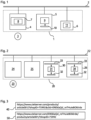
- a client-server system 1 is shown, the components of which are connected, for example, by means of a network cable, e.g., an Ethernet cable, or wirelessly, e.g., by means of a WiFi connection, to a communication network, which is preferably designed as the Internet 2.
- the client-server system 1 comprises a terminal 4 assigned to a user 3, for example, a smartphone, a tablet computer, or a laptop, a first server 5, and a target server 6.
- the terminal 4 has a display 7 on which a website 8 can be displayed.
- the first server 5 is designed, for example, as a search engine and comprises a functional unit 9 that is programmed to generate a click ID 10.
- the target server 6 is implemented, for example, as a web shop and comprises a functional unit 11 that is programmed to interpret and process information requests. Such information requests can In particular, inquiries about products or services offered by the webshop.
- FIG 2 shows a further embodiment of a client-server system 20 suitable for implementing the method according to the invention.
- the client-server system 20 like the client-server system 1, comprises a terminal 24 assigned to a user 23, a first server configured as an Internet search engine 25, and a target server 26.
- the terminal 24, the search engine 25, and the target server 26 are connected to the Internet 22 and can be accessed analogously to the method described in Figure 1 terminal 4 shown, the first server 5 and the target server 6, even if in Figure 1 components shown in Figure 2 are not explicitly shown for reasons of clarity.
- the client-server system 20 comprises a second server 30, which is designed, for example, as a tracking server and comprises a functional unit 31 by means of which a click ID 32 can be extracted from a URL 33.
- the target server 26 has a functional unit 34 by means of which the click ID 32 can also be read from the URL 33.
- the transmission of the click ID 32 to the target server 26 can also be initiated by the second server 30 in another way.
- the click ID 32 is removed from the URL 33 by the second server 30 and that the information request of the user 23 is forwarded using a modified URL that does not contain a click ID 30.
- the second server 30 takes over the further processing of the click ID 32 and initiates communication with the search engine 25 in order to be able to evaluate, for example, the effectiveness and efficiency (i.e., the so-called traffic) of an advertising campaign launched by the target server 26.
- Figure 3 shows the structure of a first URL 40, which includes a click ID appended as a parameter in a known manner.
- the URL assigned to that link is used.
- a target server 6, 26 can be reached at the address " www.zielserver.com” .
- the client 4, 24 requests information from the target server 6, 26 that is assigned to a specific product, which is referred to internally on the target server 6, 26 as "article001" .
- Selecting the link displayed on the web page 8 causes the URL 40 to be transmitted to the target server 6, 26.
- the target server 6, 26 will then interpret the information stored there based on the directory path " / products / article001" contained in the URL 40 and respond to the request accordingly.
- a web page may be stored in the directory path or a web page may be dynamically generated and sent to the client 4, 24 in response to the request.
- the target server 6, 26 also receives the parameters attached there and thus receives the click ID 10, 32, which can then be used in the target server 6, 26 to assign the request to the user 3. If the request by the user 3 leads to a conversion on the target server 6, 26, the click ID 10, 32 is regularly transmitted to the first server 5 or the search engine 25, for example, in order to evaluate the success of an advertising campaign booked on the first server 5 or the search engine 25 and, if necessary, to optimize it. However, it cannot currently be guaranteed that the parameters attached to a URL 33, 40 will be reliably transmitted.
- the target server 6, 26 is no longer able to design, for example, information campaigns or advertising campaigns for individual products effectively and efficiently.
- Information that is part of a directory path is currently not regularly modified by Internet browsers or network routers, since directory paths are fundamentally important for a target server 6, 26 to locate or generate the information it requests and return it to the requesting client 4, 24. Hiding the click ID 10, 32 within the directory path in a URL 50 thus enables a secure transmission of this information to the target server 6, 26.
- FIG 4 A flowchart is shown showing individual steps of a possible embodiment of the method according to the invention.
- the method begins in step 100.
- a user 3, 23 submits an information request to a first server 5, for example in the form of a search query to an Internet search engine 25, and transmits the request to the search engine 25 via a communications network 2, for example the Internet 22.
- the search engine 25 assigns a click ID 10, 32 to the user 3, 23 who has made the search query in a known manner. This can be done by the content of a click on the client 4, 24 during a previous Interaction with the search engine 25 is read, so that the current query can be assigned to this client 4, 24 or the user 3, 23.
- Another possibility is to use a profile database to which the search engine 25 has access to determine whether the user is already known to the search engine due to previous search queries. For this purpose, information that is automatically sent to the search engine 25 along with the search query from an Internet browser running on the client 4, 24 can be used in a known manner, such as a browser ID, a MAC address and/or an IP address.
- the first server 5 or the Internet search engine 25 generates a dynamic web page 8 containing various Internet links.
- the visual representation of the Internet links on the web page 8 can be achieved in a known manner using descriptive texts, graphic elements and/or videos.
- URLs 33, 40, 50 are assigned to the Internet links, which contain addresses to further information. At least one of the URLs 33, 50 refers to information provided by a target server 6, 26 according to the invention. This URL 50 will contain the found or generated click ID 10, 32 as part of the directory path, as exemplified in Figure 3 shown and explained in the corresponding description.
- a step 104 the web page 8 is transmitted to the client 4, 24 via the Internet 22 and displayed there to the user 3, 23 on the display 7.
- a step 105 the user 3, 23 selects the link that refers to information on the target server 6, 26.
- an information request is then sent to the target server 6, 26 in a step 106, wherein in particular the information containing the click ID 10, 32 as a virtual directory is transmitted to the target server 6, 26.
- the target server 6, 26 extracts the click ID 10, 32 from the directory path that it received as URL 33, 50 when transmitting the information request in step 106 and processes the information request in a step 108, for example by sending a static or dynamically generated web page to the client 4, 24.
- the extraction of the click ID 10, 32 in the target server 6, 26 can be done, for example, by a so-called proxy rewrite, i.e., an addition or reprogramming of the rules in the server configuration, in the target server 6, 26. This can, for example, cause the target server 6, 26 to retrieve information about traffic or the content of a website 8 from another location.
- the target server 6, 26 further processes the click ID 10, 32 in a known manner, for example by updating internal statistics, optimizing an advertising campaign and/or, in particular in the case of a conversion, sending the click ID 10, 32 to the search engine 25 in order to generate or receive further information about the effectiveness and efficiency of an advertising campaign.
- FIG. 5 Another possible embodiment of the method according to the invention is shown.
- This method begins in a step 200.
- a step 201 analogous to the Figure 4
- a user 3, 23 sends an information request to a first server 5 or an Internet search engine 25.
- the search engine 25 assigns the user 3, 23 a click ID 10, 32, in a step 203 generates a dynamic web page 8 containing various Internet links, and in a step 204 transmits the web page 8 to the client 4, 24 via the Internet 22.
- the user 3, 23 selects the link that refers to information on the target server 6, 26.
- the URL 32, 50 is structured such that, in a step 206, selecting the link corresponding to this URL 32, 50 and displayed on the web page 8 causes the information request to be forwarded to a second server 30.
- the second server 30 is designed, for example, as a so-called tracking server, the functionality of which is specialized, among other things, in collecting and analyzing information about activities on websites so that, on this basis, websites can be optimally designed, product portfolios improved, and advertising campaigns optimized.
- the second server 20 extracts, according to the method described in Figure 5 In the embodiment shown, in a step 207, the click ID 10, 32, which according to the invention is stored as part of the directory path of the target server 6, 26 in the URL 32, 50.
- the information request is forwarded from the second server 30 to the target server 6, 26.
- the target server 6, 26 processes the information request forwarded by the second server 30, for example by sending a static or dynamically generated web page back to the client 4, 24.
- the click ID 10, 32 is further processed on the second server 30, for example by the second server 30 collecting and/or evaluating information related to the selection of the link by the user 3, 23 in step 205 in a known manner and, if necessary, also establishing a connection to the search engine 25 in order to retrieve further information regarding the click that has taken place or information provided by the search engine 25 for further analyses.
- the second server 30 and/or the target server 6, 26 further process the click ID 10, 32 in a known manner, for example by updating internal statistics, optimizing an advertising campaign and/or, in particular in the case of a conversion, sending the click ID 10, 32 to the search engine 25 in order to generate or obtain further information about the effectiveness and efficiency of an advertising campaign.
Landscapes
- Engineering & Computer Science (AREA)
- Databases & Information Systems (AREA)
- Theoretical Computer Science (AREA)
- Data Mining & Analysis (AREA)
- Physics & Mathematics (AREA)
- General Engineering & Computer Science (AREA)
- General Physics & Mathematics (AREA)
- Information Transfer Between Computers (AREA)
Priority Applications (2)
| Application Number | Priority Date | Filing Date | Title |
|---|---|---|---|
| EP23211665.7A EP4560497A1 (fr) | 2023-11-23 | 2023-11-23 | Communication d'une id de clic au moyen d'une url |
| PCT/EP2024/081023 WO2025108679A1 (fr) | 2023-11-23 | 2024-11-04 | Transmission d'un id de clic au moyen d'une adresse url |
Applications Claiming Priority (1)
| Application Number | Priority Date | Filing Date | Title |
|---|---|---|---|
| EP23211665.7A EP4560497A1 (fr) | 2023-11-23 | 2023-11-23 | Communication d'une id de clic au moyen d'une url |
Publications (1)
| Publication Number | Publication Date |
|---|---|
| EP4560497A1 true EP4560497A1 (fr) | 2025-05-28 |
Family
ID=88964976
Family Applications (1)
| Application Number | Title | Priority Date | Filing Date |
|---|---|---|---|
| EP23211665.7A Pending EP4560497A1 (fr) | 2023-11-23 | 2023-11-23 | Communication d'une id de clic au moyen d'une url |
Country Status (2)
| Country | Link |
|---|---|
| EP (1) | EP4560497A1 (fr) |
| WO (1) | WO2025108679A1 (fr) |
Citations (1)
| Publication number | Priority date | Publication date | Assignee | Title |
|---|---|---|---|---|
| US20110239103A1 (en) * | 2010-03-23 | 2011-09-29 | Microsoft Corporation | Detecting virality paths and supporting referral monetization |
-
2023
- 2023-11-23 EP EP23211665.7A patent/EP4560497A1/fr active Pending
-
2024
- 2024-11-04 WO PCT/EP2024/081023 patent/WO2025108679A1/fr active Pending
Patent Citations (1)
| Publication number | Priority date | Publication date | Assignee | Title |
|---|---|---|---|---|
| US20110239103A1 (en) * | 2010-03-23 | 2011-09-29 | Microsoft Corporation | Detecting virality paths and supporting referral monetization |
Also Published As
| Publication number | Publication date |
|---|---|
| WO2025108679A1 (fr) | 2025-05-30 |
Similar Documents
| Publication | Publication Date | Title |
|---|---|---|
| DE602005003449T2 (de) | Verbesserte benutzerschnittstelle | |
| DE69834129T2 (de) | Verfahren und system zum vorausladen von informationen | |
| DE69832786T2 (de) | Vorrichtung und verfahren zur identifizierung von klienten die an netzwer-sites zugreifen | |
| DE60108861T2 (de) | Gerät und verfahren zur überwachung der netzwerkauslastung | |
| EP1559038B1 (fr) | Procedes de pre-transmission de quantites de donnees structurees entre un dispositif client et un dispositif serveur | |
| DE602004002783T2 (de) | Verfahren, system und programmprodukt zum asynchronen verarbeiten von anforderungen | |
| EP1178409A1 (fr) | Gestionnaire d'informations témoins pour contrôler le transfert de témoins dans un système client-serveur d'ordinateur sur internet | |
| EP1435148B1 (fr) | Procede de sortie d'informations personnalisees sur un site web | |
| DE10314792A1 (de) | Verfolgen von Benutzern an einem Webservernetz | |
| EP1620810B1 (fr) | Procede et dispositif d'agencement et de mise a jour d'une interface d'utilisateur pour l'acces a des pages d'information dans un reseau de donnees | |
| DE19813884B4 (de) | System und Verfahren zur Ermittlung und Darstellung von verbindungsbezogenen Leistungsdaten in Netzwerken | |
| WO2025108679A1 (fr) | Transmission d'un id de clic au moyen d'une adresse url | |
| DE10118064A1 (de) | Erweiterung Browser-Bezogener Internetseiteninhaltskennzeichen und Kennwortüberprüfung auf Kommunikationsprotokolle | |
| EP2198577B1 (fr) | Système d'information assisté par internet, et procédé de détermination d'un ensemble de données spécifiques d'un récepteur de données | |
| WO2007076897A1 (fr) | Procede pour le suivi de transactions reseau | |
| EP1755049B1 (fr) | Procédée der transmission d'information d'un serveur d'information à un client | |
| EP1062601B1 (fr) | Systeme et procede de recherche sur des ordinateurs mis en reseau contenant des informations a l'aide d'agents logiciels | |
| EP2164021A1 (fr) | Procédé de reconnaissance d'un accès indésirable et dispositif de serveur en réseau | |
| WO2006037406A1 (fr) | Procede pour traiter un flux de donnees en fonction de son contenu | |
| DE10108564A1 (de) | Verfahren zur Suche nach in einem verteilten System aktuell oder früher gespeicherten Daten oder Daten enthaltenden Ressourcen unter Berücksichtigung des Zeitpunkts ihrer Verfügbarkeit | |
| DE19959142A1 (de) | Verfahren und Vorrichtung zum Übermitteln von Inhalten, insbesondere von Werbung | |
| DE102004047815A1 (de) | Verfahren zum gezielten Steuern von Werbung und System dafür | |
| DE10045279A1 (de) | Vorrichtung und Verfahren zur Bereitstellung von benutzerspezifischen Informationen in Datennetzen | |
| EP1755048A1 (fr) | Procédée der transmission d'information d'un serveur d'information à un client | |
| EP1170676A1 (fr) | Visualisation d'une structure d'informations de documents sur Internet |
Legal Events
| Date | Code | Title | Description |
|---|---|---|---|
| PUAI | Public reference made under article 153(3) epc to a published international application that has entered the european phase |
Free format text: ORIGINAL CODE: 0009012 |
|
| STAA | Information on the status of an ep patent application or granted ep patent |
Free format text: STATUS: THE APPLICATION HAS BEEN PUBLISHED |
|
| AK | Designated contracting states |
Kind code of ref document: A1 Designated state(s): AL AT BE BG CH CY CZ DE DK EE ES FI FR GB GR HR HU IE IS IT LI LT LU LV MC ME MK MT NL NO PL PT RO RS SE SI SK SM TR |
|
| STAA | Information on the status of an ep patent application or granted ep patent |
Free format text: STATUS: REQUEST FOR EXAMINATION WAS MADE |
|
| 17P | Request for examination filed |
Effective date: 20251027 |