EP4560972A1 - Authentifizierung mit sicheren nahfeldkommunikation - Google Patents
Authentifizierung mit sicheren nahfeldkommunikation Download PDFInfo
- Publication number
- EP4560972A1 EP4560972A1 EP24213772.7A EP24213772A EP4560972A1 EP 4560972 A1 EP4560972 A1 EP 4560972A1 EP 24213772 A EP24213772 A EP 24213772A EP 4560972 A1 EP4560972 A1 EP 4560972A1
- Authority
- EP
- European Patent Office
- Prior art keywords
- code
- value
- user
- key
- authentication
- Prior art date
- Legal status (The legal status is an assumption and is not a legal conclusion. Google has not performed a legal analysis and makes no representation as to the accuracy of the status listed.)
- Pending
Links
Images




Classifications
-
- H—ELECTRICITY
- H04—ELECTRIC COMMUNICATION TECHNIQUE
- H04L—TRANSMISSION OF DIGITAL INFORMATION, e.g. TELEGRAPHIC COMMUNICATION
- H04L9/00—Cryptographic mechanisms or cryptographic arrangements for secret or secure communications; Network security protocols
- H04L9/32—Cryptographic mechanisms or cryptographic arrangements for secret or secure communications; Network security protocols including means for verifying the identity or authority of a user of the system or for message authentication, e.g. authorization, entity authentication, data integrity or data verification, non-repudiation, key authentication or verification of credentials
- H04L9/3226—Cryptographic mechanisms or cryptographic arrangements for secret or secure communications; Network security protocols including means for verifying the identity or authority of a user of the system or for message authentication, e.g. authorization, entity authentication, data integrity or data verification, non-repudiation, key authentication or verification of credentials using a predetermined code, e.g. password, passphrase or PIN
-
- G—PHYSICS
- G07—CHECKING-DEVICES
- G07C—TIME OR ATTENDANCE REGISTERS; REGISTERING OR INDICATING THE WORKING OF MACHINES; GENERATING RANDOM NUMBERS; VOTING OR LOTTERY APPARATUS; ARRANGEMENTS, SYSTEMS OR APPARATUS FOR CHECKING NOT PROVIDED FOR ELSEWHERE
- G07C9/00—Individual registration on entry or exit
- G07C9/00174—Electronically operated locks; Circuits therefor; Nonmechanical keys therefor, e.g. passive or active electrical keys or other data carriers without mechanical keys
- G07C9/00309—Electronically operated locks; Circuits therefor; Nonmechanical keys therefor, e.g. passive or active electrical keys or other data carriers without mechanical keys operated with bidirectional data transmission between data carrier and locks
-
- H—ELECTRICITY
- H04—ELECTRIC COMMUNICATION TECHNIQUE
- H04L—TRANSMISSION OF DIGITAL INFORMATION, e.g. TELEGRAPHIC COMMUNICATION
- H04L9/00—Cryptographic mechanisms or cryptographic arrangements for secret or secure communications; Network security protocols
- H04L9/30—Public key, i.e. encryption algorithm being computationally infeasible to invert or user's encryption keys not requiring secrecy
- H04L9/3006—Public key, i.e. encryption algorithm being computationally infeasible to invert or user's encryption keys not requiring secrecy underlying computational problems or public-key parameters
- H04L9/3013—Public key, i.e. encryption algorithm being computationally infeasible to invert or user's encryption keys not requiring secrecy underlying computational problems or public-key parameters involving the discrete logarithm problem, e.g. ElGamal or Diffie-Hellman systems
-
- H—ELECTRICITY
- H04—ELECTRIC COMMUNICATION TECHNIQUE
- H04L—TRANSMISSION OF DIGITAL INFORMATION, e.g. TELEGRAPHIC COMMUNICATION
- H04L9/00—Cryptographic mechanisms or cryptographic arrangements for secret or secure communications; Network security protocols
- H04L9/30—Public key, i.e. encryption algorithm being computationally infeasible to invert or user's encryption keys not requiring secrecy
- H04L9/3066—Public key, i.e. encryption algorithm being computationally infeasible to invert or user's encryption keys not requiring secrecy involving algebraic varieties, e.g. elliptic or hyper-elliptic curves
-
- H—ELECTRICITY
- H04—ELECTRIC COMMUNICATION TECHNIQUE
- H04L—TRANSMISSION OF DIGITAL INFORMATION, e.g. TELEGRAPHIC COMMUNICATION
- H04L9/00—Cryptographic mechanisms or cryptographic arrangements for secret or secure communications; Network security protocols
- H04L9/08—Key distribution or management, e.g. generation, sharing or updating, of cryptographic keys or passwords
- H04L9/0816—Key establishment, i.e. cryptographic processes or cryptographic protocols whereby a shared secret becomes available to two or more parties, for subsequent use
- H04L9/0838—Key agreement, i.e. key establishment technique in which a shared key is derived by parties as a function of information contributed by, or associated with, each of these
- H04L9/0841—Key agreement, i.e. key establishment technique in which a shared key is derived by parties as a function of information contributed by, or associated with, each of these involving Diffie-Hellman or related key agreement protocols
Definitions
- This description generally relates to near-field communication methods between two devices, more particularly to methods of exchanging keys by near-field communication.
- Some services such as locker rental, overnight accommodation rental, provision of secure parking for a vehicle such as a bicycle, etc., require authentication between the user of the service and the equipment.
- Authentication can be performed by running a client application, for example, installed on a user's smartphone. However, in some use cases, it may be desirable for the execution of the application and/or communication between the user's smartphone and the hardware device to be able to take place in a white zone, i.e. without connection to any network.
- authentication through an insecure application is generally prone to cyber attacks such as, for example, replay attacks, spoofing attacks, relay attacks, or man-in-the-middle attacks.
- control of the first actuator causes a locking or unlocking action of the second device and the control of the second actuator causes an unlocking or locking action of the second or third device.
- the first public key is provided, by the second device, to the first device via an unsecured near-field communication.
- the first element is a digital code and wherein providing the first element to the second device, via the user consists of the user entering the numeric code on a keypad of the second device.
- the first element is a quick response code and wherein providing the first element to the second device, via the user, comprises presenting the quick response code to a quick response code reader of the second device.
- the second element is a random value comprising a number N of words included in a standard dictionary of words encoding entropy, for example BitCoin improvement proposal 39, N being an integer between 3 and 24.
- the session key is erased from the first and second devices following the performance of the first action, and in which the session key is generated again, by the first device, then by the second, or the third, device, following the authentication of the second, or the third, device, by the first device.
- the above method further comprises, before the generation, by the first device, of the session key, the authentication of the second device, by the first device and on the basis of the first public key and on the basis of a master key.
- the above method further comprises following generation of the first code, providing a message authentication code to the second device.
- the message authentication code is one of the coordinates, on the elliptic curve, of the session key.
- the first code is a concatenation of a first part of a value generated based on the second element with a second part of the value and wherein the second code is a concatenation of the first part of the value with a third part of the value.
- One embodiment provides a system comprising first and second devices configured to perform the above method.
- the first device is a smartphone.
- the expressions "about”, “approximately”, “substantially”, and “of the order of” mean to within 10%, preferably to within 5%.
- FIG. 1 illustrates an example of an authentication between at least one user 100 and a bicycle parking terminal 102 according to an embodiment of the present description.
- terminal 102 For example, user 100 wishes to park his bicycle temporarily at terminal 102.
- Authentication between user 100 and terminal 102 allows, for example, the bicycle to be locked in the terminal in order to protect it.
- Terminal 102 is, for example, configured to unlock the bicycle when user 100 wishes to retrieve it.
- the authentication is carried out via the use of a smartphone 104.
- the smartphone 104 comprises a client application allowing the user 100 to authenticate himself with the terminal 102.
- the terminal 102 comprises for example an electronic card configured to carry out cryptographic operations according to an embodiment of the present description.
- the communication between the smartphone 104 and the terminal 102 is a wireless communication that does not require the smartphone to be connected to a network.
- the communication between the smartphone 104 and the terminal 102 is a near field communication (NFC).
- the terminal 102 comprises an NFC radio signal reader, configured to receive radio signals transmitted by the smartphone 104.
- the user 100 has the possibility of allowing another user 106 to recover the bicycle, and consequently to order the unlocking of the bicycle.
- the unlocking of the bicycle by the other user 106 is carried out via a smartphone 108, on which the client application is installed.
- each authentication between the user 100 and the terminal 102 is unique. That is to say that when the user 100 has, for example, recovered his bicycle, the authentication carried out is forgotten, by the terminal 102 and by the smartphone 104. Thus, each new re-authentication between the user 100 and the terminal 102 is carried out as if no authentication had ever taken place.
- the user 100 has the possibility of authenticating himself, for example simultaneously, with several terminals similar to the terminal 102. Similarly, users other than the user 100 have the possibility of authenticating himself with the terminal 102, when the latter is free.
- the device with which the user authenticates is, for example, a locker for storing belongings in a public place such as a swimming pool, a museum, a supermarket, etc.
- authentication is performed at a parking terminal, for example for self-service vehicles such as bicycles, scooters or cars.
- authentication allows, for example, a parked vehicle to be unlocked and then lock, for example in a parking terminal different from the one used for unlocking.
- authentication is performed, for example, between two smartphones.
- authentication is performed at the entrance of a museum or tourist attraction.
- the user authenticates upon entering, then upon exiting.
- authentication upon entering, then upon exiting allows for time-based billing.
- FIG. 2 illustrates a near-field communication protocol between two devices 200 and 202.
- the Figure 2 illustrates the verification, by a reader device 200, of the authenticity of an NFC tag transmitted by an electronic chip 202.
- the reader 200 is powered and emits a radio signal.
- the electronic chip 202 is within range of the radio signal emitted by the reader 200, the chip 202 is for example powered by the radio signal.
- the electronic chip 202 is configured to provide a message to the reader 200.
- the message includes an identifier (TAGID), a count value (TAGCOUNT) and an encrypted code (UCODE).
- TGID an identifier
- TAGCOUNT a count value
- UODE encrypted code
- the encrypted code depends on the value of the identifier and the count value.
- the encrypted code has been encrypted using a secret key (SECRETKEY) known by the chip 202.
- the reader 200 is then configured to verify the authenticity of the chip 200 based on the secret key, before performing, or not, the required action.
- the secret key is stored remotely, on a server, and the chip 202 is configured to query the server upon receipt of the message, for example by providing the server identifier, so that it can provide the secret key.
- this communication protocol is vulnerable to cyberattacks, such as relay or man-in-the-middle attacks.
- this protocol requires complex secret key management.
- the secret keys are then stored in a remote and secure server, for example in association with the chip identifier.
- the communication protocol requires a connection between the reader and the server in which the secret keys are stored.
- the reader 202 transmits the encrypted message, the identifier and the counting value to the remote server.
- the server knowing the secret key of the chip 200, is able to verify that the encrypted message was indeed generated from the secret key of the indicated identifier, taking into account the counting value. Incrementing the count value with each new use of the 200 chip prevents replay attacks on the encrypted message.
- FIG. 3A illustrates the emulation of a near field communication by a device 300 comprising a secure element 302 (SECURE ELEMENT).
- the device 300 is a smartphone.
- the secure element 302 comprises an emulation of a chip similar to the chip 202.
- the device 300 further comprises a control circuit 304 (NFC CTRL) configured to provide the data transmitted by a reader device 306 to the secure circuit 302.
- the secure element 302 is configured to communicate directly with the reader 306, without the intervention of a generic processor 310 (HOST CPU) of the device 300.
- HOST CPU generic processor
- the near-field communication between the secure element 302 and the reader 306 is carried out without the intermediary of the execution of an application installed on the device 300. For example, once the transaction, between the secure element 302 and the reader 306, is completed, the processor 310 has access to the status of the transaction.
- an application such as the client application described in connection with the Figure 1
- the device 300 does not have the possibility of initiating an NFC communication via the secure element 302. Indeed, access to the secure element 302 is generally not open to applications.
- the client application cannot therefore benefit from the advantages provided by the secure element 302. In particular, the client application cannot benefit from the robustness of the secure element 302 against cyberattacks during NFC communications.
- FIG. 3B illustrates the emulation of near-field communication by a device 312 comprising an NFC emulation software brick.
- the emulation software is installed in a memory (not shown) of the device 312.
- the emulation software is derived from HCE (Host Card Emulation) technology.
- the software is executed by a generic processor 314 (HOST CPU) of the device 312 during an NFC transaction with a reader device 316 (NFC READER).
- the device 312 further comprises a control circuit 318 (NFC CTRL) configured to provide the data transmitted from the reader device 316 to the processor 314, and/or to transmit data from the processor 314 to the control circuit 318.
- HCE-type emulation software is easily implemented on a device such as a smartphone and allows the use of applications using NFC communication protocols. However, using emulation software makes the device vulnerable to cyberattacks.
- FIG. 4 illustrates an example of a cyber attack on a wireless communication between two devices 400 (CB) and 402 (TERMINAL).
- the Figure 4 illustrates a relay attack on the device 400.
- the device 400 comprises, for example, an NFC chip.
- the device 400 is a means of payment, such as a bank card or a smartphone comprising a payment application.
- the device 402 is an electronic payment terminal (EPT) configured to carry out financial transactions.
- EPT electronic payment terminal
- a relay attack on the device 400 is for example carried out via two attackers and via a pirate device 404 (MOLE) and an accomplice device 406 (PROXY).
- the reader device 404 is placed near the device 400, for example at a distance of less than 50cm from the device 400.
- the NFC chip of the device 400 is then powered by the sending of a request by the device 404.
- the device 400 responds to the request, the message sent by the device 400 is transmitted, by the reader device 404, to the accomplice device 406.
- the accomplice device 406 is within range of the device 402.
- the attacker holding the accomplice device 406 pretends to pay with the device 406 to the device 402.
- the device 406 then transmits the message, from the device 400, to the device 402.
- the device 402 believes that the transaction is carried out by the device 406 while it is, in reality, carried out by the device 400 and, for example, without the knowledge of the holder of the device 400.
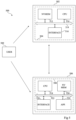
- FIG. 5 is a block diagram illustrating a system 500 configured to implement an authentication method, according to an embodiment of the present description.
- the system 500 comprises, for example, a device 502, such as for example a parking terminal, a locker, or a smartphone, comprising an electronic chip 504 configured to carry out NFC type communications.
- the chip 504 comprises, or is, a secure element.
- the system 500 further comprises a device 506, such as for example a smartphone, the device 506 comprising an electronic chip 508 configured to carry out NFC type communications.
- the chip 508 comprises an NFC emulation software brick as described in relation to the Figure 3B .
- the system 500 is configured to interact with a user 509 (USER).
- the user is the owner of the device 506.
- the chip 504, included in the device 502, comprises for example a processor 510 (CPU) connected to a non-volatile memory 512 (NVMEM) via a bus 514.
- the processor 510 is configured to perform cryptographic operations, such as for example cryptographic operations on elliptic curves.
- the memory 512 is included in a hardware security component, such as a secure element, a trusted platform module (in English "Trusted Platform Module”), a secure storage element, etc.
- the memory 512 stores the value of at least one secret key, such as for example a secret key linked to the provider of the service implemented by the device 502.
- the memory 512 stores, for example, in addition, at least one private key associated with the device 502 as well as a secret value.
- the memory 512 stores, for example, in addition at least one public key, such as for example a public key associated with the device 502.
- the public key is stored in an encrypted manner, for example by being signed by the private key.
- the memory 512 and the processor 510 are included in a secure element of the device 502.
- the device 502 further comprises, for example, an interface 516 connected to the bus 514.
- the interface 516 is a keyboard, a touch screen, a QR code scanner, etc.
- the chip 508 comprises for example a processor 518 (CPU) connected to a non-volatile memory 520 (NVMEM) via a bus 522.
- the processor 518 is configured to perform cryptographic operations, such as for example cryptographic operations on elliptic curves.
- the chip 508 further comprises an application 524 (APP.).
- the application 524 is a software application installed in a non-volatile memory of the device 506 connected to the bus 522.
- the application 524 is configured to, when executed by the processor 518, generate elements, such as for example numerical values and recovery phrases (in English “mnemonic phrases” or “seed phrases”).
- the recovery phrases are sequences of words, for example sequences of between 3 and 24 words.
- Each word of a recovery phrase is for example chosen randomly from a standard list of words, for example from a list of 2048 words determined by the BIP39 standard (from the English “Bitcoin Improvement Proposal 39”).
- the application 524 is configured to generate quick response codes (in English “Quick Response Codes” - QR codes).
- the device 506 further comprises an interface 526 (INTERFACE) allowing the user 509 to interact with the device 526.
- the interface 526 is a touch screen, a keyboard, etc.
- FIG. 6A is a flowchart illustrating steps in an authentication process.
- the flowchart of the Figure 6A illustrates steps for performing a first action by the device 502.
- the first action is locking a bicycle in a parking terminal, locking a locker or more generally a door.
- the first action is unlocking a bicycle, or a vehicle, made available to the user 509.
- the first action is a validation or authorization, for example to enter a tourist site.
- a step 600 the user 509 launches for example the execution of the application 524 on the device 506.
- a PIN numerical value such as a personal identification number (PIN) value
- PIN personal identification number
- a quick response code is generated when performing step 600.
- the generated numerical value, or code is directly accessible by the user 509.
- the PIN value, or code is displayed on a screen of the device 506.
- the value, or the PIN code is further stored in the memory 520.
- another mnemonic element is generated when executing the application 524.
- the other mnemonic element is a recovery phrase comprising, for example, between 3 and 24 words, for example 12 words.
- the generated mnemonic recovery phrase is, for example, directly stored in the memory 520.
- the recovery phrase is not provided to the user 509.
- the user 509 transmits the value, or code, previously generated by the application 524, directly to the device 502.
- the user 509 enters, for example manually, the PIN value via the interface.
- the user 509 scans, via the device 502, the quick response code, for example by presenting the device 506 to a reader of the device 502.
- the device 502 uses a private key sk borne as well as a secret value chaincode borne , in combination with the value, or code, PIN provided by the user 509, in order to generate a private key sk user / borne .
- the private key sk user / borne is generated, by the device 502, by applying a key derivation function to the private key sk borne , the secret value chaincode borne and the value, or code, PIN.
- the generation of the private key sk user / borne is carried out by the processor 510 in a secure manner.
- the private key sk borne and the secret value chaincode borne are values stored in the memory 512, for example during manufacture, or when the device 502 is put into service. These values are, for example, values specific to the device 502. In the example where the device 502 is a parking terminal, a locker, etc., each terminal and/or locker includes a private key and a secret value different from those stored in the other similar devices.
- the device 502 further comprises, for example, a public key pk borne , as well as a private key sk master associated with the holder of the device 502.
- the keys pk borne and sk master are for example stored securely in the memory 512.
- the public key pk borne takes the form of an electronic certificate.
- a public key pk master associated with the secret key sk master , is, for example, further stored in the memory 520 of the device 506.
- the public key pk master is stored in the memory 520 during the installation of the application 524.
- the device 506 further generates, for example securely, a public key pk user / borne .
- the public key pk user / borne is the result of multiplying a point of an elliptic curve by the value of the private key sk user / borne .
- the point of the elliptic curve used is the generating point of said elliptic curve.
- the elliptic curve on which the calculation is performed is, for example, defined upstream and is an elliptic curve suitable for implementing key exchange according to a Diffie-Hellman protocol.
- Step 601 further comprises the electronic signature of the public key pk borne , for example by the private key sk master .
- Step 601 further comprises the electronic signature of the public key pk user / borne , for example by the private key sk borne .
- Step 601 further comprises, for example, the transmission of the signed pk borne and pk user / borne keys to the device 506.
- the transmission of the signed keys is carried out by NFC communication between the devices 502 and 506.
- a step 602 the device 506, via the execution of the application 524, verifies the authenticity of the device 502.
- Verifying the authenticity of the device 502 comprises, for example, verifying the signature of the public key pk borne .
- the verification is carried out, for example, on the basis of the key pk master , stored, for example, in the memory 520.
- this verification fails, the method ends in failure and the communication between the devices 502 and 506 is broken.
- the PIN value is deleted from the device 502 and the signed pk borne and pk user / borne keys are deleted from the device 506.
- the elements generated during steps 600 and 601, such as the mnemonic recovery phrase, and the sk user / borne and pk user / borne keys are deleted from the memories of the devices 502 and 506.
- step 602 continues with the verification of the signature of the key pk user / borne .
- the value of the key pk borne is known by the device 506.
- the verification of the key pk user / borne is for example carried out by means of the execution of the application 524 and based on the key pk borne . In the event that the verification of the signature of the key pk user / borne fails, the method ends in failure.
- the public key pk borne , the mnemonic recovery phrase and the value, or the code, PIN are, for example, stored in the memory 520.
- the mnemonic recovery phrase and the value, or the code, PIN are stored in the memory 520 in association, and/or for example indexed by the public key pk borne .
- the NFC communication between the devices 502 and 506, in particular the transmission of the signed pk borne and pk user / borne keys is carried out in a metal niche, for example made of aluminum in order to thwart a relay attack.
- the metal niche is attached to, or is part of, the device 502.
- the signed pk borne and pk user / borne keys are displayed, for example in the form of quick response codes, on the interface 516 and are scanned by the user 509.
- a secret ephemeralkey is generated by the device 506 in order to create a secure channel with the device 502.
- the masterkey value generated from the recovery phrase, is a concatenation of the sk phone / borne private key and the authentication values authN 1 to authN 4 .
- bytes 0 to 31 of the masterkey value define the sk phone / borne private key; bytes 32 to 39 define the authentication value authN 1 ; bytes 40 to 47 define the authentication value authN 2 ; bytes 48 to 55 define the authentication value authN 3 ; and bytes 56 to 63 define the authentication value authN 4 .
- the secret key ephemeralkey is generated by the device 506, during the execution of the application 524, on the basis of the private key sk phone / borne and the public key pk user / bone .
- the secret key ephemeralkey is obtained by multiplication on the elliptic curve of the point defined by the public key pk user / borne by the scalar determined by the value of the private key sk user / borne .
- the multiplication of the key pk user / borne by the key skuser / phone results in a point on the elliptic curve.
- the point obtained is therefore defined by two coordinates ( ephemeralkey ( x ) , ephemeralkey ( y )).
- the secret key ephemeralkey is equal to the coordinate ephemeralkey ( x ) . It is of course entirely possible that the secret key ephemeralkey is equal to the coordinate ephemeralkey(y).
- the secret key ephemeralkey is then used to encrypt communications transmitted by the device 506 to the device 502.
- a public key pk phone / borne is furthermore generated during the execution of the application 524.
- the public key pk phone / borne is a point of the elliptic curve comprising two coordinates, the point being derived from the result of the multiplication of the point G , generator of the elliptic curve considered, by the scalar defined by the private key sk phone / borne .
- a secret code is determined.
- the user 509 does not have control over the choice of the secret code.
- the secret code is determined as being a part of the generated masterkey value.
- the secret code is equal to the authentication value authN 1 .
- the secret code can also be equal to one of the values authN 2 , authN 3 or authN 4 .
- the secret code is concatenated with one of the other authentication values.
- the authentication value authN 1 is concatenated with the identification value authN 2 .
- the concatenation of the secret code with the identification value, for example authN 2 is then encrypted by the secret key ephemeralkey resulting in a value cipher_codelock.
- a message including the cipher_codelock value and the two coordinates of the public key pk phone / terminal is then transmitted, by NFC communication, to the device 506.
- the transmitted message further includes a message authentication code (MAC), or a hash-based message authentication code (HMAC).
- MAC message authentication code
- HMAC hash-based message authentication code
- Authentication Code encrypted with the unused coordinate of the point calculated for the generation of the secret key.
- the MAC, or the HMAC is generated based on the coordinate ephemeralkey(y).
- the MAC or the HMAC is a cryptographic hash and its generation includes the calculation of a checksum.
- a step 605 the device 502 generates the secret key ephemeralkey on its side.
- the generation of the secret key ephemeralkey is carried out, for example, from the public key pk phone / borne received during the performance of step 604.
- the secret key ephemeralkey is for example a coordinate of the point ( ephemeralkey ( x ) , ephemeralkey ( y ), for example the coordinate ephemeralkey ( x ), obtained by multiplication on the elliptic curve of the point defined by the public key pk phone / borne by the scalar defined by the value of the private key sk user / borne .
- the MAC code, or HMAC, generated and received during the performance of step 604 is for example verified using the other coordinate, for example the ephemeralkey(y) coordinate generated by the device 502.
- the encrypted value cipher_codelock is stored in the memory 512 of the device 502.
- a step 606 the device 506 encrypts a value, for example the PIN value, or a value from the quick response code.
- a value for example the PIN value, or a value from the quick response code.
- the Encryption is performed based on the secret ephemeralkey.
- encryption is performed on the PIN value, or on a value from the quick response code, concatenated with another value.
- this other value corresponds to the 8 most significant bytes of the private key sk user / borne . More generally, the other value is a value known by the devices 502 and 506.
- the value encrypted during the performance of step 606 is then transmitted, by NFC communication, to the device 506.
- the device 506 is then configured, via the execution of the application 524, to decrypt the received encrypted value.
- the decryption is performed on the basis of the application of a symmetric encryption algorithm using the secret key ephemeralkey.
- the device 506 is then configured to compare the decrypted value with the PIN value, or with the quick response code.
- the verification is performed by comparing the first bytes, for example the bytes preceding the last 8 bytes of the decrypted value, with the PIN value, or the quick response code.
- the device 506 is further configured to communicate to the user 509 the value, or the first bytes of the decrypted value.
- the communication to the user is carried out by display on the interface 526.
- the user 509 checks whether the communicated value corresponds, for example, to his PIN code, generated when performing step 600. If the values do not match, the user 509 indicates, for example via the interface 526, that the values do not match, and the method ends in failure. If the values match, the user 509 indicates, for example via the interface 526, that the values match, thus validating the authentication between the two devices 502 and 506.
- the device 506 is then configured, via the execution of the application 524 and when the values match, to transmit an ACK validation value, encrypted by the secret key ephemeralkey.
- the ACK validation value is concatenated with one of the authentication values, for example with the value authN 3 , before being encrypted by the secret key ephemeralkey.
- the validation value for example concatenated, encrypted is then transmitted, by NFC communication, to the device 502.
- the device 502 is then configured to decrypt, by means of the secret key ephemeralkey, the value received during the performance of step 606 and to compare it, or to compare the first bytes corresponding to the number of bytes forming the validation value ACK, of the decrypted value with the validation value ACK.
- the validation value ACK has been stored in the memory 512 upstream, for example during the manufacture, or during the commissioning, of the device 502.
- Step 607 includes performing an action, such as locking, or unlocking, the user's bicycle or vehicle 509, locking the locker door, validating the entry of user 509 in a tourist site etc., by device 502.
- the secret key ephemeralkey is not kept in any memory of the devices 502 and 506.
- the device 506 stores the value or code, PIN, the mnemonic recovery phrase and the public key pk user / borne .
- the device 502 stores the encrypted value cipher_codelock.
- the device 502 stores the encrypted value cipher_codelock decrypted via the secret key ephemeralkey.
- the other values, transmitted and/or generated by one and the other of the devices 502 and 506, are deleted from the memories 512 and 520.
- FIG. 6B is a flowchart illustrating steps of an authentication method, according to an embodiment of the present description.
- the steps described in relation to the Figure 6B are carried out when the user comes to collect his bicycle or vehicle from the parking terminal, or comes to return the vehicle that was made available to him, or comes to collect items placed in the locker, or when the user 509 leaves the tourist site that he was visiting, etc.
- a step 608 is for example carried out by the initiative of the user 509.
- the user 509 presents himself, with the device 506, to the device 502.
- the device 506 transmits a request by NFC communication to the device 502.
- the device 502 is configured to expose the public key pk borne signed by the private key sk master to the device 506.
- the device 502 exposes a digital certificate comprising the value of the public key pk borne signed by the value of the key sk master .
- the signed public key pk borne , or the certificate is transmitted by NFC communication.
- the value is for example displayed on the interface 516, for example in the form of a quick response code and the user 509 presents the device 506 in order to scan the code.
- a request for the performance of the second action is transmitted by the device 506 to the device 502.
- the request includes transmitting the PIN value, or code, to the device 502.
- the value is transmitted in clear text via NFC communication.
- a step 609 the device 502 again generates the private key sk user / borne on the basis of the value, or code, PIN received during the performance of step 608, of the private key sk borne and of the secret value chaincode borne .
- the private key sk user / borne is obtained by applying a key derivation function on the value, or code, PIN, the private key sk borne and the secret value chaincode borne .
- the deterministically regenerated sk user / terminal private key is then, for example, signed by the sk terminal private key.
- the signed sk user / terminal private key is then transmitted, by NFC communication, to the device 506.
- a step 610 (SECURE CHANNEL RE-ESTABLISHMENT), the device 506, via the execution of the application 524, regenerates the masterkey value from the mnemonic recovery phrase, stored in memory.
- the device 506 further regenerates the secret key ephemeralkey as well as the public key pk phone / borne .
- Carrying out step 610 is identical to carrying out step 603.
- a MAC code, or an HMAC code is further generated from the coordinate ephemeralkey ( y ), or epehemeralkey ( x ) if applicable.
- the device 506 In a step 611 (CIPHER CODE), the device 506 generates a new secret code codeunlock.
- the new secret code is equal to the secret code codelock, generated when performing step 604.
- the new secret code codeunlock is equal to the authentication value authN 1 , regenerated when performing step 610.
- the new secret code codeunlock is then concatenated with a value different from that concatenated with the value of the codelock code when performing step 604.
- the new code code_unlock is concatenated with the authentication value authN 4 .
- the concatenation of the two values is then encrypted via the secret key ephemeralkey , resulting in an encrypted value cipher_codeunlock.
- the two secret codes codelock and codeunlock are the same, the encrypted values cipher_codelock and cipher_codeunlock differ.
- a message comprising the encrypted code cipher_codeunlock, the public key pk phone / borne , regenerated during the performance of step 610, as well as the MAC code, or HMAC, generated, for example on the basis of the coordinate ephemeralkey(y), is provided to the device 502.
- the device 502 estimates, for example, the time elapsed between the transmission of the message and its reception.
- the device 502 is then configured to compare the estimated time with a reference time period.
- the reference time period is a duration of less than 1 second, for example of the order of several milliseconds. If the estimated time is greater than the reference time period, the method ends in failure. In the case where the estimated time is much less than the reference time period, the device 502 regenerates the secret key ephemeralkey.
- the generation of the secret key ephemeralkey is carried out in an identical manner to the generation carried out in step 605.
- the device 502 then verifies, for example, the integrity of the MAC or HMAC code received by decrypting it using the coordinate ephemeralkey(y), or ephemeralkey ( x ) if applicable, also regenerated during the calculation of the secret key ephemeralkey. If the integrity of the MAC or HMAC code is not verified, the method ends in failure. If the MAC or HMAC code is indeed intact, the device 502 decrypts the encrypted code cipher_codeunlock. The device 502 further decrypts the encrypted code cipher_codelock, stored in memory following the performance of step 607.
- the device 502 is then configured to compare the first bytes, for example the number of bytes corresponding to the size of the authentication values, by example the first 8 bytes of the decrypted cipher_codeunlock and cipher_codelock codes. If the two compared elements, normally equal to the authentication value authN 1 , do not match, the method ends in failure. If the two compared elements match, and therefore are both equal to the value authN 1 , the device 502 compares the remaining bytes, for example the last 8 bytes, of the decrypted cipher_codeunlock and cipher_codelock codes. If the remaining bytes of the decrypted cipher_codeunlock and cipher_codelock codes are equal, the method ends in failure.
- the first bytes for example the number of bytes corresponding to the size of the authentication values, by example the first 8 bytes of the decrypted cipher_codeunlock and cipher_codelock codes.
- step 613 If the remaining bytes of the decrypted cipher_codeunlock and cipher_codelock codes differ, the process continues in step 613 (ACTION 2). Indeed, for the process not to end in failure, the last bytes of the decrypted cipher_codeunlock and cipher_codelock codes must differ, some being for example equal to the value authN 2 and others to the value authN 4 . Indeed, if the last bytes of the decrypted cipher_codeunlock and cipher_codelock codes are equal, this indicates that a replay attack is possibly taking place.
- Carrying out step 613 consists, for example, of carrying out the second action.
- the value, or code, PIN, the mnemonic recovery phrase and the public key pk user / borne are deleted from the memory 520.
- the encrypted code cipher_codelock stored in the memory 512 following the performance of step 607, is deleted from the memory 512, as well as all other values generated and received during the performance of steps 608 to 613.
- the keys sk master , sk borne and chaincode borne value are stored in memory 512 and the pk master key is stored in memory 520.
- all operations performed by the device 502 are performed securely, for example in a secure hardware element of the device 502.
- the steps described in relation to the Figures 6A And 6B can be performed in parallel between the device 506 and several devices similar to the device 502.
- the values, or codes, as well as the recovery phrases generated by the device 506, differ for each device similar to the device 502.
- all the other values and keys generated during the performance of the steps described in relation to the Figures 6A And 6B differ between each device similar to device 502.
- the device 502 with which the first action is performed may differ from the device 502 with which the second action is performed.
- the use of the sk borne key is replaced by the use of the sk master key and only a self-signed certificate is exposed when performing step 601.
- the public key pk borne does not differ from one device 502 to another.
- the steps described in relation to the Figure 6A are carried out with a user different from the one present for carrying out the steps described in relation to the Figure 6B This example occurs, for example, when user 509 wishes to lend his vehicle, which he has parked in a parking terminal, to a third party.
- An advantage of the described embodiments is that they enable robust communication in the face of most known cyber attacks.
- Another advantage of the described embodiments is that they can be implemented without connecting to any network. Thus, implementing the described embodiments is also possible in a white zone. In particular, NFC communication does not require a PKI (Public Key Infrastructure).
- An advantage of the described embodiments is that the number of elements kept in memory of the devices 502 and 506 is restricted.
Landscapes
- Engineering & Computer Science (AREA)
- Computer Security & Cryptography (AREA)
- Computer Networks & Wireless Communication (AREA)
- Theoretical Computer Science (AREA)
- Signal Processing (AREA)
- Computing Systems (AREA)
- General Physics & Mathematics (AREA)
- Physics & Mathematics (AREA)
- Pure & Applied Mathematics (AREA)
- Mathematical Physics (AREA)
- Mathematical Optimization (AREA)
- Mathematical Analysis (AREA)
- Algebra (AREA)
- Lock And Its Accessories (AREA)
- Mobile Radio Communication Systems (AREA)
Applications Claiming Priority (1)
| Application Number | Priority Date | Filing Date | Title |
|---|---|---|---|
| FR2312894A FR3155603A1 (fr) | 2023-11-22 | 2023-11-22 | Communication en champ proche sécurisée |
Publications (1)
| Publication Number | Publication Date |
|---|---|
| EP4560972A1 true EP4560972A1 (de) | 2025-05-28 |
Family
ID=90365893
Family Applications (1)
| Application Number | Title | Priority Date | Filing Date |
|---|---|---|---|
| EP24213772.7A Pending EP4560972A1 (de) | 2023-11-22 | 2024-11-19 | Authentifizierung mit sicheren nahfeldkommunikation |
Country Status (3)
| Country | Link |
|---|---|
| US (1) | US20250168005A1 (de) |
| EP (1) | EP4560972A1 (de) |
| FR (1) | FR3155603A1 (de) |
Citations (5)
| Publication number | Priority date | Publication date | Assignee | Title |
|---|---|---|---|---|
| US20200028672A1 (en) * | 2017-03-29 | 2020-01-23 | Yunding Network Technology (Beijing) Co., Ltd. | Secure communication method and smart lock system based thereof |
| US20200052905A1 (en) * | 2017-03-01 | 2020-02-13 | Apple Inc. | System access using a mobile device |
| US20220392286A1 (en) * | 2021-06-06 | 2022-12-08 | Apple Inc. | Techniques for authenticating building/room access terminals |
| US11528153B1 (en) * | 2022-05-27 | 2022-12-13 | Vouch.Io Llc | Systems and methods for delayed-message attack mitigation |
| US20230140203A1 (en) * | 2020-06-30 | 2023-05-04 | Yunding Network Technology (Beijing) Co., Ltd. | Smart device control methods and systems |
Family Cites Families (7)
| Publication number | Priority date | Publication date | Assignee | Title |
|---|---|---|---|---|
| US20160087949A1 (en) * | 2014-09-24 | 2016-03-24 | Intel Corporation | Establishing secure digital relationship using symbology |
| US10042782B2 (en) * | 2015-06-02 | 2018-08-07 | ALTR Solutions, Inc. | Immutable datastore for low-latency reading and writing of large data sets |
| US11256783B2 (en) * | 2020-02-26 | 2022-02-22 | Amera IoT Inc. | Method and apparatus for simultaneous key generation on device and server for secure communication |
| US11336647B2 (en) * | 2020-09-30 | 2022-05-17 | Juniper Networks, Inc. | Error handling for media access control security |
| KR102336068B1 (ko) * | 2020-12-30 | 2021-12-07 | 주식회사 피에스디엘 | 도어락, 도어락 컨트롤 장치, 도어락 컨트롤 프로그램 및 도어락 관리 서버 |
| TW202243441A (zh) * | 2021-04-15 | 2022-11-01 | 美商品譜公司 | 與諸如電子鎖之物聯網裝置的安全藍牙連接之建立 |
| US12249200B2 (en) * | 2023-02-15 | 2025-03-11 | Dormakaba Canada Inc. | Electronic lock system and associated method of operation |
-
2023
- 2023-11-22 FR FR2312894A patent/FR3155603A1/fr active Pending
-
2024
- 2024-11-13 US US18/945,709 patent/US20250168005A1/en active Pending
- 2024-11-19 EP EP24213772.7A patent/EP4560972A1/de active Pending
Patent Citations (5)
| Publication number | Priority date | Publication date | Assignee | Title |
|---|---|---|---|---|
| US20200052905A1 (en) * | 2017-03-01 | 2020-02-13 | Apple Inc. | System access using a mobile device |
| US20200028672A1 (en) * | 2017-03-29 | 2020-01-23 | Yunding Network Technology (Beijing) Co., Ltd. | Secure communication method and smart lock system based thereof |
| US20230140203A1 (en) * | 2020-06-30 | 2023-05-04 | Yunding Network Technology (Beijing) Co., Ltd. | Smart device control methods and systems |
| US20220392286A1 (en) * | 2021-06-06 | 2022-12-08 | Apple Inc. | Techniques for authenticating building/room access terminals |
| US11528153B1 (en) * | 2022-05-27 | 2022-12-13 | Vouch.Io Llc | Systems and methods for delayed-message attack mitigation |
Also Published As
| Publication number | Publication date |
|---|---|
| US20250168005A1 (en) | 2025-05-22 |
| FR3155603A1 (fr) | 2025-05-23 |
Similar Documents
| Publication | Publication Date | Title |
|---|---|---|
| CN1777096B (zh) | 用于口令保护的方法和设备 | |
| US7596704B2 (en) | Partition and recovery of a verifiable digital secret | |
| JP4680505B2 (ja) | 簡易音声認証方法および装置 | |
| US9338163B2 (en) | Method using a single authentication device to authenticate a user to a service provider among a plurality of service providers and device for performing such a method | |
| US6535980B1 (en) | Keyless encryption of messages using challenge response | |
| CN113472793B (zh) | 一种基于硬件密码设备的个人数据保护系统 | |
| EP3280089B1 (de) | Schlüsselerzeugungsverfahren und zugangskontrollverfahren | |
| US20150113283A1 (en) | Protecting credentials against physical capture of a computing device | |
| EP1549011A1 (de) | Kommunikationsverfahren und System zwischen einem Endgerät und mindestens einer Kommunikationsvorrichtung | |
| EP2811708A1 (de) | System und Methode zur Authentifizierung eines Benutzers | |
| CN101964805B (zh) | 一种数据安全发送与接收的方法、设备及系统 | |
| JP2009272671A (ja) | 秘匿認証システム | |
| US20020018570A1 (en) | System and method for secure comparison of a common secret of communicating devices | |
| JP6723422B1 (ja) | 認証システム | |
| EP3965361B1 (de) | Datenaustausch zwischen einem client und einem fernen gerät, z.b. ein geschützten modul | |
| EP2509025A1 (de) | Zugriffsverfahren auf eine geschützte Quelle einer gesicherten persönlichen Vorrichtung | |
| EP1514377A1 (de) | Schnittstellenverfahren- und einrichtung zum online-austausch von inhaltsdaten auf sichere weise | |
| FR3155603A1 (fr) | Communication en champ proche sécurisée | |
| FR3082089A1 (fr) | Procede et systeme de deverrouillage a distance d'un vehicule automobile | |
| US20030014672A1 (en) | Authentication protocol with dynamic secret | |
| EP2630746B1 (de) | Authentifikationsverfahren und -system | |
| JP4148465B2 (ja) | 電子価値流通システムおよび電子価値流通方法 | |
| JP4655459B2 (ja) | 暗証番号照合システム及び暗証番号照合方法及び暗証番号照合プログラム及び暗証番号照合システムを用いたカード決済システム及び暗証番号照合システムを用いた扉管理システム | |
| WO2017005644A1 (fr) | Procédé et système de contrôle d'accès à un service via un média mobile sans intermediaire de confiance | |
| US8543817B1 (en) | Secure indentification and authorization apparatus and method |
Legal Events
| Date | Code | Title | Description |
|---|---|---|---|
| PUAI | Public reference made under article 153(3) epc to a published international application that has entered the european phase |
Free format text: ORIGINAL CODE: 0009012 |
|
| STAA | Information on the status of an ep patent application or granted ep patent |
Free format text: STATUS: REQUEST FOR EXAMINATION WAS MADE |
|
| 17P | Request for examination filed |
Effective date: 20241119 |
|
| AK | Designated contracting states |
Kind code of ref document: A1 Designated state(s): AL AT BE BG CH CY CZ DE DK EE ES FI FR GB GR HR HU IE IS IT LI LT LU LV MC ME MK MT NL NO PL PT RO RS SE SI SK SM TR |
|
| STAA | Information on the status of an ep patent application or granted ep patent |
Free format text: STATUS: EXAMINATION IS IN PROGRESS |
|
| RIC1 | Information provided on ipc code assigned before grant |
Ipc: H04L 9/08 20060101AFI20251230BHEP Ipc: H04L 9/32 20060101ALI20251230BHEP Ipc: G07C 9/00 20200101ALI20251230BHEP |
|
| 17Q | First examination report despatched |
Effective date: 20260116 |