EP4563356A1 - Flüssigkeitsausstosskopf, kopfmodul und flüssigkeitsausstossvorrichtung - Google Patents
Flüssigkeitsausstosskopf, kopfmodul und flüssigkeitsausstossvorrichtung Download PDFInfo
- Publication number
- EP4563356A1 EP4563356A1 EP24199535.6A EP24199535A EP4563356A1 EP 4563356 A1 EP4563356 A1 EP 4563356A1 EP 24199535 A EP24199535 A EP 24199535A EP 4563356 A1 EP4563356 A1 EP 4563356A1
- Authority
- EP
- European Patent Office
- Prior art keywords
- liquid
- blow
- liquid discharge
- nozzle
- nozzles
- Prior art date
- Legal status (The legal status is an assumption and is not a legal conclusion. Google has not performed a legal analysis and makes no representation as to the accuracy of the status listed.)
- Pending
Links
Images




Classifications
-
- B—PERFORMING OPERATIONS; TRANSPORTING
- B41—PRINTING; LINING MACHINES; TYPEWRITERS; STAMPS
- B41J—TYPEWRITERS; SELECTIVE PRINTING MECHANISMS, i.e. MECHANISMS PRINTING OTHERWISE THAN FROM A FORME; CORRECTION OF TYPOGRAPHICAL ERRORS
- B41J2/00—Typewriters or selective printing mechanisms characterised by the printing or marking process for which they are designed
- B41J2/005—Typewriters or selective printing mechanisms characterised by the printing or marking process for which they are designed characterised by bringing liquid or particles selectively into contact with a printing material
- B41J2/01—Ink jet
- B41J2/135—Nozzles
- B41J2/14—Structure thereof only for on-demand ink jet heads
- B41J2/14201—Structure of print heads with piezoelectric elements
-
- B—PERFORMING OPERATIONS; TRANSPORTING
- B41—PRINTING; LINING MACHINES; TYPEWRITERS; STAMPS
- B41J—TYPEWRITERS; SELECTIVE PRINTING MECHANISMS, i.e. MECHANISMS PRINTING OTHERWISE THAN FROM A FORME; CORRECTION OF TYPOGRAPHICAL ERRORS
- B41J2/00—Typewriters or selective printing mechanisms characterised by the printing or marking process for which they are designed
- B41J2/005—Typewriters or selective printing mechanisms characterised by the printing or marking process for which they are designed characterised by bringing liquid or particles selectively into contact with a printing material
- B41J2/01—Ink jet
- B41J2/015—Ink jet characterised by the jet generation process
- B41J2/04—Ink jet characterised by the jet generation process generating single droplets or particles on demand
- B41J2/045—Ink jet characterised by the jet generation process generating single droplets or particles on demand by pressure, e.g. electromechanical transducers
- B41J2/04501—Control methods or devices therefor, e.g. driver circuits, control circuits
- B41J2/04505—Control methods or devices therefor, e.g. driver circuits, control circuits aiming at correcting alignment
-
- B—PERFORMING OPERATIONS; TRANSPORTING
- B41—PRINTING; LINING MACHINES; TYPEWRITERS; STAMPS
- B41J—TYPEWRITERS; SELECTIVE PRINTING MECHANISMS, i.e. MECHANISMS PRINTING OTHERWISE THAN FROM A FORME; CORRECTION OF TYPOGRAPHICAL ERRORS
- B41J2/00—Typewriters or selective printing mechanisms characterised by the printing or marking process for which they are designed
- B41J2/005—Typewriters or selective printing mechanisms characterised by the printing or marking process for which they are designed characterised by bringing liquid or particles selectively into contact with a printing material
- B41J2/01—Ink jet
- B41J2/135—Nozzles
- B41J2/14—Structure thereof only for on-demand ink jet heads
-
- B—PERFORMING OPERATIONS; TRANSPORTING
- B41—PRINTING; LINING MACHINES; TYPEWRITERS; STAMPS
- B41J—TYPEWRITERS; SELECTIVE PRINTING MECHANISMS, i.e. MECHANISMS PRINTING OTHERWISE THAN FROM A FORME; CORRECTION OF TYPOGRAPHICAL ERRORS
- B41J2/00—Typewriters or selective printing mechanisms characterised by the printing or marking process for which they are designed
- B41J2/005—Typewriters or selective printing mechanisms characterised by the printing or marking process for which they are designed characterised by bringing liquid or particles selectively into contact with a printing material
- B41J2/01—Ink jet
-
- B—PERFORMING OPERATIONS; TRANSPORTING
- B41—PRINTING; LINING MACHINES; TYPEWRITERS; STAMPS
- B41J—TYPEWRITERS; SELECTIVE PRINTING MECHANISMS, i.e. MECHANISMS PRINTING OTHERWISE THAN FROM A FORME; CORRECTION OF TYPOGRAPHICAL ERRORS
- B41J2/00—Typewriters or selective printing mechanisms characterised by the printing or marking process for which they are designed
- B41J2/005—Typewriters or selective printing mechanisms characterised by the printing or marking process for which they are designed characterised by bringing liquid or particles selectively into contact with a printing material
- B41J2/01—Ink jet
- B41J2/135—Nozzles
- B41J2/14—Structure thereof only for on-demand ink jet heads
- B41J2/14201—Structure of print heads with piezoelectric elements
- B41J2/14233—Structure of print heads with piezoelectric elements of film type, deformed by bending and disposed on a diaphragm
-
- B—PERFORMING OPERATIONS; TRANSPORTING
- B41—PRINTING; LINING MACHINES; TYPEWRITERS; STAMPS
- B41J—TYPEWRITERS; SELECTIVE PRINTING MECHANISMS, i.e. MECHANISMS PRINTING OTHERWISE THAN FROM A FORME; CORRECTION OF TYPOGRAPHICAL ERRORS
- B41J2/00—Typewriters or selective printing mechanisms characterised by the printing or marking process for which they are designed
- B41J2/005—Typewriters or selective printing mechanisms characterised by the printing or marking process for which they are designed characterised by bringing liquid or particles selectively into contact with a printing material
- B41J2/01—Ink jet
- B41J2/135—Nozzles
- B41J2/145—Arrangement thereof
-
- B—PERFORMING OPERATIONS; TRANSPORTING
- B41—PRINTING; LINING MACHINES; TYPEWRITERS; STAMPS
- B41J—TYPEWRITERS; SELECTIVE PRINTING MECHANISMS, i.e. MECHANISMS PRINTING OTHERWISE THAN FROM A FORME; CORRECTION OF TYPOGRAPHICAL ERRORS
- B41J2/00—Typewriters or selective printing mechanisms characterised by the printing or marking process for which they are designed
- B41J2/005—Typewriters or selective printing mechanisms characterised by the printing or marking process for which they are designed characterised by bringing liquid or particles selectively into contact with a printing material
- B41J2/01—Ink jet
- B41J2/135—Nozzles
- B41J2/16—Production of nozzles
- B41J2/1607—Production of print heads with piezoelectric elements
-
- B—PERFORMING OPERATIONS; TRANSPORTING
- B41—PRINTING; LINING MACHINES; TYPEWRITERS; STAMPS
- B41J—TYPEWRITERS; SELECTIVE PRINTING MECHANISMS, i.e. MECHANISMS PRINTING OTHERWISE THAN FROM A FORME; CORRECTION OF TYPOGRAPHICAL ERRORS
- B41J2/00—Typewriters or selective printing mechanisms characterised by the printing or marking process for which they are designed
- B41J2/005—Typewriters or selective printing mechanisms characterised by the printing or marking process for which they are designed characterised by bringing liquid or particles selectively into contact with a printing material
- B41J2/01—Ink jet
- B41J2/135—Nozzles
- B41J2/16—Production of nozzles
- B41J2/162—Manufacturing of the nozzle plates
-
- B—PERFORMING OPERATIONS; TRANSPORTING
- B41—PRINTING; LINING MACHINES; TYPEWRITERS; STAMPS
- B41J—TYPEWRITERS; SELECTIVE PRINTING MECHANISMS, i.e. MECHANISMS PRINTING OTHERWISE THAN FROM A FORME; CORRECTION OF TYPOGRAPHICAL ERRORS
- B41J2/00—Typewriters or selective printing mechanisms characterised by the printing or marking process for which they are designed
- B41J2/005—Typewriters or selective printing mechanisms characterised by the printing or marking process for which they are designed characterised by bringing liquid or particles selectively into contact with a printing material
- B41J2/01—Ink jet
- B41J2/135—Nozzles
- B41J2/16—Production of nozzles
- B41J2/1621—Manufacturing processes
- B41J2/1623—Manufacturing processes bonding and adhesion
-
- B—PERFORMING OPERATIONS; TRANSPORTING
- B41—PRINTING; LINING MACHINES; TYPEWRITERS; STAMPS
- B41J—TYPEWRITERS; SELECTIVE PRINTING MECHANISMS, i.e. MECHANISMS PRINTING OTHERWISE THAN FROM A FORME; CORRECTION OF TYPOGRAPHICAL ERRORS
- B41J2/00—Typewriters or selective printing mechanisms characterised by the printing or marking process for which they are designed
- B41J2/005—Typewriters or selective printing mechanisms characterised by the printing or marking process for which they are designed characterised by bringing liquid or particles selectively into contact with a printing material
- B41J2/01—Ink jet
- B41J2/135—Nozzles
- B41J2/16—Production of nozzles
- B41J2/1621—Manufacturing processes
- B41J2/1626—Manufacturing processes etching
- B41J2/1628—Manufacturing processes etching dry etching
-
- B—PERFORMING OPERATIONS; TRANSPORTING
- B41—PRINTING; LINING MACHINES; TYPEWRITERS; STAMPS
- B41J—TYPEWRITERS; SELECTIVE PRINTING MECHANISMS, i.e. MECHANISMS PRINTING OTHERWISE THAN FROM A FORME; CORRECTION OF TYPOGRAPHICAL ERRORS
- B41J2/00—Typewriters or selective printing mechanisms characterised by the printing or marking process for which they are designed
- B41J2/005—Typewriters or selective printing mechanisms characterised by the printing or marking process for which they are designed characterised by bringing liquid or particles selectively into contact with a printing material
- B41J2/01—Ink jet
- B41J2/135—Nozzles
- B41J2/16—Production of nozzles
- B41J2/1621—Manufacturing processes
- B41J2/1631—Manufacturing processes photolithography
-
- B—PERFORMING OPERATIONS; TRANSPORTING
- B41—PRINTING; LINING MACHINES; TYPEWRITERS; STAMPS
- B41J—TYPEWRITERS; SELECTIVE PRINTING MECHANISMS, i.e. MECHANISMS PRINTING OTHERWISE THAN FROM A FORME; CORRECTION OF TYPOGRAPHICAL ERRORS
- B41J2/00—Typewriters or selective printing mechanisms characterised by the printing or marking process for which they are designed
- B41J2/005—Typewriters or selective printing mechanisms characterised by the printing or marking process for which they are designed characterised by bringing liquid or particles selectively into contact with a printing material
- B41J2/01—Ink jet
- B41J2/135—Nozzles
- B41J2/16—Production of nozzles
- B41J2/1621—Manufacturing processes
- B41J2/1632—Manufacturing processes machining
-
- B—PERFORMING OPERATIONS; TRANSPORTING
- B41—PRINTING; LINING MACHINES; TYPEWRITERS; STAMPS
- B41J—TYPEWRITERS; SELECTIVE PRINTING MECHANISMS, i.e. MECHANISMS PRINTING OTHERWISE THAN FROM A FORME; CORRECTION OF TYPOGRAPHICAL ERRORS
- B41J2/00—Typewriters or selective printing mechanisms characterised by the printing or marking process for which they are designed
- B41J2/005—Typewriters or selective printing mechanisms characterised by the printing or marking process for which they are designed characterised by bringing liquid or particles selectively into contact with a printing material
- B41J2/01—Ink jet
- B41J2/135—Nozzles
- B41J2/16—Production of nozzles
- B41J2/1621—Manufacturing processes
- B41J2/164—Manufacturing processes thin film formation
- B41J2/1642—Manufacturing processes thin film formation thin film formation by CVD [chemical vapor deposition]
-
- B—PERFORMING OPERATIONS; TRANSPORTING
- B41—PRINTING; LINING MACHINES; TYPEWRITERS; STAMPS
- B41J—TYPEWRITERS; SELECTIVE PRINTING MECHANISMS, i.e. MECHANISMS PRINTING OTHERWISE THAN FROM A FORME; CORRECTION OF TYPOGRAPHICAL ERRORS
- B41J2/00—Typewriters or selective printing mechanisms characterised by the printing or marking process for which they are designed
- B41J2/005—Typewriters or selective printing mechanisms characterised by the printing or marking process for which they are designed characterised by bringing liquid or particles selectively into contact with a printing material
- B41J2/01—Ink jet
- B41J2/135—Nozzles
- B41J2/16—Production of nozzles
- B41J2/1621—Manufacturing processes
- B41J2/164—Manufacturing processes thin film formation
- B41J2/1646—Manufacturing processes thin film formation thin film formation by sputtering
-
- B—PERFORMING OPERATIONS; TRANSPORTING
- B41—PRINTING; LINING MACHINES; TYPEWRITERS; STAMPS
- B41J—TYPEWRITERS; SELECTIVE PRINTING MECHANISMS, i.e. MECHANISMS PRINTING OTHERWISE THAN FROM A FORME; CORRECTION OF TYPOGRAPHICAL ERRORS
- B41J2/00—Typewriters or selective printing mechanisms characterised by the printing or marking process for which they are designed
- B41J2/005—Typewriters or selective printing mechanisms characterised by the printing or marking process for which they are designed characterised by bringing liquid or particles selectively into contact with a printing material
- B41J2/01—Ink jet
- B41J2/135—Nozzles
- B41J2/14—Structure thereof only for on-demand ink jet heads
- B41J2002/14362—Assembling elements of heads
-
- B—PERFORMING OPERATIONS; TRANSPORTING
- B41—PRINTING; LINING MACHINES; TYPEWRITERS; STAMPS
- B41J—TYPEWRITERS; SELECTIVE PRINTING MECHANISMS, i.e. MECHANISMS PRINTING OTHERWISE THAN FROM A FORME; CORRECTION OF TYPOGRAPHICAL ERRORS
- B41J2/00—Typewriters or selective printing mechanisms characterised by the printing or marking process for which they are designed
- B41J2/005—Typewriters or selective printing mechanisms characterised by the printing or marking process for which they are designed characterised by bringing liquid or particles selectively into contact with a printing material
- B41J2/01—Ink jet
- B41J2/135—Nozzles
- B41J2/14—Structure thereof only for on-demand ink jet heads
- B41J2002/14491—Electrical connection
-
- B—PERFORMING OPERATIONS; TRANSPORTING
- B41—PRINTING; LINING MACHINES; TYPEWRITERS; STAMPS
- B41J—TYPEWRITERS; SELECTIVE PRINTING MECHANISMS, i.e. MECHANISMS PRINTING OTHERWISE THAN FROM A FORME; CORRECTION OF TYPOGRAPHICAL ERRORS
- B41J2202/00—Embodiments of or processes related to ink-jet or thermal heads
- B41J2202/01—Embodiments of or processes related to ink-jet heads
- B41J2202/02—Air-assisted ejection
Definitions
- the present disclosure relates to a liquid discharge head, a head module, and a liquid discharge apparatus.
- a liquid discharge head accurately lands liquid from each nozzle to a predetermined position on a recording medium, whereby a desired image can be formed on the recording medium.
- the landing position of the liquid is disadvantageously displaced due to the influence of the gas flow generated by discharging the liquid.
- the liquid discharge head described in Japanese Patent No. 6018356 includes a gas flow blow-out part that blows out a gas flow toward a recording medium.
- the gas flow blow-out part includes a main gas-flow blowing outlet and a sub gas-flow blowing outlet. These outlets surround a nozzle array as an array of nozzles that discharge ink.
- the gas flow blow-out part is different in member from a nozzle plate including the nozzles, and protrudes toward the recording medium from the nozzle plate.
- An object of the present disclosure is to secure maintainability of a liquid discharge head and to inhibit displacement of a landing position of liquid.
- the present disclosure described herein provides a liquid discharge head that includes a nozzle member including a plurality of nozzles to discharge liquid and a blow-out hole to blow out gas.
- the blow-out hole is closer to an end in a longitudinal direction of the nozzle member than a nozzle closest to the end in the longitudinal direction of the nozzle member among the plurality of nozzles is.
- the present disclosure described herein also provides a head module including a plurality of liquid discharge heads, each one of which is the liquid discharge head.
- the present disclosure described herein further provides a liquid discharge apparatus including the liquid discharge head.
- the maintainability of the liquid discharge head can be assured and the displacement of the landing position of the liquid can be inhibited.
- FIG. 1 illustrates a nozzle face 2a side of a nozzle plate 2 provided to a liquid discharge head 1.
- FIG. 2 is a cross-sectional view taken along line A1-A1 of FIG. 1 .
- FIG. 3 is a cross-sectional view taken along line A2-A2 of FIG. 1 .
- FIG. 4 is a cross-sectional view taken along line A3-A3 of FIG. 1 .
- FIG. 5 is a perspective view of a side opposite to the nozzle face 2a side of the liquid discharge head 1.
- the arrow X direction in FIG. 1 is the longitudinal direction of the nozzle plate 2.
- the longitudinal direction is an array direction of nozzles.
- the up-and-down direction in FIG. 1 orthogonal to the arrow X direction is the lateral direction of the nozzle plate 2.
- the nozzle plate 2 as a nozzle member includes a plurality of nozzles 3 and a plurality of blow-out holes 4.
- the nozzle face 2a of the nozzle plate 2 illustrated in FIG. 1 is a face provided with an end on the ink discharge side of the nozzles 3.
- the nozzle face 2a is also provided with another end on the gas blow-out side of the blow-out holes 4.
- the liquid discharge head 1 includes the nozzle plate 2, an individual liquid chamber substrate 5, a common liquid chamber substrate 6, a housing 7, a liquid port 8, a gas port 9, for example.
- the individual liquid chamber substrate 5 forms each individual liquid chamber 10 in communication with the corresponding nozzle 3 and each individual supply channel in communication with the corresponding individual liquid chamber 10.
- Each piezoelectric element 11 as a pressure generating member is provided facing the corresponding individual liquid chamber 10.
- the common liquid chamber substrate 6 forms a common liquid chamber 12 in communication with each individual liquid chamber 10 through the corresponding individual supply channel.
- the housing 7 forms a common supply channel 13 in communication with the common liquid chamber 12.
- the common supply channel 13 is communication with the liquid port 8 on the side opposite to the common liquid chamber 12 side. As illustrated in FIGS.
- the housing 7 has an upper portion provided with the liquid port 8, the gas port 9, and an electric interface (I/F) 15.
- the electric I/F 15 of the present embodiment includes a printed circuit board (PCB) and a connector mounted thereon.
- PCB printed circuit board
- each piezoelectric element 11 is electrically connected to the electric I/F 15 through a wiring board 16.
- the housing 7, the common liquid chamber substrate 6, and the individual liquid chamber substrate 5 form a gas path 14 through which gas is supplied from the gas port 9 to each blow-out hole 4.
- the gas path 14 includes a gas common path 14a, a gas branch path 14b, and a gas individual path 14c in communication with the gas port 9.
- Each blow-out hole 4 blows out the gas supplied from the gas port 9 and does not discharge ink.
- an appropriate gas flow generating mechanism such as an air pump or an air compressor is provided on the gas port 9 side, and the gas flow generating mechanism can blow out the gas such as compressed air from the blow-out hole 4 through the gas port 9 and the gas path 14.
- FIGS. 6A and 6B illustrate a nozzle plate 200 of a liquid discharge head different in configuration from the present embodiment.
- FIG. 6A is a plan view of a nozzle face 200a as a face on the ink discharge side of the nozzle plate 200.
- FIG. 6B is a cross-sectional view taken along line A1-A1 of FIG. 6A .
- the nozzle plate 200 illustrated in FIG. 6A includes a nozzle array 201A and a nozzle array 201B in two rows in the lateral direction of the nozzle plate 200, as nozzle arrays each including a plurality of nozzles 201 disposed in the longitudinal direction of the nozzle plate 200.
- the nozzles 201 are alternately disposed in the longitudinal direction in the upper and lower nozzle arrays 201A and 201B.
- a downward gas flow is generated due to ink discharge.
- a gas flow is not generated outside the region where the nozzles 201 are disposed.
- the vortex of a gas flow circulating clockwise is generated around the boundary between the region where the nozzles 201 are disposed and the outside of the region.
- a recording medium M such as a paper sheet is conveyed opposite to the nozzle plate 200.
- a gas flow is also generated due to the conveyance of the recording medium M.
- conveyance of the recording medium M in a direction parallel to the longitudinal direction exerts influence such as promoting the above-described clockwise circulating gas flow.
- the landing position of ink 150 discharged from each nozzle 201 disposed closest to the corresponding end in the longitudinal direction among the nozzles 201 of the nozzle arrays 201A and 201B is displaced outside in the longitudinal direction.
- This displacement causes an abnormal image formation such as density unevenness or streaks of an image formed on the recording medium M.
- a gas flow easily exerts influence on the ink discharged from the nozzles.
- the displacement of the landing position of the ink due to the influence of the gas flow is remarkable.
- the large printing gap includes a printing gap larger than 5 mm.
- a plurality of nozzle arrays 30A and 30B is disposed on the nozzle plate 2.
- the nozzles 3 are alternately disposed in the longitudinal direction in the nozzle arrays 30A and 30B.
- the disposition of the nozzles of the nozzle member of the present disclosure is not limited the disposition described above. Therefore, one or at least three nozzle arrays may be disposed, the nozzles may be disposed in a row in the longitudinal direction, or the nozzles may be irregularly disposed.
- the nozzle plate 2 of the present embodiment is different from the nozzle plate 200 in that the nozzle plate 2 includes the blow-out holes 4 that blow out gas and the blow-out holes 4 are each provided closer to the corresponding end in the longitudinal direction of the nozzle plate 2 than the corresponding nozzle 3 is, the corresponding nozzle 3 being disposed closest to the corresponding end in the longitudinal direction of the nozzle plate 2 among the plurality of nozzles 3.
- the blow-out holes 4 are indicated by the two-dot chain lines for convenience.
- the blow-out holes 4 are each provided particularly at the corresponding end of the nozzle face 2a and closer to the corresponding end of the nozzle face 2a than the corresponding nozzle 3 is.
- the nozzles 3 and the blow-out holes 4 extend in a direction substantially perpendicular to the nozzle face 2a.
- two blow-out holes 4 are provided outside the nozzles 3 of the nozzle array 30A one-to-one at both ends of the nozzle array 30A and two blow-out holes 4 are provided outside the nozzles 3 of the nozzle array 30B one-to-one at both ends of the nozzle array 30B in the longitudinal direction.
- gas is blown out from the blow-out holes 4 toward a recording medium M in the arrow B direction. That is, a gas flow in the arrow B direction is formed at each position of the clockwise gas flow illustrated in FIG. 6B or a position corresponding to the vicinity of each position of the clockwise gas flow illustrated in FIG. 6B .
- This formation of the gas flow in the arrow B direction inhibits the displacement in the discharge direction of ink discharged from each of the outermost nozzles 3, namely, the displacement of the landing position as illustrated in FIG. 7B . Therefore, density unevenness and an abnormal image due to the displacement of the landing position of the ink can be inhibited.
- the blow-out holes 4 are provided to the nozzle plate 2.
- blow-out holes 4 do not exert influence on maintainability of the liquid discharge head 1. That is, as compared with a case where the blow-out holes 4 are provided to a member different from the nozzle plate 2, there is no adverse influence such as complication of a wiping operation and a suction operation for the nozzles 3, and in the present embodiment, the blow-out holes 4 can be wiped simultaneously by the wiping operation for the nozzles 3.
- the blow-out holes 4 are substantially equal in diameter to the nozzles 3.
- the nozzle plate 2 can be easily processed, and the blow-out holes 4 can be formed with a highly accurate dimension.
- the blow-out holes 4 are provided on both outer sides in the longitudinal direction. This arrangement inhibits the influence of the gas flow on the nozzles 3 disposed closest to both ends in the longitudinal direction.
- the blow-out holes of the present disclosure are not necessarily provided on both sides in the longitudinal direction. For example, in a case where the influence of a gas flow is small and the displacement of the landing position of liquid is small on one side in the longitudinal direction, a blow-out hole may be provided only on the other side.
- the gas path 14 through which gas is supplied from the gas port 9 to the blow-out holes 4 is formed by the housing 7, the common liquid chamber substrate 6, and the individual liquid chamber substrate 5.
- the housing 7, the common liquid chamber substrate 6, and the individual liquid chamber substrate 5 are channel members forming a liquid channel including, for example, a common supply channel and an individual supply channel for supplying ink from the liquid port 8 to the nozzles 3. Forming a path for ink supply and a path for gas supply using a common member results in reduction of the liquid discharge head in size and cost.
- a gas path is not necessarily formed by all of the housing 7, the common liquid chamber substrate 6, and the individual liquid chamber substrate 5, namely, all of the channel members. Thus, the gas path may be formed only by individual liquid chamber substrate 5, for example.
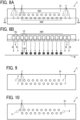
- a liquid discharge head illustrated in FIGS. 8A and 8B includes two blow-out holes 4 disposed side by side in the longitudinal direction outside the outermost nozzles 3 in the longitudinal direction of each nozzle array.
- this arrangement enlarges the range in the longitudinal direction in which a gas flow is formed from the blow-out holes 4.
- the displacement of the landing position of ink discharged from the nozzles 3 can be further inhibited. Therefore, for example, even with a large printing gap between a nozzle face 2a and a recording medium M, the displacement of the landing position of the ink can be inhibited.
- three or more blow-out holes 4 may be disposed side by side outside the nozzles 3 in the longitudinal direction.
- a liquid discharge head illustrated in FIG. 9 includes blow-out holes 4 smaller in diameter than nozzles 3.
- the reduction of the blow-out holes 4 in diameter results in a decrease in the flow rate of gas blown out from the blow-out holes 4, but results in an increase in the flow velocity of the gas blown out therefrom. Therefore, the displacement of landing position due to, for example, a large influence of the gas flow can be effectively inhibited, and deterioration in the quality of an image formed on a recording medium M can be inhibited.
- blow-out holes 4 corresponding to all of the nozzle arrays are not necessarily provided.
- a liquid discharge head illustrated in FIG. 10 one blow-out hole 4 and the other blow-out hole 4 are provided, respectively, to one end and the other end of a nozzle plate 2 between an upper nozzle array and a lower nozzle array.
- This arrangement results in reduction in the number of blow-out holes 4 and paths through which a gas flows, and results in reduction of the liquid discharge head in size and cost.
- the blow-out holes 4 are larger in diameter than nozzles 3. This arrangement results in a decrease in the flow velocity of gas blown out from the blow-out holes 4, but results in enlargement of the range in which the gas is blown out.
- the blow-out holes 4 may be equal in diameter to or may be smaller in diameter than the nozzles 3, or a plurality of blow-out holes 4 may be provided in the longitudinal direction as illustrated in FIGS. 8A and 8B .
- a nozzle plate 2 of the present embodiment is formed of silicon.
- the nozzle plate 2 can be hole-processed with high accuracy, and a nozzle 3 and a blow-out hole 4 can be formed with high accuracy.
- the nozzle plate 2 can be alternatively formed of metal such as stainless steel or nickel, or can be alternatively formed of resin such as polyimide resin.
- nozzles 3 and blow-out holes 4 as described above are formed in a silicon wafer with a thickness of 600 ⁇ m by photolithography and dry etching. Formation of the blow-out holes 4 by the same processing method as the nozzles 3 results in reduction or substantial elimination of the cost for providing the blow-out holes 4.
- the nozzles 3 are each 0.02 mm in diameter. Thereafter, the wafer is polished to a thickness of 100 ⁇ m, and cut into such nozzle plates 2 as described above by dicing. After the dicing, a water-repellent film is formed only on the respective ends of the nozzles 3 of each nozzle face 2a.
- a thickness of 0.6 ⁇ m of SiO 2 After a thickness of 0.6 ⁇ m of SiO 2 , a thickness of 1.5 ⁇ m of Si, and a thickness of 0.4 ⁇ m of SiO 2 are layered on the silicon wafer with a thickness of 600 ⁇ m to form a diaphragm having a three-layer structure. Thereafter, a thickness of 20 nm of Ti and a thickness of 200 nm of Pt are formed, as a lower electrode, over the diaphragm plate by sputtering.
- a film with a thickness of 2 ⁇ m is formed over the lower electrode by a sol-gel method using an organometallic solution containing lead zirconate titanate (PZT), and then sintered at 700°C to form a piezoelectric film of PZT. Thereafter, a thickness of 200 nm of Pt is formed, as an upper electrode, on the piezoelectric film by sputtering. After the formation of the upper electrode, the upper electrode, the piezoelectric film, and the lower electrode are patterned by dry etching to form a piezoelectric element 11 on the nozzle plate 2.
- PZT lead zirconate titanate
- each interlayer insulating film is formed on the upper electrode and the lower electrode by plasma chemical vapor deposition (CVD).
- CVD plasma chemical vapor deposition
- Each contact hole is formed in the interlayer insulating film on the upper electrode and the interlayer insulating film on the lower electrode.
- a thickness of 50 nm of Ti and a thickness of 2 ⁇ m of Al are sequentially layered and dry-etched to form a wiring layer.
- a portion of the diaphragm corresponding to an ink supply port is dry-etched to complete a wafer as the base of an individual liquid chamber substrate 5.
- a holding substrate is formed using a silicon wafer.
- the holding substrate has a holding substrate recess and a holding substrate opening serving to be a supply port.
- An epoxy-based adhesive with a film thickness of 2 ⁇ m is applied to a joint face of the prepared holding substrate wafer by a flexographic printer.
- the holding substrate was joined by curing the adhesive.
- the individual liquid chamber substrate 5 with a thickness of 600 ⁇ m is polished to a thickness of 80 ⁇ m.
- An individual liquid chamber 10 and a fluid resistance part are formed by inductively coupled plasma (ICP) dry etching.
- the wafer is formed into chips by dicing to complete the individual liquid chamber substrate 5.
- the individual liquid chamber substrate 5 has a connecter into which an electric signal is input from the outside.
- the wiring layer is drawn out to an end of the individual liquid chamber substrate 5, and a wiring board 16 described later is connected thereto.
- a common liquid chamber substrate 6 including a common liquid chamber 12 for supplying ink to each individual liquid chamber 10 is provided upstream of the individual liquid chamber substrate 5.
- the common liquid chamber substrate 6 is formed by dry etching a silicon wafer.
- a housing 7 can be made of resin such as epoxy resin or polyphenylene sulfide (PPS) resin, or may be made of metal such as stainless steel.
- epoxy resin is used because of its inexpensiveness and lightweight.
- a liquid port 8 and a gas port 9 are provided to an upper portion of the housing 7.
- the wiring board 16 is a flexible wiring board, and is electrically connected to the wiring of the individual liquid chamber substrate 5.
- Examples of the connecting method include soldering, anisotropic conductive film (ACF) connection, and non-conductive paste (NCP) connection.
- a drive circuit is installed on the wiring board 16. If a drive circuit is on the individual liquid chamber substrate 5, the drive circuit is cooled. However, heat generation leads to a temperature distribution of the nozzle plate 2, and thus the discharge characteristics deteriorate. Therefore, in the present embodiment, the drive circuit is provided on the wiring board 16.
- the wiring board 16 is the flexible wiring board.
- the wiring board 16 is connected to an electric I/F 15 by, for example, soldering, and is drawn out from the electric I/F 15.
- a head module 100 includes a plurality of liquid discharge heads 1, a base 102, a cover 103, a heat dissipator 104, a manifold 105, a printed circuit board 106, and a module case 107.
- the plurality of liquid discharge heads 1 are inserted into openings of the base 102, and the cover 103 joined and secured to the base 102 is joined with an adhesive to individual liquid chamber substrates of the liquid discharge heads 1.
- the cover 103 has openings in regions corresponding to nozzles and blow-out holes on a nozzle face of a nozzle plate, and covers the peripheral edge of the nozzle face.
- a channel provided to the manifold 105 is in communication with a liquid port of each liquid discharge head 1.
- the printed circuit board 106 is electrically connected to a piezoelectric element of each liquid discharge head 1 through a flexible wiring member 90.
- a driver integrated circuit (IC) (drive circuit) 91 is mounted on the flexible wiring member 90.
- a printer 500 as a liquid discharge apparatus includes a carry-in unit 501, a guide conveyance unit 503, a printing unit 505, a drying unit 507, a carry-out unit 509, for example.
- the carry-in unit 501 carries a continuous material 510 into the guide conveyance unit 503.
- the guide conveyance unit 503 guides and conveys, to the printing unit 505, the continuous material 510 carried from the carry-in unit 501.
- the printing unit 505 discharges liquid onto the continuous material 510 to form an image.
- the drying unit 507 heats and dries the continuous material 510 after the image formation.
- the carry-out unit 509 carries out the dried continuous material 510.
- the continuous material 510 is sent out from an original-roll roller 511 provided to the carry-in unit 501. Thereafter, the continuous material 510 is guided and conveyed by the carry-in unit 501, the guide conveyance unit 503, the drying unit 507, and the carry-out unit 509 to be wound around a winding roller 591 of the carry-out unit 509.
- ink is discharged from the liquid discharge head onto the continuous material 510 to print an image thereon.
- the head unit 550 includes three head modules 100A, 100B, and 100C, and a common base member 552 to which the head modules 100A, 100B, and 100C are provided.
- FIG. 14 is a schematic view of an exemplary electrode producing apparatus according to an embodiment of the present disclosure.
- the electrode producing apparatus is an apparatus for producing an electrode including a layer containing an electrode material by discharging a liquid composition using a head module including a liquid discharge head.
- a discharging unit included in the electrode producing apparatus illustrated in FIG. 14 is the head module according to the embodiment of the present disclosure.
- a liquid composition is discharged from the liquid discharge head of the head module.
- the liquid composition is applied onto a target, resulting in formation of a liquid composition layer.
- the target (hereinafter, may be referred to as "discharge target”) is not particularly limited, and thus may be appropriately selected depending on the intended purpose, as long as the target is a target on which a layer containing an electrode material is to be formed.
- Examples of the discharge target include an electrode substrate (current collector), an active material layer, and a layer containing a solid electrode material.
- the discharge target may be an electrode mixture layer containing an active material on an electrode substrate (current collector).
- the discharging unit and the discharging process may be a unit and a process of forming a layer containing an electrode material by directly discharging a liquid composition.
- the discharging unit and the discharging process may be a unit and a process of forming a layer containing an electrode material by indirectly discharging a liquid composition.
- a heating unit and a heating process are examples of the configuration and the process included in the apparatus for producing the electrode mixture layer and the method for producing the electrode mixture layer.
- the heating unit included in the apparatus for producing the electrode mixture layer is a unit that heats a liquid composition discharged by the discharging unit.
- the heating process included in the method for producing the electrode mixture layer is a process of heating a liquid composition discharged in the discharging process. The liquid composition is heated to dry the liquid composition layer.
- the electrode producing apparatus includes a discharging process unit 710 and a heating process unit 720.
- the discharging process unit 710 performs a discharging process including applying a liquid composition onto a printing base material 704 having a discharge target to form a liquid composition layer.
- the heating process unit 720 performs a heating process including heating the liquid composition layer to obtain an electrode mixture layer.
- the electrode producing apparatus further includes a conveyor 705 that conveys the printing base material 704.
- the conveyor 705 conveys the printing base material 704 to the discharging process unit 710 and the heating process unit 720 in this order at a preset speed.
- a method for producing the printing base material 704 having the discharge target such as an active material layer is not particularly limited, and thus a known method can be appropriately selected.
- the discharging process unit 710 includes a liquid discharge head 1, a storage container 701, and a supply tube 702.
- the liquid discharge head 1 performs an application process of applying a liquid composition 707 onto the printing base material 704.
- the storage container 701 stores the liquid composition 707.
- the supply tube 702 supplies the liquid composition 707 stored in the storage container 701 to the liquid discharge head 1.
- the discharging process unit 710 discharges the liquid composition 707 from the liquid discharge head 1 to apply the liquid composition 707 onto the printing base material 704, so that a liquid composition layer is formed in a thin film shape.
- the storage container 701 may be integrated with the electrode producing apparatus or may be detachable therefrom.
- the storage container 701 may include a container for adding the liquid composition 707 to the storage container 701 integrated with the electrode producing apparatus or to the storage container detachable from the electrode producing apparatus.
- the storage container 701 and the supply tube 702 can be freely selected as long as the liquid composition 707 can be stably stored and supplied to the liquid discharge head 1.
- the heating process unit 720 performs a solvent removal process of heating and removing the solvent remaining in the liquid composition layer. Specifically, the solvent remaining in the liquid composition layer is heated and dried by a heating device 703 of the heating process unit 720, so that the solvent is removed from the liquid composition layer. As a result, the electrode mixture layer is formed.
- the solvent removal process by the heating process unit 720 may be performed under reduced pressure.
- the heating device 703 is not particularly limited, and thus may be appropriately selected depending on the intended purpose.
- the heating device 703 may be a substrate heater, an infrared (IR) heater, or a hot air heater.
- the heating device 703 may be a combination of at least two of the substrate heater, the IR heater, and the hot air heater.
- a heating temperature and heating duration can be appropriately selected according to a boiling point of the solvent contained in the liquid composition 707 or the thickness of a formed film.
- the electrode producing apparatus is used to discharge the liquid composition onto a desired place of the discharge target.
- the electrode mixture layer can be suitably used as, for example, part of the configuration of an electrochemical element.
- the configuration other than the electrode mixture layer in the electrochemical element is not particularly limited, and thus a known configuration can be appropriately selected.
- the electrochemical element may include a positive electrode, a negative electrode, and a separator.
- discharged liquid is not limited to a particular liquid as long as the liquid has a viscosity or surface tension to be discharged from a head.
- the viscosity of the liquid is not greater than 30 mPa s under ordinary temperature and ordinary pressure or by heating or cooling.
- the liquid include a solution, a suspension, or an emulsion including, for example, a solvent, such as water or an organic solvent, a colorant, such as dye or pigment, a functional material, such as a polymerizable compound, a resin, a surfactant, a biocompatible material, such as deoxyribonucleic acid (DNA), amino acid, protein, or calcium, and an edible material, such as a natural colorant.
- Such a solution, a suspension, or an emulsion can be used for, e.g., inkjet ink, surface treatment solution, a liquid for forming components of electronic element or light-emitting element or a resist pattern of electronic circuit, or a material solution for three-dimensional fabrication.
- liquid includes not only ink but also paint, a pretreatment liquid, a binder, and an overcoat liquid.
- liquid discharge apparatus is an apparatus that includes a carriage including a liquid discharge head and discharges liquid by driving the liquid discharge head.
- liquid discharge apparatus used herein includes, in addition to apparatuses to discharge liquid to materials onto which liquid can adhere, apparatuses to discharge the liquid into gas (air) or liquid.
- the “liquid discharge apparatus” may include devices to feed, convey, and eject a material onto which liquid can adhere.
- the liquid discharge apparatus may further include a pretreatment apparatus to coat a treatment liquid onto the material, and a post-treatment apparatus to coat a treatment liquid onto the material, onto which the liquid has been discharged.
- the "liquid discharge apparatus” may be, for example, an image forming apparatus to form an image on a paper sheet by discharging ink, or a three-dimensional fabrication apparatus to discharge a fabrication liquid to a powder layer in which a powder material is formed in layers to form a three-dimensional fabrication object.
- liquid discharge apparatus is not limited to an apparatus to discharge liquid to visualize meaningful images, such as letters or figures.
- the liquid discharge apparatus may be an apparatus to form meaningless images, such as meaningless patterns, or fabricate three-dimensional images.
- the term "material onto which liquid can adhere” is a material onto which liquid at least temporarily adheres, a material onto which liquid adheres to be fixed, or a material onto which liquid adheres to permeate into the material.
- the term “material onto which liquid can adhere” represents a recording medium in the embodiments described above. Examples of the “material onto which liquid can adhere” include recording media, such as paper sheet, recording paper, recording sheet of paper, film, and cloth, electronic component such as electronic substrate and piezoelectric element, and media such as powder layer, organ model, and testing cell.
- the "material onto which liquid can adhere” includes any material onto which liquid can adhere, unless particularly limited.
- Examples of the "material onto which liquid can adhere” include any materials onto which liquid can adhere even temporarily, such as paper, thread, fiber, fabric, leather, metal, plastic, glass, wood, and ceramic.
- Examples of the liquid discharge apparatus further include: a treatment liquid applying apparatus that discharges a treatment liquid onto a paper sheet to apply the treatment liquid to the surface of the paper sheet, for reforming the surface of the paper sheet; and an injection granulation apparatus that injects a composition liquid, in which a raw material is dispersed in a solution, through a nozzle to granulate fine particle of the raw material.
- a treatment liquid applying apparatus that discharges a treatment liquid onto a paper sheet to apply the treatment liquid to the surface of the paper sheet, for reforming the surface of the paper sheet
- an injection granulation apparatus that injects a composition liquid, in which a raw material is dispersed in a solution, through a nozzle to granulate fine particle of the raw material.
- image formation means “image formation”, “recording”, “printing”, “image printing”, and “fabricating” used herein may be used synonymously with each other.
Landscapes
- Engineering & Computer Science (AREA)
- Manufacturing & Machinery (AREA)
- Particle Formation And Scattering Control In Inkjet Printers (AREA)
Applications Claiming Priority (1)
| Application Number | Priority Date | Filing Date | Title |
|---|---|---|---|
| JP2023202959A JP2025088320A (ja) | 2023-11-30 | 2023-11-30 | 液体吐出ヘッド、ヘッドモジュール、液体吐出装置 |
Publications (1)
| Publication Number | Publication Date |
|---|---|
| EP4563356A1 true EP4563356A1 (de) | 2025-06-04 |
Family
ID=92746388
Family Applications (1)
| Application Number | Title | Priority Date | Filing Date |
|---|---|---|---|
| EP24199535.6A Pending EP4563356A1 (de) | 2023-11-30 | 2024-09-10 | Flüssigkeitsausstosskopf, kopfmodul und flüssigkeitsausstossvorrichtung |
Country Status (4)
| Country | Link |
|---|---|
| US (1) | US20250178336A1 (de) |
| EP (1) | EP4563356A1 (de) |
| JP (1) | JP2025088320A (de) |
| CN (1) | CN120056599A (de) |
Citations (5)
| Publication number | Priority date | Publication date | Assignee | Title |
|---|---|---|---|---|
| JP2009051081A (ja) * | 2007-08-27 | 2009-03-12 | Ricoh Co Ltd | 液滴吐出ヘッド、一体型液滴吐出ヘッドユニット及び画像形成装置 |
| JP2010179195A (ja) * | 2009-02-03 | 2010-08-19 | Panasonic Corp | 液体塗布装置および液体塗布方法 |
| JP2011005422A (ja) * | 2009-06-25 | 2011-01-13 | Kyocera Corp | 液体塗布ヘッドおよびそれを用いた液体塗布装置 |
| US9289988B2 (en) * | 2013-03-29 | 2016-03-22 | Canon Kabushiki Kaisha | Liquid ejection head |
| JP6018356B2 (ja) | 2009-10-09 | 2016-11-02 | 株式会社ミマキエンジニアリング | インクジェットプリンタ、インクジェットヘッド、及び印刷方法 |
-
2023
- 2023-11-30 JP JP2023202959A patent/JP2025088320A/ja active Pending
-
2024
- 2024-09-10 EP EP24199535.6A patent/EP4563356A1/de active Pending
- 2024-11-05 US US18/937,062 patent/US20250178336A1/en active Pending
- 2024-11-27 CN CN202411710534.3A patent/CN120056599A/zh active Pending
Patent Citations (5)
| Publication number | Priority date | Publication date | Assignee | Title |
|---|---|---|---|---|
| JP2009051081A (ja) * | 2007-08-27 | 2009-03-12 | Ricoh Co Ltd | 液滴吐出ヘッド、一体型液滴吐出ヘッドユニット及び画像形成装置 |
| JP2010179195A (ja) * | 2009-02-03 | 2010-08-19 | Panasonic Corp | 液体塗布装置および液体塗布方法 |
| JP2011005422A (ja) * | 2009-06-25 | 2011-01-13 | Kyocera Corp | 液体塗布ヘッドおよびそれを用いた液体塗布装置 |
| JP6018356B2 (ja) | 2009-10-09 | 2016-11-02 | 株式会社ミマキエンジニアリング | インクジェットプリンタ、インクジェットヘッド、及び印刷方法 |
| US9289988B2 (en) * | 2013-03-29 | 2016-03-22 | Canon Kabushiki Kaisha | Liquid ejection head |
Also Published As
| Publication number | Publication date |
|---|---|
| US20250178336A1 (en) | 2025-06-05 |
| JP2025088320A (ja) | 2025-06-11 |
| CN120056599A (zh) | 2025-05-30 |
Similar Documents
| Publication | Publication Date | Title |
|---|---|---|
| US11292254B2 (en) | Liquid discharge head, discharge device, liquid discharge apparatus, and bonded substrate | |
| US10464324B2 (en) | Molded fluid flow structure | |
| US11559990B2 (en) | Liquid discharge head, discharge device, liquid discharge apparatus, and bonded substrate | |
| US11104132B2 (en) | Liquid discharge head, head module, and liquid discharge apparatus | |
| US11207890B2 (en) | Head array, head module, discharge unit, and liquid discharge apparatus | |
| US11072173B2 (en) | Head module, head unit, liquid discharge head, and liquid discharge apparatus | |
| US10717281B2 (en) | Head module and liquid discharge apparatus | |
| US11027549B2 (en) | Bonding structure, head module, head device, and liquid discharge apparatus | |
| EP4563356A1 (de) | Flüssigkeitsausstosskopf, kopfmodul und flüssigkeitsausstossvorrichtung | |
| US20240367435A1 (en) | Liquid discharge head and recording apparatus | |
| JP4758255B2 (ja) | 液体吐出装置、及び画像形成装置 | |
| US10960667B2 (en) | Electronic device, liquid discharge head, liquid discharge device, liquid discharge apparatus, and electronic apparatus | |
| US20240001673A1 (en) | Discharge head, head module, and discharge apparatus | |
| US20240326413A1 (en) | Liquid discharge head and liquid discharge apparatus | |
| US12391042B2 (en) | Liquid discharge head, liquid discharge unit, and liquid discharge apparatus | |
| US20250242589A1 (en) | Liquid discharge head, head module, liquid discharge apparatus, and method of manufacturing liquid discharge head | |
| US20240092081A1 (en) | Liquid discharge head, liquid discharge head unit, and liquid discharge apparatus | |
| JP2021068863A (ja) | デバイス、液体吐出ヘッド、吐出ユニット、液体を吐出する装置 | |
| JP2022001407A (ja) | 液体吐出ヘッド、吐出ユニット、液体を吐出する装置、貼り合わせ基板 | |
| JP2009137098A (ja) | 液滴吐出ヘッドの製造方法 |
Legal Events
| Date | Code | Title | Description |
|---|---|---|---|
| PUAI | Public reference made under article 153(3) epc to a published international application that has entered the european phase |
Free format text: ORIGINAL CODE: 0009012 |
|
| STAA | Information on the status of an ep patent application or granted ep patent |
Free format text: STATUS: REQUEST FOR EXAMINATION WAS MADE |
|
| 17P | Request for examination filed |
Effective date: 20240910 |
|
| AK | Designated contracting states |
Kind code of ref document: A1 Designated state(s): AL AT BE BG CH CY CZ DE DK EE ES FI FR GB GR HR HU IE IS IT LI LT LU LV MC ME MK MT NL NO PL PT RO RS SE SI SK SM TR |
|
| STAA | Information on the status of an ep patent application or granted ep patent |
Free format text: STATUS: EXAMINATION IS IN PROGRESS |
|
| 17Q | First examination report despatched |
Effective date: 20260217 |