EP4563508A1 - Procédé de surveillance d'un agencement de manipulation de bande - Google Patents
Procédé de surveillance d'un agencement de manipulation de bande Download PDFInfo
- Publication number
- EP4563508A1 EP4563508A1 EP24212136.6A EP24212136A EP4563508A1 EP 4563508 A1 EP4563508 A1 EP 4563508A1 EP 24212136 A EP24212136 A EP 24212136A EP 4563508 A1 EP4563508 A1 EP 4563508A1
- Authority
- EP
- European Patent Office
- Prior art keywords
- web
- roller
- time
- point
- mark
- Prior art date
- Legal status (The legal status is an assumption and is not a legal conclusion. Google has not performed a legal analysis and makes no representation as to the accuracy of the status listed.)
- Pending
Links
Images

Classifications
-
- B—PERFORMING OPERATIONS; TRANSPORTING
- B65—CONVEYING; PACKING; STORING; HANDLING THIN OR FILAMENTARY MATERIAL
- B65H—HANDLING THIN OR FILAMENTARY MATERIAL, e.g. SHEETS, WEBS, CABLES
- B65H20/00—Advancing webs
- B65H20/30—Arrangements for accumulating surplus web
- B65H20/32—Arrangements for accumulating surplus web by making loops
-
- B—PERFORMING OPERATIONS; TRANSPORTING
- B65—CONVEYING; PACKING; STORING; HANDLING THIN OR FILAMENTARY MATERIAL
- B65B—MACHINES, APPARATUS OR DEVICES FOR, OR METHODS OF, PACKAGING ARTICLES OR MATERIALS; UNPACKING
- B65B41/00—Supplying or feeding container-forming sheets or wrapping material
- B65B41/12—Feeding webs from rolls
- B65B41/16—Feeding webs from rolls by rollers
-
- B—PERFORMING OPERATIONS; TRANSPORTING
- B65—CONVEYING; PACKING; STORING; HANDLING THIN OR FILAMENTARY MATERIAL
- B65B—MACHINES, APPARATUS OR DEVICES FOR, OR METHODS OF, PACKAGING ARTICLES OR MATERIALS; UNPACKING
- B65B9/00—Enclosing successive articles, or quantities of material, e.g. liquids or semiliquids, in flat, folded, or tubular webs of flexible sheet material; Subdividing filled flexible tubes to form packages
- B65B9/10—Enclosing successive articles, or quantities of material, in preformed tubular webs, or in webs formed into tubes around filling nozzles, e.g. extruded tubular webs
- B65B9/20—Enclosing successive articles, or quantities of material, in preformed tubular webs, or in webs formed into tubes around filling nozzles, e.g. extruded tubular webs the webs being formed into tubes in situ around the filling nozzles
-
- B—PERFORMING OPERATIONS; TRANSPORTING
- B65—CONVEYING; PACKING; STORING; HANDLING THIN OR FILAMENTARY MATERIAL
- B65H—HANDLING THIN OR FILAMENTARY MATERIAL, e.g. SHEETS, WEBS, CABLES
- B65H2701/00—Handled material; Storage means
- B65H2701/10—Handled articles or webs
- B65H2701/12—Surface aspects
- B65H2701/124—Patterns, marks, printed information
-
- B—PERFORMING OPERATIONS; TRANSPORTING
- B65—CONVEYING; PACKING; STORING; HANDLING THIN OR FILAMENTARY MATERIAL
- B65H—HANDLING THIN OR FILAMENTARY MATERIAL, e.g. SHEETS, WEBS, CABLES
- B65H2701/00—Handled material; Storage means
- B65H2701/10—Handled articles or webs
- B65H2701/12—Surface aspects
- B65H2701/124—Patterns, marks, printed information
- B65H2701/1242—Patterns, marks, printed information printed information
-
- B—PERFORMING OPERATIONS; TRANSPORTING
- B65—CONVEYING; PACKING; STORING; HANDLING THIN OR FILAMENTARY MATERIAL
- B65H—HANDLING THIN OR FILAMENTARY MATERIAL, e.g. SHEETS, WEBS, CABLES
- B65H2701/00—Handled material; Storage means
- B65H2701/10—Handled articles or webs
- B65H2701/12—Surface aspects
- B65H2701/124—Patterns, marks, printed information
- B65H2701/1244—RFID [Radio Frequency Identification Data] transponder
-
- B—PERFORMING OPERATIONS; TRANSPORTING
- B65—CONVEYING; PACKING; STORING; HANDLING THIN OR FILAMENTARY MATERIAL
- B65H—HANDLING THIN OR FILAMENTARY MATERIAL, e.g. SHEETS, WEBS, CABLES
- B65H2801/00—Application field
- B65H2801/69—Form fill-and-seal machines
Definitions
- the invention relates to a method for monitoring a web handling arrangement holding a web of packaging material, a control unit for upgrading a web handling arrangement, a packaging machine and a computer program product.
- the stop will also result in that the filling machine has to be re-started, which also will result in packaging material and food product losses.
- the number of stops can be reduced, which in turn will result in less packaging material and food product losses.
- Web slacks may be used for several purposes in the filling machine. For instance, web slacks may be used as a web buffer for an automatic splicing unit (ASU) such that an empty packaging material reel can be replaced by a new packaging material reel without stopping the filling machine.
- ASU automatic splicing unit
- Another reason for having the web slacks is in order to provide for that intermittent movements, also referred to as indexed movements, can be provided in a direct-injection moulding concept (DIMC) station for applying opening devices onto the web.
- DIMC direct-injection moulding concept
- a method for monitoring a web handling arrangement holding a web of packaging material comprising a first roller and a second roller, wherein the first and second roller are placed at a distance from each other such that a web slack is formed, wherein a first motor is positioned upstream or in the first roller and/or a second motor is positioned downstream or in the second roller, wherein a first sensor, for detecting a mark on the web, is positioned between the first motor and the first roller and a second sensor, for detecting the mark, is positioned between the second roller and the second motor, said method comprising receiving first speed data; receiving second speed data; receiving initial web slack data representing an initial web slack at the first point of time; determining a non-compensated length of the web slack at a second point of time based on the first and second speed data for a time period spanning from a first point of time to the second point of time and the initial web slack data
- the first speed data pertains to a rotational speed of the first roller. This data may be received from the first motor, from a sensor measuring the first speed data by observing the web over time or a combination thereof.
- the second speed data pertains to a rotational speed of the second roller. This data may be received from the second motor, from a sensor measuring the second speed data by observing the web over time or a combination thereof.
- An advantage with using the first and second sensor is that the non-compensated length can be adjusted such that the length of the web held between the first and second roller can be more accurately determined compared to if only the length is determined based on the first and second speed data.
- the form of the web slack may be changed without affecting the accuracy of the measurements of the first and second sensor. This is however not the case if using the light-based sensor placed above the web slack. Having the properties of the web changed as an effect of a stop may depend on the type of packaging material used. In case having a carton-based packaging material, a stiffness of the web due to crystallization may occur.
- the mark may be detected directly or indirectly. For instance, it may be the same mark that is detected both by the first and second sensor. However, in case each sub-portion of the web is provided with marks and a distance between two consecutive marks are set, the second registration data may detect the mark indirectly by detecting another mark in another sub-section.
- the mark may be used for other purposes as well.
- the mark may be used for tracing the sub-portion and the package formed by the sub-portion.
- sensors already present in the packaging machine may also serve the purpose of determining the compensated length of the web slack.
- the mark may be a printed mark, a magnetic mark, a mechanical mark, an electronic circuit or a combination thereof.
- the packaging material may comprise a number of layers and at least one of these layers is a cellulose-based layer, such as a carton-based layer.
- Using cellulose-based material may have the effect that different batches may have different properties. For instance, different fiber lengths may result in that the web slack is formed differently. In addition, different cellulose batches may be affected differently by hydrogen peroxide. Thus, due to the special circumstances related to cellulose, the proposed method will be particularly beneficial for such material.
- the web handling arrangement may be placed downstream a web sterilization station such that effects on properties of the packaging material during web sterilization is compensated for.
- the web may comprise a number of sub-portions, each arranged to be formed into a package and each comprising an opening device dedicated area, wherein the web handling arrangement may be placed upstream an opening device applicator such that a risk of having opening devices applied outside the opening device dedicated areas is reduced.
- So-called design correction is today commonly used in packaging machines. By being able to more accurately compensate for sliding on the rollers and other mechanical imperfections, it is made possible to further improve this design correction.
- the opening device applicator may be an injection moulding device arranged to penetrate the opening device dedicated areas such that the opening devices are provided on both sides of the web.
- the opening device dedicated area are prepared for that plastic material should be passed through the web, correct positioning is of particular relevance.
- the opening device dedicated areas may be prepared in that perforations are provided in the cellulose-based layer of the packaging material.
- the number of sub-portions of the web may each comprise a printing dedicated area, wherein the web handling arrangement may be placed upstream a printing station such that a risk of having printing made outside the printing dedicated area can be reduced.
- Each sub-portion of the web may be provided with a package-specific mark.
- the mark may have dual purposes. By being package-specific, it can be used for traceability purposes. In addition, the mark may also be used for determining the compensated length of the web slack.
- the time difference may pertain to that the web is sliding against the first and/or second roller and/or roller surface inaccuracies and/or roller eccentricity of the first and/or second roller.
- a position difference may be linked to the time difference in such a way that the position difference is related to a difference between a position of the web at the second point of time and a position of the web at the third point of time.
- a control unit for upgrading a web handling arrangement for holding a web of packaging material, said control unit being configured to receive first speed data, to receive second speed data, to receive initial web slack data representing an initial web slack at a first point of time, to determine a non-compensated length of the web slack at a second point of time based on the first and second speed data for a time period spanning from the first point of time to the second point of time and the initial web slack data, to receive first registration data from a first sensor for detecting a mark on the web, said first registration data pertaining to a detection of the mark at the first point of time, wherein the first sensor is positioned between the first motor and a first roller of the web handling arrangement, wherein the first motor is positioned upstream or in the first roller, to receive second registration data from a second sensor for detecting the mark, said second registration data pertaining to a detection of the mark at a third point of time, wherein the second sensor is
- the time difference may pertain to that the web is sliding against the first and/or second roller and/or roller surface inaccuracies and/or roller eccentricity of the first and/or second roller.
- a packaging machine comprising a web handling arrangement comprising a control unit according to the second aspect, and a web sterilization station placed upstream the web handling arrangement.
- the packaging machine may further comprise an opening device applicator placed downstream the web handling arrangement.
- the packaging machine may further comprise a printing station placed downstream the web handling arrangement.
- a computer program product comprising instructions, which when the program is executed by a control unit, cause the control unit to carry out the steps of the method of the first aspect.
- Fig. 1 illustrates a web handling arrangement 100 for holding a web 102 of packaging material by way of example.
- the web handling arrangement 100 may form part of a packaging machine, also referred to as filling machine or packaging system.
- the arrangement may be used for buffering the web, and in such case, the arrangement may be referred to as a web buffer.
- the web handling arrangement 100 may be used as an enabler for an automatic splicing unit (ASU).
- ASU automatic splicing unit
- Another example is to use the web handling arrangement 100 for enabling indexed movements, also referred to as intermittent movements, in a direct injection moulding concept (DIMC) station arranged to apply opening devices onto the web 102.
- DIMC direct injection moulding concept
- the web handling arrangement 100 can comprise a first roller 104 that may be driven by a first motor 106 and a second roller 108 that may be driven by a second motor 110.
- the web 102 is fed from the first roller 104 to the second roller 108 in a feeding direction FD.
- the first and second roller 104, 108 may be placed at a distance D from each other.
- a web slack 112 can be formed in a space between the first and second roller 104, 108. The web slack may change overtime.
- the web slack may be increased before the switch takes place and during the switch when no web is unrolled from the reel, the web slack may be decreased.
- an initial web slack WS-I (dotted lines) and a final web slack WS-F (full lines) are provided.
- the web slack 112 is increased between an initial stage and a final stage.
- an initial web length WL-I, held at the initial stage is shorter than a final web length WL-F held at the final stage.
- first and second motor 106, 110 it is possible to have only one of the two rollers 104, 108 motor-driven.
- one of the rollers 104, 108 may be a driven roller and the other may be an idle roller.
- the first motor 106 is not forming part of the first roller 104 as illustrated, it may be placed upstream the first roller 104 provided that the web 102 is tensioned.
- the second motor 110 is not forming part of the second roller 108, the second motor 110 may be placed downstream the second roller 108 provided that the web 102 is tensioned.
- the first roller 104 may be motor-driven and the second roller 108 may be dragged, that is, non-motor-driven.
- an encoder may be provided, or any other means for registering movement of the web.
- a device placed downstream the second roller 108 may provide for that the web is tensioned such that the web slack can be controlled.
- the web 102 may also be fed in the opposite direction. In case the feeding direction is changed, there may also be a switch from, by way of example, having the first roller 104 being motor-driven to having the second roller 106 being motor-driven.
- a first sensor 114 may be placed at the first roller 104 as illustrated. Even though illustrated as being placed straight above the first roller 104, the first sensor 114 may also be placed upstream the first roller 104 provided for that the web 102 is tensioned between a position of the first sensor and the first roller. In a similar manner, a second sensor 118 may be placed at the second roller 108, or downstream the second roller 108 provided for that the web is tensioned between the second roller and the second sensor.
- the first sensor 114 and the second sensor 118 can be arranged to detect a mark 116 on the web 102.
- the mark 116 may come in different forms.
- the mark may be a printed mark, such as a QR code, DataMatrix code or the like.
- the mark is a magnetic mark, e.g. the mark may be formed by a number of magnetic particles provided inside the packaging material.
- the mark is a mechanical mark, e.g. the mark may comprise one or several cut-outs in the packaging material.
- a further option is to have the mark embodied as an electronic circuit, e.g. an RFID device. It is also possible to the mark 116 being a combination of different types, e.g. magnetic particles in combination with cut-outs.
- the first and second sensor 114, 118 may be arranged to detect the mark 116, that is, determining that the mark is present in a field of view of the first and second sensor, respectively.
- the mark is embodied as the QR code
- the first sensor 114 may be used not only for detecting the mark, but also to read the mark such that a sub-portion of the web passing the first sensor can be identified.
- the sub-portions of the web which are later on formed into the packages, each is provided with a package-specific code, it can be determined when a specific sub-portion is passing the first sensor 114. Having the first sensor 114 configured in this way provides for that the web 102 can be traced in the packaging machine.
- first sensor 114 configured not only to detect, but also to read, provides for that an existing sensor in the packaging machine, placed upstream the web slack 112 can be used as the first sensor 114.
- this existing sensor can be used as the second sensor 118.
- first speed data 120 and second speed data 122 can be provided.
- the first speed data 120 represents a rotational speed for the first roller 104 and the second speed data 122 represents a rotational speed for the second roller 108 between a first point of time to a second point of time.
- the final web slack WS-F based on the initial web slack WS-I, i.e. how a distance between the web 102 and a horizontal reference line is changing from the initial stage to the final stage.
- the first and second speed data 120, 122 may, as illustrated, be transferred from the first and second motor 106, 110, respectively, to a control unit 124.
- the control unit 124 may be a data processing device, comprising a processor, a memory and a transceiver, suitable for performing the mentioned calculations.
- Initial web slack data 126 may be provided, as illustrated, to the control unit 124 from a database 132.
- a non-compensated length of the web slack 112 at the second point of time can be provided.
- the reason for it being non-compensated is that any sliding of the web 102 with respect to the first roller 104 and/or the second roller 108 will not be taken into account.
- roller surface inaccuracies and/or roller eccentricity will not be taken into account. Put differently, if not having perfectly cylindrical rollers this will not be taken into account when determining the web length based on the first and second speed data.
- first registration data 128 provided to the control unit 124 by the first sensor 114
- second registration data 130 provided to the control unit 124 by the second sensor 118.
- the first registration data 128 pertains to a detection of the mark 116 in the first point of time
- the second registration data 130 pertains to a detection of the mark 116 in a third point of time.
- the third point of time will correspond to the second point of time, but in case there is sliding occurring, the rollers are not perfectly cylindrical, and so forth, there will be a time difference between the third and second point of time.
- the time difference may be positive or negative.
- the time difference may, as pointed out above, be linked to the position difference.
- the position difference may be a difference between a first position of the web at the second point of time and a second position of the web at the third point of time.
- the position difference may be a spatial difference while the time difference is a temporal difference.
- output data 134 pertaining to the compensated web length can be transferred from the control unit 124.
- the output data 134 can be transferred to a station placed downstream the web handling arrangement 100 such that settings can be adjusted accordingly.
- the station placed downstream is a DIMC station for applying opening devices
- time points for opening and closing of moulds may be adjusted in accordance with the compensated web length, thereby lowering a risk that injection molded opening devices are applied more accurately in terms of position on the web 102.
- Fig. 2 schematically illustrates by way of example a packaging machine 200 comprising two web handling arrangements 100 as illustrated in fig. 1 .
- a reel of packaging material is provided in a packaging material (PM) reel receiver 202.
- the web 102 is unrolled from the PM reel and fed from the PM reel receiver 202 to a web sterilization station 204.
- This station may comprise a hydrogen peroxide bath, as illustrated, for removing bacteria, germs, spores and other unwanted microorganisms from the web 102, but other techniques may also be used for sterilization, e.g. Low-Voltage Electron Beam (LVEB) technology.
- LVEB Low-Voltage Electron Beam
- An advantage of having the web handling arrangement 100, as described above, placed downstream the web sterilization station 204 is that in case the web 102 is mechanically affected by a treatment in the web sterilization station 204, this may accurately be compensated for. For instance, in case a stop of the packaging machine 202 results in that the web 102 is placed for a longer period of time than planned in the hydrogen peroxide bath, an increased exposure of the hydrogen peroxide to the web 102 can result in that the web slack 112 is changing character. For instance, the final web slack WS-F may occur at a different position, i.e. a maximum distance between the web 102 and the horizontal reference line may change position due to the changed mechanical properties of the web 102.
- the changed properties may be a result of that crystallization occurs as an effect of that the web is held for a longer period of time in the hydrogen peroxide bath due to the stop of the packaging machine 200.
- using an approach with the first and second sensor 114, 118 as described above provides for that more robust measurements with respect to the web slack 112 can be made compared to using a light-based sensor placed above the web slack 112.
- an opening device applicator 206 Downstream the first instance of the web handling arrangement 100, an opening device applicator 206 can be provided downstream the first instance of the web handling arrangement 100.
- This applicator can be a direct injection moulding concept (DIMC) station provided with two moulds for providing opening devices onto the web 102.
- DIMC direct injection moulding concept
- a second instance of the web handling arrangement 100 can be provided downstream the opening device applicator 206.
- intermittent movement also referred to as indexed movements
- a printing station 208 can be provided downstream the second instance of the web handling arrangement 100.
- the printing station 208 may be a digital printing station that is printed part or the whole web 102 before this is transformed into packages 216.
- An advantage of having the second instance of the web handling arrangement 100 provided upstream the printing station 208 is that so-called design correction may take place.
- positing of the web 102 can be adapted such that printing provided by the printing station 208 is placed correctly with respect to the web 102.
- the design correction may result in that the printing is placed correctly, that is, in line with pre-set expectations, with respect to sub-portions and/or crease lines of the web 102.
- the web 102 may be formed into a tube in a tube forming station 210.
- This station may be comprise web guiding rollers and a longitudinal sealing station.
- Food product may be filled into the tube from above via a product pipe 211.
- transversal sealings may be formed by a transversal sealing station 212.
- the tube may also be cut such that the packages 216 are formed.
- a forming station 214 may be provided downstream the transversal sealing station 212.
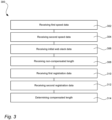
- Fig. 3 is a flowchart illustrating a method 300 for monitoring the web handling arrangement 100 holding the web 102 of packaging material.
- the method may comprise receiving 302 the first speed data 120 from the first motor 106; receiving 304 the second speed data 122 from the second motor 110; receiving 306 the initial web slack data 126 representing the initial web slack WS-I at the first point of time; determining 308 the non-compensated length of the web slack 112 at the second point of time based on the first and second speed data 120, 122 for the time period spanning from the first point of time to the second point of time and the initial web slack data 126; receiving 310 the first registration data 128 from the first sensor 114, said first registration data 128 pertaining to a detection of the mark 116 at the first point of time; receiving 312 the second registration data 130 from the second sensor 118, said second registration data 130 pertaining to the detection of the mark 116 at the third point of time; and determining 314 the compensated
Landscapes
- Engineering & Computer Science (AREA)
- Mechanical Engineering (AREA)
- Controlling Rewinding, Feeding, Winding, Or Abnormalities Of Webs (AREA)
Applications Claiming Priority (1)
| Application Number | Priority Date | Filing Date | Title |
|---|---|---|---|
| IT102023000025338A IT202300025338A1 (it) | 2023-11-28 | 2023-11-28 | Metodo per monitorare un gruppo per la gestione di un nastro |
Publications (1)
| Publication Number | Publication Date |
|---|---|
| EP4563508A1 true EP4563508A1 (fr) | 2025-06-04 |
Family
ID=89723263
Family Applications (1)
| Application Number | Title | Priority Date | Filing Date |
|---|---|---|---|
| EP24212136.6A Pending EP4563508A1 (fr) | 2023-11-28 | 2024-11-11 | Procédé de surveillance d'un agencement de manipulation de bande |
Country Status (3)
| Country | Link |
|---|---|
| EP (1) | EP4563508A1 (fr) |
| IT (1) | IT202300025338A1 (fr) |
| WO (1) | WO2025113971A1 (fr) |
Citations (3)
| Publication number | Priority date | Publication date | Assignee | Title |
|---|---|---|---|---|
| GB2249782A (en) * | 1990-11-19 | 1992-05-20 | Tokyo Automatic Mach Works | Web feeding mechanism |
| EP3246262A1 (fr) * | 2015-01-15 | 2017-11-22 | Ishida Co., Ltd. | Machine de fabrication et d'emballage de sacs |
| EP3725692A1 (fr) * | 2019-04-19 | 2020-10-21 | Tetra Laval Holdings & Finance S.A. | Machine d'emballage et procédé pour la production d'emballages |
-
2023
- 2023-11-28 IT IT102023000025338A patent/IT202300025338A1/it unknown
-
2024
- 2024-11-11 WO PCT/EP2024/081883 patent/WO2025113971A1/fr active Pending
- 2024-11-11 EP EP24212136.6A patent/EP4563508A1/fr active Pending
Patent Citations (3)
| Publication number | Priority date | Publication date | Assignee | Title |
|---|---|---|---|---|
| GB2249782A (en) * | 1990-11-19 | 1992-05-20 | Tokyo Automatic Mach Works | Web feeding mechanism |
| EP3246262A1 (fr) * | 2015-01-15 | 2017-11-22 | Ishida Co., Ltd. | Machine de fabrication et d'emballage de sacs |
| EP3725692A1 (fr) * | 2019-04-19 | 2020-10-21 | Tetra Laval Holdings & Finance S.A. | Machine d'emballage et procédé pour la production d'emballages |
Also Published As
| Publication number | Publication date |
|---|---|
| IT202300025338A1 (it) | 2025-05-28 |
| WO2025113971A1 (fr) | 2025-06-05 |
Similar Documents
| Publication | Publication Date | Title |
|---|---|---|
| AU2015377541B2 (en) | Bag making and packaging machine | |
| JPH02500971A (ja) | 可変繰り返し長さ部分を持つウェブ用の調整制御システム | |
| JP3073001B2 (ja) | ラベル貼り機のためのオンラインエンボス装置 | |
| CA2837005A1 (fr) | Procede de detection de la position transversale d'un materiau d'emballage, en particulier d'un emballage filme | |
| RU2538372C2 (ru) | Упаковочный материал, содержащий намагничиваемые участки | |
| JP4096112B2 (ja) | ウェッブの位置合せ装置 | |
| CN110116834B (zh) | 在包装机中用于自动控制薄膜网送料的方法 | |
| EP4563508A1 (fr) | Procédé de surveillance d'un agencement de manipulation de bande | |
| EP3964361A1 (fr) | Procédé et système d'impression | |
| US10286583B2 (en) | Unit and a method for carrying out a first operation and a second operation on a web | |
| US8740061B2 (en) | Recording information for a web manufacturing process | |
| US12473112B2 (en) | Filling machine package waste management | |
| RU2571900C2 (ru) | Упаковочный материал и способ получения конечной упаковки | |
| JP7835757B2 (ja) | 強化学習に基づく食品包装システムにおけるパッケージ形成の高度化 | |
| JP3701402B2 (ja) | 不良指示方法および装置ならびに不良除去方法および装置 | |
| EP4450405A1 (fr) | Procédé d'association de données de machine à un paquet, et système associé | |
| Zamuragin et al. | Adaptive system of position synchronization of tape materials in automatic assembly | |
| US20070081715A1 (en) | Quality control system and method for moving web material | |
| EP4450285A2 (fr) | Procédé de production d'une bande de matériau d'emballage et appareil associé | |
| JP2011189607A (ja) | パンチ穴位置ずれ検知装置及び製袋機 | |
| SE2151019A1 (en) | System and methods for the calculation of additional local stretching in a web | |
| RU2537543C2 (ru) | Упаковочный материал | |
| JP7516880B2 (ja) | 製袋装置、及び袋状の包装容器の製造方法 | |
| EP4464634A1 (fr) | Dispositif d'alimentation et procédé d'alimentation | |
| CN106276372A (zh) | 一种定位卷装包装缺陷的方法及装置 |
Legal Events
| Date | Code | Title | Description |
|---|---|---|---|
| PUAI | Public reference made under article 153(3) epc to a published international application that has entered the european phase |
Free format text: ORIGINAL CODE: 0009012 |
|
| STAA | Information on the status of an ep patent application or granted ep patent |
Free format text: STATUS: THE APPLICATION HAS BEEN PUBLISHED |
|
| AK | Designated contracting states |
Kind code of ref document: A1 Designated state(s): AL AT BE BG CH CY CZ DE DK EE ES FI FR GB GR HR HU IE IS IT LI LT LU LV MC ME MK MT NL NO PL PT RO RS SE SI SK SM TR |
|
| STAA | Information on the status of an ep patent application or granted ep patent |
Free format text: STATUS: REQUEST FOR EXAMINATION WAS MADE |
|
| 17P | Request for examination filed |
Effective date: 20251204 |