EP4563641A1 - Composition de résine de polypropylène présentant une excellente résistance aux chocs à basse température et composés organiques faiblement volatils et article moulé à partir de celle-ci - Google Patents
Composition de résine de polypropylène présentant une excellente résistance aux chocs à basse température et composés organiques faiblement volatils et article moulé à partir de celle-ci Download PDFInfo
- Publication number
- EP4563641A1 EP4563641A1 EP24215607.3A EP24215607A EP4563641A1 EP 4563641 A1 EP4563641 A1 EP 4563641A1 EP 24215607 A EP24215607 A EP 24215607A EP 4563641 A1 EP4563641 A1 EP 4563641A1
- Authority
- EP
- European Patent Office
- Prior art keywords
- polypropylene resin
- resin composition
- propylene
- weight
- ethylene
- Prior art date
- Legal status (The legal status is an assumption and is not a legal conclusion. Google has not performed a legal analysis and makes no representation as to the accuracy of the status listed.)
- Granted
Links
Images

Classifications
-
- C—CHEMISTRY; METALLURGY
- C08—ORGANIC MACROMOLECULAR COMPOUNDS; THEIR PREPARATION OR CHEMICAL WORKING-UP; COMPOSITIONS BASED THEREON
- C08L—COMPOSITIONS OF MACROMOLECULAR COMPOUNDS
- C08L23/00—Compositions of homopolymers or copolymers of unsaturated aliphatic hydrocarbons having only one carbon-to-carbon double bond; Compositions of derivatives of such polymers
- C08L23/02—Compositions of homopolymers or copolymers of unsaturated aliphatic hydrocarbons having only one carbon-to-carbon double bond; Compositions of derivatives of such polymers not modified by chemical after-treatment
- C08L23/10—Homopolymers or copolymers of propene
- C08L23/14—Copolymers of propene
-
- C—CHEMISTRY; METALLURGY
- C08—ORGANIC MACROMOLECULAR COMPOUNDS; THEIR PREPARATION OR CHEMICAL WORKING-UP; COMPOSITIONS BASED THEREON
- C08L—COMPOSITIONS OF MACROMOLECULAR COMPOUNDS
- C08L23/00—Compositions of homopolymers or copolymers of unsaturated aliphatic hydrocarbons having only one carbon-to-carbon double bond; Compositions of derivatives of such polymers
- C08L23/02—Compositions of homopolymers or copolymers of unsaturated aliphatic hydrocarbons having only one carbon-to-carbon double bond; Compositions of derivatives of such polymers not modified by chemical after-treatment
- C08L23/10—Homopolymers or copolymers of propene
- C08L23/12—Polypropene
-
- C—CHEMISTRY; METALLURGY
- C08—ORGANIC MACROMOLECULAR COMPOUNDS; THEIR PREPARATION OR CHEMICAL WORKING-UP; COMPOSITIONS BASED THEREON
- C08L—COMPOSITIONS OF MACROMOLECULAR COMPOUNDS
- C08L53/00—Compositions of block copolymers containing at least one sequence of a polymer obtained by reactions only involving carbon-to-carbon unsaturated bonds; Compositions of derivatives of such polymers
-
- B—PERFORMING OPERATIONS; TRANSPORTING
- B29—WORKING OF PLASTICS; WORKING OF SUBSTANCES IN A PLASTIC STATE IN GENERAL
- B29C—SHAPING OR JOINING OF PLASTICS; SHAPING OF MATERIAL IN A PLASTIC STATE, NOT OTHERWISE PROVIDED FOR; AFTER-TREATMENT OF THE SHAPED PRODUCTS, e.g. REPAIRING
- B29C45/00—Injection moulding, i.e. forcing the required volume of moulding material through a nozzle into a closed mould; Apparatus therefor
- B29C45/0001—Injection moulding, i.e. forcing the required volume of moulding material through a nozzle into a closed mould; Apparatus therefor characterised by the choice of material
-
- C—CHEMISTRY; METALLURGY
- C08—ORGANIC MACROMOLECULAR COMPOUNDS; THEIR PREPARATION OR CHEMICAL WORKING-UP; COMPOSITIONS BASED THEREON
- C08K—Use of inorganic or non-macromolecular organic substances as compounding ingredients
- C08K3/00—Use of inorganic substances as compounding ingredients
- C08K3/10—Metal compounds
- C08K3/105—Compounds containing metals of Groups 1 to 3 or of Groups 11 to 13 of the Periodic Table
-
- C—CHEMISTRY; METALLURGY
- C08—ORGANIC MACROMOLECULAR COMPOUNDS; THEIR PREPARATION OR CHEMICAL WORKING-UP; COMPOSITIONS BASED THEREON
- C08K—Use of inorganic or non-macromolecular organic substances as compounding ingredients
- C08K3/00—Use of inorganic substances as compounding ingredients
- C08K3/18—Oxygen-containing compounds, e.g. metal carbonyls
- C08K3/24—Acids; Salts thereof
- C08K3/26—Carbonates; Bicarbonates
-
- C—CHEMISTRY; METALLURGY
- C08—ORGANIC MACROMOLECULAR COMPOUNDS; THEIR PREPARATION OR CHEMICAL WORKING-UP; COMPOSITIONS BASED THEREON
- C08K—Use of inorganic or non-macromolecular organic substances as compounding ingredients
- C08K5/00—Use of organic ingredients
- C08K5/04—Oxygen-containing compounds
- C08K5/05—Alcohols; Metal alcoholates
- C08K5/053—Polyhydroxylic alcohols
-
- C—CHEMISTRY; METALLURGY
- C08—ORGANIC MACROMOLECULAR COMPOUNDS; THEIR PREPARATION OR CHEMICAL WORKING-UP; COMPOSITIONS BASED THEREON
- C08K—Use of inorganic or non-macromolecular organic substances as compounding ingredients
- C08K5/00—Use of organic ingredients
- C08K5/04—Oxygen-containing compounds
- C08K5/09—Carboxylic acids; Metal salts thereof; Anhydrides thereof
- C08K5/098—Metal salts of carboxylic acids
-
- C—CHEMISTRY; METALLURGY
- C08—ORGANIC MACROMOLECULAR COMPOUNDS; THEIR PREPARATION OR CHEMICAL WORKING-UP; COMPOSITIONS BASED THEREON
- C08K—Use of inorganic or non-macromolecular organic substances as compounding ingredients
- C08K5/00—Use of organic ingredients
- C08K5/04—Oxygen-containing compounds
- C08K5/10—Esters; Ether-esters
- C08K5/12—Esters; Ether-esters of cyclic polycarboxylic acids
-
- C—CHEMISTRY; METALLURGY
- C08—ORGANIC MACROMOLECULAR COMPOUNDS; THEIR PREPARATION OR CHEMICAL WORKING-UP; COMPOSITIONS BASED THEREON
- C08K—Use of inorganic or non-macromolecular organic substances as compounding ingredients
- C08K5/00—Use of organic ingredients
- C08K5/49—Phosphorus-containing compounds
- C08K5/51—Phosphorus bound to oxygen
- C08K5/52—Phosphorus bound to oxygen only
- C08K5/524—Esters of phosphorous acids, e.g. of H3PO3
- C08K5/526—Esters of phosphorous acids, e.g. of H3PO3 with hydroxyaryl compounds
-
- C—CHEMISTRY; METALLURGY
- C08—ORGANIC MACROMOLECULAR COMPOUNDS; THEIR PREPARATION OR CHEMICAL WORKING-UP; COMPOSITIONS BASED THEREON
- C08L—COMPOSITIONS OF MACROMOLECULAR COMPOUNDS
- C08L23/00—Compositions of homopolymers or copolymers of unsaturated aliphatic hydrocarbons having only one carbon-to-carbon double bond; Compositions of derivatives of such polymers
- C08L23/02—Compositions of homopolymers or copolymers of unsaturated aliphatic hydrocarbons having only one carbon-to-carbon double bond; Compositions of derivatives of such polymers not modified by chemical after-treatment
- C08L23/04—Homopolymers or copolymers of ethene
- C08L23/06—Polyethylene
-
- C—CHEMISTRY; METALLURGY
- C08—ORGANIC MACROMOLECULAR COMPOUNDS; THEIR PREPARATION OR CHEMICAL WORKING-UP; COMPOSITIONS BASED THEREON
- C08L—COMPOSITIONS OF MACROMOLECULAR COMPOUNDS
- C08L2207/00—Properties characterising the ingredient of the composition
- C08L2207/02—Heterophasic composition
-
- C—CHEMISTRY; METALLURGY
- C08—ORGANIC MACROMOLECULAR COMPOUNDS; THEIR PREPARATION OR CHEMICAL WORKING-UP; COMPOSITIONS BASED THEREON
- C08L—COMPOSITIONS OF MACROMOLECULAR COMPOUNDS
- C08L2207/00—Properties characterising the ingredient of the composition
- C08L2207/06—Properties of polyethylene
- C08L2207/062—HDPE
Definitions
- the present invention relates to a polypropylene resin composition with excellent impact resistance and a low level of volatile organic compounds discharged and to an article molded therefrom.
- the present invention relates to a polypropylene resin composition that comprises a propylene-ethylene block copolymer resin as a main component and has excellent impact resistance at low temperatures and room temperature and a low level of volatile organic compounds discharged and to a molded article prepared therefrom.
- a polypropylene resin which is one of the general-purpose resins, is not only inexpensive but also excellent in mechanical properties, moldability, and chemical resistance. Thus, it is widely used as a material for automobile interior and exterior parts, electronic and household appliance parts, construction and industrial supplies, films, pipes, power cables, and the like.
- a propylene-ethylene block copolymer which is a type of polypropylene, is a polymer in which a propylene-ethylene rubber copolymer is dispersed in a propylene homopolymer. It is a resin that reinforces the impact resistance of a propylene homopolymer.
- R-TPO reactor-made-thermoplastic olefin
- Polypropylene resins which have excellent impact resistance, are difficult to have a high melt index; thus, a peroxide is usually added to polypropylene resins to increase the final melt index.
- the residual peroxide has a strong odor and discharges a large amount of volatile organic compounds, making it unsuitable for use as automobile parts or food containers. Accordingly, there is a need to develop a polypropylene resin composition that has excellent impact resistance and high melt index characteristics and discharges a low amount of volatile organic compounds.
- Patent Document 1 Korean Laid-open Patent Publication No. 10-2007-0098279
- An object of the present invention is to provide a polypropylene resin composition that has excellent impact resistance at low temperatures and room temperature and a low level of volatile organic compounds discharged.
- Another object of the present invention is to provide an article molded from the polypropylene resin composition that has excellent impact resistance at low temperatures and room temperature and a low level of volatile organic compounds discharged.
- a polypropylene resin composition that comprises, based on the total weight of components (A) and (B), (A) 85 to 97% by weight of a propylene-ethylene block copolymer obtained by the polymerization of a propylene homopolymer as a matrix with a propylene-ethylene rubber copolymer in stages in reactors; and (B) 3 to 15% by weight of a polyethylene, wherein, when the propylene-ethylene block copolymer (A) is extracted with a xylene solvent at room temperature, the content of the propylene-ethylene rubber copolymer measured as the amount of a solvent extract (or xylene soluble) is 25 to 40% by weight, the content of ethylene in the xylene soluble is 35 to 45% by weight, the content of ethylene in the propylene-ethylene block copolymer (A) is 9 to 20% by weight, and the ratio (MFR T /MFR M ) of the
- the propylene-ethylene block copolymer (A) may have a melt index of 30 to 50 g/10 minutes when measured at 230°C under a load of 2.16 kg.
- the polyethylene (B) may comprise a low-density polyethylene (LDPE), a linear low-density polyethylene (LLDPE), or a high-density polyethylene (HDPE).
- LDPE low-density polyethylene
- LLDPE linear low-density polyethylene
- HDPE high-density polyethylene
- the polyethylene (B) may comprise a high-density polyethylene.
- the polypropylene resin composition may further comprise at least one additive selected from the group consisting of an antioxidant, a neutralizer, a slip agent, an anti-blocking agent, a reinforcing agent, a filler, a weathering stabilizer, an antistatic agent, a lubricant, a nucleating agent, a flame retardant, a pigment, and a dye.
- at least one additive selected from the group consisting of an antioxidant, a neutralizer, a slip agent, an anti-blocking agent, a reinforcing agent, a filler, a weathering stabilizer, an antistatic agent, a lubricant, a nucleating agent, a flame retardant, a pigment, and a dye.
- the polypropylene resin composition may further comprise at least one antioxidant selected from the group consisting of pentaerythritol tetrakis(3-(3,5-di-t-butyl-4-hydroxyphenyl)propionate), 1,3,5-trimethyl-2,4,6-tris(3,5-di-t-butyl-4-hydroxybenzyl)benzene, and tris(2,4-di-t-butylphenyl)phosphite in an amount of 0.05 to 0.3 part by weight relative to 100 parts by weight of the composition.
- at least one antioxidant selected from the group consisting of pentaerythritol tetrakis(3-(3,5-di-t-butyl-4-hydroxyphenyl)propionate), 1,3,5-trimethyl-2,4,6-tris(3,5-di-t-butyl-4-hydroxybenzyl)benzene, and tris(2,4-di-t-butylphenyl)pho
- the polypropylene resin composition may further comprise at least one neutralizer selected from the group consisting of hydrotalcite and calcium stearate in an amount of 0.05 to 0.3 part by weight relative to 100 parts by weight of the composition.
- the polypropylene resin composition may have a melt index of 30 to 50 g/10 minutes when measured at 230°C under a load of 2.16 kg.
- the polypropylene resin composition when analyzed by differential scanning calorimetry, it may have a temperature of the first peak in the range of 125 to 130°C that appears during the second elevation of temperature.
- the amount of total volatile organic compounds discharged from the polypropylene resin composition may be 400 ppm or less.
- a polypropylene resin article molded from the polypropylene resin composition.
- the polypropylene resin article may be prepared by injection-molding the polypropylene resin composition.
- the polypropylene resin article may have an Izod impact strength of 50 kgf ⁇ cm/cm or more when measured at 23°C and an Izod impact strength of 50 kgf ⁇ cm/cm or more when measured at 0°C.
- the polypropylene resin article according to an embodiment of the present invention may be an automobile interior or exterior part, a toy for children, or a food storage container.
- a polypropylene resin article prepared from the polypropylene resin composition according to an embodiment of the present invention has excellent low-temperature impact resistance and a low level of volatile organic compounds discharged, it can be advantageously used as an automobile interior or exterior part, a toy for children, or a food storage container.
- a polypropylene resin composition which comprises, based on the total weight of components (A) and (B), (A) 85 to 97% by weight of a propylene-ethylene block copolymer obtained by the polymerization of a propylene homopolymer as a matrix with a propylene-ethylene rubber copolymer in stages in reactors; and (B) 3 to 15% by weight of a polyethylene, wherein, when the propylene-ethylene block copolymer (A) is extracted with a xylene solvent at room temperature, the content of the propylene-ethylene rubber copolymer measured as the amount of a solvent extract (or xylene soluble) is 25 to 40% by weight, the content of ethylene in the xylene soluble is 35 to 45% by weight, the content of ethylene in the propylene-ethylene block copolymer (A) is 9 to 20% by weight, and the ratio (MFR T /MFR M ) of the melt index (MFR
- the polypropylene resin composition according to an embodiment of the present invention comprises a propylene-ethylene block copolymer (A).
- the propylene-ethylene block copolymer (A) may be a polymer obtained by the polymerization of a propylene homopolymer with a propylene-ethylene rubber copolymer in stages in reactors.
- the content of the propylene-ethylene rubber copolymer measured as the amount of a solvent extract (or xylene soluble) is 25 to 40% by weight.
- the content of the propylene-ethylene rubber copolymer measured as the amount of a solvent extract (or xylene soluble) may be 26 to 38% by weight, more preferably, 30 to 35% by weight.
- the content of the propylene-ethylene rubber copolymer is less than 25% by weight, the Izod impact strength of a resin article molded from the composition when measured at 23 °C may be deteriorated. If the content of the propylene-ethylene rubber copolymer exceeds 40% by weight, there is a possibility that the Izod impact strength of a resin article molded from the composition may not be further improved while the flexural modulus thereof is deteriorated.
- the content of ethylene in the xylene soluble of the propylene-ethylene block copolymer (A) is 35 to 45% by weight.
- the content of ethylene in the xylene soluble of the propylene-ethylene block copolymer (A) may be 36 to 44% by weight, more preferably, 37 to 44% by weight. If the content of ethylene in the xylene soluble is less than 35% by weight or greater than 45% by weight, the Izod impact strength of a resin article molded from the composition when measured at 23 °C may be deteriorated.
- the content of ethylene in the propylene-ethylene block copolymer (A) is 9 to 20% by weight.
- the content of ethylene in the propylene-ethylene block copolymer (A) may be 10 to 18% by weight, more preferably, 12 to 16% by weight. If the content of ethylene in the propylene-ethylene block copolymer (A) is less than 9% by weight, the Izod impact strength at 23 °C of a resin article molded therefrom may be deteriorated.
- the content of ethylene in the propylene-ethylene block copolymer (A) exceeds 20% by weight, the compatibility between the propylene homopolymer and the propylene-ethylene rubber copolymer is low, which makes difficult the dispersion of the propylene-ethylene rubber copolymer in the propylene homopolymer matrix. As a result, there is a concern that the balance of rigidity and impact resistance of a resin article molded from the composition may be reduced.
- the propylene-ethylene block copolymer (A) may have a melt index of 30 to 50 g/10 minutes when measured at 230°C under a load of 2.16 kg.
- the melt index of the propylene-ethylene block copolymer (A) measured at 230°C under a load of 2.16 kg may be 35 to 45 g/10 minutes.
- melt index is less than 30 g/10 minutes, the flowability of the resin composition during injection may be decreased, thereby deteriorating processability. If the melt index exceeds 50 g/10 minute, there is a concern that the impact resistance of a resin article molded from the composition may not be sufficiently improved.
- the polypropylene resin composition according to an embodiment of the present invention comprises 85 to 97% by weight of the propylene-ethylene block copolymer (A) based on the total weight of components (A) and (B).
- the polypropylene resin composition may comprise 90 to 97% by weight of the propylene-ethylene block copolymer (A) based on the total weight of components (A) and (B). If the content of the propylene-ethylene block copolymer (A) is less than 85% by weight, the flexural modulus of a resin article molded from the composition may be deteriorated. On the other hand, if the content of the propylene-ethylene block copolymer (A) exceeds 97% by weight, the Izod impact strength of a resin article molded from the composition when measured at 0°C may be deteriorated.
- the method of preparing the propylene-ethylene block copolymer (A) There is no particular limitation to the method of preparing the propylene-ethylene block copolymer (A). Any method of preparing a propylene-ethylene block copolymer known in the art to which the present invention pertains may be used as it is or appropriately modified. For example, a bulk polymerization method, a solution polymerization method, a slurry polymerization method, a gas phase polymerization method, or the like may be used. Further, either a batch type or a continuous type is possible.
- propylene-ethylene block copolymer (A) in order to increase the molecular weight distribution of the propylene-ethylene block copolymer (A), if necessary, several polymerization reactors for the polymerization of propylene-based polymers are arranged in series, and the polymerization may be carried out sequentially with the degree of polymerization in each polymerization reactor adjusted to be different.
- the propylene-ethylene block copolymer (A) may be prepared by a polymerization method known to those skilled in the art using a commercialized process such as LyondellBasell's Spherizone process, Mitsui's Hypol process, or Grace's Unipol process.
- the Spherizone process may be a process in which one loop-type reactor called a multizone circulating reactor (MZCR) and one gas-phase reactor are connected in series to enable continuous polymerization.
- MZCR multizone circulating reactor
- propylene alone may be fed to the MZCR reactor to produce a propylene homopolymer.
- propylene and ethylene may be fed to carry out the block-polymerization of a propylene-ethylene rubber component, thereby obtaining the propylene-ethylene block copolymer.
- the melt index of the resulting copolymer can be controlled by injecting hydrogen into each reactor.
- the Hypol process may be a process in which two bulk or slurry reactors and two gas-phase reactors are connected in series to enable continuous polymerization. Specifically, propylene alone may be fed to the first- to third-stage reactors to produce a propylene homopolymer. In the ensuing fourth-stage reactor, propylene and ethylene may be fed to carry out the block-polymerization of a propylene-ethylene rubber component, thereby obtaining the propylene-ethylene block copolymer. The melt index of the resulting copolymer can be controlled by injecting hydrogen into each reactor.
- two or more gas-phase reactors are connected in series, and polymerization can be continuously carried out.
- propylene alone may be fed to the first-stage reactor to produce a propylene homopolymer.
- propylene and ethylene may be fed to carry out the block-polymerization of a propylene-ethylene rubber component, thereby obtaining the propylene-ethylene block copolymer.
- the melt index of the resulting copolymer can be controlled by injecting hydrogen into each reactor.
- the propylene-ethylene block copolymer (A) may be polymerized in the presence of a Ziegler-Natta catalyst or a metallocene catalyst.
- a Ziegler-Natta catalyst may be prepared using a phthalate-based, succinate-based, or diether-based internal electron donor, two or more of which may be used in combination.
- dialkoxymagnesium may be reacted with a titanium compound and a phthalate-based, succinate-based, or diether-based internal electron donor in the presence of an organic solvent to prepare a catalyst for the polymerization of propylene.
- a propylene monomer may then be polymerized in the presence of this catalyst, along with a co-catalyst and an external electron donor, to produce a propylene-ethylene block copolymer (A).
- a catalyst system formed by selecting and combining the catalysts, alkylaluminum, and an appropriate external electron donor disclosed in Korean Laid-open Patent Publication Nos. 2006-0038101 , 2006-0038102 , and 2006-0038103 may be used.
- a catalyst capable of increasing the tacticity in order to maximize the balance between rigidity and impact resistance of the resin article of the present invention, it is preferable to use a catalyst capable of increasing the tacticity.
- the polypropylene resin composition according to an embodiment of the present invention comprises a polyethylene (B).
- the polyethylene (B) may be a polymer obtained by the polymerization of an ethylene monomer substantially alone or by the copolymerization of a small amount of C 4-8 alpha-olefin with ethylene.
- the type of the polyethylene (B) is not particularly limited.
- the polyethylene may comprise a low-density polyethylene (LDPE), a linear low-density polyethylene (LLDPE), or a high-density polyethylene (HDPE).
- LDPE low-density polyethylene
- LLDPE linear low-density polyethylene
- HDPE high-density polyethylene
- the polyethylene (B) may comprise a high-density polyethylene.
- the polypropylene resin composition according to an embodiment of the present invention comprises 3 to 15% by weight of the polyethylene (B) based on the total weight of components (A) and (B).
- the polypropylene resin composition may comprise 3 to 10% by weight of the polyethylene (B) based on the total weight of components (A) and (B). If the content of the polyethylene (B) is less than 3% by weight, the Izod impact strength of a resin article molded from the composition when measured at 0°C may be deteriorated. On the other hand, if the content of the polyethylene (B) exceeds 15% by weight, the flexural modulus of a resin article molded from the composition may be deteriorated.
- the polypropylene resin composition according to an embodiment of the present invention may further comprise conventional additives within a range that does not depart from the scope of the present invention.
- the polypropylene resin composition may further comprise at least one additive selected from an antioxidant, a neutralizer, a slip agent, an anti-blocking agent, a reinforcing agent, a filler, a weathering stabilizer, an antistatic agent, a lubricant, a nucleating agent, a flame retardant, a pigment, and a dye, but it is not particularly limited thereto.
- the polypropylene resin composition may further comprise an antioxidant to increase the thermal stability thereof.
- the content of the antioxidant may be 0.05 to 0.3 part by weight, preferably 0.05 to 0.2 part by weight, relative to 100 parts by weight of components (A) and (B). If the content of the antioxidant is less than 0.05 part by weight, it is difficult to secure long-term thermal stability. On the other hand, if the content of the antioxidant exceeds 0.3 part by weight, the thermal stability would not be further improved, while the economic efficiency of the product may be reduced, which is not preferable.
- the antioxidant may be a phenolic antioxidant, a phosphite antioxidant, or the like. Specifically, it may comprise at least one antioxidant selected from the group consisting of pentaerythritol tetrakis(3-(3,5-di-t-butyl-4-hydroxyphenyl)propionate), 1,3,5-trimethyl-2,4,6-tris(3,5-di-t-butyl-4-hydroxybenzyl)benzene, and tris(2,4-di-t-butylphenyl)phosphite, but it is not particularly limited thereto.
- the polypropylene resin composition may further comprise a neutralizer to remove the catalyst components remaining in the polypropylene resin composition.
- the content of the neutralizer may be 0.05 to 0.3 part by weight, preferably 0.05 to 0.2 part by weight, relative to 100 parts by weight of components (A) and (B). If the content of the neutralizer is less than 0.05 part by weight, it is difficult to sufficiently remove the residual catalyst components. On the other hand, if the content of the neutralizer exceeds 0.3 part by weight, the effect of removing the residual catalyst components would not be further improved, while the economic efficiency of the product may be reduced, which is not preferable.
- the neutralizer may comprise at least one selected from the group consisting of hydrotalcite and calcium stearate, but it is not particularly limited thereto.
- the propylene-ethylene block copolymer resin, polyethylene resin, and additives described above are supplied to a mixer such as a kneader, a roll, and a Banbury mixer, or a single- or twin-screw extruder in predetermined amounts, and they are then blended with this apparatus, thereby preparing the polypropylene resin composition of the present invention.
- a mixer such as a kneader, a roll, and a Banbury mixer, or a single- or twin-screw extruder in predetermined amounts
- the polypropylene resin composition according to an embodiment of the present invention may have a melt index of 30 to 50 g/10 min when measured at 230°C under a load of 2.16 kg.
- the melt index of the polypropylene resin composition measured at 230°C under a load of 2.16 kg may be 35 to 45 g/10 minutes. If the melt index of the polypropylene resin composition is less than 30 g/10 minutes, there is a concern that the melt flowability of the resin composition is low, resulting in molding defects during injection molding. If the melt index exceeds 50 g/10 minute, there is a concern that the impact resistance of a resin article molded from the composition may be low.
- the ratio (MFR T /MFR M ) of the melt index (MFR T ) of the polypropylene resin composition to the melt index (MFR M ) of the propylene homopolymer matrix of the propylene-ethylene block copolymer (A) satisfies 0.3 or less (MFR T /MFR M ⁇ 0.3).
- the respective melt indices are measured at 230°C under a load of 2.16 kg.
- melt index of the propylene homopolymer matrix of the propylene-ethylene block copolymer (A) may be measured by sampling the propylene homopolymer before the propylene-ethylene rubber component is block-copolymerized in the above-mentioned preparation process.
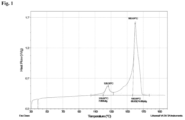
- the polypropylene resin composition when analyzed by differential scanning calorimetry, it may have a temperature of the first peak in the range of 125 to 130°C that appears during the second elevation of temperature.
- the amount of total volatile organic compounds discharged from the polypropylene resin composition may be 400 ppm or less.
- the melt index of the final resin composition can be increased without adding a peroxide, resulting in a low level of volatile organic compounds discharged.
- the method of preparing a molded article from the polypropylene resin composition according to an embodiment of the present invention Any method known in the technical field to which the present invention pertains may be used.
- the polypropylene resin composition according to an embodiment of the present invention may be molded by a conventional method such as injection molding, extrusion molding, casting molding, or the like to prepare a polypropylene resin article.
- the polypropylene resin composition may be injection molded to prepare a polypropylene resin article.
- the polypropylene resin article may have an Izod impact strength of 50 kgf ⁇ cm/cm or more when measured at 23°C and an Izod impact strength of 50 kgf ⁇ cm/cm or more when measured at 0°C.
- the polypropylene resin article according to an embodiment of the present invention has excellent low-temperature impact resistance and a low level of volatile organic compounds discharged, it can be advantageously used as an automobile interior or exterior part, a toy for children, or a food storage container.
- the polypropylene resin article according to an embodiment of the present invention has excellent impact resistance even at low temperatures, it is suitable for use as an automobile bumper. It may substitute a polyolefin-based thermoplastic elastomer in a polypropylene composite resin composition, thereby producing a cost-reduction effect.
- a propylene-ethylene block copolymer (A) was prepared using Grace's Consista C601 catalyst in Grace's Unipol process. Specifically, propylene was fed to the first-stage gas-phase reactor to prepare a propylene homopolymer matrix. Propylene and ethylene were copolymerized in the presence of the propylene homopolymer matrix in the subsequent second-stage gas-phase reactor to prepare a propylene-ethylene block copolymer (A). The composition of the propylene-ethylene block copolymer thus obtained is shown in Table 1.
- the propylene-ethylene block copolymer resin of Table 1 was mixed with a polyethylene resin (B) (Hanwha TotalEnergies, HDPE C430A; MFR (at 190°C and 2.16 kg) 1.7 g/10 minutes) in the composition shown in Table 2 below, followed by mixing and kneading with 500/500 ppm of antioxidants (Irganox 1010/Irgafos 168) and 400 ppm of a neutralizer (calcium stearate).
- Pellets of the polypropylene resin composition were prepared using a twin-screw kneading extruder (SM Platek, TEK-30, LID 36, 30-mm twin-screw extruder).
- ASTM No. 4 injection specimens were prepared using a Woojin injection machine (SELEX-TE 150, 150 tons, screw diameter 36 mm). The physical properties were measured in the following manner and summarized in Table 3 below.
- the melt index of the polypropylene resin composition, the polypropylene homopolymer matrix and the propylene-ethylene block copolymer was measured at 230°C under a load of 2.16 kg according to ASTM D 1238.
- the flexural modulus was measured at 23°C in accordance with ASTM D770.
- the Izod impact strength was measured with a notched specimen having a thickness of 3.2 mm at 0°C and 23°C according to ASTM D256.
- a static head space sampler (Agilent's 7697A) was used. After resin pellets reached equilibrium at a certain temperature (180°C), the volatile organic components generated were analyzed using GC/FID (Agilent's 7890B) with n-hexane as a reference material.
- Exothermic and endothermic curves were obtained by differential scanning calorimetry. Specifically, a sample was placed in an aluminum pan, the temperature was first raised to 200°C at 40°C/minute, the temperature was maintained at 200°C for 10 minutes, the temperature was lowered to 30°C at 10°C/minute, the temperature was maintained at 30°C for 10 minutes, and the temperature was raised again to 200°C at 10°C/minute. The temperature at which the first peak appeared in the endothermic curve during the second temperature elevation was obtained.
- the molded article prepared therefrom had excellent flexural modulus and Izod impact strength at 0°C and 23°C. In addition, the level of total volatile organic compounds discharged was low.
- Comparative Example 2 In contrast, in the resin composition of Comparative Example 1, which did not comprise a polyethylene resin, the Izod impact strength at 0°C was deteriorated. In Comparative Example 2, the Izod impact strength 0°C and 23°C was excellent, whereas the ratio MFR T /MFR M exceeded the range of the present invention, indicating that a large amount of total volatile organic compounds was discharged.
- the polypropylene resin composition according to an embodiment of the present invention has excellent impact resistance and a low level of total volatile organic compounds discharged, an article molded therefrom can be advantageously used as an automobile interior or exterior part, a toy for children, or a food storage container.
Landscapes
- Chemical & Material Sciences (AREA)
- Health & Medical Sciences (AREA)
- Chemical Kinetics & Catalysis (AREA)
- Medicinal Chemistry (AREA)
- Polymers & Plastics (AREA)
- Organic Chemistry (AREA)
- Engineering & Computer Science (AREA)
- Manufacturing & Machinery (AREA)
- Mechanical Engineering (AREA)
- Compositions Of Macromolecular Compounds (AREA)
Applications Claiming Priority (1)
| Application Number | Priority Date | Filing Date | Title |
|---|---|---|---|
| KR1020230170408A KR102857710B1 (ko) | 2023-11-30 | 2023-11-30 | 저온 내충격성이 우수하고 휘발성 유기 화합물 배출이 적은 폴리프로필렌 수지 조성물 및 그로부터 제조된 성형품 |
Publications (3)
| Publication Number | Publication Date |
|---|---|
| EP4563641A1 true EP4563641A1 (fr) | 2025-06-04 |
| EP4563641B1 EP4563641B1 (fr) | 2026-01-14 |
| EP4563641C0 EP4563641C0 (fr) | 2026-01-14 |
Family
ID=93656190
Family Applications (1)
| Application Number | Title | Priority Date | Filing Date |
|---|---|---|---|
| EP24215607.3A Active EP4563641B1 (fr) | 2023-11-30 | 2024-11-26 | Composition de résine de polypropylène présentant une excellente résistance aux chocs à basse température et composés organiques faiblement volatils et article moulé à partir de celle-ci |
Country Status (4)
| Country | Link |
|---|---|
| US (1) | US20250179282A1 (fr) |
| EP (1) | EP4563641B1 (fr) |
| KR (1) | KR102857710B1 (fr) |
| CN (1) | CN120059392A (fr) |
Citations (8)
| Publication number | Priority date | Publication date | Assignee | Title |
|---|---|---|---|---|
| KR20060038101A (ko) | 2004-10-29 | 2006-05-03 | 삼성토탈 주식회사 | 프로필렌의 중합방법 |
| KR20060038103A (ko) | 2004-10-29 | 2006-05-03 | 삼성토탈 주식회사 | 프로필렌 중합용 촉매 및 이를 이용한 프로필렌의 중합방법 |
| KR20060038102A (ko) | 2004-10-29 | 2006-05-03 | 삼성토탈 주식회사 | 프로필렌의 중합방법 |
| KR20070098279A (ko) | 2006-03-31 | 2007-10-05 | 주식회사 엘지화학 | 총휘발성 유기화합물의 발생량이 적은 열가소성 수지조성물 |
| EP2530117B1 (fr) * | 2011-05-30 | 2014-03-26 | Borealis AG | Procédé de production de composés de polypropylène avec un CLTE faible |
| US20140213719A1 (en) * | 2011-07-15 | 2014-07-31 | Borealis Ag | High flow polyolefin composition with low shrinkage and clte |
| US10450451B2 (en) * | 2014-05-20 | 2019-10-22 | Borealis Ag | Polypropylene composition for automotive interior applications |
| US11434355B2 (en) * | 2016-12-23 | 2022-09-06 | Sabic Global Technologies B.V. | Exterior or semi-exterior automotive part |
Family Cites Families (5)
| Publication number | Priority date | Publication date | Assignee | Title |
|---|---|---|---|---|
| JP2002003692A (ja) * | 2000-04-18 | 2002-01-09 | Japan Polychem Corp | 耐傷付き性に優れたポリプロピレン系樹脂組成物 |
| JP4737848B2 (ja) * | 2001-02-26 | 2011-08-03 | 日本ポリプロ株式会社 | 自動車外装材用ポリプロピレン系樹脂組成物及びそれを成形してなる自動車用サイドモール |
| KR101862917B1 (ko) * | 2016-01-04 | 2018-05-30 | 한화토탈 주식회사 | 폴리프로필렌 수지 조성물 및 이것으로 제조된 성형품 |
| KR20170084466A (ko) * | 2016-01-12 | 2017-07-20 | 한화토탈 주식회사 | 저온 내충격성이 우수한 프로필렌-에틸렌 블록 공중합체 수지 조성물 |
| KR102106220B1 (ko) * | 2018-10-05 | 2020-04-29 | 한화토탈 주식회사 | 자동차 내장재용 폴리프로필렌 수지 조성물, 그 제조방법 및 그로부터 제조된 성형품 |
-
2023
- 2023-11-30 KR KR1020230170408A patent/KR102857710B1/ko active Active
-
2024
- 2024-11-11 US US18/943,030 patent/US20250179282A1/en active Pending
- 2024-11-20 CN CN202411659775.XA patent/CN120059392A/zh active Pending
- 2024-11-26 EP EP24215607.3A patent/EP4563641B1/fr active Active
Patent Citations (8)
| Publication number | Priority date | Publication date | Assignee | Title |
|---|---|---|---|---|
| KR20060038101A (ko) | 2004-10-29 | 2006-05-03 | 삼성토탈 주식회사 | 프로필렌의 중합방법 |
| KR20060038103A (ko) | 2004-10-29 | 2006-05-03 | 삼성토탈 주식회사 | 프로필렌 중합용 촉매 및 이를 이용한 프로필렌의 중합방법 |
| KR20060038102A (ko) | 2004-10-29 | 2006-05-03 | 삼성토탈 주식회사 | 프로필렌의 중합방법 |
| KR20070098279A (ko) | 2006-03-31 | 2007-10-05 | 주식회사 엘지화학 | 총휘발성 유기화합물의 발생량이 적은 열가소성 수지조성물 |
| EP2530117B1 (fr) * | 2011-05-30 | 2014-03-26 | Borealis AG | Procédé de production de composés de polypropylène avec un CLTE faible |
| US20140213719A1 (en) * | 2011-07-15 | 2014-07-31 | Borealis Ag | High flow polyolefin composition with low shrinkage and clte |
| US10450451B2 (en) * | 2014-05-20 | 2019-10-22 | Borealis Ag | Polypropylene composition for automotive interior applications |
| US11434355B2 (en) * | 2016-12-23 | 2022-09-06 | Sabic Global Technologies B.V. | Exterior or semi-exterior automotive part |
Also Published As
| Publication number | Publication date |
|---|---|
| KR102857710B1 (ko) | 2025-09-09 |
| CN120059392A (zh) | 2025-05-30 |
| KR20250082276A (ko) | 2025-06-09 |
| US20250179282A1 (en) | 2025-06-05 |
| EP4563641B1 (fr) | 2026-01-14 |
| EP4563641C0 (fr) | 2026-01-14 |
Similar Documents
| Publication | Publication Date | Title |
|---|---|---|
| EP1963424B1 (fr) | Composition de polypropylene comprenant une composante homolymere de propylene | |
| EP2174980B1 (fr) | Polypropylène hétérophasique hautement fluide | |
| EP2454298B1 (fr) | Copolymères résistants au choc de polypropylène ayant un indice de fusion élevé et une ductilité izod élevée | |
| CN101379127B (zh) | 聚丙烯组合物 | |
| EP2449026B1 (fr) | Composition de polypropylène à flux élevé | |
| EP2471858B1 (fr) | Polypropylène hétérophasique agant rigidité et transparence améliorées et résistance à l'impact acceptable | |
| EP4101890A1 (fr) | Compositions de polypropylène pour applications automobiles extérieures | |
| EP2108679A1 (fr) | Composition de polymère à faible émission | |
| EP3388483B1 (fr) | Composition de résine de propylène et article moulé par injection | |
| EP1801157A1 (fr) | Composition de polypropylène comprenant un copolymère de propylène | |
| US20220112324A1 (en) | Propylene Resin Composition With Excellent Melt Flowability And Impact Resistance | |
| EP3467022B1 (fr) | Composition de résine à base de propylène et article moulé par injection obtenu à partir de cette dernière | |
| KR20170084466A (ko) | 저온 내충격성이 우수한 프로필렌-에틸렌 블록 공중합체 수지 조성물 | |
| EP4563641B1 (fr) | Composition de résine de polypropylène présentant une excellente résistance aux chocs à basse température et composés organiques faiblement volatils et article moulé à partir de celle-ci | |
| EP4372047B1 (fr) | Composition de résine de polypropylène présentant une excellente résistance aux chocs à basse température et article moulé à partir de celle-ci | |
| JP6910407B2 (ja) | 耐白化性に優れたポリプロピレン樹脂組成物、その調製方法およびそれにより製造された成形品 | |
| CN116670228A (zh) | 具有高透明度的聚烯烃组合物 | |
| CASTELLI et al. | PCT/EP2008/061412 | |
| CN114350058A (zh) | 乙烯聚合物组合物及其在聚烯烃组合物中的用途 |
Legal Events
| Date | Code | Title | Description |
|---|---|---|---|
| PUAI | Public reference made under article 153(3) epc to a published international application that has entered the european phase |
Free format text: ORIGINAL CODE: 0009012 |
|
| STAA | Information on the status of an ep patent application or granted ep patent |
Free format text: STATUS: THE APPLICATION HAS BEEN PUBLISHED |
|
| AK | Designated contracting states |
Kind code of ref document: A1 Designated state(s): AL AT BE BG CH CY CZ DE DK EE ES FI FR GB GR HR HU IE IS IT LI LT LU LV MC ME MK MT NL NO PL PT RO RS SE SI SK SM TR |
|
| STAA | Information on the status of an ep patent application or granted ep patent |
Free format text: STATUS: REQUEST FOR EXAMINATION WAS MADE |
|
| 17P | Request for examination filed |
Effective date: 20250611 |
|
| GRAP | Despatch of communication of intention to grant a patent |
Free format text: ORIGINAL CODE: EPIDOSNIGR1 |
|
| STAA | Information on the status of an ep patent application or granted ep patent |
Free format text: STATUS: GRANT OF PATENT IS INTENDED |
|
| INTG | Intention to grant announced |
Effective date: 20250909 |
|
| GRAS | Grant fee paid |
Free format text: ORIGINAL CODE: EPIDOSNIGR3 |
|
| GRAA | (expected) grant |
Free format text: ORIGINAL CODE: 0009210 |
|
| STAA | Information on the status of an ep patent application or granted ep patent |
Free format text: STATUS: THE PATENT HAS BEEN GRANTED |
|
| RAP3 | Party data changed (applicant data changed or rights of an application transferred) |
Owner name: HANWHA TOTALENERGIES PETROCHEMICAL CO., LTD. |
|
| AK | Designated contracting states |
Kind code of ref document: B1 Designated state(s): AL AT BE BG CH CY CZ DE DK EE ES FI FR GB GR HR HU IE IS IT LI LT LU LV MC ME MK MT NL NO PL PT RO RS SE SI SK SM TR |
|
| REG | Reference to a national code |
Ref country code: CH Ref legal event code: F10 Free format text: ST27 STATUS EVENT CODE: U-0-0-F10-F00 (AS PROVIDED BY THE NATIONAL OFFICE) Effective date: 20260114 Ref country code: GB Ref legal event code: FG4D |
|
| REG | Reference to a national code |
Ref country code: DE Ref legal event code: R096 Ref document number: 602024002066 Country of ref document: DE |
|
| REG | Reference to a national code |
Ref country code: IE Ref legal event code: FG4D |
|
| U01 | Request for unitary effect filed |
Effective date: 20260203 |
|
| U07 | Unitary effect registered |
Designated state(s): AT BE BG DE DK EE FI FR IT LT LU LV MT NL PT RO SE SI Effective date: 20260206 |