EP4564094A1 - Originalplatte für flexodruckplatte und verfahren zur herstellung einer flexodruckplatte - Google Patents
Originalplatte für flexodruckplatte und verfahren zur herstellung einer flexodruckplatte Download PDFInfo
- Publication number
- EP4564094A1 EP4564094A1 EP23846343.4A EP23846343A EP4564094A1 EP 4564094 A1 EP4564094 A1 EP 4564094A1 EP 23846343 A EP23846343 A EP 23846343A EP 4564094 A1 EP4564094 A1 EP 4564094A1
- Authority
- EP
- European Patent Office
- Prior art keywords
- group
- printing plate
- flexographic printing
- carbon atoms
- substituent
- Prior art date
- Legal status (The legal status is an assumption and is not a legal conclusion. Google has not performed a legal analysis and makes no representation as to the accuracy of the status listed.)
- Pending
Links
Images
Classifications
-
- G—PHYSICS
- G03—PHOTOGRAPHY; CINEMATOGRAPHY; ANALOGOUS TECHNIQUES USING WAVES OTHER THAN OPTICAL WAVES; ELECTROGRAPHY; HOLOGRAPHY
- G03F—PHOTOMECHANICAL PRODUCTION OF TEXTURED OR PATTERNED SURFACES, e.g. FOR PRINTING, FOR PROCESSING OF SEMICONDUCTOR DEVICES; MATERIALS THEREFOR; ORIGINALS THEREFOR; APPARATUS SPECIALLY ADAPTED THEREFOR
- G03F7/00—Photomechanical, e.g. photolithographic, production of textured or patterned surfaces, e.g. printing surfaces; Materials therefor, e.g. comprising photoresists; Apparatus specially adapted therefor
- G03F7/004—Photosensitive materials
- G03F7/0045—Photosensitive materials with organic non-macromolecular light-sensitive compounds not otherwise provided for, e.g. dissolution inhibitors
-
- G—PHYSICS
- G03—PHOTOGRAPHY; CINEMATOGRAPHY; ANALOGOUS TECHNIQUES USING WAVES OTHER THAN OPTICAL WAVES; ELECTROGRAPHY; HOLOGRAPHY
- G03F—PHOTOMECHANICAL PRODUCTION OF TEXTURED OR PATTERNED SURFACES, e.g. FOR PRINTING, FOR PROCESSING OF SEMICONDUCTOR DEVICES; MATERIALS THEREFOR; ORIGINALS THEREFOR; APPARATUS SPECIALLY ADAPTED THEREFOR
- G03F7/00—Photomechanical, e.g. photolithographic, production of textured or patterned surfaces, e.g. printing surfaces; Materials therefor, e.g. comprising photoresists; Apparatus specially adapted therefor
- G03F7/004—Photosensitive materials
- G03F7/027—Non-macromolecular photopolymerisable compounds having carbon-to-carbon double bonds, e.g. ethylenic compounds
-
- B—PERFORMING OPERATIONS; TRANSPORTING
- B41—PRINTING; LINING MACHINES; TYPEWRITERS; STAMPS
- B41C—PROCESSES FOR THE MANUFACTURE OR REPRODUCTION OF PRINTING SURFACES
- B41C1/00—Forme preparation
- B41C1/02—Engraving; Heads therefor
- B41C1/04—Engraving; Heads therefor using heads controlled by an electric information signal
- B41C1/05—Heat-generating engraving heads, e.g. laser beam, electron beam
-
- G—PHYSICS
- G03—PHOTOGRAPHY; CINEMATOGRAPHY; ANALOGOUS TECHNIQUES USING WAVES OTHER THAN OPTICAL WAVES; ELECTROGRAPHY; HOLOGRAPHY
- G03F—PHOTOMECHANICAL PRODUCTION OF TEXTURED OR PATTERNED SURFACES, e.g. FOR PRINTING, FOR PROCESSING OF SEMICONDUCTOR DEVICES; MATERIALS THEREFOR; ORIGINALS THEREFOR; APPARATUS SPECIALLY ADAPTED THEREFOR
- G03F7/00—Photomechanical, e.g. photolithographic, production of textured or patterned surfaces, e.g. printing surfaces; Materials therefor, e.g. comprising photoresists; Apparatus specially adapted therefor
- G03F7/004—Photosensitive materials
- G03F7/027—Non-macromolecular photopolymerisable compounds having carbon-to-carbon double bonds, e.g. ethylenic compounds
- G03F7/028—Non-macromolecular photopolymerisable compounds having carbon-to-carbon double bonds, e.g. ethylenic compounds with photosensitivity-increasing substances, e.g. photoinitiators
- G03F7/031—Organic compounds not covered by group G03F7/029
-
- G—PHYSICS
- G03—PHOTOGRAPHY; CINEMATOGRAPHY; ANALOGOUS TECHNIQUES USING WAVES OTHER THAN OPTICAL WAVES; ELECTROGRAPHY; HOLOGRAPHY
- G03F—PHOTOMECHANICAL PRODUCTION OF TEXTURED OR PATTERNED SURFACES, e.g. FOR PRINTING, FOR PROCESSING OF SEMICONDUCTOR DEVICES; MATERIALS THEREFOR; ORIGINALS THEREFOR; APPARATUS SPECIALLY ADAPTED THEREFOR
- G03F7/00—Photomechanical, e.g. photolithographic, production of textured or patterned surfaces, e.g. printing surfaces; Materials therefor, e.g. comprising photoresists; Apparatus specially adapted therefor
- G03F7/20—Exposure; Apparatus therefor
- G03F7/2002—Exposure; Apparatus therefor with visible light or UV light, through an original having an opaque pattern on a transparent support, e.g. film printing, projection printing; by reflection of visible or UV light from an original such as a printed image
- G03F7/2014—Contact or film exposure of light sensitive plates such as lithographic plates or circuit boards, e.g. in a vacuum frame
- G03F7/2016—Contact mask being integral part of the photosensitive element and subject to destructive removal during post-exposure processing
- G03F7/202—Masking pattern being obtained by thermal means, e.g. laser ablation
Definitions
- the present invention relates to a flexographic printing plate precursor and a manufacturing method of a flexographic printing plate using the same.
- a precursor of a flexographic printing plate generally includes a photosensitive resin layer (photosensitive layer) formed of a photosensitive resin composition on a support formed of a polyester film or the like.
- the flexographic printing plate is formed by exposing a surface of the photosensitive resin layer of the precursor to a predetermined image and then removing a resin in a portion not exposed.
- a negative film on which the predetermined image is already formed is placed on the photosensitive resin layer, and the predetermined image is exposed on the surface of the photosensitive resin layer through this negative film.
- a laser ablation mask (LAM)-type flexographic printing plate precursor an infrared ablation layer is provided in advance on the photosensitive resin layer, an infrared laser is used to draw digitized negative image information directly onto the infrared ablation layer to produce a desired negative pattern, and then the predetermined image is exposed on the surface of the photosensitive resin layer through this negative pattern.
- LAM laser ablation mask
- JP2012-137515A discloses a flexographic printing plate precursor in which a support, a photosensitive resin layer, and an infrared ablation layer are laminated.
- the present inventor has attempted to form a fine uneven pattern (hereinafter, also abbreviated as "microcell”) on a surface of an image area of the flexographic printing plate.
- microcell a fine uneven pattern
- independent dots independent image areas having a diameter of approximately 100 to 1,000 ⁇ m.
- an object of the present invention is to provide a flexographic printing plate precursor in which reproducibility of microcells is improved in a case of being made into a flexographic printing plate, and durability of independent dots is improved, and a manufacturing method of a flexographic printing plate using the flexographic printing plate precursor.
- the present inventor has found that, in a flexographic printing plate precursor including a support, a photosensitive resin layer, and an infrared ablation layer in this order, by including a photopolymerization initiator represented by Formula (1) described later and a photopolymerization initiator represented by Formula (2) described later in the photosensitive resin layer, reproducibility of microcells is improved in a case of being made into a flexographic printing plate, and durability of independent dots is also improved, thereby completing the present invention.
- a flexographic printing plate precursor in which reproducibility of microcells is improved in a case of being made into a flexographic printing plate, and durability of independent dots is improved, and a manufacturing method of a flexographic printing plate using the flexographic printing plate precursor.
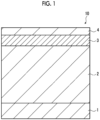
- Fig. 1 is a schematic cross-sectional view showing an example of a flexographic printing plate precursor according to the embodiment of the present invention.
- a numerical range expressed using “to” refers to a range including numerical values described before and after “to” as a lower limit value and an upper limit value.
- (meth)acryl denotes “acryl” or “methacryl”
- (meth)acryloyl denotes “acryloyl” or “methacryloyl”.
- substituents may be further substituted with these substituents. Further, in a case where two or more substituents are present, these may be the same as or different from each other. Furthermore, if possible, these substituents may be bonded to each other to form a ring.
- the flexographic printing plate precursor according to the embodiment of the present invention is a flexographic printing plate precursor including an infrared ablation layer, a photosensitive resin layer, and a support in this order.
- the photosensitive resin layer contains a photopolymerization initiator represented by Formula (1) described later and a photopolymerization initiator represented by Formula (2) described later.
- Fig. 1 is a schematic cross-sectional view showing an example of the flexographic printing plate precursor according to the embodiment of the present invention.
- a flexographic printing plate precursor 10 shown in Fig. 1 has a support 1, a photosensitive resin layer 2, and an infrared ablation layer 3 in this order.
- the flexographic printing plate precursor according to the embodiment of the present invention may include a cover sheet 4.
- a material used for the support included in the flexographic printing plate precursor according to the embodiment of the present invention is not particularly limited, and a support with high dimensional stability is preferably used.
- a support with high dimensional stability examples thereof include metals such as steel, stainless steel, and aluminum; polyester (for example, polyethylene terephthalate (PET), polybutylene terephthalate (PBT), polyethylene naphthalate (PEN), polyimide (PI), polyamide, liquid crystal polymer (LCP), and polyacrylonitrile (PAN)); plastic resins such as polyvinyl chloride; synthetic rubber such as styrene-butadiene rubber; glass fiber reinforced plastic resin (such as epoxy resin and phenolic resin); and cloth and paper.
- PET polyethylene terephthalate
- PBT polybutylene terephthalate
- PEN polyethylene naphthalate
- PI polyimide
- polyamide polyamide
- LCP liquid crystal polymer
- PAN polyacrylonitrile
- plastic resins such
- the support is preferably a polymer film or cloth, and more preferably a polymer film.
- the morphology of the support is determined by whether the polymer layer is sheet-like or sleeve-like.
- cloth plain or twill weave fabrics and various knitted fabrics of natural fibers such as cotton, linen, silk, and wool or synthetic fibers such as acetate, vinylon, vinylidene, polyvinyl chloride, acrylic, polypropylene, polyethylene, polyurethane, fluorine filament, polyclar, rayon, nylon, polyamide, and polyester, or nonwoven fabrics can be used.
- natural fibers such as cotton, linen, silk, and wool
- synthetic fibers such as acetate, vinylon, vinylidene, polyvinyl chloride, acrylic, polypropylene, polyethylene, polyurethane, fluorine filament, polyclar, rayon, nylon, polyamide, and polyester, or nonwoven fabrics
- synthetic fibers such as acetate, vinylon, vinylidene, polyvinyl chloride, acrylic, polypropylene, polyethylene, polyurethane, fluorine filament, polyclar, rayon, nylon, polyamide, and polyester, or nonwoven fabrics
- the polymer film examples include a film formed of various polymers such as polyester (for example, polyethylene terephthalate (PET), polybutylene terephthalate (PBT), polyethylene naphthalate (PEN), polyimide (PI), polyamide, liquid crystal polymer (LCP), and polyacrylonitrile (PAN)); plastic resins such as polyvinyl chloride; synthetic rubber such as styrene-butadiene rubber; and glass fiber reinforced plastic resin (such as epoxy resin and phenolic resin). Among these, from the viewpoint of dimensional stability and the like, a polyester film is preferable.
- polyester for example, polyethylene terephthalate (PET), polybutylene terephthalate (PBT), polyethylene naphthalate (PEN), polyimide (PI), polyamide, liquid crystal polymer (LCP), and polyacrylonitrile (PAN)
- plastic resins such as polyvinyl chloride
- synthetic rubber such as styrene-butadiene rubber
- polyester film examples include a PET film, a PBT film, and a PEN film, and from the viewpoint of dimensional stability and the like, a polyethylene terephthalate (PET) film is preferable.
- PET polyethylene terephthalate
- a film thickness of the support is not particularly limited, but from the viewpoint of dimensional stability and handleability, it is preferably 5 to 3,000 ⁇ m, more preferably 50 to 2,000 ⁇ m, and still more preferably 100 to 1,000 ⁇ m.
- the photosensitive resin layer of the flexographic printing plate precursor according to the embodiment of the present invention contains a photopolymerization initiator represented by Formula (1).
- n 1 or 2, and preferably represents 1.
- examples of the substituent represented by one aspect of R 1 include the substituents described in the above-described substituent group A, and among these, an alkyl group is preferable, and a linear alkyl group having 1 to 6 carbon atoms is more preferable. That is, the group represented by -OR 1 is preferably an alkoxy group.
- X 1 and X 2 may be linked to each other to form a ring.
- examples of the ring to be formed include a cycloalkane ring, and among these, a cyclohexane ring is preferable.
- the ring may have a heteroatom as an atom constituting the ring.
- n in Formula (1) is 2
- a plurality of X 1 's may be the same as or different from each other
- a plurality of X 2 's may be the same as or different from each other.
- X 3 represents a hydrogen atom or a substituent, and a hydrogen atom is preferable.
- examples of the substituent represented by one aspect of X 3 in a case where n is 1 include the substituents described in the above-described substituent group A, and among these, a hydroxyalkyleneoxy group is preferable, and a hydroxyethyleneoxy group is more preferable.
- X 3 represents a single bond or a divalent linking group, and a divalent linking group is preferable.
- examples of the divalent linking group represented by one aspect of X 3 in a case where n is 2 include a divalent hydrocarbon group which may have a substituent.
- One or more of -CH 2 -'s constituting the divalent hydrocarbon group may be substituted with -O-, -S-, -NH-, -N(Q)-, or -CO-.
- Q represents a hydrogen atom or a substituent.
- divalent hydrocarbon group examples include divalent aliphatic hydrocarbon groups such as an alkylene group having 1 to 10 carbon atoms, an alkenylene group having 1 to 10 carbon atoms, and an alkynylene group having 1 to 10 carbon atoms; and divalent aromatic hydrocarbon groups such as an arylene group.
- Examples of the photopolymerization initiator represented by Formula (1) include compounds represented by Formulae (1-1) to (1-4).
- the compounds represented by Formulae (1-1) to (1-3) are exemplary compounds in a case where n in Formula (1) is 1, and the compound represented by Formula (1-4) is an exemplary compound in a case where n in Formula (1) is 2.
- the content of the photopolymerization initiator represented by Formula (1) is preferably 0.5% to 20% by mass, more preferably 1% to 10% by mass, and still more preferably 2% to 5% by mass with respect to the total mass of the solid content of the photosensitive resin layer.
- the photosensitive resin layer of the flexographic printing plate precursor according to the embodiment of the present invention contains a photopolymerization initiator represented by Formula (2).
- Y 1 and Y 2 each independently represent a hydrogen atom or a substituent other than a group represented by -OR 1 .
- R 1 represents a hydrogen atom or a substituent.
- examples of the substituent represented by one aspect of R 1 include the substituents described in the above-described substituent group A, and among these, an alkyl group is preferable, and a linear alkyl group having 1 to 6 carbon atoms is more preferable. That is, the group represented by -OR 1 is preferably an alkoxy group.
- examples of the substituent other than the group represented by -OR 1 which is represented by one aspect of Y 1 and Y 2 , include the substituents other than the group represented by -OR 1 , which are described in the above-described substituent group A, and among these, an alkyl group or an arylalkyl group is preferable, and a linear alkyl group having 1 to 6 carbon atoms or a benzyl group is more preferable.
- Y 1 and Y 2 may be linked to each other to form a ring.
- Y 3 represents a hydrogen atom or a substituent, and preferably represents a substituent.
- examples of the substituent represented by one aspect of Y 3 include the substituents described in the above-described substituent group A, and among these, an alkylthio group or a morpholino group is preferable.
- Y 4 and Y 5 each independently represent a hydrogen atom or a substituent, and preferably represent a substituent.
- examples of the substituent represented by one aspect of Y 4 and Y 5 include the substituents described in the above-described substituent group A, and among these, an alkyl group is preferable, and a linear alkyl group having 1 to 6 carbon atoms is more preferable.
- Y 4 and Y 5 may be linked to each other to form a ring.
- the ring to be formed is not particularly limited as long as it is a ring having a nitrogen atom, in which Y 4 and Y 5 are bonded, and examples of the ring include a morpholine ring, a pyrrole ring, a pyridine ring, an imidazole ring, a benzopyrrole ring, a benzimidazole ring, a thiazole ring, and an oxazole ring.
- the atom constituting the ring may further have a heteroatom other than the nitrogen atom.
- Examples of the photopolymerization initiator represented by Formula (2) include compounds represented by Formulae (2-1) and (2-2).
- the content of the photopolymerization initiator represented by Formula (2) is preferably 0.5% to 15% by mass, more preferably 0.7% to 10% by mass, and still more preferably 1% to 3% by mass with respect to the total mass of the solid content of the photosensitive resin layer.
- the content of the photopolymerization initiator represented by Formula (2) is preferably less than 50% by mass and more preferably 25% to 45% by mass with respect to the total mass of the photopolymerization initiator represented by Formula (1) and the photopolymerization initiator represented by Formula (2).
- the photosensitive resin layer further contains a photopolymerization initiator represented by Formula (3).
- Z 1 and Z 2 each independently represent a hydrogen atom or a substituent, and preferably represent a substituent.
- examples of the substituent represented by one aspect of Z 1 and Z 2 include the substituents described in the above-described substituent group A, and among these, an alkyl group is preferable, and a linear alkyl group having 1 to 6 carbon atoms is more preferable.
- Z 3 represents a hydrogen atom or a substituent, and preferably represents a hydrogen atom.
- examples of the substituent represented by one aspect of Z 3 include the substituents described in the above-described substituent group A, and among these, an alkyl group is preferable, and a linear alkyl group having 1 to 6 carbon atoms is more preferable.
- Z 4 represents a substituent
- examples of the substituent represented by Z 4 include the substituents described in the above-described substituent group A, and among these, an aryl group is preferable, and a phenyl group is more preferable.
- Examples of the photopolymerization initiator represented by Formula (3) include a compound represented by Formula (3-1).
- the content of the photopolymerization initiator represented by Formula (3) is preferably 3% by mass or less, more preferably 2% by mass or less, and still more preferably 0.5% to 1.5% by mass with respect to the total mass of the solid content of the photosensitive resin layer.
- the photosensitive resin layer of the flexographic printing plate precursor according to the embodiment of the present invention preferably contains water-dispersible particles, a binder, a monomer, and a polymerization inhibitor, in addition to the above-described photopolymerization initiator.
- the water-dispersible particles are not particularly limited, but from the reason that the reproducibility of microcells is further improved in a case of being made into a flexographic printing plate, and the durability of independent dots is further improved, a polymer is preferable.
- the "the reproducibility of microcells is further improved in a case of being made into a flexographic printing plate and the durability of independent dots is further improved" is also referred to as "effects of the present invention are more excellent".
- polystyrene-based polymers for example, polybutadiene, natural rubber, styrene-butadiene copolymer, acrylonitrile-butadiene copolymer, methyl methacrylate-butadiene copolymer, polychloroprene, and polyisoprene
- diene-based polymers for example, polybutadiene, natural rubber, styrene-butadiene copolymer, acrylonitrile-butadiene copolymer, methyl methacrylate-butadiene copolymer, polychloroprene, and polyisoprene
- polyurethane vinylpyridine polymer
- butyl polymer butyl polymer
- thiokol polymer acrylate polymer
- a polymer obtained by copolymerizing these polymers with other components such as acrylic acid and methacrylic acid.
- the above-described polymer is preferably a polymer obtained by polymerizing at least one monomer selected from the group consisting of isoprene, butadiene, styrene, butyl, ethylene, propylene, acrylic acid ester, and methacrylic acid ester, and more preferably polybutadiene.
- the above-described polymer does not have a reactive functional group (for example, a (meth)acryloyloxy group) at both terminals.
- the above-described polymer is a polymer obtained by removing water from water-dispersible latex.
- Specific examples of the above-described water-dispersible latex include water-dispersible latex of specific examples of the above-described polymer.
- a content of the water-dispersible particles is preferably 5% to 80% by mass, more preferably 10% to 60% by mass, and still more preferably 20% to 45% by mass with respect to the total mass of solid content in the photosensitive resin layer.
- the binder is not particularly limited, and examples thereof include a thermoplastic polymer.
- thermoplastic polymer is not particularly limited as long as the thermoplastic polymer is a polymer exhibiting thermoplasticity, and specific examples thereof include a polystyrene resin, a polyester resin, a polyamide resin, a polysulfone resin, a polyethersulfone resin, a polyimide resin, an acrylic resin, an acetal resin, an epoxy resin, a polycarbonate resin, rubbers, and a thermoplastic elastomer. These may be used alone or in combination of two or more.
- a rubber or a thermoplastic elastomer is preferable, a rubber is more preferable, and a diene-based rubber is still more preferable.
- BR butadiene rubber
- NBR nitrile rubber
- acrylic rubber epichlorohydrin rubber
- urethane rubber isoprene rubber
- styrene isoprene rubber styrene butadiene rubber
- SBR ethylene-propylene copolymer
- chlorinated polyethylene examples thereof include butadiene rubber (BR), nitrile rubber (NBR), acrylic rubber, epichlorohydrin rubber, urethane rubber, isoprene rubber, styrene isoprene rubber, styrene butadiene rubber (SBR), ethylene-propylene copolymer, and chlorinated polyethylene.
- BR butadiene rubber
- NBR nitrile rubber
- acrylic rubber epichlorohydrin rubber
- urethane rubber isoprene rubber
- styrene isoprene rubber styrene butadiene rubber
- At least one rubber selected from the group consisting of butadiene rubber (BR), styrene butadiene rubber (SBR), and nitrile rubber (NBR) is preferable, and from the viewpoint of water-based ink resistance, butadiene rubber or styrene butadiene rubber is more preferable.
- thermoplastic elastomer examples include a polybutadiene-based thermoplastic elastomer (PB), a polyisoprene-based thermoplastic elastomer, a polyolefin-based thermoplastic elastomer, and an acrylic thermoplastic elastomer.
- PB polybutadiene-based thermoplastic elastomer
- polyisoprene-based thermoplastic elastomer examples include polyisoprene-based thermoplastic elastomer (PB), a polyisoprene-based thermoplastic elastomer, a polyolefin-based thermoplastic elastomer, and an acrylic thermoplastic elastomer.
- polystyrene-polybutadiene SB
- polystyrene-polybutadiene-polystyrene SBS
- polystyrene-polyisoprene-polystyrene SEBS
- SEBS polystyrene-polyethylene/polybutylene-polystyrene
- ABS acrylonitrile butadiene styrene copolymer
- ABS acrylic acid ester rubber
- ACM acrylic acid ester rubber
- ACS acrylonitrile-chlorinated polyethylene-styrene copolymer
- ACS acrylonitrile-styrene copolymer
- syndiotactic 1,2-polybutadiene and methyl polymethacrylate-butyl polyacrylate-methyl polymethacrylate.
- PB polystyrene-polybutadiene
- SBS polystyrene-polybutadiene-pol
- a content of the binder is preferably 1% to 50% by mass, more preferably 5% to 40% by mass, and still more preferably 7% to 30% by mass with respect to the total mass of solid content in the photosensitive resin layer.
- the monomer is not particularly limited, but from the reason that the effects of the present invention are more excellent, it is preferable to use a monofunctional monomer and a bifunctional monomer in combination.
- the above-described monofunctional monomer is preferably a compound having one ethylenically unsaturated group.
- Examples of the compound having one ethylenically unsaturated group include
- N-vinyl compounds such as N-vinylformamide
- a content of the monofunctional monomer is preferably 0.1% to 30% by mass, and more preferably 1% to 10% by mass with respect to the total mass of solid content in the photosensitive resin layer.
- the above-described bifunctional monomer is preferably a compound having two ethylenically unsaturated groups.
- Specific examples of the above-described ethylenically unsaturated group are as described above.
- Examples of the compound having two ethylenically unsaturated groups include
- a content of the bifunctional monomer is preferably 0.1% to 30% by mass with respect to the total mass of solid content in the photosensitive resin layer.
- the photosensitive resin layer preferably contains a polymerization inhibitor (stabilizer).
- polymerization inhibitor examples include phenols, hydroquinones, and catechols.
- a content of the polymerization inhibitor is preferably 0.01% to 5% by mass and more preferably 0.01% to 0.5% by mass with respect to the total mass of solid contents of the photosensitive resin layer.
- the photosensitive resin layer preferably contains a telechelic polymer.
- the "telechelic polymer” means a polymer which has a reactive functional group at both terminals.
- a polymer constituting a main chain of the telechelic polymer is not particularly limited, and examples thereof include a thermoplastic polymer.
- thermoplastic polymer is not particularly limited as long as the thermoplastic polymer is a polymer exhibiting thermoplasticity, and specific examples thereof include a polystyrene resin, a polyester resin, a polyamide resin, a polysulfone resin, a polyethersulfone resin, a polyimide resin, an acrylic resin, an acetal resin, an epoxy resin, a polycarbonate resin, rubbers, and a thermoplastic elastomer.
- a rubber or a thermoplastic elastomer is preferable, a rubber is more preferable, and a diene-based rubber is still more preferable.
- BR butadiene rubber
- NBR nitrile rubber
- acrylic rubber epichlorohydrin rubber
- urethane rubber isoprene rubber
- styrene isoprene rubber styrene butadiene rubber
- SBR ethylene-propylene copolymer
- chlorinated polyethylene examples include butadiene rubber (BR), nitrile rubber (NBR), acrylic rubber, epichlorohydrin rubber, urethane rubber, isoprene rubber, styrene isoprene rubber, styrene butadiene rubber (SBR), ethylene-propylene copolymer, and chlorinated polyethylene.
- BR butadiene rubber
- NBR nitrile rubber
- acrylic rubber epichlorohydrin rubber
- urethane rubber isoprene rubber
- styrene isoprene rubber styrene butadiene rubber
- ethylene-propylene copolymer
- At least one rubber selected from the group consisting of butadiene rubber (BR), styrene butadiene rubber (SBR), and nitrile rubber (NBR) is preferable, and butadiene rubber or styrene butadiene rubber is more preferable.
- thermoplastic elastomer examples include a polybutadiene-based thermoplastic elastomer (PB), a polyisoprene-based thermoplastic elastomer, a polyolefin-based thermoplastic elastomer, and an acrylic thermoplastic elastomer.
- PB polybutadiene-based thermoplastic elastomer
- polyisoprene-based thermoplastic elastomer examples include polyisoprene-based thermoplastic elastomer (PB), a polyisoprene-based thermoplastic elastomer, a polyolefin-based thermoplastic elastomer, and an acrylic thermoplastic elastomer.
- polystyrene-polybutadiene SB
- polystyrene-polybutadiene-polystyrene SBS
- polystyrene-polyisoprene-polystyrene SEBS
- SEBS polystyrene-polyethylene/polybutylene-polystyrene
- ABS acrylonitrile butadiene styrene copolymer
- ABS acrylic acid ester rubber
- ACM acrylic acid ester rubber
- ACS acrylonitrile-chlorinated polyethylene-styrene copolymer
- ACS acrylonitrile-styrene copolymer
- syndiotactic 1,2-polybutadiene and methyl polymethacrylate-butyl polyacrylate-methyl polymethacrylate.
- PB polystyrene-polybutadiene
- SBS polystyrene-polybutadiene-pol
- the telechelic polymer has a reactive functional group at both terminals.
- the above-described reactive functional group is not particularly limited, but from the reason that the effects of the present invention are more excellent, an ethylenically unsaturated group is preferable.
- the telechelic polymer may have a reactive functional group at both terminals of the polymer constituting the main chain through a divalent linking group.
- the above-described divalent linking group is not particularly limited, and examples thereof include a linear, branched, or cyclic divalent aliphatic hydrocarbon group (for example, an alkylene group such as a methylene group, an ethylene group, and a propylene group), a divalent aromatic hydrocarbon group (for example, a phenylene group), -O-, -S-, -SO 2 -, -NRL-, -CO-, -NH-, -COO-, -CONRL-, -O-CO-O-, -SO 3 -, -NHCOO-, -SO 2 NRL-, -NH-CO-NH-, and a group in which two or more of these groups are combined (for example, an alkyleneoxy group, an alkyleneoxycarbonyl group, an alkylenecarbonyl
- a weight-average molecular weight (Mw) of the telechelic polymer is preferably 6,000 or more, more preferably 7,000 or more, still more preferably 8,000 or more, and particularly preferably 9,000 or more.
- the upper limit of Mw of the telechelic polymer is not particularly limited, but from the reason that the effects of the present invention are more excellent, it is preferably 500,000 or less and more preferably 100,000 or less.
- the weight-average molecular weight is measured by a gel permeation chromatograph method (GPC) and is calculated by converting with standard polystyrene.
- GPC gel permeation chromatograph method
- HLC-8220 GPC manufactured by Tosoh Corporation
- TSKgeL SuperHZM-H three of TSKgeL SuperHZM-H, TSKgeL SuperHZ4000, and TSKgeL SuperHZ2000 (all manufactured by Tosoh Corporation, 4.6 mmID ⁇ 15 cm) are used as a column
- TSKgeL SuperHZ2000 tetrahydrofuran
- a sample concentration of 0.35% by mass, a flow rate of 0.35 mL/min, a sample injection amount of 10 ⁇ L, and a measurement temperature of 40°C are set, and an IR detector is used.
- a calibration curve is created using 8 samples of "F-40", “F-20”, “F-4", “F-1”, “A-5000”, “A-2500”, “A-1000”, and "n-propylbenzene” which are "Standard Samples TSK standard, polystyrene” (manufactured by TOSOH Corporation).
- a Hansen solubility parameter (HSP) value of the telechelic polymer is not particularly limited, but from the reason that the effects of the present invention are more excellent, it is preferably 8 to 12, more preferably 8.5 to 11, and still more preferably 8.5 to 10.5.
- a content of the telechelic polymer is preferably 1% to 50% by mass, more preferably 5% to 40% by mass, still more preferably 7% to 30% by mass, and particularly preferably 10% to 20% by mass with respect to the total mass of solid content in the photosensitive resin layer.
- the photosensitive resin layer preferably contains a plasticizer.
- plasticizer examples include liquid rubber, oil, polyester, and phosphoric acid-based compounds.
- liquid rubber examples include liquid polybutadiene, liquid polyisoprene, and compounds in which these compounds are modified with maleic acid or an epoxy group.
- oil examples include paraffin, naphthene, and aroma.
- polyester examples include adipic acid-based polyester.
- phosphoric acid-based compound examples include phosphoric acid ester.
- a content of the plasticizer is preferably 0.1% to 40% by mass, and more preferably 5% to 30% by mass with respect to the total mass of solid content in the photosensitive resin layer.
- the photosensitive resin layer preferably contains a surfactant.
- the surfactant examples include a cationic surfactant, an anionic surfactant, and a nonionic surfactant. Among these, from the reason that the effects of the present invention are more excellent, an anionic surfactant is preferable.
- anionic surfactant examples include
- sulfonic acid-based surfactants such as alkyl sulfonate and alkyl allyl sulfonate are preferable.
- a content of the surfactant is preferably 0.1% to 20% by mass, and more preferably 1% to 10% by mass with respect to the total mass of solid content in the photosensitive resin layer.
- additives such as an ultraviolet absorber, a dye, a pigment, an anti-foaming agent, and a fragrance can be appropriately further added to the photosensitive resin layer, for the purpose of improving various properties.
- a method for producing the photosensitive resin layer is not particularly limited, and examples thereof include a method of preparing a resin composition containing each of the above-described components and applying the resin composition to the above-described support.
- a film thickness of the photosensitive resin layer is preferably 0.01 to 10 mm and more preferably 0.2 to 6 mm.
- the infrared ablation layer included in the flexographic printing plate precursor according to the embodiment of the present invention is a portion serving as a mask which covers the surface of the photosensitive resin layer.
- the infrared ablation layer is a portion which can be removed by an infrared laser, and the unremoved portion shields (absorbs) ultraviolet light to mask the photosensitive resin layer below the unremoved portion from not being irradiated with the ultraviolet light.
- Such an infrared ablation layer can be formed using a resin composition containing a binder polymer and an infrared absorbing substance.
- binder polymer contained in the resin composition examples include a polymer component corresponding to a rubber component and a resin component.
- the rubber component is not particularly limited as long as it is a rubber which does not hinder adhesiveness with the photosensitive resin layer.
- the rubber examples include butadiene rubber (BR), acrylonitrile butadiene rubber (NBR), acrylic rubber, epichlorohydrin rubber, urethane rubber, isoprene rubber (IR), styrene isoprene rubber (SIR), styrene butadiene rubber (SBR), ethylene-propylene copolymer, and chlorinated polyethylene. These may be used alone or in combination of two or more.
- the resin component is not particularly limited as long as it is a resin which does not hinder adhesiveness with the photosensitive resin layer.
- BR butadiene rubber
- NBR acrylonitrile butadiene rubber
- SBR styrene butadiene rubber
- NBR acrylonitrile butadiene rubber
- an acrylic resin or a methacrylic resin is preferable.
- the infrared absorbing substance contained in the resin composition is not particularly limited as long as it is a substance which can absorb infrared rays and convert the infrared rays into heat.
- the infrared absorbing substance include black pigments (for example, carbon black, aniline black, cyanine black, and the like), green pigments (for example, phthalocyanine, naphthalocyanine, and the like), rhodamine coloring agents, naphthoquinone-based coloring agents, polymethine dyes, diimmonium salts, azoimonium-based coloring agents, chalcogen-based coloring agents, carbon graphite, iron powder, diamine-based metal complexes, dithiol-based metal complexes, phenolthiol-based metal complexes, mercaptophenol-based metal complexes, aryl aluminum metal salts, crystal water-containing inorganic compounds, copper sulfate, metal oxides (for example, cobalt oxide, tungsten oxide, and the like), and metal powders (for example, bismuth, tin, tellurium, aluminum, and the like).
- black pigments for example, carbon black, aniline black, cyanine black,
- carbon black, carbon graphite, or the like is preferable.
- the infrared ablation layer may contain various additives in addition to the binder polymer and the infrared absorbing substance described above.
- additive examples include a surfactant, a plasticizer, an ultraviolet absorbing substance, a mold release agent, a dye, a pigment, an antifoaming agent, and a fragrance.
- a method for producing the infrared ablation layer is not particularly limited, and examples thereof include a method of preparing a resin composition containing each of the above-described components and applying the resin composition to the photosensitive resin layer.
- a film thickness of the infrared ablation layer is preferably 0.1 to 6 ⁇ m and more preferably 0.5 to 3 ⁇ m.
- the flexographic printing plate precursor according to the embodiment of the present invention may include a cover sheet.
- Such a cover sheet is not particularly limited, but is preferably a transparent polymer film and may be one layer alone or two or more layers laminated.
- the "transparent" in the present invention means that a transmittance of visible light is 60% or more, preferably 80% or more and particularly preferably 90% or more.
- Examples of a material of the polymer film include cellulose-based polymers; acrylic polymers having an acrylic acid ester polymer such as polymethyl methacrylate and a lactone ring-containing polymer; thermoplastic norbornene-based polymers; polycarbonate-based polymers; polyester-based polymers such as polyethylene terephthalate, polyethylene naphthalate, and a fluoropolyester polymer; styrene-based polymers such as polystyrene and an acrylonitrile-styrene copolymer (AS resin); polyolefin-based polymers such as polyethylene, polypropylene, an ethylene-propylene copolymer, and polybutadiene; vinyl chloride-based polymers; amide-based polymers such as nylon and aromatic polyamide; imide-based polymers; sulfone-based polymers; polyether sulfone-based polymers; polyether ether ketone-based polymers; polyphenylene sulfide-based
- a surface (surface on which the infrared ablation layer is formed) of the cover sheet may be subjected to peeling treatment for suppressing adhesion of the infrared ablation layer and enhancing peelability of the cover sheet.
- peeling treatment include a method of applying a peeling agent to the surface of the cover sheet to form a peeling layer.
- the peeling agent include a silicone-based peeling agent and an alkyl-based peeling agent.
- a film thickness of the cover sheet is preferably 25 to 250 ⁇ m.
- the manufacturing method of a flexographic printing plate according to the embodiment of the present invention is a manufacturing method of a flexographic printing plate having a non-image area and an image area, the manufacturing method including:
- the above-described mask forming step is a step of forming an image on the infrared ablation layer to form a mask to be used in the exposure step described later.
- the action of the infrared absorbing substance in a case of being irradiated with an infrared laser, the action of the infrared absorbing substance generates heat, which decomposes the infrared ablation layer to be removed, that is, to laser-ablate the infrared ablation layer.
- an infrared laser having an oscillation wavelength in a range of 750 nm to 3000 nm is used.
- Examples of such a laser include a solid-state laser such as a ruby laser, an Alexandrite laser, a perovskite laser, an Nd-YAG laser, and an emerald glass laser; a semiconductor laser such as InGaAsP, InGaAs, and GaAsAl; and a coloring agent laser such as a Rhodamine coloring agent.
- a solid-state laser such as a ruby laser, an Alexandrite laser, a perovskite laser, an Nd-YAG laser, and an emerald glass laser
- a semiconductor laser such as InGaAsP, InGaAs, and GaAsAl
- a coloring agent laser such as a Rhodamine coloring agent.
- a fiber laser which amplifies these light sources with a fiber can also be used.
- an exposure light source having an oscillation wavelength of 900 to 1200 nm it is preferable to use an exposure light source having an oscillation wavelength of 900 to 1200 nm, and it is more preferable to use a fiber laser.
- the above-described exposure step is a step of imagewise exposing the photosensitive resin layer through the mask obtained in the above-described mask forming step, and by imagewise irradiating the photosensitive resin layer with ultraviolet rays, crosslinking and/or polymerization of regions irradiated with the ultraviolet rays can be induced to be cured.
- the above-described development step is a step of performing development using a developer to form a non-image area and an image area.
- the developer used in the above-described development step is not particularly limited, and known developer in the related art can be used. However, from the viewpoint of reducing the environmental load, it is preferable to use a developer containing 50% by mass or more of water (hereinafter, also abbreviated as "aqueous developer").
- the developer may be an aqueous solution or a suspension (for example, an aqueous dispersion liquid).
- a content of water contained in the aqueous developer is preferably 80% to 99.99% by mass and more preferably 90% to 99.9% by mass with respect to the total mass of the aqueous developer.
- the manufacturing method of a flexographic printing plate according to the embodiment of the present invention includes a rinse step of, after the above-described development step, rinsing surfaces of the non-image area and the image area formed in the above-described development step with water.
- a rinsing method in the rinse step a method of washing with tap water, a method of spraying high pressure water, a method of rubbing the surfaces of the non-image area and the image area with a brush using a known batch-type or transport-type brush-type washing machine as a developing machine for flexographic printing plates mainly in the presence of water, and the like may be used.
- the obtained mixed solution was dispersed using a three-roll mill, and then methyl isobutyl ketone was further added thereto so that the solid content was 15% by mass to prepare a composition for forming an infrared ablation layer.
- a water-dispersible latex Napol LX111NF, water-dispersible latex of polybutadiene, solid content: 55%, manufactured by ZEON CORPORATION
- BAC-45 telechelic polymer
- the mixture 20 parts by mass of butadiene rubber (NF35R, manufactured by Asahi Kasei Corporation), 15 parts by mass of a plasticizer (Diana Process Oil PW-32, manufactured by Idemitsu Kosan Co., Ltd.), and 5 parts by mass of a surfactant (RAPISOL A-90, effective content: 90%, manufactured by NOF CORPORATION) were kneaded in a kneader set at 110°C for 45 minutes.
- NF35R butadiene rubber
- plasticizer Diana Process Oil PW-32, manufactured by Idemitsu Kosan Co., Ltd.
- RPISOL A-90 effective content: 90%, manufactured by NOF CORPORATION
- composition for forming an infrared ablation layer was applied onto a 125 ⁇ m-thick PET film (cover sheet), which had been coated with a silicone-based peeling agent, with a bar coater so that a thickness of a coating film after drying was 1 ⁇ m, and dried at 120°C for 5 minutes to obtain a laminate X consisting of infrared ablation layer/cover sheet.
- the composition for a photosensitive resin layer described above was interposed between the above-described laminate X and the surface of the support to which the adhesive is applied, the support being obtained by applying the adhesive to the surface of the the 125 ⁇ m-thick PET film (base materal), and the laminate was pressed with a press machine heated to 120°C such that a thickness of the photosensitive resin layer was 1.5 mm, thereby producing a flexographic printing plate precursor of Example 1, in which the support, the photosensitive resin layer, the infrared ablation layer, and the cover sheet were laminated in this order.
- a printing plate was produced using the following device.
- the obtained flexographic printing plate precursor was back-exposed by exposing a back surface of the flexographic printing plate precursor with energy of 80 W for 18 seconds using the following ultraviolet exposure machine.
- imaging was performed by ablating the infrared ablation layer, and main-exposure was performed by exposing a front surface (back surface of the back surface) at 80 W for 420 seconds.
- the obtained product was dried with hot air of 60°C until the moisture was removed.
- a flexographic printing plate precursor was produced in the same procedure as in Example 1, except that a developing method or the type and content of the photopolymerization initiator represented by Formula (1) and the photopolymerization initiator represented by Formula (2) were changed as shown in Table 1 below, and the photopolymerization initiator represented by Formula (3) was blended as shown in Table 1 below.
- Example 2 The developing method (solvent development) of Example 2 was performed in the same procedure as in Example 1, except that POLYMER FLEXO A2/S (manufactured by AGI Graphics) was used as a washing machine and FLEXOSOL-i (manufactured by DuPont) was used as a washing solution.
- POLYMER FLEXO A2/S manufactured by AGI Graphics
- FLEXOSOL-i manufactured by DuPont
- the obtained flexographic printing plate was evaluated for microcell reproducibility (MC) by the following method.
- a confocal measurement was performed on a surface of the solid image area of the flexographic printing plate in increments of 0.1 ⁇ m in height with a 50x Apo objective lens (high numerical aperture (high NA)) to obtain three-dimensional data.
- An evaluation range was defined as a region of 300 ⁇ m in length and 300 ⁇ m in width.
- Image reproduction% (Number of reproduced convex portions without chipping)/(Number of evaluations) ⁇ 100
- the image reproduction of the microcells is preferably 3 to 5, more preferably 4 or 5, and still more preferably 5. In a case where the image reproduction was less than 80%, unevenness of the ink transferred to the printed article was large, and the solid density was deteriorated.
- the image area of the obtained flexographic printing plate was rubbed 4 times using a continuous load-type scratch resistance strength tester (HEIDON TYPE: 18) and using a cotton waste cloth as a rubbing member under conditions of a load of 500 g and a reciprocating speed of 100 mm/min.
- HEIDON TYPE 18
- a cotton waste cloth as a rubbing member under conditions of a load of 500 g and a reciprocating speed of 100 mm/min.
- 3 to 5 are preferable, 4 or 5 is more preferable, and 5 is still more preferable.
- Example 6 From the comparison between Example 1 and Example 6, it was found that in a case where the content of the photopolymerization initiator represented by Formula (2) was less than 50% by mass with respect to the total mass of the photopolymerization initiator represented by Formula (1) and the photopolymerization initiator represented by Formula (2), the balance between the reproducibility of the microcells and the durability of the independent dots was improved.
Landscapes
- Physics & Mathematics (AREA)
- General Physics & Mathematics (AREA)
- Spectroscopy & Molecular Physics (AREA)
- Engineering & Computer Science (AREA)
- Optics & Photonics (AREA)
- Plasma & Fusion (AREA)
- Manufacturing & Machinery (AREA)
- Photosensitive Polymer And Photoresist Processing (AREA)
Applications Claiming Priority (2)
| Application Number | Priority Date | Filing Date | Title |
|---|---|---|---|
| JP2022120221 | 2022-07-28 | ||
| PCT/JP2023/026537 WO2024024612A1 (ja) | 2022-07-28 | 2023-07-20 | フレキソ印刷版原版およびフレキソ印刷版の製造方法 |
Publications (2)
| Publication Number | Publication Date |
|---|---|
| EP4564094A1 true EP4564094A1 (de) | 2025-06-04 |
| EP4564094A4 EP4564094A4 (de) | 2025-12-24 |
Family
ID=89706381
Family Applications (1)
| Application Number | Title | Priority Date | Filing Date |
|---|---|---|---|
| EP23846343.4A Pending EP4564094A4 (de) | 2022-07-28 | 2023-07-20 | Originalplatte für flexodruckplatte und verfahren zur herstellung einer flexodruckplatte |
Country Status (5)
| Country | Link |
|---|---|
| US (1) | US20250164876A1 (de) |
| EP (1) | EP4564094A4 (de) |
| JP (1) | JPWO2024024612A1 (de) |
| CN (1) | CN119422110A (de) |
| WO (1) | WO2024024612A1 (de) |
Family Cites Families (6)
| Publication number | Priority date | Publication date | Assignee | Title |
|---|---|---|---|---|
| JP5710961B2 (ja) | 2010-12-24 | 2015-04-30 | 住友理工株式会社 | フレキソ印刷版原版 |
| JP7012526B2 (ja) * | 2017-12-20 | 2022-01-28 | 旭化成株式会社 | フレキソ印刷原版、及びフレキソ印刷版 |
| EP3842862B1 (de) * | 2018-08-23 | 2025-05-14 | FUJIFILM Corporation | Wasserentwickelbare flexodruckplattenoriginalplatte, flexodruckplatte und lichtempfindliche harzzusammensetzung |
| WO2020090978A1 (ja) * | 2018-10-31 | 2020-05-07 | 富士フイルム株式会社 | フレキソ印刷版原版及びフレキソ印刷版 |
| TWI894339B (zh) * | 2020-08-25 | 2025-08-21 | 日商富士軟片股份有限公司 | 硬化性樹脂組成物、硬化物、積層體、硬化物之製造方法及半導體元件 |
| JP7229211B2 (ja) * | 2020-09-17 | 2023-02-27 | 株式会社タムラ製作所 | 感光性樹脂組成物 |
-
2023
- 2023-07-20 EP EP23846343.4A patent/EP4564094A4/de active Pending
- 2023-07-20 JP JP2024537637A patent/JPWO2024024612A1/ja active Pending
- 2023-07-20 WO PCT/JP2023/026537 patent/WO2024024612A1/ja not_active Ceased
- 2023-07-20 CN CN202380049271.3A patent/CN119422110A/zh active Pending
-
2025
- 2025-01-17 US US19/027,808 patent/US20250164876A1/en active Pending
Also Published As
| Publication number | Publication date |
|---|---|
| WO2024024612A1 (ja) | 2024-02-01 |
| CN119422110A (zh) | 2025-02-11 |
| JPWO2024024612A1 (de) | 2024-02-01 |
| EP4564094A4 (de) | 2025-12-24 |
| US20250164876A1 (en) | 2025-05-22 |
Similar Documents
| Publication | Publication Date | Title |
|---|---|---|
| KR101840055B1 (ko) | 터치 패널용 착색 감광성 수지 조성물, 터치 패널, 및 표시 장치 | |
| JP5691274B2 (ja) | 感光性樹脂印刷版原版 | |
| JP4068892B2 (ja) | 画像形成材料 | |
| JP7234348B2 (ja) | 感光性転写材料、樹脂パターンの製造方法、回路配線の製造方法、及び、タッチパネルの製造方法 | |
| JPH06509759A (ja) | 赤外直接書き込み画像化媒体 | |
| KR20170121240A (ko) | 패턴 형성 방법 및 이를 이용하여 제조한 전자 디바이스 | |
| KR20230047106A (ko) | 광경화형 잉크젯 인쇄용 잉크 조성물 | |
| EP4564094A1 (de) | Originalplatte für flexodruckplatte und verfahren zur herstellung einer flexodruckplatte | |
| WO2016039272A1 (ja) | 画像形成材料及び画像形成方法 | |
| TW201502700A (zh) | 著色組成物、著色硬化膜及顯示元件 | |
| JP3800513B2 (ja) | 画像形成材料 | |
| JP3800512B2 (ja) | 画像形成材料 | |
| US20240126173A1 (en) | Flexographic printing plate precursor and manufacturing method of flexographic printing plate | |
| EP1901117A1 (de) | Verfahren zur herstellung einer lichtempfindlichen laminat-originaldruckplatte für die typographie, lichtempfindliche laminat-originaldruckplatte für die lithographie und verfahren zum herstellen einer lithographie-druckplatte | |
| JPH04301802A (ja) | カラーフィルターおよびその製造方法 | |
| EP4459374A1 (de) | Flexodruckoriginalplatte und verfahren zur herstellung einer flexodruckplatte | |
| US20230408924A1 (en) | Flexographic printing plate precursor and manufacturing method of flexographic printing plate | |
| JP3767806B2 (ja) | 画像形成材料 | |
| EP4674635A1 (de) | Flexodruckplatte und verfahren zur herstellung davon | |
| WO2025069850A1 (ja) | フレキソ印刷版原版およびフレキソ印刷版の製造方法 | |
| US20230393480A1 (en) | Manufacturing method of flexographic printing plate | |
| CN118355325A (zh) | 柔版印刷版原版及柔版印刷版的制造方法 | |
| WO2020209145A1 (ja) | 水現像性フレキソ印刷版原版、フレキソ印刷版および感光性樹脂組成物 | |
| JP2003177521A (ja) | 画像形成材料 | |
| JP2023121310A (ja) | 感光性樹脂印刷版原版 |
Legal Events
| Date | Code | Title | Description |
|---|---|---|---|
| STAA | Information on the status of an ep patent application or granted ep patent |
Free format text: STATUS: THE INTERNATIONAL PUBLICATION HAS BEEN MADE |
|
| PUAI | Public reference made under article 153(3) epc to a published international application that has entered the european phase |
Free format text: ORIGINAL CODE: 0009012 |
|
| STAA | Information on the status of an ep patent application or granted ep patent |
Free format text: STATUS: REQUEST FOR EXAMINATION WAS MADE |
|
| 17P | Request for examination filed |
Effective date: 20241219 |
|
| AK | Designated contracting states |
Kind code of ref document: A1 Designated state(s): AL AT BE BG CH CY CZ DE DK EE ES FI FR GB GR HR HU IE IS IT LI LT LU LV MC ME MK MT NL NO PL PT RO RS SE SI SK SM TR |
|
| DAV | Request for validation of the european patent (deleted) | ||
| DAX | Request for extension of the european patent (deleted) | ||
| A4 | Supplementary search report drawn up and despatched |
Effective date: 20251126 |
|
| RIC1 | Information provided on ipc code assigned before grant |
Ipc: G03F 7/031 20060101AFI20251120BHEP Ipc: B41C 1/00 20060101ALI20251120BHEP Ipc: B41N 1/00 20060101ALI20251120BHEP Ipc: G03F 7/004 20060101ALI20251120BHEP Ipc: G03F 7/095 20060101ALI20251120BHEP Ipc: G03F 7/20 20060101ALI20251120BHEP Ipc: B41C 1/05 20060101ALI20251120BHEP Ipc: G03F 7/027 20060101ALI20251120BHEP Ipc: G03F 7/029 20060101ALI20251120BHEP |