EP4564132A1 - Test non destructif soutenu par réalité augmentée - Google Patents
Test non destructif soutenu par réalité augmentée Download PDFInfo
- Publication number
- EP4564132A1 EP4564132A1 EP23213675.4A EP23213675A EP4564132A1 EP 4564132 A1 EP4564132 A1 EP 4564132A1 EP 23213675 A EP23213675 A EP 23213675A EP 4564132 A1 EP4564132 A1 EP 4564132A1
- Authority
- EP
- European Patent Office
- Prior art keywords
- data
- images
- ndt
- acquisition device
- features
- Prior art date
- Legal status (The legal status is an assumption and is not a legal conclusion. Google has not performed a legal analysis and makes no representation as to the accuracy of the status listed.)
- Pending
Links
Images



Classifications
-
- G—PHYSICS
- G01—MEASURING; TESTING
- G01N—INVESTIGATING OR ANALYSING MATERIALS BY DETERMINING THEIR CHEMICAL OR PHYSICAL PROPERTIES
- G01N21/00—Investigating or analysing materials by the use of optical means, i.e. using sub-millimetre waves, infrared, visible or ultraviolet light
- G01N21/84—Systems specially adapted for particular applications
- G01N21/88—Investigating the presence of flaws or contamination
-
- G—PHYSICS
- G01—MEASURING; TESTING
- G01V—GEOPHYSICS; GRAVITATIONAL MEASUREMENTS; DETECTING MASSES OR OBJECTS; TAGS
- G01V11/00—Prospecting or detecting by methods combining techniques covered by two or more of main groups G01V1/00 - G01V9/00
-
- G—PHYSICS
- G06—COMPUTING OR CALCULATING; COUNTING
- G06F—ELECTRIC DIGITAL DATA PROCESSING
- G06F3/00—Input arrangements for transferring data to be processed into a form capable of being handled by the computer; Output arrangements for transferring data from processing unit to output unit, e.g. interface arrangements
- G06F3/01—Input arrangements or combined input and output arrangements for interaction between user and computer
- G06F3/011—Arrangements for interaction with the human body, e.g. for user immersion in virtual reality
-
- G—PHYSICS
- G01—MEASURING; TESTING
- G01N—INVESTIGATING OR ANALYSING MATERIALS BY DETERMINING THEIR CHEMICAL OR PHYSICAL PROPERTIES
- G01N21/00—Investigating or analysing materials by the use of optical means, i.e. using sub-millimetre waves, infrared, visible or ultraviolet light
- G01N21/01—Arrangements or apparatus for facilitating the optical investigation
-
- G—PHYSICS
- G02—OPTICS
- G02B—OPTICAL ELEMENTS, SYSTEMS OR APPARATUS
- G02B27/00—Optical systems or apparatus not provided for by any of the groups G02B1/00 - G02B26/00, G02B30/00
- G02B27/01—Head-up displays
- G02B27/017—Head mounted
-
- G—PHYSICS
- G06—COMPUTING OR CALCULATING; COUNTING
- G06T—IMAGE DATA PROCESSING OR GENERATION, IN GENERAL
- G06T19/00—Manipulating three-dimensional [3D] models or images for computer graphics
- G06T19/006—Mixed reality
-
- G—PHYSICS
- G06—COMPUTING OR CALCULATING; COUNTING
- G06T—IMAGE DATA PROCESSING OR GENERATION, IN GENERAL
- G06T7/00—Image analysis
- G06T7/70—Determining position or orientation of objects or cameras
- G06T7/73—Determining position or orientation of objects or cameras using feature-based methods
-
- G—PHYSICS
- G06—COMPUTING OR CALCULATING; COUNTING
- G06V—IMAGE OR VIDEO RECOGNITION OR UNDERSTANDING
- G06V20/00—Scenes; Scene-specific elements
- G06V20/20—Scenes; Scene-specific elements in augmented reality scenes
-
- G—PHYSICS
- G01—MEASURING; TESTING
- G01N—INVESTIGATING OR ANALYSING MATERIALS BY DETERMINING THEIR CHEMICAL OR PHYSICAL PROPERTIES
- G01N21/00—Investigating or analysing materials by the use of optical means, i.e. using sub-millimetre waves, infrared, visible or ultraviolet light
- G01N21/01—Arrangements or apparatus for facilitating the optical investigation
- G01N2021/0106—General arrangement of respective parts
- G01N2021/0112—Apparatus in one mechanical, optical or electronic block
-
- G—PHYSICS
- G01—MEASURING; TESTING
- G01V—GEOPHYSICS; GRAVITATIONAL MEASUREMENTS; DETECTING MASSES OR OBJECTS; TAGS
- G01V3/00—Electric or magnetic prospecting or detecting; Measuring magnetic field characteristics of the earth, e.g. declination, deviation
- G01V3/08—Electric or magnetic prospecting or detecting; Measuring magnetic field characteristics of the earth, e.g. declination, deviation operating with magnetic or electric fields produced or modified by objects or geological structures or by detecting devices
- G01V3/088—Electric or magnetic prospecting or detecting; Measuring magnetic field characteristics of the earth, e.g. declination, deviation operating with magnetic or electric fields produced or modified by objects or geological structures or by detecting devices operating with electric fields
-
- G—PHYSICS
- G01—MEASURING; TESTING
- G01V—GEOPHYSICS; GRAVITATIONAL MEASUREMENTS; DETECTING MASSES OR OBJECTS; TAGS
- G01V3/00—Electric or magnetic prospecting or detecting; Measuring magnetic field characteristics of the earth, e.g. declination, deviation
- G01V3/08—Electric or magnetic prospecting or detecting; Measuring magnetic field characteristics of the earth, e.g. declination, deviation operating with magnetic or electric fields produced or modified by objects or geological structures or by detecting devices
- G01V3/10—Electric or magnetic prospecting or detecting; Measuring magnetic field characteristics of the earth, e.g. declination, deviation operating with magnetic or electric fields produced or modified by objects or geological structures or by detecting devices using induction coils
-
- G—PHYSICS
- G02—OPTICS
- G02B—OPTICAL ELEMENTS, SYSTEMS OR APPARATUS
- G02B27/00—Optical systems or apparatus not provided for by any of the groups G02B1/00 - G02B26/00, G02B30/00
- G02B27/01—Head-up displays
- G02B27/0101—Head-up displays characterised by optical features
- G02B2027/0138—Head-up displays characterised by optical features comprising image capture systems, e.g. camera
-
- G—PHYSICS
- G02—OPTICS
- G02B—OPTICAL ELEMENTS, SYSTEMS OR APPARATUS
- G02B27/00—Optical systems or apparatus not provided for by any of the groups G02B1/00 - G02B26/00, G02B30/00
- G02B27/01—Head-up displays
- G02B27/0101—Head-up displays characterised by optical features
- G02B2027/0141—Head-up displays characterised by optical features characterised by the informative content of the display
-
- G—PHYSICS
- G02—OPTICS
- G02B—OPTICAL ELEMENTS, SYSTEMS OR APPARATUS
- G02B27/00—Optical systems or apparatus not provided for by any of the groups G02B1/00 - G02B26/00, G02B30/00
- G02B27/01—Head-up displays
- G02B27/017—Head mounted
- G02B2027/0178—Eyeglass type
Definitions
- the present invention generally pertains to the field of non-destructive testing (NDT). More specifically, the invention pertains to supporting a person conducting NDT by the use of augmented reality (AR).
- NDT non-destructive testing
- AR augmented reality
- Non-destructive testing includes methods that do not damage the parts being tested.
- NDT uses various inspection techniques to assess individual or group components. By employing different principles from physics, chemistry, and mathematics, NDT can test components without causing damage.
- One special field of NDT is directed to the testing of buildings and other structures, i.e., by determining the position and condition of reinforced bars (rebar) inside of the structure, e.g., inside of a wall of a building.
- the data acquisition follows a grid pattern.
- the grid must have known dimensions and allows a plurality of 2D line scans to be related to each other.
- This grid may be painted by hand, which is time-consuming, or a paper grid may be used, which may be difficult to place at challenging locations.
- paper grids have specific sizes so that there is not always a fitting grid size available for the job at hand.
- a first aspect of the invention pertains to a system for non-destructive testing (NDT) of a structure, the system comprising a data-acquisition device (NDT device) comprising at least one NDT sensor configured to detect features inside the structure by means of NDT and to generate feature data related to the detected features.
- NDT device data-acquisition device
- the system comprises an augmented-reality (AR) device comprising at least one camera and a display unit, wherein the at least one camera is configured to capture images of a surrounding and to generate image data, the surrounding comprising at least one surface of the structure.
- the system further comprises a computing unit that is configured to generate AR image data based on the image data and on NDT data and to provide the AR image data to the display unit.
- AR augmented-reality
- the display unit is configured to present, based on the AR image data, AR images in real time to a user of the system.
- the NDT data comprises either the feature data, instruction data or both, wherein the instruction data comprises measuring instructions for the user for performing the non-destructive testing of the structure using the data-acquisition device.
- the AR device is configured as a wearable, e.g., as AR goggles, to be worn by the user. According to some embodiments, it is configured as a projector, e.g., as a head-up display. Alternatively, the AR device may be configured as a handheld device having a touchscreen, e.g., a smartphone or tablet computer. According to some embodiments, the AR device comprises the computing unit. According to some embodiments, the AR device comprises an inertial measuring unit and/or a gyroscope.
- the at least one camera is configured to capture the images as an image stream
- the display unit is configured to present the AR images in real time as a live AR image stream.
- the NDT data comprises at least the feature data, and at least a subset of the AR images shows the structure overlaid with representations of the detected features.
- the data-acquisition device comprises a plurality of different NDT sensors, including at least a radar sensor, an inductive sensor and/or a capacitive sensor.
- the representations of the detected features are presented in the AR images in a 3D view.
- the at least one NDT sensor is configured to determine properties of the features, the properties comprising at least a kind of the feature or a material of the feature, the feature data comprising information about the determined properties, and the representations of the detected features are presented in the AR images together with the information about the determined properties, wherein different kinds of features or different materials are highlighted or coloured differently. For instance, the highlighting or colouring of the different kinds of features and/or the different materials may be user-selectable.
- the data-acquisition device comprises a plurality of NDT sensors of different sensor types, such as inductive sensors, capacitive sensors, and/or radar sensors.
- the computing unit can then be configured to determine, based on feature data generated by NDT sensors of two or more different sensor types, object types of the features, such as water pipes, plastic pipes, copper pipes, live wires, and reinforcement bars.
- object types of the features such as water pipes, plastic pipes, copper pipes, live wires, and reinforcement bars.
- the representations of the detected features may then be presented in the AR images together with information about their object type, wherein different object types are highlighted or coloured differently (the highlighting or colouring may be user-selectable) .
- the computing unit is configured to generate further information based on the feature data (and optionally other information). At least a subset of the AR images then shows the structure overlaid with said further information, the further information comprising areas that are or safe or unsafe to drill into and/or locations that should be inspected further.
- the NDT data comprises at least the measuring instruction data, and at least a subset of the AR images shows the structure overlaid with the measuring instructions.
- the measuring instructions may comprise visual instructions on how to move the data-acquisition device over the structure.
- the measuring instructions comprise a grid that provides a pattern for moving the data-acquisition device over the structure.
- a size and shape of the grid may be user-selectable or may be selected automatically depending on a detected size and shape of the structure or of a scanning area on the structure.
- the computing unit is configured to identify the data-acquisition device in at least a subset of the images of the surrounding and to derive an actual position of the data-acquisition device relative to the structure.
- the measuring instructions then may be updated in real time based on the actual position of the data-acquisition device.
- the NDT data comprises the feature data and at least a subset of the AR images shows the structure overlaid with representations of the detected features
- the AR images show representations of the detected features positioned relative to the structure based on the actual position of the data-acquisition device when detecting the respective features.
- the computing unit is configured to perform a user-guidance process, in the course of which the measuring instructions are updated in real time based on the actual position of the data-acquisition device to guide its user through the non-destructive testing of the structure.
- the computing unit is configured for generating documentation data of steps of the non-destructive testing of the structure, the documentation data comprising at least one of image, video and audio data.
- the computing unit is then further configured to automatically capture the documentation data, and/or to prompt the user to capture the documentation data, e.g., by displaying a visual indicator on the display unit.
- the computing unit is configured to detect a fiducial marker in at least a subset of the images of the surrounding and to extract computer-readable information from the fiducial marker.
- the fiducial marker can be provided on a surface of the structure, can be an ArUco marker, and/or can be an elongated element, such as a ribbon band.
- the fiducial marker comprises information that allows identifying the structure
- the computing unit is configured to identify the structure based on the information of the fiducial marker.
- the computing unit may have access to a database providing a multitude of datasets with information about individual structures.
- the NDT data comprises the feature data
- the computing unit has access to a database providing past NDT data of a previously performed NDT of the individual structure
- the computing unit is configured, upon identifying the structure, to generate the AR image data based on the image data and on the past NDT data.
- the fiducial marker comprises information that allows aligning the NDT data relative to the image data
- the computing unit is configured to generate the AR image data based on the information of the fiducial marker.
- the computing unit may be configured to generate, based on the information of the fiducial marker, the AR image data by mooring coordinates of the NDT data to a 3D location, orientation and scale of the surface of the structure.
- the structure is a wall, a ceiling or a floor, and the features comprise at least one of reinforcement bars, conduits and utilities.
- the structure is a bridge, a viaduct, a pillar, a dam, or a tower (or a part thereof), and the features comprise at least one of reinforcement bars and post-tensioning cables.
- the features may comprise non-homogenous compositions of a material of the structure, such as a fault or a defect in the material or an absence (e.g., hole) of the material inside the structure.
- a second aspect of the invention pertains to a computer-implemented method for NDT of a structure, e.g., using a system according the first aspect of the invention. Said method comprises, in real time:
- the method comprises, while the user performs the NDT of the structure using the data acquisition device:
- a third aspect of the invention pertains to a computer program product comprising program code having computer-executable instructions for performing, in particular when run in a system according to the first aspect of the invention, the method according to the second aspect of the invention.
- FIG. 1 a known method for non-destructive testing (NDT) of a structure is illustrated.
- the structure is a wall 3.
- a user 2 of an NDT data acquisition device 20 moves the device over the surface of the wall 3 to detect features such as reinforcement bars (rebars) 5 inside the wall 3. Since the data acquisition preferably follows a grid pattern, in the shown example, the user 2 has attached a grid paper 7 to the wall which comprises the grid.
- the data may be uploaded to a device having a display, e.g., to a laptop computer, so that detected rebars and other features may be visualized.
- the data-acquisition device may comprise a plurality of different NDT sensors (i.e., different sensor types), such as inductive, capacitive, and/or radar sensors.
- Figures 2a and 2b illustrate an improved method for NDT according to the invention.
- Figure 2a shows a user 2 wearing AR goggles 10 in front of a wall 3 to be tested.
- Figure 2b shows the AR image 50 presented to the user on his AR goggles.
- the grid 52 for performing the NDT is provided as augmented content on the wall of the real-world image.
- detected objects may be visualized in 3D relative to a known location (e.g., to fiducial markers). This also allows to visualize locations which are or are not allowed to be drilled into, and/or to detect and highlight critical locations that must be opened for inspection.
- AR goggles 10 may be used that allow displaying augmented reality information to the user 2.
- such devices may include other wearables, projectors, or head-up displays.
- the AR device may be configured as a handheld device having a touchscreen, a camera and an IMU, e.g., a smartphone or tablet computer on which a software application (app) may be installed, which allows the AR device to cooperate with the NDT device and to display the AR images on the touchscreen in dependence of a pose of the AR device, the pose being detectable by means of the IMU and/or the camera.
- IMU e.g., a smartphone or tablet computer on which a software application (app) may be installed
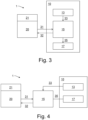
- FIG 3 schematically shows a first embodiment of a system 1 according to the invention and the flow of data in this embodiment.
- the system comprises an augmented-reality device (AR device) 10, comprising one or more cameras 13, a computing unit 15 and a display unit 17.
- AR device augmented-reality device
- the AR device 10 may be configured as a wearable device (such as the AR goggles of Figure 2a ), as a tablet computer or similar apparatus.
- the AR device 10 may comprise further sensors that facilitate detecting its current pose and/or movement, for instance including accelerometers, an inertial measuring unit (IMU), a digital compass and/or a gyroscope.
- IMU inertial measuring unit
- the system further comprises an NDT data acquisition device (NDT device) 20, comprising one or more NDT sensors 21 configured for detecting features inside of a structure.
- NDT device 20 allows material discrimination for detecting and classifying features in the structure. For instance, this can be achieved by combining different NDT sensors 21 like radar, inductive sensors and capacitive sensors.
- these features may comprise reinforcement bars, tendon cables, post-tensioning cables, conduits, pipes (e.g., gas or water pipes) and utilities (e.g., electric cables).
- These features may also comprise hidden defects and other anomalies of the structure such as voids, cracks, foreign objects or material anomalies.
- the computing unit generates AR image data 35 and provides it to the display unit 17, which displays AR images to the user based on the AR image data 35.
- Generating the AR image data 35 is based at least on the provided image data 33 and on AR content.
- the AR content may comprise measuring instructions for the user, e.g. (as shown in Figure 2b ) in form of a grid, the instructions being projected directly on the structure in the AR images.
- the AR content may also comprise features detected by the NDT device 20.
- the NDT device sends NDT data 31 to the computing unit, e.g. via a wireless data connection, such as Bluetooth or WiFi.
- the detected features are then projected on the structure in the AR images.
- the cameras 13 For correctly positioning and orienting the AR content relative to the structure in the AR images, the cameras 13 optionally may capture images of a fiducial marker on the structure. Also, the cameras 13 may capture images of the NDT device 20 while the NDT is performed.
- the computing unit 15 may be configured to provide instruction data 32 with measuring instructions for the user to the NDT device 20, and the NDT device 20 may comprise means for displaying the instructions to the user, e.g. in addition to a grid being displayed in AR images on the display unit 17.
- These means may comprise a small display or LEDs on the NDT device indicating a distance to follow along the grid.
- FIG. 4 schematically shows a second embodiment of a system 1 according to the invention and the flow of data in this embodiment.
- the computing unit 15 is not part of the AR device 10. This allows for a lighter and smaller AR device 10 which consumes less electric power, which is especially desirable if the AR device 10 is configured as a wearable (e.g., as AR goggles).
- the computing unit 15 may be part of a multi-purpose personal device of the user, e.g. a smartphone, on which a software ("app") is installed that allows generating the AR image data 35.
- the computing unit 15 may be part of a computer that, for instance, could be a stationary computer positioned near the site of the NDT operation or embodied as a remote server computer or as a computer cloud. Also, the computing unit 15 could be integrated into the NDT device 20.
- FIGS 5 to 7 illustrate an exemplary NDT process using a system according to the invention.
- the user 2 is guided by projecting a virtual scan area grid in a defined location (in particular on the structure to be tested), wherein the grid is anchored with reference to the real world.
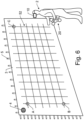
- Figure 5 illustrates an initial setup of the grid scan area on the wall 3 using the AR goggles 10 worn by the user 2.
- the grid scan area size and position can be automatically detected using the cameras of the AR googles and available 3D mesh information.
- fiducial markers e.g., ArUco markers
- three points A, B, C marked with fiducial markers can define the grid scan area plane in 3D space. These markers can be detected using the camera on the AR goggles. If the AR goggles provide a 3D mesh of the environment, mapping to the wall 3 can be done automatically. Alternatively, the grid scan area initially may be defined by the user by manually defining the corner points of the 2D grid scan area.
- a single fiducial marker 4 (e.g., a single ArUco marker) may be provided permanently at the wall 3. This allows unambiguously identifying the structure to be tested. Also, the manual grid definition may be based on the single fiducial marker 4 to map the grid scan to a serial number or specific fiducial marker pattern.
- the fiducial marker 4 can be an elongated fiducial marker, e.g. in the form of a ribbon band. This may allow for a better detection of the marker, and an improved referencing and scaling.
- the ribbon band be about 5cm wide and up to 10m long. It can be provided in arbitrary position on the wall 3 or other feature, either permanently or temporarily, i.e. only during the measurement.
- Figure 6 shows a grid 52, which - using the three points A, B, C - is projected onto the wall 3 in the AR image presented to the user 2 by the AR goggles 10.
- the AR goggles 10 may provide the necessary tools for selecting points in 3D space either by hand gesture tracking or by controllers.
- Three points A, B, C are sufficient to fully define the grid on flat surfaces or even on slightly curved surfaces if they are "quasi-flat" - from a mathematical point of view and from a local point of view. In case of more complex, non-quasi flat surfaces (i.e., columns with small radius) additional points or parameters could be defined in order to project the grid.
- the size and shape of the grid 52 may vary depending on a detected size and shape of the scanning area.
- grid shapes need not be limited to rectangles.
- obstacles on the surface which need to be scanned may be taken into account when defining the grid 52.
- the size and shape of the grid 52 may be selectable or customizable by the user 2.
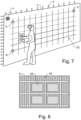
- Figure 7 shows the user 2 performing NDT using the NDT device 20, while the grid 52 is shown in the AR images presented to the user 2 by the AR goggles 10.
- the AR goggles 10 provide camera images from the person's point of view. Combining the grid plane information and visual tracking of unique features of the NDT device 20 over the camera, a 3D position of the NDT device 20 - particularly relative to the wall 3 - can be defined.
- the camera may also detect, which parts of the grid 52 have already been tested and update the grid 52 in real time, e.g. by only displaying the remaining parts of the grid 52 or by highlighting those parts of the grid that have already been tested differently than the remaining parts of the grid 52 (e.g. using different colours).
- the process may also be split into sub-processes, so that only one line of the grid 52 may be displayed at the same time, i.e. that line of the grid 52, along which the user is performing the current part (or the next part) of the measurement.
- the user may be guided through the process by providing feedback in the AR images to correct or improve the data collection process. For instance, if the position of the sensor of the NDT device 20 is deviating from the current line, the user can be given feedback, e.g. by displaying arrows indicating how to correct the sensor position (up, down, left, right). If the whole grid is displayed and the user does not follow the correct sequence of grid lines, this may be indicated in the AR images, e.g. by highlighting the correct line. Optionally, if a deviation is detected, this may be taken into account in the data processing, in order to automatically correct the user's error.
- a scan surface has been defined over points A, B and C, providing a 2D plane where the device 20 will always be on during data collection.
- the AR Goggles 10 have position reference to the grid 52 through points A, B, C.
- the camera on the AR goggles 10 can track the NDT device 20 by recognizing significant features or geometries of the device. As the NDT device 20 will always drive on the previously defined 2D plane (or slightly curved surface), camera images (or more) can add sufficient information to track the device 20 in three dimensions, fully defining the device position relative to points A, B, C.
- Detected features e.g., rebars 5 and utilities
- Detected features e.g., rebars 5 and utilities
- Data visualization can be used for several purposes.
- the data captured by the AR device 10, particularly the AR images, and the data captured by the NDT device 20, i.e. the feature data related to the detected features are related in 3D space to each other.
- the process or important steps thereof may be documented by the AR googles 10 by taking and storing pictures, videos and/or audio of the process, which optionally may be combined with 3D space information, e.g. of the NDT sensor.
- This documentation may be done automatically or involve prompting the user 2 to do so.
- Figure 8 shows an exemplary AR image 51, in which representations 55 of detected rebars are visualized on the wall.
- Such an image 51 may be visualized with actual data, i.e. of a presently tested wall, as well as with past data, i.e. for a wall that has been tested a while ago, where the data has been retrieved from a database (e.g. automatically upon recognizing the wall). Visualizing such features allows relocating these features for later inspection and also allows avoiding hitting them when drilling holes.
- further information may be generated based on the detected features and visualized in the AR image 51.
- the representations 55 may be visualized in 3D.
- Presently available AR solutions that allow this include the Oculus Quest 2, the Microsoft HoloLens and a 3D rendering software such as Unity.
- this further information comprises highlighting areas 58 that are safe to drill into.
- the NDT sensor data e.g., detected life wire
- locations may be defined and highlighted that should be inspected further.
- Depth of detected utilities may be highlighted using colour grading
- material properties may be highlighted using overlaid symbols, marks, icons, text or abstracted objects (e.g., spheres or cylinders).
- Detected features may be classified (e.g., as rebars, conduits, water pipes, pockets) and highlighted by representative geometrical overlays (e.g. cylinders, rectangular objects, tubes or spheres).
- Visualizing the feature data may comprise object discrimination. This involves sensor fusion on the side of the NDT device, so that the different detected properties or objects can be visualizing. For instance, this may include highlighting different kinds of objects (e.g., highlighting representations of rebars differently than representations of pipes) or showing different materials (e.g. plastic, iron, copper) in different colours.
- object discrimination involves sensor fusion on the side of the NDT device, so that the different detected properties or objects can be visualizing. For instance, this may include highlighting different kinds of objects (e.g., highlighting representations of rebars differently than representations of pipes) or showing different materials (e.g. plastic, iron, copper) in different colours.
- a plurality of NDT sensors of different sensor types may be used for detecting the features, for instance inductive sensors, capacitive sensors, and radar sensors.
- object types of the features may be determined, such as water pipes, plastic pipes, copper pipes, live wires, and reinforcement bars. Representations of the detected features may then be presented in the AR images according to their object type, e.g., highlighted or coloured differently.
- the inductive sensor For instance, if radar detects a strong signal, whereas the inductive sensor gives no signal, it is likely that the feature is a non-metal object like a water pipe (containing water). If radar detects a weak signal, and the inductive sensor gives no signal, it is likely that the feature is a non-metal object like an empty plastic pipe. If radar detects a strong signal, and the inductive sensor senses a non-ferrous metal object, it is likely that the feature is a copper pipe as used for heating. If radar detects a strong signal, and the inductive sensor senses a ferrous metal object, it is likely that the feature is a reinforcement bar. If radar detects a signal, the inductive sensor senses a non-ferrous metal object, and the capacitive sensor detects 50Hz, it is likely that the feature is a live wire.
- Figure 9 shows a flow-chart illustrating an exemplary computer-implemented method 100 for non-destructive testing of a structure.
- the structure may be a part of a building, e.g. a wall, floor or ceiling.
- the structure may also be a bridge, a viaduct, a pillar, a dam, a tower, or a part of one of these.
- the method 100 may be performed using a system as described above, e.g. with respect to Figures 3a or 3b.
- the method 100 comprises, in real time:
- the measuring instructions may comprise a grid that is projected on the structure in the AR images. While the user performs the non-destructive testing (NDT process) of the structure using the data acquisition device according to the measuring instructions, the method 100 further comprises (particularly continuously during the NDT process):
Landscapes
- Engineering & Computer Science (AREA)
- Physics & Mathematics (AREA)
- General Physics & Mathematics (AREA)
- Theoretical Computer Science (AREA)
- General Engineering & Computer Science (AREA)
- Life Sciences & Earth Sciences (AREA)
- Analytical Chemistry (AREA)
- Biochemistry (AREA)
- General Health & Medical Sciences (AREA)
- Immunology (AREA)
- Pathology (AREA)
- Chemical & Material Sciences (AREA)
- Health & Medical Sciences (AREA)
- Computer Graphics (AREA)
- Computer Hardware Design (AREA)
- Software Systems (AREA)
- Multimedia (AREA)
- Computer Vision & Pattern Recognition (AREA)
- General Life Sciences & Earth Sciences (AREA)
- Geophysics (AREA)
- Optics & Photonics (AREA)
- Human Computer Interaction (AREA)
- Processing Or Creating Images (AREA)
- Image Analysis (AREA)
Priority Applications (3)
| Application Number | Priority Date | Filing Date | Title |
|---|---|---|---|
| EP23213675.4A EP4564132A1 (fr) | 2023-12-01 | 2023-12-01 | Test non destructif soutenu par réalité augmentée |
| CN202411677331.9A CN120084794A (zh) | 2023-12-01 | 2024-11-22 | 增强现实支持的无损测试 |
| US18/965,740 US20250180774A1 (en) | 2023-12-01 | 2024-12-02 | Augmented-reality supported non-destructive testing |
Applications Claiming Priority (1)
| Application Number | Priority Date | Filing Date | Title |
|---|---|---|---|
| EP23213675.4A EP4564132A1 (fr) | 2023-12-01 | 2023-12-01 | Test non destructif soutenu par réalité augmentée |
Publications (1)
| Publication Number | Publication Date |
|---|---|
| EP4564132A1 true EP4564132A1 (fr) | 2025-06-04 |
Family
ID=89073211
Family Applications (1)
| Application Number | Title | Priority Date | Filing Date |
|---|---|---|---|
| EP23213675.4A Pending EP4564132A1 (fr) | 2023-12-01 | 2023-12-01 | Test non destructif soutenu par réalité augmentée |
Country Status (3)
| Country | Link |
|---|---|
| US (1) | US20250180774A1 (fr) |
| EP (1) | EP4564132A1 (fr) |
| CN (1) | CN120084794A (fr) |
Citations (4)
| Publication number | Priority date | Publication date | Assignee | Title |
|---|---|---|---|---|
| US9952438B1 (en) * | 2012-10-29 | 2018-04-24 | The Boeing Company | Augmented reality maintenance system |
| US20180293801A1 (en) * | 2017-04-06 | 2018-10-11 | Hexagon Technology Center Gmbh | Near field maneuvering for ar-device using image tracking |
| EP3748583A1 (fr) * | 2019-06-04 | 2020-12-09 | My Virtual Reality Software AS | Visualisation d'un service public souterrain |
| US20220313216A1 (en) * | 2021-03-31 | 2022-10-06 | Baker Hughes Holdings Llc | Augmented reality in ultrasonic inspection |
-
2023
- 2023-12-01 EP EP23213675.4A patent/EP4564132A1/fr active Pending
-
2024
- 2024-11-22 CN CN202411677331.9A patent/CN120084794A/zh active Pending
- 2024-12-02 US US18/965,740 patent/US20250180774A1/en active Pending
Patent Citations (5)
| Publication number | Priority date | Publication date | Assignee | Title |
|---|---|---|---|---|
| US9952438B1 (en) * | 2012-10-29 | 2018-04-24 | The Boeing Company | Augmented reality maintenance system |
| US20180293801A1 (en) * | 2017-04-06 | 2018-10-11 | Hexagon Technology Center Gmbh | Near field maneuvering for ar-device using image tracking |
| US10347051B2 (en) | 2017-04-06 | 2019-07-09 | Hexagon Technology Center Gmbh | Near field maneuvering for AR-device using image tracking |
| EP3748583A1 (fr) * | 2019-06-04 | 2020-12-09 | My Virtual Reality Software AS | Visualisation d'un service public souterrain |
| US20220313216A1 (en) * | 2021-03-31 | 2022-10-06 | Baker Hughes Holdings Llc | Augmented reality in ultrasonic inspection |
Also Published As
| Publication number | Publication date |
|---|---|
| CN120084794A (zh) | 2025-06-03 |
| US20250180774A1 (en) | 2025-06-05 |
Similar Documents
| Publication | Publication Date | Title |
|---|---|---|
| Zhou et al. | Implementation of augmented reality for segment displacement inspection during tunneling construction | |
| EP3055648B1 (fr) | Procédé et système de modélisation tridimensionnelle à l'aide d'une détection de caractéristiques | |
| Behzadan et al. | Augmented reality visualization: A review of civil infrastructure system applications | |
| Kim et al. | Improvement of realism of 4D objects using augmented reality objects and actual images of a construction site | |
| EP3483594B1 (fr) | Dispositif de traitement d'informations, procédé de traitement d'informations et programme | |
| Al-Sabbag et al. | Interactive defect quantification through extended reality | |
| US7139685B2 (en) | Video-supported planning of equipment installation and/or room design | |
| EP3330928A1 (fr) | Dispositif de génération d'image, système de génération d'image et procédé de génération d'image | |
| Chmelina et al. | A 3-d laser scanning system and scan data processing method for the monitoring of tunnel deformations | |
| KR20210077322A (ko) | 인공지능 기반의 시설물 외관 분석 방법 | |
| JPWO2018066614A1 (ja) | スリーブ位置検査装置及びスリーブ位置検査方法 | |
| JP2019194605A (ja) | 対象物、特に建造物を検査するための構成および方法 | |
| JP6719368B2 (ja) | 3次元空間可視化装置、3次元空間可視化方法およびプログラム | |
| JP6829846B2 (ja) | 構造物の検査システム、構造物の検査方法及びプログラム | |
| Han et al. | Vision-based field inspection of concrete reinforcing bars | |
| Hsieh et al. | On-site visual construction management system based on the integration of SLAM-based AR and BIM on a handheld device | |
| JP2005310044A (ja) | データ処理装置、データ処理方法、及びデータ処理プログラム | |
| Dunston et al. | Key areas and issues for augmented reality applications on construction sites | |
| Hu et al. | Augmented reality based visualization for concrete bridge deck deterioration characterized by ground penetrating radar | |
| EP4564132A1 (fr) | Test non destructif soutenu par réalité augmentée | |
| Yusoff et al. | Detection of discontinuity pattern and orientation for tunnel faces by using 2D and 3D image analysis techniques | |
| Aziz et al. | Visual fire safety inspection framework using computer vision algorithms | |
| Trindade et al. | Damar: Augmented reality in dam safety control | |
| JPWO2014087494A1 (ja) | 計算システム | |
| Lamsal et al. | Development of an AR system for the advancement of the tasks in the construction sites |
Legal Events
| Date | Code | Title | Description |
|---|---|---|---|
| PUAI | Public reference made under article 153(3) epc to a published international application that has entered the european phase |
Free format text: ORIGINAL CODE: 0009012 |
|
| STAA | Information on the status of an ep patent application or granted ep patent |
Free format text: STATUS: THE APPLICATION HAS BEEN PUBLISHED |
|
| AK | Designated contracting states |
Kind code of ref document: A1 Designated state(s): AL AT BE BG CH CY CZ DE DK EE ES FI FR GB GR HR HU IE IS IT LI LT LU LV MC ME MK MT NL NO PL PT RO RS SE SI SK SM TR |
|
| STAA | Information on the status of an ep patent application or granted ep patent |
Free format text: STATUS: REQUEST FOR EXAMINATION WAS MADE |
|
| 17P | Request for examination filed |
Effective date: 20251203 |