EP4564301A1 - Procédé de création d'un avatar pouvant être commandé - Google Patents
Procédé de création d'un avatar pouvant être commandé Download PDFInfo
- Publication number
- EP4564301A1 EP4564301A1 EP23213823.0A EP23213823A EP4564301A1 EP 4564301 A1 EP4564301 A1 EP 4564301A1 EP 23213823 A EP23213823 A EP 23213823A EP 4564301 A1 EP4564301 A1 EP 4564301A1
- Authority
- EP
- European Patent Office
- Prior art keywords
- parameters
- geometric
- geometric primitives
- learning
- model
- Prior art date
- Legal status (The legal status is an assumption and is not a legal conclusion. Google has not performed a legal analysis and makes no representation as to the accuracy of the status listed.)
- Withdrawn
Links
Images


Classifications
-
- G—PHYSICS
- G06—COMPUTING OR CALCULATING; COUNTING
- G06T—IMAGE DATA PROCESSING OR GENERATION, IN GENERAL
- G06T17/00—Three-dimensional [3D] modelling for computer graphics
-
- G—PHYSICS
- G06—COMPUTING OR CALCULATING; COUNTING
- G06T—IMAGE DATA PROCESSING OR GENERATION, IN GENERAL
- G06T13/00—Animation
- G06T13/20—Three-dimensional [3D] animation
- G06T13/40—Three-dimensional [3D] animation of characters, e.g. humans, animals or virtual beings
-
- G—PHYSICS
- G06—COMPUTING OR CALCULATING; COUNTING
- G06V—IMAGE OR VIDEO RECOGNITION OR UNDERSTANDING
- G06V40/00—Recognition of biometric, human-related or animal-related patterns in image or video data
- G06V40/10—Human or animal bodies, e.g. vehicle occupants or pedestrians; Body parts, e.g. hands
- G06V40/16—Human faces, e.g. facial parts, sketches or expressions
- G06V40/174—Facial expression recognition
- G06V40/176—Dynamic expression
Definitions
- the present disclosure relates to the field of reconstruction from images and animation, and more particularly to a computer-implemented method for creating a controllable avatar of an animated subject.
- Reconstructing a 3D representation able to jointly capture the appearance, geometry and dynamics of a subject, for instance a human head represents a major challenge for high-fidelity avatar generation.
- the under-constrained nature of this reconstruction problem significantly complicates the task of achieving a representation that combines novel-view rendering photorealism with pose and expression controllability.
- extreme expressions and facial details like wrinkles, the mouth interior, and hair, are difficult to capture, and can produce visual artifacts easily noticed by humans. Similar difficulties, mutatis mutandis, arise for other types of subjects.
- Neural Radiance Fields NeRF [REF. 1]
- NeRF Neural Radiance Fields
- the object of the present invention is to at least substantially remedy the above-mentioned drawbacks.
- the present disclosure relates to a computer-implemented method for creating a controllable avatar of an animated subject from at least one image set of the animated subject, the method comprising:
- this method is referred to, hereinafter, as the creating method.
- An avatar may be a digital replication of the subject's appearance.
- the avatar being controllable means that parameters of the avatar can be changed in order to change the avatar's appearance, as will be detailed hereinafter.
- the avatar may be a three-dimensional avatar.
- the image set may be a single-view image set or a multi-view image set, i.e. an image set in which each element or time step corresponds to a plurality of images of the subject simultaneously taken from a plurality of viewpoints, respectively.
- the image set may be acquired, e.g. through an image acquisition module such as a camera, or retrieved as an already acquired image set from a database, e.g. a local or distant server or the like.
- Geometric primitives are a representation of local visual information of the avatar.
- the geometric primitives contain the necessary information to enable, possibly after processing such as image rendering, displaying the avatar.
- a geometric primitive may be defined by parameters such as a position, an orientation, a shape, a size or scale, a color, an opacity, etc.
- Examples of geometric primitives include a point cloud, 3D Gaussians ([REF. 2]), other three-dimension probability distributions or even more expressive geometric primitives which may, for instance, bend or stretch. Expressiveness qualifies the ability of the geometric primitive to convey the appearance of the subject.
- model of the animated subject is parametric and morphable: the model is defined by parameters and changing the parameters of the model and its shape, including pose and expression, enables to control the avatar.
- model will refer to the parametric and morphable model of the animated subject.
- the model may represent a global shape of the animated subject.
- the model may be a surface model in three-dimensions.
- each base element (e.g. cell of a mesh) of the model is two-dimensional and has a 3D position and orientation with respect to other elements of the model.
- the geometric primitives are rigged to the model.
- the geometric primitives add visual information to the model which includes the shape information.
- the geometric primitives together form a dynamic representation.
- the model enables to efficiently and consistently animate the geometric primitives, which would otherwise be too difficult to control.
- the controllable avatar comprises the parametric morphable model associated to the geometric primitives with learned parameters.
- the geometric primitives are anchored relative to the model and are animated and controlled by the underlying model.
- a visualization of the avatar, from an arbitrary viewpoint, can be obtained by rendering the geometric primitives associated to the model, which can be performed in real time.
- the learning enables to adjust parameters of the geometric primitives, thus compensating for regions where the model is either not accurately aligned, or is incapable of reproducing certain visual elements.
- This enables to obtain a controllable avatar that is more accurate and realistic than previous work, better performing at tasks such as novel-view rendering (generating an unknown view of the animated subject) and reenactment (making the controllable avatar of a first subject copy the pose and attitude of a second subject).
- one or more of the at least one image set comprises a plurality of successive frames of a video; the image set may be a video.
- the image set may comprise a plurality of non-successive frames of a video, e.g. selected at a given sampling frequency (e.g. every third frame of the video).
- the image set may comprise one or more static images, e.g. photographs. Using frames from a video enables to take temporal information into account, thus giving access to broader and more detailed information.
- the associating comprises positioning the geometric primitives in respective local reference frames bound to points of the model, said positioning being defined by values of the parameters. That is, each geometric primitive is anchored to the model, the parameters of the geometric primitive defining the position of the geometric primitive in a local reference frame bound to a point of the model.
- the parameters may be referred to as local parameters.
- the local reference frames may also be referred to as local spaces.
- the parameters may define a static relationship between the respective geometric primitives and the respective local reference frames of the model.
- Such parameters may include a position, orientation, scale, etc.
- a plurality of local reference frames, bound to a plurality of points respectively, may be considered.
- Two different geometric primitives may be associated to two different local reference frames.
- the parameters may define a static positioning of the geometric primitives with respect to the local reference frames.
- the geometric primitives may be locally static, while in a global space, and considering the morphability of the model, they form a dynamic representation of the animated subject. Therefore, the controllability of the avatar is enhanced.
- learning parameters defining the local positioning of the geometric primitives enables to consider explicit displacement offsets of the geometric primitives, leading to a more accurate geometric representation of the subject.
- the geometric primitives are discrete. Discrete geometric primitives can be directly associated to the model and explicitly moved during the learning, thereby obviating the need for intermediate spaces such as a canonical space.
- the model comprises a mesh.
- a mesh is a network of points forming cells in-between neighboring points.
- the associating comprises allocating each one of the geometric primitives to a cell of the mesh while enabling the geometric primitive to move and deform with the cell.
- the respective local reference frames may correspond to the respective cells of the mesh.
- cells and local reference frames are used interchangeably, depending on whether the model comprises a mesh or another type of representation.
- the learning keeps constant the allocation of the geometric primitives to the cells of the mesh.
- a geometric primitive remains anchored to the same cell (or more generally to the same local reference frame) throughout the learning. This consistent correspondence between a geometric primitive and a cell provides robustness to the creating method and to the created avatar.
- the parameters of the geometric primitives may include an identifier of a cell of the mesh to which the geometric primitive is allocated, and the identifier is kept constant during the learning.
- the parameters comprise scaling information of the geometric primitive with respect to a scaling of an associated cell thereof.
- the local position and the scaling of a geometric primitive are defined relative to the absolute scale of a cell. This enables an adaptive step size in the metric space with a constant learning rate for parameters defined in the local space. For example, geometric primitives paired with small cells will move slower in a learning iteration step than those paired with large cells.
- the learning comprises updating values of the parameters in a global reference frame of the model.
- the parameters are optimized based on what happens in a global space, which improves the performance of the creating method.
- the geometric primitives comprise three-dimensional Gaussians.
- a 3D Gaussian may be defined by parameters such as a center and a covariance matrix. 3D Gaussians are discussed in more details in [REF. 2].
- the parameters comprise anisotropic scaling information. That is, the geometric primitive may deform differently in different directions. Anisotropic scaling makes the geometric primitive more expressive and enables to avoid dotted artifacts.
- the geometric primitives jointly encode a texture and a lighting of the animated subject. Since the texture and lighting are encoded jointly, fine details of the subject can be modelled more precisely in the avatar, so that the avatar is more realistic.
- the creating method comprises adapting a local density of the geometric primitives.
- Adapting a local density of the geometric primitives may include locally adding or removing one or more geometric primitives.
- the adapting may change the number of geometric primitives associated to one or more local reference frames or cells of the mesh.
- Adapting a local density may be carried out whenever desired, e.g. during the learning (e.g. between some iterations of the learning).
- the adapting may be carried out for the first time after a certain number of iterations, to enable the geometric primitives to be somewhat optimized before trying to improve their density.
- the adapting may be carried out once or several times. For instance, two successive occurrence of adapting may be separated by a plurality of learning iterations, in order to leave enough time for the parameters to be improved by learning before re-assessing the density.
- the adapting comprises adding a second geometric primitive to a local reference frame already having a first geometric primitive allocated thereto.
- density is increased for better modeling of details of the animated subject. This reduces blurry renderings.
- the second geometric primitive is allocated to said local reference frame. That is, both the first geometric primitive and the second geometric primitive are allocated to the same local reference frame.
- the respective parameters of the first and second geometric primitives may define different position, orientation, scale, etc. of those first and second geometric primitives in that local reference frame.
- binding inheritance Allocating the second geometric primitive to the same local reference frame as the first geometric primitive, referred to hereinafter as binding inheritance, enables to refine the avatar without losing controllability, thus leading to significant fidelity improvements.
- the adapting comprises pruning geometric primitives.
- density is reduced where it was unnecessarily high.
- the adapting comprises checking that the pruning does not remove a last geometric primitive of a cell, so that each cell remains associated with at least one geometric primitive. When it is determined that the geometric primitive to be pruned is the last geometric primitive of a cell, the pruning may be cancelled for that geometric primitive. This avoids unwanted artifacts in the avatar.
- the learning comprises rendering an image based on values of the parameters of the associated geometric primitives at a current iteration, comparing the rendered image with a ground-truth image from the at least one image set, and updating the values of the parameters to increase similarity between the rendered image and the ground-truth image.
- the learning of the parameters may be self-supervised based on the input image set.
- the learning may comprise a plurality of iterations including the aforementioned steps, each iteration basing on the parameter values updated at the preceding iteration.
- a loss function defining the similarity between the rendered image and the ground-truth image can be defined appropriately by the skilled person.
- the similarity considered may be a global similarity.
- the parameters are defined locally, they are learned on the basis of a global similarity assessment.
- the creating method comprises obtaining the parametric morphable model of the animated subject from the at least one image set.
- Obtaining such a model may be based on computer vision algorithms and/or machine learning, and may depend on the type of animated subject.
- the learning comprises fine-tuning parameters of the parametric morphable model and/or parameters of a model configured to obtain the parametric morphable model of the animated subject from the at least one image set, optionally jointly and end-to-end with the learning of the parameters of the associated geometric primitives. This improves image quality, all the more so when the geometric primitives are consistently allocated to local reference frames or, as the case may be, cells of the mesh.
- a loss function used in the learning comprises at least one of a position term penalizing a distance between a geometric primitive and a cell associated thereto, and a scaling term penalizing a scaling difference between a geometric primitive and a cell associated thereto.
- the position term ensures that a geometric primitive is not too far away from a cell associated thereto, and the scaling term ensures that a geometric primitive keeps a size consistent with that of the associated cell. Both, independently, enhance the visual consistency and robustness of the created avatar, and avoid artifacts.
- At least one of the position term and/or the scaling term includes a tolerance under which said term has a fixed value.
- a tolerance under which said term has a fixed value.
- regularization of the position term and/or the scaling term is carried out for visible portions of the model and ignored for invisible portions of the model. This helps to maintain the learned structure of occluded portions.
- the present disclosure is further directed to a device for creating a controllable avatar of an animated subject from at least one image set of the animated subject, the device comprising a processor configured to:
- the device may be configured to carry out the above-mentioned creating method, and may have part or all of the above-described features.
- the device may have the hardware structure of a computer.
- the present disclosure is further directed to a system comprising the above-described device equipped with a video or image acquisition module to obtain the at least one image set.
- the video or image acquisition module may be a camera or the like.
- the present disclosure is further related to a computer program set including instructions for executing the steps of the above described creating method when said program is executed by at least one computer.
- This program set can use any programming language and take the form of source code, object code or a code intermediate between source code and object code, such as a partially compiled form, or any other desirable form.
- the present disclosure is further related to a recording medium readable by at least one computer and having recorded thereon at least one computer program including instructions for executing the steps of the above described creating method.
- the recording medium can be any entity or device capable of storing the program.
- the medium can include a mass memory device, such as hard drive.
- mass memory devices suitable for tangibly embodying computer program instructions and data include all forms of nonvolatile memory, including by way of example semiconductor memory devices, such as EPROM, EEPROM, and flash memory devices; magnetic disks such as internal hard disks and removable disks; magneto-optical disks.
- the recording medium can be an integrated circuit in which the program is incorporated, the circuit being adapted to execute the method in question or to be used in its execution.
- the creating method is a computer-implemented method for creating a controllable avatar of an animated subject from at least one image set of the animated subject, the method comprising associating geometric primitives to a parametric morphable model of the animated subject, and learning parameters of the associated geometric primitives based on the at least one image set.
- Fig. 1 The embodiment shown in Fig. 1 is detailed with the animated subject being a human head. However, the principles explained herein also apply to other animated subjects, such as articulated (including flexible) objects, bodies, animals, plants, etc.
- Fig. 1 is detailed with the geometric primitives comprising three-dimensional Gaussians.
- the principles explained herein also apply to other geometric primitives, as mentioned above.
- Fig. 1 is detailed with the image set being a video. While a video may be helpful to effectively track a subject to obtain a model thereof, the principles explained herein for the creating method per se do not require a video, and the image set may comprise images of a subject, the images being discontinuous in time and/or viewpoint.
- Fig. 1 is detailed with the parametric morphable model comprising a mesh having cells, in particular triangular cells (also referred to herein as triangles).
- the principles explained herein also apply to other shapes of cells (e.g. quadrangular, etc.), and more generally to other types of models.
- the input to the creating method is an image set, e.g. a video 10, e.g. a multi-view video recording of a human head.
- a model of the human head may be obtained by any suitable method.
- the model may be obtained in the context of the creating method.
- a subject tracker may be used for each image of the video 10 (e.g. each time step).
- a photometric head tracker based on [REF. 4] is used to fit FLAME [REF. 3] parameters with multi-view observations and known camera parameters.
- the FLAME meshes have vertices at varied positions but share the same topology.
- An illustration of the obtained mesh is identified by reference 20 in Fig. 1 .
- the model may be parametrized by a shape ⁇ , a vertex offset ⁇ v , a translation t , joint poses ⁇ and an expression ⁇ .
- the shape ⁇ may be a vector with a length of S, where S is the number of principle components in the shape space of the model (here FLAME). This vector may be used as weights to blend the shape components of FLAME to describe the subject (e.g. a human head) in neutral pose and expression.
- the vertex offset ⁇ v may be a matrix in a size of [V, 3].
- the vertex offset ⁇ v may describe the offset of each one of the V vertices of the mesh in neutral pose and expression to compensate the limited expressiveness of the shape space of FLAME.
- the translation t may be a vector with a length of 3.
- the translation t may describe the global translation of the FLAME mesh in the world coordinate system.
- the joint poses ⁇ may be a list of axis-angles that describe the rotations of joints of the subject, e.g. the root node, neck, jaw, left eyeball, and right eyeball. They can be stored as a matrix in a size of [J, 3], where J is the number of joints.
- the expression ⁇ may be a vector with a length of E, where E is the number of expression components in the expression space of FLAME. This vector may be used as weights to blend the expression components of FLAME to describe the subject (e.g. a human head) with respect to its neutral pose and expression.
- An overview of the creating method according to the present embodiment is as follows: given a model of the animated subject, e.g. the mesh, it is possible to associate geometric primitives to the model, e.g. to build a consistent connection between triangles of the mesh and 3D Gaussians as detailed later.
- the splats may be rendered into images via a differentiable tile rasterizer [REF. 2]. Parameters of the 3D Gaussians are then learned. For instance, these rendered images (specifically, rendered images based on values of the parameters of the associated geometric primitives at a current iteration) are supervised by the ground-truth images (specifically, ground-truth images from the image set) towards learning a realistic human head avatar. Further improvements will be described, which improve quality of the created avatar.
- 3D Gaussian Splatting provides a solution to reconstruct a static scene with anisotropic 3D Gaussians given images and camera parameters.
- an ellipse may be stored as a position vector ⁇ ⁇ R 3 , a scaling vector s ⁇ R 3 , and a quaternion q ⁇ R 4 .
- the quaternion may represent the orientation of the ellipse.
- r ⁇ R 3 ⁇ 3 notates the corresponding rotation matrix to q.
- the parameters of the geometric primitive may comprise a position, and orientation and a scale of the geometric primitive.
- the color C of a pixel is computed by blending all 3D Gaussians overlapping the pixel, e.g. through Eq. (3):
- ⁇ j 1 i ⁇ 1 1 ⁇ ⁇ j ′
- c i is the color of each 3D Gaussian modeled by 3-degree spherical harmonics h , which enables to adapt the color based on the viewpoint.
- the blending weight ⁇ i ' is given by evaluating the 2D projection of the 3D Gaussian multiplied by a per-Gaussian opacity ⁇ .
- the Gaussians are sorted by depth before blending to respect visibility order.
- the parameters of the geometric primitives may comprise visual information, such as a spherical harmonics coefficient h and an opacity coefficient ⁇ .
- the origin of the local space, or local reference frame may be the mean position T of the three vertices of a triangle.
- the direction vector of one edge, the normal vector of the triangle, and their cross product may be taken as vectors forming a base of the local reference frame, namely as column vectors to form a rotation matrix R which describes the orientation of the triangle in the global space.
- a scale k of the triangle may also be computed, e.g. by the mean of the length of one edge and its perpendicular in the triangle. An example of such a local reference frame is shown in item 1 in Fig. 1 .
- each triangle of the mesh may be paired with a 3D Gaussian which has the ability to move with the triangle across time steps.
- the 3D Gaussian is static in the local space of its parent triangle but dynamic in the global (metric) space as the triangle moves.
- the associating comprises positioning the geometric primitives in respective local reference frames.
- the associating comprises allocating each one of the geometric primitives to a cell of the mesh while enabling the geometric primitive to move and deform with the cell.
- the positioning may be defined by values of the parameters.
- the parameters comprise scaling information, e.g. the anisotropic scaling s , of the geometric primitive with respect to a scaling of an associated cell thereof.
- the creating method may initialize the location ⁇ at the local origin, the rotation r as an identity rotation matrix, and the scaling s as a unit vector.
- the associating and the initial values of the parameters are shown in item 2 in Fig. 1 , where the 3D Gaussian is shown schematically by reference 22.
- the 3D Gaussians 22 form a radiance field on top of the mesh 20.
- triangle scaling is incorporated in Eqs. (5) and (6) so that the local position and scaling of a 3D Gaussian are defined relative to the absolute scale of a triangle. This enables an adaptive step size in the metric space with a constant learning rate for parameters defined in the local space. This also makes interpreting the parameters regarding the distance from the triangle center easier.
- the creating method may comprise adapting a local density of the geometric primitives.
- Such an adapting also referred to as adaptive density control, adds and removes splats, e.g. based on the view-space positional gradient and the opacity of each Gaussian.
- the adapting comprises adding a second geometric primitive to a local reference frame already having a first geometric primitive allocated thereto.
- each 3D Gaussian with a large view-space positional gradient may be split into two smaller ones if it is large or cloned if it is small.
- This adding may be conducted in the local space, and the creating method may ensure that a newly created Gaussian is close to the old one that triggers this densification operation.
- the second geometric primitive is allocated to the same local reference frame as the first geometric primitive. That is, the new 3D Gaussian is allocated to the same triangle as the old one because it was created to enhance the fidelity of the local region. Therefore, in embodiments, each 3D Gaussian carries one more parameter, namely the index i (or more generally an identifier) of its parent triangle (i.e. the cell to which it is allocated), to enable binding inheritance during densification.
- pruning operations may also be used as a part of the adaptive density control strategy.
- the pruning operation may periodically reset the opacity of all splats close to zero and remove points with opacity below a threshold, as detailed in [REF. 2].
- This technique is effective in suppressing floating artifacts, however, such pruning can also cause problems in a dynamic scene. For instance, regions of the face that are often occluded (such as eyeball triangles), can be overly sensitive to this pruning strategy, and often end up with few or no attached Gaussians.
- the adapting may comprise checking that the pruning does not remove a last geometric primitive of a triangle. For instance, the creating method may keep track of the number of splats attached to each triangle, and ensure that every triangle always has at least one splat attached and deny local pruning otherwise.
- Adaptive density control is schematically illustrated in item 4 of Fig. 1 .
- adaptive density control may be carried out at any appropriate stage of the creating method. However, for performance reasons, it is desirable to implement at least part of the learning of the geometric primitive parameters before implementing adaptive density control.
- the learning comprises rendering an image based on values of the parameters of the associated geometric primitives at a current iteration, comparing the rendered image with a ground-truth image from the at least one image set, and updating the values of the parameters to increase similarity between the rendered image and the ground-truth image.
- the image shown at reference 24 illustrates a rendered image after initialization of the 3D Gaussians. As can be seen, all the geometric primitives are centered in their respective triangles and have the same scale and the same color. As the case may be, more complex initializations may however be contemplated.
- Reference 26 shows the same avatar after learning iterations. Increasing similarity may include minimizing color loss between the ground-truth image (from the video 10) and the rendered image 26. To obtain the rendered image 26, the geometric primitives may be rendered at the same viewpoint as the ground-truth image in order to facilitate comparison.
- a loss function used in the learning comprises at least one of a position term penalizing a distance between a geometric primitive and a cell associated thereto, and a scaling term penalizing a scaling difference between a geometric primitive and a cell associated thereto, optionally wherein at least one of the position term and/or the scaling term includes a tolerance under which said term has a fixed value.
- the Gaussians should roughly match the underlying mesh. They should also match their locations; for instance a Gaussian representing a spot on the nose should not be rigged to a triangle on the cheek.
- the splats are initialized at triangle centers, and new splats may be added nearby these existing ones, it is not guaranteed that the primitives remain close to their parent triangle after the learning.
- This ⁇ scaling -tolerance is helpful to prevent the Gaussians from shrinking excessively, causing rendering speeds to deteriorate, as camera rays need to hit more splats to before zero transmittance is reached, and difficulty to construct opaque surfaces to handle occlusions.
- L position and L scaling may be applied only to visible splats. Thereby, the creating method only regularizes points when the color loss L rgb is present. This helps to maintain the learned structure of often-occluded regions such as teeth and eyeballs.
- Update of the parameters during learning leads to a change of the properties of the geometric primitive 22, as illustrated in item 3 of Fig. 1 .
- the updated parameters may include the position, orientation, scale, SH coefficient (color) and/or opacity of the geometric primitive.
- the learning may keep constant the allocation of the geometric primitives to the cells of the mesh, e.g. the parent index i .
- the learning comprises fine-tuning parameters of the parametric morphable model and/or parameters of the model configured to obtain the parametric morphable model of the animated subject from the at least one image set, jointly and end-to-end with the learning of the parameters of the associated geometric primitives.
- the creating method also fine-tunes the translation, joint pose (joint rotation), and expression parameters of the model for each time step, for instance using learning rates 1e-6, 1e-5, and 1e-3, respectively.
- the learning comprises 600,000 iterations.
- the method may exponentially decay the learning rate for the splat positions until the final iteration, where it reaches a certain fraction of the initial value (e.g. 0.01 ⁇ the initial value).
- Adaptive density control with binding inheritance is performed every 2,000 iterations, from iteration 10,000 until the end. Every 60,000 iterations, the Gaussians' opacities are reset.
- a photometric head tracker may be used to obtain the FLAME parameters, including shape ⁇ , translation t, pose ⁇ , expression ⁇ , and vertex offset ⁇ v in the canonical space.
- Triangles for the upper and lower teeth, which are rigid to the neck and jaw joints, respectively, may be manually added; this applies, more generally, to any rigid part of the animated subject.
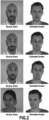
- FIG. 2 shows four examples of cross-identity reenactment, where the left image is an image by a source actor and the right image is a rendering of the created avatar for another identity. As can be seen, the avatars accurately reproduce eye and mouth movements from source actors showing lively, complex dynamics such as wrinkles.
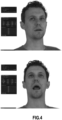
- Figures 3 and 4 show four examples of novel-view synthesis, where the parameters of the underlying mesh enable to obtain new expressions and new viewpoints. This evidences the controllability of the created avatar.
- the benefits of adapting the local density of the geometric primitives is evidenced by comparing the first rendered image 26 in Fig. 1 (above item), which was obtained without adaptive density control, and the second rendered image 28 in Fig. 1 (above item) which was obtained with adaptive density control and binding inheritance.
- the second rendered image 28 is more detailed and consistent than the first rendered image 26 in many aspects, such as the details of the hair, the uniformity of the T-shirt, etc.
Landscapes
- Physics & Mathematics (AREA)
- Engineering & Computer Science (AREA)
- General Physics & Mathematics (AREA)
- Theoretical Computer Science (AREA)
- Computer Graphics (AREA)
- Geometry (AREA)
- Software Systems (AREA)
- Processing Or Creating Images (AREA)
Priority Applications (2)
| Application Number | Priority Date | Filing Date | Title |
|---|---|---|---|
| EP23213823.0A EP4564301A1 (fr) | 2023-12-01 | 2023-12-01 | Procédé de création d'un avatar pouvant être commandé |
| JP2024209738A JP7847193B2 (ja) | 2023-12-01 | 2024-12-02 | コンピュータにより実施する方法、コンピュータプログラム、および記録媒体 |
Applications Claiming Priority (1)
| Application Number | Priority Date | Filing Date | Title |
|---|---|---|---|
| EP23213823.0A EP4564301A1 (fr) | 2023-12-01 | 2023-12-01 | Procédé de création d'un avatar pouvant être commandé |
Publications (1)
| Publication Number | Publication Date |
|---|---|
| EP4564301A1 true EP4564301A1 (fr) | 2025-06-04 |
Family
ID=89073262
Family Applications (1)
| Application Number | Title | Priority Date | Filing Date |
|---|---|---|---|
| EP23213823.0A Withdrawn EP4564301A1 (fr) | 2023-12-01 | 2023-12-01 | Procédé de création d'un avatar pouvant être commandé |
Country Status (2)
| Country | Link |
|---|---|
| EP (1) | EP4564301A1 (fr) |
| JP (1) | JP7847193B2 (fr) |
Cited By (1)
| Publication number | Priority date | Publication date | Assignee | Title |
|---|---|---|---|---|
| CN120339380A (zh) * | 2025-06-16 | 2025-07-18 | 中国石油大学(华东) | 一种面向稀疏视角的三维高斯视觉定位方法 |
Citations (3)
| Publication number | Priority date | Publication date | Assignee | Title |
|---|---|---|---|---|
| US20030052878A1 (en) * | 2001-06-29 | 2003-03-20 | Samsung Electronics Co., Ltd. | Hierarchical image-based representation of still and animated three-dimensional object, method and apparatus for using this representation for the object rendering |
| WO2022164660A1 (fr) * | 2021-01-26 | 2022-08-04 | Meta Platforms Technologies, Llc | Mélange de primitives volumétriques pour un rendu neuronal efficace |
| US11682166B2 (en) * | 2021-03-15 | 2023-06-20 | Adobe Inc. | Fitting 3D primitives to a high-resolution point cloud |
-
2023
- 2023-12-01 EP EP23213823.0A patent/EP4564301A1/fr not_active Withdrawn
-
2024
- 2024-12-02 JP JP2024209738A patent/JP7847193B2/ja active Active
Patent Citations (3)
| Publication number | Priority date | Publication date | Assignee | Title |
|---|---|---|---|---|
| US20030052878A1 (en) * | 2001-06-29 | 2003-03-20 | Samsung Electronics Co., Ltd. | Hierarchical image-based representation of still and animated three-dimensional object, method and apparatus for using this representation for the object rendering |
| WO2022164660A1 (fr) * | 2021-01-26 | 2022-08-04 | Meta Platforms Technologies, Llc | Mélange de primitives volumétriques pour un rendu neuronal efficace |
| US11682166B2 (en) * | 2021-03-15 | 2023-06-20 | Adobe Inc. | Fitting 3D primitives to a high-resolution point cloud |
Non-Patent Citations (7)
| Title |
|---|
| "Face2face: Real-time face capture and reenactment of rgb videos.", IN PROCEEDINGS OF THE IEEE CONFERENCE ON COMPUTER VISION AND PATTERN RECOGNITION, 2016, pages 2387 - 2395 |
| BEN MILDENHALL, PRATUL P SRINIVASAN, MATTHEW TANCIK, JONATHAN T BARRON: "NeRF: Representing scenes as neural radiance fields for view synthesis", COMMUNICATIONS OF THE ACM, vol. 65, no. 1, 2021, pages 99 - 106, XP055953603, DOI: 10.1145/3503250 |
| BERNHARD KERBLGEORGIOS KOPANASTHOMAS LEIMKÜHLERGEORGE DRETTAKIS: "3D Gaussian splatting for real-time radiance field rendering.", ACM TRANSACTIONS ON GRAPHICS (TOG, vol. 42, no. 4, 2023, pages 1 - 14, XP059155161, DOI: 10.1145/3592433 |
| DIEDERIK P KINGMAJIMMY BA. ADAM: "A method for stochastic optimization", ARXIV PREPRINT ARXIV: 1412.6980, 2014 |
| LOMBARDI STEPHEN STEPHEN LOMBARDI@FB COM ET AL: "Mixture of volumetric primitives for efficient neural rendering", ACM TRANSACTIONS ON GRAPHICS, ACM, NY, US, vol. 40, no. 4, 19 July 2021 (2021-07-19), pages 1 - 13, XP058628511, ISSN: 0730-0301, DOI: 10.1145/3450626.3459863 * |
| MATTHEW LOPERNAUREEN MAHMOODJAVIER ROMEROGERARD PONS-MOLLMICHAEL J. BLACK: "SMPL: A Skinned Multi-Person Linear Model. ACM Transactions on Graphics", PROC. SIGGRAPH ASIA, vol. 34, no. 6, 2015 |
| TIANYE LI, TIMO BOLKART, MICHAEL. J. BLACK, HAO LI, AND JAVIER ROMERO: "Learning a model of facial shape and expression from 4D scans.", ACM TRANSACTIONS ON GRAPHICS, (PROC. SIGGRAPH ASIA, vol. 36, no. 6, 2017, pages 1 - 194, XP058473791, DOI: 10.1145/3130800.3130813 |
Cited By (1)
| Publication number | Priority date | Publication date | Assignee | Title |
|---|---|---|---|---|
| CN120339380A (zh) * | 2025-06-16 | 2025-07-18 | 中国石油大学(华东) | 一种面向稀疏视角的三维高斯视觉定位方法 |
Also Published As
| Publication number | Publication date |
|---|---|
| JP7847193B2 (ja) | 2026-04-16 |
| JP2025092455A (ja) | 2025-06-19 |
Similar Documents
| Publication | Publication Date | Title |
|---|---|---|
| Grassal et al. | Neural head avatars from monocular rgb videos | |
| EP3827414B1 (fr) | Avatars neuronaux texturés | |
| Xiang et al. | Modeling clothing as a separate layer for an animatable human avatar | |
| Gecer et al. | Ganfit: Generative adversarial network fitting for high fidelity 3d face reconstruction | |
| EP4238062B1 (fr) | Modélisation par points de vêtements humains | |
| Noh et al. | A survey of facial modeling and animation techniques | |
| JP2023526566A (ja) | 高速で深い顔面変形 | |
| Wenninger et al. | Realistic virtual humans from smartphone videos | |
| Li et al. | Pshuman: Photorealistic single-view human reconstruction using cross-scale diffusion | |
| CN115951784B (zh) | 一种基于双神经辐射场的穿衣人体运动捕捉和生成方法 | |
| WO2026000852A1 (fr) | Procédé de reconstruction et de commande basé sur une vidéo animée multivue d'un corps humain habillé | |
| Bao et al. | High-quality face capture using anatomical muscles | |
| Poursaeed et al. | Neural puppet: Generative layered cartoon characters | |
| CN118379438A (zh) | 数字人合成方法、计算机程序产品、设备及介质 | |
| Peng et al. | Pica: Physics-integrated clothed avatar | |
| JP7847193B2 (ja) | コンピュータにより実施する方法、コンピュータプログラム、および記録媒体 | |
| Liao et al. | SOAP: Style-Omniscient Animatable Portraits | |
| Li et al. | Ggavatar: Geometric adjustment of gaussian head avatar | |
| CN119991891A (zh) | 三维虚拟对象的生成方法、装置、介质、计算机设备 | |
| Pawaskar et al. | Expression transfer: A system to build 3d blend shapes for facial animation | |
| Karim et al. | Face Image Animation with Adversarial Learning and Motion Transfer. | |
| Huang et al. | 3D-CariNet: End-to-end 3D Caricature Generation from Natural Face Images with Differentiable Renderer. | |
| Park et al. | Refined Geometry-guided Head Avatar Reconstruction from Monocular RGB Video | |
| Cowe | Example-based computer-generated facial mimicry | |
| EP4664406A1 (fr) | Procédé et dispositif de création d'un avatar pouvant être commandé |
Legal Events
| Date | Code | Title | Description |
|---|---|---|---|
| PUAI | Public reference made under article 153(3) epc to a published international application that has entered the european phase |
Free format text: ORIGINAL CODE: 0009012 |
|
| STAA | Information on the status of an ep patent application or granted ep patent |
Free format text: STATUS: REQUEST FOR EXAMINATION WAS MADE |
|
| 17P | Request for examination filed |
Effective date: 20231201 |
|
| AK | Designated contracting states |
Kind code of ref document: A1 Designated state(s): AL AT BE BG CH CY CZ DE DK EE ES FI FR GB GR HR HU IE IS IT LI LT LU LV MC ME MK MT NL NO PL PT RO RS SE SI SK SM TR |
|
| STAA | Information on the status of an ep patent application or granted ep patent |
Free format text: STATUS: THE APPLICATION IS DEEMED TO BE WITHDRAWN |
|
| 18D | Application deemed to be withdrawn |
Effective date: 20251205 |