EP4564329A1 - Systèmes et procédés de prédiction de man uvre de véhicule à l'aide d'un apprentissage profond - Google Patents
Systèmes et procédés de prédiction de man uvre de véhicule à l'aide d'un apprentissage profond Download PDFInfo
- Publication number
- EP4564329A1 EP4564329A1 EP24203307.4A EP24203307A EP4564329A1 EP 4564329 A1 EP4564329 A1 EP 4564329A1 EP 24203307 A EP24203307 A EP 24203307A EP 4564329 A1 EP4564329 A1 EP 4564329A1
- Authority
- EP
- European Patent Office
- Prior art keywords
- vehicle
- maneuver
- target vehicle
- lane
- maneuvers
- Prior art date
- Legal status (The legal status is an assumption and is not a legal conclusion. Google has not performed a legal analysis and makes no representation as to the accuracy of the status listed.)
- Granted
Links
Images




Classifications
-
- G—PHYSICS
- G08—SIGNALLING
- G08G—TRAFFIC CONTROL SYSTEMS
- G08G1/00—Traffic control systems for road vehicles
- G08G1/16—Anti-collision systems
- G08G1/167—Driving aids for lane monitoring, lane changing, e.g. blind spot detection
-
- B—PERFORMING OPERATIONS; TRANSPORTING
- B60—VEHICLES IN GENERAL
- B60W—CONJOINT CONTROL OF VEHICLE SUB-UNITS OF DIFFERENT TYPE OR DIFFERENT FUNCTION; CONTROL SYSTEMS SPECIALLY ADAPTED FOR HYBRID VEHICLES; ROAD VEHICLE DRIVE CONTROL SYSTEMS FOR PURPOSES NOT RELATED TO THE CONTROL OF A PARTICULAR SUB-UNIT
- B60W60/00—Drive control systems specially adapted for autonomous road vehicles
- B60W60/001—Planning or execution of driving tasks
- B60W60/0015—Planning or execution of driving tasks specially adapted for safety
-
- B—PERFORMING OPERATIONS; TRANSPORTING
- B60—VEHICLES IN GENERAL
- B60W—CONJOINT CONTROL OF VEHICLE SUB-UNITS OF DIFFERENT TYPE OR DIFFERENT FUNCTION; CONTROL SYSTEMS SPECIALLY ADAPTED FOR HYBRID VEHICLES; ROAD VEHICLE DRIVE CONTROL SYSTEMS FOR PURPOSES NOT RELATED TO THE CONTROL OF A PARTICULAR SUB-UNIT
- B60W60/00—Drive control systems specially adapted for autonomous road vehicles
- B60W60/001—Planning or execution of driving tasks
- B60W60/0027—Planning or execution of driving tasks using trajectory prediction for other traffic participants
- B60W60/00274—Planning or execution of driving tasks using trajectory prediction for other traffic participants considering possible movement changes
-
- G—PHYSICS
- G06—COMPUTING OR CALCULATING; COUNTING
- G06N—COMPUTING ARRANGEMENTS BASED ON SPECIFIC COMPUTATIONAL MODELS
- G06N3/00—Computing arrangements based on biological models
- G06N3/02—Neural networks
- G06N3/04—Architecture, e.g. interconnection topology
- G06N3/044—Recurrent networks, e.g. Hopfield networks
-
- G—PHYSICS
- G06—COMPUTING OR CALCULATING; COUNTING
- G06N—COMPUTING ARRANGEMENTS BASED ON SPECIFIC COMPUTATIONAL MODELS
- G06N3/00—Computing arrangements based on biological models
- G06N3/02—Neural networks
- G06N3/04—Architecture, e.g. interconnection topology
- G06N3/045—Combinations of networks
-
- G—PHYSICS
- G06—COMPUTING OR CALCULATING; COUNTING
- G06N—COMPUTING ARRANGEMENTS BASED ON SPECIFIC COMPUTATIONAL MODELS
- G06N3/00—Computing arrangements based on biological models
- G06N3/02—Neural networks
- G06N3/04—Architecture, e.g. interconnection topology
- G06N3/045—Combinations of networks
- G06N3/0455—Auto-encoder networks; Encoder-decoder networks
-
- G—PHYSICS
- G06—COMPUTING OR CALCULATING; COUNTING
- G06N—COMPUTING ARRANGEMENTS BASED ON SPECIFIC COMPUTATIONAL MODELS
- G06N3/00—Computing arrangements based on biological models
- G06N3/02—Neural networks
- G06N3/08—Learning methods
-
- G—PHYSICS
- G06—COMPUTING OR CALCULATING; COUNTING
- G06N—COMPUTING ARRANGEMENTS BASED ON SPECIFIC COMPUTATIONAL MODELS
- G06N3/00—Computing arrangements based on biological models
- G06N3/02—Neural networks
- G06N3/08—Learning methods
- G06N3/088—Non-supervised learning, e.g. competitive learning
-
- G—PHYSICS
- G08—SIGNALLING
- G08G—TRAFFIC CONTROL SYSTEMS
- G08G1/00—Traffic control systems for road vehicles
- G08G1/09—Arrangements for giving variable traffic instructions
- G08G1/0962—Arrangements for giving variable traffic instructions having an indicator mounted inside the vehicle, e.g. giving voice messages
- G08G1/0967—Systems involving transmission of highway information, e.g. weather, speed limits
- G08G1/096766—Systems involving transmission of highway information, e.g. weather, speed limits where the system is characterised by the origin of the information transmission
- G08G1/096791—Systems involving transmission of highway information, e.g. weather, speed limits where the system is characterised by the origin of the information transmission where the origin of the information is another vehicle
Definitions
- the disclosure herein generally relates to the field of vehicle maneuver prediction, and, more particularly, to systems and methods for vehicle maneuver prediction using deep learning.
- a processor implemented method comprising perceiving, via one or more hardware processors, a surrounding environment of an autonomous vehicle to identify one or more surrounding vehicles and a target vehicle from the one or more surrounding vehicles; determining, via the one or more hardware processors, (i) a set of input features for the target vehicle with respect to the autonomous vehicle for an observation time window using a plurality of driving and sensor related information of the autonomous vehicle and the target vehicle, and (ii) a set of classes of maneuvers for the target vehicle with respect to the autonomous vehicle, wherein the set of classes of maneuvers comprises a non-incident maneuver, Lane change to Left (LCL), the Lane change to Right (LCR), Cut-in to Left (CTL) and Cut-in to Right (CTR), and wherein each class from the set of classes of maneuvers corresponds to a specific condition from
- a system comprising a memory storing instructions; one or more communication interfaces; and one or more hardware processors coupled to the memory via the one or more communication interfaces, wherein the one or more hardware processors are configured by the instructions to: perceive a surrounding environment of an autonomous vehicle to identify one or more surrounding vehicles and a target vehicle from the one or more surrounding vehicles; determine (i) a set of input features for the target vehicle with respect to the autonomous vehicle for an observation time window using a plurality of driving and sensor related information of the autonomous vehicle and the target vehicle, and (ii) a set of classes of maneuvers for the target vehicle with respect to the autonomous vehicle, wherein the set of classes of maneuvers comprises a non-incident maneuver, lane change to left, lane change to right, cut-in to left and cut-in to right, and wherein each class from the set of classes of maneuvers corresponds to a specific condition from a set of conditions; train a stacked autoencoder based singular deep neural network using the set of input features and the
- a non-transitory computer readable medium configured by instructions for perceiving, a surrounding environment of an autonomous vehicle to identify one or more surrounding vehicles and a target vehicle from the one or more surrounding vehicles; determining, (i) a set of input features for the target vehicle with respect to the autonomous vehicle for an observation time window using a plurality of driving and sensor related information of the autonomous vehicle and the target vehicle, and (ii) a set of classes of maneuvers for the target vehicle with respect to the autonomous vehicle, wherein the set of classes of maneuvers comprises a non-incident maneuver, Lane change to Left (LCL), the Lane change to Right (LCR), Cut-in to Left (CTL) and Cut-in to Right (CTR), and wherein each class from the set of classes of maneuvers corresponds to a specific condition from a set of conditions; training, a stacked autoencoder based singular deep neural network using the set of input features and the set of classes of maneuvers, wherein a
- the set of input features comprises range, range rate, transversal, speed, and yaw angle.
- the set of conditions for determining the set of classes of maneuvers for the autonomous vehicle and each surrounding vehicle include: (a) selecting the cut-in to right maneuver when a lane identity value at a current time is greater than the lane identity value at a previous time and the lane identity value of the autonomous vehicles and the target vehicle are same at the current time and a parameter indicative of division of the range by the range rate is less than a predefined threshold value; (b) selecting the lane change to right maneuver when the lane identity value at the current time is greater than the lane identity value at the previous time and the lane identity value of the autonomous vehicles and the target vehicle are same at the current time and the parameter indicative of division of the range by the range rate exceeds the predefined threshold value; (c) selecting the cut-in to left maneuver when the lane identity value at the current time is lesser than the lane identity value at the previous time and the lane identity value of the autonomous vehicles and the target vehicle are same at the current time and the parameter indicative of division of the range by the range rate
- Autonomous vehicle systems provide improved safety in comparison to human driven vehicles by reducing crashes.
- the autonomous vehicles have to share the road with human-driven vehicles.
- human drivers make decision errors during maneuvers such as illegal maneuvers, misjudgment of gaps or others speed, and poor direction control which may result in crashes.
- Autonomous vehicles therefore have to predict human-initiated safe and unsafe maneuvers to react appropriately for the safety and comfort of its passengers.
- the present disclosure addresses unresolved problems of the conventional autonomous vehicle systems by providing a deep neural network model that uses sensor data to predict if any vehicle within its field of view would perform safe or unsafe lane maneuvers into its headway or into any other vehicle's headway in the next 0.5 to 5 seconds.
- the method of the present disclosure also helps surrounding vehicles to know intention of a target vehicle with the help of vehicle-to-vehicle communication systems in a road driving environment.
- FIGS. 1 through 5 where similar reference characters denote corresponding features consistently throughout the figures, there are shown preferred embodiments and these embodiments are described in the context of the following exemplary system and/or method.
- FIG. 1 illustrates an exemplary system for vehicle maneuver prediction using deep learning according to some embodiments of the present disclosure.
- the system 100 includes or is otherwise in communication with one or more hardware processors 104, communication interface device(s) or input/output (I/O) interface(s) 106, and one or more data storage devices or memory 102 operatively coupled to the one or more hardware processors 104.
- the one or more hardware processors 104, the memory 102, and the I/O interface(s) 106 may be coupled to a system bus 108 or a similar mechanism.
- the I/O interface(s) 106 may include a variety of software and hardware interfaces, for example, a web interface, a graphical user interface, and the like.
- the I/O interface(s) 106 may include a variety of software and hardware interfaces, for example, interfaces for peripheral device(s), such as a keyboard, a mouse, an external memory, a plurality of sensor devices, a printer and the like. Further, the I/O interface(s) 106 may enable the system 100 to communicate with other devices, such as web servers and external databases.
- the one or more hardware processors 104 may be implemented as one or more microprocessors, microcomputers, microcontrollers, digital signal processors, central processing units, state machines, logic circuitries, and/or any devices that manipulate signals based on operational instructions.
- the one or more hardware processors 104 are configured to fetch and execute computer-readable instructions stored in the memory 102.
- the expressions processors and hardware processors may be used interchangeably.
- the system 100 can be implemented in a variety of computing systems, such as laptop computers, portable computer, notebooks, hand-held devices, workstations, mainframe computers, servers, a network cloud and the like.
- the memory 102 may include any computer-readable medium known in the art including, for example, volatile memory, such as static random access memory (SRAM) and dynamic random access memory (DRAM), and/or non-volatile memory, such as read only memory (ROM), erasable programmable ROM, flash memories, hard disks, optical disks, and magnetic tapes.
- volatile memory such as static random access memory (SRAM) and dynamic random access memory (DRAM)
- non-volatile memory such as read only memory (ROM), erasable programmable ROM, flash memories, hard disks, optical disks, and magnetic tapes.
- the memory 102 includes a plurality of modules 102a and a repository 102b for storing data processed, received, and generated by one or more of the plurality of modules 102a.
- the plurality of modules 102a may include routines, programs, objects, components, data structures, and so on, which perform particular tasks or implement particular abstract data types.
- the plurality of modules 102a may include programs or computer-readable instructions or coded instructions that supplement applications or functions performed by the system 100.
- the plurality of modules 102a may also be used as, signal processor(s), state machine(s), logic circuitries, and/or any other device or component that manipulates signals based on operational instructions.
- the plurality of modules 102a can be used by hardware, by computer-readable instructions executed by the one or more hardware processors 104, or by a combination thereof.
- the memory 102 may include information pertaining to input(s)/output(s) of each step performed by the processor(s) 104 of the system 100 and methods of the present disclosure.
- the repository 102b may include a database or a data engine. Further, the repository 102b amongst other things, may serve as a database or includes a plurality of databases for storing the data that is processed, received, or generated as a result of the execution of the plurality of modules 102a. Although the repository 102b is shown internal to the system 100, it will be noted that, in alternate embodiments, the repository 102b can also be implemented external to the system 100, where the repository 102b may be stored within an external database (not shown in FIG. 1 ) communicatively coupled to the system 100. The data contained within such external database may be periodically updated.
- new data may be added into the external database and/or existing data may be modified and/or non-useful data may be deleted from the external database.
- the data may be stored in an external system, such as a Lightweight Directory Access Protocol (LDAP) directory and a Relational Database Management System (RDBMS).
- LDAP Lightweight Directory Access Protocol
- RDBMS Relational Database Management System
- the data stored in the repository 102b may be distributed between the system 100 and the external database.
- Embodiments of the present disclosure provide systems and methods for vehicle maneuver prediction using deep learning.
- the expressions ⁇ autonomous vehicle', and 'host' may be interchangeably used throughout the description.
- FIGS. 2A and 2B illustrate an exemplary flow diagram illustrating a method for vehicle maneuver prediction using deep learning, using the system of FIG. 1 , in accordance with some embodiments of the present disclosure.
- the system(s) 100 comprises one or more data storage devices or the memory 102 operatively coupled to the one or more hardware processors 104 and is configured to store instructions for execution of steps of the method by the one or more processors 104.
- the steps of the method 200 of the present disclosure will now be explained with reference to components of the system 100 of FIG. 1 , the flow diagram as depicted in FIGS. 2A and 2B , and one or more examples. Although steps of the method 200 including process steps, method steps, techniques or the like may be described in a sequential order, such processes, methods and techniques may be configured to work in alternate orders.
- any sequence or order of steps that may be described does not necessarily indicate a requirement that the steps be performed in that order.
- the steps of processes described herein may be performed in any practical order. Further, some steps may be performed simultaneously, or some steps may be performed alone or independently.
- the one or more hardware processors are configured to perceive a surrounding environment of an autonomous vehicle to identify one or more surrounding vehicles and a target vehicle from the one or more surrounding vehicles.
- the autonomous vehicle is equipped with the sensors to track other vehicles around it and referred as the host vehicle.
- the vehicles around the host vehicle are called surrounding vehicles.
- the surrounding vehicle whose behavior is being predicted is called the target vehicle. It is assumed that the host vehicle's sensor data is augmented by vehicle to everything (V2X) and Dedicated Short Range Communication (DSRC) so that it can track vehicles up to seven adjacent lanes and vehicles up to 70 meters ahead and behind the host vehicle.
- V2X vehicle to everything
- DSRC Dedicated Short Range Communication
- the one or more hardware processors are configured to determine (i) a set of input features for the target vehicle with respect to the autonomous vehicle for an observation time window using a plurality of driving and sensor related information of the autonomous vehicle and the target vehicle, and (ii) a set of classes of maneuvers for the target vehicle with respect to the autonomous vehicle.
- t o [ T s , T p ].
- the set of input features comprises range, range rate, transversal, speed, and yaw angle.
- the range refers to a longitudinal position of the target vehicle relative to the host vehicle.
- the range rate refers to a longitudinal velocity of the target vehicle relative to the host vehicle.
- the transversal refers to a lateral position of the target vehicle relative to the host vehicle.
- the speed refers to speed of the host vehicle.
- the yaw angle refers to an angle between a direction the target vehicle is moving and the longitudinal axis of the target vehicle.
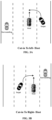
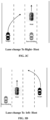
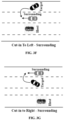
- the set of classes of maneuvers comprises a non-incident maneuver, Lane change to Left, Lane change to Right, Cut-in to Left and Cut-in to Right.
- the non-incident maneuver indicates that the target vehicle continues to proceed without performing any unsafe maneuver with respect to the autonomous vehicle.
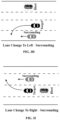
- the Lane change to Left indicates that the target vehicle performs a safe maneuver to move to its left lane.
- the Lane change to Right indicates that the target vehicle performs a safe maneuver to move to its right lane.
- the cut-in to left indicates that the target vehicle cuts into its left lane in front of another vehicle.
- the cut-in to right indicates that the target vehicle cuts into its right lane in front of another vehicle.
- FIGS. 3A through 3I depict diagram illustrating spatial views for the set of classes of maneuver, according to some embodiments of the present disclosure. As can be seen in FIGS. 3A through 3I , the spatial view for the set of classes of maneuver for the target vehicle is shown with respect to the host vehicle and a surrounding vehicle. In an embodiment, each class from the set of classes of maneuvers corresponds to a specific condition from a set of conditions.
- the set of conditions for determining the set of classes of maneuvers for the autonomous vehicle and each surrounding vehicle includes: (a) selecting the cut-in to right maneuver when a lane identity value at a current time is greater than the lane identity value at a previous time and the lane identity value of the autonomous vehicles and the target vehicle are same at the current time and a parameter indicative of division of the range by the range rate is less than a predefined threshold value; (b) selecting the lane change to right maneuver when the lane identity value at the current time is greater than the lane identity value at the previous time and the lane identity value of the autonomous vehicles and the target vehicle are same at the current time and the parameter indicative of division of the range by the range rate exceeds the predefined threshold value; (c) selecting the cut-in to left maneuver when the lane identity value at the current time is lesser than the lane identity value at the previous time and the lane identity value of the autonomous vehicles and the target vehicle are same at the current time and the parameter indicative of division of the range by the range rate is less than the predefined threshold value; (
- the step for determining the set of classes of maneuvers can be further better understood by way of following pseudo code provided as example:
- the one or more hardware processors 104 are configured to train, a stacked autoencoder based singular deep neural network using the set of input features and the set of classes of maneuvers.
- FIG. 4 illustrates a functional block diagram of architecture of the stacked autoencoder based singular deep neural network, according to some embodiments of the present disclosure.
- the stacked autoencoder based singular deep neural network comprise five layers. A number of neurons in input layers of the stacked autoencoder based singular deep neural network ranges from 50 to 375 depending on the observation window.
- the number of neurons in hidden layers and output layer of the stacked autoencoder based singular deep neural network is 64-32-16-5.
- a stacked autoencoder is used to initialize a plurality of weights and a plurality of biases of each layer of the stacked autoencoder based singular deep neural network. Output of previous auto-encoder's hidden layer is fed to next auto-encoder's input layer.
- four networks of the stacked autoencoder provide the initial weights and biases for each layer of the stacked autoencoder based singular deep neural network.
- the deep neural networks DNNs
- DNNs suffer from vanishing gradient problem and tend to get trapped in local minima.
- the stacked auto-encoder is used to pre-train the weights and biases of each layer in the stacked autoencoder based singular deep neural network. This also helps to overcome a vanishing gradient problem by utilizing dropout.
- the one or more hardware processors 104 are configured to predict a maneuver from the set of classes of maneuvers to be performed by the target vehicle with respect to the autonomous vehicle within a prediction time window using the stacked autoencoder based singular deep neural network.
- the prediction time window is indicative of a time interval between a time when the prediction is made and actual time of occurrence of the maneuver.
- the maneuver to be performed by the target vehicle is predicted even before its occurrence with the help of the stacked autoencoder based singular deep neural network.
- the step 208 is better understood by way of the following description provided as exemplary explanation.
- the target vehicle's features are determined and given as input to the stacked autoencoder based singular deep neural network.
- the output of the stacked autoencoder based singular deep neural network consists of 5 neurons with Softmax activation function.
- the 5 output neurons correspond to the 5 maneuver classes.
- the five input features for each target vehicle were sampled at 10Hz. Based on the length of t o , the number of neurons in the input layers ranges from 50 to 375.
- the second, third, and fourth layers have 64, 32, 16 neurons respectively.
- the output layer has five neurons corresponding to the five maneuver scenarios Rectified Linear Unit (ReLU) is the activation function at all intermediate layers, while Softmax is used for the output layer.
- x i are the input features and x i ′ are the output features.
- s is the input vector and C is the number of scenarios.
- the output of the previous auto-encoder's hidden layer is fed to the next auto-encoder's input.
- the stacked autoencoder comprising four auto-encoder networks provide the initial weights and biases for the layers of the stacked autoencoder based singular deep neural network as shown in the FIG. 4 .
- the initialized stacked autoencoder based singular deep neural network is then subsequently trained using the Adam optimizer.
- the stacked autoencoder based singular deep neural network is trained that can estimate value of each indicator variable element of O .
- the observation window t o was tuned from 1 to 7.5 seconds and the prediction window t p from 5 to 0.5 seconds.
- the resulting time windows ranged from 6 seconds to 8 seconds, in one example embodiment of the present disclosure.
- the one or more hardware processors 104 are configured to determine an outcome of a rule from a set of rules corresponding to a predicted maneuver from the set of predicted maneuvers of the target vehicle.
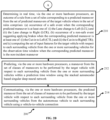
- the set of rules comprises: (a) occurrence of a safe event when the corresponding predicted maneuver is at least one of: (i) the Lane change to Left (LCL) and (ii) the Lane change to Right (LCR); (b) occurrence of a non-safe event suggesting applying brakes when the corresponding predicted maneuver is at least one of: (i) the Cut-in to Left (CTL) and (ii) the Cut-in to Right(CTR); and (c) computing the set of input features for the target vehicle with respect to each surrounding vehicle from the one or more surrounding vehicles for the observation time window when the corresponding predicted maneuver is the non-incident maneuver.
- the one or more hardware processors 104 are configured to predict a maneuver from the set of classes of maneuvers to be performed by the target vehicle with respect to each surrounding vehicle from the one or more surrounding vehicles within a prediction time window using the stacked autoencoder based singular deep neural network. If the predicted maneuver of the target vehicle with respect to host vehicle is a non- incident maneuver, then the set of input features of the target vehicle are computed with respect to each surrounding vehicle from the one or more surrounding vehicles. The set of input features are inputted to the stacked autoencoder based singular deep neural network and maneuvers of the target vehicle with respect to each surrounding vehicle are predicted.
- the one or more hardware processors 104 are configured to communicate the predicted maneuver from the set of classes of maneuvers to be performed by the target vehicle with respect to each surrounding vehicle from the one or more surrounding vehicles from the autonomous vehicle to each surrounding vehicle using a vehicle-to-vehicle (V2V) connection.
- V2V vehicle-to-vehicle
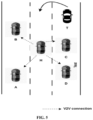
- FIG. 5 depicts an example of communication using the vehicle-to-vehicle connection, according to some embodiments of the present disclosure.
- H is the host vehicle and T is the target vehicle.
- A, B, C, and D are other surrounding vehicles of the host H.
- the host vehicle is connected to all the surrounding vehicles via V2V connection.
- the method of the present disclosure first predicts maneuver of T with respect to H.
- the host vehicle prepares for emergency breaking. If the predicted maneuver of the target vehicle with respect to host vehicle is a non- incident maneuver, then the set of input features of the target vehicle are computed with respect to each of the surrounding vehicle which are A, B, C, and D. The set of input features is inputted to the stacked autoencoder based singular deep neural network and maneuvers of the target vehicle with respect to each surrounding vehicle are predicted. The predictions are communicated to the corresponding surrounding vehicle through host vehicle's V2V connection, thus ensuring the safety of surrounding vehicles also.
- the stacked autoencoder based singular deep neural network was trained and tested on a mix of HighD and NGSIM I-80 data.
- the trained stacked autoencoder based singular deep neural network then was tested with NGSIM US-101 data to validate if it can deal with data sources not used in training.
- Table 1 below shows comparison results of the system of the present disclosure with conventional approaches.
- the method of the present disclosure is host-centric, has most number of maneuver classes, exhibits highest scores, and show possibility to use long prediction windows.
- Approach 1 is simulated with limited cut-in samples, exhibit consistency lower scores than the method of the present disclosure.
- Approach 2 has offline recognition only and exhibits lower scores than worst case scores of the method of the present disclosure.
- Approach 3 is target-centric, exhibits low scores and limited classes, and class detection was performed only two at time.
- Approach 4 is target-centric, perform only left lane change predictions and for very narrow driving scenarios only.
- Such computer-readable storage means contain program-code means for implementation of one or more steps of the method, when the program runs on a server or mobile device or any suitable programmable device.
- the hardware device can be any kind of device which can be programmed including e.g., any kind of computer like a server or a personal computer, or the like, or any combination thereof.
- the device may also include means which could be e.g., hardware means like e.g., an application-specific integrated circuit (ASIC), a field-programmable gate array (FPGA), or a combination of hardware and software means, e.g., an ASIC and an FPGA, or at least one microprocessor and at least one memory with software processing components located therein.
- the means can include both hardware means and software means.
- the method embodiments described herein could be implemented in hardware and software.
- the device may also include software means. Alternatively, the embodiments may be implemented on different hardware devices, e.g., using a plurality of CPUs.
- the embodiments herein can comprise hardware and software elements.
- the embodiments that are implemented in software include but are not limited to, firmware, resident software, microcode, etc.
- the functions performed by various components described herein may be implemented in other components or combinations of other components.
- a computer-usable or computer readable medium can be any apparatus that can comprise, store, communicate, propagate, or transport the program for use by or in connection with the instruction execution system, apparatus, or device.
- a computer-readable storage medium refers to any type of physical memory on which information or data readable by a processor may be stored.
- a computer-readable storage medium may store instructions for execution by one or more processors, including instructions for causing the processor(s) to perform steps or stages consistent with the embodiments described herein.
- the term "computer-readable medium” should be understood to include tangible items and exclude carrier waves and transient signals, i.e., be non-transitory. Examples include random access memory (RAM), read-only memory (ROM), volatile memory, nonvolatile memory, hard drives, CD ROMs, DVDs, flash drives, disks, and any other known physical storage media.
Landscapes
- Engineering & Computer Science (AREA)
- Physics & Mathematics (AREA)
- Theoretical Computer Science (AREA)
- General Physics & Mathematics (AREA)
- Life Sciences & Earth Sciences (AREA)
- Computing Systems (AREA)
- Artificial Intelligence (AREA)
- Computational Linguistics (AREA)
- Data Mining & Analysis (AREA)
- Evolutionary Computation (AREA)
- General Health & Medical Sciences (AREA)
- Molecular Biology (AREA)
- Biomedical Technology (AREA)
- General Engineering & Computer Science (AREA)
- Biophysics (AREA)
- Mathematical Physics (AREA)
- Software Systems (AREA)
- Health & Medical Sciences (AREA)
- Automation & Control Theory (AREA)
- Human Computer Interaction (AREA)
- Transportation (AREA)
- Mechanical Engineering (AREA)
- Atmospheric Sciences (AREA)
- Traffic Control Systems (AREA)
Applications Claiming Priority (1)
| Application Number | Priority Date | Filing Date | Title |
|---|---|---|---|
| IN202321080691 | 2023-11-28 |
Publications (3)
| Publication Number | Publication Date |
|---|---|
| EP4564329A1 true EP4564329A1 (fr) | 2025-06-04 |
| EP4564329C0 EP4564329C0 (fr) | 2025-12-31 |
| EP4564329B1 EP4564329B1 (fr) | 2025-12-31 |
Family
ID=92926394
Family Applications (1)
| Application Number | Title | Priority Date | Filing Date |
|---|---|---|---|
| EP24203307.4A Active EP4564329B1 (fr) | 2023-11-28 | 2024-09-27 | Systèmes et procédés de prédiction de manoeuvre de véhicule à l'aide d'un apprentissage profond |
Country Status (2)
| Country | Link |
|---|---|
| US (1) | US20250171048A1 (fr) |
| EP (1) | EP4564329B1 (fr) |
Families Citing this family (1)
| Publication number | Priority date | Publication date | Assignee | Title |
|---|---|---|---|---|
| DE102020215302A1 (de) * | 2020-12-03 | 2022-06-09 | Robert Bosch Gesellschaft mit beschränkter Haftung | Dynamikabhängige Verhaltensplanung für zumindest teilweise automatisiert fahrende Fahrzeuge |
Citations (2)
| Publication number | Priority date | Publication date | Assignee | Title |
|---|---|---|---|---|
| JP2006085285A (ja) * | 2004-09-14 | 2006-03-30 | Matsushita Electric Ind Co Ltd | 危険車両予測装置 |
| EP4009300A1 (fr) * | 2019-10-16 | 2022-06-08 | Tencent Technology (Shenzhen) Company Limited | Procédé de commande automatique de véhicule et procédé d'apprentissage de réseau de prédiction d'intention de changement de voie |
Family Cites Families (9)
| Publication number | Priority date | Publication date | Assignee | Title |
|---|---|---|---|---|
| US11042163B2 (en) * | 2018-01-07 | 2021-06-22 | Nvidia Corporation | Guiding vehicles through vehicle maneuvers using machine learning models |
| KR102054926B1 (ko) * | 2018-02-27 | 2019-12-12 | 주식회사 만도 | Free Space 신호 기반 근거리 컷인 차량 검출 시스템 및 방법 |
| US11514293B2 (en) * | 2018-09-11 | 2022-11-29 | Nvidia Corporation | Future object trajectory predictions for autonomous machine applications |
| US11577750B2 (en) * | 2018-11-08 | 2023-02-14 | Bayerische Motoren Werke Aktiengesellschaft | Method and apparatus for determining a vehicle comfort metric for a prediction of a driving maneuver of a target vehicle |
| US11092970B2 (en) * | 2019-02-07 | 2021-08-17 | Ford Global Technologies, Llc | Autonomous vehicle systems utilizing vehicle-to-vehicle communication |
| US11385642B2 (en) * | 2020-02-27 | 2022-07-12 | Zoox, Inc. | Perpendicular cut-in training |
| US11460847B2 (en) * | 2020-03-27 | 2022-10-04 | Intel Corporation | Controller for an autonomous vehicle, and network component |
| US20240059285A1 (en) * | 2022-08-19 | 2024-02-22 | Nvidia Corporation | Adaptive cruise control using future trajectory prediction for autonomous systems and applications |
| US12415545B2 (en) * | 2023-08-24 | 2025-09-16 | Toyota Motor Engineering & Manufacturing North America, Inc. | Methods and systems for collision control of moving vehicles surrounded by vehicles |
-
2024
- 2024-09-27 EP EP24203307.4A patent/EP4564329B1/fr active Active
- 2024-09-30 US US18/901,130 patent/US20250171048A1/en active Pending
Patent Citations (2)
| Publication number | Priority date | Publication date | Assignee | Title |
|---|---|---|---|---|
| JP2006085285A (ja) * | 2004-09-14 | 2006-03-30 | Matsushita Electric Ind Co Ltd | 危険車両予測装置 |
| EP4009300A1 (fr) * | 2019-10-16 | 2022-06-08 | Tencent Technology (Shenzhen) Company Limited | Procédé de commande automatique de véhicule et procédé d'apprentissage de réseau de prédiction d'intention de changement de voie |
Non-Patent Citations (2)
| Title |
|---|
| SANKARANARAYANAN PANDEESWARI ET AL: "Predicut - A Machine Learning Model For Online Prediction of Cut-In Manoeuvre For Autonomous Vehicles", 2023 IEEE 97TH VEHICULAR TECHNOLOGY CONFERENCE (VTC2023-SPRING), IEEE, 20 June 2023 (2023-06-20), pages 1 - 5, XP034397141, DOI: 10.1109/VTC2023-SPRING57618.2023.10199227 * |
| ZHU XIANGLEI ET AL: "Interaction-Aware Cut-In Trajectory Prediction and Risk Assessment in Mixed Traffic", IEEE/CAA JOURNAL OF AUTOMATICA SINICA, CHINESE ASSOCIATION OF AUTOMATION (CAA), vol. 9, no. 10, 1 October 2022 (2022-10-01), pages 1752 - 1762, XP011919766, ISSN: 2329-9266, [retrieved on 20220914], DOI: 10.1109/JAS.2022.105866 * |
Also Published As
| Publication number | Publication date |
|---|---|
| EP4564329C0 (fr) | 2025-12-31 |
| EP4564329B1 (fr) | 2025-12-31 |
| US20250171048A1 (en) | 2025-05-29 |
Similar Documents
| Publication | Publication Date | Title |
|---|---|---|
| US11586931B2 (en) | Training trajectory scoring neural networks to accurately assign scores | |
| US20220309920A1 (en) | Controlling vehicle-infrastructure cooperated autonomous driving | |
| US20210366144A1 (en) | Systems and methods for utilizing a deep learning model to determine vehicle viewpoint estimations | |
| US12314853B2 (en) | Training agent trajectory prediction neural networks using distillation | |
| US20240157979A1 (en) | Trajectory prediction using diffusion models | |
| EP3696791B1 (fr) | Prédiction d'intention de déviance de trajectoire pour véhicules | |
| Weng et al. | Rear‐end crash potential estimation in the work zone merging areas | |
| US20210150349A1 (en) | Multi object tracking using memory attention | |
| EP4564329B1 (fr) | Systèmes et procédés de prédiction de manoeuvre de véhicule à l'aide d'un apprentissage profond | |
| EP4456041A1 (fr) | Détection de conflits de trafic routier importants pour la sécurité | |
| US12576889B2 (en) | Method, system, and media for calculating a surprise score by comparing a posterior state to a prior probability distribution | |
| US20230280753A1 (en) | Robust behavior prediction neural networks through non-causal agent based augmentation | |
| Albousefi et al. | A support vector machine approach to unintentional vehicle lane departure prediction | |
| Moradloo et al. | Who initiates the automated vehicle disengagement—humans or automated driving systems? | |
| EP4219261B1 (fr) | Estimation de l'exposition au risque pour les véhicules autonomes | |
| EP4219258A1 (fr) | Procédé, système informatique et support lisible par ordinateur non transitoire pour la sélection de cible dans le voisinage d'un véhicule | |
| CN110758402A (zh) | 用于车辆控制信号的异常检测器 | |
| Suk et al. | Rationale-aware autonomous driving policy utilizing safety force field implemented on CARLA simulator | |
| Lucci et al. | Motorcycle curve assist: A novel approach based on active speed control for crash injury reduction | |
| US20250225051A1 (en) | Simulation-based testing for robotic systems | |
| Elhenawy et al. | A framework for testing independence between lane change and cooperative intelligent transportation system | |
| US12208820B2 (en) | Hybrid challenger model through peer-peer reinforcement for autonomous vehicles | |
| Zhou et al. | Driver assistance systems and safety—assessment and challenges | |
| Menendez et al. | Detecting and Predicting Smart Car Collisions in Hybrid Environments from Sensor Data | |
| US20250389541A1 (en) | Ai models generalization across different road segments |
Legal Events
| Date | Code | Title | Description |
|---|---|---|---|
| PUAI | Public reference made under article 153(3) epc to a published international application that has entered the european phase |
Free format text: ORIGINAL CODE: 0009012 |
|
| STAA | Information on the status of an ep patent application or granted ep patent |
Free format text: STATUS: THE APPLICATION HAS BEEN PUBLISHED |
|
| AK | Designated contracting states |
Kind code of ref document: A1 Designated state(s): AL AT BE BG CH CY CZ DE DK EE ES FI FR GB GR HR HU IE IS IT LI LT LU LV MC ME MK MT NL NO PL PT RO RS SE SI SK SM TR |
|
| STAA | Information on the status of an ep patent application or granted ep patent |
Free format text: STATUS: REQUEST FOR EXAMINATION WAS MADE |
|
| 17P | Request for examination filed |
Effective date: 20250714 |
|
| GRAP | Despatch of communication of intention to grant a patent |
Free format text: ORIGINAL CODE: EPIDOSNIGR1 |
|
| STAA | Information on the status of an ep patent application or granted ep patent |
Free format text: STATUS: GRANT OF PATENT IS INTENDED |
|
| RIC1 | Information provided on ipc code assigned before grant |
Ipc: G08G 1/16 20060101AFI20250929BHEP Ipc: G08G 1/0967 20060101ALI20250929BHEP Ipc: G06N 3/0455 20230101ALI20250929BHEP Ipc: G06N 3/044 20230101ALI20250929BHEP Ipc: G06N 3/045 20230101ALI20250929BHEP Ipc: G06N 3/08 20230101ALI20250929BHEP Ipc: G06N 3/088 20230101ALI20250929BHEP |
|
| INTG | Intention to grant announced |
Effective date: 20251009 |
|
| GRAS | Grant fee paid |
Free format text: ORIGINAL CODE: EPIDOSNIGR3 |
|
| GRAA | (expected) grant |
Free format text: ORIGINAL CODE: 0009210 |
|
| STAA | Information on the status of an ep patent application or granted ep patent |
Free format text: STATUS: THE PATENT HAS BEEN GRANTED |
|
| AK | Designated contracting states |
Kind code of ref document: B1 Designated state(s): AL AT BE BG CH CY CZ DE DK EE ES FI FR GB GR HR HU IE IS IT LI LT LU LV MC ME MK MT NL NO PL PT RO RS SE SI SK SM TR |
|
| REG | Reference to a national code |
Ref country code: CH Ref legal event code: F10 Free format text: ST27 STATUS EVENT CODE: U-0-0-F10-F00 (AS PROVIDED BY THE NATIONAL OFFICE) Effective date: 20251231 Ref country code: GB Ref legal event code: FG4D |
|
| REG | Reference to a national code |
Ref country code: DE Ref legal event code: R096 Ref document number: 602024001941 Country of ref document: DE |
|
| REG | Reference to a national code |
Ref country code: CH Ref legal event code: R17 Free format text: ST27 STATUS EVENT CODE: U-0-0-R10-R17 (AS PROVIDED BY THE NATIONAL OFFICE) Effective date: 20260121 |
|
| REG | Reference to a national code |
Ref country code: IE Ref legal event code: FG4D |
|
| U01 | Request for unitary effect filed |
Effective date: 20260107 |
|
| U07 | Unitary effect registered |
Designated state(s): AT BE BG DE DK EE FI FR IT LT LU LV MT NL PT RO SE SI Effective date: 20260112 |
|
| PG25 | Lapsed in a contracting state [announced via postgrant information from national office to epo] |
Ref country code: NO Free format text: LAPSE BECAUSE OF FAILURE TO SUBMIT A TRANSLATION OF THE DESCRIPTION OR TO PAY THE FEE WITHIN THE PRESCRIBED TIME-LIMIT Effective date: 20260331 |
|
| PG25 | Lapsed in a contracting state [announced via postgrant information from national office to epo] |
Ref country code: HR Free format text: LAPSE BECAUSE OF FAILURE TO SUBMIT A TRANSLATION OF THE DESCRIPTION OR TO PAY THE FEE WITHIN THE PRESCRIBED TIME-LIMIT Effective date: 20251231 |
|
| PG25 | Lapsed in a contracting state [announced via postgrant information from national office to epo] |
Ref country code: RS Free format text: LAPSE BECAUSE OF FAILURE TO SUBMIT A TRANSLATION OF THE DESCRIPTION OR TO PAY THE FEE WITHIN THE PRESCRIBED TIME-LIMIT Effective date: 20260331 |