EP4564378A1 - Noyau de stator en matériau nanocristallin et procédé de fabrication d'un noyau de stator en matériau nanocristallin - Google Patents
Noyau de stator en matériau nanocristallin et procédé de fabrication d'un noyau de stator en matériau nanocristallin Download PDFInfo
- Publication number
- EP4564378A1 EP4564378A1 EP24178176.4A EP24178176A EP4564378A1 EP 4564378 A1 EP4564378 A1 EP 4564378A1 EP 24178176 A EP24178176 A EP 24178176A EP 4564378 A1 EP4564378 A1 EP 4564378A1
- Authority
- EP
- European Patent Office
- Prior art keywords
- stator core
- encapsulation
- fact
- mass
- nanocrystalline
- Prior art date
- Legal status (The legal status is an assumption and is not a legal conclusion. Google has not performed a legal analysis and makes no representation as to the accuracy of the status listed.)
- Pending
Links
Images


Classifications
-
- H—ELECTRICITY
- H01—ELECTRIC ELEMENTS
- H01F—MAGNETS; INDUCTANCES; TRANSFORMERS; SELECTION OF MATERIALS FOR THEIR MAGNETIC PROPERTIES
- H01F3/00—Cores, Yokes, or armatures
- H01F3/04—Cores, Yokes, or armatures made from strips or ribbons
-
- H—ELECTRICITY
- H02—GENERATION; CONVERSION OR DISTRIBUTION OF ELECTRIC POWER
- H02K—DYNAMO-ELECTRIC MACHINES
- H02K1/00—Details of the magnetic circuit
- H02K1/02—Details of the magnetic circuit characterised by the magnetic material
-
- H—ELECTRICITY
- H01—ELECTRIC ELEMENTS
- H01F—MAGNETS; INDUCTANCES; TRANSFORMERS; SELECTION OF MATERIALS FOR THEIR MAGNETIC PROPERTIES
- H01F1/00—Magnets or magnetic bodies characterised by the magnetic materials therefor; Selection of materials for their magnetic properties
- H01F1/01—Magnets or magnetic bodies characterised by the magnetic materials therefor; Selection of materials for their magnetic properties of inorganic materials
- H01F1/03—Magnets or magnetic bodies characterised by the magnetic materials therefor; Selection of materials for their magnetic properties of inorganic materials characterised by their coercivity
- H01F1/12—Magnets or magnetic bodies characterised by the magnetic materials therefor; Selection of materials for their magnetic properties of inorganic materials characterised by their coercivity of soft-magnetic materials
- H01F1/14—Magnets or magnetic bodies characterised by the magnetic materials therefor; Selection of materials for their magnetic properties of inorganic materials characterised by their coercivity of soft-magnetic materials metals or alloys
- H01F1/147—Alloys characterised by their composition
- H01F1/153—Amorphous metallic alloys, e.g. glassy metals
- H01F1/15333—Amorphous metallic alloys, e.g. glassy metals containing nanocrystallites, e.g. obtained by annealing
-
- H—ELECTRICITY
- H01—ELECTRIC ELEMENTS
- H01F—MAGNETS; INDUCTANCES; TRANSFORMERS; SELECTION OF MATERIALS FOR THEIR MAGNETIC PROPERTIES
- H01F41/00—Apparatus or processes specially adapted for manufacturing or assembling magnets, inductances or transformers; Apparatus or processes specially adapted for manufacturing materials characterised by their magnetic properties
- H01F41/005—Impregnating or encapsulating
-
- H—ELECTRICITY
- H01—ELECTRIC ELEMENTS
- H01F—MAGNETS; INDUCTANCES; TRANSFORMERS; SELECTION OF MATERIALS FOR THEIR MAGNETIC PROPERTIES
- H01F41/00—Apparatus or processes specially adapted for manufacturing or assembling magnets, inductances or transformers; Apparatus or processes specially adapted for manufacturing materials characterised by their magnetic properties
- H01F41/02—Apparatus or processes specially adapted for manufacturing or assembling magnets, inductances or transformers; Apparatus or processes specially adapted for manufacturing materials characterised by their magnetic properties for manufacturing cores, coils, or magnets
- H01F41/0206—Manufacturing of magnetic cores by mechanical means
- H01F41/0213—Manufacturing of magnetic circuits made from strip(s) or ribbon(s)
-
- H—ELECTRICITY
- H02—GENERATION; CONVERSION OR DISTRIBUTION OF ELECTRIC POWER
- H02K—DYNAMO-ELECTRIC MACHINES
- H02K1/00—Details of the magnetic circuit
- H02K1/04—Details of the magnetic circuit characterised by the material used for insulating the magnetic circuit or parts thereof
-
- H—ELECTRICITY
- H02—GENERATION; CONVERSION OR DISTRIBUTION OF ELECTRIC POWER
- H02K—DYNAMO-ELECTRIC MACHINES
- H02K1/00—Details of the magnetic circuit
- H02K1/06—Details of the magnetic circuit characterised by the shape, form or construction
- H02K1/12—Stationary parts of the magnetic circuit
-
- H—ELECTRICITY
- H02—GENERATION; CONVERSION OR DISTRIBUTION OF ELECTRIC POWER
- H02K—DYNAMO-ELECTRIC MACHINES
- H02K15/00—Processes or apparatus specially adapted for manufacturing, assembling, maintaining or repairing of dynamo-electric machines
- H02K15/02—Processes or apparatus specially adapted for manufacturing, assembling, maintaining or repairing of dynamo-electric machines of stator or rotor bodies
-
- H—ELECTRICITY
- H02—GENERATION; CONVERSION OR DISTRIBUTION OF ELECTRIC POWER
- H02K—DYNAMO-ELECTRIC MACHINES
- H02K15/00—Processes or apparatus specially adapted for manufacturing, assembling, maintaining or repairing of dynamo-electric machines
- H02K15/02—Processes or apparatus specially adapted for manufacturing, assembling, maintaining or repairing of dynamo-electric machines of stator or rotor bodies
- H02K15/021—Magnetic cores
-
- H—ELECTRICITY
- H02—GENERATION; CONVERSION OR DISTRIBUTION OF ELECTRIC POWER
- H02K—DYNAMO-ELECTRIC MACHINES
- H02K15/00—Processes or apparatus specially adapted for manufacturing, assembling, maintaining or repairing of dynamo-electric machines
- H02K15/12—Impregnating, moulding insulation, heating or drying of windings, stators, rotors or machines
-
- H—ELECTRICITY
- H02—GENERATION; CONVERSION OR DISTRIBUTION OF ELECTRIC POWER
- H02K—DYNAMO-ELECTRIC MACHINES
- H02K2215/00—Specific aspects not provided for in other groups of this subclass relating to methods or apparatus specially adapted for manufacturing, assembling, maintaining or repairing of dynamo-electric machines
Definitions
- the present invention is related to a stator core of nanocrystalline material and, more specifically, to a stator core of nanocrystalline material for an axial electromagnetic flux electric machine.
- Axial electromagnetic flux electric machines are widely known in the art, and basically comprise at least one stator and at least one disc-shaped rotor wherein the electromagnetic flux travels in the axial direction of the machine's rotating axis.
- the stator comprises, usually, a laminated magnetic core over which the coils of conductive material are wound.
- the materials selected for manufacturing stators and rotors greatly impact the weight, volume, efficiency, thermal dissipation, and costs of an electric machine.
- ferromagnetic materials such as nickel-iron, cobalt-iron or ferrosilicon alloys is common.
- Magnetic composites comprise particles of powder metal material, such as iron or iron alloy powder, surrounded by insulating organic material. Although they present the advantage of allowing the construction of components by compacting in different forms, said materials have lower metal resistance than the laminated metal alloys.
- Amorphous magnetic materials result from rapid cooling of metal alloys.
- the atoms of said materials are arranged randomly, without periodicity or spatial order, which grants them easy magnetization. Although they present high mechanical resistance, they have low elasticity, being highly brittle.
- the nanocrystalline materials result from amorphous materials, from the thermal treatment of crystallization of amorphous material (amorphous ribbons).
- Said materials present high magnetic flux density, high permeability, magnetic stability and low coercivity and magnetorestriction. However, they also present low elasticity, being brittle.
- amorphous and nanocrystalline materials Another characteristic of the amorphous and nanocrystalline materials is the thin thickness thereof, which brings, jointly with the low elasticity, a complexity in the handling of material during manufacture of the magnetic component.
- the thin thickness and low elasticity preclude the use of standard manufacturing processes.
- a known solution for dealing with this problem is core encapsulation, which condition causes the external mechanical stresses to be sustained by the encapsulation material, ensuring the integrity of the core material.
- Document CN105490400 discloses a manufacturing method for nanocrystalline or amorphous material stator core for an axial flux motor, which comprises the steps of coiling an annular part using a nanocrystalline or amorphous alloy strip, the strip being coiled to form the annular part with predetermined inner diameter and outer diameter; continuously spraying, as the coiling progresses, a binder layer on a strip surface to unite the adjacent alloy strip layer to form the annular part; performing curing processing; cutting the annular element to obtain a toroidal core with a concave structure and performing the concave structure annealing to obtain the finished stator core.
- Document CN102761175 discloses a manufacturing method for an amorphous alloy stator core, microcrystalline and nanocrystalline, for an axial magnetic field motor with high performance using mold boxes.
- the manufacturing method proposed comprises the following steps: roll-shearing a coiled alloy band broadband through a roll shear along the length direction of the alloy broadband into alloy strips with the same width as the height of the finished stator iron core, rewinding the alloy strips so as to form annular alloy iron cores with preset inner diameters and outer diameters; binding the annular alloy iron cores in an annular first protective box; carrying out tooth space machining on the annular alloy iron cores and the first protective box through a cutting machining mode so as to form an alloy stator iron core with axial tooth space structures; annealing the annular alloy iron cores; and packaging the annealed annular alloy iron cores into a second protective box corresponding to the axial tooth space structures of the annular alloy iron cores, followed by binding and fixing, thus obtaining the finished stator iron cores.
- stator core of nanocrystalline material which allows a simplified manufacturing process while ensuring the final dimensions of the stator package.
- the present invention is related to a stator core of nanocrystalline material for an axial flux electric machine, which comprises an encapsulated and machined nanocrystalline material for forming the stator teeth.
- the encapsulation comprises at least two distinct encapsulation materials deposited over the nanocrystalline material.
- At least one of the distinct encapsulation materials is a material able to increase mechanical rigidity of the stator core and at least another of the distinct encapsulation materials is a material able to increase the thermal exchange capacity of the electric machine.
- the material able to increase the mechanical rigidity of the stator core is epoxy structural resin constituted by quartz or silica filler with a percentage of 10% to 50% by mass, more preferably 40% by mass, and the encapsulated stator core has, after machining thereof, about 10% to 90% by mass of epoxy structural resin encapsulation material, preferably about 20% to 50%, even more specifically 25% by mass.
- Encapsulation mass of material as used herein means the total mass of the encapsulation material considering all the encapsulation materials used.
- the material able to increase the thermal exchange capacity of the electric machine is an epoxy resin constituted by alumina and silica filler, with a percentage of 30% to 80% by mass, preferably 70% by mass, and which presents a minimum thermal conductivity of 0.5W/m.K, and preferably higher than 1 W/m.K.
- the encapsulated stator core has, after the machining thereof, about 90% to 10% by mass of the encapsulation material of the second encapsulation material, preferably about 80% to 50%, more preferably 75% by mass.
- the present invention further contemplates a process for manufacturing a stator core of nanocrystalline material for an axial flux electric machine, which comprises the steps of:
- the first encapsulation material comprises a material able to increase the mechanical rigidity of the stator core and the second encapsulation material comprises a material able to increase the thermal exchange capacity of the electric machine.
- the first encapsulation material comprises epoxy structural resin constituted by a quartz or silica filler with a percentage of 10% to 50% by mass and the second encapsulation material comprises epoxy resin constituted by silica and alumina filler, with a percentage of 30% to 80% by mass, with minimum thermal conductivity of 0.5W/m.K.
- the process according to the present invention can further comprise, after step (c) and before step (d), a step of thermally curing the first encapsulation material and the thermally treated nanocrystalline material assembled on the encapsulation mold at a temperature of about 150°C for about 90 minutes.
- the process comprises, after step (d) and before step (e): a vacuum process for eliminating air from the encapsulated raw stator core and from the encapsulation mold; and a thermal cure step of the encapsulated raw stator core at a temperature of about 150°C for about 16 hours.
- Figure 1 shows a laminated stator core 1, manufactured in a nanocrystalline material, for an axial flux motor, according to an embodiment of the present invention.
- the stator core 1 comprises grooves 2 for winding the coils of conductive material. Said grooves, which form the teeth 3 of the core 1, are usually formed by machining.
- the core of machined stator 1 is manufactured from a nanocrystalline alloy material being a soft magnetic alloy which is usually made available in the form of longitudinally continuous ribbons with a certain width.
- the stator core of nanocrystalline alloy was manufactured using a nominal chemical composition of nanocrystalline alloy ribbon Fe 84 Cu 1 Nb 5.5 Si 8.2 B 1.3 having a thickness of 20 ⁇ 1 ⁇ m and a width of 40 mm, having a smooth surface.
- the present invention can be adapted to use different chemical compositions of nanocrystalline alloy.
- stator core is encapsulated with two distinct materials, with different thermal and mechanical properties.
- the first encapsulating material is a material able to increase the mechanical resistance in the region of the stator's teeth.
- said material is an epoxy structural resin constituted by quartz or silica filler with a percentage of 10% to 50% by mass, preferably 40% by mass.
- the epoxy structural resin enables the machining process.
- the second encapsulating material is a material able to increase the thermal exchange capacity of the electric machine.
- said material is an epoxy resin constituted by an alumina and silica filler with a percentage of 30% to 80% by mass, preferably 70% by mass, with a minimum thermal conductivity of 0.5 W/m.K and preferably higher than 1 W/m.K.
- this second material increases the thermal dissipation of the heat generated by winding outside the machine, which epoxy resin loads offer the thermal capacity and mechanical resistance to the machining process.
- the forming of the nanocrystalline material core occurs by thermal treatment of an amorphous material.
- the thermal treatment process comprises the following steps: 1) placing the core of the amorphous alloy stator in a furnace, inserting and filling the furnace with nitrogen (N 2 ), heating to 480°C at a heating rate of 8°C/min and preserving the heat at the temperature for 30 minutes; 2) next, heating to 575°C at a heating rate of 2°C/min and preserving the heat at the temperature for 60 minutes; 3) and, next, initiating the rapid cooling device to cool the furnace body, cooling to 180°C at a velocity of 20°C/min and removing the stator core of nanocrystalline alloy.
- the thermal treatment there may or not be applied a magnetic flux to the nanocrystalline alloy core for increasing the magnetic permeability of the nanocrystalline material.
- said treatment for transforming the amorphous material into nanocrystalline is performed before the encapsulation process.
- the amorphous material which will form the core passes by thermal treatment for the transformation thereof into nanocrystalline material before the insertion thereof in the encapsulation mold 4 shown in figures 2 to 5b .
- the mold 4 is manufactured in a thermoplastic material, such as, for example, polybutylene terephthalate.
- the bottom of the mold is initially filled with the material able to increase the mechanical resistance in the region of the stator's teeth.
- Said material which preferably comprises epoxy resin with structural properties, with a quartz or silica filler with a percentage of 10% to 50% by mass, preferably 40% by mass, increases the mechanical rigidity of the set for allowing future machining on the nanocrystalline material.
- the thermally treated core of nanocrystalline material is placed in the encapsulation mold and, then, the epoxy structural resin is thermally cured at a temperature in the range of 150°C for 90 minutes.
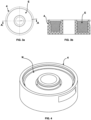
- Figures 4 to 5b show the encapsulation mold 4 with the cured epoxy structural resin (first encapsulating material) together with the core of nanocrystalline material N before performing the second encapsulation.
- Said material which preferably is a thermal property epoxy resin, constituted by an alumina and silica filler, with a percentage of 30% to 80% by mass, preferably 70% by mass, is inserted in the encapsulation mold.
- the epoxy resin is thermally cured at a temperature in the range of 150°C maintained for about 16 hours.
- the distinct encapsulating materials are deposited over the previously thermally treated nanocrystalline material.
- Figures 2 to 3b show the encapsulation mold 4 with the at least two distinct encapsulation materials E deposited before the machining of the grooves 2.
- the machining of the grooves 2 can be performed. As the machining is carried out after the thermal treatment of the core, the dimensions reached do not run the risk of suffering variations, thus being ensured the final dimensions of the stator package.
- the machining of the grooves is carried out without the encapsulated core being demolded.
- the core of encapsulated and machined stator 1 presents preferably about 10% to 90% by mass, more preferably 20% to 50% by mass, of encapsulating material of the first encapsulating material and about 90% to 10% by mass, more preferably 80% to 50% by mass, of the encapsulation material of the second encapsulating material.
- the first encapsulated material is deposited in the mold completing from 10% to 90% by mass of the encapsulating material
- the second encapsulated material is deposited in the mold completing from 90% to 10% by mass of the encapsulating material.
- the encapsulated and machined stator core 1 presents, considering the total mass of encapsulating material, about 25% by mass of the first encapsulating material and about 75% by mass of the second encapsulating material.
- the material able to increase the mechanical rigidity of the stator core has, after machining thereof, about 1% to about 10% relative to the total mass, more specifically 3% by mass, and the material able to increase the thermal exchange capacity of the electric machine has, after machining thereof, about 5% to 15% relative to the total mass, more specifically 11% by mass.
- the thermal treatment is performed before the encapsulation process, it is not necessary for the encapsulation mold 4 to be manufactured from a material that is resistant to the high temperatures reached during the thermal treatment.
- the use of the encapsulating material allows the treated core of nanocrystalline material to withstand the tensions exerted over the material during the machining process.
- the present invention achieves an encapsulation material that has adequate mechanical resistance to withstand the machining process of the core while it has a thermal conductivity that is sufficiently high to not affect the performance of the motor.
Landscapes
- Engineering & Computer Science (AREA)
- Power Engineering (AREA)
- Manufacturing & Machinery (AREA)
- Chemical & Material Sciences (AREA)
- Crystallography & Structural Chemistry (AREA)
- Inorganic Chemistry (AREA)
- Materials Engineering (AREA)
- Physics & Mathematics (AREA)
- Electromagnetism (AREA)
- Dispersion Chemistry (AREA)
- Manufacture Of Motors, Generators (AREA)
- Iron Core Of Rotating Electric Machines (AREA)
Applications Claiming Priority (1)
| Application Number | Priority Date | Filing Date | Title |
|---|---|---|---|
| BR102023025172-2A BR102023025172A2 (pt) | 2023-11-30 | Núcleo de estator de material nanocristalino e processo para a fabricação de um núcleo de estator de material nanocristalino |
Publications (1)
| Publication Number | Publication Date |
|---|---|
| EP4564378A1 true EP4564378A1 (fr) | 2025-06-04 |
Family
ID=91375050
Family Applications (1)
| Application Number | Title | Priority Date | Filing Date |
|---|---|---|---|
| EP24178176.4A Pending EP4564378A1 (fr) | 2023-11-30 | 2024-05-27 | Noyau de stator en matériau nanocristallin et procédé de fabrication d'un noyau de stator en matériau nanocristallin |
Country Status (3)
| Country | Link |
|---|---|
| US (1) | US20250183736A1 (fr) |
| EP (1) | EP4564378A1 (fr) |
| CN (1) | CN120090362A (fr) |
Citations (3)
| Publication number | Priority date | Publication date | Assignee | Title |
|---|---|---|---|---|
| US7596856B2 (en) * | 2003-06-11 | 2009-10-06 | Light Engineering, Inc. | Method for manufacturing a soft magnetic metal electromagnetic component |
| CN102761175A (zh) | 2012-07-20 | 2012-10-31 | 安泰科技股份有限公司 | 轴向磁场用定子铁心及其制造方法 |
| CN105490400A (zh) | 2015-12-21 | 2016-04-13 | 安泰科技股份有限公司 | 轴向磁场非晶、纳米晶电机定子铁芯及其制造方法 |
-
2024
- 2024-05-27 EP EP24178176.4A patent/EP4564378A1/fr active Pending
- 2024-06-20 US US18/748,850 patent/US20250183736A1/en active Pending
- 2024-07-29 CN CN202411023511.5A patent/CN120090362A/zh active Pending
Patent Citations (3)
| Publication number | Priority date | Publication date | Assignee | Title |
|---|---|---|---|---|
| US7596856B2 (en) * | 2003-06-11 | 2009-10-06 | Light Engineering, Inc. | Method for manufacturing a soft magnetic metal electromagnetic component |
| CN102761175A (zh) | 2012-07-20 | 2012-10-31 | 安泰科技股份有限公司 | 轴向磁场用定子铁心及其制造方法 |
| CN105490400A (zh) | 2015-12-21 | 2016-04-13 | 安泰科技股份有限公司 | 轴向磁场非晶、纳米晶电机定子铁芯及其制造方法 |
Also Published As
| Publication number | Publication date |
|---|---|
| CN120090362A (zh) | 2025-06-03 |
| US20250183736A1 (en) | 2025-06-05 |
Similar Documents
| Publication | Publication Date | Title |
|---|---|---|
| US4392072A (en) | Dynamoelectric machine stator having articulated amorphous metal components | |
| CN1244937C (zh) | 干式配电变压器及其制造方法 | |
| EP1240700B1 (fr) | Composants magnetiques massifs en metal amorphe pour moteur electrique | |
| US6362544B2 (en) | Electromagnetic device with embedded windings and method for its manufacture | |
| US4403401A (en) | Method of making a dynamoelectric machine stator having concentric amorphous metal laminations | |
| CN102761175B (zh) | 轴向磁场用定子铁心及其制造方法 | |
| JP2010183838A (ja) | 電動モータ用のバルクアモルファス金属磁気構成要素 | |
| CN101288135A (zh) | 软磁非晶电磁元件及其制作方法 | |
| WO2021200514A1 (fr) | Noyau feuilleté et filtre de bruit | |
| KR20140096323A (ko) | 자기 코어에서의 가청 노이즈를 감소 방법 및 감소된 가청 노이즈를 갖는 자기 코어 | |
| EP3035351B1 (fr) | Procédé pour fabriquer un noyau magnétique amorphe et noyau magnétique amorphe | |
| KR20070011604A (ko) | 변류기 코어 및 변류기 코어 제작 방법 | |
| EP4564378A1 (fr) | Noyau de stator en matériau nanocristallin et procédé de fabrication d'un noyau de stator en matériau nanocristallin | |
| CN110291601B (zh) | 卷绕磁芯的制造方法、及卷绕磁芯 | |
| US7340820B2 (en) | Machine stator fabrication method | |
| JP5249897B2 (ja) | 鉄心の製造方法 | |
| CN1839451B (zh) | 制造三维软磁性金属电动机械部件的方法 | |
| US7843092B2 (en) | Core and method for producing core | |
| JP2721165B2 (ja) | チョークコイル用磁心 | |
| BR102023025172A2 (pt) | Núcleo de estator de material nanocristalino e processo para a fabricação de um núcleo de estator de material nanocristalino | |
| US4790064A (en) | Method of manufacturing an amorphous metal transformer core and coil assembly | |
| CA2902740A1 (fr) | Procedes et systemes pour former des noyaux de transformateur en metal amorphe | |
| CA2898765A1 (fr) | Formation de noyaux de transformateur en metal amorphe | |
| GB2051491A (en) | Magnetic core for a capped core shunt reactor | |
| JP7608498B2 (ja) | 積層コア、ノイズフィルタ、磁心 |
Legal Events
| Date | Code | Title | Description |
|---|---|---|---|
| PUAI | Public reference made under article 153(3) epc to a published international application that has entered the european phase |
Free format text: ORIGINAL CODE: 0009012 |
|
| STAA | Information on the status of an ep patent application or granted ep patent |
Free format text: STATUS: THE APPLICATION HAS BEEN PUBLISHED |
|
| AK | Designated contracting states |
Kind code of ref document: A1 Designated state(s): AL AT BE BG CH CY CZ DE DK EE ES FI FR GB GR HR HU IE IS IT LI LT LU LV MC ME MK MT NL NO PL PT RO RS SE SI SK SM TR |
|
| STAA | Information on the status of an ep patent application or granted ep patent |
Free format text: STATUS: REQUEST FOR EXAMINATION WAS MADE |
|
| 17P | Request for examination filed |
Effective date: 20251128 |