EP4564501A2 - Zylindrische lithium-ionen-batterie - Google Patents
Zylindrische lithium-ionen-batterie Download PDFInfo
- Publication number
- EP4564501A2 EP4564501A2 EP24213605.9A EP24213605A EP4564501A2 EP 4564501 A2 EP4564501 A2 EP 4564501A2 EP 24213605 A EP24213605 A EP 24213605A EP 4564501 A2 EP4564501 A2 EP 4564501A2
- Authority
- EP
- European Patent Office
- Prior art keywords
- protection board
- conductive member
- elastic conductive
- battery cell
- fixing cap
- Prior art date
- Legal status (The legal status is an assumption and is not a legal conclusion. Google has not performed a legal analysis and makes no representation as to the accuracy of the status listed.)
- Pending
Links
Images


Classifications
-
- H—ELECTRICITY
- H01—ELECTRIC ELEMENTS
- H01M—PROCESSES OR MEANS, e.g. BATTERIES, FOR THE DIRECT CONVERSION OF CHEMICAL ENERGY INTO ELECTRICAL ENERGY
- H01M10/00—Secondary cells; Manufacture thereof
- H01M10/04—Construction or manufacture in general
- H01M10/0422—Cells or battery with cylindrical casing
-
- H—ELECTRICITY
- H01—ELECTRIC ELEMENTS
- H01M—PROCESSES OR MEANS, e.g. BATTERIES, FOR THE DIRECT CONVERSION OF CHEMICAL ENERGY INTO ELECTRICAL ENERGY
- H01M10/00—Secondary cells; Manufacture thereof
- H01M10/42—Methods or arrangements for servicing or maintenance of secondary cells or secondary half-cells
- H01M10/425—Structural combination with electronic components, e.g. electronic circuits integrated to the outside of the casing
- H01M10/4257—Smart batteries, e.g. electronic circuits inside the housing of the cells or batteries
-
- H—ELECTRICITY
- H01—ELECTRIC ELEMENTS
- H01M—PROCESSES OR MEANS, e.g. BATTERIES, FOR THE DIRECT CONVERSION OF CHEMICAL ENERGY INTO ELECTRICAL ENERGY
- H01M10/00—Secondary cells; Manufacture thereof
- H01M10/05—Accumulators with non-aqueous electrolyte
- H01M10/052—Li-accumulators
- H01M10/0525—Rocking-chair batteries, i.e. batteries with lithium insertion or intercalation in both electrodes; Lithium-ion batteries
-
- H—ELECTRICITY
- H01—ELECTRIC ELEMENTS
- H01M—PROCESSES OR MEANS, e.g. BATTERIES, FOR THE DIRECT CONVERSION OF CHEMICAL ENERGY INTO ELECTRICAL ENERGY
- H01M10/00—Secondary cells; Manufacture thereof
- H01M10/42—Methods or arrangements for servicing or maintenance of secondary cells or secondary half-cells
- H01M10/425—Structural combination with electronic components, e.g. electronic circuits integrated to the outside of the casing
-
- H—ELECTRICITY
- H01—ELECTRIC ELEMENTS
- H01M—PROCESSES OR MEANS, e.g. BATTERIES, FOR THE DIRECT CONVERSION OF CHEMICAL ENERGY INTO ELECTRICAL ENERGY
- H01M10/00—Secondary cells; Manufacture thereof
- H01M10/42—Methods or arrangements for servicing or maintenance of secondary cells or secondary half-cells
- H01M10/48—Accumulators combined with arrangements for measuring, testing or indicating the condition of cells, e.g. the level or density of the electrolyte
- H01M10/488—Cells or batteries combined with indicating means for external visualization of the condition, e.g. by change of colour or of light density
-
- H—ELECTRICITY
- H01—ELECTRIC ELEMENTS
- H01M—PROCESSES OR MEANS, e.g. BATTERIES, FOR THE DIRECT CONVERSION OF CHEMICAL ENERGY INTO ELECTRICAL ENERGY
- H01M50/00—Constructional details or processes of manufacture of the non-active parts of electrochemical cells other than fuel cells, e.g. hybrid cells
- H01M50/10—Primary casings; Jackets or wrappings
- H01M50/102—Primary casings; Jackets or wrappings characterised by their shape or physical structure
- H01M50/107—Primary casings; Jackets or wrappings characterised by their shape or physical structure having curved cross-section, e.g. round or elliptic
-
- H—ELECTRICITY
- H01—ELECTRIC ELEMENTS
- H01M—PROCESSES OR MEANS, e.g. BATTERIES, FOR THE DIRECT CONVERSION OF CHEMICAL ENERGY INTO ELECTRICAL ENERGY
- H01M50/00—Constructional details or processes of manufacture of the non-active parts of electrochemical cells other than fuel cells, e.g. hybrid cells
- H01M50/10—Primary casings; Jackets or wrappings
- H01M50/147—Lids or covers
- H01M50/148—Lids or covers characterised by their shape
- H01M50/152—Lids or covers characterised by their shape for cells having curved cross-section, e.g. round or elliptic
-
- H—ELECTRICITY
- H01—ELECTRIC ELEMENTS
- H01M—PROCESSES OR MEANS, e.g. BATTERIES, FOR THE DIRECT CONVERSION OF CHEMICAL ENERGY INTO ELECTRICAL ENERGY
- H01M50/00—Constructional details or processes of manufacture of the non-active parts of electrochemical cells other than fuel cells, e.g. hybrid cells
- H01M50/20—Mountings; Secondary casings or frames; Racks, modules or packs; Suspension devices; Shock absorbers; Transport or carrying devices; Holders
- H01M50/202—Casings or frames around the primary casing of a single cell or a single battery
-
- H—ELECTRICITY
- H01—ELECTRIC ELEMENTS
- H01M—PROCESSES OR MEANS, e.g. BATTERIES, FOR THE DIRECT CONVERSION OF CHEMICAL ENERGY INTO ELECTRICAL ENERGY
- H01M50/00—Constructional details or processes of manufacture of the non-active parts of electrochemical cells other than fuel cells, e.g. hybrid cells
- H01M50/20—Mountings; Secondary casings or frames; Racks, modules or packs; Suspension devices; Shock absorbers; Transport or carrying devices; Holders
- H01M50/271—Lids or covers for the racks or secondary casings
-
- H—ELECTRICITY
- H01—ELECTRIC ELEMENTS
- H01M—PROCESSES OR MEANS, e.g. BATTERIES, FOR THE DIRECT CONVERSION OF CHEMICAL ENERGY INTO ELECTRICAL ENERGY
- H01M50/00—Constructional details or processes of manufacture of the non-active parts of electrochemical cells other than fuel cells, e.g. hybrid cells
- H01M50/20—Mountings; Secondary casings or frames; Racks, modules or packs; Suspension devices; Shock absorbers; Transport or carrying devices; Holders
- H01M50/284—Mountings; Secondary casings or frames; Racks, modules or packs; Suspension devices; Shock absorbers; Transport or carrying devices; Holders with incorporated circuit boards, e.g. printed circuit boards [PCB]
-
- H—ELECTRICITY
- H01—ELECTRIC ELEMENTS
- H01M—PROCESSES OR MEANS, e.g. BATTERIES, FOR THE DIRECT CONVERSION OF CHEMICAL ENERGY INTO ELECTRICAL ENERGY
- H01M10/00—Secondary cells; Manufacture thereof
- H01M10/05—Accumulators with non-aqueous electrolyte
- H01M10/058—Construction or manufacture
- H01M10/0587—Construction or manufacture of accumulators having only wound construction elements, i.e. wound positive electrodes, wound negative electrodes and wound separators
-
- H—ELECTRICITY
- H01—ELECTRIC ELEMENTS
- H01M—PROCESSES OR MEANS, e.g. BATTERIES, FOR THE DIRECT CONVERSION OF CHEMICAL ENERGY INTO ELECTRICAL ENERGY
- H01M50/00—Constructional details or processes of manufacture of the non-active parts of electrochemical cells other than fuel cells, e.g. hybrid cells
- H01M50/50—Current conducting connections for cells or batteries
- H01M50/543—Terminals
- H01M50/552—Terminals characterised by their shape
- H01M50/559—Terminals adapted for cells having curved cross-section, e.g. round, elliptic or button cells
- H01M50/56—Cup shaped terminals
-
- Y—GENERAL TAGGING OF NEW TECHNOLOGICAL DEVELOPMENTS; GENERAL TAGGING OF CROSS-SECTIONAL TECHNOLOGIES SPANNING OVER SEVERAL SECTIONS OF THE IPC; TECHNICAL SUBJECTS COVERED BY FORMER USPC CROSS-REFERENCE ART COLLECTIONS [XRACs] AND DIGESTS
- Y02—TECHNOLOGIES OR APPLICATIONS FOR MITIGATION OR ADAPTATION AGAINST CLIMATE CHANGE
- Y02E—REDUCTION OF GREENHOUSE GAS [GHG] EMISSIONS, RELATED TO ENERGY GENERATION, TRANSMISSION OR DISTRIBUTION
- Y02E60/00—Enabling technologies; Technologies with a potential or indirect contribution to GHG emissions mitigation
- Y02E60/10—Energy storage using batteries
Definitions
- the present disclosure relates to the technical field of batteries, in particular to a cylindrical lithium-ion battery.
- lithium-ion batteries Due to their high energy density, cylindrical lithium-ion batteries are prone to damage under conditions such as overcharging, over-discharging, overcurrent, short-circuiting, as well as charging and discharging at excessively high temperatures or using at excessively low temperatures. Therefore, existing lithium-ion batteries are equipped with battery protection boards to protect the battery cells within the batteries.
- Nickel tabs are first spot-welded to the positive and negative electrodes of the protection board, respectively. Then, two nickel strips are spot-welded to the two nickel tabs, with one end of the nickel strip on the positive side of the protection board being spot-welded to the positive electrode of the battery cell, and the other end of the nickel strip on the negative side being spot-welded to the negative electrode of the battery cell. After connecting the protection board and the battery cell with nickel strips, a fixing cap is placed over them to secure the protection board on top of the battery cell. This entire process requires multiple spot-welding steps, leading to a more complex manufacturing process and higher labor costs.
- the present disclosure aims to solve at least one of the technical problems existing in the prior art. To this end, the present disclosure proposes a cylindrical lithium-ion battery, which can simplify the battery assembly process and make it more convenient.
- a cylindrical lithium-ion battery comprising: a battery cell; a protection board, wherein the protection board is installed above the battery cell at intervals, a top surface of the protection board is provided with a metal contact protruding upwards; a first elastic conductive member, wherein an upper end of the first elastic conductive member abuts against a bottom surface of the protection board and is electrically connected to a positive electrode of the protection board, and a lower end of the first elastic conductive member abuts against a top end of the battery cell and is electrically connected to a positive electrode of the battery cell; a second elastic conductive member, wherein an upper end of the second elastic conductive member abuts against the bottom surface of the protection board and is electrically connected to a negative electrode of the protection board, and a lower end of the second elastic conductive member abuts against a top surface of the battery cell and is electrically connected to a negative electrode of the battery cell; and a fixing cap, wherein the fixing cap is s
- first elastic conductive member and the second elastic conductive member By using the first elastic conductive member and the second elastic conductive member, one end of each of the first elastic conductive member and the second elastic conductive member abuts against the bottom surface of the protection board, and the other end abuts against the top surface of the battery cell, so that the upper end of the first elastic conductive member is electrically connected to the positive electrode of the protection board, the lower end of the first elastic conductive member is electrically connected to the positive electrode of the battery cell, the upper end of the second elastic conductive member is electrically connected to the negative electrode of the protection board, the lower end of the second elastic conductive member is electrically connected to the negative electrode of the battery cell, and then the fixing cap is sleeved, so that the inner top wall of the fixing cap abuts against the top surface of the protection board, thereby completing the assembly of the cylindrical lithium-ion battery.
- the entire process eliminates the traditional connection structure of nickel tabs and nickel strips, reducing the need for multiple manual spot welding processes, thereby simplify
- the upper end of the first elastic conductive member and the upper end of the second elastic conductive member are both attached to the bottom surface of the protection board.
- the first elastic conductive member and the second elastic conductive member are both compression springs.
- a first insulating support is arranged between the protection board and the battery cell.
- the first insulating support is provided with two first clearance grooves, the first elastic conductive member penetrates through one of the first clearance grooves, and the second elastic conductive member penetrates through another first clearance groove.
- a second insulating support is arranged between the protection board and the fixing cap, the inner top wall of the fixing cap abuts against the top surface of the protection board via the second insulating support, the second insulating support is provided with a second clearance groove, and the metal contact penetrates through the second clearance groove.
- an upper end of the battery cell is inserted into the fixing cap and is in interference fit with the fixing cap.
- the cylindrical lithium-ion battery further comprises an outer film, the outer film covers a periphery of the battery cell and the fixing cap, the outer film is provided with an annular top wall and an annular bottom wall, the annular top wall is attached to an outer top wall of the fixing cap, and the annular bottom wall is attached to a bottom wall of the battery cell.
- the cylindrical lithium-ion battery further comprises a charging interface
- the charging interface is installed on the protection board and is electrically connected to the protection board
- a side wall of the fixing cap is provided with a clearance hole for allowing the charging interface to be in position.
- a charging indicator light electrically connected to the charging interface is installed on the protection board.
- references to directions such as upper, lower, front, rear, left, right, etc., indicate directional or positional relationships based on the drawings, and are merely for the convenience of describing and simplifying the description of the present disclosure. They do not indicate or imply that the device or element referred to must have a specific orientation, be constructed or operated in a specific orientation, and therefore should not be construed as limiting the present disclosure.
- a plurality of means one or more, “multiple” means more than two, “greater than,””less than,””exceeding,” etc., are understood to exclude the number itself, while “above,””below,””within,” etc., are understood to include the number itself.
- first and second are described, they are used only to distinguish technical features and do not indicate or imply relative importance or implicitly specify the number of technical features indicated or the sequence of technical features.
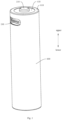
- an embodiment of the present disclosure provides a cylindrical lithium-ion battery.
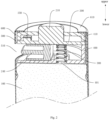
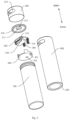
- the cylindrical lithium-ion battery comprises a battery cell 100, a protection board 200, a first elastic conductive member 300, a second elastic conductive member 310 and a fixing cap 500.
- the protection board 200 is installed above the battery cell 100 at intervals, a top surface of the protection board 200 is provided with a metal contact 210 protruding upwards.
- An upper end of the first elastic conductive member 300 abuts against a bottom surface of the protection board 200 and is electrically connected to a positive electrode of the protection board 200, and a lower end of the first elastic conductive member 300 abuts against a top end of the battery cell 100 and is electrically connected to a positive electrode of the battery cell 100.
- An upper end of the second elastic conductive member 310 abuts against the bottom surface of the protection board 200 and is electrically connected to a negative electrode of the protection board 200, and a lower end of the second elastic conductive member 310 abuts against a top surface of the battery cell 100 and is electrically connected to a negative electrode of the battery cell 100.
- the fixing cap 500 is sleeved on a periphery of the battery cell 100, and an inner top wall of the fixing cap 500 abuts against the top surface of the protection board 200 and is located on a periphery of the metal contact 210.
- the first elastic conductive member 300 and the second elastic conductive member 310 by using the first elastic conductive member 300 and the second elastic conductive member 310, one end of each of the first elastic conductive member 300 and the second elastic conductive member 310 abuts against the bottom surface of the protection board 200, and the other end abuts against the top surface of the battery cell 100, so that the upper end of the first elastic conductive member 300 is electrically connected to the positive electrode of the protection board 200, the lower end of the first elastic conductive member 300 is electrically connected to the positive electrode of the battery cell 100, the upper end of the second elastic conductive member 310 is electrically connected to the negative electrode of the protection board 200, the lower end of the second elastic conductive member 310 is electrically connected to the negative electrode of the battery cell 100, and then the fixing cap 500 is sleeved, so that the inner top wall of the fixing cap 500 abuts against the top surface of the protection board 200, thereby completing the assembly of the cylindrical lithium-ion battery.
- the entire process eliminates the
- the protection board 200 and the battery cell 100 are connected by means of the first elastic conductive member 300 and the second elastic conductive member 310, and the first elastic conductive member 300 and the second elastic conductive member 310 can also support the protection board 200, so that the protection board 200 and the top surface of the battery cell 100 are arranged at intervals, thereby preventing direct contact between the protection board 200 and the top surface of the battery cell 100.
- the first elastic conductive member 300 is located in the middle of the battery cell 100, and the second elastic conductive member 310 is disposed close to the edge of the battery cell 100, so that the first elastic conductive member 300 can be electrically connected to the positive electrode of the battery cell 100, and the second elastic conductive member 310 is electrically connected to the negative electrode of the battery cell 100.
- a top surface of the protection board 200 is provided with a metal contact 210 protruding upwards, and the metal contact 210 is used for positive electrode output of the cylindrical lithium-ion battery.
- both the first elastic conductive member 300 and the second elastic conductive member 310 are compression springs.
- the first elastic conductive member 300 and the second elastic conductive member 310 are both arranged as compression springs, so that materials are convenient to obtain, and the product cost is reduced.
- the protection board 200 and the battery cell 100 are connected by means of the two compression springs, and the protection board 200 can also be supported, so that the protection board 200 and the top surface of the battery cell 100 are arranged at intervals, thereby preventing direct contact between the protection board 200 and the top surface of the battery cell 100.
- first elastic conductive member 300 and the second elastic conductive member 310 can be configured not only as compression springs but also as elastic pins, such as POGO PIN elastic pins.
- elastic pins such as POGO PIN elastic pins.
- other elastic conductive structures may also be employed for the first elastic conductive member 300 and the second elastic conductive member 310, and the present disclosure does not specifically limit their forms.
- the upper end of the first elastic conductive member 300 and the upper end of the second elastic conductive member 310 are both attached to the bottom surface of the protection board 200.
- the upper end of the first elastic conductive member 300 and the upper end of the second elastic conductive member 310 are both attached to the bottom surface of the protection board 200, so that the connection between the first elastic conductive member 300, the second elastic conductive member 310 and the protection board 200 is firmer.
- the protection board 200, the first elastic conductive member 300 and the second elastic conductive member 310 can be directly installed above the battery cell 100, and the protection board 200, the first elastic conductive member 300 and the second elastic conductive member 310 do not need to be respectively installed, so that the assembly time can be greatly saved, the assembly efficiency is improved, and the assembly is more convenient and simpler.
- the upper end of the first elastic conductive member 300 and the upper end of the second elastic conductive member 310 are both attached to the bottom surface of the protection board 200.
- the upper end of the first elastic conductive member 300 and the upper end of the second elastic conductive member 310 may be attached to the bottom surface of the protection board 200 using Surface Mount Technology (SMT) chip attachment process.
- SMT Surface Mount Technology
- a first insulating support 400 is arranged between the protection board 200 and the battery cell 100.
- the protection board 200 can be further separated from the battery cell 100, and the protection board 200 can be supported and fixed more stably, so that the risk of mutual contact between the protection board 200 and the top surface of the battery cell 100 can be further reduced, and the internal structure of the cylindrical lithium-ion battery is more stable and compact.
- the first insulating support 400 is provided with two first clearance grooves 401, the first elastic conductive member 300 penetrates through one of the first clearance grooves 401, and the second elastic conductive member 310 penetrates through another first clearance groove 401.
- two first clearance grooves 401 are formed in the first insulating support 400, so that the first elastic conductive member 300 and the second elastic conductive member 310 can be in position, the lower end of the first elastic conductive member 300 can penetrate through one of the first clearance grooves 401 and abut against the top surface of the battery cell 100, and the lower end of the second elastic conductive member 310 can penetrate through the other first clearance groove 401 and abut against the top surface of the battery cell 100.
- one of the first clearance grooves 401 through which the first elastic conductive member 300 passes is a closed groove with a closed periphery
- the other first clearance groove 401 through which the second elastic conductive member 310 passes is an open groove with a notch in the edge.
- the first clearance groove 401 may be an open groove having a notch, or may be an edge-sealed closed groove. The present disclosure is not specifically limited.
- the first insulating support 400 is provided with two first clearance grooves 401, which are merely one example description of Fig. 1 to Fig. 6 .
- the first insulating support 400 may also not be provided with the first clearance groove 401, the first elastic conductive member 300, the second elastic conductive member 310 and the first insulating support 400 are directly arranged side by side, so that the first elastic conductive member 300 and the second elastic conductive member 310 are located on one side of the first insulating support 400.
- the first insulating support 400 is provided with a first positioning column 402 extending upwards
- the protection board 200 is provided with a first positioning hole corresponding to the first positioning column 402, and the first positioning column 402 is inserted into the first positioning hole.
- the first positioning column 402 can be arranged on the first insulating support 400, and the first positioning hole is formed in the protection board 200.
- the first positioning column 402 can also be arranged on the protection board 200, so that the first positioning column 402 extends downwards, and the first positioning hole is formed in the first insulating support 400.
- the present disclosure is not specifically limited.
- a second insulating support 410 is arranged between the protection board 200 and the fixing cap 500, the inner top wall of the fixing cap 500 abuts against the top surface of the protection board 200 via the second insulating support 410, the second insulating support 410 is provided with a second clearance groove 411, and the metal contact 210 penetrates through the second clearance groove 411.
- the protection board 200 is further insulated and protected, and is fixed in place by being matched with the first insulating support 400.
- the second clearance groove 411 is formed in the second insulating support 410, so that the metal contact 210 can be accommodated, allowing the metal contact 210 to extend out of the outer side of the cylindrical lithium-ion battery to discharge to external elements through the metal contact 210. Meanwhile, the assembly between the second insulating support 410 and the protection board 200 can be positioned, thereby avoiding any deviation between the second insulating support 410 and the protection board 200.
- the second insulating support 410 is provided with a second positioning column 412 extending downwards
- the protection board 200 is provided with a second positioning hole corresponding to the second positioning column 412
- the second positioning column 412 is inserted into the second positioning hole.
- the second positioning column 412 can be arranged on the second insulating support 410, and the second positioning hole is formed in the protection board 200.
- the second positioning column 412 can also be arranged on the protection board 200, so that the second positioning column 412 extends upwards, and the second positioning hole is formed in the second insulating support 410.
- the present disclosure is not specifically limited.
- an upper end of the battery cell 100 is inserted into the fixing cap 500 and is in interference fit with the fixing cap 500.
- the battery cell 100 and the fixing cap 500 are interference-fitted, so that the connection between the battery cell 100 and the fixing cap 500 is made tighter and more stable, not prone to scattering. Meanwhile, due to the inner top wall of the fixing cap 500 abutting against the protection board 200 downwards, the protection board 200, the first elastic conductive member 300, and the second elastic conductive member 310 are stably installed within the fixing cap 500. As a result, the structure of the cylindrical lithium-ion battery becomes more compact and stable.
- connection methods such as welding connection and buckle connection can also be employed between the battery cell 100 and the fixing cap 500. This is not specifically limited in the present disclosure.
- the fixing cap 500 can specifically be a steel cap or other metal caps, and it is also possible for the fixing cap 500 to be made of other materials, which is not specifically limited in the present disclosure.
- the cylindrical lithium-ion battery further comprises an outer film 600, the outer film 600 covers a periphery of the battery cell 100 and the fixing cap 500, the outer film 600 is provided with an annular top wall 610 and an annular bottom wall 620, the annular top wall 610 is attached to an outer top wall of the fixing cap 500, and the annular bottom wall 620 is attached to a bottom wall of the battery cell 100.
- the connection stability between the battery cell 100 and the fixing cap 500 can be further enhanced.
- the arrangement of the annular top wall 610 of the outer film 600 allows for the metal contact 210 to be positioned, and the annular bottom wall 620 of the outer film 600 allows for the negative electrode on the bottom surface of the battery cell 100 to be positioned, thus enabling the cylindrical lithium-ion battery to discharge to external elements.
- the outer film 600 can also be used for printing trademarks, parameters, etc., serving as an identification for the cylindrical lithium-ion battery.
- the outer film 600 can specifically adopt a Polyvinyl Chloride (PVC) thermal shrinkage film or an adhesive sticker label, so that the battery cell 100 and the fixing cap 500 can be more tightly coated by the outer film 600.
- PVC Polyvinyl Chloride
- the outer film 600 can also be made of other film materials, which is not specifically limited in the present disclosure.
- the cylindrical lithium-ion battery further comprises a charging interface 240, the charging interface 240 is installed on the protection board 200 and is electrically connected to the protection board 200, and a side wall of the fixing cap 500 is provided with a clearance hole 510 for allowing the charging interface 240 to be in position.
- the charging interface 240 is used for charging the battery cell 100, and by forming the clearance hole 510 in the side wall of the fixing cap 500, the external power supply can be conveniently connected to the charging interface 240.
- the external power supply connected to the charging interface 240, the current from the external power supply can flow into the battery cell 100 through the protection board 200 to charge the battery cell 100.
- the charging interface 240 is installed on the protection board 200 and is electrically connected to the protection board 200, and specifically, the charging interface 240 may be attached to the protection board 200 using SMT chip attachment process.
- the charging interface 240 is a 5V charging port
- the protection board 200 is further provided with a charging management circuit
- the charging interface 240 is electrically connected to the charging management circuit, and during charging, the 5V input power supply drops to 4.2 V through the charging management circuit, and then flows into the battery cell 100 through the protection board 200, thereby realizing charging of the battery cell 100.
- the upper surface of the protection board 200 is provided with a placement groove 403 for carrying and positioning the charging interface 240, and the placement groove 403 can prevent dislocation between the charging interface 240 and the first insulating support 400.
- a charging indicator light 250 electrically connected to the charging interface 240 is installed on the protection board 200.
- the charging indicator light 250 when the external power supply is connected to the charging interface 240, the charging indicator light 250 can be lit, and when the external power supply is disconnected from the charging interface 240, the charging indicator light 250 is extinguished, thereby facilitating user operation and indicating whether the cylindrical lithium-ion battery is charging.
- a charging indicator light 250 electrically connected to the charging interface 240 is installed on the protection board 200.
- the charging indicator light 250 can be lit up red.
- the charging indicator light 250 changes to a green light or an extinguished state, thereby facilitating user operation and reminding the user whether the cylindrical lithium ion battery is in a full or charging state.
Landscapes
- Chemical & Material Sciences (AREA)
- Chemical Kinetics & Catalysis (AREA)
- Electrochemistry (AREA)
- General Chemical & Material Sciences (AREA)
- Engineering & Computer Science (AREA)
- Manufacturing & Machinery (AREA)
- Microelectronics & Electronic Packaging (AREA)
- Materials Engineering (AREA)
- Connection Of Batteries Or Terminals (AREA)
- Battery Mounting, Suspending (AREA)
- Secondary Cells (AREA)
Applications Claiming Priority (1)
| Application Number | Priority Date | Filing Date | Title |
|---|---|---|---|
| CN202323178655.1U CN221379671U (zh) | 2023-11-23 | 2023-11-23 | 圆柱型锂离子电池 |
Publications (2)
| Publication Number | Publication Date |
|---|---|
| EP4564501A2 true EP4564501A2 (de) | 2025-06-04 |
| EP4564501A3 EP4564501A3 (de) | 2025-07-09 |
Family
ID=91857996
Family Applications (1)
| Application Number | Title | Priority Date | Filing Date |
|---|---|---|---|
| EP24213605.9A Pending EP4564501A3 (de) | 2023-11-23 | 2024-11-18 | Zylindrische lithium-ionen-batterie |
Country Status (3)
| Country | Link |
|---|---|
| US (1) | US20250174741A1 (de) |
| EP (1) | EP4564501A3 (de) |
| CN (1) | CN221379671U (de) |
Families Citing this family (5)
| Publication number | Priority date | Publication date | Assignee | Title |
|---|---|---|---|---|
| US10727457B2 (en) | 2014-01-15 | 2020-07-28 | Lat Enterprises, Inc. | System for supplying power to a portable battery using at least one solar panel |
| US11025076B2 (en) | 2014-10-16 | 2021-06-01 | Lat Enterprises, Inc. | Portable power case with lithium iron phosphate battery |
| USD1102368S1 (en) * | 2024-07-05 | 2025-11-18 | Shenzhen Oriental Willing New Energy Co., Ltd | Rechargeable battery |
| CN119651072B (zh) * | 2025-01-20 | 2025-11-11 | 合肥力翔电池科技有限责任公司 | 一种基于导电极柱优化的圆柱电池 |
| US12607335B1 (en) * | 2025-05-21 | 2026-04-21 | Zhejiang Lvshang Optoelectronics Technology Co., Ltd | Power supply for light string |
Family Cites Families (5)
| Publication number | Priority date | Publication date | Assignee | Title |
|---|---|---|---|---|
| CN101944633B (zh) * | 2010-09-29 | 2012-11-07 | 广东正飞移动照明有限公司 | 一种锂离子电池及应用该锂离子电池的充电器 |
| CN213989124U (zh) * | 2020-12-31 | 2021-08-17 | 肖繁 | 一种高可靠性充电式锂电池 |
| CN215008409U (zh) * | 2021-03-11 | 2021-12-03 | 深圳市东方芯愿新能源有限公司 | 结构简单的充电式电池 |
| CN217062404U (zh) * | 2021-12-20 | 2022-07-26 | 东莞市华慧新能源有限公司 | 一种圆柱形电池 |
| CN216624417U (zh) * | 2022-01-12 | 2022-05-27 | 深圳市山木新能源科技股份有限公司 | 一种1.5v恒压锂电池 |
-
2023
- 2023-11-23 CN CN202323178655.1U patent/CN221379671U/zh active Active
-
2024
- 2024-11-18 US US18/951,610 patent/US20250174741A1/en active Pending
- 2024-11-18 EP EP24213605.9A patent/EP4564501A3/de active Pending
Also Published As
| Publication number | Publication date |
|---|---|
| EP4564501A3 (de) | 2025-07-09 |
| CN221379671U (zh) | 2024-07-19 |
| US20250174741A1 (en) | 2025-05-29 |
Similar Documents
| Publication | Publication Date | Title |
|---|---|---|
| EP4564501A2 (de) | Zylindrische lithium-ionen-batterie | |
| US9874610B2 (en) | Battery | |
| EP2731174B1 (de) | Sekundärbatteriepack | |
| EP3128574B1 (de) | Batteriepack mit mit einer sekundärbatterie mit pouch-zellentyp und diese sekundärbatterie mit einer leiterplatte | |
| US7781092B2 (en) | Secondary battery and method of manufacturing same | |
| JP6257175B2 (ja) | バッテリーパック | |
| US6979502B1 (en) | Battery having a housing for electronic circuitry | |
| KR101074780B1 (ko) | 캡 조립체, 캔, 및 이를 이용한 이차 전지 | |
| EP2775550B1 (de) | Herstellungsverfahren für batteriezellen | |
| EP2200107A2 (de) | Batteriepack | |
| KR20090031159A (ko) | 배터리 팩 | |
| KR102283960B1 (ko) | 베터리 팩 | |
| KR100824873B1 (ko) | 리튬이온 이차전지 | |
| KR20130090957A (ko) | 신규한 구조의 내장형 전지셀 | |
| JP2018521469A (ja) | ワイヤー固定リブを備えている電池モジュール | |
| EP2779273B1 (de) | Eingebettetes sekundärbatteriepack mit neuartigem aufbau | |
| EP2775551B1 (de) | Herstellungsverfahren für batteriezellen mit neuartiger struktur | |
| JP3658877B2 (ja) | バッテリーパック | |
| CN113328209A (zh) | 一种方形锂离子电池的错位电芯结构 | |
| EP2779270B1 (de) | Eingebettete batteriezelle mit neuartiger struktur | |
| KR100490545B1 (ko) | 이차 전지 | |
| CN216288705U (zh) | 一种多腔体结构的锂离子电池 | |
| CN224110414U (zh) | 一种模块化电芯模组结构及电池包 | |
| CN223981381U (zh) | 电池焊接工装 | |
| CN218919220U (zh) | 一种电池组件 |
Legal Events
| Date | Code | Title | Description |
|---|---|---|---|
| PUAI | Public reference made under article 153(3) epc to a published international application that has entered the european phase |
Free format text: ORIGINAL CODE: 0009012 |
|
| STAA | Information on the status of an ep patent application or granted ep patent |
Free format text: STATUS: REQUEST FOR EXAMINATION WAS MADE |
|
| 17P | Request for examination filed |
Effective date: 20241118 |
|
| AK | Designated contracting states |
Kind code of ref document: A2 Designated state(s): AL AT BE BG CH CY CZ DE DK EE ES FI FR GB GR HR HU IE IS IT LI LT LU LV MC ME MK MT NL NO PL PT RO RS SE SI SK SM TR |
|
| PUAL | Search report despatched |
Free format text: ORIGINAL CODE: 0009013 |
|
| AK | Designated contracting states |
Kind code of ref document: A3 Designated state(s): AL AT BE BG CH CY CZ DE DK EE ES FI FR GB GR HR HU IE IS IT LI LT LU LV MC ME MK MT NL NO PL PT RO RS SE SI SK SM TR |
|
| RIC1 | Information provided on ipc code assigned before grant |
Ipc: H01M 10/0525 20100101ALI20250603BHEP Ipc: H01M 10/0587 20100101ALI20250603BHEP Ipc: H01M 50/152 20210101ALI20250603BHEP Ipc: H01M 50/107 20210101ALI20250603BHEP Ipc: H01M 10/48 20060101ALI20250603BHEP Ipc: H01M 10/42 20060101ALI20250603BHEP Ipc: H01M 10/04 20060101AFI20250603BHEP |