EP4564510A1 - Électrolyte solide et batterie entièrement solide comprenant celui-ci - Google Patents
Électrolyte solide et batterie entièrement solide comprenant celui-ci Download PDFInfo
- Publication number
- EP4564510A1 EP4564510A1 EP24781294.4A EP24781294A EP4564510A1 EP 4564510 A1 EP4564510 A1 EP 4564510A1 EP 24781294 A EP24781294 A EP 24781294A EP 4564510 A1 EP4564510 A1 EP 4564510A1
- Authority
- EP
- European Patent Office
- Prior art keywords
- solid electrolyte
- solid
- sulfide
- range
- present
- Prior art date
- Legal status (The legal status is an assumption and is not a legal conclusion. Google has not performed a legal analysis and makes no representation as to the accuracy of the status listed.)
- Pending
Links
Images


Classifications
-
- H—ELECTRICITY
- H01—ELECTRIC ELEMENTS
- H01M—PROCESSES OR MEANS, e.g. BATTERIES, FOR THE DIRECT CONVERSION OF CHEMICAL ENERGY INTO ELECTRICAL ENERGY
- H01M10/00—Secondary cells; Manufacture thereof
- H01M10/05—Accumulators with non-aqueous electrolyte
- H01M10/056—Accumulators with non-aqueous electrolyte characterised by the materials used as electrolytes, e.g. mixed inorganic/organic electrolytes
- H01M10/0561—Accumulators with non-aqueous electrolyte characterised by the materials used as electrolytes, e.g. mixed inorganic/organic electrolytes the electrolyte being constituted of inorganic materials only
- H01M10/0562—Solid materials
-
- H—ELECTRICITY
- H01—ELECTRIC ELEMENTS
- H01M—PROCESSES OR MEANS, e.g. BATTERIES, FOR THE DIRECT CONVERSION OF CHEMICAL ENERGY INTO ELECTRICAL ENERGY
- H01M10/00—Secondary cells; Manufacture thereof
- H01M10/05—Accumulators with non-aqueous electrolyte
- H01M10/052—Li-accumulators
-
- H—ELECTRICITY
- H01—ELECTRIC ELEMENTS
- H01M—PROCESSES OR MEANS, e.g. BATTERIES, FOR THE DIRECT CONVERSION OF CHEMICAL ENERGY INTO ELECTRICAL ENERGY
- H01M4/00—Electrodes
- H01M4/02—Electrodes composed of, or comprising, active material
- H01M4/36—Selection of substances as active materials, active masses, active liquids
- H01M4/48—Selection of substances as active materials, active masses, active liquids of inorganic oxides or hydroxides
- H01M4/52—Selection of substances as active materials, active masses, active liquids of inorganic oxides or hydroxides of nickel, cobalt or iron
- H01M4/525—Selection of substances as active materials, active masses, active liquids of inorganic oxides or hydroxides of nickel, cobalt or iron of mixed oxides or hydroxides containing iron, cobalt or nickel for inserting or intercalating light metals, e.g. LiNiO2, LiCoO2 or LiCoOxFy
-
- H—ELECTRICITY
- H01—ELECTRIC ELEMENTS
- H01M—PROCESSES OR MEANS, e.g. BATTERIES, FOR THE DIRECT CONVERSION OF CHEMICAL ENERGY INTO ELECTRICAL ENERGY
- H01M4/00—Electrodes
- H01M4/02—Electrodes composed of, or comprising, active material
- H01M2004/026—Electrodes composed of, or comprising, active material characterised by the polarity
- H01M2004/028—Positive electrodes
-
- H—ELECTRICITY
- H01—ELECTRIC ELEMENTS
- H01M—PROCESSES OR MEANS, e.g. BATTERIES, FOR THE DIRECT CONVERSION OF CHEMICAL ENERGY INTO ELECTRICAL ENERGY
- H01M2300/00—Electrolytes
- H01M2300/0017—Non-aqueous electrolytes
- H01M2300/0065—Solid electrolytes
- H01M2300/0068—Solid electrolytes inorganic
-
- H—ELECTRICITY
- H01—ELECTRIC ELEMENTS
- H01M—PROCESSES OR MEANS, e.g. BATTERIES, FOR THE DIRECT CONVERSION OF CHEMICAL ENERGY INTO ELECTRICAL ENERGY
- H01M2300/00—Electrolytes
- H01M2300/0088—Composites
- H01M2300/0094—Composites in the form of layered products, e.g. coatings
-
- Y—GENERAL TAGGING OF NEW TECHNOLOGICAL DEVELOPMENTS; GENERAL TAGGING OF CROSS-SECTIONAL TECHNOLOGIES SPANNING OVER SEVERAL SECTIONS OF THE IPC; TECHNICAL SUBJECTS COVERED BY FORMER USPC CROSS-REFERENCE ART COLLECTIONS [XRACs] AND DIGESTS
- Y02—TECHNOLOGIES OR APPLICATIONS FOR MITIGATION OR ADAPTATION AGAINST CLIMATE CHANGE
- Y02E—REDUCTION OF GREENHOUSE GAS [GHG] EMISSIONS, RELATED TO ENERGY GENERATION, TRANSMISSION OR DISTRIBUTION
- Y02E60/00—Enabling technologies; Technologies with a potential or indirect contribution to GHG emissions mitigation
- Y02E60/10—Energy storage using batteries
Definitions
- the present invention relates to a solid electrolyte and an all-solid-state battery including the same.
- An all-solid-state battery is a battery which replaces a liquid electrolyte filling between a positive electrode and a negative electrode of a conventional lithium secondary battery with a solid, wherein, since it has higher energy density than the conventional battery while being safe as there is no risk of explosion, it is attracting attention as a next-generation battery.
- a solid electrolyte used in the all-solid-state battery is a material in a solid state which may conduct lithium ions in the battery, wherein it has high ionic conductivity comparable to that of an electrolyte solution currently used in the lithium secondary battery.
- Core materials constituting the solid electrolyte include a polymer, a sulfide, or an oxide, but, among them, a sulfide-based solid electrolyte with high ductility and ionic conductivity is evaluated as suitable for preparing a high-capacity large battery.
- the sulfide-based solid electrolyte has a problem in that it is decomposed while reacting with moisture in the air to generate hydrogen sulfide gas, and has a problem in that battery performance is degraded during long-term operation due to a decomposition product formed by an interfacial side reaction with an electrode material.
- An object of the present invention is to provide a solid electrolyte having improved moisture stability and capable of suppressing an interfacial side reaction with an electrode material and an all-solid-state battery including the same.
- the present invention provides a solid electrolyte and an all-solid-state battery including the same.
- a solid electrolyte according to the present invention includes a buffer layer including Li 2 CO 3 which is formed on a sulfide-based solid electrolyte particle; and, in a near-infrared (NIR) spectrum, an integral value of a Li 2 CO 3 band present in a range of 5,200 cm -1 to 4,725 cm -1 satisfies a range of 2.0 to 8.0, a stable phase is maintained when exposed to moisture during a battery preparation process and an interfacial side reaction between the solid electrolyte and an electrode material may be suppressed, and thus, the solid electrolyte is advantageous in that it may improve battery characteristics.
- NIR near-infrared
- Room temperature in this specification means 20°C to 25°C.
- a solid electrolyte according to the present invention includes sulfide-based solid electrolyte particles; and a buffer layer including Li 2 CO 3 which is formed on the sulfide-based solid electrolyte particle, wherein, in a near-infrared (NIR) spectrum, an integral value of a Li 2 CO 3 band present in a range of 5,200 cm -1 to 4,725 cm -1 is in a range of 2.0 to 8.0.
- NIR near-infrared
- a solid electrolyte includes sulfide-based solid electrolyte particles; and a buffer layer including Li 2 CO 3 which is formed on the sulfide-based solid electrolyte particle, wherein, in a NIR spectrum, an integral value of a Li 2 CO 3 band present in a range of 5,200 cm -1 to 4,725 cm -1 satisfies a range of 2.0 to 8.0, since moisture stability of the solid electrolyte is improved, a stable phase of the solid electrolyte is maintained during a battery preparation process, and, as a result, lifetime and rate capability of a battery may be improved, thereby leading to the completion of the present invention.
- the sulfide-based solid electrolyte may have an argyrodite-type crystal structure in terms of high ionic conductivity and low reactivity with a lithium negative electrode.
- the sulfide-based solid electrolyte may be a sulfide-based solid electrolyte containing lithium (Li), phosphorus (P), and sulfur (S).
- the sulfide-based solid electrolyte may have a composition represented by Formula 1 below.
- ion conductivity may be excellent even after the formation of the buffer layer.
- M is a cation doped at a position of P, wherein it may specifically be at least one selected from Sb, Sn, Ge, and Si. In this case, since an oxidation number is similar to that of P, it may be easily doped (substituted) at the position of P.
- X may specifically be Cl, Br, or a combination thereof.
- a degree of disorder of anion arrangement is increased, a lithium ion conduction path is changed, and, as a result, ionic conductivity may be further increased.
- the buffer layer may be a mixture of Li 2 CO 3 and the argyrodite-type crystal structure.
- the solid electrolyte may have an integral value of a Li 2 CO 3 band present in a range of 5,200 cm -1 to 4,725 cm -1 in the NIR spectrum of 2.0 to 8.0.
- the integral value of the Li 2 CO 3 band present in the range of 5,200 cm -1 to 4,725 cm -1 may be 2.0 or more, 2.1 or more, 2.2 or more, 2.3 or more, 2.4 or more, 2.5 or more, 2.6 or more, 2.7 or more, 2.8 or more, 2.9 or more, 3.0 or more, 3.1 or more, 3.2 or more, or 3.3 or more, and may be 6.6 or less, 6.7 or less, 6.8 or less, 6.9 or less, 7.0 or less, 7.1 or less, 7.2 or less, 7.3 or less, 7.4 or less, 7.5 or less, 7.6 or less, 7.7 or less, 7.8 or less, 7.9 or less, or 8.0 or less.
- an appropriate amount of the buffer layer is formed, since an appropriate amount of the buffer layer is formed,
- the solid electrolyte may have an ionic conductivity of 3 mS/cm to 12 mS/cm.
- the solid electrolyte may have an integral value of a LiOH band present in a range of 7,200 cm -1 to 7,140 cm -1 in the NIR spectrum of less than 0.1. That is, since the buffer layer of the solid electrolyte may expose the electrolyte particles at a sufficiently low dew point, it may include little lithium hydroxide. In this case, since an amount of a secondary phase formed is small, there is an advantage of high ionic conductivity performance. Specifically, the solid electrolyte may have the integral value of the LiOH band present in the range of 7,200 cm -1 to 7,140 cm -1 in the NIR spectrum of 0.
- the solid electrolyte in a 2p spectrum of phosphorus (P) which is obtained by X-ray photoelectron spectroscopy (XPS) analysis, may have a ratio (A 2 /(A 1 +A 2 )) of a PO x S 4-x 3- peak area (A 2 ) to a sum of a PS 4 3- peak area (A 1 ) and the PO x S 4-x 3- peak area (A 2 ) of less than 0.1, specifically 0.09 or less, and more specifically 0.085 or less (in PO x S 4-x 3- , x satisfies 0 ⁇ x ⁇ 4).
- the solid electrolyte according to the present invention allows a trace amount of moisture and carbon dioxide to react with the sulfide-based solid electrolyte particles by exposing the sulfide-based solid electrolyte particles to air with a dew point temperature of greater than -40°C to -20°C, it may be prepared by forming a buffer layer including Li 2 CO 3 on the sulfide-based solid electrolyte particles and then drying the sulfide-based solid electrolyte particles on which the buffer layer including Li 2 CO 3 has been formed, but the present invention is not limited thereto.
- the exposure may be performed at room temperature to control an extreme reaction with moisture.
- the room temperature in the present invention may mean 20°C to 25°C.
- the exposure may be performed for 1 hour to 10 hours. Specifically, the exposure may be performed for 1 hour, 2 hours, 3 hours or more, 4 hours, 5 hours, or 10 hours or less. In this case, there is an advantage in that a buffer layer with appropriate ionic conductivity is formed.
- the drying may be vacuum drying which is performed in a vacuum state in order to quickly remove residual moisture adsorbed on a surface.
- the drying may be performed at a temperature of 50°C to 150°C in terms of inhibiting aggregation of the particles while sufficiently removing moisture.
- the drying may be performed at a temperature of 50°C, 55°C or higher, 60°C, 70°C, 80°C, 90°C, 100°C, 110°C, 120°C, 130°C, 140°C, or 150°C or lower.
- the drying may be performed for 5 hours to 24 hours to sufficiently remove the moisture.
- the drying may be performed for 5 hours, 7 hours, 9 hours or more, 10 hours, 12 hours, or 24 hours or less.
- the present invention provides an all-solid-state battery including the above solid electrolyte.
- the all-solid-state battery includes a positive electrode including a positive electrode active material, a negative electrode including a negative electrode active material, and a solid electrolyte layer including the solid electrolyte according to the present invention which is disposed between the positive electrode and the negative electrode.
- the all-solid-state battery according to the present invention has a small decrease in ionic conductivity due to moisture, initial efficiency, life characteristics, and output characteristics of the battery may be excellent.
- the all-solid-state battery of the present invention may be prepared according to a typical method known in the art.
- the all-solid-state battery of the present invention may be prepared by stacking and pressing such that the solid electrolyte layer exists between the positive electrode and the negative electrode.
- the positive electrode may be prepared by coating a positive electrode collector with a slurry for a positive electrode which includes a positive electrode active material, a binder, a conductive agent, and a solvent.
- the positive electrode collector is not particularly limited so long as it has conductivity without causing adverse chemical changes in the battery, and, for example, stainless steel, aluminum, nickel, titanium, fired carbon, or aluminum or stainless steel that is surface-treated with one of carbon, nickel, titanium, silver, or the like may be used. Also, microscopic irregularities may be formed on its surface to improve bonding strength with the positive electrode active material, and the positive electrode collector may be used in various shapes such as that of a film, a sheet, a foil, a net, a porous body, a foam body, a non-woven fabric body, and the like.
- the positive electrode active material is a compound capable of reversibly intercalating and deintercalating lithium, wherein the positive electrode active material may specifically include a lithium metal oxide including lithium and at least one metal such as cobalt, manganese, nickel, or aluminum. More specifically, the lithium metal oxide may include lithium-manganese-based oxide (e.g., LiMnO 2 , LiMn 2 O 4 , etc.), lithium-cobalt-based oxide (e.g., LiCoO 2 , etc.), lithium-nickel-based oxide (e.g., LiNiO 2 , etc.), lithium-nickel-manganese-based oxide (e.g., LiNi 1-y Mn y O 2 (where 0 ⁇ Y ⁇ 1), LiMn 2-z Ni z O 4 (where 0 ⁇ Z ⁇ 2), etc.), lithium-nickel-cobalt-based oxide (e.g., LiNi 1-Y1 Co Y1 O 2 (where 0 ⁇ Y1 ⁇ 1), etc.),
- the lithium metal oxide may be LiCoO 2 , LiMnO 2 , LiNiO 2 , lithium nickel manganese cobalt oxide (e.g., Li(Ni 1/3 Mn 1/3 Co 1/3 )O 2 , Li (Ni 0.6 Mn 0.2 CO 0.2 )O 2 , Li(Ni 0.5 Mn 0.3 CO 0.2 )O 2 , Li(Ni 0.7 Mn 0.15 Co 0.15 )O 2 , and Li (Ni 0.8 Mn 0.1 Co 0.1 )O 2 , etc.), or lithium nickel cobalt aluminum oxide (e.g., LiNi 0.8 Co 0.15 Al 0.05 O 2 , etc.), and, in consideration of a significant improvement effect due to the control of types and content ratios of components constituting the lithium composite metal oxide, the lithium composite metal oxide may be Li (Ni 0.6 Mn 0.2 CO 0.2 )O 2 , Li(Ni 0.5 Mn 0.3 Co
- the positive electrode active material may be included in an amount of 60 wt% to 99 wt%, preferably 70 wt% to 99 wt%, and more preferably 80 wt% to 98 wt% based on a total weight of solid content excluding the solvent in the slurry for a positive electrode.
- the binder is a component that assists in the binding between the conductive agent, the active material, and the current collector.
- the binder may be polyvinylidene fluoride, polyvinyl alcohol, carboxymethylcellulose, starch, hydroxypropylcellulose, regenerated cellulose, polyvinylpyrrolidone, tetrafluoroethylene, polyethylene, polypropylene, an ethylene-propylene-diene monomer, a sulfonated ethylene-propylene-diene monomer, a styrene-butadiene rubber, a fluoro rubber, or various copolymers thereof.
- the binder may commonly be included in an amount of 1 wt% to 20 wt%, preferably 1 wt% to 15 wt%, and more preferably 1 wt% to 10 wt% based on the total weight of the solid content excluding the solvent in the slurry for a positive electrode.
- the conductive agent is a component for further improving conductivity of the positive electrode active material.
- the conductive agent is not particularly limited as long as it has conductivity without causing adverse chemical changes in the battery, and, for example, a conductive material, such as: graphite; a carbon-based material such as carbon black, acetylene black, Ketjen black, channel black, furnace black, lamp black, or thermal black; conductive fibers such as carbon fibers or metal fibers; metal powder such as fluorocarbon powder, aluminum powder, and nickel powder; conductive whiskers such as zinc oxide whiskers and potassium titanate whiskers; conductive metal oxide such as titanium oxide; or polyphenylene derivatives, may be used.
- a conductive material such as: graphite; a carbon-based material such as carbon black, acetylene black, Ketjen black, channel black, furnace black, lamp black, or thermal black
- conductive fibers such as carbon fibers or metal fibers
- metal powder such as fluorocarbon powder, aluminum powder, and nickel powder
- conductive whiskers such as zinc oxide whiskers and potassium titanate whiskers
- the conductive agent may commonly be included in an amount of 1 wt% to 20 wt%, preferably 1 wt% to 15 wt%, and more preferably 1 wt% to 10 wt% based on the total weight of the solid content excluding the solvent in the slurry for a positive electrode.
- the solvent may include an organic solvent, such as N-methyl-2-pyrrolidone (NMP), and may be used in an amount such that desirable viscosity is obtained when the positive electrode active material as well as optionally the binder and the conductive agent is included.
- NMP N-methyl-2-pyrrolidone
- the solvent may be included in an amount such that a concentration of the solid content including the positive electrode active material as well as optionally the binder and the conductive agent is in a range of 50 wt% to 95 wt%, preferably 70 wt% to 95 wt%, and more preferably 70 wt% to 90 wt%.
- the negative electrode for example, may be prepared by coating a slurry for a negative electrode, which includes a negative electrode active material, a binder, a conductive agent, and a solvent, on a negative electrode collector, or a graphite electrode formed of carbon (C) or a metal itself may be used as the negative electrode.
- the negative electrode collector in a case in which the negative electrode is prepared by coating the slurry for a negative electrode on the negative electrode collector, the negative electrode collector generally has a thickness of 3 ⁇ m to 500 ⁇ m.
- the negative electrode collector is not particularly limited so long as it has high conductivity without causing adverse chemical changes in the battery, and, for example, copper, stainless steel, aluminum, nickel, titanium, fired carbon, copper or stainless steel that is surface-treated with one of carbon, nickel, titanium, silver, or the like, an aluminum-cadmium alloy, or the like may be used.
- the negative electrode collector may have fine surface roughness to improve bonding strength with the negative electrode active material, and the negative electrode collector may be used in various shapes such as a film, a sheet, a foil, a net, a porous body, a foam body, a non-woven fabric body, and the like.
- the negative electrode active material may include at least one negative electrode active material selected from the group consisting of natural graphite, artificial graphite, a carbonaceous material; lithium-containing titanium composite oxide (LTO), silicon (Si), SiO x , metals (Me) such as Sn, lithium (Li), zinc (Zn), magnesium (Mg), cadmium (Cd), cerium (Ce), Ni, or Fe; alloys composed of the metals (Me); oxides (MeO x ) of the metals (Me); and composites of the metals (Me) and carbon.
- a silicon-based negative electrode active material including silicon (Si), silicon oxide (SiO x ), or a silicon alloy may specifically be used as the negative electrode active material. In this case, since a thin and stable solid electrolyte interphase (SEI) layer containing a siloxane bond is formed, the high-temperature stability and life characteristics of the battery may be further improved.
- SEI solid electrolyte interphase
- the negative electrode active material may be included in an amount of 60 wt% to 99 wt%, preferably 70 wt% to 99 wt%, and more preferably 80 wt% to 98 wt% based on a total weight of solid content excluding the solvent in the slurry for a negative electrode.
- the binder is a component that assists in the binding between the conductive agent, the active material, and the current collector.
- the binder may be polyvinylidene fluoride, polyvinyl alcohol, carboxymethylcellulose, starch, hydroxypropylcellulose, regenerated cellulose, polyvinylpyrrolidone, tetrafluoroethylene, polyethylene, polypropylene, an ethylene-propylene-diene monomer, a sulfonated ethylene-propylene-diene monomer, a styrene-butadiene rubber, a fluoro rubber, or various copolymers thereof.
- the binder may be commonly included in an amount of 1 wt% to 20 wt%, preferably 1 wt% to 15 wt%, and more preferably 1 wt% to 10 wt% based on the total weight of the solid content excluding the solvent in the slurry for a negative electrode.
- the conductive agent is a component for further improving conductivity of the negative electrode active material.
- the conductive agent is not particularly limited as long as it has conductivity without causing adverse chemical changes in the battery, and, for example, a conductive material, such as: graphite such as natural graphite or artificial graphite; carbon black such as acetylene black, Ketjen black, channel black, furnace black, lamp black, and thermal black; conductive fibers such as carbon fibers or metal fibers; metal powder such as fluorocarbon powder, aluminum powder, and nickel powder; conductive whiskers such as zinc oxide whiskers and potassium titanate whiskers; conductive metal oxide such as titanium oxide; or polyphenylene derivatives, may be used.
- a conductive material such as: graphite such as natural graphite or artificial graphite; carbon black such as acetylene black, Ketjen black, channel black, furnace black, lamp black, and thermal black; conductive fibers such as carbon fibers or metal fibers; metal powder such as fluorocarbon powder,
- the conductive agent may be included in an amount of 1 wt% to 20 wt%, preferably 1 wt% to 15 wt%, and more preferably 1 wt% to 10 wt% based on the total weight of the solid content excluding the solvent in the slurry for a negative electrode.
- the solvent may include water or an organic solvent, such as NMP (N-methyl-2-pyrrolidone), and may be used in an amount such that desirable viscosity is obtained when the negative electrode active material as well as optionally the binder and the conductive agent is included.
- the solvent may be included in an amount such that a concentration of the solid content including the negative electrode active material as well as optionally the binder and the conductive agent is in a range of 50 wt% to 95 wt%, preferably, 70 wt% to 90 wt%.
- the negative electrode may be a metal thin film itself or may be prepared by a method in which the metal is physically bonded, rolled, or deposited on the negative electrode collector.
- the deposition method an electrical deposition method or a chemical vapor deposition method for the metal may be used.
- the metal thin film itself or the metal to be bonded/rolled/deposited on the negative electrode collector may include one type of metal selected from the group consisting of lithium (Li), nickel (Ni), tin (Sn), copper (Cu), and indium (In) or an alloy of two types of metals.
- the solid electrolyte layer may further include a binder in addition to the solid electrolyte according to the present invention.
- the binder is a component that assists in the binding between the conductive agent, the active material, and the current collector.
- the binder may be polyvinylidene fluoride, polyvinyl alcohol, carboxymethylcellulose, starch, hydroxypropylcellulose, regenerated cellulose, polyvinylpyrrolidone, tetrafluoroethylene, polyethylene, polypropylene, an ethylene-propylene-diene monomer, a sulfonated ethylene-propylene-diene monomer, a styrene-butadiene rubber, a fluoro rubber, or various copolymers thereof.
- the binder may be commonly included in an amount of 1 wt% to 20 wt%, preferably 1 wt% to 15 wt%, and more preferably 1 wt% to 10 wt% based on a total weight of the solid electrolyte layer.
- the present invention provides a battery module including the all-solid-state battery as a unit cell and a battery pack including the battery module may be provided. Since the battery module and the battery pack include the secondary battery having high capacity, high rate capability, and high cycle characteristics, the battery module and the battery pack may be used as a power source of a medium and large sized device selected from the group consisting of an electric vehicle, a hybrid electric vehicle, a plug-in hybrid electric vehicle, and a power storage system.
- Li 2 S, P 2 S 5 , LiCl, and LiBr were dry-mixed (ball-milled) at a molar ratio of 1.9:0.5:0.6:1.0.
- a planetary ball mill into which zirconia balls were introduced, was used and rotated at a speed of 300 rpm or more for uniform mixing.
- the mixed precursor thus obtained was crystallized by performing a heat treatment at 400°C to 550°C for 12 hours, and then ground again through ball milling to prepare Li 5.4 PS 4.4 Cl 0.6 Br 1.0 particles having an argyrodite-type crystal structure. All of the above processes were performed in an inert argon (Ar) atmosphere.
- Li 2 S, P 2 S 5 , LiCl, and LiBr 4 types of precursors, Li 2 S, P 2 S 5 , LiCl, and LiBr, were dry-mixed (ball-milled) at a molar ratio of 2.0:0.5:0.5:1.0.
- a planetary ball mill into which zirconia balls were introduced, was used and rotated at a speed of 300 rpm or more for uniform mixing.
- the mixed precursor thus obtained was crystallized by performing a heat treatment at 400°C to 550°C for 12 hours, and then ground again through ball milling to prepare Li 5.5 PS 4.5 Cl 0.5 Br 1.0 particles having an argyrodite-type crystal structure. All of the above processes were performed in an inert Ar atmosphere.
- Li 2 S, P 2 S 5 , LiCl, and LiBr 4 types of precursors, Li 2 S, P 2 S 5 , LiCl, and LiBr, were dry-mixed (ball-milled) at a molar ratio of 1.9:0.5:1.0:0.6.
- a planetary ball mill into which zirconia balls were introduced, was used and rotated at a speed of 300 rpm or more for uniform mixing.
- the mixed precursor thus obtained was crystallized by performing a heat treatment at 400°C to 550°C for 12 hours, and then ground again through ball milling to prepare Li 5.4 PS 4.4 Cl 1.0 Br 0.6 particles having an argyrodite-type crystal structure. All of the above processes were performed in an inert Ar atmosphere.
- Li 2 S, P 2 S 5 , and LiCl were dry-mixed (ball-milled) at a molar ratio of 2:0.5:1.5.
- a planetary ball mill into which zirconia balls were introduced, was used and rotated at a speed of 300 rpm or more for uniform mixing.
- the mixed precursor thus obtained was crystallized by performing a heat treatment at 400°C to 550°C for 12 hours, and then ground again through ball milling to prepare Li 5.5 PS 4.5 Cl 1.5 particles having an argyrodite-type crystal structure. All of the above processes were performed in an inert Ar atmosphere.
- Li 2 S, P 2 S 5 , and LiBr were dry-mixed (ball-milled) at a molar ratio of 2.5:0.5:1.0.
- a planetary ball mill into which zirconia balls were introduced, was used and rotated at a speed of 300 rpm or more for uniform mixing.
- the mixed precursor thus obtained was crystallized by performing a heat treatment at 400°C to 550°C for 12 hours, and then ground again through ball milling to prepare Li 6 PS 5 Br particles having an argyrodite-type crystal structure. All of the above processes were performed in an inert Ar atmosphere.
- Li 2 S, P 2 S 5 , and LiCl were dry-mixed (ball-milled) at a molar ratio of 2.5:0.5:1.0.
- a planetary ball mill into which zirconia balls were introduced, was used and rotated at a speed of 300 rpm or more for uniform mixing.
- the mixed precursor thus obtained was crystallized by performing a heat treatment at 400°C to 550°C for 12 hours, and then ground again through ball milling to prepare Li 6 PS 5 Cl particles having an argyrodite-type crystal structure. All of the above processes were performed in an inert Ar atmosphere.
- the Li 5.4 PS 4.4 Cl 0.6 Br 1.0 particles having an argyrodite-type crystal structure which had been prepared in Preparation Example 1, were exposed to air with a dew point temperature adjusted to -30°C at room temperature for 5 hours, and then vacuum-dried at 80°C for 12 hours to prepare solid electrolyte A.
- the Li 5.4 PS 4.4 Cl 0.6 Br 1.0 particles having an argyrodite-type crystal structure which had been prepared in Preparation Example 1, were exposed to air with a dew point temperature adjusted to -35°C at room temperature for 5 hours, and then vacuum-dried at 80°C for 12 hours to prepare solid electrolyte B.
- the Li 5.4 PS 4.4 Cl 0.6 Br 1.0 particles having an argyrodite-type crystal structure which had been prepared in Preparation Example 1, were exposed to air with a dew point temperature adjusted to -25°C at room temperature for 5 hours, and then vacuum-dried at 80°C for 12 hours to prepare solid electrolyte C.
- the Li 5.4 PS 4.4 Cl 0.6 Br 1.0 particles having an argyrodite-type crystal structure which had been prepared in Preparation Example 1, were exposed to air with a dew point temperature adjusted to 10°C at room temperature for 3 hours, and then vacuum-dried at 80°C for 12 hours to prepare solid electrolyte J.
- FIG. 1 is XRD peaks of the solid electrolyte of Example 5.
- Example 5 had an argyrodite-type crystal structure.
- a sample in the form of a pellet was attached to a sample holder in an argon atmosphere glove box.
- the sample was capped using a VTM (Vacuum Transfer Module) holder to inhibit exposure to the air, and then introduced into an instrument chamber.
- VTM Vauum Transfer Module
- a region corresponding to a binding energy of 120 eV to 140 eV was scanned with an energy step of 0.1 eV.
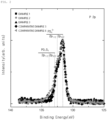
- FIG. 2 is XPS data of the solid electrolytes of Examples 1 to 3 and Comparative Examples 3 and 6.
- [Table 1] Category NIR XPS Integral value of Li 2 CO 3 band Integral value of LiOH band A 2 /(A 1 +A 2 )
- Example 1 5.63 0 0.029
- Example 2 3.37 0 0.000
- Example 3 6.6 0 0.083
- Example 4 4.68 0 0.029
- Example 5 6.42 0 0.038
- Example 6 5.34 0 0.048 Comparative Example 1 1.25 0 0.020 Comparative Example 2 1.4 0 0.010 Comparative Example 3 1.96 0 0.000 Comparative Example 4 40.3 1.6 - Comparative Example 5 1.04 0 0.014 Comparative Example 6 8.69 0 0.167 Comparative Example 7 32.1 1.32 -
- ionic conductivity after moisture exposure was calculated from the measured resistance values, and an ionic conductivity retention ratio was calculated according to Equation 1 below and presented in Table 2 below. All measurements were conducted in a drying room at a temperature of 22°C and a relative humidity of 0.7%. Since initial ionic conductivities of the solid electrolyte powders of Comparative Examples 4, 6, and 7 were excessively low, the ionic conductivity retention ratio was not evaluated.
- Ionic conductivity retention ratio % ionic conductivity after moisture exposure mS / cm initial ionic conductivity mS / cm ⁇ 100 [Table 2] Category Initial ionic conductivity (mS/cm) Ionic conductivity retention ratio (%) Example 1 6.00 51 Example 2 6.17 52 Example 3 5.54 49 Example 4 5.14 58 Example 5 4.66 59 Example 6 3.24 55 Comparative Example 1 6.77 44 Comparative Example 2 7.18 33 Comparative Example 3 6.49 43 Comparative Example 4 0.00013 - Comparative Example 5 5.41 24 Comparative Example 6 1.01 - Comparative Example 7 0.00022 -
- the solid electrolytes of Examples 1 to 6 not only included a buffer layer including Li 2 CO 3 which was formed on the particle, but also had the integral value of the Li 2 CO 3 band present in the range of 5,200 cm -1 to 4,725 cm -1 in the NIR spectrum of 2.0 to 8.0.
- Comparative Examples 1, 2, and 5 without a surface treatment, it may be confirmed that a buffer layer did not exist on the solid electrolyte particle because an integral value of the Li 2 CO 3 band at an impurity level was detected in the NIR spectrum. Also, with respect to Comparative Example 3, it may be confirmed that almost no buffer layer existed on the solid electrolyte particle because an integral value of the Li 2 CO 3 band at an impurity level was detected in the NIR spectrum. Accordingly, it may be understood that the solid electrolytes of Comparative Examples 1, 2, 3, and 5 did not maintain a stable phase during a battery preparation process and had a problem of degrading battery performance.
- the solid electrolyte of each of Example 1 and Comparative Example 1 as a solid electrolyte, and carbon nanofibers (CNF) as a conductive agent, the positive electrode active material : the solid electrolyte : the conductive agent were mixed at a weight ratio of 60:35:5 to prepare a positive electrode composition.
- a positive electrode was prepared by uniformly distributing the positive electrode composition at a loading amount of 3 mAh/cm 2 on the solid electrolyte filled in a 13 mm diameter load cell. Thereafter, a screw was tightened in a state in which the load cell was pressed using a flat press. A measured pressing force on the load cell was 35 MPa.
- a 100 ⁇ m thick lithium metal was used as a negative electrode, and a load cell (all-solid-state battery) with a negative electrode/solid electrolyte/positive electrode structure was prepared.
- the prepared all-solid-state battery was charged at a rate of 0.05 C to an upper limit voltage of 4.25 V in a constant current/constant voltage (CC/CV) mode while maintaining a temperature of 60°C, and then discharged at 0.05 C to an end voltage of 3 V in a CC mode to perform initial two cycle charging and discharging. Thereafter, charging was performed at a rate of 0.1 C, rate capability was evaluated while stepwise changing the discharging rate to 0.1 C, 0.2 C, 0.33 C, 0.5 C, 1.0 C, and 0.1 C, and the results thereof are presented in FIG. 3 .
- FIG. 3 is rate capability evaluation data of the all-solid-state batteries including the solid electrolytes of Example 1 and Comparative Example 1.
- the solid electrolyte according to the present invention not only includes the buffer layer including Li 2 CO 3 which is formed on the particle, but the integral value of the Li 2 CO 3 band present in the range of 5,200 cm -1 to 4,725 cm -1 in the NIR spectrum also satisfies a range of 2.0 to 8.0, a stable phase is maintained when exposed to moisture during the battery preparation process and an interfacial side reaction between the solid electrolyte and the electrode material may be suppressed, and thus, it may be understood that the solid electrolyte according to the present invention may improve battery characteristics.
Landscapes
- Chemical & Material Sciences (AREA)
- Chemical Kinetics & Catalysis (AREA)
- Electrochemistry (AREA)
- General Chemical & Material Sciences (AREA)
- Engineering & Computer Science (AREA)
- Manufacturing & Machinery (AREA)
- Inorganic Chemistry (AREA)
- Physics & Mathematics (AREA)
- Condensed Matter Physics & Semiconductors (AREA)
- General Physics & Mathematics (AREA)
- Secondary Cells (AREA)
- Conductive Materials (AREA)
Applications Claiming Priority (2)
| Application Number | Priority Date | Filing Date | Title |
|---|---|---|---|
| KR20230042176 | 2023-03-30 | ||
| PCT/KR2024/004034 WO2024205304A1 (fr) | 2023-03-30 | 2024-03-29 | Électrolyte solide et batterie entièrement solide comprenant celui-ci |
Publications (2)
| Publication Number | Publication Date |
|---|---|
| EP4564510A1 true EP4564510A1 (fr) | 2025-06-04 |
| EP4564510A4 EP4564510A4 (fr) | 2026-01-07 |
Family
ID=92907169
Family Applications (1)
| Application Number | Title | Priority Date | Filing Date |
|---|---|---|---|
| EP24781294.4A Pending EP4564510A4 (fr) | 2023-03-30 | 2024-03-29 | Électrolyte solide et batterie entièrement solide comprenant celui-ci |
Country Status (6)
| Country | Link |
|---|---|
| US (1) | US20260058195A1 (fr) |
| EP (1) | EP4564510A4 (fr) |
| JP (1) | JP2026504270A (fr) |
| KR (1) | KR20240147602A (fr) |
| CN (1) | CN119744465A (fr) |
| WO (1) | WO2024205304A1 (fr) |
Family Cites Families (6)
| Publication number | Priority date | Publication date | Assignee | Title |
|---|---|---|---|---|
| EP3602672B1 (fr) * | 2017-03-31 | 2024-07-31 | The Regents Of The University Of Michigan | Système et procédé de traitement de la surface d'électrolytes solides |
| JP7196625B2 (ja) * | 2019-01-17 | 2022-12-27 | トヨタ自動車株式会社 | 硫化物固体電解質粒子及びその製造方法、並びに、全固体電池 |
| CN110459798B (zh) * | 2019-07-17 | 2022-09-20 | 浙江锋锂新能源科技有限公司 | 核壳结构的硫化物固体电解质及制备方法和固态电池 |
| JP7609967B2 (ja) * | 2021-03-05 | 2025-01-07 | 三井金属鉱業株式会社 | 硫化物固体電解質の製造方法 |
| KR20230042176A (ko) | 2021-09-19 | 2023-03-28 | 정태초 | 전자 물병 |
| CN114243096B (zh) * | 2021-12-15 | 2026-04-28 | 中国科学院物理研究所 | 表面改性硫化物固体电解质材料、制备方法及装置、应用 |
-
2024
- 2024-03-29 US US19/104,926 patent/US20260058195A1/en active Pending
- 2024-03-29 KR KR1020240043015A patent/KR20240147602A/ko active Pending
- 2024-03-29 EP EP24781294.4A patent/EP4564510A4/fr active Pending
- 2024-03-29 WO PCT/KR2024/004034 patent/WO2024205304A1/fr not_active Ceased
- 2024-03-29 CN CN202480003862.1A patent/CN119744465A/zh active Pending
- 2024-03-29 JP JP2025535088A patent/JP2026504270A/ja active Pending
Also Published As
| Publication number | Publication date |
|---|---|
| US20260058195A1 (en) | 2026-02-26 |
| WO2024205304A1 (fr) | 2024-10-03 |
| EP4564510A4 (fr) | 2026-01-07 |
| JP2026504270A (ja) | 2026-02-04 |
| CN119744465A (zh) | 2025-04-01 |
| KR20240147602A (ko) | 2024-10-08 |
Similar Documents
| Publication | Publication Date | Title |
|---|---|---|
| EP4123754A1 (fr) | Matériau d'électrode positive, et batterie | |
| EP3961751A1 (fr) | Couche d'électrode positive pour batterie secondaire entièrement solide, son procédé de préparation et batterie secondaire entièrement solide la comprenant | |
| EP3011617B1 (fr) | Carbones conducteurs pour des batteries au lithium-ion | |
| EP3734714A1 (fr) | Électrode négative pour batterie rechargeable à électrolyte non aqueux et batterie rechargeable à électrolyte non aqueux | |
| KR20180090211A (ko) | 이차전지용 양극활물질 및 이의 제조방법 | |
| EP3680966B1 (fr) | Matériau actif d'électrode positive à base de lithium et de cobalt, son procédé de fabrication, électrode positive et batterie rechargeable le comprenant | |
| EP3761427A1 (fr) | Batterie secondaire à électrolyte non aqueux | |
| US20230369578A1 (en) | Positive Electrode Active Material, Method of Preparing the Same, and Positive Electrode Material, Positive Electrode, and Lithium Secondary Battery Which Include the Same | |
| EP4159684B1 (fr) | Matériau d'électrode positive, batterie et procédé de préparation de matériau d'électrode positive | |
| JP7386988B2 (ja) | 正極活物質、これを含む正極およびリチウム二次電池 | |
| EP4207380A1 (fr) | Matériau actif de cathode, suspension de matériau actif de cathode, cathode, batterie rechargeable au lithium-ion et procédé de préparation de matériau actif de cathode | |
| CN121420378A (zh) | 正极活性材料及其制备方法 | |
| CN113614948B (zh) | 正极材料和电池 | |
| CN106410127A (zh) | 电池正极材料和锂离子电池 | |
| EP4292984B1 (fr) | Matériau actif d'électrode pour éléments électrochimiques, matériau d'électrode pour éléments électrochimiques, électrode pour éléments électrochimiques, élément électrochimique et objet mobile | |
| EP4557429A1 (fr) | Électrolyte solide et batterie tout solide le comprenant | |
| EP3886217A1 (fr) | Matériau actif d'électrode positive, électrode positive le comprenant et batterie au lithium secondaire utilisant l'électrode positive | |
| EP4145556A1 (fr) | Matériau d'électrode négative et batterie | |
| EP4564510A1 (fr) | Électrolyte solide et batterie entièrement solide comprenant celui-ci | |
| EP4589711A1 (fr) | Procédé de préparation d'électrolyte solide et électrolyte solide | |
| JP7756341B2 (ja) | 正極活物質、正極材料、電池、および正極活物質の製造方法 | |
| JP7335053B2 (ja) | 非可逆添加剤、前記非可逆添加剤を含む正極、前記正極を含むリチウム二次電池 | |
| EP4560764A1 (fr) | Électrolyte solide, son procédé de préparation et batterie électrolyte solide le comprenant | |
| EP4036122A1 (fr) | Polyacrylonitrile modifié par du soufre | |
| KR102959944B1 (ko) | 고체 전해질 및 이를 포함하는 전고체 전지 |
Legal Events
| Date | Code | Title | Description |
|---|---|---|---|
| STAA | Information on the status of an ep patent application or granted ep patent |
Free format text: STATUS: THE INTERNATIONAL PUBLICATION HAS BEEN MADE |
|
| PUAI | Public reference made under article 153(3) epc to a published international application that has entered the european phase |
Free format text: ORIGINAL CODE: 0009012 |
|
| STAA | Information on the status of an ep patent application or granted ep patent |
Free format text: STATUS: REQUEST FOR EXAMINATION WAS MADE |
|
| 17P | Request for examination filed |
Effective date: 20250226 |
|
| AK | Designated contracting states |
Kind code of ref document: A1 Designated state(s): AL AT BE BG CH CY CZ DE DK EE ES FI FR GB GR HR HU IE IS IT LI LT LU LV MC ME MK MT NL NO PL PT RO RS SE SI SK SM TR |
|
| A4 | Supplementary search report drawn up and despatched |
Effective date: 20251204 |
|
| RIC1 | Information provided on ipc code assigned before grant |
Ipc: H01M 10/0562 20100101AFI20251128BHEP Ipc: H01M 10/052 20100101ALI20251128BHEP |