EP4564734A1 - Vorrichtung, datenträger, computerprogramm/s und verfahren zur authentifizierung einer nachricht - Google Patents
Vorrichtung, datenträger, computerprogramm/s und verfahren zur authentifizierung einer nachricht Download PDFInfo
- Publication number
- EP4564734A1 EP4564734A1 EP23212485.9A EP23212485A EP4564734A1 EP 4564734 A1 EP4564734 A1 EP 4564734A1 EP 23212485 A EP23212485 A EP 23212485A EP 4564734 A1 EP4564734 A1 EP 4564734A1
- Authority
- EP
- European Patent Office
- Prior art keywords
- vector
- correlation
- message
- quadrant
- authenticating
- Prior art date
- Legal status (The legal status is an assumption and is not a legal conclusion. Google has not performed a legal analysis and makes no representation as to the accuracy of the status listed.)
- Pending
Links
Images




Classifications
-
- H—ELECTRICITY
- H04—ELECTRIC COMMUNICATION TECHNIQUE
- H04L—TRANSMISSION OF DIGITAL INFORMATION, e.g. TELEGRAPHIC COMMUNICATION
- H04L9/00—Cryptographic mechanisms or cryptographic arrangements for secret or secure communications; Network security protocols
- H04L9/32—Cryptographic mechanisms or cryptographic arrangements for secret or secure communications; Network security protocols including means for verifying the identity or authority of a user of the system or for message authentication, e.g. authorization, entity authentication, data integrity or data verification, non-repudiation, key authentication or verification of credentials
-
- G—PHYSICS
- G06—COMPUTING OR CALCULATING; COUNTING
- G06F—ELECTRIC DIGITAL DATA PROCESSING
- G06F17/00—Digital computing or data processing equipment or methods, specially adapted for specific functions
- G06F17/10—Complex mathematical operations
- G06F17/18—Complex mathematical operations for evaluating statistical data, e.g. average values, frequency distributions, probability functions, regression analysis
-
- H—ELECTRICITY
- H04—ELECTRIC COMMUNICATION TECHNIQUE
- H04L—TRANSMISSION OF DIGITAL INFORMATION, e.g. TELEGRAPHIC COMMUNICATION
- H04L9/00—Cryptographic mechanisms or cryptographic arrangements for secret or secure communications; Network security protocols
- H04L9/06—Cryptographic mechanisms or cryptographic arrangements for secret or secure communications; Network security protocols the encryption apparatus using shift registers or memories for block-wise or stream coding, e.g. DES systems or RC4; Hash functions; Pseudorandom sequence generators
- H04L9/065—Encryption by serially and continuously modifying data stream elements, e.g. stream cipher systems, RC4, SEAL or A5/3
- H04L9/0656—Pseudorandom key sequence combined element-for-element with data sequence, e.g. one-time-pad [OTP] or Vernam's cipher
-
- H—ELECTRICITY
- H04—ELECTRIC COMMUNICATION TECHNIQUE
- H04L—TRANSMISSION OF DIGITAL INFORMATION, e.g. TELEGRAPHIC COMMUNICATION
- H04L9/00—Cryptographic mechanisms or cryptographic arrangements for secret or secure communications; Network security protocols
- H04L9/32—Cryptographic mechanisms or cryptographic arrangements for secret or secure communications; Network security protocols including means for verifying the identity or authority of a user of the system or for message authentication, e.g. authorization, entity authentication, data integrity or data verification, non-repudiation, key authentication or verification of credentials
- H04L9/3226—Cryptographic mechanisms or cryptographic arrangements for secret or secure communications; Network security protocols including means for verifying the identity or authority of a user of the system or for message authentication, e.g. authorization, entity authentication, data integrity or data verification, non-repudiation, key authentication or verification of credentials using a predetermined code, e.g. password, passphrase or PIN
-
- H—ELECTRICITY
- H04—ELECTRIC COMMUNICATION TECHNIQUE
- H04L—TRANSMISSION OF DIGITAL INFORMATION, e.g. TELEGRAPHIC COMMUNICATION
- H04L9/00—Cryptographic mechanisms or cryptographic arrangements for secret or secure communications; Network security protocols
- H04L9/32—Cryptographic mechanisms or cryptographic arrangements for secret or secure communications; Network security protocols including means for verifying the identity or authority of a user of the system or for message authentication, e.g. authorization, entity authentication, data integrity or data verification, non-repudiation, key authentication or verification of credentials
- H04L9/3247—Cryptographic mechanisms or cryptographic arrangements for secret or secure communications; Network security protocols including means for verifying the identity or authority of a user of the system or for message authentication, e.g. authorization, entity authentication, data integrity or data verification, non-repudiation, key authentication or verification of credentials involving digital signatures
-
- H—ELECTRICITY
- H04—ELECTRIC COMMUNICATION TECHNIQUE
- H04L—TRANSMISSION OF DIGITAL INFORMATION, e.g. TELEGRAPHIC COMMUNICATION
- H04L2209/00—Additional information or applications relating to cryptographic mechanisms or cryptographic arrangements for secret or secure communication H04L9/00
- H04L2209/84—Vehicles
Definitions
- Embodiments of the present disclosure relate to an apparatus, a data carrier, computer program/s, and methods for authenticating a message.
- embodiments relate to an authentication concept for communication between a vehicle and a mobile device.
- the demand may be satisfied by the subject-matter of the present disclosure.
- Embodiments of the present disclosure provide a method for authenticating a message from a first device (transmitter) to a second device (receiver).
- the method proposes that the first device obtains a predefined generation function for generating elements of a first vector by the first device and a second vector by the second device. Further, the first device generates the first vector using the number generation function. Also, the first device transmits the first vector to the second device for the second device to generate a second vector using the same number generation function to authenticate the message based on a correlation of the first and the second vector and a predefined condition to the correlation.
- the proposed authentication method provides not only for a coordinated generation of a counter but of vectors whose correlation need to satisfy the predefined condition for successful authentication.
- the generation function may be stored on the first device upfront and kept secret from any third parties, e.g., potential attackers.
- the generation function may be stored using a (dedicated) hardware mechanism such as Hardware Secure Mechanism (HSM), Secure Hardware Encryption (SHE), and/or a Trusted Execution Environment (TEE).
- HSM Hardware Secure Mechanism
- SHE Secure Hardware Encryption
- TEE Trusted Execution Environment
- the correlation e.g., is indicative of the Pearson correlation of the first and the second vector.
- the first device may receive, from the second device, information on one or more coefficients of the function. This, e.g., is done when the first and the second device connect with each other, e.g., during startup. Accordingly, the first device generates the first vector based on the generation function and the one or more coefficients of the function. In this way, the coefficients change to make it even more difficult for an attacker to trich the proposed authentication mechanism.
- generating the first vector may comprises generating random numbers using a random number generator and obtaining the elements of the first vector using the generation function and the random numbers as input to the generation function.
- the condition may include a condition to a coordinate system quadrant of the correlation
- the method may further include receiving information on the condition to the coordinate system quadrant from the second device
- generating the first vector may comprise determining a gradient of the first vector based on the coordinate system quadrant.
- the method further comprises determining a first counter for the first vector, transmitting the counter together with the first vector to the second device, and determining a second counter for the second vector, wherein the first and the second counter are determined independently.
- determining a first counter for the first vector transmitting the counter together with the first vector to the second device, and determining a second counter for the second vector, wherein the first and the second counter are determined independently.
- the first device e.g., transmits multiple messages and respective vectors, wherein the correlation (vector) rotates (clockwise or counter-clockwise).
- the counter e.g., increases based on a number of cycles (360° rotation) of the correlation vector. In practice, e.g., the counter increases with each cycle.
- the method further comprises determining a gradient value for the first vector based on an action to be performed by the second device.
- Some applications e.g., may offer different functions and corresponding actions.
- the message may trigger that a vehicle unlocks a door, turns on an engine, and/or sounds its horn.
- the first device e.g., adapts the gradient value accordingly, i.e., such that a desired action is performed. In this way, the vector not only serves for authentication but also for communication.
- the second device e.g., is a vehicle or a component thereof and the first device may be a separate device which is not permanently installed on the vehicle such as a key fob or a mobile device configured to function as a remote control for the vehicle.
- embodiments of the present disclosure provide a method for authenticating a message from a first device by a second device.
- the second device obtains a predefined generation function for generating elements of a first vector by the first device and a second vector by the second device.
- the second device obtains information on at least one predefined condition to a correlation between the first and the second vector.
- the second device receives the first vector from the first device, generates the second vector using the same number generation function, and authenticates the message based on the correlation of the first and the second vector and the condition to the correlation. As outlined in more detail above, this provides more security, in particular, against replay attacks.
- the second device may transmit information on one or more coefficients of the function to the first device for the aforementioned reasons and benefits. Accordingly, the second device generates the second vector based on the number generation function and the one or more coefficients.
- the condition may include a condition to a coordinate system quadrant of the correlation.
- the method may include transmitting information on the coordinate system quadrant to the first device for the first device to generate the first vector based on the coordinate system quadrant.
- generating the second vector may comprise determining a gradient of the second vector based on the coordinate system quadrant and authenticating the message may comprise checking if the correlation is within the predefined quadrant. If so, the authentication may be successful and unsuccessful otherwise.
- the method further comprises receiving, from the first device, a counter for the first vector, and wherein authenticating the message comprises authenticating the message further based on the counter.
- authenticating the message comprises authenticating the message further based on the counter.
- condition may further include a condition to a correlation value of the correlation and authenticating the message may comprise authenticating the message based on the correlation value of the correlation.
- a minimum threshold is specified for the correlation value and the authentication is successful if the correlation value exceeds the threshold. Otherwise, the authentication may fail.
- Embodiments implementing authentication based on the correlation value may further provide for different thresholds for different actions, e.g., such that the threshold is higher for safety-relevant actions (e.g., starting the engine) than for non-safety-relevant actions (e.g., sounding the horn). In this way, the security is even higher for safety-relevant actions to avoid material or personal damage.
- safety-relevant actions e.g., starting the engine
- non-safety-relevant actions e.g., sounding the horn.
- the method further comprises determining a gradient value for the second vector based on an action to be performed by the second device.
- embodiments of the present disclosure provide a non-transitory machine-readable data carrier and/or a download product with the one or more computer programs proposed herein.
- inventions provide an apparatus comprising one or more interfaces for communication and a data processing circuit configured to execute any one of the methods proposed herein.
- Car Control is commonly used in modern vehicles to control the vehicle remotely without human (e.g., driver or passenger) present inside the vehicle.
- a common feature used in Car Control serves for locking/unlocking a door and/or a starting an engine of the vehicle, which are the main target of the attackers.
- Conventional authentication mechanisms use a so-called "rolling code counter".
- the rolling code counter is vulnerable to replay attacks that can be replayed by attacker to successfully open the door maliciously.
- the main drawback of the current mechanism is that the data transmitted from a mobile device (e.g., key fob, smart phone) is predictable with its rolling code counter. The attacker can simply record the communication and replay the message at a later time.
- a transmitter and receiver share a synchronized code sequence. Every time the user presses a button, the transmitter sends the current code, and the receiver, after accepting and validating the code, increments to the next one in the sequence. This constant changing of codes makes it challenging for attackers to predict or replay the transmitted signals successfully.
- the vulnerability to replay attacks lies in the potential interception and storage of the transmitted codes. If an adversary manages to capture a valid rolling code, they can replay it later to gain unauthorized access.
- some systems implement additional security measures like time-sensitive codes or device authentication. So, current security mechanisms, e.g., to secure the communication between a mobile device and a vehicle or receiver thereof (e.g., ECU in the vehicle) is relying on a monotonic counter from both the mobile device and the vehicle which is predictable by attacker.
- One objective of the present disclosure is therefore to provide an improved authentication mechanism that is more robust against replay attacks.
- One idea of the proposed authentication mechanism is to generate two vectors independently by a first and a second device, e.g., by a receiver and a transmitter, based on a predefined function.
- the two vectors correlate to each other if the correct function is used. Therefore, if only authorized or trusted devices have access to the number generation function, they can be authenticated by a correlation of the vectors.
- Figs. 1 and 2 Exemplary methods for a receiver and a transmitter are schematically visualized by Figs. 1 and 2 .
- Fig. 1 schematically illustrates an embodiment of a method 100 for authenticating a message from a first device to a second device.
- the method 100 comprises the following steps by the first device: Obtaining 110 a predefined generation function for generating elements of a first vector by the first device and a second vector by the second device. Further, method 100 comprises generating 120 the first vector using the number generation function.
- the generation function can be, e.g., any arbitrary mathematical function such as a quadratic equation of cubic equation.
- the elements of the vectors e.g., random numbers may be used as input to the function and the results may be used as elements of the vectors.
- the input e.g., is generated using a random number generator.
- any data including at least two numbers may be seen as vector.
- method 100 suggests transmitting 130 the first vector to the second device for the second device to generate a second vector using the same number generation function to authenticate the message based on a correlation of the first and the second vector and a predefined condition to the correlation.
- the first and the second device are communicatively coupled to communicate the first vector.
- they may be configured to establish a wireless connection (e.g., via Bluetooth, Wireless Local Area Network, and/or the like) to each other and may communicate the first vector wirelessly.
- a wireless connection e.g., via Bluetooth, Wireless Local Area Network, and/or the like
- the skilled person will appreciate that the proposed approach is not limited to wireless connections, though, and may be also applied for any wired connections.
- the first device may authenticate itself or any messages to the second device.
- method 200 (see Fig. 2 ) provides a solution to authenticate the first device or its message by the first vector through the second device.
- method 200 suggests obtaining 210 a predefined generation function (see above) for generating elements of a first vector by the first device and a second vector by the second device.
- the (number) generation function e.g., is stored on and obtained from a storage of the second device or outside the second device.
- method 200 comprises obtaining 220 information on at least one predefined condition to a correlation between the first and the second vector.
- method 200 further suggests receiving 230 the first vector from the first device by the second device and generating 240 the second vector using the same number generation function.
- this is done in a similar or the same way as for the first vector (e.g., using a random number generator to generate input for the number generation function whose results are then used as elements of the vector).
- this is followed by authenticating 250 the message based on the correlation of the first and the second vector and the condition to the correlation.
- the correlation may be a vector having a certain length and direction.
- the length may indicate a correlation value while the direction indicates a system coordinate quadrant of the correlation.
- the condition to the correlation e.g., is satisfied if it has at least a minimum correlation value and/or if it is in a certain predefined coordinate system quadrant. If so, the authentication is successful. Otherwise, the authentication is not successful. In this event, a respective message or request from the first device may be refused, discarded, and/or ignored. Additionally, the second device may inform a user that a communication with another device failed and/or that an attack may have occurred.
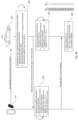
- the proposed approach is applied for communication between a mobile device 310 and a vehicle 320.
- the mobile device 310 can be any mobile device such as a key fob, car key, or a mobile phone which may be configured to control the vehicle 320 or at least some functions of it.
- the vehicle 320 may be any kind of vehicle such as a car, a truck, bus, and/or the like.
- an attacker may apply a replay attack to intercept and replay the communication between mobile device 310 and the vehicle 320.
- the communication e.g., is used to get access to the vehicle 320 or to operate any other functions of the vehicle 320 (from remote). So, potential attackers may get undesirably access to the vehicle 320 and/or may control other functions.
- the proposed approach provides for a multidimensional authentication mechanism.
- each of the dimensions can be seen as a condition that need to be satisfied for a successful authentication.
- the proposed approach provides for three dimensions/conditions, whereas one of the conditions relate to a quadrant of a correlation between vectors, which is why embodiments of the present disclosure are herein referred to as "3-D Quadrant-Correlation based authentication".
- the authentication uses the correlation (can be a string value) of vectors generated by the mobile device 310 and the vehicle 320.
- the correlation can be a string value
- Authentication mechanism uses a correlation value, a quadrant of the correlation, a counter, a slope, or gradient, and/or a threshold correlation.
- the vehicle 320 e.g., is equipped with an ECU (also referred to herein as "Car Controler") for communication with the mobile device 310.
- ECU also referred to herein as "Car Controler”
- wireless communication maybe used for this.
- the mobile device 310 may first send an initial signal to the ECU to start the communication.
- the ECU may then acknowledge the initial signal and determine initial variables for communication. In doing so, it generates keys (or a session key) for communication, determines a size (number of elements) of the vectors, a (initial) (coordinate system) quadrant of the correlation (for examples but not necessarily, quadrant I), and determines the one or more coefficients (coefficient values) of the (number) generation function. Then, the ECU sends those variables to the mobile device 310. The mobile device 310, then, in a next step 340 uses the variables to generate a vector Y 2 (also referred to herein as "first vector") for the authentication to the ECU.
- a vector Y 2 also referred to herein as "first vector
- the mobile device 310 determines the gradient value of the vector Y 2 based on the information on the quadrant of the correlation (as outlined in more detail below with reference to the table below). Further, the mobile device 310 generates an input x for generating the vector Y 2 based on the gradient value, e.g., such that the vector Y 2 has (approximately) the determined gradient value. Then, the mobile device 310 generates the vector Y 2 using the generation function (e.g., a random number generator) and the input x to the generation function and signs the vector Y 2 with a signature.
- the generation function e.g., a random number generator
- the ECU generates a vector Y 1 by determining the gradient value of the vector Y 1 based on the previously defined system coordinate quadrant, i.e., such that the correlation between vector Y 1 and vector Y 2 is within that quadrant if vector Y 2 has been generated by an authorized device. Then, random numbers are generated using a random number generator and the gradient value as reference such that the vector Y 1 has the predefined gradient. Next, the elements of the vector Y 1 is generated based on the same number generation function as Y 2 and the generated random numbers.
- the mobile device 310 sends the signed vector Y 2 to the ECU in a message.
- the ECU authenticates the message based on the vector Y 2 in step 360. For this, the ECU verifies the signature, i.e., verifies that message has been signed by the mobile device 310. Further, the ECU executes the authentication for the vectors Y 1 and Y 2 based on their correlation.
- the ECU causes an action requested through the message, e.g., that the vehicle 320 unlock one or more doors or that the vehicle 320 starts its engine. Otherwise, the ECU may consider the message malicious and may refrain from causing the requested action so that an attacker, e.g., does not get access to the vehicle 320.
- the requested action e.g., can be determined by the ECU from a gradient value or slope of the vector from the mobile device.
- the vehicle 320 or ECU in the event of a successful authentication, may send an acknowledgement to the mobile device 310.
- the mobile device 310 may receive a coordinate system quadrant for the next authentication as well as a counter that may be added to the vector for even more security as laid out in more detail later.
- the mobile device 310 may receive an error message from the vehicle 320, if the authentication failed, as can be seen in Fig. 3c .
- FIG. 4 shows a successful authentication.
- the coordinate system quadrants may be numbered clockwise, starting with I in the upper right of four quadrants separated by an abscissa X and an ordinate Y.
- the initial predefined coordinate system quadrant is, e.g., quadrant I. So, the mobile device 310, e.g., receives the information that the correlation shall be in quadrant I.
- the correlation may be the Pearson correlation.
- the coordinate system quadrant may depend on the gradient, in particular, on the sign of the vectors, as illustrated in table 1. Both of the vectors, e.g., have to be positive or negative, i.e., have a positive or negative gradient, if the predefined quadrant of the correlation is quadrant I or III, respectively.
- the vectors may need to have a different gradient, e.g., that one of the vectors is negative while the other one is positive (see table 1 below).
- the predefined quadrant e.g., is quadrant I.
- the quadrant may be also any other quadrant.
- quadrant I e.g., vector Y 2 as well as Y 1 are generated such that they only contain positive elements (see examples of Y 2 and Y 1 in Fig. 4 ).
- the one or more coefficients may be positive, and the random number generator may be adapted accordingly.
- the correlation 420 e.g., is as shown in Fig. 4 another vector with a certain length and slope.
- the length is indicative of the correlation value and the slope may be also referred to herein as gradient of the correlation.
- the correlation is checked as follows: It is checked if the correlation value (length of the correlation (vector)) is equal or greater than a predefined threshold 410 for it.
- the threshold 410 e.g., is 0.25 (see circle around coordinate origin) and the correlation value can assume any value between -1 and +1.
- another threshold and/or another value space may be chosen.
- the correlation value is 0.96 for Y 2 and Y 1 .
- the correlation value exceeds the threshold of 0.25 and may lead to a successful authentication. Otherwise, if the correlation value is lower than the threshold, the authentication will fail.
- the invalid area may be configurable and my depend on a initial set up and type of communication.
- the safety relevant communication may setup the threshold of 25% to 35% (0.25 ⁇ r or 0.35 ⁇ r).
- the safety relevant communication may setup the threshold of 25% to 35% (0.25 ⁇ r or 0.35 ⁇ r).
- the threshold For low feature without safety concern such as activating the external light when the car in parking mode can be configured to 5% to 10% (0.05 ⁇ r or 0.10 ⁇ r).
- the correlation is in the predefined coordinate system quadrant.
- the slope is used.
- the slope e.g., is between 0° and 90°. So, the correlation is in the predefined quadrant I.
- the authentication may be successful. Otherwise, if at least one of the above criteria is not met, the authentication is unsuccessful.
- the predefined system coordinate quadrant may rotate clockwise for further authentications. So, in further authentications, the system coordinate quadrant may be quadrant II, III, or IV.
- a counter may be used to indicate when the system coordinate quadrant covered one round. So, in embodiments, the counter, e.g., is incremented each time when the system coordinate quadrant covered one round or cycle. Preferably, the system coordinate quadrant does not change regularly, i.e., in same step sizes but irregularly.
- the quadrant is then, e.g., specified by [02, I] wherein the Arabic number denotes the counter and the Roman number denotes the quadrant.
- the next quadrant e.g., is [02,IV] or [03, I].
- the authentication is (only) successful if, further, the system coordinate quadrant rotated clockwise and if the counter is equal or higher than the counter in the previous authentication.
- the correlation vector may be supposed to rotate counter-clockwise.
- the counter may only increase.
- the counter may be compared to previous counters in the authentication. In practice, it is, e.g., checked if the counter is equal or higher than in the previous authentication. In practice, the counter, e.g., is transmitted together with the vector Y 2 or a respective message.
- the proposed example provides for three conditions to be fulfilled for a successful authentication.
- the conditions can be also seen as “dimensions”. Accordingly, the proposed approach may be referred to as "3-D (three-dimensional) Quadrant-Correlation based authentication”.
- Fig. 5 shows an example of an unsuccessful authentication.
- Y 1 and Y 2 are uncorrelated, and their counter differs by more than two (see z-axis Z indicating the counter). Accordingly, the above conditions are not fulfilled and the authentication will fail. So, a respective message may be seen malicious and a user may be informed about that.
- the embodiments of the present disclosure may comprise:
- the size of the two vectors (Y1, Y2) is predetermined by the ECU at the initial start of the vehicle (i.e., early morning when the engine is firstly started).
- the size of the vector for each time the engine is initially started does not need to be the same each time and determined randomly by both ECU and mobile device.
- the initial quadrant in which the correlation shall be generated is also pre-determined by both ECU and the mobile device. To achieve so, the sign and values of gradient/slope of the vector shall be determined accordingly by ECU and Car controller.
- Table 1 shows the possible sign (value) of vectors that is Internal corresponding to the quadrant correlation. The ECU will decide on which quadrant to be started and send the information to the Car controller.
- the gradient value (i.e., 0 ⁇ gradient ⁇ 1.0) is determined independently for both ECU and mobile device according to the mode of service (e.g., lock/unlock the door, trunk, or start the engine etc.).
- the quadrant value is not necessarily to be started at first quadrant as this is predictable by attacker and to protect further against replay attacks.
- Another step at initial start-up is to determine the coefficient value of the equation which is used to generate the vector component from random number.
- Step 1 ⁇ Determine the size of the Vector
- Step 2 ⁇ Determine the coefficient value of the equation
- Step 2 ⁇ Determine the gradient value based on the Quadrant information. For instance: if decided to be Quadrant II, Y1 shall be + (gradient value) and Y2 shall be - (gradient value). See Table 1. The gradient value will be dependent on the mode of communication, such as open the trunk is 0.82 and 0.90 for Y1 and Y2 respectively. For starting the engine, it could be 0.91 and 0.95 for Y1 and Y2 respectively.
- ⁇ Generate the random number based on gradient value as reference.
- Step 3 ⁇ Send the vector Y2 to the vehicle or ECU ⁇ ECU Computes the correlation value and degree of Y1 and Y2 ⁇ Check the correlation value, quadrant, and counter value ⁇ If verified, the next action is to execute the command, otherwise the system will be terminated.
- the proposed approach may be implemented in various ways.
- the proposed approach may be implemented in a computer program or computer-implemented method.
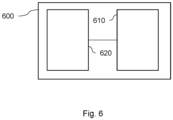
- Fig. 6 shows a block diagram schematically illustrating an embodiment of such an apparatus 600.
- the apparatus comprises one or more interfaces 610 for communication and a data processing circuit 620 configured to execute the proposed method.
- the one or more interfaces 610 may comprise wired and/or wireless interfaces for transmitting and/or receiving communication signals in connection with the execution of the proposed concept.
- the interfaces e.g., comprise pins, wires, antennas, and/or the like.
- the interfaces may comprise means for (analog and/or digital) signal or data processing in connection with the communication, e.g., filters, samples, analog-to-digital converters, signal acquisition and/or reconstruction means as well as signal amplifiers, compressors and/or any encryption/decryption means.
- the data processing circuit 620 may correspond to or comprise any type of programable hardware. So, examples of the data processing circuit 620, e.g., comprise a memory, microcontroller, field programable gate arrays, one or more central, and/or graphical processing units. To execute the proposed method, the data processing circuit 620 may be configured to access or retrieve an appropriate computer program for the execution of the proposed method from a memory of the data processing circuit 620 or a separate memory which is communicatively coupled to the data processing circuit 620.
- the proposed apparatus may be installed in an access system (e.g., for a vehicle or a house door) including a receiver and a mobile device. So, embodiments may also provide an access system.
- the apparatus e.g., is installed in a vehicle and/or a mobile device separate from the vehicle.
- the apparatus e.g., may be implemented in an ECU, a smartphone, a tablet, or wearable.
Landscapes
- Engineering & Computer Science (AREA)
- Computer Security & Cryptography (AREA)
- Computer Networks & Wireless Communication (AREA)
- Signal Processing (AREA)
- Physics & Mathematics (AREA)
- Data Mining & Analysis (AREA)
- General Physics & Mathematics (AREA)
- Mathematical Physics (AREA)
- Pure & Applied Mathematics (AREA)
- Theoretical Computer Science (AREA)
- Computational Mathematics (AREA)
- Mathematical Optimization (AREA)
- Mathematical Analysis (AREA)
- Bioinformatics & Cheminformatics (AREA)
- Operations Research (AREA)
- Probability & Statistics with Applications (AREA)
- Evolutionary Biology (AREA)
- Algebra (AREA)
- Life Sciences & Earth Sciences (AREA)
- Databases & Information Systems (AREA)
- Software Systems (AREA)
- General Engineering & Computer Science (AREA)
- Bioinformatics & Computational Biology (AREA)
- Lock And Its Accessories (AREA)
Priority Applications (2)
| Application Number | Priority Date | Filing Date | Title |
|---|---|---|---|
| EP23212485.9A EP4564734A1 (de) | 2023-11-28 | 2023-11-28 | Vorrichtung, datenträger, computerprogramm/s und verfahren zur authentifizierung einer nachricht |
| PCT/EP2024/082777 WO2025114070A1 (en) | 2023-11-28 | 2024-11-19 | Apparatus, data carrier, computer program/s, and methods for authenticating a message |
Applications Claiming Priority (1)
| Application Number | Priority Date | Filing Date | Title |
|---|---|---|---|
| EP23212485.9A EP4564734A1 (de) | 2023-11-28 | 2023-11-28 | Vorrichtung, datenträger, computerprogramm/s und verfahren zur authentifizierung einer nachricht |
Publications (1)
| Publication Number | Publication Date |
|---|---|
| EP4564734A1 true EP4564734A1 (de) | 2025-06-04 |
Family
ID=88978505
Family Applications (1)
| Application Number | Title | Priority Date | Filing Date |
|---|---|---|---|
| EP23212485.9A Pending EP4564734A1 (de) | 2023-11-28 | 2023-11-28 | Vorrichtung, datenträger, computerprogramm/s und verfahren zur authentifizierung einer nachricht |
Country Status (2)
| Country | Link |
|---|---|
| EP (1) | EP4564734A1 (de) |
| WO (1) | WO2025114070A1 (de) |
Citations (5)
| Publication number | Priority date | Publication date | Assignee | Title |
|---|---|---|---|---|
| DE102011079421A1 (de) * | 2011-07-19 | 2013-01-24 | Continental Automotive Gmbh | Verfahren und Anordnung zur Zugangs- und/oder Start-Authentifizierung |
| JP2014178862A (ja) * | 2013-03-14 | 2014-09-25 | Secom Co Ltd | 特徴点抽出装置 |
| WO2020006052A1 (en) * | 2018-06-29 | 2020-01-02 | Micron Technology, Inc. | Secure wireless lock-actuation exchange |
| US20200076603A1 (en) * | 2018-09-05 | 2020-03-05 | NEC Laboratories Europe GmbH | Method and system for publicly verifiable proofs of retrievability in blockchains |
| CN116886276A (zh) * | 2023-05-29 | 2023-10-13 | 北京中超伟业信息安全技术股份有限公司 | 一种基于动态密钥的数据传输方法及系统 |
-
2023
- 2023-11-28 EP EP23212485.9A patent/EP4564734A1/de active Pending
-
2024
- 2024-11-19 WO PCT/EP2024/082777 patent/WO2025114070A1/en active Pending
Patent Citations (5)
| Publication number | Priority date | Publication date | Assignee | Title |
|---|---|---|---|---|
| DE102011079421A1 (de) * | 2011-07-19 | 2013-01-24 | Continental Automotive Gmbh | Verfahren und Anordnung zur Zugangs- und/oder Start-Authentifizierung |
| JP2014178862A (ja) * | 2013-03-14 | 2014-09-25 | Secom Co Ltd | 特徴点抽出装置 |
| WO2020006052A1 (en) * | 2018-06-29 | 2020-01-02 | Micron Technology, Inc. | Secure wireless lock-actuation exchange |
| US20200076603A1 (en) * | 2018-09-05 | 2020-03-05 | NEC Laboratories Europe GmbH | Method and system for publicly verifiable proofs of retrievability in blockchains |
| CN116886276A (zh) * | 2023-05-29 | 2023-10-13 | 北京中超伟业信息安全技术股份有限公司 | 一种基于动态密钥的数据传输方法及系统 |
Also Published As
| Publication number | Publication date |
|---|---|
| WO2025114070A1 (en) | 2025-06-05 |
Similar Documents
| Publication | Publication Date | Title |
|---|---|---|
| Jo et al. | MAuth-CAN: Masquerade-attack-proof authentication for in-vehicle networks | |
| US9252945B2 (en) | Method for recognizing a manipulation of a sensor and/or sensor data of the sensor | |
| US10749680B1 (en) | Secure communication between a vehicle and a remote device | |
| US10369964B2 (en) | Keyless entry system security enhancement | |
| US9767627B2 (en) | Method and apparatus for providing vehicle security | |
| EP3050251B1 (de) | Echtzeit-rahmenauthentifizierung unter verwendung von id-anonymisierung in automobilnetzwerken | |
| US10618497B2 (en) | Unlocking control system and unlocking control method | |
| CN105635147A (zh) | 基于车载特种装备系统的数据安全传输方法及系统 | |
| CN111508110B (zh) | 一种实现车辆远程锁定的方法及装置 | |
| CN106537463B (zh) | 用于提高车辆安全性的方法和装置 | |
| Patel et al. | On the security of remote key less entry for vehicles | |
| CN113839782A (zh) | 基于puf的车内网络can总线轻量级安全通信方法 | |
| WO2006120617A1 (en) | Communication protocol and electronic communication system, in particular authentication control system, as well as corresponding method | |
| JP2016086353A (ja) | 通信装置 | |
| EP4564734A1 (de) | Vorrichtung, datenträger, computerprogramm/s und verfahren zur authentifizierung einer nachricht | |
| Giri et al. | An integrated safe and secure approach for authentication and secret key establishment in automotive cyber-physical systems | |
| CN119299230B (zh) | 车辆远程控制认证方法及系统 | |
| JP6557078B2 (ja) | 電子キー及び電子キーシステム | |
| CN118351616A (zh) | 安全管理方法、电子钥匙以及车辆 | |
| CN112702304A (zh) | 一种车辆信息的校验方法、装置及汽车 | |
| CN111274570A (zh) | 一种加密认证方法、装置、服务器、可读存储介质及空调器 | |
| US20060064587A1 (en) | User activated authentication system | |
| EP4664430A1 (de) | Fahrzeug, vorrichtung, datenträger, computerprogramm und verfahren zur rolling-code-basierten authentifizierung | |
| JP2024055384A (ja) | 車両用制御装置 | |
| JP6850314B2 (ja) | ユーザ認証装置及びユーザ認証方法 |
Legal Events
| Date | Code | Title | Description |
|---|---|---|---|
| PUAI | Public reference made under article 153(3) epc to a published international application that has entered the european phase |
Free format text: ORIGINAL CODE: 0009012 |
|
| STAA | Information on the status of an ep patent application or granted ep patent |
Free format text: STATUS: THE APPLICATION HAS BEEN PUBLISHED |
|
| AK | Designated contracting states |
Kind code of ref document: A1 Designated state(s): AL AT BE BG CH CY CZ DE DK EE ES FI FR GB GR HR HU IE IS IT LI LT LU LV MC ME MK MT NL NO PL PT RO RS SE SI SK SM TR |
|
| RAP3 | Party data changed (applicant data changed or rights of an application transferred) |
Owner name: AUMOVIO GERMANY GMBH |
|
| STAA | Information on the status of an ep patent application or granted ep patent |
Free format text: STATUS: REQUEST FOR EXAMINATION WAS MADE |
|
| 17P | Request for examination filed |
Effective date: 20251204 |