EP4564743A1 - Verfahren und system zum automatischen ändern einer sicherheitsebenenkonfiguration eines sicherheitssystems einer anlage auf basis eines empfangenen ereignisprofils eines an der anlage zu haltenden ereignisses - Google Patents
Verfahren und system zum automatischen ändern einer sicherheitsebenenkonfiguration eines sicherheitssystems einer anlage auf basis eines empfangenen ereignisprofils eines an der anlage zu haltenden ereignisses Download PDFInfo
- Publication number
- EP4564743A1 EP4564743A1 EP24212832.0A EP24212832A EP4564743A1 EP 4564743 A1 EP4564743 A1 EP 4564743A1 EP 24212832 A EP24212832 A EP 24212832A EP 4564743 A1 EP4564743 A1 EP 4564743A1
- Authority
- EP
- European Patent Office
- Prior art keywords
- security
- event
- facility
- security level
- profile
- Prior art date
- Legal status (The legal status is an assumption and is not a legal conclusion. Google has not performed a legal analysis and makes no representation as to the accuracy of the status listed.)
- Pending
Links
Images

Classifications
-
- H—ELECTRICITY
- H04—ELECTRIC COMMUNICATION TECHNIQUE
- H04L—TRANSMISSION OF DIGITAL INFORMATION, e.g. TELEGRAPHIC COMMUNICATION
- H04L63/00—Network architectures or network communication protocols for network security
- H04L63/10—Network architectures or network communication protocols for network security for controlling access to devices or network resources
- H04L63/105—Multiple levels of security
-
- G—PHYSICS
- G07—CHECKING-DEVICES
- G07C—TIME OR ATTENDANCE REGISTERS; REGISTERING OR INDICATING THE WORKING OF MACHINES; GENERATING RANDOM NUMBERS; VOTING OR LOTTERY APPARATUS; ARRANGEMENTS, SYSTEMS OR APPARATUS FOR CHECKING NOT PROVIDED FOR ELSEWHERE
- G07C9/00—Individual registration on entry or exit
- G07C9/00174—Electronically operated locks; Circuits therefor; Nonmechanical keys therefor, e.g. passive or active electrical keys or other data carriers without mechanical keys
- G07C9/00571—Electronically operated locks; Circuits therefor; Nonmechanical keys therefor, e.g. passive or active electrical keys or other data carriers without mechanical keys operated by interacting with a central unit
-
- H—ELECTRICITY
- H04—ELECTRIC COMMUNICATION TECHNIQUE
- H04L—TRANSMISSION OF DIGITAL INFORMATION, e.g. TELEGRAPHIC COMMUNICATION
- H04L63/00—Network architectures or network communication protocols for network security
- H04L63/20—Network architectures or network communication protocols for network security for managing network security; network security policies in general
- H04L63/205—Network architectures or network communication protocols for network security for managing network security; network security policies in general involving negotiation or determination of the one or more network security mechanisms to be used, e.g. by negotiation between the client and the server or between peers or by selection according to the capabilities of the entities involved
-
- G—PHYSICS
- G07—CHECKING-DEVICES
- G07C—TIME OR ATTENDANCE REGISTERS; REGISTERING OR INDICATING THE WORKING OF MACHINES; GENERATING RANDOM NUMBERS; VOTING OR LOTTERY APPARATUS; ARRANGEMENTS, SYSTEMS OR APPARATUS FOR CHECKING NOT PROVIDED FOR ELSEWHERE
- G07C9/00—Individual registration on entry or exit
- G07C9/20—Individual registration on entry or exit involving the use of a pass
- G07C9/29—Individual registration on entry or exit involving the use of a pass the pass containing active electronic elements, e.g. smartcards
-
- H—ELECTRICITY
- H04—ELECTRIC COMMUNICATION TECHNIQUE
- H04L—TRANSMISSION OF DIGITAL INFORMATION, e.g. TELEGRAPHIC COMMUNICATION
- H04L63/00—Network architectures or network communication protocols for network security
- H04L63/10—Network architectures or network communication protocols for network security for controlling access to devices or network resources
- H04L63/107—Network architectures or network communication protocols for network security for controlling access to devices or network resources wherein the security policies are location-dependent, e.g. entities privileges depend on current location or allowing specific operations only from locally connected terminals
-
- H—ELECTRICITY
- H04—ELECTRIC COMMUNICATION TECHNIQUE
- H04L—TRANSMISSION OF DIGITAL INFORMATION, e.g. TELEGRAPHIC COMMUNICATION
- H04L63/00—Network architectures or network communication protocols for network security
- H04L63/10—Network architectures or network communication protocols for network security for controlling access to devices or network resources
- H04L63/108—Network architectures or network communication protocols for network security for controlling access to devices or network resources when the policy decisions are valid for a limited amount of time
-
- H—ELECTRICITY
- H04—ELECTRIC COMMUNICATION TECHNIQUE
- H04L—TRANSMISSION OF DIGITAL INFORMATION, e.g. TELEGRAPHIC COMMUNICATION
- H04L9/00—Cryptographic mechanisms or cryptographic arrangements for secret or secure communications; Network security protocols
- H04L9/40—Network security protocols
-
- H—ELECTRICITY
- H04—ELECTRIC COMMUNICATION TECHNIQUE
- H04L—TRANSMISSION OF DIGITAL INFORMATION, e.g. TELEGRAPHIC COMMUNICATION
- H04L2463/00—Additional details relating to network architectures or network communication protocols for network security covered by H04L63/00
- H04L2463/082—Additional details relating to network architectures or network communication protocols for network security covered by H04L63/00 applying multi-factor authentication
Definitions
- the present disclosure relates generally to security systems and more particularly to automatically-generated event-based changes to security settings within the security system.
- the security configuration for the facility may vary from day to day, and between different areas and regions of the facility. As an example, say a particular building has vendors coming for the day. This may involve less stringent security settings for the lobby and the conference room and more stringent security settings for the server room. Variable security settings may include changes in how an individual accesses particular areas and regions of the facility, for example. These configuration changes may be difficult to implement because the security personnel need to manually think through security aspects and determine the appropriate configuration based on the available devices and the current security situation in the facility. This can require significant operator expertise. Also, manually identifying and changing security configurations based on dynamically changing security situations in the facility can be time consuming, tedious and error prone. What would be desirable are methods and systems that automatically identify and/or implement security system configuration changes based on dynamic security situations occurring in the facility.
- the present disclosure relates generally to security systems and more particularly to automatically-generated event-based changes to security settings within the security system.
- An example may be found in a method for controlling a security level of a security system of a facility.
- the illustrative method includes receiving an event profile associated with an event to be held at the facility, selecting a selected one or more of a plurality of predetermined security level configurations based at least in part on the received event profile, and automatically changing the security level of at least part of the security system based on the selected one or more of a plurality of predetermined security level configurations.
- the illustrative security system includes a plurality of security system sensors, and a controller that is operatively coupled to the security system sensors.
- the controller is configured to store a plurality of predetermined security level configurations.
- the controller is configured to identify an event profile associated with an event to be held at the facility, select a selected one or more of the plurality of predetermined security level configurations based at least in part on the identified event profile, and automatically change the security level of at least part of the security system based on the selected one or more of a plurality of predetermined security level configurations.
- Non-transitory computer readable medium storing instructions that when executed by one or more processors, causes the one or more processors to identify an event profile associated with an event to be held at a facility, automatically select a selected one or more of a plurality of predetermined security level configurations based at least in part on the identified event profile, and automatically change the security level of at least part of a security system of the facility based on the selected one or more of a plurality of predetermined security level configurations.
- references in the specification to "an embodiment”, “some embodiments”, “other embodiments”, etc., indicate that the embodiment described may include a particular feature, structure, or characteristic, but every embodiment may not necessarily include the particular feature, structure, or characteristic. Moreover, such phrases are not necessarily referring to the same embodiment. Further, when a particular feature, structure, or characteristic is described in connection with an embodiment, it is contemplated that the feature, structure, or characteristic is described in connection with an embodiment, it is contemplated that the feature, structure, or characteristic may be applied to other embodiments whether or not explicitly described unless clearly stated to the contrary.
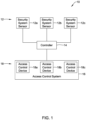
- FIG. 1 is a schematic block diagram showing an illustrative security system 10.
- the illustrative security system 10 may be installed within a facility for protecting the facility.
- the security system 10 includes a number of security system sensors 12, individually labeled as 12a, 12b and 12c. While a total of three security system sensors 12 are shown, it will be appreciated that the security system 10 may include any number of security system sensors 12, and in some instances may include substantially more than three security system sensors 12.
- Each of the security system sensors 12 may represent any of a variety of different types of sensors.
- each of the security system sensors 12 may be an intrusion sensor such as a door sensor, a window sensor, a glass break sensor, a motion sensor such as a PIR (passive infrared) sensor, a video camera and/or any other type of security system sensor.
- the security system 10 includes a controller 14 that is operatively coupled to the security system sensors 12.
- the controller 14 may be located within the facility and may communicate with the security system sensors 12 via a wired or wireless facility network. In some instances, the controller 14 may be remotely located, and may communicate with the security system sensors 12 via a gateway, for example.
- the security system 10 may further include an access control system 16 that is configured to regulate passage into secured portions of the facility.
- the illustrative access control system 16 includes a number of access control devices 18, individually labeled as 18a, 18b and 18c. It will be appreciated that the access control system 16 may include any number of access control devices 18, and in some cases may include substantially more than three access control devices 18, particularly in a large facility.
- the access control devices 18 may be access card readers, door unlock switches and/or any other access control devices.
- the access control devices 18 may include video cameras that perform facial recognition in order to determine whether a particular individual should be allowed access to a particular space, for example.
- the access control system 16 may be controlled by the controller 14. In some instances, the access control system 16 may include its own controller (not shown).
- the controller 14 is configured to store a plurality of predetermined security level configurations that may be used in controlling the security system 10.
- the controller 14 may be configured to identify an event profile associated with an event to be held at the facility.
- the event profile may include, for example, a visitor profile that identifies one or more characteristics of one or more visitors who will be attending the event.
- at least part of the event profile may be extracted from a meeting calendar event having a list of meeting attendees that will be attending the event, and at least part of the visitor profile may be extracted from the list of meeting attendees.
- the one or more characteristics of the one or more visitors who will be attending the event may include a threat level associated with the one or more visitors to the facility.
- the event profile may include a confidentiality level associated with the event.
- a high level board meeting held at the facility may have a higher associated confidentiality level than an open house event.
- at least part of the visitor profile may be extracted from a card swipe of a visitor at an access card reader (such as one of the access control devices 18) of the security system 10. For example, when a high level executive swipes his card at a facility, the security level of the facility may be elevated.
- the controller 14 is configured to select a selected one or more of the plurality of predetermined security level configurations based at least in part on the identified event profile. In some instances, the controller 14 may be configured to automatically select a security level configuration without operator input. In some cases, the controller may be configured to automatically suggest to an operator a particular one of the plurality of predetermined security level configurations, and give the operator the option to select. In some cases, the controller 14 is configured to automatically change the security level of at least part of the security system based on the selected one or more of a plurality of predetermined security level configurations.
- the plurality of predetermined security level configurations may define what an individual must do to gain access to a particular space. For example, in a lower security level configuration, an individual may only need to swipe an access card to gain access to a secure region. In a higher security level configuration, an individual may need to perform a two-part verification (e.g. multi-factor authentication) including swiping their access card as well as entering a PIN number, for example. In some cases, the two-part verification may include facial recognition rather than, or in addition to, entering a PIN number.
- a lower security level configuration may activate fewer security system sensors 12 and/or lower one or more security thresholds associated with some security system sensors 12, while a higher security level configuration may activate additional security system sensors 12 and/or raise one or more security thresholds associated with some security system sensors 12.
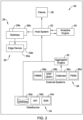
- FIG. 2 is a schematic block diagram showing an illustrative architecture 20 that may be implemented in combination with the security system 10.
- the illustrative architecture 20 includes a host system 22 that provides user profiles to an analytics engine 24 and receives security profiles from the analytics engine 24.
- the analytics engine 24 may be implemented within the controller 14.
- the analytics engine 24 may be cloudbased.
- the host system 22 provides a security dashboard to clients 26 (e.g. security operators).
- the host system 22 applies a security profile by communicating with each of a number of gateways 28, individually labeled as 28a and 28b.
- the gateways 28 in turn communicate with edge devices 30, individually labeled as 30a and 30b.
- the controller 14 may be an example of one of the edge devices 30.
- An aggregator engine 32 may receive data from a variety of data sources 34, including a database 34a, an API (application programming interface 34b or an SDK (software development kit) 34c.
- the aggregator engine 32 may receive information from external systems 36, including an HRMS (human resources management system) 36a, an ERP (SAP) (enterprise planning resource software) 36b, a calendar 36c or a PSIM (physical security information management) 36d.
- the HRMS 36a may be used to identify users associated with a card swipe, a meeting request and/or any other event.
- the calendar 36c may identify scheduled events for the facility and in some cases attendees of the events.
- the PSIM 36d may report card swipe details, facial recognition details, motion events and/or any other events reported by the security system of the facility.
- the aggregator engine 32 collects this information and provides it to the host system 22.
- the host system 22 uses the information to determine which users are currently at or are expected to be at the facility, and to provide corresponding user profiles to the analytics
- FIG 3 is a flow diagram showing an illustrative dataflow 38 of the analytics engine 24 ( Figure 2 ).
- a change sniffer 40 detects changes such as changes to the normal day to day operation of the facility and reports to a change store 42. The changes may include, for example, a card swipe event, a motion event, a facial recognition event, a scheduled event and/or any other change occurring in the operation of the facility.
- a configuration block 44, a user profiles block 46 and a rule definition block 48 each provide information to an analytics rule engine 50.
- the analytics rule engine 50 outputs a security decision 52 and provides an output 54 in which a security profile is implemented by changing one or more security level configurations of a security system (such as security system 10).
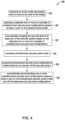
- FIG. 4 is a flow diagram showing an illustrative method 56 for controlling a security level of a security system (such as the security system 10) of a facility.
- the illustrative method 56 includes receiving an event profile associated with an event to be held at the facility, as indicated at block 58.
- the event profile may include a visitor profile, wherein the visitor profile identifies one or more characteristics of one or more visitors who will be attending the event.
- at least part of the event profile may be extracted from a meeting calendar event (e.g. from calendar 36c) having a list of meeting attendees, and wherein at least part of the visitor profile may be extracted from the list of meeting attendees.
- At least part of the visitor profile may be extracted from a card swipe of a visitor at an access card reader of the security system.
- the one or more characteristics of the one or more visitors who will be attending the event may include a threat level associated with the one or more visitors.
- the event profile may include a confidentiality level associated with the event.
- a selected one or more of a plurality of predetermined security level configurations is selected based at least in part on the received event profile, as indicated at block 60.
- the security level of at least part of the security system is automatically changed based on the selected one or more of a plurality of predetermined security level configurations, as indicated at block 62.
- the selected one or more of the plurality of predetermined security level configurations may be automatically selected based at least in part on the received event profile without operator input.
- the selected one or more of the plurality of predetermined security level configurations may be manually selected by an operator from one or more security level configurations automatically suggested by the system.
- automatically changing the security level of at least part of the security system based at least in part on the received event profile may include activating one or more security functions of the security system that were previously deactivated and/or changing one or more sensitivity thresholds of one or more security functions of the security system.
- the one or more security functions may include activating one or more video analytics algorithms that were previously deactivated.
- the one or more security functions may include activating one or more security system sensors and/or changing one or more sensitivity thresholds of one or more of the security system sensors.
- the method 56 may further include accessing timestamped security system data, as indicated at block 64, and accessing timestamped security level configuration changes implemented by an operator of the security system, as indicated at block 66.
- the method 56 may include automatically recommending one or more predetermined security level configurations based at least in part on the timestamped security system data and the timestamped security level configurations, as indicated at block 68.
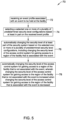
- FIG. 5 is a flow diagram showing an illustrative method 70 for controlling a security level of a security system (such as the security system 10) of a facility.
- the illustrative method 70 includes receiving an event profile associated with an event to be held at the facility, as indicated at block 72.
- the event profile may include a visitor profile, wherein the visitor profile identifies one or more characteristics of one or more visitors who will be attending the event.
- at least part of the event profile may be extracted from a meeting calendar event having a list of meeting attendees, and wherein at least part of the visitor profile may be extracted from the list of meeting attendees.
- at least part of the visitor profile may be extracted from a card swipe of a visitor at an access card reader of the security system.
- the one or more characteristics of the one or more visitors who will be attending the event may include a threat level associated with the one or more visitors.
- the event profile may include a confidentiality level associated with the event.
- a selected one or more of a plurality of predetermined security level configurations is selected based at least in part on the received event profile, as indicated at block 74.
- the method 70 includes automatically changing the security level of at least part of the security system based on the selected one or more of a plurality of predetermined security level configurations, including changing the security level of the access control system for gaining access to a region of the facility that is associated with the event, as indicated at block 76.
- changing the security level of the access control system for gaining access to the region of the facility that is associated with the event may include changing a security protocol from single-factor authentication to multi-factor authentication for gaining access to the region of the facility that is associated with the event.
- the method 70 also includes automatically changing the security level of the access control system for gaining access to a region of the facility that is not associated with the event.
- the security level of the access control system for gaining access to the region of the facility that is not associated with the event is increased when the security level of the access control system for gaining access to the region of the facility that is associated with the event is decreased, as indicated at block 78.
- the security level of the access control system for gaining access to the lobby may be decreased (open door policy) during the event, while the security level of the access control system for gaining access to other areas of the facility, such as a server room or a laboratory, may be increased during the event (e.g. multi-factor authentication).
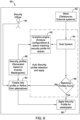
- FIG 6 is a flow diagram showing an illustrative method 80 for self-learning security profiles for the facility based on security system and other available data.
- a library of security profiles which are generated over time based on security system and other available data, is stored at block 88.
- the library of security profiles are made available to an analytics engine 90 (may be a representation of the analytics engine 24 shown in Figure 2 ).
- Information such as schedules and planned events are provided from a block 92 to a host system 94 (may be a representation of the host system 22 shown in Figure 2 ).
- the host system 94 may access the analytics engine 90 and generate a security profile.
- the generated security profile may be provided to block 96.
- Block 96 searches for a matching security profile in the library of security profiles.
- the suggested new security profile is presented to a security operator 84, and if approved by the security operator 84, the suggested new security profile is added to the security profile library at 88.
- Each security profile defines a plurality of predetermined security level configurations for the security system. Over time, the library of security profiles accumulates more and more approved security profiles that can quickly and easily adapt the security system to ever more event variations in the facility.
Landscapes
- Engineering & Computer Science (AREA)
- Computer Security & Cryptography (AREA)
- Computer Networks & Wireless Communication (AREA)
- Signal Processing (AREA)
- Computer Hardware Design (AREA)
- Computing Systems (AREA)
- General Engineering & Computer Science (AREA)
- Physics & Mathematics (AREA)
- General Physics & Mathematics (AREA)
- Alarm Systems (AREA)
- Management, Administration, Business Operations System, And Electronic Commerce (AREA)
Applications Claiming Priority (1)
| Application Number | Priority Date | Filing Date | Title |
|---|---|---|---|
| US18/525,106 US20250182548A1 (en) | 2023-11-30 | 2023-11-30 | Method and system for automatically changing a security level configuration of a security system of a facility based on a received event profile of an event to be held at the facility |
Publications (1)
| Publication Number | Publication Date |
|---|---|
| EP4564743A1 true EP4564743A1 (de) | 2025-06-04 |
Family
ID=93563004
Family Applications (1)
| Application Number | Title | Priority Date | Filing Date |
|---|---|---|---|
| EP24212832.0A Pending EP4564743A1 (de) | 2023-11-30 | 2024-11-13 | Verfahren und system zum automatischen ändern einer sicherheitsebenenkonfiguration eines sicherheitssystems einer anlage auf basis eines empfangenen ereignisprofils eines an der anlage zu haltenden ereignisses |
Country Status (3)
| Country | Link |
|---|---|
| US (1) | US20250182548A1 (de) |
| EP (1) | EP4564743A1 (de) |
| CN (1) | CN120074853A (de) |
Citations (1)
| Publication number | Priority date | Publication date | Assignee | Title |
|---|---|---|---|---|
| US20060080541A1 (en) * | 2004-09-24 | 2006-04-13 | Checkpoint Systems, Inc. | Access and security control system and method |
Family Cites Families (7)
| Publication number | Priority date | Publication date | Assignee | Title |
|---|---|---|---|---|
| KR100664943B1 (ko) * | 2005-08-10 | 2007-01-04 | 삼성전자주식회사 | 모드 기반 접근 제어 방법 및 장치 |
| WO2010106474A1 (en) * | 2009-03-19 | 2010-09-23 | Honeywell International Inc. | Systems and methods for managing access control devices |
| HK1218339A1 (zh) * | 2013-03-15 | 2017-02-10 | Adt美国控股股份有限公司 | 安全系统访问简档 |
| US9536073B2 (en) * | 2014-07-24 | 2017-01-03 | Google Technology Holdings LLC | Device-based application security |
| CN112219385B (zh) * | 2018-04-09 | 2025-02-21 | 霍尼韦尔国际公司 | 用于智能建筑物的便携式用户配置文件 |
| US11663361B2 (en) * | 2020-05-11 | 2023-05-30 | Micron Technology, Inc. | Application-specific security |
| US12142382B2 (en) * | 2021-03-01 | 2024-11-12 | Honeywell International Inc. | Airborne infection early warning system |
-
2023
- 2023-11-30 US US18/525,106 patent/US20250182548A1/en active Pending
-
2024
- 2024-11-13 EP EP24212832.0A patent/EP4564743A1/de active Pending
- 2024-11-26 CN CN202411706358.6A patent/CN120074853A/zh active Pending
Patent Citations (1)
| Publication number | Priority date | Publication date | Assignee | Title |
|---|---|---|---|---|
| US20060080541A1 (en) * | 2004-09-24 | 2006-04-13 | Checkpoint Systems, Inc. | Access and security control system and method |
Also Published As
| Publication number | Publication date |
|---|---|
| US20250182548A1 (en) | 2025-06-05 |
| CN120074853A (zh) | 2025-05-30 |
Similar Documents
| Publication | Publication Date | Title |
|---|---|---|
| US11232666B1 (en) | Verified access to a monitored property | |
| US7280030B1 (en) | System and method for adjusting access control based on homeland security levels | |
| US12506735B2 (en) | Methods and system for employee monitoring and rule and quorum compliance monitoring | |
| US10554758B2 (en) | Web-cloud hosted unified physical security system | |
| US11348396B2 (en) | Access control system using mobile device | |
| EP3920060A1 (de) | Benutzersicherheitsanmeldedaten als ein element der funktionalen sicherheit | |
| US12367726B2 (en) | Building access using a mobile device | |
| EP3777108B1 (de) | Tragbares benutzerprofil für intelligente gebäude | |
| US12400497B2 (en) | Access control system and a method for controlling operation of an access control system | |
| EP3776396B1 (de) | Erkennung eines anormalen verhaltens in intelligenten gebäuden | |
| EP4564743A1 (de) | Verfahren und system zum automatischen ändern einer sicherheitsebenenkonfiguration eines sicherheitssystems einer anlage auf basis eines empfangenen ereignisprofils eines an der anlage zu haltenden ereignisses | |
| JP2007286912A (ja) | 勤怠管理端末および勤怠管理プログラム | |
| US20260120534A1 (en) | Methods and systems for detecting a discrepancy between access rules of access control equipment and an access policy | |
| US20250110460A1 (en) | Building management system with augmented reality command center | |
| US20210173356A1 (en) | Mining and deploying profiles in smart buildings | |
| KR102685961B1 (ko) | 분산된 오피스 출입 관리 시스템 및 방법 | |
| Blaško et al. | Laboratory Access and Evidence System | |
| KR20230163839A (ko) | 맞춤형 관제 서비스를 제공하는 시스템 및 그 처리 방법 | |
| US11614851B2 (en) | Approaches for conducting investigations concerning unauthorized entry | |
| EP4738212A1 (de) | Dynamische zugangskontrolle und eindringungsdetektion für sicherheitssysteme | |
| US20220198861A1 (en) | Access control system screen capture facial detection and recognition | |
| CN121948234A (zh) | 基于访客端管理的梯控运行管理系统和管理方法 | |
| JP2024086237A (ja) | 顔認証システム及び顔認証方法 | |
| JP2024086228A (ja) | 顔認証システム及び顔認証方法 | |
| WO2025260138A1 (en) | Continuous authentication |
Legal Events
| Date | Code | Title | Description |
|---|---|---|---|
| PUAI | Public reference made under article 153(3) epc to a published international application that has entered the european phase |
Free format text: ORIGINAL CODE: 0009012 |
|
| STAA | Information on the status of an ep patent application or granted ep patent |
Free format text: STATUS: REQUEST FOR EXAMINATION WAS MADE |
|
| 17P | Request for examination filed |
Effective date: 20241113 |
|
| AK | Designated contracting states |
Kind code of ref document: A1 Designated state(s): AL AT BE BG CH CY CZ DE DK EE ES FI FR GB GR HR HU IE IS IT LI LT LU LV MC ME MK MT NL NO PL PT RO RS SE SI SK SM TR |
|
| GRAP | Despatch of communication of intention to grant a patent |
Free format text: ORIGINAL CODE: EPIDOSNIGR1 |
|
| STAA | Information on the status of an ep patent application or granted ep patent |
Free format text: STATUS: GRANT OF PATENT IS INTENDED |
|
| RIC1 | Information provided on ipc code assigned before grant |
Ipc: H04L 9/40 20220101AFI20260128BHEP |
|
| INTG | Intention to grant announced |
Effective date: 20260209 |