EP4564939A1 - Procédé et appareil de communication, support d'enregistrement, dispositif de réseau et dispositif terminal - Google Patents
Procédé et appareil de communication, support d'enregistrement, dispositif de réseau et dispositif terminal Download PDFInfo
- Publication number
- EP4564939A1 EP4564939A1 EP23845690.9A EP23845690A EP4564939A1 EP 4564939 A1 EP4564939 A1 EP 4564939A1 EP 23845690 A EP23845690 A EP 23845690A EP 4564939 A1 EP4564939 A1 EP 4564939A1
- Authority
- EP
- European Patent Office
- Prior art keywords
- signals
- signal
- power
- transmit power
- transmit
- Prior art date
- Legal status (The legal status is an assumption and is not a legal conclusion. Google has not performed a legal analysis and makes no representation as to the accuracy of the status listed.)
- Pending
Links
Images



Classifications
-
- H—ELECTRICITY
- H04—ELECTRIC COMMUNICATION TECHNIQUE
- H04W—WIRELESS COMMUNICATION NETWORKS
- H04W52/00—Power management, e.g. Transmission Power Control [TPC] or power classes
- H04W52/04—Transmission power control [TPC]
- H04W52/30—Transmission power control [TPC] using constraints in the total amount of available transmission power
- H04W52/36—Transmission power control [TPC] using constraints in the total amount of available transmission power with a discrete range or set of values, e.g. step size, ramping or offsets
- H04W52/367—Power values between minimum and maximum limits, e.g. dynamic range
-
- H—ELECTRICITY
- H04—ELECTRIC COMMUNICATION TECHNIQUE
- H04W—WIRELESS COMMUNICATION NETWORKS
- H04W52/00—Power management, e.g. Transmission Power Control [TPC] or power classes
- H04W52/04—Transmission power control [TPC]
- H04W52/06—TPC algorithms
- H04W52/14—Separate analysis of uplink or downlink
- H04W52/146—Uplink power control
-
- H—ELECTRICITY
- H04—ELECTRIC COMMUNICATION TECHNIQUE
- H04W—WIRELESS COMMUNICATION NETWORKS
- H04W52/00—Power management, e.g. Transmission Power Control [TPC] or power classes
- H04W52/04—Transmission power control [TPC]
- H04W52/18—TPC being performed according to specific parameters
- H04W52/28—TPC being performed according to specific parameters using user profile, e.g. mobile speed, priority or network state, e.g. standby, idle or non-transmission
- H04W52/281—TPC being performed according to specific parameters using user profile, e.g. mobile speed, priority or network state, e.g. standby, idle or non-transmission taking into account user or data type priority
-
- H—ELECTRICITY
- H04—ELECTRIC COMMUNICATION TECHNIQUE
- H04W—WIRELESS COMMUNICATION NETWORKS
- H04W52/00—Power management, e.g. Transmission Power Control [TPC] or power classes
- H04W52/04—Transmission power control [TPC]
- H04W52/30—Transmission power control [TPC] using constraints in the total amount of available transmission power
- H04W52/34—TPC management, i.e. sharing limited amount of power among users or channels or data types, e.g. cell loading
-
- H—ELECTRICITY
- H04—ELECTRIC COMMUNICATION TECHNIQUE
- H04W—WIRELESS COMMUNICATION NETWORKS
- H04W52/00—Power management, e.g. Transmission Power Control [TPC] or power classes
- H04W52/04—Transmission power control [TPC]
- H04W52/30—Transmission power control [TPC] using constraints in the total amount of available transmission power
- H04W52/34—TPC management, i.e. sharing limited amount of power among users or channels or data types, e.g. cell loading
- H04W52/346—TPC management, i.e. sharing limited amount of power among users or channels or data types, e.g. cell loading distributing total power among users or channels
-
- H—ELECTRICITY
- H04—ELECTRIC COMMUNICATION TECHNIQUE
- H04W—WIRELESS COMMUNICATION NETWORKS
- H04W72/00—Local resource management
- H04W72/04—Wireless resource allocation
- H04W72/044—Wireless resource allocation based on the type of the allocated resource
- H04W72/0473—Wireless resource allocation based on the type of the allocated resource the resource being transmission power
Definitions
- the present application relates to the field of communication technology and, in particular, to a communication method and apparatus, a storage medium, a network device, and a terminal device.
- a fusion system that supports both communication and sensing functions within a single frequency band is a future trend.
- a sensing signal and a communication signal need to be transmitted simultaneously in a frequency division multiplexing (Frequency Division Multiplexing, FDM) manner on the same carrier or different carriers within a specific frequency band.
- FDM Frequency Division Multiplexing
- the present application provides a communication method and apparatus, a storage medium, a network device, and a terminal device, and provides a scheme of how to realize power control when multiple signals need to be sent simultaneously.
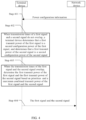
- a communication method including: receiving power configuration information; determining a first transmit power of each signal of N signals based on the power configuration information, where the first transmit power of the signal of the N signals is a maximum transmit power of the signal when the N signals are transmitted simultaneously, and N is an integer greater than 1; and transmitting the N signals simultaneously based on the first transmit powers of the N signals, where a transmit power of each signal is not greater than the first transmit power of the signal when the N signals are transmitted.
- the power configuration information includes a first configuration power of at least one signal of the N signals, and the first configuration power of the signal of the N signals is a configured maximum transmit power of the signal in a case that the N signals are transmitted simultaneously.
- the first transmit power of the signal of the N signals is the first configuration power of the signal.
- the power configuration information includes a maximum combined transmit power of the N signals.
- the maximum combined transmit power is a sum of transmit powers of the N signals on one or more carriers.
- the power configuration information further includes a second configuration power of at least one signal of the N signals, and the second configuration power of the signal of the N signals is a configured maximum transmit power of the signal in a case that the N signals are not transmitted simultaneously.
- each signal of the N signals has a priority
- the determining the first transmit power of each signal of the N signals based on the power configuration information includes: allocating the first transmit power to each signal in a descending order of the priorities of the N signals until an allocation of the maximum combined transmit power is completed, where for K signals with allocated first transmit powers, the first transmit power of each signal of the K signals is the second configuration power of the signal, or the first transmit powers of K-1 signals with highest priorities of the K signals are the second configuration powers of the signals, and the first transmit power of the K th signal is a power difference between the maximum combined transmit power and a sum of the first transmit powers of the K-1 signals, and K is less than or equal to N.
- the power configuration information further includes a bandwidth of each signal of the N signals.
- the first transmit power of each signal of the N signals is obtained by allocating the maximum combined transmit power based on a ratio of the bandwidth of the signal to a sum of the bandwidths of all the signals.
- the power configuration information further includes a second configuration power of at least one signal of the N signals.
- the communication method further including: determining a second transmit power of each signal of the N signals based on the power configuration information, where the second transmit power of the signal of the N signals is a maximum transmit power of the signal when the N signals are not transmitted simultaneously; and transmitting the N signals time-shared based on the second transmit powers of the N signals, where a transmit power of each signal is not greater than the second transmit power of the signal when the N signals are transmitted.
- the second transmit power of the signal of the N signals is the second configuration power of the signal.
- the N signals are selected from communication signals and sensing signals.
- the present application further discloses a communication method, including: transmitting power configuration information, where the power configuration information is used to determine a first transmit power of each signal of N signals, the first transmit power of the signal of the N signals is a maximum transmit power of the signal when the N signals are transmitted simultaneously, and N is an integer greater than 1; and transmitting the N signals simultaneously based on the first transmit powers of the N signals, where a transmit power of each signal is not greater than the first transmit power of the signal when the N signals are transmitted.
- the power configuration information includes a first configuration power of at least one signal of the N signals, and the first configuration power of the signal of the N signals is a configured maximum transmit power of the signal in a case that the N signals are transmitted simultaneously.
- the power configuration information includes a maximum combined transmit power of the N signals.
- the maximum combined transmit power is a sum of transmit powers of the N signals on one or more carriers.
- the power configuration information further includes a second configuration power of at least one signal of the N signals, and the second configuration power of the signal of the N signals is a configured maximum transmit power of the signal in a case that the N signals are not transmitted simultaneously.
- the N signals are selected from communication signals and sensing signals.
- the present application further discloses a communication apparatus, including: a communication module, configured to receive power configuration information; and a processing module, configured to determine a first transmit power of each signal of N signals based on the power configuration information, where the first transmit power of the signal of the N signals is a maximum transmit power of the signal when the N signals are transmitted simultaneously, and N is an integer greater than 1; where the communication module is further configured to transmit the N signals simultaneously based on the first transmit powers of the N signals, where a transmit power of each signal is not greater than the first transmit power corresponding to the signal when the N signals are transmitted.
- the present application further discloses a communication apparatus, including: a communication module, configured to transmit power configuration information, where the power configuration information is used to determine a first transmit power of each signal of N signals, the first transmit power of the signal of the N signals is a maximum transmit power of the signal when the N signals are transmitted simultaneously, and N is an integer greater than 1; where the communication module is further configured to transmit the N signals simultaneously based on the first transmit powers of the N signals, where a transmit power of each signal is not greater than the first transmit power of the signal when the N signals are transmitted.
- the power configuration information includes a first configuration power of at least one signal of the N signals, and the first configuration power of the signal of the N signals is a configured maximum transmit power of the signal in a case that the N signals are transmitted simultaneously.
- the first transmit power of the signal of the N signals is the first configuration power of the signal.
- the power configuration information includes a maximum combined transmit power of the N signals.
- the maximum combined transmit power is a sum of transmit powers of the N signals on one or more carriers.
- the power configuration information further includes a second configuration power of at least one signal of the N signals, and the second configuration power of the signal of the N signals is a configured maximum transmit power of the signal in a case that the N signals are not transmitted simultaneously.
- the power configuration information further includes a bandwidth of each signal of the N signals.
- the first transmit power of each signal of the N signals is obtained by allocating the maximum combined transmit power based on a ratio of the bandwidth of the signal to a sum of the bandwidths of all the signals.
- the power configuration information further includes a second configuration power of at least one signal of the N signals.
- the present application further discloses a communication apparatus, including: a communication module, configured to transmit power configuration information, where the power configuration information is used to determine a first transmit power of each signal of N signals when transmission times overlap; where the communication module is further configured to receive the N signals using a transmit power that does not exceed the first transmit power of each signal when the transmission times overlap.
- the power configuration information includes a first configuration power of at least one signal of the N signals, and the first configuration power of the signal of the N signals is a configured maximum transmit power of the signal in a case that the N signals are transmitted simultaneously.
- the power configuration information includes a maximum combined transmit power of the N signals.
- the maximum combined transmit power is a sum of transmit powers of the N signals on one or more carriers.
- the power configuration information includes a second configuration power of at least one signal of the N signals, and the second configuration power of the signal of the N signals is a configured maximum transmit power of the signal in a case that the N signals are not transmitted simultaneously.
- a computer-readable storage medium stores a computer program therein, and the computer program is executed by a computer to implement any one of the methods provided in the first aspect or the second aspect.
- a communication apparatus including: a memory and a processor; where the memory stores therein a computer program executable on the processor; and the processor executes the computer program to implement any one of the methods provided in the first aspect.
- a communication apparatus including: a memory and a processor; where the memory stores therein a computer program executable on the processor; and the processor executes the computer program to implement any one of the methods provided in the second aspect.
- a computer program product stores a computer program therein, and the computer program is executed by a computer to implement any one of the methods provided in the first aspect or the second aspect.
- a communication system including the terminal device and the network device described above.
- the present application further provides a chip (or a data transmission apparatus), where the chip stores a computer program therein, and when the computer program is executed by the chip, steps of the methods described above are implemented.
- a network device can configure power configuration information for a terminal device, and the power configuration information can indicate a constrained power of N signals when transmission times overlap, then the terminal device can determine a first transmit power of each signal of the N signals when the transmission times overlap under constraint of a power indicated by the power configuration information, and the terminal device can transmit each signal with a transmit power that does not exceed the first transmit power of each signal.
- the technical solution of the present application utilizes the power configuration information to determine the transmit power of each signal, which ensures the rationality of a transmit power configuration of each signal and realizes power control and power sharing when multiple signals are transmitted simultaneously in a case where a total transmit power of the terminal device is constrained.
- the power configuration information includes a first configuration power of each signal of the N signals, or the power configuration information includes a maximum combined transmit power of all the signals of the N signals.
- the technical solution of the present application directly indicates the first configuration power through the power configuration information, which enables the terminal device to determine the first transmit power based on the first configuration power; or indicates the maximum combined transmit power through the power configuration information, which enables the terminal device to calculate the first transmit power under constraint of the maximum combined power, achieving flexibility in power configuration.
- a communication system to which the embodiments of the present application are applicable includes, but is not limited to, a long term evolution (Long Term Evolution, LTE) system, a 5th-generation (5th-generation, 5G) system, a NR system, and a future evolution system or a multiple communication fusion system.
- LTE Long Term Evolution
- 5th-generation 5th-generation
- 5G 5th-generation
- NR NR
- future evolution or a multiple communication fusion system.
- the 5G system can be a non-standalone (Non-StandAlone, NSA) 5G system or a standalone (StandAlone, SA) 5G system.
- the technical solutions of the present application are also applicable to different network architectures, including but not limited to a relay network architecture, a dual-link architecture, a vehicle-to-everything (Vehicle-to-Everything) architecture, and other architectures.
- the present application mainly relates to communication between a terminal device and a network device. Where.
- the network device in the embodiments of the present application may also be referred to as an access network device, for example, it may be a base station (Base Station, BS) (also referred to as a base station device), the network device is an apparatus deployed in a radio access network (Radio Access Network, RAN) to provide a wireless communication function.
- BS Base Station
- RAN Radio Access Network
- a device that provides a base station function includes a base transceiver station (Base Transceiver Station, BTS), in a 3rd-generation (3rd-Generation, 3G) network, a device that provides a base station function includes a node B (NodeB), in a 4th-generation (4th-Generation, 4G) network, a device that provides a base station function includes an evolved node B (evolved NodeB, eNB), in a wireless local area network (Wireless Local Area Networks, WLAN), a device that provides a base station function is an access point (Access Point, AP), and a device that a provide base station function in NR includes a next generation Node Base station (next generation Node Base station, gNB) and an evolved node B (ng-eNB), where the gNB and the terminal device communicate using a NR technology, and the ng-eNB and
- BTS Base Transceiver Station
- the terminal device in the embodiments of the present application may refer to various forms of access terminals, user units, user stations, mobile stations, mobile stations (Mobile Stations, MSs), remote stations, remote terminals, mobile devices, user terminals, wireless communication devices, user agents or user devices.
- access terminals user units, user stations, mobile stations, mobile stations (Mobile Stations, MSs), remote stations, remote terminals, mobile devices, user terminals, wireless communication devices, user agents or user devices.
- the terminal device may also be a cellular phone, a cordless phone, a session initiation protocol (Session Initiation Protocol, SIP) phone, a wireless local loop (Wireless Local Loop, WLL) station, a personal digital assistant (Personal Digital Assistant, PDA), a handheld device with a wireless communication function, a computing device or other processing devices, vehicle-mounted devices, wearable devices connected to a wireless modem, a terminal device in a future 5G network or a terminal device in a future evolved public land mobile network (Public Land Mobile Network, PLMN), etc., to which the embodiments of the present application are not limited.
- the terminal device may also be referred to as a user equipment (User Equipment, UE), a terminal, etc.
- a terminal device 101 transmits a sensing signal to a sensing target 103
- a propagation path of the sensing signal is from the terminal device 101 to the sensing target 103
- the sensing target 103 reflects the sensing signal to the terminal device 101
- the terminal device 101 receives the sensing signal.
- the sensing signal is bidirectional propagated, and the terminal device 101 is both a transmitter and a receiver of the sensing signal.
- the terminal device 101 controls a transmit power of the sensing signal, it is necessary to calculate a path loss of the bidirectional propagation between the terminal device 101 and the sensing target 103, and a reflection loss of the sensing target 103.
- the terminal device 101 can also transmit a communication signal to other devices 102 or to a network device for communication.
- the communication signal may specifically be data or a signaling, etc.
- the present application provides a method, where a network device can transmit power configuration information to a terminal device, and the power configuration information can be used to determine a constrained power of N signals when transmission times overlap, then the terminal device can determine a first transmit power of each signal of the N signals when the transmission times overlap under constraint of a power indicated by a power configuration indication information, and the terminal device can transmit each signal with a transmit power that does not exceed the first transmit power of each signal.
- the technical solution of the present application utilizes the power configuration information to determine the transmit power of each signal, which ensures the rationality of a transmit power configuration of each signal and realizes power sharing when multiple signals are transmitted simultaneously in a case where a total transmit power of the terminal device is constrained.
- a communication method provided by the present application includes the following steps:
- the communication method can be implemented in a form of a software program, and the software program runs in a processor integrated inside a chip or a chip module.
- the method can also be implemented by combining software with hardware, which is not limited in the present application.
- the N signals may be selected from communication signals and sensing signals. That is to say, the N signals may be N communication signals, or N sensing signals, or a portion of the N signals may be communication signals and a remaining portion of the N signals may be sensing signals.
- the number of the N signals may be two, where one signal is a sensing signal and the other signal is a communication signal.
- the sensing signal and the communication signal can be transmitted simultaneously in a frequency division multiplexing manner on the same carrier or different carriers within a specific frequency band.
- N signals can be configured based on an actual application requirement, which is not limited in the present application.
- the network device can configure the power configuration information for the terminal device, and the power configuration information can indicate a constrained power of the N signals when transmission times overlap, which, for example, may be a constrained power of each signal or a total constrained power.
- a constrained power of the terminal device is constrained, when there are multiple signals need to be transmitted, a transmit power of each signal needs to be subject to a certain constraint.
- different signals since different signals have different priorities, it is necessary to reasonably allocate a transmit power to each signal to ensure a normal transmission of each signal.
- the power configuration information configured by the network device can indicate a respective constrained power of each signal of the N signals when the transmission times overlap. Accordingly, the terminal device determines the first transmit power of each signal based on the respective constrained power of each signal.
- the power configuration information can also indicate a total constrained power of the N signals when the transmission times overlap. Accordingly, the terminal device determines the first transmit power of each signal based on the total constrained power.
- the first transmit power of the signal represents a maximum transmit power of the signal when the N signals are transmitted simultaneously.
- the N signals include a first signal and a second signal
- the power configuration information includes different contents as examples to illustrate individually and in detail in the following.
- the first configuration power of a signal in this embodiment is a maximum transmit power of the signal configured by the network device in a case where N signals are transmitted simultaneously.
- step 302 when transmission times of the first signal and the second signal overlap, the terminal device determines that a first transmit power P 1 of the first signal is the first configuration power P ' max1 of the first signal, and determines that a first transmit power P 2 of the second signal is the first configuration power P ' max2 of the second signal.
- the terminal device transmits the first signal with a transmit power that does not exceed the first transmit power P 1 of the first signal, and transmits the second signal with a transmit power that does not exceed the first transmit power P 2 of the second signal.
- an actual transmit power of the first signal transmitted by the terminal device is less than or equal to the first transmit power P 1 of the first signal
- an actual transmit power of the second signal transmitted by the terminal device is less than or equal to the first transmit power P 2 of the second signal.
- the power configuration information includes a second configuration power P max1 of the first signal and a second configuration power P max2 of the second signal when the transmission times do not overlap, and a maximum combined transmit power P max, all of all the signals in the first signal and the second signal.
- the maximum combined transmit power is a sum of transmit powers of the first signal and the second signal on one carrier, or the maximum combined transmit power is a sum of transmit powers of the first signal and the second signal on multiple carriers.
- the terminal device determines that the first transmit power P 1 of the first signal is the second configuration power P max1 of the first signal, and determines that the first transmit power P 2 of the second signal is the second configuration power P max2 of the second signal.
- the first transmit power P 2 of the second signal is determined to be the second configuration power P max2 of the second signal
- the terminal device selectively performs one or both of step 402 and step 403.
- the terminal device transmits the first signal with a transmit power that does not exceed the first transmit power P 1 of the first signal, and transmits the second signal with a transmit power that does not exceed the first transmit power P 2 of the second signal.
- the terminal device transmits the first signal and the second signal simultaneously.
- the terminal device may need to transmit more signals simultaneously.
- the terminal device can allocate the maximum combined transmit power in the following manner.
- the terminal device allocates the first transmit power to each signal in a descending order of the priorities of the N signals until an allocation of the maximum combined transmit power P max, all is completed, where for K signals with allocated first transmit powers, the first transmit power of each signal of the K signals is the second configuration power of the signal, or the first transmit powers of K-1 signals with highest priorities of the K signals are the second configuration powers of the signals, and the first transmit power of the K th signal is a power difference between the maximum combined transmit power P max, all and a sum of the first transmit powers of the K-1 signals, and K is less than or equal to N.
- the power configuration information includes the maximum combined transmit power P max, all of all the signals in the first signal and the second signal, a bandwidth B 1 of the first signal and a bandwidth B 2 of the second signal.
- the terminal device transmits the first signal with a transmit power that does not exceed the first transmit power P 1 of the first signal, and transmits the second signal with a transmit power that does not exceed the first transmit power P 2 of the second signal.
- the terminal device transmits the first signal and the second signal simultaneously.
- the terminal device may need to transmit more signals simultaneously.
- the terminal device can allocate the maximum combined transmit power in the following manner.
- a ratio of a bandwidth of the signal to a sum of bandwidths of all signals is calculated; the maximum combined transmit power is proportionally allocated based on the ratio corresponding to each signal to obtain the first transmit power of each signal.
- the terminal device when the terminal device simultaneously transmits the first signal and the second signal, the terminal device can also allocate the maximum combined transmit power P max, all based on a bandwidth ratio of the bandwidth B 1 of the first signal to the bandwidth B 2 of the second signal and a preset adjustment coefficient.
- the preset adjustment coefficient ⁇ may be a value specified by a communication standard protocol, or it may be pre-configured by a base station, which is not limited in the present application.
- the power configuration information includes the first configuration power P ' max1 of the first signal and the first configuration power P ' max2 of the second signal when the transmission times overlap, and the second configuration power P max1 of the first signal and the second configuration power P max2 of the second signal when the transmission times do not overlap.
- the terminal device determines that the first transmit power P 1 of the first signal is the first configuration power P ' max1 of the first signal, and determines that the first transmit power P 2 of the second signal is the first configuration power P ' max2 of the second signal.
- the terminal device determines that the first transmit power P 1 of the first signal is the second configuration power P max1 of the first signal, and determines that the first transmit power P 2 of the second signal is the second configuration power P max2 of the second signal.
- the N signals may be periodic signals, and each signal of the N signals has a transmission period, then it may happen that the transmission times of the N signals do not overlap at a certain moment, and the transmission times of the N signals overlap at a next moment.
- a transmission period of the first signal is 4 milliseconds (ms)
- a transmission period of the second signal is 8ms, then at the 4 th ms, the transmission times of the first signal and the second signal do not overlap, and at the 8 th ms, the transmission times of the first signal and the second signal overlap.
- the terminal device needs to calculate the first transmit powers of the N signals when the transmission times overlap, and the first transmit powers of the N signals when the transmission times do not overlap, respectively. This requires that the power configuration information can indicate constrained powers of the N signals when the transmission times overlap and when the transmission times do not overlap.
- the power configuration information includes the second configuration power P max1 of the first signal and the second configuration power P max2 of the second signal when the transmission times do not overlap, and the maximum combined transmit power P max, all of all the signals in the first signal and the second signal. Please refer to the description of manner 2 for details.
- the power configuration information includes the second configuration power P max1 of the first signal and the second configuration power P max2 of the second signal when the transmission times do not overlap, the maximum combined transmit power P max, all of all the signals in the first signal and the second signal, the bandwidth B 1 of the first signal and the bandwidth B 2 of the second signal.
- the power configuration information includes the second configuration power P max1 of the first signal and the second configuration power P max2 of the second signal when the transmission times do not overlap, and the first configuration power P ' max1 of the first signal and the first configuration power P ' max2 of the second signal when the transmission times overlap.
- the terminal device Before the terminal device determines the first transmit power of each signal, in step 501, the terminal device can also receive scheduling information of each signal, where the scheduling information of each signal is used to indicate a transmission resource of each signal. Accordingly, the network device configures and transmits the scheduling information of each signal.
- the terminal device determines the transmission resource of each signal based on the scheduling information of each signal, and transmits each signal on the transmission resource of each signal with a transmit power that does not exceed the first transmit power of each signal.
- FIG. 6 shows a communication apparatus 60.
- the communication device 60 can include:
- the above communication apparatus 60 may correspond to a chip with a communication function in a terminal device, such as a system-on-a-chip (System-On-a-Chip, SOC), a baseband chip, etc., or correspond to a chip module with a communication function in a terminal device, or correspond to a chip module with a data processing function chip, or correspond to a terminal device.
- a terminal device such as a system-on-a-chip (System-On-a-Chip, SOC), a baseband chip, etc.
- the communication apparatus 60 may include: a communication module 601, configured to transmit power configuration information, where the power configuration information is used to determine a first transmit power of each signal of N signals when transmission times overlap; the communication module 601 is further configured to receive the N signals using a transmit power that does not exceed the first transmit power of each signal when the transmission times overlap.
- the above communication apparatus 60 may correspond to a chip with a communication function in a network device, such as a SOC, a baseband chip, etc., or correspond to a chip module with a communication function in a network device, or correspond to a chip module with a data processing function chip, or correspond to a network device.
- a network device such as a SOC, a baseband chip, etc.
- a chip module with a communication function in a network device or correspond to a chip module with a data processing function chip, or correspond to a network device.
- Each module/unit included in each apparatus and product described in the above embodiments may be a software module/unit or a hardware module/unit, or may be partially the software module/unit and partially the hardware module/unit.
- each module/unit included therein may be implemented in a form of hardware such as a circuit, or at least part of the modules/units may be implemented in a form of a software program, the software program run on a processor integrated inside a chip, and remaining (if any) modules/units may be implemented in the form of hardware such as a circuit;
- each module/unit included therein may be implemented in the form of hardware such as a circuit, and different modules/units may be located in the same component (such as a chip, a circuit module, etc.) or different components of the chip module, or, at least part of the modules/units may be implemented in the form of a software program, the software program run on a processor integrated inside the
- An embodiment of the present application further discloses a storage medium, the storage medium is a computer-readable storage medium on which a computer program is stored, when the computer program is run, steps of the method shown in FIG. 1 to FIG. 3 can be executed.
- the storage medium may include a read-only memory (Read-Only Memory, ROM), a random access memory (Random Access Memory, RAM), a magnetic disk or an optical disk, etc.
- the storage medium may also include a non-volatile (non-volatile) memory or a non-transitory (non-transitory) memory, etc.
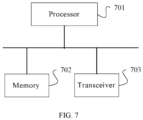
- an embodiment of the present application further provides a schematic diagram of a hardware structure of a communication apparatus.
- the apparatus includes a processor 701, a memory 702, and a transceiver 703.
- the processor 701 may be a general-purpose central processing unit (central processing unit, CPU), a microprocessor, an application-specific integrated circuit (application-specific integrated circuit, ASIC), or one or more integrated circuits for controlling an execution of a program of the present application.
- the processor 701 may also include multiple CPUs, and the processor 701 may be a single-core (single-CPU) processor or a multi-core (multi-CPU) processor.
- a processor herein may refer to one or more devices, circuits, or processing cores for processing data (e.g., computer program instructions).
- the memory 702 may be a ROM or other type of static storage device that can store static information and instructions, a RAM or other type of dynamic storage device that can store information and instructions, or an electrically erasable programmable read-only memory (electrically erasable programmable read-only memory, EEPROM), a compact disc read-only memory (compactdisc read-only memory, CD-ROM) or other optical disc storage, an optical disc storage (including a compressed optical disc, a laser disc, an optical disc, a digital versatile disc, a Blu-ray disc, etc.), a magnetic disk storage medium or other magnetic storage device, or any other medium that can be used to carry or store desired program codes in a form of an instruction or a data structure and can be accessed by a computer, and the embodiments of the present application do not impose any limitation thereon.
- the memory 702 may exist independently (in this case, the memory 702 may be located outside the apparatus or inside the apparatus), or may be integrated with the processor 701.
- the memory 702 may include computer program codes.
- the processor 701 is configured to execute the computer program codes stored in the memory 702, so as to implement the method provided in the embodiments of the present application.
- the processor 701, the memory 702 and the transceiver 703 are connected via a bus.
- the transceiver 703 is configured to communicate with other devices or communication networks.
- the transceiver 703 may include a transmitter and a receiver.
- a device in the transceiver 703 for implementing a receiving function can be regarded as a receiver, and the receiver is configured to perform the receiving steps in the embodiments of the present application.
- a device transmitter for implementing a transmitting function can be regarded as a transmitter, and the transmitter is configured to perform the transmitting steps in the embodiment of the present application.
- the processor 701 is configured to control and manage actions of the terminal device.
- the processor 701 is configured to support the terminal device to execute step 201-, step 202 and step 203 in FIG. 2 , or step 301, step 302 and step 303 in FIG. 3 , or step 401, step 402, step 403 and step 404 in FIG. 4 , or step 501 in FIG. 5 , and/or actions performed by the terminal device in other processes described in the embodiments of the present application.
- the processor 701 may communicate with other network entities, for example, the above network device, through the transceiver 703.
- the memory 702 is configured to store program codes and data of the terminal device.
- the processor 701 is configured to control and manage actions of the network device.
- the processor 701 is configured to support the network device to execute step 201 and step 203 in FIG. 2 , or step 301 and step 303 in FIG. 3 , or step 401 and step 404 in FIG. 4 , or step 201, step 501 and step 203 in FIG. 5 , and/or actions performed by the network device in other processes described in the embodiments of the present application.
- the processor 701 may communicate with other network entities, for example, the above terminal device, through the transceiver 703.
- the memory 702 is configured to store program codes and data of the network device.
- the embodiments of the present application define a unidirectional communication link from an access network to a terminal device as a downlink, data transmitted on the downlink is downlink data, and a transmission direction of the downlink data is called a downlink direction; and a unidirectional communication link from a terminal device to an access network is an uplink, data transmitted on the uplink is uplink data, and a transmission direction of the uplink data is called a uplink direction.
- the “multiple” appearing in the embodiments of the present application means two or more.
- connection appearing in the embodiments of the present application refers to various connection methods such as a direct connection or an indirect connection to achieve communication between devices, and the embodiments of the present application do not impose any limitations thereon.
- the above embodiments may be implemented in whole or in part through software, hardware, firmware or any other combination.
- the above embodiments may be implemented in whole or in part in a form of a computer program product.
- the computer program product includes one or more computer instructions or computer programs. When the computer instructions or computer programs are loaded or executed on a computer, the processes or functions described in the embodiments of the present application are generated in whole or in part.
- the computer may be a general-purpose computer, a special purpose computer, a computer network, or other programmable devices.
- the computer instructions may be stored in a computer-readable storage medium, or transmitted from one computer-readable storage medium to another computer-readable storage medium. For example, the computer instructions may be transmitted from one website, computer, server, or data center to another website, computer, server, or data center via a wired or a wireless manner.
- a size of a serial number of each of the above processes does not imply an order of an execution, and an order of the execution of each process shall be determined by a function and an inherent logic thereof, and shall not constitute any limitation on the implementation process of the embodiments of the present application.
- a unit described as a separate component may or may not be physically separated, and a component shown as a unit may or may not be a physical unit, that is, it may be located in one place or distributed over multiple network units. Some or all of the units may be selected based on an actual requirement to achieve a purpose of a solution of the present embodiment.
- each functional unit in each embodiment of the present application may be integrated into one processing unit, or each unit may be physically included separately, or two or more units may be integrated into one unit.
- the above integrated unit can be implemented in a form of hardware or in a form of hardware plus software functional units.
- the above integrated unit implemented in a form of a software functional unit can be stored in a computer-readable storage medium.
- the above software functional unit is stored in a storage medium, including a number of instructions for enabling a computer device (which may be a personal computer, a server, or a network device, etc.) to execute some steps of the method described in each embodiment of the present application.
Landscapes
- Engineering & Computer Science (AREA)
- Computer Networks & Wireless Communication (AREA)
- Signal Processing (AREA)
- Mobile Radio Communication Systems (AREA)
Applications Claiming Priority (2)
| Application Number | Priority Date | Filing Date | Title |
|---|---|---|---|
| CN202210907673.XA CN117528749B (zh) | 2022-07-29 | 2022-07-29 | 通信方法及装置、存储介质、网络设备、终端设备 |
| PCT/CN2023/109832 WO2024022486A1 (fr) | 2022-07-29 | 2023-07-28 | Procédé et appareil de communication, support d'enregistrement, dispositif de réseau et dispositif terminal |
Publications (2)
| Publication Number | Publication Date |
|---|---|
| EP4564939A1 true EP4564939A1 (fr) | 2025-06-04 |
| EP4564939A4 EP4564939A4 (fr) | 2025-11-05 |
Family
ID=89705452
Family Applications (1)
| Application Number | Title | Priority Date | Filing Date |
|---|---|---|---|
| EP23845690.9A Pending EP4564939A4 (fr) | 2022-07-29 | 2023-07-28 | Procédé et appareil de communication, support d'enregistrement, dispositif de réseau et dispositif terminal |
Country Status (3)
| Country | Link |
|---|---|
| EP (1) | EP4564939A4 (fr) |
| CN (1) | CN117528749B (fr) |
| WO (1) | WO2024022486A1 (fr) |
Families Citing this family (3)
| Publication number | Priority date | Publication date | Assignee | Title |
|---|---|---|---|---|
| CN121264130A (zh) * | 2024-02-02 | 2026-01-02 | 北京小米移动软件有限公司 | 功率确定方法及装置、通信设备、通信系统、存储介质 |
| WO2025199971A1 (fr) * | 2024-03-29 | 2025-10-02 | Nec Corporation | Dispositifs et procédés d'attribution de puissance pour détection |
| WO2026024073A1 (fr) * | 2024-07-24 | 2026-01-29 | 엘지전자 주식회사 | Procédé et appareil d'émission et de réception de signal de détection sur la base d'un chevauchement |
Family Cites Families (6)
| Publication number | Priority date | Publication date | Assignee | Title |
|---|---|---|---|---|
| US9516608B2 (en) * | 2013-07-10 | 2016-12-06 | Lg Electronics Inc. | Power control method for device-to-device (D2D) communication in wireless communication system and apparatus therefor |
| BR112016021392B8 (pt) * | 2014-03-19 | 2024-01-23 | Ericsson Telefon Ab L M | Métodos de operar um dispositivo sem fio, dispositivos sem fio, meio de armazenamento não transitório e portadora |
| CN110858998A (zh) * | 2018-08-23 | 2020-03-03 | 维沃移动通信有限公司 | 上行信号传输处理方法和终端设备 |
| CN110381576A (zh) * | 2019-06-10 | 2019-10-25 | 华为技术有限公司 | 功率配置方法及装置 |
| CN112399545B (zh) * | 2019-08-16 | 2024-04-12 | 华为技术有限公司 | 一种信号发送方法及装置 |
| US12078709B2 (en) * | 2020-06-11 | 2024-09-03 | Qualcomm Incorporated | Power control scheme for radio frequency object detection |
-
2022
- 2022-07-29 CN CN202210907673.XA patent/CN117528749B/zh active Active
-
2023
- 2023-07-28 WO PCT/CN2023/109832 patent/WO2024022486A1/fr not_active Ceased
- 2023-07-28 EP EP23845690.9A patent/EP4564939A4/fr active Pending
Also Published As
| Publication number | Publication date |
|---|---|
| CN117528749A (zh) | 2024-02-06 |
| EP4564939A4 (fr) | 2025-11-05 |
| CN117528749B (zh) | 2026-03-24 |
| WO2024022486A1 (fr) | 2024-02-01 |
Similar Documents
| Publication | Publication Date | Title |
|---|---|---|
| EP3187016B1 (fr) | Système et procédé de communication d'une attribution de ressource pour la d2d | |
| US11564181B2 (en) | Method and apparatus for reporting power headroom report, and method and apparatus for obtaining power headroom report | |
| EP4564939A1 (fr) | Procédé et appareil de communication, support d'enregistrement, dispositif de réseau et dispositif terminal | |
| US12082185B2 (en) | Pending SR cancellation method and apparatus | |
| WO2019062461A1 (fr) | Procédé et appareil de communication sans fil | |
| EP4240077B1 (fr) | Procédé de gestion de porteuse de liaison latérale, appareil et système | |
| RU2763775C1 (ru) | Способ и устройство беспроводной связи | |
| JP7189207B2 (ja) | 信号送信方法、関連する装置及びシステム | |
| US20220167380A1 (en) | Communication Method And Apparatus | |
| US20260067887A1 (en) | Transmission information determining method, configuration information sending method, terminal, and device | |
| WO2023202530A1 (fr) | Procédé et appareil de détermination de puissance, puce et dispositif de module | |
| EP3836647A1 (fr) | Procédé et dispositif détermination de puissance | |
| EP3700283A1 (fr) | Dispositif émetteur-récepteur et dispositif de programmation | |
| WO2022237629A1 (fr) | Appareil et procédé de transmission d'informations | |
| CN108574559B (zh) | 一种传输方法和装置 | |
| CN111436106B (zh) | 信号发送方法、装置及系统 | |
| US12342373B2 (en) | Wireless communication methods, user equipment and network device | |
| WO2024120463A1 (fr) | Procédé et appareil de rapport de cli apériodique, et support d'enregistrement lisible par ordinateur | |
| WO2022253150A1 (fr) | Procédé et appareil de transmission de données | |
| WO2024032293A1 (fr) | Procédé de communication sans fil, équipement utilisateur, et station de base | |
| CN111436134A (zh) | 通信方法和通信装置 | |
| WO2019227361A1 (fr) | Procédé et dispositif de transmission de bloc d'informations de système (sib) | |
| CN118283832A (zh) | 数据传输的方法和装置 | |
| WO2025148807A1 (fr) | Procédé de communication et appareil de communication | |
| CN120239068A (zh) | 通信方法及装置、计算机可读存储介质 |
Legal Events
| Date | Code | Title | Description |
|---|---|---|---|
| STAA | Information on the status of an ep patent application or granted ep patent |
Free format text: STATUS: THE INTERNATIONAL PUBLICATION HAS BEEN MADE |
|
| PUAI | Public reference made under article 153(3) epc to a published international application that has entered the european phase |
Free format text: ORIGINAL CODE: 0009012 |
|
| STAA | Information on the status of an ep patent application or granted ep patent |
Free format text: STATUS: REQUEST FOR EXAMINATION WAS MADE |
|
| 17P | Request for examination filed |
Effective date: 20250121 |
|
| AK | Designated contracting states |
Kind code of ref document: A1 Designated state(s): AL AT BE BG CH CY CZ DE DK EE ES FI FR GB GR HR HU IE IS IT LI LT LU LV MC ME MK MT NL NO PL PT RO RS SE SI SK SM TR |
|
| A4 | Supplementary search report drawn up and despatched |
Effective date: 20251007 |
|
| DAV | Request for validation of the european patent (deleted) | ||
| DAX | Request for extension of the european patent (deleted) | ||
| RIC1 | Information provided on ipc code assigned before grant |
Ipc: H04W 52/34 20090101AFI20250930BHEP Ipc: H04W 52/04 20090101ALI20250930BHEP |